

IEC 60633:2019
(Main)High-voltage direct current (HVDC) transmission - Vocabulary
General Information
- Abstract
IEC 6033:2019 defines terms for high-voltage direct current (HVDC) power transmission systems and for HVDC substations using electronic power converters for the conversion from AC to DC or vice versa. This document is applicable to HVDC substations with line commutated converters, most commonly based on three-phase bridge (double way) connections (see Figure 2) in which unidirectional electronic valves, for example semiconductor valves, are used. For the thyristor valves, only the most important definitions are included in this document. A more comprehensive list of HVDC valve terminology is given in IEC 60700-2. This edition includes the following significant technical changes with respect to the previous edition:
- 40 terms and definitions have been amended and 31 new terms and definitions have been added mainly on converter units and valves, converter operating conditions, HVDC systems and substations and HVDC substation equipment;
- a new Figure 13 on capacitor commutated converter configurations has been added.
The contents of the corrigendum of February 2020 have been included in this copy.
- Status
- Published
- Publication Date
- 24-Apr-2019
- Drafting Committee
- MT 13 - TC 22/SC 22F/MT 13
- Current Stage
- PPUB - Publication issued
- Start Date
- 25-Apr-2019
- Completion Date
- 10-May-2019
Buy Documents
IEC 60633:2019 RLV - High-voltage direct current (HVDC) transmission - Vocabulary Released:4/25/2019
IEC 60633:2019 - High-voltage direct current (HVDC) transmission - Vocabulary Released:4/25/2019
Overview
IEC 60633:2019 - High-voltage direct current (HVDC) transmission - Vocabulary is an International Electrotechnical Commission (IEC) standard focused on creating a unified terminology for high-voltage direct current (HVDC) transmission systems, including HVDC substations that use electronic power converters for AC-DC conversion. This standard is essential for engineers, manufacturers, utilities, and stakeholders involved with HVDC power transmission infrastructure, ensuring clear and consistent communication across the industry. The 2019 edition introduces significant technical revisions, including updated and new terms reflecting advancements in converter technology and HVDC systems.
Key Topics
IEC 60633:2019 covers the following main areas relevant to HVDC transmission systems:
- Terms and Definitions: Standardized terminology for HVDC technology, addressing converters, substations, and control functions.
- Converter Circuits: Definitions related to the structure and operation of converter circuits, including bridge connections and commutation processes.
- Units and Valves: Terminology for converter units and various types of electronic valves, including thyristors and related equipment.
- Operating Conditions: Definitions describing operational states, firing angles, voltage and current behaviors, and failure modes in HVDC systems.
- System Configurations: Terms describing different types of HVDC systems, such as two-terminal, multiterminal, unidirectional, and bidirectional arrangements.
- Graphical and Symbolic Representation: Guidance on standardized symbols for diagrams and schematics in HVDC technology documentation.
Key technical updates in this edition include:
- Amended definitions for 40 terms, addition of 31 new terms primarily concerning converter units, valves, and HVDC substations.
- Inclusion of Figure 13 depicting capacitor commutated converter configurations.
- Integration of the February 2020 corrigendum.
Applications
The practical value of IEC 60633:2019 lies in its facilitation of international collaboration and standardization across HVDC projects. Its applications include:
- Technical Documentation and Communication: Ensuring all stakeholders use standardized vocabulary when designing, operating, and maintaining HVDC systems.
- Project Specification and Procurement: Providing a clear basis for technical specifications, reducing ambiguity during procurement and commissioning of HVDC equipment.
- Training and Education: Serving as an authoritative reference for training engineers and technicians working with HVDC technology.
- System Interoperability: Enhancing compatibility between equipment from different manufacturers by aligning on common terminology.
- Compliance and Quality Assurance: Supporting regulatory and quality assurance bodies in auditing HVDC installations using internationally recognized terminology.
IEC 60633 is widely referenced throughout the industry for consistent language in contracts, technical proposals, operations manuals, and engineering documentation involved in large-scale HVDC transmission projects.
Related Standards
IEC 60633:2019 is supported by several related international standards that provide further technical detail and guidance, including:
- IEC 60146-1-1 - General requirements and line commutated converters
- IEC 60050-551 - International Electrotechnical Vocabulary: Power electronics
- IEC 60617-5 & IEC 60617-6 - Graphical symbols for electrical diagrams
- IEC 60700-2 - Comprehensive list of HVDC valve terminology
Together, these IEC standards form a comprehensive framework for reliable, safe, and efficient design and management of high-voltage direct current transmission systems worldwide. For the most accurate and up-to-date information, consult the latest editions and applicable corrigenda.
Keywords: IEC 60633, HVDC transmission, high-voltage direct current, power converter, HVDC substation, converter valve, standardized terminology, line commutated converter, international standard, electrical power transmission.
Relations
- Corrected By
IEC 60633:2019/COR1:2020 - Corrigendum 1 - High-voltage direct current (HVDC) transmission - Vocabulary - Effective Date
- 05-Sep-2023
- Effective Date
- 05-Sep-2023
- Effective Date
- 05-Sep-2023
- Effective Date
- 05-Sep-2023
Buy Documents
IEC 60633:2019 RLV - High-voltage direct current (HVDC) transmission - Vocabulary Released:4/25/2019
IEC 60633:2019 - High-voltage direct current (HVDC) transmission - Vocabulary Released:4/25/2019
Get Certified
Connect with accredited certification bodies for this standard

IMQ S.p.A. (Certification)
Italian electrical product certification.

SLG Prüf- und Zertifizierungs GmbH
German testing and certification body.

UL Solutions
Global safety science company with testing, inspection and certification.
Sponsored listings
Frequently Asked Questions
IEC 60633:2019 is a standard published by the International Electrotechnical Commission (IEC). Its full title is "High-voltage direct current (HVDC) transmission - Vocabulary". This standard covers: IEC 6033:2019 defines terms for high-voltage direct current (HVDC) power transmission systems and for HVDC substations using electronic power converters for the conversion from AC to DC or vice versa. This document is applicable to HVDC substations with line commutated converters, most commonly based on three-phase bridge (double way) connections (see Figure 2) in which unidirectional electronic valves, for example semiconductor valves, are used. For the thyristor valves, only the most important definitions are included in this document. A more comprehensive list of HVDC valve terminology is given in IEC 60700-2. This edition includes the following significant technical changes with respect to the previous edition: - 40 terms and definitions have been amended and 31 new terms and definitions have been added mainly on converter units and valves, converter operating conditions, HVDC systems and substations and HVDC substation equipment; - a new Figure 13 on capacitor commutated converter configurations has been added. The contents of the corrigendum of February 2020 have been included in this copy.
IEC 6033:2019 defines terms for high-voltage direct current (HVDC) power transmission systems and for HVDC substations using electronic power converters for the conversion from AC to DC or vice versa. This document is applicable to HVDC substations with line commutated converters, most commonly based on three-phase bridge (double way) connections (see Figure 2) in which unidirectional electronic valves, for example semiconductor valves, are used. For the thyristor valves, only the most important definitions are included in this document. A more comprehensive list of HVDC valve terminology is given in IEC 60700-2. This edition includes the following significant technical changes with respect to the previous edition: - 40 terms and definitions have been amended and 31 new terms and definitions have been added mainly on converter units and valves, converter operating conditions, HVDC systems and substations and HVDC substation equipment; - a new Figure 13 on capacitor commutated converter configurations has been added. The contents of the corrigendum of February 2020 have been included in this copy.
IEC 60633:2019 is classified under the following ICS (International Classification for Standards) categories: 29.200 - Rectifiers. Convertors. Stabilized power supply. The ICS classification helps identify the subject area and facilitates finding related standards.
IEC 60633:2019 has the following relationships with other standards: It is inter standard links to IEC 60633:2019/COR1:2020, IEC 60633:1998/AMD1:2009, IEC 60633:1998, IEC 60633:1998/AMD2:2015. Understanding these relationships helps ensure you are using the most current and applicable version of the standard.
IEC 60633:2019 is available in PDF format for immediate download after purchase. The document can be added to your cart and obtained through the secure checkout process. Digital delivery ensures instant access to the complete standard document.
Standards Content (Sample)
IEC 60633 ®
Edition 3.0 2019-04
REDLINE VERSION
INTERNATIONAL
STANDARD
colour
inside
Terminology for High-voltage direct current (HVDC) transmission – Vocabulary
All rights reserved. Unless otherwise specified, no part of this publication may be reproduced or utilized in any form
or by any means, electronic or mechanical, including photocopying and microfilm, without permission in writing from
either IEC or IEC's member National Committee in the country of the requester. If you have any questions about IEC
copyright or have an enquiry about obtaining additional rights to this publication, please contact the address below or
your local IEC member National Committee for further information.
IEC Central Office Tel.: +41 22 919 02 11
3, rue de Varembé info@iec.ch
CH-1211 Geneva 20 www.iec.ch
Switzerland
About the IEC
The International Electrotechnical Commission (IEC) is the leading global organization that prepares and publishes
International Standards for all electrical, electronic and related technologies.
About IEC publications
The technical content of IEC publications is kept under constant review by the IEC. Please make sure that you have the
latest edition, a corrigendum or an amendment might have been published.
IEC publications search - webstore.iec.ch/advsearchform Electropedia - www.electropedia.org
The advanced search enables to find IEC publications by a The world's leading online dictionary on electrotechnology,
variety of criteria (reference number, text, technical containing more than 22 000 terminological entries in English
committee,…). It also gives information on projects, replaced and French, with equivalent terms in 16 additional languages.
and withdrawn publications. Also known as the International Electrotechnical Vocabulary
(IEV) online.
IEC Just Published - webstore.iec.ch/justpublished
Stay up to date on all new IEC publications. Just Published IEC Glossary - std.iec.ch/glossary
details all new publications released. Available online and 67 000 electrotechnical terminology entries in English and
once a month by email. French extracted from the Terms and Definitions clause of
IEC publications issued since 2002. Some entries have been
IEC Customer Service Centre - webstore.iec.ch/csc collected from earlier publications of IEC TC 37, 77, 86 and
If you wish to give us your feedback on this publication or CISPR.
need further assistance, please contact the Customer Service
Centre: sales@iec.ch.
IEC 60633 ®
Edition 3.0 2019-04
REDLINE VERSION
INTERNATIONAL
STANDARD
colour
inside
Terminology for High-voltage direct current (HVDC) transmission – Vocabulary
INTERNATIONAL
ELECTROTECHNICAL
COMMISSION
ICS 29.200 ISBN 978-2-8322-6878-0
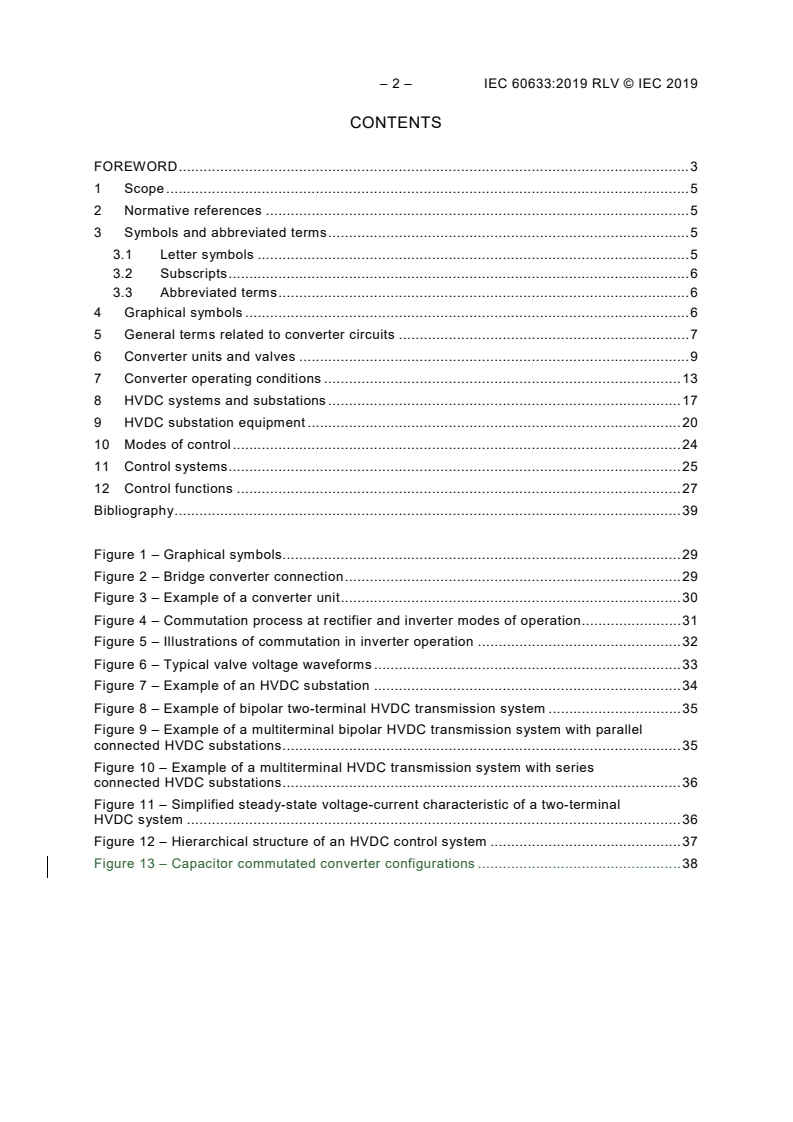
– 2 – IEC 60633:2019 RLV © IEC 2019
CONTENTS
FOREWORD . 3
1 Scope . 5
2 Normative references . 5
3 Symbols and abbreviated terms . 5
3.1 Letter symbols . 5
3.2 Subscripts . 6
3.3 Abbreviated terms . 6
4 Graphical symbols . 6
5 General terms related to converter circuits . 7
6 Converter units and valves . 9
7 Converter operating conditions . 13
8 HVDC systems and substations . 17
9 HVDC substation equipment . 20
10 Modes of control . 24
11 Control systems . 25
12 Control functions . 27
Bibliography . 39
Figure 1 – Graphical symbols . 29
Figure 2 – Bridge converter connection . 29
Figure 3 – Example of a converter unit . 30
Figure 4 – Commutation process at rectifier and inverter modes of operation . 31
Figure 5 – Illustrations of commutation in inverter operation . 32
Figure 6 – Typical valve voltage waveforms . 33
Figure 7 – Example of an HVDC substation . 34
Figure 8 – Example of bipolar two-terminal HVDC transmission system . 35
Figure 9 – Example of a multiterminal bipolar HVDC transmission system with parallel
connected HVDC substations . 35
Figure 10 – Example of a multiterminal HVDC transmission system with series
connected HVDC substations . 36
Figure 11 – Simplified steady-state voltage-current characteristic of a two-terminal
HVDC system . 36
Figure 12 – Hierarchical structure of an HVDC control system . 37
Figure 13 – Capacitor commutated converter configurations . 38
INTERNATIONAL ELECTROTECHNICAL COMMISSION
____________
TERMINOLOGY FOR HIGH-VOLTAGE DIRECT CURRENT
(HVDC) TRANSMISSION – VOCABULARY
FOREWORD
1) The International Electrotechnical Commission (IEC) is a worldwide organization for standardization comprising
all national electrotechnical committees (IEC National Committees). The object of IEC is to promote
international co-operation on all questions concerning standardization in the electrical and electronic fields. To
this end and in addition to other activities, IEC publishes International Standards, Technical Specifications,
Technical Reports, Publicly Available Specifications (PAS) and Guides (hereafter referred to as "IEC
Publication(s)"). Their preparation is entrusted to technical committees; any IEC National Committee interested
in the subject dealt with may participate in this preparatory work. International, governmental and non-
governmental organizations liaising with the IEC also participate in this preparation. IEC collaborates closely
with the International Organization for Standardization (ISO) in accordance with conditions determined by
agreement between the two organizations.
2) The formal decisions or agreements of IEC on technical matters express, as nearly as possible, an international
consensus of opinion on the relevant subjects since each technical committee has representation from all
interested IEC National Committees.
3) IEC Publications have the form of recommendations for international use and are accepted by IEC National
Committees in that sense. While all reasonable efforts are made to ensure that the technical content of IEC
Publications is accurate, IEC cannot be held responsible for the way in which they are used or for any
misinterpretation by any end user.
4) In order to promote international uniformity, IEC National Committees undertake to apply IEC Publications
transparently to the maximum extent possible in their national and regional publications. Any divergence
between any IEC Publication and the corresponding national or regional publication shall be clearly indicated in
the latter.
5) IEC itself does not provide any attestation of conformity. Independent certification bodies provide conformity
assessment services and, in some areas, access to IEC marks of conformity. IEC is not responsible for any
services carried out by independent certification bodies.
6) All users should ensure that they have the latest edition of this publication.
7) No liability shall attach to IEC or its directors, employees, servants or agents including individual experts and
members of its technical committees and IEC National Committees for any personal injury, property damage or
other damage of any nature whatsoever, whether direct or indirect, or for costs (including legal fees) and
expenses arising out of the publication, use of, or reliance upon, this IEC Publication or any other IEC
Publications.
8) Attention is drawn to the Normative references cited in this publication. Use of the referenced publications is
indispensable for the correct application of this publication.
9) Attention is drawn to the possibility that some of the elements of this IEC Publication may be the subject of
patent rights. IEC shall not be held responsible for identifying any or all such patent rights.
This redline version of the official IEC Standard allows the user to identify the changes
made to the previous edition. A vertical bar appears in the margin wherever a change
has been made. Additions are in green text, deletions are in strikethrough red text.
– 4 – IEC 60633:2019 RLV © IEC 2019
International Standard IEC 60633 has been prepared by subcommittee 22F: Power electronics
for electrical transmission and distribution systems, of IEC technical committee 22: Power
electronic systems and equipment.
This third edition cancels and replaces the second edition published in 1998,
Amendment 1:2009 and Amendment 2:2015. This edition constitutes a technical revision.
This edition includes the following significant technical changes with respect to the previous
edition:
a) 40 terms and definitions have been amended and 31 new terms and definitions have been
added mainly on converter units and valves, converter operating conditions, HVDC
systems and substations and HVDC substation equipment;
b) a new Figure 13 on capacitor commutated converter configurations has been added.
The text of this International Standard is based on the following documents:
CDV Report on voting
22F/480/CDV 22F/491A/RVC
Full information on the voting for the approval of this International Standard can be found in
the report on voting indicated in the above table.
This document has been drafted in accordance with the ISO/IEC Directives, Part 2.
The committee has decided that the contents of this document will remain unchanged until the
stability date indicated on the IEC website under "http://webstore.iec.ch" in the data related to
the specific document. At this date, the document will be
• reconfirmed,
• withdrawn,
• replaced by a revised edition, or
• amended.
IMPORTANT – The “colour inside” logo on the cover page of this publication indicates
that it contains colours which are considered to be useful for the correct understanding
of its contents. Users should therefore print this publication using a colour printer.
The contents of the corrigendum of February 2020 have been included in this copy.
TERMINOLOGY FOR HIGH-VOLTAGE DIRECT CURRENT
(HVDC) TRANSMISSION – VOCABULARY
1 Scope
This document defines terms for high-voltage direct current (HVDC) power transmission
systems and for HVDC substations using electronic power converters for the conversion from
AC to DC or vice versa.
This document is applicable to HVDC substations with line commutated converters, most
commonly based on three-phase bridge (double way) connections (see Figure 2) in which
unidirectional electronic valves, for example semiconductor valves, are used. For the thyristor
valves, only the most important definitions are included in this document. A more
comprehensive list of HVDC valve terminology is given in IEC 60700-2.
2 Normative references
The following normative documents contain provisions which, through reference in this text,
constitute provisions of this International Standard. At the time of publication, the editions
indicated were valid. All normative documents are subject to revision, and parties to
agreements based on this International Standard are encouraged to investigate the possibility
of applying the most recent editions of the normative documents indicated below. Members of
IEC and ISO maintain registers of currently valid International Standards.
IEC 60027 (all parts), Letter symbols to be used in electrical technology
IEC 60050-551:1998, International Electrotechnical Vocabulary – Part 551: Power electronics
IEC 60146-1-1:1991, General requirements and line commutated convertors – Part 1-1:
Specifications of basic requirements
IEC 60617-5:1996, Graphical symbols for diagrams – Part 5: Semiconductors and electron
tubes
IEC 60617-6:1996, Graphical symbols for diagrams – Part 6: Production and conversion of
electrical energy
There are no normative references in this document.
3 Symbols and abbreviated terms
The list covers only the most frequently used symbols. For a more complete list of the
symbols which have been adopted for static converters, see IEC 60027 (all parts) and other
standards listed in the normative references and the Bibliography.
3.1 Letter symbols
U direct voltage (any defined value)
d
U conventional nominal no-load direct voltage
d0
U
ideal no-load direct voltage
di0
U rated direct voltage
dN
– 6 – IEC 60633:2019 RLV © IEC 2019
U line-to-line phase-to-phase voltage on line side of converter transformer, RMS
L
value including harmonics
U rated value of U
LN L
U RMS value
no-load phase-to-phase voltage on the valve side of transformer,
ν0
excluding harmonics
I
direct current (any defined value)
d
I
rated direct current
dN
I current on line side of converter transformer, RMS value including harmonics
L
I I
rated value of
LN L
I current on valve side of transformer, RMS value including harmonics
ν
α (trigger) delay angle
β (trigger) advance angle
γ extinction angle
µ overlap angle
p pulse number
q commutation number
3.2 Subscripts
0 (zero) at no load
N rated value or at rated load
d direct current or voltage
i ideal
L line side of converter transformer
v valve side of converter transformer
max maximum
min minimum
n pertaining to harmonic component of order n
3.3 Abbreviated terms
The following abbreviated terms are always in capital letters and without dots.
HVDC high-voltage direct current
MVU multiple valve (unit) (see 6.3.2)
SCR short-circuit ratio (see 7.32)
ESCR effective short-circuit ratio (see 7.33)
MTDC multiterminal HVDC transmission system (see 8.2.2)
MRTB metallic return transfer breaker (see 9.22)
ERTB earth return transfer breaker (see 9.23)
VDCOL voltage dependent current order limit (see 12.9)
SSTI sub-synchronous torsional interaction (see 10.10)
4 Graphical symbols
Figure 1 shows the specific graphical symbols which are defined only for the purposes of this
document. For a more complete list of the graphical symbols which have been adopted for
-5 and IEC 60617-6.
static converters, see IEC 60617
5 General terms related to converter circuits
For the purposes of this document, the following terms and definitions apply.
ISO and IEC maintain terminological databases for use in standardization at the following
addresses:
• IEC Electropedia: available at http://www.electropedia.org/
• ISO Online browsing platform: available at http://www.iso.org/obp
NOTE For a more complete list of the terms which have been adopted for static converters, see IEC 60050-551
and IEC 60146-1-1.
5.1
conversion
transfer of energy from AC to DC or vice versa, or a combination of these operations
5.2
converter connection
electrical arrangement of arms and other components necessary for the functioning of the
main power circuit of a converter
5.3
bridge (converter connection)
double-way connection comprising six converter arms which are connected as illustrated in
Figure 2
NOTE – The term “bridge” may be used to describe either the circuit connection or the equipment implementing
that circuit (see 6.2).
double-way connection comprising six converter arms such that the centre terminals are the
phase terminals of the AC circuit, and that the outer terminals of like polarity are connected
together and are the DC terminals
Note 1 to entry: The double-way connection is illustrated in Figure 2.
5.3.1
uniform bridge
bridge where all converter arms are either controllable or non-controllable
5.3.2
non-uniform bridge
bridge with both controllable and non-controllable converter arms
5.4
(converter) arm
part of an operative circuit used for conversion which is connected between an a.c. terminal
and a d.c. terminal, with the ability to conduct current in only one direction, defined as the
forward direction (see 7.3)
NOTE – The main function of a converter arm is conversion; it may also perform additional functions such as
voltage limiting, damping, etc.
part of a bridge connecting two points of different potentials within a bridge, for example,
between an AC terminal and a DC terminal
5.4.1
controllable converter arm
converter arm in which the start of forward conduction may be determined by an externally
applied signal
– 8 – IEC 60633:2019 RLV © IEC 2019
5.4.2
non-controllable converter arm
converter arm in which the start of forward conduction is determined solely by the voltage
applied to its terminals
5.5
by-pass path
low resistance path between the DC terminals of one or several bridges excluding the AC
circuit
Note 1 to entry: The by-pass path may either constitute a unidirectional path, e.g. a by-pass arm (see 5.5.1), or a
by-pass pair (see 5.5.2), or it may constitute a bidirectional path, e.g. a by-pass switch (see 9.30).
5.5.1
by-pass arm
unidirectionally conducting by-pass path connected only between DC terminals, commonly
used with mercury arc valve technology
Note 1 to entry: By-pass arm is not shown in Figure 2.
5.5.2
by-pass pair
two converter arms of a bridge connected to a common AC terminal and forming a by-pass
path
SEE: Figure 2.
5.6
commutation
transfer of current between any two paths with both paths carrying current simultaneously
during this process
Note 1 to entry: Commutation may occur between any two converter arms, including the connected AC phases,
between a converter arm and a by-pass arm, or between any two paths in the circuit.
5.6.1
line commutation
method of commutation whereby the commutating voltage is supplied by the AC system
5.7
commutating group
group of converter arms which commutate cyclically and independently from other converter
arms, i.e. and where the commutations are normally not simultaneous
Note 1 to entry: In the case of a bridge, a commutating group is composed of the converter arms connected to a
common DC terminal. In certain cases, e.g. when large currents and/or large commutation inductances are
involved, the commutation in the two commutating groups belonging to the same bridge need not be independent.
SEE: Figure 2.
5.8
commutation inductance
total inductance included in the commutation circuit, in series with the commutating voltage
5.9
pulse number
p
characteristic of a converter connection expressed as the number of non-simultaneous
symmetrical commutations occurring during one cycle of the AC line voltage
Note 1 to entry: The pulse number of a bridge converter connection defined in 5.3 is always p = 6.
5.10
commutation number
q
number of commutations during one cycle of the AC line voltage occurring in each
commutating group
Note 1 to entry: In a bridge converter connection, each commutating group has a commutation number q = 3.
5.11
capacitor commutated converter
converter in which series capacitors are included between the converter transformer and the
valves
SEE: Figure 13 a).
5.12
controlled series capacitor converter
converter in which series capacitors are inserted between the AC filter bus and the AC
network
SEE: Figure 13 b).
5.13
commutating voltage
voltage which causes the current to commutate
[SOURCE: IEC 60050-551:1998, 551-16-02]
5.14
controlled capacitor commutated converter
converter in which controlled series capacitors are included between the converter
transformer and the valves
5.15
series capacitor converter
converter in which fixed series capacitors are inserted between the AC filter bus and the AC
network
6 Converter units and valves
6.1
converter unit
indivisible operative unit comprising all equipment between the point of common coupling on
the AC side (see 8.24) and the point of common coupling-DC side (see 8.25), essentially one
or more converter bridges, together with one or more converter transformers, converter unit
control equipment, essential protective and switching devices and auxiliaries, if any, used for
conversion
NOTE – If a converter unit comprises two converter bridges with a phase displacement of 30°, then the converter
unit forms a 12-pulse unit (see figure 7). The term “12-pulse group” is also used.
SEE: Figure 3.
6.2
converter bridge
equipment used to implement the bridge converter connection and the by-pass arm, if used
Note 1 to entry: The term "bridge" may be used to describe either the circuit connection or the equipment
implementing that circuit (see 5.3).
– 10 – IEC 60633:2019 RLV © IEC 2019
6.2.1
anode (/cathode) valve commutating group
equipment used to implement the converter arms of one commutating group of a bridge with
interconnected anode (/cathode) terminals
6.3
valve
complete operative controllable or non-controllable valve device assembly, normally
conducting in only one direction (the forward direction), which can function as a converter arm
in a converter bridge
NOTE – An example of a non-controllable valve device assembly is a semiconductor diode valve. An example of a
controllable valve device assembly is a thyristor valve.
6.3.1
single valve (unit)
single structure comprising only one valve
6.3.2
multiple valve (unit)
MVU
single structure comprising more than one valve
Note 1 to entry: Examples of multiple valve units are double valves, quadrivalves and octovalves with two, four
and eight series-connected valves respectively.
Note 2 to entry: This note applies to the French language only.
6.4
main valve
valve in a converter arm
6.5
by-pass valve
valve in a by-pass arm
6.6
thyristor module
part of a valve comprised of comprising a mechanical assembly of thyristors with their
immediate auxiliaries, and but without valve reactors, if used
Note 1 to entry: Thyristor modules may be elements in the construction of a valve, and/or be interchangeable for
maintenance purposes.
NOTE 2 – The deprecated term “valve module” has been used with an equivalent meaning.
6.7
reactor module
part of a valve, being a mechanical assembly of one or more reactors, used in some valve
designs
Note 1 to entry: Reactor modules may be elements in the construction of a valve.
6.8
valve section
electrical assembly, comprising a number of thyristors and other components, which exhibits
prorated electrical properties of a complete valve
Note 1 to entry: This term is mainly used to define a test object for valve testing purposes.
6.9
(valve) thyristor level
part of a valve comprised of comprising a thyristor, or thyristors connected in parallel,
together with their immediate auxiliaries, and reactor, if any
6.10
valve support
part of the valve which mechanically supports and electrically insulates the active part of the
valve from earth the active part of the valve which houses the valve sections
Note 1 to entry: A part of a valve which is clearly identifiable in a discrete form to be a valve support may not
exist in all designs of valves.
6.11
valve structure
physical structure holding the thyristor levels of a valve which is insulated to the appropriate
voltage above earth potential
structural components of a valve, required in order to physically support the valve modules
6.12
valve interface (electronics) (unit)
electronic unit which provides an interface between the control equipment, at earth potential,
and the valve electronics or valve devices
NOTE 1 – Valve interface electronics units, if used, are typically located at earth potential close to the valve(s).
NOTE 2 – The term “valve base electronics” (VBE) has also been used for this unit.
valve base electronics
VBE
electronic unit, at earth potential, providing the electrical to optical conversion between the
converter control system and the valves
Note 1 to entry: This note applies to the French language only.
6.13
valve electronics
electronic circuits at valve potential(s) which perform control and protection functions for one
or more thyristor levels
6.14
valve arrester
arrester connected across a valve
SEE: Figure 3.
6.15
converter unit arrester
arrester connected across the DC terminals of a converter unit
SEE: Figure 3.
6.16
converter unit DC bus arrester
arrester connected from the high-voltage DC bus of the converter unit to substation earth
SEE: Figure 3 and Figure 7.
– 12 – IEC 60633:2019 RLV © IEC 2019
6.17
midpoint DC bus arrester
arrester connected between the midpoint of the two 6-pulse bridges of a 12-pulse converter
unit and substation earth
Note 1 to entry: In some HVDC substation designs, two twelve-pulse converter units are connected in series. In
this case, the midpoint DC bus arrester at the upper twelve-pulse converter unit is not connected to the substation
earth but to the high-voltage DC bus of the lower twelve-pulse converter unit.
SEE: Figure 7.
6.18
valve (anode) (cathode) reactor
reactor connected in series with the valve, commonly used with mercury arc technology
reactor(s) connected in series with the thyristors in a valve, for the purpose of limiting the rate
of rise of current at turn-on and voltage during the off-state
Note 1 to entry: Valve reactors may be external to the entire valve or distributed within the valve.
6.19
converter transformer
transformer through which energy is transmitted from an AC system to one or more converter
bridges or vice versa
SEE: Figure 3.
6.19.1
line side windings
converter transformer windings which are connected to the AC system
6.19.2
valve side windings
converter transformer windings which are connected to the AC terminals of one or more
converter bridges
6.20
valve module
part of a valve comprising a mechanical assembly of thyristors with their immediate auxiliaries
and valve reactor(s)
6.21
redundant levels
maximum number of series connected thyristor levels in a valve that may be short-circuited
externally or internally during service without affecting the safe operation of the valve as
demonstrated by type tests, and which if and when exceeded, would require shutdown of the
valve to replace the failed levels or acceptance of increased risk of failures
6.22
valve anode terminal
valve terminal at which the forward current flows into the valve
6.23
valve cathode terminal
valve terminal at which the forward current flows out of the valve
7 Converter operating conditions
7.1
rectifier operation
rectification
mode of operation of a converter or an HVDC substation when energy is transferred from the
AC side to the DC side
7.2
inverter operation
inversion
mode of operation of a converter or an HVDC substation when energy is transferred from the
DC side to the AC side
7.3
forward direction
conducting direction
direction of current through a valve, when current flows from the anode terminal to the
cathode terminal
direction in which a valve is capable of conducting load current
7.4
reverse direction
non-conducting direction
direction of current through a valve, when current flows from the cathode terminal to the
anode terminal
reverse of the conducting direction
7.5
forward current
current which flows through a valve in the forward direction
7.6
reverse current
current which flows through a valve in the reverse direction
7.7
forward voltage
voltage applied between the anode and cathode terminals of a valve or an arm when the
anode is positive with respect to the cathode
7.8
reverse voltage
voltage applied between the anode and cathode terminals of a valve or an arm when the
anode is negative with respect to the cathode
7.9
conducting state
on-state
condition of a valve when the valve exhibits a low resistance
Note 1 to entry: The valve voltage for this condition is shown in Figure 6.
7.10
valve voltage drop
voltage which, during the conducting state, appears across the valve terminals
– 14 – IEC 60633:2019 RLV © IEC 2019
7.11
non-conducting state
blocking state
condition of a valve when the valve exhibits a high resistance (see figure 6) all thyristors are
turned off
7.11.1
forward blocking state
off-state
non-conducting state of a controllable valve when forward voltage is applied between its main
terminals
SEE: Figure 6.
7.11.2
reverse blocking state
non-conducting state of a valve when reverse voltage is applied between its main terminals
SEE: Figure 6.
7.12
firing
establishment of current in the forward direction in a valve
NOTE – The control action to establish current in an individual thyristor is referred to as triggering or gating.
7.13
(valve) control pulse
pulse which, during its entire duration, allows the firing of the valve
7.14
(valve) firing pulse
pulse which initiates the firing of the valve, normally derived from the valve control pulse
7.15
converter blocking
operation preventing further conversion by a converter by inhibiting valve control pulses
Note 1 to entry: This action may also include firing of a valve, or valves, selected to form a by-pass path.
7.16
converter deblocking
operation permitting the start of conversion by a converter by removing blocking action
7.17
valve blocking
operation preventing further firing of a controllable valve by inhibiting the valve control pulses
7.18
valve deblocking
operation permitting firing of a controllable valve by removing the valve blocking action
7.19
phase control
process of controlling the instant within the cycle at which forward current conduction in a
controllable valve begins
7.20
(trigger) delay angle
firing delay angle
α
time, expressed in electrical angular measure, from the zero crossing of the idealized
sinusoidal commutating voltage to the starting instant of forward current conduction
SEE: Figure 4.
7.21
(trigger) advance angle
firing advance angle
β
time, expressed in electrical angular measure, from the starting instant of forward current
conduction to the next zero crossing of the idealized sinusoidal commutating voltage
Note 1 to entry: The advance angle β is related to the delay angle α by β = π – α (see Figure 4).
7.22
overlap angle
µ
duration of commutation between two converter arms, expressed in electrical angular
measure
SEE: Figure 4 and Figure 5.
7.23
extinction angle
γ
time, expressed in electrical angular measure, from the end of current conduction to the next
zero crossing of the idealized sinusoidal commutating voltage
Note 1 to entry: γ depends on the advance angle β and the overlap angle µ and is determined by the relation γ = β
– µ (see Figure 4 and Figure 5).
7.24
hold-off interval
time from the instant when the forward current of a controllable valve has decreased to zero
to the instant when the same valve is subjected to forward voltage
Note 1 to entry: Hold-off interval, when expressed in electrical angular measure, is commonly referred to as the
extinction angle. However, the difference between the concepts of extinction angle and hold-off interval should be
noted, as shown in Figure 5.
7.24.1
critical hold-off interval
minimum hold-off interval for which the inverter operation can be maintained
7.25
conduction interval
part of a cycle during which a valve is in the conducting state
SEE: Figure 6.
7.26
blocking interval
idle interval
part of a cycle during which a valve is in the non-conducting state
SEE: Figure 6.
– 16 – IEC 60633:2019 RLV © IEC 2019
7.27
forward blocking interval
part of the blocking interval during which a controllable valve is in the forward blocking state
SEE: Figure 6.
7.28
reverse blocking interval
part of the blocking interval during which a valve is in the reverse blocking state
SEE: Figure 6.
7.29
false firing
misfiring
firing of a valve at an incorrect unintended instant
7.30
firing failure
failure to achieve firing of a valve during the entire forward voltage interval
7.31
commutation failure
failure to commutate the forward current from the conducting converter arm to the succeeding
converter arm
7.32
short-circuit ratio
SCR
ratio of the AC network short-circuit level (in MVA) at 1 p.u. voltage at the point of connection
to the HVDC substation AC bus, to the rated DC power of the HVDC substation (in MW)
Note 1 to entry: The present definition of SCR differs from the definition given in IEC 60146-1-1.
7.33
effective short-circuit ratio
ESCR
ratio of the AC network short-circuit level (in MVA) at 1 p.u. voltage at the point of connection
to the HVDC substation AC bus, reduced by the reactive power of the shunt capacitor banks
and AC filters connected to this point (in Mvar), to the rated DC power of the HVDC substation
(in MW)
7.34
triggering
gating
control action to achieve firing of a valve or an individual thyristor
7.35
operating state
condition in which the HVDC substation is energized and the converters are operating at
non-zero active or reactive power output at the point of common coupling (PCC) to the AC
network
7.36
blocked state
condition in which all valves of the converter unit are blocked
7.37
valve voltage
difference in voltage between the valve anode terminal and valve cathode terminal
8 HVDC systems and substations
8.1
HVDC system
electrical power system which transfers energy in the form of high-voltage direct current
between two or more AC buses
8.2
HVDC transmission system
HVDC system which transfers energy between two or more geographic locations
8.2.1
two-terminal HVDC transmission system
HVDC transmission system consisting of two HVDC transmission substations and the
connecting HVDC transmission line(s)
SEE: Figure 8.
8.2.2
multiterminal HVDC transmission system
MTDC
HVDC transmission system consisting of more than two separated HVDC substations and the
interconnecting HVDC transmission lines
SEE: Figure 9 and Figure 10.
8.2.3
HVDC back-to-back system
HVDC system which transfers energy between AC buses at the same location
8.3
unidirectional HVDC system
HVDC system for the transfer of energy in only one direction
Note 1 to entry: Most HVDC systems are inherently bidirectional. However, some systems may be optimized to
transmit power in only one preferred direction. Such systems may still be considered as "bidirectional".
8.4
reversible bidirectional HVDC system
HVDC system for the transfer of energy in either direction
Note 1 to entry: A multiterminal HVDC system is reversible bidirectional if one or more substations are reversible
bidirectional.
8.5
(HVDC) (system) pole
part of an HVDC system consisting of all the equipment in the HVDC substations and the
interconnecting transmission lines, if any, which during normal operation exhibit a common
direct voltage polarity with respect to earth
SEE: Figure 8.
8.6
(HVDC) (system) bipole
part of an HVDC system consisting of two independently operable HVDC system poles, which
during normal operation, exhibit opposite direct voltage polarities with respect to earth
8.7
symmetrical monopole
part of an HVDC system consisting of all the equipment in the HVDC substations and the
interconnecting transmission lines, if any, which during normal operation exhibits equal and
– 18 – IEC 60633:2019 RLV © IEC 2019
opposite direct voltage polarities with respect to earth but without series connection of
converters in each converter station
Note 1 to entry: The term "symmetrical monopole" is used even though there are two polarities with DC voltages,
because with only one converter it is not possible to provide the redundancy which is normally associated with the
term "bipole".
8.8
bipolar HVDC system
HVDC system with two poles of opposite polarity with respect to earth
Note 1 to entry: The overhead lines, if any, of the two poles may be carried on common or separate towers.
SEE: Figure 8.
8.8.1
monopolar earth return (HVDC) system
monopolar system in which the return current path between neutrals of the HVDC substations
is through the earth
8.8.2
monopolar metallic return (HVDC) system
monopolar system in which the return current path between neutrals of the HVDC substations
is through a metallic circuit
8.9
rigid DC current bipolar system
bipolar HVDC system without neutral connection between both converter stations
Note 1 to entry: Since only two (pole) conductors exist, no unbalance current between both poles is possible. In
case of interruption of power transfer of one converter pole, the current of the other pole has to be interrupted as
well (at least for a limited time to allow reconfiguration of the DC circuit).
8.10
monopolar HVDC system
asymmetric HVDC system
HVDC system with only one pole
8.11
symmetrical monopolar HVDC system
HVDC system with only one symmetrical monopole
8.12
HVDC substation
HVDC converter station
part of an HVDC system which consists of one or more converter units installed in a single
location together with buildings, reactors, filters, reactive power supply, control, monitoring,
protective, measuring and auxiliary equipment
Note 1 to entry: An HVDC substation forming part of an HVDC transmission system may be referred to as an
HVDC transmission substation.
SEE: Figure 7.
8.12.1
(HVDC) tapping substation
HVDC substation, mainly used for inversion, with a rating which is a small fraction of that of
the rectifier(s) in the system
8.13
(HVDC) substation bipole
part of a bipolar HVDC system contained within a substation
8.14
(HVDC) substation pole
part of an HVDC system pole which is contained within a substation
SEE: Figure 8.
8.15
HVDC transmission line
part of an HVDC transmission system consisting of a system of overhead lines and/or cables
Note 1 to entry: The HVDC transmission lines are terminated in HVDC substations (see Figure 8).
8.16
HVDC transmission line pole
part of an HVDC transmission line which belongs to the same HVDC system pole
8.17
earth electrode
array of conducting elements placed in the earth, or the sea, which provides a low resistance
path between a point in the DC circuit and the earth and is capable of carrying continuous
current for some extended period
Note 1 to entry: An earth electrode may be located at a point some distance from the HVDC substation.
Note 2 to entry: Where the electrode is placed in the sea it may be termed a sea electrode.
SEE: Figure 7.
8.18
earth electrode line
insulated line between the HVDC substation DC neutral bus and the earth electrode
SEE: Figure 7.
8.19
bipolar earth return (HVDC) system
bipolar system operation mode in which the return current path between neutrals of the HVDC
system substations is through the earth
8.20
bipolar metallic return (HVDC) system
bipolar system operation mode in which the return current path between neutrals of the HVDC
system substations is through a metallic circuit dedicated conductor
Note 1 to entry: The metallic return conductor may be either a dedicated neutral conductor or another high
voltage conductor.
8.21
series converter configuration
converter configuration which consists of two or more converters connected in series on the
DC side and located in the same substation and connected to the same AC and DC
transmission system
8.22
unitary connection
HVDC system where only one generator is directly connected to an HVDC system through a
specific converter and without any other AC component except for an assigned step-up
transformer
– 20 – IEC 60633:2019 RLV © IEC 2019
8.23
isolated generating system
HVDC system in which several generators are directly connected to one HVDC converter
through one or more specifically assigned step-up transformers but without any other AC
network connection
8.24
point of common coupling
PCC
point of interconnection of the HVDC converter station to the adjacent AC system
Note 1 to entry: This note applies to the French language only.
8.25
point of common coupling-DC side
PCC-DC
point of interconnection of the HVDC converter station to the DC transmission line
Note 1 to entry: This note applies to the French language only.
9 HVDC substation equipment
9.1
AC harmonic filter
filter designed to reduce the harmonic voltage at the AC bus and the flow of harmonic current
into the associated AC system and to prevent amplification of background harmonics on the
AC system
SEE: Figure 7.
9.2
DC (smoothing) reactor
reactor connected in series with a converter unit or converter units on the DC side for the
primary purpose of smoothing the direct current and reducing current transients
SEE: Figure 7.
9.3
d.c. smoothing reactor arrester
arrester connected between the terminals of a d.c. smoothing reactor
SEE: Figure 7.
9.4
DC harmonic filter
filter which, in conjunction with the DC reactor(s) and with the DC surge capaci
...
IEC 60633 ®
Edition 3.0 2019-04
INTERNATIONAL
STANDARD
NORME
INTERNATIONALE
High-voltage direct current (HVDC) transmission – Vocabulary
Transport d'énergie en courant continu à haute tension (CCHT) – Vocabulaire
All rights reserved. Unless otherwise specified, no part of this publication may be reproduced or utilized in any form
or by any means, electronic or mechanical, including photocopying and microfilm, without permission in writing from
either IEC or IEC's member National Committee in the country of the requester. If you have any questions about IEC
copyright or have an enquiry about obtaining additional rights to this publication, please contact the address below or
your local IEC member National Committee for further information.
Droits de reproduction réservés. Sauf indication contraire, aucune partie de cette publication ne peut être reproduite
ni utilisée sous quelque forme que ce soit et par aucun procédé, électronique ou mécanique, y compris la photocopie
et les microfilms, sans l'accord écrit de l'IEC ou du Comité national de l'IEC du pays du demandeur. Si vous avez des
questions sur le copyright de l'IEC ou si vous désirez obtenir des droits supplémentaires sur cette publication, utilisez
les coordonnées ci-après ou contactez le Comité national de l'IEC de votre pays de résidence.
IEC Central Office Tel.: +41 22 919 02 11
3, rue de Varembé info@iec.ch
CH-1211 Geneva 20 www.iec.ch
Switzerland
About the IEC
The International Electrotechnical Commission (IEC) is the leading global organization that prepares and publishes
International Standards for all electrical, electronic and related technologies.
About IEC publications
The technical content of IEC publications is kept under constant review by the IEC. Please make sure that you have the
latest edition, a corrigendum or an amendment might have been published.
IEC publications search - webstore.iec.ch/advsearchform Electropedia - www.electropedia.org
The advanced search enables to find IEC publications by a The world's leading online dictionary on electrotechnology,
variety of criteria (reference number, text, technical containing more than 22 000 terminological entries in English
committee,…). It also gives information on projects, replaced and French, with equivalent terms in 16 additional languages.
and withdrawn publications. Also known as the International Electrotechnical Vocabulary
(IEV) online.
IEC Just Published - webstore.iec.ch/justpublished
Stay up to date on all new IEC publications. Just Published IEC Glossary - std.iec.ch/glossary
details all new publications released. Available online and 67 000 electrotechnical terminology entries in English and
once a month by email. French extracted from the Terms and Definitions clause of
IEC publications issued since 2002. Some entries have been
IEC Customer Service Centre - webstore.iec.ch/csc collected from earlier publications of IEC TC 37, 77, 86 and
If you wish to give us your feedback on this publication or CISPR.
need further assistance, please contact the Customer Service
Centre: sales@iec.ch.
A propos de l'IEC
La Commission Electrotechnique Internationale (IEC) est la première organisation mondiale qui élabore et publie des
Normes internationales pour tout ce qui a trait à l'électricité, à l'électronique et aux technologies apparentées.
A propos des publications IEC
Le contenu technique des publications IEC est constamment revu. Veuillez vous assurer que vous possédez l’édition la
plus récente, un corrigendum ou amendement peut avoir été publié.
Recherche de publications IEC - Electropedia - www.electropedia.org
webstore.iec.ch/advsearchform Le premier dictionnaire d'électrotechnologie en ligne au
La recherche avancée permet de trouver des publications IEC monde, avec plus de 22 000 articles terminologiques en
en utilisant différents critères (numéro de référence, texte, anglais et en français, ainsi que les termes équivalents dans
comité d’études,…). Elle donne aussi des informations sur les 16 langues additionnelles. Egalement appelé Vocabulaire
projets et les publications remplacées ou retirées. Electrotechnique International (IEV) en ligne.
IEC Just Published - webstore.iec.ch/justpublished Glossaire IEC - std.iec.ch/glossary
Restez informé sur les nouvelles publications IEC. Just 67 000 entrées terminologiques électrotechniques, en anglais
Published détaille les nouvelles publications parues. et en français, extraites des articles Termes et Définitions des
Disponible en ligne et une fois par mois par email. publications IEC parues depuis 2002. Plus certaines entrées
antérieures extraites des publications des CE 37, 77, 86 et
Service Clients - webstore.iec.ch/csc CISPR de l'IEC.
Si vous désirez nous donner des commentaires sur cette
publication ou si vous avez des questions contactez-nous:
sales@iec.ch.
IEC 60633 ®
Edition 3.0 2019-04
INTERNATIONAL
STANDARD
NORME
INTERNATIONALE
High-voltage direct current (HVDC) transmission – Vocabulary
Transport d'énergie en courant continu à haute tension (CCHT) – Vocabulaire
INTERNATIONAL
ELECTROTECHNICAL
COMMISSION
COMMISSION
ELECTROTECHNIQUE
INTERNATIONALE
ICS 29.200 ISBN 978-2-8322-6812-4
– 2 – IEC 60633:2019 © IEC 2019
CONTENTS
FOREWORD . 3
1 Scope . 5
2 Normative references . 5
3 Symbols and abbreviated terms . 5
3.1 Letter symbols . 5
3.2 Subscripts . 6
3.3 Abbreviated terms . 6
4 Graphical symbols . 6
5 General terms related to converter circuits . 6
6 Converter units and valves . 9
7 Converter operating conditions . 12
8 HVDC systems and substations . 15
9 HVDC substation equipment . 19
10 Modes of control . 23
11 Control systems . 23
12 Control functions . 26
Bibliography . 37
Figure 1 – Graphical symbols . 27
Figure 2 – Bridge converter connection . 27
Figure 3 – Example of a converter unit . 28
Figure 4 – Commutation process at rectifier and inverter modes of operation . 29
Figure 5 – Illustrations of commutation in inverter operation . 30
Figure 6 – Typical valve voltage waveforms . 31
Figure 7 – Example of an HVDC substation . 32
Figure 8 – Example of bipolar two-terminal HVDC transmission system . 33
Figure 9 – Example of a multiterminal bipolar HVDC transmission system with parallel
connected HVDC substations . 33
Figure 10 – Example of a multiterminal HVDC transmission system with series
connected HVDC substations . 34
Figure 11 – Simplified steady-state voltage-current characteristic of a two-terminal
HVDC system . 34
Figure 12 – Hierarchical structure of an HVDC control system . 35
Figure 13 – Capacitor commutated converter configurations . 36
INTERNATIONAL ELECTROTECHNICAL COMMISSION
____________
HIGH-VOLTAGE DIRECT CURRENT
(HVDC) TRANSMISSION – VOCABULARY
FOREWORD
1) The International Electrotechnical Commission (IEC) is a worldwide organization for standardization comprising
all national electrotechnical committees (IEC National Committees). The object of IEC is to promote
international co-operation on all questions concerning standardization in the electrical and electronic fields. To
this end and in addition to other activities, IEC publishes International Standards, Technical Specifications,
Technical Reports, Publicly Available Specifications (PAS) and Guides (hereafter referred to as "IEC
Publication(s)"). Their preparation is entrusted to technical committees; any IEC National Committee interested
in the subject dealt with may participate in this preparatory work. International, governmental and non-
governmental organizations liaising with the IEC also participate in this preparation. IEC collaborates closely
with the International Organization for Standardization (ISO) in accordance with conditions determined by
agreement between the two organizations.
2) The formal decisions or agreements of IEC on technical matters express, as nearly as possible, an international
consensus of opinion on the relevant subjects since each technical committee has representation from all
interested IEC National Committees.
3) IEC Publications have the form of recommendations for international use and are accepted by IEC National
Committees in that sense. While all reasonable efforts are made to ensure that the technical content of IEC
Publications is accurate, IEC cannot be held responsible for the way in which they are used or for any
misinterpretation by any end user.
4) In order to promote international uniformity, IEC National Committees undertake to apply IEC Publications
transparently to the maximum extent possible in their national and regional publications. Any divergence
between any IEC Publication and the corresponding national or regional publication shall be clearly indicated in
the latter.
5) IEC itself does not provide any attestation of conformity. Independent certification bodies provide conformity
assessment services and, in some areas, access to IEC marks of conformity. IEC is not responsible for any
services carried out by independent certification bodies.
6) All users should ensure that they have the latest edition of this publication.
7) No liability shall attach to IEC or its directors, employees, servants or agents including individual experts and
members of its technical committees and IEC National Committees for any personal injury, property damage or
other damage of any nature whatsoever, whether direct or indirect, or for costs (including legal fees) and
expenses arising out of the publication, use of, or reliance upon, this IEC Publication or any other IEC
Publications.
8) Attention is drawn to the Normative references cited in this publication. Use of the referenced publications is
indispensable for the correct application of this publication.
9) Attention is drawn to the possibility that some of the elements of this IEC Publication may be the subject of
patent rights. IEC shall not be held responsible for identifying any or all such patent rights.
International Standard IEC 60633 has been prepared by subcommittee 22F: Power electronics
for electrical transmission and distribution systems, of IEC technical committee 22: Power
electronic systems and equipment.
This third edition cancels and replaces the second edition published in 1998,
Amendment 1:2009 and Amendment 2:2015. This edition constitutes a technical revision.
This edition includes the following significant technical changes with respect to the previous
edition:
a) 40 terms and definitions have been amended and 31 new terms and definitions have been
added mainly on converter units and valves, converter operating conditions, HVDC
systems and substations and HVDC substation equipment;
b) a new Figure 13 on capacitor commutated converter configurations has been added.
– 4 – IEC 60633:2019 © IEC 2019
The text of this International Standard is based on the following documents:
CDV Report on voting
22F/480/CDV 22F/491A/RVC
Full information on the voting for the approval of this International Standard can be found in
the report on voting indicated in the above table.
This document has been drafted in accordance with the ISO/IEC Directives, Part 2.
The committee has decided that the contents of this document will remain unchanged until the
stability date indicated on the IEC website under "http://webstore.iec.ch" in the data related to
the specific document. At this date, the document will be
• reconfirmed,
• withdrawn,
• replaced by a revised edition, or
• amended.
The contents of the corrigendum of February 2020 have been included in this copy.
HIGH-VOLTAGE DIRECT CURRENT
(HVDC) TRANSMISSION – VOCABULARY
1 Scope
This document defines terms for high-voltage direct current (HVDC) power transmission
systems and for HVDC substations using electronic power converters for the conversion from
AC to DC or vice versa.
This document is applicable to HVDC substations with line commutated converters, most
commonly based on three-phase bridge (double way) connections (see Figure 2) in which
unidirectional electronic valves, for example semiconductor valves, are used. For the thyristor
valves, only the most important definitions are included in this document. A more
comprehensive list of HVDC valve terminology is given in IEC 60700-2.
2 Normative references
There are no normative references in this document.
3 Symbols and abbreviated terms
The list covers only the most frequently used symbols. For a more complete list of the
symbols which have been adopted for static converters, see IEC 60027 (all parts) and other
standards listed in the Bibliography.
3.1 Letter symbols
U direct voltage (any defined value)
d
U nominal no-load direct voltage
d0
U
ideal no-load direct voltage
di0
U rated direct voltage
dN
U phase-to-phase voltage on line side of converter transformer, RMS value including
L
harmonics
U U
rated value of
LN L
U RMS value
no-load phase-to-phase voltage on the valve side of transformer,
ν0
excluding harmonics
I
direct current (any defined value)
d
I rated direct current
dN
I
current on line side of converter transformer, RMS value including harmonics
L
I rated value of I
LN L
I
current on valve side of transformer, RMS value including harmonics
ν
α (trigger) delay angle
β (trigger) advance angle
γ extinction angle
µ overlap angle
p pulse number
q commutation number
– 6 – IEC 60633:2019 © IEC 2019
3.2 Subscripts
0 (zero) at no load
N rated value or at rated load
d direct current or voltage
i ideal
L line side of converter transformer
v valve side of converter transformer
max maximum
min minimum
n pertaining to harmonic component of order n
3.3 Abbreviated terms
The following abbreviated terms are always in capital letters and without dots.
HVDC high-voltage direct current
MVU multiple valve (unit) (see 6.3.2)
SCR short-circuit ratio (see 7.32)
ESCR effective short-circuit ratio (see 7.33)
MTDC multiterminal HVDC transmission system (see 8.2.2)
MRTB metallic return transfer breaker (see 9.22)
ERTB earth return transfer breaker (see 9.23)
VDCOL voltage dependent current order limit (see 12.9)
SSTI sub-synchronous torsional interaction (see 10.10)
4 Graphical symbols
Figure 1 shows the specific graphical symbols which are defined only for the purposes of this
document. For a more complete list of the graphical symbols which have been adopted for
static converters, see IEC 60617.
5 General terms related to converter circuits
For the purposes of this document, the following terms and definitions apply.
ISO and IEC maintain terminological databases for use in standardization at the following
addresses:
• IEC Electropedia: available at http://www.electropedia.org/
• ISO Online browsing platform: available at http://www.iso.org/obp
NOTE For a more complete list of the terms which have been adopted for static converters, see IEC 60050-551
and IEC 60146-1-1.
5.1
conversion
transfer of energy from AC to DC or vice versa, or a combination of these operations
5.2
converter connection
electrical arrangement of arms and other components necessary for the functioning of the
main power circuit of a converter
5.3
bridge converter connection
double-way connection comprising six converter arms such that the centre terminals are the
phase terminals of the AC circuit, and that the outer terminals of like polarity are connected
together and are the DC terminals
Note 1 to entry: The double-way connection is illustrated in Figure 2.
5.3.1
uniform bridge
bridge where all converter arms are either controllable or non-controllable
5.3.2
non-uniform bridge
bridge with both controllable and non-controllable converter arms
5.4
converter arm
part of a bridge connecting two points of different potentials within a bridge, for example,
between an AC terminal and a DC terminal
5.4.1
controllable converter arm
converter arm in which the start of forward conduction may be determined by an externally
applied signal
5.4.2
non-controllable converter arm
converter arm in which the start of forward conduction is determined solely by the voltage
applied to its terminals
5.5
by-pass path
low resistance path between the DC terminals of one or several bridges excluding the AC
circuit
Note 1 to entry: The by-pass path may either constitute a unidirectional path, e.g. a by-pass arm (see 5.5.1), or a
by-pass pair (see 5.5.2), or it may constitute a bidirectional path, e.g. a by-pass switch (see 9.30).
5.5.1
by-pass arm
unidirectionally conducting by-pass path connected only between DC terminals, commonly
used with mercury arc valve technology
Note 1 to entry: By-pass arm is not shown in Figure 2.
5.5.2
by-pass pair
two converter arms of a bridge connected to a common AC terminal and forming a by-pass
path
SEE: Figure 2.
5.6
commutation
transfer of current between any two paths with both paths carrying current simultaneously
during this process
Note 1 to entry: Commutation may occur between any two converter arms, including the connected AC phases,
between a converter arm and a by-pass arm, or between any two paths in the circuit.
– 8 – IEC 60633:2019 © IEC 2019
5.6.1
line commutation
method of commutation whereby the commutating voltage is supplied by the AC system
5.7
commutating group
group of converter arms which commutate cyclically and independently from other converter
arms and where the commutations are normally not simultaneous
Note 1 to entry: In the case of a bridge, a commutating group is composed of the converter arms connected to a
common DC terminal. In certain cases, e.g. when large currents and/or large commutation inductances are
involved, the commutation in the two commutating groups belonging to the same bridge need not be independent.
SEE: Figure 2.
5.8
commutation inductance
total inductance included in the commutation circuit, in series with the commutating voltage
5.9
pulse number
p
characteristic of a converter connection expressed as the number of non-simultaneous
symmetrical commutations occurring during one cycle of the AC line voltage
Note 1 to entry: The pulse number of a bridge converter connection defined in 5.3 is always p = 6.
5.10
commutation number
q
number of commutations during one cycle of the AC line voltage occurring in each
commutating group
Note 1 to entry: In a bridge converter connection, each commutating group has a commutation number q = 3.
5.11
capacitor commutated converter
converter in which series capacitors are included between the converter transformer and the
valves
SEE: Figure 13 a).
5.12
controlled series capacitor converter
converter in which series capacitors are inserted between the AC filter bus and the AC
network
SEE: Figure 13 b).
5.13
commutating voltage
voltage which causes the current to commutate
[SOURCE: IEC 60050-551:1998, 551-16-02]
5.14
controlled capacitor commutated converter
converter in which controlled series capacitors are included between the converter
transformer and the valves
5.15
series capacitor converter
converter in which fixed series capacitors are inserted between the AC filter bus and the AC
network
6 Converter units and valves
6.1
converter unit
indivisible operative unit comprising all equipment between the point of common coupling on
the AC side (see 8.24) and the point of common coupling-DC side (see 8.25), essentially one
or more converter bridges, together with one or more converter transformers, converter unit
control equipment, essential protective and switching devices and auxiliaries, if any, used for
conversion
SEE: Figure 3.
6.2
converter bridge
equipment used to implement the bridge converter connection and the by-pass arm, if used
Note 1 to entry: The term "bridge" may be used to describe either the circuit connection or the equipment
implementing that circuit (see 5.3).
6.2.1
anode/cathode valve commutating group
equipment used to implement the converter arms of one commutating group of a bridge with
interconnected anode/cathode terminals
6.3
valve
complete operative controllable or non-controllable valve device assembly, normally
conducting in only one direction (the forward direction), which can function as a converter arm
in a converter bridge
6.3.1
single valve unit
single structure comprising only one valve
6.3.2
multiple valve unit
MVU
single structure comprising more than one valve
Note 1 to entry: Examples of multiple valve units are double valves, quadrivalves and octovalves with two, four
and eight series-connected valves respectively.
Note 2 to entry: This note applies to the French language only.
6.4
main valve
valve in a converter arm
6.5
by-pass valve
valve in a by-pass arm
– 10 – IEC 60633:2019 © IEC 2019
6.6
thyristor module
part of a valve comprising a mechanical assembly of thyristors with their immediate auxiliaries
but without valve reactors
Note 1 to entry: Thyristor modules may be elements in the construction of a valve, and/or be interchangeable for
maintenance purposes.
6.7
reactor module
part of a valve, being a mechanical assembly of one or more reactors, used in some valve
designs
Note 1 to entry: Reactor modules may be elements in the construction of a valve.
6.8
valve section
electrical assembly, comprising a number of thyristors and other components, which exhibits
prorated electrical properties of a complete valve
Note 1 to entry: This term is mainly used to define a test object for valve testing purposes.
6.9
valve thyristor level
part of a valve comprising a thyristor, or thyristors connected in parallel, together with their
immediate auxiliaries, and reactor, if any
6.10
valve support
part of the valve which mechanically supports and electrically insulates the active part of the
valve from earth
Note 1 to entry: A part of a valve which is clearly identifiable in a discrete form to be a valve support may not
exist in all designs of valves.
6.11
valve structure
structural components of a valve, required in order to physically support the valve modules
6.12
valve base electronics
VBE
electronic unit, at earth potential, providing the electrical to optical conversion between the
converter control system and the valves
Note 1 to entry: This note applies to the French language only.
6.13
valve electronics
electronic circuits at valve potential(s) which perform control and protection functions for one
or more thyristor levels
6.14
valve arrester
arrester connected across a valve
SEE: Figure 3.
6.15
converter unit arrester
arrester connected across the DC terminals of a converter unit
SEE: Figure 3.
6.16
converter unit DC bus arrester
arrester connected from the high-voltage DC bus of the converter unit to substation earth
SEE: Figure 3 and Figure 7.
6.17
midpoint DC bus arrester
arrester connected between the midpoint of the two 6-pulse bridges of a 12-pulse converter
unit and substation earth
Note 1 to entry: In some HVDC substation designs, two twelve-pulse converter units are connected in series. In
this case, the midpoint DC bus arrester at the upper twelve-pulse converter unit is not connected to the substation
earth but to the high-voltage DC bus of the lower twelve-pulse converter unit.
SEE: Figure 7.
6.18
valve reactor
reactor(s) connected in series with the thyristors in a valve, for the purpose of limiting the rate
of rise of current at turn-on and voltage during the off-state
Note 1 to entry: Valve reactors may be external to the entire valve or distributed within the valve.
6.19
converter transformer
transformer through which energy is transmitted from an AC system to one or more converter
bridges or vice versa
SEE: Figure 3.
6.19.1
line side windings
converter transformer windings which are connected to the AC system
6.19.2
valve side windings
converter transformer windings which are connected to the AC terminals of one or more
converter bridges
6.20
valve module
part of a valve comprising a mechanical assembly of thyristors with their immediate auxiliaries
and valve reactor(s)
6.21
redundant levels
maximum number of series connected thyristor levels in a valve that may be short-circuited
externally or internally during service without affecting the safe operation of the valve as
demonstrated by type tests, and which if and when exceeded, would require shutdown of the
valve to replace the failed levels or acceptance of increased risk of failures
6.22
valve anode terminal
valve terminal at which the forward current flows into the valve
6.23
valve cathode terminal
valve terminal at which the forward current flows out of the valve
– 12 – IEC 60633:2019 © IEC 2019
7 Converter operating conditions
7.1
rectifier operation
rectification
mode of operation of a converter or an HVDC substation when energy is transferred from the
AC side to the DC side
7.2
inverter operation
inversion
mode of operation of a converter or an HVDC substation when energy is transferred from the
DC side to the AC side
7.3
forward direction
conducting direction
direction in which a valve is capable of conducting load current
7.4
reverse direction
non-conducting direction
reverse of the conducting direction
7.5
forward current
current which flows through a valve in the forward direction
7.6
reverse current
current which flows through a valve in the reverse direction
7.7
forward voltage
voltage applied between the anode and cathode terminals of a valve or an arm when the
anode is positive with respect to the cathode
7.8
reverse voltage
voltage applied between the anode and cathode terminals of a valve or an arm when the
anode is negative with respect to the cathode
7.9
conducting state
on-state
condition of a valve when the valve exhibits a low resistance
Note 1 to entry: The valve voltage for this condition is shown in Figure 6.
7.10
valve voltage drop
voltage which, during the conducting state, appears across the valve terminals
7.11
non-conducting state
blocking state
condition of a valve when all thyristors are turned off
7.11.1
forward blocking state
off-state
non-conducting state of a controllable valve when forward voltage is applied between its main
terminals
SEE: Figure 6.
7.11.2
reverse blocking state
non-conducting state of a valve when reverse voltage is applied between its main terminals
SEE: Figure 6.
7.12
firing
establishment of current in the forward direction in a valve
7.13
valve control pulse
pulse which, during its entire duration, allows the firing of the valve
7.14
valve firing pulse
pulse which initiates the firing of the valve, normally derived from the valve control pulse
7.15
converter blocking
operation preventing further conversion by a converter by inhibiting valve control pulses
Note 1 to entry: This action may also include firing of a valve, or valves, selected to form a by-pass path.
7.16
converter deblocking
operation permitting the start of conversion by a converter
7.17
valve blocking
operation preventing further firing of a controllable valve
7.18
valve deblocking
operation permitting firing of a controllable valve
7.19
phase control
process of controlling the instant within the cycle at which forward current conduction in a
controllable valve begins
7.20
trigger delay angle
firing delay angle
α
time, expressed in electrical angular measure, from the zero crossing of the idealized
sinusoidal commutating voltage to the starting instant of forward current conduction
SEE: Figure 4.
– 14 – IEC 60633:2019 © IEC 2019
7.21
trigger advance angle
firing advance angle
β
time, expressed in electrical angular measure, from the starting instant of forward current
conduction to the next zero crossing of the idealized sinusoidal commutating voltage
Note 1 to entry: The advance angle β is related to the delay angle α by β = π – α (see Figure 4).
7.22
overlap angle
µ
duration of commutation between two converter arms, expressed in electrical angular
measure
SEE: Figure 4 and Figure 5.
7.23
extinction angle
γ
time, expressed in electrical angular measure, from the end of current conduction to the next
zero crossing of the idealized sinusoidal commutating voltage
Note 1 to entry: γ depends on the advance angle β and the overlap angle µ and is determined by the relation
γ = β – µ (see Figure 4 and Figure 5).
7.24
hold-off interval
time from the instant when the forward current of a controllable valve has decreased to zero
to the instant when the same valve is subjected to forward voltage
Note 1 to entry: Hold-off interval, when expressed in electrical angular measure, is commonly referred to as the
extinction angle. However, the difference between the concepts of extinction angle and hold-off interval should be
noted, as shown in Figure 5.
7.24.1
critical hold-off interval
minimum hold-off interval for which the inverter operation can be maintained
7.25
conduction interval
part of a cycle during which a valve is in the conducting state
SEE: Figure 6.
7.26
blocking interval
idle interval
part of a cycle during which a valve is in the non-conducting state
SEE: Figure 6.
7.27
forward blocking interval
part of the blocking interval during which a controllable valve is in the forward blocking state
SEE: Figure 6.
7.28
reverse blocking interval
part of the blocking interval during which a valve is in the reverse blocking state
SEE: Figure 6.
7.29
false firing
misfiring
firing of a valve at an unintended instant
7.30
firing failure
failure to achieve firing of a valve during the entire forward voltage interval
7.31
commutation failure
failure to commutate the forward current from the conducting converter arm to the succeeding
converter arm
7.32
short-circuit ratio
SCR
ratio of the AC network short-circuit level (in MVA) at 1 p.u. voltage at the point of connection
to the HVDC substation AC bus, to the rated DC power of the HVDC substation (in MW)
Note 1 to entry: The present definition of SCR differs from the definition given in IEC 60146-1-1.
7.33
effective short-circuit ratio
ESCR
ratio of the AC network short-circuit level (in MVA) at 1 p.u. voltage at the point of connection
to the HVDC substation AC bus, reduced by the reactive power of the shunt capacitor banks
and AC filters connected to this point (in Mvar), to the rated DC power of the HVDC substation
(in MW)
7.34
triggering
gating
control action to achieve firing of a valve or an individual thyristor
7.35
operating state
condition in which the HVDC substation is energized and the converters are operating at
non-zero active or reactive power output at the point of common coupling (PCC) to the AC
network
7.36
blocked state
condition in which all valves of the converter unit are blocked
7.37
valve voltage
difference in voltage between the valve anode terminal and valve cathode terminal
8 HVDC systems and substations
8.1
HVDC system
electrical power system which transfers energy in the form of high-voltage direct current
between two or more AC buses
– 16 – IEC 60633:2019 © IEC 2019
8.2
HVDC transmission system
HVDC system which transfers energy between two or more geographic locations
8.2.1
two-terminal HVDC transmission system
HVDC transmission system consisting of two HVDC substations and the connecting HVDC
transmission line(s)
SEE: Figure 8.
8.2.2
multiterminal HVDC transmission system
MTDC
HVDC transmission system consisting of more than two separated HVDC substations and the
interconnecting HVDC transmission lines
SEE: Figure 9 and Figure 10.
8.2.3
HVDC back-to-back system
HVDC system which transfers energy between AC buses at the same location
8.3
unidirectional HVDC system
HVDC system for the transfer of energy in only one direction
Note 1 to entry: Most HVDC systems are inherently bidirectional. However, some systems may be optimized to
transmit power in only one preferred direction. Such systems may still be considered as "bidirectional".
8.4
bidirectional HVDC system
HVDC system for the transfer of energy in either direction
Note 1 to entry: A multiterminal HVDC system is bidirectional if one or more substations are bidirectional.
8.5
HVDC system pole
part of an HVDC system consisting of all the equipment in the HVDC substations and the
interconnecting transmission lines, if any, which during normal operation exhibit a common
direct voltage polarity with respect to earth
SEE: Figure 8.
8.6
HVDC system bipole
part of an HVDC system consisting of two independently operable HVDC system poles, which
during normal operation, exhibit opposite direct voltage polarities with respect to earth
8.7
symmetrical monopole
part of an HVDC system consisting of all the equipment in the HVDC substations and the
interconnecting transmission lines, if any, which during normal operation exhibits equal and
opposite direct voltage polarities with respect to earth but without series connection of
converters in each converter station
Note 1 to entry: The term "symmetrical monopole" is used even though there are two polarities with DC voltages,
because with only one converter it is not possible to provide the redundancy which is normally associated with the
term "bipole".
8.8
bipolar HVDC system
HVDC system with two poles of opposite polarity with respect to earth
Note 1 to entry: The overhead lines, if any, of the two poles may be carried on common or separate towers.
SEE: Figure 8.
8.9
rigid DC current bipolar system
bipolar HVDC system without neutral connection between both converter stations
Note 1 to entry: Since only two (pole) conductors exist, no unbalance current between both poles is possible. In
case of interruption of power transfer of one converter pole, the current of the other pole has to be interrupted as
well (at least for a limited time to allow reconfiguration of the DC circuit).
8.10
monopolar HVDC system
asymmetric HVDC system
HVDC system with only one pole
8.11
symmetrical monopolar HVDC system
HVDC system with only one symmetrical monopole
8.12
HVDC substation
HVDC converter station
part of an HVDC system which consists of one or more converter units installed in a single
location together with buildings, reactors, filters, reactive power supply, control, monitoring,
protective, measuring and auxiliary equipment
Note 1 to entry: An HVDC substation forming part of an HVDC transmission system may be referred to as an
HVDC transmission substation.
SEE: Figure 7.
8.12.1
HVDC tapping substation
HVDC substation, mainly used for inversion, with a rating which is a small fraction of that of
the rectifier(s) in the system
8.13
HVDC substation bipole
part of a bipolar HVDC system contained within a substation
8.14
HVDC substation pole
part of an HVDC system pole which is contained within a substation
SEE: Figure 8.
8.15
HVDC transmission line
part of an HVDC transmission system consisting of a system of overhead lines and/or cables
Note 1 to entry: The HVDC transmission lines are terminated in HVDC substations (see Figure 8).
8.16
HVDC transmission line pole
part of an HVDC transmission line which belongs to the same HVDC system pole
– 18 – IEC 60633:2019 © IEC 2019
8.17
earth electrode
array of conducting elements placed in the earth, or the sea, which provides a low resistance
path between a point in the DC circuit and the earth and is capable of carrying continuous
current for some extended period
Note 1 to entry: An earth electrode may be located at a point some distance from the HVDC substation.
Note 2 to entry: Where the electrode is placed in the sea it may be termed a sea electrode.
SEE: Figure 7.
8.18
earth electrode line
insulated line between the HVDC substation DC neutral bus and the earth electrode
SEE: Figure 7.
8.19
earth return
operation mode in which the return current path between neutrals of the HVDC substations is
through the earth
8.20
metallic return
operation mode in which the return current path between neutrals of the HVDC substations is
through a dedicated conductor
Note 1 to entry: The metallic return conductor may be either a dedicated neutral conductor or another high
voltage conductor.
8.21
series converter configuration
converter configuration which consists of two or more converters connected in series on the
DC side and located in the same substation and connected to the same AC and DC
transmission system
8.22
unitary connection
HVDC system where only one generator is directly connected to an HVDC system through a
specific converter and without any other AC component except for an assigned step-up
transformer
8.23
isolated generating system
HVDC system in which several generators are directly connected to one HVDC converter
through one or more specifically assigned step-up transformers but without any other AC
network connection
8.24
point of common coupling
PCC
point of interconnection of the HVDC converter station to the adjacent AC system
Note 1 to entry: This note applies to the French language only.
8.25
point of common coupling-DC side
PCC-DC
point of interconnection of the HVDC converter station to the DC transmission line
Note 1 to entry: This note applies to the French language only.
9 HVDC substation equipment
9.1
AC harmonic filter
filter designed to reduce the harmonic voltage at the AC bus and the flow of harmonic current
into the associated AC system and to prevent amplification of background harmonics on the
AC system
SEE: Figure 7.
9.2
DC smoothing reactor
reactor connected in series with a converter unit or converter units on the DC side for the
primary purpose of smoothing the direct current and reducing current transients
SEE: Figure 7.
9.3
smoothing reactor arrester
arrester connected between the terminals of a smoothing reactor
SEE: Figure 7.
9.4
DC harmonic filter
filter which, in conjunction with the DC reactor(s) and with the DC surge capacitor(s), if any,
serves the primary function of reducing (current or voltage) ripple on the HVDC transmission
line and/or earth electrode line
SEE: Figure 7.
9.5
main DC filter capacitor
high voltage DC filter capacitor which is exposed to a substantial DC voltage
9.6
main AC filter capacitor
high voltage AC filter capacitor which is exposed to most of the system fundamental
frequency voltage
9.7
auxiliary filter capacitor
LV filter capacitor
capacitor in an AC or DC filter, not generally stressed by high DC or fundamental frequency
voltage, which acts with other components to provide an impedance tuned to a particular
harmonic or multiple harmonics.
9.8
filter resistor
power resistor forming part of some types of harmonic filter bank and connected in parallel
and/or series with the LV filter capacitors and/or filter reactors, usually at the neutral side of
the filter
9.9
resistor element
single part of resistor, which cannot be divided into smaller parts (such as a grid, a mat, a
spring coil, etc. depending on the technology)
– 20 – IEC 60633:2019 © IEC 2019
9.10
bank of resistor elements
mechanical assembly of several single elements electrically connected together, plus a
mechanical structure, insulating parts, terminals, etc.
9.11
resistor module
part of the resistor in one an enclosure (if applicable)
9.12
filter reactor
power reactor forming part of a harmonic filter bank, responsible (together with the LV filter
capacitors, where used) for defining the tuned frequency(ies) of the filter bank
9.13
DC damping circuit
combination of circuit elements which serve to reduce voltage transients and/or change
resonance conditions on the DC line
Note 1 to entry: DC damping circuits are no longer commonly used on HVDC schemes.
SEE: Figure 7.
9.14
DC surge capacitor
capacitor array connected between the DC line and the substation ear
...