

IEC 60215:2016
(Main)Safety requirements for radio transmitting equipment - General requirements and terminology
General Information
- Abstract
IEC 60215:2016(E) applies to radio transmitting equipment, operating under the responsibility of SKILLED persons. It also applies to auxiliary equipment and ancillary apparatus, including combining units and matching networks and cooling systems where these form an integral part of the transmitter system. This fourth edition cancels and replaces the third edition, published in 1987, Amendment 1:1989 and Amendment 2:1993. This edition constitutes a technical revision. This edition includes the following significant technical changes with respect to the previous edition:
- The test methods in this standard are similar to those given in IEC 60215:1987 and continue to apply only to radio transmitting equipment and equipment defined in Clause 1, operating under the responsibility of SKILLED persons.
- Reorganization and revision of the content are summarized in Annex F. Words printed in SMALL CAPITALS are terms that are defined in Clause 3.
- Status
- Published
- Publication Date
- 26-Apr-2016
- Technical Committee
- TC 103 - Transmitting and receiving equipment for radiocommunication
- Drafting Committee
- MT 60215 - TC 103/MT 60215
- Current Stage
- PPUB - Publication issued
- Start Date
- 27-Apr-2016
- Completion Date
- 15-Feb-2016
Buy Documents
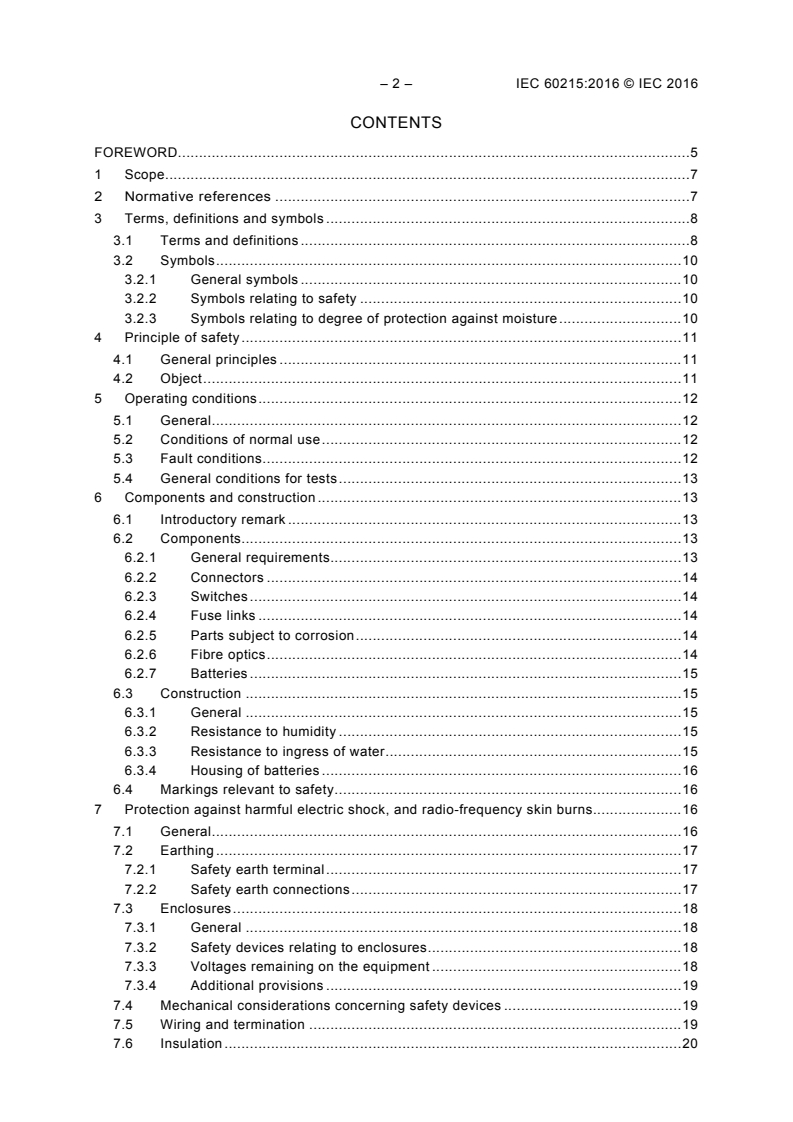
IEC 60215:2016 - Safety requirements for radio transmitting equipment - General requirements and terminology Released:4/27/2016
IEC 60215:2016 - Safety requirements for radio transmitting equipment - General requirements and terminology Released:4/27/2016
Overview
IEC 60215:2016 (Edition 4.0) - titled Safety requirements for radio transmitting equipment – General requirements and terminology - defines safety principles, terms and test methods for radio transmitters and associated apparatus. The standard applies to radio transmitting equipment and integral auxiliary devices (for example, combining units, matching networks and cooling systems) operated under the responsibility of SKILLED persons. Edition 4.0 (2016) is a technical revision of the earlier 1987 edition; test methods remain similar but the content has been reorganized (see Annex F).
Key topics and technical requirements
The standard establishes general safety requirements and guidance covering:
- Terminology and symbols (Clause 3) - core definitions used throughout the standard; words in SMALL CAPITALS are defined terms.
- Operating conditions (normal and fault conditions) and general test conditions.
- Components and construction - requirements for connectors, switches, fuse links, batteries, fibre optics, corrosion-prone parts, housings and integral cooling systems.
- Protection against electric shock and RF skin burns - earthing, enclosures, wiring, insulation, and limits for voltages and currents at RF output connections.
- Thermal, fire and mechanical hazards - permissible temperature rises, touch temperature limits (Annex E), fire, implosion and explosion risks.
- Hazardous substances and dangerous short-circuiting - material safety and fault behaviour.
- Exposure limits and RF safety - guidance for limiting exposure to time-varying electric, magnetic and electromagnetic fields up to 300 GHz (Annex D).
- Clearance and creepage requirements (Annex A) and other prescriptive safety distances.
- Personnel competence and safety procedures - guidance for assigning skilled personnel and safe working practices (Annices B and C).
Practical applications - who uses IEC 60215
IEC 60215 is used by:
- Manufacturers and design engineers creating radio transmitters, combiner and matching network systems, and integral cooling or power subsystems.
- Safety and compliance engineers preparing designs for regulatory approval and product certification.
- Test laboratories and conformity assessment bodies performing safety testing to international benchmarks.
- Facility engineers and installation teams working on transmitter sites, where equipment operation is restricted to skilled personnel.
- Technical writers and training developers creating safe work procedures and operator guidance.
Practical use cases include design verification for insulation/earthing, establishing safe operating/fault conditions, selecting components (fuses, connectors), defining lab test set-ups, and ensuring RF exposure and touch-temperature compliance.
Related guidance and annexes
Key informative and normative annexes provide actionable detail:
- Annex A: clearance and creepage distances
- Annex B: assigning competence of skilled personnel
- Annex C: safety precautions and procedures
- Annex D: exposure limits up to 300 GHz
- Annex E: touch temperature limits
- Annex F: summary of changes in Edition 4.0
For broader compliance, apply IEC 60215 together with other applicable IEC safety and EMC standards and national regulations when certifying radio transmitting equipment.
Buy Documents
IEC 60215:2016 - Safety requirements for radio transmitting equipment - General requirements and terminology Released:4/27/2016
IEC 60215:2016 - Safety requirements for radio transmitting equipment - General requirements and terminology Released:4/27/2016
Get Certified
Connect with accredited certification bodies for this standard

ANCE
Mexican certification and testing association.

Intertek Slovenia
Intertek testing, inspection, and certification services in Slovenia.

LNE (Laboratoire National de Métrologie et d'Essais)
French national laboratory for metrology and testing.
Sponsored listings
Frequently Asked Questions
IEC 60215:2016 is a standard published by the International Electrotechnical Commission (IEC). Its full title is "Safety requirements for radio transmitting equipment - General requirements and terminology". This standard covers: IEC 60215:2016(E) applies to radio transmitting equipment, operating under the responsibility of SKILLED persons. It also applies to auxiliary equipment and ancillary apparatus, including combining units and matching networks and cooling systems where these form an integral part of the transmitter system. This fourth edition cancels and replaces the third edition, published in 1987, Amendment 1:1989 and Amendment 2:1993. This edition constitutes a technical revision. This edition includes the following significant technical changes with respect to the previous edition: - The test methods in this standard are similar to those given in IEC 60215:1987 and continue to apply only to radio transmitting equipment and equipment defined in Clause 1, operating under the responsibility of SKILLED persons. - Reorganization and revision of the content are summarized in Annex F. Words printed in SMALL CAPITALS are terms that are defined in Clause 3.
IEC 60215:2016(E) applies to radio transmitting equipment, operating under the responsibility of SKILLED persons. It also applies to auxiliary equipment and ancillary apparatus, including combining units and matching networks and cooling systems where these form an integral part of the transmitter system. This fourth edition cancels and replaces the third edition, published in 1987, Amendment 1:1989 and Amendment 2:1993. This edition constitutes a technical revision. This edition includes the following significant technical changes with respect to the previous edition: - The test methods in this standard are similar to those given in IEC 60215:1987 and continue to apply only to radio transmitting equipment and equipment defined in Clause 1, operating under the responsibility of SKILLED persons. - Reorganization and revision of the content are summarized in Annex F. Words printed in SMALL CAPITALS are terms that are defined in Clause 3.
IEC 60215:2016 is classified under the following ICS (International Classification for Standards) categories: 33.060.20 - Receiving and transmitting equipment. The ICS classification helps identify the subject area and facilitates finding related standards.
IEC 60215:2016 is available in PDF format for immediate download after purchase. The document can be added to your cart and obtained through the secure checkout process. Digital delivery ensures instant access to the complete standard document.
Standards Content (Sample)
IEC 60215 ®
Edition 4.0 2016-04
INTERNATIONAL
STANDARD
colour
inside
Safety requirements for radio transmitting equipment – General requirements
and terminology
All rights reserved. Unless otherwise specified, no part of this publication may be reproduced or utilized in any form
or by any means, electronic or mechanical, including photocopying and microfilm, without permission in writing from
either IEC or IEC's member National Committee in the country of the requester. If you have any questions about IEC
copyright or have an enquiry about obtaining additional rights to this publication, please contact the address below or
your local IEC member National Committee for further information.
IEC Central Office Tel.: +41 22 919 02 11
3, rue de Varembé Fax: +41 22 919 03 00
CH-1211 Geneva 20 info@iec.ch
Switzerland www.iec.ch
About the IEC
The International Electrotechnical Commission (IEC) is the leading global organization that prepares and publishes
International Standards for all electrical, electronic and related technologies.
About IEC publications
The technical content of IEC publications is kept under constant review by the IEC. Please make sure that you have the
latest edition, a corrigenda or an amendment might have been published.
IEC Catalogue - webstore.iec.ch/catalogue Electropedia - www.electropedia.org
The stand-alone application for consulting the entire The world's leading online dictionary of electronic and
bibliographical information on IEC International Standards, electrical terms containing 20 000 terms and definitions in
Technical Specifications, Technical Reports and other English and French, with equivalent terms in 15 additional
documents. Available for PC, Mac OS, Android Tablets and languages. Also known as the International Electrotechnical
iPad. Vocabulary (IEV) online.
IEC publications search - www.iec.ch/searchpub IEC Glossary - std.iec.ch/glossary
The advanced search enables to find IEC publications by a 65 000 electrotechnical terminology entries in English and
variety of criteria (reference number, text, technical French extracted from the Terms and Definitions clause of
committee,…). It also gives information on projects, replaced IEC publications issued since 2002. Some entries have been
and withdrawn publications. collected from earlier publications of IEC TC 37, 77, 86 and
CISPR.
IEC Just Published - webstore.iec.ch/justpublished
Stay up to date on all new IEC publications. Just Published IEC Customer Service Centre - webstore.iec.ch/csc
details all new publications released. Available online and If you wish to give us your feedback on this publication or
also once a month by email. need further assistance, please contact the Customer Service
Centre: csc@iec.ch.
IEC 60215 ®
Edition 4.0 2016-04
INTERNATIONAL
STANDARD
colour
inside
Safety requirements for radio transmitting equipment – General requirements
and terminology
INTERNATIONAL
ELECTROTECHNICAL
COMMISSION
ICS 33.060.20 ISBN 978-2-8322-3137-1
– 2 – IEC 60215:2016 © IEC 2016
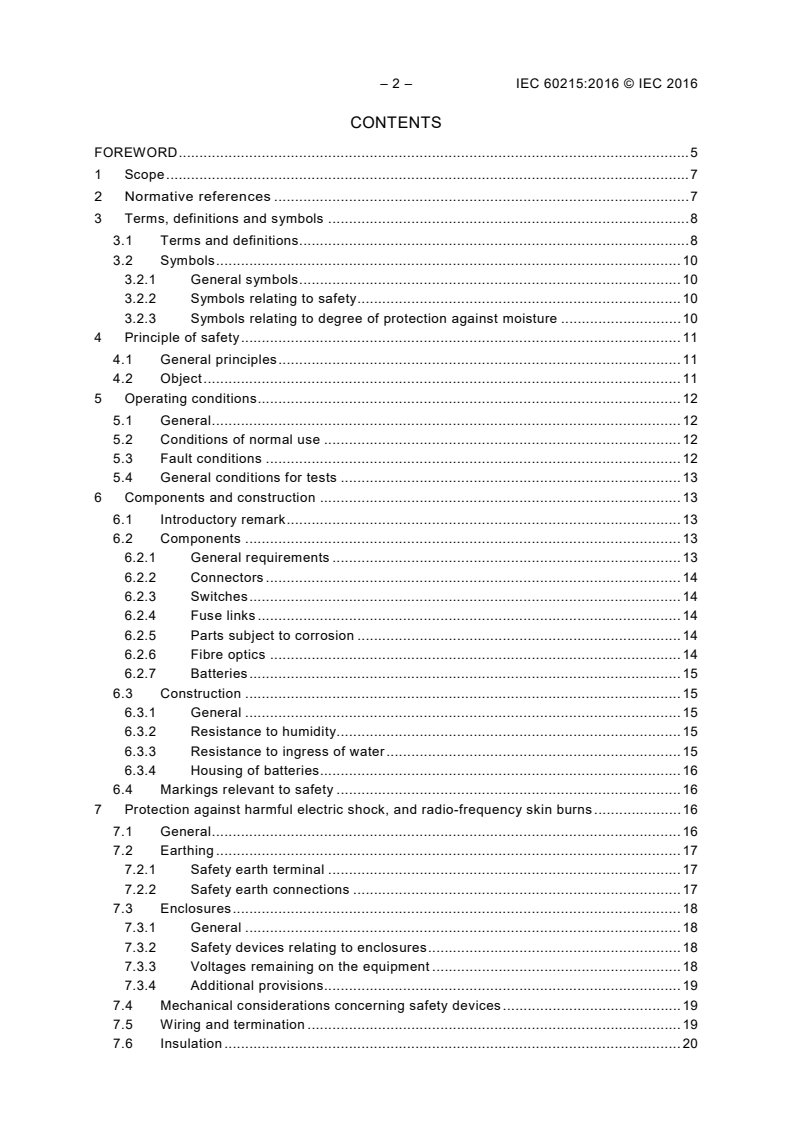
CONTENTS
FOREWORD. 5
1 Scope . 7
2 Normative references . 7
3 Terms, definitions and symbols . 8
3.1 Terms and definitions . 8
3.2 Symbols . 10
3.2.1 General symbols . 10
3.2.2 Symbols relating to safety . 10
3.2.3 Symbols relating to degree of protection against moisture . 10
4 Principle of safety . 11
4.1 General principles . 11
4.2 Object . 11
5 Operating conditions . 12
5.1 General . 12
5.2 Conditions of normal use . 12
5.3 Fault conditions . 12
5.4 General conditions for tests . 13
6 Components and construction . 13
6.1 Introductory remark . 13
6.2 Components. 13
6.2.1 General requirements . 13
6.2.2 Connectors . 14
6.2.3 Switches . 14
6.2.4 Fuse links . 14
6.2.5 Parts subject to corrosion . 14
6.2.6 Fibre optics . 14
6.2.7 Batteries . 15
6.3 Construction . 15
6.3.1 General . 15
6.3.2 Resistance to humidity . 15
6.3.3 Resistance to ingress of water . 15
6.3.4 Housing of batteries . 16
6.4 Markings relevant to safety . 16
7 Protection against harmful electric shock, and radio-frequency skin burns . 16
7.1 General . 16
7.2 Earthing . 17
7.2.1 Safety earth terminal . 17
7.2.2 Safety earth connections . 17
7.3 Enclosures . 18
7.3.1 General . 18
7.3.2 Safety devices relating to enclosures . 18
7.3.3 Voltages remaining on the equipment . 18
7.3.4 Additional provisions . 19
7.4 Mechanical considerations concerning safety devices . 19
7.5 Wiring and termination . 19
7.6 Insulation . 20
7.7 Voltages at the radio-frequency output connection . 20
8 High temperature, fire and miscellaneous hazards . 20
8.1 Introductory remark . 20
8.2 High temperatures . 20
8.2.1 Permissible temperature rise under conditions of normal use . 20
8.2.2 Temperature rise under fault conditions . 20
8.3 Fire . 21
8.4 Implosion and explosion . 21
8.4.1 General requirements . 21
8.4.2 Implosion . 21
8.4.3 Explosion . 21
8.5 Harmful radiation. 21
8.5.1 Non-ionizing radiation, including electromagnetic fields . 21
8.5.2 Ionizing radiation . 22
8.5.3 General requirements concerning radioactive materials . 22
8.5.4 General requirements concerning lasers . 22
8.6 Dangerous materials . 22
8.7 Dangerous short-circuiting of low-voltage supplies . 23
Annex A (normative) Clearance and creepage distances . 24
Annex B (normative) Guidance on assigning the competence of personnel for
designation as skilled . 25
Annex C (normative) Guidance on safety precautions to be observed by personnel
working on radio transmitting equipment . 26
C.1 Introductory remark . 26
C.2 Dangerous voltages and currents . 26
C.3 Electric shock: first-aid treatment . 26
C.4 Operation of transmitting equipment . 27
C.5 Procedure for establishing the absence of voltage . 27
C.6 Procedure for determination of the absence of voltage . 28
C.7 Working on live circuits . 28
C.8 Other hazards . 28
C.8.1 Radio-frequency radiation hazards . 28
C.8.2 Eye protection . 29
Annex D (normative) Guidelines for limiting exposure to time-varying electric,
magnetic and electromagnetic fields (up to 300 GHz) . 30
Annex E (normative) Touch temperature limits . 32
Annex F (informative) Changes in the fourth edition . 33
Bibliography . 35
Figure D.1 – Reference levels for exposure to time-varying electrical fields comparing
Tables D.1 and D.2 . 31
Figure D.2 – Reference levels for exposure to time-varying magnetic fields comparing
Tables D.1 and D.2 . 31
Table 1 – Examples of equipment . 7
Table 2 – Current limits . 16
Table 3 – Capacitance limits . 17
Table A.1 – Clearances and creepage distances . 24
– 4 – IEC 60215:2016 © IEC 2016
Table D.1 – Reference levels for occupational exposure to time-varying electrical and
magnetic fields (unperturbed r.m.s. values) . 30
Table D.2 – Reference levels for general public exposure to time-varying electrical
and magnetic fields (unperturbed r.m.s. values) . 30
Table E.1 – Touch temperature limits . 32
Table F.1 – Reorganization and revision of content between the third and fourth
editions of IEC 60215 . 33
INTERNATIONAL ELECTROTECHNICAL COMMISSION
____________
SAFETY REQUIREMENTS FOR RADIO TRANSMITTING EQUIPMENT –
GENERAL REQUIREMENTS AND TERMINOLOGY
FOREWORD
1) The International Electrotechnical Commission (IEC) is a worldwide organization for standardization comprising
all national electrotechnical committees (IEC National Committees). The object of IEC is to promote
international co-operation on all questions concerning standardization in the electrical and electronic fields. To
this end and in addition to other activities, IEC publishes International Standards, Technical Specifications,
Technical Reports, Publicly Available Specifications (PAS) and Guides (hereafter referred to as “IEC
Publication(s)”). Their preparation is entrusted to technical committees; any IEC National Committee interested
in the subject dealt with may participate in this preparatory work. International, governmental and non-
governmental organizations liaising with the IEC also participate in this preparation. IEC collaborates closely
with the International Organization for Standardization (ISO) in accordance with conditions determined by
agreement between the two organizations.
2) The formal decisions or agreements of IEC on technical matters express, as nearly as possible, an international
consensus of opinion on the relevant subjects since each technical committee has representation from all
interested IEC National Committees.
3) IEC Publications have the form of recommendations for international use and are accepted by IEC National
Committees in that sense. While all reasonable efforts are made to ensure that the technical content of IEC
Publications is accurate, IEC cannot be held responsible for the way in which they are used or for any
misinterpretation by any end user.
4) In order to promote international uniformity, IEC National Committees undertake to apply IEC Publications
transparently to the maximum extent possible in their national and regional publications. Any divergence
between any IEC Publication and the corresponding national or regional publication shall be clearly indicated in
the latter.
5) IEC itself does not provide any attestation of conformity. Independent certification bodies provide conformity
assessment services and, in some areas, access to IEC marks of conformity. IEC is not responsible for any
services carried out by independent certification bodies.
6) All users should ensure that they have the latest edition of this publication.
7) No liability shall attach to IEC or its directors, employees, servants or agents including individual experts and
members of its technical committees and IEC National Committees for any personal injury, property damage or
other damage of any nature whatsoever, whether direct or indirect, or for costs (including legal fees) and
expenses arising out of the publication, use of, or reliance upon, this IEC Publication or any other IEC
Publications.
8) Attention is drawn to the Normative references cited in this publication. Use of the referenced publications is
indispensable for the correct application of this publication.
9) Attention is drawn to the possibility that some of the elements of this IEC Publication may be the subject of
patent rights. IEC shall not be held responsible for identifying any or all such patent rights.
International Standard IEC 60215 has been prepared by IEC technical committee 103:
Transmitting equipment for radiocommunication.
This fourth edition cancels and replaces the third edition, published in 1987,
Amendment 1:1989 and Amendment 2:1993. This edition constitutes a technical revision.
This edition includes the following significant technical changes with respect to the previous
edition:
• The test methods in this standard are similar to those given in IEC 60215:1987 and
continue to apply only to radio transmitting equipment and equipment defined in Clause 1,
operating under the responsibility of SKILLED persons.
• Reorganization and revision of the content are summarized in Annex F.
Words printed in SMALL CAPITALS are terms that are defined in Clause 3.
– 6 – IEC 60215:2016 © IEC 2016
The text of this standard is based on the following documents:
FDIS Report on voting
103/143/FDIS 103/146/RVD
Full information on the voting for the approval of this standard can be found in the report on
voting indicated in the above table.
This publication has been drafted in accordance with the ISO/IEC Directives, Part 2.
The committee has decided that the contents of this publication will remain unchanged until
the stability date indicated on the IEC website under "http://webstore.iec.ch" in the data
related to the specific publication. At this date, the publication will be
• reconfirmed,
• withdrawn,
• replaced by a revised edition, or
• amended.
A bilingual version of this publication may be issued at a later date.
IMPORTANT – The 'colour inside' logo on the cover page of this publication indicates
that it contains colours which are considered to be useful for the correct
understanding of its contents. Users should therefore print this document using a
colour printer.
SAFETY REQUIREMENTS FOR RADIO TRANSMITTING EQUIPMENT –
GENERAL REQUIREMENTS AND TERMINOLOGY
1 Scope
This International Standard applies to radio transmitting equipment, operating under the
responsibility of SKILLED persons. It also applies to auxiliary equipment and ancillary
apparatus, including combining units and matching networks and cooling systems where
these form an integral part of the transmitter system.
The requirements of IEC 60215 may also be used to meet safety requirements for cognate
equipment. Examples of equipment that could be within the scope of this International
Standard are shown in Table 1.
Table 1 – Examples of equipment
Generic product type Specific example of generic type
RF amplifiers High power RF amplifiers used for industrial, medical or scientific
applications
High-voltage power supplies (HVPS) DC HVPS based on PSM technology or any cognate technology
Table 1 is not intended to be comprehensive, and equipment that is not listed is not
necessarily excluded.
When the equipment is to be manufactured and/or installed in territories that have safety
standards covering the scope of this International Standard that are more stringent, then
those standards apply.
Antenna systems, associated feeder lines and matching networks, not forming an integral part
of the transmitter, are excluded.
This International Standard does not apply to transmitters of safety-insulated construction
DOUBLE INSULATION or REINFORCED INSULATION and without provision for protective
using
earthing. This type of equipment is designated CLASS II EQUIPMENT and is usually marked with
a symbol as shown in 3.2.2 b).
This International Standard does not apply to battery powered transmitters or to radio base
stations and fixed terminal stations for wireless telecommunication, as this equipment is
covered by other standards.
2 Normative references
The following documents, in whole or in part, are normatively referenced in this document and
are indispensable for its application. For dated references, only the edition cited applies. For
undated references, the latest edition of the referenced document (including any
amendments) applies.
IEC 60068-2-1, Environmental testing – Part 2-1: Tests – Test A: Cold
IEC 60112, Method for the determination of the proof and the comparative tracking indices of
solid insulating materials
– 8 – IEC 60215:2016 © IEC 2016
IEC 60244-6, Methods of measurement for radio transmitters – Part 6: Cabinet radiation at
frequencies between 130 kHz and 1 GHz
IEC 60529, Degrees of protection provided by enclosures (IP Code)
IEC 60695-1-10, Fire hazard testing – Part 1-10: Guidance for assessing the fire hazard of
electrotechnical products – General guidelines
IEC 60695-1-11, Fire hazard testing – Part 1-11: Guidance for assessing the fire hazard of
electrotechnical products – Fire hazard assessment
IEC 60825-12, Safety of laser products – Part 12: Safety of free space optical communication
systems used for transmission of information
IEC 62232, Determination of RF field strength and SAR in the vicinity of radiocommunication
base stations for the purpose of evaluating human exposure
IEC 62311, Assessment of electronic and electrical equipment related to human exposure
restrictions for electromagnetic fields (0 Hz – 300 GHz)
ISO 1999, Acoustics – Estimation of noise-induced hearing loss
Directive 2011/65/EU of the European Parliament and the Council of 8 June 2011 on the
restriction of the use of hazardous substances in electrical and electronic equipment
3 Terms, definitions and symbols
For the purposes of this document, the following terms, definitions and symbols apply.
3.1 Terms and definitions
3.1.1
skilled
having the necessary knowledge and practical experience of electrical and radio engineering
to appreciate the various hazards that can arise from working on radio transmitters including
auxiliaries, and to take appropriate precautions to ensure the safety of personnel
Note 1 to entry: Guidance on assessing the competence of personnel for designation as SKILLED is given in
Annex B.
Note 2 to entry: The above definition and the guidance in Annex B detail the minimum requirements for a SKILLED
PERSON. In some countries more stringent requirements for qualifications, training and experience are stipulated,
with formal certification.
3.1.2
unskilled
not SKILLED
3.1.3
operator
operating company and operating personnel
3.1.4
operator area
area in which the ICNIRP occupational exposure limits apply
3.1.5
electrically safe
unable to cause a harmful electric shock or radio-frequency skin burn
3.1.6
creepage distance
shortest distance measured in air, over the surface of the insulation, between two conductive
parts, or between a conductive part and the chassis of the equipment
3.1.7
clearance
shortest distance, measured in air, between two conductive parts, or between a conductive
part and the chassis of the equipment
3.1.8
by hand
without the use of a tool, coin or any other object
3.1.9
accessible part
part which can be touched by either of the standard test fingers described in IEC 60529, when
applied in any direction with a force not exceeding 30 N
Note 1 to entry: In addition to guarding against flashover, any part carrying a voltage is regarded as an
ACCESSIBLE PART if its distance to the test finger is less than the CLEARANCE given in Annex A.
3.1.10
enclosure
space in which items of the equipment that might be dangerous are located, and access to
which is prevented, for example, with locked doors or with cover plates which cannot be
removed without using a tool
3.1.11
safety device
part or component provided for the purpose of protecting personnel from possible injury
3.1.12
Class II equipment
equipment in which protection against electric shock does not rely on BASIC INSULATION only,
but in which additional safety precautions, such as DOUBLE INSULATION or REINFORCED
INSULATION are provided, there being no reliance on protective earthing
3.1.13
basic insulation
insulation that provides basic protection against electric shock
3.1.14
double insulation
insulation comprising both BASIC INSULATION and an independent insulation in order to reduce
the risk of electric shock in the event of a failure of the BASIC INSULATION
3.1.15
reinforced insulation
single insulation system that provides a degree of protection against electric shock equivalent
to DOUBLE INSULATION
– 10 – IEC 60215:2016 © IEC 2016
3.2 Symbols
As far as practicable, the symbols given below conform to those given in IEC 60417.
3.2.1 General symbols
a) AC supply IEC 60417-5032 (2002-10)
b) DC supply IEC 60417-5031 (2002-10)
c) AC and DC supply IEC 60417-5033 (2002-10)
d) Three-phase AC supply IEC 60417-5032-1 (2002-10)
e) Earth IEC 60417-5017 (2006-08)
f) Aerial; antenna IEC 60417-5039 (2006-08)
g) Special disposal restrictions apply
3.2.2 Symbols relating to safety
a) Safety earth IEC 60417-5019 (2006-08)
b) Equipment of safety insulated IEC 60417-5172 (2003-02)
construction
(CLASS II EQUIPMENT)
IEC 60417-5036 (2002-10)
c) Dangerous voltage
d) Ionizing radiation ISO 7000-0907 (2004-01)
e) High temperature IEC 60417-5041 (2002-10)
3.2.3 Symbols relating to degree of protection against moisture
IP codes (International Protection Marking) are used to indicate the degree of protection
against the intrusion of solid particles or water. The first digit of the code indicates the
protection against solid particles and the second digit the protection against ingress of water.
Where no protection is specified for solid particles, this digit is replaced with the letter X.
The the following IP codes apply for ingress of water:
IPX0 Non-protected
IPX1 Protected against vertically falling water drops
IPX2 Protected against vertically falling water drops when enclosure tilted up to 15°
IPX3 Protected against spraying water
IPX4 Protected against splashing water
IPX5 Protected against water jets
IPX6 Protected against powerful water jets
IPX7 Protected against the effects of temporary immersion in water
IPX8 Protected against the effects of continuous immersion in water
IPX9 Protected against high pressure and temperature water jets
4 Principle of safety
4.1 General principles
It is essential that designers understand the underlying principles of safety requirements in
order that they can engineer safe equipment.
Designers shall take into account not only normal operating conditions of the equipment but
also fault conditions, foreseeable misuse and external influences such as temperature,
altitude, pollution, moisture and overvoltages on the mains supply. Dimensioning of insulation
spacing should take account of possible reductions by manufacturing tolerances, or where
deformation could occur due to handling, shock ageing and vibration likely to be encountered
during manufacture, transport and normal use.
There are two types of person whose safety needs to be considered, SKILLED persons and
UNSKILLED persons.
Requirements for protection should assume that UNSKILLED persons are not trained to identify
hazards, but will not intentionally create a hazardous situation. Consequently, the
requirements provide protection for cleaners and casual visitors and all other UNSKILLED
UNSKILLED persons should not have access to hazardous parts, whether
persons. In general,
or not such parts are marked or barriered.
4.2 Object
This International Standard specifies requirements intended to reduce risks of
• electric shock,
• skin burns,
• high temperature and fire,
• injury from harmful radiation, and
• mechanical or any other hazard,
for the persons who may come into contact with the equipment covered by this International
Standard.
This International Standard is intended to reduce such risks with respect to installed
equipment, whether it consists of a system of interconnected units or independent units,
subject to installing, operating and maintaining the equipment in the manner prescribed by the
manufacturer.
Design and construction requirements and, where appropriate, test methods are specified
covering the following:
a) the safety of SKILLED personnel when operating, carrying out routine adjustments, and as
far as practicable, during fault finding and repairing the equipment;
b) the safety of personnel, including UNSKILLED personnel directed by SKILLED personnel,
when the equipment is operating normally, and also when operating under certain specific
fault conditions which may arise in normal use;
c) the prevention of fire and its spread.
These requirements do not necessarily ensure the safety of UNSKILLED personnel
working on the equipment when it is not in normal operation.
Tests are specified, where appropriate, for checking that the equipment meets the
safety requirements of this International Standard when operating normally and also
under the specified fault conditions. The tests should be carried out on a representative
– 12 – IEC 60215:2016 © IEC 2016
set of equipment in order to determine whether the design meets the requirements of
this International Standard. The tests are neither mandatory nor limiting and may be
modified by agreement between manufacturer and purchaser.
The use of this International Standard is not, however, intended to be restricted to type tests. It
may also be used for acceptance tests after installation of the equipment, for tests after
modifications to parts of the equipment, and for tests at appropriate intervals to ensure
the continuing safety of the equipment throughout its life.
5 Operating conditions
5.1 General
Clause 5 sets out the range of conditions of normal use and the fault conditions under which
the equipment may operate without danger to personnel, including UNSKILLED personnel
directed by SKILLED personnel. The equipment shall meet the safety requirements of this
International Standard when operating under the conditions of normal use given in 5.2 and
also when any of the initial fault conditions detailed in 5.3 have been applied.
5.2 Conditions of normal use
The conditions of normal use are as follows.
a) The temperature and humidity conditions shall be compliant with the material specification
as well as within conditions agreed between manufacturer and purchaser.
b) Temperature and humidity shall never be such as to cause condensation on the
equipment.
c) Where no specific environmental condition exists, the atmospheric conditions shall be
within the following range:
– temperature: +5 °C to +45 °C;
– relative humidity: 45 % to 75 %, without condensation;
– air pressure: 86 kPa to 106 kPa (860 mbar to 1 060 mbar).
d) The supply voltage and frequency shall be within the range for which the equipment has
been designed.
e) For AC equipment, the waveform of the supply voltage shall be substantially sinusoidal.
f) For equipment which may be operated from AC or DC, either supply shall be applied
separately.
g) The safety earth terminals or contacts, if any, (see 7.2.1) and any other earth terminal
shall be connected to earth, unless they are designed to be tightened BY HAND, in which
case they shall be left unconnected.
h) The access doors and cover plates or other protective covers, if any, shall be closed or
fixed in position unless they are designed to be opened or removed BY HAND, in which
case they may be left open or removed.
i) The equipment shall operate in any position for which it has been designed to be used.
j) The equipment shall be controllable at any operating state.
k) The equipment shall operate with any input signal condition and output load given in the
equipment specification.
5.3 Fault conditions
Operating under fault conditions denotes that, with the equipment operating under the
conditions of normal use given in 5.2, one of the faults a) to i) listed below is present, together
with any associated consequential faults arising. The initial faults shall be applied separately,
in turn, in any convenient order.
The faults are as follows:
a) short circuits across CREEPAGE DISTANCES, if they are less than the values given in
Annex A, unless the insulation materials are resistant to tracking and non-flammable (for
details see 7.6);
b) short circuits across CLEARANCES, if they are less than the values given in Annex A;
c) a potentially dangerous failure of any component as determined from inspecting the
equipment and studying the circuit diagram, unless the component is known to comply
with an IEC test recommendation appropriate to the conditions of use in the equipment;
d) connection of any unfavourable impedance to the radio-frequency output connection,
including open circuits and short circuits;
e) failure of any cooling system;
f) continuous operation of motors, intended for intermittent operation, unless protection
against this is included in the equipment;
g) locking of moving parts in rotating or linear operating devices, if these parts can be
jammed by mechanical failure;
h) the loss of one or more phases on a three-phase supply;
i) the loss of the neutral conductor on a three-phases, four wire supply.
5.4 General conditions for tests
General conditions for tests shall comply with the international standards which define the
methods of measurement of the equipment concerned.
Partial deviated test conditions might be mutually agreed between purchaser and supplier.
6 Components and construction
6.1 Introductory remark
The purpose of Clause 6 is to ensure that the equipment is designed and constructed to
ensure safety of the personnel throughout the life of the equipment, starting from the
development through the operation of entire systems and the disposal of disused equipment.
Where no test method is given, compliance shall be checked by visual inspection and where
appropriate by functional test.
6.2 Components
6.2.1 General requirements
Components shall not be loaded in excess of their ratings under normal conditions nor, as far
as practicable, under fault conditions. Normal and fault conditions are described in 5.2 and
5.3
Components which are known to comply with an IEC test recommendation appropriate to the
conditions of use in the equipment need not be tested.
When this is not so, the components may be tested either in the equipment or externally
under conditions equivalent to those applying in the equipment. The number of components to
be tested shall be agreed between manufacturer and purchaser.
– 14 – IEC 60215:2016 © IEC 2016
6.2.2 Connectors
The following requirements apply.
a) Connectors shall be designed so that they cannot be mated in a manner which might
cause a hazard, for example, a connector for a circuit other than a supply circuit shall not
be able to accept a mains supply connector. Mains supply connectors shall not be used
for any other purpose, for example for low-voltage supplies or signal circuits.
b) Connectors shall be constructed so as to prevent a bare wire inserted into the connector
from penetrating the connector and making contact with any other part.
c) Connectors and internal connections for ancillary purposes such as monitoring shall have
CLEARANCE and CREEPAGE DISTANCES to other circuits at least twice those specified in
Annex A.
d) Connectors with a non-detachable cord or cable shall comply with the country-specific
safety standard.
6.2.3 Switches
Circuit breakers and manually-operated switches for the mains supply and other supply
circuits shall have adequate making and breaking capacity under conditions of normal use.
Circuit breakers shall also have adequate making and breaking capacity under fault
conditions.
Switches, including circuit breakers and safety isolators, shall disconnect the equipment
simultaneously from all poles of the supply source necessary to make the equipment safe.
In case of three-phase supplies using an arrangement of single phase breaker, the neutral
pole shall not be protected.
An indication of the ON and OFF positions of such switches shall be provided and be clearly
visible.
NOTE In some countries local regulations require that the neutral pole be isolated to render the equipment safe
and in others that this not be done.
6.2.4 Fuse links
Fuse links shall have an enclosed fuse element. Where practicable, the rating of the fuse link
shall be marked on the fixed part of the assembly or adjacent to it.
Special fusing characteristics such as time delay or breaking capacity shall at least be
indicated in the manual.
6.2.5 Parts subject to corrosion
The equipment shall be so constructed so that there is no danger to personnel resulting from
the failure of any part due to corrosion.
Tests shall be agreed between manufacturer and purchaser.
6.2.6 Fibre optics
In order to prevent eye injury, fibre optic transmitters of laser class 1 (eye safe) shall be used
to prevent fibre optics allowing powered laser light at dangerous intensity.
Equipment containing fibre optics of laser class 1M or higher and accessible to SKILLED
persons or UNSKILLED persons shall be in accordance with IEC 60825-12.
6.2.7 Batteries
The following requirements apply.
a) The equipment shall not contain
– any battery or accumulator that contains more than 0,000 5 % of mercury by weight;
and
– portable batteries or accumulators, including those incorporated into appliances that
contain more than 0,002 % of cadmium by weight;
b) Batteries, accumulators and battery packs shall be appropriated marked with the symbol
shown in 3.2.1 g).
c) If equipment is provided with a replaceable battery, and if replacement by an incorrect
type could result in an explosion (for example, with some lithium batteries), there shall be
a marking close to the battery or a statement in the operating and servicing instructions.
This marking or statement shall include the following or similar text:
CAUTION: RISK OF EXPLOSION IF BATTERY IS REPLACED BY AN INCORRECT
TYPE. DISPOSE OF USED BATTERIES ACCORDING TO THE INSTRUCTIONS
6.3 Construction
6.3.1 General
The following requirements apply.
a) The equipment shall, as far as practicable, be constructed of non-flammable materials and
shall have adequate strength to ensure safety.
b) No hazardous substances according to the “Restriction of hazardous substances” (RoHS)
Directive 2011/65/EU shall be used, except where the directive allows exemption.
c) Where the slackness of electrical connections could constitute a hazard, their tightness
shall not be dependent upon the degree of compression applied to an insulating material.
d) Screws which serve both as electrical and mechanical connections shall be adequately
locked.
e) Moving parts liable to cause personal injury shall be adequately guarded.
f) Where parts can be set in motion by remote control, suitable precautions shall be
incorporated to prevent possible injury and shall have suitable labelling adjacent to the
remotely controlled part.
g) Equipment shall be mechanically designed to minimize the possibility of injury to
personnel from sharp edges, protruding corners, hot pipes, the release of potential energy
from, for example, a spring, etc. Warnings shall be displayed where appropriate.
h) Attention shall be paid in the design of equipment to minimize the generation of acoustic
noise, as exposure to excessive noise can cause damage to hearing and to the nervous
system. Where noise exceeds the safe value recommended in ISO 1999, notices shall be
displayed giving the safe exposure time allowed and recommending that ear protectors be
worn. Such noise levels may, for example, exist in rooms housing cooling plant for large
transmitters.
6.3.2 Resistance to humidity
Tests to check the resistance to humidity shall be agreed between manufacturer and
purchaser and shall be made after the equipment has been subjected to the appropriate damp
heat test given in IEC 60068-2-1.
6.3.3 Resistance to ingress of water
If the transmitter is specified as protected against the ingress of water (see IP codes in 0), it
shall remain safe when tested under the conditions agreed between manufacturer and
– 16 – IEC 60215:2016 © IEC 2016
purchaser. The test shall be made after the equipment has been subjected to the appropriate
sealing test given in IEC 60068-2-1.
6.3.4 Housing of batteries
The arrangements for housing lead-acid and nickel-cadmium batteries shall provide adequate
ventilation to remove noxious gas and vapours and ensure that leakage of electrolyte will
neither cause damage to other parts nor endanger personnel.
6.4 Markings relevant to safety
The following safety marking shall be used:
a) Marking shall be indelible and remain easily legible and discernible throughout the life of
the equipment. Compliance is checked by visual inspection and by the following tests:
• it shall not be possible to remove the marking by rubbing lightly in turn with two pieces
of cloth, one soaked with water, the other with petroleum spirit;
• when exposed to sunlight, the marking shall not fade so as to become illegible.
b) Safety-markings shall, as far as practicable, be in the language appropriate to the area in
which the equipment is to be used. Symbols should be used to avoid language problems.
c) Switches and isolators specifically provided to ren
...
IEC 60215 ®
Edition 4.0 2016-04
INTERNATIONAL
STANDARD
NORME
INTERNATIONALE
colour
inside
Safety requirements for radio transmitting equipment – General requirements
and terminology
Exigences de sécurité applicables aux matériels d'émission radioélectrique –
Exigences générales et terminologie
All rights reserved. Unless otherwise specified, no part of this publication may be reproduced or utilized in any form
or by any means, electronic or mechanical, including photocopying and microfilm, without permission in writing from
either IEC or IEC's member National Committee in the country of the requester. If you have any questions about IEC
copyright or have an enquiry about obtaining additional rights to this publication, please contact the address below or
your local IEC member National Committee for further information.
Droits de reproduction réservés. Sauf indication contraire, aucune partie de cette publication ne peut être reproduite
ni utilisée sous quelque forme que ce soit et par aucun procédé, électronique ou mécanique, y compris la photocopie
et les microfilms, sans l'accord écrit de l'IEC ou du Comité national de l'IEC du pays du demandeur. Si vous avez des
questions sur le copyright de l'IEC ou si vous désirez obtenir des droits supplémentaires sur cette publication, utilisez
les coordonnées ci-après ou contactez le Comité national de l'IEC de votre pays de résidence.
IEC Central Office Tel.: +41 22 919 02 11
3, rue de Varembé Fax: +41 22 919 03 00
CH-1211 Geneva 20 info@iec.ch
Switzerland www.iec.ch
About the IEC
The International Electrotechnical Commission (IEC) is the leading global organization that prepares and publishes
International Standards for all electrical, electronic and related technologies.
About IEC publications
The technical content of IEC publications is kept under constant review by the IEC. Please make sure that you have the
latest edition, a corrigenda or an amendment might have been published.
IEC Catalogue - webstore.iec.ch/catalogue Electropedia - www.electropedia.org
The stand-alone application for consulting the entire The world's leading online dictionary of electronic and
bibliographical information on IEC International Standards, electrical terms containing 20 000 terms and definitions in
Technical Specifications, Technical Reports and other English and French, with equivalent terms in 15 additional
documents. Available for PC, Mac OS, Android Tablets and languages. Also known as the International Electrotechnical
iPad. Vocabulary (IEV) online.
IEC publications search - www.iec.ch/searchpub IEC Glossary - std.iec.ch/glossary
The advanced search enables to find IEC publications by a 65 000 electrotechnical terminology entries in English and
variety of criteria (reference number, text, technical French extracted from the Terms and Definitions clause of
committee,…). It also gives information on projects, replaced IEC publications issued since 2002. Some entries have been
and withdrawn publications. collected from earlier publications of IEC TC 37, 77, 86 and
CISPR.
IEC Just Published - webstore.iec.ch/justpublished
Stay up to date on all new IEC publications. Just Published IEC Customer Service Centre - webstore.iec.ch/csc
details all new publications released. Available online and If you wish to give us your feedback on this publication or
also once a month by email. need further assistance, please contact the Customer Service
Centre: csc@iec.ch.
A propos de l'IEC
La Commission Electrotechnique Internationale (IEC) est la première organisation mondiale qui élabore et publie des
Normes internationales pour tout ce qui a trait à l'électricité, à l'électronique et aux technologies apparentées.
A propos des publications IEC
Le contenu technique des publications IEC est constamment revu. Veuillez vous assurer que vous possédez l’édition la
plus récente, un corrigendum ou amendement peut avoir été publié.
Catalogue IEC - webstore.iec.ch/catalogue Electropedia - www.electropedia.org
Application autonome pour consulter tous les renseignements
Le premier dictionnaire en ligne de termes électroniques et
bibliographiques sur les Normes internationales,
électriques. Il contient 20 000 termes et définitions en anglais
Spécifications techniques, Rapports techniques et autres
et en français, ainsi que les termes équivalents dans 15
documents de l'IEC. Disponible pour PC, Mac OS, tablettes
langues additionnelles. Egalement appelé Vocabulaire
Android et iPad.
Electrotechnique International (IEV) en ligne.
Recherche de publications IEC - www.iec.ch/searchpub
Glossaire IEC - std.iec.ch/glossary
65 000 entrées terminologiques électrotechniques, en anglais
La recherche avancée permet de trouver des publications IEC
en utilisant différents critères (numéro de référence, texte, et en français, extraites des articles Termes et Définitions des
comité d’études,…). Elle donne aussi des informations sur les publications IEC parues depuis 2002. Plus certaines entrées
projets et les publications remplacées ou retirées. antérieures extraites des publications des CE 37, 77, 86 et
CISPR de l'IEC.
IEC Just Published - webstore.iec.ch/justpublished
Service Clients - webstore.iec.ch/csc
Restez informé sur les nouvelles publications IEC. Just
Published détaille les nouvelles publications parues. Si vous désirez nous donner des commentaires sur cette
Disponible en ligne et aussi une fois par mois par email. publication ou si vous avez des questions contactez-nous:
csc@iec.ch.
IEC 60215 ®
Edition 4.0 2016-04
INTERNATIONAL
STANDARD
NORME
INTERNATIONALE
colour
inside
Safety requirements for radio transmitting equipment – General requirements
and terminology
Exigences de sécurité applicables aux matériels d'émission radioélectrique –
Exigences générales et terminologie
INTERNATIONAL
ELECTROTECHNICAL
COMMISSION
COMMISSION
ELECTROTECHNIQUE
INTERNATIONALE
ICS 33.060.20 ISBN 978-2-8322-3771-7
– 2 – IEC 60215:2016 © IEC 2016
CONTENTS
FOREWORD . 5
1 Scope . 7
2 Normative references . 7
3 Terms, definitions and symbols . 8
3.1 Terms and definitions. 8
3.2 Symbols . 10
3.2.1 General symbols . 10
3.2.2 Symbols relating to safety . 10
3.2.3 Symbols relating to degree of protection against moisture . 10
4 Principle of safety . 11
4.1 General principles . 11
4.2 Object . 11
5 Operating conditions . 12
5.1 General . 12
5.2 Conditions of normal use . 12
5.3 Fault conditions . 12
5.4 General conditions for tests . 13
6 Components and construction . 13
6.1 Introductory remark . 13
6.2 Components . 13
6.2.1 General requirements . 13
6.2.2 Connectors . 14
6.2.3 Switches . 14
6.2.4 Fuse links . 14
6.2.5 Parts subject to corrosion . 14
6.2.6 Fibre optics . 14
6.2.7 Batteries . 15
6.3 Construction . 15
6.3.1 General . 15
6.3.2 Resistance to humidity. 15
6.3.3 Resistance to ingress of water . 15
6.3.4 Housing of batteries. 16
6.4 Markings relevant to safety . 16
7 Protection against harmful electric shock, and radio-frequency skin burns . 16
7.1 General . 16
7.2 Earthing . 17
7.2.1 Safety earth terminal . 17
7.2.2 Safety earth connections . 17
7.3 Enclosures . 18
7.3.1 General . 18
7.3.2 Safety devices relating to enclosures . 18
7.3.3 Voltages remaining on the equipment . 18
7.3.4 Additional provisions. 19
7.4 Mechanical considerations concerning safety devices . 19
7.5 Wiring and termination . 19
7.6 Insulation . 20
7.7 Voltages at the radio-frequency output connection . 20
8 High temperature, fire and miscellaneous hazards . 20
8.1 Introductory remark . 20
8.2 High temperatures . 20
8.2.1 Permissible temperature rise under conditions of normal use. 20
8.2.2 Temperature rise under fault conditions . 20
8.3 Fire . 21
8.4 Implosion and explosion. 21
8.4.1 General requirements . 21
8.4.2 Implosion . 21
8.4.3 Explosion . 21
8.5 Harmful radiation . 21
8.5.1 Non-ionizing radiation, including electromagnetic fields . 21
8.5.2 Ionizing radiation . 22
8.5.3 General requirements concerning radioactive materials . 22
8.5.4 General requirements concerning lasers . 22
8.6 Dangerous materials . 22
8.7 Dangerous short-circuiting of low-voltage supplies . 23
Annex A (normative) Clearance and creepage distances . 24
Annex B (normative) Guidance on assigning the competence of personnel for
designation as skilled . 25
Annex C (normative) Guidance on safety precautions to be observed by personnel
working on radio transmitting equipment . 26
C.1 Introductory remark . 26
C.2 Dangerous voltages and currents . 26
C.3 Electric shock: first-aid treatment . 26
C.4 Operation of transmitting equipment . 27
C.5 Procedure for establishing the absence of voltage . 27
C.6 Procedure for determination of the absence of voltage . 28
C.7 Working on live circuits . 28
C.8 Other hazards . 28
C.8.1 Radio-frequency radiation hazards . 28
C.8.2 Eye protection . 29
Annex D (normative) Guidelines for limiting exposure to time-varying electric,
magnetic and electromagnetic fields (up to 300 GHz) . 30
Annex E (normative) Touch temperature limits . 32
Annex F (informative) Changes in the fourth edition . 33
Bibliography . 35
Figure D.1 – Reference levels for exposure to time-varying electrical fields comparing
Tables D.1 and D.2 . 31
Figure D.2 – Reference levels for exposure to time-varying magnetic fields comparing
Tables D.1 and D.2 . 31
Table 1 – Examples of equipment . 7
Table 2 – Current limits . 16
Table 3 – Capacitance limits . 17
Table A.1 – Clearances and creepage distances . 24
– 4 – IEC 60215:2016 © IEC 2016
Table D.1 – Reference levels for occupational exposure to time-varying electrical and
magnetic fields (unperturbed r.m.s. values). 30
Table D.2 – Reference levels for general public exposure to time-varying electrical
and magnetic fields (unperturbed r.m.s. values) . 30
Table E.1 – Touch temperature limits . 32
Table F.1 – Reorganization and revision of content between the third and fourth
editions of IEC 60215 . 33
INTERNATIONAL ELECTROTECHNICAL COMMISSION
____________
SAFETY REQUIREMENTS FOR RADIO TRANSMITTING EQUIPMENT –
GENERAL REQUIREMENTS AND TERMINOLOGY
FOREWORD
1) The International Electrotechnical Commission (IEC) is a worldwide organization for standardization comprising
all national electrotechnical committees (IEC National Committees). The object of IEC is to promote
international co-operation on all questions concerning standardization in the electrical and electronic fields. To
this end and in addition to other activities, IEC publishes International Standards, Technical Specifications,
Technical Reports, Publicly Available Specifications (PAS) and Guides (hereafter referred to as “IEC
Publication(s)”). Their preparation is entrusted to technical committees; any IEC National Committee interested
in the subject dealt with may participate in this preparatory work. International, governmental and non-
governmental organizations liaising with the IEC also participate in this preparation. IEC collaborates closely
with the International Organization for Standardization (ISO) in accordance with conditions determined by
agreement between the two organizations.
2) The formal decisions or agreements of IEC on technical matters express, as nearly as possible, an international
consensus of opinion on the relevant subjects since each technical committee has representation from all
interested IEC National Committees.
3) IEC Publications have the form of recommendations for international use and are accepted by IEC National
Committees in that sense. While all reasonable efforts are made to ensure that the technical content of IEC
Publications is accurate, IEC cannot be held responsible for the way in which they are used or for any
misinterpretation by any end user.
4) In order to promote international uniformity, IEC National Committees undertake to apply IEC Publications
transparently to the maximum extent possible in their national and regional publications. Any divergence
between any IEC Publication and the corresponding national or regional publication shall be clearly indicated in
the latter.
5) IEC itself does not provide any attestation of conformity. Independent certification bodies provide conformity
assessment services and, in some areas, access to IEC marks of conformity. IEC is not responsible for any
services carried out by independent certification bodies.
6) All users should ensure that they have the latest edition of this publication.
7) No liability shall attach to IEC or its directors, employees, servants or agents including individual experts and
members of its technical committees and IEC National Committees for any personal injury, property damage or
other damage of any nature whatsoever, whether direct or indirect, or for costs (including legal fees) and
expenses arising out of the publication, use of, or reliance upon, this IEC Publication or any other IEC
Publications.
8) Attention is drawn to the Normative references cited in this publication. Use of the referenced publications is
indispensable for the correct application of this publication.
9) Attention is drawn to the possibility that some of the elements of this IEC Publication may be the subject of
patent rights. IEC shall not be held responsible for identifying any or all such patent rights.
International Standard IEC 60215 has been prepared by IEC technical committee 103:
Transmitting equipment for radiocommunication.
This bilingual version (2017-01) corresponds to the monolingual English version, published in
2016-04.
This fourth edition cancels and replaces the third edition, published in 1987,
Amendment 1:1989 and Amendment 2:1993. This edition constitutes a technical revision.
This edition includes the following significant technical changes with respect to the previous
edition:
• The test methods in this standard are similar to those given in IEC 60215:1987 and
continue to apply only to radio transmitting equipment and equipment defined in Clause 1,
operating under the responsibility of SKILLED persons.
• Reorganization and revision of the content are summarized in Annex F.
Words printed in SMALL CAPITALS are terms that are defined in Clause 3.
– 6 – IEC 60215:2016 © IEC 2016
The text of this standard is based on the following documents:
FDIS Report on voting
103/143/FDIS 103/146/RVD
Full information on the voting for the approval of this standard can be found in the report on
voting indicated in the above table.
The French version of this standard has not been voted upon.
This publication has been drafted in accordance with the ISO/IEC Directives, Part 2.
The committee has decided that the contents of this publication will remain unchanged until
the stability date indicated on the IEC website under "http://webstore.iec.ch" in the data
related to the specific publication. At this date, the publication will be
• reconfirmed,
• withdrawn,
• replaced by a revised edition, or
• amended.
IMPORTANT – The 'colour inside' logo on the cover page of this publication indicates
that it contains colours which are considered to be useful for the correct
understanding of its contents. Users should therefore print this document using a
colour printer.
SAFETY REQUIREMENTS FOR RADIO TRANSMITTING EQUIPMENT –
GENERAL REQUIREMENTS AND TERMINOLOGY
1 Scope
This International Standard applies to radio transmitting equipment, operating under the
responsibility of SKILLED persons. It also applies to auxiliary equipment and ancillary
apparatus, including combining units and matching networks and cooling systems where
these form an integral part of the transmitter system.
The requirements of IEC 60215 may also be used to meet safety requirements for cognate
equipment. Examples of equipment that could be within the scope of this International
Standard are shown in Table 1.
Table 1 – Examples of equipment
Generic product type Specific example of generic type
RF amplifiers High power RF amplifiers used for industrial, medical or scientific
applications
High-voltage power supplies (HVPS) DC HVPS based on PSM technology or any cognate technology
Table 1 is not intended to be comprehensive, and equipment that is not listed is not
necessarily excluded.
When the equipment is to be manufactured and/or installed in territories that have safety
standards covering the scope of this International Standard that are more stringent, then
those standards apply.
Antenna systems, associated feeder lines and matching networks, not forming an integral part
of the transmitter, are excluded.
This International Standard does not apply to transmitters of safety-insulated construction
DOUBLE INSULATION or REINFORCED INSULATION and without provision for protective
using
earthing. This type of equipment is designated CLASS II EQUIPMENT and is usually marked with
a symbol as shown in 3.2.2 b).
This International Standard does not apply to battery powered transmitters or to radio base
stations and fixed terminal stations for wireless telecommunication, as this equipment is
covered by other standards.
2 Normative references
The following documents, in whole or in part, are normatively referenced in this document and
are indispensable for its application. For dated references, only the edition cited applies. For
undated references, the latest edition of the referenced document (including any
amendments) applies.
IEC 60068-2-1, Environmental testing – Part 2-1: Tests – Test A: Cold
IEC 60112, Method for the determination of the proof and the comparative tracking indices of
solid insulating materials
– 8 – IEC 60215:2016 © IEC 2016
IEC 60244-6, Methods of measurement for radio transmitters – Part 6: Cabinet radiation at
frequencies between 130 kHz and 1 GHz
IEC 60529, Degrees of protection provided by enclosures (IP Code)
IEC 60695-1-10, Fire hazard testing – Part 1-10: Guidance for assessing the fire hazard of
electrotechnical products – General guidelines
IEC 60695-1-11, Fire hazard testing – Part 1-11: Guidance for assessing the fire hazard of
electrotechnical products – Fire hazard assessment
IEC 60825-12, Safety of laser products – Part 12: Safety of free space optical communication
systems used for transmission of information
IEC 62232, Determination of RF field strength and SAR in the vicinity of radiocommunication
base stations for the purpose of evaluating human exposure
IEC 62311, Assessment of electronic and electrical equipment related to human exposure
restrictions for electromagnetic fields (0 Hz – 300 GHz)
ISO 1999, Acoustics – Estimation of noise-induced hearing loss
Directive 2011/65/EU of the European Parliament and the Council of 8 June 2011 on the
restriction of the use of hazardous substances in electrical and electronic equipment
3 Terms, definitions and symbols
For the purposes of this document, the following terms, definitions and symbols apply.
3.1 Terms and definitions
3.1.1
skilled
having the necessary knowledge and practical experience of electrical and radio engineering
to appreciate the various hazards that can arise from working on radio transmitters including
auxiliaries, and to take appropriate precautions to ensure the safety of personnel
Note 1 to entry: Guidance on assessing the competence of personnel for designation as SKILLED is given in
Annex B.
Note 2 to entry: The above definition and the guidance in Annex B detail the minimum requirements for a SKILLED
PERSON. In some countries more stringent requirements for qualifications, training and experience are stipulated,
with formal certification.
3.1.2
unskilled
not SKILLED
3.1.3
operator
operating company and operating personnel
3.1.4
operator area
area in which the ICNIRP occupational exposure limits apply
3.1.5
electrically safe
unable to cause a harmful electric shock or radio-frequency skin burn
3.1.6
creepage distance
shortest distance measured in air, over the surface of the insulation, between two conductive
parts, or between a conductive part and the chassis of the equipment
3.1.7
clearance
shortest distance, measured in air, between two conductive parts, or between a conductive
part and the chassis of the equipment
3.1.8
by hand
without the use of a tool, coin or any other object
3.1.9
accessible part
part which can be touched by either of the standard test fingers described in IEC 60529, when
applied in any direction with a force not exceeding 30 N
Note 1 to entry: In addition to guarding against flashover, any part carrying a voltage is regarded as an
ACCESSIBLE PART if its distance to the test finger is less than the CLEARANCE given in Annex A.
3.1.10
enclosure
space in which items of the equipment that might be dangerous are located, and access to
which is prevented, for example, with locked doors or with cover plates which cannot be
removed without using a tool
3.1.11
safety device
part or component provided for the purpose of protecting personnel from possible injury
3.1.12
Class II equipment
equipment in which protection against electric shock does not rely on BASIC INSULATION only,
but in which additional safety precautions, such as DOUBLE INSULATION or REINFORCED
INSULATION are provided, there being no reliance on protective earthing
3.1.13
basic insulation
insulation that provides basic protection against electric shock
3.1.14
double insulation
insulation comprising both BASIC INSULATION and an independent insulation in order to reduce
the risk of electric shock in the event of a failure of the BASIC INSULATION
3.1.15
reinforced insulation
single insulation system that provides a degree of protection against electric shock equivalent
to DOUBLE INSULATION
– 10 – IEC 60215:2016 © IEC 2016
3.2 Symbols
As far as practicable, the symbols given below conform to those given in IEC 60417.
3.2.1 General symbols
a) AC supply IEC 60417-5032 (2002-10)
b) DC supply IEC 60417-5031 (2002-10)
c) AC and DC supply IEC 60417-5033 (2002-10)
d) Three-phase AC supply IEC 60417-5032-1 (2002-10)
e) Earth IEC 60417-5017 (2006-08)
f) Aerial; antenna IEC 60417-5039 (2006-08)
g) Special disposal restrictions apply
3.2.2 Symbols relating to safety
a) Safety earth IEC 60417-5019 (2006-08)
b) Equipment of safety insulated
IEC 60417-5172 (2003-02)
construction
(CLASS II EQUIPMENT)
c) Dangerous voltage IEC 60417-5036 (2002-10)
d) Ionizing radiation ISO 7000-0907 (2004-01)
e) High temperature IEC 60417-5041 (2002-10)
3.2.3 Symbols relating to degree of protection against moisture
IP codes (International Protection Marking) are used to indicate the degree of protection
against the intrusion of solid particles or water. The first digit of the code indicates the
protection against solid particles and the second digit the protection against ingress of water.
Where no protection is specified for solid particles, this digit is replaced with the letter X.
The the following IP codes apply for ingress of water:
IPX0 Non-protected
IPX1 Protected against vertically falling water drops
IPX2 Protected against vertically falling water drops when enclosure tilted up to 15°
IPX3 Protected against spraying water
IPX4 Protected against splashing water
IPX5 Protected against water jets
IPX6 Protected against powerful water jets
IPX7 Protected against the effects of temporary immersion in water
IPX8 Protected against the effects of continuous immersion in water
IPX9 Protected against high pressure and temperature water jets
4 Principle of safety
4.1 General principles
It is essential that designers understand the underlying principles of safety requirements in
order that they can engineer safe equipment.
Designers shall take into account not only normal operating conditions of the equipment but
also fault conditions, foreseeable misuse and external influences such as temperature,
altitude, pollution, moisture and overvoltages on the mains supply. Dimensioning of insulation
spacing should take account of possible reductions by manufacturing tolerances, or where
deformation could occur due to handling, shock ageing and vibration likely to be encountered
during manufacture, transport and normal use.
There are two types of person whose safety needs to be considered, SKILLED persons and
UNSKILLED persons.
Requirements for protection should assume that UNSKILLED persons are not trained to identify
hazards, but will not intentionally create a hazardous situation. Consequently, the
requirements provide protection for cleaners and casual visitors and all other UNSKILLED
UNSKILLED persons should not have access to hazardous parts, whether
persons. In general,
or not such parts are marked or barriered.
4.2 Object
This International Standard specifies requirements intended to reduce risks of
• electric shock,
• skin burns,
• high temperature and fire,
• injury from harmful radiation, and
• mechanical or any other hazard,
for the persons who may come into contact with the equipment covered by this International
Standard.
This International Standard is intended to reduce such risks with respect to installed
equipment, whether it consists of a system of interconnected units or independent units,
subject to installing, operating and maintaining the equipment in the manner prescribed by the
manufacturer.
Design and construction requirements and, where appropriate, test methods are specified
covering the following:
a) the safety of SKILLED personnel when operating, carrying out routine adjustments, and as
far as practicable, during fault finding and repairing the equipment;
b) the safety of personnel, including UNSKILLED personnel directed by SKILLED personnel,
when the equipment is operating normally, and also when operating under certain specific
fault conditions which may arise in normal use;
c) the prevention of fire and its spread.
These requirements do not necessarily ensure the safety of UNSKILLED personnel
working on the equipment when it is not in normal operation.
Tests are specified, where appropriate, for checking that the equipment meets the
safety requirements of this International Standard when operating normally and also
under the specified fault conditions. The tests should be carried out on a representative
– 12 – IEC 60215:2016 © IEC 2016
set of equipment in order to determine whether the design meets the requirements of
this International Standard. The tests are neither mandatory nor limiting and may be
modified by agreement between manufacturer and purchaser.
The use of this International Standard is not, however, intended to be restricted to type tests. It
may also be used for acceptance tests after installation of the equipment, for tests after
modifications to parts of the equipment, and for tests at appropriate intervals to ensure
the continuing safety of the equipment throughout its life.
5 Operating conditions
5.1 General
Clause 5 sets out the range of conditions of normal use and the fault conditions under which
the equipment may operate without danger to personnel, including UNSKILLED personnel
directed by SKILLED personnel. The equipment shall meet the safety requirements of this
International Standard when operating under the conditions of normal use given in 5.2 and
also when any of the initial fault conditions detailed in 5.3 have been applied.
5.2 Conditions of normal use
The conditions of normal use are as follows.
a) The temperature and humidity conditions shall be compliant with the material specification
as well as within conditions agreed between manufacturer and purchaser.
b) Temperature and humidity shall never be such as to cause condensation on the
equipment.
c) Where no specific environmental condition exists, the atmospheric conditions shall be
within the following range:
– temperature: +5 °C to +45 °C;
– relative humidity: 45 % to 75 %, without condensation;
– air pressure: 86 kPa to 106 kPa (860 mbar to 1 060 mbar).
d) The supply voltage and frequency shall be within the range for which the equipment has
been designed.
e) For AC equipment, the waveform of the supply voltage shall be substantially sinusoidal.
f) For equipment which may be operated from AC or DC, either supply shall be applied
separately.
g) The safety earth terminals or contacts, if any, (see 7.2.1) and any other earth terminal
shall be connected to earth, unless they are designed to be tightened BY HAND, in which
case they shall be left unconnected.
h) The access doors and cover plates or other protective covers, if any, shall be closed or
fixed in position unless they are designed to be opened or removed BY HAND, in which
case they may be left open or removed.
i) The equipment shall operate in any position for which it has been designed to be used.
j) The equipment shall be controllable at any operating state.
k) The equipment shall operate with any input signal condition and output load given in the
equipment specification.
5.3 Fault conditions
Operating under fault conditions denotes that, with the equipment operating under the
conditions of normal use given in 5.2, one of the faults a) to i) listed below is present, together
with any associated consequential faults arising. The initial faults shall be applied separately,
in turn, in any convenient order.
The faults are as follows:
a) short circuits across CREEPAGE DISTANCES, if they are less than the values given in
Annex A, unless the insulation materials are resistant to tracking and non-flammable (for
details see 7.6);
b) short circuits across CLEARANCES, if they are less than the values given in Annex A;
c) a potentially dangerous failure of any component as determined from inspecting the
equipment and studying the circuit diagram, unless the component is known to comply
with an IEC test recommendation appropriate to the conditions of use in the equipment;
d) connection of any unfavourable impedance to the radio-frequency output connection,
including open circuits and short circuits;
e) failure of any cooling system;
f) continuous operation of motors, intended for intermittent operation, unless protection
against this is included in the equipment;
g) locking of moving parts in rotating or linear operating devices, if these parts can be
jammed by mechanical failure;
h) the loss of one or more phases on a three-phase supply;
i) the loss of the neutral conductor on a three-phases, four wire supply.
5.4 General conditions for tests
General conditions for tests shall comply with the international standards which define the
methods of measurement of the equipment concerned.
Partial deviated test conditions might be mutually agreed between purchaser and supplier.
6 Components and construction
6.1 Introductory remark
The purpose of Clause 6 is to ensure that the equipment is designed and constructed to
ensure safety of the personnel throughout the life of the equipment, starting from the
development through the operation of entire systems and the disposal of disused equipment.
Where no test method is given, compliance shall be checked by visual inspection and where
appropriate by functional test.
6.2 Components
6.2.1 General requirements
Components shall not be loaded in excess of their ratings under normal conditions nor, as far
as practicable, under fault conditions. Normal and fault conditions are described in 5.2 and
5.3
Components which are known to comply with an IEC test recommendation appropriate to the
conditions of use in the equipment need not be tested.
When this is not so, the components may be tested either in the equipment or externally
under conditions equivalent to those applying in the equipment. The number of components to
be tested shall be agreed between manufacturer and purchaser.
– 14 – IEC 60215:2016 © IEC 2016
6.2.2 Connectors
The following requirements apply.
a) Connectors shall be designed so that they cannot be mated in a manner which might
cause a hazard, for example, a connector for a circuit other than a supply circuit shall not
be able to accept a mains supply connector. Mains supply connectors shall not be used
for any other purpose, for example for low-voltage supplies or signal circuits.
b) Connectors shall be constructed so as to prevent a bare wire inserted into the connector
from penetrating the connector and making contact with any other part.
c) Connectors and internal connections for ancillary purposes such as monitoring shall have
CLEARANCE and CREEPAGE DISTANCES to other circuits at least twice those specified in
Annex A.
d) Connectors with a non-detachable cord or cable shall comply with the country-specific
safety standard.
6.2.3 Switches
Circuit breakers and manually-operated switches for the mains supply and other supply
circuits shall have adequate making and breaking capacity under conditions of normal use.
Circuit breakers shall also have adequate making and breaking capacity under fault
conditions.
Switches, including circuit breakers and safety isolators, shall disconnect the equipment
simultaneously from all poles of the supply source necessary to make the equipment safe.
In case of three-phase supplies using an arrangement of single phase breaker, the neutral
pole shall not be protected.
An indication of the ON and OFF positions of such switches shall be provided and be clearly
visible.
NOTE In some countries local regulations require that the neutral pole be isolated to render the equipment safe
and in others that this not be done.
6.2.4 Fuse links
Fuse links shall have an enclosed fuse element. Where practicable, the rating of the fuse link
shall be marked on the fixed part of the assembly or adjacent to it.
Special fusing characteristics such as time delay or breaking capacity shall at least be
indicated in the manual.
6.2.5 Parts subject to corrosion
The equipment shall be so constructed so that there is no danger to personnel resulting from
the failure of any part due to corrosion.
Tests shall be agreed between manufacturer and purchaser.
6.2.6 Fibre optics
In order to prevent eye injury, fibre optic transmitters of laser class 1 (eye safe) shall be used
to prevent fibre optics allowing powered laser light at dangerous intensity.
Equipment containing fibre optics of laser class 1M or higher and accessible to SKILLED
persons or UNSKILLED persons shall be in accordance with IEC 60825-12.
6.2.7 Batteries
The following requirements apply.
a) The equipment shall not contain
– any battery or accumulator that contains more than 0,000 5 % of mercury by weight;
and
– portable batteries or accumulators, including those incorporated into appliances that
contain more than 0,002 % of cadmium by weight;
b) Batteries, accumulators and battery packs shall be appropriated marked with the symbol
shown in 3.2.1 g).
c) If equipment is provided with a replaceable battery, and if replacement by an incorrect
type could result in an explosion (for example, with some lithium batteries), there shall be
a marking close to the battery or a statement in the operating and servicing instructions.
This marking or statement shall include the following or similar text:
CAUTION: RISK OF EXPLOSION IF BATTERY IS REPLACED BY AN INCORRECT
TYPE. DISPOSE OF USED BATTERIES ACCOR
...