

IEC TR 63675-1:2026
(Main)Transmitting and receiving equipment for radiocommunication - Transciever technologies and their performance standards - Part 1: Low phase-noise oscillator technologies using photonics techniques
General Information
- Abstract
IEC TR 63675-1:2026 is a Technical Report. Millimetre wave and terahertz wave radio communication services require low phase noise oscillators in order to comply with radio regulations and reduce the computing resources required for demodulation processes. This document provides the principle and application of the optoelectronic oscillation technologies using the photonics technique as a guideline for the design of the radiocommunication transceivers.
- Status
- Published
- Publication Date
- 08-Feb-2026
- Technical Committee
- TC 103 - Transmitting and receiving equipment for radiocommunication
- Drafting Committee
- WG 6 - TC 103/WG 6
- Current Stage
- PPUB - Publication issued
- Start Date
- 09-Feb-2026
- Completion Date
- 06-Mar-2026
Buy Documents
IEC TR 63675-1:2026 - Transmitting and receiving equipment for radiocommunication - Transciever technologies and their performance standards - Part 1: Low phase-noise oscillator technologies using photonics techniques/9/2026
Overview
IEC TR 63675-1:2026 is a Technical Report published by the International Electrotechnical Commission (IEC). This report focuses on transmitting and receiving equipment for radiocommunication, specifically addressing transceiver technologies and the performance standards for oscillators utilizing photonics techniques. Part 1 of this series details low phase-noise oscillator technologies essential for supporting millimetre wave and terahertz wave radio communication services.
The report provides both the fundamental principles and practical applications of optoelectronic oscillation technologies, guiding the design and enhancement of high-performance radiocommunication transceivers. The adoption of photonics-based solutions supports compliance with radio regulations and minimizes the computing power required for advanced demodulation processes.
Key Topics
- Phase Noise in Oscillators: The report explains the origins and types of phase noise, its impact on signal quality, and its significance in high-frequency communications such as those utilizing QAM and OFDM modulation schemes.
- Optoelectronic Oscillator (OEO) Principles: The configuration and operation of OEOs are discussed, highlighting the advantages of combining optical and electronic components for improved signal stability.
- Photonics Techniques in Oscillator Design: Application of optical cavities-such as long fibre loops-enables higher quality factors, contributing to lower phase noise at higher frequencies.
- Micro-ring Resonator and Optical Frequency Comb Generation: The document outlines the use of micro-ring resonator technology to produce optical frequency combs with stable, low phase noise, facilitating reliable THz wave generation.
- Performance Guidelines: The report offers guidance for implementing optoelectronic oscillators and frequency combs to meet the requirements of emerging high-frequency radiocommunication systems.
Applications
Low phase-noise photonic oscillator technologies have pivotal applications in:
- Advanced Wireless Communications: Supporting 5G and future 6G systems operating at millimetre and terahertz wave frequencies, where low phase noise translates into higher data rates and improved signal integrity.
- High-Precision Radar: Enabling the development of radar systems with enhanced resolution and reduced error due to minimized phase fluctuations.
- Research and Development: Providing a foundation for experts and engineers involved in in the design and testing of next-generation communication hardware.
- Test and Measurement Equipment: Allowing the creation of reference sources for calibration and validation of RF/microwave devices.
- High-Capacity Optical Transmission: Integrating with advanced optical modulation formats to enable robust, high-capacity transmission where oscillator phase noise is a limiting factor.
Related Standards
IEC TR 63675-1:2026 is part of an evolving series dedicated to transmitting and receiving equipment for radiocommunication. Other related standards and resources include:
- IEC 63675 series: Broader principles and performance standards for radiocommunication equipment.
- IEC 60747: Semiconductor devices, relevant for understanding electronic oscillator components.
- IEC 60874: Fibre optic connectors and equipment, supporting optical links in oscillator systems.
- ITU-R Recommendations: Standards for across various radiofrequency services, including the specification of phase noise for communication systems.
- Electropedia (IEC 60050): International Electrotechnical Vocabulary for terms and definitions related to electronics, photonics, and radiocommunication.
For comprehensive guidelines on international best practices in the field of radiocommunication transceiver design and oscillator performance, professionals are encouraged to reference IEC TR 63675-1:2026 alongside related IEC and ITU standards. This ensures global interoperability, regulatory compliance, and optimal performance in high-frequency applications utilizing advanced photonics techniques.
Buy Documents
IEC TR 63675-1:2026 - Transmitting and receiving equipment for radiocommunication - Transciever technologies and their performance standards - Part 1: Low phase-noise oscillator technologies using photonics techniques/9/2026
Get Certified
Connect with accredited certification bodies for this standard

ANCE
Mexican certification and testing association.

Intertek Slovenia
Intertek testing, inspection, and certification services in Slovenia.

LNE (Laboratoire National de Métrologie et d'Essais)
French national laboratory for metrology and testing.
Sponsored listings
Frequently Asked Questions
IEC TR 63675-1:2026 is a technical report published by the International Electrotechnical Commission (IEC). Its full title is "Transmitting and receiving equipment for radiocommunication - Transciever technologies and their performance standards - Part 1: Low phase-noise oscillator technologies using photonics techniques". This standard covers: IEC TR 63675-1:2026 is a Technical Report. Millimetre wave and terahertz wave radio communication services require low phase noise oscillators in order to comply with radio regulations and reduce the computing resources required for demodulation processes. This document provides the principle and application of the optoelectronic oscillation technologies using the photonics technique as a guideline for the design of the radiocommunication transceivers.
IEC TR 63675-1:2026 is a Technical Report. Millimetre wave and terahertz wave radio communication services require low phase noise oscillators in order to comply with radio regulations and reduce the computing resources required for demodulation processes. This document provides the principle and application of the optoelectronic oscillation technologies using the photonics technique as a guideline for the design of the radiocommunication transceivers.
IEC TR 63675-1:2026 is classified under the following ICS (International Classification for Standards) categories: 33.060.20 - Receiving and transmitting equipment. The ICS classification helps identify the subject area and facilitates finding related standards.
IEC TR 63675-1:2026 is available in PDF format for immediate download after purchase. The document can be added to your cart and obtained through the secure checkout process. Digital delivery ensures instant access to the complete standard document.
Standards Content (Sample)
IEC TR 63675-1 ®
Edition 1.0 2026-02
TECHNICAL
REPORT
Transmitting and receiving equipment for radiocommunication - Transciever
technologies and their performance standards -
Part 1: Low phase-noise oscillator technologies using photonics techniques
ICS 33.060.20 ISBN 978-2-8327-1044-9
All rights reserved. Unless otherwise specified, no part of this publication may be reproduced or utilized in any form or
by any means, electronic or mechanical, including photocopying and microfilm, without permission in writing from either
IEC or IEC's member National Committee in the country of the requester. If you have any questions about IEC copyright
or have an enquiry about obtaining additional rights to this publication, please contact the address below or your local
IEC member National Committee for further information.
IEC Secretariat Tel.: +41 22 919 02 11
3, rue de Varembé info@iec.ch
CH-1211 Geneva 20 www.iec.ch
Switzerland
About the IEC
The International Electrotechnical Commission (IEC) is the leading global organization that prepares and publishes
International Standards for all electrical, electronic and related technologies.
About IEC publications
The technical content of IEC publications is kept under constant review by the IEC. Please make sure that you have the
latest edition, a corrigendum or an amendment might have been published.
IEC publications search - IEC Products & Services Portal - products.iec.ch
webstore.iec.ch/advsearchform Discover our powerful search engine and read freely all the
The advanced search enables to find IEC publications by a
publications previews, graphical symbols and the glossary.
variety of criteria (reference number, text, technical With a subscription you will always have access to up to date
committee, …). It also gives information on projects, content tailored to your needs.
replaced and withdrawn publications.
Electropedia - www.electropedia.org
IEC Just Published - webstore.iec.ch/justpublished The world's leading online dictionary on electrotechnology,
Stay up to date on all new IEC publications. Just Published containing more than 22 500 terminological entries in English
details all new publications released. Available online and and French, with equivalent terms in 25 additional languages.
once a month by email. Also known as the International Electrotechnical Vocabulary
(IEV) online.
IEC Customer Service Centre - webstore.iec.ch/csc
If you wish to give us your feedback on this publication or
need further assistance, please contact the Customer
Service Centre: sales@iec.ch.
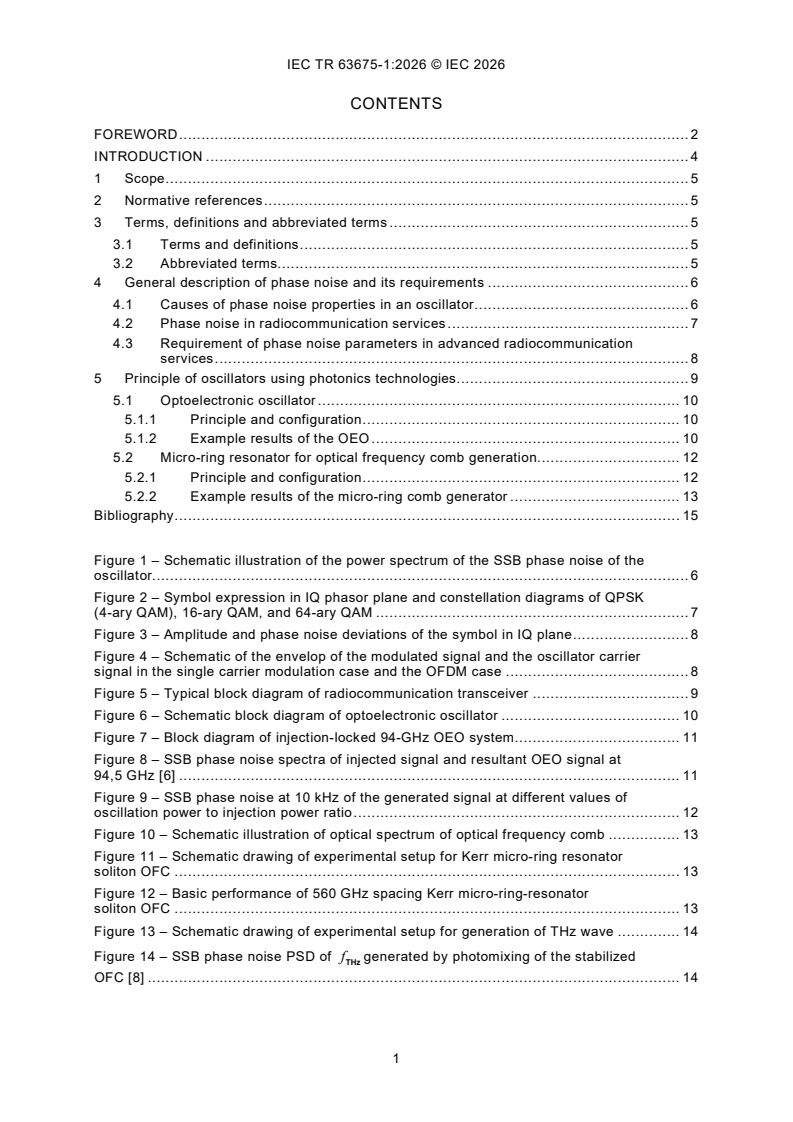
CONTENTS
FOREWORD . 2
INTRODUCTION . 4
1 Scope . 5
2 Normative references . 5
3 Terms, definitions and abbreviated terms . 5
3.1 Terms and definitions . 5
3.2 Abbreviated terms. 5
4 General description of phase noise and its requirements . 6
4.1 Causes of phase noise properties in an oscillator . 6
4.2 Phase noise in radiocommunication services . 7
4.3 Requirement of phase noise parameters in advanced radiocommunication
services . 8
5 Principle of oscillators using photonics technologies . 9
5.1 Optoelectronic oscillator . 10
5.1.1 Principle and configuration . 10
5.1.2 Example results of the OEO . 10
5.2 Micro-ring resonator for optical frequency comb generation. 12
5.2.1 Principle and configuration . 12
5.2.2 Example results of the micro-ring comb generator . 13
Bibliography . 15
Figure 1 – Schematic illustration of the power spectrum of the SSB phase noise of the
oscillator. 6
Figure 2 – Symbol expression in IQ phasor plane and constellation diagrams of QPSK
(4-ary QAM), 16-ary QAM, and 64-ary QAM . 7
Figure 3 – Amplitude and phase noise deviations of the symbol in IQ plane . 8
Figure 4 – Schematic of the envelop of the modulated signal and the oscillator carrier
signal in the single carrier modulation case and the OFDM case . 8
Figure 5 – Typical block diagram of radiocommunication transceiver . 9
Figure 6 – Schematic block diagram of optoelectronic oscillator . 10
Figure 7 – Block diagram of injection-locked 94-GHz OEO system . 11
Figure 8 – SSB phase noise spectra of injected signal and resultant OEO signal at
94,5 GHz [6] . 11
Figure 9 – SSB phase noise at 10 kHz of the generated signal at different values of
oscillation power to injection power ratio . 12
Figure 10 – Schematic illustration of optical spectrum of optical frequency comb . 13
Figure 11 – Schematic drawing of experimental setup for Kerr micro-ring resonator
soliton OFC . 13
Figure 12 – Basic performance of 560 GHz spacing Kerr micro-ring-resonator
soliton OFC . 13
Figure 13 – Schematic drawing of experimental setup for generation of THz wave . 14
Figure 14 – SSB phase noise PSD of f generated by photomixing of the stabilized
THz
OFC [8] . 14
INTERNATIONAL ELECTROTECHNICAL COMMISSION
____________
Transmitting and receiving equipment for radiocommunication -
Transceiver technologies and their performance standards -
Part 1: Low phase-noise oscillator technologies
using photonics techniques
FOREWORD
1) The International Electrotechnical Commission (IEC) is a worldwide organization for standardization comprising
all national electrotechnical committees (IEC National Committees). The object of IEC is to promote international
co-operation on all questions concerning standardization in the electrical and electronic fields. To this end and
in addition to other activities, IEC publishes International Standards, Technical Specifications, Technical Reports,
Publicly Available Specifications (PAS) and Guides (hereafter referred to as "IEC Publication(s)"). Their
preparation is entrusted to technical committees; any IEC National Committee interested in the subject dealt with
may participate in this preparatory work. International, governmental and non-governmental organizations liaising
with the IEC also participate in this preparation. IEC collaborates closely with the International Organization for
Standardization (ISO) in accordance with conditions determined by agreement between the two organizations.
2) The formal decisions or agreements of IEC on technical matters express, as nearly as possible, an international
consensus of opinion on the relevant subjects since each technical committee has representation from all
interested IEC National Committees.
3) IEC Publications have the form of recommendations for international use and are accepted by IEC National
Committees in that sense. While all reasonable efforts are made to ensure that the technical content of IEC
Publications is accurate, IEC cannot be held responsible for the way in which they are used or for any
misinterpretation by any end user.
4) In order to promote international uniformity, IEC National Committees undertake to apply IEC Publications
transparently to the maximum extent possible in their national and regional publications. Any divergence between
any IEC Publication and the corresponding national or regional publication shall be clearly indicated in the latter.
5) IEC itself does not provide any attestation of conformity. Independent certification bodies provide conformity
assessment services and, in some areas, access to IEC marks of conformity. IEC is not responsible for any
services carried out by independent certification bodies.
6) All users should ensure that they have the latest edition of this publication.
7) No liability shall attach to IEC or its directors, employees, servants or agents including individual experts and
members of its technical committees and IEC National Committees for any personal injury, property damage or
other damage of any nature whatsoever, whether direct or indirect, or for costs (including legal fees) and
expenses arising out of the publication, use of, or reliance upon, this IEC Publication or any other IEC
Publications.
8) Attention is drawn to the Normative references cited in this publication. Use of the referenced publications is
indispensable for the correct application of this publication.
9) IEC draws attention to the possibility that the implementation of this document may involve the use of (a)
patent(s). IEC takes no position concerning the evidence, validity or applicability of any claimed patent rights in
respect thereof. As of the date of publication of this document, IEC had not received notice of (a) patent(s), which
may be required to implement this document. However, implementers are cautioned that this may not represent
the latest information, which may be obtained from the patent database available at https://patents.iec.ch. IEC
shall not be held responsible for identifying any or all such patent rights.
IEC TR 63675-1 has been prepared by IEC technical committee 103: Transmitting and receiving
equipment for radiocommunication. It is a Technical Report.
The text of this Technical Report is based on the following documents:
Draft Report on voting
103/285/DTR 103/288/RVDTR
Full information on the voting for its approval can be found in the report on voting indicated in
the above table.
The language used for the development of this Technical Report is English.
This document was drafted in accordance with ISO/IEC Directives, Part 2, and developed in
accordance with ISO/IEC Directives, Part 1 and ISO/IEC Directives, IEC Supplement, available
at www.iec.ch/members_experts/refdocs. The main document types developed by IEC are
described in greater detail at www.iec.ch/publications.
A list of all parts of the IEC 63675 series, published under the general title Transmitting and
receiving equipment for radiocommunication - Transceiver technologies and their performance
standards, can be found on the IEC website.
The committee has decided that the contents of this document will remain unchanged until the
stability date indicated on the IEC website under webstore.iec.ch in the data related to the
specific document. At this date, the document will be
– reconfirmed,
– withdrawn, or
– revised.
INTRODUCTION
A frequency-stabilized oscillator is an indispensable device in radiocommunication due to the
radio regulations and reduction of the computing resources for frequency offset compensation
in the demodulation process. In principle, the combination of crystal oscillators and multipliers
has been used for the generation of the microwave signal in conventional microwave bands, as
well as lower millimetre-wave frequency bands less than 40 GHz. Raising the carrier frequency
of radiocommunication is necessary to increase the wireless transmission capacity. In this
scenario, the multiplication factor also increases and finally, the phase noise of the signal is
degraded. An intrinsic phase noise degradation by the multiplication is expressed by 20 log m,
where m is a multiplication factor. For the realization of the advanced modulation formats such
as an orthogonal frequency division multiplexing with a multilevel modulation, a low-phase noise
oscillator is necessary.
An optoelectronic oscillation technique is a promising solution for achieving both high oscillation
frequency and low phase noise, as the optical transmission technique, thanks to the broadband
nature of optical signals, makes it possible to obtain a long cavity with a high quality factor. In
this document, the principle of the optoelectronic oscillation and an example of the usage for
the radiocommunications are shown as a guideline to the experts and engineers, who design
and develop the radiocommunication transceivers in high frequency millimetre-wave systems
and terahertz-wave systems.
1 Scope
Millimetre wave and terahertz wave radio communication services require low phase noise
oscillators in order to comply with radio regulations and reduce the computing resources
required for demodulation processes. This document provides the principle and application of
the optoelectronic oscillation technologies using the photonics technique as a guideline for the
design of the radiocommunication transceivers.
2 Normative references
There are no normative references in this document.
3 Terms, definitions and abbreviated terms
For the purposes of this document, the following terms and definitions apply.
ISO and IEC maintain terminology databases for use in standardization at the following
addresses:
– IEC Electropedia: available at https://www.electropedia.org/
– ISO Online browsing platform: available at https://www.iso.org/obp
3.1 Terms and definitions
3.1.1
optoelectronic oscillator
oscillator that provides an electronic signal using circuits composed of an optical cavity and
electrical inputs, outputs, and converters
3.1.2
Kerr effect
electro-optic effect in which an applied electric field makes an optically isotropic substance
birefringent, the difference of refractive indexes being proportional to the square of the
magnitude of the electric field strength
3.2 Abbreviated terms
BPF band-pass filter
EDFA erbium-doped fibre amplifier
FM frequency modulation
FSR free Spectral Range
LD laser diode
LTE long-term evolution
MZM Mach-Zehnder-interferometer-type optical modulator
OEO optoelectronic oscillator
OFDM orthogonal frequency division multiplexing
OFDMA orthogonal frequency division multiple access
PD photodiode
PRBS pseudo random bit stream
PM phase modulation
QAM quadrature amplitude modulation
QPSK quadrature phase-shift keying
SSB single side band
UTC-PD uni-traveling carrier photodiode
4 General description of phase noise and its requirements
4.1 Causes of phase noise properties in an oscillator
Phase noise of an oscillator is a key parameter to generate high-precision signals in advanced
radiocommunication services such as high-capacity wireless communications and high-
precision radars.
4 3 2
The phase noise generally consists of five parts: 1/f , 1/f , 1/f , 1/f, and frequency-independent
components shown in Figure 1. 1/f component is caused by the random walk frequency-
modulated (FM) noise: mechanical vibration, environmental temperature, etc. This effect will
) is mainly generated by the design
randomly shift the carrier frequency. Flicker FM noise (1/f
of the active oscillator components including the selection of the components and organization
of the order of the components. The
...