

IEC 63138-1:2019
(Main)Multi-channel radio frequency connectors - Part 1: Generic specification - General requirements and test methods
General Information
- Abstract
IEC 63138-1:2019 which is a generic specification, specifies general requirements for multi-channel radio-frequency connectors, including terms and definitions, design and construction, ratings and characteristics, climatic categories, IEC type designation, requirements and test procedures, quality assessment, marking, etc.
It provides the basis for establishing the sectional specifications for various multichannel radiofrequency connector types. This document applies to multi-channel radio-frequency connectors (called "connectors", hereinafter) for use in communications, electronics and other equipment.
- Status
- Published
- Publication Date
- 11-Sep-2019
- Technical Committee
- SC 46F - RF and microwave passive components
- Drafting Committee
- WG 1 - TC 46/SC 46F/WG 1
- Current Stage
- PPUB - Publication issued
- Start Date
- 12-Sep-2019
- Completion Date
- 06-Sep-2019
Overview
IEC 63138-1:2019 is an international standard published by the International Electrotechnical Commission (IEC) that provides a generic specification for multi-channel radio frequency (RF) connectors. It establishes the general requirements, design principles, and rigorous test methods essential for ensuring the quality, reliability, and interoperability of multi-channel RF connectors used in communications, electronics, and related equipment. By defining terms, classifications, climatic categories, electrical and mechanical testing procedures, and quality assessments, this standard lays the foundation for further sectional standards tailored to specific multi-channel RF connector types.
Key Topics
- Design and Construction: Specifies materials, finishes, interface dimensions, and construction guidelines crucial for optimal electrical performance and mechanical durability.
- Standard Ratings & Characteristics: Defines typical electrical parameters such as return loss, insertion loss, contact resistance, insulation resistance, voltage proof, screening effectiveness, and passive intermodulation (PIM).
- Classifications & Climatic Categories: Establishes environmental classifications based on IEC 60068-1 for connectors to ensure functionality under varied climatic conditions.
- Testing Methods: Comprehensive procedures cover visual inspections, dimensional verification for interchangeability, electrical tests (including RF performance), mechanical tests (solderability, engagement forces, vibration, shock, endurance), and environmental tests (thermal shock, damp heat, salt mist).
- Quality Assessment: Describes qualification and conformance inspections including sampling plans, lot-by-lot and periodic evaluations to maintain consistent production quality.
- Marking Requirements: Provides guidelines on component and packaging markings to facilitate traceability and identification.
Applications
IEC 63138-1:2019 is essential for manufacturers, designers, and quality specialists involved in the development and production of multi-channel RF connectors utilized in:
- Wireless communication systems, including cellular and satellite networks
- Broadcasting and audio-video transmission equipment
- Aerospace and defense communication hardware
- Electronic instrumentation and test equipment
- Networking cables and adaptors requiring high-frequency, multi-channel connections
By adhering to this standard, stakeholders can ensure connectors meet stringent electrical performance, mechanical reliability, and environmental durability requirements-critical for maintaining signal integrity and operational safety in complex RF applications.
Related Standards
- IEC 60068-1: Environmental testing - provides climatic category classifications referred to by IEC 63138-1.
- Other sectional specifications under IEC 63138 series detailing specific types of multi-channel RF connectors.
- IEC standards on RF and microwave passive components addressing related aspects of connector and cable interface compatibility.
- International Electrotechnical Vocabulary (IEV) by IEC – offers terminology standardization supporting clear communication across electrotechnology fields.
By following IEC 63138-1:2019, industry professionals ensure global interoperability and quality assurance in multi-channel RF connector design and deployment, contributing to more reliable and efficient electronic communication infrastructures worldwide.
Get Certified
Connect with accredited certification bodies for this standard

ANCE
Mexican certification and testing association.

Intertek Slovenia
Intertek testing, inspection, and certification services in Slovenia.

LNE (Laboratoire National de Métrologie et d'Essais)
French national laboratory for metrology and testing.
Sponsored listings
Frequently Asked Questions
IEC 63138-1:2019 is a standard published by the International Electrotechnical Commission (IEC). Its full title is "Multi-channel radio frequency connectors - Part 1: Generic specification - General requirements and test methods". This standard covers: IEC 63138-1:2019 which is a generic specification, specifies general requirements for multi-channel radio-frequency connectors, including terms and definitions, design and construction, ratings and characteristics, climatic categories, IEC type designation, requirements and test procedures, quality assessment, marking, etc. It provides the basis for establishing the sectional specifications for various multichannel radiofrequency connector types. This document applies to multi-channel radio-frequency connectors (called "connectors", hereinafter) for use in communications, electronics and other equipment.
IEC 63138-1:2019 which is a generic specification, specifies general requirements for multi-channel radio-frequency connectors, including terms and definitions, design and construction, ratings and characteristics, climatic categories, IEC type designation, requirements and test procedures, quality assessment, marking, etc. It provides the basis for establishing the sectional specifications for various multichannel radiofrequency connector types. This document applies to multi-channel radio-frequency connectors (called "connectors", hereinafter) for use in communications, electronics and other equipment.
IEC 63138-1:2019 is classified under the following ICS (International Classification for Standards) categories: 33.120.30 - RF connectors. The ICS classification helps identify the subject area and facilitates finding related standards.
IEC 63138-1:2019 is available in PDF format for immediate download after purchase. The document can be added to your cart and obtained through the secure checkout process. Digital delivery ensures instant access to the complete standard document.
Standards Content (Sample)
IEC 63138-1 ®
Edition 1.0 2019-09
INTERNATIONAL
STANDARD
NORME
INTERNATIONALE
Multi-channel radio-frequency connectors –
Part 1: Generic specification – General requirements and test methods
Connecteurs radiofréquences multicanaux –
Partie 1: Spécification générique – Exigences générales et méthodes d'essai
All rights reserved. Unless otherwise specified, no part of this publication may be reproduced or utilized in any form
or by any means, electronic or mechanical, including photocopying and microfilm, without permission in writing from
either IEC or IEC's member National Committee in the country of the requester. If you have any questions about IEC
copyright or have an enquiry about obtaining additional rights to this publication, please contact the address below or
your local IEC member National Committee for further information.
Droits de reproduction réservés. Sauf indication contraire, aucune partie de cette publication ne peut être reproduite
ni utilisée sous quelque forme que ce soit et par aucun procédé, électronique ou mécanique, y compris la photocopie
et les microfilms, sans l'accord écrit de l'IEC ou du Comité national de l'IEC du pays du demandeur. Si vous avez des
questions sur le copyright de l'IEC ou si vous désirez obtenir des droits supplémentaires sur cette publication, utilisez
les coordonnées ci-après ou contactez le Comité national de l'IEC de votre pays de résidence.
IEC Central Office Tel.: +41 22 919 02 11
3, rue de Varembé info@iec.ch
CH-1211 Geneva 20 www.iec.ch
Switzerland
About the IEC
The International Electrotechnical Commission (IEC) is the leading global organization that prepares and publishes
International Standards for all electrical, electronic and related technologies.
About IEC publications
The technical content of IEC publications is kept under constant review by the IEC. Please make sure that you have the
latest edition, a corrigendum or an amendment might have been published.
IEC publications search - webstore.iec.ch/advsearchform Electropedia - www.electropedia.org
The advanced search enables to find IEC publications by a The world's leading online dictionary on electrotechnology,
variety of criteria (reference number, text, technical containing more than 22 000 terminological entries in English
committee,…). It also gives information on projects, replaced and French, with equivalent terms in 16 additional languages.
and withdrawn publications. Also known as the International Electrotechnical Vocabulary
(IEV) online.
IEC Just Published - webstore.iec.ch/justpublished
Stay up to date on all new IEC publications. Just Published IEC Glossary - std.iec.ch/glossary
details all new publications released. Available online and 67 000 electrotechnical terminology entries in English and
once a month by email. French extracted from the Terms and Definitions clause of
IEC publications issued since 2002. Some entries have been
IEC Customer Service Centre - webstore.iec.ch/csc collected from earlier publications of IEC TC 37, 77, 86 and
If you wish to give us your feedback on this publication or CISPR.
need further assistance, please contact the Customer Service
Centre: sales@iec.ch.
A propos de l'IEC
La Commission Electrotechnique Internationale (IEC) est la première organisation mondiale qui élabore et publie des
Normes internationales pour tout ce qui a trait à l'électricité, à l'électronique et aux technologies apparentées.
A propos des publications IEC
Le contenu technique des publications IEC est constamment revu. Veuillez vous assurer que vous possédez l’édition la
plus récente, un corrigendum ou amendement peut avoir été publié.
Recherche de publications IEC - Electropedia - www.electropedia.org
webstore.iec.ch/advsearchform Le premier dictionnaire d'électrotechnologie en ligne au
La recherche avancée permet de trouver des publications IEC monde, avec plus de 22 000 articles terminologiques en
en utilisant différents critères (numéro de référence, texte, anglais et en français, ainsi que les termes équivalents dans
comité d’études,…). Elle donne aussi des informations sur les 16 langues additionnelles. Egalement appelé Vocabulaire
projets et les publications remplacées ou retirées. Electrotechnique International (IEV) en ligne.
IEC Just Published - webstore.iec.ch/justpublished Glossaire IEC - std.iec.ch/glossary
Restez informé sur les nouvelles publications IEC. Just 67 000 entrées terminologiques électrotechniques, en anglais
Published détaille les nouvelles publications parues. et en français, extraites des articles Termes et Définitions des
Disponible en ligne et une fois par mois par email. publications IEC parues depuis 2002. Plus certaines entrées
antérieures extraites des publications des CE 37, 77, 86 et
Service Clients - webstore.iec.ch/csc CISPR de l'IEC.
Si vous désirez nous donner des commentaires sur cette
publication ou si vous avez des questions contactez-nous:
sales@iec.ch.
IEC 63138-1 ®
Edition 1.0 2019-09
INTERNATIONAL
STANDARD
NORME
INTERNATIONALE
Multi-channel radio-frequency connectors –
Part 1: Generic specification – General requirements and test methods
Connecteurs radiofréquences multicanaux –
Partie 1: Spécification générique – Exigences générales et méthodes d'essai
INTERNATIONAL
ELECTROTECHNICAL
COMMISSION
COMMISSION
ELECTROTECHNIQUE
INTERNATIONALE
ICS 33.120.30 ISBN 978-2-8322-7270-1
– 2 – IEC 63138-1:2019 © IEC 2019
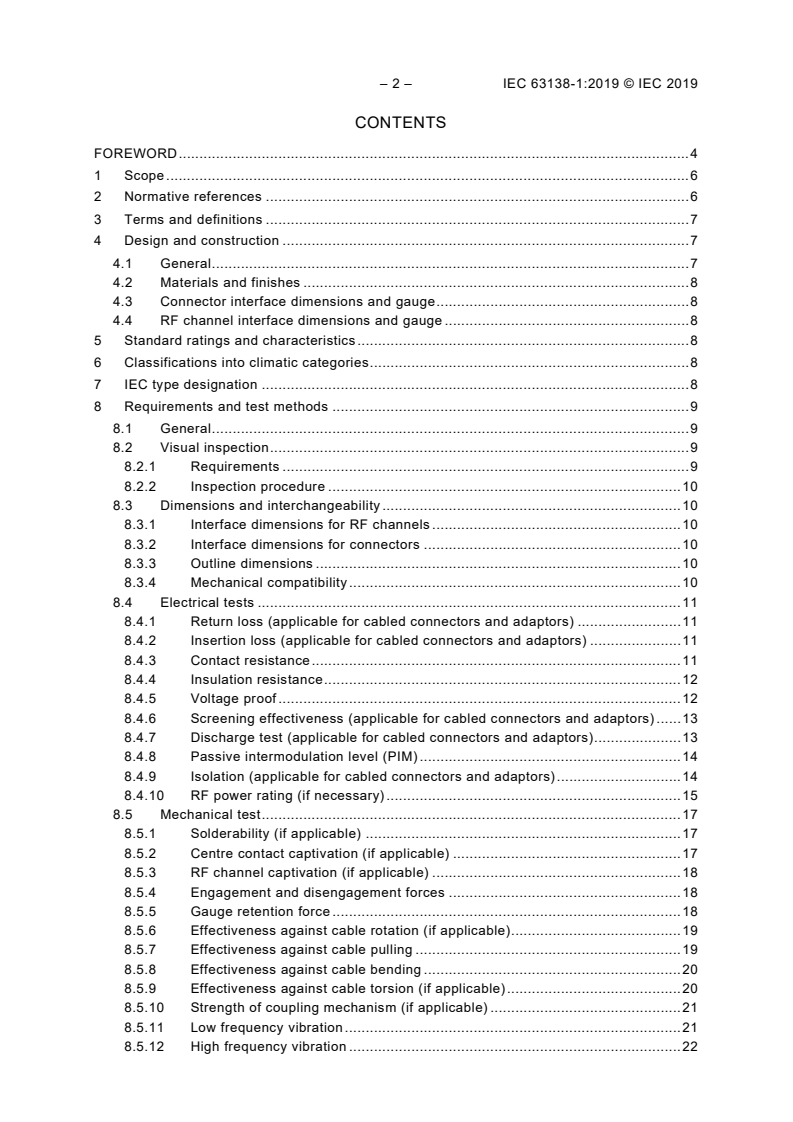
CONTENTS
FOREWORD . 4
1 Scope . 6
2 Normative references . 6
3 Terms and definitions . 7
4 Design and construction . 7
4.1 General . 7
4.2 Materials and finishes . 8
4.3 Connector interface dimensions and gauge . 8
4.4 RF channel interface dimensions and gauge . 8
5 Standard ratings and characteristics . 8
6 Classifications into climatic categories . 8
7 IEC type designation . 8
8 Requirements and test methods . 9
8.1 General . 9
8.2 Visual inspection . 9
8.2.1 Requirements . 9
8.2.2 Inspection procedure . 10
8.3 Dimensions and interchangeability . 10
8.3.1 Interface dimensions for RF channels . 10
8.3.2 Interface dimensions for connectors . 10
8.3.3 Outline dimensions . 10
8.3.4 Mechanical compatibility . 10
8.4 Electrical tests . 11
8.4.1 Return loss (applicable for cabled connectors and adaptors) . 11
8.4.2 Insertion loss (applicable for cabled connectors and adaptors) . 11
8.4.3 Contact resistance . 11
8.4.4 Insulation resistance . 12
8.4.5 Voltage proof . 12
8.4.6 Screening effectiveness (applicable for cabled connectors and adaptors) . 13
8.4.7 Discharge test (applicable for cabled connectors and adaptors) . 13
8.4.8 Passive intermodulation level (PIM) . 14
8.4.9 Isolation (applicable for cabled connectors and adaptors) . 14
8.4.10 RF power rating (if necessary) . 15
8.5 Mechanical test . 17
8.5.1 Solderability (if applicable) . 17
8.5.2 Centre contact captivation (if applicable) . 17
8.5.3 RF channel captivation (if applicable) . 18
8.5.4 Engagement and disengagement forces . 18
8.5.5 Gauge retention force . 18
8.5.6 Effectiveness against cable rotation (if applicable) . 19
8.5.7 Effectiveness against cable pulling . 19
8.5.8 Effectiveness against cable bending . 20
8.5.9 Effectiveness against cable torsion (if applicable) . 20
8.5.10 Strength of coupling mechanism (if applicable) . 21
8.5.11 Low frequency vibration . 21
8.5.12 High frequency vibration . 22
8.5.13 Shock . 22
8.5.14 Mechanical endurance . 23
8.5.15 Safety wire hole pullout (if applicable) . 24
8.6 Environmental test . 24
8.6.1 Damp heat, steady state . 24
8.6.2 Thermal shock . 24
8.6.3 High temperature endurance. 24
8.6.4 Low temperature endurance . 24
8.6.5 Leakage (if applicable) . 24
8.6.6 Hermetic seal . 25
8.6.7 Salt mist . 25
9 Quality assessment . 25
9.1 General . 25
9.2 Qualification inspection . 25
9.2.1 Test samples . 25
9.2.2 Inspection procedure . 26
9.2.3 Structurally similar components . 27
9.3 Conformance inspection. 27
9.3.1 General . 27
9.3.2 Lot-by-lot inspection . 27
9.3.3 Periodic inspections . 28
9.4 Specification structures . 30
9.4.1 General . 30
9.4.2 Sectional specification (SS) . 30
9.4.3 Detail specification (DS) . 30
10 Marking . 30
10.1 Marking of components . 30
10.2 Marking and contents of package . 31
Figure 1 – Diagram for test for isolation . 15
Table 1 – Preferred climatic categories (see IEC 60068-1) . 8
Table 2 – Severities of vibration . 22
Table 3 – Recommended severities for shocks . 23
Table 4 – Qualification inspection . 26
Table 5 – Lot-by-lot inspection . 28
Table 6 – Sampling plans for mechanical compatibility and return loss inspection . 28
Table 7 – Periodic inspection . 29
– 4 – IEC 63138-1:2019 © IEC 2019
INTERNATIONAL ELECTROTECHNICAL COMMISSION
____________
MULTI-CHANNEL RADIO-FREQUENCY CONNECTORS –
Part 1: Generic specification –
General requirements and test methods
FOREWORD
1) The International Electrotechnical Commission (IEC) is a worldwide organization for standardization comprising
all national electrotechnical committees (IEC National Committees). The object of IEC is to promote international
co-operation on all questions concerning standardization in the electrical and electronic fields. To this end and in
addition to other activities, IEC publishes International Standards, Technical Specifications, Technical Reports,
Publicly Available Specifications (PAS) and Guides (hereafter referred to as “IEC Publication(s)”). Their
preparation is entrusted to technical committees; any IEC National Committee interested in the subject dealt with
may participate in this preparatory work. International, governmental and non-governmental organizations liaising
with the IEC also participate in this preparation. IEC collaborates closely with the International Organization for
Standardization (ISO) in accordance with conditions determined by agreement between the two organizations.
2) The formal decisions or agreements of IEC on technical matters express, as nearly as possible, an international
consensus of opinion on the relevant subjects since each technical committee has representation from all
interested IEC National Committees.
3) IEC Publications have the form of recommendations for international use and are accepted by IEC National
Committees in that sense. While all reasonable efforts are made to ensure that the technical content of IEC
Publications is accurate, IEC cannot be held responsible for the way in which they are used or for any
misinterpretation by any end user.
4) In order to promote international uniformity, IEC National Committees undertake to apply IEC Publications
transparently to the maximum extent possible in their national and regional publications. Any divergence between
any IEC Publication and the corresponding national or regional publication shall be clearly indicated in the latter.
5) IEC itself does not provide any attestation of conformity. Independent certification bodies provide conformity
assessment services and, in some areas, access to IEC marks of conformity. IEC is not responsible for any
services carried out by independent certification bodies.
6) All users should ensure that they have the latest edition of this publication.
7) No liability shall attach to IEC or its directors, employees, servants or agents including individual experts and
members of its technical committees and IEC National Committees for any personal injury, property damage or
other damage of any nature whatsoever, whether direct or indirect, or for costs (including legal fees) and
expenses arising out of the publication, use of, or reliance upon, this IEC Publication or any other IEC
Publications.
8) Attention is drawn to the Normative references cited in this publication. Use of the referenced publications is
indispensable for the correct application of this publication.
9) Attention is drawn to the possibility that some of the elements of this IEC Publication may be the subject of
patent rights. IEC shall not be held responsible for identifying any or all such patent rights.
International Standard IEC 63138-1 has been prepared by subcommittee 46F: RF and
microwave passive components, of IEC technical committee 46: Cables, wires, waveguides, RF
connectors, RF and microwave passive components and accessories.
The text of this International Standard is based on the following documents:
FDIS Report on voting
46F/467/FDIS 46F/481/RVD
Full information on the voting for the approval of this International Standard can be found in the
report on voting indicated in the above table.
This document has been drafted in accordance with the ISO/IEC Directives, Part 2.
The committee has decided that the contents of this document will remain unchanged until the
stability date indicated on the IEC website under "http://webstore.iec.ch" in the data related to
the specific document. At this date, the document will be
• reconfirmed,
• withdrawn,
• replaced by a revised edition, or
• amended.
– 6 – IEC 63138-1:2019 © IEC 2019
MULTI-CHANNEL RADIO-FREQUENCY CONNECTORS –
Part 1: Generic specification –
General requirements and test methods
1 Scope
This part of IEC 63138-1, which is a generic specification, specifies general requirements for
multi-channel radio-frequency connectors, including terms and definitions, design and
construction, ratings and characteristics, climatic categories, IEC type designation,
requirements and test procedures, quality assessment, marking, etc.
It provides the basis for establishing the sectional specifications for various multi-channel
radio-frequency connector types.
This document applies to multi-channel radio-frequency connectors (called "connectors",
hereinafter) for use in communications, electronics and other equipment.
2 Normative references
The following documents are referred to in the text in such a way that some or all of their
content constitutes requirements of this document. For dated references, only the edition cited
applies. For undated references, the latest edition of the referenced document (including any
amendments) applies.
IEC 60068-1, Environmental testing – Part 1: General and guidance
IEC 60068-2-6, Environmental testing – Part 2-6: Tests – Test Fc: Vibration (sinusoidal)
IEC 60068-2-11, Basic environmental testing procedures – Part 2-11: Tests – Test Ka: Salt mist
IEC 60068-2-20, Environmental testing – Part 2-20: Tests – Test T: Test methods for
solderability and resistance to soldering heat of devices with leads
IEC 60068-2-27, Environmental testing – Part 2-27: Tests – Test Ea and guidance: Shock
IEC 61169-1:2013, Radio frequency connectors – Part 1: Generic specification – General
requirements and measuring methods
IEC 61169-1-2, Radio-frequency connectors – Part 1-2: Electrical test methods – Insertion loss
, Radio-frequency connectors – Part 1-4: Electrical test methods – Voltage
IEC 61169-1-4:—
standing wave ratio, return loss and reflection coefficient
IEC 61726, Cable assemblies, cables, connectors and passive microwave components –
Screening attenuation measurement by the reverberation chamber method
IEC 62037-3, Passive RF and microwave devices, intermodulation level measurement – Part 3:
Measurement of passive intermodulation in coaxial connectors
___________
Under preparation. Stage at the time of publication: IEC CDV 61169-1-4:2019.
3 Terms and definitions
For the purposes of this document, the terms and definitions given in IEC 61169-1 and the
following apply.
ISO and IEC maintain terminological databases for use in standardization at the following
addresses:
• IEC Electropedia: available at http://www.electropedia.org/
• ISO Online browsing platform: available at http://www.iso.org/obp
3.1
RF channel
channel for RF transmission which is composed of an RF contact pair
3.2
multi-channel radio-frequency connector
connector with two or more RF channels
3.3
isolation
RF signal leakage generated from any one RF channel, with respect to any other RF channel
around it, and expressed by ratio of input power into the channel to the received power of any
other RF channel around it, in dB
It can be also expressed by Formula (1):
P
Isolation = −10log (1)
P
where
P is the input power into the RF channel, transmitted by signal source;
P is the received power of any other RF channel
4 Design and construction
4.1 General
The connectors and accessories shall be designed and constructed to meet the allowance
required for proper mating, installation and maintenance. The inserts in the connectors shall be
designed and constructed to ensure proper mating and performance of RF channels. When
design and construction permit, the connectors should have an indicator to show when mating
is in place. The RF contacts of connectors should be removable as far as possible.
A visual means shall be provided to indicate when two mating connectors are properly mated.
The relevant specification is not intended to restrict details of construction which do not affect
interchangeability or performance, or to be used as manufacturing drawings. The interface of
the connector accessories and the recommended opening hole dimensions of the panel shall
be as specified in the relevant specification.
The dimensions and tolerances shall be given in metric units. During conversion of dimensions
given in inches into millimetres, they shall be rounded to the nearest 0,001 mm or 0,000 05 in.
Where, however, mechanical and electrical considerations permit, the rounding shall usually be
to the nearest 0,01 mm or 0,000 5 in.
– 8 – IEC 63138-1:2019 © IEC 2019
4.2 Materials and finishes
The materials and finishes used for the connectors shall be as specified in the safety and
environmental regulations and in the relevant specifications. Dissimilar metals (between which
an electromotive coupling may exist) shall not be placed in contact with one another as an
electromotive force may be created between them.
4.3 Connector interface dimensions and gauge
The connector interface dimensions (including RF channel arrangements) and gauge shall
comply with the relevant specification.
4.4 RF channel interface dimensions and gauge
The interface dimensions and gauge for the RF channels in connectors shall comply with the
relevant specification.
5 Standard ratings and characteristics
The ratings and characteristics applicable to each connector type and style shall be specified in
the relevant specification. They should normally cover:
– electrical, mechanical and environmental performances;
– performances for each type of RF channel, which should be specified respectively when the
connector is composed of different types of RF channel.
6 Classifications into climatic categories
The classification of connectors with regard to climatic conditions is based on IEC 60068-1 and
indicated by a series of three sets of digits separated by oblique strokes corresponding
respectively to tests at low temperature (minus sign not shown), high temperature and the
number of days of exposure to damp heat, steady state.
The climatic severities are referenced by a cold temperature, high temperature and damp heat
steady state duration. Examples of preferred climatic categories of this are shown in Table 1.
Table 1 – Preferred climatic categories (see IEC 60068-1)
Category designation Letter Temperature range Damp heat steady state
40/85/21 A −40 °C to +85 °C 21 days
55/125/21 B −55 °C to +125 °C 21 days
55/155/56 C −55 °C to +155 °C 56 days
7 IEC type designation
The purpose of the IEC type designation is to identify a particular connector within the scope of
IEC RF connector standardization. It is not intended to include information in excess of this.
In practice, it is usually necessary to identify a manufacturer's product because, although it
may comply with this document, there may be features that are not covered by this document.
Connectors complying with the relevant specification shall be designated by the following
indications and in the order given:
a) the number of this document;
b) the letters "IEC";
c) series code (type designation);
d) additional identification as indicated in the relevant specification.
NOTE When an IEC type designation is used, either for the marking of the product or in a description of the product,
it is the responsibility of the manufacturer to ensure that the item meets the requirements of the relevant
specification.
8 Requirements and test methods
8.1 General
Unless otherwise specified, the following conditions shall apply:
a) tests shall be carried out under standard atmospheric conditions for testing as specified in
IEC 60068-1;
b) before measurements are made, the connectors shall be preconditioned under standard
atmospheric conditions for testing for a time sufficient to allow the entire connector to reach
thermal stability;
c) recovery conditions for the interval after a conditioning and the next measurement of the
test shall be in accordance with IEC 60068-1.
When a nominal value only is given for an applied stress and/or the duration of application, the
specified value shall be taken to indicate the minimum test severity to be applied.
In no case shall the contact parts be cleaned or otherwise prepared prior to tests, unless
explicitly stated in the relevant specification.
If it is required that a cable be attached to an RF contact of the connector, this shall be done in
accordance with the connector manufacturer's instructions.
Mated sets of connectors shall be fully engaged and screw-coupled connectors shall be
tightened to the normal coupling torque quoted in the relevant specification.
In the case of mounted connectors subjected to environmental conditioning, care shall be taken
to ensure that the back-of-panel portion of such fixed connectors, when appropriate, is
protected.
When using for tests involving exposure to extreme temperatures, a cable with appropriate
temperature capability should be used.
8.2 Visual inspection
8.2.1 Requirements
Visual inspection shall meet the following requirements:
a) Marking
Marking shall be in compliance with 10.1 and be legible after any of the specified tests.
b) Workmanship
Connectors and associated fittings shall be processed in such a manner as to be uniform in
quality and shall be free from visible sharp edges, burrs and other defects that will affect life,
serviceability or appearance.
c) Deterioration after electrical, mechanical and environmental tests
Unless otherwise specified, there shall be no visible deterioration likely to influence
performance.
– 10 – IEC 63138-1:2019 © IEC 2019
8.2.2 Inspection procedure
The inspection will be performed visually or under a magnification as stated in the relevant
specification.
8.3 Dimensions and interchangeability
8.3.1 Interface dimensions for RF channels
8.3.1.1 Requirements
The mating face dimensions for RF channels shall comply with the relevant specification.
8.3.1.2 Inspection procedure
The inspection for the interface dimensions shall be performed by mating the gauge stated in
the relevant specification with the RF channel.
When critical dimensions of mating faces are specified in the relevant specification for the RF
channels, the inspection shall be performed using a measuring tool with adequate accuracy.
8.3.2 Interface dimensions for connectors
8.3.2.1 Requirements
The mating face dimensions for connectors shall comply with the relevant specification.
8.3.2.2 Inspection procedure
The inspection for the interface dimensions for connectors shall be performed by mating the
gauge stated in the relevant specification with the connector.
8.3.3 Outline dimensions
8.3.3.1 Requirements
The outline dimensions shall be as specified in the relevant specification.
8.3.3.2 Inspection procedure
The inspection for the outline dimensions shall be performed using a measuring tool with
adequate accuracy.
8.3.4 Mechanical compatibility
8.3.4.1 Requirements
The connector under test shall be mated normally with its mating connector.
8.3.4.2 Inspection procedure
The inspections for mechanical compatibility shall be performed using at least three mating
connectors to mate with the connector under test separately.
8.4 Electrical tests
8.4.1 Return loss (applicable for cabled connectors and adaptors)
8.4.1.1 Requirements
The return loss for each RF channel in the connector shall comply with the relevant
specification.
8.4.1.2 Test procedure
Each RF channel in the connector shall be tested individually for return loss in accordance with
IEC 61169-1-4 . All RF channels should remain in the connector when testing. Unless
otherwise specified, the connectors shall be fully engaged.
8.4.1.3 Information to be given in the relevant specification
The following information shall be given in the relevant specification:
a) frequency range to be measured;
b) minimum return loss value;
c) detail of the standard test connector, if required;
d) necessary characteristics of the appropriate cable, when cable is needed;
e) any deviation from the standard test procedure.
8.4.2 Insertion loss (applicable for cabled connectors and adaptors)
8.4.2.1 Requirements
The insertion loss for each RF channel in the connector shall comply with the relevant
specification.
8.4.2.2 Test procedure
Each RF channel in the connector shall be tested individually for insertion loss as specified in
IEC 61169-1-2. All RF channels should remain in the connector when testing. Unless otherwise
specified, the connectors shall be fully engaged.
8.4.2.3 Information to be given in the relevant specification
The following information shall be given in the relevant specification:
a) frequency range to be measured;
b) maximum insertion loss value;
c) detail of the standard test connector, if required;
d) necessary characteristics of the appropriate cable, when cable is needed;
e) any deviation from the standard test procedure.
8.4.3 Contact resistance
8.4.3.1 Requirements
Contact resistances of the centre contact in the RF channel, contact resistances of the outer
contact in the RF channel and contact resistances of the connector shell (if applicable), shall be
measured separately. The initial values of contact resistance and the value after environmental
test shall be in accordance with the relevant specification.
___________
Under preparation. Stage at the time of publication: IEC CDV 61169-1-4:2019.
– 12 – IEC 63138-1:2019 © IEC 2019
8.4.3.2 Test procedure
The connector shall be tested for contact resistance as specified in 9.2.3 of IEC 61169-1:2013;
however, the following details shall be applied:
a) all the RF channels shall remain in the connector while testing;
b) the centre contact and outer contact in every RF channel in the connector shall be tested
for contact resistance;
c) the connector shell shall also be measured for contact resistance, when needed.
8.4.3.3 Information to be given in the relevant specification
The following information shall be given in the relevant specification:
a) the initial value of contact resistance and the value after environmental test for the centre
contacts and the outer contacts in the RF channels and the connector shell, if applicable;
b) any deviation from the standard procedure.
8.4.4 Insulation resistance
8.4.4.1 Requirements
The initial values of insulation resistance between centre and outer contacts in every RF
channel in the connector, between outer contacts for every two RF channels, if applicable, as
well as between outer contacts in every RF channel and connector shell, if applicable, and the
values after the environmental test, shall be in accordance with the relevant specification.
8.4.4.2 Test procedure
The connector shall be tested for insulation resistance as specified in 9.2.5 of
IEC 61169-1:2013; however, the following details shall be applied:
a) the RF channel shall remain in the connector while testing;
b) insulation resistance between centre contact and outer contact in every RF channel in the
connector shall be tested;
c) insulation resistance between outer contacts for every two RF channels shall be tested;
d) insulation resistance between the outer contact in every RF channel and the connector shell,
if applicable, shall also be tested.
8.4.4.3 Information to be given in the relevant specification
The following information shall be given in the relevant specification:
a) value of the test voltage if other than 500 V;
b) minimum value of insulation resistance;
c) test arrangement (mated or un-mated connector with or without cables);
d) any deviation from the standard procedure.
8.4.5 Voltage proof
8.4.5.1 Requirements
Connectors shall withstand the voltage specified in the relevant specification, without
breakdown or flashover.
8.4.5.2 Test procedure
The connector shall be tested for voltage proof as specified in 9.2.6 of IEC 61169-1:2013;
however, the following details shall be applied:
a) the RF channel shall remain in the connector while testing;
b) the voltage proof between centre contact and outer contact in every RF channel in the
connector shall be tested;
c) the voltage proof between outer contacts for every two RF channels shall be tested;
d) the voltage proof between the outer contact in every RF channel and the connector shell, if
applicable, shall also be tested.
8.4.5.3 Information to be given in the relevant specification
The following information shall be given in the relevant specification:
a) values of test voltage between centre contact and outer contact in every RF channel in the
connector;
b) values of test voltage between outer contacts for every two RF channels;
c) values of test voltage between the outer contact in every RF channel and the connector
shell, if applicable;
d) maximum leakage current;
e) any deviation from the standard test procedure.
8.4.6 Screening effectiveness (applicable for cabled connectors and adaptors)
8.4.6.1 Requirements
The screening effectiveness of the connector shall comply with requirements over the
frequency range as stated in the relevant specification.
8.4.6.2 Test procedure
The connector shall be tested for screening effectiveness as specified in IEC 61726.
Every RF channel shall be tested for screening effectiveness separately unless otherwise
specified in relevant specification.
8.4.6.3 Information to be given in the relevant specification
The following information shall be given in the relevant specification:
a) frequency range to be measured;
b) allowable worst value of screening effectiveness;
c) any deviation from the standard test procedure.
8.4.7 Discharge test (applicable for cabled connectors and adaptors)
8.4.7.1 Requirements
The corona level of connectors shall be in accordance with requirements as stated in the
relevant specification.
8.4.7.2 Test procedure
Every RF channel in the connector shall be tested for discharge as specified in 9.2.8 of
IEC 61169-1:2013; however, the following details shall be applied:
a) all RF channels shall remain in the connector while testing;
b) every RF channel in the connector shall be tested separately for discharge.
– 14 – IEC 63138-1:2019 © IEC 2019
8.4.7.3 Information to be given in the relevant specification
The following information shall be given in the relevant specification:
a) minimum value of the extinction voltage;
b) atmospheric pressure, or equivalent altitude;
c) cable type designation and length, which shall be as specified in the relevant specification;
d) any deviation from the standard test procedure.
8.4.8 Passive intermodulation level (PIM)
8.4.8.1 Requirements
The passive intermodulation level (PIM) of connectors shall be in compliance with requirements
as specified in the relevant specification.
8.4.8.2 Test procedure
Every RF channel in the connector shall be tested for PIM, as specified in IEC 62037-3.
Every RF channel shall be kept in the connector for the test.
8.4.8.3 Information to be given in the relevant specification
The following information shall be given in the relevant specification:
a) the frequency and power for the test;
b) allowable minimum values for static and dynamic levels;
c) the weight, impact height and position of heavy punch;
d) any deviation from the standard test procedure.
8.4.9 Isolation (applicable for cabled connectors and adaptors)
8.4.9.1 Requirements
The isolation shall comply with requirements as stated in the relevant specifications.
8.4.9.2 Test procedure
The connector shall be tested for isolation between any two RF channels. All RF channels shall
be kept in the connector for the test. The connector shall be engaged completely, unless otherwise
specified. For the cabled connector, the matched cable shall be attached. The other end of the
cable should be connected to the standard RF coaxial connector, thus forming a cable
assembly. In addition, it is permissible to protect the cable. All unused RF channel ports shall
be terminated with matched load respectively, unless otherwise specified in the relevant
specification.
The test procedures are as follows:
a) set the test mode of vector network analyzer into transmission measurement (S12 or S21),
and set the frequency range as stated in relevant specification. Unless otherwise specified,
the number of measuring points shall not be less than 801;
b) system calibration: the two test cable ports which are connected with the appropriate
network analyzer are calibrated completely;
c) connect two ports of the vector network to the two RF channels at the near end of the
connector, and the far end of the RF channels shall be terminated with standard load, as
shown in Figure 1a. Then read the minimum absolute value of the transmission
measurement (S12 or S21) which is the isolation at the near end for the two RF channels,
in dB;
d) connect one port of the vector network to one RF channel at the near end of the connector
and connect the other port of the vector network to another RF channel at the far end of the
connector with the other sides of the two RF channels terminated with standard load, as
shown in Figure 1b. Then read the minimum absolute value of the transmission
measurement (S12 or S21) which is the isolation at the far end of the two RF channels, in
dB;
e) the smaller value of the isolations measured at the near and far ends is just the isolation of
the two RF channels;
f) the isolation between other RF channels shall be measured in sequence when needed.
a) Near-end isolation b) Far-end isolation
Figure 1 – Diagram for test for isolation
8.4.9.3 Information to be given in the relevant specification
The following information shall be given in the relevant specification:
a) two RF channels or specific RF channels which shall be measured;
b) the frequency range to be tested;
c) minimum allowable isolation;
d) type designation and length of cable to be attached;
e) any deviation from the standard test procedure.
8.4.10 RF power rating (if necessary)
8.4.10.1 Requirements
The connector assemblies shall be subjected to the power specified in the relevant
specification under the specified frequency, temperature and altitude, without breakdown. After
the test, the return loss (VSWR) and insertion loss shall comply with the relevant specification.
– 16 – IEC 63138-1:2019 © IEC 2019
8.4.10.2 Test conditions
Stabilization of test conditions shall include temperature stabilization and altitude stabilization:
a) Temperature stabilization:
When the temperature of the chamber and that of the test item do not change by more
than ±2 °C over a 10-min period, and the temperature difference between the chamber and
the test item does not exceed 3,5 °C over a 10-min period, the temperature shall be
considered stabilized.
b) Altitude stabilization:
When the altitude remains constant within ±5 % of the specified value for 10 min, the
altitude shall be considered stabilized.
When it is required during the test program to measure and record the temperature or the
associated temperature rise of the test sample, at least 1 thermocouple shall be used to
measure ambient conditions and a minimum of 2 thermocouples shall be used on the test
sample.
The temperature of the thermocouples shall be recorded at the start and at the completion
of the test period, at 5 min intervals during the test period, and at more frequen
...