


IEC 62645:2019
(Main)Nuclear power plants - Instrumentation, control and electrical power systems - Cybersecurity requirements
Nuclear power plants - Instrumentation, control and electrical power systems - Cybersecurity requirements
IEC 62645:2019 establishes requirements and provides guidance for the development and management of effective computer security programmes for I&C programmable digital systems. Inherent to these requirements and guidance is the criterion that the power plant I&C programmable digital system security programme complies with the applicable country’s requirements.
This document defines adequate measures for the prevention of, detection of and reaction to malicious acts by digital means (cyberattacks) on I&C programmable digital systems. This includes any unsafe situation, equipment damage or plant performance degradation.
This second edition cancels and replaces the first edition published in 2014. This edition includes the following significant technical changes with respect to the previous edition:
a) to align the standard with the new revisions of ISO/IEC 27001;
b) to review the existing requirements and to update the terminology and definitions;
c) to take account of, as far as possible, requirements associated with standards published since the first edition;
d) to take into account the fact that cybersecurity techniques, but also national practices evolve.
Centrales nucléaires de puissance - Systèmes d'instrumentation, de contrôle-commande et d'alimentation électrique - Exigences relatives à la cybersécurité
L’IEC 62645:2019 établit des exigences et fournit des recommandations pour le développement et la gestion des programmes de sécurité informatique des systèmes numériques programmables d’I&C. Le critère de conformité du programme de sécurité des systèmes numériques programmables d’I&C de la centrale nucléaire aux exigences nationales applicables est inhérent aux exigences et recommandations du présent document.
Le présent document définit les mesures adéquates pour ce qui concerne la prévention, la détection et la réaction à des actes malveillants, réalisés en utilisant des moyens informatiques (cyberattaques), portant atteinte aux systèmes numériques programmables d’I&C. Ceci comprend les situations non sûres, les endommagements d’équipements ou la dégradation des performances.
Cette deuxième édition annule et remplace la première édition parue en 2014. Cette édition inclut les modifications techniques majeures suivantes par rapport à l'édition précédente:
a) aligner la norme sur les nouvelles révisions de l’ISO/IEC 27001;
b) passer en revue les exigences existantes et mettre à jour la terminologie et les définitions;
c) prendre en compte, autant que possible, les exigences associées aux normes publiées depuis la parution de la première édition;
d) prendre en compte le fait que les techniques de cybersécurité, mais aussi les pratiques nationales évoluent.
General Information
- Status
- Published
- Publication Date
- 12-Nov-2019
- Technical Committee
- SC 45A - Instrumentation, control and electrical power systems of nuclear facilities
- Drafting Committee
- WG 9 - TC 45/SC 45A/WG 9
- Current Stage
- PPUB - Publication issued
- Start Date
- 13-Nov-2019
- Completion Date
- 22-Nov-2019
Relations
- Effective Date
- 05-Sep-2023
- Effective Date
- 05-Sep-2023
Overview
IEC 62645:2019 is an international standard developed by the International Electrotechnical Commission (IEC) that sets forth cybersecurity requirements for nuclear power plants, specifically focusing on Instrumentation, Control, and electrical power systems. This standard addresses the development and management of comprehensive computer security programs aimed at protecting I&C (Instrumentation & Control) programmable digital systems from cyber threats. It emphasizes compliance with country-specific regulations and guides organizations on effective prevention, detection, and response to cyberattacks that could cause unsafe conditions, equipment damage, or operational degradation. The 2019 edition updates the 2014 version by aligning with ISO/IEC 27001, refining terminology, and integrating recent cybersecurity and national practice developments.
Key Topics
Cybersecurity Program Management:
IEC 62645 outlines the framework for establishing, managing, and continuously improving computer security programs covering all phases-from development and implementation to operation and retirement of I&C systems. It stresses leadership commitment, clear roles, and documented policies to ensure robust cybersecurity governance.Risk Assessment and Graded Approach:
The standard advocates a risk-based, graded approach to cybersecurity tailored to the significance of specific I&C systems. It provides methods for identifying security degrees based on safety categories, operational impact, and performance degradation risks.Lifecycle Security Implementation:
Comprehensive lifecycle guidance covers system specification, detailed design, integration, validation, installation, operation, maintenance, and retirement phases. This ensures security considerations are embedded throughout the system’s evolution.Security Controls and Defense-in-Depth:
IEC 62645 promotes defense-in-depth strategies, recommending layered security controls to mitigate vulnerabilities. This includes secure architecture, communication pathways protection, security zones definition, and continuous reassessment of controls.Alignment with International Standards:
The 2019 edition harmonizes with ISO/IEC 27001:2013 requirements, supporting integration into existing cybersecurity management systems. It also correlates with other IEC SC 45A standards and the IEC 62443 series, enhancing consistency in the nuclear cybersecurity domain.
Applications
IEC 62645:2019 is primarily designed for nuclear power plants but offers valuable guidance for cybersecurity in I&C programmable digital systems across various nuclear-related facilities, such as research reactors, fuel cycle plants, and small modular reactors (SMRs). The standard helps organizations:
- Develop and maintain effective cybersecurity programs to protect critical operational systems from cyber threats.
- Assess and mitigate cybersecurity risks based on system safety impact and plant availability considerations.
- Implement lifecycle security measures that reduce vulnerabilities during design, operation, and maintenance phases.
- Comply with national and international regulations for nuclear facility cybersecurity.
- Enhance resilience against cyberattacks that can cause safety hazards, equipment failure, or productivity losses.
By adhering to IEC 62645, nuclear operators improve the reliability and safety of their I&C systems, safeguarding critical infrastructure from emerging cyber risks.
Related Standards
ISO/IEC 27001:2013 – Information Security Management Systems (ISMS)
IEC 62645 aligns its cybersecurity program requirements with ISO/IEC 27001, facilitating integration with broader organizational ISMS frameworks.IEC 62443 Series – Industrial Automation and Control Systems Security
There is a high-level correspondence between IEC 62645 and the IEC 62443 standard series, which focuses on cybersecurity for automation and control systems in industrial environments.IEC 61513 – Nuclear Power Plant Instrumentation and Control Systems – General Requirements for Systems Important to Safety
Safety categorization processes in IEC 62645 reference criteria established in IEC 61513 to determine security degree assignments.Other IEC SC 45A Standards
These standards cover various aspects of instrumentation, control, and electrical power systems, complementing IEC 62645 by providing additional guidance for cybersecurity in nuclear environments.
Adopting IEC 62645:2019 assists nuclear power plants and associated facilities in establishing rigorous cybersecurity practices for their critical I&C programmable digital systems, balancing safety, reliability, and regulatory compliance effectively.


Frequently Asked Questions
IEC 62645:2019 is a standard published by the International Electrotechnical Commission (IEC). Its full title is "Nuclear power plants - Instrumentation, control and electrical power systems - Cybersecurity requirements". This standard covers: IEC 62645:2019 establishes requirements and provides guidance for the development and management of effective computer security programmes for I&C programmable digital systems. Inherent to these requirements and guidance is the criterion that the power plant I&C programmable digital system security programme complies with the applicable country’s requirements. This document defines adequate measures for the prevention of, detection of and reaction to malicious acts by digital means (cyberattacks) on I&C programmable digital systems. This includes any unsafe situation, equipment damage or plant performance degradation. This second edition cancels and replaces the first edition published in 2014. This edition includes the following significant technical changes with respect to the previous edition: a) to align the standard with the new revisions of ISO/IEC 27001; b) to review the existing requirements and to update the terminology and definitions; c) to take account of, as far as possible, requirements associated with standards published since the first edition; d) to take into account the fact that cybersecurity techniques, but also national practices evolve.
IEC 62645:2019 establishes requirements and provides guidance for the development and management of effective computer security programmes for I&C programmable digital systems. Inherent to these requirements and guidance is the criterion that the power plant I&C programmable digital system security programme complies with the applicable country’s requirements. This document defines adequate measures for the prevention of, detection of and reaction to malicious acts by digital means (cyberattacks) on I&C programmable digital systems. This includes any unsafe situation, equipment damage or plant performance degradation. This second edition cancels and replaces the first edition published in 2014. This edition includes the following significant technical changes with respect to the previous edition: a) to align the standard with the new revisions of ISO/IEC 27001; b) to review the existing requirements and to update the terminology and definitions; c) to take account of, as far as possible, requirements associated with standards published since the first edition; d) to take into account the fact that cybersecurity techniques, but also national practices evolve.
IEC 62645:2019 is classified under the following ICS (International Classification for Standards) categories: 27.120.20 - Nuclear power plants. Safety. The ICS classification helps identify the subject area and facilitates finding related standards.
IEC 62645:2019 has the following relationships with other standards: It is inter standard links to IEC 62645:2014/COR1:2015, IEC 62645:2014. Understanding these relationships helps ensure you are using the most current and applicable version of the standard.
IEC 62645:2019 is available in PDF format for immediate download after purchase. The document can be added to your cart and obtained through the secure checkout process. Digital delivery ensures instant access to the complete standard document.
Standards Content (Sample)
IEC 62645 ®
Edition 2.0 2019-11
INTERNATIONAL
STANDARD
NORME
INTERNATIONALE
colour
inside
Nuclear power plants – Instrumentation, control and electrical power systems –
Cybersecurity requirements
Centrales nucléaires de puissance – Systèmes d’instrumentation, de contrôle-
commande et d’alimentation électrique – Exigences relatives à la cybersécurité
All rights reserved. Unless otherwise specified, no part of this publication may be reproduced or utilized in any form
or by any means, electronic or mechanical, including photocopying and microfilm, without permission in writing from
either IEC or IEC's member National Committee in the country of the requester. If you have any questions about IEC
copyright or have an enquiry about obtaining additional rights to this publication, please contact the address below or
your local IEC member National Committee for further information.
Droits de reproduction réservés. Sauf indication contraire, aucune partie de cette publication ne peut être reproduite
ni utilisée sous quelque forme que ce soit et par aucun procédé, électronique ou mécanique, y compris la photocopie
et les microfilms, sans l'accord écrit de l'IEC ou du Comité national de l'IEC du pays du demandeur. Si vous avez des
questions sur le copyright de l'IEC ou si vous désirez obtenir des droits supplémentaires sur cette publication, utilisez
les coordonnées ci-après ou contactez le Comité national de l'IEC de votre pays de résidence.
IEC Central Office Tel.: +41 22 919 02 11
3, rue de Varembé info@iec.ch
CH-1211 Geneva 20 www.iec.ch
Switzerland
About the IEC
The International Electrotechnical Commission (IEC) is the leading global organization that prepares and publishes
International Standards for all electrical, electronic and related technologies.
About IEC publications
The technical content of IEC publications is kept under constant review by the IEC. Please make sure that you have the
latest edition, a corrigendum or an amendment might have been published.
IEC publications search - webstore.iec.ch/advsearchform Electropedia - www.electropedia.org
The advanced search enables to find IEC publications by a The world's leading online dictionary on electrotechnology,
variety of criteria (reference number, text, technical containing more than 22 000 terminological entries in English
committee,…). It also gives information on projects, replaced and French, with equivalent terms in 16 additional languages.
and withdrawn publications. Also known as the International Electrotechnical Vocabulary
(IEV) online.
IEC Just Published - webstore.iec.ch/justpublished
Stay up to date on all new IEC publications. Just Published IEC Glossary - std.iec.ch/glossary
details all new publications released. Available online and 67 000 electrotechnical terminology entries in English and
once a month by email. French extracted from the Terms and Definitions clause of
IEC publications issued since 2002. Some entries have been
IEC Customer Service Centre - webstore.iec.ch/csc collected from earlier publications of IEC TC 37, 77, 86 and
If you wish to give us your feedback on this publication or CISPR.
need further assistance, please contact the Customer Service
Centre: sales@iec.ch.
A propos de l'IEC
La Commission Electrotechnique Internationale (IEC) est la première organisation mondiale qui élabore et publie des
Normes internationales pour tout ce qui a trait à l'électricité, à l'électronique et aux technologies apparentées.
A propos des publications IEC
Le contenu technique des publications IEC est constamment revu. Veuillez vous assurer que vous possédez l’édition la
plus récente, un corrigendum ou amendement peut avoir été publié.
Recherche de publications IEC - Electropedia - www.electropedia.org
webstore.iec.ch/advsearchform Le premier dictionnaire d'électrotechnologie en ligne au
La recherche avancée permet de trouver des publications IEC monde, avec plus de 22 000 articles terminologiques en
en utilisant différents critères (numéro de référence, texte, anglais et en français, ainsi que les termes équivalents dans
comité d’études,…). Elle donne aussi des informations sur les 16 langues additionnelles. Egalement appelé Vocabulaire
projets et les publications remplacées ou retirées. Electrotechnique International (IEV) en ligne.
IEC Just Published - webstore.iec.ch/justpublished Glossaire IEC - std.iec.ch/glossary
Restez informé sur les nouvelles publications IEC. Just 67 000 entrées terminologiques électrotechniques, en anglais
Published détaille les nouvelles publications parues. et en français, extraites des articles Termes et Définitions des
Disponible en ligne et une fois par mois par email. publications IEC parues depuis 2002. Plus certaines entrées
antérieures extraites des publications des CE 37, 77, 86 et
Service Clients - webstore.iec.ch/csc CISPR de l'IEC.
Si vous désirez nous donner des commentaires sur cette
publication ou si vous avez des questions contactez-nous:
sales@iec.ch.
IEC 62645 ®
Edition 2.0 2019-11
INTERNATIONAL
STANDARD
NORME
INTERNATIONALE
colour
inside
Nuclear power plants – Instrumentation, control and electrical power systems –
Cybersecurity requirements
Centrales nucléaires de puissance – Systèmes d’instrumentation, de contrôle-
commande et d’alimentation électrique – Exigences relatives à la cybersécurité
INTERNATIONAL
ELECTROTECHNICAL
COMMISSION
COMMISSION
ELECTROTECHNIQUE
INTERNATIONALE
ICS 27.120.20 ISBN 978-2-8322-7548-1
– 2 – IEC 62645:2019 © IEC 2019
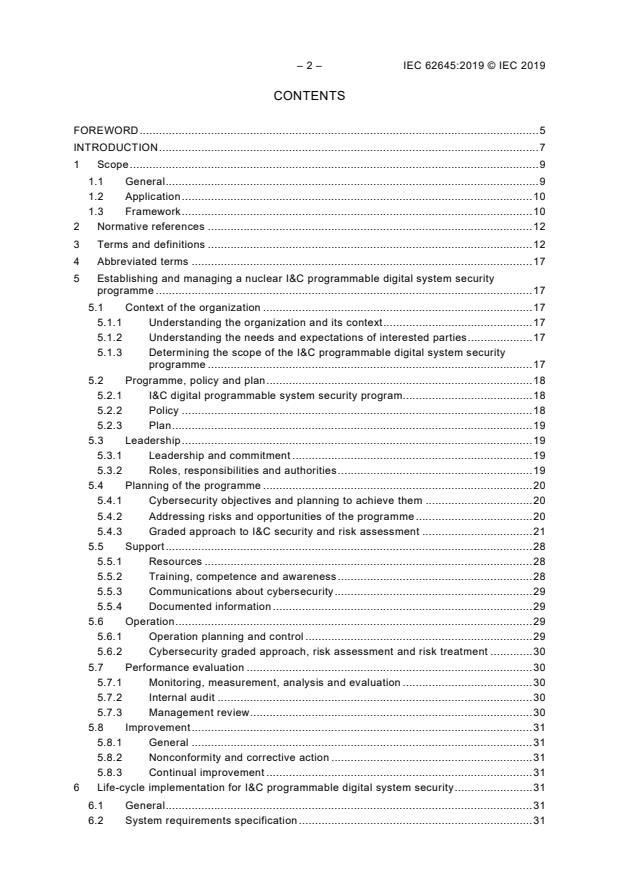
CONTENTS
FOREWORD . 5
INTRODUCTION . 7
1 Scope . 9
1.1 General . 9
1.2 Application . 10
1.3 Framework . 10
2 Normative references . 12
3 Terms and definitions . 12
4 Abbreviated terms . 17
5 Establishing and managing a nuclear I&C programmable digital system security
programme . 17
5.1 Context of the organization . 17
5.1.1 Understanding the organization and its context . 17
5.1.2 Understanding the needs and expectations of interested parties . 17
5.1.3 Determining the scope of the I&C programmable digital system security
programme . 17
5.2 Programme, policy and plan . 18
5.2.1 I&C digital programmable system security program. 18
5.2.2 Policy . 18
5.2.3 Plan . 19
5.3 Leadership . 19
5.3.1 Leadership and commitment . 19
5.3.2 Roles, responsibilities and authorities . 19
5.4 Planning of the programme . 20
5.4.1 Cybersecurity objectives and planning to achieve them . 20
5.4.2 Addressing risks and opportunities of the programme . 20
5.4.3 Graded approach to I&C security and risk assessment . 21
5.5 Support . 28
5.5.1 Resources . 28
5.5.2 Training, competence and awareness . 28
5.5.3 Communications about cybersecurity . 29
5.5.4 Documented information . 29
5.6 Operation . 29
5.6.1 Operation planning and control . 29
5.6.2 Cybersecurity graded approach, risk assessment and risk treatment . 30
5.7 Performance evaluation . 30
5.7.1 Monitoring, measurement, analysis and evaluation . 30
5.7.2 Internal audit . 30
5.7.3 Management review . 30
5.8 Improvement . 31
5.8.1 General . 31
5.8.2 Nonconformity and corrective action . 31
5.8.3 Continual improvement . 31
6 Life-cycle implementation for I&C programmable digital system security . 31
6.1 General . 31
6.2 System requirements specification . 31
6.2.1 General . 31
6.2.2 Security degree assignment . 32
6.3 System specification . 32
6.3.1 Selection of pre-existing components . 32
6.3.2 System architecture . 32
6.4 System detailed design and implementation . 32
6.4.1 General . 32
6.4.2 Risk assessment at the design phase . 33
6.4.3 Design project security plan . 33
6.4.4 Communication pathways . 33
6.4.5 Security zone definition . 34
6.4.6 Security assessment of the final design . 34
6.4.7 Implementation activities . 34
6.5 System integration . 34
6.6 System validation . 34
6.7 System installation . 35
6.8 Operation and maintenance activities . 35
6.8.1 Change control during operations and maintenance . 35
6.8.2 Periodic reassessment of risks and security controls . 35
6.8.3 Change management . 35
6.9 Retirement activities . 36
7 Security controls . 36
7.1 General . 36
7.2 Characterization. 36
7.3 Security defence-in-depth . 37
7.4 Selection and enforcement of cybersecurity controls . 37
Annex A (informative) Rationale for, and notes related to, the scope of this document . 38
A.1 Objective of this annex. 38
A.2 Inclusion of I&C programmable digital system not important to safety . 38
A.3 Exclusion of site physical security, room access control and site security
surveillance systems . 38
A.4 Exclusion of non-malevolent actions and events . 38
A.5 Development tools and platforms . 38
Annex B (informative) Generic considerations about the security degrees . 39
B.1 Rationale for three security degrees. 39
B.1.1 General . 39
B.1.2 Safety categories as input to security degree assignment . 39
B.1.3 Impact on plant availability and performance as input to security degree . 39
B.1.4 Resulting security degree assignment approach . 40
B.2 Considerations about tools associated to on-line systems . 40
B.3 Practical design and implementation . 40
Annex C (informative) Correspondence with ISO/IEC 27001:2013 . 41
Annex D (informative) Overall organisation of IEC SC 45A standards related to
cybersecurity . 43
Annex E (informative) Selection of security controls . 45
Annex F (informative) Considerations about IEC 62645 applicability to non-NPP
nuclear facilities . 47
F.1 Applicability of IEC 62645 security graded approach to Research Reactors . 47
F.1.1 General . 47
– 4 – IEC 62645:2019 © IEC 2019
F.1.2 Categorization of RRs in accordance with potential hazards . 47
F.1.3 Safety categories as input to security degree assignment . 48
F.1.4 Impact on operational capacity as input to security degree . 49
F.1.5 Considerations on requirements associated to security degrees . 49
F.2 Applicability of IEC 62645 security graded approach to fuel cycle facilities . 49
F.3 Applicability of IEC 62645 security graded approach to SMR . 49
F.4 Reference documents . 50
Annex G (informative) High-level correspondence table between IEC 62443 series and
IEC 62645. 51
Bibliography . 53
Figure 1 – Overall framework of IEC 62645 . 11
Figure 2 – E/E/PE items . 14
Figure D.1 – Overview of IEC SC 45A standards with cybersecurity relation . 44
Figure E.1 – Selection of security controls . 46
Table C.1 – Correspondence between ISO/IEC 27001:2013 and IEC 62645 . 41
Table F.1 – Correspondence between safety categories and classes as per IEC 61513 . 48
INTERNATIONAL ELECTROTECHNICAL COMMISSION
____________
NUCLEAR POWER PLANTS – INSTRUMENTATION, CONTROL AND
ELECTRICAL POWER SYSTEMS – CYBERSECURITY REQUIREMENTS
FOREWORD
1) The International Electrotechnical Commission (IEC) is a worldwide organization for standardization comprising
all national electrotechnical committees (IEC National Committees). The object of IEC is to promote
international co-operation on all questions concerning standardization in the electrical and electronic fields. To
this end and in addition to other activities, IEC publishes International Standards, Technical Specifications,
Technical Reports, Publicly Available Specifications (PAS) and Guides (hereafter referred to as “IEC
Publication(s)”). Their preparation is entrusted to technical committees; any IEC National Committee interested
in the subject dealt with may participate in this preparatory work. International, governmental and non-
governmental organizations liaising with the IEC also participate in this preparation. IEC collaborates closely
with the International Organization for Standardization (ISO) in accordance with conditions determined by
agreement between the two organizations.
2) The formal decisions or agreements of IEC on technical matters express, as nearly as possible, an international
consensus of opinion on the relevant subjects since each technical committee has representation from all
interested IEC National Committees.
3) IEC Publications have the form of recommendations for international use and are accepted by IEC National
Committees in that sense. While all reasonable efforts are made to ensure that the technical content of IEC
Publications is accurate, IEC cannot be held responsible for the way in which they are used or for any
misinterpretation by any end user.
4) In order to promote international uniformity, IEC National Committees undertake to apply IEC Publications
transparently to the maximum extent possible in their national and regional publications. Any divergence
between any IEC Publication and the corresponding national or regional publication shall be clearly indicated in
the latter.
5) IEC itself does not provide any attestation of conformity. Independent certification bodies provide conformity
assessment services and, in some areas, access to IEC marks of conformity. IEC is not responsible for any
services carried out by independent certification bodies.
6) All users should ensure that they have the latest edition of this publication.
7) No liability shall attach to IEC or its directors, employees, servants or agents including individual experts and
members of its technical committees and IEC National Committees for any personal injury, property damage or
other damage of any nature whatsoever, whether direct or indirect, or for costs (including legal fees) and
expenses arising out of the publication, use of, or reliance upon, this IEC Publication or any other IEC
Publications.
8) Attention is drawn to the Normative references cited in this publication. Use of the referenced publications is
indispensable for the correct application of this publication.
9) Attention is drawn to the possibility that some of the elements of this IEC Publication may be the subject of
patent rights. IEC shall not be held responsible for identifying any or all such patent rights.
International Standard IEC 62645 has been prepared by subcommittee 45A: Instrumentation,
control and electrical power systems of nuclear facilities, of IEC technical committee 45:
Nuclear instrumentation.
This second edition cancels and replaces the first edition published in 2014. This edition
constitutes a technical revision.
This edition includes the following significant technical changes with respect to the previous
edition:
a) to align the standard with the new revisions of ISO/IEC 27001;
b) to review the existing requirements and to update the terminology and definitions;
c) to take account of, as far as possible, requirements associated with standards published
since the first edition;
d) to take into account the fact that cybersecurity techniques, but also national practices
evolve.
– 6 – IEC 62645:2019 © IEC 2019
The text of this International Standard is based on the following documents:
FDIS Report on voting
45A/1289/FDIS 45A/1295/RVD
Full information on the voting for the approval of this International Standard can be found in
the report on voting indicated in the above table.
This document has been drafted in accordance with the ISO/IEC Directives, Part 2.
The committee has decided that the contents of this document will remain unchanged until the
stability date indicated on the IEC website under "http://webstore.iec.ch" in the data related to
the specific document. At this date, the document will be
• reconfirmed,
• withdrawn,
• replaced by a revised edition, or
• amended.
IMPORTANT – The 'colour inside' logo on the cover page of this publication indicates
that it contains colours which are considered to be useful for the correct
understanding of its contents. Users should therefore print this document using a
colour printer.
INTRODUCTION
a) Technical background, main issues and organisation of the standard
This International Standard focuses on the issue of cybersecurity requirements to prevent
and/or minimize the impact of attacks against I&C programmable digital systems on nuclear
safety and plant performance. It covers programme level, architectural level and system level
requirements.
This standard was prepared and based on the ISO/IEC 27000 series, IAEA and country
specific guidance in this expanding technical and security focus area.
It is intended that the International Standard be used by designers and operators of nuclear
power plants (NPPs) (utilities), licensees, systems evaluators, vendors and subcontractors,
and by licensors.
b) Situation of the current Standard in the structure of the IEC SC 45A standard
series
IEC 62645 is a second level IEC SC 45A document, tackling the generic issue of NPP I&C
cybersecurity.
IEC 62645 is considered formally as a second level document with respect to IEC 61513,
although IEC 61513 needs revision to actually ensure proper reference to and consistency
with IEC 62645. IEC 62645 is the top-level document with respect to cybersecurity in the
SC 45A standard series. Other documents are developed under IEC 62645 and correspond to
third level documents in the IEC SC 45A standards.
For more details on the structure of the IEC SC 45A standard series, see item d) of this
introduction.
c) Recommendations and limitations regarding the application of this standard
This standard establishes requirements for I&C programmable digital systems, with regard to
computer security, and clarifies the processes that I&C programmable digital systems are
designed, developed and operated under in NPPs.
It is recognized that this standard addresses an evolving area of regulatory requirements, due
to the changing and evolving nature of computer security threats. Therefore, the standard
defines a framework within which the evolving country specific requirements may be
developed and applied.
It is also recognized that products derived from application of this subject matter require
protection. Release of the standard’s country specific requirements should be controlled to
limit the extent to which organizations or individuals intending to access nuclear plant
systems illegally, improperly or without authorization may benefit from this information.
d) Description of the structure of the IEC SC 45A standard series and relationships
with other IEC documents and other bodies documents (IAEA, ISO)
The top-level documents of the IEC SC 45A standard series are IEC 61513 and IEC 63046.
IEC 61513 provides general requirements for I&C systems and equipment that are used to
perform functions important to safety in NPPs. IEC 63046 provides general requirements for
electrical power systems of NPPs; it covers power supply systems including the supply
systems of the I&C systems. IEC 61513 and IEC 63046 are to be considered in conjunction
and at the same level. IEC 61513 and IEC 63046 structure the IEC SC 45A standard series
– 8 – IEC 62645:2019 © IEC 2019
and shape a complete framework establishing general requirements for instrumentation,
control and electrical systems for nuclear power plants.
IEC 61513 and IEC 63046 refer directly to other IEC SC 45A standards for general topics
related to categorization of functions and classification of systems, qualification, separation,
defence against common cause failure, control room design, electromagnetic compatibility,
cybersecurity, software and hardware aspects for programmable digital systems, coordination
of safety and security requirements and management of ageing. The standards referenced
directly at this second level should be considered together with IEC 61513 and IEC 63046 as
a consistent document set.
At a third level, IEC SC 45A standards not directly referenced by IEC 61513 or by IEC 63046
are standards related to specific equipment, technical methods, or specific activities. Usually
these documents, which make reference to second-level documents for general topics, can be
used on their own.
A fourth level extending the IEC SC 45 standard series, corresponds to the Technical Reports
which are not normative.
The IEC SC 45A standards series consistently implement and detail the safety and security
principles and basic aspects provided in the relevant IAEA safety standards and in the
relevant documents of the IAEA nuclear security series (NSS). In particular this includes the
IAEA requirements SSR-2/1, establishing safety requirements related to the design of nuclear
power plants (NPPs), the IAEA safety guide SSG-30 dealing with the safety classification of
structures, systems and components in NPPs, the IAEA safety guide SSG-39 dealing with the
design of instrumentation and control systems for NPPs, the IAEA safety guide SSG-34
dealing with the design of electrical power systems for NPPs and the implementing guide
NSS17 for computer security at nuclear facilities. The safety and security terminology and
definitions used by SC 45A standards are consistent with those used by the IAEA.
IEC 61513 and IEC 63046 have adopted a presentation format similar to the basic safety
publication IEC 61508 with an overall life-cycle framework and a system life-cycle framework.
Regarding nuclear safety, IEC 61513 and IEC 63046 provide the interpretation of the general
requirements of IEC 61508-1, IEC 61508-2 and IEC 61508-4, for the nuclear application
sector. In this framework IEC 60880, IEC 62138 and IEC 62566 correspond to IEC 61508-3
for the nuclear application sector. IEC 61513 and IEC 63046 refer to ISO as well as to
IAEA GS-R part 2 and IAEA GS-G-3.1 and IAEA GS-G-3.5 for topics related to quality
assurance (QA). At level 2, regarding nuclear security, IEC 62645 is the entry document for
the IEC/SC 45A security standards. It builds upon the valid high level principles and main
concepts of the generic security standards, in particular ISO/IEC 27001 and ISO/IEC 27002; it
adapts them and completes them to fit the nuclear context and coordinates with the
IEC 62443 series. At level 2, IEC 60964 is the entry document for the IEC/SC 45A control
rooms standards and IEC 62342 is the entry document for the ageing management standards.
NOTE 1 It is assumed that for the design of I&C systems in NPPs that implement conventional safety functions
(e.g. to address worker safety, asset protection, chemical hazards, process energy hazards) international or
national standards would be applied.
NOTE 2 IEC/SC 45A domain was extended in 2013 to cover electrical systems. In 2014 and 2015 discussions
were held within IEC/SC 45A to decide how and where general requirements for the design of electrical systems
were to be considered. IEC/SC 45A experts recommended that an independent standard be developed at the same
level as IEC 61513 to establish general requirements for electrical systems. Project IEC 63046 is now launched to
cover this objective. When IEC 63046 is published, this Note 2 of the introduction of IEC/SC 45A standards will be
suppressed.
NUCLEAR POWER PLANTS – INSTRUMENTATION, CONTROL AND
ELECTRICAL POWER SYSTEMS – CYBERSECURITY REQUIREMENTS
1 Scope
1.1 General
This document establishes requirements and provides guidance for the development and
management of effective computer security programmes for I&C programmable digital
systems. Inherent to these requirements and guidance is the criterion that the power plant
I&C programmable digital system security programme complies with the applicable country’s
requirements.
This document defines adequate measures for the prevention of, detection of and reaction to
malicious acts by digital means (cyberattacks) on I&C programmable digital systems. This
includes any unsafe situation, equipment damage or plant performance degradation that could
result from such an act, such as:
– malicious modifications affecting system integrity;
– malicious interference with information, data or resources that could compromise the
delivery of or performance of the required I&C programmable digital functions;
– malicious interference with information, data or resources that could compromise operator
displays or lead to loss of management of I&C programmable digital systems;
– malicious changes to hardware, firmware or software at the programmable logic controller
(PLC) level.
Human errors leading to violation of the security policy and/or easing the aforementioned
malicious acts are also in the scope of this document.
This document describes a graded approach scheme for assets subject to digital compromise,
based on their relevance to the overall plant safety, availability, and equipment protection.
Excluded from the scope of this document are considerations related to:
– non-malevolent actions and events such as accidental failures, human errors (except
those impacting the performance of cybersecurity controls) and natural events. In
particular, good practices for managing applications and data, including back-up and
restoration related to accidental failure, are out of scope;
NOTE 1 Although such aspects are often covered by security programme in other normative contexts (e.g., in
the ISO/IEC 27000 series or in the IEC 62443 series), this document is only focused on the protection against
malicious acts by digital means (cyberattacks) on I&C programmable digital systems. The main reason is that
in the nuclear generation domain, other standards and practices already cover accidental failures,
unintentional human errors, natural events, etc. The focus of IEC 62645 is made to provide the maximum
consistency and the minimum overlap with these other nuclear standards and practices.
– site physical security, room access control and site security surveillance systems. These
systems, while not specifically addressed in this document, are to be covered by plant
operating procedures and programmes;
NOTE 2 This exclusion does not deny that cybersecurity has clear dependencies on the security of the
physical environment (e.g., physical protection, power delivery systems, heating/ventilation/air-conditioning
systems (HVAC), etc.).
– the aspect of confidentiality of information about I&C digital programmable systems is out
of the scope of this document (see 5.4.3.2.3).
– 10 – IEC 62645:2019 © IEC 2019
Annex A provides a rationale for and comments about the scope, definition and the
document's application, and in particular about the exclusions and limitations previously
mentioned.
Standards such as ISO/IEC 27001 and ISO/IEC 27002 are not directly applicable to the cyber
protection of nuclear I&C programmable digital systems. This is mainly due to the specificities
of these systems, including the regulatory and safety requirements inherent to nuclear
facilities. However, this document builds upon the valid high level principles and main
concepts of ISO/IEC 27001:2013, adapts them and completes them to fit the nuclear context.
This document follows the general principles given in the IAEA reference manual NSS17.
1.2 Application
This document is limited to computer security of I&C programmable digital systems (including
non-safety systems) used in a NPP as well as associated computer-based tools. This
document is applicable to the parts of electrical power systems covered by IEC 63046 which
rely on digital programmable technology.
NOTE 1 For the sake of simplicity, the terms “I&C programmable digital systems” in the text refer both to I&C and
the parts of electrical power systems covered by IEC 63046 which rely on digital programmable technology.
This document is intended for use in evaluating or changing established NPP security
programmes for I&C programmable digital systems, and in establishing new programmes.
This document is applied to all NPP I&C programmable digital systems throughout the life
cycles of these systems, as specified in this document. It may also be applicable to other
types of nuclear facilities.
NOTE 2 The term NPP is understood in its “physical site” meaning, NPP I&C programmable digital systems
including systems within the NPP buildings, but also systems in the nuclear plant switchyard, water treatment
facilities, etc.
1.3 Framework
The requirements and recommendations of this document are structured along three main
normative clauses.
Clause 5 deals with cybersecurity on the programme life-cycle level; its approach is
completely consistent with ISO/IEC 27001:2013. It is based on its structure and content,
which are when needed, adapted and completed to fit the nuclear context specificities.
Annex C provides a clause-to-clause correspondence table between the IEC 62645 structure
and the ISO/IEC 27001:2013 structure. When direct references to ISO/IEC 27001:2013
content are made, the following terminological substitutions are to be made:
– the terms “information security management system” used in the referenced ISO/IEC
27001:2013 content correspond to “I&C digital programmable system cybersecurity
program” in this document (as defined in Clause 3);
NOTE 1 This document focuses on the part of the program, or the dedicated program, related to I&C. This can be
part of a larger program at the corporate level, which is out of the scope of this document.
– the term “information security” used in the referenced ISO/IEC 27001:2013 content
correspond to “cybersecurity” in this document (as defined in Clause 3);
– the terms “information security policy” used in the referenced ISO/IEC 27001:2013 content
correspond to “I&C digital programmable system policy” in this document.
NOTE 2 Some subclauses of ISO/IEC 27001:2013 contain internal references to other subclauses of ISO/IEC
27001. When relevant, the references used in these subclauses are to be considered in the IEC 62645 context,
however, they do not reference IEC 62645 subclauses. See Annex C for help in the correspondences.
The subclauses related to the graded approach and security categorization are organized in a
similar way to IEC 61226.
Clause 6 deals with cybersecurity on a system life-cycle level. It is structured along the
system life-cycle of IEC 61513, adapted to take into account specifics of cybersecurity.
Clause 7 deals with cybersecurity at the cybersecurity control level. It provides the high level
principles of an approach consistent with ISO/IEC 27002:2013, further detailed in IEC 63096.
Figure 1 presents the overall framework of this document.
Figure 1 – Overall framework of IEC 62645
IEC 61513 addresses the concept of a safety life cycle for the total I&C system architecture,
and a safety life cycle for the individual systems. As part of the overall framework, IEC 61513
calls for establishment of an overall security plan to specify the procedural and technical
measures to be taken to protect the architecture of I&C systems from digital attacks that may
jeopardize functions important to safety. The provisions of the overall security plan may
differentiate between requirements for systems supporting category A, B or C functions, as
defined in IEC 61226 and include the establishment of controls for electronic and physical
access. This document provides more detailed requirements for the overall security plan, as
called for in IEC 61513.
– 12 – IEC 62645:2019 © IEC 2019
Additional requirements for software of systems supporting category A functions are provided
in IEC 60880 and IEC 62566. Additional requirements for software of systems supporting
category B and C functions are provided in IEC 62138.
This document also covers security requirements for I&C programmable digital systems which
are not in the scope of IEC 61513, IEC 60880, IEC 62138 and IEC 62566 but have a potential
impact on plant equipment, availability and performance.
2 Normative references
The following documents are referred to in the text in such a way that some or all of their
content constitutes requirements of this document. For dated references, only the edition
cited applies. For undated references, the latest edition of the referenced document (including
any amendments) applies.
IEC 60880:2006, Nuclear power plants – Instrumentation and control systems important to
safety – Software aspects for computer-based systems performing category A functions
IEC 61226, Nuclear power plants – Instrumentation and control important to safety –
Classification of instrumentation and control functions
IEC 61513, Nuclear power plants – Instrumentation and control important to safety – General
requirements for systems
IEC 62138, Nuclear power plants – Instrumentation and control important for safety –
Software aspects for computer-based systems performing category B or C functions
IEC 62566, Nuclear power plants – Instrumentation and control important for safety –
Development of HDL-programmed integrated circuits for systems performing category A
functions
IEC 62859, Nuclear power plants – Instrumentation and control systems – Requirements for
coordinating safety and cybersecurity
IEC 62988:2018, Nuclear power plants – Instrumentation and control important to safety –
Selection and use of wireless devices
ISO/IEC 27001:2013, Information technology – Security techniques – Information security
management systems – Requirements
ISO/IEC 27002:2013, Information technology – Security techniques – Code of practice for
information security controls
ISO/IEC 27005:2018, Information technology – Security techniques – Information security risk
management
IAEA TLD-006, Conducting Computer Security Assessments at Nuclear Facilities, 2016
3 Terms and definitions
For the purposes of this document, the following terms and definitions apply.
ISO and IEC maintain terminological databases for use in standardization at the following
addresses:
• IEC Electropedia: available at http://www.electropedia.org/
• ISO Online browsing platform: available at http://www.iso.org/obp
3.1
attack vector
path or means by which an attacker or malicious program can gain access to a computer-
based system
3.2
authorization
function of specifying access rights to resources, which is related to information security and
computer security in general and to access control in particular
3.3
availability
property of being accessible and usable upon demand by an authorized entity
Note 1 to entry: This definition is different from the one used in the other IEC standards in the field of
instrumentation and control of nuclear facilities which is “ability of an item to be in a state to perform a required
function under given conditions at a given instant of time or over a given time interval, assuming that the required
external resources are provided”.
[SOURCE: IAEA Nuclear Security Series No. 17:2011]
3.4
computer-based item
item that relies on software instructions running on microprocessors or microcontrollers
Note 1 to entry: The term item can be replaced by the terms system or equipment or device.
Note 2 to entry: A computer-based item is a kind of programmable digital item.
Note 3 to entry: This term is equivalent to software-based item.
[SOURCE: IEC 62138: 2018, 3.8]
3.5
confidentiality
property that information is not made available or disclosed to unauthorized individuals,
entities, or processes
[SOURCE: IAEA Nuclear Security Series No. 17:2011]
3.6
cyberattack
malicious acts by digital means
3.7
cybersecurity
set of activities and measures the objective of which is to prevent, detect, and react to:
– malicious modifications (integrity) of functions that may compromise the delivery or
integrity of the required service by I&C programmable digital systems (incl. loss of control)
which could lead to an accident, an unsafe situation or plant performance degradation;
– malicious withholding or prevent
...
Questions, Comments and Discussion
Ask us and Technical Secretary will try to provide an answer. You can facilitate discussion about the standard in here.
Loading comments...