

IEC 61869-4:2013
(Main)Instrument transformers - Part 4: Additional requirements for combined transformers
General Information
- Abstract
IEC 61869-4:2013 applies to newly-manufactured combined transformers for use with electrical measuring instruments and electrical protective devices at frequencies from 15 Hz to 100 Hz. The requirements and tests of this standard, in addition to the requirements and tests of IEC 61869-1, IEC 61869-2 and IEC 61869-3 cover current and inductive voltage transformers that are necessary for combined instrument transformers. This standard replaces IEC 60044-3: Combined transformers.
This publication is to be read in conjunction with IEC 61869-1:2007, IEC 61869-2:2012 and IEC 61869-3:2011. The contents of the corrigendum of August 2014 have been included in this copy.
- Status
- Published
- Publication Date
- 18-Nov-2013
- Technical Committee
- TC 38 - Instrument Transformers
- Drafting Committee
- WG 34 - TC 38/WG 34
- Current Stage
- PPUB - Publication issued
- Start Date
- 19-Nov-2013
- Completion Date
- 31-Dec-2013
Overview
IEC 61869-4:2013 is an international standard published by the International Electrotechnical Commission (IEC), titled "Instrument transformers - Part 4: Additional requirements for combined transformers." This standard specifically addresses the additional requirements for combined instrument transformers used in electrical measurement and protection systems. It applies to newly manufactured combined transformers operating within a frequency range of 15 Hz to 100 Hz and supplements the general and specific requirements outlined in IEC 61869-1, IEC 61869-2, and IEC 61869-3. IEC 61869-4 replaces the older IEC 60044-3 standard, ensuring up-to-date technical guidance for combined current and inductive voltage transformers housed in the same enclosure.
Key Topics
Scope and Applicability
IEC 61869-4 applies to combined transformers that integrate current and voltage transformer functions for electrical instrumentation and protection devices. It covers design, testing, ratings, service conditions, and safety requirements essential for reliable operation.Normative References
This standard should be used in conjunction with:- IEC 61869-1: General Requirements for instrument transformers
- IEC 61869-2: Additional Requirements for Current Transformers
- IEC 61869-3: Additional Requirements for Inductive Voltage Transformers
Definitions and Terms
Precise technical terms such as ratio error, phase displacement, induced voltage effects, and variations caused by mutual influence between current and voltage transformers are defined to ensure clarity and uniformity in application.Mutual Influence Considerations
The standard addresses the impact of the current transformer on the voltage transformer and vice versa, including voltage induced by continuous thermal current and the effect of capacitive currents, which are critical for maintaining measurement accuracy.Design and Construction Requirements
Guidance on transformer enclosure, insulation, and magnetic circuit design ensures robustness and accuracy for combined instrument transformers.Testing Procedures
IEC 61869-4 specifies comprehensive testing protocols, including ratio and phase displacement measurements, thermal current testing, and influence tests to verify performance under practical electrical conditions.Safety and Environmental Aspects
The standard defines safety requirements for transport, storage, erection, operation, and maintenance, emphasizing protection for personnel and machinery while considering environmental impacts.
Applications
Electrical Measurement and Protection Systems
Combined instrument transformers compliant with IEC 61869-4 are essential components in electric power systems, enabling accurate measurement and protection for high voltage and medium voltage installations.Power Generation and Distribution
Used extensively in power plants, substations, and distribution networks for monitoring current and voltage, supporting billing, fault detection, and load management.Industrial Electrical Installations
Enhances safety, control, and efficiency in industrial environments by providing reliable instrument transformer solutions for critical electrical equipment.Renewable Energy Systems
Supports the integration and monitoring of renewable generation units such as wind and solar farms, ensuring compatibility and precision in combined transformer applications.
Related Standards
- IEC 61869-1 – General requirements for instrument transformers, forming the foundational framework for the series.
- IEC 61869-2 – Additional requirements for current transformers, detailing specifics relevant to current measurement devices.
- IEC 61869-3 – Additional requirements for inductive voltage transformers, focusing on voltage measurement accuracy and performance.
- IEC 60044 Series – The previous generation of standards for instrument transformers replaced or supplemented by IEC 61869 documents.
- IEC 61869-5 to IEC 61869-15 – Cover additional types of instrument transformers such as capacitive voltage transformers, electronic transformers, and digital interfaces.
Conclusion
IEC 61869-4:2013 provides critical supplementary requirements for combined instrument transformers, essential for electrical measurement and protection at frequencies between 15 Hz and 100 Hz. It ensures harmonized global standards that enhance measurement accuracy, safety, and performance in power systems. Adhering to this standard supports manufacturers, designers, and engineers in producing reliable, compliant combined transformers that meet stringent international criteria.
Keywords: IEC 61869-4, combined instrument transformers, current transformers, voltage transformers, electrical measurement, protective devices, instrument transformer standards, power system instrumentation, IEC standards, transformer testing, mutual influence, transformer design.
Relations
- Effective Date
- 05-Sep-2023
- Effective Date
- 05-Sep-2023
Get Certified
Connect with accredited certification bodies for this standard

BSMI (Bureau of Standards, Metrology and Inspection)
Taiwan's standards and inspection authority.
Sponsored listings
Frequently Asked Questions
IEC 61869-4:2013 is a standard published by the International Electrotechnical Commission (IEC). Its full title is "Instrument transformers - Part 4: Additional requirements for combined transformers". This standard covers: IEC 61869-4:2013 applies to newly-manufactured combined transformers for use with electrical measuring instruments and electrical protective devices at frequencies from 15 Hz to 100 Hz. The requirements and tests of this standard, in addition to the requirements and tests of IEC 61869-1, IEC 61869-2 and IEC 61869-3 cover current and inductive voltage transformers that are necessary for combined instrument transformers. This standard replaces IEC 60044-3: Combined transformers. This publication is to be read in conjunction with IEC 61869-1:2007, IEC 61869-2:2012 and IEC 61869-3:2011. The contents of the corrigendum of August 2014 have been included in this copy.
IEC 61869-4:2013 applies to newly-manufactured combined transformers for use with electrical measuring instruments and electrical protective devices at frequencies from 15 Hz to 100 Hz. The requirements and tests of this standard, in addition to the requirements and tests of IEC 61869-1, IEC 61869-2 and IEC 61869-3 cover current and inductive voltage transformers that are necessary for combined instrument transformers. This standard replaces IEC 60044-3: Combined transformers. This publication is to be read in conjunction with IEC 61869-1:2007, IEC 61869-2:2012 and IEC 61869-3:2011. The contents of the corrigendum of August 2014 have been included in this copy.
IEC 61869-4:2013 is classified under the following ICS (International Classification for Standards) categories: 17.220.20 - Measurement of electrical and magnetic quantities. The ICS classification helps identify the subject area and facilitates finding related standards.
IEC 61869-4:2013 has the following relationships with other standards: It is inter standard links to IEC 60044-3:2002, IEC 61869-4:2013/COR1:2014. Understanding these relationships helps ensure you are using the most current and applicable version of the standard.
IEC 61869-4:2013 is available in PDF format for immediate download after purchase. The document can be added to your cart and obtained through the secure checkout process. Digital delivery ensures instant access to the complete standard document.
Standards Content (Sample)
IEC 61869-4 ®
Edition 1.0 2013-11
INTERNATIONAL
STANDARD
NORME
INTERNATIONALE
Instrument transformers –
Part 4: Additional requirements for combined transformers
Transformateurs de mesure –
Partie 4: Exigences supplémentaires concernant les transformateurs combinés
All rights reserved. Unless otherwise specified, no part of this publication may be reproduced or utilized in any form
or by any means, electronic or mechanical, including photocopying and microfilm, without permission in writing from
either IEC or IEC's member National Committee in the country of the requester.
If you have any questions about IEC copyright or have an enquiry about obtaining additional rights to this publication,
please contact the address below or your local IEC member National Committee for further information.
Droits de reproduction réservés. Sauf indication contraire, aucune partie de cette publication ne peut être reproduite ni
utilisée sous quelque forme que ce soit et par aucun procédé, électronique ou mécanique, y compris la photocopie et les
microfilms, sans l'accord écrit de la CEI ou du Comité national de la CEI du pays du demandeur.
Si vous avez des questions sur le copyright de la CEI ou si vous désirez obtenir des droits supplémentaires sur cette
publication, utilisez les coordonnées ci-après ou contactez le Comité national de la CEI de votre pays de résidence.
IEC Central Office Tel.: +41 22 919 02 11
3, rue de Varembé Fax: +41 22 919 03 00
CH-1211 Geneva 20 info@iec.ch
Switzerland www.iec.ch
About the IEC
The International Electrotechnical Commission (IEC) is the leading global organization that prepares and publishes
International Standards for all electrical, electronic and related technologies.
About IEC publications
The technical content of IEC publications is kept under constant review by the IEC. Please make sure that you have the
latest edition, a corrigenda or an amendment might have been published.
Useful links:
IEC publications search - www.iec.ch/searchpub Electropedia - www.electropedia.org
The advanced search enables you to find IEC publications The world's leading online dictionary of electronic and
by a variety of criteria (reference number, text, technical electrical terms containing more than 30 000 terms and
committee,…). definitions in English and French, with equivalent terms in
It also gives information on projects, replaced and additional languages. Also known as the International
withdrawn publications. Electrotechnical Vocabulary (IEV) on-line.
IEC Just Published - webstore.iec.ch/justpublished Customer Service Centre - webstore.iec.ch/csc
Stay up to date on all new IEC publications. Just Published If you wish to give us your feedback on this publication
details all new publications released. Available on-line and or need further assistance, please contact the
also once a month by email. Customer Service Centre: csc@iec.ch.
A propos de la CEI
La Commission Electrotechnique Internationale (CEI) est la première organisation mondiale qui élabore et publie des
Normes internationales pour tout ce qui a trait à l'électricité, à l'électronique et aux technologies apparentées.
A propos des publications CEI
Le contenu technique des publications de la CEI est constamment revu. Veuillez vous assurer que vous possédez
l’édition la plus récente, un corrigendum ou amendement peut avoir été publié.
Liens utiles:
Recherche de publications CEI - www.iec.ch/searchpub Electropedia - www.electropedia.org
La recherche avancée vous permet de trouver des Le premier dictionnaire en ligne au monde de termes
publications CEI en utilisant différents critères (numéro de électroniques et électriques. Il contient plus de 30 000
référence, texte, comité d’études,…). termes et définitions en anglais et en français, ainsi que
Elle donne aussi des informations sur les projets et les les termes équivalents dans les langues additionnelles.
publications remplacées ou retirées. Egalement appelé Vocabulaire Electrotechnique
International (VEI) en ligne.
Just Published CEI - webstore.iec.ch/justpublished
Service Clients - webstore.iec.ch/csc
Restez informé sur les nouvelles publications de la CEI.
Just Published détaille les nouvelles publications parues. Si vous désirez nous donner des commentaires sur
Disponible en ligne et aussi une fois par mois par email. cette publication ou si vous avez des questions
contactez-nous: csc@iec.ch.
IEC 61869-4 ®
Edition 1.0 2013-11
INTERNATIONAL
STANDARD
NORME
INTERNATIONALE
Instrument transformers –
Part 4: Additional requirements for combined transformers
Transformateurs de mesure –
Partie 4: Exigences supplémentaires concernant les transformateurs combinés
INTERNATIONAL
ELECTROTECHNICAL
COMMISSION
COMMISSION
ELECTROTECHNIQUE
PRICE CODE
INTERNATIONALE
CODE PRIX S
ICS 17.220.20 ISBN 978-2-8322-1215-8
– 2 – 61869-4 © IEC:2013
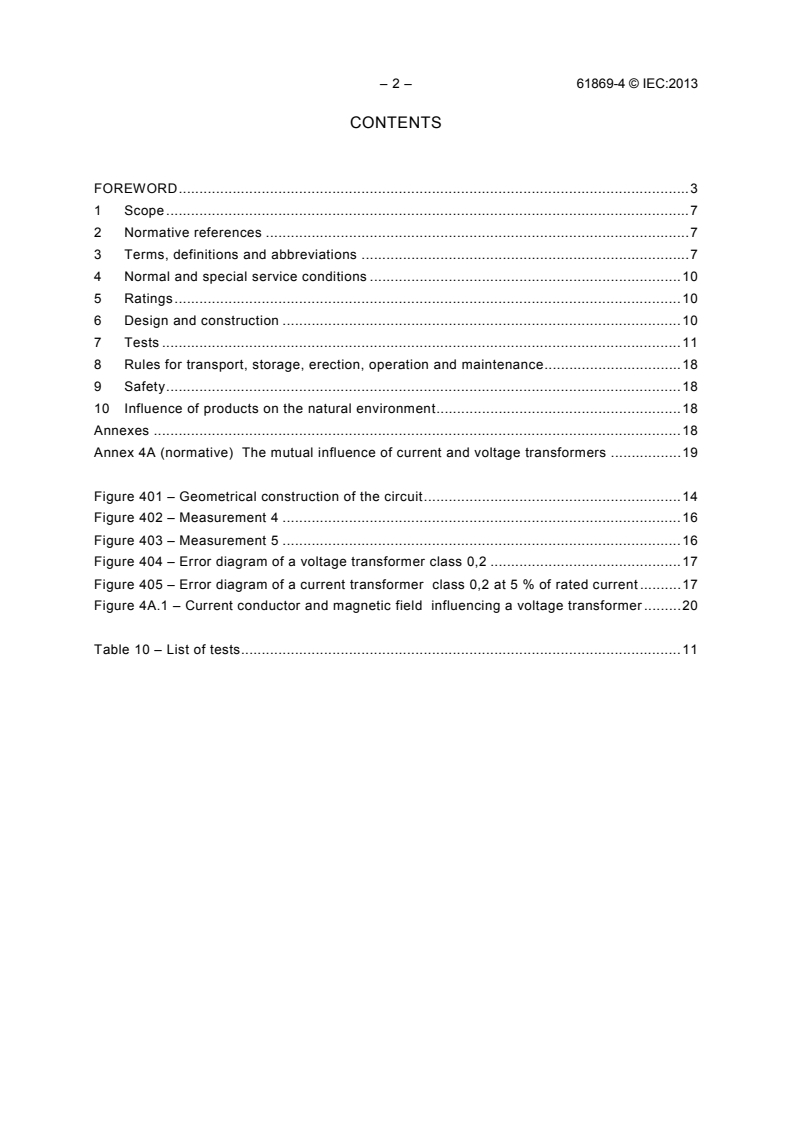
CONTENTS
FOREWORD . 3
1 Scope . 7
2 Normative references . 7
3 Terms, definitions and abbreviations . 7
4 Normal and special service conditions . 10
5 Ratings . 10
6 Design and construction . 10
7 Tests . 11
8 Rules for transport, storage, erection, operation and maintenance . 18
9 Safety . 18
10 Influence of products on the natural environment . 18
Annexes . 18
Annex 4A (normative) The mutual influence of current and voltage transformers . 19
Figure 401 – Geometrical construction of the circuit . 14
Figure 402 – Measurement 4 . 16
Figure 403 – Measurement 5 . 16
Figure 404 – Error diagram of a voltage transformer class 0,2 . 17
Figure 405 – Error diagram of a current transformer class 0,2 at 5 % of rated current . 17
Figure 4A.1 – Current conductor and magnetic field influencing a voltage transformer . 20
Table 10 – List of tests. 11
61869-4 © IEC:2013 – 3 –
INTERNATIONAL ELECTROTECHNICAL COMMISSION
____________
INSTRUMENT TRANSFORMERS –
Part 4: Additional requirements for combined transformers
FOREWORD
1) The International Electrotechnical Commission (IEC) is a worldwide organization for standardization comprising
all national electrotechnical committees (IEC National Committees). The object of IEC is to promote
international co-operation on all questions concerning standardization in the electrical and electronic fields. To
this end and in addition to other activities, IEC publishes International Standards, Technical Specifications,
Technical Reports, Publicly Available Specifications (PAS) and Guides (hereafter referred to as “IEC
Publication(s)”). Their preparation is entrusted to technical committees; any IEC National Committee interested
in the subject dealt with may participate in this preparatory work. International, governmental and non-
governmental organizations liaising with the IEC also participate in this preparation. IEC collaborates closely
with the International Organization for Standardization (ISO) in accordance with conditions determined by
agreement between the two organizations.
2) The formal decisions or agreements of IEC on technical matters express, as nearly as possible, an international
consensus of opinion on the relevant subjects since each technical committee has representation from all
interested IEC National Committees.
3) IEC Publications have the form of recommendations for international use and are accepted by IEC National
Committees in that sense. While all reasonable efforts are made to ensure that the technical content of IEC
Publications is accurate, IEC cannot be held responsible for the way in which they are used or for any
misinterpretation by any end user.
4) In order to promote international uniformity, IEC National Committees undertake to apply IEC Publications
transparently to the maximum extent possible in their national and regional publications. Any divergence
between any IEC Publication and the corresponding national or regional publication shall be clearly indicated in
the latter.
5) IEC itself does not provide any attestation of conformity. Independent certification bodies provide conformity
assessment services and, in some areas, access to IEC marks of conformity. IEC is not responsible for any
services carried out by independent certification bodies.
6) All users should ensure that they have the latest edition of this publication.
7) No liability shall attach to IEC or its directors, employees, servants or agents including individual experts and
members of its technical committees and IEC National Committees for any personal injury, property damage or
other damage of any nature whatsoever, whether direct or indirect, or for costs (including legal fees) and
expenses arising out of the publication, use of, or reliance upon, this IEC Publication or any other IEC
Publications.
8) Attention is drawn to the Normative references cited in this publication. Use of the referenced publications is
indispensable for the correct application of this publication.
9) Attention is drawn to the possibility that some of the elements of this IEC Publication may be the subject of
patent rights. IEC shall not be held responsible for identifying any or all such patent rights.
This International Standard IEC 61869-4 has been prepared by IEC technical committee 38:
Instrument transformers.
This standard replaces IEC 60044-3: Combined transformers.
The text of this standard is based on the following documents:
FDIS Report on voting
38/468/FDIS 38/472/RVD
Full information on the voting for the approval of this standard can be found in the report on
voting indicated in the above table.
This publication has been drafted in accordance with the ISO/IEC Directives, Part 2.
– 4 – 61869-4 © IEC:2013
This standard is Part 4 of IEC 61869, published under the general title Instrument
transformers.
This Part 4 is to be read in conjunction with, and is based on, IEC 61869-1 General
Requirements – first edition (2007), IEC 61869-2, Additional requirements for current
transformers first edition (2012) and IEC 61869-3, Additional requirements for inductive
voltage transformers first edition (2011) – however, the reader is encouraged to use the most
recent edition of these documents.
This Part 4 follows the structure of IEC 61869-1, IEC 61869-2 and IEC 61869-3 and
supplements or modifies its corresponding clauses.
When a particular subclause of Part 1, 2 or 3 is not mentioned in this Part 4, that subclause
applies as far as is reasonable. When this standard states “addition”, “modification” or
“replacement”, the relevant text in Part 1, 2 or 3 is to be adapted accordingly.
For additional clauses, subclauses, figures, tables, annexes or notes, the following numbering
system is used:
– clauses, subclauses, tables and figures that are numbered starting from 401 are additional
to those in Part 1, 2 or 3;
– additional annexes are lettered 4A, 4B, etc.
An overview of the planned set of standards at the date of publication of this document is
given below. The updated list of standards issued by IEC TC38 is available at the website:
www.iec.ch
The contents of the corrigendum of August 2014 have been included in this copy.
61869-4 © IEC:2013 – 5 –
PRODUCT FAMILY STANDARDS PRODUCT PRODUCTS OLD
STANDARD STANDARD
ADDITIONAL REQUIREMENTS FOR 60044-1
61869-2
CURRENT TRANSFORMERS
60044-6
ADDITIONAL REQUIREMENTS FOR 60044-2
61869-3
INDUCTIVE VOLTAGE TRANSFORMERS
61869-4 ADDITIONAL REQUIREMENTS FOR 60044-3
COMBINED TRANSFORMERS
61869-5 ADDITIONAL REQUIREMENTS FOR 60044-5
CAPACITIVE VOLTAGE TRANSFORMERS
61869-1
ADDITIONAL REQUIREMENTS FOR 60044-7
61869-6 61869-7
ELECTRONIC VOLTAGE
TRANSFORMERS
GENERAL
ADDITIONAL
REQUIREMENTS
GENERAL
FOR
REQUIREMENT 61869-8 ADDITIONAL REQUIREMENTS FOR 60044-8
INSTRUMENT
FOR LOW POWER ELECTRONIC CURRENT
TRANSFORMERS
TRANSFORMERS
INSTRUMENT
TRANSFORMERS
61869-9 DIGITAL INTERFACE FOR INSTRUMENT
TRANSFORMERS
61869-10 ADDITIONAL REQUIREMENTS FOR LOW-
POWER STAND-ALONE CURRENT
SENSORS
61869-11 ADDITIONAL REQUIREMENTS FOR LOW 60044-7
POWER STAND ALONE VOLTAGE
SENSORS
ADDITIONAL REQUIREMENTS FOR
61869-12
COMBINED ELECTRONIC INSTRUMENT
TRANSFORMER OR COMBINED STAND
ALONE SENSORS
STAND ALONE MERGING UNIT
61869-13
ADDITIONAL REQUIREMENTS FOR DC
61869-14
CURRENT TRANSFORMERS
61869-15 ADDITIONAL REQUIREMENTS FOR DC
VOLTAGE TRANSFORMERS
– 6 – 61869-4 © IEC:2013
The committee has decided that the contents of this publication will remain unchanged until
the stability date indicated on the IEC web site under "http://webstore.iec.ch" in the data
related to the specific publication. At this date, the publication will be
• reconfirmed,
• withdrawn,
• replaced by a revised edition, or
• amended.
61869-4 © IEC:2013 – 7 –
INSTRUMENT TRANSFORMERS –
Part 4: Additional requirements for combined transformers
1 Scope
This part of IEC 61869 applies to newly-manufactured combined transformers for use with
electrical measuring instruments and electrical protective devices at frequencies from 15 Hz
to 100 Hz.
The requirements and tests of this standard, in addition to the requirements and tests of
IEC 61869-1, IEC 61869-2 and IEC 61869-3 cover current and inductive voltage transformers
that are necessary for combined instrument transformers.
2 Normative references
Clause 2 of IEC 61869-1:2007 is applicable with the following modifications:
Addition:
IEC 60028, International Standard of resistance for copper
IEC 60038, IEC standard voltages
IEC 61869-1:2007, Instrument Transformers – Part 1: General requirements
IEC 61869-2:2012, Instrument Transformers – Part 2: Additional requirements for current
transformers
IEC 61869-3:2011, Instrument Transformers – Part 3: Additional requirements for inductive
voltage transformers
3 Terms, definitions and abbreviations
For the purposes of this document, the terms and definitions given in IEC 61869-1:2007,
IEC 61869-2:2012 and IEC 61869-3:2011, as well as the following apply.
3.1 General definitions
3.1.401
combined instrument transformer
instrument transformer consisting of a current and a voltage transformer in the same
enclosure
3.1.402
error of voltage transformer
ε
v
ratio error of voltage transformer determined with disconnected current transformer
– 8 – 61869-4 © IEC:2013
3.1.403
phase displacement of voltage transformer
δ
v
phase displacement of voltage transformer determined with disconnected current transformer
3.1.404
voltage induced by rated continuous thermal current
U
v
the voltage induced by the rated continuous thermal current of the current transformer in the
voltage transformer defined as a measure of the maximum variation of the voltage error
3.1.405
greatest variation of voltage error
Δε
v
the greatest possible variation of the ratio error of the voltage transformer due to voltage
induced by the rated continuous thermal current of the current transformer
3.1.406
greatest variation of phase displacement
Δδ
v
the greatest possible variation of the phase displacement of the voltage transformer due to
voltage induced by the rated continuous thermal current of the current transformer
3.1.407
absolute value of the variations of voltage error
ε′
v
sum of the absolute values of the ratio error of the voltage transformer and the greatest
variation of the voltage error obtained at specified voltage
3.1.408
absolute value of the variations of phase displacement of voltage transformer
δ′
v
sum of the absolute values of the phase displacement of the voltage transformer and the
greatest variation of the phase displacement obtained at specified voltage
3.1.409
voltage induced at rated short-time thermal current
U
e
the voltage induced by the short-time thermal current of the current transformer in the voltage
transformer and marked on the rating plate
3.1.410
error of current transformer
ε
i
ratio error of current transformer determined with unexcited voltage transformer
3.1.411
phase displacement of current transformer
δ
i
phase displacement of current transformer determined with unexcited voltage transformer
3.1.412
voltage generated in the current transformer by capacitive current
U
i
voltage generated in the current transformer by capacitive current due to applied voltage of
the voltage transformer and defined as a measure of the maximum variation of the current
error
61869-4 © IEC:2013 – 9 –
3.1.413
greatest variation of current error
Δε
i
the greatest possible variation of the ratio error of the current transformer due to voltage
generated in the current transformer by capacitive current
3.1.414
greatest variation of phase displacement
Δδ
i
the greatest possible variation of the phase displacement of the current transformer due to
voltage generated in the current transformer by capacitive current
3.1.415
absolute value of the variations of current error
ε′
i
sum of the absolute values of the ratio error of the current transformer and the greatest
variation of the current error obtained at specified current
3.1.416
absolute value of the variations of phase displacement of current transformer
δ’
i
sum of the absolute values of the phase displacement of the current transformer and the
greatest variation of the phase displacement obtained at specified current
3.7 Index of abbreviations and symbols
Replacement:
ε error of voltage transformer
v
δ phase displacement of the voltage transformer
v
U
voltage induced by the rated continuous thermal current
v
Δε the greatest variation of the voltage error
v
U rated secondary voltage
sr
Δδ the greatest variation of the phase displacement of the voltage transformer
v
ε′ the absolute value of the variations of the voltage error
v
δ′ the absolute value of the variations of the phase displacement of voltage transformer
v
I
rated short-time thermal current
th
I
rated continuous thermal current
cth
U
the voltage induced at rated short-time thermal current
e
error of current transformer
ε
i
δ phase displacement of the current transformer
i
U
voltage generated in the current transformer by capacitive current
i
the greatest variation of the current error
Δε
i
Δδ the greatest variation of the phase displacement of the current transformer
i
the absolute value of the variations of the current error
ε′
i
δ’ the absolute value of the variations of the phase displacement of current transformer
i
I rated secondary current
sr
– 10 – 61869-4 © IEC:2013
4 Normal and special service conditions
Clause 4 of IEC 61869-1:2007 is applicable.
5 Ratings
Clause 5 of IEC 61869-1:2007, Clause 5 of IEC 61869-2:2012 and Clause 5 of IEC 61869-
3:2011 are applicable with the following modifications:
Additional subclause:
5.401 Additional requirements for measuring and protective combined transformer
5.401.1 General
The error limits for measuring combined transformers shall correspond to the requirements for
measuring current transformers, indicated in 5.6.201 of IEC 61869-2:2012, and to the
requirements for measuring voltage transformers indicated in 5.6.301 of IEC 61869-3:2011.
The limits of error for protective combined transformers shall correspond to the requirements
for protective current transformers indicated in 5.6.202 of IEC 61869-2:2012, and to the
requirements for protective voltage transformers indicated in 5.6.302 of IEC 61869-3:2011.
5.401.2 Mutual influence
When operating the current transformer between 5 % of the rated current and the rated
continuous thermal current, the voltage transformer shall not exceed the limits of voltage error
and phase displacement corresponding to its class within the specified range of burden and
between 80 % and 120 % of the rated voltage.
When operating the voltage transformer between 80 % of the rated voltage and the rated
voltage multiplied by the rated voltage factor, the current transformer shall not exceed the
limits of current error and phase displacement within the range of current corresponding to its
class and within the specified range of burden.
See 7.2.6.401 and 7.2.6.402 and Annex 4A.
6 Design and construction
Clause 6 of IEC 61869-1:2007, Clause 6 of IEC 61869-2:2012 and Clause 6 of
IEC 61869-3:2011 are applicable with the following modifications:
6.4 Requirements for temperature rise of parts and components
6.4.1 General
Subclause 6.4.1 of IEC 61869-2:2012 is applicable with the following modifications:
Addition:
The temperature rise of a combined instrument transformer shall not exceed the appropriate
values of 6.4 of IEC 61869-1:2007, if a voltage as indicated in 7.2.2 of IEC 61869-3:2011, is
applied to it and the current transformer is carrying a primary current equal to the rated
continuous thermal current. The current transformer is connected to a unity power factor
burden corresponding to the rated output and with the voltage transformer being loaded at
rated burden, or at the highest rated burden if there are several rated burdens, and at a power
factor between 0,8 lagging and unity. The additional tolerance of 10 K proposed in some
61869-4 © IEC:2013 – 11 –
cases for the voltage transformers (see clause 7.2.2 of IEC 61869-3:2011) is also applicable
for the current transformers of the combined instrument transformers.
6.13 Markings
Additional subclauses:
6.13.401 Terminal markings
The terminals of the current and voltage transformer parts of combined instrument trans-
formers shall be marked in the same way as for individual transformers as specified in
6.13.201 of IEC 61869-2:2012 and 6.13.301 of IEC 61869-3:2011.
6.13.402 Rating plate marking
6.13.402.1 General rules
The specifications for the current transformer according to 6.13.202 of IEC 61869-2:2012 and
the voltage transformer according to 6.13.302 of IEC 61869-3:2011 shall be marked
separately on the rating plate.
6.13.402.2 Marking of the rating plate of a combined transformer
The voltage transformer shall carry on the rating plate the value of the voltage U induced by
e
the r.m.s. value of the rated short-time thermal current flowing through the current
transformer, when the primary winding of the voltage transformer is short-circuited. The
induced voltage is measured at the terminals of the secondary winding of the voltage
transformer loaded with 15 VA or the rated burden.
NOTE Instead of the voltage U induced by the r.m.s. value of the rated short-time thermal current, the rating
e
plate can carry the indication of the proportion of the induced voltage to the current flowing through the current
transformer in millivolts per kiloampere.
7 Tests
Clause 7 of IEC 61869-1:2007, Clause 7 of IEC 61869-2:2012 and Clause 7 of IEC 61869-
3:2011 are applicable with the following modifications:
7.1 General
7.1.2 List of tests
Replacement of Table 10:
Table 10 – List of tests
Tests Subclause
Type tests 7.2
Temperature-rise test 7.2.2
Impulse voltage withstand test on primary terminals 7.2.3
Wet test for outdoor type transformers 7.2.4
Electromagnetic Compatibility tests 7.2.5
Tests for accuracy 7.2.6
Verification of the degree of protection by enclosures 7.2.7
Enclosure tightness test at ambient temperature 7.2.8
Pressure test for the enclosure 7.2.9
– 12 – 61869-4 © IEC:2013
Tests Subclause
Short-time current tests 7.2.201
Short-circuit withstand capability test 7.2.301
Routine tests 7.3
Power-frequency voltage withstand tests on primary terminals 7.3.1
Partial discharge measurement 7.3.2
Power-frequency voltage withstand tests between sections 7.3.3
Power-frequency voltage withstand tests on secondary terminals 7.3.4
Tests for accuracy 7.3.5
Verification of markings 7.3.6
Enclosure tightness test at ambient temperature 7.3.7
Pressure test for the enclosure 7.3.8
Determination of the secondary winding resistance 7.3.201
Determination of the secondary loop time constant 7.3.202
Rated knee point e.m.f. and maximum exciting current 7.3.203
Inter-turn overvoltage test 7.3.204
Special tests 7.4
Chopped impulse voltage withstand test on primary terminals 7.4.1
Multiple chopped impulse test on primary terminals 7.4.2
Measurement of capacitance and dielectric dissipation factor 7.4.3
Transmitted overvoltage test 7.4.4
Mechanical tests 7.4.5
Internal arc fault test 7.4.6
Enclosure tightness test at low and high temperatures 7.4.7
Gas dew point test 7.4.8
Corrosion test 7.4.9
Fire hazard test 7.4.10
Sample tests 7.5
Determination of the remanence factor 7.5.1
Determination of the instrument security factor (FS) of measuring current 7.5.2
transformers
7.2 Type tests
7.2.2 Temperature-rise test
Replacement of the first sentence by the following:
A test shall be made in order to prove compliance with 6.4.1.
Addition:
When there is more than one secondary winding, the tests shall be made with the appropriate
rated burden connected to each secondary winding unless otherwise agreed between
manufacturer and user. For the test, the transformer shall be mounted in a manner
representative of the mounting in service. The prescribed current and voltage are applied
simultaneously to the combined instrument transformer. For this purpose, it is necessary that
the primary winding and the secondary winding of the transformer generating the high current
61869-4 © IEC:2013 – 13 –
which excites the current transformers are insulated in relation to one another for the full
voltage of the network.
If such a transformer is not available, two other test arrangements are recommended.
1) The combined instrument transformer may be installed insulated. The high voltage is then
applied simultaneously to the frame, to the casing, to the terminal of the primary winding
usually earthed in service, and to one terminal of each secondary winding, whilst the
terminal of the primary winding applied to the mains line in service is earthed. Thus the
insulation of the transformer generating the current need not be constructed for high
voltage.
2) The high voltage is applied to the terminal which is connected to the main line in service.
Primary terminals of the current transformer are short-circuited and connected to the high
voltage. The rated continuous thermal current in the short-circuited primary winding shall
be obtained by energizing one or more secondary windings of the current transformer.
The results of all three methods are the same and the choice of the method is left to the
manufacturer.
The temperature rise of windings shall be measured by the increase in resistance method. For
primary windings of the current transformer with very low resistance, thermocouples may be
employed. The temperature rise of parts other than windings may be measured by means of
thermometers or thermocouples.
7.2.3 Impulse voltage withstand test on primary terminals
7.2.3.1 General
Addition:
The impulse voltage waves shall be applied to the short-circuited primary winding of the
current transformer connected to the terminal of the voltage transformer primary winding,
which is at high voltage when in operation. The same connection is valid for chopped and
multiple chopped impulse tests.
7.2.6 Test for accuracy
Additional subclauses:
7.2.6.401 Influence of the current transformer on the voltage transformer
The influence of the current transformer on the voltage transformer shall be tested as follows.
First, the voltage error ε and the phase displacement δ of the voltage transformer are
v v
determined with no current supplied to the current transformer and in accordance with
7.2.6.301 and 7.2.6.302 of IEC 61869-3:2011 within the specified range of burden
(measurement 1). Then the current transformer is supplied with the rated continuous thermal
current.
The supply line to the current transformer shall form a horizontal loop at the height of the
primary terminals (see Figure 401). The distance, indicated as a in Figure 401, of the return
conductor shall correspond to the distance of the other phase in the mains line. The remaining
lengths of the current loop shall each be at least 1,6 m. The primary winding of the voltage
transformer is short-circuited with a connection as short as possible, which is placed in the
vertical plane of the primary terminals of the current transformer.
– 14 – 61869-4 © IEC:2013
Combined voltage current transformer (CVCT)
The CG transformer generates the current. The
stray field of this transformer shall not influence
Position Position
the combined voltage current transformer. If in
³
1 600 A B
position A an influence is detected, then
position B shall be used.
CVCT
CG CG The distance of return a of the conductor
corresponds to the distance of the other phase
conductors of the mains line.
³1 600
Highest Minimum
system values of
voltage distance a
a kV mm
12 150
24 215
36 325
72,5 700
Full 123 1 100
insulation 245 2 200
123 950
Reduced 245 1 850
IEC 3000/02 insulation 420 2 900
Figure 401 – Geometrical construction of the circuit
The voltage induced by the current in the voltage transformer is measured by a millivoltmeter
or an oscilloscope at the secondary terminals. This voltage U is a measure of the maximum
v
variation of the voltage error.
It is recommended that the voltage transformer is loaded with the rated burden or 15 VA to
avoid errors by externally influenced voltage (measurement 2). For protective transformers, it
is sufficient to bring the variationDe only into relation to 2 % and for measuring transformers
into relation to 80 % of rated secondary voltage.
The greatest possible variation of the voltage error is then:
U
v
±Δe = ´ 100 [%] at 80 % of the rated secondary voltage
V
0,8 U
sr
U
v
±Δe = ´ 100 [%] at 2 % of the rated secondary voltage
V
0,02 U
sr
where
U is the secondary rated voltage, in volts (V), and
sr
U is expressed in volts (V).
v
The greatest possible variation of the phase displacement is then
±Dd =De ´ 34,4 , in minutes (min), or
v v
±Dd =De , in centiradians (crad).
v v
61869-4 © IEC:2013 – 15 –
If the absolute values of the variations of the voltage error ±Δε and of the phase
v
displacement ±Δδ are added to the absolute values of the measuring results ε and δ
v v v
obtained in measurement 1 at 80 % of rated primary voltage for measuring transformer and
2% of the rated primary voltage for protective transformer within the specified range of
burden, then the values obtained
±ε′ = ε + Δε and ±δ′ = δ + Δδ
v v v v v v
shall not exceed the limits of error for the voltage transformer given in 5.6.301.3 and
5.6.302.3 of IEC 61869-3:2011 (see Figure 404).
Additionally, it shall be ensured that the voltage errors due to the influence of the current do
not exceed the limits of error, even at 100 % and 120 % of the rated voltage.
To prove compliance with 6.13.402 the value of the voltage induced by the rated short-time
thermal current which shall be indicated on the rating plate, may be calculated with the
voltage U measured at the rated continuous thermal current.
v
The voltage U induced at rated short-time thermal current is:
e
U = U × p
e v
where
I
th
p =
I
cth
U is the voltage induced by the rated continuous thermal current;
v
I is the rated short-time thermal current;
th
I is the rated continuous thermal current.
cth
To obtain greater accuracy, it is better to measure the induced voltage U at the highest
v
possible current.
7.2.6.402 Influence of the voltage transformer on the current transformer
In the case of combined instrument transformers, the influence of the voltage transformer on
the current transformer has to be tested as follows.
With an unexcited voltage transformer, the current error ε and the phase displacement δ
i i
of the current transformers are determined according to 7.2.6.201, 7.3.5.202 or 7.3.5.204 of
IEC 61869-2:2012 (measurement 3).
A voltage equal to 120 % of the rated voltage and the rated voltage multiplied by the rated
voltage factor shall then be applied to the terminal of the voltage transformer which is directly
connected to a terminal of the current transformer, the latter not being excited. A capacitive
current is generated in the current transformer by the voltage and this is measured as the
voltage drop U across a resistor R connected to the secondary terminals of the current
i
transformer. The burden of the secondary windings of the voltage transformer does not affect
the results. They may therefore be open-circuited.
At the rated secondary current of 1 A or 5 A, this recommended resistor can be respectively
100 Ω or 4 Ω. It is sufficient for the accuracy of the resistor R to be ±10 % of the value. Two
measurements shall then be made. First, the voltage drop U is measured when one terminal
i
of the secondary winding of the current transformer is earthed (Figure 402, measurement 4)
and then, when the other terminal of the secondary winding is earthed (Figure 403,
measurement 5). The greater value of the two measurements is to be considered.
– 16 – 61869-4 © IEC:2013
NOTE It is sufficient to earth only the terminal which is earthed in service if agreed upon between the
manufacturer and user.
It generally suffices to calculate the influence of voltage at 5 % of the rated current.
The variation of the current error is then
U
i
±Δε = × 100 [%] at 5 % of the rated current.
i
R × 0,05 I
sr
where
R is expressed in ohms (Ω);
U is expressed in volts (V);
i
I is the rated secondary current in amperes (A).
sr
The variation of the phase displacement is then
±Δδ = Δε × 34,4 , in minutes (min), or
i i
±Δδ = Δε , in centiradians (crad).
i I
If the variations of the current error ±Δε and of the phase displacement ±Δδ are added to the
i i
absolute values of the measuring results ε and δ obtained in Measurement 1 at 5 % of the
i i
rated current within the specified range of burden, then the values obtained
±ε′ = ε + Δε and ±δ′ = δ + Δδ (see Figure 405)
i i i i i i
shall not exceed the limits of error for the current transformer given in 5.6.201.3, 5.6.202.2.4
or 5.6.202.3.4 or 5.6.202.5.1 of IEC 61869-2:2012. It shall be ensured, however, that current
errors do not exceed the limits of error, even between 5 % and 120 % of the rated current and
in the case of extended current rating at the rated continuous thermal current.
Figure 402 – Measurement 4 Figure 403 – Measurement 5
61869-4 © IEC:2013 – 17 –
Limits of error
IEC 2852/13
Key
Δε is the variation of the error caused by a current.
v
According to the angle between the current and the voltage phasors, the end points of Δε lie on circles round
v
the points of the voltage transformer errors without current influence.
A is the error of the voltage transformer at an output of 12,5 VA.
B is the error of the voltage transformer at an output of 50 VA.
Figure 404 – Error diagram of a voltage transformer class 0,2
Key
Δε is the variation of the error caused by the applied voltage.
i
According to the angle between the voltage and the current phasors, the end points of Δε lie on circles
i
round the points of current transformer errors without applying voltage.
A error of the current transformer at an output of 15 VA.
B error of the current transformer at an output of 3,75 VA.
Figure 405 – Error diagram of a current transformer
class 0,2 at 5 % of rated current
– 18 – 61869-4 © IEC:2013
7.3 Routine tests
7.3.1 Power-frequency voltage withstand tests on primary terminals
Subclause 7.3.1 of IEC 61869-3:2011 is applicable with the following modifications:
7.3.1.301 General
Addition, after item b):
The differential mode (induced) AC voltage test for the voltage transformer is also the power-
frequency test for the primary winding of the current transformer.
7.3.5 Test for accuracy
Additional subclause:
7.3.5.401 General
The test for accuracy of the current transformer shall be carried out in accordance with 7.3.5
of IEC 61869-2:2012 for current transformers.
The test for accuracy of the voltage transformer shall be carried out in accordance with 7.3.5
of IEC 61869-3:2011 for voltage transformers.
The variation of error determined at the type test according to 7.2.6.401 and 7.2.6.402 shall
be taken into account.
8 Rules for transport, storage, erection, operation and maintenance
Clause 8 of IEC 61869-1:2007 is applicable.
9 Safety
Clause 9 of IEC 61869-1:2007 is applicable.
10 Influence of products on the natural environment
Clause 10 of IEC 61869-1:2007 is applicable.
Annexes
The annexes of IEC 61869-1:2007 and IEC 61869-2:2012 are applicable with the following
modifications:
Additional annex:
61869-4 © IEC:2013 – 19 –
Annex 4A
(normative)
The mutual influence of current and voltage transformers
4A.1 The influence of the magnetic field of a current-carrying conductor
on the error of a voltage transformer
The errors of a voltage transformer can be influenced by the magnetic field of a current-
carrying conductor in the vicinity. The influence is greatest when the conductor is positioned
horizontally at right angles to the longitudinal direction of the iron core and when the magnetic
flux encircling the conductor passes through the coil opening (Figure 4A.1, influence shown
for a transformer rated at 10 kV). However, in the case where the conductor is located parallel
to the longitudinal direction of the iron core, the influence is practically negligible. This fact is
of importance for combined instrument transformers as care shall be taken during
construction that the voltage transformer is mounted in the correct position, that is, with the
longitudinal direction of the iron core parallel to the current conductor running through
the transformer top.
Knowing the influence of the magnetic field of a current conductor on the error of a voltage
transformer is important in particular for protection with directional relay.
It is necessary to be assured of the accuracy of the voltage transformers, particularly in
relation to the phase shift of the secondary voltage with respect to the primary voltage, since
the voltage induced by the current has a phase shift of 90° with respect to the primary
voltage.
If, in the case of a fault, the secondary voltage is 0,5 V and the induced voltage is 50 mV, the
resultant error on the secondary voltage would be greater than 10 %.
A current conductor can, of course, also have an influence on any voltage transformer with
highest system voltage of 0,6 kV or more, and not only on the combined instrument
transformer, if the current conductor of the network is laid near the voltage transformer. This
requirement therefore also applies to each voltage transformer.
4A.2 Influence of the applied voltage on the error of a current transformer
The errors of the current transformers, irrespective of whether they are constructed for low or
high voltages, are normally determined at a relatively low potential of a few volts which is just
sufficient to generate the necessary current. If high voltage is applied to the primary winding
of the transformer, the error may change more or less because the voltage gives rise to a
capacitive current from the primary winding to the secondary winding which – in the case of
an unshielded secondary winding – partly flows through the instruments connected to it and
partly direct to the earthed terminal of the secondary winding. Furthermore, the capacitive
current flowing through the primary winding is inductively induced in the secondary winding
even when flowing to a secondary electrostatic screen. In particular with 5 % of the rated
current, the errors may become so great that the limits of error are exceeded. If the errors of
the current transformer are measured applying the high voltage simultaneously, the reference
current transformer (standard transformer) used for this purpose as well as the transformer
generating the current shall be insulated from the high voltage. It is possible to use two
separate transformers for the measurement but it is more practical to have only one high
current winding for both the reference transformer and the current-generating transformer and
to insulate this winding for the high voltage. It is important to screen the core and the
secondary winding of the reference transformer as well as the core and the primary winding of
the current-generating transformer.
– 20 – 61869-4 © IEC:2013
This high current winding shall also be shielded by a screen connected to the high-voltage
transformer side of the current winding in order to have the capacitive current from the high
voltage to earth flowing immediately from the high-voltage transformer and not via the high
current winding.
The methods for measuring the influence of a current conductor on the voltage transformer
described in 7.2.6.401 are indirect methods which may be performed more easily than the
direct methods whilst giving the same measuring results. For the indirect methods, the
transformer previously described which is insulated for the high voltage is not necessary.
Figure 4A.1 – Current conductor and magnetic field
influencing a voltage transformer
_____________
– 22 – 61869-4 © CEI:2013
SOMMAIRE
AVANT-PROPO S . 23
1 Domaine d’application.
...