

IEC 61169-1-4:2020
(Main)Radio-frequency connectors - Part 1-4: Electrical test methods - Voltage standing wave ratio, return loss and reflection coefficient
General Information
- Abstract
IEC 61169-1-4:2020 provides test methods for the voltage standing wave ratio, return loss and reflection coefficient of RF connectors, including frequency domain method, time domain method, and gating.
This document is applicable to cable RF connectors, microstrip RF connectors and RF adapters. It is also suitable to RF channels in multi-RF channel connectors and hybrid connectors.
- Status
- Published
- Publication Date
- 07-Jul-2020
- Technical Committee
- SC 46F - RF and microwave passive components
- Drafting Committee
- WG 1 - TC 46/SC 46F/WG 1
- Current Stage
- PPUB - Publication issued
- Start Date
- 08-Jul-2020
- Completion Date
- 26-Jun-2020
Overview
IEC 61169-1-4:2020 is an international standard published by the International Electrotechnical Commission (IEC) that defines electrical test methods for radio-frequency (RF) connectors. Focusing on critical performance parameters-the Voltage Standing Wave Ratio (VSWR), return loss, and reflection coefficient-this standard establishes consistent procedures to evaluate the electrical integrity and performance of RF connectors. It details measurement techniques including frequency domain, time domain, and gating methods applicable to various connector types such as cable RF connectors, microstrip connectors, RF adapters, multi-RF channel connectors, and hybrid connectors.
By providing standardized test methodologies, IEC 61169-1-4:2020 ensures reliable characterization and quality control of RF connectors used widely in telecommunications, aerospace, and electronics industries.
Key Topics
Voltage Standing Wave Ratio (VSWR):
Defines the ratio of maximum to minimum voltage magnitudes in a standing wave pattern along a transmission line, indicating impedance matching quality and energy reflection in the connector.Return Loss:
Represents the ratio between reflected and incident power at a connector interface. Higher return loss signifies lower reflections and better connector performance.Reflection Coefficient:
The complex ratio of reflected wave amplitude to incident wave amplitude, fundamental to calculating VSWR and return loss for RF components.Test Methods Covered:
- Frequency-Domain Method: Uses vector network analyzers to measure S-parameters representing transmission and reflection characteristics across frequencies.
- Time-Domain Method: Employs time-domain reflectometry to detect impedance discontinuities and locate defects in connectors.
- Gating Technique: Isolates specific reflections by applying temporal windows, enhancing measurement accuracy for complex connectors.
Device Under Test (DUT) Preparation:
Procedures for assembling test samples, including dual-connector assemblies linked by cables or simulated cables with precise characteristic impedance, ensuring standardized conditions for accurate measurements.System Calibration and Verification:
Guidelines to calibrate test equipment and validate setup using standard test adapters for guaranteed repeatability and accuracy.
Applications
IEC 61169-1-4:2020 serves engineers, manufacturers, and test laboratories involved in:
Design and Manufacturing of RF Connectors:
Facilitating performance evaluation during development to meet industry quality requirements and interoperability standards.Quality Assurance and Compliance Testing:
Ensuring connectors meet electrical performance specifications critical for high-frequency communication systems.Telecommunication Infrastructure:
Verifying RF components in base stations, antennas, and transmission lines for consistent signal integrity.Aerospace and Defense Systems:
Testing connectors used in stringent environments where signal reliability and minimal reflection are crucial.Multi-Channel and Hybrid Connectors:
Assessing RF channels within complex connectors carrying multiple signals, improving overall system performance.
Related Standards
IEC 61169-1:
The generic specification that outlines general requirements and measuring methods for radio frequency connectors, providing foundational terms and definitions referenced within Part 1-4.Other IEC 61169 Parts:
A comprehensive series covering mechanical, environmental, and additional electrical test methods for RF connectors used worldwide.ISO/IEC Directives Part 2:
Governs the drafting rules followed in developing IEC 61169-1-4 ensuring international consensus and technical rigor.
By adopting IEC 61169-1-4:2020, organizations can standardize RF connector testing, enhance product reliability, and support global interoperability in RF communication systems. The standard’s focus on critical parameters like VSWR, return loss, and reflection coefficient ensures optimized connector performance essential for modern high-frequency applications.
Get Certified
Connect with accredited certification bodies for this standard

ANCE
Mexican certification and testing association.

Intertek Slovenia
Intertek testing, inspection, and certification services in Slovenia.

LNE (Laboratoire National de Métrologie et d'Essais)
French national laboratory for metrology and testing.
Sponsored listings
Frequently Asked Questions
IEC 61169-1-4:2020 is a standard published by the International Electrotechnical Commission (IEC). Its full title is "Radio-frequency connectors - Part 1-4: Electrical test methods - Voltage standing wave ratio, return loss and reflection coefficient". This standard covers: IEC 61169-1-4:2020 provides test methods for the voltage standing wave ratio, return loss and reflection coefficient of RF connectors, including frequency domain method, time domain method, and gating. This document is applicable to cable RF connectors, microstrip RF connectors and RF adapters. It is also suitable to RF channels in multi-RF channel connectors and hybrid connectors.
IEC 61169-1-4:2020 provides test methods for the voltage standing wave ratio, return loss and reflection coefficient of RF connectors, including frequency domain method, time domain method, and gating. This document is applicable to cable RF connectors, microstrip RF connectors and RF adapters. It is also suitable to RF channels in multi-RF channel connectors and hybrid connectors.
IEC 61169-1-4:2020 is classified under the following ICS (International Classification for Standards) categories: 33.120.30 - RF connectors. The ICS classification helps identify the subject area and facilitates finding related standards.
IEC 61169-1-4:2020 is available in PDF format for immediate download after purchase. The document can be added to your cart and obtained through the secure checkout process. Digital delivery ensures instant access to the complete standard document.
Standards Content (Sample)
IEC 61169-1-4 ®
Edition 1.0 2020-07
INTERNATIONAL
STANDARD
NORME
INTERNATIONALE
Radio-frequency connectors –
Part 1-4: Electrical test methods – Voltage standing wave ratio, return loss and
reflection coefficient
Connecteurs pour fréquences radioélectriques –
Partie -4: Méthodes d’essai électriques – Rapport d’ondes stationnaires
en tension, affaiblissement de réflexion et coefficient de réflexion
All rights reserved. Unless otherwise specified, no part of this publication may be reproduced or utilized in any form
or by any means, electronic or mechanical, including photocopying and microfilm, without permission in writing from
either IEC or IEC's member National Committee in the country of the requester. If you have any questions about IEC
copyright or have an enquiry about obtaining additional rights to this publication, please contact the address below or
your local IEC member National Committee for further information.
Droits de reproduction réservés. Sauf indication contraire, aucune partie de cette publication ne peut être reproduite
ni utilisée sous quelque forme que ce soit et par aucun procédé, électronique ou mécanique, y compris la photocopie
et les microfilms, sans l'accord écrit de l'IEC ou du Comité national de l'IEC du pays du demandeur. Si vous avez des
questions sur le copyright de l'IEC ou si vous désirez obtenir des droits supplémentaires sur cette publication, utilisez
les coordonnées ci-après ou contactez le Comité national de l'IEC de votre pays de résidence.
IEC Central Office Tel.: +41 22 919 02 11
3, rue de Varembé info@iec.ch
CH-1211 Geneva 20 www.iec.ch
Switzerland
About the IEC
The International Electrotechnical Commission (IEC) is the leading global organization that prepares and publishes
International Standards for all electrical, electronic and related technologies.
About IEC publications
The technical content of IEC publications is kept under constant review by the IEC. Please make sure that you have the
latest edition, a corrigendum or an amendment might have been published.
IEC publications search - webstore.iec.ch/advsearchform Electropedia - www.electropedia.org
The advanced search enables to find IEC publications by a The world's leading online dictionary on electrotechnology,
variety of criteria (reference number, text, technical containing more than 22 000 terminological entries in English
committee,…). It also gives information on projects, replaced and French, with equivalent terms in 16 additional languages.
and withdrawn publications. Also known as the International Electrotechnical Vocabulary
(IEV) online.
IEC Just Published - webstore.iec.ch/justpublished
Stay up to date on all new IEC publications. Just Published IEC Glossary - std.iec.ch/glossary
details all new publications released. Available online and 67 000 electrotechnical terminology entries in English and
once a month by email. French extracted from the Terms and Definitions clause of
IEC publications issued since 2002. Some entries have been
IEC Customer Service Centre - webstore.iec.ch/csc collected from earlier publications of IEC TC 37, 77, 86 and
If you wish to give us your feedback on this publication or CISPR.
need further assistance, please contact the Customer Service
Centre: sales@iec.ch.
A propos de l'IEC
La Commission Electrotechnique Internationale (IEC) est la première organisation mondiale qui élabore et publie des
Normes internationales pour tout ce qui a trait à l'électricité, à l'électronique et aux technologies apparentées.
A propos des publications IEC
Le contenu technique des publications IEC est constamment revu. Veuillez vous assurer que vous possédez l’édition la
plus récente, un corrigendum ou amendement peut avoir été publié.
Recherche de publications IEC - Electropedia - www.electropedia.org
webstore.iec.ch/advsearchform Le premier dictionnaire d'électrotechnologie en ligne au
La recherche avancée permet de trouver des publications IEC monde, avec plus de 22 000 articles terminologiques en
en utilisant différents critères (numéro de référence, texte, anglais et en français, ainsi que les termes équivalents dans
comité d’études,…). Elle donne aussi des informations sur les 16 langues additionnelles. Egalement appelé Vocabulaire
projets et les publications remplacées ou retirées. Electrotechnique International (IEV) en ligne.
IEC Just Published - webstore.iec.ch/justpublished Glossaire IEC - std.iec.ch/glossary
Restez informé sur les nouvelles publications IEC. Just 67 000 entrées terminologiques électrotechniques, en anglais
Published détaille les nouvelles publications parues. et en français, extraites des articles Termes et Définitions des
Disponible en ligne et une fois par mois par email. publications IEC parues depuis 2002. Plus certaines entrées
antérieures extraites des publications des CE 37, 77, 86 et
Service Clients - webstore.iec.ch/csc CISPR de l'IEC.
Si vous désirez nous donner des commentaires sur cette
publication ou si vous avez des questions contactez-nous:
sales@iec.ch.
IEC 61169-1-4 ®
Edition 1.0 2020-07
INTERNATIONAL
STANDARD
NORME
INTERNATIONALE
Radio-frequency connectors –
Part 1-4: Electrical test methods – Voltage standing wave ratio, return loss and
reflection coefficient
Connecteurs pour fréquences radioélectriques –
Partie -4: Méthodes d’essai électriques – Rapport d’ondes stationnaires
en tension, affaiblissement de réflexion et coefficient de réflexion
INTERNATIONAL
ELECTROTECHNICAL
COMMISSION
COMMISSION
ELECTROTECHNIQUE
INTERNATIONALE
ICS 33.120.30 ISBN 978-2-8322-8428-5
– 2 – IEC 61169-1-4:2020 © IEC 2020
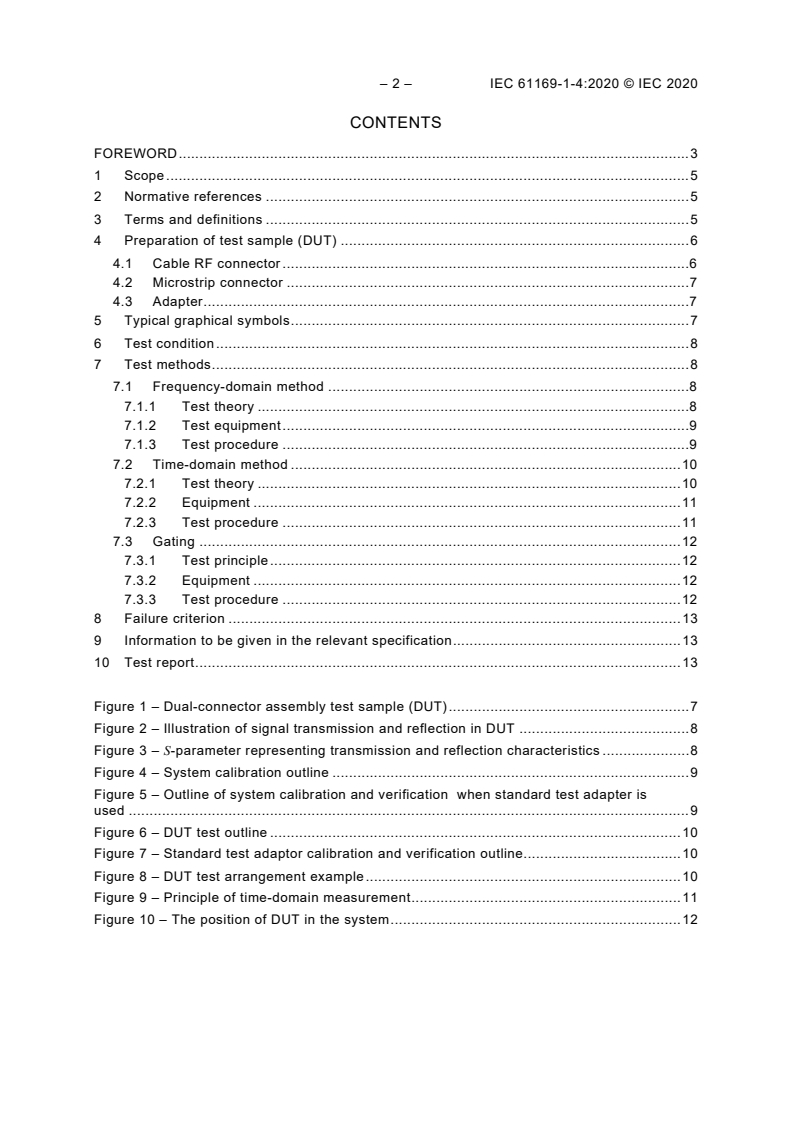
CONTENTS
FOREWORD . 3
1 Scope . 5
2 Normative references . 5
3 Terms and definitions . 5
4 Preparation of test sample (DUT) . 6
4.1 Cable RF connector .6
4.2 Microstrip connector .7
4.3 Adapter .7
5 Typical graphical symbols . 7
6 Test condition . 8
7 Test methods . 8
7.1 Frequency-domain method .8
7.1.1 Test theory .8
7.1.2 Test equipment .9
7.1.3 Test procedure .9
7.2 Time-domain method . 10
7.2.1 Test theory . 10
7.2.2 Equipment . 11
7.2.3 Test procedure . 11
7.3 Gating . 12
7.3.1 Test principle . 12
7.3.2 Equipment . 12
7.3.3 Test procedure . 12
8 Failure criterion . 13
9 Information to be given in the relevant specification . 13
10 Test report . 13
Figure 1 – Dual-connector assembly test sample (DUT) . 7
Figure 2 – Illustration of signal transmission and reflection in DUT . 8
Figure 3 – S-parameter representing transmission and reflection characteristics . 8
Figure 4 – System calibration outline . 9
Figure 5 – Outline of system calibration and verification when standard test adapter is
used . 9
Figure 6 – DUT test outline . 10
Figure 7 – Standard test adaptor calibration and verification outline. 10
Figure 8 – DUT test arrangement example . 10
Figure 9 – Principle of time-domain measurement . 11
Figure 10 – The position of DUT in the system . 12
INTERNATIONAL ELECTROTECHNICAL COMMISSION
____________
RADIO-FREQUENCY CONNECTORS –
Part 1-4: Electrical test methods – Voltage standing wave ratio,
return loss and reflection coefficient
FOREWORD
1) The International Electrotechnical Commission (IEC) is a worldwide organization for standardization comprising
all national electrotechnical committees (IEC National Committees). The object of IEC is to promote
international co-operation on all questions concerning standardization in the electrical and electronic fields. To
this end and in addition to other activities, IEC publishes International Standards, Technical Specifications,
Technical Reports, Publicly Available Specifications (PAS) and Guides (hereafter referred to as “IEC
Publication(s)”). Their preparation is entrusted to technical committees; any IEC National Committee interested
in the subject dealt with may participate in this preparatory work. International, governmental and non-
governmental organizations liaising with the IEC also participate in this preparation. IEC collaborates closely
with the International Organization for Standardization (ISO) in accordance with conditions determined by
agreement between the two organizations.
2) The formal decisions or agreements of IEC on technical matters express, as nearly as possible, an international
consensus of opinion on the relevant subjects since each technical committee has representation from all
interested IEC National Committees.
3) IEC Publications have the form of recommendations for international use and are accepted by IEC National
Committees in that sense. While all reasonable efforts are made to ensure that the technical content of IEC
Publications is accurate, IEC cannot be held responsible for the way in which they are used or for any
misinterpretation by any end user.
4) In order to promote international uniformity, IEC National Committees undertake to apply IEC Publications
transparently to the maximum extent possible in their national and regional publications. Any divergence
between any IEC Publication and the corresponding national or regional publication shall be clearly indicated in
the latter.
5) IEC itself does not provide any attestation of conformity. Independent certification bodies provide conformity
assessment services and, in some areas, access to IEC marks of conformity. IEC is not responsible for any
services carried out by independent certification bodies.
6) All users should ensure that they have the latest edition of this publication.
7) No liability shall attach to IEC or its directors, employees, servants or agents including individual experts and
members of its technical committees and IEC National Committees for any personal injury, property damage or
other damage of any nature whatsoever, whether direct or indirect, or for costs (including legal fees) and
expenses arising out of the publication, use of, or reliance upon, this IEC Publication or any other IEC
Publications.
8) Attention is drawn to the Normative references cited in this publication. Use of the referenced publications is
indispensable for the correct application of this publication.
9) Attention is drawn to the possibility that some of the elements of this IEC Publication may be the subject of
patent rights. IEC shall not be held responsible for identifying any or all such patent rights.
International Standard IEC 61169-1-4 has been prepared by subcommittee 46F: RF and
microwave passive components, of IEC technical committee 46: Cables, wires, waveguides,
RF connectors, RF and microwave passive components and accessories.
The text of this International Standard is based on the following documents:
FDIS Report on voting
46F/505/FDIS 46F/510/RVD
Full information on the voting for the approval of this International Standard can be found in
the report on voting indicated in the above table.
This document has been drafted in accordance with the ISO/IEC Directives, Part 2.
– 4 – IEC 61169-1-4:2020 © IEC 2020
A list of all parts of the IEC 61169 series, under the general title: Radio-frequency connectors,
can be found on the IEC website.
The committee has decided that the contents of this document will remain unchanged until the
stability date indicated on the IEC website under "http://webstore.iec.ch" in the data related to
the specific document. At this date, the document will be
• reconfirmed,
• withdrawn,
• replaced by a revised edition, or
• amended.
RADIO-FREQUENCY CONNECTORS –
Part 1-4: Electrical test methods – Voltage standing wave ratio,
return loss and reflection coefficient
1 Scope
This part of IEC 61169 provides test methods for the voltage standing wave ratio, return loss
and reflection coefficient of RF connectors, including frequency domain method, time domain
method, and gating.
This document is applicable to cable RF connectors, microstrip RF connectors and RF
adapters. It is also suitable to RF channels in multi-RF channel connectors and hybrid
connectors.
2 Normative references
The following documents are referred to in the text in such a way that some or all of their
content constitutes requirements of this document. For dated references, only the edition
cited applies. For undated references, the latest edition of the referenced document (including
any amendments) applies.
IEC 61169-1, Radio frequency connectors – Part 1: Generic specification – General
requirements and measuring methods
3 Terms and definitions
For the purposes of this document, the terms and definitions given in IEC 61169-1 and the
following definitions apply.
ISO and IEC maintain terminological databases for use in standardization at the following
addresses:
• IEC Electropedia: available at http://www.electropedia.org/
• ISO Online browsing platform: available at http://www.iso.org/obp
3.1
reflection coefficient
ratio of the normalized complex wave amplitude of the reflected wave to that of the incident
wave at a port or transverse cross-section of a transmission line, expressed as the following:
V ZZ−
r L0
Γ (1)
V ZZ+
i L0
where
Γ is the reflection coefficient in complex number;
V is the incident voltage in complex number;
i
V is the reflection voltage in complex number;
r
is the characteristic impedance of a transmission line;
Z
Z is the impedance of the termination in complex number.
L
==
– 6 – IEC 61169-1-4:2020 © IEC 2020
3.2
voltage standing wave ratio
VSWR
ratio, along a transmission line, of a maximum of the voltage to an adjacent minimum
magnitude of the voltage of a standing wave, expressed as the following:
V VV++1 Γ
max i r
VSWR (2)
V V−−V 1 Γ
min i r
where
VSWR is the voltage standing wave ratio;
V is the maximum magnitude of the voltage;
max
V is the minimum magnitude of the voltage;
min
V is the incident voltage;
i
V is the reflection voltage;
r
Γ is the reflection coefficient in complex number.
3.3
return loss
RL
ratio of the power of the reflected wave to the power of the incident wave at a specified port or
transverse cross-section of a transmission line, expressed as follows:
P
r
RL=−=10log −20log Γ
(3)
10 10
P
i
where
RL is the return loss;
P is the power of incident wave;
i
P is the power of reflected wave;
r
Γ is the reflection coefficient in complex number.
4 Preparation of test sample (DUT)
4.1 Cable RF connector
Use two cable connectors under test to make a dual-connector assembly as a test sample
(DUT) by connecting a section of pre-selected uniform cable with accurate characteristic
impedance or a simulated cable which is designed as a coaxial airline, as shown in Figure 1,
with following requirements:
a) The length l of the cable or the simulated cable shall at least have two wave nodes in the
frequency range being tested. That is:
v
I> (4)
2( f − f )
2 1
where
v is the wave velocity in the cable or the simulated cable;
f and f are the minimum and maximum frequency being test respectively within the
1 2
tested frequency domain.
===
b) The ratio of the diameters of the inner and outer conductors of the simulated cable should
use the typical value if possible and is suitable for the connector under test. The axial
length of the inner conductor is related to the electric length, so its structure and
dimension accuracy should without axial movement.
Figure 1 – Dual-connector assembly test sample (DUT)
4.2 Microstrip connector
The microstrip connector shall be tested by using an appropriate test fixture on the microstrip
end, and the microstrip connector with test fixture as a whole should be treated as the test
sample (DUT). Test fixture which should be specified in relevant specification.
4.3 Adapter
An adapter shall be tested directly when it can connect to the test system or to connect to test
system by using standard test adapter when it cannot connect to the test system directly.
5 Typical graphical symbols
The typical graphical symbols used are as follows:
Time domain reflect meter equipment
Frequency domain vector network analyser
Mated precision hermaphroditic connectors
Standard airline
Precision termination
Short
Open
Interface of standard test connector
Interface of connector under test
or or
interface of pin, interface of socket
Adapter from hermaphroditic interface to standard test
connector
or
Interface of pin connector
Interface of socket connector
Interface of hermaphroditic connector
– 8 – IEC 61169-1-4:2020 © IEC 2020
6 Test condition
Test shall be conducted under room ambient conditions or as specified in the relevant
specification.
7 Test methods
7.1 Frequency-domain method
7.1.1 Test theory
At lower frequencies, physical length of the test sample is less than λ/10, where λ is the
wavelength, and the test values of the voltage/current on the test sample are independent of
the test position. At higher frequencies, physical length of the test sample is bigger than λ/10,
and the characteristic impedance reflects its transmission characteristics. The voltage/current
on the test sample differs at different positions.
It is assuming that the shielding effect of the test sample is good enough with no interference
from outside and no signal leaking out. The input signal a of the test sample will transmit one
part of signal b to the load and also a portion of the signal b ; a is reflected back at both the
2 1 2
input port 1 and the output load port 2 respectively, as shown in Figure 2.
Figure 2 – Illustration of signal transmission and reflection in DUT
The signal transmission and reflection characteristics in test sample can be represented by
the S-parameter in Figure 3.
Figure 3 – S-parameter representing transmission and reflection characteristics
The definition of S-parameter is based on the signal voltages which are vectors, where:
b aS+ a S
1 1 11 2 12
b aS+ a S
2 1 21 2 22
When the end of test sample is terminated on a precision load, a = 0 and the input reflection
coefficient can be calculated as following formulae:
b
S =
a
=
=
Vector network analyser is based on the above principle to measure the S-parameter of the
connector, cable and cable assemblies, and these S-parameters reflect the transmission and
reflection characteristics of the connector, cable and cable assemblies in the frequency
domain.
Due to inhomogeneity and manufacturing error of the internal structure of the connector, it is
necessary to test the reflection characteristics of the test sample from two directions.
7.1.2 Test equipment
The test equipment is as follows.
a) A vector network analyser (VNA).
b) Calibration standards including open, short, load, standard test adapter; electronic
calibration may also be used. The frequency range of the standard parts should cover the
entire test frequency range.
7.1.3 Test procedure
7.1.3.1 One-port measurement
The one-port measurement procedure is as follows.
a) After the vector network analyser is warmed up, set the measurement frequency range
and other related parameters, and then set its test mode to measure the voltage standing
wave ratio or return loss or reflection coefficient.
b) System calibration: use the open, short, load calibration standards separately to calibrate
the vector network analyser test system, as shown in Figure 4.
Figure 4 – System calibration outline
c) System calibration with standard test adaptor when needed: when the test port of the
vector network analyser cannot directly connect with the test sample, the standard test
adaptors are needed. In that case, the standard test adaptors are needed to be inserted in
system and calibrated, shown as Figure 5.
Figure 5 – Outline of system calibration and verification
when standard test adapter is used
d) Connect the DUT to the test system as shown in Figure 6 as an example and record the
S graph. Turn DUT around and test the DUT in other direction and record the other S
11 11
graph.
– 10 – IEC 61169-1-4:2020 © IEC 2020
Figure 6 – DUT test outline
7.1.3.2 Two-port measurement
The two-port measurement procedure is as follows.
a) After the vector network analyser is warmed up, set the measurement frequency range
and other related parameters, and then set its test mode to measure the voltage standing
wave ratio or return loss or reflection coefficient.
b) System calibration: use the open, short, load and straight through calibration standards to
calibrate the vector network analyser test system completely or use the electronic
calibration to calibrate the vector network analyser test system directly.
c) Standard test adaptor calibration and verification when needed: when the test port of the
vector network analyser cannot directly connect with the test sample, the standard test
adaptors are needed. In that case, the standard test adaptors are needed to be calibrated
and verified, shown as Figure 7.
Figure 7 – Standard test adaptor calibration and verification outline
d) DUT measurement: connect the DUT to the test system as shown in Figure 8 as an
example and record the S and S graphs.
11 22
Figure 8 – DUT test arrangement example
7.2 Time-domain method
7.2.1 Test theory
When a step function signal is sent to DUT and the signal pass through the test point of DUT,
part of the energy is reflected. The distance (L) from the input end to the test point can be
calculated by measuring the total signal traveling time (t) as Figure 9. The reflection
coefficient of the position can be calculated by measuring the amplitude of the incident signal
and the reflected signal, as shown in Figure 9.
Figure 9 – Principle of time-domain measurement
The distance L of the test point can be determined by
vt× ct×
L (5)
2× ε
r
where
L is the distance of the test point, in m;
is the propagation velocity, in m/s;
v
t
is the total signal traveling time as in Figure 9, in s;
is the propagation velocity in free space (2,997 924 58 × 10 m/s);
c
ε is the relative permittivity of the dielectric.
r
The reflection coefficient, VSWR or the return loss of DUT at the measured points can be
obtained through the TDR test system.
7.2.2 Equipment
The test equipment is as follows.
a) In TDR measurement system, input and output VSWR shall be less than 1,02 + 0,004 f
(f in GHz).
b) Calibration standards including a standard air-line and a precision load with the same
nominal impedance as the cable under test. The frequency range of the calibration
standards should cover the entire test frequency range.
7.2.3 Test procedure
The test procedure is as follows.
a) After the time domain reflectometry is warmed up, set its test mode to measure the
reflection coefficient, and convert the rising time of TDR according to the measurement
frequency range of the sample.
b) The standard air-line shall be connected between the test instrument and the precision
load.
==
– 12 – IEC 61169-1-4:2020 © IEC 2020
c) Connect the DUT between the standard air-line and load. When it is not possible to
connect directly, the standard test adaptor connector needs to be used, as shown in
Figure 10 as an example. Set the test range of the test instrument (the range of the gate)
to DUT. Then, record the reflection coefficient or VSWR or return loss-length (time) graph
of the DUT.
Figure 10 – The position of DUT in the system
7.3 Gating
7.3.1 Test principle
The reflection characteristic parameters, such as reflection coefficient, etc., are the function
of frequency. They are usually used to measure in frequency domain, and it is best to use a
sweep frequency signal generator. But due to the inherent non-uniformity of DUT, the
transmission and reflection characteristics vary with the position where the DUT located. In
order to measure the transmission and reflection characteristics of the DUT in different
locations, the characteristics of the frequency domain can be converted into the time domain
characteristics by using the inverse Fourier transformation. Time domain measurement
function of a vector network analyser (VNA) can be used to transform the frequency domain
characteristics into time domain characteristics, and also the time domain characteristics into
frequency domain characteristics.
Using the frequency domain to time domain conversion function of a vector network analyser
we can find location of DUT and set gates markers, apply the gate function and measure the
reflection characteristics of DUT inside gate interval. This method is usually called gating.
Gating may be used to estimate the reflection characteristics of connectors.
7.3.2 Equipment
The test equipment is as follows.
a) A vector network analyser (VNA) with time domain and gating function.
b) Calibration standards including open, short, load, standard test adapter. The frequency
range of the standard parts should cover the entire test frequency range.
7.3.3 Test procedure
The test procedure is as follows.
a) Set and calibrate the test system and adapter (when needed) as in 7.1.3.1 a) to c).
b) Connect the DUT between the vector network analyser and the load with the correct
gender. Convert the vector network analyser into the time domain function.
c) Open the DUT at one end, then obtain the maximum value of the reflection and set the
gate marker P1 in the maximum reflection point. Reconnect DUT again and open the DUT
at another end, then obtain another maximum value of the reflection and set the gate
marker P2 in the max
...