


IEC 62810:2015
(Main)Cylindrical cavity method to measure the complex permittivity of low-loss dielectric rods
General Information
- Abstract
IEC 62810:2015 relates to a measurement method for complex permittivity of a dielectric rod at microwave frequency. This method has been developed to evaluate the dielectric properties of low-loss materials in coaxial cables and electronic devices used in microwave systems. It uses the TM010 mode in a circular cylindrical cavity and presents accurate measurement results of a dielectric rod sample, where the effect of sample insertion holes is taken into account accurately on the basis of the rigorous electromagnetic analysis.
- Status
- Published
- Publication Date
- 16-Feb-2015
- Technical Committee
- SC 46F - RF and microwave passive components
- Current Stage
- PPUB - Publication issued
- Start Date
- 17-Feb-2015
- Completion Date
- 15-Apr-2015
Buy Documents
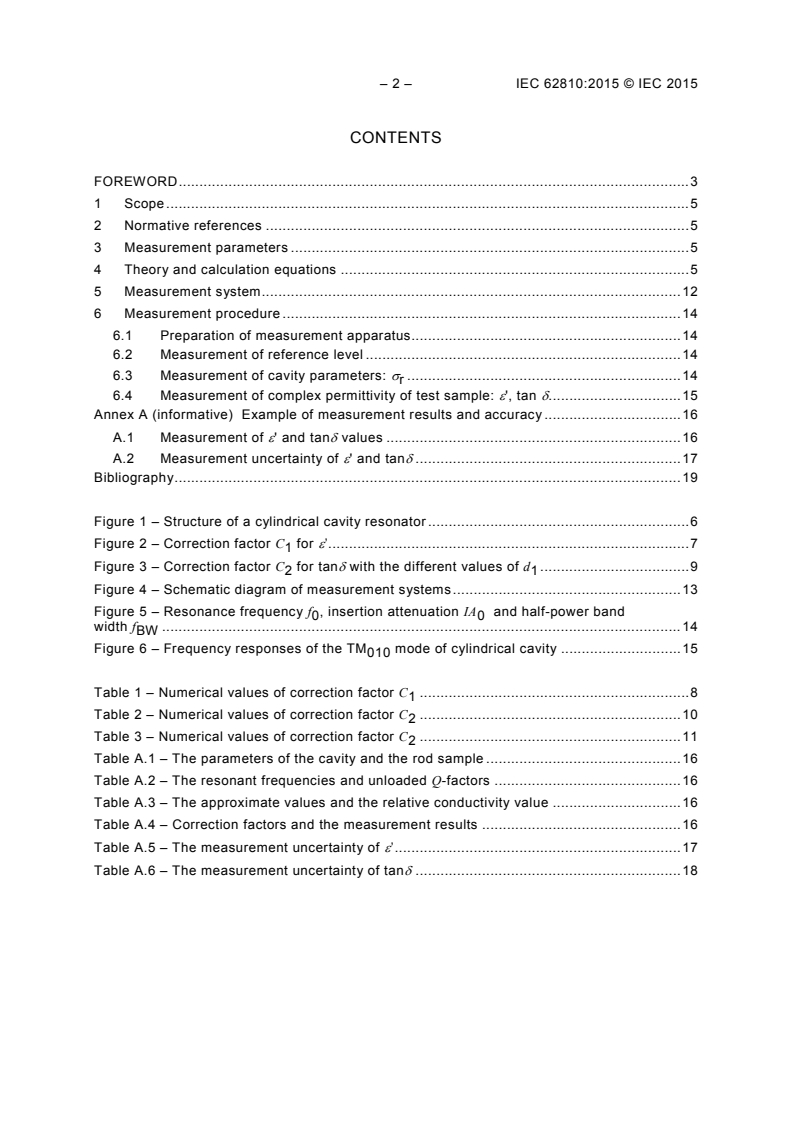
IEC 62810:2015 - Cylindrical cavity method to measure the complex permittivity of low-loss dielectric rods Released:2/17/2015
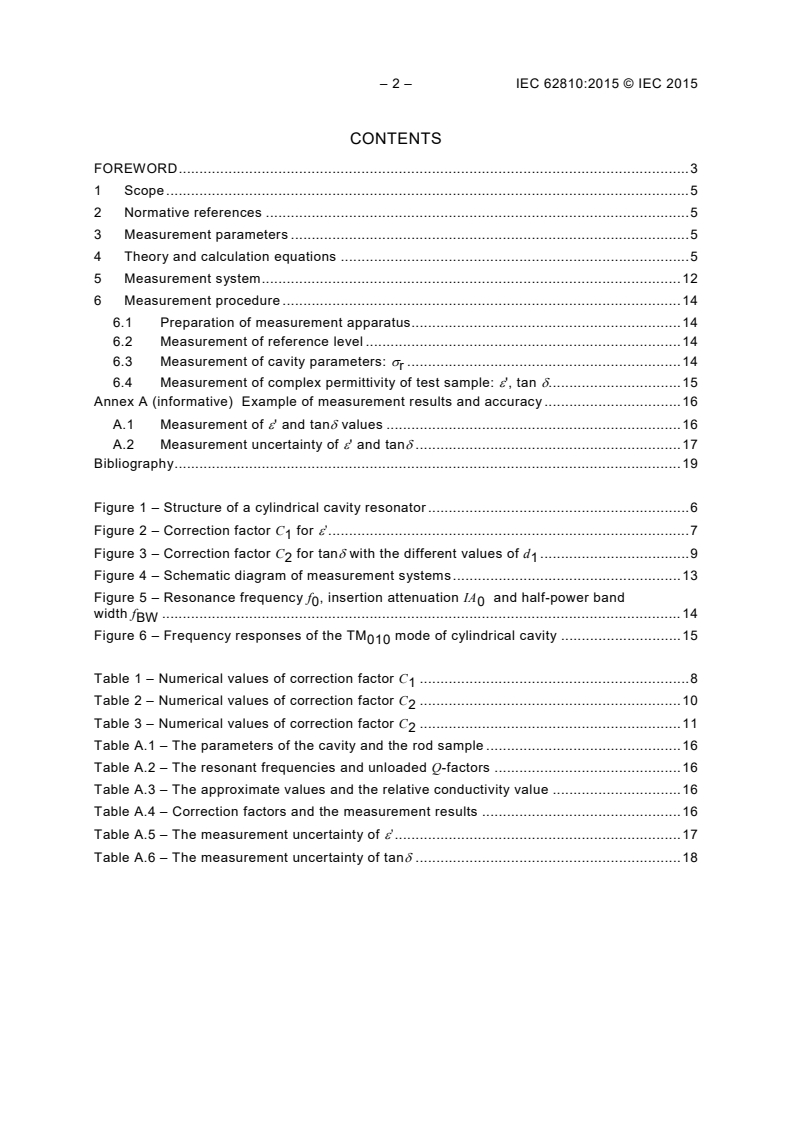
IEC 62810:2015 - Cylindrical cavity method to measure the complex permittivity of low-loss dielectric rods Released:2/17/2015
Overview - IEC 62810:2015 (cylindrical cavity method, complex permittivity)
IEC 62810:2015 specifies a microwave measurement method - the cylindrical cavity method - for determining the complex permittivity (ε = ε' − jε") of low‑loss dielectric rods. The method uses the TM010 resonant mode in a circular cylindrical cavity and derives ε' (real permittivity) and loss tangent (tan δ) from measured resonance frequency shifts and unloaded Q‑factors. The standard includes rigorous electromagnetic corrections for sample insertion holes based on numerical analysis (Ritz–Galerkin), and provides correction charts and tables for accurate, non‑destructive measurement.
Key topics and technical requirements
- Measurement principle: monitor resonant frequency and unloaded Q of a cylindrical cavity in TM010 mode with and without the dielectric rod inserted; use perturbation formulas for initial estimates, then apply numerical correction factors (C1, C2) from the standard.
- Accuracy targets: ≈1.0% for ε' and ≈20% for tan δ (as given in the standard).
- Applicable ranges:
- Frequency: ~1 GHz to 10 GHz
- Relative permittivity (ε'): 1 to 100
- Loss tangent (tan δ): typically low‑loss range (document range formatted in the standard)
- Geometry & corrections: correction factors tabulated for typical cavity dimensions (example: D = 76.5 mm, H = 20.0 mm, sample hole d = 3.0 mm, hole depth g = 10.0 mm) and scalable by aspect ratios H/D, d/D, g/D.
- Numerical methods: use of Ritz–Galerkin electromagnetic analysis to account for effects of insertion holes and to generate correction charts.
- Measurement procedure: prepare apparatus, measure reference cavity parameters, measure cavity with sample (resonant frequency f and Q), compute perturbation estimates, then apply correction factors to obtain final ε' and tan δ.
Practical applications
- Material characterization for coaxial cable dielectrics, microwave substrates, and polymer or ceramic rods used in RF/microwave components.
- Quality control and R&D in materials science and electronics manufacturing where dielectric loss and permittivity affect microwave performance.
- Supporting electromagnetic simulation validation and component design (e.g., matching networks, filters, connectors) by providing accurate material property data.
Who should use this standard
- RF/microwave test laboratories and national metrology institutes
- Material scientists and dielectric measurement specialists
- Engineers in telecommunications, microwave component manufacturing, and cable production
- Quality assurance teams validating dielectric parameters for microwave systems
Related standards
- IEC 60556 (conventional dielectric measurement methods referenced in IEC 62810)
- General microwave dielectric measurement and metrology guidance from national/international test-method documents
Keywords: IEC 62810:2015, cylindrical cavity method, complex permittivity, low‑loss dielectric rods, TM010 mode, microwave measurement, loss tangent, dielectric characterization.
Relations
- Effective Date
- 10-Feb-2026
Buy Documents
IEC 62810:2015 - Cylindrical cavity method to measure the complex permittivity of low-loss dielectric rods Released:2/17/2015
IEC 62810:2015 - Cylindrical cavity method to measure the complex permittivity of low-loss dielectric rods Released:2/17/2015
Get Certified
Connect with accredited certification bodies for this standard

ANCE
Mexican certification and testing association.

Intertek Slovenia
Intertek testing, inspection, and certification services in Slovenia.

LNE (Laboratoire National de Métrologie et d'Essais)
French national laboratory for metrology and testing.
Sponsored listings
Frequently Asked Questions
IEC 62810:2015 is a standard published by the International Electrotechnical Commission (IEC). Its full title is "Cylindrical cavity method to measure the complex permittivity of low-loss dielectric rods". This standard covers: IEC 62810:2015 relates to a measurement method for complex permittivity of a dielectric rod at microwave frequency. This method has been developed to evaluate the dielectric properties of low-loss materials in coaxial cables and electronic devices used in microwave systems. It uses the TM010 mode in a circular cylindrical cavity and presents accurate measurement results of a dielectric rod sample, where the effect of sample insertion holes is taken into account accurately on the basis of the rigorous electromagnetic analysis.
IEC 62810:2015 relates to a measurement method for complex permittivity of a dielectric rod at microwave frequency. This method has been developed to evaluate the dielectric properties of low-loss materials in coaxial cables and electronic devices used in microwave systems. It uses the TM010 mode in a circular cylindrical cavity and presents accurate measurement results of a dielectric rod sample, where the effect of sample insertion holes is taken into account accurately on the basis of the rigorous electromagnetic analysis.
IEC 62810:2015 is classified under the following ICS (International Classification for Standards) categories: 33.120.30 - RF connectors. The ICS classification helps identify the subject area and facilitates finding related standards.
IEC 62810:2015 has the following relationships with other standards: It is inter standard links to EN IEC 63185:2021. Understanding these relationships helps ensure you are using the most current and applicable version of the standard.
IEC 62810:2015 is available in PDF format for immediate download after purchase. The document can be added to your cart and obtained through the secure checkout process. Digital delivery ensures instant access to the complete standard document.
Standards Content (Sample)
IEC 62810 ®
Edition 1.0 2015-02
INTERNATIONAL
STANDARD
colour
inside
Cylindrical cavity method to measure the complex permittivity of low-loss
dielectric rods
All rights reserved. Unless otherwise specified, no part of this publication may be reproduced or utilized in any form
or by any means, electronic or mechanical, including photocopying and microfilm, without permission in writing from
either IEC or IEC's member National Committee in the country of the requester. If you have any questions about IEC
copyright or have an enquiry about obtaining additional rights to this publication, please contact the address below or
your local IEC member National Committee for further information.
IEC Central Office Tel.: +41 22 919 02 11
3, rue de Varembé Fax: +41 22 919 03 00
CH-1211 Geneva 20 info@iec.ch
Switzerland www.iec.ch
About the IEC
The International Electrotechnical Commission (IEC) is the leading global organization that prepares and publishes
International Standards for all electrical, electronic and related technologies.
About IEC publications
The technical content of IEC publications is kept under constant review by the IEC. Please make sure that you have the
latest edition, a corrigenda or an amendment might have been published.
IEC Catalogue - webstore.iec.ch/catalogue Electropedia - www.electropedia.org
The stand-alone application for consulting the entire The world's leading online dictionary of electronic and
bibliographical information on IEC International Standards, electrical terms containing more than 30 000 terms and
Technical Specifications, Technical Reports and other definitions in English and French, with equivalent terms in 15
documents. Available for PC, Mac OS, Android Tablets and additional languages. Also known as the International
iPad. Electrotechnical Vocabulary (IEV) online.
IEC publications search - www.iec.ch/searchpub IEC Glossary - std.iec.ch/glossary
The advanced search enables to find IEC publications by a More than 60 000 electrotechnical terminology entries in
variety of criteria (reference number, text, technical English and French extracted from the Terms and Definitions
committee,…). It also gives information on projects, replaced clause of IEC publications issued since 2002. Some entries
and withdrawn publications. have been collected from earlier publications of IEC TC 37,
77, 86 and CISPR.
IEC Just Published - webstore.iec.ch/justpublished
Stay up to date on all new IEC publications. Just Published IEC Customer Service Centre - webstore.iec.ch/csc
details all new publications released. Available online and If you wish to give us your feedback on this publication or
also once a month by email. need further assistance, please contact the Customer Service
Centre: csc@iec.ch.
IEC 62810 ®
Edition 1.0 2015-02
INTERNATIONAL
STANDARD
colour
inside
Cylindrical cavity method to measure the complex permittivity of low-loss
dielectric rods
INTERNATIONAL
ELECTROTECHNICAL
COMMISSION
ICS 33.120.30 ISBN 978-2-8322-2264-5
– 2 – IEC 62810:2015 © IEC 2015
CONTENTS
FOREWORD . 3
1 Scope . 5
2 Normative references . 5
3 Measurement parameters . 5
4 Theory and calculation equations . 5
5 Measurement system . 12
6 Measurement procedure . 14
6.1 Preparation of measurement apparatus. 14
6.2 Measurement of reference level . 14
6.3 Measurement of cavity parameters: σ . 14
r
6.4 Measurement of complex permittivity of test sample: ε', tan d. 15
Annex A (informative) Example of measurement results and accuracy . 16
A.1 Measurement of ε' and tand values . 16
A.2 Measurement uncertainty of ε' and tand . 17
Bibliography . 19
Figure 1 – Structure of a cylindrical cavity resonator . 6
Figure 2 – Correction factor C for ε’. 7
Figure 3 – Correction factor C for tand with the different values of d . 9
2 1
Figure 4 – Schematic diagram of measurement systems . 13
Figure 5 – Resonance frequency f , insertion attenuation IA and half-power band
0 0
width f . 14
BW
Figure 6 – Frequency responses of the TM mode of cylindrical cavity . 15
Table 1 – Numerical values of correction factor C . 8
Table 2 – Numerical values of correction factor C . 10
Table 3 – Numerical values of correction factor C . 11
Table A.1 – The parameters of the cavity and the rod sample . 16
Table A.2 – The resonant frequencies and unloaded Q-factors . 16
Table A.3 – The approximate values and the relative conductivity value . 16
Table A.4 – Correction factors and the measurement results . 16
Table A.5 – The measurement uncertainty of ε’ . 17
Table A.6 – The measurement uncertainty of tand . 18
INTERNATIONAL ELECTROTECHNICAL COMMISSION
____________
CYLINDRICAL CAVITY METHOD TO MEASURE
THE COMPLEX PERMITTIVITY OF LOW-LOSS DIELECTRIC RODS
FOREWORD
1) The International Electrotechnical Commission (IEC) is a worldwide organization for standardization comprising
all national electrotechnical committees (IEC National Committees). The object of IEC is to promote
international co-operation on all questions concerning standardization in the electrical and electronic fields. To
this end and in addition to other activities, IEC publishes International Standards, Technical Specifications,
Technical Reports, Publicly Available Specifications (PAS) and Guides (hereafter referred to as “IEC
Publication(s)”). Their preparation is entrusted to technical committees; any IEC National Committee interested
in the subject dealt with may participate in this preparatory work. International, governmental and non-
governmental organizations liaising with the IEC also participate in this preparation. IEC collaborates closely
with the International Organization for Standardization (ISO) in accordance with conditions determined by
agreement between the two organizations.
2) The formal decisions or agreements of IEC on technical matters express, as nearly as possible, an international
consensus of opinion on the relevant subjects since each technical committee has representation from all
interested IEC National Committees.
3) IEC Publications have the form of recommendations for international use and are accepted by IEC National
Committees in that sense. While all reasonable efforts are made to ensure that the technical content of IEC
Publications is accurate, IEC cannot be held responsible for the way in which they are used or for any
misinterpretation by any end user.
4) In order to promote international uniformity, IEC National Committees undertake to apply IEC Publications
transparently to the maximum extent possible in their national and regional publications. Any divergence
between any IEC Publication and the corresponding national or regional publication shall be clearly indicated in
the latter.
5) IEC itself does not provide any attestation of conformity. Independent certification bodies provide conformity
assessment services and, in some areas, access to IEC marks of conformity. IEC is not responsible for any
services carried out by independent certification bodies.
6) All users should ensure that they have the latest edition of this publication.
7) No liability shall attach to IEC or its directors, employees, servants or agents including individual experts and
members of its technical committees and IEC National Committees for any personal injury, property damage or
other damage of any nature whatsoever, whether direct or indirect, or for costs (including legal fees) and
expenses arising out of the publication, use of, or reliance upon, this IEC Publication or any other IEC
Publications.
8) Attention is drawn to the Normative references cited in this publication. Use of the referenced publications is
indispensable for the correct application of this publication.
9) Attention is drawn to the possibility that some of the elements of this IEC Publication may be the subject of
patent rights. IEC shall not be held responsible for identifying any or all such patent rights.
International Standard IEC 62810 has been prepared by subcommittee 46F: R.F. and
microwave passive components, of IEC technical committee 46: Cables, wires, waveguides,
R.F. connectors, R.F. and microwave passive components and accessories.
The text of this standard is based on the following documents:
CDV Report on voting
46F/242/CDV 46F/260/RVC
Full information on the voting for the approval of this standard can be found in the report on
voting indicated in the above table.
This publication has been drafted in accordance with the ISO/IEC Directives, Part 2.
The committee has decided that the contents of this publication will remain unchanged until
the stability date indicated on the IEC website under "http://webstore.iec.ch" in the data
related to the specific publication. At this date, the publication will be
– 4 – IEC 62810:2015 © IEC 2015
• reconfirmed,
• withdrawn,
• replaced by a revised edition, or
• amended.
A bilingual version of this publication may be issued at a later date.
IMPORTANT – The 'colour inside' logo on the cover page of this publication indicates
that it contains colours which are considered to be useful for the correct
understanding of its contents. Users should therefore print this document using a
colour printer.
CYLINDRICAL CAVITY METHOD TO MEASURE
THE COMPLEX PERMITTIVITY OF LOW-LOSS DIELECTRIC RODS
1 Scope
This International Standard relates to a measurement method for complex permittivity of a
dielectric rod at microwave frequency. This method has been developed to evaluate the
dielectric properties of low-loss materials in coaxial cables and electronic devices used in
microwave systems. It uses the TM mode in a circular cylindrical cavity and presents
accurate measurement results of a dielectric rod sample, where the effect of sample insertion
holes is taken into account accurately on the basis of the rigorous electromagnetic analysis.
In comparison with the conventional method described in IEC 60556 [2] , this method has the
following characteristics:
• the values of the relative permittivity ε' and loss tangent tand of a dielectric rod sample
can be measured accurately and non-destructively;
• the measurement accuracy is within 1,0 % for ε' and within 20 % for tand;
• the effect of sample insertion holes is corrected using correction charts presented;
• this method is applicable for the measurements on the following condition:
– frequency: 1 GHz ≦f ≦10 GHz;
– relative permittivity: 1 ≦ε' ≦100;
–4 –1
– loss tangent: 10 ≦tand ≦10 .
2 Normative references
Void.
3 Measurement parameters
The measurement parameters are defined as follows:
ε = ε'-jε" (1)
r
tand = ε"/ε' (2)
where ε' and ε" are the real and imaginary parts of the complex relative permittivity ε .
r
4 Theory and calculation equations
A resonator structure used in these measurements is shown in Figure 1. A cavity, made with
copper, with diameter D and height H has sample insertion holes with diameter d and depth g
having ε' and tand is inserted into
oriented coaxially. A dielectric rod sample of diameter d
the holes.
Figures in square brackets refer to the Bibliography.
– 6 – IEC 62810:2015 © IEC 2015
The TM mode, where the electric field component in the cavity is parallel to the sample
rod, is used for the measurement. Taking account of the effect of sample insertion holes
calculated on the basis of the rigorous electromagnetic field analysis, ε' and tand are
determined from the measured values of the resonant frequency f and the unloaded Q-factor
Q . To avoid the tedious numerical calculation and make the measurements easy, the
u
following process is taken in this measurement:
Cylindrical cavity Dielectric rod (sample)
Sample insertion hole
Coaxial cable
with small loop
Ød
Ød
ØD
IEC
Figure 1 – Structure of a cylindrical cavity resonator
The following steps shall be taken:
1) At the first step, obtain approximate values ε and tand from the f and Q values by
p p 0 u
using the simple perturbation formulas, where the effect of sample insertion holes is
neglected. The subscript p denotes the calculated values using the following perturbation
formulas:
1 f − f D
0 1
ε = +1 (3)
p
α f d
1 1
1 D 1 1
tand = − (4)
p
2αε d Q Q
p 1 u1 u0
where α = 1 J ( x ) = 1,855 .
1 01
J ( x) is the Bessel function of order n of first kind and x = 2,405 is the first root of
n 01
J ( x) = 0 . f and Q are the resonant frequency and unloaded Q-factor measured for the
0 u0
cavity without a sample, respectively. f and Q are ones measured for the cavity with a
1 u1
sample.
2) In the second step, obtain accurate values ε' and tand from ε and tand values by using
p p
the following equations with correction factors calculated based on the rigorous analysis:
ε ′ = C ε
(5)
1 p
tand = C tand (6)
2 p
g H g
where correction factors C and C , due to the sample insertion holes and errors included
1 2
in the perturbation formulas, are calculated numerically by using the Ritz-Galerkin method
[3][5], as shown in Figure 2 and Figure 3, and the corresponding data are listed in detail in
Table 1, 2, and 3. The missing data of C and C can be obtained by interpolation or
1 2
extrapolation from the tables. The correction factors shown in these figures are calculated
for the cavity with D = 76,5 mm, H = 20,0 mm, d = 3,0 mm, and g = 10,0 mm, where the
resonant frequency is about 3 GHz. C is also used for a cavity having the same aspect
ratios as H/D, d /D and g/D.
It is found from the analysis for a cavity with insertion holes which constitute a cut-off TM
mode cylindrical waveguide that f converges to a constant value for g>10 mm and d = 3 mm.
0 2
Therefore, the correction factors shown in Figure 2 and Figure 3 are applicable to a dielectric
sample rod with d <3 mm and ε’ below the value calculated by the following equation for the
measured value of the resonant frequency:
x c
ε' ≤ (7)
πd f
2 0
where c is the velocity of light in a vacuum (c = 2,9 979 × 108 m/s).
1,2
1,0 0,5
76,5 76,5
1,1
1,5
76,5
1,0
2,0
76,5
0,9
2,5
76,5
0,8
d
3,0
=
0,7
D 76,5
0,6
2 3 4 5 6 2 3 4 5 6
1 10 100
ε
p
IEC
Assumptions
D 76,5 mm d 3,0 mm
H 20,0 mm g 10,0 mm
Figure 2 – Correction factor C for ε’
Factor C
– 8 – IEC 62810:2015 © IEC 2015
Table 1 – Numerical values of correction factor C
d (mm)
ε
p
0,5 1,0 1,5 2,0 2,5 3,0
1 1,000 1,000 1,000 1,000 1,000 1,000
1,5 1,023 1,022 1,021 1,019 1,
...
IEC 62810 ®
Edition 1.0 2015-02
INTERNATIONAL
STANDARD
NORME
INTERNATIONALE
colour
inside
Cylindrical cavity method to measure the complex permittivity of low-loss
dielectric rods
Mesure de la permittivité complexe des barreaux diélectriques à faibles pertes
par la méthode de la cavité cylindrique
All rights reserved. Unless otherwise specified, no part of this publication may be reproduced or utilized in any form
or by any means, electronic or mechanical, including photocopying and microfilm, without permission in writing from
either IEC or IEC's member National Committee in the country of the requester. If you have any questions about IEC
copyright or have an enquiry about obtaining additional rights to this publication, please contact the address below or
your local IEC member National Committee for further information.
Droits de reproduction réservés. Sauf indication contraire, aucune partie de cette publication ne peut être reproduite
ni utilisée sous quelque forme que ce soit et par aucun procédé, électronique ou mécanique, y compris la photocopie
et les microfilms, sans l'accord écrit de l'IEC ou du Comité national de l'IEC du pays du demandeur. Si vous avez des
questions sur le copyright de l'IEC ou si vous désirez obtenir des droits supplémentaires sur cette publication, utilisez
les coordonnées ci-après ou contactez le Comité national de l'IEC de votre pays de résidence.
IEC Central Office Tel.: +41 22 919 02 11
3, rue de Varembé Fax: +41 22 919 03 00
CH-1211 Geneva 20 info@iec.ch
Switzerland www.iec.ch
About the IEC
The International Electrotechnical Commission (IEC) is the leading global organization that prepares and publishes
International Standards for all electrical, electronic and related technologies.
About IEC publications
The technical content of IEC publications is kept under constant review by the IEC. Please make sure that you have the
latest edition, a corrigenda or an amendment might have been published.
IEC Catalogue - webstore.iec.ch/catalogue Electropedia - www.electropedia.org
The stand-alone application for consulting the entire The world's leading online dictionary of electronic and
bibliographical information on IEC International Standards, electrical terms containing 20 000 terms and definitions in
Technical Specifications, Technical Reports and other English and French, with equivalent terms in 16 additional
documents. Available for PC, Mac OS, Android Tablets and languages. Also known as the International Electrotechnical
iPad. Vocabulary (IEV) online.
IEC publications search - www.iec.ch/searchpub IEC Glossary - std.iec.ch/glossary
The advanced search enables to find IEC publications by a 65 000 electrotechnical terminology entries in English and
variety of criteria (reference number, text, technical French extracted from the Terms and Definitions clause of
committee,…). It also gives information on projects, replaced IEC publications issued since 2002. Some entries have been
and withdrawn publications. collected from earlier publications of IEC TC 37, 77, 86 and
CISPR.
IEC Just Published - webstore.iec.ch/justpublished
Stay up to date on all new IEC publications. Just Published IEC Customer Service Centre - webstore.iec.ch/csc
details all new publications released. Available online and If you wish to give us your feedback on this publication or
also once a month by email. need further assistance, please contact the Customer Service
Centre: csc@iec.ch.
A propos de l'IEC
La Commission Electrotechnique Internationale (IEC) est la première organisation mondiale qui élabore et publie des
Normes internationales pour tout ce qui a trait à l'électricité, à l'électronique et aux technologies apparentées.
A propos des publications IEC
Le contenu technique des publications IEC est constamment revu. Veuillez vous assurer que vous possédez l’édition la
plus récente, un corrigendum ou amendement peut avoir été publié.
Catalogue IEC - webstore.iec.ch/catalogue Electropedia - www.electropedia.org
Application autonome pour consulter tous les renseignements
Le premier dictionnaire en ligne de termes électroniques et
bibliographiques sur les Normes internationales,
électriques. Il contient 20 000 termes et définitions en anglais
Spécifications techniques, Rapports techniques et autres
et en français, ainsi que les termes équivalents dans 16
documents de l'IEC. Disponible pour PC, Mac OS, tablettes
langues additionnelles. Egalement appelé Vocabulaire
Android et iPad.
Electrotechnique International (IEV) en ligne.
Recherche de publications IEC - www.iec.ch/searchpub
Glossaire IEC - std.iec.ch/glossary
65 000 entrées terminologiques électrotechniques, en anglais
La recherche avancée permet de trouver des publications IEC
en utilisant différents critères (numéro de référence, texte, et en français, extraites des articles Termes et Définitions des
comité d’études,…). Elle donne aussi des informations sur les publications IEC parues depuis 2002. Plus certaines entrées
projets et les publications remplacées ou retirées. antérieures extraites des publications des CE 37, 77, 86 et
CISPR de l'IEC.
IEC Just Published - webstore.iec.ch/justpublished
Service Clients - webstore.iec.ch/csc
Restez informé sur les nouvelles publications IEC. Just
Published détaille les nouvelles publications parues. Si vous désirez nous donner des commentaires sur cette
Disponible en ligne et aussi une fois par mois par email. publication ou si vous avez des questions contactez-nous:
csc@iec.ch.
IEC 62810 ®
Edition 1.0 2015-02
INTERNATIONAL
STANDARD
NORME
INTERNATIONALE
colour
inside
Cylindrical cavity method to measure the complex permittivity of low-loss
dielectric rods
Mesure de la permittivité complexe des barreaux diélectriques à faibles pertes
par la méthode de la cavité cylindrique
INTERNATIONAL
ELECTROTECHNICAL
COMMISSION
COMMISSION
ELECTROTECHNIQUE
INTERNATIONALE
ICS 33.120.30 ISBN 978-2-8322-5194-2
– 2 – IEC 62810:2015 © IEC 2015
CONTENTS
FOREWORD . 3
1 Scope . 5
2 Normative references . 5
3 Measurement parameters . 5
4 Theory and calculation equations . 5
5 Measurement system . 12
6 Measurement procedure . 14
6.1 Preparation of measurement apparatus. 14
6.2 Measurement of reference level . 14
6.3 Measurement of cavity parameters: σ . 14
r
6.4 Measurement of complex permittivity of test sample: ε', tan d. 15
Annex A (informative) Example of measurement results and accuracy . 16
A.1 Measurement of ε' and tand values . 16
A.2 Measurement uncertainty of ε' and tand . 17
Bibliography . 19
Figure 1 – Structure of a cylindrical cavity resonator . 6
Figure 2 – Correction factor C for ε’. 7
Figure 3 – Correction factor C for tand with the different values of d . 9
2 1
Figure 4 – Schematic diagram of measurement systems . 13
Figure 5 – Resonance frequency f , insertion attenuation IA and half-power band
0 0
width f . 14
BW
Figure 6 – Frequency responses of the TM mode of cylindrical cavity . 15
Table 1 – Numerical values of correction factor C . 8
Table 2 – Numerical values of correction factor C . 10
Table 3 – Numerical values of correction factor C . 11
Table A.1 – The parameters of the cavity and the rod sample . 16
Table A.2 – The resonant frequencies and unloaded Q-factors . 16
Table A.3 – The approximate values and the relative conductivity value . 16
Table A.4 – Correction factors and the measurement results . 16
Table A.5 – The measurement uncertainty of ε’ . 17
Table A.6 – The measurement uncertainty of tand . 18
INTERNATIONAL ELECTROTECHNICAL COMMISSION
____________
CYLINDRICAL CAVITY METHOD TO MEASURE
THE COMPLEX PERMITTIVITY OF LOW-LOSS DIELECTRIC RODS
FOREWORD
1) The International Electrotechnical Commission (IEC) is a worldwide organization for standardization comprising
all national electrotechnical committees (IEC National Committees). The object of IEC is to promote
international co-operation on all questions concerning standardization in the electrical and electronic fields. To
this end and in addition to other activities, IEC publishes International Standards, Technical Specifications,
Technical Reports, Publicly Available Specifications (PAS) and Guides (hereafter referred to as “IEC
Publication(s)”). Their preparation is entrusted to technical committees; any IEC National Committee interested
in the subject dealt with may participate in this preparatory work. International, governmental and non-
governmental organizations liaising with the IEC also participate in this preparation. IEC collaborates closely
with the International Organization for Standardization (ISO) in accordance with conditions determined by
agreement between the two organizations.
2) The formal decisions or agreements of IEC on technical matters express, as nearly as possible, an international
consensus of opinion on the relevant subjects since each technical committee has representation from all
interested IEC National Committees.
3) IEC Publications have the form of recommendations for international use and are accepted by IEC National
Committees in that sense. While all reasonable efforts are made to ensure that the technical content of IEC
Publications is accurate, IEC cannot be held responsible for the way in which they are used or for any
misinterpretation by any end user.
4) In order to promote international uniformity, IEC National Committees undertake to apply IEC Publications
transparently to the maximum extent possible in their national and regional publications. Any divergence
between any IEC Publication and the corresponding national or regional publication shall be clearly indicated in
the latter.
5) IEC itself does not provide any attestation of conformity. Independent certification bodies provide conformity
assessment services and, in some areas, access to IEC marks of conformity. IEC is not responsible for any
services carried out by independent certification bodies.
6) All users should ensure that they have the latest edition of this publication.
7) No liability shall attach to IEC or its directors, employees, servants or agents including individual experts and
members of its technical committees and IEC National Committees for any personal injury, property damage or
other damage of any nature whatsoever, whether direct or indirect, or for costs (including legal fees) and
expenses arising out of the publication, use of, or reliance upon, this IEC Publication or any other IEC
Publications.
8) Attention is drawn to the Normative references cited in this publication. Use of the referenced publications is
indispensable for the correct application of this publication.
9) Attention is drawn to the possibility that some of the elements of this IEC Publication may be the subject of
patent rights. IEC shall not be held responsible for identifying any or all such patent rights.
International Standard IEC 62810 has been prepared by subcommittee 46F: R.F. and
microwave passive components, of IEC technical committee 46: Cables, wires, waveguides,
R.F. connectors, R.F. and microwave passive components and accessories.
This bilingual version (2017-12) corresponds to the monolingual English version, published in
2015-02.
The text of this standard is based on the following documents:
CDV Report on voting
46F/242/CDV 46F/260/RVC
Full information on the voting for the approval of this standard can be found in the report on
voting indicated in the above table.
The French version of this standard has not been voted upon.
– 4 – IEC 62810:2015 © IEC 2015
This publication has been drafted in accordance with the ISO/IEC Directives, Part 2.
The committee has decided that the contents of this publication will remain unchanged until
the stability date indicated on the IEC website under "http://webstore.iec.ch" in the data
related to the specific publication. At this date, the publication will be
• reconfirmed,
• withdrawn,
• replaced by a revised edition, or
• amended.
IMPORTANT – The 'colour inside' logo on the cover page of this publication indicates
that it contains colours which are considered to be useful for the correct
understanding of its contents. Users should therefore print this document using a
colour printer.
CYLINDRICAL CAVITY METHOD TO MEASURE
THE COMPLEX PERMITTIVITY OF LOW-LOSS DIELECTRIC RODS
1 Scope
This International Standard relates to a measurement method for complex permittivity of a
dielectric rod at microwave frequency. This method has been developed to evaluate the
dielectric properties of low-loss materials in coaxial cables and electronic devices used in
microwave systems. It uses the TM mode in a circular cylindrical cavity and presents
accurate measurement results of a dielectric rod sample, where the effect of sample insertion
holes is taken into account accurately on the basis of the rigorous electromagnetic analysis.
In comparison with the conventional method described in IEC 60556 [2] , this method has the
following characteristics:
• the values of the relative permittivity ε' and loss tangent tand of a dielectric rod sample
can be measured accurately and non-destructively;
• the measurement accuracy is within 1,0 % for ε' and within 20 % for tand;
• the effect of sample insertion holes is corrected using correction charts presented;
• this method is applicable for the measurements on the following condition:
– frequency: 1 GHz ≦f ≦10 GHz;
– relative permittivity: 1 ≦ε' ≦100;
–4 –1
– loss tangent: 10 ≦tand ≦10 .
2 Normative references
Void.
3 Measurement parameters
The measurement parameters are defined as follows:
ε = ε'-jε" (1)
r
tand = ε"/ε' (2)
where ε' and ε" are the real and imaginary parts of the complex relative permittivity ε .
r
4 Theory and calculation equations
A resonator structure used in these measurements is shown in Figure 1. A cavity, made with
copper, with diameter D and height H has sample insertion holes with diameter d and depth g
having ε' and tand is inserted into
oriented coaxially. A dielectric rod sample of diameter d
the holes.
___________
Figures in square brackets refer to the Bibliography.
– 6 – IEC 62810:2015 © IEC 2015
The TM mode, where the electric field component in the cavity is parallel to the sample
rod, is used for the measurement. Taking account of the effect of sample insertion holes
calculated on the basis of the rigorous electromagnetic field analysis, ε' and tand are
determined from the measured values of the resonant frequency f and the unloaded Q-factor
Q . To avoid the tedious numerical calculation and make the measurements easy, the
u
following process is taken in this measurement:
Cylindrical cavity Dielectric rod (sample)
Sample insertion hole
Coaxial cable
with small loop
Ød
Ød
ØD
IEC
Figure 1 – Structure of a cylindrical cavity resonator
The following steps shall be taken:
1) At the first step, obtain approximate values ε and tand from the f and Q values by
p p 0 u
using the simple perturbation formulas, where the effect of sample insertion holes is
neglected. The subscript p denotes the calculated values using the following perturbation
formulas:
f − f
1 D
0 1
ε = +1 (3)
p
α f d
1 1
1 D 1 1
tand = − (4)
p
2αε d Q Q
p 1 u1 u0
where α = 1 J ( x ) = 1,855 .
1 01
is the Bessel function of order n of first kind and x = 2,405 is the first root of
J ( x)
n 01
J ( x) = 0 . f and Q are the resonant frequency and unloaded Q-factor measured for the
0 0 u0
and Q are ones measured for the cavity with a
cavity without a sample, respectively. f
1 u1
sample.
2) In the second step, obtain accurate values ε' and tand from ε and tand values by using
p p
the following equations with correction factors calculated based on the rigorous analysis:
ε ′ = C ε (5)
1 p
tand = C tand (6)
2 p
g H g
where correction factors C and C , due to the sample insertion holes and errors included
1 2
in the perturbation formulas, are calculated numerically by using the Ritz-Galerkin method
[3][5], as shown in Figure 2 and Figure 3, and the corresponding data are listed in detail in
Table 1, 2, and 3. The missing data of C and C can be obtained by interpolation or
1 2
extrapolation from the tables. The correction factors shown in these figures are calculated
for the cavity with D = 76,5 mm, H = 20,0 mm, d = 3,0 mm, and g = 10,0 mm, where the
resonant frequency is about 3 GHz. C is also used for a cavity having the same aspect
ratios as H/D, d /D and g/D.
It is found from the analysis for a cavity with insertion holes which constitute a cut-off TM
mode cylindrical waveguide that f converges to a constant value for g>10 mm and d = 3 mm.
0 2
Therefore, the correction factors shown in Figure 2 and Figure 3 are applicable to a dielectric
sample rod with d <3 mm and ε’ below the value calculated by the following equation for the
measured value of the resonant frequency:
x c
ε' ≤ (7)
πd f
2 0
where c is the velocity of light in a vacuum (c = 2,9 979 × 108 m/s).
1,2
1,0 0,5
76,5 76,5
1,1
1,5
76,5
1,0
2,0
76,5
0,9
2,5
76,5
0,8
d 3,0
=
0,7
D 76,5
0,6
2 3 4 5 6 2 3 4 5 6
1 10 100
ε
p
IEC
Assumptions
D 76,5 mm d 3,0 mm
H 20,0 mm g 10,0 mm
Figure 2 – Correction factor C for ε’
Factor C
– 8 – IEC 62810:2015 © IEC 2015
Table 1 – Numerical values of correction factor C
d (mm)
ε
p
0, 5 1, 0 1, 5 2, 0 2, 5 3, 0
1 1, 000 1, 000 1, 000 1, 000 1, 000 1, 000
1, 5 1, 023 1, 022 1, 021 1, 019 1, 016 1, 010
2 1, 035 1, 034 1, 033 1, 030 1, 024 1, 013
3 1, 047 1, 047 1, 046 1, 041 1, 032 1, 012
4 1, 054 1, 055 1, 053 1, 047 1, 035 1, 007
5 1, 058 1, 060 1, 059 1, 051 1, 037 1, 001
6 1, 061 1, 064 1, 063 1, 054 1, 037 0, 995
7 1, 064 1, 068 1, 066 1, 056 1, 037 0, 988
8 1, 066 1, 071 1, 069 1, 058 1, 036 0, 981
9 1, 068 1, 073 1, 071 1, 059 1, 035 0, 975
10 1, 070 1, 076 1, 073 1, 060 1, 033 0, 968
15 1, 077 1, 085 1, 080 1, 061 1, 024 0, 936
20 1, 082 1, 091 1, 084 1, 060 1, 013 0, 907
30 1, 090 1, 101 1, 088 1, 052 0, 992 0, 859
40 1, 097 1, 107 1, 088 1, 043 0, 971 0, 820
50 1, 102 1, 112 1, 086 1, 032 0, 953 0, 789
60 1, 107 1, 115 1, 082 1, 021 0, 938 0, 764
70 1, 112 1, 117 1, 077 1, 011 0, 924 0, 743
80 1, 116 1, 118 1, 071 1, 001 0, 912 0, 726
90 1, 119 1, 118 1, 065 0, 991 0, 903 0, 712
100 1, 123 1, 117 1, 058 0, 982 0, 894 0, 700
1,4
σ = 1,0
d 2,0 r
=
D 76,5
σ = 0,9
r
1,3
1,2
tand =
p
-5
6×10
-4
1×10
1,1
-4
2×10
-4
4×10
1,0
-3
1×10
-2
1×10
-1
1×10
0,9
2 3 4 5 6 7 2 3 4 5 6 7
1 10 100
ε
p
IEC
a) Dielectric sample rod with d = 2,0 mm
Factor C
1,4
σ = 1,0
d r
2,5
=
D 76,5
σ = 0,9
r
1,3
1,2
tand =
p
-5
6×10
1,1
-4
1×10
-4
2×10
-4
4×10
1,0
-3
1×10
-2
1×10
-1
1×10
0,9
2 3 4 5 6 7 2 3 4 5 6 7
1 10 100
ε
p
IEC
b) Dielectric sample rod with d = 2,5 mm
Assumptions
D 76,5 mm d 3,0 mm
H 20,0 mm g 10,0 mm
Figure 3 – Correction factor C for tand with the different values of d
2 1
Factor C
– 10 – IEC 62810:2015 © IEC 2015
Table 2 – Numerical values of correction factor C
(Dielectric sample rod with d = 2,0 mm)
σ =0,9
r
tand
p
ε
p
-5 -4 -4 -4 -3 -2 -1
6×10 1×10 2×10 4×10 1×10 1×10 1×10
1 1, 045 1, 058 1, 057 1, 057 1, 057 1, 056 1, 056
1, 5 1, 081 1, 070 1, 055 1, 048 1, 043 1, 040 1, 040
2 1, 099 1, 077 1, 055 1, 044 1, 037 1, 033 1, 033
3 1, 119 1, 085 1, 055 1, 041 1, 032 1, 026 1, 026
4 1, 130 1, 090 1, 056 1, 040 1, 030 1, 024 1, 023
5 1, 137 1, 093 1, 057 1, 039 1, 029 1, 022 1, 021
6 1, 143 1, 096 1, 058 1, 039 1, 028 1, 021 1, 020
7 1, 147 1, 098 1, 059 1, 039 1, 028 1, 020 1, 020
8 1, 151 1, 100 1, 060 1, 039 1, 027 1, 020 1, 019
9 1, 154 1, 102 1, 060 1, 039 1, 027 1, 019 1, 019
10 1, 157 1, 103 1, 061 1, 039 1, 027 1, 019 1, 018
15 1, 167 1, 108 1, 062 1, 039 1, 025 1, 017 1, 016
20 1, 173 1, 111 1, 063 1, 038 1, 024 1, 015 1, 014
30 1, 179 1, 113 1, 062 1, 036 1, 021 1, 012 1, 011
40 1, 181 1, 114 1, 061 1, 034 1, 019 1, 009 1, 008
50 1, 180 1, 113 1, 060 1, 033 1, 018 1, 008 1, 007
60 1, 177 1, 111 1, 059 1, 033 1, 018 1, 009 1, 008
70 1, 172 1, 109 1, 059 1, 034 1, 019 1, 011 1, 010
80 1, 165 1, 106 1, 060 1, 036 1, 022 1, 014 1, 013
90 1, 158 1, 104 1, 061 1, 040 1, 027 1, 019 1, 018
100 1, 150 1, 102 1, 063 1, 044 1, 032 1, 025 1, 025
σ =1,0
r
tand
p
ε
p
-5 -4 -4 -4 -3 -2 -1
6×10 1×10 2×10 4×10 1×10 1×10 1×10
1 0, 932 0, 990 1, 023 1, 040 1, 050 1, 056 1, 056
1, 5 1, 004 1, 024 1, 032 1, 036 1, 038 1, 040 1, 040
2 1, 040 1, 042 1, 037 1, 035 1, 033 1, 033 1, 032
3 1, 077 1, 060 1, 043 1, 034 1, 029 1, 026 1, 026
4 1, 097 1, 070 1, 046 1, 035 1, 028 1, 023 1, 023
5 1, 110 1, 077 1, 049 1, 035 1, 027 1, 022 1, 021
6 1, 118 1, 081 1, 051 1, 036 1, 026 1, 021 1, 020
7 1, 125 1, 085 1, 052 1, 036 1, 026 1, 020 1, 020
8 1, 131 1, 088 1, 053 1, 036 1, 026 1, 020 1, 019
9 1, 135 1, 090 1, 054 1, 037 1, 026 1, 019 1, 019
10 1, 139 1, 092 1, 055 1, 037 1, 026 1, 019 1, 018
15 1, 152 1, 099 1, 058 1, 037 1, 024 1, 017 1, 016
20 1, 159 1, 103 1, 058 1, 036 1, 023 1, 015 1, 014
30 1, 167 1, 106 1, 058 1, 034 1, 020 1, 012 1, 011
40 1, 170 1, 107 1, 057 1, 033 1, 018 1, 009 1, 008
50 1, 169 1, 106 1, 056 1, 032 1, 017 1, 008 1, 007
60 1, 166 1, 104 1, 056 1, 032 1, 017 1, 008 1, 008
70 1, 162 1, 103 1, 056 1, 033 1, 019 1, 010 1, 010
80 1, 156 1, 101 1, 057 1, 035 1, 022 1, 014 1, 013
90 1, 150 1, 099 1, 059 1, 038 1, 026 1, 019 1, 018
100 1, 142 1, 097 1, 061 1, 043 1, 032 1, 025 1, 025
Table 3 – Numerical values of correction factor C
(Dielectric sample rod with d = 2,5 mm)
σ =0,9
r
tand
p
ε
p
-5 -4 -4 -4 -3 -2 -1
6×10 1×10 2×10 4×10 1×10 1×10 1×10
1 1, 042 1, 049 1, 049 1, 048 1, 048 1, 048 1, 048
1, 5 1, 077 1, 063 1, 048 1, 040 1, 036 1, 033 1, 033
2 1, 095 1, 070 1, 048 1, 037 1, 030 1, 026 1, 026
3 1, 113 1, 078 1, 048 1, 033 1, 024 1, 019 1, 018
4 1, 123 1, 081 1, 048 1, 031 1, 021 1, 015 1, 014
5 1, 129 1, 084 1, 048 1, 030 1, 019 1, 012 1, 012
6 1, 133 1, 086 1, 047 1, 028 1, 017 1, 010 1, 009
7 1, 136 1, 087 1, 047 1, 027 1, 015 1, 008 1, 008
8 1, 139 1, 087 1, 047 1, 026 1, 014 1, 007 1, 006
9 1, 141 1, 088 1, 046 1, 025 1, 013 1, 005 1, 004
10 1, 142 1, 088 1, 046 1, 024 1, 011 1, 004 1, 003
15 1, 146 1, 088 1, 043 1, 020 1, 006 0, 998 0, 997
20 1, 148 1, 088 1, 040 1, 017 1, 002 0, 994 0, 993
30 1, 150 1, 088 1, 039 1, 014 0, 999 0, 991 0, 990
40 1, 150 1, 089 1, 041 1, 016 1, 002 0, 993 0, 992
50 1, 152 1, 094 1, 047 1, 023 1, 009 1, 001 1, 000
60 1, 154 1, 100 1, 056 1, 034 1, 021 1, 013 1, 012
70 1, 157 1, 108 1, 068 1, 048 1, 036 1, 029 1, 028
80 1, 161 1, 118 1, 083 1, 065 1, 055 1, 048 1, 048
90 1, 165 1, 130 1, 100 1, 084 1, 075 1, 070 1, 069
100 1, 170 1, 142 1, 118 1, 106 1, 098 1, 094 1, 094
σ =1,0
r
tand
p
ε
p
-5 -4 -4 -4 -3 -2 -1
6×10 1×10 2×10 4×10 1×10 1×10 1×10
1 0, 970 1, 006 1, 027 1, 037 1, 044 1, 048 1, 048
1, 5 1, 027 1, 033 1, 033 1, 033 1, 033 1, 033 1, 033
2 1, 056 1, 046 1, 036 1, 031 1, 028 1, 026 1, 026
3 1, 085 1, 060 1, 039 1, 029 1, 022 1, 019 1, 018
4 1, 100 1, 068 1, 041 1, 028 1, 020 1, 015 1, 014
5 1, 109 1, 072 1, 042 1, 027 1, 018 1, 012 1, 012
6 1, 115 1, 075 1, 042 1, 026 1, 016 1, 010 1, 009
7 1, 120 1, 077 1, 042 1, 025 1, 014 1, 008 1, 008
8 1, 123 1, 078 1, 042 1, 024 1, 013 1, 007 1, 006
9 1, 126 1, 079 1, 042 1, 023 1, 012 1, 005 1, 004
10 1, 128 1, 080 1, 041 1, 022 1, 011 1, 004 1, 003
15 1, 134 1, 081 1, 039 1, 018 1, 006 0, 998 0, 997
20 1, 137 1, 081 1, 037 1, 015 1, 002 0, 994 0, 993
30 1, 139 1, 081 1, 035 1, 012 0, 999 0, 990 0, 990
40 1, 141 1, 083 1, 038 1, 015 1, 001 0, 993 0, 992
50 1, 143 1, 088 1, 044 1, 022 1, 009 1, 001 1, 000
60 1, 146 1, 095 1, 054 1, 033 1, 021 1, 013 1, 012
70 1, 150 1, 104 1, 066 1, 047 1, 036 1, 029 1, 028
80 1, 154 1, 114 1, 081 1, 064 1, 054 1, 048 1, 048
90 1, 159 1, 126 1, 098 1, 084 1, 075 1, 070 1, 069
100 1, 165 1, 139 1, 116 1, 105 1, 098 1, 094 1, 094
– 12 – IEC 62810:2015 © IEC 2015
The value of relative conductivity σ is determined from the measured unloaded Q-factor Q
r u0
at f for the TM mode by the following equation:
0 010
D
2π1+
d 2H
σ0
(8)
σ = Q
r u0
λ x
0 01
where λ = c/f is the wave length, and the skin depth d at f is defined as follows:
0 0 s0 0
d = (9)
σ 0
π f µ σ
0 0 0
where µ is the permeability of vacuum and σ = 5,8 × 10 S/m is the conductivity of standard
0 0
copper.
Measurement uncertainties of ε' and tand, u(ε') and u(tand), are estimated as the mean square
uncertainty and given respectively by
2 2 2 2 2
′ ′ ′ ′ ′
∂ ε ∂ ε ∂ ε ∂ ε ∂ ε
2 2 2 2 2 2
(10)
′
u(ε ) = u( f ) + u( f ) + u(d ) + u(D) + u(C )
0 1 1 1
∂ f ∂ f ∂d ∂D ∂C
0 1 1 1
2 2 2
∂ tand ∂ tand ∂ tand
2 2 2 2
u(tand ) = u(ε ) + u(d ) + u(D) +
P 1
∂ε ∂d ∂D
P 1
2 2 2
tand tand tand
∂ ∂ ∂
2 2 2
(11)
u(Q ) + u(Q ) + u(C )
u0 u1 2
∂Q ∂Q ∂C
u0 u1 2
where u(f ), u(f ), u(d ), u(D), and u(C ) are the standard uncertainties of f , f , d , D, and C ,
0 1 1 1 0 1 1 1
respectively. Also, u(tand) is mainly attributed to measurement uncertainty of ε , d , D, Q ,
p 1 u0
Q , and C . u(ε ), u(d ), u(D), u(Q ), u(Q ), and u(C ) are the standard uncertainties of
u1 2 p 1 u0 u1 2
them, respectively.
5 Measurement system
Figure 4 shows a schematic diagram of two equipment systems required for microwave
measurement. For the measurement of dielectric properties, only the information on the
amplitude of transmitted power is needed, that is, the information on the phase of the
transmitted power is not required. Therefore, a scalar network analyser can be used for the
measurement shown in Figure 4a. However, a vector network analyser, as shown in
Figure 4b, has an advantage in precision of the measurement.
Scalar
Sweeper
network Vector
analyser network
analyser
Detector
Measurement
Power Measurement
Detector
apparatus
splitter apparatus
Reference line
Reference line
IEC
IEC
a) Scalar network analyzer system b) Vector network analyzer system
Figure 4 – Schematic diagram of measurement systems
The structure of the TM mode cylindrical cavity resonator used in the complex permittivity
measurement is shown in Figure 1. The cavity has D = 76,5 mm, H = 20,0 mm, d = 3,0 mm,
and g = 10,0 mm for the measurement around 3 GHz. A sample with diameter d
1 2
coaxially inserted into the holes and excited magnetically by a pair of semi-rigid coaxial
cables with a small loop at the top. The transmission-type resonator is constituted and under-
coupled equally to the input and output loops with setting S = S .
11 22
The resonant frequency f , half-power band width f , and the insertion attenuation IA (dB)
0 BW 0
are measured using a network analyser by means of the swept-frequency method, as
at f
shown in Figure 5. The value of Q is given by
u
f
Q
L 0
Q = Q =
u L
IA (dB) 20
f
1− 10 BW
, (12)
1) At the first step, obtain approximate values ε and tand from the f and Q values by
p p 0 u
using the simple perturbation formulas, where the effect of sample insertion holes is
neglected. The subscript p denotes the calculated values using the following perturbation
formulas:
f − f
1 D
0 1
ε = +1 (13)
p
α f d
1 1
1 D 1 1
tand = − (14)
p
2αε d Q Q
p 1 u1 u0
where α = 1/J (x ) = 1,855. J (x) is the Bessel function of order n of first kind and
1 01 n
x = 2,405 is the first root of J (x) = 0. f and Q are the resonant frequency and
01 0 0 u0
unloaded Q-factor measured for the cavity without a sample, respectively. f and Q are
1 u1
ones measured for the cavity with a sample.
2) In the second step, obtain accurate values ε' and tand from ε and tand values by using
p p
the following equations with correction factors calculated based on the rigorous analysis:
′
ε = C ε (15)
1 p
tand = C tand (16)
2 p
– 14 – IEC 62810:2015 © IEC 2015
where correction factors C and C due to the sample insertion holes and errors included
1 2
in the perturbation formulas are calculated numerically by using the Ritz-Galerkin method
[3][5], as shown in Figure 2 and Figure 3, and the corresponding data are listed in detail in
Table 1, 2, and 3. The missing data of C and C can be obtained by interpolation or
1 2
extrapolation from the tables. The correction factors shown in these figures are calculated
for the cavity with D = 76,5 mm, H = 20,0 mm, d = 3,0 mm, and g = 10,0 mm, where the
resonant frequency is about 3 GHz. C is also used for a cavity having the same aspect
ratios as H/D, d /D and g/D.
It is found from the analysis for a cavity with insertion holes which constitute a cut-off TM
mode cylindrical waveguide that f converges to a constant value for g>10 mm and d = 3 mm.
0 2
Therefore, the correction factors shown in Figure 2 and Figure 3 are applicable to a dielectric
sample rod with d <3 mm and ε’ below the value calculated by the following equation for the
measured value of the resonant frequency:
−25
−30
IA
f
−35
BW
−40
−45
f
Frequency (Hz)
IEC
, insertion attenuation IA
Figure 5 – Resonance frequency f
0 0
and half-power band width f
BW
6 Measurement procedure
6.1 Preparation of measurement apparatus
Set up the measurement equipment and apparatus as shown in Figure 4. The cavity resonator
and dielectric samples shall be kept in a clean and dry state, as high humidity degrades
unloaded Q. The relative humidity shall preferably be less than 60 %.
6.2 Measurement of reference level
The reference level, level of full transmission power, is measured first. Connect the reference
line to the measurement equipment and measure the full transmission power level over the
entire measurement frequency range.
6.3 Measurement of cavity parameters: σ
r
Set the empty cavity and adjust the insertion attenuation IA to be around 30 dB by changing
the distance between two semi-rigid cables, as shown in Figure 5.
Insertion attenuation (dB)
3 dB
Measure f , f , and IA of the TM resonant mode. Calculate Q by using Equation (12).
0 BW 0 010 u0
Then, calculate σ by using Equation (8). Since the value of σ degrades due to oxidation of
r r
the metal surface, it shall be measured periodically. σ shall preferably be more than 0,9.
r
6.4 Measurement of complex permittivity of test sample: ε', tan d
Insert the test sample into the holes. Figure 6 shows the frequency responses of the TM
mode in the cavity with and without a sample. Measure the resonant frequency f , half-power
band width f and the insertion attenuation IA . Calculate the values of ε ' and tan d by
BW 0 p p
using Equations (3) and (4), respectively. Then, calculate ε' and tand values by using
Equations (5) and (6).
Cavity without a sample
Cavity with a sample
−20
TM
−40
−60
−80
2,98 2,99 3,00 3,01 3,02
Frequency (GHz)
IEC
Assumptions
D 76,5 mm d 3,0 mm
H 20,0 mm g 10,0 mm
Figure 6 – Frequency responses of the TM mode of cylindrical cavity
Insertion attenuation (dB)
– 16 – IEC 62810:2015 © IEC 2015
Annex A
(informative)
Example of measurement results and accuracy
A.1 Measurement of ε' and tand values
The measurement results of ε' and tand for polyethylene rod sample are obtained as followed.
a) The parameters such as D, H and d of the cavity and d of the polyethylene sample used
2 1
in the measurements are shown in Table A.1.
Table A.1 – The parameters of the cavity and the rod sample
D H d d
2 1
mm mm mm mm
76,50 20,00 3,00 2,52
±0,02 ±0,01 ±0,01 ±0,01
b) The resonant frequency f and unloaded Q-factor Q of the TM mode in the cavity
0 u0 010
without a sample and f and Q in the cavity with a sample are measured and shown in
1 u1
Table A.2.
Table A.2 – The resonant frequencies and unloaded Q-factors
c) The approximate values ε and tand and the value of relative conductivity σ are
p p r
calculated numerically by Equations (3), (4), and (8), respectively, and the results are
shown in Table A.3.
Table A.3 – The approximate values and the relative conductivity value
d) The correction factors C and C are found from Figure 2 and Figure 3b, respectively,
1 2
using the calculated values of ε , tand and σ . The results are shown in Table A.4.
p p r
Table A.4 – Correction factors and the measurement results
e) The accurate values ε' and tand are obtained from Equations (5) and (6), and these results
are also shown in Table A.4.
A.2 Measurement uncertainty of ε' and tand
The measurement uncertainty (see ISO/IEC Guide 98-3) of ε' and tand is calculated for the
polyethylene sample mentioned above by Equation (10) and (11). Each sensitivity coefficients
in Equations (10) and (11) are as follows:
′
∂ ε 1 1 D
= C
∂f α f d
0 1 1
∂ ε ′ f
1 D
= − C
∂f α d
1 f 1
1
∂ ε ′ f − f
1 D
0 1
= − 2 C
∂d α f
1 1 d
1
∂ ε ′ 1 f − f 2D
0 1
= C
∂D α f
d
1
′
∂ ε 1 f − f D
0 1
=
∂C α f d
1 1 1
∂ tand
1 1 D 1 1
= − − C
∂ε 2α d Q Q
p ε 1 u1 u0
p
∂ tand 1 1 D 1 1
= − 2 − C
∂d ε 2α Q Q
1 p d u1 u0
1
∂ tand
1 1 2D 1 1
= − C
∂D ε 2α Q Q
d
p u1 u0
1
∂ tand 1 1 D 1
= C
∂Q ε 2α d
u0 p 1 Q
u0
∂ tand 1 1 D 1
= − C
2
∂Q ε 2α d
Q
u1 p 1
u1
∂ tand 1 1 D 1 1
== −
∂C ε 2α d Q Q
2 p 1 u1 u0
The results are shown in Table A.5 and A.6.
Table A.5 – The measurement uncertainty of ε’
– 18 – IEC 62810:2015 © IEC 2015
Table A.6 – The measurement uncertainty of tand
Bibliography
[1] ISO/IEC Guide 98-3, Uncertainty of meaσurement – Part 3: Guide to the expreσσion of
uncertainty in meaσurement (GUM:1995)
[2] IEC 60556, Gyromagnetic materialσ intended for application at microwave frequencieσ
– Meaσuring methodσ for propertieσ
[3] ESTIN, A.J. and H.E.BUSSEY, H.E., Errorσ in dielectric meaσurementσ due to a
σample inσertion hol in a cavity, IRE Trans. Microwave Theory & Tech., vol.MTT-8,
no.6, pp.650-653, Nov. 1960
[4] KAWABATA, H., TANPO, H. and KOBAYASHI, Y., An improvement of the perturbation
method uσing a TM mode cylindrical cavity, IEICE Trans. Electron., vol.E86-C,
no.12, pp.2371-2379, Dec. 2003
[5] KANEKO, S., KAWABATA, H.and KOBAYASHI, Y., Improved perturbation method of
complex permittivity uσing correction chartσ for TM and TM modeσ of a circular
010 020
cylindrical cavity" Proc. 2010 Asia-Pacific Microwave Conf., TH3G-47, pp.1448-1451,
Dec. 2010
[6] WEISSTEIN, Eric W., Galerkin Method, from MathWorld – A Wolfram Web Resource.
http://mathworld.wolfram.com/GalerkinMethod.html (website checked 2014.12.22)
_____________
– 20 – IEC 62810:2015 © IEC 2015
SOMMAIRE
AVANT-PROPOS . 21
1 Domaine d'application . 23
2 Références normatives . 23
3 Paramètres de mesure . 23
4 Théorie et équations de calcul . 24
5 Système de mesure . 31
6 Procédure de mesure . 33
6.1 Préparation de l'appareil de mesure . 33
6.2 Mesure du niveau de référence . 33
6.3 Mesure des paramètres de la cavité: σ . 34
r
6.4 Mesure de la permittivité complexe de l'échantillon d'essai: ε', tan d . 34
Annexe A (informative) Exemple de résultats de mesure et précision de mesure . 35
A.1 Mesure des valeurs ε' et tand . 35
A.2 Incertitude de mesure de ε' et de tand . 36
Bibliographie . 38
Figure 1 – Structure d'un résonateur à cavité cylindrique . 24
Figure 2 – Facteur de correction C pour ε’ . 26
Figure 3 – Facteur de correction C pour tand avec les différentes valeurs de d . 28
2 1
Figure 4 – Représentation schématique des systèmes de mesure . 32
Figure 5 – Fréquence de résonance f , affaiblissement d'insertion IA et bande
0 0
passante à mi-puissance f . 33
BW
Figure 6 – Réponses en fréquences du mode TM de la cavité cylindrique . 34
Tableau 1 – Valeurs numériques du facteur de correction C . 26
Tableau 2 – Valeurs numériques du facteur de correction C . 29
Tableau 3 – Valeurs numériques du facteur de correction C . 30
Tableau A.1 – Paramètres de la cavité et de l'échantillon de barreau . 35
Tableau A.2 – Fréquences de résonance et facteurs Q à vide . 35
Tableau A.3 – Valeurs approchées et valeur de la conductivité relative . 35
Tableau A.4 – Facteurs de correction et résultats de mesure . 36
Tableau A.5 – Incertitude de mesure de ε’ . 37
Tableau A.6 – Incertitude de mesure de tand . 37
COMMISSION ÉLECTROTECHNIQUE INTERNATIONALE
____________
MESURE DE LA PERMITTIVITÉ COMPLEXE DES BARREAUX
DIÉLECTRIQUES À FAIBLES PERTES PAR LA MÉTHODE
DE LA CAVITÉ CYLINDRIQUE
AVANT-PROPOS
1) La Commission Electrotechnique Internationale (IEC) est une organisation mondiale de normalisation
composée de l'ensemble des comités électrotechniques nationaux (Comités nationaux de l'IEC). L'IEC a pour
objet de favoriser la coopération internationale pour toutes les questions de normalisation dans les domaines
de l'électricité et de l'électronique. A cet effet, l'IEC – entre autres activités – publie des Normes
internationales, des Spécifications techniques, des Rapports techniques, des Spécifications accessibles au
public (PAS) et des Guides (ci-après dénommés "Publication(s) de l'IEC"). Leur élaboration est confiée à des
comités d'études, aux travaux desquels tout Comité national intéressé par le sujet traité peut participer. Les
organisations internationales, gouvernementales et non gouvernementales, en liaison avec l'IEC, participent
également aux travaux. L'IEC collabore étroitement avec l'Organisation Internationale de Normalisation (ISO),
selon des conditions fixées par accord entre les deux organisations.
2) Les décisions ou accords officiels de l'IEC concernant les questions techniques représentent, dans la mesure
du possible, un accord international sur les sujets étudiés, étant donné que les Comités nationaux de l'IEC
intéressés sont représentés dans chaque comité d’études.
3) Les Publications de l'IEC se présentent sous la forme de recommandations internationales et sont agréées
comme telles par les Comités nationaux de l'IEC. Tous les efforts raisonnables sont entrepris afin que l'IEC
s'assure de l'exactitude du contenu technique de ses publications; l'IEC ne peut pas être tenue responsable de
l'éventuelle
...