

IEC 62271-101:2006
(Main)High-voltage switchgear and controlgear - Part 101: Synthetic testing
General Information
- Abstract
This part of IEC 62271 mainly applies to a.c. circuit-breakers within the scope of IEC 62271-100. It provides the general rules for testing a.c. circuit-breakers, for making and breaking capacities over the range of test duties described in 6.102 to 6.111 of IEC 62271-100, by synthetic methods.
This publication is to be read in conjunction with IEC 62271-100:2008.
- Status
- Published
- Publication Date
- 28-Nov-2010
- Technical Committee
- SC 17A - Switching devices
- Current Stage
- DELPUB - Deleted Publication
- Start Date
- 12-Oct-2012
- Completion Date
- 28-Aug-2026
Buy Documents
IEC 62271-101:2006 - High-voltage switchgear and controlgear - Part 101: Synthetic testing Released:5/23/2006
IEC 62271-101:2006+AMD1:2010 CSV - High-voltage switchgear and controlgear - Part 101: Synthetic testing Released:11/29/2010
Overview
IEC 62271-101:2006 is an international standard published by the International Electrotechnical Commission (IEC) that specifies the rules and methodologies for the synthetic testing of high-voltage switchgear and controlgear, specifically focusing on a.c. circuit-breakers as outlined in IEC 62271-100. Synthetic testing is a vital procedure for verifying the making and breaking capacities of a.c. circuit-breakers under controlled conditions that simulate real-life operating scenarios. The standard defines general requirements, techniques, and criteria to ensure that synthetic tests reliably replicate the performance and safety attributes required for high-voltage equipment.
Key Topics
- Scope and Purpose: This standard applies primarily to a.c. circuit-breakers tested for making and breaking capabilities through synthetic methods, covering a wide range of test duties in alignment with IEC 62271-100.
- Synthetic Testing Principles: Provides detailed descriptions regarding:
- Types of tests: distinguishing between direct tests (using a single power source) and synthetic tests (utilizing separate sources for current and voltage).
- Definitions and roles of current circuits, voltage circuits, test circuit-breakers, and auxiliary circuit-breakers within test systems.
- Test Techniques: Covers major synthetic test methods including:
- Current-injection and voltage-injection approaches.
- Three-phase synthetic testing techniques for more complex validation.
- Specific requirements for testing making and breaking performances.
- Criteria and Evaluation: Establishes parameters for evaluating the validity of test methods without constraining innovation while defining essential criteria for repeatable, accurate, and standardized reporting of test results.
- Annexes for Additional Guidance: Includes informative and normative annexes with detail on current and voltage distortion, test circuits, procedures for special circuit-breaker configurations, and further technical considerations.
Applications
The IEC 62271-101:2006 standard is widely used by the following professionals and organizations:
- Manufacturers of High-voltage Circuit-breakers: To demonstrate that products meet international safety and performance requirements through proven synthetic testing methods.
- Testing Laboratories: For setting up accurate and compliant test circuits that replicate system conditions for product type testing and certification.
- Utilities and Asset Owners: When specifying technical requirements in procurement to ensure new equipment meets rigorous synthetic test criteria.
- Engineers and System Integrators: To design, select, and validate high-voltage switchgear in substations or grids, ensuring reliability and safety under fault conditions.
By following the guidelines in IEC 62271-101, stakeholders ensure that high-voltage circuit-breakers are validated in conditions that closely mimic possible service scenarios, supporting both safety and performance across national and international power networks.
Related Standards
Several standards complement IEC 62271-101 and are frequently referenced together in the context of high-voltage equipment testing and certification:
- IEC 62271-100: High-voltage switchgear and controlgear - Part 100: High-voltage alternating current circuit-breakers (core test requirements for circuit-breakers, to be read in conjunction with Part 101).
- IEC 61633: Guide for short-circuit and switching test procedures.
- IEC 62271-308: Guide for asymmetrical short-circuit test duty T100a.
Adherence to these standards collectively ensures a unified approach to the type testing and performance verification of high-voltage switchgear and controlgear, contributing to grid stability and international equipment compatibility.
By aligning with IEC 62271-101:2006, organizations contribute to safer, more reliable, and standardized electrical infrastructure on a global scale. This standard is fundamental for anyone involved in the design, testing, and deployment of high-voltage circuit-breakers and related controlgear.
Relations
- Effective Date
- 05-Sep-2023
- Effective Date
- 05-Sep-2023
- Effective Date
- 05-Sep-2023
Buy Documents
IEC 62271-101:2006 - High-voltage switchgear and controlgear - Part 101: Synthetic testing Released:5/23/2006
IEC 62271-101:2006+AMD1:2010 CSV - High-voltage switchgear and controlgear - Part 101: Synthetic testing Released:11/29/2010
Get Certified
Connect with accredited certification bodies for this standard

IMQ S.p.A. (Certification)
Italian electrical product certification.

SLG Prüf- und Zertifizierungs GmbH
German testing and certification body.

UL Solutions
Global safety science company with testing, inspection and certification.
Sponsored listings
Frequently Asked Questions
IEC 62271-101:2006 is a standard published by the International Electrotechnical Commission (IEC). Its full title is "High-voltage switchgear and controlgear - Part 101: Synthetic testing". This standard covers: This part of IEC 62271 mainly applies to a.c. circuit-breakers within the scope of IEC 62271-100. It provides the general rules for testing a.c. circuit-breakers, for making and breaking capacities over the range of test duties described in 6.102 to 6.111 of IEC 62271-100, by synthetic methods. This publication is to be read in conjunction with IEC 62271-100:2008.
This part of IEC 62271 mainly applies to a.c. circuit-breakers within the scope of IEC 62271-100. It provides the general rules for testing a.c. circuit-breakers, for making and breaking capacities over the range of test duties described in 6.102 to 6.111 of IEC 62271-100, by synthetic methods. This publication is to be read in conjunction with IEC 62271-100:2008.
IEC 62271-101:2006 is classified under the following ICS (International Classification for Standards) categories: 29.130.10 - High voltage switchgear and controlgear. The ICS classification helps identify the subject area and facilitates finding related standards.
IEC 62271-101:2006 has the following relationships with other standards: It is inter standard links to IEC 60427:2000, IEC 62271-101:2006/AMD1:2010, IEC 62271-101:2012. Understanding these relationships helps ensure you are using the most current and applicable version of the standard.
IEC 62271-101:2006 is available in PDF format for immediate download after purchase. The document can be added to your cart and obtained through the secure checkout process. Digital delivery ensures instant access to the complete standard document.
Standards Content (Sample)
NORME CEI
INTERNATIONALE
IEC
62271-101
INTERNATIONAL
Première édition
STANDARD
First edition
2006-05
Appareillage à haute tension –
Partie 101:
Essais synthétiques
High-voltage switchgear and controlgear –
Part 101:
Synthetic testing
Numéro de référence
Reference number
CEI/IEC 62271-101:2006
Numérotation des publications Publication numbering
Depuis le 1er janvier 1997, les publications de la CEI As from 1 January 1997 all IEC publications are
sont numérotées à partir de 60000. Ainsi, la CEI 34-1 issued with a designation in the 60000 series. For
devient la CEI 60034-1. example, IEC 34-1 is now referred to as IEC 60034-1.
Editions consolidées Consolidated editions
Les versions consolidées de certaines publications de la The IEC is now publishing consolidated versions of its
CEI incorporant les amendements sont disponibles. Par publications. For example, edition numbers 1.0, 1.1
exemple, les numéros d’édition 1.0, 1.1 et 1.2 indiquent and 1.2 refer, respectively, to the base publication,
respectivement la publication de base, la publication de the base publication incorporating amendment 1 and
base incorporant l’amendement 1, et la publication de the base publication incorporating amendments 1
base incorporant les amendements 1 et 2. and 2.
Informations supplémentaires Further information on IEC publications
sur les publications de la CEI
Le contenu technique des publications de la CEI est The technical content of IEC publications is kept
constamment revu par la CEI afin qu'il reflète l'état under constant review by the IEC, thus ensuring that
actuel de la technique. Des renseignements relatifs à the content reflects current technology. Information
cette publication, y compris sa validité, sont dispo- relating to this publication, including its validity, is
nibles dans le Catalogue des publications de la CEI available in the IEC Catalogue of publications
(voir ci-dessous) en plus des nouvelles éditions, (see below) in addition to new editions, amendments
amendements et corrigenda. Des informations sur les and corrigenda. Information on the subjects under
sujets à l’étude et l’avancement des travaux entrepris consideration and work in progress undertaken by the
par le comité d’études qui a élaboré cette publication, technical committee which has prepared this
ainsi que la liste des publications parues, sont publication, as well as the list of publications issued,
également disponibles par l’intermédiaire de: is also available from the following:
• Site web de la CEI (www.iec.ch) • IEC Web Site (www.iec.ch)
• Catalogue des publications de la CEI • Catalogue of IEC publications
Le catalogue en ligne sur le site web de la CEI The on-line catalogue on the IEC web site
(www.iec.ch/searchpub) vous permet de faire des (www.iec.ch/searchpub) enables you to search by a
recherches en utilisant de nombreux critères, variety of criteria including text searches,
comprenant des recherches textuelles, par comité technical committees and date of publication. On-
d’études ou date de publication. Des informations en line information is also available on recently
ligne sont également disponibles sur les nouvelles issued publications, withdrawn and replaced
publications, les publications remplacées ou retirées, publications, as well as corrigenda.
ainsi que sur les corrigenda.
• IEC Just Published • IEC Just Published
Ce résumé des dernières publications parues This summary of recently issued publications
(www.iec.ch/online_news/justpub) est aussi dispo- (www.iec.ch/online_news/justpub) is also available
nible par courrier électronique. Veuillez prendre by email. Please contact the Customer Service
contact avec le Service client (voir ci-dessous) Centre (see below) for further information.
pour plus d’informations.
• Service clients • Customer Service Centre
Si vous avez des questions au sujet de cette If you have any questions regarding this
publication ou avez besoin de renseignements publication or need further assistance, please
supplémentaires, prenez contact avec le Service contact the Customer Service Centre:
clients:
Email: custserv@iec.ch Email: custserv@iec.ch
Tél: +41 22 919 02 11 Tel: +41 22 919 02 11
Fax: +41 22 919 03 00 Fax: +41 22 919 03 00
.
NORME CEI
INTERNATIONALE
IEC
62271-101
INTERNATIONAL
Première édition
STANDARD
First edition
2006-05
Appareillage à haute tension –
Partie 101:
Essais synthétiques
High-voltage switchgear and controlgear –
Part 101:
Synthetic testing
IEC 2006 Droits de reproduction réservés Copyright - all rights reserved
Aucune partie de cette publication ne peut être reproduite ni No part of this publication may be reproduced or utilized in any
utilisée sous quelque forme que ce soit et par aucun procédé, form or by any means, electronic or mechanical, including
électronique ou mécanique, y compris la photocopie et les photocopying and microfilm, without permission in writing from
microfilms, sans l'accord écrit de l'éditeur. the publisher.
International Electrotechnical Commission, 3, rue de Varembé, PO Box 131, CH-1211 Geneva 20, Switzerland
Telephone: +41 22 919 02 11 Telefax: +41 22 919 03 00 E-mail: inmail@iec.ch Web: www.iec.ch
CODE PRIX
XG
PRICE CODE
Commission Electrotechnique Internationale
International Electrotechnical Commission
МеждународнаяЭлектротехническаяКомиссия
Pour prix, voir catalogue en vigueur
For price, see current catalogue
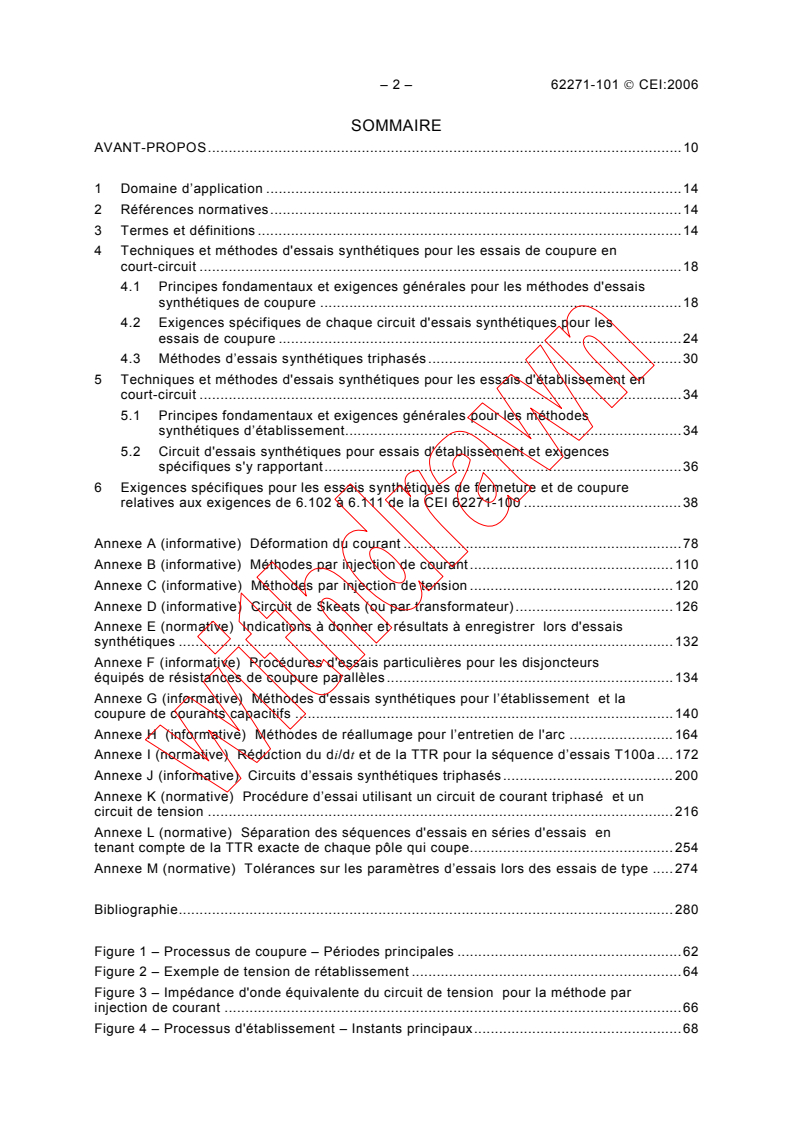
– 2 – 62271-101 CEI:2006
SOMMAIRE
AVANT-PROPOS.10
1 Domaine d’application .14
2 Références normatives.14
3 Termes et définitions .14
4 Techniques et méthodes d'essais synthétiques pour les essais de coupure en
court-circuit .18
4.1 Principes fondamentaux et exigences générales pour les méthodes d'essais
synthétiques de coupure .18
4.2 Exigences spécifiques de chaque circuit d'essais synthétiques pour les
essais de coupure .24
4.3 Méthodes d’essais synthétiques triphasés .30
5 Techniques et méthodes d'essais synthétiques pour les essais d'établissement en
court-circuit .34
5.1 Principes fondamentaux et exigences générales pour les méthodes
synthétiques d’établissement.34
5.2 Circuit d'essais synthétiques pour essais d'établissement et exigences
spécifiques s'y rapportant.36
6 Exigences spécifiques pour les essais synthétiques de fermeture et de coupure
relatives aux exigences de 6.102 à 6.111 de la CEI 62271-100 .38
Annexe A (informative) Déformation du courant .78
Annexe B (informative) Méthodes par injection de courant.110
Annexe C (informative) Méthodes par injection de tension .120
Annexe D (informative) Circuit de Skeats (ou par transformateur).126
Annexe E (normative) Indications à donner et résultats à enregistrer lors d'essais
synthétiques .132
Annexe F (informative) Procédures d'essais particulières pour les disjoncteurs
équipés de résistances de coupure parallèles.134
Annexe G (informative) Méthodes d'essais synthétiques pour l’établissement et la
coupure de courants capacitifs .140
Annexe H (informative) Méthodes de réallumage pour l’entretien de l'arc .164
Annexe I (normative) Réduction du di/dt et de la TTR pour la séquence d’essais T100a .172
Annexe J (informative) Circuits d’essais synthétiques triphasés.200
Annexe K (normative) Procédure d’essai utilisant un circuit de courant triphasé et un
circuit de tension .216
Annexe L (normative) Séparation des séquences d'essais en séries d'essais en
tenant compte de la TTR exacte de chaque pôle qui coupe.254
Annexe M (normative) Tolérances sur les paramètres d’essais lors des essais de type .274
Bibliographie.280
Figure 1 – Processus de coupure – Périodes principales .62
Figure 2 – Exemple de tension de rétablissement .64
Figure 3 – Impédance d'onde équivalente du circuit de tension pour la méthode par
injection de courant .66
Figure 4 – Processus d'établissement – Instants principaux.68
62271-101 IEC:2006 – 3 –
CONTENTS
FOREWORD.11
1 Scope.15
2 Normative references .15
3 Terms and definitions .15
4 Synthetic testing techniques and methods for short-circuit breaking tests.19
4.1 Basic principles and general requirements for synthetic breaking test
methods .19
4.2 Synthetic test circuits and related specific requirements for breaking tests .25
4.3 Three-phase synthetic test methods .31
5 Synthetic testing techniques and methods for short-circuit making tests .35
5.1 Basic principles and general requirements for synthetic making test methods .35
5.2 Synthetic test circuit and related specific requirements for making tests .37
6 Specific requirements for synthetic tests for making and breaking performance
related to the requirements of 6.102 through 6.111 of IEC 62271-100 .39
Annex A (informative) Current distortion .79
Annex B (informative) Current injection methods.111
Annex C (informative) Voltage injection methods .121
Annex D (informative) Duplicate circuit (transformer or Skeats circuit) .127
Annex E (normative) Information to be given and results to be recorded for synthetic tests . 133
Annex F (informative) Special procedures for testing circuit-breakers having parallel
breaking resistors .135
Annex G (informative) Synthetic methods for capacitive-current switching .141
Annex H (informative) Re-ignition methods to prolong arcing .165
Annex I (normative) Reduction in di/dt and TRV for test duty T100a .173
Annex J (informative) Three-phase synthetic test circuits.201
Annex K (normative) Test procedure using a three-phase current circuit and one
voltage circuit .217
Annex L (normative) Splitting of test duties in test series taking into account the
associated TRV for each pole-to-clear .255
Annex M (normative) Tolerances on test quantities for type tests.275
Bibliography.281
Figure 1 – Interrupting process – Basic time intervals .63
Figure 2 – Example of recovery voltage .65
Figure 3 – Equivalent surge impedance of the voltage circuit for the current injection
method .67
Figure 4 – Making process – Basic time intervals.69
– 4 – 62271-101 CEI:2006
Figure 5 – Circuit d’essais synthétiques de fermeture type pour les essais
monophasés .70
Figure 6 – Circuit type d’essais synthétiques d'établissement pour les essais triphasés
(k = 1,5) .72
pp
Figure 7 – Comparaison des réglages de la durée d’arc pendant les essais directs
triphasés (gauche) et les essais synthétiques triphasés (droite) pour T100s avec k =1,5 .74
p
Figure 8 – Comparaison des réglages de la durée d’arc pendant les essais directs
triphasés (gauche) et les essais synthétiques triphasés (droite) pour T100a avec k =1,5 .76
pp
Figure A.1 – Circuit direct, schéma simplifié .92
Figure A.2 – Courant de court-circuit présumé .92
Figure A.3 – Courant déformant.92
Figure A.4 – Courant déformant.94
Figure A.5 – Schéma de circuit simplifié .96
Figure A.6 – Caractéristiques du courant et de la tension d'arc pour courant
symétrique.98
Figure A.7 – Caractéristiques de courant et de tension d'arc pour courant asymétrique .100
Figure A.8 – Réduction de l'amplitude et de la durée de la dernière alternance d’arc
de courant .102
Figure A.9 – Réduction de l'amplitude et de la durée de la dernière alternance d’arc
de courant .104
Figure A.10 – Réduction de l'amplitude et de la durée de la dernière alternance d’arc
de courant .106
Figure A.11 – Réduction de l'amplitude et de la durée de la dernière alternance d’arc
de courant .108
Figure B.1 – Circuit type à injection de courant où la source de tension est en
parallèle avec le disjoncteur en essai.114
Figure B.2 – Séquence de l'injection du courant dans le circuit de la Figure B.1 .114
Figure B.3 – Circuit type à injection de courant où la source de tension est en
parallèle avec le disjoncteur auxiliaire.116
Figure B.4 – Séquence de l'injection du courant dans le circuit de la Figure B.3 .116
Figure B.5 – Exemples de détermination de la durée de changement significatif de la
tension d'arc à partir d'oscillogrammes .118
Figure C.1 – Schéma caractéristique de l'injection de tension avec la source de
tension en parallèle avec le disjoncteur auxiliaire (schéma simplifié) .122
Figure C.2 – Formes d'ondes de TTR obtenues dans un circuit à injection de tension
avec la source de tension en parallèle avec le disjoncteur auxiliaire .124
Figure D.1 – Circuit de Skeats ou par transformateur.128
Figure D.2 – Circuit de Skeats ou par transformateur déclenché.130
Figure G.1 – Circuits de courant capacitif (mode parallèle) .146
Figure G.2 – Circuit à injection de courant .148
Figure G.3 – Circuit oscillant LC .150
Figure G.4 – Source de courant inductive en parallèle avec le circuit oscillant LC.152
Figure G.5 – Circuit à injection de courant, tension de rétablissement normale
appliquée aux deux bornes du disjoncteur en essai .154
Figure G.6 – Circuit d’essais synthétiques (circuit série), tension de rétablissement
normale appliquée aux deux bornes du disjoncteur en essai.156
Figure G.7 – Circuit à injection de courant, tension de rétablissement appliquée aux
deux bornes du disjoncteur en essai .158
Figure G.8 – Circuit d’essai d’établissement .160
Figure G.9 – Circuit d'établissement du courant d'appel de fermeture .162
62271-101 IEC:2006 – 5 –
Figure 5 – Typical synthetic make circuit for single-phase tests .71
Figure 6 – Typical synthetic make circuit for three-phase tests (k = 1,5).73
pp
Figure 7 – Comparison of arcing time settings during three-phase direct tests (left)
and three-phase synthetic (right) for T100s with k = 1,5 .75
pp
Figure 8 – Comparison of arcing time settings during three-phase direct tests (left)
and three-phase synthetic (right) for T100a with k = 1,5.77
pp
Figure A.1 – Direct circuit, simplified diagram .93
Figure A.2 – Prospective short-circuit current .93
Figure A.3 – Distortion current .93
Figure A.4 – Distortion current .95
Figure A.5 – Simplified circuit diagram.97
Figure A.6 – Current and arc voltage characteristics for symmetrical current .99
Figure A.7 – Current and arc voltage characteristics for asymmetrical current .101
Figure A.8 – Reduction of amplitude and duration of final current loop of arcing .103
Figure A.9 – Reduction of amplitude and duration of final current loop of arcing .105
Figure A.10 – Reduction of amplitude and duration of final current loop of arcing .107
Figure A.11 – Reduction of amplitude and duration of final current loop of arcing .109
Figure B.1 – Typical current injection circuit with voltage circuit in parallel with the test
circuit-breaker.115
Figure B.2 – Injection timing for current injection scheme with circuit B.1.115
Figure B.3 – Typical current injection circuit with voltage circuit in parallel with the
auxiliary circuit-breaker.117
Figure B.4 – Injection timing for current injection scheme with circuit B.3.117
Figure B.5 – Examples of the determination of the interval of significant change of arc
voltage from the oscillograms .119
Figure C.1 – Typical voltage injection circuit diagram with voltage circuit in parallel
with the auxiliary circuit-breaker (simplified diagram) .123
Figure C.2 – TRV waveshapes in a voltage injection circuit with the voltage circuit in
parallel with the auxiliary circuit-breaker .125
Figure D.1 – Transformer or Skeats circuit.129
Figure D.2 – Triggered transformer or Skeats circuit .131
Figure G.1 – Capacitive current circuits (parallel mode) .147
Figure G.2 – Current injection circuit.149
Figure G.3 – LC oscillating circuit .151
Figure G.4 – Inductive current circuit in parallel with LC oscillating circuit.153
Figure G.5 – Current injection circuit, normal recovery voltage applied to both
terminals of the circuit-breaker.155
Figure G.6 – Synthetic test circuit (series circuit), normal recovery voltage applied to
both sides of the test circuit breaker .157
Figure G.7 – Current injection circuit, recovery voltage applied to both sides of the
circuit-breaker.159
Figure G.8 – Making test circuit .161
Figure G.9 – Inrush making current test circuit.163
– 6 – 62271-101 CEI:2006
Figure H.1 – Schéma type du circuit de réallumage servant à prolonger la durée d'arc .166
Figure H.2 – Circuits combinés à injection de courant et de Skeats .168
Figure H.3 – Formes d'ondes typiques obtenues pendant un essai asymétrique en
utilisant le circuit de la Figure H.2.170
Figure J.1a – Circuit combiné d’essais synthétiques triphasés .204
Figure J.1b – Formes d’ondes de courants, tensions phase-terre et entre phases
pendant un essai synthétique triphasé (T100s; k = 1,5) réalisé conformément au
pp
circuit combiné d’essais synthétiques triphasés .206
Figure J.2a – Circuit d’essais synthétiques triphasés avec injection dans toutes les
phases pour k = 1,5 .208
pp
Figure J.2b – Formes d’ondes de courants et tensions phase-terre pendant un essai
synthétique triphasé (T100s; k =1,5) réalisé conformément au circuit d’essais
pp
synthétiques triphasés avec injection dans toutes les phases .210
Figure J.3a – Circuit d’essais synthétiques triphasés pour les essais de défauts aux
bornes avec k = 1,3 (méthode par injection de courant) .212
pp
Figure J.3b – Formes d’ondes de courants, tensions phase-terre et entre phases
pendant un essai synthétique triphasé (T100s; k =1,3 ) réalisé conformément au
pp
circuit d’essais synthétiques triphasés représenté à la Figure J.3a .212
Figure J.3c – Formes d’ondes de la TTR du circuit d’essai décrit à la Figure J.3a.214
Figure K.1 – Exemple d’une source de courant triphasée avec une injection
synthétique monophasée .236
Figure K.2 – Représentation des conditions d’essais du Tableau K.1a.238
Figure K.3 – Représentation des conditions d’essais du Tableau K.1b.240
Figure K.4 – Représentation des conditions d’essais du Tableau K.2a.242
Figure K.5 – Représentation des conditions d’essais du Tableau K.2b.244
Figure K.6 – Représentation des conditions d’essais du Tableau K.3a.246
Figure K.8 – Représentation des conditions d’essais du Tableau K.4a.250
Figure K.9 – Représentation des conditions d’essais du Tableau K.4b.252
Figure L.1 – Représentation graphique de l’essai représenté au Tableau L.1.266
Figure L.2 – Représentation graphique de l’essai représenté au Tableau L.2.268
Tableau 1 – Circuits d’essais pour les séquences d’essais T100s et T100a .30
Tableau 2 – Séquences d’essais T10, T30, T60 et T100s .32
Tableau 2a – Facteur de premier pôle: 1,5 – Paramètres d’essais pendant la coupure
triphasée .32
Tableau 2b – Facteur de premier pôle: 1,3 – Paramètres d’essais pendant la coupure
triphasée .32
Tableau 3 – Méthodes d’essais synthétiques pour les séquences d’essais T10, T30,
T60, T100s, T100a, SP, DEF, OP et SLF .58
Tableau I.1a – Paramètres de la dernière alternance de courant applicables lors d’une
séquence d’essais de court-circuit T100a en 50Hz τ = 45 ms.174
Tableau I.1b – Paramètres de la dernière alternance de courant applicables lors d’une
séquence d’essais de court-circuit T100a en 50Hz τ = 60 ms.176
Tableau I.1c – Paramètres de la dernière alternance de courant applicables lors d’une
séquence d’essais de court-circuit T100a en 50Hz τ = 75 ms.178
Tableau I.1d – Paramètres de la dernière alternance de courant applicables lors d’une
séquence d’essais de court-circuit T100a en 50 Hz τ = 120 ms.180
62271-101 IEC:2006 – 7 –
Figure H.1 – Typical re-ignition circuit diagram for prolonging arc-duration .167
Figure H.2 – Combined Skeats and current injection circuits.169
Figure H.3 – Typical waveforms obtained during an asymmetrical test using the circuit
in Figure H.2.171
Figure J.1a – Three-phase synthetic combined circuit.205
Figure J.1b – Waveshapes of currents, phase-to-ground and phase-to phase voltages
during a three-phase synthetic test (T100s; k = 1,5 ) performed according to the
pp
three-phase synthetic combined circuit .207
Figure J.2a – Three-phase synthetic circuit with injection in all phases for k = 1,5 .209
pp
Figure J.2b – Waveshapes of currents and phase-to-ground voltages during a three-
phase synthetic test (T100s; k =1,5) performed according to the three-phase
pp
synthetic circuit with injection in all phases .211
Figure J.3a – Three-phase synthetic circuit for terminal fault tests with k = 1,3
pp
(current injection method) .213
Figure J.3b – Waveshapes of currents, phase-to-ground and phase-to-phase voltages
during a three-phase synthetic test (T100s; k =1,3 ) performed according to the
pp
three-phase synthetic circuit shown in Figure J.3a .213
Figure J.3c – TRV voltages waveshapes of the test circuit described in Figure J.3a.215
Figure K.1 – Example of a three-phase current circuit with single-phase synthetic injection . 237
Figure K.2 – Representation of the testing conditions of Table K.1a.239
Figure K.3 – Representation of the testing conditions of Table K.1b.241
Figure K.4 – Representation of the testing conditions of Table K.2a.243
Figure K.5 – Representation of the testing conditions of Table K.2b.245
Figure K.6 – Representation of the testing conditions of Table K.3a.247
Figure K.7 – Representation of the testing conditions of Table K.3b.249
Figure K.8 – Representation of the testing conditions of Table K.4a.251
Figure K.9 – Representation of the testing conditions of Table K.4b.253
Figure L.1 – Graphical representation of the test shown in Table L.1 .267
Figure L.2 – Graphical representation of the test shown in Table L.2 .269
Table 1 – Test circuits for test duties T100s and T100a .31
Table 2 – Test duties T10, T30, T60 and T100s .33
Table 2a – First-pole-to-clear factor: 1,5 – Test parameters during three-phase
interruption .33
Table 2b – First-pole-to-clear factor: 1,3 – Test parameters during three-phase
interruption .33
Table 3 – Synthetic test methods for test duties T10, T30, T60, T100s, T100a, SP,
DEF, OP and SLF .59
Table I.1a – Last current loop parameters for 50 Hz operation in relation to short-circuit
test duty T100a τ = 45 ms.175
Table I.1b – Last current loop parameters for 50 Hz operation in relation to short-circuit
test duty T100a τ = 60 ms.177
Table I.1c – Last current loop parameters for 50 Hz operation in relation to short-circuit
test duty T100a τ = 75 ms.179
Table I.1d – Last current loop parameters for 50 Hz operation in relation to short-circuit
test duty T100a τ = 120 ms.181
– 8 – 62271-101 CEI:2006
Tableau I.2a – Paramètres de la dernière alternance de courant applicables lors d’une
séquence d’essais de court-circuit T100a en 60Hz τ = 45 ms.182
Tableau I.2b – Paramètres de la dernière alternance de courant applicables lors d’une
séquence d’essais de court-circuit T100a en 60 Hz τ = 60 ms.184
Tableau I.2c – Paramètres de la dernière alternance de courant applicables lors d’une
séquence d’essais de court-circuit T100a en 60 Hz τ = 75 ms.186
Tableau I.2d – Paramètres de la dernière alternance de courant applicables lors d’une
séquence d’essais de court-circuit T100a en 60 Hz τ = 120 ms.188
Tableau I.3a – Réduction du di/dt de la dernière alternance en 50 Hz dans des
conditions triphasées avec le premier pôle qui coupe en phase A et l’asymétrie
requise en phase C.190
Tableau I.3b – Réduction du di/dt de la dernière alternance en 60 Hz dans des
conditions triphasées avec le premier pôle qui coupe en phase A et l’asymétrie
requise en phase C.192
Tableau I.4a – Valeurs corrigées de TTR pour k = 1,3 et f = 50 Hz .194
pp r
Tableau I.4b – Valeurs corrigées de TTR pour k = 1,3 et f = 60 Hz .196
pp r
Tableau I.4c – Valeurs corrigées de TTR pour k = 1,5 et f = 50 Hz .198
pp r
Tableau I.4d – Valeurs corrigées de TTR pour k = 1,5 et f = 60 Hz .198
pp r
Tableau K.1a – Démonstration des durées d’arc pour un facteur de premier pôle de 1,5.218
Tableau K.1b – Démonstration alternative des durées d’arc pour un facteur de premier
pôle de 1,5.220
Tableau K.2a – Démonstration des durées d’arc pour un facteur de premier pôle de 1,3.222
Tableau K.2b – Démonstration alternative des durées d’arc pour un facteur de premier
pôle de 1,3.224
Tableau K.3a – Démonstration des durées d’arc pour un facteur de premier pôle de 1,5.228
Tableau K.3b – Autre démonstration des durées d’arc pour un facteur de premier pôle
de 1,5 .230
Tableau K.4a – Démonstration des durées d’arc pour un facteur de premier pôle de 1,3.232
Tableau K.4b – Autre démonstration des durées d’arc pour un facteur de premier pôle
de 1,3 .234
Tableau L.1 – Procédure d’essais pour un facteur de premier pôle de 1,5.256
Tableau L.2a – Démonstration alternative des durées d’arc pour un facteur de premier
pôle de 1,3.258
Tableau L.2b – Procédure d’essais simplifiée pour un facteur de premier pôle de 1,3 .260
Tableau L.3 – Procédure d’essais pour des courants asymétriques dans le cas d’un
facteur de premier pôle de 1,5 .262
Tableau L.4 – Procédure d’essais pour des courants asymétriques dans le cas d’un
facteur de premier pôle de 1,3 .264
Tableau L.5 – Conditions d’arc requises en ° pour les différentes conditions
asymétriques, f = 50 Hz.270
r
Tableau L.6 – Conditions d’arc requises en ° pour les différentes conditions
asymétriques, f = 60 Hz.272
r
Tableau M.1 – Tolérances sur les paramètres d’essais lors des essais de type .276
62271-101 IEC:2006 – 9 –
Table I.2a – Last current loop parameters for 60 Hz operation in relation to short-circuit
test duty T100a τ = 45 ms.183
Table I.2b – Last current loop parameters for 60 Hz operation in relation to short-circuit
test duty T100a τ = 60 ms.185
Table I.2c – Last current loop parameters for 60 Hz operation in relation to short-circuit
test duty T100a τ = 75 ms.187
Table I.2d – Last current loop parameters for 60 Hz operation in relation to short-circuit
test duty T100a τ = 120 ms.189
Table I.3a – Last loop di/dt reduction for 50 Hz under three-phase conditions with the
first pole to clear in phase A and the required asymmetry in phase C.191
Table I.3b – Last loop di/dt reduction for 60 Hz under three- phase conditions with the
first pole to clear in phase A and the required asymmetry in phase C.193
Table I.4a – Corrected TRV values for k = 1,3 and f = 50 Hz.195
pp r
Table I.4b – Corrected TRV values for k = 1,3 and f = 60 Hz.197
pp r
Table I.4c – Corrected TRV values for k = 1,5 and f = 50 Hz.199
pp r
Table I.4d – Corrected TRV values for k = 1,5 and f = 60 Hz.199
pp r
Table K.1a – Demonstration of arcing times for a first-pole-to-clear factor of 1,5.219
Table K.1b – Alternative demonstration of arcing times for a first-pole-to-clear factor
of 1,5 .221
Table K.2a – Demonstration of arcing times for a first-pole-to-clear factor of 1,3.223
Table K.2b – Alternative demonstration of arcing times for a first-pole-to-clear factor
of 1,3 .225
Table K.3a – Demonstration of arcing times for a first-pole-to-clear factor of 1,5.229
Table K.3b – Alternative demonstration of arcing times for a first-pole-to-clear factor
of 1,5 .231
Table K.4a – Demonstration of arcing times for a first-pole-to-clear factor of 1,3.233
Table K.4b – Alternative demonstration of arcing times for a first-pole-to-clear factor
of 1,3 .235
Table L.1 – Test procedure for a first-pole-to-clear factor of 1,5.257
Table L.2a – Alternative demonstration of arcing times for a first-pole-to-clear factor
of 1,3 .259
Table L.2b – Simplified test procedure for a first-pole-to-clear factor of 1,3.261
Table L.3 – Test procedure for asymmetrical currents in the case of a first-pole-to-
clear factor of 1,5.263
Table L.4 – Test procedure for asymmetrical currents in the case of a first-pole-to-
clear factor of 1,3.265
Table L.5 – Required arcing windows in ° for different asymmetrical conditions, f =
r
50 Hz.271
Table L.6 – Required arcing windows in ° for different asymmetrical conditions, f =
r
60 Hz.273
Table M.1 – Tolerances on test quantities for type tests.277
– 10 – 62271-101 CEI:2006
COMMISSION ÉLECTROTECHNIQUE INTERNATIONALE
___________
APPAREILLAGE À HAUTE TENSION –
Partie 101: Essais synthétiques
AVANT-PROPOS
1) La Commission Electrotechnique Internationale (CEI) est une organisation mondiale de normalisation
composée de l'ensemble des comités électrotechniques nationaux (Comités nationaux de la CEI). La CEI a
pour objet de favoriser la coopération internationale pour toutes les questions de normalisation dans les
domaines de l'électricité et de l'électronique. A cet effet, la CEI – entre autres activités – publie des Normes
internationales, des Spécifications techniques, des Rapports techniques, des Spécifications accessibles au
public (PAS) et des Guides (ci-après dénommés "Publication(s) de la CEI"). Leur élaboration est confiée à des
comités d'études, aux travaux desquels tout Comité national intéressé par le sujet traité peut participer. Les
organisations internationales, gouvernementales et non gouvernementales, en liaison avec la CEI, participent
également aux travaux.
...
IEC 62271-101 ®
Edition 1.1 2010-11
INTERNATIONAL
STANDARD
NORME
INTERNATIONALE
colour
inside
High-voltage switchgear and controlgear –
Part 101: Synthetic testing
Appareillage à haute tension –
Partie 101: Essais synthétiques
All rights reserved. Unless otherwise specified, no part of this publication may be reproduced or utilized in any form or by
any means, electronic or mechanical, including photocopying and microfilm, without permission in writing from either IEC or
IEC's member National Committee in the country of the requester.
If you have any questions about IEC copyright or have an enquiry about obtaining additional rights to this publication,
please contact the address below or your local IEC member National Committee for further information.
Droits de reproduction réservés. Sauf indication contraire, aucune partie de cette publication ne peut être reproduite
ni utilisée sous quelque forme que ce soit et par aucun procédé, électronique ou mécanique, y compris la photocopie
et les microfilms, sans l'accord écrit de la CEI ou du Comité national de la CEI du pays du demandeur.
Si vous avez des questions sur le copyright de la CEI ou si vous désirez obtenir des droits supplémentaires sur cette
publication, utilisez les coordonnées ci-après ou contactez le Comité national de la CEI de votre pays de résidence.
IEC Central Office
3, rue de Varembé
CH-1211 Geneva 20
Switzerland
Email: inmail@iec.ch
Web: www.iec.ch
About the IEC
The International Electrotechnical Commission (IEC) is the leading global organization that prepares and publishes
International Standards for all electrical, electronic and related technologies.
About IEC publications
The technical content of IEC publications is kept under constant review by the IEC. Please make sure that you have the
latest edition, a corrigenda or an amendment might have been published.
§ Catalogue of IEC publications: www.iec.ch/searchpub
The IEC on-line Catalogue enables you to search by a variety of criteria (reference number, text, technical committee,…).
It also gives information on projects, withdrawn and replaced publications.
§ IEC Just Published: www.iec.ch/online_news/justpub
Stay up to date on all new IEC publications. Just Published details twice a month all new publications released. Available
on-line and also by email.
§ Electropedia: www.electropedia.org
The world's leading online dictionary of electronic and electrical terms containing more than 20 000 terms and definitions
in English and French, with equivalent terms in additional languages. Also known as the International Electrotechnical
Vocabulary online.
§ Customer Service Centre: www.iec.ch/webstore/custserv
If you wish to give us your feedback on this publication or need further assistance, please visit the Customer Service
Centre FAQ or contact us:
Email: csc@iec.ch
Tel.: +41 22 919 02 11
Fax: +41 22 919 03 00
A propos de la CEI
La Commission Electrotechnique Internationale (CEI) est la première organisation mondiale qui élabore et publie des
normes internationales pour tout ce qui a trait à l'électricité, à l'électronique et aux technologies apparentées.
A propos des publications CEI
Le contenu technique des publications de la CEI est constamment revu. Veuillez vous assurer que vous possédez
l’édition la plus récente, un corrigendum ou amendement peut avoir été publié.
§ Catalogue des publications de la CEI: www.iec.ch/searchpub/cur_fut-f.htm
Le Catalogue en-ligne de la CEI vous permet d’effectuer des recherches en utilisant différents critères (numéro de référence,
texte, comité d’études,…). Il donne aussi des informations sur les projets et les publications retirées ou remplacées.
§ Just Published CEI: www.iec.ch/online_news/justpub
Restez informé sur les nouvelles publications de la CEI. Just Published détaille deux fois par mois les nouvelles
publications parues. Disponible en-ligne et aussi par email.
§ Electropedia: www.electropedia.org
Le premier dictionnaire en ligne au monde de termes électroniques et électriques. Il contient plus de 20 000 termes et
définitions en anglais et en français, ainsi que les termes équivalents dans les langues additionnelles. Egalement appelé
Vocabulaire Electrotechnique International en ligne.
§ Service Clients: www.iec.ch/webstore/custserv/custserv_entry-f.htm
Si vous désirez nous donner des commentaires sur cette publication ou si vous avez des questions, visitez le FAQ du
Service clients ou contactez-nous:
Email: csc@iec.ch
Tél.: +41 22 919 02 11
Fax: +41 22 919 03 00
IEC 62271-101 ®
Edition 1.1 2010-11
INTERNATIONAL
STANDARD
NORME
INTERNATIONALE
colour
inside
High-voltage switchgear and controlgear –
Part 101: Synthetic testing
Appareillage à haute tension –
Partie 101: Essais synthétiques
INTERNATIONAL
ELECTROTECHNICAL
COMMISSION
COMMISSION
ELECTROTECHNIQUE
INTERNATIONALE
PRICE CODE
C7
CODE PRIX
ICS 29.130.10
ISBN 978-2-88912-191-5
– 2 – 62271-101 IEC:2006+A1:2010
CONTENTS
FOREWORD . 6
INTRODUCTION (to amendment 1) . 8
1 Scope . 9
2 Normative references . 9
3 Terms and definitions . 9
4 Synthetic testing techniques and methods for short-circuit breaking tests . 11
4.1 Basic principles and general requirements for synthetic breaking test
methods . 11
4.2 Synthetic test circuits and related specific requirements for breaking tests . 14
4.3 Three-phase synthetic test methods . 17
5 Synthetic testing techniques and methods for short-circuit making tests . 19
5.1 Basic principles and general requirements for synthetic making test methods . 19
5.2 Synthetic test circuit and related specific requirements for making tests . 20
6 Specific requirements for synthetic tests for making and breaking performance
related to the requirements of 6.102 through 6.111 of IEC 62271-100 . 21
Annex A (informative) Current distortion . 42
Annex B (informative) Current injection methods. 58
Annex C (informative) Voltage injection methods . 63
Annex D (informative) Duplicate circuit (transformer or Skeats circuit) . 66
Annex E (normative) Information to be given and results to be recorded for synthetic tests . 69
Annex F (informative) Special procedures for testing circuit-breakers having parallel
breaking resistors . 70
Annex G (informative) Synthetic methods for capacitive-current switching . 73
Annex H (informative) Re-ignition methods to prolong arcing . 85
Annex I (normative) Reduction in di/dt and TRV for test duty T100a . 89
Annex J (informative) Three-phase synthetic test circuits . 103
Annex K (normative) Test procedure using a three-phase current circuit and one
voltage circuit . 111
Annex L (normative) Splitting of test duties in test series taking into account the
associated TRV for each pole-to-clear . 130
Annex M (normative) Tolerances on test quantities for type tests . 140
Annex N (informative) Typical test circuits for metal-enclosed and dead tank circuit
breakers . 143
Bibliography . 143
Figure 1 – Interrupting process – Basic time intervals . 33
Figure 2 – Example of recovery voltage . 34
Figure 3 – Equivalent surge impedance of the voltage circuit for the current injection
method . 35
Figure 4 – Making process – Basic time intervals . 36
Figure 5 – Typical synthetic make circuit for single-phase tests . 38
Figure 6 – Typical synthetic make circuit for three-phase tests (k = 1,5) . 39
pp
Figure 7 – Comparison of arcing time settings during three-phase direct tests (left)
and three-phase synthetic (right) for T100s with k = 1,5 . 40
pp
62271-101 IEC:2006+A1:2010 – 3 –
Figure 8 – Comparison of arcing time settings during three-phase direct tests (left)
and three-phase synthetic (right) for T100a with k = 1,5 . 41
pp
Figure A.1 – Direct circuit, simplified diagram . 49
Figure A.2 – Prospective short-circuit current . 49
Figure A.3 – Distortion current . 49
Figure A.4 – Distortion current . 50
Figure A.5 – Simplified circuit diagram . 51
Figure A.6 – Current and arc voltage characteristics for symmetrical current . 52
Figure A.7 – Current and arc voltage characteristics for asymmetrical current . 53
Figure A.8 – Reduction of amplitude and duration of final current loop of arcing . 54
Figure A.9 – Reduction of amplitude and duration of final current loop of arcing . 55
Figure A.10 – Reduction of amplitude and duration of final current loop of arcing . 56
Figure A.11 – Reduction of amplitude and duration of final current loop of arcing . 57
Figure B.1 – Typical current injection circuit with voltage circuit in parallel with the test
circuit-breaker . 60
Figure B.2 – Injection timing for current injection scheme with circuit B.1 . 60
Figure B.3 – Typical current injection circuit with voltage circuit in parallel with the
auxiliary circuit-breaker . 61
Figure B.4 – Injection timing for current injection scheme with circuit B.3 . 61
Figure B.5 – Examples of the determination of the interval of significant change of arc
voltage from the oscillograms . 62
Figure C.1 – Typical voltage injection circuit diagram with voltage circuit in parallel
with the auxiliary circuit-breaker (simplified diagram) . 64
Figure C.2 – TRV waveshapes in a voltage injection circuit with the voltage circuit in
parallel with the auxiliary circuit-breaker . 65
Figure D.1 – Transformer or Skeats circuit . 67
Figure D.2 – Triggered transformer or Skeats circuit . 68
Figure G.1 – Capacitive current circuits (parallel mode) . 76
Figure G.2 – Current injection circuit . 77
Figure G.3 – LC oscillating circuit . 78
Figure G.4 – Inductive current circuit in parallel with LC oscillating circuit . 79
Figure G.5 – Current injection circuit, normal recovery voltage applied to both
terminals of the circuit-breaker . 80
Figure G.6 – Synthetic test circuit (series circuit), normal recovery voltage applied to
both sides of the test circuit breaker . 81
Figure G.7 – Current injection circuit, recovery voltage applied to both sides of the
circuit-breaker . 82
Figure G.8 – Making test circuit . 83
Figure G.9 – Inrush making current test circuit . 84
Figure H.1 – Typical re-ignition circuit diagram for prolonging arc-duration . 86
Figure H.2 – Combined Skeats and current injection circuits . 87
Figure H.3 – Typical waveforms obtained during an asymmetrical test using the circuit
in Figure H.2 . 88
Figure J.1a – Three-phase synthetic combined circuit . 105
Figure J.1b – Waveshapes of currents, phase-to-ground and phase-to phase voltages
during a three-phase synthetic test (T100s; k = 1,5 ) performed according to the
pp
three-phase synthetic combined circuit . 106
Figure J.2a – Three-phase synthetic circuit with injection in all phases for k = 1,5 . 107
pp
– 4 – 62271-101 IEC:2006+A1:2010
Figure J.2b – Waveshapes of currents and phase-to-ground voltages during a three-
phase synthetic test (T100s; k =1,5) performed according to the three-phase
pp
synthetic circuit with injection in all phases . 108
Figure J.3a – Three-phase synthetic circuit for terminal fault tests with k = 1,3
pp
(current injection method) . 109
Figure J.3b – Waveshapes of currents, phase-to-ground and phase-to-phase voltages
during a three-phase synthetic test (T100s; k =1,3 ) performed according to the
pp
three-phase synthetic circuit shown in Figure J.3a . 109
Figure J.3c – TRV voltages waveshapes of the test circuit described in Figure J.3a . 110
Figure K.1 – Example of a three-phase current circuit with single-phase synthetic injection . 121
Figure K.2 – Representation of the testing conditions of Table K.1a . 122
Figure K.3 – Representation of the testing conditions of Table K.1b . 123
Figure K.4 – Representation of the testing conditions of Table K.2a . 124
Figure K.5 – Representation of the testing conditions of Table K.2b . 125
Figure K.6 – Representation of the testing conditions of Table K.3a . 126
Figure K.7 – Representation of the testing conditions of Table K.3b . 127
Figure K.8 – Representation of the testing conditions of Table K.4a . 128
Figure K.9 – Representation of the testing conditions of Table K.4b . 129
Figure L.1 – Graphical representation of the test shown in Table L.1 . 136
Figure L.2 – Graphical representation of the test shown in Table L.2 . 137
Figure N.1 – Test circuit for unit testing (circuit-breaker with interaction
due to gas circulation) . 144
Figure N.2 – Half-pole testing of a circuit-breaker in test circuit given by Figure N.1 –
Example of the required TRVs to be applied between the terminals of the unit(s)
under test and between the live parts and the insulated enclosure . 145
Figure N.3 – Synthetic test circuit for unit testing (if unit testing is allowed as per
Subclause 6.102.4.2 of IEC 62271-100:2008) . 146
Figure N.4 – Half-pole testing of a circuit-breaker in the test circuit of Figure N.3 –
Example of the required TRVs to be applied between the terminals of the unit(s)
under test and between the live parts and the insulated enclosure . 147
Figure N.5 – Capacitive current injection circuit with enclosure of the circuit-breaker
energized . 148
Figure N.6 – Capacitive synthetic circuit using two power-frequency sources
and with the enclosure of the circuit-breaker energized . 149
Figure N.7 – Capacitive synthetic current injection circuit – Example of unit testing
on half a pole of a circuit-breaker with two units per pole – Enclosure energized
with d.c. voltage source . 150
Figure N.8 – Symmetrical synthetic test circuit for out-of-phase switching tests on a
complete pole of a circuit-breaker . 151
Figure N.9 – Full pole test with voltage applied to both terminals
and the metal enclosure . 152
Table 1 – Test circuits for test duties T100s and T100a . 17
Table 2 – Test duties T10, T30, T60 and T100s . 18
Table 2a – First-pole-to-clear factor: 1,5 – Test parameters during three-phase
interruption . 18
Table 2b – First-pole-to-clear factor: 1,3 – Test parameters during three-phase
interruption . 18
Table 3 – Synthetic test methods for test duties T10, T30, T60, T100s, T100a, SP,
DEF, OP and SLF . 31
62271-101 IEC:2006+A1:2010 – 5 –
Table I.1a – Last current loop parameters for 50 Hz operation in relation to short-circuit
test duty T100a τ = 45 ms . 90
Table I.1b – Last current loop parameters for 50 Hz operation in relation to short-circuit
test duty T100a τ = 60 ms . 91
Table I.1c – Last current loop parameters for 50 Hz operation in relation to short-circuit
test duty T100a τ = 75 ms . 92
Table I.1d – Last current loop parameters for 50 Hz operation in relation to short-circuit
test duty T100a τ = 120 ms . 93
Table I.2a – Last current loop parameters for 60 Hz operation in relation to short-circuit
test duty T100a τ = 45 ms . 94
Table I.2b – Last current loop parameters for 60 Hz operation in relation to short-circuit
test duty T100a τ = 60 ms . 95
Table I.2c – Last current loop parameters for 60 Hz operation in relation to short-circuit
test duty T100a τ = 75 ms . 96
Table I.2d – Last current loop parameters for 60 Hz operation in relation to short-circuit
test duty T100a τ = 120 ms . 97
Table I.3a I.1a – Last loop di/dt reduction for 50 Hz under three-phase conditions with
the first pole to clear in phase A and the required asymmetry in phase C . 98
Table I.3b I.1b – Last loop di/dt reduction for 60 Hz under three- phase conditions with
the first pole to clear in phase A and the required asymmetry in phase C . 99
Table I.4a I.2a – Corrected TRV values for k = 1,3 and f = 50 Hz . 100
pp r
Table I.4b I.2b – Corrected TRV values for k = 1,3 and f = 60 Hz . 101
pp r
Table I.4c I.2c – Corrected TRV values for k = 1,5 and f = 50 Hz . 102
pp r
Table I.4d I.2d – Corrected TRV values for k = 1,5 and f = 60 Hz . 102
pp r
Table K.1a – Demonstration of arcing times for a first-pole-to-clear factor of 1,5 . 112
Table K.1b – Alternative demonstration of arcing times for a first-pole-to-clear factor
of 1,5 . 113
Table K.2a – Demonstration of arcing times for a first-pole-to-clear factor of 1,3 . 114
Table K.2b – Alternative demonstration of arcing times for a first-pole-to-clear factor
of 1,3 . 115
Table K.3a – Demonstration of arcing times for a first-pole-to-clear factor of 1,5 . 117
Table K.3b – Alternative demonstration of arcing times for a first-pole-to-clear factor
of 1,5 . 118
Table K.4a – Demonstration of arcing times for a first-pole-to-clear factor of 1,3 . 119
Table K.4b – Alternative demonstration of arcing times for a first-pole-to-clear factor
of 1,3 . 120
Table L.1 – Test procedure for a first-pole-to-clear factor of 1,5 . 131
Table L.2a – Alternative demonstration of arcing times for a first-pole-to-clear factor
of 1,3 . 132
Table L.2b – Simplified test procedure for a first-pole-to-clear factor of 1,3 . 133
Table L.3 – Test procedure for asymmetrical currents in the case of a first-pole-to-
clear factor of 1,5 . 134
Table L.4 – Test procedure for asymmetrical currents in the case of a first-pole-to-
clear factor of 1,3 . 135
Table L.5 – Required arcing windows in ° for different asymmetrical conditions, f = 50 Hz . 138
r
Table L.6 – Required arcing windows in ° for different asymmetrical conditions, f = 60 Hz . 139
r
Table M.1 – Tolerances on test quantities for type tests . 141
– 6 – 62271-101 IEC:2006+A1:2010
INTERNATIONAL ELECTROTECHNICAL COMMISSION
___________
HIGH-VOLTAGE SWITCHGEAR AND CONTROLGEAR –
Part 101: Synthetic testing
FOREWORD
1) The International Electrotechnical Commission (IEC) is a worldwide organization for standardization comprising
all national electrotechnical committees (IEC National Committees). The object of IEC is to promote
international co-operation on all questions concerning standardization in the electrical and electronic fields. To
this end and in addition to other activities, IEC publishes International Standards, Technical Specifications,
Technical Reports, Publicly Available Specifications (PAS) and Guides (hereafter referred to as “IEC
Publication(s)”). Their preparation is entrusted to technical committees; any IEC National Committee interested
in the subject dealt with may participate in this preparatory work. International, governmental and non-
governmental organizations liaising with the IEC also participate in this preparation. IEC collaborates closely
with the International Organization for Standardization (ISO) in accordance with conditions determined by
agreement between the two organizations.
2) The formal decisions or agreements of IEC on technical matters express, as nearly as possible, an international
consensus of opinion on the relevant subjects since each technical committee has representation from all
interested IEC National Committees.
3) IEC Publications have the form of recommendations for international use and are accepted by IEC National
Committees in that sense. While all reasonable efforts are made to ensure that the technical content of IEC
Publications is accurate, IEC cannot be held responsible for the way in which they are used or for any
misinterpretation by any end user.
4) In order to promote international uniformity, IEC National Committees undertake to apply IEC Publications
transparently to the maximum extent possible in their national and regional publications. Any divergence
between any IEC Publication and the corresponding national or regional publication shall be clearly indicated in
the latter.
5) IEC itself does not provide any attestation of conformity. Independent certification bodies provide conformity
assessment services and, in some areas, access to IEC marks of conformity. IEC is not responsible for any
services carried out by independent certification bodies.
6) All users should ensure that they have the latest edition of this publication.
7) No liability shall attach to IEC or its directors, employees, servants or agents including individual experts and
members of its technical committees and IEC National Committees for any personal injury, property damage or
other damage of any nature whatsoever, whether direct or indirect, or for costs (including legal fees) and
expenses arising out of the publication, use of, or reliance upon, this IEC Publication or any other IEC
Publications.
8) Attention is drawn to the Normative references cited in this publication. Use of the referenced publications is
indispensable for the correct application of this publication.
9) Attention is drawn to the possibility that some of the elements of this IEC Publication may be the subject of
patent rights. IEC shall not be held responsible for identifying any or all such patent rights.
This consolidated version of IEC 62271-101 consists of the first edition (2006)
[documents 17A/753/FDIS and 17A/755/RVD] and its amendment 1 (2010) [documents
17A/907/FDIS and 17A/919/RVD]. It bears the edition number 1.1.
The technical content is therefore identical to the base edition and its amendment and
has been prepared for user convenience. A vertical line in the margin shows where the
base publication has been modified by amendment 1. Additions and deletions are
displayed in red, with deletions being struck through.
62271-101 IEC:2006+A1:2010 – 7 –
International Standard IEC 62271-101 has been prepared by subcommittee 17A: High-voltage
switchgear and controlgear, of IEC technical committee 17: Switchgear and controlgear.
This publication has been drafted in accordance with the ISO/IEC Directives, Part 2.
This publication shall be read in conjunction with IEC 62271-100. The numbering of the
subclauses of Clause 6 is the same as in IEC 62271-100. However, not all subclauses of IEC
62271-100 are addressed; merely those where synthetic testing has introduced changes.
The IEC 62271-100 series consists of the following parts, under the general title High-voltage
switchgear and controlgear:
Part 100: High-voltage alternating-current circuit-breakers
Part 101: Synthetic testing
Part 102: Alternating current disconnectors and earthing switches
Part 104: Alternating current switches for rated voltages of 52 kV and above
Part 105: Alternating current switch-fuse combinations
Part 107: Alternating current fused circuit-switchers for rated voltages above 1 kV up to and
including 52 kV
Part 108: High voltage alternating current disconnecting circuit-breakers for rated voltages
of 72,5 kV and above
Part 109: Alternating-current series capacitor by-pass switches
Part 110: Inductive load switching
A list of the other parts belonging to the IEC 62271 series can be found on the IEC website
http://www.iec.ch. Further information is available on http://tc17.iec.ch.
The committee has decided that the contents of the base publication and its amendments will
remain unchanged until the stability date indicated on the IEC web site under
"http://webstore.iec.ch" in the data related to the specific publication. At this date, the publication will
be
• reconfirmed,
• withdrawn,
• replaced by a revised edition, or
• amended.
IMPORTANT – The “colour inside” logo on the cover page of this publication indicates
that it contains colours which are considered to be useful for the correct understanding
of its contents. Users should therefore print this publication using a colour printer.
___________
Some of these parts are still in the process of being developed.
– 8 – 62271-101 IEC:2006+A1:2010
INTRODUCTION
(to amendment 1)
This amendment cancels and replaces IEC 61633.
The original edition of IEC 62271-101 (2006) makes extensive reference to
IEC 62271-100:2001. Since then, a new edition of IEC 62271-100 has been published (2008).
Within this amendment, references are made to IEC 62271-100:2008. Unless they are
explicitly mentioned in this amendment, all of the references in the original edition of
IEC 62271-101 (2006) still make reference to IEC 62271-100:2001. A second amendment to
IEC 62271-101, which will update all cross-references to the new IEC 62271-100:2008, is
under consideration.
62271-101 IEC:2006+A1:2010 – 9 –
HIGH-VOLTAGE SWITCHGEAR AND CONTROLGEAR –
Part 101: Synthetic testing
1 Scope
This part of IEC 62271 mainly applies to a.c. circuit-breakers within the scope of IEC 62271-100.
It provides the general rules for testing a.c. circuit-breakers, for making and breaking capacities
over the range of test duties described in 6.102 to 6.111 of IEC 62271-100, by synthetic methods.
NOTE Circuits for the test duties described in 6.111 have not yet been standardized. However, present methods
are given in Annex G.
It has been proven that synthetic testing is an economical and technically correct way to test
high-voltage a.c. circuit-breakers according to the requirements of IEC 62271-100 and that it
is equivalent to direct testing.
The methods and techniques described are those in general use. The purpose of this
standard is to establish criteria for synthetic testing and for the proper evaluation of results.
Such criteria will establish the validity of the test method without imposing restraints on
innovation of test circuitry.
2 Normative references
The following referenced documents are indispensable for the application of this document.
For dated references, only the edition cited applies. For undated references, the latest edition
of the referenced document (including any amendments) applies.
IEC 61633:1995, High-voltage alternating current circuit-breakers – Guide for short-circuit and
switching test procedures for metal-enclosed and dead tank circuit-breakers
IEC 62271-100:2001 2008, High-voltage switchgear and controlgear – Part 100: High-voltage
Alternating current circuit-breakers
IEC 62271-308:2002, High-voltage switchgear and controlgear – Part 308: Guide for asym-
metrical short-circuit test duty T100a
3 Terms and definitions
For the purposes of this document, the terms and definitions of IEC 62271-100, as well as the
following terms and definitions, apply.
3.1
direct test
test in which the applied voltage, the current and the transient and power-frequency recovery
voltages are all obtained from a circuit having a single-power source, which may be a power
system or special alternators as used in short-circuit testing stations or a combination of both
___________
Unless explicitly otherwise mentioned, all of the references to IEC 62271-100 make reference to IEC 62271-100:2001. A
second amendment to IEC 62271-101, which will update all cross-references to the new IEC 62271-100:2008, is under
consideration.
– 10 – 62271-101 IEC:2006+A1:2010
3.2
synthetic test
test in which all of the current, or a major portion of it, is obtained from one source (current
circuit), and in which the applied voltage and/or the recovery voltages (transient and power
frequency) are obtained wholly or in part from one or more separate sources (voltage circuits)
3.3
test circuit-breaker
circuit-breaker under test (see 6.102.2 of IEC 62271-100:2001)
3.4
auxiliary circuit-breaker(s)
circuit-breaker(s) forming part of a synthetic test circuit used to put the test circuit-breaker
into the required relation with various circuits
3.5
current circuit
that part of the synthetic test circuit from which all or the major part of the power-frequency
current is obtained
3.6
voltage circuit
that part of the synthetic test circuit from which all or the major part of the applied voltage
and/or recovery voltage is obtained
3.7
prospective current (of a circuit and with respect to a circuit-breaker)
current that would flow in the circuit if each pole of the test and auxiliary circuit-breakers were
replaced by a conductor of negligible impedance
[IEV 441-17-01, modified]
3.8
actual current
current through the test circuit-breaker (prospective current modified by the arc voltage of the
test and auxiliary circuit-breakers)
3.9
distortion current
calculated current equal to the difference between the prospective current and the actual
current
3.10
post-arc current
current which flows through the arc gap of a circuit-breaker when the current and arc voltage
have fallen to zero and the transient recovery voltage has begun to rise
3.11
current-injection method
synthetic test method in which the voltage circuit is applied to the test circuit-breaker before
power-frequency current zero
3.12
initial transient making current
ITMC
transient current which flows through the circuit-breaker at the moment of voltage breakdown
prior to the initiation of current from the current circuit during making
62271-101 IEC:2006+A1:2010 – 11 –
3.13
injected current
current supplied by the voltage circuit of a current injection circuit when it is connected to the
circuit-breaker under test
3.14
voltage-injection method
synthetic test method in which the voltage circuit is applied to the test circuit-breaker after
power frequency current zero
3.15
reference system conditions
conditions of an electrical system having the parameters from which the rated and test values
of IEC 62271-100 are derived
3.16
time delay of making device
t
m
time interval, during synthetic making test, between the instant of breakdown of the applied
voltage and the initiation of current from the current circuit
3.17
minimum clearing time
sum of the minimum opening time, minimum relay time (½ cycle), and the minimum arcing
time for the minor loop of the first-pole-to-clear, during test duty T100a only, as declared by
the manufacturer. This definition should be used only for the determination of the test
parameters for test duty T100a.
NOTE 1 The minimum clearing time obtained during the tests should not be lower than the value declared by the
manufacturer. Prior to the tests, the minimum opening time should be measured at maximum trip coil voltage
maximum pressure for operation and minimum pressure for interruption. If the minimum opening time measured
prior to the tests is lower than the one declared by the manufacturer, this lower value should be used for the
determination of the required test parameters.
NOTE 2 This definition assumes that the minimum clearing time obtained with the minimum pressure for
interruption is similar to the one that would be obtained with the maximum pressure for interruption. Normally, the
minimum clearing time is obtained with the maximum pressure for interruption. If such pressure condition is giving
a minimum clearing time such that the minimum clearing time range applicable (as given in Tables 1a to 2d of
IEC 62271-308:2002) for tests is different than the one obtained at minimum pressure for interruption, then it is
permissible to verify the minimum clearing time by using the maximum pressure for interruption.
3.18
pre-strike
voltage breakdown between the contacts during a making operation which initiates current
flow
4 Synthetic testing techniques and methods for short-circuit breaking tests
4.1 Basic principles and general requirements for synthetic breaking test methods
Any particular synthetic method chosen for testing shall adequately stress the test circuit-
breaker. Generally, the adequacy is established when the test method meets the requirements
set forth in the following subclauses.
– 12 – 62271-101 IEC:2006+A1:2010
A circuit-breaker has two basic positions: closed and open. In the closed position a circuit-
breaker conducts full current with negligible voltage drop across its contacts. In the open
position it conducts negligible current but with full voltage across the contacts. This defines
the two main stresses, the current stress and the voltage stress, which are separated in time.
If closer attention is paid to the voltage and current stresses during the interrupting process
(Figure 1), three main intervals can be recognized:
– High-current interval
The high-current interval is the time from contact separation to the start of the significant
change in arc voltage. The high-current interval precedes the interaction and high-voltage
intervals.
– Interaction interval
The interaction interval is the time from the start of the significant change in arc voltage
prior to current zero to the time when the current including the post-arc current, if any,
ceases to flow through the test circuit-breaker (see also Clause B.2).
– High-voltage interval
The high-voltage interval is the time from the moment when the current including the post-
arc current, if any, ceases to flow through the test circuit-breaker to the end of the test.
4.1.1 High-current interval
During the high-current interval the test circuit-breaker shall be stressed by the test circuit in
such a way that the starting conditions for the interaction interval, within tolerances to be
specified, are the same as under reference system conditions.
In synthetic test circuits the ratio of the power-frequency voltage of the current circuit to the
arc voltage is low in comparison with tests at reference system conditions due to:
– the voltage of the current circuit being a fraction of the system voltage;
– the fact that the arc voltages of the test circuit-breaker and of the auxiliary circuit-breaker
are added.
As a result the duration of the current loop and the peak value of the current will be reduced.
This distortion of the current is outlined in Annex A.
Considerations with respect to the arc energy released in the test circuit-breaker lead to a
maximum permissible influence in terms of tolerances on two characteristic values of the
shape of the current, i.e. current-peak value and current-loop duration (see Annex A).
The tolerance on the amplitude and the power frequency of the prospective breaking current
is given in 6.103.2 and 6.104.3 of IEC 62271-100. Therefore, the following conditions
concerning the actual current through the test circuit-breaker shall be met:
– for symmetrical testing the current amplitude and final loop duration shall not be less than
90 % of the required values based on rated current;
– for asymmetrical testing, the current amplitude and final loop duration shall be between
90 % and 110 % of the required values, based on rated current and time constant (see
Tables I.1a to I.2d 15 through 22 of IEC 62271-100:2008).
62271-101 IEC:2006+A1:2010 – 13 –
Adjustment measures:
The amplitude and duration of the last current loop may be adjusted by several means,
such as
– increasing or decreasing of the r.m.s. value of the short-circuit test current,
– changing of the frequency of the test current,
– using pre-tripping or delayed tripping,
– changing the instant of current initiation (initial d.c. component).
For reference see 5.3 of IEC 62271-308.
4.1.2 Interaction interval
During the interaction interval, the short-circuit current stress changes into high-voltage stress
and the circuit-breaker performance can significantly influence the current and voltages in the
circuit. As the current decreases to zero, the arc voltage m
...