


IEC 60427:2000
(Main)Synthetic testing of high-voltage alternating current circuit-breakers
General Information
- Abstract
Applies to a.c. circuit-breakers within the scope of IEC 60056 (Clause 1). It provides the general rules for testing a.c. circuit-breakers, for making and breaking capacities over the range of test-duties described in Subclauses 6.102 to 6.111 of IEC 60056, by synthetic methods. The purpose of this standard is to establish criteria for synthetic testing and for the proper evaluation of results. Such criteria will establish the validity of the test method without imposing restraints on innovation of test circuitry.
- Status
- Replaced
- Publication Date
- 06-Apr-2000
- Technical Committee
- SC 17A - Switching devices
- Current Stage
- DELPUB - Deleted Publication
- Start Date
- 23-May-2006
- Completion Date
- 28-Aug-2026
Relations
- Replaced By
IEC 62271-101:2006 - High-voltage switchgear and controlgear - Part 101: Synthetic testing - Effective Date
- 05-Sep-2023
Get Certified
Connect with accredited certification bodies for this standard

IMQ S.p.A. (Certification)
Italian electrical product certification.

SLG Prüf- und Zertifizierungs GmbH
German testing and certification body.

UL Solutions
Global safety science company with testing, inspection and certification.
Sponsored listings
Frequently Asked Questions
IEC 60427:2000 is a standard published by the International Electrotechnical Commission (IEC). Its full title is "Synthetic testing of high-voltage alternating current circuit-breakers". This standard covers: Applies to a.c. circuit-breakers within the scope of IEC 60056 (Clause 1). It provides the general rules for testing a.c. circuit-breakers, for making and breaking capacities over the range of test-duties described in Subclauses 6.102 to 6.111 of IEC 60056, by synthetic methods. The purpose of this standard is to establish criteria for synthetic testing and for the proper evaluation of results. Such criteria will establish the validity of the test method without imposing restraints on innovation of test circuitry.
Applies to a.c. circuit-breakers within the scope of IEC 60056 (Clause 1). It provides the general rules for testing a.c. circuit-breakers, for making and breaking capacities over the range of test-duties described in Subclauses 6.102 to 6.111 of IEC 60056, by synthetic methods. The purpose of this standard is to establish criteria for synthetic testing and for the proper evaluation of results. Such criteria will establish the validity of the test method without imposing restraints on innovation of test circuitry.
IEC 60427:2000 is classified under the following ICS (International Classification for Standards) categories: 29.130.10 - High voltage switchgear and controlgear. The ICS classification helps identify the subject area and facilitates finding related standards.
IEC 60427:2000 has the following relationships with other standards: It is inter standard links to IEC 62271-101:2006. Understanding these relationships helps ensure you are using the most current and applicable version of the standard.
IEC 60427:2000 is available in PDF format for immediate download after purchase. The document can be added to your cart and obtained through the secure checkout process. Digital delivery ensures instant access to the complete standard document.
Standards Content (Sample)
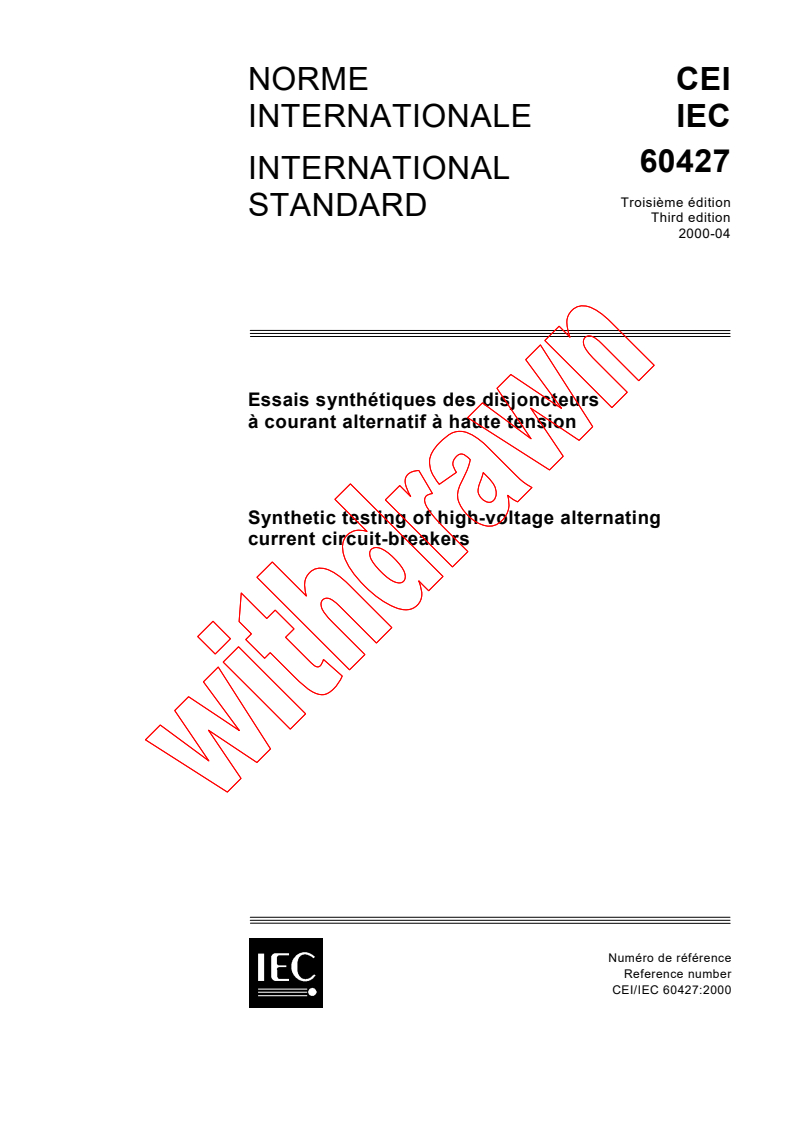
NORME CEI
INTERNATIONALE IEC
INTERNATIONAL
Troisième édition
STANDARD
Third edition
2000-04
Essais synthétiques des disjoncteurs
à courant alternatif à haute tension
Synthetic testing of high-voltage alternating
current circuit-breakers
Numéro de référence
Reference number
CEI/IEC 60427:2000
Numéros des publications Numbering
Depuis le 1er janvier 1997, les publications de la CEI As from 1 January 1997 all IEC publications are
sont numérotées à partir de 60000. issued with a designation in the 60000 series.
Publications consolidées Consolidated publications
Les versions consolidées de certaines publications de Consolidated versions of some IEC publications
la CEI incorporant les amendements sont disponibles. including amendments are available. For example,
Par exemple, les numéros d’édition 1.0, 1.1 et 1.2 edition numbers 1.0, 1.1 and 1.2 refer, respectively, to
indiquent respectivement la publication de base, la the base publication, the base publication incor-
publication de base incorporant l’amendement 1, et la porating amendment 1 and the base publication
publication de base incorporant les amendements 1 incorporating amendments 1 and 2.
et 2.
Validité de la présente publication Validity of this publication
Le contenu technique des publications de la CEI est The technical content of IEC publications is kept
constamment revu par la CEI afin qu'il reflète l'état under constant review by the IEC, thus ensuring that
actuel de la technique. the content reflects current technology.
Des renseignements relatifs à la date de reconfir- Information relating to the date of the reconfirmation
mation de la publication sont disponibles dans le of the publication is available in the IEC catalogue.
Catalogue de la CEI.
Les renseignements relatifs à des questions à l’étude et Information on the subjects under consideration and
des travaux en cours entrepris par le comité technique work in progress undertaken by the technical
qui a établi cette publication, ainsi que la liste des committee which has prepared this publication, as well
publications établies, se trouvent dans les documents ci- as the list of publications issued, is to be found at the
dessous: following IEC sources:
• «Site web» de la CEI* • IEC web site*
• Catalogue des publications de la CEI • Catalogue of IEC publications
Publié annuellement et mis à jour Published yearly with regular updates
régulièrement (On-line catalogue)*
(Catalogue en ligne)*
• Bulletin de la CEI • IEC Bulletin
Disponible à la fois au «site web» de la CEI* Available both at the IEC web site* and
et comme périodique imprimé as a printed periodical
Terminologie, symboles graphiques Terminology, graphical and letter
et littéraux symbols
En ce qui concerne la terminologie générale, le lecteur For general terminology, readers are referred to
se reportera à la CEI 60050: Vocabulaire Electro- IEC 60050: International Electrotechnical Vocabulary
technique International (VEI). (IEV).
Pour les symboles graphiques, les symboles littéraux For graphical symbols, and letter symbols and signs
et les signes d'usage général approuvés par la CEI, le approved by the IEC for general use, readers are
lecteur consultera la CEI 60027: Symboles littéraux à referred to publications IEC 60027: Letter symbols to
utiliser en électrotechnique, la CEI 60417: Symboles be used in electrical technology, IEC 60417: Graphical
graphiques utilisables sur le matériel. Index, relevé et symbols for use on equipment. Index, survey and
compilation des feuilles individuelles, et la CEI 60617: compilation of the single sheets and IEC 60617:
Symboles graphiques pour schémas. Graphical symbols for diagrams.
* Voir adresse «site web» sur la page de titre. * See web site address on title page.
NORME CEI
INTERNATIONALE IEC
INTERNATIONAL
Troisième édition
STANDARD
Third edition
2000-04
Essais synthétiques des disjoncteurs
à courant alternatif à haute tension
Synthetic testing of high-voltage alternating
current circuit-breakers
IEC 2000 Droits de reproduction réservés Copyright - all rights reserved
Aucune partie de cette publication ne peut être reproduite ni No part of this publication may be reproduced or utilized in
utilisée sous quelque forme que ce soit et par aucun procédé, any form or by any means, electronic or mechanical,
électronique ou mécanique, y compris la photocopie et les including photocopying and microfilm, without permission in
microfilms, sans l'accord écrit de l'éditeur. writing from the publisher.
International Electrotechnical Commission 3, rue de Varembé Geneva, Switzerland
Telefax: +41 22 919 0300 e-mail: inmail@iec.ch IEC web site http://www.iec.ch
CODE PRIX
Commission Electrotechnique Internationale
XB
PRICE CODE
International Electrotechnical Commission
Pour prix, voir catalogue en vigueur
For price, see current catalogue
– 2 – 60427 CEI:2000
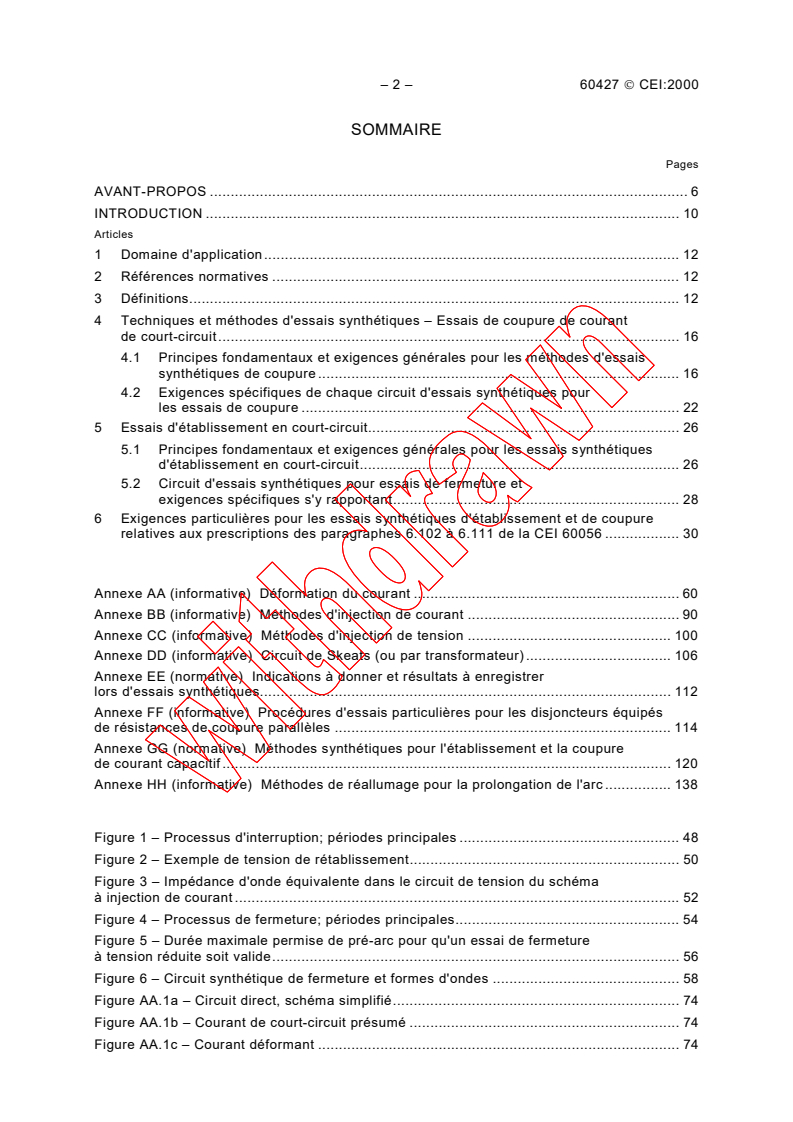
SOMMAIRE
Pages
AVANT-PROPOS . 6
INTRODUCTION . 10
Articles
1 Domaine d'application. 12
2 Références normatives . 12
3 Définitions. 12
4 Techniques et méthodes d'essais synthétiques – Essais de coupure de courant
de court-circuit. 16
4.1 Principes fondamentaux et exigences générales pour les méthodes d'essais
synthétiques de coupure . 16
4.2 Exigences spécifiques de chaque circuit d'essais synthétiques pour
les essais de coupure . 22
5 Essais d'établissement en court-circuit. 26
5.1 Principes fondamentaux et exigences générales pour les essais synthétiques
d'établissement en court-circuit. 26
5.2 Circuit d'essais synthétiques pour essais de fermeture et
exigences spécifiques s'y rapportant. 28
6 Exigences particulières pour les essais synthétiques d'établissement et de coupure
relatives aux prescriptions des paragraphes 6.102 à 6.111 de la CEI 60056 . 30
Annexe AA (informative) Déformation du courant . 60
Annexe BB (informative) Méthodes d'injection de courant . 90
Annexe CC (informative) Méthodes d'injection de tension . 100
Annexe DD (informative) Circuit de Skeats (ou par transformateur). 106
Annexe EE (normative) Indications à donner et résultats à enregistrer
lors d'essais synthétiques. 112
Annexe FF (informative) Procédures d'essais particulières pour les disjoncteurs équipés
de résistances de coupure parallèles . 114
Annexe GG (normative) Méthodes synthétiques pour l'établissement et la coupure
de courant capacitif .120
Annexe HH (informative) Méthodes de réallumage pour la prolongation de l'arc . 138
Figure 1 – Processus d'interruption; périodes principales . 48
Figure 2 – Exemple de tension de rétablissement. 50
Figure 3 – Impédance d'onde équivalente dans le circuit de tension du schéma
à injection de courant . 52
Figure 4 – Processus de fermeture; périodes principales. 54
Figure 5 – Durée maximale permise de pré-arc pour qu'un essai de fermeture
à tension réduite soit valide. 56
Figure 6 – Circuit synthétique de fermeture et formes d'ondes . 58
Figure AA.1a – Circuit direct, schéma simplifié. 74
Figure AA.1b – Courant de court-circuit présumé . 74
Figure AA.1c – Courant déformant . 74
60427 IEC:2000 – 3 –
CONTENTS
Page
FOREWORD . 7
INTRODUCTION . 11
Clause
1 Scope . 13
2 Normative references. 13
3 Definitions. 13
4 Synthetic testing techniques and methods – Short-circuit breaking tests . 17
4.1 Basic principles and general requirements for synthetic breaking test methods. 17
4.2 Synthetic test circuits and related specific requirements for breaking tests . 23
5 Short-circuit making tests. 27
5.1 Basic principles and general requirements for synthetic making test methods . 27
5.2 Synthetic test circuit and related specific requirements for making tests . 29
6 Specific requirements for synthetic tests for making and breaking performance related
to the requirements of subclauses 6.102 to 6.111 inclusive of IEC 60056. 31
Annex AA (informative) Current distortion. 61
Annex BB (informative) Current injection methods. 91
Annex CC (informative) Voltage injection methods . 101
Annex DD (informative) Duplicate circuit (transformer or Skeats circuit) . 107
Annex EE (normative) Information to be given and results to be recorded
for synthetic tests . 113
Annex FF (informative) Special procedures for testing circuit-breakers
having parallel breaking resistors . 115
Annex GG (normative) Synthetic methods for capacitive-current switching . 121
Annex HH (informative) Reignition methods to prolong arcing . 139
Figure 1 – Interrupting process; basic time intervals. 49
Figure 2 – Example of recovery voltage. 51
Figure 3 – Equivalent surge impedance within the voltage circuit of
current injection scheme . 53
Figure 4 – Making process; basic time intervals . 55
Figure 5 – Maximum allowable pre-arcing time for valid making test at reduced voltage . 57
Figure 6 – Synthetic make circuit and waveforms . 59
Figure AA.1a – Direct circuit, simplified diagram . 75
Figure AA.1b – Prospective short-circuit current. 75
Figure AA.1c – Distortion current. 75
– 4 – 60427 CEI:2000
Pages
Figure AA.1d – Courant déformant . 76
Figure AA.2a – Schéma de circuit simplifié. 76
Figure AA.2b – Caractéristiques du courant et de la tension d'arc pour courant symétrique. 78
Figure AA.2c – Caractéristiques de courant et de tension d'arc pour courant asymétrique. 80
Figures AA.3a à AA.3d – Réduction de l'amplitude et de la durée de la dernière alternance. 80
Figure BB.1 – Circuit type à injection de courant où le circuit de tension est en parallèle
avec le disjoncteur en essai . 94
Figure BB.2 – Séquence de l'injection du courant dans le circuit de la figure BB.1 . 94
Figure BB.3 – Circuit type à injection de courant où le circuit de tension est en parallèle
avec le disjoncteur auxiliaire . 96
Figure BB.4 – Séquence de l'injection dans le circuit de la figure BB.3. 96
Figure BB.5 – Exemples de détermination de la période de changement significatif
de la tension d'arc à partir d'oscillogrammes . 98
Figure CC.1 – Schéma caractéristique de l'injection de tension avec le circuit
de tension en parallèle avec le disjoncteur auxiliaire (schéma simplifié) . 102
Figure CC.2 – Formes d'onde (TTR) obtenues dans un circuit d'injection de tension
avec la source de tension en parallèle avec le disjoncteur auxiliaire. 104
Figure DD.1 – Circuit de Skeats ou par transformateur. 110
Figure DD.2 – Circuit de Skeats ou par transformateur avec déclenchement . 110
Figure GG.1 – Schéma d'essais synthétiques (dit parallèle) . 126
Figure GG.2 – Schéma d'essais synthétiques avec circuit de courant inductif et
la possibilité de régler le saut de tension. 128
Figure GG.3 – Circuit synthétique d'injection de tension simulant le saut de tension . 130
Figure GG.4 – Circuit synthétique à injection de courant . 132
Figure GG.5 – Circuit d'essai synthétique (dit série) pour appliquer aux deux bornes
du disjoncteur en essai les composantes réelles de la tension de rétablissement. 134
Figure GG.6 – Schéma d'essais synthétique pour la fermeture. 136
Figure HH.1 – Schéma type du circuit de réallumage servant à prolonger la durée d'arc . 142
Figure HH.2 – Circuits combinés d'injection de courant et de Skeats. 142
Figure HH.3 – Formes d'ondes typiques obtenues sur un essai asymétrique en utilisant
le circuit de la figure HH.2 . 144
60427 IEC:2000 – 5 –
Page
Figure AA.1d – Distortion current . 77
Figure AA.2a – Simplified circuit diagram . 77
Figure AA.2b – Current and arc-voltage characteristics for symmetrical current . 79
Figure AA.2c – Current and arc-voltage characteristics for asymmetrical current. 81
Figures AA.3a to AA.3d – Reduction of amplitude and duration of final current loop
of arcing. 83
Figure BB.1 – Typical current injection circuit with voltage circuit in parallel with
the test circuit-breaker . 95
Figure BB.2 – Injection timing for current injection scheme with circuit BB.1. 95
Figure BB.3 – Typical current injection circuit with voltage circuit in parallel with
the auxiliary circuit-breaker . 97
Figure BB.4 – Injection timing for current injection scheme with circuit BB.3. 97
Figure BB.5 – Examples of the determination of the interval of significant change
of arc-voltage from the oscillograms. 99
Figure CC.1 – Typical voltage injection circuit diagram with voltage circuit in parallel
with the auxiliary circuit-breaker (simplified diagram) . 103
Figure CC.2 – TRV waveshapes in a voltage injection circuit with the voltage circuit
in parallel with the auxiliary circuit-breaker. 105
Figure DD.1 – Transformer or Skeats circuit. 111
Figure DD.2 – Triggered transformer or Skeats circuit . 111
Figure GG.1 – Synthetic testing scheme (parallel mode) . 127
Figure GG.2 – Synthetic testing scheme with an inductive current circuit and
with facility to adjust a voltage jump . 129
Figure GG.3 – Synthetic voltage injection circuit providing a voltage jump. 131
Figure GG.4 – Synthetic current injection scheme . 133
Figure GG.5 – Synthetic test circuit (serial mode) to apply to both sides of the test breaker
the normal system recovery voltage . 135
Figure GG.6 – Synthetic testing scheme for making . 137
Figure HH.1 – Typical reignition circuit diagram for prolonging arc-duration . 143
Figure HH.2 – Combined Skeats and current injection circuits. 143
Figure HH.3 – Typical waveforms obtained on an asymmetrical test using
the circuit in figure HH.2. 145
– 6 – 60427 CEI:2000
COMMISSION ÉLECTROTECHNIQUE INTERNATIONALE
––––––––––––––
ESSAIS SYNTHÉTIQUES DES DISJONCTEURS
À COURANT ALTERNATIF À HAUTE TENSION
AVANT-PROPOS
1) La CEI (Commission Électrotechnique Internationale) est une organisation mondiale de normalisation
composée de l'ensemble des comités électrotechniques nationaux (Comités nationaux de la CEI). La CEI a
pour objet de favoriser la coopération internationale pour toutes les questions de normalisation dans les
domaines de l'électricité et de l'électronique. A cet effet, la CEI, entre autres activités, publie des Normes
internationales. Leur élaboration est confiée à des comités d'études, aux travaux desquels tout Comité national
intéressé par le sujet traité peut participer. Les organisations internationales, gouvernementales et non
gouvernementales, en liaison avec la CEI, participent également aux travaux. La CEI collabore étroitement
avec l'Organisation Internationale de Normalisation (ISO), selon des conditions fixées par accord entre les
deux organisations.
2) Les décisions ou accords officiels de la CEI concernant les questions techniques représentent, dans la mesure
du possible, un accord international sur les sujets étudiés, étant donné que les Comités nationaux intéressés
sont représentés dans chaque comité d’études.
3) Les documents produits se présentent sous la forme de recommandations internationales. Ils sont publiés
comme normes, spécifications techniques, rapports techniques ou guides et agréés comme tels par les
Comités nationaux.
4) Dans le but d'encourager l'unification internationale, les Comités nationaux de la CEI s'engagent à appliquer de
façon transparente, dans toute la mesure possible, les Normes internationales de la CEI dans leurs normes
nationales et régionales. Toute divergence entre la norme de la CEI et la norme nationale ou régionale
correspondante doit être indiquée en termes clairs dans cette dernière.
5) La CEI n’a fixé aucune procédure concernant le marquage comme indication d’approbation et sa responsabilité
n’est pas engagée quand un matériel est déclaré conforme à l’une de ses normes.
6) L’attention est attirée sur le fait que certains des éléments de la présente Norme internationale peuvent faire
l’objet de droits de propriété intellectuelle ou de droits analogues. La CEI ne saurait être tenue pour
responsable de ne pas avoir identifié de tels droits de propriété et de ne pas avoir signalé leur existence.
La Norme internationale CEI 60427 a été établie par le sous-comité 17A: Appareillage à haute
tension, du comité d'études 17 de la CEI: Appareillage.
Cette troisième édition annule et remplace la deuxième édition parue en 1989, l'amendement 1
(1992), l'amendement 2 (1995). Cette troisième édition constitue une révision technique.
Le texte de cette norme est issu de la deuxième édition, de l'amendement 1, de l'amendement 2
et des documents suivants:
FDIS Rapport de vote
17A/559/FDIS 17A/565/RVD
Le rapport de vote indiqué dans le tableau ci-dessus donne toute information sur le vote ayant
abouti à l'approbation de cette norme.
Cette publication n'a pas été rédigée en parfaite conformité avec les Directives ISO/CEI,
Partie 3.
Cette publication doit être lue conjointement avec la CEI 60056 (1987). La numérotation des
paragraphes de l'article 6 reprend celle de la CEI 60056. Les annexes et leurs figures sont
appelées AA, BB, etc.
Les annexes EE et GG font partie intégrante de cette norme.
60427 IEC:2000 – 7 –
INTERNATIONAL ELECTROTECHNICAL COMMISSION
–––––––––––––
SYNTHETIC TESTING OF HIGH-VOLTAGE ALTERNATING
CURRENT CIRCUIT-BREAKERS
FOREWORD
1) The IEC (International Electrotechnical Commission) is a worldwide organization for standardization comprising
all national electrotechnical committees (IEC National Committees). The object of the IEC is to promote
international co-operation on all questions concerning standardization in the electrical and electronic fields. To
this end and in addition to other activities, the IEC publishes International Standards. Their preparation is
entrusted to technical committees; any IEC National Committee interested in the subject dealt with may
participate in this preparatory work. International, governmental and non-governmental organizations liaising
with the IEC also participate in this preparation. The IEC collaborates closely with the International
Organization for Standardization (ISO) in accordance with conditions determined by agreement between the
two organizations.
2) The formal decisions or agreements of the IEC on technical matters express, as nearly as possible, an
international consensus of opinion on the relevant subjects since each technical committee has representation
from all interested National Committees.
3) The documents produced have the form of recommendations for international use and are published in the form
of standards, technical specifications, technical reports or guides and they are accepted by the National
Committees in that sense.
4) In order to promote international unification, IEC National Committees undertake to apply IEC International
Standards transparently to the maximum extent possible in their national and regional standards. Any
divergence between the IEC Standard and the corresponding national or regional standard shall be clearly
indicated in the latter.
5) The IEC provides no marking procedure to indicate its approval and cannot be rendered responsible for any
equipment declared to be in conformity with one of its standards.
6) Attention is drawn to the possibility that some of the elements of this International Standard may be the subject
of patent rights. The IEC shall not be held responsible for identifying any or all such patent rights.
International Standard IEC 60427 has been prepared by subcommittee 17A: High voltage
switchgear and controlgear, of IEC technical committee 17: Switchgear and controlgear.
This third edition cancels and replaces the second edition published in 1989, amendment 1
(1992), amendment 2 (1995). This third edition constitutes a technical revision.
The text of this standard is based on the second edition, amendment 1, amendment 2 and the
following documents:
FDIS Report on voting
17A/559/FDIS 17A/565/RVD
Full information on the voting for the approval of this standard can be found in the report on
voting indicated in the above table.
This publication has not been drafted in complete accordance with the ISO/IEC Directives,
Part 3.
This publication shall be read in conjunction with IEC 60056 (1987). The numbering of the
subclauses of clause 6 is the same as in IEC 60056. The annexes and their figures are
named AA, BB, etc.
Annexes EE and GG form an integral part of this standard.
– 8 – 60427 CEI:2000
Les annexes AA, BB, CC, DD, FF et HH sont données uniquement à titre d'information.
Le comité a décidé que le contenu de cette publication ne sera pas modifié avant 2005-01-01.
A cette date, la publication sera
reconduite;
supprimée;
remplacée par une édition révisée, ou
amendée.
60427 IEC:2000 – 9 –
Annexes AA, BB, CC, DD, FF and HH are for information only.
The committee has decided that the contents of this publication will remain unchanged until
2005-01-01. At this date, the publication will be
reconfirmed;
withdrawn;
replaced by a revised edition, or
amended.
– 10 – 60427 CEI:2000
INTRODUCTION
Au cours des dernières décennies, les connaissances sur les techniques et les méthodes
d'essais synthétiques ont progressé. Il a été démontré que l'essai synthétique était un moyen
économique et techniquement valable pour essayer les disjoncteurs à courant alternatif à
haute tension selon les spécifications de la CEI 60056.
C'est pourquoi il a été décidé de considérer les méthodes d'essais synthétiques, après une
révision complète de la première édition de la CEI 60427, comme équivalentes aux méthodes
d'essais directs.
60427 IEC:2000 – 11 –
INTRODUCTION
During the past few decades experience has been gained with synthetic testing techniques
and methods. It has been proven that synthetic testing is an economical and technically
correct way to test high-voltage a.c. circuit-breakers according to the requirements of
IEC 60056.
This is why it was decided to include synthetic testing methods, after a thorough revision of
the first edition of IEC 60427, as equivalent to the direct test methods.
– 12 – 60427 CEI:2000
ESSAIS SYNTHÉTIQUES DES DISJONCTEURS
À COURANT ALTERNATIF À HAUTE TENSION
1 Domaine d'application
La présente Norme internationale s'applique aux disjoncteurs à courant alternatif définis dans
le domaine d'application de la CEI 60056. Elle donne les règles générales d'essais de ces
disjoncteurs pour les essais d'établissement et de coupure décrits aux 6.102 à 6.111 de la
CEI 60056, à l'aide de méthodes d'essais synthétiques.
NOTE Les circuits pour les séquences d'essais décrites au 6.111 ne sont pas encore normalisés. Néanmoins, les
méthodes existantes sont indiquées à l'annexe GG.
Les méthodes et techniques décrites sont celles d'usage courant. Le but de cette norme est
d'établir des critères pour les essais synthétiques et pour l'évaluation correcte des résultats.
Ces critères établissent la validité de la méthode d'essai sans limiter l'invention de nouveaux
circuits d'essais.
2 Références normatives
Les documents normatifs suivants contiennent des dispositions qui, par suite de la référence
qui y est faite, constituent des dispositions valables pour la présente Norme internationale.
Pour les références datées, les amendements ultérieurs ou les révisions de ces publications
ne s’appliquent pas. Toutefois, les parties prenantes aux accords fondés sur la présente
Norme internationale sont invitées à rechercher la possibilité d'appliquer les éditions les plus
récentes des documents normatifs indiqués ci-après. Pour les références non datées, la
dernière édition du document normatif en référence s’applique. Les membres de la CEI et de
l'ISO possèdent le registre des Normes internationales en vigueur.
CEI 60050(441):1984, Vocabulaire Electrotechnique International (VEI) – Chapitre 441:
Appareillage et fusibles
CEI 60056:1987, Disjoncteurs à courant alternatif à haute tension
CEI 61633:1995, Disjoncteurs à courant alternatif à haute tension – Guide pour la procédure
d'essai d'établissement et de coupure de courants de court-circuit et de courants de charge
pour les disjoncteurs sans enveloppe métallique et à cuve mise à la terre
3 Définitions
Pour les besoins de la présente Norme internationale les définitions de la CEI 60056 et les
définitions suivantes s'appliquent:
3.1
essai direct
essai dans lequel la tension appliquée, le courant, la tension de rétablissement, transitoire et
à fréquence industrielle, sont tous obtenus à l'aide d'un seul circuit de puissance. Cette
source peut être un réseau ou des alternateurs spéciaux comme ceux qui sont utilisés dans
les stations d'essais de court-circuit ou une combinaison des deux
60427 IEC:2000 – 13 –
SYNTHETIC TESTING OF HIGH-VOLTAGE ALTERNATING
CURRENT CIRCUIT-BREAKERS
1 Scope
This International Standard applies to a.c. circuit-breakers within the scope of IEC 60056. It
provides the general rules for testing a.c. circuit-breakers, for making and breaking capacities
over the range of test-duties described in 6.102 to 6.111 of IEC 60056, by synthetic methods.
NOTE Circuits for the test duties described in 6.111 have not yet been standardized. However, present methods
are given in annex GG.
The methods and techniques described are those in general use. The purpose of this
standard is to establish criteria for synthetic testing and for the proper evaluation of results.
Such criteria will establish the validity of the test method without imposing restraints on
innovation of test circuitry.
2 Normative references
The following normative documents contain provisions which, through reference in this text,
constitute provisions of this International Standard. For dated references, subsequent
amendments to, or revisions of, any of these publications do not apply. However, parties to
agreements based on this International Standard are encouraged to investigate the possibility
of applying the most recent editions of the normative documents indicated below. For undated
references, the latest edition of the normative document referred to applies. Members of IEC
and ISO maintain registers of currently valid International Standards.
IEC 60050(441):1984, International Electrotechnical Vocabulary (IEV) – Chapter 441:
Switchgear, controlgear and fuses
IEC 60056:1987, High-voltage alternating current circuit-breakers
IEC 61633:1995, High-voltage alternating current circuit-breakers – Guide for short-circuit and
switching test procedures for metal-enclosed and dead tank circuit-breakers
3 Definitions
For the purposes of this International Standard the definitions of IEC 60056 and the following
definitions apply:
3.1
direct test
a test in which the applied voltage, the current and the transient and power-frequency
recovery voltages are all obtained from a circuit having a single-power source, which may be
a power system or special alternators as used in short-circuit testing stations or a combination
of both
– 14 – 60427 CEI:2000
3.2
essai synthétique
essai dans lequel la totalité du courant ou la plus grande partie de celui-ci est obtenue à partir
d'une source (circuit de courant) et dans lequel la tension appliquée et/ou les tensions de
rétablissement (transitoire et à fréquence industrielle) sont obtenues en totalité ou en partie à
partir d'une ou de plusieurs sources séparées (circuit de tension)
3.3
disjoncteur en essai
disjoncteur soumis aux essais (voir 6.102.2 de la CEI 60056)
3.4
disjoncteur(s) auxiliaire(s)
disjoncteur introduit dans le circuit d'essais synthétiques et utilisé pour séparer ou relier les
différents circuits au disjoncteur en essai
3.5
circuit de courant
partie du circuit d'essais synthétiques fournissant la plus grande part du courant à fréquence
industrielle ou sa totalité
3.6
circuit de tension
partie du circuit d'essais synthétiques fournissant la plus grande part de la tension d'essai ou
sa totalité
3.7
courant présumé (d'un circuit pour un disjoncteur donné)
courant qui circulerait dans le circuit si chaque pôle du disjoncteur en essai et du disjoncteur
auxiliaire était remplacé par un conducteur d'impédance négligeable [VEI 441-17-01, modifiée]
3.8
courant réel
courant circulant dans le disjoncteur en essai (courant présumé modifié par les tensions d'arc
des disjoncteurs en essai et auxiliaire)
3.9
courant déformant
courant calculé égal à la différence entre le courant présumé et le courant réel
3.10
courant post-arc
courant qui circule dans l'espace entre les contacts d'arc d'un disjoncteur immédiatement
après que le courant et la tension d'arc sont devenus nuls et que la tension transitoire de
rétablissement a commencé à croître
3.11
méthode par injection de courant
méthode d'essais synthétiques dans laquelle la source de tension est appliquée au
disjoncteur en essai avant le zéro de courant à fréquence industrielle
3.12
courant injecté
courant fourni par le circuit de tension d'un circuit à injection de courant au moment où cette
source est reliée au disjoncteur en essai
60427 IEC:2000 – 15 –
3.2
synthetic test
a test in which all of the current, or a major portion of it, is obtained from one source (current
circuit), and in which the applied voltage and/or the recovery voltages (transient and power-
frequency) are obtained wholly or in part from one or more separate sources (voltage circuits)
3.3
test circuit-breaker
the circuit-breaker under test (see 6.102.2 of IEC 60056)
3.4
auxiliary circuit-breaker(s)
the circuit-breaker(s) forming part of a synthetic test circuit used to put the test circuit-breaker
into the required relation with various circuits
3.5
current circuit
that part of the synthetic test circuit from which all or the major part of the power-frequency
current is obtained
3.6
voltage circuit
that part of the synthetic test circuit from which all or the major part of the test voltage is
obtained
3.7
prospective current (of a circuit and with respect to a circuit-breaker)
the current that would flow in the circuit if each pole of the test and auxiliary circuit-breakers
were replaced by a conductor of negligible impedance [IEV 441-17-01, modified]
3.8
actual current
the current through the test circuit-breaker (prospective current modified by the arc-voltage of
the test and auxiliary circuit-breakers)
3.9
distortion current
a calculated current equal to the difference between the prospective current and the actual
current
3.10
post-arc current
the current which flows through the arc-gap of a circuit-breaker immediately after the current
and arc-voltage have fallen to zero and the transient recovery voltage has begun to rise
3.11
current-injection method
a synthetic test method in which the voltage circuit is applied to the test circuit-breaker before
power-frequency current-zero
3.12
injected current
the current supplied by the voltage circuit of a current injection circuit when it is connected to
the circuit-breaker under test
– 16 – 60427 CEI:2000
3.13
méthode par injection de tension
méthode d'essais synthétiques dans laquelle la source de tension est appliquée au
disjoncteur en essai après le zéro de courant à fréquence industrielle
3.14
conditions du réseau de référence
conditions d'un réseau électrique ayant les paramètres constitutifs dont les valeurs spécifiées
et les valeurs d'essais de la CEI 60056 sont dérivées
4 Techniques et méthodes d'essais synthétiques – Essais de coupure de
courant de court-circuit
4.1 Principes fondamentaux et exigences générales pour les méthodes d'essais
synthétiques de coupure
Toute méthode d'essai synthétique retenue doit contraindre le disjoncteur en essai de
manière adéquate. L'adéquation est généralement établie dès que la méthode satisfait aux
exigences exposées dans les paragraphes suivants.
Périodes principales
Le disjoncteur a deux positions: fermé et ouvert. Fermé, il conduit le plein courant avec une
chute de tension négligeable entre ses contacts. Ouvert, il ne laisse passer qu'un courant
négligeable mais avec la pleine tension entre ses contacts. Cela définit les deux contraintes
principales, la contrainte en courant et la contrainte en tension, qui sont séparées dans le
temps.
Si on observe plus précisément les contraintes en tension et courant pendant le processus de
coupure (figure 1), trois périodes principales peuvent être distinguées:
– La période fort courant
Cette période est définie par le temps entre la séparation des contacts et le début du
changement significatif de la tension d'arc. La période fort courant précède les périodes
d'interaction et de contrainte diélectrique.
– La période d'interaction
Cette période est définie par le temps séparant le début du changement significatif de la
tension d'arc avant le zéro de courant, de la disparition du courant dans le disjoncteur,
y compris, s'il existe, le courant post-arc (voir aussi annexe BB.2).
– La période de contrainte diélectrique
Cette période est définie par le temps séparant la disparition du courant dans le
disjoncteur en essai, y compris le courant post-arc, s'il existe, de la fin de l'essai.
4.1.1 Période fort courant
Pendant cette période, le disjoncteur en essai doit être contraint par le circuit de manière telle
que les conditions initiales de la période d'interaction, avec des tolérances à préciser, soient
les mêmes que celles apparaissant dans les conditions du réseau de référence.
Dans les circuits d'essais synthétiques, le rapport entre la tension à fréquence industrielle du
circuit de courant et la tension d'arc est faible comparé à ce rapport lors d'essais dans les
conditions du réseau de référence, pour deux raisons:
– cette tension d'alimentation est une fraction de la tension du réseau;
– les tensions d'arc des disjoncteurs en essai et auxiliaire s'ajoutent.
60427 IEC:2000 – 17 –
3.13
voltage-injection method
a synthetic test method in which the voltage circuit is applied to the test circuit-breaker after
power-frequency current-zero
3.14
reference system conditions
the conditions of an electrical system having the parameters from which the rated and test
values of IEC 60056 are derived
4 Synthetic testing techniques and methods – Short-circuit breaking tests
4.1 Basic principles and general requirements for synthetic breaking test methods
Any particular synthetic method chosen for testing shall adequately stress the test circuit-
breaker. Generally, the adequacy is established when the test method meets the requirements
set forth in the following subclauses.
Basic intervals
A circuit-breaker has two basic positions: closed and open. In the closed position a circuit-
breaker conducts full current with negligible voltage drop across its contacts. In the open
position it conducts negligible current but with full voltage across the contacts. This defines
the two main stresses, the current stress and the voltage stress, which are separated in time.
If closer attention is paid to the voltage and current stresses during the interrupting process
(figure 1), three main intervals can be recognized:
– High-current interval
The high-current interval is the time from contact separation to the start of the significant
change in arc-voltage. The high-current interval precedes the interaction and high-voltage
intervals.
– Interaction interval
The interaction interval is the time from the start of the significant change in arc-voltage
prior to current-zero to the time when the current including the post-arc current, if any,
ceases to flow through the test circuit-breaker. (See also annex BB.2).
– High-voltage interval
The high-voltage interval is the time from the moment when the current including the post-
arc current, if any, ceases to flow through the test circuit-breaker to the end of the test.
4.1.1 High-current interval
During this interval the test circuit-breaker shall be stressed by the test circuit in such a way
that the starting conditions for the interaction interval, within tolerances to be specified, are
the same as under reference system conditions.
In synthetic test circuits the ratio of the power-frequency voltage of the current circuit to the
arc-voltage is low in comparison with tests at reference system conditions due to:
– the voltage of the current circuit being a fraction of the system voltage;
– the fact that the arc-voltages of the test circuit-breaker and of the auxiliary circuit-breaker
are added.
– 18 – 60427 CEI:2000
Il en résulte que la durée de l'onde de courant et sa valeur à la crête en sont réduites. Cette
déformation est expliquée dans l'annexe AA.
L'étude de l'énergie d'arc dégagée dans le disjoncteur en essai conduit à fixer les tolérances
pour limiter l'influence de cette déformation sur deux grandeurs caractéristiques de la forme
du courant, à savoir la valeur crête de l'onde et la durée de cette onde (voir annexe AA).
Les tolérances sur l'amplitude et la fréquence du courant présumé à couper, comme indiqué
en 6.103.2 et 6.104.3 de la CEI 60056, ne doivent pas être dépassées par le courant réel
circulant dans le disjoncteur en essai. Les conditions suivantes devront donc être remplies:
– l'amplitude de la dernière alternance du courant réel dans le disjoncteur en essai doit
satisfaire aux prescriptions imposées par le 6.
...