

IEC 61158-6-20:2007
(Main)Industrial communication networks - Fieldbus specifications - Part 6-20: Application layer protocol specification - Type 20 elements
General Information
- Abstract
It provides user programs with a means to access the fieldbus communication environment. In this respect, the FAL can be viewed as a "window between corresponding application programs." This standard provides common elements for basic time-critical and non-time-critical messaging communications between application programs in an automation environment and material specific to Type 2 fieldbus. The term "time-critical" is used to represent the presence of a time-window, within which one or more specified actions are required to be completed with some defined level of certainty. Failure to complete specified actions within the time window risks failure of the applications requesting the actions, with attendant risk to equipment, plant and possibly human life. It includes the following significant changes from the previous edition deletion of the former Type 6 fieldbus for lack of market relevance; addition of new types of fieldbuses; partition of part 6 of the third edition into multiple parts numbered.
- Status
- Published
- Publication Date
- 13-Dec-2007
- Technical Committee
- SC 65C - Industrial networks
- Drafting Committee
- WG 9 - TC 65/SC 65C/WG 9
- Current Stage
- DELPUB - Deleted Publication
- Start Date
- 06-Aug-2010
- Completion Date
- 28-Aug-2026
Overview
IEC 61158-6-20:2007 is an international standard that defines the Fieldbus Application Layer (FAL) protocol elements for Type 20 fieldbuses. It specifies how user application programs access and exchange messages over a fieldbus, acting as a “window between corresponding application programs.” The standard covers both time‑critical and non‑time‑critical messaging in industrial automation, and documents protocol structures, coding rules and state machines needed to implement the application layer for Type 20 fieldbus systems. This edition (2007) reflects structural changes in the IEC 61158 family including removal of the former Type 6 and addition/partitioning of new fieldbus types.
Key topics and technical requirements
- FAL services and APDU formats: Defines the Application Protocol Data Unit (APDU) structures and common service primitives used for request/response messaging.
- Time‑critical messaging semantics: Describes the notion of a time window within which actions must complete and the consequences of missed deadlines.
- Protocol state machines: Specifies the FAL protocol state machines including FSPM (FAL Service Protocol Machine), ARPM (Application Relationship Protocol Machines), and DMPM (DLL Mapping Protocol Machine).
- Transfer and abstract syntax: Contains transfer syntax, data coding rules (numeric, date, ASCII subsets), and conventions for encoding application data.
- Error and response handling: Enumerates response codes, device status values and communication error codes for robust application behavior.
- Primitives and interfaces: Details primitives and parameters exchanged between FAL and lower layers (data link layer) for mapping and conformance.
- Conformance and references: Specifies conformance principles and normative references needed for compliant implementations.
Practical applications
- Integrating and developing field devices, I/O modules, and controllers that communicate using Type 20 fieldbus.
- Designing real‑time control systems where deterministic, time‑bounded messaging is required (process plants, safety‑critical control loops).
- Implementing protocol stacks (application layer) in gateways, RTUs and programmable logic controllers (PLCs).
- Creating device firmware and interoperability test suites that validate APDU formats, state machines and coding rules.
Who should use this standard
- Device manufacturers and firmware engineers building Type 20 fieldbus devices.
- System integrators and automation architects implementing deterministic communications.
- Safety and reliability engineers involved in time‑critical control applications.
- Test laboratories and certification bodies validating fieldbus application‑layer conformance.
Related standards
- Other parts of the IEC 61158 family (fieldbus specifications).
- IEC/TR 61158‑1 (terms and supporting material) and normative references listed in the standard.
Keywords: IEC 61158-6-20, fieldbus, application layer, FAL, Type 20, industrial communication, time-critical messaging, APDU, protocol state machine, automation.
Relations
- Effective Date
- 05-Sep-2023
- Effective Date
- 05-Sep-2023
- Effective Date
- 05-Sep-2023
Get Certified
Connect with accredited certification bodies for this standard

BSI Group
BSI (British Standards Institution) is the business standards company that helps organizations make excellence a habit.

DVS-ZERT GmbH
German welding certification society.
CARES (UK Certification Authority for Reinforcing Steels)
UK certification for reinforcing steels and construction.
Sponsored listings
Frequently Asked Questions
IEC 61158-6-20:2007 is a standard published by the International Electrotechnical Commission (IEC). Its full title is "Industrial communication networks - Fieldbus specifications - Part 6-20: Application layer protocol specification - Type 20 elements". This standard covers: It provides user programs with a means to access the fieldbus communication environment. In this respect, the FAL can be viewed as a "window between corresponding application programs." This standard provides common elements for basic time-critical and non-time-critical messaging communications between application programs in an automation environment and material specific to Type 2 fieldbus. The term "time-critical" is used to represent the presence of a time-window, within which one or more specified actions are required to be completed with some defined level of certainty. Failure to complete specified actions within the time window risks failure of the applications requesting the actions, with attendant risk to equipment, plant and possibly human life. It includes the following significant changes from the previous edition deletion of the former Type 6 fieldbus for lack of market relevance; addition of new types of fieldbuses; partition of part 6 of the third edition into multiple parts numbered.
It provides user programs with a means to access the fieldbus communication environment. In this respect, the FAL can be viewed as a "window between corresponding application programs." This standard provides common elements for basic time-critical and non-time-critical messaging communications between application programs in an automation environment and material specific to Type 2 fieldbus. The term "time-critical" is used to represent the presence of a time-window, within which one or more specified actions are required to be completed with some defined level of certainty. Failure to complete specified actions within the time window risks failure of the applications requesting the actions, with attendant risk to equipment, plant and possibly human life. It includes the following significant changes from the previous edition deletion of the former Type 6 fieldbus for lack of market relevance; addition of new types of fieldbuses; partition of part 6 of the third edition into multiple parts numbered.
IEC 61158-6-20:2007 is classified under the following ICS (International Classification for Standards) categories: 25.040.40 - Industrial process measurement and control; 35.100.70 - Application layer. The ICS classification helps identify the subject area and facilitates finding related standards.
IEC 61158-6-20:2007 has the following relationships with other standards: It is inter standard links to IEC 61158-6:2003/COR1:2004, IEC 61158-6:2003, IEC 61158-6-20:2010. Understanding these relationships helps ensure you are using the most current and applicable version of the standard.
IEC 61158-6-20:2007 is available in PDF format for immediate download after purchase. The document can be added to your cart and obtained through the secure checkout process. Digital delivery ensures instant access to the complete standard document.
Standards Content (Sample)
IEC 61158-6-20
Edition 1.0 2007-12
INTERNATIONAL
STANDARD
Industrial communication networks – Fieldbus specifications –
Part 6-20: Application layer protocol specification – Type 20 elements
All rights reserved. Unless otherwise specified, no part of this publication may be reproduced or utilized in any form
or by any means, electronic or mechanical, including photocopying and microfilm, without permission in writing from
either IEC or IEC's member National Committee in the country of the requester.
If you have any questions about IEC copyright or have an enquiry about obtaining additional rights to this publication,
please contact the address below or your local IEC member National Committee for further information.
IEC Central Office
3, rue de Varembé
CH-1211 Geneva 20
Switzerland
Email: inmail@iec.ch
Web: www.iec.ch
About the IEC
The International Electrotechnical Commission (IEC) is the leading global organization that prepares and publishes
International Standards for all electrical, electronic and related technologies.
About IEC publications
The technical content of IEC publications is kept under constant review by the IEC. Please make sure that you have the
latest edition, a corrigenda or an amendment might have been published.
ƒ Catalogue of IEC publications: www.iec.ch/searchpub
The IEC on-line Catalogue enables you to search by a variety of criteria (reference number, text, technical committee,…).
It also gives information on projects, withdrawn and replaced publications.
ƒ IEC Just Published: www.iec.ch/online_news/justpub
Stay up to date on all new IEC publications. Just Published details twice a month all new publications released. Available
on-line and also by email.
ƒ Electropedia: www.electropedia.org
The world's leading online dictionary of electronic and electrical terms containing more than 20 000 terms and definitions
in English and French, with equivalent terms in additional languages. Also known as the International Electrotechnical
Vocabulary online.
ƒ Customer Service Centre: www.iec.ch/webstore/custserv
If you wish to give us your feedback on this publication or need further assistance, please visit the Customer Service
Centre FAQ or contact us:
Email: csc@iec.ch
Tel.: +41 22 919 02 11
Fax: +41 22 919 03 00
IEC 61158-6-20
Edition 1.0 2007-12
INTERNATIONAL
STANDARD
Industrial communication networks – Fieldbus specifications –
Part 6-20: Application layer protocol specification – Type 20 elements
INTERNATIONAL
ELECTROTECHNICAL
COMMISSION
PRICE CODE
XA
ICS 35.100.70; 25.040.40 ISBN 2-8318-9500-6
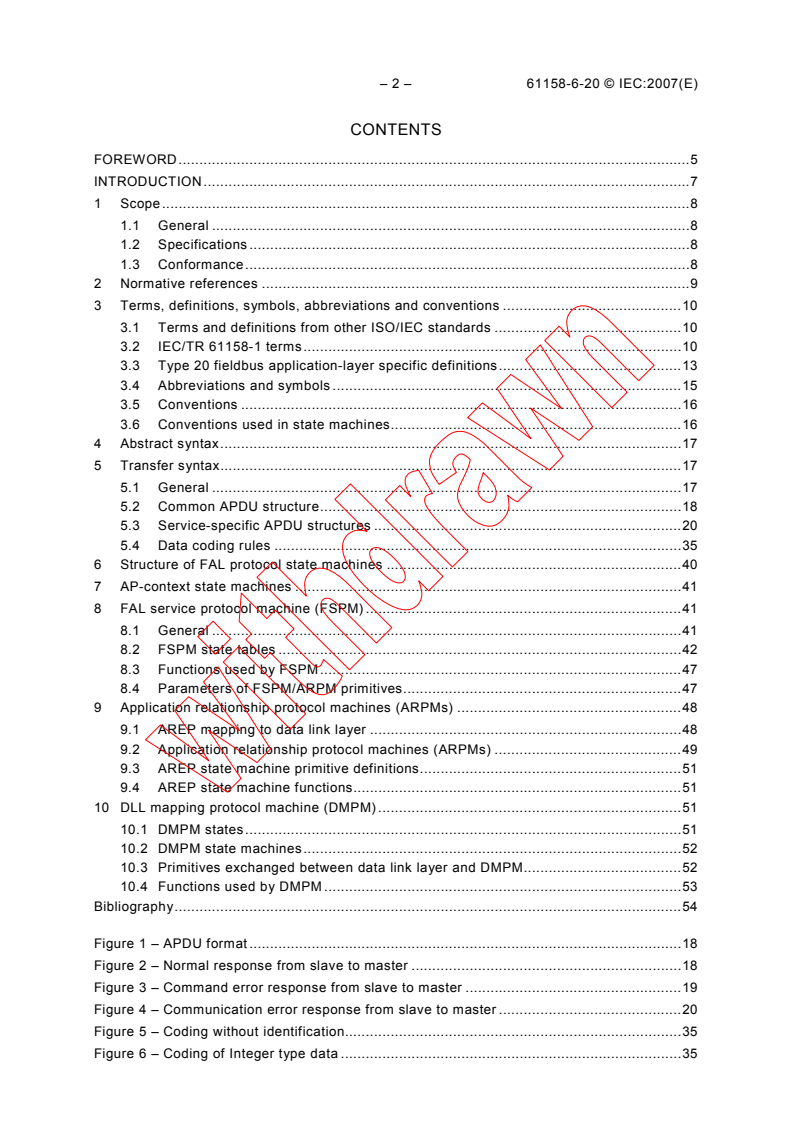
– 2 – 61158-6-20 © IEC:2007(E)
CONTENTS
FOREWORD.5
INTRODUCTION.7
1 Scope.8
1.1 General .8
1.2 Specifications .8
1.3 Conformance.8
2 Normative references .9
3 Terms, definitions, symbols, abbreviations and conventions .10
3.1 Terms and definitions from other ISO/IEC standards .10
3.2 IEC/TR 61158-1 terms.10
3.3 Type 20 fieldbus application-layer specific definitions.13
3.4 Abbreviations and symbols .15
3.5 Conventions .16
3.6 Conventions used in state machines.16
4 Abstract syntax.17
5 Transfer syntax.17
5.1 General .17
5.2 Common APDU structure.18
5.3 Service-specific APDU structures .20
5.4 Data coding rules .35
6 Structure of FAL protocol state machines .40
7 AP-context state machines .41
8 FAL service protocol machine (FSPM) .41
8.1 General .41
8.2 FSPM state tables .42
8.3 Functions used by FSPM.47
8.4 Parameters of FSPM/ARPM primitives.47
9 Application relationship protocol machines (ARPMs) .48
9.1 AREP mapping to data link layer .48
9.2 Application relationship protocol machines (ARPMs) .49
9.3 AREP state machine primitive definitions.51
9.4 AREP state machine functions.51
10 DLL mapping protocol machine (DMPM) .51
10.1 DMPM states.51
10.2 DMPM state machines.52
10.3 Primitives exchanged between data link layer and DMPM.52
10.4 Functions used by DMPM .53
Bibliography.54
Figure 1 – APDU format.18
Figure 2 – Normal response from slave to master .18
Figure 3 – Command error response from slave to master .19
Figure 4 – Communication error response from slave to master .20
Figure 5 – Coding without identification.35
Figure 6 – Coding of Integer type data .35
61158-6-20 © IEC:2007(E) – 3 –
Figure 7 – Coding of Integer16 type data .36
Figure 8 – Coding of Unsigned type data .36
Figure 9 – Coding of Unsigned16 type data.36
Figure 10 – Coding of single precision Floating Point type data .36
Figure 11 – Coding of double precision Floating Point type data .37
Figure 12 – Coding of Date type data.37
Figure 13 – Relationships among protocol machines and adjacent layers .41
Figure 14 – State transition diagram of FSPM .42
Figure 15 – State transition diagram of the client ARPM .49
Figure 16 – State transition diagram of the server ARPM .50
Figure 17 – State transition diagram of DMPM .52
Table 1 – Conventions used for state machines .16
Table 2 – Response code values .19
Table 3 – Device status values .19
Table 4 – Response code values .20
Table 5 – Communication error codes.20
Table 6 – Identify request APDU .21
Table 7 – Identify response value field .22
Table 8 – Identify command specific response codes.22
Table 9 – Read primary variable response value field .23
Table 10 – Read primary variable command specific response codes .23
Table 11 – Read loop current and percent of range value field.23
Table 12 – Read loop current and percent of range command specific response codes .24
Table 13 – Read dynamic variables and loop current value field .24
Table 14 – Read dynamic variables and loop current command specific response
codes.24
Table 15 – Write polling address value field .25
Table 16 – Loop current mode codes .25
Table 17 – Write polling address command specific response codes.25
Table 18 – Read loop configuration value field.26
Table 19 – Read loop configuration command specific response codes .26
Table 20 – Read dynamic variable families classifications value field.26
Table 21 – Read dynamic variable families classifications command specific response
codes.27
Table 22 – Read device variables with status request value field .27
Table 23 – Read device variables with status command specific response codes.27
Table 24 – Read device variables with status value field.28
Table 25 – Variable status values .28
Table 26 – Read message response value field .29
Table 27 – Read message command specific response codes .29
Table 28 – Read tag, descriptor, date response value field .30
Table 29 – Read tag, descriptor, date command specific response codes .30
Table 30 – Read primary variable transducer information response value field.30
– 4 – 61158-6-20 © IEC:2007(E)
Table 31 – Read primary variable transducer information command specific response
codes.31
Table 32 – Read device information response value field.31
Table 33 – Read device information command specific response codes.32
Table 34 – Read final assembly number response value field .32
Table 35 – Read final assembly number command specific response codes .32
Table 36 – Write message value field.32
Table 37 – Write message command specific response codes .33
Table 38 – Write tag, descriptor, date value field .33
Table 39 – Write tag, descriptor, date command specific response codes .33
Table 40 – Write final assembly number value field.34
Table 41 – Write final assembly number command specific response codes .34
Table 42 – Read long tag response value field.34
Table 43 – Read long tag command-specific response codes .34
Table 44 – Write long tag value field .35
Table 45 – Write long tag command specific Response codes .35
Table 46 – Coding for Date type .37
Table 47 – Coding for one octet Enumerated Type.38
Table 48 – One octet bit field .39
Table 49 – Packed ASCII character set.39
Table 50 – Acceptable subset of ISO Latin-1 characters .40
Table 51 – FSPM state table – client transactions.42
Table 52 – FSPM state table – server transactions .46
Table 53 – Function Command () .47
Table 54 – Function CommErr () .47
Table 55 – Function CommandErr () .47
Table 56 – Function Resp ().47
Table 57 – Function Device () .47
Table 58 – Parameters used with primitives exchanged between FSPM and ARPM .47
Table 59 – Client ARPM states .49
Table 60 – Client ARPM state table .50
Table 61 – Server ARPM states .50
Table 62 – Server ARPM state table .50
Table 63 – Primitives issued from ARPM to DMPM .51
Table 64 – Primitives issued by DMPM to ARPM.51
Table 65 – Parameters used with primitives exchanged between ARPM and DMPM .51
Table 66 – DMPM state descriptions .52
Table 67 – DMPM state table – Client transactions .52
Table 68 – DMPM state table – Server transactions .52
Table 69 – Primitives exchanged between data-link layer and DMPM .53
61158-6-20 © IEC:2007(E) – 5 –
INTERNATIONAL ELECTROTECHNICAL COMMISSION
____________
INDUSTRIAL COMMUNICATION NETWORKS –
FIELDBUS SPECIFICATIONS –
Part 6-20: Application layer protocol specification – Type 20 elements
FOREWORD
1) The International Electrotechnical Commission (IEC) is a worldwide organization for standardization comprising
all national electrotechnical committees (IEC National Committees). The object of IEC is to promote
international co-operation on all questions concerning standardization in the electrical and electronic fields. To
this end and in addition to other activities, IEC publishes International Standards, Technical Specifications,
Technical Reports, Publicly Available Specifications (PAS) and Guides (hereafter referred to as “IEC
Publication(s)”). Their preparation is entrusted to technical committees; any IEC National Committee interested
in the subject dealt with may participate in this preparatory work. International, governmental and non-
governmental organizations liaising with the IEC also participate in this preparation. IEC collaborates closely
with the International Organization for Standardization (ISO) in accordance with conditions determined by
agreement between the two organizations.
2) The formal decisions or agreements of IEC on technical matters express, as nearly as possible, an international
consensus of opinion on the relevant subjects since each technical committee has representation from all
interested IEC National Committees.
3) IEC Publications have the form of recommendations for international use and are accepted by IEC National
Committees in that sense. While all reasonable efforts are made to ensure that the technical content of IEC
Publications is accurate, IEC cannot be held responsible for the way in which they are used or for any
misinterpretation by any end user.
4) In order to promote international uniformity, IEC National Committees undertake to apply IEC Publications
transparently to the maximum extent possible in their national and regional publications. Any divergence
between any IEC Publication and the corresponding national or regional publication shall be clearly indicated in
the latter.
5) IEC provides no marking procedure to indicate its approval and cannot be rendered responsible for any
equipment declared to be in conformity with an IEC Publication.
6) All users should ensure that they have the latest edition of this publication.
7) No liability shall attach to IEC or its directors, employees, servants or agents including individual experts and
members of its technical committees and IEC National Committees for any personal injury, property damage or
other damage of any nature whatsoever, whether direct or indirect, or for costs (including legal fees) and
expenses arising out of the publication, use of, or reliance upon, this IEC Publication or any other IEC
Publications.
8) Attention is drawn to the Normative references cited in this publication. Use of the referenced publications is
indispensable for the correct application of this publication.
9) Attention is drawn to the possibility that some of the elements of this IEC Publication may be the subject of
patent rights. IEC shall not be held responsible for identifying any or all such patent rights.
NOTE Use of some of the associated protocol types is restricted by their intellectual-property-right holders. In all
cases, the commitment to limited release of intellectual-property-rights made by the holders of those rights permits
a particular data-link layer protocol type to be used with physical layer and application layer protocols in Type
combinations as specified explicitly in the IEC 61784 series. Use of the various protocol types in other
combinations may require permission from their respective intellectual-property-right holders.
International Standard IEC 61158-6-20 has been prepared by subcommittee 65C: Industrial
networks, of IEC technical committee 65: Industrial-process measurement, control and
automation.
This first edition and its companion parts of the IEC 61158-6 subseries cancel and replace
IEC 61158-6:2003. This edition of this part constitutes a technical addition.
This edition of IEC 61158-6 includes the following significant changes from the previous
edition:
a) deletion of the former Type 6 fieldbus for lack of market relevance;
b) addition of new types of fieldbuses;
c) partition of part 6 of the third edition into multiple parts numbered -6-2, -6-3, …
– 6 – 61158-6-20 © IEC:2007(E)
The text of this standard is based on the following documents:
FDIS Report on voting
65C/476/FDIS 65C/487/RVD
Full information on the voting for the approval of this standard can be found in the report on
voting indicated in the above table.
This publication has been drafted in accordance with ISO/IEC Directives, Part 2.
The committee has decided that the contents of this publication will remain unchanged until
the maintenance result date indicated on the IEC web site under http://webstore.iec.ch in the
data related to the specific publication. At this date, the publication will be:
• reconfirmed;
• withdrawn;
• replaced by a revised edition, or
• amended.
NOTE The revision of this standard will be synchronized with the other parts of the IEC 61158 series.
The list of all the parts of the IEC 61158 series, under the general title Industrial
communication networks – Fieldbus specifications, can be found on the IEC web site.
61158-6-20 © IEC:2007(E) – 7 –
INTRODUCTION
This part of IEC 61158 is one of a series produced to facilitate the interconnection of
automation system components. It is related to other standards in the set as defined by the
“three-layer” fieldbus reference model described in IEC/TR 61158-1.
The application protocol provides the application service by making use of the services
available from the data-link or other immediately lower layer. The primary aim of this standard
is to provide a set of rules for communication expressed in terms of the procedures to be
carried out by peer application entities (AEs) at the time of communication. These rules for
communication are intended to provide a sound basis for development in order to serve a
variety of purposes:
• as a guide for implementors and designers;
• for use in the testing and procurement of equipment;
• as part of an agreement for the admittance of systems into the open systems environment;
• as a refinement to the understanding of time-critical communications within OSI.
This standard is concerned, in particular, with the communication and interworking of sensors,
effectors and other automation devices. By using this standard together with other standards
positioned within the OSI or fieldbus reference models, otherwise incompatible systems may
work together in any combination.
– 8 – 61158-6-20 © IEC:2007(E)
INDUSTRIAL COMMUNICATION NETWORKS –
FIELDBUS SPECIFICATIONS –
Part 6-20: Application layer protocol specification – Type 20 elements
1 Scope
1.1 General
The fieldbus Application Layer (FAL) provides user programs with a means to access the
fieldbus communication environment. In this respect, the FAL can be viewed as a “window
between corresponding application programs.”
This standard provides common elements for basic time-critical and non-time-critical
messaging communications between application programs in an automation environment and
material specific to Type 20 fieldbus. The term “time-critical” is used to represent the
presence of a time-window, within which one or more specified actions are required to be
completed with some defined level of certainty. Failure to complete specified actions within
the time window risks failure of the applications requesting the actions, with attendant risk to
equipment, plant and possibly human life.
This standard defines in an abstract way the externally visible behavior provided by the Type
20 of the fieldbus Application Layer in terms of
a) the abstract syntax defining the application layer protocol data units conveyed between
communicating application entities,
b) the transfer syntax defining the application layer protocol data units conveyed between
communicating application entities,
c) the application context state machine defining the application service behavior visible
between communicating application entities; and
d) the application relationship state machines defining the communication behavior visible
between communicating application entities; and.
The purpose of this standard is to define the protocol provided to define
1) the wire-representation of the service primitives defined in IEC 61158-5-20, and
2) the externally visible behavior associated with their transfer.
This standard specify the protocol of the Type 20 IEC fieldbus application layer, in
conformance with the OSI Basic Reference Model (ISO/IEC 7498) and the OSI Application
Layer Structure (ISO/IEC 9545).
1.2 Specifications
The principal objective of this standard is to specify the syntax and behavior of the application
layer protocol that conveys the application layer services defined in IEC 61158-5-20.
A secondary objective is to provide migration paths from previously-existing industrial
communications protocols. It is this latter objective which gives rise to the diversity of
protocols standardized in IEC 61158-6.
1.3 Conformance
This standard does not specify individual implementations or products, nor does it constrain
the implementations of application layer entities within industrial automation systems.
61158-6-20 © IEC:2007(E) – 9 –
Conformance is achieved through implementation of this application layer protocol
specification.
2 Normative references
The following referenced documents are indispensable for the application of this document.
For dated references, only the edition cited applies. For undated references, the latest edition
of the referenced document (including any amendments) applies.
IEC 60559, Binary floating-point arithmetic for microprocessor systems
IEC 61158-5-20, Industrial communication networks – Fieldbus specifications – Part 5-20:
Application layer service definition – Type 20 elements
ISO/IEC 7498-1, Information technology – Open Systems Interconnection – Basic Reference
Model – Part 1: The Basic Model
ISO/IEC 8824, Information technology – Open Systems Interconnection – Specification of
Abstract Syntax Notation One (ASN.1)
ISO/IEC 8859-1, Information technology – 8-bit single-byte coded graphic character sets –
Part 1: Latin alphabet No. 1
ISO/IEC 9545, Information technology – Open Systems Interconnection – Application Layer
structure
– 10 – 61158-6-20 © IEC:2007(E)
3 Terms, definitions, symbols, abbreviations and conventions
For the purposes of this document, the following definitions apply.
3.1 Terms and definitions from other ISO/IEC standards
3.1.1 Terms and definitions from ISO/IEC 7498-1
a) abstract syntax
b) application entity
c) application process
d) application protocol data unit
e) application service element
f) application entity invocation
g) application process invocation
h) application transaction
i) presentation context
j) real open system
k) transfer syntax
3.1.2 Terms and definitions from ISO/IEC 9545
a) application-association
b) application-context
c) application context name
d) application-entity-invocation
e) application-entity-type
f) application-process-invocation
g) application-process-type
h) application-service-element
i) application control service element
3.1.3 Terms and definitions from ISO/IEC 8824
a) object identifier
b) type
c) value
d) simple type
e) structured type
f) component type
g) tag
i) true
j) false
k) integer type
m) octet string type
n) null type
o) sequence type
p) sequence of type
q) choice type
r) tagged type
s) any type
t) module
u) production
3.1.4 Terms and definitions from ISO/IEC 8825
a) encoding (of a data value)
b) data value
c) identifier octets (the singular form is used in this standard)
d) length octet(s) (both singular and plural forms are used in this standard)
e) contents octets
3.2 IEC/TR 61158-1 terms
The following IEC/TR 61158-1 terms apply.
61158-6-20 © IEC:2007(E) – 11 –
3.2.1 application
function or data structure for which data is consumed or produced
3.2.2 application layer interoperability
capability of application entities to perform coordinated and cooperative operations using the
services of the FAL
3.2.3 application object
object class that manages and provides the run time exchange of messages across the
network and within the network device
NOTE: Multiple types of application object classes may be defined
3.2.4 application process
part of a distributed application on a network, which is located on one device and
unambiguously addressed
3.2.5 application process identifier
identifier that distinguishes among multiple application processes used in a device
3.2.6 application process object
component of an application process that is identifiable and accessible through an FAL
application relationship
NOTE Application process object definitions are composed of a set of values for the attributes of their class (see
the definition for Application Process Object Class Definition). Application process object definitions may be
accessed remotely using the services of the FAL Object Management ASE. FAL Object Management services can
be used to load or update object definitions, to read object definitions, and to dynamically create and delete
application objects and their corresponding definitions
3.2.7 application process object class
a class of application process objects defined in terms of the set of their network-accessible
attributes and services
3.2.8 application relationship
cooperative association between two or more application-entity-invocations for the purpose of
exchange of information and coordination of their joint operation
NOTE This relationship is activated either by the exchange of application-protocol-data-units or as a result of pre-
configuration activities
3.2.9 application relationship application service element
application-service-element that provides the exclusive means for establishing and
terminating all application relationships
3.2.10 application relationship endpoint
context and behavior of an application relationship as seen and maintained by one of the
application processes involved in the application relationship
NOTE Each application process involved in the application relationship maintains its own application relationship
endpoint.
– 12 – 61158-6-20 © IEC:2007(E)
3.2.11 attribute
description of an externally visible characteristic or feature of an object
NOTE The attributes of an object contain information about variable portions of an object. Typically, they provide
status information or govern the operation of an object. Attributes may also affect the behaviour of an object.
Attributes are divided into class attributes and instance attributes.
3.2.12 behaviour
indication of how the object responds to particular events. Its description includes the
relationship between attribute values and services
3.2.13 class
set of objects, all of which represent the same kind of system component
NOTE A class is a generalisation of the object; a template for defining variables and methods. All objects in a
class are identical in form and behaviour, but usually contain different data in their attributes.
3.2.14 class attributes
attribute that is shared by all objects within the same class
3.2.15 class code
unique identifier assigned to each object class
3.2.16 class specific service
service defined by a particular object class to perform a required function which is not
performed by a common service
NOTE A class specific object is unique to the object class which defines it.
3.2.17 client
(a) an object which uses the services of another (server) object to perform a task
(b) an initiator of a message to which a server reacts, such as the role of an AR endpoint in
which it issues confirmed service request APDUs to a single AR endpoint acting as a server
3.2.18 conveyance path
unidirectional flow of APDUs across an application relationship
3.2.19 cyclic
term used to describe events which repeat in a regular and repetitive manner
3.2.20 dedicated AR
AR used directly by the FAL User. On Dedicated ARs, only the FAL Header and the user data
are transferred
3.2.21 device
a physical hardware connection to the link. A device may contain more than one node
61158-6-20 © IEC:2007(E) – 13 –
3.2.22 device profile
a collection of device dependent information and functionality providing consistency between
similar devices of the same device type
3.2.23 endpoint
one of the communicating entities involved in a connection
3.2.24 error
discrepancy between a computed, observed or measured value or condition and the specified
or theoretically correct value or condition
3.2.25 error code
identification of a specific type of error within an error class
3.2.26 management information
network-accessible information that supports managing the operation of the fieldbus system,
including the application layer
NOTE Managing includes functions such as controlling, monitoring, and diagnosing.
3.2.27 network
series of nodes connected by some type of communication medium
NOTE The connection paths between any pair of nodes can include repeaters, routers and gateways.
3.2.28 pre-defined AR endpoint
AR endpoint that is defined locally within a device without use of the create service
NOTE Pre-defined ARs that are not pre-established are established before being used.
3.2.29 pre-established AR endpoint
AR endpoint that is placed in an established state during configuration of the AEs that control
its endpoints
3.2.30 server
a) role of an AREP in which it returns a confirmed service response APDU to the client that
initiated the request
b) an object which provides services to another (client) object
3.2.31 service
operation or function than an object and/or object class performs upon request from another
object and/or object class
NOTE A set of common services is defined and provisions for the definition of object-specific services are
provided. Object-specific services are those which are defined by a particular object class to perform a required
function which is not performed by a common service.
3.3 Type 20 fieldbus application-layer specific definitions
There are additional terms defined for this part.
– 14 – 61158-6-20 © IEC:2007(E)
3.3.1 analog channel
continuously varying electrical signal connecting a field device to the remainder of the data
acquisition or control system. Some field devices support multiple analog channels (input or
output)
NOTE Each analog channel transmits a single dynamic variable to or from the field device.
3.3.2 broadcast address
broadcast address is used by a master to send a command to all devices
NOTE The broadcast address is five octet long and has all zeros as the value.
3.3.3 busy
The device is busy and cannot execute a command at the time. A device indicates busy by
returning response code 32 when allowed by the command specification. The requested
command is not executed if a busy response is returned.
3.3.4 device ID
a serial number for a device
NOTE The manufacturer is required to assigned unique value for every device that has the identical values for
Manufacturer ID and Device Type.
3.3.5 device type
manufacturer’s type of a device, e.g. its product name
NOTE The value of this attribute is assigned by the manufacturer. Its value specifies the set of commands and
data objects supported by the device. The manufacturer is required to assigned unique value to each type of the
device.
3.3.6 device variable
A uniquely defined data item within a Field Device that is always associated with cyclical
process information. A device variable's value varies in response to changes and variations in
the process to which the device is connected.
3.3.7 dynamic variable
connection between a process and an analog channel
NOTE A device may contain primary, secondary, tertiary, and quaternary variables. These are collectively called
the dynamic variables.
3.3.8 long tag
32-character restricted ISO Latin-1 string used to identify a field device
3.3.9 loop current
value measured by a milli-ammeter in series with the field device
NOTE The loop current is a near DC analog 4-20 mA signal used to communicate a single value between the
control system and the field device. Voltage mode devices use "Volts DC" as their engineering units where "loop
current" values are used.
3.3.10 manufacturer ID
string identifying the manufacturer that produced a device
NOTE A manufacturer is required to use the value assigned to it and is not permitted to use the value assigned to
another manufacturer.
61158-6-20 © IEC:2007(E) – 15 –
3.3.11 master
device that initiates communication activity by sending request PDUs to other devices
3.3.12 polling address
integer used to identify a device
NOTE The polling address is used to construct a one-octet address.
3.3.13 slave
device that initiates communication activity only after it receives a request PDU from a master
device, and that is required to send a response to that request
3.3.14 tag
8-character ASCII string used to identify a field device
3.3.15 unique address
five-octet address of a device that uniquely identifies the device among all other devices that
support this standard, formed by concatenating a manufacturer ID, a device type and a device
ID
3.4 Abbreviations and symbols
AE Application entity
AL Application layer
ALP Application layer protocol
APO Application object
AP Application process
APDU Application protocol data unit
API Application process Identifier
AR Application relationship
AREP Application relationship endpoint
ASCII American Standard Code for Information Interchange
ASE Application Service Element
Cnf Confirmation
DL- (as a prefix) data-link-
DLC Data-link connection
DLCEP Data-link connection endpoint
DLL Data-link layer
DLM Data-link-management
DLSAP Data-link service access point
DLSDU DL-service-data-unit
FAL Fieldbus application layer
ID Identifier
IEC International Electrotechnical Commission
Ind Indication
MSB Most significant byte
– 16 – 61158-6-20 © IEC:2007(E)
LSB Least significant byte
OSI Open Systems Interconnect
Req Request
Rsp Response
SAP Service access point
SDU Service data unit
VFD Virtual field device
3.5 Conventions
3.5.1 General concept
The FAL is defined as a set of object-oriented ASEs. Each ASE is specified in a separate
subclause. Each ASE specification is composed of three parts: its class definitions, its
services, and its protocol specification. The first two are contained in IEC 61158-5. The
protocol specification for each of the ASEs is defined in this standard.
The class definitions define the attributes of the classes supported by each ASE. The
attributes are accessible from instances of the class using the Management ASE services
specified in IEC 61158-5 standard. The service specification defines the services that are
provided by the ASE.
This standard uses the descriptive conventions given in ISO/IEC 10731.
3.5.2 Conventions for class definitions
The data-link layer mapping definitions are described using templates. Each template consists
of a list of attributes for the class. The general form of the template is defined in IEC 61158-5-
5.
3.5.3 Abstract syntax conventions
When the "optionalParametersMap" parameter is used, a bit number which corresponds to
each OPTIONAL or DEFAULT production is given as a comment.
3.6 Conventions used in state machines
The state machines are described in Table 1.
Table 1 – Conventions used for state machines
Event
Current
# / condition Next state
state
=> action
Name of The Events or conditions that trigger this state transaction. The next
this current state after
=>
transition state to the actions
which this in this
The actions that are taken when the above events or
state transition is
conditions are met. The actions are always indented below
transition taken
events or conditions
applies
The conventions used in the state machines are as follows:
:= Value of an item on the left is replaced by value of an item on the right. If an item on the
right is a parameter, it comes from the primitive shown as an input event.
61158-6-20 © IEC:2007(E) – 17 –
xxx A parameter name.
Example:
Identifier := reason
means value of a 'reason' parameter is assigned to a parameter called 'Identifier.'
"xxx" Indicates fixed value.
Example:
Identifier := "abc"
means value "abc" is assigned to a parameter named 'Identifier.'
= A logical condition to indicate an item on the left is equal to an item on the right.
< A logical condition to indicate an item on the left is less than the item on the right.
> A logical condition to indicate an item on the left is greater than the item on the right.
<> A logical condition to indicate an item on the left is not equal to an item on the right.
&& Logical "AND"
|| Logical "OR"
This construct allows the execution of a sequence of actions in a loop within one transition.
The loop is executed for all values from start_value to end_value.
Example:
for (Identifier := start_value to end_value)
actions
endfor
This construct allows the exec
...