

IEC 60297-3-105:2008
(Main)Mechanical structures for electronic equipment - Dimensions of mechanical structures of the 482,6 mm (19 in) series - Part 3-105: Dimensions and design aspects for 1U high chassis
General Information
- Abstract
IEC 60297-3-105:2008 specifies the dimensions for 1U chassis mounted into IEC 60297-3-100 compliant racks/cabinets where dimensions, loaded weight and accessibility require differing assembly methods. Guidance for cooling and reference for EMC, seismic and for the climatic and mechanical requirements and tests are provided, as defined in the IEC 61587 series.
- Status
- Published
- Publication Date
- 25-Nov-2008
- Technical Committee
- SC 48D - Mechanical structures for electrical and electronic equipment
- Drafting Committee
- WG 4 - TC 48/SC 48D/WG 4
- Current Stage
- PPUB - Publication issued
- Start Date
- 26-Nov-2008
- Completion Date
- 15-Dec-2008
Buy Documents
IEC 60297-3-105:2008 - Mechanical structures for electronic equipment - Dimensions of mechanical structures of the 482,6 mm (19 in) series - Part 3-105: Dimensions and design aspects for 1U high chassis
Overview
IEC 60297-3-105:2008 is an international standard developed by the International Electrotechnical Commission (IEC) that defines the dimensions and design aspects of 1U high chassis for electronic equipment. This standard is part of the broader IEC 60297 series, which addresses the mechanical structures for 482.6 mm (19-inch) racks and cabinets widely used in electronics, IT, and telecommunications industries. IEC 60297-3-105:2008 specifically targets 1U chassis, ensuring mechanical compatibility and reliable integration within standardized racks, and provides important guidance on assembly methods, cooling, and critical environmental considerations.
Key Topics
- 1U Chassis Dimensions: Specifies the dimensional requirements for 1U chassis to ensure interoperability with IEC 60297-3-100 compliant racks and cabinets.
- Mounting Types: Defines three principal types of 1U chassis:
- Type A: Light-weight units mounted directly to 19-inch uprights, suitable for shallow or low cable-load equipment.
- Type B: Chassis designed for heavier units requiring slides for support, with recessed areas to accommodate mounting hardware.
- Type C: Extendable chassis using telescopic slides for easy rear access and advanced cable management.
- Cooling Guidance: Recommends airflow management best practices for thermal performance, referencing front-to-rear and alternative air paths depending on installation.
- Environmental and Mechanical Requirements: Details key references for seismic, climatic, EMC, and mechanical tests as established in the IEC 61587 series.
- Serviceability and Accessibility: Considers various chassis applications based on weight, cable management, and access requirements to optimize installation and maintenance.
Applications
IEC 60297-3-105:2008 is pivotal for manufacturers, engineers, and designers involved in the production or integration of rack-mounted electronics. Typical areas of use include:
- Data Centers and IT Infrastructure: Enables consistent sizing and mounting of 1U server chassis, storage units, and networking devices.
- Telecommunication Systems: Facilitates the reliable integration of 1U equipment in telecom racks, supporting both active and passive electronic modules.
- Industrial Automation: Ensures compatibility for process control equipment and instrumentation panels within 19-inch enclosures.
- Broadcast and Audio-Visual Installations: Standardizes mounting for AV equipment, enabling flexible system expansion and maintenance.
- Seismic and EMC Sensitive Applications: Provides foundational dimensions that support compliance with additional protective measures and testing against shocks, vibrations, electromagnetic interference, and climatic effects.
Organizations implementing this standard benefit from improved equipment interchangeability, streamlined installation, enhanced cooling efficiency, and safer operation in various environmental conditions.
Related Standards
For comprehensive rack and enclosure system design, consider the following related IEC standards:
- IEC 60297-3-100: Specifies the basic dimensions of front panels, subracks, chassis, racks, and cabinets in the 19-inch series.
- IEC 60917-1: Outlines modular approaches for mechanical structures in electronic equipment.
- IEC 61587 Series: Provides detailed mechanical, climatic, seismic, and electromagnetic compatibility (EMC) testing procedures for racks, cabinets, and chassis.
- IEC 60050-581: International Electrotechnical Vocabulary for electromechanical components in electronic equipment.
By aligning electronic equipment design with IEC 60297-3-105:2008 and its complementary standards, manufacturers and end-users ensure mechanical compatibility, optimized cooling, and compliance with stringent environmental and operational requirements of today’s demanding applications.
Buy Documents
IEC 60297-3-105:2008 - Mechanical structures for electronic equipment - Dimensions of mechanical structures of the 482,6 mm (19 in) series - Part 3-105: Dimensions and design aspects for 1U high chassis
Frequently Asked Questions
IEC 60297-3-105:2008 is a standard published by the International Electrotechnical Commission (IEC). Its full title is "Mechanical structures for electronic equipment - Dimensions of mechanical structures of the 482,6 mm (19 in) series - Part 3-105: Dimensions and design aspects for 1U high chassis". This standard covers: IEC 60297-3-105:2008 specifies the dimensions for 1U chassis mounted into IEC 60297-3-100 compliant racks/cabinets where dimensions, loaded weight and accessibility require differing assembly methods. Guidance for cooling and reference for EMC, seismic and for the climatic and mechanical requirements and tests are provided, as defined in the IEC 61587 series.
IEC 60297-3-105:2008 specifies the dimensions for 1U chassis mounted into IEC 60297-3-100 compliant racks/cabinets where dimensions, loaded weight and accessibility require differing assembly methods. Guidance for cooling and reference for EMC, seismic and for the climatic and mechanical requirements and tests are provided, as defined in the IEC 61587 series.
IEC 60297-3-105:2008 is classified under the following ICS (International Classification for Standards) categories: 31.240 - Mechanical structures for electronic equipment. The ICS classification helps identify the subject area and facilitates finding related standards.
IEC 60297-3-105:2008 is available in PDF format for immediate download after purchase. The document can be added to your cart and obtained through the secure checkout process. Digital delivery ensures instant access to the complete standard document.
Standards Content (Sample)
IEC 60297-3-105
Edition 1.0 2008-11
INTERNATIONAL
STANDARD
NORME
INTERNATIONALE
Mechanical structures for electronic equipment – Dimensions of mechanical
structures of the 482,6 mm (19 in) series –
Part 3-105: Dimensions and design aspects for 1U high chassis
Structures mécaniques pour équipements électroniques – Dimensions des
structures mécaniques de la série 482,6 mm (19 pouces) –
Partie 3-105: Dimensions et aspects de conception pour les châssis d’une
hauteur de 1U
All rights reserved. Unless otherwise specified, no part of this publication may be reproduced or utilized in any form or by
any means, electronic or mechanical, including photocopying and microfilm, without permission in writing from either IEC or
IEC's member National Committee in the country of the requester.
If you have any questions about IEC copyright or have an enquiry about obtaining additional rights to this publication,
please contact the address below or your local IEC member National Committee for further information.
Droits de reproduction réservés. Sauf indication contraire, aucune partie de cette publication ne peut être reproduite
ni utilisée sous quelque forme que ce soit et par aucun procédé, électronique ou mécanique, y compris la photocopie
et les microfilms, sans l'accord écrit de la CEI ou du Comité national de la CEI du pays du demandeur.
Si vous avez des questions sur le copyright de la CEI ou si vous désirez obtenir des droits supplémentaires sur cette
publication, utilisez les coordonnées ci-après ou contactez le Comité national de la CEI de votre pays de résidence.
IEC Central Office
3, rue de Varembé
CH-1211 Geneva 20
Switzerland
Email: inmail@iec.ch
Web: www.iec.ch
About the IEC
The International Electrotechnical Commission (IEC) is the leading global organization that prepares and publishes
International Standards for all electrical, electronic and related technologies.
About IEC publications
The technical content of IEC publications is kept under constant review by the IEC. Please make sure that you have the
latest edition, a corrigenda or an amendment might have been published.
ƒ Catalogue of IEC publications: www.iec.ch/searchpub
The IEC on-line Catalogue enables you to search by a variety of criteria (reference number, text, technical committee,…).
It also gives information on projects, withdrawn and replaced publications.
ƒ IEC Just Published: www.iec.ch/online_news/justpub
Stay up to date on all new IEC publications. Just Published details twice a month all new publications released. Available
on-line and also by email.
ƒ Electropedia: www.electropedia.org
The world's leading online dictionary of electronic and electrical terms containing more than 20 000 terms and definitions
in English and French, with equivalent terms in additional languages. Also known as the International Electrotechnical
Vocabulary online.
ƒ Customer Service Centre: www.iec.ch/webstore/custserv
If you wish to give us your feedback on this publication or need further assistance, please visit the Customer Service
Centre FAQ or contact us:
Email: csc@iec.ch
Tel.: +41 22 919 02 11
Fax: +41 22 919 03 00
A propos de la CEI
La Commission Electrotechnique Internationale (CEI) est la première organisation mondiale qui élabore et publie des
normes internationales pour tout ce qui a trait à l'électricité, à l'électronique et aux technologies apparentées.
A propos des publications CEI
Le contenu technique des publications de la CEI est constamment revu. Veuillez vous assurer que vous possédez
l’édition la plus récente, un corrigendum ou amendement peut avoir été publié.
ƒ Catalogue des publications de la CEI: www.iec.ch/searchpub/cur_fut-f.htm
Le Catalogue en-ligne de la CEI vous permet d’effectuer des recherches en utilisant différents critères (numéro de référence,
texte, comité d’études,…). Il donne aussi des informations sur les projets et les publications retirées ou remplacées.
ƒ Just Published CEI: www.iec.ch/online_news/justpub
Restez informé sur les nouvelles publications de la CEI. Just Published détaille deux fois par mois les nouvelles
publications parues. Disponible en-ligne et aussi par email.
ƒ Electropedia: www.electropedia.org
Le premier dictionnaire en ligne au monde de termes électroniques et électriques. Il contient plus de 20 000 termes et
définitions en anglais et en français, ainsi que les termes équivalents dans les langues additionnelles. Egalement appelé
Vocabulaire Electrotechnique International en ligne.
ƒ Service Clients: www.iec.ch/webstore/custserv/custserv_entry-f.htm
Si vous désirez nous donner des commentaires sur cette publication ou si vous avez des questions, visitez le FAQ du
Service clients ou contactez-nous:
Email: csc@iec.ch
Tél.: +41 22 919 02 11
Fax: +41 22 919 03 00
IEC 60297-3-105
Edition 1.0 2008-11
INTERNATIONAL
STANDARD
NORME
INTERNATIONALE
Mechanical structures for electronic equipment – Dimensions of mechanical
structures of the 482,6 mm (19 in) series –
Part 3-105: Dimensions and design aspects for 1U high chassis
Structures mécaniques pour équipements électroniques – Dimensions des
structures mécaniques de la série 482,6 mm (19 pouces) –
Partie 3-105: Dimensions et aspects de conception pour les châssis d’une
hauteur de 1U
INTERNATIONAL
ELECTROTECHNICAL
COMMISSION
COMMISSION
ELECTROTECHNIQUE
PRICE CODE
INTERNATIONALE
Q
CODE PRIX
ICS 31.240 ISBN 978-2-88910-096-5
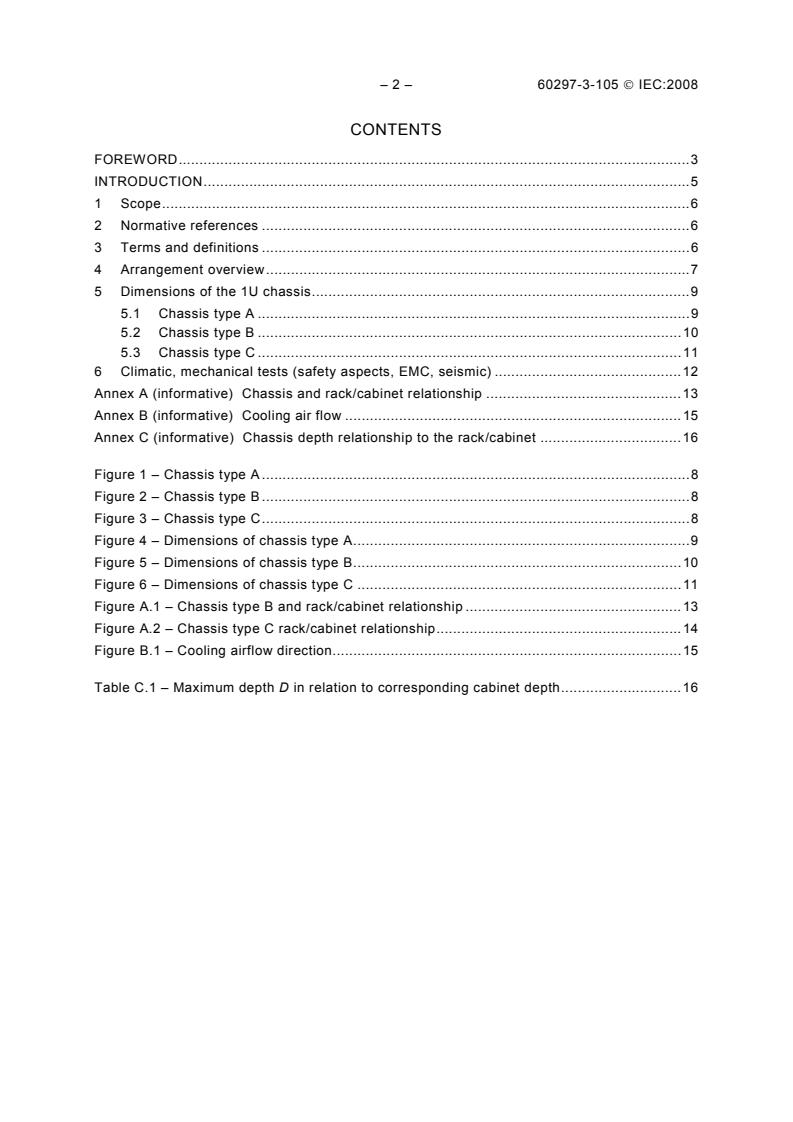
– 2 – 60297-3-105 © IEC:2008
CONTENTS
FOREWORD.3
INTRODUCTION.5
1 Scope.6
2 Normative references .6
3 Terms and definitions .6
4 Arrangement overview.7
5 Dimensions of the 1U chassis.9
5.1 Chassis type A .9
5.2 Chassis type B .10
5.3 Chassis type C .11
6 Climatic, mechanical tests (safety aspects, EMC, seismic) .12
Annex A (informative) Chassis and rack/cabinet relationship .13
Annex B (informative) Cooling air flow .15
Annex C (informative) Chassis depth relationship to the rack/cabinet .16
Figure 1 – Chassis type A.8
Figure 2 – Chassis type B.8
Figure 3 – Chassis type C.8
Figure 4 – Dimensions of chassis type A.9
Figure 5 – Dimensions of chassis type B.10
Figure 6 – Dimensions of chassis type C .11
Figure A.1 – Chassis type B and rack/cabinet relationship .13
Figure A.2 – Chassis type C rack/cabinet relationship.14
Figure B.1 – Cooling airflow direction.15
Table C.1 – Maximum depth D in relation to corresponding cabinet depth.16
60297-3-105 © IEC:2008 – 3 –
INTERNATIONAL ELECTROTECHNICAL COMMISSION
______________
MECHANICAL STRUCTURES FOR ELECTRONIC EQUIPMENT –
DIMENSIONS OF MECHANICAL STRUCTURES
OF THE 482,6 mm (19 in) SERIES –
Part 3-105: Dimensions and design aspects for 1U high chassis
FOREWORD
1) The International Electrotechnical Commission (IEC) is a worldwide organization for standardization comprising
all national electrotechnical committees (IEC National Committees). The object of IEC is to promote
international co-operation on all questions concerning standardization in the electrical and electronic fields. To
this end and in addition to other activities, IEC publishes International Standards, Technical Specifications,
Technical Reports, Publicly Available Specifications (PAS) and Guides (hereafter referred to as “IEC
Publication(s)”). Their preparation is entrusted to technical committees; any IEC National Committee interested
in the subject dealt with may participate in this preparatory work. International, governmental and non-
governmental organizations liaising with the IEC also participate in this preparation. IEC collaborates closely
with the International Organization for Standardization (ISO) in accordance with conditions determined by
agreement between the two organizations.
2) The formal decisions or agreements of IEC on technical matters express, as nearly as possible, an international
consensus of opinion on the relevant subjects since each technical committee has representation from all
interested IEC National Committees.
3) IEC Publications have the form of recommendations for international use and are accepted by IEC National
Committees in that sense. While all reasonable efforts are made to ensure that the technical content of IEC
Publications is accurate, IEC cannot be held responsible for the way in which they are used or for any
misinterpretation by any end user.
4) In order to promote international uniformity, IEC National Committees undertake to apply IEC Publications
transparently to the maximum extent possible in their national and regional publications. Any divergence
between any IEC Publication and the corresponding national or regional publication shall be clearly indicated in
the latter.
5) IEC provides no marking procedure to indicate its approval and cannot be rendered responsible for any
equipment declared to be in conformity with an IEC Publication.
6) All users should ensure that they have the latest edition of this publication.
7) No liability shall attach to IEC or its directors, employees, servants or agents including individual experts and
members of its technical committees and IEC National Committees for any personal injury, property damage or
other damage of any nature whatsoever, whether direct or indirect, or for costs (including legal fees) and
expenses arising out of the publication, use of, or reliance upon, this IEC Publication or any other IEC
Publications.
8) Attention is drawn to the Normative references cited in this publication. Use of the referenced publications is
indispensable for the correct application of this publication.
9) Attention is drawn to the possibility that some of the elements of this IEC Publication may be the subject of
patent rights. IEC shall not be held responsible for identifying any or all such patent rights.
International Standard IEC 60297-3-105 has been prepared by subcommittee 48D:
Mechanical structures for electronic equipment, of IEC technical committee 48:
Electromechanical components and mechanical structures for electronic equipment.
The text of this standard is based on the following documents:
FDIS Report on voting
48D/381/FDIS 48D/387/RVD
Full information on the voting for the approval of this standard can be found in the report on
voting indicated in the above table.
This publication has been drafted in accordance with the ISO/IEC Directives, Part 2.
– 4 – 60297-3-105 © IEC:2008
A list of all parts of IEC 60297 series, published under the general title Mechanical structures
for electronic equipment – Dimensions of mechanical structures of the 482,6 mm (19 in)
series, can be found on the IEC website.
The committee has decided that the contents of this publication will remain unchanged until
the maintenance result date indicated on the IEC web site under "http://webstore.iec.ch" in
the data related to the specific publication. At this date, the publication will be
• reconfirmed,
• withdrawn,
• replaced by a revised edition, or
• amended.
60297-3-105 © IEC:2008 – 5 –
INTRODUCTION
Electronic systems based on 1U chassis design have become one of the most important
platforms used for servers, industrial electronics, information technology (IT) and
telecommunication equipment. 1U chassis are sometimes referred to as “Pizza Boxes”.
Applications for 1U chassis designs are wide spread and solutions are found in every
segment of the electronics industry.
IEC 60297-3-100 defines the dimensional rack/cabinet details such as the available aperture
and the front panel mounting dimensions. However, IEC 60297-3-100 falls short of providing
guidance or dimensional requirements for assembling 1U chassis designs into these
IEC 60297 conforming racks/cabinets either in singles or in multiples (stacked in n × 1U).
This part of IEC 60297 will give guidance and provide for dimensional requirements for 1U
chassis based on weight loading, physical size and service accessibility.
In this standard, various chassis types are identified according to application needs.
The defined interface dimensions of the various chassis types permit the development of
common mounting accessories. Due to this clarification and the application specific chassis
type choice, the serviceability and airflow aspects of the chosen 1U chassis can be addressed
by the designer.
Similar attributes for multiple unit high equipment may be derived from this standard. The
economical value of this standard lies in the predefined interface dimensions of chassis for
which suitable accessories may be developed. In addition, as a consequence of the chosen
mounting support, the cooling possibilities are indicated.
– 6 – 60297-3-105 © IEC:2008
MECHANICAL STRUCTURES FOR ELECTRONIC EQUIPMENT –
DIMENSIONS OF MECHANICAL STRUCTURES
OF THE 482,6 mm (19 in) SERIES –
Part 3-105: Dimensions and design aspects for 1U high chassis
1 Scope
This part of IEC 60297 specifies the dimensions for 1U chassis mounted into IEC 60297-3-
100 compliant racks/cabinets where dimensions, loaded weight and accessibility require
differing assembly methods.
Guidance for cooling and reference for EMC, seismic and for the climatic and mechanical
requirements and tests are provided, as defined in the IEC 61587 series.
The drawings used in this standard are not intended to indicate product design, only the
specific dimensions shall be used.
The terminology used complies with IEC 60917-1.
2 Normative references
The following referenced documents are indispensable for the application of this document.
For dated references, only the edition cited applies. For undated references, the latest edition
of the referenced document (including any amendments) applies.
IEC 60050-581, International electrotechnical vocabulary – Part 581: Electromechanical
components for electronic equipment
IEC 60917-1, Modular order for the development of mechanical structures for electronic
equipment practices – Part 1: Generic standard
IEC 60297-3-100, Mechanical structures for electronic equipment – Dimensions of mechanical
structures of the 482,6 mm (19 in) series – Part 3-100: Basic dimensions of front panels,
subracks, chassis, racks and cabinets
IEC 61587-1, Mechanical structures for electronic equipment – Tests for IEC 60917 and
IEC 60297 – Part 1: Climatic, mechanical tests and safety aspects for cabinets, racks,
subracks and chassis
IEC 61587-2, Mechanical structures for electronic equipment – Tests for IEC 60917 and
IEC 60297 – Part 2: Seismic tests for cabinets and racks
IEC 61587-3, Mechanical structures for electronic equipment – Tests for IEC 60917 and
IEC 60297 – Part 3: Electromagnetic shielding performance tests for cabinets, racks and
subracks
3 Terms and definitions
For the purposes of this document, the terms and definitions of IEC 60917-1 and IEC 60050-
581 apply, as well as the following.
60297-3-105 © IEC:2008 – 7 –
3.1
19 in cabinet
cabinet in accordance with IEC 60297-3-100
3.2
19 in vertical members
parts of a cabinet with the mounting holes for front panels, chassis and subracks
3.3
chassis slides
angled parts mounted in the cabinet to support heavy or deep chassis (see also IEC 60917-1)
3.4
telescopic slide
extendable mounting support for heavy or deep chassis within a cabinet, providing easy
access to rear parts in extended position of the chassis
3.5
aperture of a cabinet
horizontal opening dimension between two 19 in uprights
3.6
height pitch line
theoretical line between any increment of U (1U = 44,45 mm)
3.7
cable management
cable routing within a cabinet to the equipment
3.8
chassis mounting flanges
may be an integrated part of the chassis or separate brackets attached to the chassis
3.9
cable pull factor
summary of cable weight, linked to the chassis
4 Arrangement overview
The arrangement overview in Figure 1 illustrates the chassis mounting methods into a typical
19 in cabinet.
The 1U chassis dimensions differ pending on the choice of the chassis type and resulting
mounting dimensions. There are three types of chassis, determined by the principal methods
of mounting into a cabinet. The definitions of the three types of chassis are:
● Chassis type A: This type of chassis is mounted into racks/cabinets without chassis
supports (light weight, shallow equipment with low cable pull factor, IEC 61587-1 DL 1
shock/vibration environment). For the assembly into cabinets only, the chassis mounting
flanges are bolted to the 19 in uprights. This type of chassis provides the maximum use of the
available width and heights within a 1U section. See Figure 1.
● Chassis type B: This type of chassis is designated for equipment with higher load (high
rear cabling pull factor, IEC 61587-1 DL 1 shock/vibration environment). Therefore, chassis
slides shall be used. The chassis design shall provide recessed areas as a space for the
cabinet mounted chassis slides. See Figure 2.
– 8 – 60297-3-105 © IEC:2008
● Chassis type C: This type of chassis is designated for extendable equipment mounted on
telescopic slides (top cover and/or rear I/O access via rear cable management, IEC 61587-1
DL 1 environment). Telescopic slides may be of two or three parts, dependent on the
extension requirement. The chassis design shall provide on both sides recessed areas
dependent on the required space for the telescopic slides.
NOTE There is no standard for telescopic slides, mounting dimensions should be defined by the equipment
design. See Figure 3.
19 in vertical member
1U chassis
IEC 2064/08
Figure 1 – Chassis type A
19 in vertical member
Chassis slide
IEC 2065/08
1U chassis
Figure 2 – Chassis type B
19 in vertical member
Telescopic slide
1U chassis IEC 2066/08
Figure 3 – Chassis type C
60297-3-105 © IEC:2008 – 9 –
5 Dimensions of the 1U chassis
IEC 60297-3-100 defines the front panel dimensions and the aperture of the rack/cabinet.
5.1 Chassis type A
This type of chassis is typically of either light weight, limited depth and/or has a very low
cable pull factor. Therefore, the centre of gravity is relatively close to the chassis front panel
where the chassis mounting screws to the rack/cabinet uprights are located. Figure 4
illustrates the recommended chassis dimensions utilizing the maximum available cabinet
aperture dimension for a 1U chassis. The maximum cable pull factor is to be considered in
addition to the maximum weight. The mounted chassis vertical deflection shall not pass over
the theoretical rack/cabinet height pitch line.
The maximum width as shown in Figure 4 includes any attached mounting flanges as well as
mounting screws.
Front view
Hole dimensions (see IEC 60297-3-100)
13,5 ± 0,4
465,1 ± 1,6
Height pitch line
482,6 ± 0,4 (19 in)
Top view
≤ 449
Missing dimensions
(see IEC 60297-3-100)
IEC 2067/08
Dimensions in millimetres
Figure 4 – Dimensions of chassis type A
31,75 ± 0,4
5,9 ± 0,4
D
43,65 ± 0,4
44,45
– 10 – 60297-3-105 © IEC:2008
5.2 Chassis type B
For the type B chassis as shown in Figure 5 the chassis height dimension shall be reduced in
order to provide for chassis support space. For the purposes of this standard, the chassis
height is reduced by 2 mm at the bottom of the chassis height. This provides for an
interference free modular mounting approach of multiple and/or different chassis or subracks
in a rack/cabinet.
Where maximum available chassis height is required, only the chassis to mounting support
interfaces have to be observed.
For safety reasons and for the load bearing calculation of the chassis slides, the total weight
shall not exceed 25 kg.
Side view Rear view
1)
≤ 10
≤ 350
Height pitch line
Recessed area for corresponding chassis slides
1)
The dotted line indicates that the recess may be throughout the whole width
Top view
≤ 449
Missing dimensions
(see IEC 60297-3-100)
IEC 2068/08
Dimensions in millimetres
Figure 5 – Dimensions of chassis type B
43,65 ± 0,4
≥ 2, 0
D
60297-3-105 © IEC:2008 – 11 –
5.3 Chassis type C
For the type C chassis as shown in Figure 6, the chassis width dimension is reduced to
provide space for single, double or triple extension telescopic slides.
The type C chassis may require cable management between the rear of the chassis and the
rack/cabinet interface.
The type C chassis dimensions are based on the triple extension telescopic design and the
telescopic slides are within the 1U chassis dimension.
The type C chassis load, when fully extended out of the rack/cabinet, must be observed in
means of the possible dangerous tilt effect of a free standing rack/cabinet. The recommended
chassis width of maximum 425 mm leaves 2 × 12 mm space for the extendable parts of the
telescopic slides (see Clause A.2). There is no standard for telescopic slides, but the
recommended dimension of 12 mm complies with the most common products in the
electronics market and in relation to the maximum load.
NOTE For safety reasons (tilt effect of a cabinet by fully extended chassis) and for the load bearing calculation of
telescopic slides the chassis shall not exceed 25 kg.
1)
Side view
≤ 10
2)
1) Height pitch line
Keep out area for telescopic slides
2)
Mounting holes to be defined dependent on telescopic slide chosen
≤ 449
Top view
≤ 425
Missing dimensions
(see IEC 60297-3-100)
IEC 2069/08
Dimensions in millimetres
Figure 6 – Dimensions of chassis type C
43,65 ± 0,4
D
– 12 – 60297-3-105 © IEC:2008
6 Climatic, mechanical tests (safety aspects, EMC, seismic)
For the test of mechanical integrity, dedicated tests are described in the IEC 61587 series.
This standard should be referenced in technical specifications as a common base for the
design properties of 1U equipment. The 1U chassis are not explicitly described in the above
mentioned standard. Therefore, the tests for the chassis should be performed according to
the subracks.
60297-3-105 © IEC:2008 – 13 –
Annex A
(informative)
Chassis and rack/cabinet relationship
A.1 Chassis type B and rack/cabinet relationship
Top view
Cross section
Rack/cabinet aperture between
Chassis mounted on slides
Rack/cabinet envelope dimensions the 19 in vertical members
in accordance with IEC 60297-3-100 ≥ 450
Mounting dimensions of
the 19 in vertical member
in accordance with
1)
IEC 60297-3-100
Rack/cabinet
mounted slide
≥ 355
≤ 449
1)
Minimum distance of the slide to the 19 in uprights attachment plane
Rear view
(see clause 5.2)
≤ 350
≤ 449
IEC 2070/08
Dimensions in millimetres
Figure A.1 – Chassis type B and rack/cabinet relationship
≥ 15
≥ 2, 0
– 14 – 60297-3-105 © IEC:2008
A.2 Chassis type C rack/cabinet relationship
≥ 450
Usable space for
telescopic slides
Chassis mounted on
(12, 0)
≤ 425 telescopic slides
Mounting dimensions of
the 19 in vertical member
in accordance with
IEC 60297-3-100
1)
Telescopic slide mounted
to the rack/cabinet structure
Rack/cabinet envelope
dimensions
in accordance with
IEC 60297-3-100
1)
Chassis type C top and rear I/O access to be defined by the designer and installer defined cable management
IEC 2071/08
Dimensions in millimetres
Figure A.2 – Chassis type C rack/cabinet relationship
60297-3-105 © IEC:2008 – 15 –
Annex B
(informative)
Cooling air flow
For well-controlled heat management within a cabinet, the air flow through multiple built-in
chassis or subracks should be in the same direction. The preferred air flow direction for 1U
chassis is from front to rear. As an alternative side to side or side to rear air flow may be
considered. These alternative air flow solutions are mainly used for stand-alone equipment.
These rules apply
...