

IEC 62053-24:2014
(Main)Electricity metering equipment (a.c.) - Particular requirements - Part 24: Static meters for reactive energy at fundamental frequency (classes 0,5 S, 1S and 1)
General Information
- Abstract
IEC 62053-24:2014 applies only to newly manufactured transformer operated static var-hour meters of accuracy classes 0,5 S, and 1 S as well as direct connected static var-hour meters of accuracy class 1, for the measurement of alternating current electrical reactive energy in 50 Hz or 60 Hz networks and it applies to their type tests only. It uses a conventional definition of reactive energy where the reactive power and energy is calculated from the fundamental frequency components of the currents and voltages only.
- Status
- Published
- Publication Date
- 14-Nov-2016
- Technical Committee
- TC 13 - Electrical energy measurement and control
- Drafting Committee
- PT 62053-24 - TC 13/PT 62053-24
- Current Stage
- DELPUB - Deleted Publication
- Start Date
- 17-Jun-2020
- Completion Date
- 28-Aug-2026
Buy Documents
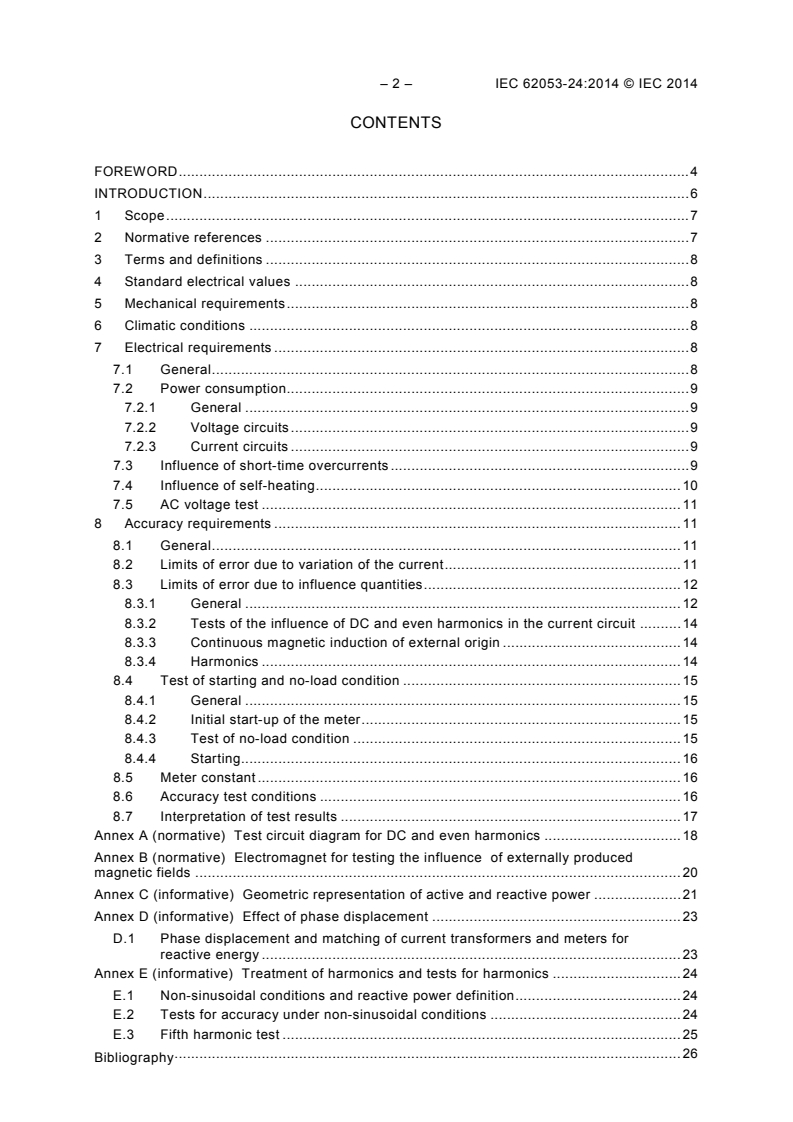
IEC 62053-24:2014 - Electricity metering equipment (a.c.) - Particular requirements - Part 24: Static meters for reactive energy at fundamental frequency (classes 0,5 S, 1S and 1) Released:6/19/2014

IEC 62053-24:2014+AMD1:2016 CSV - Electricity metering equipment (a.c.) - Particular requirements - Part 24: Static meters for reactive energy at fundamental frequency(classes 0,5 S, 1 S and 1) Released:11/15/2016
Overview
IEC 62053-24:2014 is an international standard published by the International Electrotechnical Commission (IEC) that specifies particular requirements for static electricity meters used to measure reactive energy in alternating current (a.c.) electrical systems. This standard focuses exclusively on newly manufactured static var-hour meters - transformer operated meters of accuracy classes 0.5 S and 1 S, and direct connected meters of accuracy class 1. These meters are designed for fundamental frequency measurement of reactive energy in 50 Hz or 60 Hz networks.
The standard defines accuracy, testing, and performance requirements to ensure precise measurement of reactive energy, which is essential for effective energy management, billing, and network efficiency. Accuracy classes covered include 0.5 S, 1 S, and 1, indicating a range of precision levels suitable for various industrial and utility metering applications.
Key Topics
Scope and Application
Applies to static var-hour meters that calculate reactive energy from fundamental frequency components of current and voltage only. It covers type testing of meters during manufacturing.Accuracy Classes
Includes classes 0.5 S, 1 S, and 1 to define tolerance levels for meter precision in reactive energy measurement.Measurement Conditions
Designed for 50 Hz and 60 Hz a.c. networks, commonly used worldwide in industrial and commercial settings.Testing Requirements
Details on accuracy tests under varying electrical and climatic conditions, including influence of harmonics, short-time overcurrents, and environmental factors.Power Consumption Limits
Specifies limits for power consumption in voltage and current circuits to ensure energy-efficient meter operation.Influence Quantities
Evaluation of effects from DC components, harmonics, external magnetic fields, and self-heating on the meter’s performance.Starting Current and No-load Conditions
Requirements for meter startup and behavior when no load is applied.Test Circuits and Procedures
Includes normative annexes with circuit diagrams, electromagnet testing setups, and guidance on geometric representation of active and reactive power.
Applications
IEC 62053-24:2014 is crucial for manufacturers, utilities, and regulatory bodies involved in:
Reactive Energy Measurement
Ensuring accurate metering of reactive power consumption or generation in industrial plants and commercial buildings.Billing and Tariff Implementation
Supporting utilities in fair and precise billing based on reactive energy usage with standardized accuracy.Energy Management Systems
Providing reliable data for power factor correction, load balancing, and network optimization.Compliance and Certification
Assisting manufacturers in designing meters that meet international quality and accuracy standards.Grid Monitoring
Enabling grid operators to monitor reactive energy flow for maintaining system stability and efficiency.
Related Standards
IEC 62053 Series
Covers various types of electricity metering equipment including active energy meters and multi-function devices.IEC 61036
Standard for active energy meters which complements reactive energy metering for comprehensive power measurement.IEC 62586 Series
Focuses on meter communication protocols and requirements, often used alongside measurement standards.IEC 62052 Series
Generic requirements for electricity metering equipment, covering general features applicable to static meters.
Keywords: IEC 62053-24, static meters, reactive energy, accuracy classes, transformer operated meters, reactive power measurement, alternating current metering, fundamental frequency, electricity metering equipment, IEC standards, energy measurement, power quality, meter testing.
Relations
- Effective Date
- 05-Sep-2023
- Effective Date
- 05-Sep-2023
Buy Documents
IEC 62053-24:2014 - Electricity metering equipment (a.c.) - Particular requirements - Part 24: Static meters for reactive energy at fundamental frequency (classes 0,5 S, 1S and 1) Released:6/19/2014
IEC 62053-24:2014+AMD1:2016 CSV - Electricity metering equipment (a.c.) - Particular requirements - Part 24: Static meters for reactive energy at fundamental frequency(classes 0,5 S, 1 S and 1) Released:11/15/2016
Get Certified
Connect with accredited certification bodies for this standard

DIBt (Deutsches Institut für Bautechnik)
German Institute for Building Technology.
DIN CERTCO
DIN Group product certification.

Aboma Certification B.V.
Specialized in construction, metal, and transport sectors.
Sponsored listings
Frequently Asked Questions
IEC 62053-24:2014 is a standard published by the International Electrotechnical Commission (IEC). Its full title is "Electricity metering equipment (a.c.) - Particular requirements - Part 24: Static meters for reactive energy at fundamental frequency (classes 0,5 S, 1S and 1)". This standard covers: IEC 62053-24:2014 applies only to newly manufactured transformer operated static var-hour meters of accuracy classes 0,5 S, and 1 S as well as direct connected static var-hour meters of accuracy class 1, for the measurement of alternating current electrical reactive energy in 50 Hz or 60 Hz networks and it applies to their type tests only. It uses a conventional definition of reactive energy where the reactive power and energy is calculated from the fundamental frequency components of the currents and voltages only.
IEC 62053-24:2014 applies only to newly manufactured transformer operated static var-hour meters of accuracy classes 0,5 S, and 1 S as well as direct connected static var-hour meters of accuracy class 1, for the measurement of alternating current electrical reactive energy in 50 Hz or 60 Hz networks and it applies to their type tests only. It uses a conventional definition of reactive energy where the reactive power and energy is calculated from the fundamental frequency components of the currents and voltages only.
IEC 62053-24:2014 is classified under the following ICS (International Classification for Standards) categories: 17.220.20 - Measurement of electrical and magnetic quantities; 91.140.50 - Electricity supply systems. The ICS classification helps identify the subject area and facilitates finding related standards.
IEC 62053-24:2014 has the following relationships with other standards: It is inter standard links to IEC 62053-24:2014/AMD1:2016, IEC 62053-24:2020. Understanding these relationships helps ensure you are using the most current and applicable version of the standard.
IEC 62053-24:2014 is available in PDF format for immediate download after purchase. The document can be added to your cart and obtained through the secure checkout process. Digital delivery ensures instant access to the complete standard document.
Standards Content (Sample)
IEC 62053-24 ®
Edition 1.0 2014-06
INTERNATIONAL
STANDARD
NORME
INTERNATIONALE
Electricity metering equipment (a.c.) – Particular requirements –
Part 24: Static meters for reactive energy at fundamental frequency (classes
0,5 S, 1 S and 1)
Équipement de comptage de l’électricité (c.a.) – Exigences particulières –
Partie 24: Compteurs statiques d’énergie réactive à la fréquence fondamentale
(classes 0,5 S, 1 S et 1)
All rights reserved. Unless otherwise specified, no part of this publication may be reproduced or utilized in any form
or by any means, electronic or mechanical, including photocopying and microfilm, without permission in writing from
either IEC or IEC's member National Committee in the country of the requester. If you have any questions about IEC
copyright or have an enquiry about obtaining additional rights to this publication, please contact the address below or
your local IEC member National Committee for further information.
Droits de reproduction réservés. Sauf indication contraire, aucune partie de cette publication ne peut être reproduite
ni utilisée sous quelque forme que ce soit et par aucun procédé, électronique ou mécanique, y compris la photocopie
et les microfilms, sans l'accord écrit de l'IEC ou du Comité national de l'IEC du pays du demandeur. Si vous avez des
questions sur le copyright de l'IEC ou si vous désirez obtenir des droits supplémentaires sur cette publication, utilisez
les coordonnées ci-après ou contactez le Comité national de l'IEC de votre pays de résidence.
IEC Central Office Tel.: +41 22 919 02 11
3, rue de Varembé Fax: +41 22 919 03 00
CH-1211 Geneva 20 info@iec.ch
Switzerland www.iec.ch
About the IEC
The International Electrotechnical Commission (IEC) is the leading global organization that prepares and publishes
International Standards for all electrical, electronic and related technologies.
About IEC publications
The technical content of IEC publications is kept under constant review by the IEC. Please make sure that you have the
latest edition, a corrigenda or an amendment might have been published.
IEC Catalogue - webstore.iec.ch/catalogue Electropedia - www.electropedia.org
The stand-alone application for consulting the entire The world's leading online dictionary of electronic and
bibliographical information on IEC International Standards, electrical terms containing more than 30 000 terms and
Technical Specifications, Technical Reports and other definitions in English and French, with equivalent terms in 14
documents. Available for PC, Mac OS, Android Tablets and additional languages. Also known as the International
iPad. Electrotechnical Vocabulary (IEV) online.
IEC publications search - www.iec.ch/searchpub IEC Glossary - std.iec.ch/glossary
The advanced search enables to find IEC publications by a More than 55 000 electrotechnical terminology entries in
variety of criteria (reference number, text, technical English and French extracted from the Terms and Definitions
committee,…). It also gives information on projects, replaced clause of IEC publications issued since 2002. Some entries
and withdrawn publications. have been collected from earlier publications of IEC TC 37,
77, 86 and CISPR.
IEC Just Published - webstore.iec.ch/justpublished
Stay up to date on all new IEC publications. Just Published IEC Customer Service Centre - webstore.iec.ch/csc
details all new publications released. Available online and If you wish to give us your feedback on this publication or
also once a month by email. need further assistance, please contact the Customer Service
Centre: csc@iec.ch.
A propos de l'IEC
La Commission Electrotechnique Internationale (IEC) est la première organisation mondiale qui élabore et publie des
Normes internationales pour tout ce qui a trait à l'électricité, à l'électronique et aux technologies apparentées.
A propos des publications IEC
Le contenu technique des publications IEC est constamment revu. Veuillez vous assurer que vous possédez l’édition la
plus récente, un corrigendum ou amendement peut avoir été publié.
Catalogue IEC - webstore.iec.ch/catalogue Electropedia - www.electropedia.org
Application autonome pour consulter tous les renseignements
Le premier dictionnaire en ligne de termes électroniques et
bibliographiques sur les Normes internationales,
électriques. Il contient plus de 30 000 termes et définitions en
Spécifications techniques, Rapports techniques et autres
anglais et en français, ainsi que les termes équivalents dans
documents de l'IEC. Disponible pour PC, Mac OS, tablettes
14 langues additionnelles. Egalement appelé Vocabulaire
Android et iPad.
Electrotechnique International (IEV) en ligne.
Recherche de publications IEC - www.iec.ch/searchpub
Glossaire IEC - std.iec.ch/glossary
Plus de 55 000 entrées terminologiques électrotechniques, en
La recherche avancée permet de trouver des publications IEC
en utilisant différents critères (numéro de référence, texte, anglais et en français, extraites des articles Termes et
comité d’études,…). Elle donne aussi des informations sur les Définitions des publications IEC parues depuis 2002. Plus
projets et les publications remplacées ou retirées. certaines entrées antérieures extraites des publications des
CE 37, 77, 86 et CISPR de l'IEC.
IEC Just Published - webstore.iec.ch/justpublished
Service Clients - webstore.iec.ch/csc
Restez informé sur les nouvelles publications IEC. Just
Published détaille les nouvelles publications parues. Si vous désirez nous donner des commentaires sur cette
Disponible en ligne et aussi une fois par mois par email. publication ou si vous avez des questions contactez-nous:
csc@iec.ch.
IEC 62053-24 ®
Edition 1.0 2014-06
INTERNATIONAL
STANDARD
NORME
INTERNATIONALE
Electricity metering equipment (a.c.) – Particular requirements –
Part 24: Static meters for reactive energy at fundamental frequency (classes
0,5 S, 1 S and 1)
Équipement de comptage de l’électricité (c.a.) – Exigences particulières –
Partie 24: Compteurs statiques d’énergie réactive à la fréquence fondamentale
(classes 0,5 S, 1 S et 1)
INTERNATIONAL
ELECTROTECHNICAL
COMMISSION
COMMISSION
ELECTROTECHNIQUE
PRICE CODE
INTERNATIONALE
CODE PRIX U
ICS 17.220.20; 91.140.50 ISBN 978-2-8322-1560-9
– 2 – IEC 62053-24:2014 © IEC 2014
CONTENTS
FOREWORD . 4
INTRODUCTION . 6
1 Scope . 7
2 Normative references . 7
3 Terms and definitions . 8
4 Standard electrical values . 8
5 Mechanical requirements . 8
6 Climatic conditions . 8
7 Electrical requirements . 8
7.1 General . 8
7.2 Power consumption. 9
7.2.1 General . 9
7.2.2 Voltage circuits . 9
7.2.3 Current circuits . 9
Influence of short-time overcurrents . 9
7.3
7.4 Influence of self-heating . 10
7.5 AC voltage test . 11
8 Accuracy requirements . 11
8.1 General . 11
8.2 Limits of error due to variation of the current . 11
8.3 Limits of error due to influence quantities . 12
8.3.1 General . 12
8.3.2 Tests of the influence of DC and even harmonics in the current circuit . 14
8.3.3 Continuous magnetic induction of external origin . 14
8.3.4 Harmonics . 14
8.4 Test of starting and no-load condition . 15
8.4.1 General . 15
8.4.2 Initial start-up of the meter . 15
8.4.3 Test of no-load condition . 15
8.4.4 Starting. 16
8.5 Meter constant . 16
8.6 Accuracy test conditions . 16
8.7 Interpretation of test results . 17
Annex A (normative) Test circuit diagram for DC and even harmonics . 18
Annex B (normative) Electromagnet for testing the influence of externally produced
magnetic fields . 20
Annex C (informative) Geometric representation of active and reactive power . 21
Annex D (informative) Effect of phase displacement . 23
D.1 Phase displacement and matching of current transformers and meters for
reactive energy . 23
Annex E (informative) Treatment of harmonics and tests for harmonics . 24
E.1 Non-sinusoidal conditions and reactive power definition . 24
E.2 Tests for accuracy under non-sinusoidal conditions . 24
E.3 Fifth harmonic test . 25
.......................................................................................................................... 26
Bibliography
Figure A.1 – Test circuit diagram for half-wave rectification . 18
Figure A.2 – Half-wave rectified waveform . 19
Figure B.1 – Electromagnet for testing the influence of externally produced magnetic
fields. 20
Figure C.1 – Recommended geometric representation . 21
Figure C.2 – Alternative geometric representation . 22
Table 1 – Power consumption in voltage circuits for single-phase and polyphase
meters including the power supply . 9
Table 2 – Power consumption in current circuits . 9
Table 3 – Variations due to short-time overcurrents . 10
Table 4 – Variations due to self-heating . 10
Table 5 – AC voltage tests . 11
Table 6 – Percentage error limits (single-phase meters and polyphase meters with
balanced loads) . 12
Table 7 – Percentage error limits (polyphase meters carrying a single-phase load, but
with balanced polyphase voltages applied to voltage circuits) . 12
Table 8 – Influence quantities . 13
Table 9 – Starting current . 16
Table 10 – Voltage and current balance . 16
Table 11 – Reference conditions . 17
Table 12 – Interpretation of test results . 17
Table D.1 – Limits of phase displacement for measuring current transformers and
corresponding measurement error for reactive energy measurement . 23
– 4 – IEC 62053-24:2014 © IEC 2014
INTERNATIONAL ELECTROTECHNICAL COMMISSION
____________
ELECTRICITY METERING EQUIPMENT (a.c.) –
PARTICULAR REQUIREMENTS –
Part 24: Static meters for reactive energy at fundamental frequency
(classes 0,5 S, 1 S and 1)
FOREWORD
1) The International Electrotechnical Commission (IEC) is a worldwide organization for standardization comprising
all national electrotechnical committees (IEC National Committees). The object of IEC is to promote
international co-operation on all questions concerning standardization in the electrical and electronic fields. To
this end and in addition to other activities, IEC publishes International Standards, Technical Specifications,
Technical Reports, Publicly Available Specifications (PAS) and Guides (hereafter referred to as “IEC
Publication(s)”). Their preparation is entrusted to technical committees; any IEC National Committee interested
in the subject dealt with may participate in this preparatory work. International, governmental and non-
governmental organizations liaising with the IEC also participate in this preparation. IEC collaborates closely
with the International Organization for Standardization (ISO) in accordance with conditions determined by
agreement between the two organizations.
2) The formal decisions or agreements of IEC on technical matters express, as nearly as possible, an international
consensus of opinion on the relevant subjects since each technical committee has representation from all
interested IEC National Committees.
3) IEC Publications have the form of recommendations for international use and are accepted by IEC National
Committees in that sense. While all reasonable efforts are made to ensure that the technical content of IEC
Publications is accurate, IEC cannot be held responsible for the way in which they are used or for any
misinterpretation by any end user.
4) In order to promote international uniformity, IEC National Committees undertake to apply IEC Publications
transparently to the maximum extent possible in their national and regional publications. Any divergence
between any IEC Publication and the corresponding national or regional publication shall be clearly indicated in
the latter.
5) IEC itself does not provide any attestation of conformity. Independent certification bodies provide conformity
assessment services and, in some areas, access to IEC marks of conformity. IEC is not responsible for any
services carried out by independent certification bodies.
6) All users should ensure that they have the latest edition of this publication.
7) No liability shall attach to IEC or its directors, employees, servants or agents including individual experts and
members of its technical committees and IEC National Committees for any personal injury, property damage or
other damage of any nature whatsoever, whether direct or indirect, or for costs (including legal fees) and
expenses arising out of the publication, use of, or reliance upon, this IEC Publication or any other IEC
Publications.
8) Attention is drawn to the Normative references cited in this publication. Use of the referenced publications is
indispensable for the correct application of this publication.
9) Attention is drawn to the possibility that some of the elements of this IEC Publication may be the subject of
patent rights. IEC shall not be held responsible for identifying any or all such patent rights.
International Standard IEC 62053-24 has been prepared by IEC technical committee 13:
Electrical energy measurement and control.
The text of this standard is based on the following documents:
FDIS Report on voting
13/1569/FDIS 13/1578/RVD
Full information on the voting for the approval of this standard can be found in the report on
voting indicated in the above table.
This publication has been drafted in accordance with the ISO/IEC Directives, Part 2.
A list of all parts of IEC series 62053, under the general title Electricity metering equipment
(a.c.) – Particular requirements, can be found on the IEC website.
The committee has decided that the contents of this publication will remain unchanged until
the stability date indicated on the IEC web site under "http://webstore.iec.ch" in the data
related to the specific publication. At this date, the publication will be
• reconfirmed,
• withdrawn,
• replaced by a revised edition, or
• amended.
– 6 – IEC 62053-24:2014 © IEC 2014
INTRODUCTION
This part of IEC 62053 is to be used with the following relevant parts of the IEC 62052,
IEC 62053 and IEC 62059 series, Electricity metering equipment:
IEC 62052-11:2003, Electricity metering equipment (a.c.) – General requirements, tests and
test conditions – Part 11: Metering equipment
IEC 62053-21:2003, Electricity metering equipment (a.c.) – Particular requirements – Part 21:
Static meters for active energy (classes 1 and 2)
IEC 62053-22:2003, Electricity metering equipment (a.c.) – Particular requirements – Part 22:
Static meters for active energy (classes 0,2 S and 0,5 S)
IEC 62053-31:1998, Electricity metering equipment (a.c.) – Particular requirements – Part 31:
Pulse output devices for electromechanical and electronic meters (two wires only)
IEC 62053-52:2005, Electricity metering equipment (a.c.) – Particular requirements – Part 52:
Symbols
IEC 62053-61:1998, Electricity metering equipment (a.c.) – Particular requirements – Part 61:
Power consumption and voltage requirements
IEC 62059-11:2002, Electricity metering equipment (a.c.) – Dependability – Part 11: General
concepts
IEC 62059-21:2002, Electricity metering equipment (a.c.) – Dependability – Part 21:
Collection of meter dependability data from the field
IEC 62059-31-1:2008, Electricity metering equipment – Dependability –Part 31-1: Accelerated
reliability testing – Elevated temperature and humidity
IEC 62059-32-1:2011, Electricity metering equipment – Dependability – Part 32-1: Durability –
Testing of the stability of metrological characteristics by applying elevated temperature
IEC 62059-41:2006, Electricity metering equipment – Dependability – Part 41: Reliability
prediction
This part is a standard for type testing electricity meters. It covers the particular requirements
for meters, used indoors and outdoors. It does not deal with special implementations (such as
metering-part and/or displays in separate housings).
This standard is intended to be used in conjunction with IEC 62052-11. When any requirement
in this standard concerns an item already covered in IEC 62052-11, the requirements of this
standard take precedence over the requirements of IEC 62052-11.
This standard distinguishes:
• between transformer operated meters of accuracy class index 0,5 S and 1 S and direct
connected meters of accuracy class index 1;
• between protective class I and protective class II meters;
• between meters for use in networks equipped with or without earth fault neutralizers.
The test levels are regarded as minimum values that provide for the proper functioning of the
meter under normal working conditions. For special application, other test levels might be
necessary and should be agreed on between the user and the manufacturer.
ELECTRICITY METERING EQUIPMENT (a.c.) –
PARTICULAR REQUIREMENTS –
Part 24: Static meters for reactive energy at fundamental frequency
(classes 0,5 S, 1 S and 1)
1 Scope
This part of IEC 62053 applies only to newly manufactured transformer operated static var-
hour meters of accuracy classes 0,5 S, and 1 S as well as direct connected static var-hour
meters of accuracy class 1, for the measurement of alternating current electrical reactive
energy in 50 Hz or 60 Hz networks and it applies to their type tests only.
This standard uses a conventional definition of reactive energy where the reactive power and
energy is calculated from the fundamental frequency components of the currents and voltages
only. See Clause 3.
NOTE 1 This differs from the approach of IEC 62053-23, where reactive power and energy is defined only for
sinusoidal signals. In this standard reactive power and energy is defined for all periodic signals. Reactive power
and energy is defined in this way to achieve proper reproducibility of measurements with meters of different
designs. With this definition, reactive power and energy reflects the generally unnecessary current possible to
compensate with capacitors rather than the total unnecessary current.
It applies only to static var-hour meters for indoor and outdoor application consisting of a
measuring element and register(s) enclosed together in a meter case. It also applies to
operation indicator(s) and test output(s). If the meter has a measuring element for more than
one type of energy (multi-energy meters), or when other functional elements, like maximum
demand indicators, electronic tariff registers, time switches, ripple control receivers, data
communication interfaces, etc., are enclosed in the meter case, then the relevant standards
for these elements also apply.
NOTE 2 IEC 61869-2:2012 describes transformers having a measuring range of 0,05 I to I for accuracy
n max
classes 0,2, 0,5, 1 and 2, and transformers having a measuring range of 0,01 I to I for accuracy classes 0,2 S
n max
and 0,5 S. As the measuring range of a meter and its associated transformers have to be matched and as only
transformers of classes 0,2 S / 0,5 S have the current error and phase displacement characteristics suitable to
operate a class 0,5 S / 1 S meter respectively as specified in this standard, the measuring range of the transformer
operated meters will be 0,01 I to I . Reactive meters intended to be used together with non-S transformers are,
n max
therefore, not covered by this standard.
It does not apply to:
• var-hour meters where the voltage across the connection terminals exceeds 600 V (line-
to-line voltage for meters for polyphase systems);
• portable meters;
• data interfaces to the register of the meter;
• reference meters.
The dependability aspect is covered by the standards of the IEC 62059 series.
2 Normative references
The following documents, in whole or in part, are normatively referenced in this document and
are indispensable for its application. For dated references, only the edition cited applies. For
undated references, the latest edition of the referenced document (including any
amendments) applies.
– 8 – IEC 62053-24:2014 © IEC 2014
IEC 62052-11:2003, Electricity metering equipment (a.c.) – General requirements, tests and
test conditions – Part 11: Metering equipment
3 Terms and definitions
For the purposes of this document, the terms and definitions given in IEC 62052-11 apply with
the following exception:
3.1
reactive power
Q
reactive power Q in a single phase system is defined for steady-state and periodic signals as
Q = U ∗ I ∗sinϕ
1 1 1
where U and I are the r.m.s. values of the fundamental frequency components of the
1 1
voltage and the current respectively, and
φ is the phase angle between them. The reactive power in poly-phase system is the
algebraic sum of the per-phase reactive powers:
Q = U ∗ I ∗sinϕ +U ∗ I ∗sinϕ + .
L1 L1 L1 L2 L2 L2
where
L1 and L2 are the first and second phase of the system.
Note 1 to entry: For direction of flow and sign of reactive power, see Annex C.
Note 2 to entry: The actual algorithm used for the calculation of reactive power is not of importance as long as the
meter meets requirements of this standard. See also Annex E.
Note 3 to entry: While meters for active energy have to measure active energy including harmonic components,
reactive energy meters according to this standard have to measure fundamental component reactive energy, with
minimum influence from harmonics.
4 Standard electrical values
The values given in IEC 62052-11 apply.
5 Mechanical requirements
The requirements of IEC 62052-11 apply.
6 Climatic conditions
The conditions given in IEC 62052-11 apply.
7 Electrical requirements
7.1 General
In addition to the electrical requirements in IEC 62052-11, meters shall fulfil the following
requirements.
7.2 Power consumption
7.2.1 General
The power consumption in the voltage and current circuit shall be determined at reference
values of the influence quantities given in 8.6 by any suitable method. The overall uncertainty
of the measurement of the power consumption shall not exceed 5 %.
7.2.2 Voltage circuits
The active and apparent power consumption in each voltage circuit of a meter at reference
voltage, reference temperature and reference frequency shall not exceed the values shown in
Table 1.
Table 1 – Power consumption in voltage circuits for single-phase
and polyphase meters including the power supply
Meters Power supply connected Power supply not connected
to the voltage circuits to the voltage circuits
Voltage circuit 2 W and 10 VA 0,5 VA
Auxiliary power supply – 10 VA
NOTE 1 In order to match voltage transformers to meters, the meter manufacturer should state whether the
burden is inductive or capacitive (for transformer operated meters only).
NOTE 2 The above figures are mean values. Switching power supplies with peak values in excess of these
specified values are permitted, but it should be ensured that the rating of associated voltage transformers is
adequate.
NOTE 3 For multifunctional meters, see IEC 62053-61.
7.2.3 Current circuits
The apparent power taken by each current circuit of a direct connected meter at basic current,
reference frequency and reference temperature shall not exceed the values shown in Table 2.
The apparent power taken by each current circuit of a meter connected through a current
transformer shall not exceed the value shown in Table 2, at a current value that equals the
rated secondary current of the corresponding transformer, at reference temperature and
reference frequency of the meter.
Table 2 – Power consumption in current circuits
Class of meter
Meters
0,5 S 1 S 1
Single-phase and polyphase direct connected meter – – 4,0 VA
Single-phase and polyphase transformer operated meters 1,0 VA 1,0 VA –
NOTE 1 The rated secondary current is the value of the secondary current indicated on the current transformer,
on which the performance of the transformer is based. Standard values of maximum secondary current are
120 %, 150 % and 200 % of the rated secondary current.
NOTE 2 In order to match current transformers to meters, the meter manufacturer should state whether the
burden is inductive or capacitive (for transformer operated meters only).
7.3 Influence of short-time overcurrents
Short-time overcurrents shall not damage the meter. The meter shall perform correctly when
back to its initial working condition and the variation of error shall not exceed the values
shown in Table 3.
– 10 – IEC 62053-24:2014 © IEC 2014
The test circuit shall be practically non-inductive and the test shall be performed for
polyphase meters phase-by-phase.
After the application of the short-time overcurrent with the voltage maintained at the terminals,
the meter shall be allowed to return to the initial temperature with the voltage circuit(s)
energized (about 1 h).
a) Meter for direct connection
The meter shall be able to carry a short-time overcurrent of 30 I (r.m.s.) with a relative
max
tolerance of +0 % to –10 % for one half-cycle of a sinusoidal waveforms starting at zero
volt, at rated frequency.
b) Meter for connection through current transformer
The meter shall be able to carry for 0,5 s a sinusoidal current at rated frequency equal to
20 I with a relative tolerance of +0 % to –10 %.
max
This requirement does not apply to meters having a switch in the current circuits. For this
case, see appropriate standards.
Table 3 – Variations due to short-time overcurrents
Limits of variations in percentage
sin ϕ
error for meters of class
Meters for Value of current (inductive or
capacitive)
0,5 S 1 S 1
Direct connection I 1 – – 1,5
b
Connection through
current I 1 0,1 0,1 –
n
transformers
7.4 Influence of self-heating
The variation of error due to self-heating shall not exceed the values given in Table 4.
Table 4 – Variations due to self-heating
Limits of variations in percentage
sin ϕ
error for meters of class
Value of current
(inductive or capacitive)
0,5 S 1 S or 1
1 0,2 0,7
I
max
0,5 0,2 1,0
The test shall be carried out as follows: After the voltage circuits have been energized at
reference voltage for at least 1 h, without any current in the current circuits, the maximum
current shall be applied to the current circuits. The meter error shall be measured at sin ϕ = 1
immediately after the current is applied and then at intervals short enough to allow a correct
drawing to be made of the curve of error variation as a function of time. The test shall be
carried out for at least 1 h, and in any event until the variation of error during 20 min does not
exceed 0,1 % for class 1 S and class 1 meters and 0,05 % for a class 0,5 S meter.
For this test, the percentage error of the meter shall be measured at sin φ = 1 and sin φ = 0,5
inductive or capacitive with minimum interruptions for changing the measurement point.
The cable to be used for energizing the meter shall have a length of 1 m. For meters with
I > 6 A, the cable cross-section shall ensure that the current density is between 3,2 A/mm
max
and 4 A/mm . For meters with an I ≤ 6 A, a cross-section in accordance with the meter
max
specification shall be used.
7.5 AC voltage test
The a.c. voltage test shall be carried out in accordance with Table 5.
The test voltage shall be substantially sinusoidal, having a frequency between 45 Hz and
65 Hz, and applied for 1 min. The power source shall be capable of supplying at least 500 VA.
During the tests relative to earth, the auxiliary circuits with reference voltage equal to or
below 40 V shall be connected to earth.
All these tests shall be carried out with the case closed and the cover and terminal covers in
place.
During this test, no flashover, disruptive discharge or puncture shall occur.
Table 5 – AC voltage tests
Test Applicable to Test voltage r.m.s Points of application of the test voltage
a) Between, on the one hand, all the current and voltage
circuits as well as the auxiliary circuits whose reference
2 kV
voltage is over 40 V, connected together, and, on the
Protective
A
other hand, earth
class I meters
b) Between circuits not intended to be connected together in
2 kV
service
a) Between, on the one hand, all the current and voltage
circuits as well as the auxiliary circuits whose reference
4 kV
voltage is over 40 V, connected together, and, on the
other hand, earth
Protective
B
class II meters b) Between circuits not intended to be connected together in
2 kV
service
c) A visual inspection for compliance with the conditions of
–
5.7 of IEC 62052-11:2003.
8 Accuracy requirements
8.1 General
The tests and test conditions given in IEC 62052-11 apply.
8.2 Limits of error due to variation of the current
When the meter is under the reference conditions given in 8.6, the percentage errors shall not
exceed the limits for the relevant accuracy class given in Table 6 and Table 7.
– 12 – IEC 62053-24:2014 © IEC 2014
Table 6 – Percentage error limits (single-phase meters
and polyphase meters with balanced loads)
Percentage error limits
Value of current
sin ϕ
for meters of class
(inductive or
for direct connected for transformer
capacitive) a) a)
0,5 S 1 S 1
a)
meters operated (S) meters
0,05 I ≤ I < 0,1 I 0,01 I ≤ I < 0,05 I 1
±1,0 ±1,5 ±1,5
b b n n
0,1 I ≤ I ≤ I 0,05 I ≤ I ≤ I 1 ±0,5 ±1,0 ±1,0
b max n max
0,5
0,1 I ≤ I < 0,2 I 0,05 I ≤ I < 0,1 I ±1,0 ±1,5 ±1,5
b b n n
0,2 I ≤ I ≤ I 0,1 I ≤ I ≤ I 0,5 ±0,5 ±1,0 ±1,0
b max n max
0,25
0,2 I ≤ I ≤ I 0,1 I ≤ I ≤ I ±1,0 ±2,0 ±2,0
m
b max n ax
a)
It is recommended that current transformers of accuracy class 0,2 S / 0,5 S are used with meters of accuracy
class 0,5 S / 1 S respectively in order to keep the overall system error – due to the phase displacement – on
a low level.
Table 7 – Percentage error limits (polyphase meters carrying a single-phase load,
but with balanced polyphase voltages applied to voltage circuits)
Percentage error limits
Value of current
sin ϕ
for meters of class
(inductive or
for direct connected for transformer
capacitive) a) a)
0,5 S 1 or 1 S
a)
meters operated (S) meters
0,1 I ≤ I ≤ I 0,05 I ≤ I ≤ I ± 0,7 ± 1,5
b max n max
0,2 I ≤ I ≤ I 0,1 I ≤ I ≤ I 0,5 ± 1,0 ± 2,0
b max n max
0,2 I ≤ I ≤ I 0,1 I ≤ I ≤ I 0,25 ± 1,5 ± 3,0
b max n max
a)
It is recommended that current transformers of accuracy class 0,2 S / 0,5 S are used with meters of accuracy
class 0,5 S / 1 S respectively in order to keep the overall system error – due to the phase displacement – on
a low level.
The difference between the percentage error when the meter is carrying a single-phase load
and a balanced polyphase load at basic current I and sin ϕ = 1 for direct connected meters,
b
shall not exceed 1,5 % for meters of class 1. At rated current I and sin ϕ = 1 for transformer
n
operated meters, the difference shall not exceed 0,7 % and 1,5 % for meters of classes 0,5 S
and 1 S respectively.
When testing for compliance with Table 7, the test current should be applied to each
measuring element in sequence.
8.3 Limits of error due to influence quantities
8.3.1 General
The additional percentage error due to the change of influence quantities with respect to
reference conditions, as given in 8.6, shall not exceed the limits for the relevant accuracy
class given in Table 8.
Table 8 – Influence quantities
Value of current (balanced
Mean temperature
sin ϕ
unless otherwise stated)
coefficient %/K for
(inductive
Influence quantity meters of class
for direct
or
for transformer-
connected
capacitive)
operated meters
0,5 S 1 or 1 S
meters
1 0,03 0,05
0,1 I ≤ I ≤ I 0,05 I ≤ I ≤ I
b max n max
7)
Ambient temperature variation
0,2 I ≤ I ≤ I 0,1 I ≤ I ≤ I 0,5 0,05 0,10
b max n max
Limits of variation
in percentage error
for meters of class
0,5 S 1 or 1 S
0,05 I ≤ I ≤ I 0,02 I ≤ I ≤ I 1 0,25 0,5
b max n max
1) 2)
Voltage variation ±10 %
0,1 I ≤ I ≤ I 0,05 I ≤ I ≤ I 0,5 0,5 1,0
b max n max
1 0,5 1,0
0,05 I ≤ I ≤ I 0,02 I ≤ I ≤ I
b max n max
2)
Frequency variation±2 %
0,1 I ≤ I ≤ I 0,05 I ≤ I ≤ I 0,5 0,5 1,0
b max n max
Harmonic components in the
I I /2 1 2,5 2,5
9)
b max
current and voltage circuits
I
DC and even harmonics in the max
1 – 6,0
3)
–
current circuit
Continuous magnetic induction of
I I 1 2,0 2,0
4) b n
external origin
Magnetic induction of external
I I 1 1,0 2,0
5) b n
origin 0,5 mT
Electromagnetic RF fields I I 1 2,0 2,0
b n
6)
Operation of accessories 0,05 I 0,05 I 1 0,5 0,5
b n
Conducted disturbances, induced
I I 1 1,5 2,5
b n
by radio-frequency fields
Fast transient burst I I 1 2,0 3,0
b n
Damped oscillatory waves
– I 1 2,0 3,0
8) n
immunity
– 14 – IEC 62053-24:2014 © IEC 2014
1)
For the voltage ranges from –20 % to –10 % and +10 % to +15 %, the limits of variation in percentage errors
are three times the values given in this Table.
Below 0,8 U the error of the meter may vary between +10 % and –100 %.
n
2)
The recommended test point for voltage variation and frequency variation is I for direct connected meters
b
and I for transformer operated meters.
n
3)
The purpose of this test is to check for current sensor saturation only. The test conditions are specified in
8.3.2 and in Annex A. The distortion factor of the voltage shall be less than 1 %. This test is not applicable for
transformer operated meters.
4)
The test conditions are specified in 8.3.3.
5)
A magnetic induction of external origin of 0,5 mT produced by a current of the same frequency as that of the
voltage applied to the meter and under the most unfavourable conditions of phase and direction shall not
cause a variation in the percentage error of the meter exceeding the values shown in this Table.
The magnetic induction shall be obtained by placing the meter in the centre of a circular coil, 1 m in mean
diameter, of square section and of small radial thickness relative to the diameter, and having 400 At.
6)
Such an accessory, when enclosed in the meter case, is energized intermittently, for example the
electromagnet of a multi-rate register.
It is preferable that the connection to the auxiliary device(s) is marked to indicate the correct method of
connection. If these connections are made by means of plugs and sockets, they should not be
interchangeable.
7)
The mean temperature coefficient shall be determined for the whole operating range. The operating
temperature range shall be divided into 20 K wide ranges. The mean temperature coefficient shall then be
determined for these ranges, by taking measurements10 K above and 10 K below the middle of the range.
During the test, the temperature shall be in no case outside the specified operating temperature range.
8)
See IEC 62052-11:2003, 7.5.7.
9)
The test conditions are specified in 8.3.4.
Tests for variation caused by influence quantities should be performed independently with all
other influence quantities at their reference conditions (see Table 11).
8.3.2 Tests of the influence of DC and even harmonics in the current circuit
This test applies only for direct connected meters.
The tests of the influence of DC and even harmonics in the current circuit shall be made with
the circuit shown in Figure A.1 or with other equipment able to generate the required wave-
forms, and the current wave-forms as shown in Figure A.2.
The variation in percentage error when the meter is subjected to the test wave-form given in
Figure A.2 and when it is subjected to the reference wave-form shall not exceed the limits of
variation given in Table 8.
The values given in Figure A.2 are for 50 Hz only. For other frequencies the values have to be
adapted accordingly.
8.3.3 Continuous magnetic induction of external origin
The continuous magnetic induction may be obtained by using the electromagnet according to
Annex B, energized with a d.c. current. This magnetic field shall be applied to all accessible
surfaces of the meter when it is mounted as for normal use. The value of the magneto-motive
force applied shall be 1 000 At (ampere-turns).
8.3.4 Harmonics
This test is to verify that harmonics do not influence the measurements more than what is
given in Table 8.
Test conditions:
• fundamental frequency current (I ): see Table 8;
• fundamental frequency voltage: U = U ;
1 n
• fundamental frequency power factor: such that sin φ = 1;
• content of 5th harmonic voltage: U = 10 % of U ;
5 n
• content of 5th harmonic current: I = 40 % of fundamental frequency current;
• harmonic power factor: such that sin φ = 1;
• fundamental and harmonic voltages positive zero crossing coincides.
The test shall be repeated when the harmonic power factor is changed such that sin φ = 0.
The variation in percentage error when the meter is subjected to the test wave-form compared
to when it is subjected to the reference wave-form shall not exceed the limits of variation
given in Table 8.
The reference standard meter used for these tests should be designed and evaluated to
measure reactive power in accordance with the definition given in clause 3.
NOTE Harmonic power factor: such that sin φ = 1; means that the phase angle of the fifth order current harmonic
is lagging the fifth order voltage harmonic by 90 degrees (or 1 ms for a 50 Hz signal or 0,833 ms for a 60 Hz
signal).
8.4 Test of starting and no-load condition
8.4.1 General
For these tests, the conditions and the values of the influence quantities shall be as stated in
8.6 except for any changes specified below.
8.4.2 Initial start-up of the meter
The meter shall be functional within 5 s after the reference voltage is applied to the meter
terminals.
8.4.3 Test of no-load condition
When the voltage is applied with no current flowing in the current circuit, the test output of the
meter shall not produce more than one pulse.
For this test, the current circuit shall be open-circuit and a voltage of 115 % of the reference
voltage shall be applied to the voltage circuits.
The minimum test period ∆t shall be
600∙ 10
∆𝑡 ≥ [𝑚𝑖𝑛]
𝑘 ∙𝑚∙𝑈 ∙𝐼
𝑛 𝑚𝑎𝑥
for meters of class 0,5 S, 1 S and 1
where:
k is the number of pulses emitted by the output device of the meter per kilovarhour
(imp/kvarh);
m is the num
...
IEC 62053-24 ®
Edition 1.1 2016-11
CONSOLIDATED VERSION
INTERNATIONAL
STANDARD
NORME
INTERNATIONALE
colour
inside
Electricity metering equipment (a.c.) – Particular requirements –
Part 24: Static meters for reactive energy at fundamental frequency (classes
0,5 S, 1 S and 1)
Équipement de comptage de l’électricité (c.a.) – Exigences particulières –
Partie 24: Compteurs statiques d’énergie réactive à la fréquence fondamentale
(classes 0,5 S, 1 S et 1)
All rights reserved. Unless otherwise specified, no part of this publication may be reproduced or utilized in any form
or by any means, electronic or mechanical, including photocopying and microfilm, without permission in writing from
either IEC or IEC's member National Committee in the country of the requester. If you have any questions about IEC
copyright or have an enquiry about obtaining additional rights to this publication, please contact the address below or
your local IEC member National Committee for further information.
Droits de reproduction réservés. Sauf indication contraire, aucune partie de cette publication ne peut être reproduite
ni utilisée sous quelque forme que ce soit et par aucun procédé, électronique ou mécanique, y compris la photocopie
et les microfilms, sans l'accord écrit de l'IEC ou du Comité national de l'IEC du pays du demandeur. Si vous avez des
questions sur le copyright de l'IEC ou si vous désirez obtenir des droits supplémentaires sur cette publication, utilisez
les coordonnées ci-après ou contactez le Comité national de l'IEC de votre pays de résidence.
IEC Central Office Tel.: +41 22 919 02 11
3, rue de Varembé Fax: +41 22 919 03 00
CH-1211 Geneva 20 info@iec.ch
Switzerland www.iec.ch
About the IEC
The International Electrotechnical Commission (IEC) is the leading global organization that prepares and publishes
International Standards for all electrical, electronic and related technologies.
About IEC publications
The technical content of IEC publications is kept under constant review by the IEC. Please make sure that you have the
latest edition, a corrigenda or an amendment might have been published.
IEC Catalogue - webstore.iec.ch/catalogue Electropedia - www.electropedia.org
The stand-alone application for consulting the entire The world's leading online dictionary of electronic and
bibliographical information on IEC International Standards, electrical terms containing 20 000 terms and definitions in
Technical Specifications, Technical Reports and other English and French, with equivalent terms in 15 additional
documents. Available for PC, Mac OS, Android Tablets and languages. Also known as the International Electrotechnical
iPad. Vocabulary (IEV) online.
IEC publications search - www.iec.ch/searchpub IEC Glossary - std.iec.ch/glossary
The advanced search enables to find IEC publications by a 65 000 electrotechnical terminology entries in English and
variety of criteria (reference number, text, technical French extracted from the Terms and Definitions clause of
committee,…). It also gives information on projects, replaced IEC publications issued since 2002. Some entries have been
and withdrawn publications. collected from earlier publications of IEC TC 37, 77, 86 and
CISPR.
IEC Just Published - webstore.iec.ch/justpublished
Stay up to date on all new IEC publications. Just Published IEC Customer Service Centre - webstore.iec.ch/csc
details all new publications released. Available online and If you wish to give us your feedback on this publication or
also once a month by email. need further assistance, please contact the Customer Service
Centre: csc@iec.ch.
A propos de l'IEC
La Commission Electrotechnique Internationale (IEC) est la première organisation mondiale qui élabore et publie des
Normes internationales pour tout ce qui a trait à l'électricité, à l'électronique et aux technologies apparentées.
A propos des publications IEC
Le contenu technique des publications IEC est constamment revu. Veuillez vous assurer que vous possédez l’édition la
plus récente, un corrigendum ou amendement peut avoir été publié.
Catalogue IEC - webstore.iec.ch/catalogue Electropedia - www.electropedia.org
Application autonome pour consulter tous les renseignements
Le premier dictionnaire en ligne de termes électroniques et
bibliographiques sur les Normes internationales,
électriques. Il contient 20 000 termes et définitions en anglais
Spécifications techniques, Rapports techniques et autres
et en français, ainsi que les termes équivalents dans 15
documents de l'IEC. Disponible pour PC, Mac OS, tablettes
langues additionnelles. Egalement appelé Vocabulaire
Android et iPad.
Electrotechnique International (IEV) en ligne.
Recherche de publications IEC - www.iec.ch/searchpub
Glossaire IEC - std.iec.ch/glossary
La recherche avancée permet de trouver des publications IEC
65 000 entrées terminologiques électrotechniques, en anglais
en utilisant différents critères (numéro de référence, texte,
et en français, extraites des articles Termes et Définitions des
comité d’études,…). Elle donne aussi des informations sur les
publications IEC parues depuis 2002. Plus certaines entrées
projets et les publications remplacées ou retirées.
antérieures extraites des publications des CE 37, 77, 86 et
CISPR de l'IEC.
IEC Just Published - webstore.iec.ch/justpublished
Restez informé sur les nouvelles publications IEC. Just Service Clients - webstore.iec.ch/csc
Published détaille les nouvelles publications parues. Si vous désirez nous donner des commentaires sur cette
Disponible en ligne et aussi une fois par mois par email. publication ou si vous avez des questions contactez-nous:
csc@iec.ch.
IEC 62053-24 ®
Edition 1.1 2016-11
CONSOLIDATED VERSION
INTERNATIONAL
STANDARD
NORME
INTERNATIONALE
colour
inside
Electricity metering equipment (a.c.) – Particular requirements –
Part 24: Static meters for reactive energy at fundamental frequency (classes
0,5 S, 1 S and 1)
Équipement de comptage de l’électricité (c.a.) – Exigences particulières –
Partie 24: Compteurs statiques d’énergie réactive à la fréquence fondamentale
(classes 0,5 S, 1 S et 1)
INTERNATIONAL
ELECTROTECHNICAL
COMMISSION
COMMISSION
ELECTROTECHNIQUE
INTERNATIONALE
ICS 17.220.20; 91.140.50 ISBN 978-2-8322-3765-6
IEC 62053-24 ®
Edition 1.1 2016-11
CONSOLIDATED VERSION
REDLINE VERSION
VERSION REDLINE
colour
inside
Electricity metering equipment (a.c.) – Particular requirements –
Part 24: Static meters for reactive energy at fundamental frequency (classes
0,5 S, 1 S and 1)
Équipement de comptage de l’électricité (c.a.) – Exigences particulières –
Partie 24: Compteurs statiques d’énergie réactive à la fréquence fondamentale
(classes 0,5 S, 1 S et 1)
– 2 – IEC 62053-24:2014+AMD1:2016 CSV
© IEC 2016
CONTENTS
FOREWORD . 4
INTRODUCTION . 6
INTRODUCTION TO AMENDMENT 1 . 7
1 Scope . 8
2 Normative references . 9
3 Terms and definitions . 9
4 Standard electrical values . 9
5 Mechanical requirements . 9
6 Climatic conditions . 10
7 Electrical requirements . 10
7.1 General . 10
7.2 Power consumption. 10
7.2.1 General . 10
7.2.2 Voltage circuits . 10
7.2.3 Current circuits . 10
7.3 Influence of short-time overcurrents . 11
7.4 Influence of self-heating . 12
7.5 AC voltage test . 12
8 Accuracy requirements . 12
8.1 General . 12
8.2 Limits of error due to variation of the current . 12
8.3 Limits of error due to influence quantities . 13
8.3.1 General . 13
8.3.2 Tests of the influence of DC and even harmonics in the current circuit . 15
8.3.3 Continuous magnetic induction of external origin . 15
8.3.4 Harmonics . 15
8.4 Test of starting and no-load condition . 15
8.4.1 General . 15
8.4.2 Initial start-up of the meter . 16
8.4.3 Test of no-load condition . 16
8.4.4 Starting. 16
8.5 Meter constant . 16
8.6 Accuracy test conditions . 16
8.7 Interpretation of test results . 18
Annex A (normative) Test circuit diagram for DC and even harmonics . 19
Annex B (normative) Electromagnet for testing the influence of externally produced
magnetic fields . 21
Annex C (informative) Geometric representation of active and reactive power . 22
Annex D (informative) Effect of phase displacement . 24
D.1 Phase displacement and matching of current transformers and meters for
reactive energy . 24
Annex E (informative) Treatment of harmonics and tests for harmonics . 25
E.1 Non-sinusoidal conditions and reactive power definition . 25
E.2 Tests for accuracy under non-sinusoidal conditions . 25
E.3 Fifth harmonic test . 26
© IEC 2016
.......................................................................................................................... 27
Bibliography
Figure A.1 – Test circuit diagram for half-wave rectification . 19
Figure A.2 – Half-wave rectified waveform . 20
Figure B.1 – Electromagnet for testing the influence of externally produced magnetic
fields. 21
Figure C.1 – Recommended geometric representation . 22
Figure C.2 – Alternative geometric representation . 23
Table 1 – Power consumption in voltage circuits for single-phase and polyphase
meters including the power supply . 10
Table 2 – Power consumption in current circuits . 11
Table 3 – Variations due to short-time overcurrents . 11
Table 4 – Variations due to self-heating . 12
Table 5 – AC Voltage tests .
Table 6 – Percentage error limits (single-phase meters and polyphase meters with
balanced loads) . 13
Table 7 – Percentage error limits (polyphase meters carrying a single-phase load, but
with balanced polyphase voltages applied to voltage circuits) . 13
Table 8 – Influence quantities . 13
Table 9 – Starting current . 16
Table 10 – Voltage and current balance . 17
Table 11 – Reference conditions . 18
Table 12 – Interpretation of test results . 18
Table D.1 – Limits of phase displacement for measuring current transformers and
corresponding measurement error for reactive energy measurement . 24
– 4 – IEC 62053-24:2014+AMD1:2016 CSV
© IEC 2016
INTERNATIONAL ELECTROTECHNICAL COMMISSION
____________
ELECTRICITY METERING EQUIPMENT (a.c.) –
PARTICULAR REQUIREMENTS –
Part 24: Static meters for reactive energy at fundamental frequency
(classes 0,5 S, 1 S and 1)
FOREWORD
1) The International Electrotechnical Commission (IEC) is a worldwide organization for standardization comprising
all national electrotechnical committees (IEC National Committees). The object of IEC is to promote
international co-operation on all questions concerning standardization in the electrical and electronic fields. To
this end and in addition to other activities, IEC publishes International Standards, Technical Specifications,
Technical Reports, Publicly Available Specifications (PAS) and Guides (hereafter referred to as “IEC
Publication(s)”). Their preparation is entrusted to technical committees; any IEC National Committee interested
in the subject dealt with may participate in this preparatory work. International, governmental and non-
governmental organizations liaising with the IEC also participate in this preparation. IEC collaborates closely
with the International Organization for Standardization (ISO) in accordance with conditions determined by
agreement between the two organizations.
2) The formal decisions or agreements of IEC on technical matters express, as nearly as possible, an international
consensus of opinion on the relevant subjects since each technical committee has representation from all
interested IEC National Committees.
3) IEC Publications have the form of recommendations for international use and are accepted by IEC National
Committees in that sense. While all reasonable efforts are made to ensure that the technical content of IEC
Publications is accurate, IEC cannot be held responsible for the way in which they are used or for any
misinterpretation by any end user.
4) In order to promote international uniformity, IEC National Committees undertake to apply IEC Publications
transparently to the maximum extent possible in their national and regional publications. Any divergence
between any IEC Publication and the corresponding national or regional publication shall be clearly indicated in
the latter.
5) IEC itself does not provide any attestation of conformity. Independent certification bodies provide conformity
assessment services and, in some areas, access to IEC marks of conformity. IEC is not responsible for any
services carried out by independent certification bodies.
6) All users should ensure that they have the latest edition of this publication.
7) No liability shall attach to IEC or its directors, employees, servants or agents including individual experts and
members of its technical committees and IEC National Committees for any personal injury, property damage or
other damage of any nature whatsoever, whether direct or indirect, or for costs (including legal fees) and
expenses arising out of the publication, use of, or reliance upon, this IEC Publication or any other IEC
Publications.
8) Attention is drawn to the Normative references cited in this publication. Use of the referenced publications is
indispensable for the correct application of this publication.
9) Attention is drawn to the possibility that some of the elements of this IEC Publication may be the subject of
patent rights. IEC shall not be held responsible for identifying any or all such patent rights.
This consolidated version of the official IEC Standard and its amendment has been prepared
for user convenience.
IEC 62053-24 edition 1.1 contains the first edition (2014-06) [documents 13/1569/FDIS and
13/1578/RVD] and its amendment 1 (2016-11) [documents 13/1703/FDIS and 13/1717/RVD].
In this Redline version, a vertical line in the margin shows where the technical content
is modified by amendment 1. Additions are in green text, deletions are in strikethrough
red text. A separate Final version with all changes accepted is available in this
publication.
© IEC 2016
International Standard IEC 62053-24 has been prepared by IEC technical committee 13:
Electrical energy measurement and control.
This publication has been drafted in accordance with the ISO/IEC Directives, Part 2.
A list of all parts of IEC series 62053, under the general title Electricity metering equipment
(a.c.) – Particular requirements, can be found on the IEC website.
The committee has decided that the contents of the base publication and its amendment will
remain unchanged until the stability date indicated on the IEC web site under
"http://webstore.iec.ch" in the data related to the specific publication. At this date, the
publication will be
• reconfirmed,
• withdrawn,
• replaced by a revised edition, or
• amended.
NOTE The attention of National Committees is drawn to the fact that equipment manufacturers and testing
organizations may need a transitional period following publication of a new, amended or revised IEC publication in
which to make products in accordance with the new requirements and to equip themselves for conducting new or
revised tests.
It is the recommendation of the committee that the content of this publication be adopted for implementation
nationally not earlier than 4 years from the date of publication.
The contents of the corrigendum of March 2018 have been included in this copy.
IMPORTANT – The 'colour inside' logo on the cover page of this publication indicates
that it contains colours which are considered to be useful for the correct
understanding of its contents. Users should therefore print this document using a
colour printer.
– 6 – IEC 62053-24:2014+AMD1:2016 CSV
© IEC 2016
INTRODUCTION
This part of IEC 62053 is to be used with the following relevant parts of the IEC 62052,
IEC 62053 and IEC 62059 series, Electricity metering equipment:
IEC 62052-11:2003, Electricity metering equipment (AC) – General requirements, tests and
test conditions – Part 11: Metering equipment
Amendment 1 (2016)
IEC 62052-31:2015, Electricity metering equipment (AC) – General requirements, tests and
test conditions – Part 31: Product safety requirements and tests
IEC 62053-21:2003, Electricity metering equipment (a.c.) – Particular requirements – Part 21:
Static meters for active energy (classes 1 and 2)
IEC 62053-22:2003, Electricity metering equipment (a.c.) – Particular requirements – Part 22:
Static meters for active energy (classes 0,2 S and 0,5 S)
IEC 62053-31:1998, Electricity metering equipment (a.c.) – Particular requirements – Part 31:
Pulse output devices for electromechanical and electronic meters (two wires only)
IEC 62053-52:2005, Electricity metering equipment (a.c.) – Particular requirements – Part 52:
Symbols
IEC 62053-61:1998, Electricity metering equipment (a.c.) – Particular requirements – Part 61:
Power consumption and voltage requirements
IEC 62059-11:2002, Electricity metering equipment (a.c.) – Dependability – Part 11: General
concepts
IEC 62059-21:2002, Electricity metering equipment (a.c.) – Dependability – Part 21:
Collection of meter dependability data from the field
IEC 62059-31-1:2008, Electricity metering equipment – Dependability –Part 31-1: Accelerated
reliability testing – Elevated temperature and humidity
IEC 62059-32-1:2011, Electricity metering equipment – Dependability – Part 32-1: Durability –
Testing of the stability of metrological characteristics by applying elevated temperature
IEC 62059-41:2006, Electricity metering equipment – Dependability – Part 41: Reliability
prediction
This part is a standard for type testing electricity meters. It covers the particular requirements
for meters, used indoors and outdoors. It does not deal with special implementations (such as
metering-part and/or displays in separate housings).
This standard is intended to be used in conjunction with IEC 62052-11. When any requirement
in this standard concerns an item already covered in IEC 62052-11, the requirements of this
standard take precedence over the requirements of IEC 62052-11.
This standard distinguishes:
• between transformer operated meters of accuracy class index 0,5 S and 1 S and direct
connected meters of accuracy class index 1;
• between protective class I and protective class II meters;
• between meters for use in networks equipped with or without earth fault neutralizers.
© IEC 2016
The test levels are regarded as minimum values that provide for the proper functioning of the
meter under normal working conditions. For special application, other test levels might be
necessary and should be agreed on between the user and the manufacturer.
INTRODUCTION TO AMENDMENT 1
The purpose of this amendment is to identify and remove all safety related requirements and
tests of IEC 62053-24:2014 that are replaced and extended by the complete set of
requirements and tests in IEC 62052-31:2015.
– 8 – IEC 62053-24:2014+AMD1:2016 CSV
© IEC 2016
ELECTRICITY METERING EQUIPMENT (a.c.) –
PARTICULAR REQUIREMENTS –
Part 24: Static meters for reactive energy at fundamental frequency
(classes 0,5 S, 1 S and 1)
1 Scope
This part of IEC 62053 applies only to newly manufactured transformer operated static var-
hour meters of accuracy classes 0,5 S, and 1 S as well as direct connected static var-hour
meters of accuracy class 1, for the measurement of alternating current electrical reactive
energy in 50 Hz or 60 Hz networks and it applies to their type tests only.
This standard uses a conventional definition of reactive energy where the reactive power and
energy is calculated from the fundamental frequency components of the currents and voltages
only. See Clause 3.
NOTE 1 This differs from the approach of IEC 62053-23, where reactive power and energy is defined only for
sinusoidal signals. In this standard reactive power and energy is defined for all periodic signals. Reactive power
and energy is defined in this way to achieve proper reproducibility of measurements with meters of different
designs. With this definition, reactive power and energy reflects the generally unnecessary current possible to
compensate with capacitors rather than the total unnecessary current.
It applies only to static var-hour meters for indoor and outdoor application consisting of a
measuring element and register(s) enclosed together in a meter case. It also applies to
operation indicator(s) and test output(s). If the meter has a measuring element for more than
one type of energy (multi-energy meters), or when other functional elements, like maximum
demand indicators, electronic tariff registers, time switches, ripple control receivers, data
communication interfaces, etc., are enclosed in the meter case, then the relevant standards
for these elements also apply.
NOTE 2 IEC 61869-2:2012 describes transformers having a measuring range of 0,05 I to I for accuracy
n max
classes 0,2, 0,5, 1 and 2, and transformers having a measuring range of 0,01 I to I for accuracy classes 0,2 S
n max
and 0,5 S. As the measuring range of a meter and its associated transformers have to be matched and as only
transformers of classes 0,2 S / 0,5 S have the current error and phase displacement characteristics suitable to
operate a class 0,5 S / 1 S meter respectively as specified in this standard, the measuring range of the transformer
operated meters will be 0,01 I to I . Reactive meters intended to be used together with non-S transformers are,
n max
therefore, not covered by this standard.
It does not apply to:
• var-hour meters where the voltage across the connection terminals exceeds 600 V (line-
to-line voltage for meters for polyphase systems);
• portable meters;
• data interfaces to the register of the meter;
• reference meters.
The dependability aspect is covered by the standards of the IEC 62059 series.
The safety aspect is covered by IEC 62052-31:2015.
© IEC 2016
2 Normative references
The following documents, in whole or in part, are normatively referenced in this document and
are indispensable for its application. For dated references, only the edition cited applies. For
undated references, the latest edition of the referenced document (including any
amendments) applies.
IEC 62052-11:2003, Electricity metering equipment (AC) – General requirements, tests and
test conditions – Part 11: Metering equipment
Amendment 1 (2016)
IEC 62052-31:2015, Electricity metering equipment (AC) – General requirements, tests and
test conditions – Part 31: Product safety requirements and tests
3 Terms and definitions
For the purposes of this document, the terms and definitions given in IEC 62052-11 apply with
the following exception:
3.1
reactive power
Q
reactive power Q in a single phase system is defined for steady-state and periodic signals as
Q = U ∗ I ∗sinϕ
1 1 1
where U and I are the r.m.s. values of the fundamental frequency components of the
1 1
voltage and the current respectively, and
φ is the phase angle between them. The reactive power in poly-phase system is the
algebraic sum of the per-phase reactive powers:
Q = U ∗ I ∗sinϕ +U ∗ I ∗sinϕ + .
L1 L1 L1 L2 L2 L2
where
L1 and L2 are the first and second phase of the system.
Note 1 to entry: For direction of flow and sign of reactive power, see Annex C.
Note 2 to entry: The actual algorithm used for the calculation of reactive power is not of importance as long as the
meter meets requirements of this standard. See also Annex E.
Note 3 to entry: While meters for active energy have to measure active energy including harmonic components,
reactive energy meters according to this standard have to measure fundamental component reactive energy, with
minimum influence from harmonics.
4 Standard electrical values
The values given in IEC 62052-11 apply.
5 Mechanical requirements
The requirements of IEC 62052-11 apply.
– 10 – IEC 62053-24:2014+AMD1:2016 CSV
© IEC 2016
6 Climatic conditions
The conditions given in IEC 62052-11 apply.
7 Electrical requirements
7.1 General
In addition to the electrical requirements in IEC 62052-11, meters shall fulfil the following
requirements.
7.2 Power consumption
7.2.1 General
The power consumption in the voltage and current circuit shall be determined at reference
values of the influence quantities given in 8.6 by any suitable method. The overall uncertainty
of the measurement of the power consumption shall not exceed 5 %.
7.2.2 Voltage circuits
The active and apparent power consumption in each voltage circuit of a meter at reference
voltage, reference temperature and reference frequency shall not exceed the values shown in
Table 1.
Table 1 – Power consumption in voltage circuits for single-phase
and polyphase meters including the power supply
Meters Power supply connected Power supply not connected
to the voltage circuits to the voltage circuits
Voltage circuit 2 W and 10 VA 0,5 VA
Auxiliary power supply – 10 VA
NOTE 1 In order to match voltage transformers to meters, the meter manufacturer should state whether the
burden is inductive or capacitive (for transformer operated meters only).
NOTE 2 The above figures are mean values. Switching power supplies with peak values in excess of these
specified values are permitted, but it should be ensured that the rating of associated voltage transformers is
adequate.
NOTE 3 For multifunctional meters, see IEC 62053-61.
7.2.3 Current circuits
The apparent power taken by each current circuit of a direct connected meter at basic current,
reference frequency and reference temperature shall not exceed the values shown in Table 2.
The apparent power taken by each current circuit of a meter connected through a current
transformer shall not exceed the value shown in Table 2, at a current value that equals the
rated secondary current of the corresponding transformer, at reference temperature and
reference frequency of the meter.
© IEC 2016
Table 2 – Power consumption in current circuits
Class of meter
Meters
0,5 S 1 S 1
Single-phase and polyphase direct connected meter – – 4,0 VA
Single-phase and polyphase transformer operated meters 1,0 VA 1,0 VA –
NOTE 1 The rated secondary current is the value of the secondary current indicated on the current transformer,
on which the performance of the transformer is based. Standard values of maximum secondary current are
120 %, 150 % and 200 % of the rated secondary current.
NOTE 2 In order to match current transformers to meters, the meter manufacturer should state whether the
burden is inductive or capacitive (for transformer operated meters only).
7.3 Influence of short-time overcurrents
Short-time overcurrents shall not damage the meter. The meter shall perform correctly when
back to its initial working condition and the variation of error shall not exceed the values
shown in Table 3.
The test circuit shall be practically non-inductive and the test shall be performed for
polyphase meters phase-by-phase.
After the application of the short-time overcurrent with the voltage maintained at the terminals,
the meter shall be allowed to return to the initial temperature with the voltage circuit(s)
energized (about 1 h).
a) Meter for direct connection
The meter shall be able to carry a short-time overcurrent of 30 I (r.m.s.) with a relative
max
tolerance of +0 % to –10 % for one half-cycle of a sinusoidal waveforms starting at zero
volt, at rated frequency.
b) Meter for connection through current transformer
The meter shall be able to carry for 0,5 s a sinusoidal current at rated frequency equal to
20 I with a relative tolerance of +0 % to –10 %.
max
This requirement does not apply to meters having a switch in the current circuits. For this
case, see appropriate standards.
Table 3 – Variations due to short-time overcurrents
Limits of variations in percentage
sin ϕ
error for meters of class
Meters for Value of current (inductive or
capacitive)
0,5 S 1 S 1
Direct connection I 1 – – 1,5
b
Connection through
current I 1 0,1 0,1 –
n
transformers
In addition to the current requirement and test covering the metrology aspect, safety related
requirements specified in IEC 62052-31:2015, 6.9.8 and tests specified in 6.10.5 and 6.10.6
apply.
– 12 – IEC 62053-24:2014+AMD1:2016 CSV
© IEC 2016
7.4 Influence of self-heating
The variation of error due to self-heating shall not exceed the values given in Table 4.
Table 4 – Variations due to self-heating
Limits of variations in percentage
sin ϕ
error for meters of class
Value of current
(inductive or capacitive)
0,5 S 1 S or 1
1 0,2 0,7
I
max
0,5 0,2 1,0
The test shall be carried out as follows: After the voltage circuits have been energized at
reference voltage for at least 1 h, without any current in the current circuits, the maximum
current shall be applied to the current circuits. The meter error shall be measured at sin ϕ = 1
immediately after the current is applied and then at intervals short enough to allow a correct
drawing to be made of the curve of error variation as a function of time. The test shall be
carried out for at least 1 h, and in any event until the variation of error during 20 min does not
exceed 0,1 % for class 1 S and class 1 meters and 0,05 % for a class 0,5 S meter.
For this test, the percentage error of the meter shall be measured at sin φ = 1 and sin φ = 0,5
inductive or capacitive with minimum interruptions for changing the measurement point.
The cable to be used for energizing the meter shall have a length of 1 m. For meters with
I > 6 A, the cable cross-section shall ensure that the current density is between 3,2 A/mm
max
and 4 A/mm . For meters with an I ≤ 6 A, a cross-section in accordance with the meter
max
specification shall be used.
Test cables shall be as specified in IEC 62052-31:2015, 4.3.2.11.
7.5 AC voltage test
The a.c. voltage test shall be carried out in accordance with Table 5.
The test voltage shall be substantially sinusoidal, having a frequency between 45 Hz and
65 Hz, and applied for 1 min. The power source shall be capable of supplying at least 500 VA.
During the tests relative to earth, the auxiliary circuits with reference voltage equal to or
below 40 V shall be connected to earth.
All these tests shall be carried out with the case closed and the cover and terminal covers in
place.
During this test, no flashover, disruptive discharge or puncture shall occur.
Table 5 – AC voltage tests
Test Applicable to Test voltage r.m.s Points of application of the test voltage
a) Between, on the one hand, all the current and voltage
circuits as well as the auxiliary circuits whose reference
2 kV
voltage is over 40 V, connected together, and, on the
Protective
A
other hand, earth
class I meters
b) Between circuits not intended to be connected together in
2 kV
service
© IEC 2016
a) Between, on the one hand, all the current and voltage
circuits as well as the auxiliary circuits whose reference
4 kV
voltage is over 40 V, connected together, and, on the
other hand, earth
Protective
B
class II meters b) Between circuits not intended to be connected together in
2 kV
service
c) A visual inspection for compliance with the conditions of
–
5.7 of IEC 62052-11:2003.
IEC 62052-31:2015, 6.10.4.3.4 applies.
8 Accuracy requirements
8.1 General
The tests and test conditions given in IEC 62052-11 apply.
8.2 Limits of error due to variation of the current
When the meter is under the reference conditions given in 8.6, the percentage errors shall not
exceed the limits for the relevant accuracy class given in Table 6 and Table 7.
Table 6 – Percentage error limits (single-phase meters
and polyphase meters with balanced loads)
Percentage error limits
Value of current
sin ϕ
for meters of class
(inductive or
for direct connected for transformer
capacitive) a) a)
0,5 S 1 S 1
a)
meters operated (S) meters
0,05 I ≤ I < 0,1 I 0,01 I ≤ I < 0,05 I 1 ±1,0 ±1,5 ±1,5
b b n n
0,1 I ≤ I ≤ I 0,05 I ≤ I ≤ I 1
±0,5 ±1,0 ±1,0
b max n max
0,1 I ≤ I < 0,2 I 0,05 I ≤ I < 0,1 I 0,5 ±1,0 ±1,5 ±1,5
b b n n
0,5
0,2 I ≤ I ≤ I 0,1 I ≤ I ≤ I ±0,5 ±1,0 ±1,0
b max n max
0,2 I ≤ I ≤ I 0,1 I ≤ I ≤ I 0,25 ±1,0 ±2,0 ±2,0
m
b max n ax
a)
It is recommended that current transformers of accuracy class 0,2 S / 0,5 S are used with meters of accuracy
class 0,5 S / 1 S respectively in order to keep the overall system error – due to the phase displacement – on
a low level.
Table 7 – Percentage error limits (polyphase meters carrying a single-phase load,
but with balanced polyphase voltages applied to voltage circuits)
Percentage error limits
Value of current
sin ϕ
for meters of class
(inductive or
for direct connected for transformer
capacitive) a) a)
0,5 S 1 or 1 S
a)
meters operated (S) meters
0,1 I ≤ I ≤ I 0,05 I ≤ I ≤ I 1 ± 0,7 ± 1,5
b max n max
0,5
0,2 I ≤ I ≤ I 0,1 I ≤ I ≤ I ± 1,0 ± 2,0
b max n max
0,2 I ≤ I ≤ I 0,1 I ≤ I ≤ I 0,25 ± 1,5 ± 3,0
b max n max
a)
It is recommended that current transformers of accuracy class 0,2 S / 0,5 S are used with meters of accuracy
class 0,5 S / 1 S respectively in order to keep the overall system error – due to the phase displacement – on
a low level.
– 14 – IEC 62053-24:2014+AMD1:2016 CSV
© IEC 2016
The difference between the percentage error when the meter is carrying a single-phase load
and a balanced polyphase load at basic current I and sin ϕ = 1 for direct connected meters,
b
shall not exceed 1,5 % for meters of class 1. At rated current I and sin ϕ = 1 for transformer
n
operated meters, the difference shall not exceed 0,7 % and 1,5 % for meters of classes 0,5 S
and 1 S respectively.
When testing for compliance with Table 7, the test current should be applied to each
measuring element in sequence.
8.3 Limits of error due to influence quantities
8.3.1 General
The additional percentage error due to the change of influence quantities with respect to
reference conditions, as given in 8.6, shall not exceed the limits for the relevant accuracy
class given in Table 8.
Table 8 – Influence quantities
Value of current (balanced
Mean temperature
sin ϕ
unless otherwise stated)
coefficient %/K for
(inductive
Influence quantity meters of class
for direct
or
for transformer-
connected
capacitive)
operated meters
0,5 S 1 or 1 S
meters
0,1 I ≤ I ≤ I 0,05 I ≤ I ≤ I 1 0,03 0,05
b max n max
7)
Ambient temperature variation
0,2 I ≤ I ≤ I 0,1 I ≤ I ≤ I 0,5 0,05 0,10
b max n max
Limits of variation
in percentage error
for meters of class
0,5 S 1 or 1 S
0,05 I ≤ I ≤ I 0,02 I ≤ I ≤ I 1 0,25 0,5
b max n max
1) 2)
Voltage variation ±10 %
0,1 I ≤ I ≤ I 0,05 I ≤ I ≤ I 0,5 0,5 1,0
b max n max
0,05 I ≤ I ≤ I 0,02 I ≤ I ≤ I 1 0,5 1,0
b max n max
2)
Frequency variation±2 %
0,1 I ≤ I ≤ I 0,05 I ≤ I ≤ I 0,5 0,5 1,0
b max n max
Harmonic components in the
I I /2 1 2,5 2,5
9) b max
current and voltage circuits
I
DC and even harmonics in the
max
1 – 6,0
3)
–
current circuit
Continuous magnetic induction of
I I
1 2,0 2,0
4) b n
external origin
Magnetic induction of external
I I 1 1,0 2,0
5) b n
origin 0,5 mT
Electromagnetic RF fields I I 1 2,0 2,0
b n
6)
Operation of accessories 0,05 I 0,05 I 1 0,5 0,5
b n
Conducted disturbances, induced
I I 1 1,5 2,5
b n
by radio-frequency fields
Fast transient burst I I 1 2,0 3,0
b n
Damped oscillatory waves
– I 1 2,0 3,0
8) n
immunity
© IEC 2016
1)
For the voltage ranges from –20 % to –10 % and +10 % to +15 %, the limits of variation in percentage errors
are three times the values given in this Table.
Below 0,8 U the error of the meter may vary between +10 % and –100 %.
n
2)
The recommended test point for voltage variation and frequency variation is I for direct connected meters
b
and I for transformer operated meters.
n
3)
The purpose of this test is to check for current sensor saturation only. The test conditions are specified in
8.3.2 and in Annex A. The distortion factor of the voltage shall be less than 1 %. This test is not applicable for
transformer operated meters.
4)
The test conditions are specified in 8.3.3.
5)
A magnetic induction of external origin of 0,5 mT produced by a current of the same frequency as that of the
voltage applied to the meter and under the most unfavourable conditions of phase and direction shall not
cause a variation in the percentage error of the meter exceeding the values shown in this Table.
The magnetic induction shall be obtained by placing the meter in the centre of a circular coil, 1 m in mean
diameter, of square section and of small radial thickness relative to the diameter, and having 400 At.
6)
Such an accessory, when enclosed in the meter case, is energized intermittently, for example the
electromagnet of a multi-rate register.
It is preferable that the connection to the auxiliary device(s) is marked to indicate the correct method of
connection. If these connections are made by means of plugs and sockets, they should not be
interchangeable.
7)
The mean temperature coefficient shall be determined for the whole operating range. The operating
temperature range shall be divided into 20 K wide ranges. The mean temperature coefficient shall then be
determined for these ranges, by taking measurements10 K above and 10 K below the middle of the range.
During the test, the temperature shall be in no case outside the specified operating temperature range.
8)
See IEC 62052-11:2003, 7.5.7.
9)
The test conditions are specified in 8.3.4.
Tests for variation caused by influence quantities should be performed independently with all
other influence quantities at their reference conditions (see Table 11).
8.3.2 Tests of the influence of DC and even harmonics in the current circuit
This test applie
...