

IEC TR 61850-90-3:2016
(Main)Communication networks and systems for power utility automation - Part 90-3: Using IEC 61850 for condition monitoring diagnosis and analysis
General Information
- Abstract
IEC TR 61850-90-3:2016(E) addresses communication aspects related to specific sensor networks that are widely used as well as information exchange towards asset management systems. Since the outcome of this work will affect several parts of IEC 61850, in a first step, this technical report has been prepared to address the topic from an application specific viewpoint across all affected parts of IEC 61850. Once this technical report has been approved, the affected parts of the standard will be amended with the results from the report. This approach is similar to what is done as an example with IEC 61850-90-1 for the communication between substations.
The contents of the corrigendum of November 2020 have been included in this copy.
- Status
- Published
- Publication Date
- 11-May-2016
- Technical Committee
- TC 57 - Power systems management and associated information exchange
- Drafting Committee
- WG 10 - TC 57/WG 10
- Current Stage
- PPUB - Publication issued
- Start Date
- 12-May-2016
- Completion Date
- 30-Jun-2016
Overview
IEC TR 61850-90-3:2016 - “Communication networks and systems for power utility automation - Part 90-3: Using IEC 61850 for condition monitoring diagnosis and analysis” is a Technical Report from the IEC that describes how to apply IEC 61850 for condition monitoring (CM), diagnosis and analysis across power utility assets. The report focuses on communication aspects of sensor networks and the information exchange required between field sensors and asset management systems. This edition includes the November 2020 corrigendum.
Key topics and technical requirements
- Scope & approach
- Application-specific viewpoint covering multiple IEC 61850 parts; intended results to feed amendments into the standard family (similar to IEC 61850-90-1).
- Use cases and asset coverage
- Detailed CMD (condition monitoring and diagnosis) use cases for major assets: GIS, power transformers, load tap changers (LTC), underground cables, transmission lines, auxiliary power systems, and more.
- Data modelling & logical nodes
- Recommendations for modelling sensor data, new and extended Logical Nodes (LNs) and abstract LN classes to represent CM items (tanks, towers, sensors).
- IEC 61850 services
- How to use Dataset, Log, Report, Polling, SCSM and other IEC 61850 services to support CM workflows and diagnostics.
- Communication and performance
- Requirements for response behavior, data integrity, WAN communications, performance and plug-and-play considerations for sensor integration.
- Asset management integration
- Information exchange patterns between CM systems and asset management / ERP systems, maintenance workflow support and data lifecycle considerations.
- Practical CM techniques referenced
- Examples include partial discharge (PD) monitoring, dissolved gas analysis, temperature and bushing monitoring, and sensor-network topologies - with guidance on mapping these items into IEC 61850 models.
Practical applications and users
Who benefits:
- Power utilities implementing condition-based maintenance and asset management.
- Substation and grid automation engineers designing IEC 61850-based CM systems.
- OEMs and sensor vendors mapping sensor outputs to IEC 61850 Logical Nodes and services.
- System integrators and software developers building gateways, SCADA, or CM analytics that exchange CM data using IEC 61850.
- Asset managers and maintenance planners using standardized CM data for diagnostics, maintenance scheduling and ERP updates.
Practical value:
- Enables interoperability between sensors, protection and asset management systems.
- Standardizes CM data models to support remote diagnosis, alarm/reporting and historical analysis.
- Provides guidance for reliable WAN and substation communications to meet performance and data-integrity needs.
Related standards
- IEC 61850 (core standard for substation automation)
- IEC 61850-90-1 (communication between substations - similar application-driven approach)
- IEC 61850-5 (performance and system requirements referenced in the report)
Keywords: IEC TR 61850-90-3, IEC 61850, condition monitoring, power utility automation, asset management, sensor networks, partial discharge, GIS, transformer monitoring, logical nodes, data modelling, interoperability.
Relations
- Effective Date
- 05-Sep-2023
Get Certified
Connect with accredited certification bodies for this standard

ANCE
Mexican certification and testing association.

Intertek Slovenia
Intertek testing, inspection, and certification services in Slovenia.

LNE (Laboratoire National de Métrologie et d'Essais)
French national laboratory for metrology and testing.
Sponsored listings
Frequently Asked Questions
IEC TR 61850-90-3:2016 is a technical report published by the International Electrotechnical Commission (IEC). Its full title is "Communication networks and systems for power utility automation - Part 90-3: Using IEC 61850 for condition monitoring diagnosis and analysis". This standard covers: IEC TR 61850-90-3:2016(E) addresses communication aspects related to specific sensor networks that are widely used as well as information exchange towards asset management systems. Since the outcome of this work will affect several parts of IEC 61850, in a first step, this technical report has been prepared to address the topic from an application specific viewpoint across all affected parts of IEC 61850. Once this technical report has been approved, the affected parts of the standard will be amended with the results from the report. This approach is similar to what is done as an example with IEC 61850-90-1 for the communication between substations. The contents of the corrigendum of November 2020 have been included in this copy.
IEC TR 61850-90-3:2016(E) addresses communication aspects related to specific sensor networks that are widely used as well as information exchange towards asset management systems. Since the outcome of this work will affect several parts of IEC 61850, in a first step, this technical report has been prepared to address the topic from an application specific viewpoint across all affected parts of IEC 61850. Once this technical report has been approved, the affected parts of the standard will be amended with the results from the report. This approach is similar to what is done as an example with IEC 61850-90-1 for the communication between substations. The contents of the corrigendum of November 2020 have been included in this copy.
IEC TR 61850-90-3:2016 is classified under the following ICS (International Classification for Standards) categories: 33.200 - Telecontrol. Telemetering. The ICS classification helps identify the subject area and facilitates finding related standards.
IEC TR 61850-90-3:2016 has the following relationships with other standards: It is inter standard links to IEC TR 61850-90-3:2016/COR1:2020. Understanding these relationships helps ensure you are using the most current and applicable version of the standard.
IEC TR 61850-90-3:2016 is available in PDF format for immediate download after purchase. The document can be added to your cart and obtained through the secure checkout process. Digital delivery ensures instant access to the complete standard document.
Standards Content (Sample)
IEC TR 61850-90-3 ®
Edition 1.0 2016-05
TECHNICAL
REPORT
colour
inside
Communication networks and systems for power utility automation –
Part 90-3: Using IEC 61850 for condition monitoring diagnosis and analysis
All rights reserved. Unless otherwise specified, no part of this publication may be reproduced or utilized in any form
or by any means, electronic or mechanical, including photocopying and microfilm, without permission in writing from
either IEC or IEC's member National Committee in the country of the requester. If you have any questions about IEC
copyright or have an enquiry about obtaining additional rights to this publication, please contact the address below or
your local IEC member National Committee for further information.
IEC Central Office Tel.: +41 22 919 02 11
3, rue de Varembé Fax: +41 22 919 03 00
CH-1211 Geneva 20 info@iec.ch
Switzerland www.iec.ch
About the IEC
The International Electrotechnical Commission (IEC) is the leading global organization that prepares and publishes
International Standards for all electrical, electronic and related technologies.
About IEC publications
The technical content of IEC publications is kept under constant review by the IEC. Please make sure that you have the
latest edition, a corrigenda or an amendment might have been published.
IEC Catalogue - webstore.iec.ch/catalogue Electropedia - www.electropedia.org
The stand-alone application for consulting the entire The world's leading online dictionary of electronic and
bibliographical information on IEC International Standards, electrical terms containing 20 000 terms and definitions in
Technical Specifications, Technical Reports and other English and French, with equivalent terms in 15 additional
documents. Available for PC, Mac OS, Android Tablets and languages. Also known as the International Electrotechnical
iPad. Vocabulary (IEV) online.
IEC publications search - www.iec.ch/searchpub IEC Glossary - std.iec.ch/glossary
The advanced search enables to find IEC publications by a 65 000 electrotechnical terminology entries in English and
variety of criteria (reference number, text, technical French extracted from the Terms and Definitions clause of
committee,…). It also gives information on projects, replaced IEC publications issued since 2002. Some entries have been
and withdrawn publications. collected from earlier publications of IEC TC 37, 77, 86 and
CISPR.
IEC Just Published - webstore.iec.ch/justpublished
Stay up to date on all new IEC publications. Just Published IEC Customer Service Centre - webstore.iec.ch/csc
details all new publications released. Available online and If you wish to give us your feedback on this publication or
also once a month by email. need further assistance, please contact the Customer Service
Centre: csc@iec.ch.
IEC TR 61850-90-3 ®
Edition 1.0 2016-05
TECHNICAL
REPORT
colour
inside
Communication networks and systems for power utility automation –
Part 90-3: Using IEC 61850 for condition monitoring diagnosis and analysis
INTERNATIONAL
ELECTROTECHNICAL
COMMISSION
ICS 33.200 ISBN 978-2-8322-3318-4
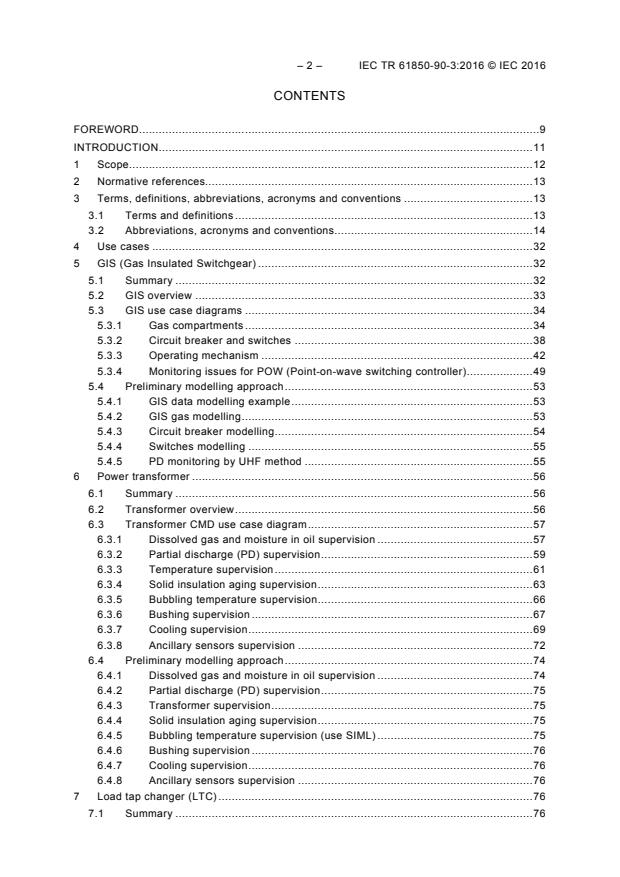
– 2 – IEC TR 61850-90-3:2016 © IEC 2016
CONTENTS
FOREWORD . 9
INTRODUCTION . 11
1 Scope . 12
2 Normative references. 13
3 Terms, definitions, abbreviations, acronyms and conventions . 13
3.1 Terms and definitions . 13
3.2 Abbreviations, acronyms and conventions . 14
4 Use cases . 32
5 GIS (Gas Insulated Switchgear) . 32
5.1 Summary . 32
5.2 GIS overview . 33
5.3 GIS use case diagrams . 34
5.3.1 Gas compartments . 34
5.3.2 Circuit breaker and switches . 38
5.3.3 Operating mechanism . 42
5.3.4 Monitoring issues for POW (Point-on-wave switching controller) . 49
5.4 Preliminary modelling approach . 53
5.4.1 GIS data modelling example . 53
5.4.2 GIS gas modelling . 53
5.4.3 Circuit breaker modelling . 54
5.4.4 Switches modelling . 55
5.4.5 PD monitoring by UHF method . 55
6 Power transformer . 56
6.1 Summary . 56
6.2 Transformer overview . 56
6.3 Transformer CMD use case diagram . 57
6.3.1 Dissolved gas and moisture in oil supervision . 57
6.3.2 Partial discharge (PD) supervision . 59
6.3.3 Temperature supervision . 61
6.3.4 Solid insulation aging supervision . 63
6.3.5 Bubbling temperature supervision . 66
6.3.6 Bushing supervision . 67
6.3.7 Cooling supervision . 69
6.3.8 Ancillary sensors supervision . 72
6.4 Preliminary modelling approach . 74
6.4.1 Dissolved gas and moisture in oil supervision . 74
6.4.2 Partial discharge (PD) supervision . 75
6.4.3 Transformer supervision . 75
6.4.4 Solid insulation aging supervision . 75
6.4.5 Bubbling temperature supervision (use SIML) . 75
6.4.6 Bushing supervision . 76
6.4.7 Cooling supervision . 76
6.4.8 Ancillary sensors supervision . 76
7 Load tap changer (LTC) . 76
7.1 Summary . 76
7.2 Load tap changer overview . 77
7.3 Constraints/assumptions/design considerations . 77
7.4 Data flow . 79
7.5 Use case diagram . 80
7.5.1 Monitoring LTC operation properties . 81
7.5.2 Monitoring LTC operation counts . 83
7.5.3 Monitoring contact abrasion . 84
7.5.4 Monitoring LTC oil temperature and flow . 86
7.5.5 Monitoring operation of oil filter unit . 88
7.6 Data description table . 89
7.6.1 Monitoring operation property . 89
7.6.2 Monitoring operation counts . 91
7.6.3 Monitoring contact abrasion . 92
7.6.4 Monitoring LTC oil temperature and flow . 92
7.6.5 Monitoring operation of oil filter unit . 93
8 Underground cable (UGC) . 94
8.1 Summary . 94
8.2 Underground cable overview . 94
8.2.1 General . 94
8.2.2 XLPE (cross-linked polyethylene insulated) cable . 94
8.2.3 OF (Oil Filled) cable . 95
8.3 Constraints/assumptions/design considerations . 95
8.4 Data flow . 95
8.5 Use case diagram . 97
8.5.1 General . 97
8.5.2 Thermal aging supervision . 97
8.5.3 Supervision of cable parts cracking . 98
8.5.4 Insulation aging supervision . 101
8.5.5 Water-tree supervision . 102
8.5.6 Supervision of earth fault without circuit breaker trip . 104
8.5.7 Oil aging supervision . 106
8.5.8 Oil leak supervision . 107
8.6 Data description table . 109
8.6.1 Sensor items held in existing LNs . 109
8.6.2 Sensor items requiring a new LN . 109
8.6.3 Supervising items held in existing LNs . 110
8.6.4 Supervising items requiring new DO’s in an existing LN . 110
8.6.5 Supervising items requiring a new LN . 110
9 Transmission line (TL) . 110
9.1 Summary . 110
9.2 Transmission line overview . 111
9.2.1 Overhead transmission line (OHTL) . 111
9.2.2 Line sensor unit . 112
9.3 TL CMD use case diagram . 113
9.3.1 Line condition supervisor . 113
9.3.2 Tower condition supervisor . 114
9.3.3 Insulator condition supervisor . 116
9.3.4 Surrounding area supervisor . 118
9.4 Data description table . 121
– 4 – IEC TR 61850-90-3:2016 © IEC 2016
10 Auxiliary power system . 121
10.1 Summary . 121
10.2 Auxiliary power system overview . 122
10.2.1 General . 122
10.2.2 Legend of diagrams . 122
10.2.3 Secured DC system from AC input power . 122
10.2.4 Secured AC system from DC input with AC backup . 123
10.2.5 Secured AC system from AC input with AC backup . 123
10.3 Data flow . 124
10.4 Use case diagram . 124
10.5 Data modelling . 126
10.5.1 Functional breakdown . 126
11 Communication Requirements . 128
11.1 General issues . 128
11.2 Response behaviour requirements (6.4 of IEC 61850-5:2013) . 129
11.3 Requirements for data integrity (Clause 14 of IEC 61850-5:2013) . 129
11.4 Communication requirements for the WAN . 129
11.5 Performance issue . 130
11.6 Plug and Play . 130
12 Asset Management . 130
12.1 Definition . 130
12.2 Comparison of asset management to other systems . 130
12.3 IEC 61850 services for Asset Management . 131
12.3.1 General . 131
12.3.2 Data set . 132
12.3.3 Log . 132
12.3.4 Report . 132
12.3.5 Polling . 133
12.3.6 SCSM . 133
12.4 CMD . 133
12.5 Conclusion . 133
12.6 Maintenance . 133
12.7 ERP Update . 136
13 Logical node classes . 139
13.1 General . 139
13.2 Abstract Logical Nodes (AbstractLNs_90_3) . 140
13.2.1 General . 140
13.2.2 <> LN: Battery Charger Name: BatteryChargerLN . 141
13.3 Logical nodes for tanks (LNGroupK) . 143
13.3.1 General . 143
13.3.2 LN: Tank Name: KTNKExt . 145
13.3.3 LN: Tower Name: KTOW . 146
13.4 Logical nodes for metering and measurement (LNGroupM) . 147
13.4.1 General . 147
13.4.2 LN: Meteorological information Name: MMETExt. 148
13.5 Logical nodes for supervision and monitoring (LNGroupS) . 150
13.5.1 General . 150
13.5.2 LN: Battery Name: SBAT . 153
13.5.3 LN: Circuit breaker supervision Name: SCBRExt . 155
13.5.4 LN: Cooling Group Supervision Name: SCGR . 156
13.5.5 LN: Equipment Ageing Model Name: SEAM . 158
13.5.6 LN: Fire Supervision Name: SFIR . 159
13.5.7 LN: Insulation medium supervision (liquid) Name: SIMLExt . 160
13.5.8 LN: Insulation moisture supervision (solid) Name: SIMS . 165
13.5.9 LN: Tap changer supervision Name: SLTCExt . 167
13.5.10 LN: Power Transformer supervision Name: SPTRExt . 169
13.5.11 LN: Saturation temperature supervision Name: SSTP . 171
13.6 Logical nodes for instrument transformers and sensors (LNGroupT) . 172
13.6.1 General . 172
13.6.2 LN: Density Sensor Name: TDEN . 173
13.6.3 LN: Torque Name: TTRQ . 174
13.6.4 LN: UHF Sensor Name: TUHF . 175
13.7 Logical nodes for power transformers (LNGroupY) . 176
13.7.1 General . 176
13.7.2 LN: Power Transformer Supervision Name: YPTRExt . 177
13.8 Logical nodes for further power system equipment (LNGroupZ) . 179
13.8.1 General . 179
13.8.2 LN: Auxiliary network Name: ZAXNExt . 182
13.8.3 LN: Battery Name: ZBATExt . 183
13.8.4 LN: Bushing Name: ZBSHExt . 185
13.8.5 LN: Battery Charger Name: ZBTC . 186
13.8.6 LN: Power cable Name: ZCABExt . 187
13.8.7 LN: Converter Name: ZCONExt . 189
13.8.8 LN: Generator Name: ZGENExt . 190
13.8.9 LN: Power overhead line Name: ZLINExt . 192
13.8.10 LN: UPS (Uninterruptable Power Supply) Name: ZUPS . 194
14 Data object name semantics and enumerations . 196
14.1 Data semantics . 196
14.2 Enumerated data attribute types . 204
14.2.1 General . 204
14.2.2 BatteryChargerType90_3Kind enumeration . 204
14.2.3 BatteryTestResult90-3Kind enumeration . 205
14.2.4 BatteryType90_3Kind enumeration . 205
14.2.5 ChargerOperationKind enumeration . 205
14.2.6 ExternalDeviceModeKind enumeration . 206
14.2.7 OperationFailureModeKind enumeration . 206
14.2.8 SystemOperationModeKind enumeration . 206
15 SCL enumerations (from DOEnums_90_3) . 207
Annex A (informative) Usage of “T” logical node and “S” logical node in CMD
application . 209
Bibliography . 210
Figure 1 – CMD Modelling Concept . 32
Figure 2 – GIS CMD Overview . 34
Figure 3 – GIS use case diagram . 35
Figure 4 – Abrasion monitoring use case . 39
– 6 – IEC TR 61850-90-3:2016 © IEC 2016
Figure 5 – Switch monitoring use case . 41
Figure 6 – Operating mechanism monitoring use case . 43
Figure 7 – Maintenance planning use case . 48
Figure 8 – CB operating time monitoring use case . 50
Figure 9 – GIS internal structure . 53
Figure 10 – Example of 3 phases compartment modelling . 54
Figure 11 – Example of 3 phases CB modelling . 54
Figure 12 – Example of 3 phases switch modelling . 55
Figure 13 – Example of PD monitoring modelling . 55
Figure 14 – Transformer principle . 56
Figure 15 – Typical power transformer . 57
Figure 16 – Use case for oil supervision . 58
Figure 17 – Partial discharge (PD) use case . 60
Figure 18 – Use case for temperature supervision . 62
Figure 19 – Use case for solid insulation aging supervision . 64
Figure 20 – Use case for bubbling temperature supervision . 66
Figure 21 – Use case for bushing supervision . 68
Figure 22 – Use case for cooling supervision . 70
Figure 23 – Use case for ancillary sensors supervision . 73
Figure 24 – Structure of load tap changer . 77
Figure 25 – Configuration of LTC CMD system . 78
Figure 26 – Data flows for LTC CMD (part 1) . 79
Figure 27 – Data flows for LTC CMD (part 2) . 80
Figure 28 – Data flows for LTC CMD (part 3) . 80
Figure 29 – Use case for monitoring LTC operation properties . 81
Figure 30 – Use case for monitoring LTC operation counts . 83
Figure 31 – Use case for monitoring contact abrasion . 84
Figure 32 – Use case for monitoring LTC oil temperature and flow . 86
Figure 33 – Use case for monitoring operation of oil filter unit . 88
Figure 34 – An online system monitoring OF (Oil Filled) cable conditions . 94
Figure 35 – Cable cross-section drawing . 95
Figure 36 – Supervisions of UGC and their data flows . 96
Figure 37 – Supervisions of OF cables and their data flows . 97
Figure 38 – Use case for thermal aging supervision . 97
Figure 39 – A sensor detecting cable positions in 3 dimensions . 99
Figure 40 – Use case for supervision of cable parts cracking . 99
Figure 41 – Use case for insulation aging supervision . 101
Figure 42 – Use case for water-tree supervision . 102
Figure 43 – Use case for supervision of earth fault without circuit breaker trip . 104
Figure 44 – Use case for oil aging supervision . 106
Figure 45 – Use case for oil leak supervision . 107
Figure 46 – Example configuration of OHTL tower cluster . 112
Figure 47 – Line sensor unit . 112
Figure 48 – Use case for line condition supervisor . 113
Figure 49 – Use case for tower condition supervisor . 115
Figure 50 – Use case for insulator condition supervisor . 117
Figure 51 – Use case for surrounding area supervisor . 119
Figure 52 – Legend of diagrams . 122
Figure 53 – Secured DC system from AC input power . 123
Figure 54 – Secured AC system from DC input with AC backup . 123
Figure 55 – Secured AC system from AC input with AC backup . 124
Figure 56 – Data flow of auxiliary power system . 124
Figure 57 – Use case for auxiliary power system . 125
Figure 58 – Secured DC system from AC input power . 127
Figure 59 – Secured AC system from DC input with AC backup . 127
Figure 60 – Secured AC system from AC input with AC backup . 128
Figure 61 – Communication architecture for CMD . 129
Figure 62 – Reporting and logging model (conceptual) from IEC 61850-7-1 . 132
Figure 63 – Use case for maintenance . 134
Figure 64 – Use case for ERP update . 137
Figure 65 – Class diagram LogicalNodes_90_3::LogicalNodes_90_3 . 140
Figure 66 – Class diagram AbstractLNs_90_3::AbstractLNs_90_3 . 141
Figure 67 – Class diagram LNGroupK::LNGroupK . 144
Figure 68 – Class diagram LNGroupM::LNGroupM . 148
Figure 69 – Class diagram LNGroupS::LNGroupS1 . 151
Figure 70 – Class diagram LNGroupS::LNGroupS2 . 152
Figure 71 – Class diagram LNGroupT::LNGroupT . 173
Figure 72 – Class diagram LNGroupY::LNGroupY . 177
Figure 73 – Class diagram LNGroupZ::LNGroupZ1 . 180
Figure 74 – Class diagram LNGroupZ::LNGroupZ2 . 181
Figure 75 – Class diagram DOEnums_90_3::DOEnums_90_3 . 204
Figure A.1 – Decomposition of functions into interacting LN on different levels:
Examples for generic function with tele control interface, protection function and
measuring/metering function (from IEC 61850-5:2003) . 209
Table 1 – Normative abbreviations for data object names . 14
Table 2 – Data objects of BatteryChargerLN . 142
Table 3 – Data objects of KTNKExt . 145
Table 4 – Data objects of KTOW . 146
Table 5 – Data objects of MMETExt . 149
Table 6 – Data objects of SBAT . 154
Table 7 – Data objects of SCBRExt . 155
Table 8 – Data objects of SCGR . 157
Table 9 – Data objects of SEAM . 158
Table 10 – Data objects of SFIR . 160
Table 11 – Data objects of SIMLExt . 161
Table 12 – Data objects of SIMS . 166
– 8 – IEC TR 61850-90-3:2016 © IEC 2016
Table 13 – Data objects of SLTCExt . 167
Table 14 – Data objects of SPTRExt . 170
Table 15 – Data objects of SSTP . 171
Table 16 – Data objects of TDEN . 174
Table 17 – Data objects of TTRQ . 175
Table 18 – Data objects of TUHF . 176
Table 19 – Data objects of YPTRExt . 178
Table 20 – Data objects of ZAXNExt . 182
Table 21 – Data objects of ZBATExt . 183
Table 22 – Data objects of ZBSHExt . 185
Table 23 – Data objects of ZBTC . 186
Table 24 – Data objects of ZCABExt . 188
Table 25 – Data objects of ZCONExt . 190
Table 26 – Data objects of ZGENExt . 191
Table 27 – Data objects of ZLINExt . 193
Table 28 – Data objects of ZUPS . 195
Table 29 – Attributes defined on classes of LogicalNodes_90_3 package . 196
Table 30 – Literals of BatteryChargerType90_3Kind . 204
Table 31 – Literals of BatteryTestResult90-3Kind . 205
Table 32 – Literals of BatteryType90_3Kind . 205
Table 33 – Literals of ChargerOperationKind . 206
Table 34 – Literals of ExternalDeviceModeKind . 206
Table 35 – Literals of OperationFailureModeKind . 206
Table 36 – Literals of SystemOperationModeKind . 207
INTERNATIONAL ELECTROTECHNICAL COMMISSION
____________
COMMUNICATION NETWORKS AND
SYSTEMS FOR POWER UTILITY AUTOMATION –
Part 90-3: Using IEC 61850 for condition monitoring
diagnosis and analysis
FOREWORD
1) The International Electrotechnical Commission (IEC) is a worldwide organization for standardization comprising
all national electrotechnical committees (IEC National Committees). The object of IEC is to promote
international co-operation on all questions concerning standardization in the electrical and electronic fields. To
this end and in addition to other activities, IEC publishes International Standards, Technical Specifications,
Technical Reports, Publicly Available Specifications (PAS) and Guides (hereafter referred to as “IEC
Publication(s)”). Their preparation is entrusted to technical committees; any IEC National Committee interested
in the subject dealt with may participate in this preparatory work. International, governmental and non-
governmental organizations liaising with the IEC also participate in this preparation. IEC collaborates closely
with the International Organization for Standardization (ISO) in accordance with conditions determined by
agreement between the two organizations.
2) The formal decisions or agreements of IEC on technical matters express, as nearly as possible, an international
consensus of opinion on the relevant subjects since each technical committee has representation from all
interested IEC National Committees.
3) IEC Publications have the form of recommendations for international use and are accepted by IEC National
Committees in that sense. While all reasonable efforts are made to ensure that the technical content of IEC
Publications is accurate, IEC cannot be held responsible for the way in which they are used or for any
misinterpretation by any end user.
4) In order to promote international uniformity, IEC National Committees undertake to apply IEC Publications
transparently to the maximum extent possible in their national and regional publications. Any divergence
between any IEC Publication and the corresponding national or regional publication shall be clearly indicated in
the latter.
5) IEC itself does not provide any attestation of conformity. Independent certification bodies provide conformity
assessment services and, in some areas, access to IEC marks of conformity. IEC is not responsible for any
services carried out by independent certification bodies.
6) All users should ensure that they have the latest edition of this publication.
7) No liability shall attach to IEC or its directors, employees, servants or agents including individual experts and
members of its technical committees and IEC National Committees for any personal injury, property damage or
other damage of any nature whatsoever, whether direct or indirect, or for costs (including legal fees) and
expenses arising out of the publication, use of, or reliance upon, this IEC Publication or any other IEC
Publications.
8) Attention is drawn to the Normative references cited in this publication. Use of the referenced publications is
indispensable for the correct application of this publication.
9) Attention is drawn to the possibility that some of the elements of this IEC Publication may be the subject of
patent rights. IEC shall not be held responsible for identifying any or all such patent rights.
The main task of IEC technical committees is to prepare International Standards. However, a
technical committee may propose the publication of a technical report when it has collected
data of a different kind from that which is normally published as an International Standard, for
example "state of the art".
IEC TR 61850-90-3, which is a technical report, has been prepared by IEC technical
committee 57: Power systems management and associated information exchange.
– 10 – IEC TR 61850-90-3:2016 © IEC 2016
The text of this technical report is based on the following documents:
Enquiry draft Report on voting
57/1522/DTR 57/1654/RVC
Full information on the voting for the approval of this technical report can be found in the
report on voting indicated in the above table.
This publication has been drafted in accordance with the ISO/IEC Directives, Part 2.
A list of all parts in the IEC 61850 series, published under the general title Communication
networks and systems for power utility automation, can be found on the IEC website.
The committee has decided that the contents of this publication will remain unchanged until
the stability date indicated on the IEC website under "http://webstore.iec.ch" in the data
related to the specific publication. At this date, the publication will be
• reconfirmed,
• withdrawn,
• replaced by a revised edition, or
• amended.
A bilingual version of this publication may be issued at a later date.
IMPORTANT – The 'colour inside' logo on the cover page of this publication indicates
that it contains colours which are considered to be useful for the correct
understanding of its contents. Users should therefore print this document using a
colour printer.
INTRODUCTION
The CMD (Condition Monitoring Diagnosis) which diagnoses power grid health status has
been one of the major issues to improve the reliability of the power system by preventing a
potential failure in advance. Since too many different information modelling, information
exchange, and configuration techniques for CMD in various forms from many vendors are
currently used, they need to be standardized within the IEC.
IEC 61850 is intended to be used to communicate with the condition monitoring equipment. A
seamless communication with the sensor network is also desirable.
– 12 – IEC TR 61850-90-3:2016 © IEC 2016
COMMUNICATION NETWORKS AND
SYSTEMS FOR POWER UTILITY AUTOMATION –
Part 90-3: Using IEC 61850 for condition monitoring
diagnosis and analysis
1 Scope
Since the outcome of this work will affect several parts of IEC 6185
...