

IEC 61003-1:2004
(Main)Industrial-process control systems - Instruments with analogue inputs and two-or multi-state outputs - Part 1: Methods of evaluating performance
General Information
- Abstract
IEC 61003-1:2004 is applicable to pneumatic and electric industrial-process instruments using measured values that are continuous signals in accordance with IEC 60382, or IEC 60381-1. It is intended to specify uniform testing methods for performance evaluation of industrial-process instruments with analogue measured values and two- or multi-state outputs. This second edition cancels and replaces the first edition issued in 1991 and constitutes a technical revision. It takes into account the common standardized basis specified in the IEC 61298 series. This bilingual version (2014-01) corresponds to the monolingual English version, published in 2004-01.
- Status
- Published
- Publication Date
- 27-Jan-2004
- Technical Committee
- SC 65B - Measurement and control devices
- Drafting Committee
- WG 6 - TC 65/SC 65B/WG 6
- Current Stage
- DELPUB - Deleted Publication
- Start Date
- 14-Jun-2016
- Completion Date
- 28-Aug-2026
Buy Documents
IEC 61003-1:2004 - Industrial-process control systems - Instruments with analogue inputs and two-or multi-state outputs - Part 1: Methods of evaluating performance Released:1/28/2004
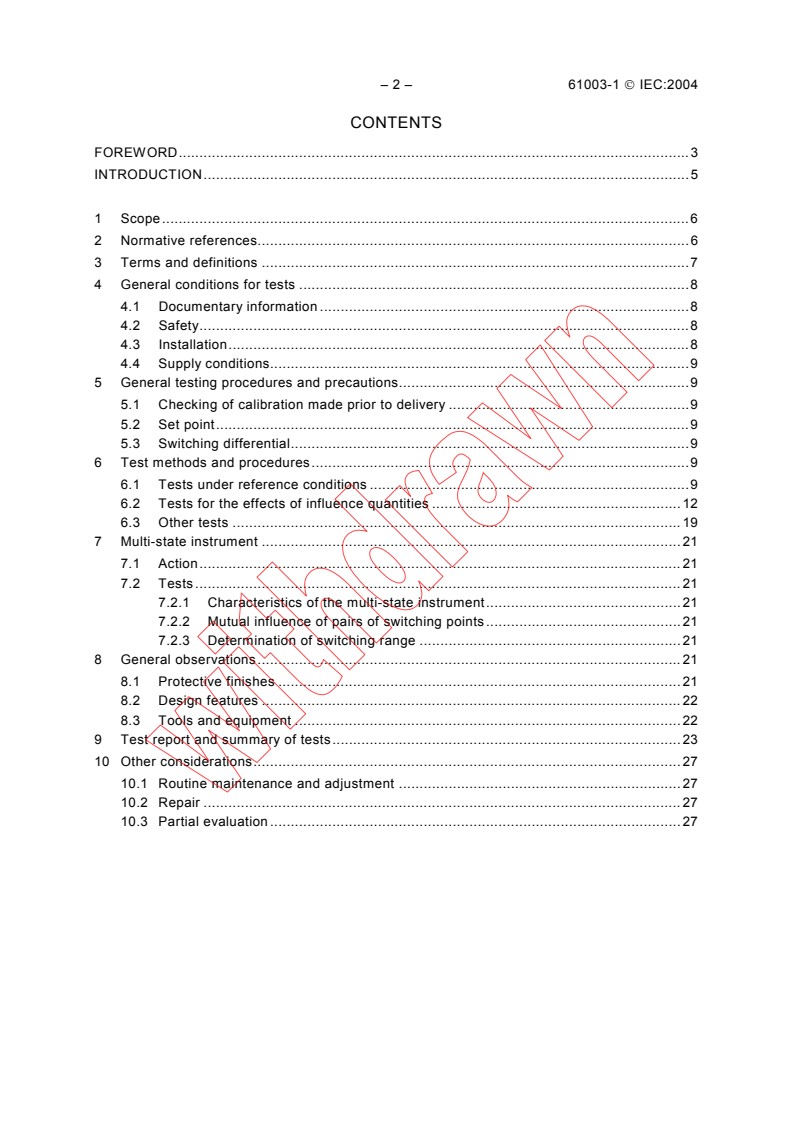
IEC 61003-1:2004 - Industrial-process control systems - Instruments with analogue inputs and two-or multi-state outputs - Part 1: Methods of evaluating performance Released:1/28/2004
Overview
IEC 61003-1:2004 - "Industrial-process control systems - Instruments with analogue inputs and two‑ or multi‑state outputs - Part 1: Methods of evaluating performance" - defines uniform methods of evaluating performance for pneumatic and electric process instruments that accept continuous (analogue) measured values and provide two‑state or multi‑state outputs. This second edition (2004) replaces the 1991 edition and aligns test methods with the common basis in the IEC 61298 series. The standard is intended for manufacturers, users and independent testing bodies to verify performance claims and to guide consistent test programs.
Key topics and requirements
- Scope and applicability
- Applies to instruments using continuous signals per IEC 60382 or IEC 60381‑1 (pneumatic and DC analogue signals).
- Covers devices used as controllers or as switches (alarms, interlocks) with two‑state or multi‑state outputs.
- Excludes instruments with feedback and does not address electronic security issues.
- General test conditions
- Requirements for documentary information, safety, installation and supply conditions to be considered during evaluation.
- Emphasis on manufacturer-supplied documentation (installation, commissioning, maintenance, spare parts).
- Performance test procedures
- Tests under reference conditions and tests for the effects of influence quantities (environmental and supply variations).
- Procedures for checking pre‑delivery calibration, set point determination, switching points, switching differential (Xsd), mean switching point, and, for multi‑state devices, switching range.
- Multi‑state instruments
- Definitions and methods to evaluate n‑state outputs, mutual influence between switching points and overall switching range.
- Reporting and observations
- Content and format expectations for test reports and summary of tests.
- Notes on protective finishes, design features, tools/equipment, maintenance and repair considerations.
Applications and practical value
- Provides a repeatable, internationally recognized method to:
- Verify manufacturer performance specifications for two‑state and multi‑state instruments.
- Support product development, factory acceptance testing and third‑party certification.
- Evaluate switching behavior used in alarms, safety interlocks, and on/off control loops in process plants.
- Useful in sectors such as chemical, oil & gas, power generation, water treatment and manufacturing where robust switching and alarm performance are critical.
Who should use this standard
- Instrument manufacturers designing and certifying analogue‑input, multi‑state output devices.
- Independent testing laboratories and conformity assessment bodies.
- Plant engineers, procurement specialists and system integrators who need objective performance data for selection and acceptance testing.
Related standards
- IEC 61298 series (Parts 1–4) - general methods and procedures for evaluating performance
- IEC 60381‑1, IEC 60382 - analogue signal standards for process control
- IEC 61010‑1 - safety requirements for measurement and control equipment
- IEC 61326 - EMC requirements
- IEC 60050‑351 - IEV terms for automatic control
Keywords: IEC 61003-1, industrial-process control systems, analogue inputs, two-state outputs, multi-state outputs, methods of evaluating performance, switching differential, switching point, IEC 61298.
Relations
- Effective Date
- 05-Sep-2023
Buy Documents
IEC 61003-1:2004 - Industrial-process control systems - Instruments with analogue inputs and two-or multi-state outputs - Part 1: Methods of evaluating performance Released:1/28/2004
IEC 61003-1:2004 - Industrial-process control systems - Instruments with analogue inputs and two-or multi-state outputs - Part 1: Methods of evaluating performance Released:1/28/2004
Get Certified
Connect with accredited certification bodies for this standard

BSI Group
BSI (British Standards Institution) is the business standards company that helps organizations make excellence a habit.

DVS-ZERT GmbH
German welding certification society.
CARES (UK Certification Authority for Reinforcing Steels)
UK certification for reinforcing steels and construction.
Sponsored listings
Frequently Asked Questions
IEC 61003-1:2004 is a standard published by the International Electrotechnical Commission (IEC). Its full title is "Industrial-process control systems - Instruments with analogue inputs and two-or multi-state outputs - Part 1: Methods of evaluating performance". This standard covers: IEC 61003-1:2004 is applicable to pneumatic and electric industrial-process instruments using measured values that are continuous signals in accordance with IEC 60382, or IEC 60381-1. It is intended to specify uniform testing methods for performance evaluation of industrial-process instruments with analogue measured values and two- or multi-state outputs. This second edition cancels and replaces the first edition issued in 1991 and constitutes a technical revision. It takes into account the common standardized basis specified in the IEC 61298 series. This bilingual version (2014-01) corresponds to the monolingual English version, published in 2004-01.
IEC 61003-1:2004 is applicable to pneumatic and electric industrial-process instruments using measured values that are continuous signals in accordance with IEC 60382, or IEC 60381-1. It is intended to specify uniform testing methods for performance evaluation of industrial-process instruments with analogue measured values and two- or multi-state outputs. This second edition cancels and replaces the first edition issued in 1991 and constitutes a technical revision. It takes into account the common standardized basis specified in the IEC 61298 series. This bilingual version (2014-01) corresponds to the monolingual English version, published in 2004-01.
IEC 61003-1:2004 is classified under the following ICS (International Classification for Standards) categories: 25.040.40 - Industrial process measurement and control; 35.240.50 - IT applications in industry. The ICS classification helps identify the subject area and facilitates finding related standards.
IEC 61003-1:2004 has the following relationships with other standards: It is inter standard links to IEC 61003-1:2016. Understanding these relationships helps ensure you are using the most current and applicable version of the standard.
IEC 61003-1:2004 is available in PDF format for immediate download after purchase. The document can be added to your cart and obtained through the secure checkout process. Digital delivery ensures instant access to the complete standard document.
Standards Content (Sample)
INTERNATIONAL IEC
STANDARD 61003-1
Second edition
2004-01
Industrial-process control systems –
Instruments with analogue inputs and
two- or multi-state outputs –
Part 1:
Methods of evaluating performance
Reference number
Publication numbering
As from 1 January 1997 all IEC publications are issued with a designation in the
60000 series. For example, IEC 34-1 is now referred to as IEC 60034-1.
Consolidated editions
The IEC is now publishing consolidated versions of its publications. For example,
edition numbers 1.0, 1.1 and 1.2 refer, respectively, to the base publication, the
base publication incorporating amendment 1 and the base publication incorporating
amendments 1 and 2.
Further information on IEC publications
The technical content of IEC publications is kept under constant review by the IEC,
thus ensuring that the content reflects current technology. Information relating to
this publication, including its validity, is available in the IEC Catalogue of
publications (see below) in addition to new editions, amendments and corrigenda.
Information on the subjects under consideration and work in progress undertaken
by the technical committee which has prepared this publication, as well as the list
of publications issued, is also available from the following:
• IEC Web Site (www.iec.ch)
• Catalogue of IEC publications
The on-line catalogue on the IEC web site (www.iec.ch/searchpub) enables you to
search by a variety of criteria including text searches, technical committees
and date of publication. On-line information is also available on recently issued
publications, withdrawn and replaced publications, as well as corrigenda.
• IEC Just Published
This summary of recently issued publications (www.iec.ch/online_news/ justpub)
is also available by email. Please contact the Customer Service Centre (see
below) for further information.
• Customer Service Centre
If you have any questions regarding this publication or need further assistance,
please contact the Customer Service Centre:
Email: custserv@iec.ch
Tel: +41 22 919 02 11
Fax: +41 22 919 03 00
INTERNATIONAL IEC
STANDARD 61003-1
Second edition
2004-01
Industrial-process control systems –
Instruments with analogue inputs and
two- or multi-state outputs –
Part 1:
Methods of evaluating performance
IEC 2004 Copyright - all rights reserved
No part of this publication may be reproduced or utilized in any form or by any means, electronic or
mechanical, including photocopying and microfilm, without permission in writing from the publisher.
International Electrotechnical Commission, 3, rue de Varembé, PO Box 131, CH-1211 Geneva 20, Switzerland
Telephone: +41 22 919 02 11 Telefax: +41 22 919 03 00 E-mail: inmail@iec.ch Web: www.iec.ch
PRICE CODE
Commission Electrotechnique Internationale U
International Electrotechnical Commission
МеждународнаяЭлектротехническаяКомиссия
For price, see current catalogue
– 2 – 61003-1 IEC:2004(E)
CONTENTS
FOREWORD.3
INTRODUCTION.5
1 Scope.6
2 Normative references.6
3 Terms and definitions .7
4 General conditions for tests .8
4.1 Documentary information.8
4.2 Safety.8
4.3 Installation.8
4.4 Supply conditions.9
5 General testing procedures and precautions.9
5.1 Checking of calibration made prior to delivery .9
5.2 Set point.9
5.3 Switching differential.9
6 Test methods and procedures.9
6.1 Tests under reference conditions .9
6.2 Tests for the effects of influence quantities .12
6.3 Other tests.19
7 Multi-state instrument.21
7.1 Action.21
7.2 Tests.21
7.2.1 Characteristics of the multi-state instrument.21
7.2.2 Mutual influence of pairs of switching points.21
7.2.3 Determination of switching range .21
8 General observations.21
8.1 Protective finishes.21
8.2 Design features.22
8.3 Tools and equipment .22
9 Test report and summary of tests.23
10 Other considerations.27
10.1 Routine maintenance and adjustment .27
10.2 Repair.27
10.3 Partial evaluation.27
61003-1 © IEC:2004(E) – 3 –
INTERNATIONAL ELECTROTECHNICAL COMMISSION
___________
INDUSTRIAL-PROCESS CONTROL SYSTEMS –
INSTRUMENTS WITH ANALOGUE INPUTS AND
TWO- OR MULTI-STATE OUTPUTS –
Part 1: Methods of evaluating performance
FOREWORD
1) The International Electrotechnical Commission (IEC) is a worldwide organization for standardization comprising
all national electrotechnical committees (IEC National Committees). The object of IEC is to promote
international co-operation on all questions concerning standardization in the electrical and electronic fields. To
this end and in addition to other activities, IEC publishes International Standards, Technical Specifications,
Technical Reports, Publicly Available Specifications (PAS) and Guides (hereafter referred to as “IEC
Publication(s)”). Their preparation is entrusted to technical committees; any IEC National Committee interested
in the subject dealt with may participate in this preparatory work. International, governmental and non-
governmental organizations liaising with the IEC also participate in this preparation. IEC collaborates closely
with the International Organization for Standardization (ISO) in accordance with conditions determined by
agreement between the two organizations.
2) The formal decisions or agreements of IEC on technical matters express, as nearly as possible, an international
consensus of opinion on the relevant subjects since each technical committee has representation from all
interested IEC National Committees.
3) IEC Publications have the form of recommendations for international use and are accepted by IEC National
Committees in that sense. While all reasonable efforts are made to ensure that the technical content of IEC
Publications is accurate, IEC cannot be held responsible for the way in which they are used or for any
misinterpretation by any end user.
4) In order to promote international uniformity, IEC National Committees undertake to apply IEC Publications
transparently to the maximum extent possible in their national and regional publications. Any divergence
between any IEC Publication and the corresponding national or regional publication shall be clearly indicated in
the latter.
5) IEC provides no marking procedure to indicate its approval and cannot be rendered responsible for any
equipment declared to be in conformity with an IEC Publication.
6) All users should ensure that they have the latest edition of this publication.
7) No liability shall attach to IEC or its directors, employees, servants or agents including individual experts and
members of its technical committees and IEC National Committees for any personal injury, property damage or
other damage of any nature whatsoever, whether direct or indirect, or for costs (including legal fees) and
expenses arising out of the publication, use of, or reliance upon, this IEC Publication or any other IEC
Publications.
8) Attention is drawn to the Normative references cited in this publication. Use of the referenced publications is
indispensable for the correct application of this publication.
9) Attention is drawn to the possibility that some of the elements of this IEC Publication may be the subject of
patent rights. IEC shall not be held responsible for identifying any or all such patent rights.
International Standard IEC 61003-1 has been prepared by subcommittee 65B: Devices, of IEC
technical committee 65: Industrial-process measurement and control.
This second edition cancels and replaces the first edition issued in 1991 and constitutes a
technical revision. It takes into account the common standardized basis specified in the IEC
61298 series. Any test method or procedure specified and described herein is referred to the
corresponding Clause of the IEC 61298 series. Any particular method or procedure not covered
by the IEC 61298 series is developed and specified in this standard in accordance with the
criteria stated in the IEC 61298 series, as far as they are applicable.
– 4 – 61003-1 IEC:2004(E)
The text of this standard is based on the following documents:
FDIS Report on voting
65B/516/FDIS 65B/524/RVD
Full information on the voting for the approval of this standard can be found in the report on
voting indicated in the above table.
This publication has been drafted in accordance with the ISO/IEC Directives, Part 2.
The committee has decided that the contents of this publication will remain unchanged until
2012. At this date, the publication will be
• reconfirmed;
• withdrawn;
• replaced by a revised edition, or
• amended.
A bilingual version of this publication may be issued at a later date.
61003-1 © IEC:2004(E) – 5 –
INTRODUCTION
The methods of evaluation specified in this part of IEC 61003 are intended for use by
manufacturers to determine the performance of their products and by users, or independent
testing establishments, to verify the manufacturer's performance specifications.
The test conditions in this standard, for example the range of ambient temperatures and power
supply, represent those, which commonly arise in use. Consequently, the values specified
herein shall be used where the manufacturer specifies no other values.
The tests specified in this standard are not necessarily sufficient for instruments specifically
designed for unusually arduous duties. Conversely, a restricted series of tests may be suitable
for instruments designed to perform within a more limited range of conditions.
It will be appreciated that the closest communication should be maintained between the
evaluating body and the manufacturer. Note shall be taken of the manufacturer's specifications
for the instrument, when the test programme is being decided, and the manufacturer should be
invited to comment on both the test programme and the results. His comments on the results
should be included in any report produced by the testing organisation.
– 6 – 61003-1 IEC:2004(E)
INDUSTRIAL-PROCESS CONTROL SYSTEMS –
INSTRUMENTS WITH ANALOGUE INPUTS AND
TWO- OR MULTI-STATE OUTPUTS –
Part 1: Methods of evaluating performance
1 Scope
This part of IEC 61003 is applicable to pneumatic and electric industrial-process instruments
using measured values that are continuous signals in accordance with IEC 60382, or IEC
60381-1. The other input value (i.e. the set point value) may be either a mechanical (position,
force, etc.) or a standard signal.
It should be noted that tests specified herein may be applied to instruments which have other
continuous measured values, provided that due allowance is made for such differences.
These instruments may be used as controllers or as switches for alarm and other similar
purposes.
Instruments with feedback are not covered by this standard.
Electronic security issues may impact only a few products covered by this document.
Consequently this document does not address such security issues.
This standard is intended to specify uniform testing methods for performance evaluation of
industrial-process instruments with analogue measured values and two- or multi-state outputs.
Considerations other than the performances are listed in Clause 10.
2 Normative references
The following referenced documents are indispensable for the application of this document. For
dated references, only the edition cited applies. For undated references, the latest edition of
the referenced document (including any amendments) applies.
IEC 60050-351:1998, International Electrotechnical Vocabulary (IEV) – Part 351 Automatic
control
IEC 60381-1:1982, Analogue signals for process control systems – Part 1: Direct current
signals
IEC 60382:1991, Analogue pneumatic signals for process control systems
IEC 61010-1:2001, Safety requirements for electrical equipment for measurement, control and
laboratory use – Part 1: General requirements
IEC 61298-1:1995, Process measurement and control devices – General methods and
procedures for evaluating performance – Part 1: General considerations
IEC 61298-2:1995, Process measurement and control devices – General methods and
procedures for evaluating performance – Part 2: Tests under reference conditions
61003-1 © IEC:2004(E) – 7 –
IEC 61298-3:1998, Process measurement and control devices – General methods and
procedures for evaluating performance – Part 3: Tests for the effects of influence quantities
IEC 61298-4:1995, Process measurement and control devices – General methods and
procedures for evaluating performance – Part 4: Evaluation report content
IEC 61326:2002, Electrical equipment for measurement, control and laboratory use – EMC
requirements
3 Terms and definitions
For the purposes of this document, the terms and definitions given in IEC 60050-351 and in
IEC 61298-1, IEC 61298-2, IEC 61298-3, IEC 61298-4, together with the following definitions
apply.
3.1
, x
switching point x
1 2
measured value (with the input moving either upscale or downscale), at which the output (y)
changes from one state to another
3.2
two-state instrument
action illustrated in Figure 1, where x is the value of the input variable and y is the value of the
output signal.
The two-state instrument, having one pair of switching points x and x (x greater than x ) has
1 2 2 1
the relationships:
for x < x
y = y
1 1
y = y for x > x
2 2
For x < x < x y may be either y or y .
1 2, 1 2
It is y if the last switching point crossed by x was x .
1 1
It is y if the last switching point crossed by x was x .
2 2
3.3
multi-state instrument
a multi-state instrument (see Clause 7 and Figure 4) has n possible output values and n-1 pairs
of switching points. Each pair of switching points may be investigated by the procedure given
for the two-state instrument.
3.4
switching differential X
sd
difference between the switching point x with the measured value moving upscale and the
switching point x with the measured value moving downscale
3.5
instrument with no switching differential
this is considered to be a special case where the switching differential approaches zero
3.6
mean switching point x
m
the mean of the values of upscale and downscale switching points
– 8 – 61003-1 IEC:2004(E)
3.7
switching range X
sr
in a multi-state instrument the range of measured values corresponding to the extreme
switching points
3.8
set point w (reference input variable)
the point (value) at which it is desired that switching (at x or x as specified) should occur
2 1
4 General conditions for tests
For the purpose of this standard the general test conditions (e.g. environmental test conditions,
supply conditions, load conditions, mounting position, externally induced vibrations, external
mechanical constraints, delivery of the instrument) specified in IEC 61298-1, Clause 6 apply,
together with the additional information below.
4.1 Documentary information
The manufacturer shall supply to the evaluating body information for installation,
commissioning, operation, routine maintenance and repair of the instrument. A spare parts list,
together with a recommendation of the spare parts to be held in stock, shall be supplied. The
language of written information for installation should be the language of the local user.
All the relevant publications supplied by the manufacturer, automatically and on request, should
be listed.
If they do not contain a clear description, with adequate diagrams, of the operation of the
instrument, or if they do not contain an adequate spare parts and specifications list, the nature
of the inadequacy should be noted.
Additionally, any certificates indicating the degree of intrinsic safety and flameproofing, etc. of
electrically powered instruments should be listed. This information should give details of the
certificate numbers and the degree of protection provided.
Procedures for installation, routine maintenance and adjustment, repairs and overhaul should
be examined by the actual performance of the required operation. This should be performed in
accordance with the manufacturer's instructions, so that an evaluation of the instructions can
be carried out concurrently.
4.2 Safety
Electrically powered instruments should be examined to determine the degree to which their
design protects them against accidental electric shock.
4.3 Installation
The instrument should be installed and set to work according to the manufacturer's
instructions, taking account of the various applications which may be met in practice and which
require different procedures.
The method of mounting specified by the manufacturer should be reported. Any restrictions on
the use of the instrument caused by this method of mounting shall be noted with explanations.
Any other aspects that may seem relevant to the ease or difficulty of installation should be
noted with explanations.
61003-1 © IEC:2004(E) – 9 –
4.4 Supply conditions
Tolerances on supply conditions for mains supplied equipment are given in 6.2.2 of IEC 61298-1.
For instruments with self-contained power supplies (e.g. battery-powered) the tolerances are
different and shall be agreed.
NOTE For pneumatic instrument care should be taken to ensure that pneumatic connections are leak tight.
5 General testing procedures and precautions
For the purpose of this standard, the general testing procedures and precautions, specified in
Clause 7 of IEC 61298-1, shall be applied, together with the additional information below.
5.1 Checking of calibration made prior to delivery
The input-output characteristic that shall be checked (see 7.6 of IEC 61298-1) is the values of
the switching points x and x found during the calibration (if any) made prior to delivery.
1 2
5.2 Set point
Except where otherwise specified, the set point shall be set to the midscale value or, where no
scale is provided, to the middle of the effective range of adjustment.
5.3 Switching differential
Except where otherwise specified, if the switching differential X is adjustable, it shall be set
sd
to the midscale value or, where no scale is provided, to the middle of the effective range of
adjustment.
6 Test methods and procedures
For the purpose of this standard, the tests general methods and procedures – if any – specified
in IEC 61298-2 and IEC 61298-3 apply, together with the additional information stated below.
6.1 Tests under reference conditions
Methods and procedures for each test are described in the last column of the following table.
In the others column are indicated:
– Clause N° and designation of test;
– Clause number of the reference where the general procedures are specified.
– 10 – 61003-1 IEC:2004(E)
Clause and Designation Reference Test methods and procedures description
6.1.1 Switching accuracy IEC 61298-2 The input measured value x shall be varied
related factors slowly at least five times in each direction
4.1.7
through its entire range. By observation of the
output, the values of points x and x and their
1 2
average shall be determined.
For each cycle, the switching differential (x –
x ) shall be noted.
6.1.1.1 Inaccuracy of IEC 61298-2 Switching point inaccuracy is determined by
selecting the greatest positive and negative
switching points
4.1.7.1
deviations of any measured value of x and x ,
1 2
of any cycle, from the set point w for increasing
and decreasing inputs and reporting this in
percent of nominal span of measured value.
6.1.1.2 Non-repeatability of IEC 61298-2 Non-repeatability shall be computed observing
the maximum difference, in percent of nominal
switching points
4.1.7.6
span of measured value, among all x values
and among all x values.
The maximum value, from either the x
maximum difference or the x maximum
difference, is reported as non-repeatability.
6.1.1.3 Inaccuracy of IEC 61298-2 The switching differential X is calculated by
sd
subtracting the average value of x from the
switching
4.1.7.1
average value of x (see 6.1.1).
differential
Switching differential inaccuracy is determined
by selecting the greatest positive and negative
deviations of any measured value of the
switching differentials – calculated in each of
the five cycles – from the X value and
sd
reporting this in percent of the nominal span of
measured value.
6.1.1.4 Non-repeatability of IEC 61298-2 Non-repeatability shall be computed calculating
the differences, in percent of the nominal span
switching
4.1.7.6
of measured value, among all switching
differential
differential values noted in 6.1.1.
The maximum of those values is reported as
non-repeatability of switching differential.
6.1.2 Mean switching Mean switching point x is calculated as the
m
mean of the average values of x and x (see
point
1 2
6.1.1).
For the adjustment of set point value w, four
6.1.3 Set point
cases shall be considered:
1. a) w is an adjustable and directly
measurable value;
b) w is adjustable at the instrument and an
adjusting scale for w is provided;
2. w is adjustable at the instrument, but there
is no adjusting scale;
3. w is a pre-selected fixed value.
61003-1 © IEC:2004(E) – 11 –
Clause and Designation Reference Test methods and procedures description
6.1.3.1 Set point adjustable IEC 61298-2 Determine values of x x and X , and their
1, 2 sd
and measurable or accuracy-related factors, in accordance with
4.1.7.1 and
the test procedures in subclause 6.1.1, at least
indicated
4.1.7.6
for values of w of 10 %, 50 % and 90 %, the
50 % value being taken last.
Determine values of x , in accordance with the
m
test procedures in 6.1.2.
The inaccuracy of set point setting is
determined by selecting the greatest positive
and negative deviations of any measured value
of x from the ideal set-point value for each
m
cycle and for each set-point and reporting this
in percent of the nominal span of measured
value.
6.1.3.2 Set point adjustable IEC 61298-2 Determine values of x x and X , and their
1, 2 sd
accuracy-related factors, in accordance with
but not indicated
4.1.7.1 and
the test procedures in 6.1.1 and 6.1.2, and
4.1.7.6
values of x , in accordance with the test
m
procedures in 6.1.2.
Make this test, for at least three values of w,
approximately evenly spaced over the effective
range of adjustment, the approximately mid
value being taken last.
No determination of x -w is possible in this
m
case.
6.1.3.3 Set point not IEC 61298-2 Determine values of x x and X , and their
1, 2 sd
adjustable accuracy-related factors, in accordance with
4.1.7.1 and
the test procedures in 6.1.1 and 6.1.2, and
4.1.7.6
values of x , in accordance with the test
m
procedures in 6.1.2.
The inaccuracy of set point setting is
determined by selecting the greatest positive
and negative deviations of any measured value
of x from the value of w declared by the
m
manufacturer and reporting that in percent of
the nominal span of measured value.
NOTE For two-state instruments with non-symmetrically
adjustable switching differential (e.g. instruments where
x or x instead of x is intended to be equal to w) the
1 2 m
value of x – w or x – w instead of x -w should be taken
1 2 m
into account.
– 12 – 61003-1 IEC:2004(E)
6.2 Tests for the effects of influence quantities
Methods and procedures for each test are described in the last column of the following table.
In the others column are indicated:
– Clause N° and designation of test;
– Clause number of the reference where the general procedures are specified.
Clause and Designation Reference Test methods and procedures description
6.2.1 Ambient IEC 61298-3 The change in switching points shall be
determined at each test temperature
temperature
Clause 5
specified in 5.2 of IEC 61298-3. For example:
+20 °C (reference), +40 °C, +55 °C, +20 °C,
0 °C, –20 °C, +20 °C. After the first cycle, a
second temperature cycle, identical to the
first, shall be performed without readjustment
of the instrument.
For instruments with a pneumatic output the
air supply temperature shall be the same as
the instrument temperature.
6.2.2 Humidity IEC 61298-3 The test shall be performed for electrical
instruments only.
Clause 6
This test shall be performed according to the
methods and procedures stated in Clause 6
of IEC 61298-3, together with what is stated
below.
After the stabilisation at the reference relative
humidity and temperature, a set of reference
measurements shall be taken.
The power supply to the instrument shall be
switched off and the relative humidity shall be
increased as specified in Clause 6 of IEC
61298-3.
The instrument shall be switched on for the
final 4 h of the period in stable conditions and
the change in switching points shall be
measured immediately after this period.
As specified in Clause 6 of IEC 61298-3, the
relative humidity shall be reduced to the
original reference value and, after
stabilisation, the effect of this test on the
switching points shall be determined.
After this test, a visual inspection shall be
conducted to check for effects of flashover,
accumulation of condensation, deterioration
of components.
61003-1 © IEC:2004(E) – 13 –
Clause and Designation Reference Test methods and procedures description
6.2.3 Vibrations IEC 61298-3 a) During the frequency sweeping,
frequencies shall be noted, which cause
Clause 7
significant changes in the switching points or
spurious operation such as contact bounce.
NOTE In order to measure the effect of vibrations on
the switching behaviour, the sweeping shall be
performed with the measured variable input set above
the switching point x , or below the switching point x
2 1
to a distance that is twice the value of the switching
differential X , but not less than 1 % of nominal span
sd
of measured value.
If, during the sweeping, switching occurs, the
test shall be repeated with a larger difference
between measured value input and switching
point (at 0 Hz) until no switching is induced by
vibration.
The largest difference and the frequency, at
which the last switching occurred, are to be
noted.
b) Endurance conditioning by sweeping
7.3 of IEC 61298-3
The instrument shall be subjected to vibration
for ½ h in each of three mutually perpen-
dicular planes, one of which shall be the
vertical direction. In each plane, the test shall
be run at that frequency which resulted in the
largest mechanical resonance during the
initial resonance search, or if a resonance
was not detected, the vibration frequency
shall be swept continuously through the
whole frequency range being considered.
c) Final resonance search
7.4 of IEC 61298-3
The resonance frequencies and the
frequencies which cause significant changes
in the switching points found in the initial
resonance search and the final resonance
search shall be compared. Difference can be
caused by non-elastic deformation, which
may lead to the origination of cracks in the
mechanical construction.
d) Final measurement
7.5 of IEC 61298-3
The satisfactory mechanical condition of the
instrument shall be verified at the end of the
test. Any change of switching points shall be
noted. If the instrument has a mechanical set
point, determine whether vibration has shifted
the set point.
– 14 – 61003-1 IEC:2004(E)
Clause and Designation Reference Test methods and procedures description
6.2.4 Shock, drop and IEC 61298-3 This test shall be performed according to the
methods and procedures stated in Clause 8
topple
Clause 8
of IEC 61298-3, together with what is stated
below.
Before the test, a reference measurement of
switching points shall be recorded.
After the test any change in switching points
shall be recorded.
6.2.5 Mounting position IEC 61298-3 The change in switching points caused by
±10° inclinations from the reference position
Clause 9
of the instrument shall be determine
...
IEC 61003-1 ®
Edition 2.0 2004-01
INTERNATIONAL
STANDARD
NORME
INTERNATIONALE
Industrial-process control systems – Instruments with analogue inputs and two-
or multi-state outputs –
Part 1: Methods of evaluating performance
Systèmes de commande de processus industriels – Instruments avec entrées
analogiques et sorties à deux ou plusieurs états –
Partie 1: Méthodes d’évaluation des performances
All rights reserved. Unless otherwise specified, no part of this publication may be reproduced or utilized in any form
or by any means, electronic or mechanical, including photocopying and microfilm, without permission in writing from
either IEC or IEC's member National Committee in the country of the requester. If you have any questions about IEC
copyright or have an enquiry about obtaining additional rights to this publication, please contact the address below or
your local IEC member National Committee for further information.
Droits de reproduction réservés. Sauf indication contraire, aucune partie de cette publication ne peut être reproduite
ni utilisée sous quelque forme que ce soit et par aucun procédé, électronique ou mécanique, y compris la photocopie
et les microfilms, sans l'accord écrit de l'IEC ou du Comité national de l'IEC du pays du demandeur. Si vous avez des
questions sur le copyright de l'IEC ou si vous désirez obtenir des droits supplémentaires sur cette publication, utilisez
les coordonnées ci-après ou contactez le Comité national de l'IEC de votre pays de résidence.
IEC Central Office Tel.: +41 22 919 02 11
3, rue de Varembé Fax: +41 22 919 03 00
CH-1211 Geneva 20 info@iec.ch
Switzerland www.iec.ch
About the IEC
The International Electrotechnical Commission (IEC) is the leading global organization that prepares and publishes
International Standards for all electrical, electronic and related technologies.
About IEC publications
The technical content of IEC publications is kept under constant review by the IEC. Please make sure that you have the
latest edition, a corrigenda or an amendment might have been published.
IEC Catalogue - webstore.iec.ch/catalogue Electropedia - www.electropedia.org
The stand-alone application for consulting the entire The world's leading online dictionary of electronic and
bibliographical information on IEC International Standards, electrical terms containing more than 30 000 terms and
Technical Specifications, Technical Reports and other definitions in English and French, with equivalent terms in 14
documents. Available for PC, Mac OS, Android Tablets and additional languages. Also known as the International
iPad. Electrotechnical Vocabulary (IEV) online.
IEC publications search - www.iec.ch/searchpub IEC Glossary - std.iec.ch/glossary
The advanced search enables to find IEC publications by a More than 55 000 electrotechnical terminology entries in
variety of criteria (reference number, text, technical English and French extracted from the Terms and Definitions
committee,…). It also gives information on projects, replaced clause of IEC publications issued since 2002. Some entries
and withdrawn publications. have been collected from earlier publications of IEC TC 37,
77, 86 and CISPR.
IEC Just Published - webstore.iec.ch/justpublished
Stay up to date on all new IEC publications. Just Published IEC Customer Service Centre - webstore.iec.ch/csc
details all new publications released. Available online and If you wish to give us your feedback on this publication or
also once a month by email. need further assistance, please contact the Customer Service
Centre: csc@iec.ch.
A propos de l'IEC
La Commission Electrotechnique Internationale (IEC) est la première organisation mondiale qui élabore et publie des
Normes internationales pour tout ce qui a trait à l'électricité, à l'électronique et aux technologies apparentées.
A propos des publications IEC
Le contenu technique des publications IEC est constamment revu. Veuillez vous assurer que vous possédez l’édition la
plus récente, un corrigendum ou amendement peut avoir été publié.
Catalogue IEC - webstore.iec.ch/catalogue Electropedia - www.electropedia.org
Application autonome pour consulter tous les renseignements
Le premier dictionnaire en ligne de termes électroniques et
bibliographiques sur les Normes internationales,
électriques. Il contient plus de 30 000 termes et définitions en
Spécifications techniques, Rapports techniques et autres
anglais et en français, ainsi que les termes équivalents dans
documents de l'IEC. Disponible pour PC, Mac OS, tablettes
14 langues additionnelles. Egalement appelé Vocabulaire
Android et iPad.
Electrotechnique International (IEV) en ligne.
Recherche de publications IEC - www.iec.ch/searchpub
Glossaire IEC - std.iec.ch/glossary
Plus de 55 000 entrées terminologiques électrotechniques, en
La recherche avancée permet de trouver des publications IEC
en utilisant différents critères (numéro de référence, texte, anglais et en français, extraites des articles Termes et
comité d’études,…). Elle donne aussi des informations sur les Définitions des publications IEC parues depuis 2002. Plus
projets et les publications remplacées ou retirées. certaines entrées antérieures extraites des publications des
CE 37, 77, 86 et CISPR de l'IEC.
IEC Just Published - webstore.iec.ch/justpublished
Service Clients - webstore.iec.ch/csc
Restez informé sur les nouvelles publications IEC. Just
Published détaille les nouvelles publications parues. Si vous désirez nous donner des commentaires sur cette
Disponible en ligne et aussi une fois par mois par email. publication ou si vous avez des questions contactez-nous:
csc@iec.ch.
IEC 61003-1 ®
Edition 2.0 2004-01
INTERNATIONAL
STANDARD
NORME
INTERNATIONALE
Industrial-process control systems – Instruments with analogue inputs and two-
or multi-state outputs –
Part 1: Methods of evaluating performance
Systèmes de commande de processus industriels – Instruments avec entrées
analogiques et sorties à deux ou plusieurs états –
Partie 1: Méthodes d’évaluation des performances
INTERNATIONAL
ELECTROTECHNICAL
COMMISSION
COMMISSION
ELECTROTECHNIQUE
PRICE CODE
INTERNATIONALE
V
CODE PRIX
ICS 25.040.40; 35.240.50 ISBN 978-2-8322-1326-1
– 2 – 61003-1 IEC:2004
CONTENTS
FOREWORD . 3
INTRODUCTION . 5
1 Scope . 6
2 Normative references. 6
3 Terms and definitions . 7
4 General conditions for tests . 8
4.1 Documentary information . 8
4.2 Safety . 8
4.3 Installation . 8
4.4 Supply conditions. 9
5 General testing procedures and precautions. 9
5.1 Checking of calibration made prior to delivery . 9
5.2 Set point . 9
5.3 Switching differential . 9
6 Test methods and procedures . 9
6.1 Tests under reference conditions . 9
6.2 Tests for the effects of influence quantities . 12
6.3 Other tests . 19
7 Multi-state instrument . 21
7.1 Action . 21
7.2 Tests . 21
7.2.1 Characteristics of the multi-state instrument . 21
7.2.2 Mutual influence of pairs of switching points . 21
7.2.3 Determination of switching range . 21
8 General observations . 21
8.1 Protective finishes . 21
8.2 Design features . 22
8.3 Tools and equipment . 22
9 Test report and summary of tests . 23
10 Other considerations . 27
10.1 Routine maintenance and adjustment . 27
10.2 Repair . 27
10.3 Partial evaluation . 27
61003-1 © IEC:2004 – 3 –
INTERNATIONAL ELECTROTECHNICAL COMMISSION
___________
INDUSTRIAL-PROCESS CONTROL SYSTEMS –
INSTRUMENTS WITH ANALOGUE INPUTS AND
TWO- OR MULTI-STATE OUTPUTS –
Part 1: Methods of evaluating performance
FOREWORD
1) The International Electrotechnical Commission (IEC) is a worldwide organization for standardization comprising
all national electrotechnical committees (IEC National Committees). The object of IEC is to promote
international co-operation on all questions concerning standardization in the electrical and electronic fields. To
this end and in addition to other activities, IEC publishes International Standards, Technical Specifications,
Technical Reports, Publicly Available Specifications (PAS) and Guides (hereafter referred to as “IEC
Publication(s)”). Their preparation is entrusted to technical committees; any IEC National Committee interested
in the subject dealt with may participate in this preparatory work. International, governmental and non-
governmental organizations liaising with the IEC also participate in this preparation. IEC collaborates closely
with the International Organization for Standardization (ISO) in accordance with conditions determined by
agreement between the two organizations.
2) The formal decisions or agreements of IEC on technical matters express, as nearly as possible, an international
consensus of opinion on the relevant subjects since each technical committee has representation from all
interested IEC National Committees.
3) IEC Publications have the form of recommendations for international use and are accepted by IEC National
Committees in that sense. While all reasonable efforts are made to ensure that the technical content of IEC
Publications is accurate, IEC cannot be held responsible for the way in which they are used or for any
misinterpretation by any end user.
4) In order to promote international uniformity, IEC National Committees undertake to apply IEC Publications
transparently to the maximum extent possible in their national and regional publications. Any divergence
between any IEC Publication and the corresponding national or regional publication shall be clearly indicated in
the latter.
5) IEC provides no marking procedure to indicate its approval and cannot be rendered responsible for any
equipment declared to be in conformity with an IEC Publication.
6) All users should ensure that they have the latest edition of this publication.
7) No liability shall attach to IEC or its directors, employees, servants or agents including individual experts and
members of its technical committees and IEC National Committees for any personal injury, property damage or
other damage of any nature whatsoever, whether direct or indirect, or for costs (including legal fees) and
expenses arising out of the publication, use of, or reliance upon, this IEC Publication or any other IEC
Publications.
8) Attention is drawn to the Normative references cited in this publication. Use of the referenced publications is
indispensable for the correct application of this publication.
9) Attention is drawn to the possibility that some of the elements of this IEC Publication may be the subject of
patent rights. IEC shall not be held responsible for identifying any or all such patent rights.
International Standard IEC 61003-1 has been prepared by subcommittee 65B: Devices, of IEC
technical committee 65: Industrial-process measurement and control.
This second edition cancels and replaces the first edition issued in 1991 and constitutes a
technical revision. It takes into account the common standardized basis specified in the IEC
61298 series. Any test method or procedure specified and described herein is referred to the
corresponding Clause of the IEC 61298 series. Any particular method or procedure not covered
by the IEC 61298 series is developed and specified in this standard in accordance with the
criteria stated in the IEC 61298 series, as far as they are applicable.
This bilingual version (2014-01) corresponds to the monolingual English version, published in
2004-01.
– 4 – 61003-1 IEC:2004
The text of this standard is based on the following documents:
FDIS Report on voting
65B/516/FDIS 65B/524/RVD
Full information on the voting for the approval of this standard can be found in the report on
voting indicated in the above table.
The French version of this standard has not been voted upon.
This publication has been drafted in accordance with the ISO/IEC Directives, Part 2.
The committee has decided that the contents of this publication will remain unchanged until
2012. At this date, the publication will be
• reconfirmed;
• withdrawn;
• replaced by a revised edition, or
• amended.
61003-1 © IEC:2004 – 5 –
INTRODUCTION
The methods of evaluation specified in this part of IEC 61003 are intended for use by
manufacturers to determine the performance of their products and by users, or independent
testing establishments, to verify the manufacturer's performance specifications.
The test conditions in this standard, for example the range of ambient temperatures and power
supply, represent those, which commonly arise in use. Consequently, the values specified
herein shall be used where the manufacturer specifies no other values.
The tests specified in this standard are not necessarily sufficient for instruments specifically
designed for unusually arduous duties. Conversely, a restricted series of tests may be suitable
for instruments designed to perform within a more limited range of conditions.
It will be appreciated that the closest communication should be maintained between the
evaluating body and the manufacturer. Note shall be taken of the manufacturer's specifications
for the instrument, when the test programme is being decided, and the manufacturer should be
invited to comment on both the test programme and the results. His comments on the results
should be included in any report produced by the testing organisation.
– 6 – 61003-1 IEC:2004
INDUSTRIAL-PROCESS CONTROL SYSTEMS –
INSTRUMENTS WITH ANALOGUE INPUTS AND
TWO- OR MULTI-STATE OUTPUTS –
Part 1: Methods of evaluating performance
1 Scope
This part of IEC 61003 is applicable to pneumatic and electric industrial-process instruments
using measured values that are continuous signals in accordance with IEC 60382, or IEC
60381-1. The other input value (i.e. the set point value) may be either a mechanical (position,
force, etc.) or a standard signal.
It should be noted that tests specified herein may be applied to instruments which have other
continuous measured values, provided that due allowance is made for such differences.
These instruments may be used as controllers or as switches for alarm and other similar
purposes.
Instruments with feedback are not covered by this standard.
Electronic security issues may impact only a few products covered by this document.
Consequently this document does not address such security issues.
This standard is intended to specify uniform testing methods for performance evaluation of
industrial-process instruments with analogue measured values and two- or multi-state outputs.
Considerations other than the performances are listed in Clause 10.
2 Normative references
The following referenced documents are indispensable for the application of this document. For
dated references, only the edition cited applies. For undated references, the latest edition of
the referenced document (including any amendments) applies.
IEC 60050-351:1998, International Electrotechnical Vocabulary (IEV) – Part 351 Automatic
control
IEC 60381-1:1982, Analogue signals for process control systems – Part 1: Direct current
signals
IEC 60382:1991, Analogue pneumatic signals for process control systems
IEC 61010-1:2001, Safety requirements for electrical equipment for measurement, control and
laboratory use – Part 1: General requirements
IEC 61298-1:1995, Process measurement and control devices – General methods and
procedures for evaluating performance – Part 1: General considerations
IEC 61298-2:1995, Process measurement and control devices – General methods and
procedures for evaluating performance – Part 2: Tests under reference conditions
61003-1 © IEC:2004 – 7 –
IEC 61298-3:1998, Process measurement and control devices – General methods and
procedures for evaluating performance – Part 3: Tests for the effects of influence quantities
IEC 61298-4:1995, Process measurement and control devices – General methods and
procedures for evaluating performance – Part 4: Evaluation report content
IEC 61326:2002, Electrical equipment for measurement, control and laboratory use – EMC
requirements
3 Terms and definitions
For the purposes of this document, the terms and definitions given in IEC 60050-351 and in
IEC 61298-1, IEC 61298-2, IEC 61298-3, IEC 61298-4, together with the following definitions
apply.
3.1
switching point x , x
1 2
measured value (with the input moving either upscale or downscale), at which the output (y)
changes from one state to another
3.2
two-state instrument
action illustrated in Figure 1, where x is the value of the input variable and y is the value of the
output signal.
The two-state instrument, having one pair of switching points x and x (x greater than x ) has
1 2 2 1
the relationships:
y = y for x < x
1 1
y = y for x > x
2 2
< x < x y may be either y or y .
For x
1 2, 1 2
It is y if the last switching point crossed by x was x .
1 1
It is y if the last switching point crossed by x was x .
2 2
3.3
multi-state instrument
a multi-state instrument (see Clause 7 and Figure 4) has n possible output values and n-1 pairs
of switching points. Each pair of switching points may be investigated by the procedure given
for the two-state instrument.
3.4
switching differential X
sd
difference between the switching point x with the measured value moving upscale and the
switching point x with the measured value moving downscale
3.5
instrument with no switching differential
this is considered to be a special case where the switching differential approaches zero
3.6
mean switching point x
m
the mean of the values of upscale and downscale switching points
– 8 – 61003-1 IEC:2004
3.7
switching range X
sr
in a multi-state instrument the range of measured values corresponding to the extreme
switching points
3.8
set point w (reference input variable)
the point (value) at which it is desired that switching (at x or x as specified) should occur
2 1
4 General conditions for tests
For the purpose of this standard the general test conditions (e.g. environmental test conditions,
supply conditions, load conditions, mounting position, externally induced vibrations, external
mechanical constraints, delivery of the instrument) specified in IEC 61298-1, Clause 6 apply,
together with the additional information below.
4.1 Documentary information
The manufacturer shall supply to the evaluating body information for installation,
commissioning, operation, routine maintenance and repair of the instrument. A spare parts list,
together with a recommendation of the spare parts to be held in stock, shall be supplied. The
language of written information for installation should be the language of the local user.
All the relevant publications supplied by the manufacturer, automatically and on request, should
be listed.
If they do not contain a clear description, with adequate diagrams, of the operation of the
instrument, or if they do not contain an adequate spare parts and specifications list, the nature
of the inadequacy should be noted.
Additionally, any certificates indicating the degree of intrinsic safety and flameproofing, etc. of
electrically powered instruments should be listed. This information should give details of the
certificate numbers and the degree of protection provided.
Procedures for installation, routine maintenance and adjustment, repairs and overhaul should
be examined by the actual performance of the required operation. This should be performed in
accordance with the manufacturer's instructions, so that an evaluation of the instructions can
be carried out concurrently.
4.2 Safety
Electrically powered instruments should be examined to determine the degree to which their
design protects them against accidental electric shock.
4.3 Installation
The instrument should be installed and set to work according to the manufacturer's
instructions, taking account of the various applications which may be met in practice and which
require different procedures.
The method of mounting specified by the manufacturer should be reported. Any restrictions on
the use of the instrument caused by this method of mounting shall be noted with explanations.
Any other aspects that may seem relevant to the ease or difficulty of installation should be
noted with explanations.
61003-1 © IEC:2004 – 9 –
4.4 Supply conditions
Tolerances on supply conditions for mains supplied equipment are given in 6.2.2 of IEC 61298-1.
For instruments with self-contained power supplies (e.g. battery-powered) the tolerances are
different and shall be agreed.
NOTE For pneumatic instrument care should be taken to ensure that pneumatic connections are leak tight.
5 General testing procedures and precautions
For the purpose of this standard, the general testing procedures and precautions, specified in
Clause 7 of IEC 61298-1, shall be applied, together with the additional information below.
5.1 Checking of calibration made prior to delivery
The input-output characteristic that shall be checked (see 7.6 of IEC 61298-1) is the values of
and x found during the calibration (if any) made prior to delivery.
the switching points x
1 2
5.2 Set point
Except where otherwise specified, the set point shall be set to the midscale value or, where no
scale is provided, to the middle of the effective range of adjustment.
5.3 Switching differential
Except where otherwise specified, if the switching differential X is adjustable, it shall be set
sd
to the midscale value or, where no scale is provided, to the middle of the effective range of
adjustment.
6 Test methods and procedures
For the purpose of this standard, the tests general methods and procedures – if any – specified
in IEC 61298-2 and IEC 61298-3 apply, together with the additional information stated below.
6.1 Tests under reference conditions
Methods and procedures for each test are described in the last column of the following table.
In the others column are indicated:
– Clause N° and designation of test;
– Clause number of the reference where the general procedures are specified.
– 10 – 61003-1 IEC:2004
Clause and Designation Reference Test methods and procedures description
6.1.1 Switching accuracy IEC 61298-2 The input measured value x shall be varied
related factors slowly at least five times in each direction
4.1.7
through its entire range. By observation of the
output, the values of points x and x and their
1 2
average shall be determined.
For each cycle, the switching differential (x –
x ) shall be noted.
6.1.1.1 Inaccuracy of IEC 61298-2 Switching point inaccuracy is determined by
selecting the greatest positive and negative
switching points
4.1.7.1
deviations of any measured value of x and x ,
1 2
of any cycle, from the set point w for increasing
and decreasing inputs and reporting this in
percent of nominal span of measured value.
6.1.1.2 Non-repeatability of IEC 61298-2 Non-repeatability shall be computed observing
the maximum difference, in percent of nominal
switching points
4.1.7.6
span of measured value, among all x values
and among all x values.
The maximum value, from either the x
maximum difference or the x maximum
difference, is reported as non-repeatability.
6.1.1.3 Inaccuracy of IEC 61298-2 The switching differential X is calculated by
sd
subtracting the average value of x from the
switching
4.1.7.1
average value of x (see 6.1.1).
differential
Switching differential inaccuracy is determined
by selecting the greatest positive and negative
deviations of any measured value of the
switching differentials – calculated in each of
the five cycles – from the X value and
sd
reporting this in percent of the nominal span of
measured value.
6.1.1.4 Non-repeatability of IEC 61298-2 Non-repeatability shall be computed calculating
the differences, in percent of the nominal span
switching
4.1.7.6
of measured value, among all switching
differential
differential values noted in 6.1.1.
The maximum of those values is reported as
non-repeatability of switching differential.
is calculated as the
6.1.2 Mean switching Mean switching point x
m
mean of the average values of x and x (see
point
1 2
6.1.1).
For the adjustment of set point value w, four
6.1.3 Set point
cases shall be considered:
1. a) w is an adjustable and directly
measurable value;
b) w is adjustable at the instrument and an
adjusting scale for w is provided;
2. w is adjustable at the instrument, but there
is no adjusting scale;
3. w is a pre-selected fixed value.
61003-1 © IEC:2004 – 11 –
Clause and Designation Reference Test methods and procedures description
6.1.3.1 Set point adjustable IEC 61298-2 Determine values of x x and X , and their
1, 2 sd
and measurable or accuracy-related factors, in accordance with
4.1.7.1 and
the test procedures in subclause 6.1.1, at least
indicated
4.1.7.6
for values of w of 10 %, 50 % and 90 %, the
50 % value being taken last.
Determine values of x , in accordance with the
m
test procedures in 6.1.2.
The inaccuracy of set point setting is
determined by selecting the greatest positive
and negative deviations of any measured value
of x from the ideal set-point value for each
m
cycle and for each set-point and reporting this
in percent of the nominal span of measured
value.
6.1.3.2 Set point adjustable IEC 61298-2 Determine values of x x and X , and their
1, 2 sd
accuracy-related factors, in accordance with
but not indicated
4.1.7.1 and
the test procedures in 6.1.1 and 6.1.2, and
4.1.7.6
values of x , in accordance with the test
m
procedures in 6.1.2.
Make this test, for at least three values of w,
approximately evenly spaced over the effective
range of adjustment, the approximately mid
value being taken last.
No determination of x -w is possible in this
m
case.
6.1.3.3 Set point not IEC 61298-2 Determine values of x x and X , and their
1, 2 sd
accuracy-related factors, in accordance with
adjustable
4.1.7.1 and
the test procedures in 6.1.1 and 6.1.2, and
4.1.7.6
values of x , in accordance with the test
m
procedures in 6.1.2.
The inaccuracy of set point setting is
determined by selecting the greatest positive
and negative deviations of any measured value
of x from the value of w declared by the
m
manufacturer and reporting that in percent of
the nominal span of measured value.
NOTE For two-state instruments with non-symmetrically
adjustable switching differential (e.g. instruments where
x or x instead of x is intended to be equal to w) the
1 2 m
value of x – w or x – w instead of x -w should be taken
1 2 m
into account.
– 12 – 61003-1 IEC:2004
6.2 Tests for the effects of influence quantities
Methods and procedures for each test are described in the last column of the following table.
In the others column are indicated:
– Clause N° and designation of test;
– Clause number of the reference where the general procedures are specified.
Clause and Designation Reference Test methods and procedures description
6.2.1 Ambient IEC 61298-3 The change in switching points shall be
determined at each test temperature
temperature
Clause 5
specified in 5.2 of IEC 61298-3. For example:
+20 °C (reference), +40 °C, +55 °C, +20 °C,
0 °C, –20 °C, +20 °C. After the first cycle, a
second temperature cycle, identical to the
first, shall be performed without readjustment
of the instrument.
For instruments with a pneumatic output the
air supply temperature shall be the same as
the instrument temperature.
6.2.2 Humidity IEC 61298-3 The test shall be performed for electrical
instruments only.
Clause 6
This test shall be performed according to the
methods and procedures stated in Clause 6
of IEC 61298-3, together with what is stated
below.
After the stabilisation at the reference relative
humidity and temperature, a set of reference
measurements shall be taken.
The power supply to the instrument shall be
switched off and the relative humidity shall be
increased as specified in Clause 6 of IEC
61298-3.
The instrument shall be switched on for the
final 4 h of the period in stable conditions and
the change in switching points shall be
measured immediately after this period.
3, the
As specified in Clause 6 of IEC 61298-
relative humidity shall be reduced to the
original reference value and, after
stabilisation, the effect of this test on the
switching points shall be determined.
After this test, a visual inspection shall be
conducted to check for effects of flashover,
accumulation of condensation, deterioration
of components.
61003-1 © IEC:2004 – 13 –
Clause and Designation Reference Test methods and procedures description
6.2.3 Vibrations IEC 61298-3 a) During the frequency sweeping,
frequencies shall be noted, which cause
Clause 7
significant changes in the switching points or
spurious operation such as contact bounce.
NOTE In order to measure the effect of vibrations on
the switching behaviour, the sweeping shall be
performed with the measured variable input set above
the switching point x , or below the switching point x
2 1
to a distance that is twice the value of the switching
differential X , but not less than 1 % of nominal span
sd
of measured value.
If, during the sweeping, switching occurs, the
test shall be repeated with a larger difference
between measured value input and switching
point (at 0 Hz) until no switching is induced by
vibration.
The largest difference and the frequency, at
which the last switching occurred, are to be
noted.
b) Endurance conditioning by sweeping
7.3 of IEC 61298-3
The instrument shall be subjected to vibration
for ½ h in each of three mutually perpen-
dicular planes, one of which shall be the
vertical direction. In each plane, the test shall
be run at that frequency which resulted in the
largest mechanical resonance during the
initial resonance search, or if a resonance
was not detected, the vibration frequency
shall be swept continuously through the
whole frequency range being considered.
c) Final resonance search
7.4 of IEC 61298-3
The resonance frequencies and the
frequencies which cause significant changes
in the switching points found in the initial
resonance search and the final resonance
search shall be compared. Difference can be
caused by non-elastic deformation, which
may lead to the origination of cracks in the
mechanical construction.
d) Final measurement
7.5 of IEC 61298-3
The satisfactory mechanical condition of the
instrument shall be verified at the end of the
test. Any change of switching points shall be
noted. If the instrument has a mechanical set
point, determine whether vibration has shifted
the set point.
– 14 – 61003-1 IEC:2004
Clause and Designation Reference Test methods and procedures description
6.2.4 Shock, drop and IEC 61298-3 This test shall be performed according to the
methods and procedures stated in Clause 8
topple
Clause 8
of IEC 61298-3, together with what is stated
below.
Before the test, a reference measurement of
switching points shall be recorded.
After the test any change in switching points
shall be recorded.
6.2.5 Mounting position IEC 61298-3 The change in switching points caused by
±10° inclinations from the reference position
Clause 9
of the instrument shall be determined.
IEC 61298-3 This test shall be performed according to the
6.2.6 Over-range
methods and procedures stated in Clause 10
Clause 10
of IEC 61298-3, together with what is stated
below.
Under reference conditions, with set point at
50 % (if possible), set the measured value
signal to 50 % overload (i.e. to a value equal
to 150 % of upper range values) for 1 min.
The measured value signal shall then be set
to 50 % of span and, after 5 min, the change
in switching points shall be measured. For
instruments using elevated zero signals (e.g.
0,2 bar to 1,0 bar, 4 mA to 20 mA), the test
shall be repeated with measured value
signals set to 0 (actual zero, not lower range
values).
IEC 61298-3 The effect of the load on the instrument being
6.2.7 Output load effects
changed is determined by changing the value
Clause 11
of the energy source (voltage, frequency,
etc.) and changing the load of the instrument
within the permissible limits. Combinations of
values are to be selected, which provide the
largest and smallest loading for the switch.
6.2.8 Supply voltage and IEC 61298-3 This test shall be performed on instruments
with electrical power supply for internal
frequency
12.1
operations.
variations
The effect on switching points of the
variations in the electrical power supply,
indicated in 12.1 of IEC 61298-3, shall be
measured, the load impedance being as
specified in 6.3 of IEC 61298-1.
61003-1 © IEC:2004 – 15 –
Clause and Designation Reference Test methods and procedures description
6.2.9 Short-term supply IEC 61298-3 The test shall be performed as in 12.4 of IEC
61298-3, with the following additional
voltage
12.4
procedures.
interruptions
The set point will be set to a value as
specified in the NOTE to item a) in 6.2.3.
The test shall be carried out with the output
energised and repeated with the output de-
energised.
Any spurious operations such as contact
bounce shall be noted.
In order to assess the repeatability of these
results, this test shall be repeated 10 times at
each interruption duration, the period of time
between two tests being at least equal to
10 times the duration of the interruption.
6.2.10 Power supply IEC 61298-3 Voltage spikes shall be superimposed on the
mains supply. The spike energy shall be 0,1 J
transient
12.5
and the spike amplitudes shall be 100 %,
overvoltages
200 %, 300 % and 500 % overvoltage
(percentage of nominal mains r.m.s. voltage).
The power supply lines shall be protected by
a suitable suppression filter, consisting of at
least a choke of 500 µH, capable of carrying
the line current.
Two pulses of each amplitude phased to
mains peak voltage shall be applied or
alternatively at least 10 pulses randomly
phased with respect to the mains supply.
Use the same input conditions as in the
NOTE to item a) in 6.2.3.
Any change in switching points shall be
noted.
6.2.11 Supply pressure IEC 61298-3 The effect on switching points shall be
determined when tests, as in 12.8 of IEC
variations
Clause 12.8
61298-3, are performed.
NOTE If the manufacturer's specified limits are less
than the preferred test values indicated above, this fact
shall be reported with the test results.
– 16 – 61003-1 IEC:2004
Clause and Designation Reference Test methods and procedures description
6.2.12 Common mode IEC 61298-3 This test shall be performed according to the
methods and procedures stated in 13.1 of
interference
Clause 13.1
IEC 61298-3 and in IEC 61326, together with
what is stated below.
This test shall be carried out by measurement
of the changes in switching points caused by
the superposition of an a.c. signal of 250 V
r.m.s. at mains frequency between earth and
each input terminal in turn (Figure 2 – Detail a).
The test shall then be repeated using a direct
instead of an alternating voltage (Figure 2 –
Detail b).
Whichever common mode condition is chosen,
the tests shall be performed with the measured
variable input set above the switching point x ,
or below the switching point x to a distance
that is twice the value of the switching
differential X , but not less than 1 % of
sd
nominal span of measured value.
IEC 61298-3 This test shall be performed according to the
6.2.13 Normal mode
methods and procedures stated in 13.2 of IEC
interference (series
Clause 13.2
61298-3 and in IEC 61326 together with what is
mode)
stated below.
This test is used to determine the influence on
switching points of an a.c. signal (series mode
signal) at mains frequency superimposed in
series on the input signal.
For voltage-input instruments (see Figure 3a),
the series mode voltage shall be increased
gradually until the change of the switching point
equals twice the value of the switching
difference, but not less than 1 % of span, or
until the amplitude of the series mode signal
reaches 1 V peak, whichever occurs first. If the
manufacturer specifies a maximum value of
less than 1 V peak, then this lower value shall
be used. The amplitude of the series mode
signal corresponding to this effect shall be
recorded.
For current-input instruments (see Figure 3b),
a series mode current signal shall be used,
increased gradually to a limiting value of 10 %
of span peak.
The interference signal should be mixed with
the input signal, in a method which is
compatible with the circuit impedances
involved. An example of such a method, using
a summing amplifier with a current output is
illustrated in Figure 3b.
61003-1 © IEC:2004 – 17 –
Clause and Designation Reference Test methods and procedures description
6.2.14 Earthing IEC 61298-3 This test shall be performed according to the
methods and procedures stated in 13.3 of
13.3
IEC 61298-3, together with what is stated
below.
This test is applicable only to instruments
with electrical inputs and outputs which are
isolated from earth.
The test shall be carried out by measurement
of the steady-state change of the switching
points caused by earthing each input and
output terminal in turn.
Any transient change shall be noted.
6.2.15 Magnetic field IEC 61298-3 This test shall be performed according to the
methods and procedures stated in Clause 15
effects
Clause 15
of IEC 61298-3, together with what is stated
below.
The test shall be carried out by measurement
of the steady-state change of the switching
points caused by the applied magnetic fields
specified in IEC 61298-3.
IEC 61298-3 This test shall be performed according to the
6.2.16 Radiated
methods and procedures stated in Clause 15
electromagnetic
Clause 16
of IEC 61298-3, together with what is stated
interference
below.
The steady-state changes of the switching
points as:
i) a consistent measurable change,
ii) as a random change, not repeatable, and
possibly further classified as a transient
effect occurring during the application of
the electromagnetic field and as a
permanent or semi-permanent field after
the application of the electromagnetic
field,
shall be measured and reported.
Any damage to the instrument, resulting from
the application of the electromagnetic field,
shall be noted.
6.2.17 Electrostatic IEC 61298-3 This test shall be performed according to the
methods and procedures stated in Clause 17
discharge
Clause 17
of IEC 61298-3, together with what is stated
below.
The records may show, for example:
a) the effect of ESD on the switching points:
i) as a consistent measurable effect,
ii) as a random effect, not repeatable and
possibly further classified as a
transient effect occurring during the
application of ESD and as a
permanent or semi-permanent effect
lasting after the application of the
ESD;
b) any damage to the instrument resulting
from the application of the ESD.
– 18 – 61003-1 IEC:2004
Clause and Designation Reference Test methods and procedures description
6.2.18 Effect of open- IEC 61298-3 This test shall be performed according to the
circuited and short methods and procedures stated in Clause 18 of
Clause 18
IEC 61298-3, together with what is stated
circuited input
below.
The changes in switching points during the test
and the ultimate steady-state changes shall be
recorded.
6.2.19 Effect of open- IEC 61298-3 This test shall be performed according to the
methods and procedures stated in Clause 19 of
circuited and short
Clause 19
IEC 61298-3, together with what is stated
circuited output
below.
The changes in switching points during the test
and the ultimate steady-state changes shall be
recorded.
6.2.20 Effect of process IEC 61298-3 This test shall be performed according to the
methods and procedures stated in 20.1
...