


IEC 60958-4:1999
(Main)Digital audio interface - Part 4: Professional applications
Digital audio interface - Part 4: Professional applications
Describes a serial, uni-directional, self-clocking interface for the interconnection of digital audio equipment for professional applications. Is intended for use with shielded twisted-pair cables over distances of up to 100 m.
Interface audionumérique - Partie 4: Applications professionnelles
Décrit un interface série, unidirectionnelle, autosynchronisante pour l'interconnexion des appareils audionumériques destinés aux applications professionnelles. Est destiné aux utilisations avec des paires de câbles blindés sur des distances allant jusqu'à 100 m.
General Information
- Status
- Published
- Publication Date
- 16-Dec-1999
- Technical Committee
- TC 100 - Audio, video and multimedia systems and equipment
- Current Stage
- DELPUB - Deleted Publication
- Start Date
- 09-May-2003
- Completion Date
- 26-Oct-2025
Relations
- Effective Date
- 05-Sep-2023
- Effective Date
- 05-Sep-2023
Overview
IEC 60958-4:1999 defines a digital audio interface specifically designed for professional audio applications. This standard extends the general IEC 60958 series, focusing on a serial, uni-directional, self-clocking digital audio interface that enables efficient interconnection of professional digital audio equipment. The interface supports transmission over shielded twisted-pair cables with lengths up to 100 meters without requiring special equalization.
The standard is essential for professionals and manufacturers working with digital audio systems, offering a reliable protocol for transmitting monophonic or stereophonic audio signals with high fidelity. Specifically, it caters to sampling frequencies up to 48 kHz and resolutions up to 24 bits per sample, while also supporting 32 kHz and 44.1 kHz sampling rates.
Key Topics
- Serial, Uni-directional Interface: Defines a one-way digital audio data stream suitable for interconnecting devices in professional environments.
- Self-Clocking Signal: Eliminates the need for separate clock signals by embedding synchronization within the data stream, enhancing signal integrity.
- Channel Status and User Data: Includes provisions for transmitting channel status information and user data alongside audio samples, critical for control and metadata.
- Signal Format: Standardizes the data frame and bit structure optimized for professional linear PCM audio applications.
- Cable and Transmission Requirements: Specifies use over balanced shielded twisted-pair cables supporting distances up to 100 meters without equalization, ideal for studio and broadcast facilities.
- Electrical Characteristics: Addresses balancing, jitter tolerance, and electrical noise criteria to ensure high-quality digital audio transmission.
Applications
IEC 60958-4 is widely applied in professional audio systems where reliable and high-quality digital audio transmission is critical. Common use cases include:
- Broadcast Studios: Reliable linking of digital audio consoles, processors, and recorders.
- Live Sound Reinforcement: Connecting digital mixing equipment and stage audio interfaces.
- Recording Studios: High-fidelity audio routing between digital audio workstations (DAWs), recorders, and outboard equipment.
- Professional Audio Equipment Manufacturing: Ensuring interoperability and conformance with a standardized digital audio interface.
- Audio Signal Distribution: Facilitating long cable runs in professional environments without signal degradation.
This standard is crucial for users requiring precise timing, low noise, and high data integrity in digital audio workflows.
Related Standards
IEC 60958-4 is part of the broader IEC 60958 family of standards focusing on digital audio interfaces:
- IEC 60958-1: Defines the general aspects and basic characteristics of the digital audio interface.
- IEC 60958-2 (Technical Report): Covers software information delivery modes within the digital audio protocol.
- IEC 60958-3: Targets consumer applications of the digital audio interface.
- Other IEC standards: Complementary standards covering graphical symbols (IEC 60417, IEC 60617) and terminology (IEC 60050).
Together, these standards provide a comprehensive framework facilitating standardized digital audio communication across consumer and professional domains.
Keywords: IEC 60958-4, digital audio interface, professional audio, serial audio interface, self-clocking signal, balanced twisted-pair cable, PCM audio transmission, audio interface standard, professional digital audio, audio signal integrity, broadcast audio standards, recording studio interface.
Frequently Asked Questions
IEC 60958-4:1999 is a standard published by the International Electrotechnical Commission (IEC). Its full title is "Digital audio interface - Part 4: Professional applications". This standard covers: Describes a serial, uni-directional, self-clocking interface for the interconnection of digital audio equipment for professional applications. Is intended for use with shielded twisted-pair cables over distances of up to 100 m.
Describes a serial, uni-directional, self-clocking interface for the interconnection of digital audio equipment for professional applications. Is intended for use with shielded twisted-pair cables over distances of up to 100 m.
IEC 60958-4:1999 is classified under the following ICS (International Classification for Standards) categories: 33.160.01 - Audio, video and audiovisual systems in general. The ICS classification helps identify the subject area and facilitates finding related standards.
IEC 60958-4:1999 has the following relationships with other standards: It is inter standard links to IEC 60958:1989, IEC 60958-4:2003. Understanding these relationships helps ensure you are using the most current and applicable version of the standard.
IEC 60958-4:1999 is available in PDF format for immediate download after purchase. The document can be added to your cart and obtained through the secure checkout process. Digital delivery ensures instant access to the complete standard document.
Standards Content (Sample)
NORME CEI
INTERNATIONALE IEC
60958-4
INTERNATIONAL
Première édition
STANDARD
First edition
1999-12
Interface audionumérique –
Partie 4:
Applications professionnelles
Digital audio interface –
Part 4:
Professional applications
Numéro de référence
Reference number
CEI/IEC 60958-4:1999
Numéros des publications Numbering
Depuis le 1er janvier 1997, les publications de la CEI As from 1 January 1997 all IEC publications are
sont numérotées à partir de 60000. issued with a designation in the 60000 series.
Publications consolidées Consolidated publications
Les versions consolidées de certaines publications de Consolidated versions of some IEC publications
la CEI incorporant les amendements sont disponibles. including amendments are available. For example,
Par exemple, les numéros d’édition 1.0, 1.1 et 1.2 edition numbers 1.0, 1.1 and 1.2 refer, respectively, to
indiquent respectivement la publication de base, la the base publication, the base publication incor-
publication de base incorporant l’amendement 1, et la porating amendment 1 and the base publication
publication de base incorporant les amendements 1 incorporating amendments 1 and 2.
et 2.
Validité de la présente publication Validity of this publication
Le contenu technique des publications de la CEI est The technical content of IEC publications is kept
constamment revu par la CEI afin qu'il reflète l'état under constant review by the IEC, thus ensuring that
actuel de la technique. the content reflects current technology.
Des renseignements relatifs à la date de reconfir- Information relating to the date of the reconfirmation
mation de la publication sont disponibles dans le of the publication is available in the IEC catalogue.
Catalogue de la CEI.
Les renseignements relatifs à des questions à l’étude et Information on the subjects under consideration and
des travaux en cours entrepris par le comité technique work in progress undertaken by the technical
qui a établi cette publication, ainsi que la liste des committee which has prepared this publication, as well
publications établies, se trouvent dans les documents ci- as the list of publications issued, is to be found at the
dessous: following IEC sources:
• «Site web» de la CEI* • IEC web site*
• Catalogue des publications de la CEI • Catalogue of IEC publications
Publié annuellement et mis à jour Published yearly with regular updates
régulièrement (On-line catalogue)*
(Catalogue en ligne)*
• IEC Bulletin
• Bulletin de la CEI Available both at the IEC web site* and
Disponible à la fois au «site web» de la CEI* as a printed periodical
et comme périodique imprimé
Terminology, graphical and letter
Terminologie, symboles graphiques
symbols
et littéraux
For general terminology, readers are referred to
En ce qui concerne la terminologie générale, le lecteur IEC 60050: International Electrotechnical Vocabulary
se reportera à la CEI 60050: Vocabulaire Electro- (IEV).
technique International (VEI).
For graphical symbols, and letter symbols and signs
Pour les symboles graphiques, les symboles littéraux approved by the IEC for general use, readers are
et les signes d'usage général approuvés par la CEI, le referred to publications IEC 60027: Letter symbols to
lecteur consultera la CEI 60027: Symboles littéraux à be used in electrical technology, IEC 60417: Graphical
utiliser en électrotechnique, la CEI 60417: Symboles symbols for use on equipment. Index, survey and
graphiques utilisables sur le matériel. Index, relevé et compilation of the single sheets and IEC 60617:
compilation des feuilles individuelles, et la CEI 60617: Graphical symbols for diagrams.
Symboles graphiques pour schémas.
* See web site address on title page.
* Voir adresse «site web» sur la page de titre.
NORME CEI
INTERNATIONALE IEC
60958-4
INTERNATIONAL
Première édition
STANDARD
First edition
1999-12
Interface audionumérique –
Partie 4:
Applications professionnelles
Digital audio interface –
Part 4:
Professional applications
IEC 1999 Droits de reproduction réservés Copyright - all rights reserved
Aucune partie de cette publication ne peut être reproduite ni No part of this publication may be reproduced or utilized in
utilisée sous quelque forme que ce soit et par aucun procédé, any form or by any means, electronic or mechanical,
électronique ou mécanique, y compris la photo-copie et les including photocopying and microfilm, without permission in
microfilms, sans l'accord écrit de l'éditeur. writing from the publisher.
International Electrotechnical Commission 3, rue de Varembé Geneva, Switzerland
Telefax: +41 22 919 0300 e-mail: inmail@iec.ch IEC web site http://www.iec.ch
CODE PRIX
Commission Electrotechnique Internationale
R
PRICE CODE
International Electrotechnical Commission
Pour prix, voir catalogue en vigueur
For price, see current catalogue
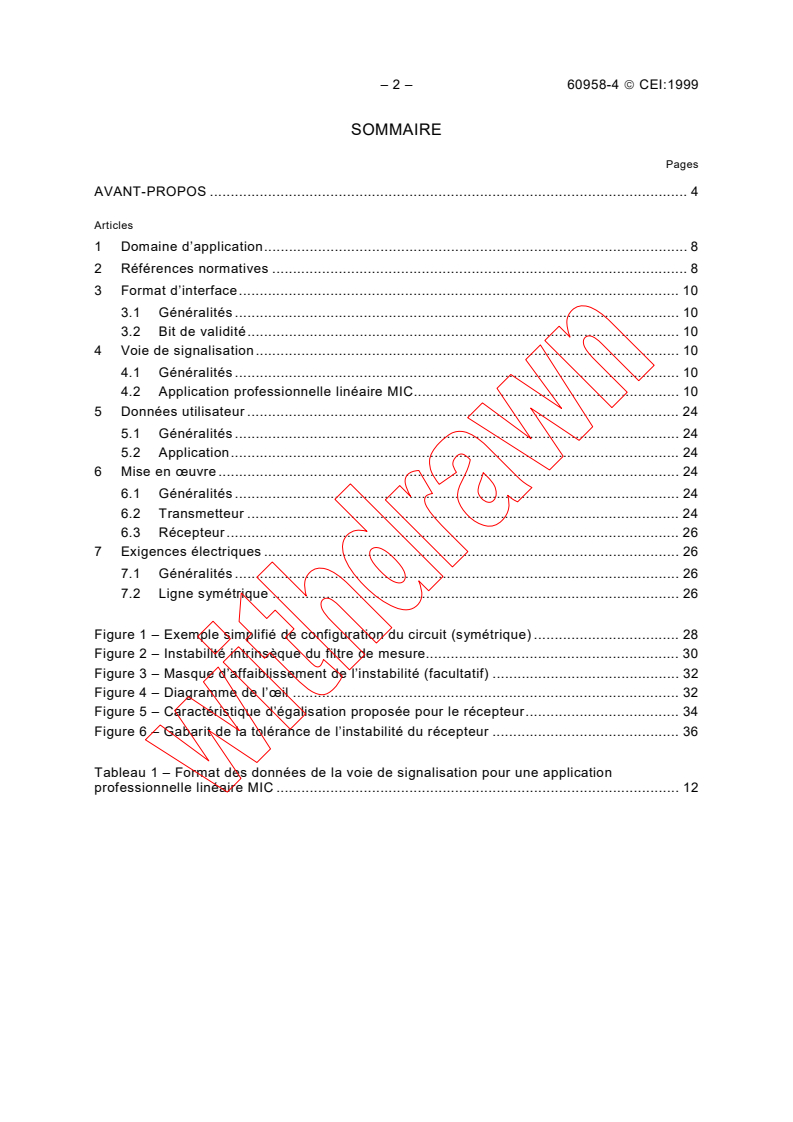
– 2 – 60958-4 CEI:1999
SOMMAIRE
Pages
AVANT-PROPOS . 4
Articles
1 Domaine d’application. 8
2 Références normatives . 8
3 Format d’interface. 10
3.1 Généralités . 10
3.2 Bit de validité. 10
4 Voie de signalisation. 10
4.1 Généralités . 10
4.2 Application professionnelle linéaire MIC. 10
5 Données utilisateur . 24
5.1 Généralités . 24
5.2 Application. 24
6 Mise en œuvre. 24
6.1 Généralités . 24
6.2 Transmetteur . 24
6.3 Récepteur. 26
7 Exigences électriques . 26
7.1 Généralités . 26
7.2 Ligne symétrique . 26
Figure 1 – Exemple simplifié de configuration du circuit (symétrique) . 28
Figure 2 – Instabilité intrinsèque du filtre de mesure. 30
Figure 3 – Masque d’affaiblissement de l’instabilité (facultatif) . 32
Figure 4 – Diagramme de l’œil . 32
Figure 5 – Caractéristique d’égalisation proposée pour le récepteur. 34
Figure 6 – Gabarit de la tolérance de l’instabilité du récepteur . 36
Tableau 1 – Format des données de la voie de signalisation pour une application
professionnelle linéaire MIC . 12
60958-4 IEC:1999 – 3 –
CONTENTS
Page
FOREWORD . 5
Clause
1 Scope . 9
2 Normative references . 9
3 Interface format. 11
3.1 General. 11
3.2 Validity bit . 11
4 Channel status . 11
4.1 General. 11
4.2 Professional linear PCM application . 11
5 User data . 25
5.1 General. 25
5.2 Application . 25
6 Implementation . 25
6.1 General. 25
6.2 Transmitter . 25
6.3 Receivers. 27
7 Electrical requirements. 27
7.1 General. 27
7.2 Balanced line . 27
Figure 1 – Simplified example of the configuration of the circuit (balanced) . 29
Figure 2 – Intrinsic jitter measurement filter . 31
Figure 3 – Jitter attenuation mask (optional) . 33
Figure 4 – Eye diagram. 33
Figure 5 – Suggested equalizing characteristic for the receiver . 35
Figure 6 – Receiver jitter tolerance template . 37
Table 1 – Channel status data format for professional linear PCM application . 13
– 4 – 60958-4 CEI:1999
COMMISSION ÉLECTROTECHNIQUE INTERNATIONALE
____________
INTERFACE AUDIONUMÉRIQUE –
Partie 4: Applications professionnelles
AVANT-PROPOS
1) La CEI (Commission Electrotechnique Internationale) est une organisation mondiale de normalisation
composée de l'ensemble des comités électrotechniques nationaux (Comités nationaux de la CEI). La CEI a
pour objet de favoriser la coopération internationale pour toutes les questions de normalisation dans les
domaines de l'électricité et de l'électronique. A cet effet, la CEI, entre autres activités, publie des Normes
internationales. Leur élaboration est confiée à des comités d'études, aux travaux desquels tout Comité national
intéressé par le sujet traité peut participer. Les organisations internationales, gouvernementales et non
gouvernementales, en liaison avec la CEI, participent également aux travaux. La CEI collabore étroitement
avec l'Organisation Internationale de Normalisation (ISO), selon des conditions fixées par accord entre les
deux organisations.
2) Les décisions ou accords officiels de la CEI concernant les questions techniques représentent, dans la mesure
du possible un accord international sur les sujets étudiés, étant donné que les Comités nationaux intéressés
sont représentés dans chaque comité d’études.
3) Les documents produits se présentent sous la forme de recommandations internationales. Ils sont publiés
comme normes, rapports techniques ou guides et agréés comme tels par les Comités nationaux.
4) Dans le but d'encourager l'unification internationale, les Comités nationaux de la CEI s'engagent à appliquer de
façon transparente, dans toute la mesure possible, les Normes internationales de la CEI dans leurs normes
nationales et régionales. Toute divergence entre la norme de la CEI et la norme nationale ou régionale
correspondante doit être indiquée en termes clairs dans cette dernière.
5) La CEI n’a fixé aucune procédure concernant le marquage comme indication d’approbation et sa responsabilité
n’est pas engagée quand un matériel est déclaré conforme à l’une de ses normes.
6) L’attention est attirée sur le fait que certains des éléments de la présente Norme internationale peuvent faire
l’objet de droits de propriété intellectuelle ou de droits analogues. La CEI ne saurait être tenue pour
responsable de ne pas avoir identifié de tels droits de propriété et de ne pas avoir signalé leur existence.
La Norme internationale CEI 60958-4 a été établie par le sous-comité 100C: Appareils et
sous-systèmes audio, vidéo et multimédia, du comité d'études 100 de la CEI: Systèmes et
appareils audio, vidéo et multimédia.
Le texte de cette norme est issu des documents suivants:
FDIS Rapport de vote
100C/249/FDIS 100C/255/RVD
Le rapport de vote indiqué dans le tableau ci-dessus donne toute information sur le vote ayant
abouti à l'approbation de cette norme.
Cette publication a été rédigée selon les Directives ISO/CEI, Partie 3.
60958-4 IEC:1999 – 5 –
INTERNATIONAL ELECTROTECHNICAL COMMISSION
____________
DIGITAL AUDIO INTERFACE –
Part 4: Professional applications
FOREWORD
1) The IEC (International Electrotechnical Commission) is a worldwide organization for standardization comprising
all national electrotechnical committees (IEC National Committees). The object of the IEC is to promote
international co-operation on all questions concerning standardization in the electrical and electronic fields. To
this end and in addition to other activities, the IEC publishes International Standards. Their preparation is
entrusted to technical committees; any IEC National Committee interested in the subject dealt with may
participate in this preparatory work. International, governmental and non-governmental organizations liaising
with the IEC also participate in this preparation. The IEC collaborates closely with the International Organization
for Standardization (ISO) in accordance with conditions determined by agreement between the two
organizations.
2) The formal decisions or agreements of the IEC on technical matters express, as nearly as possible, an
international consensus of opinion on the relevant subjects since each technical committee has representation
from all interested National Committees.
3) The documents produced have the form of recommendations for international use and are published in the form
of standards, technical specifications, technical reports or guides and they are accepted by the National
Committees in that sense.
4) In order to promote international unification, IEC National Committees undertake to apply IEC International
Standards transparently to the maximum extent possible in their national and regional standards. Any
divergence between the IEC Standard and the corresponding national or regional standard shall be clearly
indicated in the latter.
5) The IEC provides no marking procedure to indicate its approval and cannot be rendered responsible for any
equipment declared to be in conformity with one of its standards.
6) Attention is drawn to the possibility that some of the elements of this International Standard may be the subject
of patent rights. The IEC shall not be held responsible for identifying any or all such patent rights.
International Standard 60958-4 has been prepared by subcommittee 100C: Audio, video and
multimedia subsystems and equipment, of IEC technical committee 100: Audio, video and
multimedia systems and equipment.
The text of this standard is based on the following documents:
FDIS Report on voting
100C/249/FDIS 100C/255/RVD
Full information on the voting for the approval of this standard can be found in the report on
voting indicated in the above table.
This publication has been drafted in accordance with the ISO/IEC Directives, Part 3.
– 6 – 60958-4 CEI:1999
La CEI 60958 est composée des parties suivantes, avec le titre général «Interface audio-
numérique»:
Partie 1: Généralités
Partie 2 (RT): Mode de livraison de l’information sur le logiciel
Partie 3: Applications grand public
Partie 4: Applications professionnelles
Le comité a décidé que cette publication reste valable jusqu’en 2003. A cette date, selon
décision préalable du comité, la publication sera
• reconduite;
• supprimée;
• remplacée par une édition révisée, ou
• amendée.
60958-4 IEC:1999 – 7 –
IEC 60958 consists of the following parts under the general title: Digital audio interface:
Part 1: General
Part 2 (TR): Software information delivery mode
Part 3: Consumer applications
Part 4: Professional applications
The committee has decided that this publication remains valid until 2003. At this date, in
accordance with the committee’s decision, the publication will be
• reconfirmed;
• withdrawn;
• replaced by a revised edition, or
• amended.
– 8 – 60958-4 CEI:1999
INTERFACE AUDIONUMÉRIQUE –
Partie 4: Applications professionnelles
1 Domaine d’application
La présente Norme internationale décrit une application de l’interface série, unidirectionnelle,
autosynchronisante définie dans la CEI 60958-1, pour l’interconnexion des appareils
audionumériques destinés aux applications professionnelles.
Cette interface est principalement destinée à acheminer des programmes monophoniques ou
stéréophoniques, avec une fréquence d’échantillonnage de 48 kHz et une résolution allant
jusqu’à 24 bits par échantillon. Elle peut également être utilisée pour acheminer des signaux
échantillonnés à 32 kHz ou à 44,1 kHz.
Le format est destiné aux utilisations avec des paires de câbles blindés sur des distances
allant jusqu’à 100 m, sans égalisation de transmission ou sans la moindre égalisation
particulière au récepteur. Des longueurs de câble plus importantes peuvent être utilisées avec
des câbles mieux adaptés à la transmission de données, ou avec une égalisation au
récepteur, ou avec les deux.
Dans les deux cas, les références d’horloge et les informations auxiliaires sont transmises
avec les données audio. Des précautions sont également prises pour permettre à l’interface
d’acheminer des données non audio.
2 Références normatives
Les documents normatifs suivants contiennent des dispositions qui, par suite de la référence
qui y est faite, constituent des dispositions valables pour la présente Norme internationale.
Pour les références datées, les amendements ultérieurs ou les révisions de ces publications
ne s’appliquent pas. Toutefois, les parties prenantes aux accords fondés sur la présente
Norme internationale sont invitées à rechercher la possibilité d'appliquer les éditions les plus
récentes des documents normatifs indiqués ci-après. Pour les références non datées, la
dernière édition du document normatif en référence s’applique. Les membres de la CEI et de
l'ISO possèdent le registre des Normes internationales en vigueur.
CEI 60268-12:1987, Equipements pour systèmes électroacoustiques – Douzième partie:
Application des connecteurs pour radiodiffusion et usage analogue
CEI 60958-1:1999, Interface audionumérique – Partie 1: Généralités
CEI 60958-3:1999, Interface audionumérique – Partie 3: Applications grand public
ISO/IEC 646:1991, Technologies de l'information – Jeu ISO de caractère codés à 7 éléments
pour l'échange d'informations (Publiée actuellement en anglais seulement)
UIT-T Recommandation J.17:1988, Préaccentuation utilisée dans les circuits de programme
son
UIT-T Recommandation V.11:1996, Caractéristiques électriques des circuits de jonction symé-
triques à double courant fonctionnant à des débits binaires jusqu'à 10 Mbit/s
60958-4 IEC:1999 – 9 –
DIGITAL AUDIO INTERFACE –
Part 4: Professional applications
1 Scope
This International Standard describes an application of a serial, uni-directional, self-clocking
interface as defined in IEC 60958-1, for the interconnection of digital audio equipment for
professional applications.
The interface is primarily intended to carry monophonic or stereophonic programmes, at a
48 kHz sampling frequency and with a resolution of up to 24 bits per sample. It may
alternatively be used to carry signals sampled at 32 kHz or 44,1 kHz.
The format is intended for use with shielded twisted-pair cables over distances of up to 100 m
without transmission equalization or any special equalization at the receiver. Longer cable
lengths may be used with cables better matched for data transmission, or with receiver
equalization, or both.
In both cases, the clock references and auxiliary information are transmitted along with the
audio data. Provision is also made to allow the interface to carry non-audio data.
2 Normative references
The following normative documents contain provisions which, through reference in this text,
constitute provisions of this International Standard. For dated references, subsequent
amendments to, or revisions of, any of these publications do not apply. However, parties to
agreements based on this International Standard are encouraged to investigate the possibility
of applying the most recent editions of the normative documents indicated below. For undated
references, the latest edition of the normative document referred to applies. Members of IEC
and ISO maintain registers of currently valid International Standards.
IEC 60268-12:1987, Sound system equipment – Part 12: Application of connectors for
broadcast and similar use
IEC 60958-1:1999, Digital audio interface – Part 1: General
IEC 60958-3:1999, Digital audio interface – Part 3: Consumer applications
ISO/IEC 646:1991, Information technology – ISO 7-bit coded character set for information
interchange
ITU-T Recommendation J.17:1988, Pre-emphasis used on sound-programme circuits
ITU-T Recommendation V.11:1996, Electrical characteristics for balanced double-current
interchange circuits operating at data signalling rates up to 10 Mbit/s
– 10 – 60958-4 CEI:1999
3 Format d’interface
3.1 Généralités
On doit utiliser le format d’interface défini dans la partie 1.
Pour des raisons historiques, les préambules «B», «M» et «W», tels que définis en 4.3 de la
partie 1 doivent être référencés respectivement «Z», «X» and «Y», pour leurs utilisations
dans des applications professionnelles.
3.2 Bit de validité
Dans cette norme, le bit de validité doit être utilisé pour indiquer si les bits du champ de
données principal de la sous-trame sont adaptés à leur conversion en un signal audio-
analogique utilisant un codage linéaire MIC.
4 Voie de signalisation
4.1 Généralités
La voie de signalisation de chaque signal audio achemine les informations associées à ce signal
audio, et par conséquent il est possible de le faire, pour les différentes données de la voie de
signalisation qui sont à acheminer en deux sous-trames de signal audionumérique. Les exemples
d’informations à acheminer dans la voie de signalisation sont: la longueur des mots échantillons
audio, le nombre de voies audio, la fréquence d’échantillonnage, le code d’adresse d’échantillon,
les codes alphanumériques de source et de destination, et la préaccentuation.
Les informations de la voie de signalisation sont organisées en un bloc de 192 bits, subdivisé
en 24 octets, numérotés de 0 à 23 (voir le tableau 1). Le premier bit de chaque bloc est
acheminé dans la trame avec le préambule «Z».
Chaque bit d’un bloc est numéroté de 0 à 191.
L’application principale est indiquée par le bit 0 de la voie de signalisation.
Pour les applications professionnelles décrites ici, ce premier bit de la voie de signalisation
est forcé à «1».
Pour les matériels audionumériques grand public, ce premier bit de la voie de signalisation
est forcé à «0», et cette partie de la CEI 60958 ne s’applique pas.
Des applications secondaires peuvent être définies dans le cadre de ces applications
principales.
4.2 Application professionnelle linéaire MIC
L’organisation particulière des données de la voie de signalisation est la suivante:
La signification du bit 0 de l’octet 0 est telle qu’une transmission provenant d’une interface
conforme à la CEI 60958-3, puisse être identifiée «grand public». De même, une transmission
«professionnelle» définie dans cette partie de la CEI 60958 peut être correctement identifiée
par un récepteur «grand public». La liaison d’un transmetteur «grand public» avec un récepteur
«professionnel» ou vice versa peut conduire à un fonctionnement aléatoire. Par conséquent, les
définitions du tableau 1 concernant cet octet s’appliquent uniquement si le bit 0 = «1» et si le
bit 1 = «0» (utilisation professionnelle linéaire MIC du bloc de voie de signalisation).
60958-4 IEC:1999 – 11 –
3 Interface format
3.1 General
The interface format as defined in part 1 shall be used.
For historical reasons, preambles “B”, “M” and “W”, as defined in 4.3 of part 1, shall, for use in
professional applications, be referred to as “Z”, “X” and “Y”, respectively.
3.2 Validity bit
For this standard, the validity bit shall be used to indicate whether the main data field bits in the
sub-frame are suitable for conversion to an analog audio signal using linear PCM coding.
4 Channel status
4.1 General
The channel status for each audio signal carries information associated with that audio signal,
thus it is possible for different channel status data to be carried in the two sub-frames of the
digital audio signal. Examples of information to be carried in the channel status are: length of
audio sample words, number of audio channels, sampling frequency, sample address code,
alphanumeric source and destination codes, and pre-emphasis.
Channel status information is organized in a 192-bit block, subdivided into 24 bytes, numbered
0 to 23 (see table 1). The first bit of each block is carried in the frame with preamble “Z”.
The individual bits of a block are numbered 0 to 191.
The primary application is indicated by channel status bit 0.
For the professional applications described here, this first channel status bit equals “1”.
For consumer digital audio equipment, this first channel status bit equals “0”, and this part of
IEC 60958 does not apply.
Secondary applications may be defined within the framework of these primary applications.
4.2 Professional linear PCM application
The specific organization of the channel status data is as follows:
The significance of byte 0, bit 0 is such that a transmission from an interface conforming to
IEC 60958-3 (“consumer use”) can be identified. Also, a “professional use” transmission,
defined in this part of IEC 60958, can be correctly identified by a “consumer use” receiver.
Connection of a “consumer use” transmitter with a “professional use” receiver or vice versa
might result in unpredictable operation. Thus, the byte definitions in table 1 apply only when bit
0 = “1” and bit 1 = “0” (professional linear PCM use of the channel status block).
– 12 – 60958-4 CEI:1999
Tableau 1 – Format des données de la voie de signalisation pour
une application professionnelle linéaire MIC
Octet
0 a = «1» b = «0» c d e
bit0 1 234 5 6 7
1fg
bit8 9 101112 13 1415
2hi
bit1617 181920 21 2223
3 j
bit2425 262728 29 3031
4 k Réservé mais actuellement non défini
bit3233 343536 37 3839
5 Réservé mais actuellement non défini
bit4041 424344 45 4647
6 Données alphanumériques de la voie d’origine
bit4849 505152 53 5455
7 Données alphanumériques de la voie d’origine
bit5657 585960 61 6263
8 Données alphanumériques de la voie d’origine
bit6465 666768 69 7071
9 Données alphanumériques de la voie d’origine
bit7273 747576 77 7879
10 Données alphanumériques de la voie de destination
bit8081 828384 85 8687
11 Données alphanumériques de la voie de destination
bit8889 909192 93 9495
12 Données alphanumériques de la voie de destination
bit 96 97 98 99 100 101 102 103
13 Données alphanumériques de la voie de destination
bit 104 105 106 107 108 109 110 111
14 Code d’adresse locale de l’échantillon (binaire à 32 bits)
bit 112 113 114 115 116 117 118 119
15 Code d’adresse locale de l’échantillon (binaire à 32 bits)
bit 120 121 122 123 124 125 126 127
16 Code d’adresse locale de l’échantillon (binaire à 32 bits)
bit 128 129 130 131 132 133 134 135
17 Code d’adresse locale de l’échantillon (binaire à 32 bits)
bit 136 137 138 139 140 141 142 143
18 Code horaire journalier (binaire à 32 bits)
bit 144 145 146 147 148 149 150 151
19 Code horaire journalier (binaire à 32 bits)
bit 152 153 154 155 156 157 158 159
20 Code horaire journalier (binaire à 32 bits)
bit 160 161 162 163 164 165 166 167
21 Code horaire journalier (binaire à 32 bits)
bit 168 169 170 171 172 173 174 175
22 Drapeaux de fiabilité
bit 176 177 178 179 180 181 182 183
23 Caractère de contrôle de redondance cyclique
bit 184 185 186 187 188 189 190 191
a: utilisation du bloc de la voie de signalisation. g: gestion des bits utilisateur.
b: identification du mode MIC linéaire. h: utilisation des bits auxiliaires.
c: préaccentuation du signal audio. i: longueur des mots et historique des mots à la
d: verrouillage de la fréquence d’échantillon- source.
nage à la source. j: description d’un fonctionnement multivoie
e: fréquence d’échantillonnage. ultérieur.
f: mode d’utilisation des voies.
k: signal de référence audionumérique.
60958-4 IEC:1999 – 13 –
Table 1 – Channel status data format for professional linear PCM application
Byte
a = “1” b = “0” c d e
bit0 1 234 5 6 7
fg
bit8 9 101112 13 1415
hi
bit1617 181920 21 2223
j
bit2425 262728 29 3031
4 k Reserved but undefined at present
bit3233 343536 37 3839
5 Reserved but undefined at present
bit4041 424344 45 4647
6 Alphanumeric channel origin data
bit4849 505152 53 5455
7 Alphanumeric channel origin data
bit5657 585960 61 6263
8 Alphanumeric channel origin data
bit6465 666768 69 7071
9 Alphanumeric channel origin data
bit7273 747576 77 7879
10 Alphanumeric channel destination data
bit8081 828384 85 8687
11 Alphanumeric channel destination data
bit8889 909192 93 9495
Alphanumeric channel destination data
bit 96 97 98 99 100 101 102 103
Alphanumeric channel destination data
bit 104 105 106 107 108 109 110 111
Local sample address code (32-bit binary)
bit 112 113 114 115 116 117 118 119
Local sample address code (32-bit binary)
bit 120 121 122 123 124 125 126 127
Local sample address code (32-bit binary)
bit 128 129 130 131 132 133 134 135
17 Local sample address code (32-bit binary)
bit 136 137 138 139 140 141 142 143
18 Time of day code (32-bit binary)
bit 144 145 146 147 148 149 150 151
19 Time of day code (32-bit binary)
bit 152 153 154 155 156 157 158 159
20 Time of day code (32-bit binary)
bit 160 161 162 163 164 165 166 167
21 Time of day code (32-bit binary)
bit 168 169 170 171 172 173 174 175
22 Reliability flags
bit 176 177 178 179 180 181 182 183
23 Cyclic redundancy check character
bit 184 185 186 187 188 189 190 191
a: use of channel status block. g: user bits management.
b: linear PCM identification. h: use of auxiliary sample bits.
c: audio signal pre-emphasis. i: source word length and source encoding
d: locking of source sampling frequency. history.
e: sampling frequency. j: future description of multichannel function.
f: channel mode. k: digital audio reference signal.
– 14 – 60958-4 CEI:1999
Octet 0
Bit 0 «1» Utilisation professionnelle du bloc de la voie de
signalisation.
Bit 1 «0» Le mot échantillon audio correspond à des échantillons
linéaires MIC.
«1» Le mot échantillon audio est utilisé à d’autres fins.
Bits 2 à 4 Codage de la préaccentuation du signal audio
bit 2 3 4
état «0 0 0» Préaccentuation non indiquée. Le récepteur se place par
défaut en position sans préaccentuation, avec forçage
manuel.
«1 0 0» Pas de préaccentuation. Forçage manuel du récepteur
impossible.
«1 1 0»
Préaccentuation 50/15 μs. Forçage manuel du récepteur
impossible.
«1 1 1» Préaccentuation selon la recommandation J.17 de l'UIT-T
(avec insertion d’un affaiblissement de 6,5 dB à 800 Hz).
Forçage manuel du récepteur impossible.
Les autres états des bits 2 à 4 sont tous réservés et ne doivent pas être
utilisés jusqu’à qu’ils soient définis.
Bit 5 «0» Indication par défaut. Condition de verrouillage non
indiquée.
«1» Fréquence d’échantillonnage à la source déverrouillée.
Bits 6 et 7 Codage de la fréquence d’échantillonnage.
bit 6 7
état «0 0» Fréquence d’échantillonnage non indiquée. Le récepteur
adopte 48 kHz par défaut et le forçage manuel ou
automatique est possible.
«0 1» Fréquence d’échantillonnage de 48 kHz. Forçage manuel
du récepteur ou automatique impossible.
«1 0» Fréquence d’échantillonnage de 44,1 kHz. Forçage manuel
du récepteur ou automatique impossible.
«1 1» Fréquence d’échantillonnage de 32 kHz. Forçage manuel
du récepteur ou automatique impossible.
Octet 1
Les quatre modes de transmission sont identifiés par la valeur des bits 8 à 11 de l’octet 1 de
la voie de signalisation.
Mode deux voies: Dans le mode deux voies, les échantillons provenant des deux voies sont
transmis dans des sous-trames successives. La voie 1 est placée dans la sous-trame 1, et la
voie 2 est placée dans la sous-trame 2.
60958-4 IEC:1999 – 15 –
Byte 0
Bit 0 “1” Professional use of channel status block.
Bit 1 “0” Audio sample word represents linear PCM samples.
“1” Audio sample word used for purposes other than linear
PCM samples.
Bits 2-4 Encoded audio signal pre-emphasis.
bit 2 3 4
state “0 0 0” Pre-emphasis not indicated. Receiver defaults to no pre-
emphasis with manual override enabled.
“1 0 0” No pre-emphasis. Receiver manual override is disabled.
“1 1 0”
50/15 μs pre-emphasis. Receiver manual override is
disabled.
“1 1 1” ITU-T recommendation J.17 pre-emphasis (with 6,5 dB
insertion loss at 800 Hz). Receiver manual override is
disabled.
All other states of bits 2-4 are reserved and shall not be used until further
defined.
Bit 5 “0” Default, lock condition not indicated.
“1” Source sampling frequency unlocked.
Bits 6-7 Encoded sampling frequency.
bit 6 7
state “0 0” Sampling frequency not indicated. Receiver defaults to
48 kHz and manual override or auto set is enabled.
“0 1” 48 kHz sampling frequency. Receiver manual override or
auto set is disabled.
“1 0” 44,1 kHz sampling frequency. Receiver manual override or
auto set is disabled.
“1 1” 32 kHz sampling frequency. Receiver manual override or
auto set is disabled.
Byte 1
The four modes of transmission are signalled by setting bits 8 to 11 of byte 1 of channel status.
Two-channel mode: In two-channel mode, the samples from both channels are transmitted in
consecutive sub-frames. Channel 1 is in sub-frame 1, and channel 2 is in sub-frame 2.
– 16 – 60958-4 CEI:1999
Mode stéréophonique: En mode stéréophonique, l’interface est utilisée pour transmettre les
signaux stéréophoniques, et les deux voies sont supposées avoir été échantillonnées
simultanément. La voie gauche ou «A» est placée dans la sous-trame 1, et la voie droite ou
«B» est placée dans la sous-trame 2.
Mode monophonique: En mode monophonique, le débit transmis reste le débit normal du
mode deux voies et le mot échantillon audio est placé dans la sous-trame 1. Les intervalles
temporels 4 à 31 de la sous-trame 2 acheminent les bits identiques vers la sous-trame 1 ou
les forcent au «0» logique. Un récepteur passe, normalement par défaut sur la voie 1, sauf en
cas de forçage manuel.
Mode primaire/secondaire: Dans certaines applications nécessitant deux voies où une des
deux est la voie principale ou primaire, alors que l’autre est la voie secondaire, la voie
principale est placée dans la sous-trame 1, et la voie secondaire est placée dans la sous-
trame 2.
bits 8 à 11 Codage du mode d’utilisation des voies.
bit 8 9 10 11
état «0 0 0 0» Mode non indiqué. Le récepteur se place par défaut en
mode deux voies et le forçage manuel est possible.
«0 0 0 1» Mode deux voies. Forçage manuel du récepteur
impossible.
«0 0 1 0» Mode une voie (monophonique). Forçage manuel du
récepteur impossible.
«0 0 1 1» Mode primaire/secondaire (la sous-trame 1 est principale).
Forçage manuel du récepteur impossible.
«0 1 0 0» Mode stéréophonique (la sous-trame 1 est la voie de
gauche). Forçage manuel du récepteur impossible.
«0 1 0 1» Réservé aux applications utilisateur définies.
et
«0 1 1 0»
«1 1 1 1» Renvoi vers octet 3. Réservé à des applications futures.
Les autres états des bits 8 à 11 sont tous réservés et ne doivent pas être
utilisés jusqu’à ce qu’ils soient ultérieurement définis.
bits 12 à 15 Codage de la gestion des bits utilisateur.
bit 12 13 14 15
état «0 0 0 0» Par défaut, le format de données utilisateur est indéfini.
«0 0 0 1» Structure de bloc de 192 bits. Le préambule «Z» indique le
début du bloc.
«0 0 1 0» Réservé à la norme AES18.
«0 0 1 1» Utilisateur défini.
«0 1 0 0» Les données utilisateur sont conformes au format des
données utilisateur telles que définies dans la CEI 60958-3.
Les autres états des bits 12 à 15 sont tous réservés et ne doivent pas être
utilisés jusqu’à ce qu’ils soient ultérieurement définis.
60958-4 IEC:1999 – 17 –
Stereophonic mode: In stereophonic mode, the interface is used to transmit stereophonic
signals, and the two channels are presumed to have been simultaneously sampled. The left, or
“A”, channel is in sub-frame 1, and the right, or “B”, channel is in sub-frame 2.
Single channel mode (monophonic): In monophonic mode, the transmitted bit rate remains at
the normal two-channel rate and the audio sample word is placed in sub-frame 1. Time slots 4
to 31 of sub-frame 2 either carry the bits identical to sub-frame 1 or are set to logical “0”.
A receiver normally defaults to channel 1, unless manual override is provided.
Primary/secondary mode: In some applications requiring two channels where one of the
channels is the main or primary channel while the other is a secondary channel, the primary
channel is in sub-frame 1, and the secondary channel is in sub-frame 2.
bits 8-11 Encoded channel mode.
bit 8 9 10 11
state “0 0 0 0” Mode not indicated. Receiver defaults to two-channel
mode and manual override is enabled.
“0 0 0 1” Two-channel mode. Receiver manual override is
disabled.
“0 0 1 0” Single channel mode (monophonic). Receiver manual
override is disabled.
“0 0 1 1” Primary/secondary mode (sub-frame 1 is primary).
Receiver manual override is disabled.
“0 1 0 0” Stereophonic mode (sub-frame 1 is left channel).
Receiver manual override is disabled.
“0 1 0 1” Reserved for user-defined applications.
and
“0 1 1 0”
“1 1 1 1” Vector to byte 3. Reserved for future applications.
All other states of bits 8-11 are reserved and shall not be used until
further defined.
bits 12-15 Encoded user bits management.
bit 12 13 14 15
state “0 0 0 0” Default, user data format is undefined.
“0 0 0 1” 192-bit block structure. Preamble “Z” indicates the start
of block.
“0 0 1 0” Reserved for the AES18 standard.
“0 0 1 1” User defined.
“0 1 0 0” User data conforms to the general user data format as
defined in IEC 60958-3.
All other states of bits 12-15 are reserved and shall not be used until
further defined.
– 18 – 60958-4 CEI:1999
Octet 2
bits 16 à 18 Codage de l’utilisation des bits auxiliaires.
bit 16 17 18
état «0 0 0» La longueur maximale du mot échantillon audio est de 20 bits
(par défaut). L’utilisation de bits auxiliaires n’est pas définie.
«0 0 1» La longueur maximale du mot échantillon audio est de 24 bits.
Les bits auxiliaires sont utilisés pour les données audio
principales.
«0 1 0» La longueur maximale du mot échantillon est de 20 bits.
Les bits auxiliaires de la voie sont utilisés pour acheminer
un seul signal de coordination.
«0 1 1» Réservé aux applications utilisateur définies.
Les autres états des bits 16 à 18 sont tous réservés et ne doivent pas être
utilisés jusqu’à ce qu’ils soient ultérieurement définis.
bits 19 à 21 Codage de la longueur du mot audio du signal transmis.
bit 19 20 21 Longueur du mot audio Longueur du mot audio
(celle indiquée par les bits (celle indiquée par les bits
16 à 18 précédents) si la 16 à 18 précédents) si la
longueur maximale est de longueur maximale est de
24 bits. 20 bits.
état «0 0 0» Longueur du mot non Longueur du mot non
indiquée (par défaut). indiquée (par défaut).
«0 0 1» 23 bits 19 bits
«0 1 0» 22 bits 18 bits
«0 1 1» 21 bits 17 bits
«1 0 0» 20 bits 16 bits
«1 0 1» 24 bits 20 bits
Les autres états des bits 19 à 21 sont tous réservés et ne doivent pas être
utilisés jusqu’à ce qu’ils soient ultérieurement définis.
NOTE 1 L’état par défaut des bits 19 à 21 indique que le nombre de bits existants dans la plage de codage
réservée au bit 20 ou 24 n’est pas spécifié par le transmetteur. Il convient que le récepteur indique par défaut le
nombre maximal de bits spécifié par la plage de codage et permette le forçage manuel ou le réglage automatique.
NOTE 2 L’état (non par défaut) des bits 19 à 21 indique le nombre de bits existants dans la plage de codage
réservée au bit 20 ou 24 pouvant être actif. Ceci est également une expression indirecte du nombre des bits les
moins significatifs réellement inactifs et qui est de 20 ou 24 moins le nombre correspondant au bit d’état. Il
convient que le récepteur interrompe le forçage ou le réglage automatique pour ces valeurs d’état.
NOTE 3 Indépendamment de la longueur du mot échantillon audio, tel qu’indiqué par un quelconque état des bits
19 à 21, le bit le plus significatif se trouve dans l’intervalle temporel 27 de la sous-trame transmise, comme
spécifié en 3.2.1 de la partie 1.
bits 22 à 23 Réservé et forcé à «0» jusqu’à ce qu’ils soient ultérieurement définis.
60958-4 IEC:1999 – 19 –
Byte 2
bits 16-18 Encoded use of auxiliary sample bits.
bit 16 17 18
state “0 0 0” Maximum audio sample word length is 20 bits (default).
Use of auxiliary sample bits is not defined.
“0 0 1” Maximum audio sample word length is 24 bits. Auxiliary
sample bits are used for main audio sample data.
“0 1 0” Maximum audio sample word length is 20 bits. Auxiliary
sample bits in this channel are used to carry a single co-
ordination signal.
“0 1 1” Reserved for user-defined applications.
All other states of bits 16-18 are
...
Questions, Comments and Discussion
Ask us and Technical Secretary will try to provide an answer. You can facilitate discussion about the standard in here.
Loading comments...