

IEC TS 62898-2:2018
(Main)Microgrids - Part 2: Guidelines for operation
General Information
- Abstract
IEC TS 62898-2:2018 provides guidelines for operation of microgrids. Microgrids considered in this document are alternating current (AC) electrical systems with loads and distributed energy resources (DER) at low or medium voltage level. This document does not cover direct current (DC) microgrids.
IEC TS 62898-2 applies to operation and control of microgrids, including:
• operation modes and mode transfer;
• energy management system (EMS) and control of microgrids;
• communication and monitoring procedures;
• electrical energy storage;
• protection principle covering: principle for non-isolated microgrid, isolated microgrid, anti-islanding, synchronization and reclosing, power quality;
• commissioning, maintenance and test.
- Status
- Published
- Publication Date
- 06-Nov-2023
- Technical Committee
- SC 8B - Decentralized electrical energy systems
- Drafting Committee
- JWG 1 - TC 8/SC 8B/JWG 1
- Current Stage
- PPUB - Publication issued
- Start Date
- 20-Sep-2018
- Completion Date
- 18-Sep-2018
Buy Documents
IEC TS 62898-2:2018 - Microgrids - Part 2: Guidelines for operation Released:9/20/2018

IEC TS 62898-2:2018+AMD1:2023 CSV - Microgrids - Part 2: Guidelines for operation Released:11/7/2023
Overview
IEC TS 62898-2:2018 - Microgrids: Part 2 - Guidelines for operation provides operational guidance for alternating-current (AC) microgrids at low and medium voltage levels. The technical specification focuses on the safe, reliable and coordinated operation of microgrids that include loads and distributed energy resources (DER). It explicitly excludes direct-current (DC) microgrids. The document is intended as practical guidance for operators, integrators and planners working with AC microgrids.
Key topics
The standard covers operational and control aspects including:
Operation modes and mode transfer
- Grid-connected vs island (isolated) operation
- Mode transfer principles including synchronization and reclosing
Control and Energy Management
- Energy management system (EMS) roles and control strategies for both non‑isolated and isolated microgrids
- Frequency and voltage response characteristics and control requirements
Communication and monitoring
- Communications between the microgrid and utility grid and internal microgrid communications
- Monitoring requirements for DER, switching devices and control systems
Electrical energy storage (EES)
- Requirements for EES in grid-connected, island and during mode transfers
- EES management and integration with EMS
Protection principles
- Protection approaches for non‑isolated and isolated microgrids
- Anti‑islanding, reclosing with synchronization and protection coordination
Power quality and EMC
- Power quality considerations in grid‑connected and isolated operation
- Electromagnetic compatibility (EMC) guidance
Commissioning, maintenance and testing
- Practical procedures and test requirements to ensure safe operation and reliability
Applications and practical users
IEC TS 62898-2 is useful for:
- Microgrid designers and system integrators implementing AC microgrids
- Utilities and distribution system operators coordinating customer‑side microgrids
- Plant and site operators managing islanding and grid‑connected operation
- Manufacturers of inverters, controllers, protection equipment and EES systems
- Test engineers and commissioning teams validating microgrid behavior
- Policy makers and project developers planning rural electrification and resilient energy systems
Practical applications include improving reliability via controlled islanding, rural electrification using mainly-isolated microgrids, cost reduction through local energy optimization, and providing ancillary services to the grid.
Related standards
- IEC TS 62898-1 (microgrid planning and requirements)
- IEC 62786 (connection of parallel generators)
- IEC technical committees on safety/protection (TC 64, TC 99)
- IEC TS 62257 (rural electrification)
- IEC TS 62749 (power quality)
Keywords: IEC TS 62898-2:2018, microgrids guidelines for operation, AC microgrids, EMS, DER, electrical energy storage, anti-islanding, synchronization, power quality, commissioning.
Relations
- Amended By
IEC TS 62898-2:2018/AMD1:2023 - Amendment 1 - Microgrids - Part 2: Guidelines for operation - Effective Date
- 05-Sep-2023
Buy Documents
IEC TS 62898-2:2018 - Microgrids - Part 2: Guidelines for operation Released:9/20/2018
IEC TS 62898-2:2018+AMD1:2023 CSV - Microgrids - Part 2: Guidelines for operation Released:11/7/2023
Get Certified
Connect with accredited certification bodies for this standard

IMQ S.p.A. (Certification)
Italian electrical product certification.

SLG Prüf- und Zertifizierungs GmbH
German testing and certification body.

UL Solutions
Global safety science company with testing, inspection and certification.
Sponsored listings
Frequently Asked Questions
IEC TS 62898-2:2018 is a technical specification published by the International Electrotechnical Commission (IEC). Its full title is "Microgrids - Part 2: Guidelines for operation". This standard covers: IEC TS 62898-2:2018 provides guidelines for operation of microgrids. Microgrids considered in this document are alternating current (AC) electrical systems with loads and distributed energy resources (DER) at low or medium voltage level. This document does not cover direct current (DC) microgrids. IEC TS 62898-2 applies to operation and control of microgrids, including: • operation modes and mode transfer; • energy management system (EMS) and control of microgrids; • communication and monitoring procedures; • electrical energy storage; • protection principle covering: principle for non-isolated microgrid, isolated microgrid, anti-islanding, synchronization and reclosing, power quality; • commissioning, maintenance and test.
IEC TS 62898-2:2018 provides guidelines for operation of microgrids. Microgrids considered in this document are alternating current (AC) electrical systems with loads and distributed energy resources (DER) at low or medium voltage level. This document does not cover direct current (DC) microgrids. IEC TS 62898-2 applies to operation and control of microgrids, including: • operation modes and mode transfer; • energy management system (EMS) and control of microgrids; • communication and monitoring procedures; • electrical energy storage; • protection principle covering: principle for non-isolated microgrid, isolated microgrid, anti-islanding, synchronization and reclosing, power quality; • commissioning, maintenance and test.
IEC TS 62898-2:2018 is classified under the following ICS (International Classification for Standards) categories: 29.240.01 - Power transmission and distribution networks in general. The ICS classification helps identify the subject area and facilitates finding related standards.
IEC TS 62898-2:2018 has the following relationships with other standards: It is inter standard links to IEC TS 62898-2:2018/AMD1:2023. Understanding these relationships helps ensure you are using the most current and applicable version of the standard.
IEC TS 62898-2:2018 is available in PDF format for immediate download after purchase. The document can be added to your cart and obtained through the secure checkout process. Digital delivery ensures instant access to the complete standard document.
Standards Content (Sample)
IEC TS 62898-2 ®
Edition 1.0 2018-09
TECHNICAL
SPECIFICATION
colour
inside
Microgrids –
Part 2: Guidelines for operation
All rights reserved. Unless otherwise specified, no part of this publication may be reproduced or utilized in any form
or by any means, electronic or mechanical, including photocopying and microfilm, without permission in writing from
either IEC or IEC's member National Committee in the country of the requester. If you have any questions about IEC
copyright or have an enquiry about obtaining additional rights to this publication, please contact the address below or
your local IEC member National Committee for further information.
IEC Central Office Tel.: +41 22 919 02 11
3, rue de Varembé info@iec.ch
CH-1211 Geneva 20 www.iec.ch
Switzerland
About the IEC
The International Electrotechnical Commission (IEC) is the leading global organization that prepares and publishes
International Standards for all electrical, electronic and related technologies.
About IEC publications
The technical content of IEC publications is kept under constant review by the IEC. Please make sure that you have the
latest edition, a corrigenda or an amendment might have been published.
IEC Catalogue - webstore.iec.ch/catalogue Electropedia - www.electropedia.org
The stand-alone application for consulting the entire The world's leading online dictionary of electronic and
bibliographical information on IEC International Standards, electrical terms containing 21 000 terms and definitions in
Technical Specifications, Technical Reports and other English and French, with equivalent terms in 16 additional
documents. Available for PC, Mac OS, Android Tablets and languages. Also known as the International Electrotechnical
iPad. Vocabulary (IEV) online.
IEC publications search - webstore.iec.ch/advsearchform IEC Glossary - std.iec.ch/glossary
The advanced search enables to find IEC publications by a 67 000 electrotechnical terminology entries in English and
variety of criteria (reference number, text, technical French extracted from the Terms and Definitions clause of
committee,…). It also gives information on projects, replaced IEC publications issued since 2002. Some entries have been
and withdrawn publications. collected from earlier publications of IEC TC 37, 77, 86 and
CISPR.
IEC Just Published - webstore.iec.ch/justpublished
Stay up to date on all new IEC publications. Just Published IEC Customer Service Centre - webstore.iec.ch/csc
details all new publications released. Available online and If you wish to give us your feedback on this publication or
also once a month by email. need further assistance, please contact the Customer Service
Centre: sales@iec.ch.
IEC TS 62898-2 ®
Edition 1.0 2018-09
TECHNICAL
SPECIFICATION
colour
inside
Microgrids –
Part 2: Guidelines for operation
INTERNATIONAL
ELECTROTECHNICAL
COMMISSION
ICS 29.240.01 ISBN 978-2-8322-6042-5
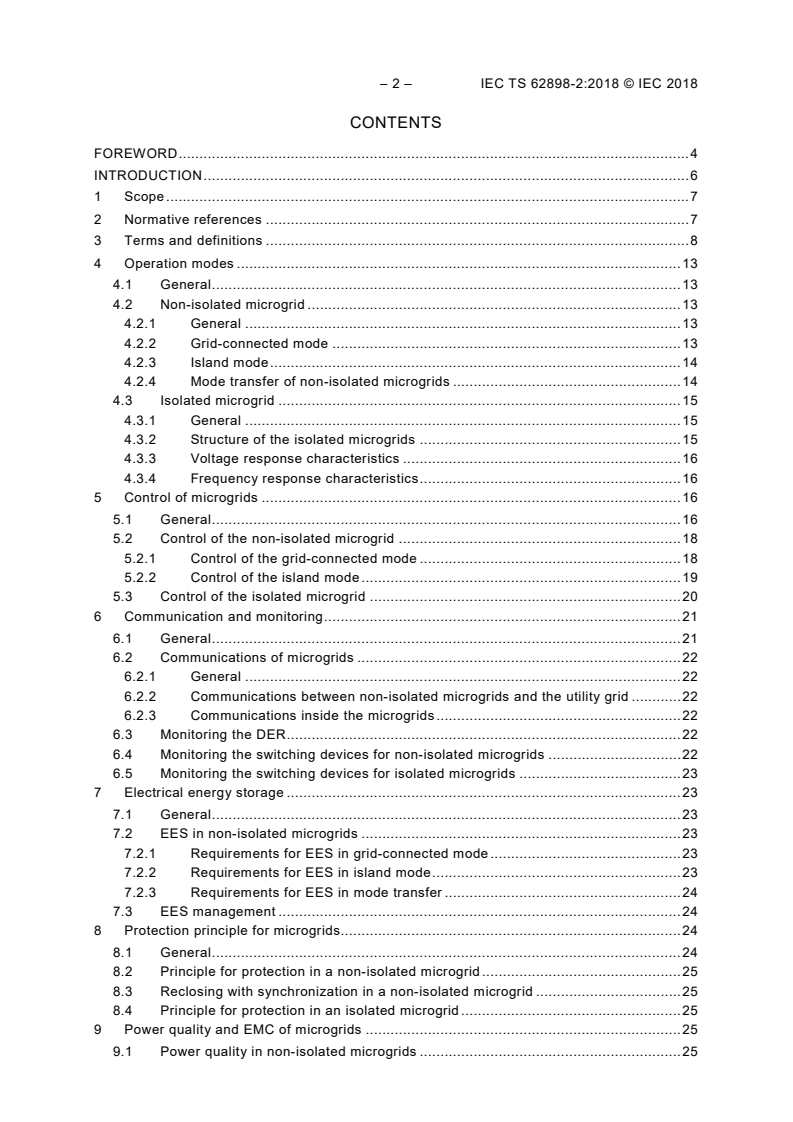
– 2 – IEC TS 62898-2:2018 © IEC 2018
CONTENTS
FOREWORD . 4
INTRODUCTION . 6
1 Scope . 7
2 Normative references . 7
3 Terms and definitions . 8
4 Operation modes . 13
4.1 General . 13
4.2 Non-isolated microgrid . 13
4.2.1 General . 13
4.2.2 Grid-connected mode . 13
4.2.3 Island mode . 14
4.2.4 Mode transfer of non-isolated microgrids . 14
4.3 Isolated microgrid . 15
4.3.1 General . 15
4.3.2 Structure of the isolated microgrids . 15
4.3.3 Voltage response characteristics . 16
4.3.4 Frequency response characteristics . 16
5 Control of microgrids . 16
5.1 General . 16
5.2 Control of the non-isolated microgrid . 18
5.2.1 Control of the grid-connected mode . 18
5.2.2 Control of the island mode . 19
5.3 Control of the isolated microgrid . 20
6 Communication and monitoring . 21
6.1 General . 21
6.2 Communications of microgrids . 22
6.2.1 General . 22
6.2.2 Communications between non-isolated microgrids and the utility grid . 22
6.2.3 Communications inside the microgrids . 22
6.3 Monitoring the DER . 22
6.4 Monitoring the switching devices for non-isolated microgrids . 22
6.5 Monitoring the switching devices for isolated microgrids . 23
7 Electrical energy storage . 23
7.1 General . 23
7.2 EES in non-isolated microgrids . 23
7.2.1 Requirements for EES in grid-connected mode . 23
7.2.2 Requirements for EES in island mode . 23
7.2.3 Requirements for EES in mode transfer . 24
7.3 EES management . 24
8 Protection principle for microgrids. 24
8.1 General . 24
8.2 Principle for protection in a non-isolated microgrid . 25
8.3 Reclosing with synchronization in a non-isolated microgrid . 25
8.4 Principle for protection in an isolated microgrid . 25
9 Power quality and EMC of microgrids . 25
9.1 Power quality in non-isolated microgrids . 25
9.2 Power quality in isolated microgrids . 26
9.3 EMC in microgrids . 26
10 Maintenance and test of microgrids . 26
10.1 General . 26
10.2 Maintenance . 26
10.3 Test . 27
Annex A (informative) Business use case A: Improving reliability and securing the
energy supply by islanding . 28
Annex B (informative) Business use case B: Electrifying remote areas and using
renewable energy sources . 31
Annex C (informative) Business use case C: Reducing energy costs for microgrid
users . 33
Annex D (informative) Business use case D: Optimizing local resources to provide
services to the grid/disaster preparedness . 35
Annex E (informative) Example of power factor requirements cited in some standards . 36
Bibliography . 37
Figure 1 – Example for a non-isolated microgrid . 17
Figure 2 – Example for an isolated microgrid . 18
Figure 3 – The P-f control in isolated microgrid . 20
Figure B.1 – One of the actual examples of mainly-isolated microgrids used for
electrification in far rural area . 32
Figure C.1 – Principle scheme of customer energy management and information
exchange with upstream grid . 34
Table 1 – Example for the isolated microgrid frequency response of 50 Hz . 21
Table E.1 – Power factor requirements . 36
– 4 – IEC TS 62898-2:2018 © IEC 2018
INTERNATIONAL ELECTROTECHNICAL COMMISSION
____________
MICROGRIDS –
Part 2: Guidelines for operation
FOREWORD
1) The International Electrotechnical Commission (IEC) is a worldwide organization for standardization comprising
all national electrotechnical committees (IEC National Committees). The object of IEC is to promote
international co-operation on all questions concerning standardization in the electrical and electronic fields. To
this end and in addition to other activities, IEC publishes International Standards, Technical Specifications,
Technical Reports, Publicly Available Specifications (PAS) and Guides (hereafter referred to as “IEC
Publication(s)”). Their preparation is entrusted to technical committees; any IEC National Committee interested
in the subject dealt with may participate in this preparatory work. International, governmental and non-
governmental organizations liaising with the IEC also participate in this preparation. IEC collaborates closely
with the International Organization for Standardization (ISO) in accordance with conditions determined by
agreement between the two organizations.
2) The formal decisions or agreements of IEC on technical matters express, as nearly as possible, an international
consensus of opinion on the relevant subjects since each technical committee has representation from all
interested IEC National Committees.
3) IEC Publications have the form of recommendations for international use and are accepted by IEC National
Committees in that sense. While all reasonable efforts are made to ensure that the technical content of IEC
Publications is accurate, IEC cannot be held responsible for the way in which they are used or for any
misinterpretation by any end user.
4) In order to promote international uniformity, IEC National Committees undertake to apply IEC Publications
transparently to the maximum extent possible in their national and regional publications. Any divergence
between any IEC Publication and the corresponding national or regional publication shall be clearly indicated in
the latter.
5) IEC itself does not provide any attestation of conformity. Independent certification bodies provide conformity
assessment services and, in some areas, access to IEC marks of conformity. IEC is not responsible for any
services carried out by independent certification bodies.
6) All users should ensure that they have the latest edition of this publication.
7) No liability shall attach to IEC or its directors, employees, servants or agents including individual experts and
members of its technical committees and IEC National Committees for any personal injury, property damage or
other damage of any nature whatsoever, whether direct or indirect, or for costs (including legal fees) and
expenses arising out of the publication, use of, or reliance upon, this IEC Publication or any other IEC
Publications.
8) Attention is drawn to the Normative references cited in this publication. Use of the referenced publications is
indispensable for the correct application of this publication.
9) Attention is drawn to the possibility that some of the elements of this IEC Publication may be the subject of
patent rights. IEC shall not be held responsible for identifying any or all such patent rights.
The main task of IEC technical committees is to prepare International Standards. In
exceptional circumstances, a technical committee may propose the publication of a technical
specification when
• the required support cannot be obtained for the publication of an International Standard,
despite repeated efforts, or
• the subject is still under technical development or where, for any other reason, there is the
future but no immediate possibility of an agreement on an International Standard.
Technical specifications are subject to review within three years of publication to decide
whether they can be transformed into International Standards.
IEC TS 62898-2, which is a technical specification, has been prepared by subcommittee 8B:
Decentralized Electrical Energy Systems, of IEC technical committee 8: Systems aspects of
electrical energy supply.
The text of this technical specification is based on the following documents:
Enquiry draft Report on voting
8B/3/DTS 8B/13B/RVDTS
Full information on the voting for the approval of this technical specification can be found in
the report on voting indicated in the above table.
This document has been drafted in accordance with the ISO/IEC Directives, Part 2.
A list of all parts in the IEC 62898 series, published under the general title Microgrids, can be
found on the IEC website.
The committee has decided that the contents of this publication will remain unchanged until
the stability date indicated on the IEC website under "http://webstore.iec.ch" in the data
related to the specific publication. At this date, the publication will be
• transformed into an International standard,
• reconfirmed,
• withdrawn,
• replaced by a revised edition, or
• amended.
A bilingual version of this publication may be issued at a later date.
IMPORTANT – The 'colour inside' logo on the cover page of this publication indicates
that it contains colours which are considered to be useful for the correct
understanding of its contents. Users should therefore print this document using a
colour printer.
– 6 – IEC TS 62898-2:2018 © IEC 2018
INTRODUCTION
Microgrids can serve different purposes depending on the primary objectives of their
applications. They are usually seen as means to facilitate the management of grid
contingency and the local optimization of energy supply by controlling distributed energy
resources (DER). Microgrids also present a way to provide electricity supply in remote areas
and to use clean and renewable energy as a systemic approach for rural electrification.
IEC TS 62898 series is intended to provide with comprehensive guidelines and requirements
for microgrid projects.
IEC TS 62898-1 mainly covers the following issues:
1) determination of microgrid purposes and application;
2) preliminary study necessary for microgrid planning, including resource analysis, load
forecast, DER planning and power system planning;
3) principles of microgrid technical requirements that should be specified during planning
stage;
4) microgrid evaluation to select an optimal microgrid planning scheme.
IEC TS 62898-2 mainly covers the following issues:
a) response characteristic requirements of microgrids under different operation modes;
b) the basic control strategies and methods under different operation modes;
c) the requirements of electrical energy storage (EES), communication and monitoring under
different operation modes;
d) the principle of relay protection under different operation modes;
e) basic requirements of synchronization and reclosing during mode transfer;
f) principle for power quality, EMC, maintenance and test of microgrid.
Microgrids can be stand-alone or be the sub-system of the smart grid. The technical
requirements in this document are intended to be consistent and in line with:
• system requirements from IEC System Committee Smart Energy (e.g. Use Cases
“microgrid” to come);
• IEC 62786 requirements for connection of generators intended to be operated in parallel
with the grid;
• basic rules from IEC TC 64 and TC 99 for safety and quality of power distribution within
installations (essentially through coordination of protective devices in the different
operation modes);
• IEC TS 62257 series (IEC TC 82) with respect to rural electrification;
• IEC TS 62749 with respect to power quality.
MICROGRIDS –
Part 2: Guidelines for operation
1 Scope
The purpose of this document is to provide guidelines for operation of microgrids. Microgrids
considered in this document are alternating current (AC) electrical systems with loads and
distributed energy resources (DER) at low or medium voltage level. This document does not
cover direct current (DC) microgrids.
Microgrids are classified into isolated microgrids and non-isolated microgrids.
Isolated microgrids have no electrical connection to a larger electric power system and
operate in island mode only.
Non-isolated microgrids may act as controllable units to the electric power system and can
operate in the following two modes:
• grid-connected mode;
• island mode.
The 62898 series is intended to provide guidelines and the basic technical requirements to
ensure the security, reliability and stability of microgrids.
IEC TS 62898-2 applies to operation and control of microgrids, including:
• operation modes and mode transfer;
• energy management system (EMS) and control of microgrids;
• communication and monitoring procedures;
• electrical energy storage;
• protection principle covering: principle for non-isolated microgrid, isolated microgrid, anti-
islanding, synchronization and reclosing, power quality;
• commissioning, maintenance and test.
NOTE 1 Safety for personnel is outside the scope of this document, and such information is referred to in
IEC TC 64 and TC 99 publications.
NOTE 2 Local laws and regulations can overrule the requirements of this document.
NOTE 3 The principles for main types of protections in microgrid, fault analysis for converter type and rotating
machines type, protection type selection, general technical requirements, setting value principles and so forth are
intended to be developed in IEC TS 62898-3-1 .
2 Normative references
The following documents are referred to in the text in such a way that some or all of their
content constitutes requirements of this document. For dated references, only the edition
cited applies. For undated references, the latest edition of the referenced document (including
any amendments) applies.
___________
Under preparation. Stage at the time of publication: IEC/CD TS 62898-3-1:2018.
– 8 – IEC TS 62898-2:2018 © IEC 2018
IEC TR 61000-1-7:2016, Electromagnetic compatibility (EMC) – Part 1-7: General – Power
factor in single-phase systems under non-sinusoidal conditions
IEC 61000-4-7:2002, Electromagnetic compatibility (EMC) – Part 4-7: Testing and
measurement techniques – General guide on harmonics and interharmonics measurements
and instrumentation, for power supply systems and equipment connected thereto
IEC 61000-4-7:2002/AMD1:2008
IEC 61000-4-30:2008 , Electromagnetic compatibility (EMC) – Part 4-30: Testing and
measurement techniques – Power quality measurement techniques
IEC 61968-1, Application integration at electric utilities – System interfaces for distribution
management – Part 1: Interface architecture and general recommendations
IEC 61850-3, Communication networks and systems for power utility automation – Part 3:
General requirements
IEC 61850-4, Communication networks and systems for power utility automation – Part 4:
System and project management
IEC 61850-5, Communication networks and systems for power utility automation – Part 5:
Communication requirements for functions and device models
IEC TS 62749, Assessment of power quality – Characteristics of electricity supplied by public
networks
IEC TS 62786, Distributed energy resources connection with the grid
IEC TS 62898-1, Microgrids – Part 1: Guidelines for microgrid projects planning and
specification
3 Terms and definitions
For the purposes of this document, the following terms and definitions apply.
ISO and IEC maintain terminological databases for use in standardization at the following
addresses:
• IEC Electropedia: available at http://www.electropedia.org/
• ISO Online browsing platform: available at http://www.iso.org/obp
3.1
anti-islanding protection
protection function(s) or combination of protection functions preventing distributed energy
resources from supplying electricity to an unintentional island
Note 1 to entry: The protection function includes the detection of system characteristics which can lead to an
unintentional island.
[SOURCE: IEC 60050-617:2017, 617-04-19, modified – "an unintentional island to be
supplied with electrical energy by distributed energy resources" has been replaced by
"distributed energy resources from supplying electricity to an unintentional island" and Note 1
to entry has been changed]
___________
nd rd
This 2 edition was replaced in 2015 by a 3 Edition.
3.2
black start
start-up of an electric power system from a blackout through internal energy resources
[SOURCE: IEC 60050-617:2017, 617-04-24]
3.3
converter
device for changing one or more characteristics associated with electrical energy
Note 1 to entry: Characteristics associated with energy are for example voltage, number of phases and frequency
including zero frequency.
[SOURCE: IEC 60050-151:2001, 151-13-36]
3.4
distributed energy resources
DER
generators, including loads having a generating mode (such as electrical energy storage
systems), connected to the low or medium voltage network, with their auxiliaries, protection
and connection equipment, if any
[SOURCE: IEC 60050-617:2017, 617-04-20, modified – "including loads having a generating
mode" and "with their auxiliaries, protection and connection equipment, if any" have been
added]
3.5
distributed generation
generation of electric energy by multiple sources which are connected to the low or medium
voltage network
[SOURCE: IEC 60050-617:2009, 617-04-09, modified – "power distribution system" has been
replaced by "low or medium voltage network"]
3.6
distribution network
electrical facility and its components including poles, transformers, disconnects, relays,
isolators, cables and wires that are owned by an electrical utility for the purpose of distributing
electrical energy from substations to customers
Note 1 to entry: Usually, the distribution network operates up to a nominal voltage of 35 kV.
3.7
distribution system operator
DSO
party operating a distribution system
[SOURCE: IEC 60050-617:2009, 617-02-10]
3.8
electrical energy storage
EES
installation that is able to absorb electrical energy, store it and release it for a certain amount
of time during which energy conversion processes may be included
EXAMPLE A device that absorbs AC electrical energy to produce hydrogen by electrolysis, stores the hydrogen,
and uses that gas to produce AC electrical energy is an EES.
Note 1 to entry: EES may be used also to indicate the activity of an apparatus described in the definition while
performing its own functionality.
– 10 – IEC TS 62898-2:2018 © IEC 2018
3.9
electromagnetic compatibility
EMC
ability of an equipment or system to function satisfactorily in its electromagnetic environment
without introducing intolerable electromagnetic disturbances to anything in that environment
[SOURCE: IEC 60050-161:2017 161-01-07, modified – "apparatus or system" has been
replaced by "equipment or system"]
3.10
electromagnetic disturbance
any electromagnetic phenomenon which may degrade the performance of a device,
equipment or system, or adversely affect living or inert matter
3.11
high voltage
HV
voltage having a value above a conventionally adopted limit
[SOURCE: IEC 60050-151:2001, 151-15-05]
3.12
intentional island
island resulted from planned action(s) of automatic protections, or from deliberate action(s) by
the responsible network operator, or both, in order to keep supplying electrical energy to a
section of an electric power system
[SOURCE: IEC 60050-617:2017, 617-04-17]
3.13
interconnection
single or multiple transmission link between transmission systems
enabling electric power and energy to be exchanged between these networks by means of
electric circuits and/or transformers
[SOURCE: IEC 60050-617:2009, 617-03-08]
3.14
island
part of an electric power system, that is disconnected from the
remainder of the interconnected system, but remains energized
Note 1 to entry: An island can be either the result of the action of automatic protections or the result of a
deliberate action.
Note 2 to entry: The generation and loads can be any combination of customer-owned and utility-owned.
[SOURCE: IEC 60050-617:2017, 617-04-12, modified – "electrically disconnected" has been
changed to "disconnected", "interconnected electric power system" has been changed to
"interconnected system", "from the local electric power sources" has been deleted, Note 2 to
entry has been changed]
3.15
isolated microgrid
group of interconnected loads and distributed energy resources forming a local electric power
system at distribution voltage levels not currently capable of being connected to a wider
electric power system
Note 1 to entry: Isolated microgrids are usually designed for geographical islands or for rural electrification.
Note 2 to entry: Microgrids capable of being connected to a wider electric power system are also called non-
isolated microgrids.
[SOURCE: IEC 60050-617:2017, 617-04-23, modified – "with defined electrical boundaries"
has been deleted, Note 2 to entry has been added]
3.16
low voltage
LV
a set of voltage levels used for the distribution of electricity and whose upper limit is generally
accepted to be 1 000 V for alternating current
[SOURCE: IEC 60050-601:1985, 601-01-26]
3.17
medium voltage
MV
any set of voltage levels lying between low and high voltage
Note 1 to entry: The term medium voltage is commonly used for distribution systems with voltages above 1 kV and
generally applied up to and including 35 kV.
[SOURCE: IEC 60050-601:1985, 601-01-28, modified – Note 1 to entry has been changed]
3.18
microgrid
group of interconnected loads and distributed energy resources with
defined electrical boundaries that acts as a single controllable entity and is able to operate in
both grid-connected and island mode
Note 1 to entry: This definition is intended to cover both (utility) distribution microgrids and (customer owned)
facility microgrids.
[SOURCE: IEC 60050-617:2017, 617-04-22, modified – "forming a local electric power system
at distribution voltage levels" has been deleted]
3.19
microgrid energy management system
system operating and controlling energy resources and loads of the microgrid
[SOURCE: IEC 60050-617:2017, 617-04-25]
3.20
nominal value
value of a quantity used to designate and identify a component, device, equipment, or system
Note 1 to entry: The nominal value is generally a rounded value.
[SOURCE: IEC 60050-151:2001, 151-16-09]
3.21
point of connection
POC
reference point on the electric power system where the user’s electrical facility is connected
Note 1 to entry: In this document, point of connection indicates the point where microgrid is connected to the
utility grid.
[SOURCE: IEC 60050-617:2009, 617-04-01, modified – Note 1 to entry has been added]
– 12 – IEC TS 62898-2:2018 © IEC 2018
3.22
power factor
under periodic conditions, ratio of the active power P to the apparent power S:
P
λ=
S
Note 1 to entry: Under sinusoidal and symmetric conditions, the power factor λ is equal to cos φ.
Note 2 to entry: For the purpose of this document, the load power factor is determined assuming an ideal
sinusoidal supply voltage. Where the load is non-linear, the load power factor includes harmonic power
components.
P
cosϕ=
Note 3 to entry: with positive and negative value.
S
[SOURCE: IEC 60050-131:2002, 131-11-46, modified – "ratio of the absolute value of the
active power P" has been changed to "ratio of the active power P", Note 1 to entry has been
changed and Notes 2 and 3 to entry have been added]
3.23
power quality
characteristics of the electric current, voltage and frequencies at a given point in an electric
power system, evaluated against a set of reference technical parameters
Note 1 to entry: These parameters might, in some cases, relate to the compatibility between electricity supplied in
an electric power system and the loads connected to that electric power system.
[SOURCE: IEC 60050-617:2009, 617-01-05]
3.24
reliability
probability that an electric power system can perform a required function under given
conditions for a given time interval
Note 1 to entry: Reliability quantifies the ability of an electric power system to supply adequate electric service on a
nearly continuous basis with few interruptions over an extended period of time.
Note 2 to entry: Reliability is the overall objective in electric power system design and operation.
[SOURCE: IEC 60050-617:2009, 617-01-01]
3.25
renewable energy
primary energy the source of which is constantly replenished and will not become depleted
Note 1 to entry: Examples of renewable energy are: wind, solar, geothermal, hydropower.
Note 2 to entry: Fossil fuels are non renewable.
[SOURCE: IEC 60050-617:2009, 617-04-11]
3.26
security
ability of an electric power system to operate in such a way that credible events do not give
rise to loss of load, stresses of system components beyond their ratings, bus voltages or
system frequency outside tolerances, instability, voltage collapse, or cascading
Note 1 to entry: This ability may be measured by one or several appropriate indices.
Note 2 to entry: This concept is normally applied to bulk power systems.
Note 3 to entry: In North America, this concept is usually defined with reference to instability, voltage collapse
and cascading only.
[SOURCE: IEC 60050-617:2009, 617-01-02]
3.27
unintentional island
island that is not anticipated by the relevant network operator
[SOURCE: IEC 60050-617:2017, 617-04-18]
4 Operation modes
4.1 General
Microgrids can be designed to address different needs. Operation requirements are
developed in accordance with the high level Use Cases (Business Use Cases or BUCs)
already identified in IEC TS 62898-1.
Operation complements to Microgrids BUCs are given in Annex A to D.
4.2 Non-isolated microgrid
4.2.1 General
When a microgrid operates in island mode, the most important tasks are to ensure the normal
operation of critical loads and not to impair the integrity or the safety of the utility grid. When
the microgrid transfers between the two modes, the voltage and frequency should stay within
acceptable limits and the protection system shall operate reliably.
4.2.2 Grid-connected mode
4.2.2.1 General
In grid-connected mode, DER as well as other connected components in the microgrid shall
comply with the same requirements as required for connection to the utility grid. DER have to
be able to operate in the operating range specified in IEC TS 62786, regardless of the
topology and the settings of the interface for both microgrid POC and DER interface
protection.
In grid-connected mode, the microgrid as a whole shall follow the same requirements as DER
in microgrid.
4.2.2.2 Voltage response characteristics
The operating voltage requirement of this mode is specified in IEC TS 62786. DER with
capacity exceeding a certain level, as defined by local requirements, shall be capable of
withstanding voltage deviations.
4.2.2.3 Frequency response characteristics
The operating frequency requirement of this mode is specified in IEC TS 62786. DER with
capacity exceeding a certain level, as defined by local requirements, shall provide capability
of withstanding frequency deviations.
– 14 – IEC TS 62898-2:2018 © IEC 2018
4.2.3 Island mode
4.2.3.1 Voltage response characteristics
Voltage control is essentially a local problem. Thus, there is no critical difference between the
island mode and the grid-connected mode. In both cases, in order to limit the voltage
deviation within a permissible range, the voltage is controlled by both active and reactive
power generated by the DER in the microgrid. In the grid-connected mode, the voltage in
microgrid is controlled by both utility grid and DER.
The DER shall respond accordingly when the voltage of the microgrid violates the operating
limits defined by local requirements.
The following important issues should be considered when the non-isolated microgrid is
operating in the island mode:
a) proper operation of auxiliary equipment, including capacitor banks, voltage regulators,
reactors, protection equipment, capacity, and configuration of transformers;
b) the characteristics of loads in steady state;
c) the abnormal voltage withstanding capability;
d) the characteristics of the distribution network and microgrids, such as the earthing scheme,
the short-circuit impendence of the equivalent source, the voltage regulators, configuration
of the protection system, and automation scheme;
e) the measurement, information exchange, voltage control systems, and their requirements;
f) the permissible dynamic voltage stability limit and the reactive power capacity reserved for
the future.
4.2.3.2 Frequency response characteristics
Non-isolated microgrids in island mode shall be able to perform load tracking. Load in this
operation mode is supplied solely by DER and load management, and the sizing of DER
should be large enough to ensure the normal operation of predetermined critical load.
In this operation mode, there shall be at least one (or one group of) controllable DER to
provide frequency reference. The response characteristics of the converter control system
shall be the same as those in grid-connected mode. Frequency regulation can be achieved by
DER active power output adjustment through frequency droop control, storage devices
response, and load shedding schemes in order to limit frequency deviation within a
permissible range.
The microgrid in island mode needs to meet the following objectives:
a) active power balance between DER output and load;
b) frequency measurement and regulation;
c) load tracking, load management, and load shedding;
d) the ability to maintain transient stability when severe load swing, DER outage or other
internal faults occur.
In the low voltage application area, sometimes Q(U) and P(f) are not decoupled, and this kind
of situation should be considered.
4.2.4 Mode transfer of non-isolated microgrids
4.2.4.1 General
Mode transferring from grid-connected mode to island mode can be divided into two types:
intentional islanding and unintentional islanding. The intentional islanding requires the
microgrid to be disconnected from the utility grid seamlessly. When there is a fault in the
utility grid which causes power quality to deteriorate beyond the predefined limit at POC, the
microgrid is separated from the utility grid passively, and this is called unintentional islanding.
A microgrid may have black start capability, which is needed if the mode transferring fails.
The microgrid may be able to maintain acceptable voltage continuity if enough DER operating
in U/f operation mode are connected at the moment of the disconnection, associated to a fast
shedding system to quickly adapt the load to the islanded generation capacity. Otherwise, the
microgrid will stop operation and requires a black start sequence to restart.
4.2.4.2 Grid-connected mode to island mode
When DER can satisfy the critical loads in the non-isolated microgrid, the non-isolated
microgrid may be disconnected from the utility grid and operate in island mode. For intentional
islanding, the disconnecting time and duration need to be coordinated with all parties involved.
a) Voltage support
In order to prevent severe voltage fluctuation, the microgrid shall have enough devices to
provide self-regulation of reactive power. The major DER operating in Q(U)-mode shall be
used to provide voltage support.
b) Frequency support
In order to prevent severe frequency fluctuation, the microgrid shall provide self-regulation
of active power. The major DER operating in P(f)-mode shall be used to provide frequency
support.
4.2.4.3 Island mode to grid-connected mode
In island mode, the microgrid shall monitor the voltage amplitude and frequency of the utility
grid plus the phase angle between the utility grid and the microgrid by a synchronization relay.
Synchronization control shall be adopted for the transition from island mode to grid-connected
mode by shifting voltage amplitude and frequency in a desired direction. When the voltage
amplitude, frequency and phase angle differences between the utility grid and microgrid are
within given ranges, the synchronization relay may close the interface switch to transfer the
microgrid from island mode to grid-connected mode.
In case the microgrid does not have the capability to meet the requirements above, the
synchronization control shall wait until the synchronization condition reappears. If
synchronization is needed urgently, the synchronization control shall shut down connected
DER, so that the microgrid is de-energized and then the interface switch can be closed. The
interface switch can be closed without complete synchronization if the microgrid users have
been requested to provide immunity for reclosing the interface switch outside the given
ranges for resynchronization conditions and the relevant DSO has agreed. The DSO provides
the synchronization conditions for frequency, voltage, and phase angle range.
4.3 Isolated microgrid
4.3.1 General
An isolated microgrid is a small local power system. It aims at providing a certain level of
power quality and reliability even if large amounts of intermittent resources are present. It is
physically independent of a utility grid.
4.3.2 Structure of the isolated microgrids
The isolated microgrid only contains DER, loads, and other control and monitoring devices. It
has no connection with a larger utility grid. The structure of the isolated microgrid shall meet
the following objectives:
a) ensure the safe, secure and steady operation of the system;
b) provide stable power supply to critical loads, if any;
– 16 – IEC TS 62898-2:2018 © IEC 2018
c) improve the economy of the system if possible.
4.3.3 Voltage response characteristics
When the voltage of the isolated microgrid is outside the normal range, the DER shall respond
timely to ensure the reliability of the power supply. The DER shall be designed to withstand
abnormal voltage for certain durations. In this situation, the protecting devices shall not
disconnect the DER from the microgrid, unless the voltage deviation exceeds the given range.
The EES may also provide sufficient reactive power timely to reduce the voltage deviation.
4.3.4 Frequency response characteristics
Without active power support from the utility grid, the frequency response characteristics of
DER are especially significant for the isolated microgrid. There shall be at least one
controllable DER to provide frequency support. When the frequency is outside the normal
range, the DER should respond accordingly to ensure the power quality and the reliability of
power supply. The EES may also provide sufficient active power timely to reduce the
frequency deviation.
5 Control of microgrids
5.1 General
The control structure may have several hierarchies. For example, the main control system of
the microgrid is the primary control in each unit by local droop control, and this control may
have a proportional characteristic (P control). The central controller is a secondary loop, and
this control may have an integral characteristic (I control). The local control at each mode
reacts on measured frequency and voltage locally. The central control is needed for
coordinating and optimizing purposes, it is also needed to guarantee steady state accuracy
prior to resynchronization. The microgrid gets access to the utility grid through the interface
switch.
In isolated microgrids and island mode of non-isolated microgrids, the majo
...
IEC TS 62898-2 ®
Edition 1.1 2023-11
CONSOLIDATED VERSION
TECHNICAL
SPECIFICATION
colour
inside
Microgrids –
Part 2: Guidelines for operation
All rights reserved. Unless otherwise specified, no part of this publication may be reproduced or utilized in any form
or by any means, electronic or mechanical, including photocopying and microfilm, without permission in writing from
either IEC or IEC's member National Committee in the country of the requester. If you have any questions about IEC
copyright or have an enquiry about obtaining additional rights to this publication, please contact the address below or
your local IEC member National Committee for further information.
IEC Secretariat Tel.: +41 22 919 02 11
3, rue de Varembé info@iec.ch
CH-1211 Geneva 20 www.iec.ch
Switzerland
About the IEC
The International Electrotechnical Commission (IEC) is the leading global organization that prepares and publishes
International Standards for all electrical, electronic and related technologies.
About IEC publications
The technical content of IEC publications is kept under constant review by the IEC. Please make sure that you have the
latest edition, a corrigendum or an amendment might have been published.
IEC publications search - webstore.iec.ch/advsearchform IEC Products & Services Portal - products.iec.ch
The advanced search enables to find IEC publications by a Discover our powerful search engine and read freely all the
variety of criteria (reference number, text, technical publications previews. With a subscription you will always have
committee, …). It also gives information on projects, replaced access to up to date content tailored to your needs.
and withdrawn publications.
Electropedia - www.electropedia.org
IEC Just Published - webstore.iec.ch/justpublished
The world's leading online dictionary on electrotechnology,
Stay up to date on all new IEC publications. Just Published
containing more than 22 300 terminological entries in English
details all new publications released. Available online and once
and French, with equivalent terms in 19 additional languages.
a month by email.
Also known as the International Electrotechnical Vocabulary
(IEV) online.
IEC Customer Service Centre - webstore.iec.ch/csc
If you wish to give us your feedback on this publication or need
further assistance, please contact the Customer Service
Centre: sales@iec.ch.
IEC TS 62898-2 ®
Edition 1.1 2023-11
CONSOLIDATED VERSION
TECHNICAL
SPECIFICATION
colour
inside
Microgrids –
Part 2: Guidelines for operation
INTERNATIONAL
ELECTROTECHNICAL
COMMISSION
ICS 29.240.01 ISBN 978-2-8322-7826-0
IEC TS 62898-2 ®
Edition 1.1 2023-11
CONSOLIDATED VERSION
REDLINE VERSION
colour
inside
Microgrids –
Part 2: Guidelines for operation
– 2 – IEC TS 62898-2:2018+AMD1:2023 CSV
© IEC 2023
CONTENTS
FOREWORD . 4
INTRODUCTION . 6
1 Scope . 7
2 Normative references . 7
3 Terms and definitions . 8
4 Operation modes . 13
4.1 General . 13
4.2 Non-isolated microgrid . 13
4.2.1 General . 13
4.2.2 Grid-connected mode . 13
4.2.3 Island mode . 14
4.2.4 Mode transfer of non-isolated microgrids . 14
4.3 Isolated microgrid . 15
4.3.1 General . 15
4.3.2 Structure of the isolated microgrids . 15
4.3.3 Voltage response characteristics . 16
4.3.4 Frequency response characteristics . 16
5 Control of microgrids . 16
5.1 General . 16
5.2 Control of the non-isolated microgrid . 19
5.2.1 Control of the grid-connected mode . 19
5.2.2 Control of the island mode . 20
5.3 Control of the isolated microgrid . 21
6 Communication and monitoring . 23
6.1 General . 23
6.2 Communications of microgrids . 23
6.2.1 General . 23
6.2.2 Communications between non-isolated microgrids and the utility grid . 23
6.2.3 Communications inside the microgrids . 24
6.3 Monitoring the DER . 24
6.4 Monitoring the switching devices for non-isolated microgrids . 24
6.5 Monitoring the switching devices for isolated microgrids . 24
7 Electrical energy storage . 24
7.1 General . 24
7.2 EES in non-isolated microgrids . 25
7.2.1 Requirements for EES in grid-connected mode . 25
7.2.2 Requirements for EES in island mode . 25
7.2.3 Requirements for EES in mode transfer . 25
7.3 EES management . 26
8 Protection principle for microgrids. 26
8.1 General . 26
8.2 Principle for protection in a non-isolated microgrid . 26
8.3 Reclosing with synchronization in a non-isolated microgrid . 26
8.4 Principle for protection in an isolated microgrid . 27
9 Power quality and EMC of microgrids . 27
9.1 Power quality in non-isolated microgrids . 27
© IEC 2023
9.2 Power quality in isolated microgrids . 27
9.3 EMC in microgrids . 27
10 Maintenance and test of microgrids . 28
10.1 General . 28
10.2 Maintenance . 28
10.3 Test . 28
Annex A (informative) Business use case A: Improving reliability and securing the
energy supply by islanding . 29
Annex B (informative) Business use case B: Electrifying remote areas and using
renewable energy sources . 32
Annex C (informative) Business use case C: Reducing energy costs for microgrid
users . 34
Annex D (informative) Business use case D: Optimizing local resources to provide
services to the grid/disaster preparedness . 36
Annex E (informative) Example of power factor requirements cited in some standards . 37
Bibliography . 38
Figure 1 – Example for a non-isolated microgrid . 18
Figure 2 – Example for an isolated microgrid . 19
Figure 3 – The P-f control in isolated microgrid . 22
Figure B.1 – One of the actual examples of mainly-isolated microgrids used for
electrification in far rural area . 33
Figure C.1 – Principle scheme of customer energy management and information
exchange with upstream grid . 35
Table 1 – Example for the isolated microgrid frequency response of 50 Hz . 22
Table E.1 – Power factor requirements . 37
– 4 – IEC TS 62898-2:2018+AMD1:2023 CSV
© IEC 2023
INTERNATIONAL ELECTROTECHNICAL COMMISSION
____________
MICROGRIDS –
Part 2: Guidelines for operation
FOREWORD
1) The International Electrotechnical Commission (IEC) is a worldwide organization for standardization comprising
all national electrotechnical committees (IEC National Committees). The object of IEC is to promote
international co-operation on all questions concerning standardization in the electrical and electronic fields. To
this end and in addition to other activities, IEC publishes International Standards, Technical Specifications,
Technical Reports, Publicly Available Specifications (PAS) and Guides (hereafter referred to as “IEC
Publication(s)”). Their preparation is entrusted to technical committees; any IEC National Committee interested
in the subject dealt with may participate in this preparatory work. International, governmental and non-
governmental organizations liaising with the IEC also participate in this preparation. IEC collaborates closely
with the International Organization for Standardization (ISO) in accordance with conditions determined by
agreement between the two organizations.
2) The formal decisions or agreements of IEC on technical matters express, as nearly as possible, an international
consensus of opinion on the relevant subjects since each technical committee has representation from all
interested IEC National Committees.
3) IEC Publications have the form of recommendations for international use and are accepted by IEC National
Committees in that sense. While all reasonable efforts are made to ensure that the technical content of IEC
Publications is accurate, IEC cannot be held responsible for the way in which they are used or for any
misinterpretation by any end user.
4) In order to promote international uniformity, IEC National Committees undertake to apply IEC Publications
transparently to the maximum extent possible in their national and regional publications. Any divergence
between any IEC Publication and the corresponding national or regional publication shall be clearly indicated in
the latter.
5) IEC itself does not provide any attestation of conformity. Independent certification bodies provide conformity
assessment services and, in some areas, access to IEC marks of conformity. IEC is not responsible for any
services carried out by independent certification bodies.
6) All users should ensure that they have the latest edition of this publication.
7) No liability shall attach to IEC or its directors, employees, servants or agents including individual experts and
members of its technical committees and IEC National Committees for any personal injury, property damage or
other damage of any nature whatsoever, whether direct or indirect, or for costs (including legal fees) and
expenses arising out of the publication, use of, or reliance upon, this IEC Publication or any other IEC
Publications.
8) Attention is drawn to the Normative references cited in this publication. Use of the referenced publications is
indispensable for the correct application of this publication.
9) Attention is drawn to the possibility that some of the elements of this IEC Publication may be the subject of
patent rights. IEC shall not be held responsible for identifying any or all such patent rights.
This consolidated version of the official IEC Standard and its amendment has been
prepared for user convenience.
IEC TS 62898-2 edition 1.1 contains the first edition (2018-09) [documents 8B/3/DTS and
8B/13B/RVDTS] and its amendment 1 (2023-11) [documents 8B/164/DTS and
8B/195/RVDTS].
In this Redline version, a vertical line in the margin shows where the technical content
is modified by amendment 1. Additions are in green text, deletions are in strikethrough
red text. A separate Final version with all changes accepted is available in this
publication.
© IEC 2023
The main task of IEC technical committees is to prepare International Standards. In
exceptional circumstances, a technical committee may propose the publication of a technical
specification when
• the required support cannot be obtained for the publication of an International Standard,
despite repeated efforts, or
• the subject is still under technical development or where, for any other reason, there is the
future but no immediate possibility of an agreement on an International Standard.
Technical specifications are subject to review within three years of publication to decide
whether they can be transformed into International Standards.
IEC TS 62898-2, which is a technical specification, has been prepared by subcommittee 8B:
Decentralized Electrical Energy Systems, of IEC technical committee 8: Systems aspects of
electrical energy supply.
This document has been drafted in accordance with the ISO/IEC Directives, Part 2.
A list of all parts in the IEC 62898 series, published under the general title Microgrids, can be
found on the IEC website.
The committee has decided that the contents of this document and its amendment will remain
unchanged until the stability date indicated on the IEC website under webstore.iec.ch in the
data related to the specific document. At this date, the document will be
• reconfirmed,
• withdrawn,
• replaced by a revised edition, or
• amended.
IMPORTANT – The 'colour inside' logo on the cover page of this publication indicates
that it contains colours which are considered to be useful for the correct
understanding of its contents. Users should therefore print this document using a
colour printer.
– 6 – IEC TS 62898-2:2018+AMD1:2023 CSV
© IEC 2023
INTRODUCTION
Microgrids can serve different purposes depending on the primary objectives of their
applications. They are usually seen as means to facilitate the management of grid
contingency and the local optimization of energy supply by controlling distributed energy
resources (DER). Microgrids also present a way to provide electricity supply in remote areas
and to use clean and renewable energy as a systemic approach for rural electrification.
IEC TS 62898 series is intended to provide with comprehensive guidelines and requirements
for microgrid projects.
IEC TS 62898-1 mainly covers the following issues:
1) determination of microgrid purposes and application;
2) preliminary study necessary for microgrid planning, including resource analysis, load
forecast, DER planning and power system planning;
3) principles of microgrid technical requirements that should be specified during planning
stage;
4) microgrid evaluation to select an optimal microgrid planning scheme.
IEC TS 62898-2 mainly covers the following issues:
a) response characteristic requirements of microgrids under different operation modes;
b) the basic control strategies and methods under different operation modes;
c) the requirements of electrical energy storage (EES), communication and monitoring under
different operation modes;
d) the principle of relay protection under different operation modes;
e) basic requirements of synchronization and reclosing during mode transfer;
f) principle for power quality, EMC, maintenance and test of microgrid.
Microgrids can be stand-alone or be the sub-system of the smart grid. The technical
requirements in this document are intended to be consistent and in line with:
• system requirements from IEC System Committee Smart Energy (e.g. Use Cases
“microgrid” to come);
• IEC 62786 requirements for connection of generators intended to be operated in parallel
with the grid;
• basic rules from IEC TC 64 and TC 99 for safety and quality of power distribution within
installations (essentially through coordination of protective devices in the different
operation modes);
• IEC TS 62257 series (IEC TC 82) with respect to rural electrification;
• IEC TS 62749 with respect to power quality.
© IEC 2023
MICROGRIDS –
Part 2: Guidelines for operation
1 Scope
The purpose of this document is to provide guidelines for operation of microgrids. Microgrids
considered in this document are alternating current (AC) electrical systems with loads and
distributed energy resources (DER) at low or medium voltage level. This document does not
cover direct current (DC) microgrids.
Microgrids are classified into isolated microgrids and non-isolated microgrids.
Isolated microgrids have no electrical connection to a larger electric power system and
operate in island mode only.
Non-isolated microgrids may act as controllable units to the electric power system and can
operate in the following two modes:
• grid-connected mode;
• island mode.
The 62898 series is intended to provide guidelines and the basic technical requirements to
ensure the security, reliability and stability of microgrids.
IEC TS 62898-2 applies to operation and control of microgrids, including:
• operation modes and mode transfer;
• energy management system (EMS) and control of microgrids;
• communication and monitoring procedures;
• electrical energy storage;
• protection principle covering: principle for non-isolated microgrid, isolated microgrid, anti-
islanding, synchronization and reclosing, power quality;
• commissioning, maintenance and test.
NOTE 1 Safety for personnel is outside the scope of this document, and such information is referred to in
IEC TC 64 and TC 99 publications.
NOTE 2 Local laws and regulations can overrule the requirements of this document.
NOTE 3 The principles for main types of protections in microgrid, fault analysis for converter type and rotating
machines type, protection type selection, general technical requirements, setting value principles and so forth are
intended to be developed in IEC TS 62898-3-1 .
2 Normative references
The following documents are referred to in the text in such a way that some or all of their
content constitutes requirements of this document. For dated references, only the edition
cited applies. For undated references, the latest edition of the referenced document (including
any amendments) applies.
___________
Under preparation. Stage at the time of publication: IEC/CD TS 62898-3-1:2018.
– 8 – IEC TS 62898-2:2018+AMD1:2023 CSV
© IEC 2023
IEC TR 61000-1-7:2016, Electromagnetic compatibility (EMC) – Part 1-7: General – Power
factor in single-phase systems under non-sinusoidal conditions
IEC 61000-4-7:2002, Electromagnetic compatibility (EMC) – Part 4-7: Testing and
measurement techniques – General guide on harmonics and interharmonics measurements
and instrumentation, for power supply systems and equipment connected thereto
IEC 61000-4-7:2002/AMD1:2008
IEC 61000-4-30:2008 2015, Electromagnetic compatibility (EMC) – Part 4-30: Testing and
measurement techniques – Power quality measurement techniques
IEC 61968-1:2020, Application integration at electric utilities – System interfaces for
distribution management – Part 1: Interface architecture and general recommendations
IEC 61850-3:2013, Communication networks and systems for power utility automation – Part
3: General requirements
IEC 61850-4:2011, Communication networks and systems for power utility automation – Part
4: System and project management
IEC 61850-5:2013, Communication networks and systems for power utility automation – Part
5: Communication requirements for functions and device models
IEC TS 62749:2020, Assessment of power quality – Characteristics of electricity supplied by
public networks
IEC TS 62786:2017, Distributed energy resources connection with the grid
IEC TS 62898-1, Microgrids – Part 1: Guidelines for microgrid projects planning and
specification
3 Terms and definitions
For the purposes of this document, the following terms and definitions apply.
ISO and IEC maintain terminological databases for use in standardization at the following
addresses:
• IEC Electropedia: available at http://www.electropedia.org/
• ISO Online browsing platform: available at http://www.iso.org/obp
3.1
anti-islanding protection
protection function(s) or combination of protection functions preventing distributed energy
resources from supplying electricity to an unintentional island
Note 1 to entry: The protection function includes the detection of system characteristics which can lead to an
unintentional island.
[SOURCE: IEC 60050-617:2017, 617-04-19, modified – "an unintentional island to be
supplied with electrical energy by distributed energy resources" has been replaced by
"distributed energy resources from supplying electricity to an unintentional island" and Note 1
to entry has been changed]
___________
nd rd
This 2 edition was replaced in 2015 by a 3 Edition.
© IEC 2023
3.2
black start
start-up of an electric power system from a blackout through internal energy resources
[SOURCE: IEC 60050-617:2017, 617-04-24]
3.3
converter
device for changing one or more characteristics associated with electrical energy
Note 1 to entry: Characteristics associated with energy are for example voltage, number of phases and frequency
including zero frequency.
[SOURCE: IEC 60050-151:2001, 151-13-36]
3.4
distributed energy resources
DER
generators, including loads having a generating mode (such as electrical energy storage
systems), connected to the low or medium voltage network, with their auxiliaries, protection
and connection equipment, if any
[SOURCE: IEC 60050-617:2017, 617-04-20, modified – "including loads having a generating
mode" and "with their auxiliaries, protection and connection equipment, if any" have been
added]
3.5
distributed generation
generation of electric energy by multiple sources which are connected to the low or medium
voltage network
[SOURCE: IEC 60050-617:2009, 617-04-09, modified – "power distribution system" has been
replaced by "low or medium voltage network"]
3.6
distribution network
electrical facility and its components including poles, transformers, disconnects, relays,
isolators, cables and wires that are owned by an electrical utility for the purpose of distributing
electrical energy from substations to customers
Note 1 to entry: Usually, the distribution network operates up to a nominal voltage of 35 kV.
3.7
distribution system operator
DSO
party operating a distribution system
[SOURCE: IEC 60050-617:2009, 617-02-10]
3.8
electrical energy storage
EES
installation that is able to absorb electrical energy, store it and release it for a certain amount
of time during which energy conversion processes may be included
EXAMPLE A device that absorbs AC electrical energy to produce hydrogen by electrolysis, stores the hydrogen,
and uses that gas to produce AC electrical energy is an EES.
Note 1 to entry: EES may be used also to indicate the activity of an apparatus described in the definition while
performing its own functionality.
– 10 – IEC TS 62898-2:2018+AMD1:2023 CSV
© IEC 2023
3.9
electromagnetic compatibility
EMC
ability of an equipment or system to function satisfactorily in its electromagnetic environment
without introducing intolerable electromagnetic disturbances to anything in that environment
[SOURCE: IEC 60050-161:2017 161-01-07, modified – "apparatus or system" has been
replaced by "equipment or system"]
3.10
electromagnetic disturbance
any electromagnetic phenomenon which may degrade the performance of a device,
equipment or system, or adversely affect living or inert matter
3.11
high voltage
HV
voltage having a value above a conventionally adopted limit
[SOURCE: IEC 60050-151:2001, 151-15-05]
3.12
intentional island
island resulted from planned action(s) of automatic protections, or from deliberate action(s) by
the responsible network operator, or both, in order to keep supplying electrical energy to a
section of an electric power system
[SOURCE: IEC 60050-617:2017, 617-04-17]
3.13
interconnection
single or multiple transmission link between transmission systems
enabling electric power and energy to be exchanged between these networks by means of
electric circuits and/or transformers
[SOURCE: IEC 60050-617:2009, 617-03-08]
3.14
island
part of an electric power system, that is disconnected from the
remainder of the interconnected system, but remains energized
Note 1 to entry: An island can be either the result of the action of automatic protections or the result of a
deliberate action.
Note 2 to entry: The generation and loads can be any combination of customer-owned and utility-owned.
[SOURCE: IEC 60050-617:2017, 617-04-12, modified – "electrically disconnected" has been
changed to "disconnected", "interconnected electric power system" has been changed to
"interconnected system", "from the local electric power sources" has been deleted, Note 2 to
entry has been changed]
3.15
isolated microgrid
group of interconnected loads and distributed energy resources forming a local electric power
system at distribution voltage levels not currently capable of being connected to a wider
electric power system
Note 1 to entry: Isolated microgrids are usually designed for geographical islands or for rural electrification.
© IEC 2023
Note 2 to entry: Microgrids capable of being connected to a wider electric power system are also called non-
isolated microgrids.
[SOURCE: IEC 60050-617:2017, 617-04-23, modified – "with defined electrical boundaries"
has been deleted, Note 2 to entry has been added]
3.16
low voltage
LV
a set of voltage levels used for the distribution of electricity and whose upper limit is generally
accepted to be 1 000 V for alternating current
[SOURCE: IEC 60050-601:1985, 601-01-26]
3.17
medium voltage
MV
any set of voltage levels lying between low and high voltage
Note 1 to entry: The term medium voltage is commonly used for distribution systems with voltages above 1 kV and
generally applied up to and including 35 kV.
[SOURCE: IEC 60050-601:1985, 601-01-28, modified – Note 1 to entry has been changed]
3.18
microgrid
group of interconnected loads and distributed energy resources with
defined electrical boundaries forming a local electric power system at distribution voltage
levels, that acts as a single controllable entity and is able to operate in both grid-connected
and island mode
Note 1 to entry: This definition is intended to covers both (utility) distribution microgrids and (customer owned)
facility microgrids.
[SOURCE: IEC 60050-617:2017, 617-04-22, modified – "forming a local electric power system
at distribution voltage levels" has been deleted]
3.19
microgrid energy management system
system operating and controlling energy resources and loads of the microgrid
[SOURCE: IEC 60050-617:2017, 617-04-25]
3.20
nominal value
value of a quantity used to designate and identify a component, device, equipment, or system
Note 1 to entry: The nominal value is generally a rounded value.
[SOURCE: IEC 60050-151:2001, 151-16-09]
3.21
point of connection
POC
reference point on the electric power system where the user’s electrical facility is connected
Note 1 to entry: In this document, point of connection indicates the point where microgrid is connected to the
utility grid.
[SOURCE: IEC 60050-617:2009, 617-04-01, modified – Note 1 to entry has been added]
– 12 – IEC TS 62898-2:2018+AMD1:2023 CSV
© IEC 2023
3.22
power factor
under periodic conditions, ratio of the absolute value of the active power P to the apparent
power S:
P
λ=
S
Note 1 to entry: Under sinusoidal and symmetric conditions, the power factor λ is equal to cos φ the absolute
value of the active factor.
Note 2 to entry: For the purpose of this document, the load power factor is determined assuming an ideal
sinusoidal supply voltage. Where the load is non-linear, the load power factor includes harmonic power
components.
P
cosϕ=
Note 3 to entry: with positive and negative value.
S
[SOURCE: IEC 60050-131:2002, 131-11-46, modified – "ratio of the absolute value of the
active power P" has been changed to "ratio of the active power P", Note 1 to entry has been
changed and Notes 2 and 3 to entry have been added]
3.23
power quality
characteristics of the electric current, voltage and frequencies at a given point in an electric
power system, evaluated against a set of reference technical parameters
Note 1 to entry: These parameters might, in some cases, relate to the compatibility between electricity supplied in
an electric power system and the loads connected to that electric power system.
[SOURCE: IEC 60050-617:2009, 617-01-05]
3.24
reliability
probability that an electric power system can perform a required function under given
conditions for a given time interval
Note 1 to entry: Reliability quantifies the ability of an electric power system to supply adequate electric service on a
nearly continuous basis with few interruptions over an extended period of time.
Note 2 to entry: Reliability is the overall objective in electric power system design and operation.
[SOURCE: IEC 60050-617:2009, 617-01-01]
3.25
renewable energy
primary energy the source of which is constantly replenished and will not become depleted
Note 1 to entry: Examples of renewable energy are: wind, solar, geothermal, hydropower.
Note 2 to entry: Fossil fuels are non renewable.
[SOURCE: IEC 60050-617:2009, 617-04-11]
3.26
security
ability of an electric power system to operate in such a way that credible events do not give
rise to loss of load, stresses of system components beyond their ratings, bus voltages or
system frequency outside tolerances, instability, voltage collapse, or cascading
Note 1 to entry: This ability may be measured by one or several appropriate indices.
© IEC 2023
Note 2 to entry: This concept is normally applied to bulk power systems.
Note 3 to entry: In North America, this concept is usually defined with reference to instability, voltage collapse
and cascading only.
[SOURCE: IEC 60050-617:2009, 617-01-02]
3.27
unintentional island
island that is not anticipated by the relevant network operator
[SOURCE: IEC 60050-617:2017, 617-04-18]
4 Operation modes
4.1 General
Microgrids can be designed to address different needs. Operation requirements are
developed in accordance with the high level Use Cases (Business Use Cases or BUCs)
already identified in IEC TS 62898-1.
Operation complements to Microgrids BUCs are given in Annex A to D.
4.2 Non-isolated microgrid
4.2.1 General
When a microgrid operates in island mode, the most important tasks are to ensure the normal
operation of critical loads and not to impair the integrity or the safety of the utility grid. When
the microgrid transfers between the two modes, the voltage and frequency should stay within
acceptable limits and the protection system shall operate reliably.
4.2.2 Grid-connected mode
4.2.2.1 General
In grid-connected mode, DER as well as other connected components in the microgrid shall
comply with the same requirements as required for connection to the utility grid. DER have to
be able to operate in the operating range specified in IEC TS 62786, regardless of the
topology and the settings of the interface for both microgrid POC and DER interface
protection.
In grid-connected mode, the microgrid as a whole shall follow the same requirements as DER
in microgrid.
4.2.2.2 Voltage response characteristics
The operating voltage requirement of this mode is specified in IEC TS 62786. DER with
capacity exceeding a certain level, as defined by local requirements, shall be capable of
withstanding voltage deviations.
4.2.2.3 Frequency response characteristics
The operating frequency requirement of this mode is specified in IEC TS 62786. DER with
capacity exceeding a certain level, as defined by local requirements, shall provide capability
of withstanding frequency deviations.
– 14 – IEC TS 62898-2:2018+AMD1:2023 CSV
© IEC 2023
4.2.3 Island mode
4.2.3.1 Voltage response characteristics
Voltage control is essentially a local problem. Thus, there is no critical difference between the
island mode and the grid-connected mode. In both cases, in order to limit the voltage
deviation within a permissible range, the voltage is controlled by both active and reactive
power generated by the DER in the microgrid. In the grid-connected mode, the voltage in
microgrid is controlled by both utility grid and DER.
The DER shall respond accordingly when the voltage of the microgrid violates the operating
limits defined by local requirements.
The following important issues should be considered when the non-isolated microgrid is
operating in the island mode:
a) proper operation of auxiliary equipment, including capacitor banks, voltage regulators,
reactors, protection equipment, capacity, and configuration of transformers;
b) the characteristics of loads in steady state;
c) the abnormal voltage withstanding capability;
d) the characteristics of the distribution network and microgrids, such as the earthing scheme,
the short-circuit impendence of the equivalent source, the voltage regulators, configuration
of the protection system, and automation scheme;
e) the measurement, information exchange, voltage control systems, and their requirements;
f) the permissible dynamic voltage stability limit and the reactive power capacity reserved for
the future.
4.2.3.2 Frequency response characteristics
Non-isolated microgrids in island mode shall be able to perform load tracking. Load in this
operation mode is supplied solely by DER and load management, and the sizing of DER
should be large enough to ensure the normal operation of predetermined critical load.
In this operation mode, there shall be at least one (or one group of) controllable DER to
provide frequency reference. The response characteristics of the converter control system
shall be the same as those in grid-connected mode. Frequency regulation can be achieved by
DER active power output adjustment through frequency droop control, storage devices
response, and load shedding schemes in order to limit frequency deviation within a
permissible range.
The microgrid in island mode needs to meet the following objectives:
a) active power balance between DER output and load;
b) frequency measurement and regulation;
c) load tracking, load management, and load shedding;
d) the ability to maintain transient stability when severe load swing, DER outage or other
internal faults occur.
In the low voltage application area, sometimes Q(U) and P(f) are not decoupled, and this kind
of situation should be considered.
4.2.4 Mode transfer of non-isolated microgrids
4.2.4.1 General
Mode transferring from grid-connected mode to island mode can be divided into two types:
intentional islanding and unintentional islanding. The intentional islanding requires the
microgrid to be disconnected from the utility grid seamlessly. When there is a fault in the
© IEC 2023
utility grid which causes power quality to deteriorate beyond the predefined limit at POC, the
microgrid is separated from the utility grid passively, and this is called unintentional islanding.
A microgrid may have black start capability, which is needed if the mode transferring fails.
The microgrid may be able to maintain acceptable voltage continuity if enough DER operating
in U/f operation mode are connected at the moment of the disconnection, associated to a fast
shedding system to quickly adapt the load to the islanded generation capacity. Otherwise, the
microgrid will stop operation and requires a black start sequence to restart.
4.2.4.2 Grid-connected mode to island mode
When DER can satisfy the critical loads in the non-isolated microgrid, the non-isolated
microgrid may be disconnected from the utility grid and operate in island mode. For intentional
islanding, the disconnecting time and duration need to be coordinated with all parties involved.
a) Voltage support
In order to prevent severe voltage fluctuation, the microgrid shall have enough devices to
provide self-regulation of reactive power. The major DER operating in Q(U)-mode shall be
used to provide voltage support.
b) Frequency support
In order to prevent severe frequency fluctuation, the microgrid shall provide self-regulation
of active power. The major DER operating in P(f)-mode shall be used to provide frequency
support.
4.2.4.3 Island mode to grid-connected mode
In island mode, the microgrid shall monitor the voltage amplitude and frequency of the utility
grid plus the phase angle between the utility grid and the microgrid by a synchronization relay.
Synchronization control shall be adopted for the transition from island mode to grid-connected
mode by shifting voltage amplitude and frequency in a desired direction. When the voltage
amplitude, frequency and phase angle differences between the utility grid and microgrid are
within given ranges, the synchronization relay may close the interface switch to transfer the
microgrid from island mode to grid-connected mode.
In case the microgrid does not have the capability to meet the requirements above, the
synchronization control shall wait until the synchronization condition reappears. If
synchronization is needed urgently, the synchronization control shall shut down connected
DER, so that the microgrid is de-energized and then the interface switch can be closed. The
interface switch can be closed without complete synchronization if the microgrid users have
been requested to provide immunity for reclosing the interface switch outside the given
ranges for resynchronization conditions and the relevant DSO has agreed. The DSO provides
the synchronization conditions for frequency, voltage, and phase angle range.
4.3 Isolated microgrid
4.3.1 General
An isolated microgrid is a small local power system. It aims at providing a certain level of
power quality and reliability even if large amounts of intermittent resources are present. It is
physically independent of a utility grid.
4.3.2 Structure of the isolated microgrids
The isolated microgrid only contains DER, loads, and other control and monitoring devices. It
has no connection with a larger utility grid. The structure of the isolated microgrid shall meet
the following objectives:
a) ensure the safe, secure and steady operation of the system;
b) provide stable power supply to critical loads, if any;
– 16 – IEC TS 62898-2:2018+AMD1:2023 CSV
© IEC 2023
c) improve the economy of the system if possible.
4.3.3 Voltage response characteristics
When the voltage of the isolated microgrid is outside the normal range, the DER shall respond
timely to ensure the reliability of the power supply. The DER shall be designed to withstand
abnormal voltage for certain durations. In this situation, the protecting devices shall not
disconnect the DER from the microgrid, unless the voltage deviation exceeds the given range.
The EES may also provide sufficient reactive power timely to reduce the voltage deviation.
4.3.4 Frequency response characteristics
Without active power support from the utility grid, the frequency response characteristics of
DER are especially significant for the isolated microgrid. There shall be at least one
controllable DER to provide frequency support. When the frequency is outside the normal
range, the DER should respond accordingly to ensure the power quality and the reliability of
power supply. The EES may also provide sufficient active power timely to reduce the
frequency deviation.
5 Control of microgrids
5.1 General
The control structure may have several hierarchies. For example, the main control system of
the microgrid is the primary control in each unit by local droop control, and this control may
have a proportional characteristic (P control). The central controller is a secondary loop, and
this control may have an integr
...