

IEC TS 63276:2024
(Main)Guidelines for the hosting capacity evaluation of distribution networks for distributed energy resources
General Information
- Abstract
IEC TS 63276:2024 specifies methods for the evaluation of the maximum export capacity of distributed energy resources (DER) that distribution networks can accommodate. It provides guidance on the technical constraints that should be considered in evaluating hosting capacity, information required to be collected to undertake a hosting capacity evaluation, and evaluation methods. This document is applicable to AC distribution networks operating at a nominal frequency of 50 Hz or 60 Hz.
This document does not specify allowable values of system parameters that can be impacted by the addition of DER on a distribution network, such as maximum or minimum voltage, maximum current, etc. These values are to be determined by the user, from international or national standards, local regulations or the like, and used as an input to the evaluation methods described in this document. This document is mainly used by distribution system operators (DSO) and other organizations with corresponding qualifications and capabilities. The evaluation results can serve the DER investors, DSO, energy sector regulators and other stakeholders as a decision-making basis.
- Status
- Published
- Publication Date
- 16-Sep-2024
- Technical Committee
- SC 8B - Decentralized electrical energy systems
- Drafting Committee
- PT 63276 - TC 8/SC 8B/PT 63276
- Current Stage
- PPUB - Publication issued
- Start Date
- 17-Sep-2024
- Completion Date
- 30-Aug-2024
Overview
IEC TS 63276:2024 - "Guidelines for the hosting capacity evaluation of distribution networks for distributed energy resources" - provides standardized methods and guidance to evaluate the maximum export capacity of distributed energy resources (DER) that AC distribution networks (50 Hz or 60 Hz) can safely and reliably accommodate. Published as a Technical Specification by IEC (Edition 1.0, 2024-09), it defines the evaluation principle, required data, evaluation process and the types of technical constraints that must be considered. The document is intended as a decision-making tool for DSOs and other qualified organizations, and the results support DER investors, regulators and stakeholders.
Key topics and technical requirements
- Evaluation scope and principle - Defines what constitutes hosting capacity and the boundaries of the evaluation for distribution networks.
- Impact factors - Network structure, existing generation mix, DER under construction/approved, and load characteristics.
- Core technical checks:
- Thermal rating (asset loading and reverse power flow considerations)
- Short-circuit current (impacts on protection and equipment ratings)
- Voltage deviation (steady-state and operational limits)
- Harmonic voltage (power quality and EMC considerations)
- Voltage unbalance (three-phase quality and DER interactions)
- Protection configuration (relay coordination and protection performance)
- Data requirements and preparation - Network topology, equipment parameters, operating states, and operating limits; includes guidance on data sources and processing.
- Evaluation methods and process - Stepwise procedures for assessing hosting capacity, grading results and documenting outcomes; annexes provide process flow and worked examples.
- Non-prescriptive limits - IEC TS 63276 does not set allowable numeric limits (e.g., maximum/minimum voltages or currents); users must input limits from national/international standards or local regulations.
Applications and users
- Primary users: Distribution System Operators (DSOs) and organizations with technical capability to perform network studies.
- Secondary beneficiaries: DER developers and investors, energy sector regulators, planners and grid operators who need hosting capacity assessments to inform connection policies, grid reinforcement planning, interconnection studies, and DER siting strategies.
- Practical uses: pre-connection screening, grid planning, policy support, prioritizing upgrades, and informing contractual or regulatory interconnection limits.
Related standards
Normative references cited include (but are not limited to):
- IEC 60255, IEC 60364, IEC 60909-0, IEC 61000
- IEC 61400-27-1, IEC 61936-1
- IEC TS 62749, IEC TS 62786-1
- IEEE 1547.4
Keywords: IEC TS 63276:2024, hosting capacity evaluation, distributed energy resources, DER hosting capacity, distribution networks, DSO, thermal rating, short-circuit current, voltage deviation, harmonic voltage, power quality.
Get Certified
Connect with accredited certification bodies for this standard

IMQ S.p.A. (Certification)
Italian electrical product certification.

SLG Prüf- und Zertifizierungs GmbH
German testing and certification body.

UL Solutions
Global safety science company with testing, inspection and certification.
Sponsored listings
Frequently Asked Questions
IEC TS 63276:2024 is a technical specification published by the International Electrotechnical Commission (IEC). Its full title is "Guidelines for the hosting capacity evaluation of distribution networks for distributed energy resources". This standard covers: IEC TS 63276:2024 specifies methods for the evaluation of the maximum export capacity of distributed energy resources (DER) that distribution networks can accommodate. It provides guidance on the technical constraints that should be considered in evaluating hosting capacity, information required to be collected to undertake a hosting capacity evaluation, and evaluation methods. This document is applicable to AC distribution networks operating at a nominal frequency of 50 Hz or 60 Hz. This document does not specify allowable values of system parameters that can be impacted by the addition of DER on a distribution network, such as maximum or minimum voltage, maximum current, etc. These values are to be determined by the user, from international or national standards, local regulations or the like, and used as an input to the evaluation methods described in this document. This document is mainly used by distribution system operators (DSO) and other organizations with corresponding qualifications and capabilities. The evaluation results can serve the DER investors, DSO, energy sector regulators and other stakeholders as a decision-making basis.
IEC TS 63276:2024 specifies methods for the evaluation of the maximum export capacity of distributed energy resources (DER) that distribution networks can accommodate. It provides guidance on the technical constraints that should be considered in evaluating hosting capacity, information required to be collected to undertake a hosting capacity evaluation, and evaluation methods. This document is applicable to AC distribution networks operating at a nominal frequency of 50 Hz or 60 Hz. This document does not specify allowable values of system parameters that can be impacted by the addition of DER on a distribution network, such as maximum or minimum voltage, maximum current, etc. These values are to be determined by the user, from international or national standards, local regulations or the like, and used as an input to the evaluation methods described in this document. This document is mainly used by distribution system operators (DSO) and other organizations with corresponding qualifications and capabilities. The evaluation results can serve the DER investors, DSO, energy sector regulators and other stakeholders as a decision-making basis.
IEC TS 63276:2024 is classified under the following ICS (International Classification for Standards) categories: 29.240.01 - Power transmission and distribution networks in general. The ICS classification helps identify the subject area and facilitates finding related standards.
IEC TS 63276:2024 is available in PDF format for immediate download after purchase. The document can be added to your cart and obtained through the secure checkout process. Digital delivery ensures instant access to the complete standard document.
Standards Content (Sample)
IEC TS 63276 ®
Edition 1.0 2024-09
TECHNICAL
SPECIFICATION
colour
inside
Guidelines for the hosting capacity evaluation of distribution networks for
distributed energy resources
All rights reserved. Unless otherwise specified, no part of this publication may be reproduced or utilized in any form
or by any means, electronic or mechanical, including photocopying and microfilm, without permission in writing from
either IEC or IEC's member National Committee in the country of the requester. If you have any questions about IEC
copyright or have an enquiry about obtaining additional rights to this publication, please contact the address below or
your local IEC member National Committee for further information.
IEC Secretariat Tel.: +41 22 919 02 11
3, rue de Varembé info@iec.ch
CH-1211 Geneva 20 www.iec.ch
Switzerland
About the IEC
The International Electrotechnical Commission (IEC) is the leading global organization that prepares and publishes
International Standards for all electrical, electronic and related technologies.
About IEC publications
The technical content of IEC publications is kept under constant review by the IEC. Please make sure that you have the
latest edition, a corrigendum or an amendment might have been published.
IEC publications search - webstore.iec.ch/advsearchform IEC Products & Services Portal - products.iec.ch
The advanced search enables to find IEC publications by a Discover our powerful search engine and read freely all the
variety of criteria (reference number, text, technical publications previews, graphical symbols and the glossary.
committee, …). It also gives information on projects, replaced With a subscription you will always have access to up to date
and withdrawn publications. content tailored to your needs.
IEC Just Published - webstore.iec.ch/justpublished
Electropedia - www.electropedia.org
Stay up to date on all new IEC publications. Just Published
The world's leading online dictionary on electrotechnology,
details all new publications released. Available online and once
containing more than 22 500 terminological entries in English
a month by email.
and French, with equivalent terms in 25 additional languages.
Also known as the International Electrotechnical Vocabulary
IEC Customer Service Centre - webstore.iec.ch/csc
(IEV) online.
If you wish to give us your feedback on this publication or need
further assistance, please contact the Customer Service
Centre: sales@iec.ch.
IEC TS 63276 ®
Edition 1.0 2024-09
TECHNICAL
SPECIFICATION
colour
inside
Guidelines for the hosting capacity evaluation of distribution networks for
distributed energy resources
INTERNATIONAL
ELECTROTECHNICAL
COMMISSION
ICS 29.240.01 ISBN 978-2-8322-9608-0
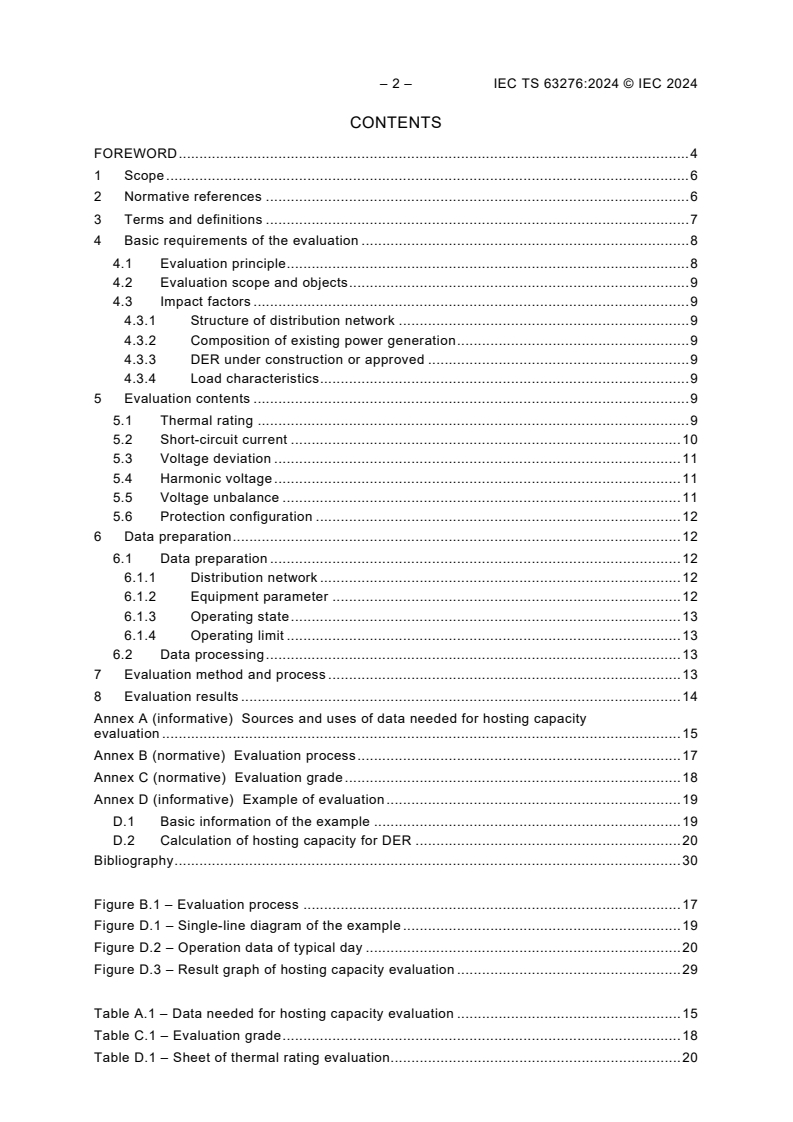
– 2 – IEC TS 63276:2024 © IEC 2024
CONTENTS
FOREWORD . 4
1 Scope . 6
2 Normative references . 6
3 Terms and definitions . 7
4 Basic requirements of the evaluation . 8
4.1 Evaluation principle . 8
4.2 Evaluation scope and objects . 9
4.3 Impact factors . 9
4.3.1 Structure of distribution network . 9
4.3.2 Composition of existing power generation . 9
4.3.3 DER under construction or approved . 9
4.3.4 Load characteristics . 9
5 Evaluation contents . 9
5.1 Thermal rating . 9
5.2 Short-circuit current . 10
5.3 Voltage deviation . 11
5.4 Harmonic voltage . 11
5.5 Voltage unbalance . 11
5.6 Protection configuration . 12
6 Data preparation . 12
6.1 Data preparation . 12
6.1.1 Distribution network . 12
6.1.2 Equipment parameter . 12
6.1.3 Operating state . 13
6.1.4 Operating limit . 13
6.2 Data processing . 13
7 Evaluation method and process . 13
8 Evaluation results . 14
Annex A (informative) Sources and uses of data needed for hosting capacity
evaluation . 15
Annex B (normative) Evaluation process . 17
Annex C (normative) Evaluation grade . 18
Annex D (informative) Example of evaluation . 19
D.1 Basic information of the example . 19
D.2 Calculation of hosting capacity for DER . 20
Bibliography . 30
Figure B.1 – Evaluation process . 17
Figure D.1 – Single-line diagram of the example . 19
Figure D.2 – Operation data of typical day . 20
Figure D.3 – Result graph of hosting capacity evaluation . 29
Table A.1 – Data needed for hosting capacity evaluation . 15
Table C.1 – Evaluation grade . 18
Table D.1 – Sheet of thermal rating evaluation. 20
Table D.2 – Sheet of short-circuit current check . 21
Table D.3 – Sheet of voltage deviation check . 22
Table D.4 – Sheet of harmonic voltage check . 23
Table D.5 – Sheet of thermal rating evaluation (after adjustment) . 24
Table D.6 – Sheet of short-circuit current check (after adjustment) . 25
Table D.7 – Sheet of voltage deviation check (after adjustment) . 26
Table D.8 – Sheet of harmonic voltage check . 27
Table D.9 – Evaluation grades of the hosting capacity of distribution network for DER . 28
– 4 – IEC TS 63276:2024 © IEC 2024
INTERNATIONAL ELECTROTECHNICAL COMMISSION
____________
GUIDELINES FOR THE HOSTING CAPACITY EVALUATION OF
DISTRIBUTION NETWORKS FOR DISTRIBUTED ENERGY RESOURCES
FOREWORD
1) The International Electrotechnical Commission (IEC) is a worldwide organization for standardization comprising
all national electrotechnical committees (IEC National Committees). The object of IEC is to promote international
co-operation on all questions concerning standardization in the electrical and electronic fields. To this end and
in addition to other activities, IEC publishes International Standards, Technical Specifications, Technical Reports,
Publicly Available Specifications (PAS) and Guides (hereafter referred to as "IEC Publication(s)"). Their
preparation is entrusted to technical committees; any IEC National Committee interested in the subject dealt with
may participate in this preparatory work. International, governmental and non-governmental organizations liaising
with the IEC also participate in this preparation. IEC collaborates closely with the International Organization for
Standardization (ISO) in accordance with conditions determined by agreement between the two organizations.
2) The formal decisions or agreements of IEC on technical matters express, as nearly as possible, an international
consensus of opinion on the relevant subjects since each technical committee has representation from all
interested IEC National Committees.
3) IEC Publications have the form of recommendations for international use and are accepted by IEC National
Committees in that sense. While all reasonable efforts are made to ensure that the technical content of IEC
Publications is accurate, IEC cannot be held responsible for the way in which they are used or for any
misinterpretation by any end user.
4) In order to promote international uniformity, IEC National Committees undertake to apply IEC Publications
transparently to the maximum extent possible in their national and regional publications. Any divergence between
any IEC Publication and the corresponding national or regional publication shall be clearly indicated in the latter.
5) IEC itself does not provide any attestation of conformity. Independent certification bodies provide conformity
assessment services and, in some areas, access to IEC marks of conformity. IEC is not responsible for any
services carried out by independent certification bodies.
6) All users should ensure that they have the latest edition of this publication.
7) No liability shall attach to IEC or its directors, employees, servants or agents including individual experts and
members of its technical committees and IEC National Committees for any personal injury, property damage or
other damage of any nature whatsoever, whether direct or indirect, or for costs (including legal fees) and
expenses arising out of the publication, use of, or reliance upon, this IEC Publication or any other IEC
Publications.
8) Attention is drawn to the Normative references cited in this publication. Use of the referenced publications is
indispensable for the correct application of this publication.
9) IEC draws attention to the possibility that the implementation of this document may involve the use of (a)
patent(s). IEC takes no position concerning the evidence, validity or applicability of any claimed patent rights in
respect thereof. As of the date of publication of this document, IEC had not received notice of (a) patent(s), which
may be required to implement this document. However, implementers are cautioned that this may not represent
the latest information, which may be obtained from the patent database available at https://patents.iec.ch. IEC
shall not be held responsible for identifying any or all such patent rights.
IEC TS 63276 has been prepared by Subcommittee 8B: Decentralized electrical energy
systems, of IEC Technical Committee 8: System aspects of electrical energy supply. It is a
Technical Specification.
The text of this Technical Specification is based on the following documents:
Draft Report on voting
8B/212/DTS 8B/225/RVDTS
Full information on the voting for its approval can be found in the report on voting indicated in
the above table.
The language used for the development of this Technical Specification is English.
This document was drafted in accordance with ISO/IEC Directives, Part 2, and developed in
accordance with ISO/IEC Directives, Part 1 and ISO/IEC Directives, IEC Supplement, available
at www.iec.ch/members_experts/refdocs. The main document types developed by IEC are
described in greater detail at www.iec.ch/publications.
The committee has decided that the contents of this document will remain unchanged until the
stability date indicated on the IEC website under webstore.iec.ch in the data related to the
specific document. At this date, the document will be
• reconfirmed,
• withdrawn, or
• revised.
IMPORTANT – The "colour inside" logo on the cover page of this document indicates
that it contains colours which are considered to be useful for the correct understanding
of its contents. Users should therefore print this document using a colour printer.
– 6 – IEC TS 63276:2024 © IEC 2024
GUIDELINES FOR THE HOSTING CAPACITY EVALUATION OF
DISTRIBUTION NETWORKS FOR DISTRIBUTED ENERGY RESOURCES
1 Scope
This document specifies methods for the evaluation of the maximum export capacity of
distributed energy resources (DER) that distribution networks can accommodate. It provides
guidance on the technical constraints that should be considered in evaluating hosting capacity,
information required to be collected to undertake a hosting capacity evaluation, and evaluation
methods.
This document is applicable to AC distribution networks operating at a nominal frequency of
50 Hz or 60 Hz.
This document does not specify allowable values of system parameters that can be impacted
by the addition of DER on a distribution network, such as maximum or minimum voltage,
maximum current, etc. These values are to be determined by the user, from international or
national standards, local regulations or the like, and used as an input to the evaluation methods
described in this document.
Options for increasing the hosting capacity of distribution networks are not specifically
considered, although the identification of constraints to the hosting capacity will assist users in
developing methods for increasing the overall hosting capacity.
This document is mainly used by distribution system operators (DSO) and other organizations
with corresponding qualifications and capabilities. The evaluation results can serve the DER
investors, DSO, energy sector regulators and other stakeholders as a decision-making basis.
2 Normative references
The following documents are referred to in the text in such a way that some or all of their content
constitutes requirements of this document. For dated references, only the edition cited applies.
For undated references, the latest edition of the referenced document (including any
amendments) applies.
IEC 60255 (all parts), Measuring relays and protection equipment
IEC 60364 (all parts), Low-voltage electrical installations
IEC 60834-1, Teleprotection equipment of power systems – Performance and testing – Part 1:
Command systems
IEC 60909-0, Short-circuit currents in three-phase a.c. systems – Part 0: Calculation of currents
IEC 61000 (all parts), Electromagnetic compatibility (EMC)
IEC 61400-27-1, Wind energy generation systems – Part 27-1: Electrical simulation models –
Generic models
IEC 61936-1, Power installations exceeding 1 kV AC and 1,5 kV DC – Part 1: AC
IEC TS 62749, Assessment of power quality – Characteristics of electricity supplied by public
networks
IEC TS 62786-1, Distributed energy resources connection with the grid – Part 1: General
requirements
IEEE 1547.4, Guide for Design, Operation, and Integration of Distributed Resource Island
Systems with Electric Power Systems
3 Terms and definitions
For the purposes of this document, the following terms and definitions apply.
ISO and IEC maintain terminology databases for use in standardization at the following
addresses:
• IEC Electropedia: available at https://www.electropedia.org/
• ISO Online browsing platform: available at https://www.iso.org/obp
For the purposes of this document, the following terms and definitions apply.
3.1
distributed energy resources
DER
generators (with their auxiliaries, protection and connection equipment), including loads having
a generating mode (such as electrical energy storage systems), connected to a low-voltage or
a medium-voltage network
[SOURCE: IEC 60050-617:2017, 617-04-20, modified – "pl" was deleted from the term and
abbreviated term.]
3.2
hosting capacity
maximum export capacity of DER that the distribution network can accommodate, under the
condition that the distribution network operates safely and reliably
3.3
distribution network
electric power network for the distribution of electric power from and to network users for which
a distribution system operator (DSO) is responsible
[SOURCE: IEC TS 62786:2017, 3.4]
3.4
distribution system operator
DSO
party operating a distribution network
[SOURCE: IEC 60050-617:2009, 617-02-10, modified – "distribution network operator" and
"distributor" were deleted from the equivalent terms.]
– 8 – IEC TS 63276:2024 © IEC 2024
3.5
reverse load rate
ratio of reverse active power through a transformer, line, cable, etc. to its actual maximum
operating capacity
Note 1 to entry: Reverse direction of power flow is from downstream to upstream.
Note 2 to entry: The actual maximum operating capacity of a transformer, line, cable, etc. is affected by aging and
climate.
3.6
thermal rating
ability of electrical equipment to bear the thermal effect of current in long-time operation
3.7
short-circuit current
electric current in a given short-circuit
[SOURCE: IEC 60050-614:2016, 614-02-03]
3.8
voltage deviation
difference between the supply voltage at a given instant and the declared supply voltage
[SOURCE: IEC 60050-614:2016, 614-01-04]
3.9
harmonic voltage
sinusoidal voltage with a frequency equal to an integer multiple of the fundamental frequency
of the voltage
[SOURCE: IEC 60050-614:2016, 614-01-14]
3.10
voltage unbalance
in a polyphase system, a condition in which the RMS values of the phase voltages or the phase
angles between consecutive phases are not all equal
[SOURCE: IEC 60050-161:1990, 161-08-09, modified – "voltage imbalance" was deleted for the
equivalent terms.]
4 Basic requirements of the evaluation
4.1 Evaluation principle
The evaluation is to guide the development of DER to match the current situation and future
development of distribution network. Therefore, the evaluation should be carried out to identify
the hosting capacity of a distribution network while ensuring the safe and reliable operation of
distribution network. The objective is to provide a reference for the planning, designing,
reconstructing and operating of DER and distribution network.
The hosting capacity of a certain voltage level should not exceed that of the corresponding
upper level. Therefore, the evaluation should be based on the principle of "hierarchical
evaluation zone by zone", i.e. it should be carried out from the whole to the segment and from
higher-voltage level to lower-voltage level according to the power supply area and voltage level.
The evaluation should be carried out periodically in synchronization with the analysis of
distribution network operation mode and distribution network planning. The evaluation period
should be appropriately adjusted according to the changes of distribution network structure,
electrical load and power generation, which can be shortened in the distribution network of low
hosting capacity.
4.2 Evaluation scope and objects
The evaluation scope could be the whole distribution network or a part of it, for example, a
control area of DSO or a supply zone of a transformer, etc.
The evaluation objects should include corresponding electrical equipment, including
transformers, lines, cables, switching equipment, corresponding relay protection equipment, etc.
4.3 Impact factors
4.3.1 Structure of distribution network
The hosting capacity is directly related to the structure and equipment capacity of the
distribution network. If the structure of distribution network is strong and the equipment capacity
of distribution network is large, the corresponding hosting capacity of distribution network is
relatively large.
4.3.2 Composition of existing power generation
The equipment capacity in a distribution network is generally fixed. Other power generation
transmitted through the same channel as DER in the distribution network can cause congestion
parts or sections of infrastructures of determined areas. Therefore, it is necessary to
in certain
consider the composition of the existing power generation when planning additional DER
installations.
4.3.3 DER under construction or approved
Different nodes in a distribution network have different thermal rating margins, voltage
deviations, and short-circuit capacities. As a result, different nodes can support different
capacities of DER. The additional DER should consider the DER under construction and
approved at the specific connection node.
4.3.4 Load characteristics
Consumption including local consumption and delivery of DER should be analysed with the load
distribution and its operation curve. The higher the load density of the distribution network or
the more similar the shape of the load curve to the DER output curve is, the higher the hosting
capacity is.
5 Evaluation contents
5.1 Thermal rating
The evaluation objects should include transformers, lines, cables, etc. within the evaluation
scope. The reverse load rate λ should be used as the evaluation index for thermal rating
evaluation.
The reverse load rate λ should be calculated according to factors such as the distribution
network operation mode, transformers, lines and cables limits, load characteristics, and output
characteristics of DER and other power generations.
– 10 – IEC TS 63276:2024 © IEC 2024
The reverse load rate λ should be calculated according to Formula (1).
P t − P t
() ()
GL
λt()= (1)
St()
e
where
Pt is the output of DER and other power sources in the evaluation scope at time t;
()
G
P t is the electrical load at time t;
()
L
St is the actual maximum operating capacity of transformers, lines, cables etc. at time t.
()
e
The maximum additional export capacity of DER should be calculated according to Formula (2).
Pk=−×λS
(2)
( )
m r max e
where
P is the maximum additional export capacity of DER that can be connected to the evaluated
m
line, cable or transformer;
k is the allowable reverse load rate;
r
NOTE k can be determined by DSO or equipment operators based on grid operation and equipment conditions.
r
is the historical maximum value of reverse load rate;
λ
max
S is the actual maximum operating capacity of transformers, lines, cables, etc.
e
corresponding to λ .
max
5.2 Short-circuit current
The short-circuit current of distribution network can be affected by the connection of DER. If the
existing short-circuit current of distribution network is large, or the interrupting capacity margin
of switchgear is small, the additional DER capacity able to be installed can be limited.
The short-circuit current should be checked based on the principle that the short-circuit current
of each bus of the distribution network does not exceed the corresponding circuit breaker
breaking current limit after the additional DER are connected. The short-circuit current of the
system should be calculated according to IEC 60909-0 based on the normal/typical operation
mode of distribution network, and the capacity of additional DER within the evaluation scope.
Short-circuit current should be checked according to Formula (3).
I < I
(3)
sc minb
where
I is the short-circuit current of the bus;
sc
I is the minimum value of the breaking current limit of all equipment (including circuit
minb
breakers) connected with the bus.
5.3 Voltage deviation
During the high output period of DER, the downstream power flow of the distribution network
can become lighter or even reversed, which can cause the voltage to exceed the limit. Under
any normal operating conditions, the connection of DER should not cause the voltage of
distribution network to exceed the limit.
The voltage deviation should be checked based on the principle that the voltage does not
exceed the limit after the additional DER are connected. The voltage deviation should meet the
relevant requirements of IEC TS 62749 and IEC TS 62786-1. The voltage of each bus within
the evaluation scope should be checked.
The maximum positive voltage deviation δU and the maximum negative voltage deviation δU
H L
should be calculated and checked based on the capacity of additional DER.
The voltage deviation should be checked according to Formula (4) and Formula (5).
δU <ΔU
(4)
HH
δU <ΔU
(5)
LL
where
δU is the maximum positive voltage deviation;
H
δU is the maximum negative voltage deviation;
L
ΔU is the maximum allowable value of positive voltage deviation;
H
ΔU is the maximum allowable value of negative voltage deviation.
L
5.4 Harmonic voltage
Harmonic voltage should be checked based on the principle that the harmonic voltage limits of
the distribution network should not be exceeded. The harmonic voltage should meet the relevant
requirements of IEC TS 62749. All nodes affected by harmonic voltage provided by DER should
be checked.
Harmonic voltage should be checked in accordance with Formula (6).
UU<
(6)
hv,h h
where
U is the h-th harmonic voltage;
hv,h
U is the allowable value of the h-th harmonic voltage.
h
5.5 Voltage unbalance
The voltage unbalance check should be performed for single-and-three-phase connections of
DER complying with the principle to ensure the unbalance factor of the three-phase voltage in
the distribution network does not exceed the limits. The voltage unbalance should meet the
relevant requirements of IEC 62749 and IEC TS 62786-1
...