

IEC TR 62572-4:2020
(Main)Fibre optic active components and devices - Reliability standards - Part 4: Guidelines for optical connector end-face cleaning methods for receptacle style optical transceivers
General Information
- Abstract
IEC/TR 62572-4:2020, which is a Technical Report, provides guidelines for optical connector end-face cleaning methods for receptacle style optical transceivers. It includes details about handling receptacle style optical transceivers, internal structures of optical transceivers, information on cleaning tools and machines, applicable cleaning methods, and cleaning procedures. Receptacle style optical transceivers as well as optical fibre patch cords are handled by operators and maintenance staff of optical network systems. This document can be used as a guideline to prepare instruction manuals for the operators and maintenance staff of optical network systems. This second edition cancels and replaces the first edition published in 2013. This edition constitutes a technical revision. This edition includes the following significant technical changes with respect to the previous edition:
- addition of terms and definitions on multifibre connector interface optical transceivers;
- addition of cleaning methods for multifibre connector interface type optical transceivers;
- updating URLs for reference websites.
- Status
- Published
- Publication Date
- 07-Sep-2020
- Technical Committee
- SC 86C - Fibre optic systems, sensing and active devices
- Current Stage
- PPUB - Publication issued
- Start Date
- 08-Sep-2020
- Completion Date
- 24-Sep-2020
Buy Documents

IEC TR 62572-4:2020 - Fibre optic active components and devices - Reliability standards - Part 4: Guidelines for optical connector end-face cleaning methods for receptacle style optical transceivers Released:9/8/2020

IEC TR 62572-4:2020 RLV - Fibre optic active components and devices - Reliability standards - Part 4: Guidelines for optical connector end-face cleaning methods for receptacle style optical transceivers Released:9/8/2020
Overview
IEC TR 62572-4:2020 is a Technical Report from the International Electrotechnical Commission (IEC) that provides practical guidelines for optical connector end-face cleaning methods specifically for receptacle style optical transceivers (e.g., SFP, XFP, QSFP, CFP). This second edition (2020) replaces the 2013 edition and adds definitions and cleaning methods for multifibre connector interfaces (MPO/MTP) and updates reference URLs. The document is intended as a reference for manufacturers, operators and maintenance staff to reduce contamination-related failures and to prepare user and maintenance manuals.
Key topics and technical requirements
- Scope and purpose
- Guidance on handling, storage, installation, connection and removal of receptacle style optical transceivers.
- Emphasis on preventing contamination transfer between patch cords and transceiver receptacles.
- Internal transceiver structures
- Differentiation between single‑fibre and multifibre connector interfaces and variations such as stub, lens and plate-contact types that affect cleaning approach.
- Cleaning tools and machines
- Overview of typical cleaning tools: reel-type, stick-type, pen-type cleaners; gas and vacuum cleaning systems; air dusters; and wet-cleaning processes.
- Tables mapping applicable tools to transceiver internal structures and connector types.
- Cleaning procedures
- Step-by-step procedures and recommended practices (annexes) for different tool types and connector interfaces, including inspection guidance.
- Inspection and verification
- Examples of visual inspection instruments and methods to verify end-face cleanliness before mating connectors.
- Operational guidance
- Recommendations for storage, abnormality handling, and safe use by operators and maintenance teams.
Practical applications and who should use it
- Network operators and maintenance staff who handle optical patch cords and pluggable transceivers in data centers and telecom installations.
- Field technicians performing connector cleaning, inspection, and transceiver servicing.
- Technical authors and product teams preparing user manuals, service instructions, and maintenance SOPs for optical network equipment.
- Manufacturers and integrators seeking to standardize cleaning procedures to improve reliability and reduce downtime due to contamination or physical damage.
Related standards (for further reference)
- IEC TR 62627-01 - guidance on cleaning optical connector plugs and adaptors
- IEC 61754 series - connector interface standards (e.g., IEC 61754-7 for MPO, IEC 61754-4 for SC)
- Other parts of the IEC reliability series for fibre optic active components
By following IEC TR 62572-4:2020 guidance for optical connector cleaning, organizations can improve link reliability, reduce contamination-induced failures, and implement consistent maintenance procedures across single‑fibre and multifibre transceiver interfaces.
Relations
- Effective Date
- 05-Sep-2023
Buy Documents
IEC TR 62572-4:2020 - Fibre optic active components and devices - Reliability standards - Part 4: Guidelines for optical connector end-face cleaning methods for receptacle style optical transceivers Released:9/8/2020
IEC TR 62572-4:2020 RLV - Fibre optic active components and devices - Reliability standards - Part 4: Guidelines for optical connector end-face cleaning methods for receptacle style optical transceivers Released:9/8/2020
Get Certified
Connect with accredited certification bodies for this standard

ANCE
Mexican certification and testing association.

Intertek Slovenia
Intertek testing, inspection, and certification services in Slovenia.

LNE (Laboratoire National de Métrologie et d'Essais)
French national laboratory for metrology and testing.
Sponsored listings
Frequently Asked Questions
IEC TR 62572-4:2020 is a technical report published by the International Electrotechnical Commission (IEC). Its full title is "Fibre optic active components and devices - Reliability standards - Part 4: Guidelines for optical connector end-face cleaning methods for receptacle style optical transceivers". This standard covers: IEC/TR 62572-4:2020, which is a Technical Report, provides guidelines for optical connector end-face cleaning methods for receptacle style optical transceivers. It includes details about handling receptacle style optical transceivers, internal structures of optical transceivers, information on cleaning tools and machines, applicable cleaning methods, and cleaning procedures. Receptacle style optical transceivers as well as optical fibre patch cords are handled by operators and maintenance staff of optical network systems. This document can be used as a guideline to prepare instruction manuals for the operators and maintenance staff of optical network systems. This second edition cancels and replaces the first edition published in 2013. This edition constitutes a technical revision. This edition includes the following significant technical changes with respect to the previous edition: - addition of terms and definitions on multifibre connector interface optical transceivers; - addition of cleaning methods for multifibre connector interface type optical transceivers; - updating URLs for reference websites.
IEC/TR 62572-4:2020, which is a Technical Report, provides guidelines for optical connector end-face cleaning methods for receptacle style optical transceivers. It includes details about handling receptacle style optical transceivers, internal structures of optical transceivers, information on cleaning tools and machines, applicable cleaning methods, and cleaning procedures. Receptacle style optical transceivers as well as optical fibre patch cords are handled by operators and maintenance staff of optical network systems. This document can be used as a guideline to prepare instruction manuals for the operators and maintenance staff of optical network systems. This second edition cancels and replaces the first edition published in 2013. This edition constitutes a technical revision. This edition includes the following significant technical changes with respect to the previous edition: - addition of terms and definitions on multifibre connector interface optical transceivers; - addition of cleaning methods for multifibre connector interface type optical transceivers; - updating URLs for reference websites.
IEC TR 62572-4:2020 is classified under the following ICS (International Classification for Standards) categories: 33.180.01 - Fibre optic systems in general. The ICS classification helps identify the subject area and facilitates finding related standards.
IEC TR 62572-4:2020 has the following relationships with other standards: It is inter standard links to IEC TR 62572-4:2013. Understanding these relationships helps ensure you are using the most current and applicable version of the standard.
IEC TR 62572-4:2020 is available in PDF format for immediate download after purchase. The document can be added to your cart and obtained through the secure checkout process. Digital delivery ensures instant access to the complete standard document.
Standards Content (Sample)
IEC TR 62572-4 ®
Edition 2.0 2020-09
TECHNICAL
REPORT
colour
inside
Fibre optic active components and devices – Reliability standards –
Part 4: Guidelines for optical connector end-face cleaning methods for
receptacle style optical transceivers
All rights reserved. Unless otherwise specified, no part of this publication may be reproduced or utilized in any form
or by any means, electronic or mechanical, including photocopying and microfilm, without permission in writing from
either IEC or IEC's member National Committee in the country of the requester. If you have any questions about IEC
copyright or have an enquiry about obtaining additional rights to this publication, please contact the address below or
your local IEC member National Committee for further information.
IEC Central Office Tel.: +41 22 919 02 11
3, rue de Varembé info@iec.ch
CH-1211 Geneva 20 www.iec.ch
Switzerland
About the IEC
The International Electrotechnical Commission (IEC) is the leading global organization that prepares and publishes
International Standards for all electrical, electronic and related technologies.
About IEC publications
The technical content of IEC publications is kept under constant review by the IEC. Please make sure that you have the
latest edition, a corrigendum or an amendment might have been published.
IEC publications search - webstore.iec.ch/advsearchform Electropedia - www.electropedia.org
The advanced search enables to find IEC publications by a The world's leading online dictionary on electrotechnology,
variety of criteria (reference number, text, technical containing more than 22 000 terminological entries in English
committee,…). It also gives information on projects, replaced and French, with equivalent terms in 16 additional languages.
and withdrawn publications. Also known as the International Electrotechnical Vocabulary
(IEV) online.
IEC Just Published - webstore.iec.ch/justpublished
Stay up to date on all new IEC publications. Just Published IEC Glossary - std.iec.ch/glossary
details all new publications released. Available online and once 67 000 electrotechnical terminology entries in English and
a month by email. French extracted from the Terms and Definitions clause of IEC
publications issued since 2002. Some entries have been
IEC Customer Service Centre - webstore.iec.ch/csc collected from earlier publications of IEC TC 37, 77, 86 and
If you wish to give us your feedback on this publication or need CISPR.
further assistance, please contact the Customer Service
Centre: sales@iec.ch.
IEC TR 62572-4 ®
Edition 2.0 2020-09
TECHNICAL
REPORT
colour
inside
Fibre optic active components and devices – Reliability standards –
Part 4: Guidelines for optical connector end-face cleaning methods for
receptacle style optical transceivers
INTERNATIONAL
ELECTROTECHNICAL
COMMISSION
ICS 33.180.01 ISBN 978-2-8322-8780-4
– 2 – IEC TR 62572-4:2020 © IEC 2020
CONTENTS
FOREWORD . 4
INTRODUCTION . 6
1 Scope . 7
2 Normative references . 7
3 Terms and definitions . 7
4 Application of receptacle style optical transceivers and influence of contamination
on optical connector end-face . 9
4.1 Application of receptacle style optical transceivers. 9
4.2 Influence of contamination on optical connector plugs . 9
4.3 Transferring of contamination. 9
4.4 Influence of contamination of optical connector for optical transceivers . 9
5 Care in handling of receptacle style optical transceivers . 9
5.1 General . 9
5.2 Storage of receptacle style optical transceivers . 9
5.3 Installation of receptacle style optical transceivers . 10
5.4 Connection of optical connector plugs to receptacle style optical transceivers . 10
5.5 Removing of receptacle style optical transceivers . 10
5.6 Action in case of abnormality . 10
6 Cleaning tools and machines . 10
6.1 General . 10
6.2 Cleaning tools and machines for optical receptacles . 11
7 Internal structure of receptacle style optical transceivers and their applicable
cleaning tools and machines . 11
7.1 General . 11
7.2 Single-fibre optical connector interface type . 11
7.3 Multifibre optical connector interface type . 12
Annex A (informative) Detail information of optical connector end-face cleaning tools
and machines . 14
A.1 Reel type cleaner . 14
A.2 Stick type cleaner . 14
A.3 Pen type cleaner . 14
A.4 Gas and vacuum cleaning machine . 15
A.5 Air duster . 16
A.6 Wet clean . 16
Annex B (informative) Detailed information on the internal structure of receptacle style
optical transceivers and their applicable cleaning tools and machines. 17
B.1 Internal structure of receptacle style optical transceivers . 17
B.2 Example of the method to distinguish internal structure of receptacle style
optical transceivers . 17
B.3 Applicable cleaning tools and machines according to internal structure of
receptacle style optical transceivers . 18
B.3.1 General . 18
B.3.2 Characteristics of stub type optical transceivers . 18
B.3.3 Characteristics of lens type optical transceivers . 18
B.3.4 Characteristics of plate contact type optical transceivers . 19
Annex C (informative) Cleaning procedure of optical connector end-face of receptacle
style optical transceivers . 20
C.1 Basic cleaning procedure . 20
C.2 Cleaning procedure of stick type cleaner . 20
C.3 Cleaning procedure of pen type cleaner . 21
C.4 Cleaning procedure of gas and vacuum type cleaning machine . 21
C.5 Cleaning procedure of air duster . 21
C.6 Other important points . 21
Annex D (informative) Examples of inspection instruments for an optical connector
receptacle end-face . 23
Bibliography . 24
Figure A.1 – Example of a reel type cleaner . 14
Figure A.2 – Examples of stick type cleaners . 14
Figure A.3 – Example of a single-fibre interface pen type cleaner . 15
Figure A.4 – Examples of a multifibre interface pen type cleaner . 15
Figure A.5 – Example of gas and vacuum cleaning machine . 15
Figure A.6 – Example of air duster . 16
Figure B.1 – Internal structures for connecting to optical connector plugs . 17
Figure C.1 – Cleaning an optical transceiver receptacle end-face by a stick type
cleaner . 20
Figure C.2 – Cleaning optical transceiver receptacle end-face using a pen type cleaner . 21
Figure D.1 – Examples of optical connector end-face visual inspection equipment . 23
Table 1 – Typical optical connector receptacle cleaning tools and machines . 11
Table 2 – Applicable cleaning tools and machines depending on the internal structure
of single-fibre optical connector interface type optical transceivers . 12
Table 3 – Applicable cleaning tools and machines depending on the internal structure
of multifibre connector interface optical transceivers . 13
– 4 – IEC TR 62572-4:2020 © IEC 2020
INTERNATIONAL ELECTROTECHNICAL COMMISSION
____________
FIBRE OPTIC ACTIVE COMPONENTS AND DEVICES –
RELIABILITY STANDARDS –
Part 4: Guidelines for optical connector end-face cleaning
methods for receptacle style optical transceivers
FOREWORD
1) The International Electrotechnical Commission (IEC) is a worldwide organization for standardization comprising
all national electrotechnical committees (IEC National Committees). The object of IEC is to promote international
co-operation on all questions concerning standardization in the electrical and electronic fields. To this end and
in addition to other activities, IEC publishes International Standards, Technical Specifications, Technical Reports,
Publicly Available Specifications (PAS) and Guides (hereafter referred to as “IEC Publication(s)”). Their
preparation is entrusted to technical committees; any IEC National Committee interested in the subject dealt with
may participate in this preparatory work. International, governmental and non-governmental organizations liaising
with the IEC also participate in this preparation. IEC collaborates closely with the International Organization for
Standardization (ISO) in accordance with conditions determined by agreement between the two organizations.
2) The formal decisions or agreements of IEC on technical matters express, as nearly as possible, an international
consensus of opinion on the relevant subjects since each technical committee has representation from all
interested IEC National Committees.
3) IEC Publications have the form of recommendations for international use and are accepted by IEC National
Committees in that sense. While all reasonable efforts are made to ensure that the technical content of IEC
Publications is accurate, IEC cannot be held responsible for the way in which they are used or for any
misinterpretation by any end user.
4) In order to promote international uniformity, IEC National Committees undertake to apply IEC Publications
transparently to the maximum extent possible in their national and regional publications. Any divergence between
any IEC Publication and the corresponding national or regional publication shall be clearly indicated in the latter.
5) IEC itself does not provide any attestation of conformity. Independent certification bodies provide conformity
assessment services and, in some areas, access to IEC marks of conformity. IEC is not responsible for any
services carried out by independent certification bodies.
6) All users should ensure that they have the latest edition of this publication.
7) No liability shall attach to IEC or its directors, employees, servants or agents including individual experts and
members of its technical committees and IEC National Committees for any personal injury, property damage or
other damage of any nature whatsoever, whether direct or indirect, or for costs (including legal fees) and
expenses arising out of the publication, use of, or reliance upon, this IEC Publication or any other IEC Publications.
8) Attention is drawn to the Normative references cited in this publication. Use of the referenced publications is
indispensable for the correct application of this publication.
9) Attention is drawn to the possibility that some of the elements of this IEC Publication may be the subject of patent
rights. IEC shall not be held responsible for identifying any or all such patent rights.
The main task of IEC technical committees is to prepare International Standards. However, a
technical committee may propose the publication of a Technical Report when it has collected
data of a different kind from that which is normally published as an International Standard, for
example "state of the art".
IEC TR 62572-4, which is a Technical Report, has been prepared by subcommittee 86C: Fibre
optic systems and active devices, of IEC technical committee 86: Fibre optics.
This second edition cancels and replaces the first edition published in 2013. This edition
constitutes a technical revision.
This edition includes the following significant technical changes with respect to the previous
edition:
a) addition of terms and definitions on multifibre connector interface optical transceivers;
b) addition of cleaning methods for multifibre connector interface type optical transceivers;
c) updating URLs for reference websites.
The text of this Technical Report is based on the following documents:
Draft TR Report on voting
86C/1661/DTR 86C/1681/RVDTR
Full information on the voting for the approval of this technical report can be found in the report
on voting indicated in the above table.
This document has been drafted in accordance with the ISO/IEC Directives, Part 2.
A list of all parts in the IEC 62752 series, under the general title Fibre optic active components
and devices – Reliability standards, can be found on the IEC website.
The committee has decided that the contents of this document will remain unchanged until the
stability date indicated on the IEC website under "http://webstore.iec.ch" in the data related to
the specific document. At this date, the document will be
• reconfirmed,
• withdrawn,
• replaced by a revised edition, or
• amended.
IMPORTANT – The 'colour inside' logo on the cover page of this publication indicates
that it contains colours which are considered to be useful for the correct understanding
of its contents. Users should therefore print this document using a colour printer.
– 6 – IEC TR 62572-4:2020 © IEC 2020
INTRODUCTION
High speed internet communication systems and subscriber systems have spread rapidly owing
to the increased capacity of data communication. In these systems, receptacle style optical
transceivers such as SFP (small form factor pluggable) and XFP (10-Gbit/s small form factor
pluggable), which can be mounted and removed during transmission systems operation, are
widely used. Optical receptacles of optical transceivers are connected to optical connector
plugs of optical patch cords, and optical signals are transmitted and received through these
optical receptacles. Pluggable optical transceivers are typically of small size and low cost, and
their designs are often simplified. Therefore, the internal structure, especially the receptacle
structure, tends to vary between optical transceiver manufacturers.
Generally, to maintain high reliability of optical connections, the optical connector end-face
needs to be cleaned. The Technical Report on cleaning of optical connector plugs and optical
adaptors, IEC TR 62627-01 [1] , proposed by Japan, was published in August 2010 and revised
in January 2016.
There are, however, no standard cleaning methods for the optical receptacles of optical
transceivers. It is a concern that the failure of optical transceivers due to damage and
contamination of the optical receptacle end-face can lead to failure in optical network systems.
Multifibre connectors, like the multi-fibre push-on (MPO) connector – see IEC 61754-7 (all
parts) [2] – have been widely used in data centres as fibre-to-fibre connections since the early
2010's. They are now also used as optical interfaces in optical transceivers, such as QSFP
(quad small form factor pluggable) and CFP (C form factor pluggable) transceivers.
The physical structure of the optical interfaces in transceivers with MPO connectors is
significantly different from that of transceivers with single fibre connectors, such as SC
connectors (see IEC 61754-4 [3]) and LC connectors (see IEC 61754-20 [4]). Therefore, it was
decided to revise this document by adding information on cleaning methods for MPO interface
receptacle style optical transceivers.
IEC 62572-4:2013 was based on OITDA TP12/TP-2012, and this edition is based on OITDA
TP12/AD-2019 [5].
___________
Numbers in square brackets refer to the Bibliography.
FIBRE OPTIC ACTIVE COMPONENTS AND DEVICES –
RELIABILITY STANDARDS –
Part 4: Guidelines for optical connector end-face cleaning
methods for receptacle style optical transceivers
1 Scope
This part of IEC 62572, which is a Technical Report, provides guidelines for optical connector
end-face cleaning methods for receptacle style optical transceivers. It includes details about
handling receptacle style optical transceivers, internal structures of optical transceivers,
information on cleaning tools and machines, applicable cleaning methods, and cleaning
procedures.
Receptacle style optical transceivers as well as optical fibre patch cords are handled by
operators and maintenance staff of optical network systems. This document can be used as a
guideline to prepare instruction manuals for the operators and maintenance staff of optical
network systems.
2 Normative references
There are no normative references in this document.
3 Terms and definitions
For the purposes of this document, the following terms and definitions apply.
ISO and IEC maintain terminological databases for use in standardization at the following
addresses:
• IEC Electropedia: available at http://www.electropedia.org/
• ISO Online browsing platform: available at http://www.iso.org/obp
3.1
stub
polished short ferrule, including optical fibre inside, mounted in a receptacle style optical
transceiver
Note 1 to entry: The stub is connected to an optical connector plug of an optical patch cord.
3.2
stub type optical transceiver
receptacle style optical transceiver with a stub
3.3
lens type optical transceiver
receptacle style optical transceiver without a stub, optically coupling an optical semiconductor
device to an optical connector plug of an optical patch cord with converging optical beams by a
lens or lenses
– 8 – IEC TR 62572-4:2020 © IEC 2020
3.4
plate contact type optical transceiver
receptacle style optical transceiver without a stub connected by contacting a flat or convex plate
(glass or plastic) to an end-face of an optical connector plug of an optical patch cord
3.5
multifibre ferrule type optical transceiver
receptacle style optical transceiver with a multifibre ferrule connecting to a multifibre connector
plug
EXAMPLE 1 MT multifibre ferrule (see IEC 61754-5 [6]).
EXAMPLE 2 MPO multifibre connector plug – see IEC 61754-7 (all parts) [2].
3.6
no ferrule type multifibre optical transceiver
receptacle style optical transceiver without a stub and a multifibre ferrule, optically coupling an
optical semiconductor device to a multifibre connector plug of an optical patch cord
3.7
optical transceiver
optical module functioning as an optical transmitter and an optical receiver
Note 1 to entry: There are two types of optical interfaces: single-fibre connector and multifibre connector.
3.8
reel type cleaner
optical connector plug end-face cleaning tool consisting of a cleaning cloth rolled and packed
in a cassette box and a small window for cleaning
3.9
stick type cleaner
swab type cleaner
optical connector receptacle and optical connector adaptor end-face cleaning tool consisting of
a cleaning cloth attached to the top of a stick
3.10
pen type cleaner
optical connector receptacle and optical connector adaptor end-face cleaning tool consisting of
a tape-shaped cleaning cloth on the top of a tool that moves and cleans
3.11
gas and vacuum type cleaning machine
optical connector end-face cleaning machine that injects and extracts volatile liquid solvent (gas)
from a nozzle
3.12
air duster
canned air
cleaning tool that blows compressed air from the nozzle of a can
3.13
dust cap
protective cover or cap attached to an optical connector plug, optical connector adaptor, or
optical receptacle when the optical connector is not connected
4 Application of receptacle style optical transceivers and influence of
contamination on optical connector end-face
4.1 Application of receptacle style optical transceivers
Almost all optical receptacle style transceivers are a pluggable type. Pluggable optical
transceivers are often attached to the front panels of optical network equipment. For installation
and maintenance, pluggable optical transceivers (as well as patch cords) are mounted and
removed from optical network equipment by operators and maintenance staff of optical network
systems.
When optical components and modules with connector plugs are mounted in optical network
equipment by equipment manufacturers, the environment (temperature, humidity and dust) in
optical network equipment factories is generally well controlled, and precautions are taken to
assure that components are kept clean. However, environments in which optical network
systems operate, such as central office, data centres and computer rooms, are not generally
as clean as those in the equipment factories. In these environments, dust or condensation can
be introduced onto the optical connector end-faces of optical transceivers.
4.2 Influence of contamination on optical connector plugs
Optical signals propagate within or slightly outside of the core of optical fibres, the diameter of
which is very small, typically from about 9 µm to around 50 µm. If a very small particle of dust
of a few micrometres (µm) in size is deposited on an optical fibre core of an optical connector
plug, the optical connector might not achieve its designed optical performance (loss and return
loss), which can adversely impact the performance of the optical network system in which it is
used. Cleaning of optical connector plugs is important and is described in IEC TR 62627-01 [1].
IEC TR 62627-05 [7] summarizes the relationship observed between contamination of optical
connector end-faces and optical performance (loss and return loss).
4.3 Transferring of contamination
Optical connector plugs and optical connector receptacles can be mated many times, and they
can also be mated to different connectors. When the end-face of an optical connector plug is
contaminated, that contamination can be transferred to the optical receptacle to which it is
mated. Moreover, that contamination can be transferred from the receptacle to another optical
connector plug to which it is mated. Contamination can be spread from one component to
another like an infection. Therefore, it is most important to prevent contamination of the optical
connector end-face and to clean the end-face when contaminated.
4.4 Influence of contamination of optical connector for optical transceivers
Contamination of the optical connector end-face of receptacle style optical transceivers can
impact optical performance in the same way that contamination of optical connector plugs
impacts optical performance. The International Electronics Manufacturing Initiative (iNEMI)
presented a paper at the Warsaw meeting of IEC/SC 86B in April 2012 that illustrates the impact
of contamination on transmitter/receiver optical subassemblies (TOSA/ROSA) [8].
5 Care in handling of receptacle style optical transceivers
5.1 General
Clause 5 describes general care in handling of receptacle style optical transceivers. It is
advisable to follow the manufacturer's operating manuals or instructions, where provided.
5.2 Storage of receptacle style optical transceivers
Receptacle style optical transceivers should be stored so as to protect the device from static
electric discharge, dust, mechanical shock, and vibration and should also be kept within a
– 10 – IEC TR 62572-4:2020 © IEC 2020
specified temperature and humidity range. During storage, dust caps should be placed on
optical receptacles to prevent contamination.
5.3 Installation of receptacle style optical transceivers
Pluggable type receptacle style optical transceivers are used on the front panels of optical
network equipment. When a pluggable type optical transceiver is mounted while network
equipment is operating, the optical transceiver is driven by electrical power coming through the
electrical pins of the transceiver. Dust caps should be put on optical receptacles when mounting
on operating equipment to prevent eye damage to maintenance staff as well as to prevent
contamination of the transceiver.
5.4 Connection of optical connector plugs to receptacle style optical transceivers
Optical connector plugs are connected to the optical receptacles of an optical transceiver after
mounting on equipment. Dust caps should be removed just before the optical connector plugs
are connected. Care should also be taken to prevent dust from entering the optical receptacle.
Optical connector plug end-faces should be inspected and cleaned if contamination is observed.
After optical connector plug end-faces are inspected and found to be in compliance with the
specified visual inspection requirements, the optical connector plugs are connected to the
optical receptacles of the transceivers. Optical receptacle end-faces are more difficult to clean
than optical connector plug end-faces. Moreover, there are several different internal structures
of optical receptacles of optical transceivers, and applicable cleaning methods will differ
depending on these internal structures. To prevent transferring of contamination, as described
previously, optical connector plugs should be inspected and cleaned as needed.
5.5 Removing of receptacle style optical transceivers
When optical transceivers are removed from equipment, optical connector plugs should be
disconnected first, dust caps should then be placed on both the optical receptacles and the
optical connector plugs, and only then should the optical transceivers be removed from the
equipment.
5.6 Action in case of abnormality
When the performance of network equipment is degraded to the point at which it fails to function
properly, and it is determined that failure has been caused by an optical transceiver, the optical
transceiver should be removed and analysed. After removing the failed transceiver, the optical
receptacle end-faces should be inspected. There is danger of eye damage if the end-faces are
directly observed while still mounted to operating equipment and the transmitter is emitting
optical radiation. Annex D shows examples of optical connector receptacle end-face visual
inspection equipment. When contamination is observed on the end-faces of optical receptacles,
it should be cleaned by appropriate cleaning methods depending on the internal structure of the
receptacles. If the internal structure is not distinguishable, it should not be cleaned, or cl
...
IEC TR 62572-4 ®
Edition 2.0 2020-09
REDLINE VERSION
TECHNICAL
REPORT
colour
inside
Fibre optic active components and devices – Reliability standards –
Part 4: Guidelines for optical connector end-face cleaning methods for
receptacle style optical transceivers
All rights reserved. Unless otherwise specified, no part of this publication may be reproduced or utilized in any form
or by any means, electronic or mechanical, including photocopying and microfilm, without permission in writing from
either IEC or IEC's member National Committee in the country of the requester. If you have any questions about IEC
copyright or have an enquiry about obtaining additional rights to this publication, please contact the address below or
your local IEC member National Committee for further information.
IEC Central Office Tel.: +41 22 919 02 11
3, rue de Varembé info@iec.ch
CH-1211 Geneva 20 www.iec.ch
Switzerland
About the IEC
The International Electrotechnical Commission (IEC) is the leading global organization that prepares and publishes
International Standards for all electrical, electronic and related technologies.
About IEC publications
The technical content of IEC publications is kept under constant review by the IEC. Please make sure that you have the
latest edition, a corrigendum or an amendment might have been published.
IEC publications search - webstore.iec.ch/advsearchform Electropedia - www.electropedia.org
The advanced search enables to find IEC publications by a The world's leading online dictionary on electrotechnology,
variety of criteria (reference number, text, technical containing more than 22 000 terminological entries in English
committee,…). It also gives information on projects, replaced and French, with equivalent terms in 16 additional languages.
and withdrawn publications. Also known as the International Electrotechnical Vocabulary
(IEV) online.
IEC Just Published - webstore.iec.ch/justpublished
Stay up to date on all new IEC publications. Just Published IEC Glossary - std.iec.ch/glossary
details all new publications released. Available online and 67 000 electrotechnical terminology entries in English and
once a month by email. French extracted from the Terms and Definitions clause of
IEC publications issued since 2002. Some entries have been
IEC Customer Service Centre - webstore.iec.ch/csc collected from earlier publications of IEC TC 37, 77, 86 and
If you wish to give us your feedback on this publication or CISPR.
need further assistance, please contact the Customer Service
Centre: sales@iec.ch.
IEC TR 62572-4 ®
Edition 2.0 2020-09
REDLINE VERSION
TECHNICAL
REPORT
colour
inside
Fibre optic active components and devices – Reliability standards –
Part 4: Guidelines for optical connector end-face cleaning methods for
receptacle style optical transceivers
INTERNATIONAL
ELECTROTECHNICAL
COMMISSION
ICS 33.180.01 ISBN 978-2-8322-8871-9
– 2 – IEC TR 62572-4:2020 RLV © IEC 2020
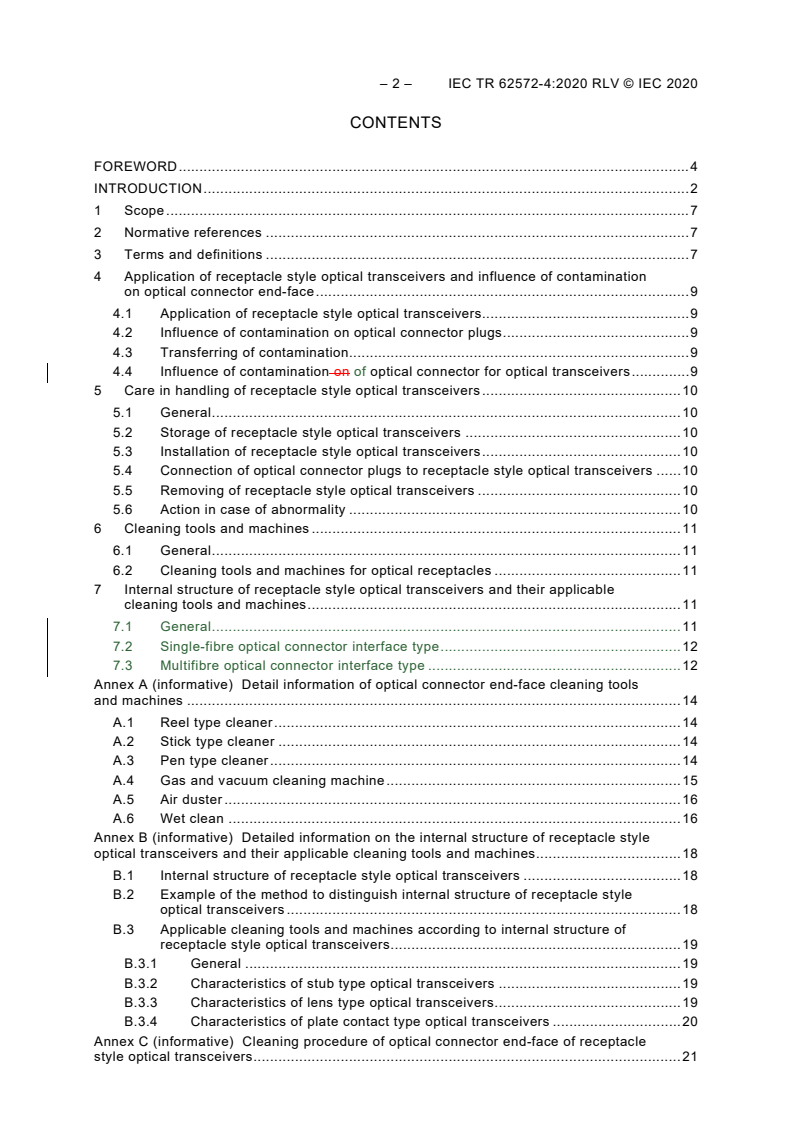
CONTENTS
FOREWORD . 4
INTRODUCTION . 2
1 Scope . 7
2 Normative references . 7
3 Terms and definitions . 7
4 Application of receptacle style optical transceivers and influence of contamination
on optical connector end-face . 9
4.1 Application of receptacle style optical transceivers. 9
4.2 Influence of contamination on optical connector plugs . 9
4.3 Transferring of contamination. 9
4.4 Influence of contamination on of optical connector for optical transceivers . 9
5 Care in handling of receptacle style optical transceivers . 10
5.1 General . 10
5.2 Storage of receptacle style optical transceivers . 10
5.3 Installation of receptacle style optical transceivers . 10
5.4 Connection of optical connector plugs to receptacle style optical transceivers . 10
5.5 Removing of receptacle style optical transceivers . 10
5.6 Action in case of abnormality . 10
6 Cleaning tools and machines . 11
6.1 General . 11
6.2 Cleaning tools and machines for optical receptacles . 11
7 Internal structure of receptacle style optical transceivers and their applicable
cleaning tools and machines . 11
7.1 General . 11
7.2 Single-fibre optical connector interface type . 12
7.3 Multifibre optical connector interface type . 12
Annex A (informative) Detail information of optical connector end-face cleaning tools
and machines . 14
A.1 Reel type cleaner . 14
A.2 Stick type cleaner . 14
A.3 Pen type cleaner . 14
A.4 Gas and vacuum cleaning machine . 15
A.5 Air duster . 16
A.6 Wet clean . 16
Annex B (informative) Detailed information on the internal structure of receptacle style
optical transceivers and their applicable cleaning tools and machines. 18
B.1 Internal structure of receptacle style optical transceivers . 18
B.2 Example of the method to distinguish internal structure of receptacle style
optical transceivers . 18
B.3 Applicable cleaning tools and machines according to internal structure of
receptacle style optical transceivers . 19
B.3.1 General . 19
B.3.2 Characteristics of stub type optical transceivers . 19
B.3.3 Characteristics of lens type optical transceivers . 19
B.3.4 Characteristics of plate contact type optical transceivers . 20
Annex C (informative) Cleaning procedure of optical connector end-face of receptacle
style optical transceivers . 21
C.1 Basic cleaning procedure . 21
C.2 Cleaning procedure of stick type cleaner . 21
C.3 Cleaning procedure of pen type cleaner . 22
C.4 Cleaning procedure of gas and vacuum type cleaning machine . 22
C.5 Cleaning procedure of air duster . 22
C.6 Other important points . 22
Annex D (informative) Examples of inspection instruments for an optical connector
receptacle end-face . 24
Bibliography . 25
Figure A.1 – Example of a reel type cleaner . 14
Figure A.2 – Examples of stick type cleaners . 14
Figure A.3 – Examples of pen type cleaners .
Figure A.3 – Example of a single-fibre interface pen type cleaner . 15
Figure A.4 – Examples of a multifibre interface pen type cleaner . 15
Figure A.5 – Example of pen type cleaner gas and vacuum cleaning machine . 16
Figure A.5 – Examples of air dusters .
Figure A.6 – Example of air duster . 16
Figure B.1 – Internal structures for connecting to optical connector plugs . 18
Figure C.1 – Cleaning an optical transceiver receptacle end-face by a stick type
cleaner . 21
Figure C.2 – Cleaning optical transceiver receptacle end-face using a pen type cleaner . 22
Figure D.1 – Examples of optical connector end-face visual inspection equipment . 24
Table 1 – Typical optical connector receptacle cleaning tools and machines . 11
Table 2 – Applicable cleaning tools and machines depending on the internal structure
of single-fibre optical connector interface type optical transceivers . 12
Table 3 – Applicable cleaning tools and machines depending on the internal structure
of multifibre connector interface optical transceivers . 13
– 4 – IEC TR 62572-4:2020 RLV © IEC 2020
INTERNATIONAL ELECTROTECHNICAL COMMISSION
____________
FIBRE OPTIC ACTIVE COMPONENTS AND DEVICES –
RELIABILITY STANDARDS –
Part 4: Guidelines for optical connector end-face cleaning
methods for receptacle style optical transceivers
FOREWORD
1) The International Electrotechnical Commission (IEC) is a worldwide organization for standardization comprising
all national electrotechnical committees (IEC National Committees). The object of IEC is to promote international
co-operation on all questions concerning standardization in the electrical and electronic fields. To this end and
in addition to other activities, IEC publishes International Standards, Technical Specifications, Technical Reports,
Publicly Available Specifications (PAS) and Guides (hereafter referred to as “IEC Publication(s)”). Their
preparation is entrusted to technical committees; any IEC National Committee interested in the subject dealt with
may participate in this preparatory work. International, governmental and non-governmental organizations liaising
with the IEC also participate in this preparation. IEC collaborates closely with the International Organization for
Standardization (ISO) in accordance with conditions determined by agreement between the two organizations.
2) The formal decisions or agreements of IEC on technical matters express, as nearly as possible, an international
consensus of opinion on the relevant subjects since each technical committee has representation from all
interested IEC National Committees.
3) IEC Publications have the form of recommendations for international use and are accepted by IEC National
Committees in that sense. While all reasonable efforts are made to ensure that the technical content of IEC
Publications is accurate, IEC cannot be held responsible for the way in which they are used or for any
misinterpretation by any end user.
4) In order to promote international uniformity, IEC National Committees undertake to apply IEC Publications
transparently to the maximum extent possible in their national and regional publications. Any divergence between
any IEC Publication and the corresponding national or regional publication shall be clearly indicated in the latter.
5) IEC itself does not provide any attestation of conformity. Independent certification bodies provide conformity
assessment services and, in some areas, access to IEC marks of conformity. IEC is not responsible for any
services carried out by independent certification bodies.
6) All users should ensure that they have the latest edition of this publication.
7) No liability shall attach to IEC or its directors, employees, servants or agents including individual experts and
members of its technical committees and IEC National Committees for any personal injury, property damage or
other damage of any nature whatsoever, whether direct or indirect, or for costs (including legal fees) and
expenses arising out of the publication, use of, or reliance upon, this IEC Publication or any other IEC Publications.
8) Attention is drawn to the Normative references cited in this publication. Use of the referenced publications is
indispensable for the correct application of this publication.
9) Attention is drawn to the possibility that some of the elements of this IEC Publication may be the subject of patent
rights. IEC shall not be held responsible for identifying any or all such patent rights.
The main task of IEC technical committees is to prepare International Standards. However, a
technical committee may propose the publication of a Technical Report when it has collected
data of a different kind from that which is normally published as an International Standard, for
example "state of the art".
IEC TR 62572-4, which is a Technical Report, has been prepared by subcommittee 86C: Fibre
optic systems and active devices, of IEC technical committee 86: Fibre optics.
This second edition cancels and replaces the first edition published in 2013. This edition
constitutes a technical revision.
This edition includes the following significant technical changes with respect to the previous
edition:
a) addition of terms and definitions on multifibre connector interface optical transceivers;
b) addition of cleaning methods for multifibre connector interface type optical transceivers;
c) updating URLs for reference websites.
The text of this Technical Report is based on the following documents:
Draft TR Report on voting
86C/1661/DTR 86C/1681/RVDTR
Full information on the voting for the approval of this technical report can be found in the report
on voting indicated in the above table.
This document has been drafted in accordance with the ISO/IEC Directives, Part 2.
A list of all parts in the IEC 62752 series, under the general title Fibre optic active components
and devices – Reliability standards, can be found on the IEC website.
The committee has decided that the contents of this document will remain unchanged until the
stability date indicated on the IEC website under "http://webstore.iec.ch" in the data related to
the specific document. At this date, the document will be
• reconfirmed,
• withdrawn,
• replaced by a revised edition, or
• amended.
IMPORTANT – The 'colour inside' logo on the cover page of this publication indicates
that it contains colours which are considered to be useful for the correct understanding
of its contents. Users should therefore print this document using a colour printer.
– 6 – IEC TR 62572-4:2020 RLV © IEC 2020
INTRODUCTION
High speed internet communication systems and subscriber systems have spread rapidly owing
to the increased capacity of data communication. In these systems, receptacle style optical
transceivers such as SFP (small form factor pluggable) and XFP (10-Gbps 10-Gbit/s small form
factor pluggable), which can be mounted and removed during transmission systems operation,
are widely used. Optical receptacles of optical transceivers are connected to optical connector
plugs of optical patch cords, and optical signals are transmitted and received through these
optical receptacles. Pluggable type optical transceivers are required to be low cost and typically
of small size and low cost, and their designs are often simplified. Therefore, the internal
structure, especially the receptacle structure, tends to vary between optical transceiver
manufacturers.
Generally, to maintain high reliability, of optical connections require cleaning of, the optical
connector end-face needs to be cleaned. The Technical Report on cleaning of optical connector
plugs and optical adaptors, IEC TR 62627-01 [1] , proposed by Japan, was published in August
2010 and revised in January 2016.
There are, however, no standard cleaning methods for the optical receptacles of optical
transceivers. It is a concern that the failure of optical transceivers due to damage and
contamination of the optical receptacle end-face may can lead to failure in optical network
systems.
Multifibre connectors, like the multi-fibre push-on (MPO) connector – see IEC 61754-7 (all
parts) [2] – have been widely used in data centres as fibre-to-fibre connections since the early
2010's. They are now also used as optical interfaces in optical transceivers, such as QSFP
(quad small form factor pluggable) and CFP (C form factor pluggable) transceivers.
The physical structure of the optical interfaces in transceivers with MPO connectors is
significantly different from that of transceivers with single fibre connectors, such as SC
connectors (see IEC 61754-4 [3]) and LC connectors (see IEC 61754-20 [4]). Therefore, it was
decided to revise this document by adding information on cleaning methods for MPO interface
receptacle style optical transceivers.
IEC 62572-4:2013 was based on OITDA TP12/TP-2012, and this edition is based on OITDA
TP12/AD-2019 [5].
___________
Numbers in square brackets refer to the Bibliography.
FIBRE OPTIC ACTIVE COMPONENTS AND DEVICES –
RELIABILITY STANDARDS –
Part 4: Guidelines for optical connector end-face cleaning
methods for receptacle style optical transceivers
1 Scope
This part of IEC 62572, which is a Technical Report, provides guidelines for optical connector
end-face cleaning methods for receptacle style optical transceivers. It includes details about
handling receptacle style optical transceivers, internal structures of optical transceivers,
information on cleaning tools and machines, applicable cleaning methods, and cleaning
procedures.
Receptacle style optical transceivers as well as optical fibre patch cords are handled by
operators and maintenance staff of optical network systems. This document may can be used
as a guideline to prepare instruction manuals for the operators and maintenance staff of optical
network systems.
2 Normative references
The following documents, in whole or in part, are normatively referenced in this document and
are indispensable for its application. For dated references, only the edition cited applies. For
undated references, the latest edition of the referenced document (including any amendments)
applies.
IEC/TR 62627-01, Fibre optic interconnecting devices and passive components – Part 01: Fibre
optic connector cleaning methods
IEC/TR 62627-05, Fibre optic interconnecting devices and passive components – Part 05:
Investigation on impact of contamination and scratches on optical performance of single mode
(SM) and multimode (MM) connectors
There are no normative references in this document.
3 Terms and definitions
For the purposes of this document, the following terms and definitions apply.
ISO and IEC maintain terminological databases for use in standardization at the following
addresses:
• IEC Electropedia: available at http://www.electropedia.org/
• ISO Online browsing platform: available at http://www.iso.org/obp
3.1
stub
polished short ferrule, including optical fibre inside, mounted in a receptacle style optical
transceiver
___________
To be published.
– 8 – IEC TR 62572-4:2020 RLV © IEC 2020
Note 1 to entry: The stub is connected to an optical connector plug of an optical patch cord.
3.2
stub type optical transceiver
receptacle style optical transceiver with a stub
3.3
lens type optical transceiver
receptacle style optical transceiver without a stub, optically connecting coupling an optical
semiconductor device to an optical connector plug of an optical patch cord with converging
optical beams by a lens or lenses
3.4
plate contact type optical transceiver
receptacle style optical transceiver without a stub connected by contacting a flat or convex plate
(material of glass or plastic) to an end-face of an optical connector plug of an optical patch cord
3.5
multifibre ferrule type optical transceiver
receptacle style optical transceiver with a multifibre ferrule connecting to a multifibre connector
plug
EXAMPLE 1 MT multifibre ferrule (see IEC 61754-5 [6]).
EXAMPLE 2 MPO multifibre connector plug – see IEC 61754-7 (all parts) [2].
3.6
no ferrule type multifibre optical transceiver
receptacle style optical transceiver without a stub and a multifibre ferrule, optically coupling an
optical semiconductor device to a multifibre connector plug of an optical patch cord
3.7
optical transceiver
optical module having both the functions of functioning as an optical transmitter and an optical
receiver
Note 1 to entry: There are two types of optical interfaces: single-fibre connector and multifibre connector.
3.8
reel type cleaner
optical connector plug end-face cleaning tool, in which consisting of a cleaning cloth is rolled
and is packed in a cassette box, and with a small window for cleaning
3.9
stick type cleaner
swab type cleaner
optical connector receptacle and optical connector adaptor end-face cleaning tool in which
consisting of a cleaning cloth is attached on to the top of a stick
Note 1 to entry: It is sometimes called a swab type cleaner.
3.10
pen type cleaner
optical connector receptacle and optical connector adaptor end-face cleaning tool in which
consisting of a tape-shaped cleaning cloth on the top of the a tool that moves and cleans
3.11
gas and vacuum type cleaning machine
optical connector end-face cleaning machine in which that injects and extracts volatile liquid
solvent (gas) is injected and extracted from a nozzle
3.12
air duster
canned air
cleaning tool in which that blows compressed air is blown from a the nozzle of a can
Note 1 to entry: It is sometimes called canned air.
3.13
dust cap
protective cover or cap attached to an optical connector plug, an optical connector adaptor, or
an optical receptacle when the optical connector is not connected to protect it from
contamination
4 Application of receptacle style optical transceivers and influence of
contamination on optical connector end-face
4.1 Application of receptacle style optical transceivers
Almost all optical receptacle style transceivers are of a pluggable type. Pluggable optical
transceivers are often attached to the front panels of optical network equipment. For installation
and maintenance, pluggable optical transceivers (as well as patch cords) are mounted and
removed from optical network equipment by operators and maintenance staff of optical network
systems.
When optical components and modules with connector plugs are mounted in optical network
equipment by equipment manufacturers, the environment (temperature, humidity and dust) in
optical network equipment factories is generally well controlled, and precautions are taken to
assure that components are kept clean. However,environments in which optical network
systems operate, such as central office, data centres and computer rooms, are not generally
as clean as those in the equipment factories. In these environments, there is the possibility that
dust or condensation may can be introduced onto the optical connector end-faces of optical
transceivers.
4.2 Influence of contamination on optical connector plugs
Optical signals propagate within or slightly outside of the core of optical fibres, the diameter of
which is very small, typically from about 10 9 µm to around 50 µm. If a very small particle of
dust of a few micrometres (µm) in size is deposited on an optical fibre core of an optical
connector plug, the optical connector may might not achieve its designed optical performance
(loss and return loss), and may which can adversely impact the performance of the optical
network system in which it is used. Cleaning of optical connector plugs is important and is
described in IEC TR 62627-01 [1]. IEC TR 62627-05 [7] summarizes the relationship observed
between contamination on of optical connector end-faces and optical performance (loss and
return loss).
4.3 Transferring of contamination
Optical connector plugs and optical connector receptacles may can be mated many times, and
they may can also be mated to different connectors. Once contamination is attached to When
the end-face of an optical connector plug is contaminated, the that contamination may can be
transferred to the optical receptacle to which the optical connector plug it is mated. Moreover,
that contamination may can be transferred from the receptacle to another optical connector plug
to which it is mated. Contamination may can be spread from one component to another like an
infection. Therefore, it is most important to prevent contamination on of the optical connector
end-face and to clean the end-face when contaminated.
4.4 Influence of contamination on of optical connector for optical transceivers
Contamination of the optical connector end-face of receptacle style optical transceivers may
can impact optical performance in the same way that contamination of optical connector plugs
– 10 – IEC TR 62572-4:2020 RLV © IEC 2020
impacts optical performance. The International Electronics Manufacturing Initiative (iNEMI)
presented a paper at the Warsaw meeting of IEC/SC 86B in April 2012 that illustrates the impact
of contamination on transmitter/receiver optical subassemblies (TOSA/ROSA) [8].
5 Care in handling of receptacle style optical transceivers
5.1 General
Clause 5 describes general care in handling of receptacle style optical transceivers. It is
advisable to follow the manufacturer's operating manuals or instructions, where provided.
5.2 Storage of receptacle style optical transceivers
Receptacle style optical transceivers should be stored so as to protect the device from static
electric discharge, dust, mechanical shock, and vibration and should also be kept within a
specified temperature and humidity range. During storage, dust caps should be placed on
optical receptacles to prevent contamination.
5.3 Installation of receptacle style optical transceivers
Pluggable type receptacle style optical transceivers are used on the front panels of optical
network equipment. When a pluggable type optical transceiver is mounted while network
equipment is operating, the optical transceiver is driven by electrical power provided coming
through the electrical pins of the transceiver. Dust caps should be put on optical receptacles
when mounting on operating equipment to prevent eye damage to maintenance staff as well as
preventing to prevent contamination to of the transceiver.
5.4 Connection of optical connector plugs to receptacle style optical transceivers
Optical connector plugs are connected to the optical receptacles of an optical transceiver after
mounting on equipment. Dust caps should be removed just before the optical connector plugs
are connected. Care should also be taken to prevent dust from entering the optical receptacle.
Optical connector plug end-faces should be inspected and cleaned if contamination is observed.
After optical connector plug end-faces are inspected and found to be in compliance with the
specified visual inspection requirements, the optical connector plugs are connected to the
optical receptacles of the transceivers. Optical receptacle end-faces are more difficult to clean
than optical connector plug end-faces. Moreover, there are several different internal structures
of optical receptacles of optical transceivers, and applicable cleaning methods will differ
depending on these internal structures. To prevent transferring of contamination, as described
previously, optical connector plugs should be inspected and cleaned as needed.
5.5 Removing of receptacle style optical transceivers
When optical transceivers are removed from equipment, optical connector plugs should be
disconnected first, dust caps should then be placed on both the optical receptacles and the
optical connector plugs, and only then should the optical transceivers be removed from the
equipment.
5.6 Action in case of abnormality
When the performance of network equipment is degraded to the point at which it fails to function
properly, and it is determined that failure has been caused by an optical transceiver, the optical
transceiver should be removed and analysed. After removing the failed transceiver, the optical
receptacle end-faces should be inspected. There is danger of eye damage if the end-faces are
directly observed while still mounted to operating equipment and the transmitter is emitting
optical radiation. Annex D shows examples of optical connector receptacle end-face visual
inspection equipment. When contamination is observed on the end-faces of optical receptacles,
it should be cleaned by appropriate cleaning methods depending on the internal structure of the
receptacles. If the internal structure is not distinguished distinguishable, it should not be
cleaned, or cleaned only by an air duster.
6 Cleaning tools and machines
6.1 General
It is well known that reel type cleaners work well for cleaning optical connector plug end-faces.
However, it is more difficult to clean optical receptacle end-faces because the end-faces are
located in the bottom of small diameter holes.
IEC TR 62627-01 gives general information on optical cleaning methods and cleaning tools and
machines for optical connector plug end-faces. The typical cleaning method for connector plug
end-faces is by rubbing the end-face with a cloth. As rubbing may can produce a static electric
charge, which may can hold contamination, it is recommended to use an optical connector
cleaner with cloth that has been processed so that it will not create a static electric charge on
the end-face. Lint-free cloths or clothes woven from special fibres are also recommended to
prevent contamination from the cleaning cloths themselves.
Sometimes, a solvent such as isopropyl alcohol is used with cleaning papers (normally used for
cleaning optical elements) to clean end-faces. Care should be taken, as residue from the solvent
may can remain on the end-face after cleaning. After cleaning with solvents, dry cleaning should
be performed to ensure that no residue is left.
6.2 Cleaning tools and machines for optical receptacles
Table 1 shows typical optical connector receptacle end-face cleaning tools and machines,
especially applicable for receptacle end-face. Annex A also provides detailed information on
optical connector end-face cleaning tools and machines.
Table 1 – Typical optical connector receptacle cleaning tools and machines
Cleaning tools Features
and machines
Stick type Cleaning cloth is attached to the top of a stick. It is also called a "swab type cleaner". The
stick-type cleaners for optical connector receptacle end-faces are sold in the market, and
almost all cleaning cloth material is processed to prevent electro-static charge build-up.
Pen type Cleaning cloth attached to the top of this type of pen type cleaner moves and cleans the
end-face of optical connector receptacles. Pressing the top onto the end-faces causes the
cleaning cloth to rotate. They are used for optical connector receptacle end-face cleaning.
As Since the width of the cleaning cloth limits thecleaning area, only the centre of the end-
faces is cleaned.
Gas and vacuum Volatile liquid solvent (gas) is injected and extracted by a nozzle to clean optical connector
type cleaning end-faces. This cleaning machine is available on the market.
machine
Air duster A propellant and compressed air are packed into a dispensing can; the compressed air is
blown from a nozzle. It is widely used for removing dust from electronic and electrical
equipment. The jet of compressed air from the air duster removes the dust from the end-
face.
Wet cleaning A solvent such as isopropyl alcohol and cleaning papers are used to clean the end-face.
Using a solvent prevents the creation of a static electric charge on the end-face.
7 Internal structure of receptacle style optical transceivers and their
applicable cleaning tools and machines
7.1 General
There are mainly two types of optical interfaces:
a) single-fibre optical connector plug such as an LC connector (IEC 61754-20 [4]);
a) multifibre optical connector plug such as an MPO connector – IEC 61754-7 (all parts) [2].
– 12 – IEC TR 62572-4:2020 RLV © IEC 2020
7.2 Single-fibre optical connector interface type
Optical emitting units and receiving units of a single-fibre optical connector interface type
receptacle style optical transceivers are composed of optical units, called transmitter optical
sub-assembly (TOSA) and receiver optical sub-assembly (ROSA). TOSA and ROSA are
components that are connected to optical connector plugs of optical patch cords. Typical
internal structures of TOSA and ROSA are of three types:
a) stub type;
b) lens type;
c) plate contacting type.
Table 2 shows the internal structures of single-fibre optical connector interface type receptacle
style optical transceivers and their applicable cleaning tools and machines. When the internal
structure is not distinguished distinguishable, only an air duster should be used for cleaning.
The detail information of the internal structures of receptacle style optical transceivers and their
applicable cleaning tools and machines, and the cleaning procedures are described in Annex B
and Annex C, respectively.
Table 2 – Applicable cleaning tools and machines depending
on the internal structure of single-fibre optical connector interface type optical
transceivers
Cleaning tools and Stub type optical Lens type optical Plate contacting type
machines transceivers transceivers optical transceivers
Stick type Applicable Not applicable Check individual
transceiver type for
compatibility
Consult transceiver
manufacturer for
recommended use.
Pen type Applicable Not applicable Check individual
transceiver type for
compatibility
Consult transceiver
manufacturer for
recommended use.
Gas and vacuum cleaning Check individual Check individual Check individual
machine transceiver type for transceiver type for transceiver type for
compatibility compatibility compatibility
Consult transceiver Consult transceiver Consult transceiver
manufacturer for manufacturer for manufacturer for
recommended use. recommended use. recommended use.
Air duster Applicable, check for Applicable; check for Applicable; check for
effectiveness effectiveness effectiveness
Consult transceiver Consult transceiver Consult transceiver
manufacturer for manufacturer for manufacturer for
recommended use. recommended use. recommended use.
7.3 Multifibre optical connector interface type
Receptacle style optical transceivers have several optical interfaces of 4 channels out of
st
8 channels for transmitters and another 4 channels for receivers; 10 channels of the 1 row for
nd
transmitters and 10 channels of the 2 row for receivers, for example.
Receptacle style optical transceivers connecting with an unpinned MPO connector plug of QSFP,
QSFP+, QSFP28 and so on have been standardized in the market by multi-source agreement
(MSA).
The internal structures of optical interfaces of multifibre connector optical transceivers differ
among manufacturers, similar to those for single-fibre connector optical transceivers, such as
SFP, XFP, etc. An example of the internal structure of a two-guide-pinned MT ferrule inside and
connecting to LDs and PDs by the short-length ribbon fibre is known. Other internal structures,
such as a glass or metal plate with holes having two guide pins and optically coupled to LDs or
PDs by optical beam either by lenses or directly, are assumed.
Table 3 shows the internal structures of multifibre optical connector interface type receptacle
style optical transceivers and their applicable cleaning tools and machines. When the internal
structure is not distinguishable, only an air duster should be used for cleaning. The internal
structure of multifibre connector interface receptacle style optical transceivers is unknown and
the appropriate cleaning methods are not clarified. However, in Annex B, the internal structure
of single-fibre optical transceivers and the applicable cleaning methods can be referred. The
cleaning procedure of pen type cleaning tools in Annex C described for single-fibre optical
transceivers can be applicable for multifibre optical transceivers (refer to guidelines of the
particular pen-type cleaning tool).
Table 3 – Applicable cleaning tools and machines depending
on the internal structure of multifibre connector interface optical transceivers
Cleaning tools and Multifibre ferrule type optical No ferrule type multifibre optical
machines transceivers transceivers
Stick type Not applicable Not applicable
a
Pen type Not applicable
Applicable
Gas and vacuum cleaning Consult transceiver manufacturer for Consult transceiver manufacturer for
machine recommended use. recommended use.
Air duster Consult transceiver manufacturer for Consult transceiver manufacturer for
recommended use. recommended use.
a
Pen type cleaning tools designed for multifibre connectors should be used. Care should be taken in choice of
12-fibre designated or 16-fibre designated.
– 14 – IEC TR 62572-4:2020 RLV © IEC 2020
Annex A
(informative)
Detail information of optical connector end-face
cleaning tools and machines
A.1 Reel type cleaner
A reel type cleaner is used for cleaning optical connector plug end-faces but is not suited for
cleaning optical receptacles. The cleaning cloth is rolled and packed in a cassette. The cassette
has a small window into which the plug end-face is inserted for cleaning. The optical connector
plug end-face is pressed and rubbed on cleaning cloth to clean it. Figure A.1 shows an example
of a reel type cleaner. It is recommended that the cleaning cloth be processed to prevent the
creation of a static electric charge. The area of the cleaning cloth should be advanced before
every cleaning to prevent contamination.
Figure A.1 – Example of a reel type cleaner
A.2 Stick type cleaner
A stick type cleaner has a cleaning cloth at the end of a stick. This cleaner is suitable for optical
receptacles and optical adaptors. Figure A.2 shows examples of stick type cleaners.
The cleaning cloth material should be processed to prevent the creation of a static electric
charge on the end-face. This cleaner is used only once. Two kinds of stick type cleaners for
ϕ 1,25 mm diameter ferrules or ϕ 2,5 mm diameter ferrules are in the market. Care should be
taken to use cleaners conforming to the stub diameter of optical transceivers.
Figure A.2 – Examples of stick type cleaners
A.3 Pen type cleaner
Pen type cleaners have a cleaning cloth at the end of the cleaner. The cleaning cloth moves
when the top of the cleaner is pressed on the end-face of an optical receptacle, and cleans the
end-face. Figure A.3 shows examples of pen type cleaners for single-fibre interface optical
transceivers. Two kinds of single-fibre interface pen type cleaners for ϕ 1,25 mm diameter
ferrules or ϕ 2,5 mm diameter ferrules are in the market. Care should be taken to use the
cleaners conforming to the stub diameter of optical transceivers. There are two kinds of
multifibre (MPO connector) interface pen type cleaners for 12-fibre and 16-fibre. Pen type
cleaners that do not contact guide-pins during cleaning should be used (see Figure A.4).
Figure A.3a – Example 1 Figure A.3b – Example 2
Figure A.3 – Examples of pen type cleaners
Figure A.3 – Example of a single-fibre interface pen type cleaner
Figure A.4 – Examples of a multifibre interface pen type cleaner
A.4 Gas and vacuum cleaning machine
A volatile liquid solvent is injected and extracted from a nozzle. This cleaning machine is
available on the market. Figure A.5 shows a picture of this cleaning machine. Contamination is
removed by the solvent.
– 16 – IEC TR 62572-4:2020 RLV © IEC 2020
Figure A.5 – Example of pen type cleaner gas and vacuum cleaning machine
A.5 Air duster
An air duster is widely used for cleaning electronic and electric equipment. Compressed air is
blown from the nozzle of a can. It is sometimes called canned air. Examples of materials include
ifluoroethane (HFC-152a), trifluoroethane (HFC-143a) or, and tetrafluoroethane (HFC-134a).
HFC-152a has a lower global warming potentials (GWP) index than HFC-143a, which is better
for the environment. Care should be taken as the solvent can leak out when the contents are
low or when the can is inverted. Figure A.6 shows an example of an air duster.
Figure A.5a – Example 1 Figure A.5b – Example 2
Figure A.5 – Examples of air dusters
Figure A.6 – Example of air duster
A.6 Wet clean
The wet cleaning method uses a solvent such as isopropyl alcohol with cleaning papers for
optica
...