

IEC 60364-7-721:2007
(Main)Low-voltage electrical installations - Part 7-721: Requirements for special installations or locations - Electrical installations in caravans and motor caravans
General Information
- Abstract
The particular requirements of this part of IEC 60364 apply to the electrical installation of caravans and motor caravans. They modify or replace certain of the general requirements in Parts 1 to 6 of IEC 60364. They apply to those electrical circuits and equipment intended for the use of the caravan for habitation purposes. They do not apply to those electrical circuits and equipment for automotive purposes. They do not apply to the electrical installations of mobile homes, residential park homes and transportable units.
- Status
- Published
- Publication Date
- 26-Apr-2007
- Technical Committee
- TC 64 - Electrical installations and protection against electric shock
- Drafting Committee
- MT 33 - TC 64/MT 33
- Current Stage
- DELPUB - Deleted Publication
- Start Date
- 15-Jun-2017
- Completion Date
- 28-Aug-2026
Buy Documents
IEC 60364-7-721:2007 - Low-voltage electrical installations - Part 7-721: Requirements for special installations or locations - Electrical installations in caravans and motor caravans Released:4/27/2007
Overview
IEC 60364-7-721:2007 is an international standard published by the International Electrotechnical Commission (IEC) that specifies the requirements for low-voltage electrical installations in caravans and motor caravans. This standard is part of the broader IEC 60364 series, which addresses low-voltage electrical installations across various special locations and applications.
The standard is focused solely on electrical circuits and equipment intended for habitation purposes within caravans and motor caravans, excluding automotive-specific systems and electrical installations in mobile homes, residential park homes, and transportable units. The document was first published in 2007 and aims to supplement, modify, or replace certain general requirements from IEC 60364 Parts 1 through 6.
Key Topics
Scope and Application: Defines the application boundaries, specifically for habitation electrical installations in caravans and motor caravans, not applying to automotive or other residential transportable units.
Normative References: Lists critical related IEC and ISO standards including IEC 60038 for standard voltages, IEC 60245 series for rubber insulated cables, IEC 60309 for industrial plugs and socket-outlets, and ISO standards for vehicle connectors and fuse-links.
Definitions: Clarifies key terminology such as ‘leisure accommodation vehicle’, ‘caravan’ as a trailer leisure accommodation vehicle, and outlines their use for temporary or seasonal occupation.
Protection Against Electric Shock and Overcurrent: Details effective safety measures including electrical separation, use of extra-low voltage systems like SELV (Separated Extra-Low Voltage) and PELV (Protective Extra-Low Voltage), and suitable overcurrent protection mechanisms.
Equipment Selection and Installation: Provides guidance on the type and rating of wiring systems, external influences on installations, cross-sectional areas of conductors, electrical connections, and proximity considerations for wiring systems.
Isolation, Switching, and Control Devices: Specifies requirements for safe isolation and switching mechanisms for electrical components inside caravans.
Special Conditions: Addresses operational conditions specific to caravans like exposure to vibration, moisture, and temperature fluctuations.
Annexes for Practical Application: Includes informative annexes for instructions related to electricity supply, guidelines for extra low-voltage DC installations often used in caravans, current-carrying capacities for cables, and notes on varying requirements among different countries.
Applications
IEC 60364-7-721:2007 is essential for manufacturers, electrical engineers, and installation technicians involved in designing, installing, inspecting, or certifying electrical systems in:
- Caravans and Motor Caravans: Ensuring safe, reliable, and compliant electrical installation for habitation purposes on the move or in temporary parking.
- Leisure Accommodation Vehicles: Temporary or seasonal living units adapted for road vehicle standards.
- Safety Compliance: Meeting international and national regulations for caravan electrical systems, especially concerning electric shock protection and fire safety.
- Maintenance and Upgrades: Applying consistent safety and operational standards during maintenance or system upgrades.
- Supply Interfaces: Safe connection to external electrical supplies and management of onboard power distribution.
This standard helps to prevent electrical hazards in the unique environments of caravans, which experience different operational stresses compared to fixed residential installations.
Related Standards
For comprehensive understanding and application, IEC 60364-7-721 aligns with and references several related standards, including but not limited to:
- IEC 60364 Series: The general framework for low-voltage electrical installations, particularly Parts 1 to 6 and other Part 7 series addressing special locations.
- IEC 60245: Specification of cables with rubber insulation, essential for flexible and vibration-resistant wiring.
- IEC 60309: Industrial plugs and socket-outlets, important for caravan connection systems.
- IEC 60335 Series: Household appliance safety, including battery chargers commonly used in caravans.
- IEC 60529: IP Code for enclosure protection degrees, critical for weatherproofing caravan electrical components.
- ISO 1724 / ISO 11446: Vehicle connectors ensuring compatibility and safety between towing vehicles and caravans.
- IEC 61008 / 61009: Residual current devices (RCCBs/RCBOs) crucial for protection against electrical faults.
- IEC 61558-2-6: Safety isolating transformers used for protective extra-low voltage supplies within the caravan.
- IEC 60614 and IEC 61386: Standards for conduit and cable management, ensuring robustness of wiring installations.
Conclusion
IEC 60364-7-721:2007 provides a critical framework for the safe and effective design and implementation of electrical installations in caravans and motor caravans. By addressing the specific challenges posed by mobile habitation environments, including protection against electric shock, mechanical stress, and environmental exposure, this standard supports manufacturers, installers, and users in achieving compliant, safe, and reliable electrical systems.
Keywords: IEC 60364-7-721, caravan electrical installation, motor caravan wiring, low-voltage installations, electrical safety in caravans, extra-low voltage in caravans, caravan electric shock protection, caravan electrical standards, caravan cable installation, IEC standards for caravans.
Relations
- Effective Date
- 25-Aug-2026
- Effective Date
- 25-Aug-2026
- Effective Date
- 25-Aug-2026
- Effective Date
- 05-Sep-2023
Buy Documents
IEC 60364-7-721:2007 - Low-voltage electrical installations - Part 7-721: Requirements for special installations or locations - Electrical installations in caravans and motor caravans Released:4/27/2007
Get Certified
Connect with accredited certification bodies for this standard

DIBt (Deutsches Institut für Bautechnik)
German Institute for Building Technology.
DIN CERTCO
DIN Group product certification.

IMQ S.p.A. (Certification)
Italian electrical product certification.
Sponsored listings
Frequently Asked Questions
IEC 60364-7-721:2007 is a standard published by the International Electrotechnical Commission (IEC). Its full title is "Low-voltage electrical installations - Part 7-721: Requirements for special installations or locations - Electrical installations in caravans and motor caravans". This standard covers: The particular requirements of this part of IEC 60364 apply to the electrical installation of caravans and motor caravans. They modify or replace certain of the general requirements in Parts 1 to 6 of IEC 60364. They apply to those electrical circuits and equipment intended for the use of the caravan for habitation purposes. They do not apply to those electrical circuits and equipment for automotive purposes. They do not apply to the electrical installations of mobile homes, residential park homes and transportable units.
The particular requirements of this part of IEC 60364 apply to the electrical installation of caravans and motor caravans. They modify or replace certain of the general requirements in Parts 1 to 6 of IEC 60364. They apply to those electrical circuits and equipment intended for the use of the caravan for habitation purposes. They do not apply to those electrical circuits and equipment for automotive purposes. They do not apply to the electrical installations of mobile homes, residential park homes and transportable units.
IEC 60364-7-721:2007 is classified under the following ICS (International Classification for Standards) categories: 29.020 - Electrical engineering in general; 91.140.50 - Electricity supply systems. The ICS classification helps identify the subject area and facilitates finding related standards.
IEC 60364-7-721:2007 has the following relationships with other standards: It is inter standard links to EN 378-3:2008+A1:2012, EN 378-3:2016, EN 1789:2007+A2:2014, IEC 60364-7-721:2017. Understanding these relationships helps ensure you are using the most current and applicable version of the standard.
IEC 60364-7-721:2007 is available in PDF format for immediate download after purchase. The document can be added to your cart and obtained through the secure checkout process. Digital delivery ensures instant access to the complete standard document.
Standards Content (Sample)
INTERNATIONAL IEC
STANDARD
CEI
60364-7-721
NORME
First edition
INTERNATIONALE
Première édition
2007-04
Low-voltage electrical installations –
Part 7-721:
Requirements for special installations
or locations – Electrical installations
in caravans and motor caravans
Installations électriques à basse tension –
Partie 7-721:
Exigences pour les installations ou
emplacements spéciaux – Installations
électriques dans les caravanes
et caravanes à moteur
Reference number
Numéro de référence
IEC/CEI 60364-7-721:2007
All rights reserved. Unless otherwise specified, no part of this publication may be reproduced or utilized in any form
or by any means, electronic or mechanical, including photocopying and microfilm, without permission in writing from
either IEC or IEC's member National Committee in the country of the requester.
If you have any questions about IEC copyright or have an enquiry about obtaining additional rights to this publication,
please contact the address below or your local IEC member National Committee for further information.
Droits de reproduction réservés. Sauf indication contraire, aucune partie de cette publication ne peut être reproduite
ni utilisée sous quelque forme que ce soit et par aucun procédé, électronique ou mécanique, y compris la photocopie
et les microfilms, sans l'accord écrit de la CEI ou du Comité national de la CEI du pays du demandeur.
Si vous avez des questions sur le copyright de la CEI ou si vous désirez obtenir des droits supplémentaires sur cette
publication, utilisez les coordonnées ci-après ou contactez le Comité national de la CEI de votre pays de résidence.
IEC Central Office
3, rue de Varembé
CH-1211 Geneva 20
Switzerland
Email: inmail@iec.ch
Web: www.iec.ch
About the IEC
The International Electrotechnical Commission (IEC) is the leading global organization that prepares and publishes
International Standards for all electrical, electronic and related technologies.
About IEC publications
The technical content of IEC publications is kept under constant review by the IEC. Please make sure that you have the
latest edition, a corrigenda or an amendment might have been published.
ƒ Catalogue of IEC publications: www.iec.ch/searchpub
The IEC on-line Catalogue enables you to search by a variety of criteria (reference number, text, technical committee,…).
It also gives information on projects, withdrawn and replaced publications.
ƒ IEC Just Published: www.iec.ch/online_news/justpub
Stay up to date on all new IEC publications. Just Published details twice a month all new publications released. Available
on-line and also by email.
ƒ Customer Service Centre: www.iec.ch/webstore/custserv
If you wish to give us your feedback on this publication or need further assistance, please visit the Customer Service
Centre FAQ or contact us:
Email: csc@iec.ch
Tel.: +41 22 919 02 11
Fax: +41 22 919 03 00
A propos de la CEI
La Commission Electrotechnique Internationale (CEI) est la première organisation mondiale qui élabore et publie des
normes internationales pour tout ce qui a trait à l'électricité, à l'électronique et aux technologies apparentées.
A propos des publications CEI
Le contenu technique des publications de la CEI est constamment revu. Veuillez vous assurer que vous possédez
l’édition la plus récente, un corrigendum ou amendement peut avoir été publié.
ƒ Catalogue des publications de la CEI: www.iec.ch/searchpub/cur_fut-f.htm
Le Catalogue en-ligne de la CEI vous permet d’effectuer des recherches en utilisant différents critères (numéro de
référence, texte, comité d’études,…). Il donne aussi des informations sur les projets et les publications retirées ou
remplacées.
ƒ Just Published CEI: www.iec.ch/online_news/justpub
Restez informé sur les nouvelles publications de la CEI. Just Published détaille deux fois par mois les nouvelles
publications parues. Disponible en-ligne et aussi par email.
ƒ Service Clients: www.iec.ch/webstore/custserv/custserv_entry-f.htm
Si vous désirez nous donner des commentaires sur cette publication ou si vous avez des questions, visitez le FAQ du
Service clients ou contactez-nous:
Email: csc@iec.ch
Tél.: +41 22 919 02 11
Fax: +41 22 919 03 00
INTERNATIONAL IEC
STANDARD
CEI
60364-7-721
NORME
First edition
INTERNATIONALE
Première édition
2007-04
Low-voltage electrical installations –
Part 7-721:
Requirements for special installations
or locations – Electrical installations
in caravans and motor caravans
Installations électriques à basse tension –
Partie 7-721:
Exigences pour les installations ou
emplacements spéciaux – Installations
électriques dans les caravanes
et caravanes à moteur
PRICE CODE
U
CODE PRIX
Commission Electrotechnique Internationale
International Electrotechnical Commission
МеждународнаяЭлектротехническаяКомиссия
For price, see current catalogue
Pour prix, voir catalogue en vigueur
– 2 – 60364-7-721 © IEC:2007
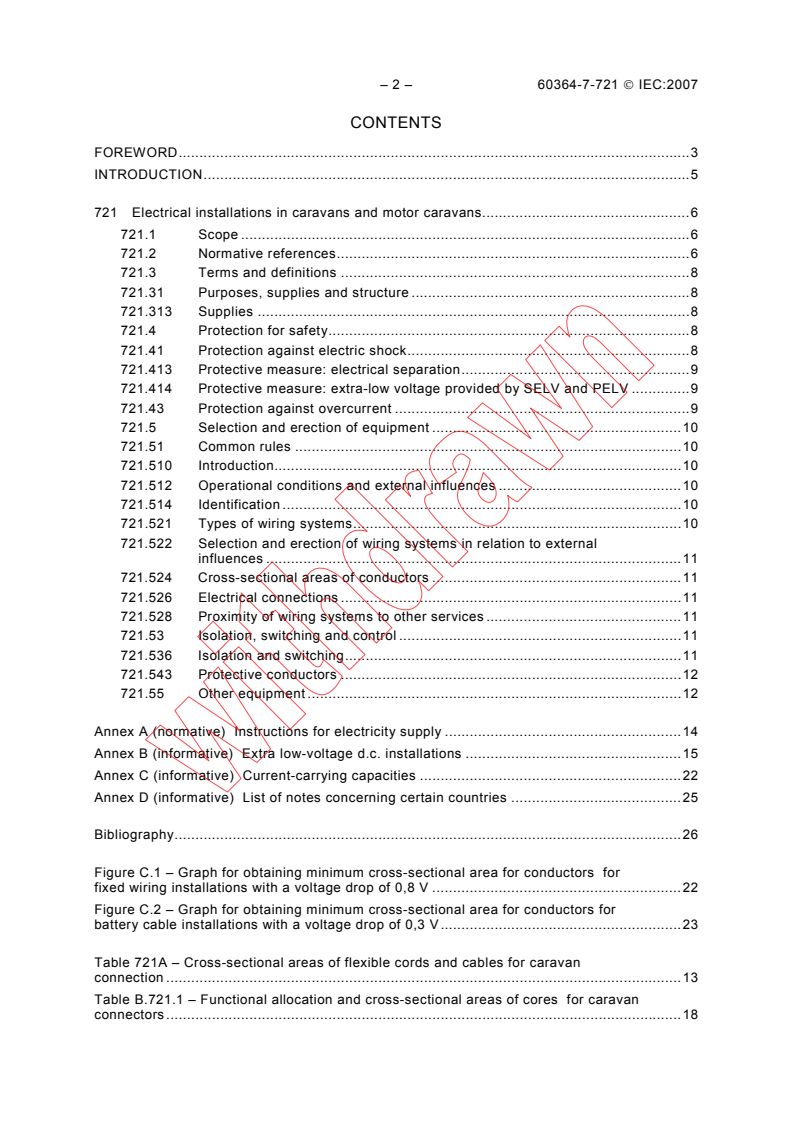
CONTENTS
FOREWORD.3
INTRODUCTION.5
721 Electrical installations in caravans and motor caravans.6
721.1 Scope.6
721.2 Normative references.6
721.3 Terms and definitions .8
721.31 Purposes, supplies and structure .8
721.313 Supplies .8
721.4 Protection for safety.8
721.41 Protection against electric shock.8
721.413 Protective measure: electrical separation.9
721.414 Protective measure: extra-low voltage provided by SELV and PELV .9
721.43 Protection against overcurrent .9
721.5 Selection and erection of equipment .10
721.51 Common rules.10
721.510 Introduction.10
721.512 Operational conditions and external influences .10
721.514 Identification .10
721.521 Types of wiring systems.10
721.522 Selection and erection of wiring systems in relation to external
influences .11
721.524 Cross-sectional areas of conductors .11
721.526 Electrical connections .11
721.528 Proximity of wiring systems to other services .11
721.53 Isolation, switching and control .11
721.536 Isolation and switching.11
721.543 Protective conductors .12
721.55 Other equipment.12
Annex A (normative) Instructions for electricity supply .14
Annex B (informative) Extra low-voltage d.c. installations .15
Annex C (informative) Current-carrying capacities .22
Annex D (informative) List of notes concerning certain countries .25
Bibliography.26
Figure C.1 – Graph for obtaining minimum cross-sectional area for conductors for
fixed wiring installations with a voltage drop of 0,8 V .22
Figure C.2 – Graph for obtaining minimum cross-sectional area for conductors for
battery cable installations with a voltage drop of 0,3 V.23
Table 721A – Cross-sectional areas of flexible cords and cables for caravan
connection .13
Table B.721.1 – Functional allocation and cross-sectional areas of cores for caravan
connectors.18
60364-7-721 © IEC:2007 – 3 –
INTERNATIONAL ELECTROTECHNICAL COMMISSION
____________
LOW-VOLTAGE ELECTRICAL INSTALLATIONS –
Part 7-721: Requirements for special installations or locations –
Electrical installations in caravans and motor caravans
FOREWORD
1) The International Electrotechnical Commission (IEC) is a worldwide organization for standardization comprising
all national electrotechnical committees (IEC National Committees). The object of IEC is to promote
international co-operation on all questions concerning standardization in the electrical and electronic fields. To
this end and in addition to other activities, IEC publishes International Standards, Technical Specifications,
Technical Reports, Publicly Available Specifications (PAS) and Guides (hereafter referred to as “IEC
Publication(s)”). Their preparation is entrusted to technical committees; any IEC National Committee interested
in the subject dealt with may participate in this preparatory work. International, governmental and non-
governmental organizations liaising with the IEC also participate in this preparation. IEC collaborates closely
with the International Organization for Standardization (ISO) in accordance with conditions determined by
agreement between the two organizations.
2) The formal decisions or agreements of IEC on technical matters express, as nearly as possible, an international
consensus of opinion on the relevant subjects since each technical committee has representation from all
interested IEC National Committees.
3) IEC Publications have the form of recommendations for international use and are accepted by IEC National
Committees in that sense. While all reasonable efforts are made to ensure that the technical content of IEC
Publications is accurate, IEC cannot be held responsible for the way in which they are used or for any
misinterpretation by any end user.
4) In order to promote international uniformity, IEC National Committees undertake to apply IEC Publications
transparently to the maximum extent possible in their national and regional publications. Any divergence
between any IEC Publication and the corresponding national or regional publication shall be clearly indicated in
the latter.
5) IEC provides no marking procedure to indicate its approval and cannot be rendered responsible for any
equipment declared to be in conformity with an IEC Publication.
6) All users should ensure that they have the latest edition of this publication.
7) No liability shall attach to IEC or its directors, employees, servants or agents including individual experts and
members of its technical committees and IEC National Committees for any personal injury, property damage or
other damage of any nature whatsoever, whether direct or indirect, or for costs (including legal fees) and
expenses arising out of the publication, use of, or reliance upon, this IEC Publication or any other IEC
Publications.
8) Attention is drawn to the Normative references cited in this publication. Use of the referenced publications is
indispensable for the correct application of this publication.
9) Attention is drawn to the possibility that some of the elements of this IEC Publication may be the subject of
patent rights. IEC shall not be held responsible for identifying any or all such patent rights.
International Standard IEC 60364-7-721 has been prepared by IEC technical committee 64:
Electrical installations and protection against electrical shock.
The text of this standard is based on the following documents:
FDIS Report on voting
64/1576/FDIS 64/1596/RVD
Full information on the voting for the approval of this standard can be found in the report on
voting indicated in the above table.
– 4 – 60364-7-721 © IEC:2007
This publication has been drafted in accordance with the ISO/IEC Directives, Part 2.
The reader’s attention is drawn to the fact that Annex D lists all of the “in-some-country”
clauses on differing practices of a less permanent nature relating to the subject of this
standard.
A list of all the parts in the IEC 60364 series, under the general title Low-voltage electrical
installations, can be found on the IEC website.
Future standards in this series will carry the new general title as cited above. Titles of existing
standards in this series will be updated at the time of the next edition.
The committee has decided that the contents of this publication will remain unchanged until
the maintenance result date indicated on the IEC web site under "http://webstore.iec.ch" in
the data related to the specific publication. At this date, the publication will be
• reconfirmed,
• withdrawn,
• replaced by a revised edition, or
• amended.
60364-7-721 © IEC:2007 – 5 –
INTRODUCTION
The requirements of this part of IEC 60364 supplement, modify or replace certain of the
general requirements in Parts 1 to 6 of IEC 60364.
The clause numbering of Part 7-721 follows the pattern and corresponding references of
IEC 60364. The numbers following the particular number of Part 7-721 are those of the
corresponding parts or clauses of IEC 60364.
The absence of reference to a part or a clause means that the corresponding general
requirements of IEC 60364 are applicable.
– 6 – 60364-7-721 © IEC:2007
LOW-VOLTAGE ELECTRICAL INSTALLATIONS –
Part 7-721: Requirements for special installations or locations –
Electrical installations in caravans and motor caravans
721 Electrical installations in caravans and motor caravans
721.1 Scope
The particular requirements of this part of IEC 60364 apply to the electrical installation of
caravans and motor caravans.
They apply to those electrical circuits and equipment intended for the use of the caravan for
habitation purposes.
They do not apply to those electrical circuits and equipment for automotive purposes.
They do not apply to the electrical installations of mobile homes, residential park homes and
transportable units.
NOTE 1 For mobile homes and residential park homes the general requirements apply.
NOTE 2 For transportable units see IEC 60364-7-717.
NOTE 3 For the purpose of this standard, caravans and motor caravans are referred to as “caravans”
The particular requirements of some parts from the IEC 60364-7 series may also apply to
such installations in caravans, e.g. IEC 60364-7-701.
721.2 Normative references
The following referenced documents are indispensable for the application of this document.
For dated references, only the edition cited applies. For undated references, the latest edition
of the referenced document (including any amendments) applies.
IEC 60038, IEC standard voltages
IEC 60245 (all parts), Rubber insulated cables – Rated voltages up to and including
450/750 V
IEC 60309-1, Plugs, socket-outlets and couplers for industrial purposes – Part 1: General
requirements
IEC 60309-2, Plugs, socket-outlets and couplers for industrial purposes – Part 2: Dimensional
interchangeability requirements for pin and contact-tube accessories
IEC 60332-1-2, Tests on electric and optical fibre cables under fire conditions – Part 1-2: Test
for vertical flame propagation for a single insulated wire or cable – Procedure for 1 kW pre-
mixed flame
IEC 60335-1, Household and similar electrical appliances – Safety – Part 1: General
requirements
60364-7-721 © IEC:2007 – 7 –
IEC 60335-2-29, Household and similar electrical appliances – Safety – Part 2-29: Particular
requirements for battery chargers
IEC 60529, Degrees of protection provided by enclosures (IP Code)
IEC 60614-2-2, Specification for conduits for electrical installations – Part 2: Particular
specification for conduits – Section Two: Rigid plain conduits of insulating materials
IEC 60614-2-3, Specification for conduits for electrical installations – Part 2: Particular
specifications for conduits. Section Three: Pliable conduits of insulating material
IEC 60947-2, Low-voltage switchgear and controlgear – Part 2: Circuit-breakers
IEC 61008-1, Residual current operated circuit-breakers without integral overcurrent
protection for household and similar uses (RCCBs) – Part 1: General rules
IEC 61009-1, Residual current operated circuit-breakers with integral overcurrent protection
for household and similar uses (RCBOs) – Part 1: General rules
IEC 61084 (all parts), Cables trunking and ducting systems for electrical installations
IEC 61386, Conduit systems for cable management
IEC 61558-2-6, Safety of power transformers, power supply units and similar – Part 2:
Particular requirements for safety isolating transformers for general use
ISO 1724, Road vehicles – Connectors for the electrical connection of towing and towed
vehicles – 7-pole connector type 12 N (normal) for vehicles with 12 V nominal supply voltage
ISO 3732, Road vehicles – Connectors for the electrical connection of towing and towed
vehicles – 7-pole connector type 12 S (supplementary) for vehicles with 12 V nominal supply
voltage
ISO 6309, Fire protection – Safety signs
ISO 8820, Road vehicles – Fuse-links
ISO 11446, Road vehicles – Connectors for the electrical connection of towing and towed
vehicles – 13-pole connectors for vehicles with 12 V nominal supply voltage
– 8 – 60364-7-721 © IEC:2007
721.3 Terms and definitions
For the purposes of this document, the following terms and definitions apply.
721.3.1
leisure accommodation vehicle
unit of living accommodation for temporary or seasonal occupation that may meet the
requirements for the construction and use of road vehicles
721.3.1.1
caravan
trailer leisure accommodation vehicle, used for touring, that meets the requirements for the
construction and use of road vehicles
721.3.1.2
motor caravan
self-propelled leisure accommodation vehicle, used for touring, that meets the requirements
for the construction and use of road vehicles
NOTE A motor caravan is either adapted from a series production vehicle, or designed and built on an existing
chassis, with or without the driving cab, the accommodation being either fixed or dismountable.
721.3.1.3
mobile home
transportable leisure accommodation vehicle that includes means for mobility but does not
meet the requirements for the construction and use of road vehicles
721.3.1.4
residential park home
a factory produced relocatable dwelling
721.31 Purposes, supplies and structure
721.313 Supplies
721.313.1.2 The nominal supply system voltage shall be selected from IEC 60038.
The nominal a.c. supply voltage of the installation of the caravan shall not exceed 230 V
single-phase, or 400 V three-phase.
The nominal d.c. supply voltage of the installation of the caravan shall not exceed 48 V.
721.4 Protection for safety
721.41 Protection against electric shock
721.411.2 Requirements for basic protection
721.41.B.2 Obstacles
Protection by obstacles shall not be used.
721.41.B.3 Placing out of reach
Protection by placing out of reach shall not be used.
60364-7-721 © IEC:2007 – 9 –
721.41.C.1 Non-conducting locations
Protection by non-conducting location shall not be used.
NOTE This precludes the use of class 0 equipment.
721.41.C.2 Protection by earth-free local equipotential bonding
Protection by earth-free equipotential bonding shall not be used.
721.411.3.1.2 Protective equipotential bonding
Structural metallic parts that are accessible from within the caravan shall be bonded to the
protective conductor.
721.413 Protective measure: electrical separation
Protection by electrical separation shall not be used, except for a shaver socket-outlet.
721.414 Protective measure: extra-low voltage provided by SELV and PELV
Any part of a caravan installation operating at extra-low voltage shall comply with the
requirements of Clause 414.
For extra-low voltage d.c. power sources, the following standard voltages are generally
applicable: 12 V, 24 V, 42 V and 48 V.
In exceptional cases, when a.c. extra-low voltage is required, the following standard voltages
(rms) are permitted: 12 V, 24 V, 42 V and 48 V.
NOTE The requirements of Part 721 are also applicable to extra low-voltage d.c. installation. See Annex B for
recommendations that may be applied in addition.
721.415.1 Additional protection: residual current protective devices
Addition:
Where protection by automatic disconnection of supply is used, a residual current device with
a rated residual operating current not exceeding 30 mA, complying with IEC 60947-2,
IEC 61008-1 or IEC 61009-1 breaking all live conductors, shall be provided having the
characteristics specified in 412.5.1.
Each supply inlet shall be directly connected to its associated RCD.
NOTE This implies that there may not be any taps or junctions in the circuit.
721.43 Protection against overcurrent
721.43.1 Final circuits
Each final circuit shall be protected by an overcurrent protective device which disconnects all
live conductors of that circuit.
– 10 – 60364-7-721 © IEC:2007
721.5 Selection and erection of equipment
721.51 Common rules
721.510 Introduction
721.510.3 General
Where there is more than one electrically independent installation, each independent
installation shall be supplied by a separate connecting device and shall be segregated in
accordance with general rules.
721.512 Operational conditions and external influences
721.512.2 External influences
NOTE Consideration should be given to the foreseeable external influences to which the caravan will be
subjected.
721.514 Identification
721.514.1 General
Instructions for use shall be provided with the caravan so that the caravan can be used safely.
The instructions shall comprise:
− a description of the installation;
− a description of the function of the RCD(s) and the use of the test button;
− a description of the function of the main isolating switch;
− the text of the instructions of Annex A.
If it is necessary to take precautions during user maintenance, appropriate details shall be
given.
721.521 Types of wiring systems
721.521.2 The wiring system shall use one or more of the following:
− insulated single-core cables, with flexible class 5 conductors, in non-metallic conduit or
non-metallic trunking system;
− insulated single-core cables, with stranded class 2 conductors (minimum of 7 strands), in
non-metallic conduit or non-metalic trunking system;
− sheathed flexible cables.
All cables shall as a minimum meet the requirements of IEC 60332-1-2.
Non-metallic conduit systems shall comply with the relevant part of IEC 60614-2 or
IEC 61386.
Cable trunking systems and cable ducting systems shall comply with the relevant part of
IEC 61084.
60364-7-721 © IEC:2007 – 11 –
721.522 Selection and erection of wiring systems in relation to external influences
721.522.7 Vibration (AH)
721.522.7.1 As wiring systems will be subjected to vibration, every wiring system shall be
protected against mechanical damage either by location or by additional protection. The
following requirements shall be met:
− Precaution shall be taken to avoid mechanical damage due to sharp edges or abrasive
parts.
− Cables passing through metalwork shall be protected by means of suitable bushes or
grommets which are securely fixed in position.
721.522.8 Other mechanical stresses (AJ)
721.522.8.1.3 All cables, unless enclosed in rigid conduit, and all flexible conduit shall be
supported at intervals not exceeding 0,4 m for vertical runs and 0,25 m for horizontal runs.
721.524 Cross-sectional areas of conductors
721.524.1 The cross-sectional area of every conductor shall be not less than 1,5 mm .
721.526 Electrical connections
721.526.1 Addition:
Connections between cables or conductors shall only be made in connecting boxes or
electrical equipment.
NOTE Connections also include junctions and taps.
721.528 Proximity of wiring systems to other services
721.528.2 Proximity to non-electrical services
721.528.2.1 No electrical equipment including wiring systems, except ELV-equipment for
gas-supply control, shall be installed in any gas cylinder storage compartment.
Where cables have to run through such a compartment, they shall be run at a height of less
than 500 mm above the base of the cylinders, and such cables shall be protected against
mechanical damage by installation within a continuous gas tight conduit or duct passing
through the compartment.
Where installed, this conduit or duct shall be able to withstand an impact equivalent to AG3
without visible physical damage.
721.53 Isolation, switching and control
721.536 Isolation and switching
721.536.2 Isolation
721.536.2.1.1 Each installation shall be provided with a main isolating switch which shall
disconnect all live conductors and which shall be suitably placed for ready operation within
the caravan. In an installation consisting of only one final circuit, the isolating switch may be
the overcurrent protection device providing such a device meets the requirements for
isolation.
– 12 – 60364-7-721 © IEC:2007
721.536.2.1.1.1 A notice in durable material shall be permanently fixed in the vicinity of the
main isolating switch inside the caravan, bearing the text shown in Annex A in the official
language(s) of the country in which the caravan is to be sold for the first time, in indelible and
easily legible characters.
721.543 Protective conductors
721.543.2 Types of protective conductors
721.543.2.1 Circuit protective conductors shall be incorporated in a multicore cable or in a
conduit together with the live conductors.
721.55 Other equipment
721.55.1 Inlets
721.55.1.1 Any a.c. electrical inlet on the caravan shall be an appliance inlet complying with
IEC 60309-1. If interchangeability is required the inlet shall comply with IEC 60309-2.
721.55.1.2 The inlet, if any, shall be installed
a) not more than 1,8 m above ground level, and
b) in a readily accessible position, and
c) have a minimum protection of IP44 with or without a connector engaged, and
d) the inlet shall not protrude significantly beyond the body of the caravan.
721.55.2 Accessories
721.55.2.1 Every low-voltage socket-outlet, other than a shaver socket-outlet, shall
incorporate an earth contact.
721.55.2.2 Every socket-outlet supplied at extra-low voltage shall have its voltage visibly
marked.
721.55.2.3 Where an accessory is located in a position in which it is exposed to the effects of
moisture it shall be constructed or enclosed so as to provide a degree of protection not less
than IP44.
721.55.2.4 Each luminaire in a caravan shall preferably be fixed directly to the structure or
lining of the caravan. Where a pendant luminaire is installed in a caravan, provision shall be
made for securing the luminaire to prevent damage when the caravan is moved.
Accessories for the suspension of pendant luminaires shall be suitable for the mass
suspended and the forces associated with vehicle movement.
721.55.2.5 A luminaire intended for dual voltage operation shall comply with the appropriate
standard.
721.55.2.6 If the appliance inlet installed under 721.55.1.1 complies only with IEC 60309-1,
the means of connection to the caravan pitch socket-outlet shall be supplied with the caravan
and shall comprise the following:
a) a plug complying with IEC 60309-2; and
b) a flexible cord or cable
− of 25 m (± 2 m) length,
60364-7-721 © IEC:2007 – 13 –
− of harmonized code designation IEC60245-57 or equivalent,
− incorporating a protective conductor, with a colour identification according to the
appropriate IEC standard and
− with a cross-sectional area in accordance with Table 721A, and
c) a connector, if any, compatible with the appliance inlet installed under 721.55.1.1.
Table 721A – Cross-sectional areas of flexible cords
and cables for caravan connection
Rated current Minimum cross-sectional area
A mm
16 2,5
25 4
32 6
63 16
100 35
If the appliance inlet installed under 721.55.1.1 complies with IEC 60309-2, the means of
connection to the caravan pitch socket-outlet shall comprise the following:
a) a plug complying with IEC 60309-2; and
b) a flexible cord or cable
− of 25 m (± 2 m) length,
− of harmonized code designation IEC60245-57 or equivalent,
− incorporating a protective conductor, with a colour identification according to the
appropriate IEC standard, and
− with a cross-sectional area in accordance with Table 721A, and
c) a connector complying with IEC 60309-2.
The means of connection to the caravan pitch socket-outlet need not to be supplied with the
caravan.
– 14 – 60364-7-721 © IEC:2007
Annex A
(normative)
Instructions for electricity supply
To connect
a) Before connecting the caravan installation to the electricity supply, check that
1) the supply available at the caravan pitch supply point is suitable for the caravan
electrical installation and appliances, the voltage, frequency and current rating are
suitable, and
2) the cable and means of connection are suitable, and
3) the main isolating switch in the caravan is in the OFF position.
THE CARAVAN SUPPLY FLEXIBLE CABLE SHOULD BE FULLY UNCOILED TO AVOID
DAMAGE BY OVERHEATING.
b) Check the cable, the plug and the connector for damage.
c) Open the cover of the appliance inlet provided at the caravan, if any, and insert the
connector of the flexible cable.
d) Insert the plug of the flexible cable into the electricity outlet provided on the pitch supply
point.
e) Switch on the caravan main isolating switch.
f) Check the operation of residual current devices fitted in the caravan by depressing the
test buttons and reset.
IN CASE OF DOUBT OR, IF AFTER CARRYING OUT THE ABOVE PROCEDURE THE
SUPPLY DOES NOT BECOME AVAILABLE, OR IF THE SUPPLY FAILS, CONSULT THE
CARAVAN PARK OPERATOR.
To disconnect
Switch off at the caravan main isolating switch, unplug the cable. First on the caravan pitch
supply point side and then at the caravan appliance inlet, if any.
PERIODIC INSPECTION
Preferably not less than once every three years and annually if the caravan is used
frequently, the caravan electrical installation and supply cable should be inspected and tested
by a competent electrician and a report on their condition obtained.
60364-7-721 © IEC:2007 – 15 –
Annex B
(informative)
Extra low-voltage d.c. installations
B.721.31 Purposes, supplies and structure
B.721.313 Supplies
B.721.313.4 Sources of supply
The supply should be obtained from one or more of the following sources:
a) the electrical installation of the towing vehicle;
b) an auxiliary battery mounted in the caravan;
c) a low-voltage d.c. supply via a transformer/rectifier unit complying with IEC 60335-1 and
IEC 61558-2-6;
d) a DC generator that is driven by any form of energy;
e) solar photovoltaic (PV) power supply systems or similar.
B.721.514 Identification
B.721.514.1 General
The following information should be provided in the instructions for use and should be in the
official language/s of the country in which the caravan is to be sold:
a) A warning worded as follows: “An auxiliary battery should only be replaced by one of the
same type and specification as that originally fitted”.
b) Instructions on the maintenance and recharging of an auxiliary battery where it is fitted.
Where a battery charger is provided, instructions on its safe use should be included.
c) Instructions on selecting and installing an auxiliary battery in a compartment, if the
caravan is intended for the installation of an auxiliary battery.
d) Details of the warning notice specified in B.721.55.3.5 and its importance for safety.
e) In order to ensure safe operation of the electrical installation, a simplified diagram of the
wiring of the ELV and LV installation, with details of the cable colours and/or marking and
the nominal values of the overcurrent protective devices should be provided.
f) Type of appliances that can be used and from what source of supply.
g) Instructions for the correct operation and maintenance of fitted appliances, as supplied by
the appliance manufacturer.
h) A warning worded as follows: “Always disconnect the electrical connector between the
towing vehicle and the caravan before connecting an LV supply to the caravan and before
charging the caravan battery by any other means”.
B.721.515 Prevention of mutual detrimental influence
B.721.515.2 The ELV installation should be so installed that the protective measures of the
LV installation against direct contact, or in case of indirect contact are not impaired.
– 16 – 60364-7-721 © IEC:2007
It should be ensured that operating currents of the ELV installation do not flow in the
protective conductors of the LV installation.
B.721.521 Types of wiring systems
B.721.521.2 Cables should be of stranded construction and should comply with IEC 60227 or
IEC 60245.
B.721.523 Current-carrying capacities
B.721.523.1 The cross-sectional areas of the conductors selected for the fixed wiring should
be in accordance with Annex C. Annex C does not apply to sensor and data lines.
B.721.525 Voltage drop in consumers' installations
Under normal service conditions, the voltage at the terminals of any fixed current-using
equipment should be greater than the lower limit corresponding to the IEC Standard relevant
to the equipment. Where the equipment is not the subject of a IEC Standard, the voltage at
the terminals should be such as not to impair the safe functioning of that equipment. In the
absence of precise data, a voltage drop of 0,8 V from the power supply to the equipment may
be allowed.
The voltage drop between the plug of the connector to the towing vehicle or LV battery
charger and the auxiliary battery should not exceed 0,3 V.
The charging current l [A] to determine the voltage drop is established by Formula (1).
c
c ⋅ 0,1
I = (1)
c
t
where
I is the charging current, in A;
c
c is the battery capacity, in Ah;
t is the period, in h.
B.721.528 Proximity of wiring systems to other services
B.721.528.2 Proximity to non-electrical services
B.721.528.2.5 Cable runs and LPG installations
Cables including those used for automotive purposes should not be run through a
compartment or housing intended for liquefied petroleum gas storage cylinders. Where cables
have to run through such a compartment or housing, they should be run at a height of less
than 500 mm above the base of the cylinders, and such cables should be protected against
mechanical damage by installation within a continuous gas tight conduit or duct passing
through the compartment.
Where installed, this conduit or duct should be able to withstand an impact equivalent to AG3
without visible physical damage.
ELV cables and electrical equipment are only to be installed within the LPG cylinder
compartment or housing if the installation serves the operation of the gas cylinders (e.g.
indication of empty gas cylinders) or is for use within the compartment or housing. Such
electrical installations and components should be constructed and installed so that they are
not a source of ignition and are in accordance with the relevant standards for any hazardous
area classification of the compartment or housing.
60364-7-721 © IEC:2007 – 17 –
B.721.53 Isolation, switching and control
B.721.533 Devices for protection against overcurrent
B.721.533.1 General requirements
B.721.533.1.5 The overcurrent protective device for the power supply from the towing vehicle
should be installed as near as possible to the auxiliary battery, but in no case more than
1 000 mm away. The overcurrent protective device for the auxiliary battery should be fitted at
the end of the battery cable and before the fixed installation. The ELV output of the
transformer/rectifier unit and of the DC generator should be provided with an overcurrent
protective device unless this is already incorporated within the unit or generator. The
protective device should be installed as near as possible to the unit or generator and, in all
cases, upstream of the distribution circuits.
B.721.533.1.6 Overcurrent protective devices should be either fuse links according to
ISO 8820 or suitable miniature circuit-breakers.
B.721.533.1.7 Fuses should be physically protected against accidental mechanical damage.
B.721.533.1.8 Overcurrent protective devices should not be fitted in a fuel storage
compartment or fuel storage housing intended for the storage of liquefied petroleum gas
cylinders or in the compartment for housing an auxiliary battery.
B.721.55 Other equipment
B.721.55.1 Inlets
The inlet, when the plug is disconnected, should be protected against the ingress of water,
foreign bodies and accidental damage.
B.721.55.2 Accessories
B.721.55.2.6 The means of connection to the towing vehicle should be supplied with the
caravan and comprise the following:
a) a plug complying with ISO 1724 and ISO 3732 or ISO 11446, and
b) a flexible cord or cable with the number of cores with the minimum cross-sectional area
and the allocation according to Table B.721.1 and a length not exceeding 5 m, and
c) a connector complying with ISO 1724 and ISO 3732 or ISO 11446.
– 18 – 60364-7-721 © IEC:2007
Table B.721.1 – Functional allocation and cross-sectional areas
of cores for caravan connectors
Contact numbers Minimum cross-
Core
Function sectional area
No.
ISO 11446 ISO 1724
mm
1 Left-hand direction - indicator light 1 1 1,5
2 Rear fog light 2 2 1,5
a a
3 Common return for core nos. 1, 2, 4, 5, 6, 7 3 3 2,5
and 8
4 Right-hand direction - indicator light 4 4 1,5
5 Right hand-rear position and marker lights, and 5 5 1,5
rear-registration-plate illumination device
6 Stop lights 6 6 1,5
7 Left-hand rear position and marker lights, and 7 7 1,5
rear-registration-plate illumination device
ISO 3732
8 Reversing light 8 1 1,5
9 Continuous power supply 9 4 2,5
10 Power supply controlled by ignition switch 10 6 2,5
a a
11 Return for core No. 10 11 7 2,5
12 Coding for coupled trailer 12 2 –
a a
13 Return for core No. 9 13 3 2,5
14 No allocation – 5 1,5
a
These return circuits should not be electrically connected in the trailer.
B.721.55.3 Auxiliary batteries
B.721.55.3.1 Type of battery
An auxiliary battery should be of the rechargeable type.
NOTE Non-rechargeable batteries are not auxiliary batteries. They may be used in caravans, provided that they
are used in circuits separated from other sources of electrical supply.
B.721.55.3.2 Capacity
An auxiliary battery should have a minimum capacity of 40 Ah at a 20 h discharge rate.
NOTE It is recommended to use a battery designed to be discharged over long periods at a relatively low current.
B.721.55.3.3 Terminals
Auxiliary battery terminals should be clearly and durably marked “+” and “-“. Connections to
auxiliary battery terminals should be securely clamped or bolted to ensure continuous contact
and should be insulated unless the auxiliary battery is provided with an insulating device.
B.721.55.3.4 Location
An auxiliary battery should be placed in a separate compartment with easy access for
maintenance or removal. The battery should be secured to prevent movement, e. g. when the
caravan is in motion.
60364-7-721 © IEC:2007 – 19 –
B.721.55.3.5 Auxiliary battery compartment
A tray should be installed under an auxiliary battery if the electrolyte of this battery is liquid.
The interior of an auxiliary battery compartment should be ventilated and protected against
the corrosive effects of acid-laden gases, by one of the following methods:
a) installing a sealed auxiliary battery that incorporates an external ventilating kit that is
taken to the exterior of the caravan or
b) installing an auxiliary battery in an enclosed battery compartment that is protected
internally against corrosion and is ventilated to the exterior of the caravan by means of a
suitable tube with a minimum inside diameter of 10 mm at the top of the auxiliary battery
compartment in accordance with the battery manufacturer's instructions or as supplied by
the manufacturer of the auxiliary battery or
c) ventilating the compartment at low-level and high-level to the exterior of the caravan and
constructing the interior of the compartment, including the sides of the ventilator openings,
of acid-resistant material or providing it with an anti-corrosive finish. If the compartment
opens into the interior of the caravan, the lid should provide an air seal. The minimum size
2 2
at low level and not less than 80 mm at
of ventilation should be not less than 80 mm
high level.
If an auxiliary battery is not provided, then the position and instructions for the installation of
the battery and compartment, in accordance with a), b) or c) of this subclause, should be
included in the instructions for use and a notice should be fixed in or near the proposed
location stating: “For instructions on auxiliary battery installation, see the instructions for use”.
The requirements concerning the protection against corrosion and ventilation are not
applicable if batteries with bound electrolytes are used.
When the manufacturer makes no provision for the installation of an auxiliary battery, the
following statement should be made in the instructions for use: “This caravan has not been
designed to accommodate an auxiliary battery. Do not fit one.”
B.721.55.3.6 Auxiliary battery cables
Cables from an auxiliary battery should be protected by additional sheathing or taping up to
the overcurrent protective device.
B.721.55.3.7 Warning notice
A warning notice should be fixed in a prominent position near the auxiliary battery or
displayed on the lid of the auxiliary battery compartment. This warning should be in the official
language(s) of the country in which the caravan is to be sold and should state: “Switch off all
appliances and lamps before disconnecting the auxiliary battery.”.
The auxiliary battery compartment should be additionally ma
...