


IEC TR 61000-3-7:2008
(Main)Electromagnetic compatibility (EMC) - Part 3-7: Limits - Assessment of emission limits for the connection of fluctuating installations to MV, HV and EHV power systems
Electromagnetic compatibility (EMC) - Part 3-7: Limits - Assessment of emission limits for the connection of fluctuating installations to MV, HV and EHV power systems
This part of IEC 61000 provides guidance on principles which can be used as the basis for determining the requirements for the connection of fluctuating installations to MV, HV and EHV public power systems (LV installations are covered in other IEC documents). For the purposes of this report, a fluctuating installation means an installation (which may be a load or a generator) that produces voltage flicker and / or rapid voltage changes. The primary objective is to provide guidance to system operators or owners on engineering practices which will facilitate the provision of adequate service quality for all connected customers. In addressing installations, this document is not intended to replace equipment standards for emission limits. This report addresses the allocation of the capacity of the system to absorb disturbances. It does not address how to mitigate disturbances, nor does it address how the capacity of the system can be increased. Since the guidelines outlined in this report are necessarily based on certain simplifying assumptions, there is no guarantee that this approach will always provide the optimum solution for all flicker situations. The recommended approach should be used with flexibility and engineering judgment as far as engineering is concerned, when applying the given assessment procedures in full or in part. The system operator or owner is responsible for specifying requirements for the connection of fluctuating installations to the system. The fluctuating installation is to be understood as the customer's complete installation (i.e. including fluctuating and non fluctuating parts). Problems related to voltage fluctuations fall into two basic categories:
- Flicker effect from light sources as a result of voltage fluctuations;
- Rapid voltage changes even within the normal operational voltage tolerances are considered as a disturbing phenomenon.
The report gives guidance for the coordination of the flicker emissions between different voltage levels in order to meet the compatibility levels at the point of utilisation. This report primarily focuses on controlling or limiting flicker, but a clause is included to address the limitation of rapid voltage changes. This second edition cancels and replaces the first edition published in 1996 and constitutes a technical revision. This new edition is significantly more streamlined than the original technical report (Edition 1), and reflects the experiences gained in the application of the first edition. This technical report has also been harmonised with IEC/TR 61000-3-6 and IEC/TR 61000-3-13. This Technical Report has the status of a basic EMC publication in accordance with IEC Guide 107.
General Information
- Status
- Published
- Publication Date
- 21-Feb-2008
- Technical Committee
- SC 77A - EMC - Low frequency phenomena
- Drafting Committee
- WG 8 - TC 77/SC 77A/WG 8
- Current Stage
- PPUB - Publication issued
- Start Date
- 22-Feb-2008
- Completion Date
- 15-May-2008
Relations
- Effective Date
- 05-Sep-2023
Overview
IEC TR 61000-3-7:2008 is a Technical Report from the International Electrotechnical Commission (IEC) that gives guidance for assessing emission limits when connecting fluctuating installations (loads or generators that produce voltage flicker and/or rapid voltage changes) to medium (MV), high (HV) and extra‑high voltage (EHV) public power systems. It is a basic EMC publication (Edition 2.0, 2008) and is harmonized with IEC/TR 61000-3-6 and IEC/TR 61000-3-13.
This report helps system operators and owners define practical connection requirements to maintain adequate service quality for all customers. It focuses on assessing and allocating the system’s capacity to absorb flicker and rapid voltage changes - it does not prescribe mitigation measures or methods to increase system capacity.
Key topics
- Assessment framework: A three‑stage approach for pre‑ and post‑connection evaluation
- Stage 1: Simplified screening of disturbance emission
- Stage 2: Emission limits relative to actual system characteristics (short‑circuit power/impedance)
- Stage 3: Conditional acceptance of higher emissions with restrictions
- Compatibility and planning levels: Concepts and indicative planning values for MV, HV and EHV systems (linked to LV compatibility levels from IEC 61000‑2‑2)
- Flicker emission definition and measurement: How to define, assess and combine flicker contributions (general summation law)
- Declared system parameters: Use of declared short‑circuit power or impedance for assessment
- Flicker transfer coefficients: Guidance on evaluating how disturbances transfer between network points
- Rapid voltage changes: Principles, planning levels and assessment procedures for sudden voltage steps (e.g., switching, motor starts)
- Informative annexes: P = 1 curves, transfer coefficient guidance, examples, case studies and symbols
Applications and who uses it
IEC TR 61000‑3‑7 is primarily used by:
- System operators and utilities for defining connection requirements and planning limits for fluctuating industrial or generation installations
- Grid planners and protection engineers assessing system compatibility and short‑circuit capacity
- Facility and industrial power engineers designing customer installations (complete installation = fluctuating + non‑fluctuating parts) to meet grid connection rules
- Regulators and consultants developing grid codes, contracts and technical specifications
Practical uses include pre‑connection screening, allocation of global emission budgets among customers, and post‑connection compliance assessment.
Related standards
- IEC/TR 61000‑3‑6 (harmonized)
- IEC/TR 61000‑3‑13 (harmonized)
- IEC 61000‑2‑2 (LV compatibility levels referenced)
Keywords: IEC TR 61000‑3‑7, flicker, fluctuating installations, MV HV EHV, emission limits, voltage fluctuations, planning levels, short‑circuit power, flicker transfer coefficient, rapid voltage changes.
Buy Documents
IEC TR 61000-3-7:2008 - Electromagnetic compatibility (EMC) - Part 3-7: Limits - Assessment of emission limits for the connection of fluctuating installations to MV, HV and EHV power systems Released:2/22/2008
Get Certified
Connect with accredited certification bodies for this standard

TL 9000 QuEST Forum
Telecommunications quality management system.

ANCE
Mexican certification and testing association.

Intertek Slovenia
Intertek testing, inspection, and certification services in Slovenia.
Sponsored listings
Frequently Asked Questions
IEC TR 61000-3-7:2008 is a technical report published by the International Electrotechnical Commission (IEC). Its full title is "Electromagnetic compatibility (EMC) - Part 3-7: Limits - Assessment of emission limits for the connection of fluctuating installations to MV, HV and EHV power systems". This standard covers: This part of IEC 61000 provides guidance on principles which can be used as the basis for determining the requirements for the connection of fluctuating installations to MV, HV and EHV public power systems (LV installations are covered in other IEC documents). For the purposes of this report, a fluctuating installation means an installation (which may be a load or a generator) that produces voltage flicker and / or rapid voltage changes. The primary objective is to provide guidance to system operators or owners on engineering practices which will facilitate the provision of adequate service quality for all connected customers. In addressing installations, this document is not intended to replace equipment standards for emission limits. This report addresses the allocation of the capacity of the system to absorb disturbances. It does not address how to mitigate disturbances, nor does it address how the capacity of the system can be increased. Since the guidelines outlined in this report are necessarily based on certain simplifying assumptions, there is no guarantee that this approach will always provide the optimum solution for all flicker situations. The recommended approach should be used with flexibility and engineering judgment as far as engineering is concerned, when applying the given assessment procedures in full or in part. The system operator or owner is responsible for specifying requirements for the connection of fluctuating installations to the system. The fluctuating installation is to be understood as the customer's complete installation (i.e. including fluctuating and non fluctuating parts). Problems related to voltage fluctuations fall into two basic categories: - Flicker effect from light sources as a result of voltage fluctuations; - Rapid voltage changes even within the normal operational voltage tolerances are considered as a disturbing phenomenon. The report gives guidance for the coordination of the flicker emissions between different voltage levels in order to meet the compatibility levels at the point of utilisation. This report primarily focuses on controlling or limiting flicker, but a clause is included to address the limitation of rapid voltage changes. This second edition cancels and replaces the first edition published in 1996 and constitutes a technical revision. This new edition is significantly more streamlined than the original technical report (Edition 1), and reflects the experiences gained in the application of the first edition. This technical report has also been harmonised with IEC/TR 61000-3-6 and IEC/TR 61000-3-13. This Technical Report has the status of a basic EMC publication in accordance with IEC Guide 107.
This part of IEC 61000 provides guidance on principles which can be used as the basis for determining the requirements for the connection of fluctuating installations to MV, HV and EHV public power systems (LV installations are covered in other IEC documents). For the purposes of this report, a fluctuating installation means an installation (which may be a load or a generator) that produces voltage flicker and / or rapid voltage changes. The primary objective is to provide guidance to system operators or owners on engineering practices which will facilitate the provision of adequate service quality for all connected customers. In addressing installations, this document is not intended to replace equipment standards for emission limits. This report addresses the allocation of the capacity of the system to absorb disturbances. It does not address how to mitigate disturbances, nor does it address how the capacity of the system can be increased. Since the guidelines outlined in this report are necessarily based on certain simplifying assumptions, there is no guarantee that this approach will always provide the optimum solution for all flicker situations. The recommended approach should be used with flexibility and engineering judgment as far as engineering is concerned, when applying the given assessment procedures in full or in part. The system operator or owner is responsible for specifying requirements for the connection of fluctuating installations to the system. The fluctuating installation is to be understood as the customer's complete installation (i.e. including fluctuating and non fluctuating parts). Problems related to voltage fluctuations fall into two basic categories: - Flicker effect from light sources as a result of voltage fluctuations; - Rapid voltage changes even within the normal operational voltage tolerances are considered as a disturbing phenomenon. The report gives guidance for the coordination of the flicker emissions between different voltage levels in order to meet the compatibility levels at the point of utilisation. This report primarily focuses on controlling or limiting flicker, but a clause is included to address the limitation of rapid voltage changes. This second edition cancels and replaces the first edition published in 1996 and constitutes a technical revision. This new edition is significantly more streamlined than the original technical report (Edition 1), and reflects the experiences gained in the application of the first edition. This technical report has also been harmonised with IEC/TR 61000-3-6 and IEC/TR 61000-3-13. This Technical Report has the status of a basic EMC publication in accordance with IEC Guide 107.
IEC TR 61000-3-7:2008 is classified under the following ICS (International Classification for Standards) categories: 33.100.10 - Emission. The ICS classification helps identify the subject area and facilitates finding related standards.
IEC TR 61000-3-7:2008 has the following relationships with other standards: It is inter standard links to IEC TR 61000-3-7:1996. Understanding these relationships helps ensure you are using the most current and applicable version of the standard.
IEC TR 61000-3-7:2008 is available in PDF format for immediate download after purchase. The document can be added to your cart and obtained through the secure checkout process. Digital delivery ensures instant access to the complete standard document.
Standards Content (Sample)
IEC/TR 61000-3-7
Edition 2.0 2008-02
TECHNICAL
REPORT
BASIC EMC PUBLICATION
Electromagnetic compatibility (EMC) –
Part 3-7: Limits – Assessment of emission limits for the connection of
fluctuating installations to MV, HV and EHV power systems
IEC/TR 61000-3-7:2008(E)
All rights reserved. Unless otherwise specified, no part of this publication may be reproduced or utilized in any form or by
any means, electronic or mechanical, including photocopying and microfilm, without permission in writing from either IEC or
IEC's member National Committee in the country of the requester.
If you have any questions about IEC copyright or have an enquiry about obtaining additional rights to this publication,
please contact the address below or your local IEC member National Committee for further information.
Droits de reproduction réservés. Sauf indication contraire, aucune partie de cette publication ne peut être reproduite
ni utilisée sous quelque forme que ce soit et par aucun procédé, électronique ou mécanique, y compris la photocopie
et les microfilms, sans l'accord écrit de la CEI ou du Comité national de la CEI du pays du demandeur.
Si vous avez des questions sur le copyright de la CEI ou si vous désirez obtenir des droits supplémentaires sur cette
publication, utilisez les coordonnées ci-après ou contactez le Comité national de la CEI de votre pays de résidence.
IEC Central Office
3, rue de Varembé
CH-1211 Geneva 20
Switzerland
Email: inmail@iec.ch
Web: www.iec.ch
About the IEC
The International Electrotechnical Commission (IEC) is the leading global organization that prepares and publishes
International Standards for all electrical, electronic and related technologies.
About IEC publications
The technical content of IEC publications is kept under constant review by the IEC. Please make sure that you have the
latest edition, a corrigenda or an amendment might have been published.
ƒ Catalogue of IEC publications: www.iec.ch/searchpub
The IEC on-line Catalogue enables you to search by a variety of criteria (reference number, text, technical committee,…).
It also gives information on projects, withdrawn and replaced publications.
ƒ IEC Just Published: www.iec.ch/online_news/justpub
Stay up to date on all new IEC publications. Just Published details twice a month all new publications released. Available
on-line and also by email.
ƒ Electropedia: www.electropedia.org
The world's leading online dictionary of electronic and electrical terms containing more than 20 000 terms and definitions
in English and French, with equivalent terms in additional languages. Also known as the International Electrotechnical
Vocabulary online.
ƒ Customer Service Centre: www.iec.ch/webstore/custserv
If you wish to give us your feedback on this publication or need further assistance, please visit the Customer Service
Centre FAQ or contact us:
Email: csc@iec.ch
Tel.: +41 22 919 02 11
Fax: +41 22 919 03 00
A propos de la CEI
La Commission Electrotechnique Internationale (CEI) est la première organisation mondiale qui élabore et publie des
normes internationales pour tout ce qui a trait à l'électricité, à l'électronique et aux technologies apparentées.
A propos des publications CEI
Le contenu technique des publications de la CEI est constamment revu. Veuillez vous assurer que vous possédez
l’édition la plus récente, un corrigendum ou amendement peut avoir été publié.
ƒ Catalogue des publications de la CEI: www.iec.ch/searchpub/cur_fut-f.htm
Le Catalogue en-ligne de la CEI vous permet d’effectuer des recherches en utilisant différents critères (numéro de référence,
texte, comité d’études,…). Il donne aussi des informations sur les projets et les publications retirées ou remplacées.
ƒ Just Published CEI: www.iec.ch/online_news/justpub
Restez informé sur les nouvelles publications de la CEI. Just Published détaille deux fois par mois les nouvelles
publications parues. Disponible en-ligne et aussi par email.
ƒ Electropedia: www.electropedia.org
Le premier dictionnaire en ligne au monde de termes électroniques et électriques. Il contient plus de 20 000 termes et
définitions en anglais et en français, ainsi que les termes équivalents dans les langues additionnelles. Egalement appelé
Vocabulaire Electrotechnique International en ligne.
ƒ Service Clients: www.iec.ch/webstore/custserv/custserv_entry-f.htm
Si vous désirez nous donner des commentaires sur cette publication ou si vous avez des questions, visitez le FAQ du
Service clients ou contactez-nous:
Email: csc@iec.ch
Tél.: +41 22 919 02 11
Fax: +41 22 919 03 00
IEC/TR 61000-3-7
Edition 2.0 2008-02
TECHNICAL
REPORT
BASIC EMC PUBLICATION
Electromagnetic compatibility (EMC) –
Part 3-7: Limits – Assessment of emission limits for the connection of
fluctuating installations to MV, HV and EHV power systems
INTERNATIONAL
ELECTROTECHNICAL
COMMISSION
PRICE CODE
XB
CODE PRIX
ICS 33.100.10 ISBN 2-8318-9606-1
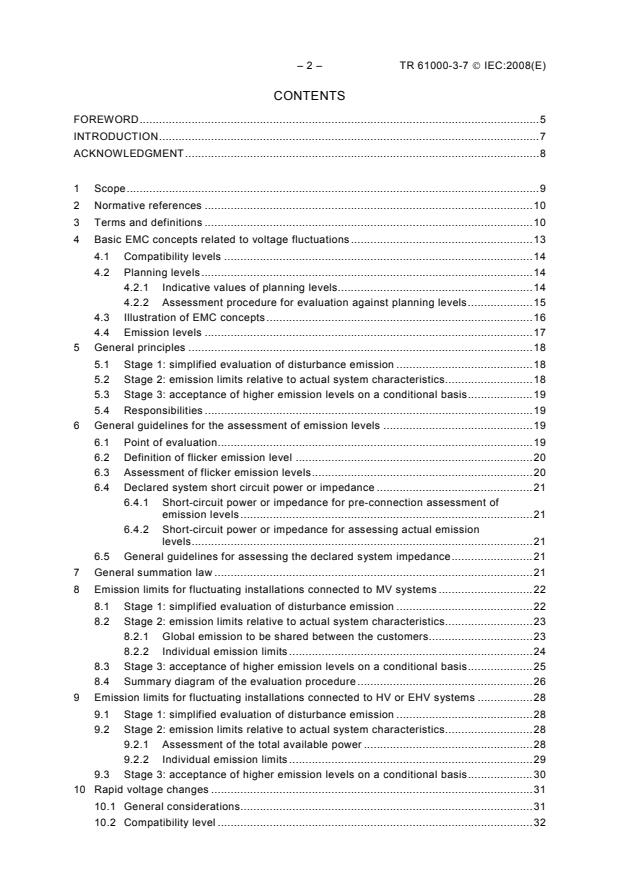
– 2 – TR 61000-3-7 © IEC:2008(E)
CONTENTS
FOREWORD.5
INTRODUCTION.7
ACKNOWLEDGMENT.8
1 Scope.9
2 Normative references .10
3 Terms and definitions .10
4 Basic EMC concepts related to voltage fluctuations.13
4.1 Compatibility levels .14
4.2 Planning levels.14
4.2.1 Indicative values of planning levels.14
4.2.2 Assessment procedure for evaluation against planning levels.15
4.3 Illustration of EMC concepts.16
4.4 Emission levels .17
5 General principles .18
5.1 Stage 1: simplified evaluation of disturbance emission .18
5.2 Stage 2: emission limits relative to actual system characteristics.18
5.3 Stage 3: acceptance of higher emission levels on a conditional basis.19
5.4 Responsibilities .19
6 General guidelines for the assessment of emission levels .19
6.1 Point of evaluation.19
6.2 Definition of flicker emission level .20
6.3 Assessment of flicker emission levels.20
6.4 Declared system short circuit power or impedance .21
6.4.1 Short-circuit power or impedance for pre-connection assessment of
emission levels.21
6.4.2 Short-circuit power or impedance for assessing actual emission
levels.21
6.5 General guidelines for assessing the declared system impedance.21
7 General summation law .21
8 Emission limits for fluctuating installations connected to MV systems .22
8.1 Stage 1: simplified evaluation of disturbance emission .22
8.2 Stage 2: emission limits relative to actual system characteristics.23
8.2.1 Global emission to be shared between the customers.23
8.2.2 Individual emission limits .24
8.3 Stage 3: acceptance of higher emission levels on a conditional basis.25
8.4 Summary diagram of the evaluation procedure .26
9 Emission limits for fluctuating installations connected to HV or EHV systems .28
9.1 Stage 1: simplified evaluation of disturbance emission .28
9.2 Stage 2: emission limits relative to actual system characteristics.28
9.2.1 Assessment of the total available power .28
9.2.2 Individual emission limits .29
9.3 Stage 3: acceptance of higher emission levels on a conditional basis.30
10 Rapid voltage changes .31
10.1 General considerations.31
10.2 Compatibility level .32
TR 61000-3-7 © IEC:2008(E) – 3 –
10.3 Planning levels.32
10.4 Emission limits .33
10.5 Assessment procedure for evaluation against planning levels & emission
limits .33
Annex A (informative) P = 1 curves and numerical data for 230 V and 120 V
st
applications .34
Annex B (informative) Guidelines on the assessment of flicker transfer coefficient.36
Annex C (informative) Example of reallocation of global contributions and planning
levels considering transfer coefficients.37
Annex D (informative) The use of the severity indicators A and A to simplify
st lt
calculations.39
Annex E (informative) Pre-connection and post-connection assessment of emission for
P .40
st
Annex F (informative) Addition of P from different busbars.49
st
Annex G (informative) Examples of case studies .51
Annex H (informative) List of symbols and subscripts .62
Bibliography.64
Figure 1 – Illustration of basic voltage quality concepts with time/ location statistics
covering the whole system.17
Figure 2 – Illustration of basic voltage quality concepts with time statistics relevant to
one site within the whole system.
Figure 3 – Example of a system for sharing global contributions at MV .23
Figure 4 – Diagram of evaluation procedure.27
Figure 5 – Determination of S for a simple HV or EHV system.28
t
Figure 6 – Determination of S for a meshed HV or EHV system .29
t
Figure 7 – Equivalent circuit and vector diagram for simple assessments .31
Figure 8 – Example rapid voltage change associated with motor starting .31
Figure 9 – Example rapid voltage change associated with capacitor switching .32
Figure A.1 – P = 1 curve for regular rectangular voltage changes [13].34
st
Figure E.1 – Shape factor curve for pulse and ramp changes .41
Figure E.2 – Shape factor curves for double-step and double-ramp changes .42
Figure E.3 – Shape factor curves for sinusoidal and triangular changes.42
Figure E.4 – Shape factor curves for aperiodic changes .43
Figure E.5 – Accounting for network loading .45
Figure E.6 – System for flicker emission assessment.47
Figure E.7 – Assessment of emission level using current measurements .48
Figure F.1 – Example of two loads fed from different busbars .49
Figure G.1 – Example of effect from a rolling mill.51
Figure G.2 – Example of effect of multiple spot welder load .53
Figure G.3 – Example profile of winder reactive power levels.57
Figure G.4 – Normal system configuration .58
Figure G.5 – Busbars coupled.59
– 4 – TR 61000-3-7 © IEC:2008(E)
Figure G.6 – "n-1" system configuration.60
Figure G.7 – Operation without SVC .61
Table 1 – Compatibility levels for flicker in low voltage systems reproduced from
IEC 61000-2-2 .14
Table 2 – Indicative values of planning levels for flicker in MV, HV and EHV power
systems .15
Table 3 – Stage 1 limits for the relative changes in power as a function of the number
of changes per minute .22
Table 4 – Minimum emission limits at MV.25
Table 5 – Minimum emission limits at HV-EHV.30
Table 6 – Indicative planning levels for rapid voltage changes as a function of the
number of such changes in a given period .33
Table A.1 – Input relative voltage fluctuation ΔV/V for P =1,0 at output [13] .34
st
Table B.1 – Example of flicker transfer coefficients.36
Table D.1 – Compatibility levels for A and A in LV and MV power systems.39
st lt
Table D.2 – Indicative values of planning levels for A and A in MV, HV and EHV
st lt
power systems.39
Table G.1 – Flicker measurements for example G.3, flicker effects, normal operation .56
TR 61000-3-7 © IEC:2008(E) – 5 –
INTERNATIONAL ELECTROTECHNICAL COMMISSION
____________
ELECTROMAGNETIC COMPATIBILITY (EMC) –
Part 3-7: Limits –
Assessment of emission limits for the connection of fluctuating
installations to MV, HV and EHV power systems
FOREWORD
1) The International Electrotechnical Commission (IEC) is a worldwide organization for standardization comprising
all national electrotechnical committees (IEC National Committees). The object of IEC is to promote
international co-operation on all questions concerning standardization in the electrical and electronic fields. To
this end and in addition to other activities, IEC publishes International Standards, Technical Specifications,
Technical Reports, Publicly Available Specifications (PAS) and Guides (hereafter referred to as “IEC
Publication(s)”). Their preparation is entrusted to technical committees; any IEC National Committee interested
in the subject dealt with may participate in this preparatory work. International, governmental and non-
governmental organizations liaising with the IEC also participate in this preparation. IEC collaborates closely
with the International Organization for Standardization (ISO) in accordance with conditions determined by
agreement between the two organizations.
2) The formal decisions or agreements of IEC on technical matters express, as nearly as possible, an international
consensus of opinion on the relevant subjects since each technical committee has representation from all
interested IEC National Committees.
3) IEC Publications have the form of recommendations for international use and are accepted by IEC National
Committees in that sense. While all reasonable efforts are made to ensure that the technical content of IEC
Publications is accurate, IEC cannot be held responsible for the way in which they are used or for any
misinterpretation by any end user.
4) In order to promote international uniformity, IEC National Committees undertake to apply IEC Publications
transparently to the maximum extent possible in their national and regional publications. Any divergence
between any IEC Publication and the corresponding national or regional publication shall be clearly indicated in
the latter.
5) IEC provides no marking procedure to indicate its approval and cannot be rendered responsible for any
equipment declared to be in conformity with an IEC Publication.
6) All users should ensure that they have the latest edition of this publication.
7) No liability shall attach to IEC or its directors, employees, servants or agents including individual experts and
members of its technical committees and IEC National Committees for any personal injury, property damage or
other damage of any nature whatsoever, whether direct or indirect, or for costs (including legal fees) and
expenses arising out of the publication, use of, or reliance upon, this IEC Publication or any other IEC
Publications.
8) Attention is drawn to the Normative references cited in this publication. Use of the referenced publications is
indispensable for the correct application of this publication.
9) Attention is drawn to the possibility that some of the elements of this IEC Publication may be the subject of
patent rights. IEC shall not be held responsible for identifying any or all such patent rights.
The main task of IEC technical committees is to prepare International Standards. However, a
technical committee may propose the publication of a technical report when it has collected
data of a different kind from that which is normally published as an International Standard, for
example "state of the art".
IEC/TR 61000-3-7, which is a technical report, has been prepared by subcommittee 77A: Low
frequency phenomena, of IEC technical committee 77: Electromagnetic compatibility.
This Technical Report forms Part 3-7 of IEC 61000. It has the status of a basic EMC
publication in accordance with IEC Guide 107 [17].
This second edition cancels and replaces the first edition published in 1996 and constitutes a
technical revision.
___________
Figures in square brackets refer to the bibliography.
– 6 – TR 61000-3-7 © IEC:2008(E)
This new edition is significantly more streamlined than the original technical report (Edition 1),
and reflects the experiences gained in the application of the first edition. This technical report
has also been harmonised with IEC/TR 61000-3-6 [18] and IEC/TR 61000-3-13 [19].
The text of this technical report is based on the following documents:
Enquiry draft Report on voting
77A/576/DTR 77A/615/RVC
Full information on the voting for the approval of this technical report can be found in the
report on voting indicated in the above table.
A list of all parts of the IEC 61000 series, under the general title Electromagnetic compatibility
(EMC), can be found on the IEC website.
This publication has been drafted in accordance with the ISO/IEC Directives, Part 2.
The committee has decided that the contents of this publication will remain unchanged until
the maintenance result date indicated on the IEC web site under "http://webstore.iec.ch" in
the data related to the specific publication. At this date, the publication will be
• reconfirmed,
• withdrawn,
• replaced by a revised edition, or
• amended.
A bilingual version of this publication may be issued at a later date.
TR 61000-3-7 © IEC:2008(E) – 7 –
INTRODUCTION
IEC 61000 is published in separate parts according to the following structure:
Part 1: General
General considerations (introduction, fundamental principles)
Definitions, terminology
Part 2: Environment
Description of the environment
Classification of the environment
Compatibility levels
Part 3: Limits
Emission limits
Immunity limits
(in so far as they do not fall under the responsibility of product committees)
Part 4: Testing and measurement techniques
Measurement techniques
Testing techniques
Part 5: Installation and mitigation guidelines
Installation guidelines
Mitigation methods and devices
Part 6: Generic standards
Part 9: Miscellaneous
Each part is further subdivided into several parts published either as International Standards
or as technical specifications or technical reports, some of which have already been published
as sections. Others will be published with the part number followed by a dash and a second
number identifying the subdivision (example: IEC 61000-6-1).
– 8 – TR 61000-3-7 © IEC:2008(E)
ACKNOWLEDGMENT
In 2002, the IEC subcommittee 77A made a request to CIGRE Study Committee C4 and
CIRED Study Committee S2, to organize an appropriate technical forum (joint working group)
whose scope was to prepare, among other tasks, the revision of the Technical Report
IEC 61000-3-7 concerning emission limits for the connection of fluctuating installations to
public supply systems at MV, HV and EHV.
To this effect, Joint Working Group CIGRE C4.103/ CIRED entitled ‘’Emission Limits for
Disturbing Installations’’ was appointed in 2003. Some previous work produced by CIGRE
JWG C4.07-CIRED has been used as an input to the revision, in particular the planning levels
and associated indices, along with the experience since the technical report IEC 61000-3-7
was initially published in 1996.
Subsequent endorsement of the document by IEC was the responsibility of SC 77A.
It may also be worthwhile mentioning that another CIGRE Working Group is currently
preparing a Technical Report for reviewing the flicker measurement results available
internationally along with the flicker propagation characteristics in systems and the related
objectives (flicker levels).
TR 61000-3-7 © IEC:2008(E) – 9 –
ELECTROMAGNETIC COMPATIBILITY (EMC) –
Part 3-7: Limits –
Assessment of emission limits for the connection of fluctuating
installations to MV, HV and EHV power systems
1 Scope
This part of IEC 61000 provides guidance on principles which can be used as the basis for
determining the requirements for the connection of fluctuating installations to MV, HV and
EHV public power systems (LV installations are covered in other IEC documents). For the
purposes of this report, a fluctuating installation means an installation (which may be a load or
a generator) that produces voltage flicker and / or rapid voltage changes. The primary
objective is to provide guidance to system operators or owners on engineering practices
which will facilitate the provision of adequate service quality for all connected customers. In
addressing installations, this document is not intended to replace equipment standards for
emission limits.
This report addresses the allocation of the capacity of the system to absorb disturbances. It
does not address how to mitigate disturbances, nor does it address how the capacity of the
system can be increased.
Since the guidelines outlined in this report are necessarily based on certain simplifying
assumptions, there is no guarantee that this approach will always provide the optimum
solution for all flicker situations. The recommended approach should be used with flexibility
and engineering judgment as far as engineering is concerned, when applying the given
assessment procedures in full or in part.
The system operator or owner is responsible for specifying requirements for the connection of
fluctuating installations to the system. The fluctuating installation is to be understood as the
customer’s complete installation (i.e. including fluctuating and non fluctuating parts).
Problems related to voltage fluctuations fall into two basic categories:
• Flicker effect from light sources as a result of voltage fluctuations;
• Rapid voltage changes even within the normal operational voltage tolerances are
considered as a disturbing phenomenon.
The report gives guidance for the coordination of the flicker emissions between different
voltage levels in order to meet the compatibility levels at the point of utilisation. This report
primarily focuses on controlling or limiting flicker, but a clause is included to address the
limitation of rapid voltage changes.
NOTE The boundaries between the various voltage levels may be different for different countries (see
IEV 601-01-28) [16]. This report uses the following terms for system voltage:
− low voltage (LV) refers to Un ≤ 1 kV;
− medium voltage (MV) refers to 1 kV < Un ≤ 35 kV;
− high voltage (HV) refers to 35 kV < Un ≤ 230 kV;
− extra high voltage (EHV) refers to 230 kV < Un.
In the context of this report, the function of the system is more important than its nominal voltage. For example, a
HV system used for distribution may be given a "planning level" which is situated between those of MV and HV
systems.
– 10 – TR 61000-3-7 © IEC:2008(E)
2 Normative references
The following referenced documents are indispensable for the application of this document.
For dated references, only the edition cited applies. For undated references, the latest edition
of the referenced document (including any amendments) applies.
IEC 60050(161), International Electrotechnical Vocabulary – Chapter 161: Electromagnetic
compatibility
3 Terms and definitions
For the purpose of this part of IEC 61000, the following definitions apply as well as the
definitions in IEC 60050(161).
3.1
agreed power
value of the apparent power of the disturbing installation on which the customer and the
system operator or owner agree. In the case of several points of connection, a different value
may be defined for each connection point
3.2
customer
a person, company or organization that operates an installation connected to, or entitled to be
connected to, a supply system by a system operator or owner
3.3
(electromagnetic) disturbance
any electromagnetic phenomenon which, by being present in the electromagnetic
environment, can cause electrical equipment to depart from its intended performance
3.4
disturbance level
the amount or magnitude of an electromagnetic disturbance measured and evaluated in a
specified way
3.5
electromagnetic compatibility (EMC)
ability of an equipment or system to function satisfactorily in its electromagnetic environment
without introducing intolerable electromagnetic disturbances to anything in that environment
NOTE 1 Electromagnetic compatibility is a condition of the electromagnetic environment such that, for every
phenomenon, the disturbance emission level is sufficiently low and immunity levels are sufficiently high so that all
devices, equipment and systems operate as intended.
NOTE 2 Electromagnetic compatibility is achieved only if emission and immunity levels are controlled such that
the immunity levels of the devices, equipment and systems at any location are not exceeded by the disturbance
level at that location resulting from the cumulative emissions of all sources and other factors such as circuit
impedances. Conventionally, compatibility is said to exist if the probability of the departure from intended
performance is sufficiently low. See Clause 4 of IEC 61000-2-1 [20].
NOTE 3 Where the context requires it, compatibility may be understood to refer to a single disturbance or class of
disturbances.
NOTE 4 Electromagnetic compatibility is a term used also to describe the field of study of the adverse
electromagnetic effects which devices, equipment and systems undergo from each other or from electromagnetic
phenomena.
TR 61000-3-7 © IEC:2008(E) – 11 –
3.6
(electromagnetic) compatibility level
specified electromagnetic disturbance level used as a reference level in a specified
environment for coordination in the setting of emission and immunity limits
NOTE By convention, the compatibility level is chosen so that there is only a small probability (for example 5%)
that it will be exceeded by the actual disturbance level.
3.7
emission
phenomenon by which electromagnetic energy emanates from a source of electromagnetic
disturbance
[IEV 161-01-08 modified]
NOTE For the purpose of this report, emission refers to phenomena or conducted electromagnetic disturbances
that can cause flicker or fluctuations of the supply voltage.
3.8
emission level
level of a given electromagnetic disturbance emitted from a particular device, equipment,
system or disturbing installation as a whole, assessed and measured in a specified manner
3.9
emission limit
maximum emission level specified for a particular device, equipment, system or disturbing
installation as a whole
3.10
flicker
impression of unsteadiness of visual sensation induced by a light stimulus whose luminance
or spectral distribution fluctuates with time
NOTE Flicker is the effect on the incandescent lamps while the electromagnetic phenomenon causing it is
referred as voltage fluctuations.
3.11
fluctuating installation
an electrical installation as a whole (i.e. including fluctuating and non-fluctuating parts) which
is characterized by repeated or sudden power fluctuations, or start-up or inrush currents
which can produce flicker or rapid voltage changes on the supply system to which it is
connected
NOTE For the purpose of this report, all references to fluctuating installations not only include loads, but also
generating plants.
3.12
fundamental frequency
frequency in the spectrum obtained from a Fourier transform of a time function, to which all
the frequencies of the spectrum are referred. For the purpose of this technical report, the
fundamental frequency is the same as the power supply frequency
NOTE In the case of a periodic function, the fundamental frequency is generally equal to the frequency of the
function itself.
3.13
generating plant
any equipment that produces electricity together with any directly connected or associated
equipment such as a unit transformer or converter
– 12 – TR 61000-3-7 © IEC:2008(E)
3.14
immunity (to a disturbance)
ability of a device, equipment or system to perform without degradation in the presence of an
electromagnetic disturbance
3.15
immunity level
maximum level of a given electromagnetic disturbance on a particular device, equipment or
system for which it remains capable of operating with a declared degree of performance
3.16
interharmonic frequency
any frequency which is not an integer multiple of the fundamental frequency
NOTE 1 By extension from harmonic order, the interharmonic order is the ratio of the interharmonic frequency to
the fundamental frequency. This ratio is not an integer (recommended notation “m”).
NOTE 2 In the case where m < 1 the term subharmonic frequency may be used.
3.17
interharmonic component
component having an interharmonic frequency. For brevity, such a component may be
referred to simply as an “interharmonic”
3.18
normal operating conditions
operating conditions of the system or of the disturbing installation typically including all
generation variations, load variations and reactive compensation or filter states (e.g. shunt
capacitor states), planned outages and arrangements during maintenance and construction
work, non-ideal operating conditions and normal contingencies under which the considered
system or disturbing installation has been designed to operate
NOTE Normal system operating conditions typically exclude: conditions arising as a result of a fault or a
combination of faults beyond that planned for under the system security standard, exceptional situations and
unavoidable circumstances (for example: force majeure, exceptional weather conditions and other natural
disasters, acts by public authorities, industrial actions), cases where system users significantly exceed their
emission limits or do not comply with the connection requirements, and temporary generation or supply
arrangements adopted to maintain supply to customers during maintenance or construction work, where otherwise
supply would be interrupted
3.19
planning level
level of a particular disturbance in a particular environment, adopted as a reference value for
the limits to be set for the emissions from the installations in a particular system, in order to
coordinate those limits with all the limits adopted for equipment and installations intended to
be connected to the power supply system
NOTE Planning levels are considered internal quality objectives to be specified at a local level by those
responsible for planning and operating the power supply system in the relevant area.
3.20
point of common coupling (PCC)
point in the public system which is electrically closest to the installation concerned and to
which other installations are or may be connected. The PCC is a point located upstream of
the considered installation
NOTE A supply system is considered as being public in relation to its use, and not its ownership.
3.21
point of connection (POC)
point on a public power supply system where the installation under consideration is, or can be
connected
TR 61000-3-7 © IEC:2008(E) – 13 –
NOTE A supply system is considered as being public in relation to its use, and not its ownership.
3.22
point of evaluation (POE)
point on a public power supply system where the emission levels of a given installation are to
be assessed against the emission limits. This point can be the point of common coupling
(PCC) or the point of connection (POC) or any other point specified by the system operator or
owner or agreed upon
NOTE A supply system is considered as being public in relation to its use, and not its ownership.
3.23
rapid voltage changes
changes in fundamental frequency r.m.s. voltages over several cycles; rapid voltage changes
could also be in the form of cyclic changes
NOTE Rapid voltage changes are often caused by start-ups, inrush currents or switching operation of equipment.
3.24
short circuit power
theoretical value expressed in MVA of the initial symmetrical three-phase short-circuit power
at a point on the supply system. It is defined as the product of the initial symmetrical short-
circuit current, the nominal system voltage and the factor √3 with the aperiodic component
(DC) being neglected
3.25
spur
a feeder branch off a main feeder (typically applied on MV and LV feeders)
3.26
supply system
all the lines, switchgear and transformers operating at various voltages which make up the
transmission systems and distribution systems to which customers’ installations are
connected
3.27
system operator or owner
entity responsible for making technical connection agreements with customers who are
seeking connection of load or generation to a distribution or transmission system
3.28
transfer coefficient (influence coefficient)
the relative level of disturbance that can be transferred between two busbars or two parts of a
power system for various operating conditions
3.29
voltage fluctuations
a series of voltage changes or a cyclic variation of the voltage envelope
4 Basic EMC concepts related to voltage fluctuations
The international flickermeter (see IEC 61000-4-15 [1]) provides two quantities to
characterize the flicker severity: P (“st” referring to “short term”: one value is obtained for
st
each 10 min period) and P (“lt” referring to “long term”: one value is obtained for each 2 h
lt
period). The flicker related voltage quality criteria are generally expressed in terms of P
st
and/or P , with P typically being derived from groups of 12 consecutive P values.
lt lt st
___________
Figures in square brackets refer to the bibliography.
– 14 – TR 61000-3-7 © IEC:2008(E)
P = ⋅ P (1)
lt st
∑ j
j=1
Flicker emission levels are assessed at the point of evaluation (POE) of a fluctuating
installation (see Clause 6), at the MV, HV or EHV level in the context of this report. However,
it should be remembered that the background for limits is the possible annoyance to LV
customers, therefore flicker attenuation between LV, MV, HV and EHV should be considered
in assessing the impact of emissions.
It is also assumed in this report that the flickermeter and the associated severity factors are
adapted to the type of incandescent lamps in use (e.g.: 120 V or 230 V) so that the flicker
limits remain the same irrespective of the voltage of the lamps. This is important because
120 V lamps are less sensitive to voltage fluctuations than 230 V lamps (see Annex A) and
100 V lamps are even less sensitive.
The development of emission limits for individual equipment or a customer’s total installation
should be based on the effect that these emissions will have on the quality of the voltage.
Some basic concepts are used to evaluate voltage quality. In order for these concepts to be
used for evaluation at specific locations, they are defined in terms of where they apply
(locations), how they are measured (measurement duration, sample times, averaging
durations, statistics), and how they are calculated. These concepts are described hereafter
and illustrated in Figures 1 and 2. Definitions may be found in IEV 60050(161).
4.1 Compatibility levels
These are reference values (see Table 1) for coordinating the emission and immunity of
equipment which is part of, or supplied by, a supply system in order to ensure the EMC in the
whole system (including system and connected equipment). Compatibility levels are generally
based on the 95 % probability levels of entire systems, using statistical distributions which
represent both time and space variations of disturbances. There is allowance for the fact that
the system operator or owner cannot control all points of a system at all times. Therefore,
evaluation with respect to compatibility levels should be made on a system-wide basis and no
assessment method is provided for evaluation at a specific location.
The compatibility levels for flicker in LV systems are reproduced in Table 1 from
IEC 61000-2-2 [2]. In some cases, higher values have been reported without a correlation
with complaints. In these cases, measurements were possibly made at EHV/HV levels, during
daylight hours, or for other reasons. Additional information is available in reference [3].
Compatibility levels are not defined by IEC for MV, HV and EHV systems.
Table 1 – Compatibility levels for flicker in low voltage systems
reproduced from IEC 61000-2-2
Compatibility
levels
P 1,0
st
P 0,8
lt
4.2 Planning levels
4.2.1 Indicative values of planning levels
These are voltage flicker levels that can be used for the purpose of determining emission
limits, taking into consideration all fluctuating installations. Planning levels are specified by
the system operator or owner for all system voltage levels and can be considered as internal
TR 61000-3-7 © IEC:2008(E) – 15 –
quality objectives of the system operator or owner and may be made available to individual
customers on request. Planning levels should allow coordination of voltage fluctuations
between different voltage levels. It is worth noting that at HV and EHV, coordination of flicker
levels can still be achieved while considering the attenuation of flicker due to motor loads and
generators connected downstream which have a steadying influence on voltages and can
reduce flicker perception.
Only indicative values may be given because planning levels will differ from case to case,
depending on system structure and circumstances. Indicative values of planning levels for
flicker are shown in Table 2.
Table 2 – Indicative values of planning levels for flicker
in MV, HV and EHV power systems
Planning levels
(see NOTE 2)
MV HV-EHV
P 0,9 0,8
st
P 0,6
lt
0,7
NOTE 1 These values were chosen on the assumption that the transfer coefficient between MV or HV systems
and LV systems is unity.
NOTE 2 In practice, the transfer coefficients between different voltage levels are less than 1,0. This can be taken
into account when establishing new planning levels. For example, a typical value for the transfer coefficient
between HV and LV is T = 0,8. In such a case, the indicative planning level for HV becomes
PstHL
L = 0,8/0,8 = 1,0.
PstHV
NOTE 3 In some countries, planning levels are defined in national standards or guidelines.
NOTE 4 Voltage characteristics that are quasi-guaranteed levels exist in some countries for MV and HV systems.
Theses should be coordinated with the planning levels [3].
As stated in NOTE 2, for the purpose of setting emission limits, it is recommended to weight
the given planning levels at MV and HV-EHV by taking into account the flicker transfer
coefficient from the source of emissions to the POE at EHV, HV, MV and LV. In addition,
planning levels must allow coordination between different voltage levels. To enable this, the
system operator or owner has to evaluate the flicker transfer coefficients for various operating
conditions of the system. Further discussion of the assessment of flicker transfer coefficients
is given in Annex B of this report. Reallocation of planning levels is exemplified in Annex C.
Where nat
...
Questions, Comments and Discussion
Ask us and Technical Secretary will try to provide an answer. You can facilitate discussion about the standard in here.
Loading comments...