


IEC 60034-2-1:2014
(Main)Rotating electrical machines - Part 2-1: Standard methods for determining losses and efficiency from tests (excluding machines for traction vehicles)
General Information
- Abstract
IEC 60034-2-1:2014(B) is intended to establish methods of determining efficiencies from tests, and also to specify methods of obtaining specific losses. This standard applies to d.c. machines and to a.c. synchronous and induction machines of all sizes within the scope of IEC 60034-1. This new edition includes the following significant technical changes with respect to the previous edition: grouping of the test methods into preferred methods and methods for field or routine testing; addition of the details of the requirements regarding instrumentation; addition of the description of tests required for a specific method in the same sequence as requested for the performance of the test.
- Status
- Published
- Publication Date
- 26-Jun-2014
- Technical Committee
- TC 2 - Rotating machinery
- Drafting Committee
- WG 28 - TC 2/WG 28
- Current Stage
- DELPUB - Deleted Publication
- Start Date
- 12-Mar-2024
- Completion Date
- 04-Apr-2022
Buy Documents
IEC 60034-2-1:2014 - Rotating electrical machines - Part 2-1: Standard methods for determining losses and efficiency from tests (excluding machines for traction vehicles) Released:6/27/2014
Overview
IEC 60034-2-1:2014 is an internationally recognized standard published by the International Electrotechnical Commission (IEC). Titled "Rotating electrical machines - Part 2-1: Standard methods for determining losses and efficiency from tests (excluding machines for traction vehicles)," this standard establishes precise and uniform methods for determining the efficiency and losses of rotating electrical machines. It covers a wide range of machinery, including d.c. machines as well as a.c. synchronous and induction machines, aligning its scope with IEC 60034-1. By defining standard test procedures and loss determination techniques, IEC 60034-2-1:2014 supports comparison, quality assurance, and compliance across the global electrical machinery industry.
Key Topics
- Test Methods for Loss and Efficiency: The standard groups test methods into preferred methods (for highest accuracy) and routine/field testing methods (for practical, on-site applications). Each machine type-d.c., a.c. synchronous, and induction-is addressed with relevant procedures.
- Instrumentation Requirements: It specifies the instrumentation needed for accurate testing, including details for measuring voltage, current, torque, speed, and temperature, ensuring consistency across different test environments.
- Procedure Descriptions: Each method includes step-by-step descriptions and flowcharts, guiding users through the sequence required for accurate testing, thereby reducing errors and ensuring repeatable results.
- Definitions and Terminology: Comprehensive definitions clarify key terms such as efficiency, direct and indirect efficiency determination, losses (total, constant, iron, friction, windage, excitation, load, and additional losses), and test types applicable to rotating electrical machines.
- Test Categories: Coverage includes dynamometer tests, back-to-back tests (single and dual supply), no-load, locked rotor, short-circuit, zero power factor, and equivalent circuit methods, tailored to different machine types and test objectives.
Applications
IEC 60034-2-1:2014 is widely applied in industries that design, manufacture, test, or operate:
- Electric Motors and Generators: Standardizes how manufacturers and test houses determine and declare performance characteristics, essential for product comparison, energy efficiency programs, and customer specifications.
- Quality Assurance and Compliance: Enables independent verification of manufacturer claims regarding losses and efficiency, crucial for certification, regulatory compliance, and energy labeling.
- Maintenance and Field Testing: Provides practical methods for periodic efficiency assessment in operational settings, helping operators monitor machine performance and identify energy-saving opportunities.
- Product Development and R&D: Offers a benchmark for machine designers and researchers evaluating the impact of new materials, designs, or cooling systems on loss profiles and efficiency.
Related Standards
For comprehensive implementation and further technical detail, IEC 60034-2-1:2014 makes reference to several related IEC standards:
- IEC 60034-1: Rotating electrical machines – Part 1: Rating and performance. Foundational standard underpinning ratings, performance, and general requirements.
- IEC 60027-1: Letter symbols to be used in electrical technology. Defines the terminology and symbols used.
- IEC 60034-4, IEC 60034-19, IEC 60034-29: Cover supplementary methods for determining machine quantities, specific test methods, and temperature rise testing, respectively.
- IEC 60051 (all parts): Direct acting indicating analogue electrical measuring instruments and their accessories, specifying measuring instrumentation used during test procedures.
Practical Value
Applying IEC 60034-2-1:2014 ensures that loss and efficiency measurements of rotating electrical machines are accurate, consistent, and comparable across different manufacturers and applications. This contributes directly to improved product quality, enhanced energy efficiency, and regulatory compliance, supporting the optimal selection, operation, and maintenance of rotating machines in industries worldwide.
Keywords: IEC 60034-2-1, rotating electrical machines, loss determination, efficiency testing, standard test methods, electrical machinery standards, efficiency measurement, dynamometer test, back-to-back test, quality assurance.
Relations
- Referred By
EN ISO 12759:2015 - Fans - Efficiency classification for fans (ISO 12759:2010, including Amd 1:2013) - Effective Date
- 09-Feb-2026
- Effective Date
- 09-Feb-2026
- Effective Date
- 09-Feb-2026
- Effective Date
- 05-Sep-2023
- Effective Date
- 05-Sep-2023
Buy Documents
IEC 60034-2-1:2014 - Rotating electrical machines - Part 2-1: Standard methods for determining losses and efficiency from tests (excluding machines for traction vehicles) Released:6/27/2014
Get Certified
Connect with accredited certification bodies for this standard

IMQ S.p.A. (Certification)
Italian electrical product certification.

SLG Prüf- und Zertifizierungs GmbH
German testing and certification body.

UL Solutions
Global safety science company with testing, inspection and certification.
Sponsored listings
Frequently Asked Questions
IEC 60034-2-1:2014 is a standard published by the International Electrotechnical Commission (IEC). Its full title is "Rotating electrical machines - Part 2-1: Standard methods for determining losses and efficiency from tests (excluding machines for traction vehicles)". This standard covers: IEC 60034-2-1:2014(B) is intended to establish methods of determining efficiencies from tests, and also to specify methods of obtaining specific losses. This standard applies to d.c. machines and to a.c. synchronous and induction machines of all sizes within the scope of IEC 60034-1. This new edition includes the following significant technical changes with respect to the previous edition: grouping of the test methods into preferred methods and methods for field or routine testing; addition of the details of the requirements regarding instrumentation; addition of the description of tests required for a specific method in the same sequence as requested for the performance of the test.
IEC 60034-2-1:2014(B) is intended to establish methods of determining efficiencies from tests, and also to specify methods of obtaining specific losses. This standard applies to d.c. machines and to a.c. synchronous and induction machines of all sizes within the scope of IEC 60034-1. This new edition includes the following significant technical changes with respect to the previous edition: grouping of the test methods into preferred methods and methods for field or routine testing; addition of the details of the requirements regarding instrumentation; addition of the description of tests required for a specific method in the same sequence as requested for the performance of the test.
IEC 60034-2-1:2014 is classified under the following ICS (International Classification for Standards) categories: 29.160.01 - Rotating machinery in general. The ICS classification helps identify the subject area and facilitates finding related standards.
IEC 60034-2-1:2014 has the following relationships with other standards: It is inter standard links to EN ISO 12759:2015, EN ISO 13350:2015, EN ISO 5801:2017, IEC 60034-2-1:2024, IEC 60034-2-1:2007. Understanding these relationships helps ensure you are using the most current and applicable version of the standard.
IEC 60034-2-1:2014 is available in PDF format for immediate download after purchase. The document can be added to your cart and obtained through the secure checkout process. Digital delivery ensures instant access to the complete standard document.
Standards Content (Sample)
IEC 60034-2-1 ®
Edition 2.0 2014-06
INTERNATIONAL
STANDARD
NORME
INTERNATIONALE
Rotating electrical machines –
Part 2-1: Standard methods for determining losses and efficiency from tests
(excluding machines for traction vehicles)
Machines électriques tournantes –
Partie 2-1: Méthodes normalisées pour la détermination des pertes et du
rendement à partir d’essais (à l’exclusion des machines pour véhicules
de traction)
All rights reserved. Unless otherwise specified, no part of this publication may be reproduced or utilized in any form
or by any means, electronic or mechanical, including photocopying and microfilm, without permission in writing from
either IEC or IEC's member National Committee in the country of the requester. If you have any questions about IEC
copyright or have an enquiry about obtaining additional rights to this publication, please contact the address below or
your local IEC member National Committee for further information.
Droits de reproduction réservés. Sauf indication contraire, aucune partie de cette publication ne peut être reproduite
ni utilisée sous quelque forme que ce soit et par aucun procédé, électronique ou mécanique, y compris la photocopie
et les microfilms, sans l'accord écrit de l'IEC ou du Comité national de l'IEC du pays du demandeur. Si vous avez des
questions sur le copyright de l'IEC ou si vous désirez obtenir des droits supplémentaires sur cette publication, utilisez
les coordonnées ci-après ou contactez le Comité national de l'IEC de votre pays de résidence.
IEC Central Office Tel.: +41 22 919 02 11
3, rue de Varembé Fax: +41 22 919 03 00
CH-1211 Geneva 20 info@iec.ch
Switzerland www.iec.ch
About the IEC
The International Electrotechnical Commission (IEC) is the leading global organization that prepares and publishes
International Standards for all electrical, electronic and related technologies.
About IEC publications
The technical content of IEC publications is kept under constant review by the IEC. Please make sure that you have the
latest edition, a corrigenda or an amendment might have been published.
IEC Catalogue - webstore.iec.ch/catalogue Electropedia - www.electropedia.org
The stand-alone application for consulting the entire The world's leading online dictionary of electronic and
bibliographical information on IEC International Standards, electrical terms containing more than 30 000 terms and
Technical Specifications, Technical Reports and other definitions in English and French, with equivalent terms in 14
documents. Available for PC, Mac OS, Android Tablets and additional languages. Also known as the International
iPad. Electrotechnical Vocabulary (IEV) online.
IEC publications search - www.iec.ch/searchpub IEC Glossary - std.iec.ch/glossary
The advanced search enables to find IEC publications by a More than 55 000 electrotechnical terminology entries in
variety of criteria (reference number, text, technical English and French extracted from the Terms and Definitions
committee,…). It also gives information on projects, replaced clause of IEC publications issued since 2002. Some entries
and withdrawn publications. have been collected from earlier publications of IEC TC 37,
77, 86 and CISPR.
IEC Just Published - webstore.iec.ch/justpublished
Stay up to date on all new IEC publications. Just Published IEC Customer Service Centre - webstore.iec.ch/csc
details all new publications released. Available online and If you wish to give us your feedback on this publication or
also once a month by email. need further assistance, please contact the Customer Service
Centre: csc@iec.ch.
A propos de l'IEC
La Commission Electrotechnique Internationale (IEC) est la première organisation mondiale qui élabore et publie des
Normes internationales pour tout ce qui a trait à l'électricité, à l'électronique et aux technologies apparentées.
A propos des publications IEC
Le contenu technique des publications IEC est constamment revu. Veuillez vous assurer que vous possédez l’édition la
plus récente, un corrigendum ou amendement peut avoir été publié.
Catalogue IEC - webstore.iec.ch/catalogue Electropedia - www.electropedia.org
Application autonome pour consulter tous les renseignements
Le premier dictionnaire en ligne de termes électroniques et
bibliographiques sur les Normes internationales,
électriques. Il contient plus de 30 000 termes et définitions en
Spécifications techniques, Rapports techniques et autres
anglais et en français, ainsi que les termes équivalents dans
documents de l'IEC. Disponible pour PC, Mac OS, tablettes
14 langues additionnelles. Egalement appelé Vocabulaire
Android et iPad.
Electrotechnique International (IEV) en ligne.
Recherche de publications IEC - www.iec.ch/searchpub
Glossaire IEC - std.iec.ch/glossary
Plus de 55 000 entrées terminologiques électrotechniques, en
La recherche avancée permet de trouver des publications IEC
en utilisant différents critères (numéro de référence, texte, anglais et en français, extraites des articles Termes et
comité d’études,…). Elle donne aussi des informations sur les Définitions des publications IEC parues depuis 2002. Plus
projets et les publications remplacées ou retirées. certaines entrées antérieures extraites des publications des
CE 37, 77, 86 et CISPR de l'IEC.
IEC Just Published - webstore.iec.ch/justpublished
Service Clients - webstore.iec.ch/csc
Restez informé sur les nouvelles publications IEC. Just
Published détaille les nouvelles publications parues. Si vous désirez nous donner des commentaires sur cette
Disponible en ligne et aussi une fois par mois par email. publication ou si vous avez des questions contactez-nous:
csc@iec.ch.
IEC 60034-2-1 ®
Edition 2.0 2014-06
INTERNATIONAL
STANDARD
NORME
INTERNATIONALE
Rotating electrical machines –
Part 2-1: Standard methods for determining losses and efficiency from tests
(excluding machines for traction vehicles)
Machines électriques tournantes –
Partie 2-1: Méthodes normalisées pour la détermination des pertes et du
rendement à partir d’essais (à l’exclusion des machines pour véhicules
de traction)
INTERNATIONAL
ELECTROTECHNICAL
COMMISSION
COMMISSION
ELECTROTECHNIQUE
PRICE CODE
INTERNATIONALE
CODE PRIX XD
ICS 29.160 ISBN 978-2-8322-1606-4
– 2 – IEC 60034-2-1:2014 © IEC 2014
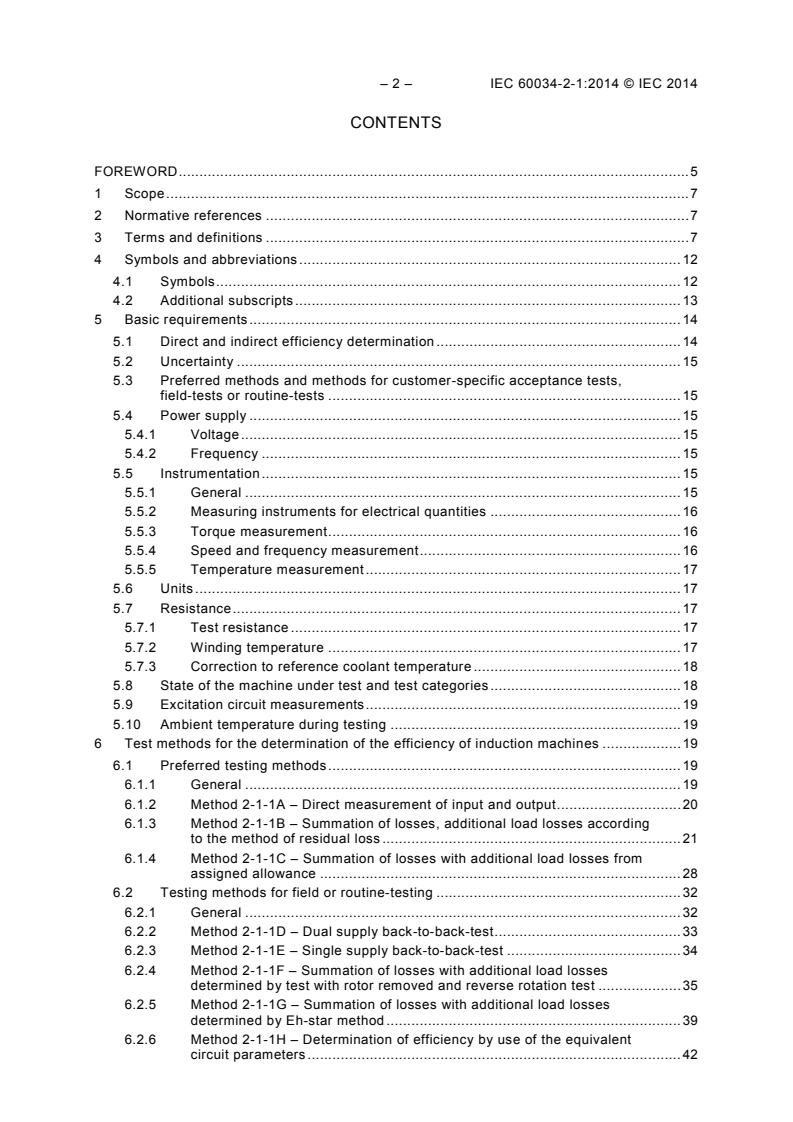
CONTENTS
FOREWORD . 5
1 Scope . 7
2 Normative references . 7
3 Terms and definitions . 7
4 Symbols and abbreviations . 12
4.1 Symbols . 12
4.2 Additional subscripts . 13
5 Basic requirements . 14
5.1 Direct and indirect efficiency determination . 14
5.2 Uncertainty . 15
5.3 Preferred methods and methods for customer-specific acceptance tests,
field-tests or routine-tests . 15
5.4 Power supply . 15
5.4.1 Voltage . 15
5.4.2 Frequency . 15
5.5 Instrumentation . 15
5.5.1 General . 15
5.5.2 Measuring instruments for electrical quantities . 16
5.5.3 Torque measurement . 16
5.5.4 Speed and frequency measurement . 16
5.5.5 Temperature measurement . 17
5.6 Units . 17
5.7 Resistance . 17
5.7.1 Test resistance . 17
5.7.2 Winding temperature . 17
5.7.3 Correction to reference coolant temperature . 18
5.8 State of the machine under test and test categories . 18
5.9 Excitation circuit measurements . 19
5.10 Ambient temperature during testing . 19
6 Test methods for the determination of the efficiency of induction machines . 19
6.1 Preferred testing methods . 19
6.1.1 General . 19
6.1.2 Method 2-1-1A – Direct measurement of input and output . 20
6.1.3 Method 2-1-1B – Summation of losses, additional load losses according
to the method of residual loss . 21
6.1.4 Method 2-1-1C – Summation of losses with additional load losses from
assigned allowance . 28
6.2 Testing methods for field or routine-testing . 32
6.2.1 General . 32
6.2.2 Method 2-1-1D – Dual supply back-to-back-test . 33
6.2.3 Method 2-1-1E – Single supply back-to-back-test . 34
6.2.4 Method 2-1-1F – Summation of losses with additional load losses
determined by test with rotor removed and reverse rotation test . 35
6.2.5 Method 2-1-1G – Summation of losses with additional load losses
determined by Eh-star method . 39
6.2.6 Method 2-1-1H – Determination of efficiency by use of the equivalent
circuit parameters . 42
7 Test methods for the determination of the efficiency of synchronous machines . 47
7.1 Preferred testing methods . 47
7.1.1 General . 47
7.1.2 Method 2-1-2A – Direct measurement of input and output . 48
7.1.3 Method 2-1-2B – Summation of separate losses with a rated load
temperature test and a short circuit test . 50
7.1.4 Method 2-1-2C – Summation of separate losses without a full load test . 55
7.2 Testing methods for field or routine testing . 57
7.2.1 General . 57
7.2.2 Method 2-1-2D – Dual supply back-to-back-test . 57
7.2.3 Method 2-1-2E – Single supply back-to-back-test . 58
7.2.4 Method 2-1-2F – Zero power factor test with excitation current from
Potier-, ASA- or Swedish-diagram . 60
7.2.5 Method 2-1-2G – Summation of separate losses with a load test without
consideration of additional load losses . 64
8 Test methods for the determination of the efficiency of d.c. machines . 65
8.1 Testing methods for field or routine testing . 65
8.1.1 General . 65
8.1.2 Method 2-1-3A – Direct measurement of input and output . 65
8.1.3 Method 2-1-3B – Summation of losses with a load test and d.c.
component of additional load losses from test. 67
8.1.4 Method 2-1-3C – Summation of losses with a load test and d.c.
component of additional load losses from assigned value . 73
8.1.5 Method 2-1-3D – Summation of losses without a load test . 75
8.1.6 Method 2-1-3E – Single supply back-to-back test . 77
Annex A (normative) Calculation of values for the Eh-star method . 80
Annex B (informative) Types of excitation systems . 83
Annex C (informative) Induction machine slip measurement. 84
Annex D (informative) Test report template for method 2-1-1B . 86
Bibliography . 87
Figure 1 – Sketch for torque measurement test . 20
Figure 2 – Efficiency determination according to method 2-1-1A . 21
Figure 3 – Efficiency determination according to method 2-1-1B . 22
Figure 4 – Smoothing of the residual loss data. 27
Figure 5 – Efficiency determination according to method 2-1-1C . 29
Figure 6 – Vector diagram for obtaining current vector from reduced voltage test . 30
Figure 7 – Assigned allowance for additional load losses P . 31
LL
Figure 8 – Efficiency determination according to method 2-1-1D . 33
Figure 9 – Sketch for dual supply back-to-back test . 33
Figure 10 – Efficiency determination according to method 2-1-1E . 34
Figure 11 – Efficiency determination according to method 2-1-1F . 36
Figure 12 – Efficiency determination according to method 2-1-1G . 39
Figure 13 – Eh-star test circuit . 40
Figure 14 – Induction machine, T-model with equivalent iron loss resistor . 42
Figure 15 – Efficiency determination according to method 2-1-1H . 43
Figure 16 – Induction machines, reduced model for calculation . 46
– 4 – IEC 60034-2-1:2014 © IEC 2014
Figure 17 – Sketch for torque measurement test . 49
Figure 18 – Efficiency determination according to method 2-1-2A . 49
Figure 19 – Efficiency determination according to method 2-1-2B . 50
Figure 20 – Efficiency determination according to method 2-1-2C . 56
Figure 21 – Efficiency determination according to method 2-1-2D . 57
Figure 22 – Sketch for dual supply back-to-back test ( I If, f ) . 58
M GM G
Figure 23 – Efficiency determination according to method 2-1-2E . 59
Figure 24 – Single supply back-to-back test for synchronous machines . 59
Figure 25 – Efficiency determination according to method 2-1-2F . 60
Figure 26 – Efficiency determination according to method 2-1-2G . 64
Figure 27 – Sketch for torque measurement test . 66
Figure 28 – Efficiency determination according to method 2-1-3A . 66
Figure 29 – Efficiency determination according to method 2-1-3B . 67
Figure 30 – Sketch for single supply back-to-back test for determination of d.c.
component of additional load losses . 71
Figure 31 – Efficiency determination according to method 2-1-3C . 73
Figure 32 – Efficiency determination according to method 2-1-3D . 76
Figure 33 – Efficiency determination according to method 2-1-3E . 78
Figure 34 – Sketch for single supply back-to-back test . 78
Figure C.1 – Slip measurement system block diagram . 85
Table 1 – Reference temperature . 17
Table 2 – Induction machines: preferred testing methods . 20
Table 3 – Induction machines: other methods . 32
Table 4 – Synchronous machines with electrical excitation: preferred testing methods. 48
Table 5 – Synchronous machines with permanent magnets: preferred testing methods . 48
Table 6 – Synchronous machines: other methods . 57
Table 7 – DC machines: test methods . 65
Table 8 – Multiplying factors for different speed ratios . 74
==
INTERNATIONAL ELECTROTECHNICAL COMMISSION
____________
ROTATING ELECTRICAL MACHINES –
Part 2-1: Standard methods for determining losses and efficiency
from tests (excluding machines for traction vehicles)
FOREWORD
1) The International Electrotechnical Commission (IEC) is a worldwide organization for standardization comprising
all national electrotechnical committees (IEC National Committees). The object of IEC is to promote
international co-operation on all questions concerning standardization in the electrical and electronic fields. To
this end and in addition to other activities, IEC publishes International Standards, Technical Specifications,
Technical Reports, Publicly Available Specifications (PAS) and Guides (hereafter referred to as “IEC
Publication(s)”). Their preparation is entrusted to technical committees; any IEC National Committee interested
in the subject dealt with may participate in this preparatory work. International, governmental and non-
governmental organizations liaising with the IEC also participate in this preparation. IEC collaborates closely
with the International Organization for Standardization (ISO) in accordance with conditions determined by
agreement between the two organizations.
2) The formal decisions or agreements of IEC on technical matters express, as nearly as possible, an international
consensus of opinion on the relevant subjects since each technical committee has representation from all
interested IEC National Committees.
3) IEC Publications have the form of recommendations for international use and are accepted by IEC National
Committees in that sense. While all reasonable efforts are made to ensure that the technical content of IEC
Publications is accurate, IEC cannot be held responsible for the way in which they are used or for any
misinterpretation by any end user.
4) In order to promote international uniformity, IEC National Committees undertake to apply IEC Publications
transparently to the maximum extent possible in their national and regional publications. Any divergence
between any IEC Publication and the corresponding national or regional publication shall be clearly indicated in
the latter.
5) IEC itself does not provide any attestation of conformity. Independent certification bodies provide conformity
assessment services and, in some areas, access to IEC marks of conformity. IEC is not responsible for any
services carried out by independent certification bodies.
6) All users should ensure that they have the latest edition of this publication.
7) No liability shall attach to IEC or its directors, employees, servants or agents including individual experts and
members of its technical committees and IEC National Committees for any personal injury, property damage or
other damage of any nature whatsoever, whether direct or indirect, or for costs (including legal fees) and
expenses arising out of the publication, use of, or reliance upon, this IEC Publication or any other IEC
Publications.
8) Attention is drawn to the Normative references cited in this publication. Use of the referenced publications is
indispensable for the correct application of this publication.
9) Attention is drawn to the possibility that some of the elements of this IEC Publication may be the subject of
patent rights. IEC shall not be held responsible for identifying any or all such patent rights.
International Standard IEC 60034-2-1 has been prepared by IEC technical committee 2:
Rotating machinery.
This second edition cancels and replaces the first edition of IEC 60034-2-1, issued in 2007,
as well as IEC 60034-2A, issued in 1974. This edition constitutes a technical revision.
This edition includes the following significant technical changes with respect to the previous
edition:
a) The test methods are now grouped into preferred methods and methods for field or routine
testing. Preferred methods have a low uncertainty and for a specific rating and type of
machine only one preferred method is now defined.
b) The requirements regarding instrumentation have been detailed and refined.
c) The description of tests required for a specific method is now given in the same sequence
as requested for the performance of the test. This will avoid misunderstandings and
– 6 – IEC 60034-2-1:2014 © IEC 2014
improve the accuracy of the procedures. In addition, for each method a flowchart shows
the sequence of tests graphically.
The text of this standard is based on the following documents:
FDIS Report on voting
2/1742/FDIS 2/1748/RVD
Full information on the voting for the approval of this standard can be found in the report on
voting indicated in the above table.
This publication has been drafted in accordance with the ISO/IEC Directives, Part 2.
NOTE A table of cross-references of all IEC TC 2 publications can be found in the IEC TC 2 dashboard on the
IEC website.
The committee has decided that the contents of this publication will remain unchanged until
the stability date indicated on the IEC web site under "http://webstore.iec.ch" in the data
related to the specific publication. At this date, the publication will be
• reconfirmed,
• withdrawn,
• replaced by a revised edition, or
• amended.
ROTATING ELECTRICAL MACHINES –
Part 2-1: Standard methods for determining losses and efficiency
from tests (excluding machines for traction vehicles)
1 Scope
This part of IEC 60034 is intended to establish methods of determining efficiencies from tests,
and also to specify methods of obtaining specific losses.
This standard applies to d.c. machines and to a.c. synchronous and induction machines of all
sizes within the scope of IEC 60034-1.
NOTE These methods may be applied to other types of machines such as rotary converters, a.c. commutator
motors and single-phase induction motors.
2 Normative references
The following documents, in whole or in part, are normatively referenced in this document and
are indispensable for its application. For dated references, only the edition cited applies. For
undated references, the latest edition of the referenced document (including any
amendments) applies.
IEC 60027-1, Letter symbols to be used in electrical technology – Part 1: General
IEC 60034-1:2010, Rotating electrical machines – Part 1: Rating and performance
IEC 60034-4:2008, Rotating electrical machines – Part 4: Methods for determining
synchronous machine quantities from tests
IEC 60034-19, Rotating electrical machines – Part 19:Specific test methods for d.c. machines
on conventional and rectifier-fed supplies
IEC 60034-29, Rotating electrical machines – Part 29: Equivalent loading and superposition
techniques – Indirect testing to determine temperature rise
IEC 60051(all parts), Direct acting indicating analogue electrical measuring instruments and
their accessories
IEC 60051-1, Direct acting indicating analogue electrical measuring instruments and their
accessories – Part 1: Definitions and general requirements common to all parts
3 Terms and definitions
For the purposes of this document, the terms and definitions given in IEC 60034-1,
IEC 60051-1 and the following apply.
3.1
efficiency
ratio of output power to input power expressed in the same units and usually given as a
percentage
– 8 – IEC 60034-2-1:2014 © IEC 2014
3.2
direct efficiency determination
method by which the determination of efficiency is made by measuring directly the input
power and the output power
3.3
dynamometer
device for measuring torque applied to the rotating part of the machine under test. It is
equipped with means for measuring and indicating torque and speed, and is not limited to a
cradle base construction. An in-line torque transducer may be used to provide a direct
measurement of torque at the shaft of the machine under test.
3.4
dynamometer test
test in which the mechanical power output of a machine acting as a motor is determined by a
dynamometer. Also a test in which the mechanical input power of a machine acting as a
generator is determined by a dynamometer.
3.5
dual-supply back-to-back test
test in which two identical machines are mechanically coupled together, and the total losses
of both machines are calculated from the difference between the electrical input to one
machine and the electrical output of the other machine
3.6
indirect efficiency determination
method by which the determination of efficiency is made by measuring the input power or the
output power and determining the total losses. Those losses are added to the output power,
thus giving the input power, or subtracted from the input power, thus giving the output power.
3.7
single-supply back-to-back test
test in which two identical machines are mechanically coupled together, and are both
connected electrically to the same power system. The total losses of both machines are taken
as the input power drawn from the system.
3.8
no-load test
test in which a machine is run as a motor providing no useful mechanical output from the
shaft, or when run as a generator with its terminals open-circuited
3.9
zero power factor test (synchronous machines)
no-load test on a synchronous machine, which is over-excited and operates at a power factor
very close to zero
3.10
equivalent circuit method (induction machines)
test in which the losses are determined by help of an equivalent circuit model
3.11
test with rotor removed and reverse rotation test (induction machines)
combined test in which the additional load losses are determined from a test with rotor
removed and a test with the rotor running in reverse direction to the rotating magnetic field of
the stator
3.12
short-circuit test (synchronous machines)
test in which a machine is run as a generator with its terminals short-circuited
3.13
locked rotor test
test in which the rotor is locked to prevent rotation
3.14
eh-star test
test in which the motor is run in star connection on unbalanced voltage
3.15 Losses
3.15.1
total losses
P
T
difference between the input power and the output power, equivalent to the sum of the
constant losses (see 3.15.2), the load losses (see 3.15.4), the additional load losses (see
3.15.5) and the excitation circuit losses (see 3.15.3)
3.15.2
constant losses
losses incorporating the sum of windage, friction and iron losses. Although these losses
change with voltage and load, they are historically called “constant” losses and the name is
retained in this standard.
3.15.2.1
constant losses
P
c
sum of the iron losses and the friction and windage losses
3.15.2.2
iron losses
P
fe
losses in active iron and additional no-load losses in other metal parts
3.15.2.3 Friction and windage losses P
fw
3.15.2.3.1
friction losses
losses due to friction (bearings and brushes, if not lifted at rated conditions) not including any
losses in a separate lubricating system
3.15.2.3.2
windage losses
total losses due to aerodynamic friction in all parts of the machine, including power absorbed
in shaft mounted fans, and in auxiliary machines forming an integral part of the machine
Note 1 to entry: Losses in a separate ventilating system should be listed separately.
Note 2 to entry: For machines indirectly or directly cooled by hydrogen, see IEC 60034-1.
3.15.3 Excitation circuit losses
3.15.3.1
excitation circuit losses
P
e
sum of the excitation winding losses (see 3.15.3.2), the exciter losses (see 3.15.3.3) and, for
synchronous machines, electrical brush loss (see 3.15.3.5), if any
– 10 – IEC 60034-2-1:2014 © IEC 2014
3.15.3.2
excitation winding losses
P
f
excitation (field) winding losses are equal to the product of the exciting current I and the
e
excitation voltage U
e
3.15.3.3
exciter losses
P
Ed
the exciter losses for the different excitation systems (see Annex B) are defined as follows:
a) Shaft driven exciter
The exciter losses are the power absorbed by the exciter at its shaft (reduced by friction
and windage losses) plus the power P drawn from a separate source at its excitation
1E
winding terminals, minus the useful power which the exciter provides at its terminals. The
useful power at the terminals of the exciter is equal to the excitation winding losses as per
3.15.3.2 plus (in the case of a synchronous machine) the electrical brush losses as per
3.15.3.5.
Note 1 to entry: If the exciter can be decoupled and tested separately its losses can be determined according
to 7.1.3.2.1.
Whenever the exciter makes use of separate auxiliary supplies, their consumptions are to be included in the
exciter losses unless they are considered together with the main machine auxiliaries consumption.
b) Brushless exciter
exciter losses are the power absorbed by the exciter at its shaft, reduced by friction and
windage losses (when the relevant test is performed on the set of main machine and
exciter), plus the electrical power P from a separate source (if any) absorbed by its field
1E
winding or its stator winding (in the case of an induction exciter), minus the useful power
which the exciter provides at the rotating power converter terminals.
Note 2 to entry: Whenever the exciter makes use of separate auxiliary supplies their consumptions are to be
included in the exciter losses unless they are considered together with the main machine auxiliaries
consumption.
If the exciter can be decoupled and tested separately, its losses can be determined according to 7.1.3.2.1.
c) Separate rotating exciter
exciter losses are the difference between the power absorbed by the driving motor, plus
the power absorbed by separate auxiliary supplies, of both driving and driven machines,
including the power supplied by separate source to their excitation winding terminals, and
the excitation power supplied as per 3.15.3.2 and 3.15.3.4. The exciter losses may be
determined according to 7.1.3.2.1.
d) Static excitation system (static exciter)
excitation system losses are the difference between the electrical power drawn from its
power source, plus the power absorbed by separate auxiliary supplies, and the excitation
supplied as per 3.15.3.2 and 3.15.3.4.
Note 3 to entry: In the case of systems fed by transformers, the transformer losses shall be included in the
exciter losses.
e) Excitation from auxiliary winding (auxiliary winding exciter)
exciter losses are the copper losses in the auxiliary (secondary) winding and the additional
iron losses produced by increased flux harmonics. The additional iron losses are the
difference between the losses which occur when the auxiliary winding is loaded and when
it is unloaded.
Note 4 to entry: Because separation of the excitation component of losses is difficult, it is recommended to
consider these losses as an integral part of the stator losses when determining overall losses.
In the cases c) and d) no allowance is made for the losses in the excitation source (if any) or
in the connections between the source and the brushes (synchronous machine) or between
the source and the excitation winding terminals (d.c. machine).
If the excitation is supplied by a system having components as described in b) to e) the
exciter losses shall include the relevant losses of the components pertaining to the categories
listed in Annex B as applicable.
3.15.3.4
separately supplied excitation power
P
1E
excitation power P supplied from a separate power source is:
1E
– for exciter types a) and b) the exciter excitation power (d.c. or synchronous exciter) or
stator winding input power (induction exciter). It covers a part of the exciter losses P
Ed
(and further losses in induction exciters) while a larger part of P is supplied via the shaft;
e
– for exciter types c) and d) equal to the excitation circuit losses, P = P ;
1E e
– for exciter type e) P = 0, the excitation power being delivered entirely by the shaft. Also,
1E
P = 0 for machines with permanent magnet excitation.
1E
Exciter types shall be in accordance with 3.15.3.3.
3.15.3.5
brush losses (excitation circuit)
P
b
electrical brush loss (including contact loss) of separately excited synchronous machines
3.15.4 Load losses
3.15.4.1
load losses
P
L
sum of the winding (I R) losses (see 3.15.4.2) and the electrical brush losses (see 3.15.4.3), if
any
3.15.4.2
winding losses
winding losses are I R losses:
– in the armature circuit of d.c. machines;
– in the stator and rotor windings of induction machines;
– in the armature and field windings of synchronous machines
3.15.4.3
brush losses (load circuits)
P
b
electrical brush loss (including contact loss) in the armature circuit of d.c. machines and in
wound-rotor induction machines
3.15.5
additional load losses (stray-load losses)
P
LL
losses produced in active iron and other metal parts by alternating stray fluxes when the
machine is loaded; eddy current losses in winding conductors caused by load current-
dependent flux pulsations and additional brush losses caused by commutation
NOTE These losses do not include the additional no-load losses of 3.15.2.2.
– 12 – IEC 60034-2-1:2014 © IEC 2014
3.15.6
short-circuit losses
P
k
current-dependent losses in a synchronous machine and in a d.c. machine when the armature
winding is short-circuited
3.16 Test quantities (polyphase a.c. machines)
3.16.1
terminal voltage
for polyphase a.c. machines, the arithmetic average of line voltages
3.16.2
line current
for polyphase a.c. machines, the arithmetic average of line currents
3.16.3
line-to-line resistance
for polyphase a.c. machines, the arithmetic average of resistances measured between each
pair of terminals
Note 1 to entry: For Y-connected three-phase machines, the phase-resistance is 0,5 times the line-to-line
resistance. For ∆-connected machines, the phase-resistance is 1,5 times the line-to-line resistance.
Note 2 to entry: In Clauses 6 and 7 explanations and formulae given are for three-phase machines, unless
otherwise indicated.
3.16.4
temperature rise
is the machine temperature minus the cooling medium (coolant) temperature as defined by
IEC 60034-1
4 Symbols and abbreviations
4.1 Symbols
cos ϕ is the power factor
f is the supply frequency, Hz
I is the average line current, A
k is the temperature correction factor
θ
–1
n is the operating speed, s
p is the number of pole pairs
P is the power, W
P is the input power at no-load, W
P is the input power, excluding excitation , W
P is the output power, W
P is the brush loss, W
b
P is the excitation circuit losses, W
e
is the excitation power supplied by a separate source, W
P
1E
P is the exciter losses, W
Ed
___________
This definition assumes sinusoidal voltage and current.
Unless otherwise indicated, the tests in this standard are described for motor operation, where P and P are
1 2
electrical input and mechanical output power, respectively.
P is the electrical power, excluding excitation, W
el
P is the excitation (field) winding losses, W
f
P is the iron losses, W
fe
P is the friction and windage losses, W
fw
P is the constant losses, W
c
P is the load losses, W
L
P is the residual losses, W
Lr
P is the additional-load losses, W
LL
P is the mechanical power, W
mech
P is the short-circuit losses, W
k
P is the total losses, W
T
P is the winding losses, W, where subscript w is generally replaced by a, f, e, s or r
w
(see 4.2)
R is a winding resistance, Ω
R is the actual value of the auxiliary resistor for the Eh-star test (see 6.4.5.5), Ω
eh
R’ is the typical value of the auxiliary resistor, Ω
eh
R is the field winding resistance, Ω
f
R is the average line-to-line-resistance, Ω
II
R is the average phase-resistance, Ω
ph
s is the slip, in per unit value of synchronous speed
T is the machine torque, N·m
T is the reading of the torque measuring device, N·m
d
T is the torque correction, N·m
c
U is the average terminal voltage, V
U is the terminal voltage at no-load, V
U is the rated terminal voltage, V
N
X is the reactance, Ω
Z= R+×j X is the notation for a complex quantity (impedance as example)
ZZ R+ X is the absolute value of a complex quantity (impedance as example)
Z is the impedance, Ω
η is the efficiency
θ is the initial winding temperature, °C
θ is the ambient temperature, °C
a
θ primary coolant inlet temperature, °C
c
θ is the winding temperature, °C
w
τ is a time constant, s
4.2 Additional subscripts
The following subscripts may be added to symbols to clarify the machine function and to
differentiate values.
Machine components:
a armature
==
– 14 – IEC 60034-2-1:2014 © IEC 2014
e excitation
f field winding
r rotor
s stator
w winding
U,V,W phase designations
Machine categories:
B booster
D dynamometer
E exciter
G generator
M motor
Operating conditions:
0 no-load
1 input
2 output
av average, mean
d dissipated
el electrical
i internal
k short circuit
L test load
lr locked rotor
mech mechanical
N rated
red at reduced voltage
t test
zpf zero power factor test
θ corrected to a reference coolant temperature.
NOTE Further additional subscripts are introduced in relevant subclauses.
5 Basic requirements
5.1 Direct and indirect efficiency determination
Tests can be grouped into the three following categories:
a) input-output power measurement on a single machine. This involves the direct
measurement of electrical or mechanical power into, and mechanical or electrical power
out of a machine;
b) electrical input and output measurement on two identical machines mechanically
connected back-to-back. This is done to eliminate the measurement of mechanical power
into or out of the machine;
c) determination of the actual loss in a machine under a particular condition. This is usually
not the total loss but comprises certain loss components.
The methods for determining the efficiency of machines are based on a number of
assumptions. Therefore, it is not recommended that a comparison be made between the
values of efficiency obtained by different methods, because the figures may not necessarily
agree.
5.2 Uncertainty
Uncertainty as used in this standard is the uncertainty of determining a true efficiency. It
reflects variations in the test procedure and the test equipment.
Although uncertainty should be expressed as a numerical value, such a requirement needs
sufficient testing to determine representative and comparative values.
5.3 Preferred methods and methods for customer-specific acceptance tests, field-
tests or routine-tests
It is difficult to establish specific rules for the determination of efficiency. The choice of test to
be made depends on the information required, the accuracy required, the type and size of the
machine involved and the available field test equipment (supply, load or driving machine).
In the following, the test methods suitable for asynchronous and synchronous machines are
separated into preferred methods and methods for customer-specific acceptance tests, field-
tests or routine tests.
5.4 Power supply
5.4.1 Voltage
The supply voltage shall be in accordance with 7.2 (and 8.3.1 for thermal tests) of
IEC 60034-1:2010.
5.4.2 Frequency
During tests, the average supply frequency shall be within ±0,1 % of the frequency required
for the test being conducted.
5.5 Instrumentation
5.5.1 General
Environmental conditions shall be within
...