

IEC TS 61000-3-4:1998
(Main)Electromagnetic compatibility (EMC) - Part 3-4: Limits - Limitation of emission of harmonic currents in low-voltage power supply systems for equipment with rated current greater than 16 A
General Information
- Abstract
The recommendations of this technical report are applicable to electrical and electronic equipment with a rated input current exceeding 16 A per phase and intended to be connected to public low-voltage a.c. distribution systems of the following types: - nominal voltage up to 240 V, single-phase, two or three wires; - nominal voltage up to 600 V, three-phase, three or four wires; - nominal frequency 50 Hz or 60 Hz. These recommendations specify the information required to enable a supply authority to assess equipment regarding harmonic disturbance and to decide wether or not the equipment is acceptable for connection with regard to the harmonic distortion aspect. This document is not to be regarded as an International Standard.
- Status
- Published
- Publication Date
- 29-Oct-1998
- Technical Committee
- SC 77A - EMC - Low frequency phenomena
- Drafting Committee
- WG 1 - TC 77/SC 77A/WG 1
- Current Stage
- PPUB - Publication issued
- Start Date
- 30-Oct-1998
- Completion Date
- 31-May-1999
Buy Documents
IEC TS 61000-3-4:1998 - Electromagnetic compatibility (EMC) - Part 3-4: Limits - Limitation of emission of harmonic currents in low-voltage power supply systems for equipment with rated current greater than 16 A Released:10/30/1998
Overview
IEC TS 61000-3-4:1998 is a technical report published by the International Electrotechnical Commission (IEC) focusing on electromagnetic compatibility (EMC). Specifically, it addresses the limitation of emission of harmonic currents in low-voltage power supply systems for electrical and electronic equipment with a rated input current greater than 16 A per phase. This report is aimed at providing recommendations for equipment connected to public low-voltage AC distribution networks with nominal voltages up to 240 V (single-phase) or 600 V (three-phase) at 50 Hz or 60 Hz.
Although classified as a technical report (Type 2), meaning it is not an official International Standard, IEC TS 61000-3-4 serves as a provisional guideline to help supply authorities assess the harmonic disturbance impact of connected equipment.
Key Topics
Scope and Applicability
The technical report is applicable for equipment exceeding 16 A rated current per phase, typically used in industrial and large commercial environments connected to low-voltage public power systems.Harmonic Emissions and Limits
The document provides recommendations for limiting harmonic current emissions to minimize distortion in the power supply network. These limits help maintain the quality and reliability of low-voltage electrical systems.Measurement Methods
It outlines procedures for measuring harmonic currents emitted by equipment, ensuring consistent evaluation and compliance with EMC requirements.Connection Procedures
The report defines a three-stage approach for equipment connection approval, ranging from simplified connection checks to detailed assessments based on network data and consumer power subscriptions:- Stage 1: Simplified connection process
- Stage 2: Connection assessment based on network and equipment data
- Stage 3: Connection based on the agreed user power capacity
Product Documentation Requirements
Manufacturers are advised to provide detailed documentation to support harmonic emission assessments at each connection stage, covering design, operational modes, and measurement results.Type Testing and Simulation
IEC TS 61000-3-4 recommends test methods and simulation conditions for type testing of equipment to verify compliance with harmonic emission limits.
Applications
Power Quality Management
Utilities and supply authorities employ the guidelines to assess and limit harmonic disturbance caused by high-current equipment, helping avoid power quality issues such as voltage distortion and increased losses.Equipment Design and Compliance
Electrical equipment manufacturers use this technical report to design products with controlled harmonic emissions and prepare compliance documentation for low-voltage public distribution systems.Installation and Commissioning
Installers and engineers apply the connection procedures to ensure equipment meets EMC requirements before integration into power networks, minimizing risk of interference with other consumers.Regulatory Assessment
Authorities and standardization bodies refer to the document when establishing or updating regulations and technical requirements related to harmonic current emissions in low-voltage networks.
Related Standards
IEC 61000 Series
This report complements other IEC standards in the 61000 series that deal with electromagnetic compatibility, such as:- IEC 61000-3-2: Limits for harmonic current emissions for equipment with input current ≤16 A
- IEC 61000-2-2: Compatibility levels for low-frequency conducted disturbances in low-voltage power supply systems
IEC 60050
Provides general terminology and definitions relevant to electromagnetic compatibility.IEC 60027 / IEC 60417 / IEC 60617
These publications cover graphical symbols, letter symbols, and terminology used in the electrotechnical field, aiding consistent documentation and communication.
Adhering to IEC TS 61000-3-4:1998 helps ensure that electrical equipment with higher rated currents causes minimal harmonic distortion, protecting the integrity of low-voltage power distribution networks and supporting global objectives for electromagnetic compatibility compliance. This supports enhanced power quality, equipment reliability, and efficient energy utilization in industrial and commercial power systems.
Relations
- Effective Date
- 25-Aug-2026
- Effective Date
- 03-Jun-2026
- Effective Date
- 20-Feb-2026
- Effective Date
- 20-Feb-2026
- Effective Date
- 20-Feb-2026
- Effective Date
- 20-Feb-2026
- Referred By
EN 60974-10:2007 - Arc welding equipment - Part 10: Electromagnetic compatibility (EMC) requirements - Effective Date
- 20-Feb-2026
- Referred By
EN 62282-3-1:2007 - Fuel cell technologies - Part 3-1: Stationary fuel cell power systems - Safety - Effective Date
- 20-Feb-2026
- Referred By
EN 60974-10:2003 - Arc welding equipment - Part 10: Electromagnetic compatibility (EMC) requirements - Effective Date
- 20-Feb-2026
- Effective Date
- 20-Feb-2026
- Effective Date
- 20-Feb-2026
- Effective Date
- 20-Feb-2026
- Effective Date
- 20-Feb-2026
- Effective Date
- 20-Feb-2026
- Effective Date
- 20-Feb-2026
Buy Documents
IEC TS 61000-3-4:1998 - Electromagnetic compatibility (EMC) - Part 3-4: Limits - Limitation of emission of harmonic currents in low-voltage power supply systems for equipment with rated current greater than 16 A Released:10/30/1998
Get Certified
Connect with accredited certification bodies for this standard

ANCE
Mexican certification and testing association.

Intertek Slovenia
Intertek testing, inspection, and certification services in Slovenia.

LNE (Laboratoire National de Métrologie et d'Essais)
French national laboratory for metrology and testing.
Sponsored listings
Frequently Asked Questions
IEC TS 61000-3-4:1998 is a technical specification published by the International Electrotechnical Commission (IEC). Its full title is "Electromagnetic compatibility (EMC) - Part 3-4: Limits - Limitation of emission of harmonic currents in low-voltage power supply systems for equipment with rated current greater than 16 A". This standard covers: The recommendations of this technical report are applicable to electrical and electronic equipment with a rated input current exceeding 16 A per phase and intended to be connected to public low-voltage a.c. distribution systems of the following types: - nominal voltage up to 240 V, single-phase, two or three wires; - nominal voltage up to 600 V, three-phase, three or four wires; - nominal frequency 50 Hz or 60 Hz. These recommendations specify the information required to enable a supply authority to assess equipment regarding harmonic disturbance and to decide wether or not the equipment is acceptable for connection with regard to the harmonic distortion aspect. This document is not to be regarded as an International Standard.
The recommendations of this technical report are applicable to electrical and electronic equipment with a rated input current exceeding 16 A per phase and intended to be connected to public low-voltage a.c. distribution systems of the following types: - nominal voltage up to 240 V, single-phase, two or three wires; - nominal voltage up to 600 V, three-phase, three or four wires; - nominal frequency 50 Hz or 60 Hz. These recommendations specify the information required to enable a supply authority to assess equipment regarding harmonic disturbance and to decide wether or not the equipment is acceptable for connection with regard to the harmonic distortion aspect. This document is not to be regarded as an International Standard.
IEC TS 61000-3-4:1998 is classified under the following ICS (International Classification for Standards) categories: 33.100.10 - Emission. The ICS classification helps identify the subject area and facilitates finding related standards.
IEC TS 61000-3-4:1998 has the following relationships with other standards: It is inter standard links to EN 12098-3:2002, EN 12015:2004, EN 62282-3-100:2012, EN 61000-3-2:2006, EN IEC 62282-3-100:2020, EN 62040-3:2011, EN 60974-10:2007, EN 62282-3-1:2007, EN 60974-10:2003, EN 61800-3:2004, EN 61000-4-1:2000, EN 61000-3-2:2014, EN 62041:2003, EN 61000-4-1:2007, EN IEC 62040-3:2021. Understanding these relationships helps ensure you are using the most current and applicable version of the standard.
IEC TS 61000-3-4:1998 is available in PDF format for immediate download after purchase. The document can be added to your cart and obtained through the secure checkout process. Digital delivery ensures instant access to the complete standard document.
Standards Content (Sample)
RAPPORT
CEI
TECHNIQUE
IEC
61000-3-4
TECHNICAL
Première édition
REPORT
First edition
1998-10
Compatibilité électromagnétique (CEM) –
Partie 3-4:
Limites – Limitation des émissions de courants
harmoniques dans les réseaux basse tension
pour les matériels ayant un courant assigné
supérieur à 16 A
Electromagnetic compatibility (EMC) –
Part 3-4:
Limits – Limitation of emission of harmonic
currents in low-voltage power supply systems
for equipment with rated current
greater than 16 A
Numéro de référence
Reference number
CEI/IEC 61000-3-4:1998
Numéros des publications Numbering
Depuis le 1er janvier 1997, les publications de la CEI As from 1 January 1997 all IEC publications are issued
sont numérotées à partir de 60000. with a designation in the 60000 series.
Publications consolidées Consolidated publications
Les versions consolidées de certaines publications de Consolidated versions of some IEC publications
la CEI incorporant les amendements sont disponibles. including amendments are available. For example,
Par exemple, les numéros d’édition 1.0, 1.1 et 1.2 edition numbers 1.0, 1.1 and 1.2 refer, respectively, to
indiquent respectivement la publication de base, la the base publication, the base publication
publication de base incorporant l’amendement 1, et la incorporating amendment 1 and the base publication
publication de base incorporant les amendements 1 incorporating amendments 1 and 2.
et 2.
Validité de la présente publication Validity of this publication
Le contenu technique des publications de la CEI est The technical content of IEC publications is kept under
constamment revu par la CEI afin qu'il reflète l'état constant review by the IEC, thus ensuring that the
actuel de la technique. content reflects current technology.
Des renseignements relatifs à la date de Information relating to the date of the reconfirmation of
reconfirmation de la publication sont disponibles dans the publication is available in the IEC catalogue.
le Catalogue de la CEI.
Les renseignements relatifs à des questions à l’étude et Information on the subjects under consideration and
des travaux en cours entrepris par le comité technique work in progress undertaken by the technical
qui a établi cette publication, ainsi que la liste des committee which has prepared this publication, as well
publications établies, se trouvent dans les documents ci- as the list of publications issued, is to be found at the
dessous: following IEC sources:
• «Site web» de la CEI* • IEC web site*
• Catalogue des publications de la CEI • Catalogue of IEC publications
Publié annuellement et mis à jour régulièrement Published yearly with regular updates
(Catalogue en ligne)* (On-line catalogue)*
• Bulletin de la CEI • IEC Bulletin
Disponible à la fois au «site web» de la CEI* et Available both at the IEC web site* and as a
comme périodique imprimé printed periodical
Terminologie, symboles graphiques Terminology, graphical and letter
et littéraux symbols
En ce qui concerne la terminologie générale, le lecteur For general terminology, readers are referred to
se reportera à la CEI 60050: Vocabulaire Electro- IEC 60050: International Electrotechnical Vocabulary
technique International (VEI). (IEV).
Pour les symboles graphiques, les symboles littéraux For graphical symbols, and letter symbols and signs
et les signes d'usage général approuvés par la CEI, le approved by the IEC for general use, readers are
lecteur consultera la CEI 60027: Symboles littéraux à referred to publications IEC 60027: Letter symbols to
utiliser en électrotechnique, la CEI 60417: Symboles be used in electrical technology, IEC 60417: Graphical
graphiques utilisables sur le matériel. Index, relevé et symbols for use on equipment. Index, survey and
compilation des feuilles individuelles, et la CEI 60617: compilation of the single sheets and IEC 60617:
Symboles graphiques pour schémas. Graphical symbols for diagrams.
* Voir adresse «site web» sur la page de titre. * See web site address on title page.
RAPPORT
CEI
TECHNIQUE – TYPE 2
IEC
61000-3-4
TECHNICAL
Première édition
REPORT – TYPE 2
First edition
1998-10
Compatibilité électromagnétique (CEM) –
Partie 3-4:
Limites – Limitation des émissions de courants
harmoniques dans les réseaux basse tension
pour les matériels ayant un courant assigné
supérieur à 16 A
Electromagnetic compatibility (EMC) –
Part 3-4:
Limits – Limitation of emission of harmonic
currents in low-voltage power supply systems
for equipment with rated current
greater than 16 A
IEC 1998 Droits de reproduction réservés Copyright - all rights reserved
Aucune partie de cette publication ne peut être reproduite ni No part of this publication may be reproduced or utilized in
utilisée sous quelque forme que ce soit et par aucun any form or by any means, electronic or mechanical,
procédé, électronique ou mécanique, y compris la photo- including photocopying and microfilm, without permission in
copie et les microfilms, sans l'accord écrit de l'éditeur. writing from the publisher.
International Electrotechnical Commission 3, rue de Varembé Geneva, Switzerland
Telefax: +41 22 919 0300 e-mail: inmail@iec.ch IEC web site http: //www.iec.ch
CODE PRIX
Commission Electrotechnique Internationale
PRICE CODE N
International Electrotechnical Commission
Pour prix, voir catalogue en vigueur
For price, see current catalogue
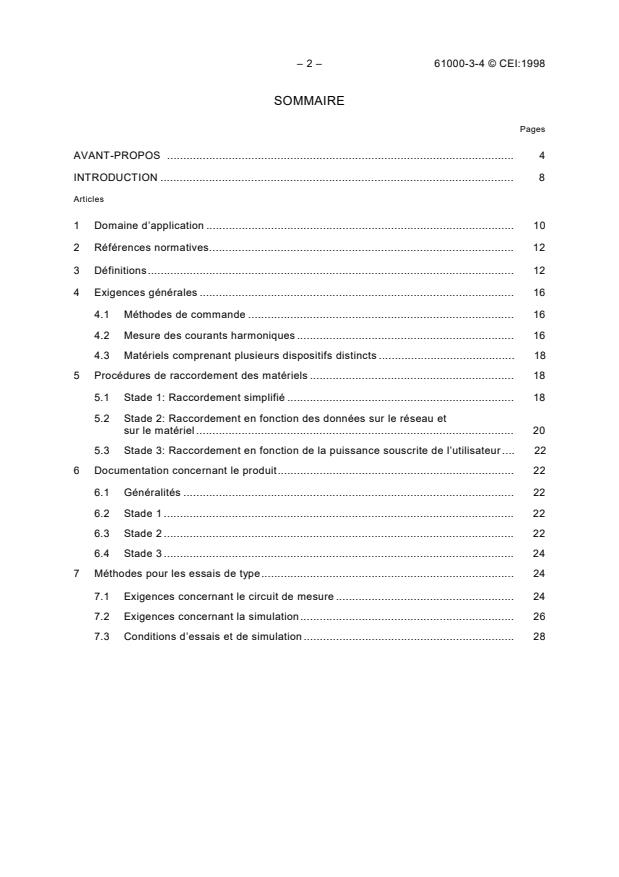
– 2 – 61000-3-4 © CEI:1998
SOMMAIRE
Pages
AVANT-PROPOS . 4
INTRODUCTION. 8
Articles
1 Domaine d’application . 10
2 Références normatives. 12
3 Définitions. 12
4 Exigences générales . 16
4.1 Méthodes de commande . 16
4.2 Mesure des courants harmoniques . 16
4.3 Matériels comprenant plusieurs dispositifs distincts . 18
5 Procédures de raccordement des matériels . 18
5.1 Stade 1: Raccordement simplifié . 18
5.2 Stade 2: Raccordement en fonction des données sur le réseau et
sur le matériel . 20
5.3 Stade 3: Raccordement en fonction de la puissance souscrite de l’utilisateur . 22
6 Documentation concernant le produit. 22
6.1 Généralités . 22
6.2 Stade 1 . 22
6.3 Stade 2 . 22
6.4 Stade 3 . 24
7 Méthodes pour les essais de type. 24
7.1 Exigences concernant le circuit de mesure . 24
7.2 Exigences concernant la simulation. 26
7.3 Conditions d’essais et de simulation . 28
61000-3-4 © IEC:1998 – 3 –
CONTENTS
Page
FOREWORD . 5
INTRODUCTION . 9
Clause
1 Scope . 11
2 Normative references . 13
3 Definitions. 13
4 General requirements. 17
4.1 Control methods. 17
4.2 Harmonic current measurement . 17
4.3 Equipment consisting of several self-contained items . 19
5 Connection procedures for equipment . 19
5.1 Stage 1: Simplified connection . 19
5.2 Stage 2: Connection based on network and equipment data . 21
5.3 Stage 3: Connection based on the consumer's agreed power. 23
6 Product documentation. 23
6.1 General. 23
6.2 Stage 1 . 23
6.3 Stage 2 . 23
6.4 Stage 3 . 25
7 Methods for type tests . 25
7.1 Requirements for measurement circuit . 25
7.2 Requirements for simulation. 27
7.3 Test and simulation conditions . 29
– 4 – 61000-3-4 © CEI:1998
COMMISSION ÉLECTROTECHNIQUE INTERNATIONALE
––––––––––
COMPATIBILITÉ ÉLECTROMAGNÉTIQUE (CEM) –
Partie 3-4: Limites –
Limitation des émissions de courants harmoniques
dans les réseaux basse tension
pour les matériels ayant un courant assigné supérieur à 16 A
AVANT-PROPOS
1) La CEI (Commission Electrotechnique Internationale) est une organisation mondiale de normalisation composée
de l'ensemble des comités électrotechniques nationaux (Comités nationaux de la CEI). La CEI a pour objet de
favoriser la coopération internationale pour toutes les questions de normalisation dans les domaines de
l'électricité et de l'électronique. A cet effet, la CEI, entre autres activités, publie des Normes Internationales.
Leur élaboration est confiée à des comités d'études, aux travaux desquels tout Comité national intéressé par le
sujet traité peut participer. Les organisations internationales, gouvernementales et non gouvernementales, en
liaison avec la CEI, participent également aux travaux. La CEI collabore étroitement avec l'Organisation
Internationale de Normalisation (ISO), selon des conditions fixées par accord entre les deux organisations.
2) Les décisions ou accords officiels de la CEI concernant les questions techniques, représentent, dans la mesure
du possible un accord international sur les sujets étudiés, étant donné que les Comités nationaux intéressés
sont représentés dans chaque comité d’études.
3) Les documents produits se présentent sous la forme de recommandations internationales. Ils sont publiés
comme normes, rapports techniques ou guides et agréés comme tels par les Comités nationaux.
4) Dans le but d'encourager l'unification internationale, les Comités nationaux de la CEI s'engagent à appliquer de
façon transparente, dans toute la mesure possible, les Normes internationales de la CEI dans leurs normes
nationales et régionales. Toute divergence entre la norme de la CEI et la norme nationale ou régionale
correspondante doit être indiquée en termes clairs dans cette dernière.
5) La CEI n’a fixé aucune procédure concernant le marquage comme indication d’approbation et sa responsabilité
n’est pas engagée quand un matériel est déclaré conforme à l’une de ses normes.
6) L’attention est attirée sur le fait que certains des éléments de la présente Norme internationale peuvent faire
l’objet de droits de propriété intellectuelle ou de droits analogues. La CEI ne saurait être tenue pour
responsable de ne pas avoir identifié de tels droits de propriété et de ne pas avoir signalé leur existence.
La tâche principale des comités d’études de la CEI est d’élaborer des Normes internationales.
Exceptionnellement, un comité d’études peut proposer la publication d’un rapport technique de
l’un des types suivants:
– type 1, lorsque, en dépit de maints efforts, l’accord requis ne peut être réalisé en faveur de
la publication d’une Norme internationale;
– type 2, lorsque le sujet en question est encore en cours de développement technique ou
lorsque, pour une raison quelconque, la possibilité d’un accord pour la publication d’une
Norme internationale peut être envisagée pour l’avenir mais pas dans l’immédiat;
– type 3, lorsqu’un comité d’études a réuni des données de nature différente de celles qui
sont normalement publiées comme Normes internationales, cela pouvant comprendre, par
exemple, des informations sur l’état de la technique.
Les rapports techniques de types 1 et 2 font l’objet d’un nouvel examen trois ans au plus tard
après leur publication afin de décider éventuellement de leur transformation en Normes
internationales. Les rapports techniques de type 3 ne doivent pas nécessairement être révisés
avant que les données qu’ils contiennent ne soient plus jugées valables ou utiles.
61000-3-4 © IEC:1998 – 5 –
INTERNATIONAL ELECTROTECHNICAL COMMISSION
––––––––––
ELECTROMAGNETIC COMPATIBILITY (EMC) –
Part 3-4: Limits –
Limitation of emission of harmonic currents
in low-voltage power supply systems
for equipment with rated current greater than 16 A
FOREWORD
1) The IEC (International Electrotechnical Commission) is a worldwide organization for standardization comprising
all national electrotechnical committees (IEC National Committees). The object of the IEC is to promote
international co-operation on all questions concerning standardization in the electrical and electronic fields. To
this end and in addition to other activities, the IEC publishes International Standards. Their preparation is
entrusted to technical committees; any IEC National Committee interested in the subject dealt with may
participate in this preparatory work. International, governmental and non-governmental organizations liaising
with the IEC also participate in this preparation. The IEC collaborates closely with the International Organization
for Standardization (ISO) in accordance with conditions determined by agreement between the two
organizations.
2) The formal decisions or agreements of the IEC on technical matters express, as nearly as possible, an
international consensus of opinion on the relevant subjects since each technical committee has representation
from all interested National Committees.
3) The documents produced have the form of recommendations for international use and are published in the form
of standards, technical reports or guides and they are accepted by the National Committees in that sense.
4) In order to promote international unification, IEC National Committees undertake to apply IEC International
Standards transparently to the maximum extent possible in their national and regional standards. Any
divergence between the IEC Standard and the corresponding national or regional standard shall be clearly
indicated in the latter.
5) The IEC provides no marking procedure to indicate its approval and cannot be rendered responsible for any
equipment declared to be in conformity with one of its standards.
6) Attention is drawn to the possibility that some of the elements of this International Standard may be the subject
of patent rights. The IEC shall not be held responsible for identifying any or all such patent rights.
The main task of IEC technical committees is to prepare International Standards. In
exceptional circumstances, a technical committee may propose the publication of a technical
report of one of the following types:
– type 1, when the required support cannot be obtained for the publication of an International
Standard, despite repeated efforts;
– type 2, when the subject is still under technical development or where for any other reason
there is the future but not immediate possibility of an agreement on an International
Standard;
– type 3, when a technical committee has collected data of a different kind from that which is
normally published as an International Standard, for example "state of the art".
Technical reports of types 1 and 2 are subject to review within three years of publication to
decide whether they can be transformed into International Standards. Technical reports of type
3 do not necessarily have to be reviewed until the data they provide are considered to be no
longer valid or useful.
– 6 – 61000-3-4 © CEI:1998
La CEI 61000-3-4, rapport technique de type 2, a été établie par le sous-comité 77A:
Phénomènes basse fréquence, du comité d’études 77 de la CEI: Compatibilité électromagnétique.
Le texte de ce rapport technique est issu des documents suivants:
CDV Rapport de vote
77A/169/CDV 77A/227/RVC
Le rapport de vote indiqué dans le tableau ci-dessus donne toute information sur le vote ayant
abouti à l’approbation de ce rapport technique.
Le présent document est publié dans la série des rapports techniques de type 2
(conformément au paragraphe G.3.2.2 de la partie 1 des Directives ISO/CEI) comme «norme
prospective d’application provisoire» dans le domaine de la compatibilité électromagnétique en
raison de l’urgence d’avoir une indication quant à la manière dont il convient d’utiliser les
normes dans ce domaine pour répondre à un besoin déterminé.
Ce document ne doit pas être considéré comme une «Norme internationale». Il est proposé
pour une mise en oeuvre provisoire, dans le but de recueillir des informations et d’acquérir de
l’expérience quant à son application dans la pratique. Il est de règle d’envoyer les observations
éventuelles relatives au contenu de ce document au Bureau Central de la CEI.
Il sera procédé à un nouvel examen de ce rapport technique de type 2 trois ans au plus tard
après sa publication, avec la faculté d’en prolonger la validité pendant trois autres années, de
le transformer en Norme internationale ou de l’annuler.
61000-3-4 © IEC:1998 – 7 –
IEC 61000-3-4, which is a technical report of type 2, has been prepared by subcommittee 77A:
Low frequency phenomena, of IEC technical committee 77: Electromagnetic compatibility.
The text of this technical report is based on the following documents:
CDV Report on voting
77A/169/CDV 77A/227/RVC
Full information on the voting for the approval of this technical report can be found in the report
on voting indicated in the above table.
This document is being issued in the technical report (type 2) series of publications (according
to subclause G.3.2.2 of part 1 of the ISO/IEC Directives) as a "prospective standard for
provisional application" in the field of electromagnetic compatibility because there is an urgent
need for guidance on how standards in this field should be used to meet an identified need.
This document is not to be regarded as an "International Standard". It is proposed for
provisional application so that information and experience of its use in practice may be
gathered. Comments on the content of this document should be sent to the IEC Central Office.
A review of this technical report (type 2) will be carried out not later than three years after its
publication with the options of: extension for another three years; conversion into an
International Standard; or withdrawal.
– 8 – 61000-3-4 © CEI:1998
INTRODUCTION
Le présent rapport technique est une partie de la série CEI 61000, conformément à la structure
suivante:
Partie 1: Généralités
Considérations générales (introduction, principes fondamentaux)
Définitions, terminologie
Partie 2: Environnement
Description de l'environnement
Classification de l'environnement
Niveaux de compatibilité
Partie 3: Limites
Limites d'émission
Limites d'immunité (dans la mesure où elles ne relèvent pas des comités de produits)
Partie 4: Techniques d'essai et de mesure
Techniques de mesure
Techniques d'essai
Partie 5: Guides d'installation et d’atténuation
Guides d'installation
Méthodes et dispositifs d’atténuation
Partie 6: Normes génériques
Partie 9: Divers
Chaque partie est à son tour subdivisée en plusieurs parties, publiées soit comme normes
internationales, soit comme rapports techniques, dont certaines ont déjà été publiées en tant
que sections. D'autres seront publiées avec le numéro de la partie, suivi d'un tiret et d'un
second chiffre identifiant la subdivision (exemple: 61000-6-1).
Cette partie constitue un rapport technique de type 2 qui donne les limites d’émission pour les
courants harmoniques provenant de matériels dont le courant assigné dépasse 16 A par
phase.
61000-3-4 © IEC:1998 – 9 –
INTRODUCTION
This technical report is part of the IEC 61000 series, according to the following structure:
Part 1: General
General considerations (introduction, fundamental principles)
Definitions, terminology
Part 2: Environment
Description of the environment
Classification of the environment
Compatibility levels
Part 3: Limits
Emission limits
Immunity limits (in so far as they do not fall under the responsibility of the product committees)
Part 4: Testing and measurement techniques
Measurement techniques
Testing techniques
Part 5: Installation and mitigation guidelines
Installation guidelines
Mitigation methods and devices
Part 6: Generic standards
Part 9: Miscellaneous
Each part is further subdivided into several parts, published either as international standards or
technical reports, some of which have already been published as sections. Others will be
published with the part number followed by a dash and a second number identifying the
subdivision (example: 61000-6-1).
This part is a technical report type 2 which gives emission limits for harmonic currents from
equipment having an input current exceeding 16 A per phase.
– 10 – 61000-3-4 © CEI:1998
COMPATIBILITÉ ÉLECTROMAGNÉTIQUE (CEM) –
Partie 3-4: Limites –
Limitation des émissions de courants harmoniques
dans les réseaux basse tension
pour les matériels ayant un courant assigné supérieur à 16 A
1 Domaine d’application
La présente partie de la CEI 61000 traite de l’émission de perturbations dues aux
harmoniques.
Les recommandations du présent rapport technique s’appliquent aux matériels électroniques et
électriques dont le courant d’entrée assigné dépasse 16 A par phase et destinés à être
raccordés aux réseaux publics de distribution basse tension alternatifs des types suivants:
– tension nominale jusqu'à 240 V, monophasé, à deux ou trois fils;
– tension nominale jusqu'à 600 V, triphasé, à trois ou quatre fils;
– fréquence nominale 50 Hz ou 60 Hz.
Les autres systèmes de distribution sont exclus.
Les essais décrits dans ce rapport sont des essais de type pour des matériels complets,
comme le ventilateur à vitesse variable, et non de composants, comme un convertisseur.
Le raccordement de ce matériel à l'alimentation nécessite généralement un accord spécial
entre le distributeur et l’utilisateur. Cet accord dépendra de plusieurs facteurs incluant les
niveaux prévus de perturbations provoquées par le matériel et la situation réelle au point de
raccordement au système d'alimentation électrique.
Ces recommandations précisent les informations nécessaires pour permettre à un distributeur
une évaluation du matériel par rapport aux perturbations harmoniques et de décider si le
matériel est ou non acceptable pour le raccordement du point de vue de la distorsion
harmonique.
NOTE 1 – Pour ces types de matériels, seules des recommandations générales sur l'évaluation des perturbations
peuvent être fournies. Il n'y a pas de garantie que le raccordement de matériels conformes à ces recommandations
sera autorisé dans tous les cas, car l'accord concernant le raccordement du matériel à l'alimentation dépend du
niveau de perturbation causé par les équipements et des conditions de charge du réseau.
NOTE 2 – Ces recommandations peuvent également s'appliquer à du matériel ayant un courant d’entrée assigné
plus faible, mais nécessitant un accord spécial du distributeur (voir la CEI 61000-3-2).
NOTE 3 – Ces recommandations ne sont pas applicables aux filtres actifs.
On donne des recommandations sur:
a) la puissance de court-circuit nécessaire pour du matériel émetteur d'harmoniques testé ou
simulé dans des conditions spécifiées;
b) des méthodes pour des essais types ou des simulations.
61000-3-4 © IEC:1998 – 11 –
ELECTROMAGNETIC COMPATIBILITY (EMC) –
Part 3-4: Limits –
Limitation of emission of harmonic currents
in low-voltage power supply systems
for equipment with rated current greater than 16 A
1 Scope
This part of IEC 61000 deals with the emission of disturbances due to harmonics.
The recommendations of this technical report are applicable to electrical and electronic
equipment with a rated input current exceeding 16 A per phase and intended to be connected
to public low-voltage a.c. distribution systems of the following types:
– nominal voltage up to 240 V, single-phase, two or three wires;
– nominal voltage up to 600 V, three-phase, three or four wires;
– nominal frequency 50 Hz or 60 Hz.
Other distribution systems are excluded.
Tests according to this report are type tests of complete pieces of equipment, for example a
speed variable fan, and not of components, for example a converter.
Connection of this equipment to the supply generally requires special agreement between the
supply authority and the consumer. This consent will depend upon several factors including the
expected levels of disturbance caused by the equipment and the actual situation at the
connection point to the power supply system.
These recommendations specify the information required to enable a supply authority to
assess equipment regarding harmonic disturbance and to decide whether or not the equipment
is acceptable for connection with regard to the harmonic distortion aspect.
NOTE 1 – For these types of equipment only general recommendations on assessment of disturbances can be
given. There is no guarantee that the connection of equipment complying with these recommendations will be
allowed in all cases, as the consent to connect equipment to the supply depends on the level of disturbance caused
by the equipment and the load conditions in the network.
NOTE 2 – These recommendations can also be applied to equipment with a lower rated input current but requiring
special consent of the supply authority (see IEC 61000-3-2).
NOTE 3 – These recommendations are not applicable to active filters.
Guidance is given on:
a) required short-circuit power for harmonics emitting equipment tested or simulated under
specified conditions;
b) methods for type tests or simulations.
– 12 – 61000-3-4 © CEI:1998
2 Références normatives
Les documents normatifs suivants contiennent des dispositions qui, par suite de la référence
qui y est faite, constituent des dispositions valables pour la présente partie de la CEI 61000.
Au moment de la publication, les éditions indiquées étaient en vigueur. Tout document normatif
est sujet à révision et les parties prenantes aux accords fondés sur la présente partie de la
CEI 61000 sont invitées à rechercher la possibilité d'appliquer les éditions les plus récentes
des documents normatifs indiqués ci-après. Les membres de la CEI et de l’ISO possèdent le
registre des Normes internationales en vigueur.
CEI 60050(161):1990, Vocabulaire Electrotechnique International (VEI) – Chapitre 161:
Compatibilité électromagnétique
CEI 61000-2-1:1990, Compatibilité électromagnétique (CEM) – Partie 2: Environnement –
Section 1: Description de l'environnement – Environnement électromagnétique pour les
perturbations conduites basse fréquence et la transmission de signaux sur les réseaux publics
d'alimentation
CEI 61000-2-2:1990, Compatibilité électromagnétique (CEM) – Partie 2: Environnement –
Section 2: Niveaux de compatibilité pour les perturbations conduites basse fréquence et la
transmission de signaux sur les réseaux publics d'alimentation à basse tension
CEI 61000-3-2:1995, Compatibilité électromagnétique (CEM) – Partie 3: Limites – Section 2:
Limites pour les émissions de courant harmonique (courant appelé par les appareils ≤ 16 A par
phase)
CEI 61000-3-5:1994, Compatibilité électromagnétique (CEM) – Partie 3: Limites – Section 5:
Limitation des fluctuations de tension et du flicker dans les réseaux basse tension pour les
équipements ayant un courant appelé supérieur à 16 A
CEI 61000-4-7:1991, Compatibilité électromagnétique (CEM) – Partie 4: Techniques d'essai et
de mesure – Section 7: Guide général relatif aux mesures d’harmoniques et d’interharmoniques
ainsi qu’à l’appareillage de mesure, applicable aux réseaux d’alimentation et aux appareils qui
y sont raccordés
3 Définitions
Les définitions sont données dans la CEI 60050(161). Pour les besoins du présent rapport
technique, les définitions suivantes s’appliquent également.
3.1
1)
distorsion harmonique totale (TDH)
rapport de la valeur efficace des harmoniques (dans ce contexte, courants harmoniques I de
n
rang n) et de la valeur efficace du fondamental, c'est-à-dire:
I
n
TDH =
∑
I
n=2
———————
1)
Cette définition a été choisie conformément aux normes appropriées CEI 61000-2-1 et CEI 61000-2-2.
61000-3-4 © IEC:1998 – 13 –
2 Normative references
The following normative documents contain provisions which, through reference in this text,
constitute provisions of this part of IEC 61000. At the time of publication, the editions indicated
were valid. All normative documents are subject to revision, and parties to agreements based
on this part of IEC 61000 are encouraged to investigate the possibility of applying the most
recent editions of the normative documents indicated below. Members of IEC and ISO maintain
registers of currently valid International Standards.
IEC 60050(161):1990, International Electrotechnical Vocabulary (IEV) – Chapter 161:
Electromagnetic compatibility
IEC 61000-2-1:1990, Electromagnetic compatibility (EMC) – Part 2: Environment – Section 1:
Description of the environment – Electromagnetic environment for low-frequency conducted
disturbances and signalling in public power supply systems
IEC 61000-2-2:1990, Electromagnetic compatibility (EMC) – Part 2: Environment – Section 2:
Compatibility levels for low-frequency conducted disturbances and signalling in public low-
voltage power supply systems
IEC 61000-3-2:1995, Electromagnetic compatibility (EMC) – Part 3: Limits – Section 2: Limits
for harmonic current emissions (equipment input current ≤ 16 A per phase)
IEC 61000-3-5:1994, Electromagnetic compatibility (EMC) – Part 3: Limits – Section 5:
Limitation of voltage fluctuations and flicker in low-voltage power supply systems for equipment
with rated current greater than 16 A
IEC 61000-4-7:1991, Electromagnetic compatibility (EMC) – Part 4: Testing and measurement
techniques – Section 7: General guide on harmonics and interharmonics measurements and
instrumentation, for power supply systems and equipment connected thereto
3 Definitions
Definitions are given in IEC 60050(161). For the purpose of this technical report, the following
definitions also apply.
3.1
1)
total harmonic distortion (THD)
ratio of the r.m.s value of the harmonics (in this context harmonic currents I of the order n) to
n
the r.m.s value of the fundamental, viz.
I
n
THD =
∑
I
n=2
———————
1)
This definition has been chosen in accordance with the relevant standards IEC 61000-2-1 and IEC 61000-2-2.
– 14 – 61000-3-4 © CEI:1998
3.2
distorsion harmonique partielle pondérée (PWHD)
rapport de la valeur efficace d'un groupe d'harmoniques sélectionné de rang supérieur
(commençant ici à partir du quatorzième rang) pondéré par le rang harmonique n, à la valeur
efficace du fondamental, c'est-à-dire
I
n
PWHD = n
∑
I
n=14
NOTE – La distorsion harmonique partielle pondérée est utilisée pour s'assurer que les effets des courants
harmoniques de rang supérieur sur les résultats sont suffisamment réduits et qu'il n'est pas nécessaire de spécifier
des limites individuelles.
3.3
point commun de raccordement (PCC)
point sur le réseau public le plus proche de l’utilisateur concerné et auquel d'autres utilisateurs
sont ou pourraient être raccordés
3.4
installation de l’utilisateur
ensemble du matériel électrique de l’utilisateur concerné, y compris le matériel de protection et
de commande et les conducteurs, raccordés du côté utilisateur du point de raccordement à
l'alimentation publique
3.5
matériel monophasé
matériel raccordé entre un conducteur de ligne et le conducteur neutre
3.6
matériel biphasé
matériel raccordé entre deux conducteurs de ligne (phases). Le conducteur neutre n'est pas
utilisé comme un conducteur transportant du courant dans les conditions normales d’utilisation
3.7
matériel triphasé
matériel raccordé aux trois conducteurs de ligne. Le conducteur de neutre n’est pas utilisé
comme un conducteur transportant du courant dans les conditions normales d’utilisation
NOTE – Le matériel destiné à être raccordé à l'ensemble des trois phases et au conducteur de neutre est considéré
comme trois matériels monophasés séparés.
3.7.1
matériel triphasé équilibré
matériel raccordé aux trois conducteurs de phase d'une alimentation triphasée et dans lequel
les trois courants de ligne ou de phase sont conçus pour avoir une amplitude et une forme
d'onde identiques, chacun étant déphasé par rapport aux deux autres d'un tiers d'une période
fondamentale. Le conducteur neutre n'est pas utilisé comme un conducteur transportant du
courant dans les conditions normales d’utilisation
3.7.2
matériel triphasé non équilibré
matériel raccordé aux trois conducteurs de phase d'une alimentation triphasée et dans lequel
les trois courants de ligne ou de phase ne sont pas conçus pour avoir une amplitude ou une
forme d'onde identique, ou tel que le déphasage entre deux conducteurs quelconques soit
différent d'un tiers d'une période fondamentale. Le conducteur neutre n'est pas utilisé comme
un conducteur transportant du courant dans les conditions normales d’utilisation
61000-3-4 © IEC:1998 – 15 –
3.2
partial weighted harmonic distortion (PWHD)
ratio of the r.m.s value of a selected group of higher order harmonics (here beginning from the
fourteenth harmonic), weighted with the harmonic order n, to the r.m.s value of the
fundamental:
I
n
PWHD= n
∑
I
n=14
NOTE – The partial weighted harmonic distortion is employed in order to ensure that the effects of the higher order
harmonic currents on the results are reduced sufficiently and individual limits need not be specified.
3.3
point of common coupling (PCC)
point in the public network which is closest to the consumer concerned and to which other
consumers are or may be connected
3.4
consumer's installation
all the electrical equipment of the consumer concerned, including protection and control
equipment and conductors, connected at the consumer’s side from the point of connection to
the public supply
3.5
single-phase equipment
equipment which is connected between one line conductor and the neutral conductor
3.6
interphase equipment
equipment which is connected between two line conductors (phases). The neutral conductor is
not used as a current-carrying conductor under normal operating conditions
3.7
three-phase equipment
equipment which is connected to the three line conductors. The neutral conductor is not used
as a current-carrying conductor under normal operating conditions
NOTE – Equipment intended to be connected to all three phases and to the neutral conductor is considered as
three separate single-phase items.
3.7.1
balanced three-phase equipment
equipment which is connected to the three line conductors of a three-phase supply and in
which the three line or phase currents are designed to be identical in amplitude and
waveshape, each being displaced from the other two by one-third of a fundamental period. The
neutral conductor is not used as a current-carrying conductor under normal operating
conditions
3.7.2
unbalanced three-phase equipment
equipment which is connected to the three line conductors of a three-phase supply and in
which the three line or phase currents are not designed to be identical in amplitude or
waveshape, or the displacement between any two is other than one-third of a fundamental
period. The neutral conductor is not used as a current-carrying conductor under normal
operating conditions
– 16 – 61000-3-4 © CEI:1998
3.8
puissance de court-circuit (S )
sc
valeur de la puissance de court-circuit triphasé calculée à partir de la tension nominale du
système U et l'impédance Z au PCC, S = U / Z
nominal sc
nominal
3.9
puissance nominale apparente (S ) du matériel
equ
valeur calculée à partir du courant de ligne efficace nominal I de l'appareil et de la tension
equ
nominale U (monophasée) ou U (entre phases).
p i
S = U I pour les matériels monophasés
equ p equ
S = U I pour les matériels biphasés
equ i equ
S = U I pour les matériels triphasés équilibrés
equ i equ
S = 3 U I pour les matériels triphasés non équilibrés où I représente le
equ p equ max equ max
maximum des courants efficaces passant dans l'une quelconque des
trois phases.
3.10
rapport de court-circuit (R )
sce
les définitions suivantes sont valables pour cette valeur caractéristique d'un matériel ou de
l'installation d'un client
R = S / (3 S ) pour les matériels monophasés
sce sc equ
R = S / (2 S ) pour les matériels biphasés
sce sc equ
R = S / S pour l'ensemble des matériels triphasés.
sce sc equ
4 Exigences générales
4.1 Méthodes de commande
Seules des méthodes de commande symétriques (c'est-à-dire ayant pour résultat des formes
d'onde identiques pour la demi-onde positive et la demi-onde négative) sont autorisées dans
des conditions normales d’utilisation.
Des méthodes de commande symétriques susceptibles de produire des harmoniques de rang
inférieur (n ≤ 40) dans le courant d’entrée ne doivent pas être utilisées pour la commande de la
puissance fournie à des éléments chauffants, sauf si la capacité de chauffage est inférieure à
10 % de S .
equ
4.2 Mesure des courants harmoniques
Les limites de courant harmonique pour le matériel telles qu’elles sont spécifiées s'appliquent à
des courants de ligne pour tous les types de raccordement et de charge électrique.
On ne tiendra pas compte des courants harmoniques individuels inférieurs à 0,6 % du courant
fondamental d’entrée.
Le courant I dans les tableaux 1 à 3 représente la composante fondamentale du courant
assigné du matériel.
61000-3-4 © IEC:1998 – 17 –
3.8
short-circuit power (S )
sc
value of the three-phase short-circuit power calculated from the nominal system voltage
U and the impedance Z at the PCC, S = U / Z .
nominal sc
nominal
3.9
rated apparent power (S ) of the equipment
equ
value calculated from the rated r.m.s line current I of the piece of equipment and the rated
equ
voltage U (single phase) or U (interphase).
p i
S = U I for single-phase equipment
equ p equ
S = U I for interphase equipment
equ i equ
S = U I for balanced three-phase equipment
equ i equ
S = 3 U I for unbalanced three-phase equipment, where I is the maximum
equ p equ max equ max
of the r.m.s currents flowing in any one of the three phases.
3.10
short-circuit ratio (R )
sce
the following definitions apply for this characteristic value of a piece of equipment or a
customer’s installation.
R = S / (3 S ) for single-phase equipment
sce sc equ
R = S / (2 S ) for interphase equipment
sce sc equ
R = S / S for all three-phase equipment.
sce sc equ
4 General requirements
4.1 Control methods
Only symmetrical control methods (i.e. resulting in identical waveshapes for the positive and
the negative half-wave) are allowed under normal operating conditions.
Symmetrical control methods which are prone to produce harmonics of low order (n ≤ 40) in the
input current shall not be used for the control of the power supplied to heating elements, except
if the heating power is less than 10 % of S .
equ
4.2 Harmonic current measurement
The harmonic current limits for equipment as specified apply to line currents for all types of
power connections and load.
Individual harmonic currents below 0,6 % of the input fundamental current are disregarded.
The current I in tables 1 to 3 is the fundamental component of the rated equipment current.
– 18 – 61000-3-4 © CEI:1998
Les conditions de test pour la mesure ou le calcul des courants harmoniques sont données à
l'article 7.
a) Les courants harmoniques d'une durée n’excédant pas 10 s lorsqu'un matériel est mis en
service ou hors service, manuellement ou automatiquement, ne doivent pas dépasser
1,5 fois les valeurs limites données pour le stade concerné.
b) Les limites données dans les tableaux 1 à 3 s'appliquent à tous les autres courants
harmoniques survenant pendant l'évaluation du matériel, ou de parties du matériel,
conformément à l’article 7.
Toutefois, pour des courants harmoniques pairs de rang allant de 2 à 10 et des courants
harmoniques impairs de rang allant de 3 à 19, des valeurs allant jusqu'à 1,5 fois les limites
données dans les tableaux 1 à 3 sont autorisées pour chacun des harmoniques pendant un
maximum de 10 % de toute période d'observation de 2,5 min.
4.3 Matériels comprenant plusieurs dispositifs distincts
Lorsque le matériel comprend plusieurs dispositifs distincts ayant un fil d'alimentation commun,
le courant d’entrée consommé par le matériel doit être analysé et comparé aux limites données
à l’article 5, tableaux 1 à 3.
5 Procédures de raccordement des matériels
On trouvera ci-dessous un ensemble de stades d'évaluation consécutifs possibles. Si le
matériel est conforme à l'un de ces stades, il est recommandé de ne pas refuser le
raccordement pour des raisons d'émissions harmoniques.
Stade 1: Raccordement simplifié.
Stade 2: Raccordement en fonction des données sur le réseau et sur le matériel.
Stade 3: Raccordement en fonction de la puissance souscrite de l’utilisateur.
Pour des matériels dépassant un courant d’entrée de 75 A par phase, le stade 3 s'applique
dans tous les cas.
NOTE – Les chiffres donnés s'appliquent à des systèmes 230/400 V, 50 Hz. Les chiffres pour les autres systèmes
sont à l'étude.
5.1 Stade 1: Raccordement simplifié
Le matériel respectant le tableau 1 pour l'émission de courants harmoniques dans le réseau
d’alimentation public peut être raccordé en un point quelconque du réseau, sous réserve que le
rapport de court-circuit R soit égal ou supérieur à 33.
sce
NOTE 1 – On ne tiendra pas compte des rapports de court-circuit inférieurs à 33 car, dans ce cas, le matériel n'est
pas conforme à la CEI 61000-3-5 et l'autorisation du distributeur est nécessaire.
NOTE 2 – Afin de limiter la profondeur des
...