

IEC 61131-2:2003
(Main)Programmable controllers - Part 2: Equipment requirements and tests
General Information
- Abstract
Specifies requirements and related tests for programmable controllers (PLC) and their associated peripherals (for example, programming and debugging tools (PADTs), human-machine interfaces (HMIs), etc.) which have as their intended use the control and command of machines and industrial processes.The object is to establish the definitions and identify the principal characteristics relevant to the selection and application of PLCs and their associated peripherals and to specify the minimum requirements for functional, electrical, mechanical, environmental and construction characteristics, service conditions, safety, EMC, user programming and tests applicable to PLCs and the associated peripherals.
- Status
- Published
- Publication Date
- 18-Feb-2003
- Technical Committee
- SC 65B - Measurement and control devices
- Drafting Committee
- WG 7 - TC 65/SC 65B/WG 7
- Current Stage
- DELPUB - Deleted Publication
- Start Date
- 25-Jul-2007
- Completion Date
- 28-Aug-2026
Overview
IEC 61131-2:2003 - "Programmable controllers - Part 2: Equipment requirements and tests" is an international standard that defines minimum equipment requirements, test methods, and verification procedures for programmable logic controllers (PLCs) and associated peripherals (for example, programming and debugging tools, HMIs). The standard establishes definitions and principal characteristics relevant to selection, safe operation and application of PLCs used for machine and industrial process control.
Key topics and technical requirements
The standard covers a comprehensive set of technical topics and test categories, including:
- Functional requirements: power-supply and memory back-up, digital and analogue I/Os, communication interfaces, MPU and memory behavior, remote I/O and peripherals (PADTs, HMIs).
- Type tests and verifications: functional type tests and procedures manufacturers must provide for Proper Functioning Verification Procedures (PFVPs).
- Environmental and mechanical tests: climatic conditions, transport, storage and mechanical shock/vibration tests.
- Electrical requirements: power ports, temporary overload, voltage variation and back-up behavior.
- Electromagnetic compatibility (EMC): emission and immunity tests, EMC zones, conducted and radiated interference, ESD, surge and fast transient tests.
- Safety requirements and tests: protection against electrical shock, fire spread, creepage/clearance, flame-retardant materials, dielectric withstand, protective earthing and single-fault condition testing.
- Manufacturer information and documentation: marking, installation, shipping/storage instructions, detailed I/O and interface characteristics, EMC and safety declarations.
Practical applications
IEC 61131-2 is used to ensure PLC equipment is suitable, reliable and safe for industrial automation applications. Practical uses include:
- Specifying procurement requirements for PLCs, HMIs and programming tools in machine building and process plants.
- Guiding product design and verification for PLC manufacturers to meet minimum functional, EMC and safety standards.
- Providing acceptance test criteria for system integrators and commissioning teams.
- Serving as a reference for compliance testing by independent test laboratories and certification bodies.
Who should use this standard
- PLC and industrial control equipment manufacturers
- System integrators and automation engineers
- OEMs (machine builders) and plant engineers
- Electrical safety and EMC test laboratories
- Procurement and compliance teams specifying automation equipment
Related standards
IEC 61131-2 forms part of the broader IEC 61131 family addressing programmable controllers. It should be used alongside applicable electrical safety and EMC standards and any regional certification requirements when specifying, designing or testing PLC systems.
Keywords: IEC 61131-2, programmable controllers, PLC standard, PLC testing, EMC testing, functional requirements, industrial automation, PLC safety.
Relations
- Effective Date
- 05-Sep-2023
- Effective Date
- 05-Sep-2023
Get Certified
Connect with accredited certification bodies for this standard

BSI Group
BSI (British Standards Institution) is the business standards company that helps organizations make excellence a habit.

DVS-ZERT GmbH
German welding certification society.
CARES (UK Certification Authority for Reinforcing Steels)
UK certification for reinforcing steels and construction.
Sponsored listings
Frequently Asked Questions
IEC 61131-2:2003 is a standard published by the International Electrotechnical Commission (IEC). Its full title is "Programmable controllers - Part 2: Equipment requirements and tests". This standard covers: Specifies requirements and related tests for programmable controllers (PLC) and their associated peripherals (for example, programming and debugging tools (PADTs), human-machine interfaces (HMIs), etc.) which have as their intended use the control and command of machines and industrial processes.The object is to establish the definitions and identify the principal characteristics relevant to the selection and application of PLCs and their associated peripherals and to specify the minimum requirements for functional, electrical, mechanical, environmental and construction characteristics, service conditions, safety, EMC, user programming and tests applicable to PLCs and the associated peripherals.
Specifies requirements and related tests for programmable controllers (PLC) and their associated peripherals (for example, programming and debugging tools (PADTs), human-machine interfaces (HMIs), etc.) which have as their intended use the control and command of machines and industrial processes.The object is to establish the definitions and identify the principal characteristics relevant to the selection and application of PLCs and their associated peripherals and to specify the minimum requirements for functional, electrical, mechanical, environmental and construction characteristics, service conditions, safety, EMC, user programming and tests applicable to PLCs and the associated peripherals.
IEC 61131-2:2003 is classified under the following ICS (International Classification for Standards) categories: 25.040.40 - Industrial process measurement and control; 35.240.50 - IT applications in industry. The ICS classification helps identify the subject area and facilitates finding related standards.
IEC 61131-2:2003 has the following relationships with other standards: It is inter standard links to IEC 61131-2:2003/COR1:2004, IEC 61131-2:2007. Understanding these relationships helps ensure you are using the most current and applicable version of the standard.
IEC 61131-2:2003 is available in PDF format for immediate download after purchase. The document can be added to your cart and obtained through the secure checkout process. Digital delivery ensures instant access to the complete standard document.
Standards Content (Sample)
INTERNATIONAL IEC
STANDARD
61131-2
Second edition
2003-02
Programmable controllers –
Part 2:
Equipment requirements and tests
Automates programmables –
Partie 2:
Spécifications et essais des équipements
Reference number
Publication numbering
As from 1 January 1997 all IEC publications are issued with a designation in the
60000 series. For example, IEC 34-1 is now referred to as IEC 60034-1.
Consolidated editions
The IEC is now publishing consolidated versions of its publications. For example,
edition numbers 1.0, 1.1 and 1.2 refer, respectively, to the base publication, the
base publication incorporating amendment 1 and the base publication incorporating
amendments 1 and 2.
Further information on IEC publications
The technical content of IEC publications is kept under constant review by the IEC,
thus ensuring that the content reflects current technology. Information relating to
this publication, including its validity, is available in the IEC Catalogue of
publications (see below) in addition to new editions, amendments and corrigenda.
Information on the subjects under consideration and work in progress undertaken
by the technical committee which has prepared this publication, as well as the list
of publications issued, is also available from the following:
• IEC Web Site (www.iec.ch)
• Catalogue of IEC publications
The on-line catalogue on the IEC web site (http://www.iec.ch/searchpub/cur_fut.htm)
enables you to search by a variety of criteria including text searches, technical
committees and date of publication. On-line information is also available on
recently issued publications, withdrawn and replaced publications, as well as
corrigenda.
• IEC Just Published
This summary of recently issued publications (http://www.iec.ch/online_news/
justpub/jp_entry.htm) is also available by email. Please contact the Customer
Service Centre (see below) for further information.
• Customer Service Centre
If you have any questions regarding this publication or need further assistance,
please contact the Customer Service Centre:
Email: custserv@iec.ch
Tel: +41 22 919 02 11
Fax: +41 22 919 03 00
INTERNATIONAL IEC
STANDARD
61131-2
Second edition
2003-02
Programmable controllers –
Part 2:
Equipment requirements and tests
Automates programmables –
Partie 2:
Spécifications et essais des équipements
IEC 2003 Copyright - all rights reserved
No part of this publication may be reproduced or utilized in any form or by any means, electronic or
mechanical, including photocopying and microfilm, without permission in writing from the publisher.
International Electrotechnical Commission, 3, rue de Varembé, PO Box 131, CH-1211 Geneva 20, Switzerland
Telephone: +41 22 919 02 11 Telefax: +41 22 919 03 00 E-mail: inmail@iec.ch Web: www.iec.ch
PRICE CODE
Commission Electrotechnique Internationale
XE
International Electrotechnical Commission
Международная Электротехническая Комиссия
For price, see current catalogue
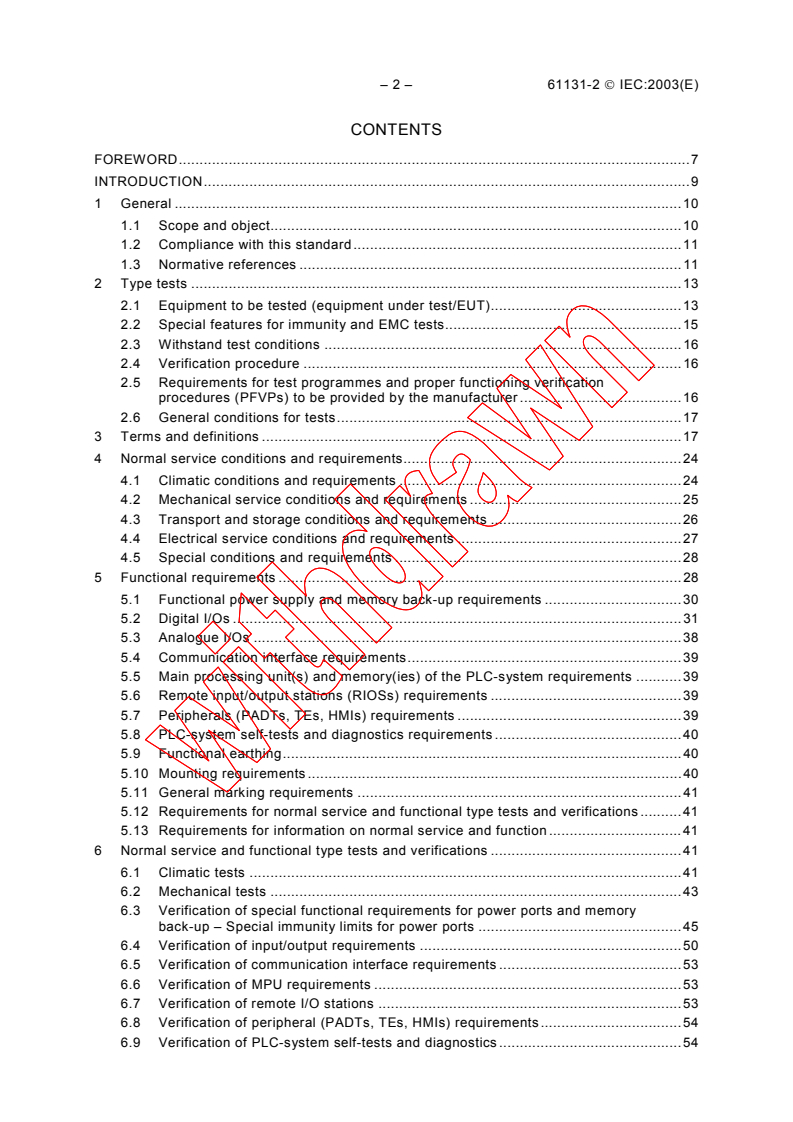
– 2 – 61131-2 IEC:2003(E)
CONTENTS
FOREWORD.7
INTRODUCTION.9
1 General.10
1.1 Scope and object.10
1.2 Compliance with this standard.11
1.3 Normative references.11
2 Type tests.13
2.1 Equipment to be tested (equipment under test/EUT).13
2.2 Special features for immunity and EMC tests.15
2.3 Withstand test conditions.16
2.4 Verification procedure.16
2.5 Requirements for test programmes and proper functioning verification
procedures (PFVPs) to be provided by the manufacturer .16
2.6 General conditions for tests.17
3 Terms and definitions .17
4 Normal service conditions and requirements.24
4.1 Climatic conditions and requirements .24
4.2 Mechanical service conditions and requirements .25
4.3 Transport and storage conditions and requirements .26
4.4 Electrical service conditions and requirements .27
4.5 Special conditions and requirements .28
5 Functional requirements.28
5.1 Functional power supply and memory back-up requirements .30
5.2 Digital I/Os.31
5.3 Analogue I/Os.38
5.4 Communication interface requirements.39
5.5 Main processing unit(s) and memory(ies) of the PLC-system requirements .39
5.6 Remote input/output stations (RIOSs) requirements .39
5.7 Peripherals (PADTs, TEs, HMIs) requirements .39
5.8 PLC-system self-tests and diagnostics requirements .40
5.9 Functional earthing.40
5.10 Mounting requirements.40
5.11 General marking requirements .41
5.12 Requirements for normal service and functional type tests and verifications .41
5.13 Requirements for information on normal service and function .41
6 Normal service and functional type tests and verifications .41
6.1 Climatic tests.41
6.2 Mechanical tests.43
6.3 Verification of special functional requirements for power ports and memory
back-up – Special immunity limits for power ports .45
6.4 Verification of input/output requirements .50
6.5 Verification of communication interface requirements .53
6.6 Verification of MPU requirements .53
6.7 Verification of remote I/O stations .53
6.8 Verification of peripheral (PADTs, TEs, HMIs) requirements.54
6.9 Verification of PLC-system self-tests and diagnostics.54
61131-2 IEC:2003(E) – 3 –
6.10 Verification of markings and manufacturer's documentation.54
7 General information to be provided by the manufacturer.54
7.1 Information on type and content of documentation.54
7.2 Information on compliance with this standard .55
7.3 Information on reliability.55
7.4 Information on other conditions .55
7.5 Information on shipping and storage.55
7.6 Information on a.c. and d.c. power supply .55
7.7 Information on digital inputs (current sinking) .56
7.8 Information on digital outputs for alternating currents (current sourcing).56
7.9 Information on digital outputs for direct current (current sourcing) .57
7.10 Information on analogue inputs .57
7.11 Information on analogue outputs .59
7.12 Information on communication interfaces.60
7.13 Information on main processing unit(s) and memory(ies) of the PLC-system .60
7.14 Information on remote input/output stations (RIOSs) .61
7.15 Information on peripherals (PADTs, TEs, HMIs) .62
7.16 Information on self-tests and diagnostics.62
8 Electromagnetic compatibility (EMC) requirements .62
8.1 General.62
8.2 Emission requirements.63
8.3 EMC immunity requirements.63
8.4 Requirements for EMC tests and verifications .69
8.5 Requirements for information on EMC .69
9 Electromagnetic compatibility (EMC) type tests and verifications .69
9.1 Electromagnetic compatibility-related tests.69
9.2 Test environment.70
9.3 Measurement of radiated interference .70
9.4 Measurement of conducted interference .70
9.5 Electrostatic discharge.71
9.6 Radiofrequency electromagnetic field – Amplitude modulated .72
9.7 Power-frequency magnetic fields .72
9.8 Fast transient bursts.73
9.9 High-energy surges.74
9.10 Conducted radiofrequency interference.75
9.11 Damped oscillatory wave (for zone C only) .76
9.12 Voltage drops and interruptions - Power port type tests and verifications .76
10 Electromagnetic compatibility (EMC) information to be provided by the
manufacturer .77
11 Safety requirements.78
11.1 Protection against electrical shock .78
11.2 Protection against the spread of fire .83
11.3 Limited power circuits.83
11.4 Clearance and creepage distances requirements .84
11.5 Flame-retardant requirements for non-metallic materials .90
11.6 Temperature limits.91
11.7 Enclosures.91
11.8 Field-wiring terminals constructional requirements .92
– 4 – 61131-2 IEC:2003(E)
11.9 Provisions for protective earthing .92
11.10 W iring .93
11.11 Switching devices . 94
11.12 Components . 94
11.13 Battery requirements . 95
11.14 Maximum voltage and minimum voltage .95
11.15 Markings and identification .95
11.16 Requirements for safety type tests and verifications .97
11.17 Requirements for safety routine tests and verifications .97
11.18 Requirements for information on safety .97
12 Safety type tests and verifications .97
12.1 Safety-related mechanical tests and verifications .97
12.2 Safety-related electrical tests.100
12.3 Single-fault condition test – General.104
13 Safety routine tests .105
13.1 Dielectric withstand test .105
13.2 Dielectric withstand verification test.106
13.3 Protective earthing test.106
14 Safety information to be provided by the manufacturer .107
14.1 Information on evaluation of enclosures for open equipment (power
dissipation).107
14.2 Information on mechanical terminal connection .107
Annex A (informative) Illustration of PLC-system hardware definitions .108
Annex B (informative) Digital input standard operating range equations.109
Annex C (normative) Test tools.110
Annex D (informative) Zone C – EMC immunity levels .113
Annex E (informative) Overvoltage example.115
Bibliography.116
Figure 1 – EUT configurations .15
Figure 2 – Typical interface/port diagram of a PLC-system .29
Figure 3 – I/O Parameters.31
Figure 4 – U-I operation regions of current-sinking inputs .33
Figure 5 – Temporary overload waveform for digital a.c. outputs.35
Figure 6 – Temporary overload waveform for digital d.c. outputs.37
Figure 7 – Gradual shut-down/start-up test .46
Figure 8 – Fast supply voltage variation test .46
Figure 9 – Third harmonic immunity test .47
Figure 10 – Slow supply voltage variation test .49
Figure 11 – EMC immunity zones.64
Figure 12 – Impact withstand test procedure.98
Figure 13 – Dielectric withstand test procedures .103
Figure A.1 – Programmable controller system (PLC-system).108
Figure C.1 – Jointed test finger .110
61131-2 IEC:2003(E) – 5 –
Figure C.2 – 15 mm × 3 mm test pin .111
Figure C.3 – 100 mm × 4 mm test pin .111
Figure C.4 – 100 mm × 3 mm test pin .112
Figure E.1 – Creepage distances of circuits where recurring peak voltages
are generated .115
Table 1 – General conditions for tests.17
Table 2 – Operating ambient air temperature of PLC-systems.24
Table 3 – Sinusoidal vibrations service conditions for PLC-systems.26
Table 4 – Free fall on concrete floor for portable and hand-held equipment .26
Table 5 – Free fall on concrete floor in manufacturer’s original packaging .27
Table 6 – Rated values and operating ranges of incoming power supply.30
Table 7 – Standard operating ranges for digital inputs (current sinking) .34
Table 8 – Rated values and operating ranges for current sourcing digital a.c. outputs .35
Table 9 – Rated values and operating ranges (d.c.)
for current sourcing digital d.c. outputs .37
Table 10 – Rated values and impedance limits for analogue inputs.38
Table 11 – Rated values and impedance limits for analogue outputs.38
Table 12 – Dry-heat and cold withstand tests.42
Table 13 – Change of temperature, withstand and immunity tests .42
Table 14 – Cyclic (12 + 12) damp-heat test.43
Table 15 – Immunity vibration test .43
Table 16 – Immunity shock test.44
Table 17 – Free-fall immunity/withstand tests (portable and hand-held equipment) .44
Table 18 – Free-fall withstand test (units within manufacturer's original packaging) .44
Table 19 – Insertions/withdrawals of removable units .45
Table 20 – Voltage-ripple and frequency-range immunity test (1).45
Table 21 – Third harmonic immunity test.46
Table 22 – Gradual shut-down/start-up test .48
Table 23 – Supply voltage variation tests.48
Table 24 – Back-up duration withstand test.49
Table 25 – Change of energy source test.50
Table 26 – Overload and short-circuit tests for digital outputs .51
Table 27 – Emission limits .63
Table 28 – EMC immunity zones.65
Table 29 – Criteria to prove the performance of a PLC-system
against EMC disturbances .65
Table 30 – Radiated immunity and enclosure ports (1) Conducted immunity, Zones A-B.66
Table 31 – Conducted immunity, Zone B.67
Table 32 – Conducted immunity, Zone A.68
Table 33 – Voltage drops and interruptions.69
Table 34 – Radiated emission measurement.70
Table 35 – Conducted emission measurement .70
Table 36 – Electrostatic discharge immunity test.71
– 6 – 61131-2 IEC:2003(E)
Table 37 – Radiated electromagnetic field immunity test.72
Table 38 – Power frequency magnetic field immunity test .72
Table 39 – Fast transient burst immunity test.73
Table 40 – High-energy surge immunity test .74
Table 41 – Conducted RF immunity test.75
Table 42 – Damped oscillatory wave immunity test .76
Table 43 – Voltage drop and interruption immunity test.77
Table 44 – Operator accessibility for open and enclosed equipment .81
Table 45 – Limits of output current and output power
for inherently limited power sources.84
Table 46 – Limits of output current, output power and ratings for over-current
protective devices for non-inherently limited power sources.84
Table 47 – Minimum clearances in air corresponding to overvoltage category II
conditions (except for field-wiring terminals) for basic/supplementary insulation .85
Table 48 – Minimum clearances in air corresponding to overvoltage category II
conditions (except for field-wiring terminals) for double /reinforced insulation .86
Table 49 – Minimum clearances in air at field-wiring terminals .86
Table 50 – Minimum clearances in air for micro-environment where the voltages are
known and controlled .87
Table 51 – Classification of material group according
to comparative tracking index (CTI) .88
Table 52 – Minimum creepage distances for other than printed circuit boards (1).88
Table 53 – Minimum creepage distances for printed circuit boards (1), (6), (9) (basic
and supplementary insulation) .89
Table 54 – Minimum creepage distances related to recurring peak voltages on printed
wiring boards without protective coating (1) (pollution degrees 1 and 2).90
Table 55 – Temperature limits .91
Table 56 – Impact withstand test (1) .97
Table 57 – Operator accessibility tests (1) .98
Table 58 – Dielectric withstand voltages for impulse a.c. power frequency and d.c.
tests for basic/supplementary insulation (5) .102
Table 59 – Dielectric withstand voltages for impulse a.c. power frequency and d.c.
tests for double/reinforced insulation (5) .102
Table 60 – Overload test circuit values .104
Table 61 – Endurance test circuit values.104
Table 62 – Routine dielectric withstand test (5).106
Table D.1 – Radiated immunity and enclosure ports (1) conducted immunity, Zone C .113
Table D.2 – Conducted immunity, Zone C .114
61131-2 IEC:2003(E) – 7 –
INTERNATIONAL ELECTROTECHNICAL COMMISSION
___________
PROGRAMMABLE CONTROLLERS –
Part 2: Equipment requirements and tests
FOREWORD
1. The IEC (International Electrotechnical Commission) is a worldwide organization for standardization comprising
all national electrotechnical committees (IEC National Committees). The object of the IEC is to promote
international co-operation on all questions concerning standardization in the electrical and electronic fields. To
this end and in addition to other activities, the IEC publishes International Standards. Their preparation is
entrusted to technical committees; any IEC National Committee interested in the subject dealt with may
participate in this preparatory work. International, governmental and non-governmental organizations having
liaisons with the IEC also participate in this preparation. The IEC collaborates closely with the International
Organization for Standardization (ISO) in accordance with conditions determined by agreement between the
two organizations.
2. The formal decisions or agreements of the IEC on technical matters express, as nearly as possible, an
international consensus of opinion on the relevant subjects since each technical committee has representation
from all interested National Committees.
3. The documents produced have the form of recommendations for international use and are published in the form
of standards, technical specifications, technical reports or guides and they are accepted by the National
Committees in that sense.
4. In order to promote international unification, IEC National Committees undertake to apply IEC International
Standards transparently to the maximum extent possible in their national and regional standards. Any
divergence between the IEC Standard and the corresponding national or regional standard shall be clearly
indicated in the latter.
5. The IEC provides no marking procedure to indicate its approval and cannot be rendered responsible for any
equipment declared to be in conformity with one of its standards.
6. Attention is drawn to the possibility that some of the elements of this International Standard may be the subject
of patent rights. The IEC shall not be held responsible for identifying any or all such patent rights.
International Standard IEC 61131-2 has been prepared by subcommittee 65B: Devices, of IEC
technical committee 65: Industrial-process measurement and control.
This second edition of IEC 61131-2 cancels and replaces the first edition published in 1992
and constitutes a technical revision.
The text of this standard is based on the following documents:
FDIS Report on voting
65B/470A/FDIS 65B/481/RVD
Full information on the voting for the approval of this standard can be found in the report on
voting indicated in the above table.
This publication has been drafted in accordance with the ISO/IEC Directives, Part 2.
IEC 61131 consists of the following parts under the general title Programmable controllers:
Part 1: General information
Part 2: Equipment requirements and tests
Part 3: Programming languages
Part 4: User guidelines
Part 5: Communications
Part 6: Reserved
Part 7: Fuzzy control programming
Part 8: Guidelines for the application and implementation of programming languages
– 8 – 61131-2 IEC:2003(E)
The committee has decided that the contents of this publication will remain unchanged until 2007.
At this date, the publication will be
• reconfirmed;
• withdrawn;
• replaced by a revised edition, or
• amended.
A bilingual version of this standard may be issued at a later date.
The contents of the corrigendum of March 2004 have been included in this copy.
61131-2 IEC:2003(E) – 9 –
INTRODUCTION
This part of IEC 61131 constitutes Part 2 of a series of standards on programmable
controllers and the associated peripherals and should be read in conjunction with the other
parts of the series.
Where a conflict exists between this and other IEC standards (except basic safety standards),
the provisions of this standard should be considered to govern in the area of programmable
controllers and their associated peripherals.
Compliance with Parts 1 and 2 of this standard cannot be claimed unless the requirements of
7.2 of this part are met.
Service and physical environment requirements are specified in Clause 4. Functional
requirements are specified in Clause 5. Electromagnetic compatibility requirements are
specified in Clause 8. Safety requirements are specified in Clause 11.
Terms of general use are defined in Part 1 of this standard. More specific terms are defined in
each part.
– 10 – 61131-2 IEC:2003(E)
PROGRAMMABLE CONTROLLERS –
Part 2: Equipment requirements and tests
1 General
1.1 Scope and object
This Part of IEC 61131 specifies requirements and related tests for programmable controllers
(PLC) and their associated peripherals (for example, programming and debugging tools
(PADTs), human-machine interfaces (HMIs), etc.) which have as their intended use the
control and command of machines and industrial processes.
PLCs and their associated peripherals are intended to be used in an industrial environment
and may be provided as open or enclosed equipment. If a PLC or its associated peripherals
are Intended for use in other environments, then the specific requirements, standards and
installation practices for those other environments must be additionally applied to the PLC
and its associated peripherals.
This standard also applies to any products performing the function of PLCs and/or their
associated peripherals.
Equipment covered in this standard is intended for use in overvoltage category II (IEC 60664-1)
in low-voltage installations, where the rated mains supply voltage does not exceed a.c.
1 000 V r.m.s. (50/60 Hz), or d.c. 1 500 V. (If PLCs or their associated peripherals are applied
in overvoltage category III installations, then additional analysis will be required to determine
the suitability of the equipment for those applications.)
This standard does not deal with the functional safety or other aspects of the overall
automated system. PLCs, their application programme and their associated peripherals are
considered as components of a control system.
Since PLCs are component devices, safety considerations for the overall automated system
including installation and application are beyond the scope of this standard. However, PLC
safety as related to electric shock and fire hazards, electrical interference immunity and error
detecting of the PLC-system operation (such as the use of parity checking, self-testing
diagnostics, etc.), are addressed. Refer to IEC 60364 or applicable national/local regulations
for electrical installation and guidelines.
The object of this standard is
– to establish the definitions and identify the principal characteristics relevant to the
selection and application of PLCs and their associated peripherals;
– to specify the minimum requirements for functional, electrical, mechanical, environmental
and construction characteristics, service conditions, safety, EMC, user programming and
tests applicable to PLCs and the associated peripherals.
This Part also specifies
a) service, storage and transportation requirements for PLCs and their associated
peripherals (Clause 4);
b) functional requirements for PLCs and their associated peripherals (Clause 5);
c) EMC requirements for PLCs and their associated peripherals (Clause 8);
d) safety requirements for PLCs and their associated peripherals (Clause 11);
61131-2 IEC:2003(E) – 11 –
e) information that the manufacturer is required to supply (Clauses 7, 10 and 14);
f) test methods and procedures that are to be used for the verification of compliance of
PLCs and their associated peripherals with the requirements (Clauses 6, 9 and 12).
The tests are type tests or production routine tests, and not tests related to the ways PLC
systems are applied.
1.2 Compliance with this standard
When compliance with this Part of IEC 61131 is indicated without qualification, compliance
with all clauses, including all tests and verifications required in this part, must be verified.
Moreover, the manufacturer’s obligations expressed in this part are not waived if no type test
is required, or if the test conditions are restricted for practical reasons.
When compliance with some portion of this Part of IEC 61131 is indicated, it is only necessary
to verify compliance with those clauses against which the compliance claim is made. The
manufacturer’s obligations as indicated above are still applicable. The smallest unit of this
part for compliance purposes shall be a clause, such as Clauses 5, 8 or 11.
Compliance with a portion of this Part of IEC 61131 is provided to facilitate efforts with
respect to particular conformity assessment requirements (for example, Clause 8 as the
compliance requirement for the EU electromagnetic compatibility directive or Clause 11 as
the compliance requirement for the EU low-voltage directive).
Compliance with constructional requirements and with requirements for information to be
provided by the manufacturer shall be verified by suitable examination, visual inspection
and/or measurement.
All requirements not tested according to the clauses on tests and verifications shall be
verifiable under a procedure to be agreed to by the manufacturer and the user.
The manufacturer shall provide, on request, compliance verification information for all require-
ments referenced in the claims of compliance with all or a portion of this Part of IEC 61131.
It is the manufacturer's responsibility to ensure that delivered PLC equipment and associated
peripherals are equivalent to the sample(s) which have been type-tested according to this
Part of IEC 61131 and therefore that they comply with all requirements of this part.
Significant modifications shall be indicated through the use of suitable revision level indexes
and markings (see 5.11 and 11.15) and shall comply with this Part of IEC 61131.
NOTE A new type test may be required to confirm compliance.
Where the manufacturer is allowed to select among several options, he shall clearly specify in
his catalogues and/or datasheets those to which any portion of the PLC-system equipment
complies. This applies to severity classes of voltage drops (i.e. PS1 or PS2) and types of
digital inputs (i.e. Type 1 or Type 3).
1.3 Normative references
The following referenced documents are indispensable for the application of this document.
For dated references, only the edition cited applies. For undated references, the latest edition
of the referenced document (including any amendments) applies.
IEC 60068-2-1:1990, Environmental testing – Part 2: Tests – Tests A: Cold
IEC 60068-2-2:1974, Environmental testing – Part 2: Tests – Tests B: Dry heat
– 12 – 61131-2 IEC:2003(E)
IEC 60068-2-6:1995, Environmental testing – Part 2: Tests – Test Fc: Vibration (sinusoidal)
IEC 60068-2-14:1984, Environmental testing – Part 2: Tests – Test N: Change of temperature
IEC 60068-2-27:1987, Environmental testing – Part 2: Tests – Test Ea and guidance: Shock
IEC 60068-2-30:1980, Environmental testing – Part 2: Tests – Test Db and guidance: Damp
heat, cyclic (12 + 12-hour cycle)
IEC 60068-2-31:1969, Environmental testing – Part 2: Tests – Test Ec: Drop and topple,
primarily for equipment-type specimens
IEC 60068-2-32:1975, Environmental testing – Part 2: Tests – Test Ed: Free fall (Procedure 1)
IEC 60364 (all parts), Electrical installations of buildings
IEC 60417 (all parts), Graphical symbols for use on equipment
IEC 60529:1989, Degrees of protection provided by enclosures (IP Code)
IEC 60664-1:1992, Insulation coordination for equipment within low-voltage systems – Part 1:
Principles, requirements and tests
IEC 60664-3:1992, Insulation coordination for equipment within low-voltage systems – Part 3:
Use of coatings to achieve insulation coordination of printed board assemblies
IEC 60695-2-1 (all sheets), Fire hazard testing – Part 2: Test methods – Section 1: Glow-wire
test and methods
IEC 60707:1999, Flammability of solid non-metallic materials when exposed to flame sources –
List of test methods
IEC 60947-5-1:1997, Low-voltage switchgear and controlgear – Part 5-1: Control circuit
devices and switching elements – Electromechanical control circuit devices
IEC 60947-7-1:2002, Low-voltage switchgear and controlgear – Part 7-1: Ancillary equipment –
Terminal blocks for copper conductors
IEC 60950-1:2001, Information technology equipment—Safety – Part 1: General requirements
IEC 61000-4-2:1995, Electromagnetic compatibility (EMC) – Part 4-2: Testing and measure-
ment techniques – Electrostatic discharge immunity test
IEC 61000-4-3:2002, Electromagnetic compatibility (EMC) – Part 4-3: Testing and measure-
ment techniques – Radiated radio-frequency electromagnetic field immunity test
IEC 61000-4-4:1995, Electromagnetic compatibility (EMC) – Part 4: Testing and measurement
techniques – Section 4: Electrical fast transient/burst immunity test
IEC 61000-4-5:1995, Electromagnetic compatibility (EMC) – Part 4-5: Testing and measure-
ment techniques – Surge immunity test
IEC 61000-4-6:1996, Electromagnetic compatibility (EMC) – Part 4-6: Testing and measure-
ment techniques – Immunity to conducted disturbances induced by radio-frequency fields
61131-2 IEC:2003(E) – 13 –
IEC 61000-4-8:1993, Electromagnetic compatibility (EMC) – Part 4-8: Testing and measure-
ment techniques – Power frequency magnetic field immunity test
IEC 61000-4-12:1995, Electromagnetic compatibility (EMC) – Part 4-12: Testing and measure-
ment techniques – Oscillatory waves immunity test
IEC 61010-1:2001, Safety requirements for electrical equipment for measurement, control,
and laboratory use – Part 1: General requirements
CISPR 11:1999, Industrial, scientific and medical (ISM) radio-frequency equipment –
Electromagnetic disturbance characteristics – Limits and methods of measurement
CISPR 16-1:1999, Specification for radio disturbance and immunity measuring apparatus and
methods – Part 1: Radio disturbance and immunity measuring apparatus
CISPR 16-2:1999, Specification for radio disturbance and immunity measuring apparatus and
methods – Part 2: Methods of measurement of disturbances and immunity
2 Type tests
The object of this clause is to define how to verify compliance of the PLC and the associated
peripherals with the requirements set forth in this part of IEC 61131. This compliance
verification includes
– verification by type tests given in Clauses 6, 9 and 12,
– verification by suitable examination, visual inspection or/and measurement.
These tests are qualification tests, and not tests related to the ways PLCs are employed.
According to the scope of this standard, the above compliance verification may not cover the
verification of the ability of the PLC-system to satisfy the intended automated system
requirements. Where needed, special tests, not covered by this standard, shall be agreed to
by the manufacturer and the user.
In addition, routine tests are specified in Clause 13.
NOTE Peripherals, used in the same environment as the PLC-system, must meet the same requirements as
the PLC-system.
2.1 Equipment to be tested (equipment under test/EUT)
PLC-systems span the range from stand-alone products to modular designs; this leads to an
infinite variety of user-built actual PLC-system configurations. For obvious practical reasons,
in most cases type tests cannot be conducted on EUT identical to user-built PLC-systems,
and engineering judgement is necessary. Therefore, the manufacturer is required to define
the EUTs and document the corresponding test plan and test programmes to meet the
following principles.
Combination of tests/EUTs/test programmes
...