


IEC 60601-2-30:1999
(Main)Medical electrical equipment - Part 2-30: Particular requirements for the safety, including essential performance, of automatic cycling non-invasive blood pressure monitoring equipment
General Information
- Abstract
Specifies particular requirements for the safety, including essential performance, of automatic cycling non-invasive blood pressure monitoring equipment, with special attention being paid to the avoidance of hazards due to the inflation process.
- Status
- Replaced
- Publication Date
- 21-Dec-1999
- Technical Committee
- SC 62D - Particular medical equipment, software, and systems
- Current Stage
- DELPUB - Deleted Publication
- Start Date
- 28-Jan-2009
- Completion Date
- 28-Aug-2026
Buy Documents
IEC 60601-2-30:1999 - Medical electrical equipment - Part 2-30: Particular requirements for the safety, including essential performance, of automatic cycling non-invasive blood pressure monitoring equipment Released:12/22/1999
Relations
- Effective Date
- 05-Sep-2023
Buy Documents
IEC 60601-2-30:1999 - Medical electrical equipment - Part 2-30: Particular requirements for the safety, including essential performance, of automatic cycling non-invasive blood pressure monitoring equipment Released:12/22/1999
Get Certified
Connect with accredited certification bodies for this standard

BSI Group
BSI (British Standards Institution) is the business standards company that helps organizations make excellence a habit.

TÜV Rheinland
TÜV Rheinland is a leading international provider of technical services.

TÜV SÜD
TÜV SÜD is a trusted partner of choice for safety, security and sustainability solutions.
Sponsored listings
Frequently Asked Questions
IEC 60601-2-30:1999 is a standard published by the International Electrotechnical Commission (IEC). Its full title is "Medical electrical equipment - Part 2-30: Particular requirements for the safety, including essential performance, of automatic cycling non-invasive blood pressure monitoring equipment". This standard covers: Specifies particular requirements for the safety, including essential performance, of automatic cycling non-invasive blood pressure monitoring equipment, with special attention being paid to the avoidance of hazards due to the inflation process.
Specifies particular requirements for the safety, including essential performance, of automatic cycling non-invasive blood pressure monitoring equipment, with special attention being paid to the avoidance of hazards due to the inflation process.
IEC 60601-2-30:1999 is classified under the following ICS (International Classification for Standards) categories: 11.040.01 - Medical equipment in general. The ICS classification helps identify the subject area and facilitates finding related standards.
IEC 60601-2-30:1999 has the following relationships with other standards: It is inter standard links to IEC 80601-2-30:2009. Understanding these relationships helps ensure you are using the most current and applicable version of the standard.
IEC 60601-2-30:1999 is available in PDF format for immediate download after purchase. The document can be added to your cart and obtained through the secure checkout process. Digital delivery ensures instant access to the complete standard document.
Standards Content (Sample)
INTERNATIONAL IEC
STANDARD
60601-2-30
Second edition
1999-12
Medical electrical equipment –
Part 2-30:
Particular requirements for the safety,
including essential performance,
of automatic cycling non-invasive
blood pressure monitoring equipment
Appareils électromédicaux –
Partie 2-30:
Règles particulières de sécurité et performances
essentielles des appareils de surveillance
de la pression sanguine prélevée indirectement,
automatiquement et périodiquement
Reference number
Numbering
As from 1 January 1997 all IEC publications are issued with a designation in the
60000 series.
Consolidated publications
Consolidated versions of some IEC publications including amendments are
available. For example, edition numbers 1.0, 1.1 and 1.2 refer, respectively, to the
base publication, the base publication incorporating amendment 1 and the base
publication incorporating amendments 1 and 2.
Validity of this publication
The technical content of IEC publications is kept under constant review by the IEC,
thus ensuring that the content reflects current technology.
Information relating to the date of the reconfirmation of the publication is available
in the IEC catalogue.
Information on the subjects under consideration and work in progress undertaken
by the technical committee which has prepared this publication, as well as the list
of publications issued, is to be found at the following IEC sources:
• IEC web site*
•
Catalogue of IEC publications
Published yearly with regular updates
(On-line catalogue)*
• IEC Bulletin
Available both at the IEC web site* and as a printed periodical
Terminology, graphical and letter symbols
For general terminology, readers are referred to IEC 60050: International
Electrotechnical Vocabulary (IEV).
For graphical symbols, and letter symbols and signs approved by the IEC for
general use, readers are referred to publications IEC 60027: Letter symbols to be
used in electrical technology, IEC 60417: Graphical symbols for use on equipment.
Index, survey and compilation of the single sheets and IEC 60617: Graphical symbols
for diagrams.
* See web site address on title page.
INTERNATIONAL IEC
STANDARD
60601-2-30
Second edition
1999-12
Medical electrical equipment –
Part 2-30:
Particular requirements for the safety,
including essential performance,
of automatic cycling non-invasive
blood pressure monitoring equipment
Appareils électromédicaux –
Partie 2-30:
Règles particulières de sécurité et performances
essentielles des appareils de surveillance
de la pression sanguine prélevée indirectement,
automatiquement et périodiquement
IEC 1999 Copyright - all rights reserved
No part of this publication may be reproduced or utilized in any form or by any means, electronic or
mechanical, including photocopying and microfilm, without permission in writing from the publisher.
International Electrotechnical Commission 3, rue de Varembé Geneva, Switzerland
Telefax: +41 22 919 0300 e-mail: inmail@iec.ch IEC web site http://www.iec.ch
Commission Electrotechnique Internationale
PRICE CODE
X
International Electrotechnical Commission
For price, see current catalogue
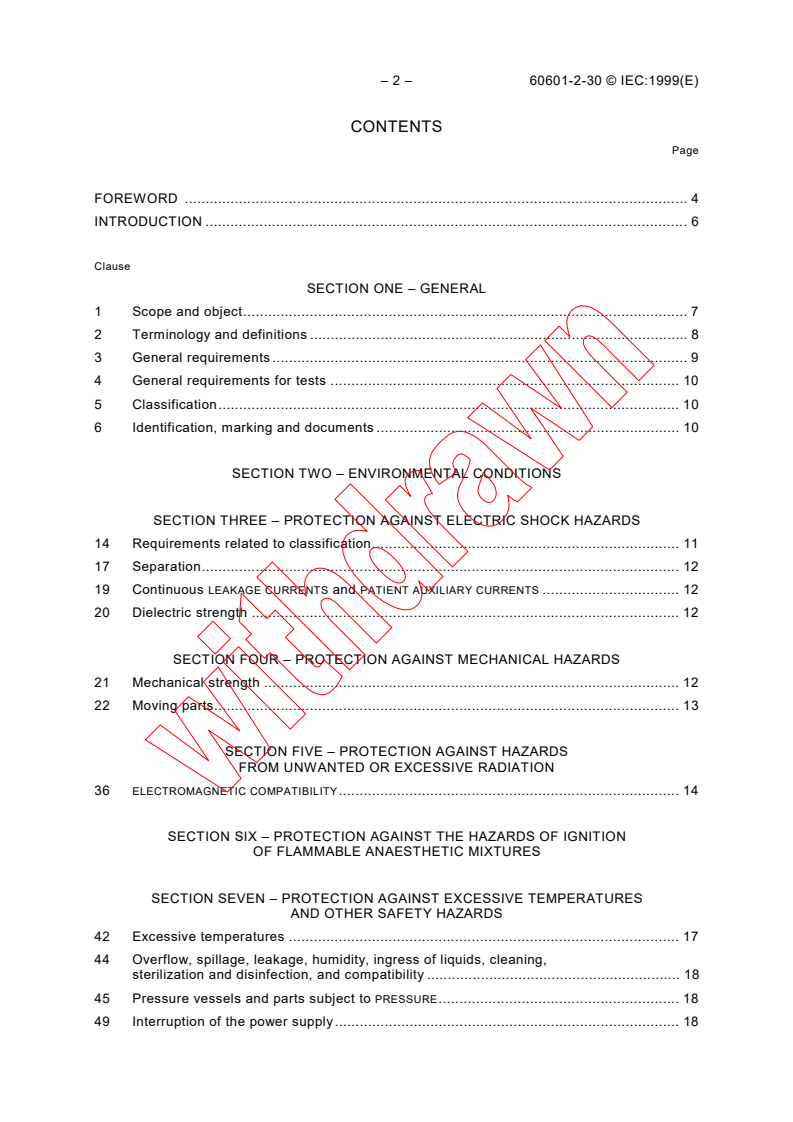
– 2 – 60601-2-30 © IEC:1999(E)
CONTENTS
Page
FOREWORD . 4
INTRODUCTION .6
Clause
SECTION ONE – GENERAL
1 Scope and object. 7
2 Terminology and definitions . 8
3 General requirements . 9
4 General requirements for tests . 10
5 Classification. 10
6 Identification, marking and documents . 10
SECTION TWO – ENVIRONMENTAL CONDITIONS
SECTION THREE – PROTECTION AGAINST ELECTRIC SHOCK HAZARDS
14 Requirements related to classification. 11
17 Separation. 12
19 Continuous LEAKAGE CURRENTS and PATIENT AUXILIARY CURRENTS . 12
20 Dielectric strength . 12
SECTION FOUR – PROTECTION AGAINST MECHANICAL HAZARDS
21 Mechanical strength . 12
22 Moving parts. 13
SECTION FIVE – PROTECTION AGAINST HAZARDS
FROM UNWANTED OR EXCESSIVE RADIATION
36 ELECTROMAGNETIC COMPATIBILITY. 14
SECTION SIX – PROTECTION AGAINST THE HAZARDS OF IGNITION
OF FLAMMABLE ANAESTHETIC MIXTURES
SECTION SEVEN – PROTECTION AGAINST EXCESSIVE TEMPERATURES
AND OTHER SAFETY HAZARDS
42 Excessive temperatures . 17
44 Overflow, spillage, leakage, humidity, ingress of liquids, cleaning,
sterilization and disinfection, and compatibility . 18
45 Pressure vessels and parts subject to PRESSURE. 18
49 Interruption of the power supply. 18
60601-2-30 © IEC:1999(E) – 3 –
SECTION EIGHT – ACCURACY OF OPERATING DATA AND PROTECTION
AGAINST HAZARDOUS OUTPUT
50 Accuracy of operating data . 19
51 Protection against hazardous output . 19
SECTION NINE – ABNORMAL OPERATION AND FAULT CONDITIONS;
ENVIRONMENTAL TESTS
SECTION TEN – CONSTRUCTIONAL REQUIREMENTS
56 Components and general assembly . 25
57 MAINS PARTS, components and lay-out. 26
Annex L (normative) References – Publications mentioned in this standard. 34
Annex AA (informative) General guidance and rationale. 35
Annex BB (informative) Alarm diagrams. 42
Figure 101 – Test for protection against defibrillator discharge . 27
Figure 102 – Safety means, SINGLE FAULT CONDITION, adult (neonatal) determination . 28
Figure 103 – Safety means, SINGLE FAULT CONDITION, adult (neonatal) determination . 28
Figure 104 – Maximum inflation time, NORMAL CONDITION and SINGLE FAULT CONDITION,
adult (neonatal) determination . 29
Figure 105 – LONG TERM AUTOMATIC MODE NORMAL CONDITION, adult (neonatal) determination . 29
Figure 106 – LONG TERM AUTOMATIC MODE SINGLE FAULT CONDITION, adult (neonatal)
determination . 30
Figure 107 – SHORT TERM AUTOMATIC MODE, adult (neonatal) determination . 30
Figure 108 – Test layout . 31
Figure 109 – ESU test layout . 32
Figure 110 – Patient simulator . 33
– 4 – 60601-2-30 © IEC:1999(E)
INTERNATIONAL ELECTROTECHNICAL COMMISSION
___________
MEDICAL ELECTRICAL EQUIPMENT –
Part 2-30: Particular requirements for the safety, including essential
performance, of automatic cycling non-invasive blood pressure
monitoring equipment
FOREWORD
1) The IEC (International Electrotechnical Commission) is a worldwide organization for standardization comprising
all national electrotechnical committees (IEC National Committees). The object of the IEC is to promote
international co-operation on all questions concerning standardization in the electrical and electronic fields. To
this end and in addition to other activities, the IEC publishes International Standards. Their preparation is
entrusted to technical committees; any IEC National Committee interested in the subject dealt with may
participate in this preparatory work. International, governmental and non-governmental organizations liaising
with the IEC also participate in this preparation. The IEC collaborates closely with the International Organization
for Standardization (ISO) in accordance with conditions determined by agreement between the two
organizations.
2) The formal decisions or agreements of the IEC on technical matters express, as nearly as possible, an
international consensus of opinion on the relevant subjects since each technical committee has representation
from all interested National Committees.
3) The documents produced have the form of recommendations for international use and are published in the form
of standards, technical specifications, technical reports or guides and they are accepted by the National
Committees in that sense.
4) In order to promote international unification, IEC National Committees undertake to apply IEC International
Standards transparently to the maximum extent possible in their national and regional standards. Any
divergence between the IEC Standard and the corresponding national or regional standard shall be clearly
indicated in the latter.
5) The IEC provides no marking procedure to indicate its approval and cannot be rendered responsible for any
equipment declared to be in conformity with one of its standards.
6) Attention is drawn to the possibility that some of the elements of this International Standard may be the subject
of patent rights. The IEC shall not be held responsible for identifying any or all such patent rights.
International Standard IEC 60601-2-30 has been prepared by sub-committee 62D: Electro-
medical equipment, of IEC technical committee 62: Electrical equipment in medical practice.
This second edition of IEC 60601-2-30 cancels and replaces the first edition published in 1995,
and constitutes a technical revision.
The text of this standard is based on the following documents:
FDIS Report on voting
62D/339/FDIS 62D/350/RVD
Full information on the voting for the approval of this standard can be found in the report on
voting indicated in the above table.
This publication has been drafted in accordance with the ISO/IEC Directives, Part 3.
Annexes AA and BB are for information only.
60601-2-30 © IEC:1999(E) – 5 –
In this Particular Standard, the following print types are used:
– requirements, compliance with which can be tested, and definitions: in roman type;
– notes, explanations, advice, introductions, general statements, exceptions and references: in smaller type;
– test specifications, headings of subclauses and headings of items: in italic type;
–TERMS DEFINED IN CLAUSE 2 OF THE GENERAL STANDARD OR THIS PARTICULAR STANDARD: SMALL
CAPITALS.
The committee has decided that this publication remains valid until 2005. At this date, in
accordance with the committee's decision, the publication will be
• reconfirmed;
• withdrawn;
• replaced by a revised edition, or
• amended.
– 6 – 60601-2-30 © IEC:1999(E)
INTRODUCTION
This Particular Standard concerns the safety of automatic cycling non-invasive blood pressure
monitoring equipment. It amends and supplements IEC 60601-1 (second edition 1988),
hereinafter referred to as the General Standard. The requirements of this Particular Standard
take priority over those of the General Standard, entitled “Medical electrical equipment –
Part 1: General requirements for safety”.
A “General guidance and rationale” for the requirements of this Particular Standard is included
in annex AA.
It is considered that a knowledge of the reasons for these requirements will not only facilitate
the proper application of the standard but will, in due course, expedite any revision
necessitated by changes in clinical practice or as a result of developments in technology.
However, this annex does not form part of the requirements of this Standard.
An asterisk (*) by a clause or subclause number indicates that some explanatory notes are
given in annex AA.
60601-2-30 © IEC:1999(E) – 7 –
MEDICAL ELECTRICAL EQUIPMENT –
Part 2-30: Particular requirements for the safety, including essential
performance, of automatic cycling non-invasive blood pressure
monitoring equipment
SECTION ONE – GENERAL
The clauses and subclauses of this section of the General Standard apply except as follows:
1 Scope and object
This clause of the General Standard applies except as follows:
*1.1 Scope
Addition:
This Particular Standard specifies requirements for the safety, including essential performance,
of AUTOMATIC CYCLING NON-INVASIVE BLOOD PRESSURE MONITORING EQUIPMENT as defined in
2.102, hereinafter referred to as EQUIPMENT. The EQUIPMENT may be attended or unattended.
This Particular Standard does not apply to blood pressure measuring equipment which uses
finger transducers or to semi-automatic blood pressure measuring equipment, typically in which
each determination needs to be initiated manually.
1.2 Object
Replacement:
The object of this Particular Standard is to establish particular requirements for the safety,
including essential performance, of AUTOMATIC CYCLING NON-INVASIVE BLOOD PRESSURE
MONITORING EQUIPMENT, with special attention being paid to the avoidance of hazards due to
the inflation process.
1.3 Particular Standards
Addition:
This Particular Standard refers to IEC 60601-1: 1988, Medical electrical equipment – Part 1:
General requirements for safety, as amended by its amendment 1 (1991) and amendment 2
(1995). The General Standard also takes into account IEC 60601-1-2: 1993, Medical electrical
equipment – Part 1: General requirements for safety – 2. Collateral Standard: Electromagnetic
compatibility – Requirements and tests, and IEC 60601-1-4:1996, Medical electrical equipment
– Part 1: General requirements for safety – 4. Collateral Standard: Programmable electrical
medical systems.
For brevity, IEC 60601 is referred to in this Particular Standard either as the “General
Standard” or as the “General Requirement(s)”.
The term “this Standard” is used to make reference to the General Standard and this Particular
Standard taken together.
– 8 – 60601-2-30 © IEC:1999(E)
The numbering of sections, clauses or subclauses of this Particular Standard corresponds with
that of the General Standard. The changes to the text of the General Standard are specified by
the use of the following words:
“Replacement” means that the clause or subclause of the General Standard is replaced
completely by the text of this Particular Standard.
“Addition” means that the text of this Particular Standard is additional to the requirements of
the General Standard.
“Amendment” means that the clause or subclause of the General Standard is amended as
indicated by the text of this Particular Standard.
Subclauses or figures which are additional to those of the General Standard are numbered
starting from 101, additional annexes are lettered AA, BB, etc., and additional items aa), bb), etc.
Where there is no corresponding section, clause or subclause in this Particular Standard, the
section, clause or subclause of the General Standard, although possibly not relevant, applies
without modification; where it is intended that any part of the General Standard, although possibly
relevant, is not to be applied, a statement to that effect is given in this Particular Standard.
The requirements of this Particular Standard take priority over those of the General Standard
and Collateral Standards mentioned above.
2 Terminology and definitions
This clause of the General Standard applies except as follows:
2.1.5 APPLIED PART
Replacement:
The occluding cuff and any integral transducers, their connecting leads and pressure tubes.
Additional definitions:
2.101 ALARM
A signal which indicates abnormal events occurring to the PATIENT or EQUIPMENT.
2.102 AUTOMATIC CYCLING NON-INVASIVE BLOOD PRESSURE MONITORING EQUIPMENT (EQUIPMENT)
A device, or part of a physiological monitoring or measuring system, including its associated
accessories used for intermittent assessment of a PATIENT’s blood pressure by an externally
applied means.
2.103 INHIBITION
Disabling or SILENCING and disabling an ALARM until revoked intentionally.
2.104 LATCHED ALARM
An ALARM, the visual and auditory manifestation of which does not stop when the parameter
(which caused the alarm) returns to a value which no longer exceeds the alarm limit or if the
abnormal PATIENT condition does not exist any longer.
60601-2-30 © IEC:1999(E) – 9 –
2.105 LONG TERM AUTOMATIC MODE
A mode in which a timer, set by the OPERATOR, initiates the measurements.
2.106 MANUAL MODE
A mode in which the OPERATOR has full control of the initiation of each measurement.
2.107 NON-LATCHED ALARM
An ALARM, the visual and auditory manifestation of which stops when the parameter (which
caused the alarm) returns to a value which no longer exceeds the alarm limit or if the abnormal
PATIENT condition does not exist any longer.
2.108 PHYSIOLOGICAL ALARM
A signal which either indicates that a monitored physiological parameter is out of specified
limits or indicates an abnormal PATIENT condition.
*2.109 SHORT TERM AUTOMATIC MODE
A mode in which as many automatic measurements as possible are made within a specified
time period.
2.110 SILENCING
The stopping of an auditory ALARM manifestation by manual action.
2.111 SILENCING/RESET
The stopping of a visual and/or auditory ALARM manifestation and re-enabling of the
EQUIPMENT’s response to an abnormal PATIENT condition.
2.112 SUSPENSION
Disabling or SILENCING and disabling an ALARM temporarily.
2.113 TECHNICAL ALARM
A signal which indicates that the EQUIPMENT or part(s) of the EQUIPMENT is not capable of
accurately monitoring the PATIENT's condition.
3 General requirements
This clause of the General Standard applies except as follows:
3.6 SINGLE FAULT CONDITION
Addition:
Any single defect which:
aa) results in a failure of the normal pressure regulating means, or,
bb) prevents deflation of the cuff within the specified period, or,
cc) results in a failure of the normal cuff pressurization timing.
– 10 – 60601-2-30 © IEC:1999(E)
*3.7 Unlikely phenomena
Addition:
aa) Kinking of the hoses, interrupting the flow of air completely, is unlikely to occur.
4 General requirements for tests
This clause of the General Standard applies except as follows:
4.6 Other conditions
Amendment:
Where reference is made in the test specifications to occluding cuffs, connecting leads and
pressure tubes, only those parts supplied or recommended by the manufacturer shall be used.
*4.11 Sequence
Amendment:
Tests called for in 17 h) and 51.106 of this Particular Standard shall be performed prior to the
LEAKAGE CURRENT and dielectric strength tests of C24 and C25 of Appendix C of the General
Standard.
5 Classification
This clause of the General Standard applies except as follows:
*5.2 According to the degree of protection against electric shock
Amendment:
Delete TYPE B APPLIED PART
5.6 According to the mode of operation
Amendment:
Delete all but CONTINUOUS OPERATION
6 Identification, marking and documents
This clause of the General Standard applies except as follows:
*6.1 Marking on the outside of EQUIPMENT or EQUIPMENT parts
Addition:
aa)Cuffs shall be marked with an indication of the limb circumference for which they are
appropriate.
60601-2-30 © IEC:1999(E) – 11 –
6.8.2 Instructions for use
Addition:
aa) Supplementary instructions for use:
Advice shall be given on the following:
1) Choice of EQUIPMENT and accessories to avoid errors and excessive pressure, for example
in the case of neonates.
2) The need to avoid compression or restriction of pressure tubes.
*3) The need to check (for example, by observation of the limb concerned), that operation of
the EQUIPMENT does not result in prolonged impairment of the circulation of the PATIENT.
4) If parts of the TRANSDUCERS and EQUIPMENT are provided with protective means against
burns to the PATIENT when used with HF SURGICAL EQUIPMENT, such means shall be drawn
to the attention of the OPERATOR. If such means are absent, such parts shall be identified in
ACCOMPANYING DOCUMENTS
the .
5) Description of those parts of the EQUIPMENT that are protected against the effects of the
discharge of a defibrillator.
6) Any precautions specific to the EQUIPMENT to be taken when a defibrillator is used on a
PATIENT, and any effects on the EQUIPMENT of the discharge of a defibrillator.
7) The action to be taken following accidental wetting of the EQUIPMENT.
8) The possible consequences of the repeated use of the SHORT TERM AUTOMATIC MODE.
EQUIPMENT
9) The suitability of the to operate in the presence of electrosurgery. If the
EQUIPMENT complies with the requirements of 36.202.7, the following statement shall be
included in the instructions for use: “This equipment is suitable for use in the presence of
electrosurgery”.
10) The instructions shall specify if the EQUIPMENT is suitable for connection to public mains as
defined in CISPR 11.
SECTION TWO – ENVIRONMENTAL CONDITIONS
The clauses and subclauses of this section of the General Standard apply.
SECTION THREE – PROTECTION AGAINST ELECTRIC SHOCK HAZARDS
The clauses and subclauses of this section of the General Standard apply except as follows:
14 Requirements related to classification
This clause of the General Standard applies except as follows:
14.6 TYPES B, BF AND CF APPLIED PARTS
Replacement:
APPLIED PARTS EQUIPMENT TYPE BF CF
The of the shall be or .
14.101
Addition:
EQUIPMENT shall have defibrillator proofed APPLIED PARTs.
– 12 – 60601-2-30 © IEC:1999(E)
17 Separation
This clause of the General Standard applies except as follows:
Addition:
*17 h) clause which begins "During each test:" add a new dash with explanatory note as
follows:
– the cuff shall be inflated to approximately half the specified maximum pressure;
that is, for adult and neonatal EQUIPMENT respectively, the cuff pressures for this test
shall be approximately 150 mm Hg and 75 mm Hg.
NOTE To achieve this, the cuff may either be half inflated with the EQUIPMENT working normally, the EQUIPMENT
then switched off and the measurements made quickly, or, with the EQUIPMENT unenergized, the cuff lines may be
clamped and the cuff then half inflated by external means.
Compliance is checked by implementing the test method detailed in the General Standard with
EQUIPMENT
the set up as detailed in figure 101.
This test does not need to be performed if examination of the construction and circuit
SAFETY HAZARD
arrangement shows that no is possible.
19 Continuous LEAKAGE CURRENTS and PATIENT AUXILIARY CURRENTS
This clause of the General Standard applies except as follows:
*19.4 Tests
a)1) Addition:
All tests shall be made with the APPLIED PART fitted around a metal cylinder (as in figure 101)
and with the cuff inflated to approximately half the maximum pressure under NORMAL CONDITION
of the highest pressure range of the EQUIPMENT.
20 Dielectric strength
This clause of the General Standard applies except as follows:
*20.2 Particular requirements for EQUIPMENT with an APPLIED PART
Amendment:
B-b is not applicable for this EQUIPMENT.
SECTION FOUR – PROTECTION AGAINST MECHANICAL HAZARDS
The clauses and subclauses of this section of the General Standard apply except as follows:
21 Mechanical strength
This clause of the General Standard applies except as follows:
21.5 Replacement:
The APPLIED PART shall not present a SAFETY HAZARD as a result of a free fall from a height of
1 m onto a hard surface.
60601-2-30 © IEC:1999(E) – 13 –
Compliance is checked by the following test. The sample to be tested is allowed to fall freely
once from each of three different starting positions from a height of 1 m onto a 50 mm thick
hardwood board (for example, hardwood > 600 kg/m ), which lies flat on a rigid base, such as
a concrete block.
After this test, all requirements of this standard shall be satisfied.
This test need not be performed if examination of the construction and circuit arrangement
shows that no SAFETY HAZARD is possible.
22 Moving parts
This clause of the General Standard applies except as follows:
*22.4 Addition:
Cuff pressure
*22.4.1
a) The maximum cuff pressure obtainable in NORMAL USE shall not exceed 300 mm Hg for
EQUIPMENT specified for adult PATIENTS ("Adult") and 150 mm Hg for EQUIPMENT specified
for use on neonatal PATIENTS ("Neonatal").
EQUIPMENT
One, or more than one, range is allowed in one .
Compliance is checked by provoking the maximum cuff pressures obtainable in NORMAL
USE, and by inspection or measurement.
*b) In any SINGLE FAULT CONDITION as described in 3.6 of this Particular Standard, means shall
be provided, functioning independently of the normal pressure control system, which
1) shall prevent the pressure in the cuff from exceeding the maximum NORMAL USE values
specified in 22.4.1 a) by more than +10 %, see figure 102, and
2) shall activate if the pressure in the cuff exceeds the maximum NORMAL USE values
specified in 22.4.1 a) for 15 s, see figure 103.
When activated this means shall deflate the cuff to 15 mm Hg for adults or 5 mm Hg for
neonates within 30 s.
Compliance is checked by introducing any SINGLE FAULT CONDITION as described in 3.6 of
this Particular Standard, and by measuring the resulting cuff pressure for a suitable period.
*22.4.2 In any mode of operation, including any SINGLE FAULT CONDITION as described in 3.6 of
this Particular Standard, the cuff shall not be inflated above 15 mm Hg for more than 180 s for
EQUIPMENT specified for use on adult PATIENTS, and shall not be inflated above 5 mm Hg for
more than 90 s for EQUIPMENT specified for use on neonatal PATIENTS, see figure 104.
SINGLE FAULT CONDITION
Compliance is checked by introducing any as described in 3.6 of this
Particular Standard and by measuring the time for which the cuff remains inflated, beginning
the timing measurement as soon as the cuff pressure exceeds either 15 mm Hg or 5 mm Hg,
as appropriate.
NOTE The maintenance of pressure, due only to the obstruction of hose(s) by kinking, is excluded from this
requirement.
*22.4.3
a) In LONG TERM AUTOMATIC MODE, cuff pressure shall be released for at least 30 s after each
period of cuff pressure above 15 mm Hg for EQUIPMENT specified for use on adult PATIENTS,
or 5 mm Hg for EQUIPMENT specified for use on neonatal PATIENTS (see figure 105), except
when the total duration of the alternating inflation/deflation periods (see figure 104) does
not exceed the maximum inflation time specified in 22.4.2) above. After this the cuff
pressure shall be released to below the pressure stated for at least 30 s.
– 14 – 60601-2-30 © IEC:1999(E)
Compliance is checked by provoking the least favourable inflation/deflation cycle in LONG
TERM AUTOMATIC MODE, and by measurement.
*b) In LONG TERM AUTOMATIC MODE, means shall be provided in any SINGLE FAULT CONDITION as
described in 3.6, functioning independently of the normal timing control system, which, if
the deflated period is less than 30 s, will release cuff pressure to below 15 mm Hg for
EQUIPMENT specified for use on adult PATIENTS, or below 5 mm Hg for EQUIPMENT specified
for use on neonatal PATIENTS, see figure 106.
Compliance is checked by introducing a SINGLE FAULT, as described in 3.6, in the normal
timing system and by measurement.
22.4.4 If any of the means described in 22.4.1 b), 22.4.2 or 22.4.3 b) is activated, any
indication of blood pressure shall be cancelled, and a TECHNICAL ALARM activated.
Compliance is checked by test and inspection.
*22.4.5 If a SHORT TERM AUTOMATIC MODE is available, means shall be provided to
1) ensure that following each individual determination the pressure in the cuff shall be reduced
to less than 15 mm Hg for adults, 5 mm Hg for neonates, for at least 2 s, to allow venous
return, see figure 107, and
2) restrict the duration of this mode to 15 min maximum, see figure 107.
At the end of this time, the EQUIPMENT shall revert to the LONG TERM AUTOMATIC MODE or the
MANUAL MODE. A further period of the SHORT TERM AUTOMATIC MODE may be selected by a
deliberate action of the OPERATOR.
Compliance is checked by inspection and measurement.
SECTION FIVE – PROTECTION AGAINST HAZARDS FROM UNWANTED
OR EXCESSIVE RADIATION
The clauses and subclauses of this section of the General Standard apply except as follows:
36 ELECTROMAGNETIC COMPATIBILITY
IEC 60601-1-2 applies except as follows:
36.201 EMISSIONS
36.201.1.1 Replacement:
The EQUIPMENT shall comply with the requirements of CISPR 11, group 1, class A or B,
depending on the environment of intended use.
36.201.1.7 Replacement:
The EQUIPMENT shall be tested with the PATIENT leads and cuff attached to the EQUIPMENT.
Signal input/output cables (if applicable) shall be attached to the EQUIPMENT during the test
(see 36.202.2.2 a).
60601-2-30 © IEC:1999(E) – 15 –
36.202 IMMUNITY
Addition to paragraph 4:
Examples of SAFETY HAZARDS include failures involving changes in operating state,
irrecoverable loss or change of stored data, errors in control software (e.g. unintended change
in output), errors in blood pressure determinations which are outside the manufacturer’s
specifications or failure to meet the requirements of this standard (re-test of compliance with
clause 50.2 is not required).
NOTE It may not be possible to provide simulators for all operating modalities.
36.202.1 ELECTROSTATIC DISCHARGE
Replacement:
A level of 6 kV shall apply for contact discharge to conductive ACCESSIBLE PARTS and coupling
planes. A level of 8 kV shall apply for air discharge to non-conductive ACCESSIBLE PARTS.
Addition:
The EQUIPMENT shall return to the previous operating mode within 10 s without loss of any
stored data.
36.202.2 Radiated radio-frequency electromagnetic fields
36.202.2.1 a) Replacement:
a) The EQUIPMENT shall be tested in accordance with IEC 61000-4-3.
36.202.2.1 d) Replacement:
The field strength of 3 V/m applies.
*36.202.2.2 a) Replacement:
80 % amplitude modulation at a single modulation frequency between 1 Hz and 5 Hz shall be
used.
The cuff shall be connected to an NIBP simulator. The cuff and cables shall be bundled in a
low inductive manner to 1 m overall length, or less if 1 m is not possible, and the signal cable
(if applicable) and mains cables shall be arranged horizontally and vertically from the
EQUIPMENT. The layout shall be as shown in figure 108.
36.202.2.2 c) Replacement:
This clause is not applicable.
36.202.2.2 d) Replacement:
The EQUIPMENT error shall not exceed the sum of the allowable EQUIPMENT inaccuracy (see
50.2 a) and the simulator inaccuracy when tested under the following conditions.
Compliance is tested by using the set-up of figure 108. Set the unit under test for LONG TERM
AUTOMATIC MODE. Set the timer to minimum interval between determinations. Select neonatal
mode (if available).
– 16 – 60601-2-30 © IEC:1999(E)
36.202.2.2 e) Replacement:
This clause is not applicable.
36.202.3.1 BURSTS
36.202.3.1 b) Addition:
The cuff and any connecting hoses or patient cables shall be excluded from the test only if they
contain no conductive elements.
Compliance with the requirements shall be checked by verifying that the EQUIPMENT returns to
the previous operating mode within 10 s.
36.202.5 Conducted disturbances induced by radio frequency fields above 9 kHz
Addition:
When exposed to a conducted radio frequency voltage, via the POWER SUPPLY CORD, the
EQUIPMENT shall operate within normal specifications.
The test methods and instruments shall be as described in IEC 61000-4-6.
The noise voltage that is injected into the mains power input shall be 3 V r.m.s. over the
frequency range of 150 kHz to 80 MHz. It shall be modulated at 80 % index at a single
frequency between 1 Hz and 5 Hz.
36.202.6 Magnetic field
Addition:
The EQUIPMENT shall be exposed to an a.c. magnetic field as per IEC 61000-4-8.
Magnetic field intensity: 3 A/m
Frequency: SUPPLY MAINS frequency
The test shall be performed at both 50 Hz and 60 Hz with the exception that EQUIPMENT rated
for use at only one of these frequencies need only be tested at that frequency. In either case,
the EQUIPMENT shall be powered at the same frequency as the applied magnetic field.
The cuff and any connecting hoses or patient cables shall be excluded from the test. Any
electrical connections to the patient shall be shorted at the NIBP device.
Under the following conditions, the EQUIPMENT error shall not exceed the sum of the allowable
EQUIPMENT inaccuracy (see 50.2 a) and the simulator inaccuracy.
Using the set-up of figure 108, set the unit under test for LONG TERM AUTOMATIC MODE. Set the
timer to minimum interval between determinations. Select neonatal mode (if available).
36.202.7 Electrosurgery interference
Where means are incorporated for protection against electrosurgery interference, the test
below applies.
When the EQUIPMENT has been used together with HIGH FREQUENCY SURGICAL EQUIPMENT it shall
return to the previous operating mode within 10 s after exposure to the field produced by the
HIGH FREQUENCY SURGICAL EQUIPMENT, without loss of any stored data.
60601-2-30 © IEC:1999(E) – 17 –
Compliance shall be tested according to figures 109 and 110.
If a filter is available the largest bandwidth shall be selected.
The high frequency surgical equipment which is used shall comply with IEC 60601-2-2, shall
have a cut mode of minimum power 300 W, a coagulation mode of minimum power 100 W and
a working frequency of 450 kHz ± 100 kHz.
a) Test in cut mode
Set the EQUIPMENT to operate from a simulator indicating a blood pressure of about 150/90 mm Hg.
The HF surgical equipment shall be set at the 300 W setting.
Touch the metal plate in the test set-up (see figure 109) with the active electrode and remove
the electrode slowly to get a spark.
When the HF interference is terminated the displayed parameters on the EQUIPMENT shall
return to their pre-test readings within 10 s.
Repeat the procedure as described five times.
b) Test in coagulation mode
Repeat the test in item a) but with a maximum output power of 100 W.
Test of the spray coagulation is excluded.
NOTE If there is any likelihood that the HF surgical equipment could interfere with the simulator used in these
tests, then the simulator needs to be screened to a sufficient level.
SECTION SIX – PROTECTION AGAINST THE HAZARDS OF IGNITION OF
FLAMMABLE ANAESTHETIC MIXTURES
The clauses and subclauses of this section of the General Standard apply.
SECTION SEVEN – PROTECTION AGAINST EXCESSIVE TEMPERATURES
AND OTHER SAFETY HAZARDS
The clauses and subclauses of this section of the General Standard apply except as follows:
42 Excessive temperatures
This clause of the General Standard applies except as follows:
42.3
3) Duty cycle
Replacement:
The EQUIPMENT is operated until the temperature measured according to test specification
42.3.4 of the General Standard does not increase in 1 h by more than 2 °C.
*42.5 Guards
Amendment:
Not applicable to any heated stylus or printing element of the EQUIPMENT.
– 18 – 60601-2-30 © IEC:1999(E)
44 Overflow, spillage, leakage, humidity, ingress of liquids, cleaning,
sterilization and disinfection, and compatibility
This clause of the General Standard applies except as follows:
44.3 Spillage
Replacement:
The EQUIPMENT shall be so constructed that, in the event of spillage of liquids (accidental
wetting), no SAFETY HAZARD shall result.
Compliance is checked by the following test.
EQUIPMENT NORMAL USE EQUIPMENT
The shall be placed in the least favourable position of . The
is then subjected for 30 s to an artificial rainfall of 3 mm/min falling vertically from a height of
0,5 m above the top of the EQUIPMENT.
A test apparatus is shown in figure 3 of IEC 60529.
An intercepting device may be used to determine the duration of the test.
Immediately after 30 s exposure, visible moisture on the ENCLOSURE shall be removed.
Immediately after the above test, inspection shall show that any water which may have entered
the EQUIPMENT cannot adversely affect the safety of the EQUIPMENT. In particular, the
EQUIPMENT shall be capable of meeting the relevant dielectric strength tests specified in
clause 20 of this Particular Standard.
If the EQUIPMENT forms part of a medical electrical system, then the system and the EQUIPMENT
shall not be subjected to the above test, unless the EQUIPMENT or part of the EQUIPMENT is
separable from the system while remaining functional, in which case the said EQUIPMENT or
parts of the EQUIPMENT shall be subjected to the above test.
45 Pressure vessels and parts subject to PRESSURE
This clause of the General Standard applies except as follows:
*45.101 Toxic and flammable fluids and gases
Addition:
Air or inert gas shall be used for the inflation of the cuff.
Compliance is checked by inspection.
49 Interruption of the power supply
This clause of the General Standard applies except as follows:
49.3 Replacement:
a) When the EQUIPMENT is switched off by the OPERATOR, with the cuff inflated, the cuff shall
be deflated within 30 s to less than 15 mm Hg adult or 5 mm Hg neonatal.
Compliance is checked by test and measurement.
60601-2-30 © IEC:1999(E) – 19 –
b) When SUPPLY MAINS to the EQUIPMENT is interrupted the cuff shall be deflated within 30 s to
less than 15 mm Hg adult or 5 mm Hg neonatal and any indication of blood pressure shall
be cancelled. When power is restored the EQUIPMENT shall either continue in the same
mode of operation and with all OPERATOR settings unchanged, or shall remain inoperative
but activate a TECHNICAL ALARM.
Compliance is checked by observing the EQUIPMENT operating mode and interrupting the
SUPPLY MAINS for a period exceeding 30 s by disconnecting the POWER SUPPLY CORD.
c) When the EQUIPMENT contains an INTERNAL ELECTRICAL POWER SOURCE and is capable of
operating from it, and the MAINS SUPPLY is interrupted, 49.3 b) does not apply. In this case
the EQUIPMENT shall continue operation, and the mode of operation and all OPERATOR
settings shall not be changed.
Compliance is checked by test and inspection.
SECTION EIGHT – ACCURACY OF OPERATING DATA AND PROTECTION
AGAINST HAZARDOUS OUTPUT
The clauses and subclauses of this section of the General Standard apply except as follows:
50 Accuracy of operating data
This clause of the General Standard applies except as follows:
*50.2 Addition:
Accuracy of systolic, mean and diastolic pressure for MANUAL MODE and LONG TERM AUTOMATIC
MODE. The EQUIPMENT shall have the following accuracy of blood pressure readings:
a) maximum mean error ±5 mm Hg;
b) maximum standard deviation 8 mm Hg.
Compliance shall be demonstrated by clinical data. The use of one of the following three
protocols is recommended:
i) Eoin O’Brien, James Petrie, William Littler, Michael de Swiet, Paul L. Padfield, Douglas G.
Altman, Martin Bland, Andrew Coats and Neil Atkins; The British Hypertension Society
protocol for the evaluation of blood pressure measuring devices. In: Journal of
Hypertension 1993, 11 (Suppl 2): S 43-S 62;
ii) DIN 58130:1995, Non-invasive sphygmomanometers – Clinical investigation;
iii) ANSI/AAMI SP10, American National Standard for electronic or automated sphygmo-
manometers, 1992.
51 Protection against hazardous output
This clause of the General Standard applies except as follows:
Addition:
51.101 ALARMS (see also ALARM diagrams in annex BB)
51.101.1 PHYSIOLOGICAL ALARM device
The EQUIPMENT shall be provided with at least one auditory and one visual PHYSIOLOGICAL
ALARM device.
Compliance is checked by inspection.
– 20 – 60601-2-30 © IEC:1999(E)
51.101.2 TECHNICAL ALARM device
The EQUIPMENT shall be provided with at least one auditory and one visual TECHNICAL ALARM
device.
Compliance is checked by inspection.
*51.101.3 SUSPENSION or INHIBITION of all PHYSIOLOGICAL ALARMS and TECHNICAL ALARMS
(ALARMS)
a) The EQUIPMENT may be provided with means to SUSPEND or INHIBIT all PHYSIOLOGICAL
ALARM(S) and all TECHNICAL ALARM(S) The said means shall INHIBIT or SUSPEND
– the auditory, or
– the auditory and visual manifestations of all PHYSIOLOGICAL ALARMS and the auditory
manifestations of all TECHNICAL ALARMS. The OPERATOR shall be allowed to activate these
means in NORMAL USE. The selection (configuration) of either the SUSPENSION or the
INHIBITION function shall be protected. The ACCOMPANYING DOCUMENTS shall describe the
selection procedure.
Compliance testing of INHIBITION: a PHYSIOLOGICAL ALARM is simulated. As soon as the visual
and auditory ALARM devices indicate the ALARMS, the function INHIBITION is activated. The
function INHIBITION shall disable the auditory or the auditory and visual ALARM manifestations
permanently depending on the configuration.
Compliance testing of SUSPENSION: a PHYSIOLOGICAL ALARM is simulated. As soon as the visual
and auditory ALARM devices indicate the ALARMS, the function SUSPENSION is activated. The
function SUSPENSION shall disable the auditory or the auditory and visual ALARM manifestations
temporarily depending on the configuration. After exceeding the pre-adjusted SUSPENSION time,
the visual and auditory ALARM manifestations shall be restored automatically.
Both tests are repeated with simulated TECHNICAL ALARM(S). The functions SUSPENSION and
INHIBITION ALARM
shall only disable the auditory manifestation.
ACCOMPANYING DOCUMENTS are checked by inspection.
b) If the EQUIPMENT is provided with means to SUSPEND or INHIBIT the PHYSIOLOGICAL ALARM(S)
and TECHNICAL ALARM(S) only one of the functions SUSPENSION and INHIBITION shall be
selectable at a time.
Compliance is checked by inspection.
c) The duration of SUSPENSION may be adjustable. The said means shall not be adjustable by
the OPERATOR in NORMAL USE. The duration and/or the adjustment range of the duration
shall be specified in the ACCOMPANYING DOCUMENTS.
Compliance is checked by inspection.
d) If global SUSPENSION or INHIBITION of ALARM(S) is activated by the OPERATOR in NORMAL USE,
it shall be visually indicated.
Compliance is checked by inspection.
Except for the case provided for
...