

IEC TR 61850-1:2013
(Main)Communication networks and systems for power utility automation - Part 1: Introduction and overview
General Information
- Abstract
IEC/TR 61850-1:2013 is applicable to power utility automation systems and defines the communication between intelligent electronic devices in such a system, and the related system requirements. This part gives an introduction and overview of the IEC 61850 standard series. This edition includes the following significant technical changes with respect to the previous edition:
- extended application scope of the IEC 61850 standard:
- power quality domain;
- statistical and historical data;
- distributed generation monitoring and automation purpose;
- for substation to substation communication;
- smart grid considerations.
- Status
- Replaced
- Publication Date
- 13-Mar-2013
- Technical Committee
- TC 57 - Power systems management and associated information exchange
- Drafting Committee
- WG 10 - TC 57/WG 10
- Current Stage
- DELPUB - Deleted Publication
- Start Date
- 26-Feb-2026
- Completion Date
- 28-Aug-2026
Buy Documents
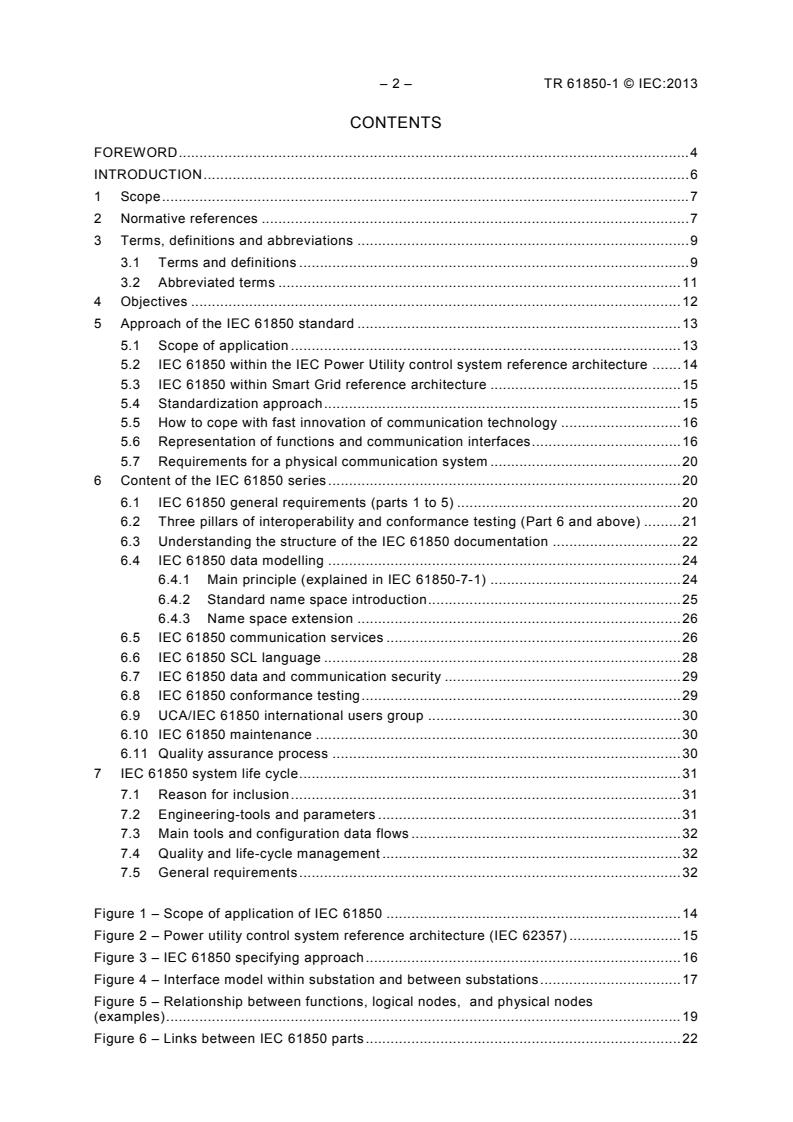
IEC TR 61850-1:2013 - Communication networks and systems for power utility automation - Part 1: Introduction and overview
IEC TR 61850-1:2013 - Communication networks and systems for power utility automation - Part 1: Introduction and overview Released:3/14/2013
Overview
IEC TR 61850-1:2013, titled Communication networks and systems for power utility automation - Part 1: Introduction and overview, is a foundational technical report published by the International Electrotechnical Commission (IEC). It serves as the introductory part of the IEC 61850 standard series, which focuses on communication between intelligent electronic devices (IEDs) within power utility automation systems.
This edition, released in 2013, brings significant technical updates over the previous 2003 version. It broadens the application scope to include power quality management, statistical and historical data handling, distributed generation monitoring, feeder automation, and substation-to-substation communication. Moreover, it incorporates smart grid considerations that are increasingly relevant in modern electrical networks.
Key Topics
Application Scope Expansion
IEC 61850 now extends beyond traditional substation automation to cover:- Power quality domain
- Statistical and historical data collection and processing
- Distributed energy resources monitoring and automation
- Feeder automation systems
- Substation-to-substation communication
- Functions monitoring compliant with IEC 62271 standards
- Smart grid integration and interoperability
Standardization Approach
The report outlines how IEC 61850 follows a user-oriented, interoperable, and scalable communication protocol design. It fits within IEC’s broader Power Utility control system reference architecture (IEC 62357), supporting seamless system lifecycle management from engineering and configuration to operation and maintenance.Data Modeling and Communication Services
IEC 61850 employs standardized data models for defining logical nodes and device functions, using Abstract Communication Service Interfaces (ACSI) to facilitate consistent communication mechanisms. This promotes interoperability between devices from different manufacturers and supports conformance testing.Engineering and Life-Cycle Management
The technical report highlights the importance of quality assurance, configuration tools, and system lifecycle management aligned with IEC 61850 to ensure reliable automation system performance.
Applications
IEC TR 61850-1:2013 is essential for utilities and manufacturers involved in:
Substation Automation Systems
Standardizing the communication between protection, control, measurement, and monitoring IEDs for efficient and secure substation operations.Smart Grid Systems
Facilitating the integration of distributed generation, renewable energy resources, automated feeders, and advanced power quality monitoring into the power grid infrastructure.Inter-Substation Communication
Enabling reliable and consistent data exchange between substations to enhance network coordination and grid stability.Power Quality and Historical Data Management
Supporting sophisticated monitoring systems that ensure compliance with power quality standards and enable detailed event analysis through historical data.Distributed Energy Resource Automation
Providing communication models and protocols to monitor and control distributed energy assets, key in transitioning towards modern, decentralized power systems.
Related Standards
IEC TR 61850-1:2013 is part of the comprehensive IEC 61850 series, which includes:
- Part 2: Glossary – Definitions of terms and abbreviations used in the series
- Part 3: General Requirements – Performance and functional requirements
- Part 5: Communication Requirements for Functions and Device Models – Defining the interaction of system components
- Part 6: Configuration Description Language (SCL) – Standardized description of communication configurations
- Part 7 (Multiple Sub-parts): Data Modeling and Logical Nodes – Detailed modeling of device functions and system behaviors
- Part 8 and 9: Communication Service Mappings – Integration with existing protocols like MMS and Ethernet
- Part 90: Application Guidelines – Usage scenarios including substation communication and condition monitoring
- Part 10: Conformance Testing – Ensuring compliance and interoperability of equipment
Additional relevant standards include IEC 62357 for power utility control system reference architecture and IEC 62271 for high-voltage switchgear, which complement IEC 61850 for comprehensive power system management.
Keywords: IEC 61850, power utility automation, intelligent electronic devices, communication networks, substation automation, smart grid, distributed energy resources, power quality monitoring, standardized data modeling, IEC standards, electrical grid automation, inter-substation communication, IEC TR 61850-1:2013.
Relations
- Effective Date
- 31-Jan-2025
- Effective Date
- 05-Sep-2023
Buy Documents
IEC TR 61850-1:2013 - Communication networks and systems for power utility automation - Part 1: Introduction and overview
IEC TR 61850-1:2013 - Communication networks and systems for power utility automation - Part 1: Introduction and overview Released:3/14/2013
Get Certified
Connect with accredited certification bodies for this standard

ANCE
Mexican certification and testing association.

Intertek Slovenia
Intertek testing, inspection, and certification services in Slovenia.

LNE (Laboratoire National de Métrologie et d'Essais)
French national laboratory for metrology and testing.
Sponsored listings
Frequently Asked Questions
IEC TR 61850-1:2013 is a technical report published by the International Electrotechnical Commission (IEC). Its full title is "Communication networks and systems for power utility automation - Part 1: Introduction and overview". This standard covers: IEC/TR 61850-1:2013 is applicable to power utility automation systems and defines the communication between intelligent electronic devices in such a system, and the related system requirements. This part gives an introduction and overview of the IEC 61850 standard series. This edition includes the following significant technical changes with respect to the previous edition: - extended application scope of the IEC 61850 standard: - power quality domain; - statistical and historical data; - distributed generation monitoring and automation purpose; - for substation to substation communication; - smart grid considerations.
IEC/TR 61850-1:2013 is applicable to power utility automation systems and defines the communication between intelligent electronic devices in such a system, and the related system requirements. This part gives an introduction and overview of the IEC 61850 standard series. This edition includes the following significant technical changes with respect to the previous edition: - extended application scope of the IEC 61850 standard: - power quality domain; - statistical and historical data; - distributed generation monitoring and automation purpose; - for substation to substation communication; - smart grid considerations.
IEC TR 61850-1:2013 is classified under the following ICS (International Classification for Standards) categories: 33.200 - Telecontrol. Telemetering. The ICS classification helps identify the subject area and facilitates finding related standards.
IEC TR 61850-1:2013 has the following relationships with other standards: It is inter standard links to IEC TR 61850-1-1:2026, IEC TR 61850-1:2003. Understanding these relationships helps ensure you are using the most current and applicable version of the standard.
IEC TR 61850-1:2013 is available in PDF format for immediate download after purchase. The document can be added to your cart and obtained through the secure checkout process. Digital delivery ensures instant access to the complete standard document.
Standards Content (Sample)
IEC/TR 61850-1 ®
Edition 2.0 2013-03
TECHNICAL
REPORT
RAPPORT
TECHNIQUE
colour
inside
Communication networks and systems for power utility automation –
Part 1: Introduction and overview
Réseaux et systèmes de communication pour l'automatisation des systèmes
électriques –
Partie 1: Introduction et présentation
IEC/TR 61850-1:2013
All rights reserved. Unless otherwise specified, no part of this publication may be reproduced or utilized in any form
or by any means, electronic or mechanical, including photocopying and microfilm, without permission in writing from
either IEC or IEC's member National Committee in the country of the requester.
If you have any questions about IEC copyright or have an enquiry about obtaining additional rights to this publication,
please contact the address below or your local IEC member National Committee for further information.
Droits de reproduction réservés. Sauf indication contraire, aucune partie de cette publication ne peut être reproduite ni
utilisée sous quelque forme que ce soit et par aucun procédé, électronique ou mécanique, y compris la photocopie et les
microfilms, sans l'accord écrit de la CEI ou du Comité national de la CEI du pays du demandeur.
Si vous avez des questions sur le copyright de la CEI ou si vous désirez obtenir des droits supplémentaires sur cette
publication, utilisez les coordonnées ci-après ou contactez le Comité national de la CEI de votre pays de résidence.
IEC Central Office Tel.: +41 22 919 02 11
3, rue de Varembé Fax: +41 22 919 03 00
CH-1211 Geneva 20 info@iec.ch
Switzerland www.iec.ch
About the IEC
The International Electrotechnical Commission (IEC) is the leading global organization that prepares and publishes
International Standards for all electrical, electronic and related technologies.
About IEC publications
The technical content of IEC publications is kept under constant review by the IEC. Please make sure that you have the
latest edition, a corrigenda or an amendment might have been published.
Useful links:
IEC publications search - www.iec.ch/searchpub Electropedia - www.electropedia.org
The advanced search enables you to find IEC publications The world's leading online dictionary of electronic and
by a variety of criteria (reference number, text, technical electrical terms containing more than 30 000 terms and
committee,…). definitions in English and French, with equivalent terms in
It also gives information on projects, replaced and additional languages. Also known as the International
withdrawn publications. Electrotechnical Vocabulary (IEV) on-line.
IEC Just Published - webstore.iec.ch/justpublished Customer Service Centre - webstore.iec.ch/csc
Stay up to date on all new IEC publications. Just Published If you wish to give us your feedback on this publication
details all new publications released. Available on-line and or need further assistance, please contact the
also once a month by email. Customer Service Centre: csc@iec.ch.
A propos de la CEI
La Commission Electrotechnique Internationale (CEI) est la première organisation mondiale qui élabore et publie des
Normes internationales pour tout ce qui a trait à l'électricité, à l'électronique et aux technologies apparentées.
A propos des publications CEI
Le contenu technique des publications de la CEI est constamment revu. Veuillez vous assurer que vous possédez
l’édition la plus récente, un corrigendum ou amendement peut avoir été publié.
Liens utiles:
Recherche de publications CEI - www.iec.ch/searchpub Electropedia - www.electropedia.org
La recherche avancée vous permet de trouver des Le premier dictionnaire en ligne au monde de termes
publications CEI en utilisant différents critères (numéro de électroniques et électriques. Il contient plus de 30 000
référence, texte, comité d’études,…). termes et définitions en anglais et en français, ainsi que
Elle donne aussi des informations sur les projets et les les termes équivalents dans les langues additionnelles.
publications remplacées ou retirées. Egalement appelé Vocabulaire Electrotechnique
International (VEI) en ligne.
Just Published CEI - webstore.iec.ch/justpublished
Service Clients - webstore.iec.ch/csc
Restez informé sur les nouvelles publications de la CEI.
Just Published détaille les nouvelles publications parues. Si vous désirez nous donner des commentaires sur
Disponible en ligne et aussi une fois par mois par email. cette publication ou si vous avez des questions
contactez-nous: csc@iec.ch.
IEC/TR 61850-1 ®
Edition 2.0 2013-03
TECHNICAL
REPORT
RAPPORT
TECHNIQUE
colour
inside
Communication networks and systems for power utility automation –
Part 1: Introduction and overview
Réseaux et systèmes de communication pour l'automatisation des systèmes
électriques –
Partie 1: Introduction et présentation
INTERNATIONAL
ELECTROTECHNICAL
COMMISSION
COMMISSION
ELECTROTECHNIQUE
PRICE CODE
INTERNATIONALE
CODE PRIX W
ICS 33.200 ISBN 978-2-83220-686-7
– 2 – TR 61850-1 © IEC:2013
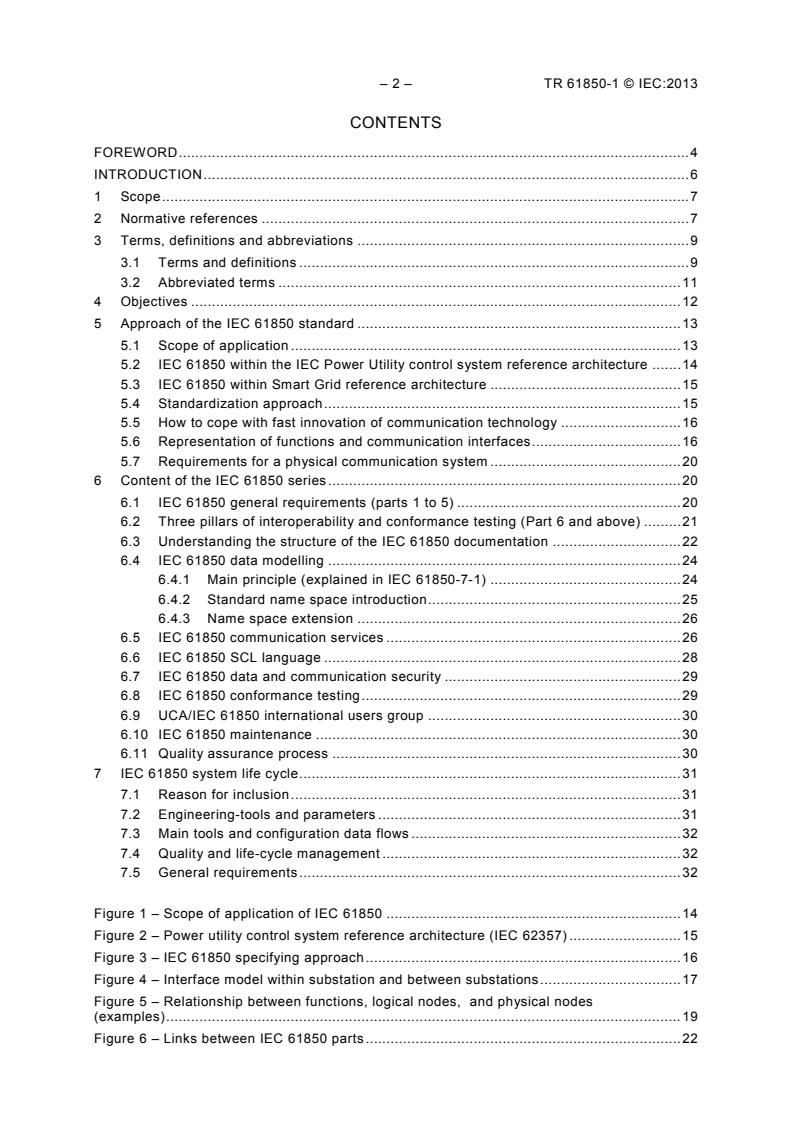
CONTENTS
FOREWORD . 4
INTRODUCTION . 6
1 Scope . 7
2 Normative references . 7
3 Terms, definitions and abbreviations . 9
3.1 Terms and definitions . 9
3.2 Abbreviated terms . 11
4 Objectives . 12
5 Approach of the IEC 61850 standard . 13
5.1 Scope of application . 13
5.2 IEC 61850 within the IEC Power Utility control system reference architecture . 14
5.3 IEC 61850 within Smart Grid reference architecture . 15
5.4 Standardization approach . 15
5.5 How to cope with fast innovation of communication technology . 16
5.6 Representation of functions and communication interfaces . 16
5.7 Requirements for a physical communication system . 20
6 Content of the IEC 61850 series . 20
6.1 IEC 61850 general requirements (parts 1 to 5) . 20
6.2 Three pillars of interoperability and conformance testing (Part 6 and above) . 21
6.3 Understanding the structure of the IEC 61850 documentation . 22
6.4 IEC 61850 data modelling . 24
6.4.1 Main principle (explained in IEC 61850-7-1) . 24
6.4.2 Standard name space introduction . 25
6.4.3 Name space extension . 26
6.5 IEC 61850 communication services . 26
6.6 IEC 61850 SCL language . 28
6.7 IEC 61850 data and communication security . 29
6.8 IEC 61850 conformance testing . 29
6.9 UCA/IEC 61850 international users group . 30
6.10 IEC 61850 maintenance . 30
6.11 Quality assurance process . 30
7 IEC 61850 system life cycle . 31
7.1 Reason for inclusion . 31
7.2 Engineering-tools and parameters . 31
7.3 Main tools and configuration data flows . 32
7.4 Quality and life-cycle management . 32
7.5 General requirements . 32
Figure 1 – Scope of application of IEC 61850 . 14
Figure 2 – Power utility control system reference architecture (IEC 62357) . 15
Figure 3 – IEC 61850 specifying approach . 16
Figure 4 – Interface model within substation and between substations . 17
Figure 5 – Relationship between functions, logical nodes, and physical nodes
(examples) . 19
Figure 6 – Links between IEC 61850 parts . 22
TR 61850-1 © IEC:2013 – 3 –
Figure 7 – IEC 61850 Data modelling . 24
Figure 8 – Basic reference model. 28
Figure 9 – Exchange of system parameters . 31
– 4 – TR 61850-1 © IEC:2013
INTERNATIONAL ELECTROTECHNICAL COMMISSION
____________
COMMUNICATION NETWORKS AND SYSTEMS
FOR POWER UTILITY AUTOMATION –
Part 1: Introduction and overview
FOREWORD
1) The International Electrotechnical Commission (IEC) is a worldwide organization for standardization comprising
all national electrotechnical committees (IEC National Committees). The object of IEC is to promote
international co-operation on all questions concerning standardization in the electrical and electronic fields. To
this end and in addition to other activities, IEC publishes International Standards, Technical Specifications,
Technical Reports, Publicly Available Specifications (PAS) and Guides (hereafter referred to as “IEC
Publication(s)”). Their preparation is entrusted to technical committees; any IEC National Committee interested
in the subject dealt with may participate in this preparatory work. International, governmental and non-
governmental organizations liaising with the IEC also participate in this preparation. IEC collaborates closely
with the International Organization for Standardization (ISO) in accordance with conditions determined by
agreement between the two organizations.
2) The formal decisions or agreements of IEC on technical matters express, as nearly as possible, an international
consensus of opinion on the relevant subjects since each technical committee has representation from all
interested IEC National Committees.
3) IEC Publications have the form of recommendations for international use and are accepted by IEC National
Committees in that sense. While all reasonable efforts are made to ensure that the technical content of IEC
Publications is accurate, IEC cannot be held responsible for the way in which they are used or for any
misinterpretation by any end user.
4) In order to promote international uniformity, IEC National Committees undertake to apply IEC Publications
transparently to the maximum extent possible in their national and regional publications. Any divergence
between any IEC Publication and the corresponding national or regional publication shall be clearly indicated in
the latter.
5) IEC itself does not provide any attestation of conformity. Independent certification bodies provide conformity
assessment services and, in some areas, access to IEC marks of conformity. IEC is not responsible for any
services carried out by independent certification bodies.
6) All users should ensure that they have the latest edition of this publication.
7) No liability shall attach to IEC or its directors, employees, servants or agents including individual experts and
members of its technical committees and IEC National Committees for any personal injury, property damage or
other damage of any nature whatsoever, whether direct or indirect, or for costs (including legal fees) and
expenses arising out of the publication, use of, or reliance upon, this IEC Publication or any other IEC
Publications.
8) Attention is drawn to the Normative references cited in this publication. Use of the referenced publications is
indispensable for the correct application of this publication.
9) Attention is drawn to the possibility that some of the elements of this IEC Publication may be the subject of
patent rights. IEC shall not be held responsible for identifying any or all such patent rights.
The main task of IEC technical committees is to prepare International Standards. However, a
technical committee may propose the publication of a technical report when it has collected
data of a different kind from that which is normally published as an International Standard, for
example "state of the art".
IEC 61850-1, which is a technical report, has been prepared by IEC technical committee 57:
Power systems management and associated information exchange.
This second edition cancels and replaces the first edition published in 2003. This edition
constitutes a technical revision.
This edition includes the following significant technical changes with respect to the previous
edition:
• Extended application scope of the IEC 61850 standard
– for the power quality domain;
– for statistical and historical data;
TR 61850-1 © IEC:2013 – 5 –
– for distributed generation monitoring and automation purpose;
– for feeder automation purpose;
– for substation to substation communication;
– for monitoring functions according to IEC 62271.
• Smart grid considerations.
• Extensions (and provisions for extensions) of the documentation system relating to
IEC 61850, especially with part 7-5xx (Application guides) and part 90-xx (Technical report
and guidelines).
The text of this technical report is based on the following documents:
Enquiry draft Report on voting
57/1233/DTR 57/1304/RVC
Full information on the voting for the approval of this technical report can be found in the
report on voting indicated in the above table.
This publication has been drafted in accordance with the ISO/IEC Directives, Part 2.
A list of all parts in the IEC 61850 series, published under the general title Communication
networks and systems for power utility automation, can be found on the IEC website.
The committee has decided that the contents of this publication will remain unchanged until
the stability date indicated on the IEC web site under "http://webstore.iec.ch" in the data
related to the specific publication. At this date, the publication will be
• reconfirmed,
• withdrawn,
• replaced by a revised edition, or
• amended.
IMPORTANT – The 'colour inside' logo on the cover page of this publication indicates
that it contains colours which are considered to be useful for the correct
understanding of its contents. Users should therefore print this document using a
colour printer.
– 6 – TR 61850-1 © IEC:2013
INTRODUCTION
IEC 61850 consists of the following parts, under the general title Communication networks
and systems for power utility automation (all parts may have not been published yet).
Part 1: Introduction and overview
Part 2: Glossary
Part 3: General requirements
Part 4: System and project management
Part 5: Communication requirements for functions and device models
Part 6: Configuration description language for communication in electrical substations
related to IEDs
Part 7-1: Basic communication structure – Principles and models
Part 7-2: Basic communication structure – Abstract communication service interface
(ACSI)
Part 7-3: Basic communication structure – Common data classes
Part 7-4: Basic communication structure – Compatible logical node classes and data
classes
Part 7-410: Hydroelectric power plants – Communication for monitoring and control
Part 7-420: Basic communication structure – Distributed energy resources logical nodes
Part 7-5: IEC 61850 – Modelling concepts
Part 7-500: Use of logical nodes to model functions of a substation automation system
Part 7-510: Use of logical nodes to model functions of a hydro power plant
Part 7-520: Use of logical nodes to model functions of distributed energy resources
Part 8-1: Specific communication service mapping (SCSM) – Mappings to MMS
(ISO 9506-1 and ISO 9506-2) and to ISO/IEC 8802-3
Part 80-1: Guideline to exchange information from a CDC based data model using
IEC 60870-5-101/104
Part 9-2: Specific communication service mapping (SCSM) – Sampled values over
ISO/IEC 8802-3
Part 90-1: Use of IEC 61850 for the communication between substations
Part 90-2: Using IEC 61850 for the communication between substations and control
centres
Part 90-3: Using IEC 61850 for condition monitoring
Part 90-4: Network Engineering Guidelines - Technical report
Part 90-5: Using IEC 61850 to transmit synchrophasor information according to IEEE
C37.118
Part 10: Conformance testing
In addition to the above parts IEC technical committee 88 has published the IEC 61850 basic
communication structure for Wind Turbines as IEC 61400-25, Wind turbines –
Communications for monitoring and control of wind power plants.
IEC 61850-1 is an introduction and overview of the IEC 61850 standard series. It describes
the philosophy, work approach and contents of the other parts.
___________
1 Under consideration.
TR 61850-1 © IEC:2013 – 7 –
COMMUNICATION NETWORKS AND SYSTEMS
FOR POWER UTILITY AUTOMATION –
Part 1: Introduction and overview
1 Scope
This technical report is applicable to power utility automation systems (PUAS). It defines the
communication between intelligent electronic devices (IEDs) in such a system, and the related
system requirements.
This part gives an introduction and overview of the IEC 61850 standard series. It refers to and
might include text and figures coming from other parts of the IEC 61850 standard series.
2 Normative references
The following documents, in whole or in part, are normatively referenced in this document and
are indispensable for its application. For dated references, only the edition cited applies. For
undated references, the latest edition of the referenced document (including any
amendments) applies.
IEC 60870-5-103, Telecontrol equipment and systems – Part 5-103: Transmission Protocols -
Companion standard for the informative interface of protection equipment
IEC 60870-5-104, Telecontrol equipment and systems – Part 5-104: Transmission protocols –
Network access for IEC 60870-5-101 using standard transport profiles
IEC 61400-25 (all parts), Communications for monitoring and control of wind power plants
IEC 61850-2, Communication networks and systems in substations – Part 2: Glossary
IEC 61850-3, Communication networks and systems in substations – Part 3: General
requirements
IEC 61850-4, Communication networks and systems for power utility automation – Part 4:
System and project management
IEC 61850-5, Communication networks and systems in substations – Part 5: Communication
requirements for functions and device models
IEC 61850-6, Communication networks and systems for power utility automation – Part 6:
Configuration description language for communication in electrical substations related to IEDs
IEC 61850-7-1, Communication networks and systems for power utility automation – Part 7-1:
Basic communication structure – Principles and models
IEC 61850-7-2, Communication networks and systems for power utility automation – Part 7-2:
Basic information and communication structure – Abstract communication service interface
(ACSI)
– 8 – TR 61850-1 © IEC:2013
IEC 61850-7-3, Communication networks and systems for power utility automation – Part 7-3:
Basic communication structure – Common data classes
IEC 61850-7-4, Communication networks and systems for power utility automation – Part 7-4:
Basic communication structure – Compatible logical node classes and data object classes
IEC 61850-7-410, Communication networks and systems for power utility automation –
Part 7-410: Hydroelectric power plants – Communication for monitoring and control
IEC 61850-7-420, Communication networks and systems for power utility automation –
Part 7-420: Basic communication structure – Distributed energy resources logical nodes
IEC 61850-7-510, Communication networks and systems for power utility automation – Part 7-
510: Basic communication structure – Hydroelectric power plants – Modelling concepts and
guidelines
IEC 61850-8-1, Communication networks and systems for power utility automation – Part 8-1:
Specific communication service mapping (SCSM) – Mappings to MMS (ISO 9506-1 and
ISO 9506-2) and to ISO/IEC 8802-3
IEC 61850-80-1, Communication networks and systems for power utility automation –
Part 80-1: Guideline to exchanging information from a CDC-based data model using
IEC 60870-5-101 or IEC 60870-5-104
IEC 61850-9-2, Communication networks and systems for power utility automation – Part 9-2:
Specific communication service mapping (SCSM) – Sampled values over ISO/IEC 8802-3
IEC/TR 61850-90-1, Communication networks and systems for power utility automation – Part
90-1: Use of IEC 61850 for the communication between substations
IEC 61850-10, Communication networks and systems in substations – Part 10: Conformance
testing
IEC 62351 (all parts), Power systems management and associated information exchange –
Data and communications security
IEC/TR 62357-1, Power systems management and associated information exchange – Part 1:
Reference architecture
IEC 81346-1, Industrial systems, installations and equipment and industrial products –
Structuring principles and reference designations – Part 1: Basic rules
ISO 9001:2008, Quality management systems – Requirements
IEEE C37.2, IEEE standard electrical power system device function numbers, acronyms and
contact designations
IEEE 100:2000, The authoritative dictionary of IEEE standards terms seventh edition
IEEE-SA TR 1550, Utility Communications Architecture (UCA) Version 2.0 – Part 4: UCA
Generic Object Models for Substation and Feeder Equipment (GOMSFE)
RFC 2246, The TLS Protocol, Version 1.0
TR 61850-1 © IEC:2013 – 9 –
3 Terms, definitions and abbreviations
3.1 Terms and definitions
For the purposes of this Technical Report, the following terms and definitions apply. However
please refer to part 2 of the standard for the standard glossary of IEC 61850.
3.1.1
Abstract Communication Service Interface
ACSI
virtual interface to an IED providing abstract communication services, for example connection,
variable access, unsolicited data transfer, device control and file transfer services,
independent of the actual communication stack and profiles used
3.1.2
bay
subpart of a substation, having some common functionality, closely connected to the other
subparts, and forming a substation
3.1.3
data object
part of a logical node object representing specific information, for example, status or
measurement. From an object-oriented point of view, a data object is an instance of
a data object class. Data objects are normally used as transaction objects; i.e., they are
data structures
3.1.4
device
mechanism or piece of equipment designed to serve a purpose or perform a function, for
example, breaker, relay, or substation computer
[SOURCE: IEEE 100:2000]
3.1.5
functions
tasks which are performed by the substation automation system, i.e. by application functions
Note 1 to entry: Generally, functions exchange data with other functions. The details are dependent on the
functions in consideration. Functions are performed by IEDs (physical devices). Functions may be split in parts
residing in different IEDs but communicating which each other (distributed function) and with parts of other
functions. These communicating function parts are called logical nodes.
Note 2 to entry: In the context of this standard, the decomposition of functions or their granularity is ruled by the
communication behaviour only. Therefore, all functions considered consist of logical nodes that exchange data.
3.1.6
Intelligent Electronic Device
IED
any device incorporating one or more processors with the capability of receiving or sending
data/controls from or to an external source (for example, electronic multifunction meters,
digital relays, controllers)
3.1.7
interchangeability
ability to replace a device supplied by one manufacturer with a device supplied by another
manufacturer, without making changes to the other elements in the system
– 10 – TR 61850-1 © IEC:2013
3.1.8
interoperability
ability of two or more IEDs from the same vendor, or from different vendors, to exchange
information and use that information for correct execution of specified functions
3.1.9
Logical Node
LN
smallest part of a function that exchanges data
Note 1 to entry: A LN is an object defined by its data and methods.
3.1.10
Logical Device
LD
virtual device that exists to enable aggregation of related logical nodes
3.1.11
open protocol
protocol whose stack is either standardised or publicly available
3.1.12
part
part of the IEC 61850 standard series
EXAMPLE Part 1 refers to IEC 61850-1, Part 7-2 refers to IEC 61850-7-2.
3.1.13
Physical Device
PD
equivalent to an IED as used in the context of this standard
3.1.14
process bus
process bus is the communication network which connects the IEDs at primary equipment
level to other IEDs
3.1.15
protocol
set of rules that determines the behaviour of functional units in achieving and performing
communication
3.1.16
Power Utility Automation System
PUAS
set of communicating components or devices (IEDs) arranged in a communication
architecture to perform any type of power utility automation functions
Note 1 to entry: Power Utility Automation System includes de facto Substation Automation system, as one possible
sub-system.
3.1.17
self-description
a device contains information on its configuration
Note 1 to entry: The representation of this information has to be standardised and has to be accessible via
communication (in the context of this standard series).
TR 61850-1 © IEC:2013 – 11 –
3.1.18
station bus
communication network which inter-connects IEDs at bay level and IEDs at station level, and
connects bay-level IEDs to station-level IEDs
3.1.19
system
within the scope of this standard, system always refers to substation automation systems
unless otherwise stated
3.1.20
Specific Communication Service Mapping
SCSM
standardised procedure which provides the concrete mapping of ACSI services and objects
onto a particular protocol stack/communication profile
Note 1 to entry: To facilitate interoperability it is intended to have a minimum number of standardized mappings
(SCSM). Special application subdomains such as “station bus” and “process bus” may result in more than one
mapping. However, for a specific protocol stack selected only one single SCSM and one single profile should be
specified.
Note 2 to entry: A SCSM should detail the instantiation of abstract services into protocol specific single service or
sequence of services which achieve the service as specified in ACSI. Additionally, a SCSM should detail the
mapping of ACSI objects into object supported by the application protocol.
Note 3 to entry: SCSMs are specified in the parts 8-x and 9-x of this standard series.
3.2 Abbreviated terms
ACSI Abstract Communication Service Interface
CDC Common Data Class
CIM Common Information Model
DA Data Attribute
DER Distributed Energy Resource
DO Data Object
EMC Electromagnetic Compatibility
GSE Generic Substation Event (communication model)
GSSE Generic Substation State Event (communication model)
GOOSE Generic Object Oriented System Event (communication model)
IED Intelligent Electronic Device
LN Logical Node
LD Logical Device
PD Physical Device
PUAS Power Utility Automation System
SCL System Configuration description Language
SCSM Specific Communication Service Mapping
TLS Transport Layer Security
VLAN Virtual Local Area Network
XML eXtensible Markup Language
– 12 – TR 61850-1 © IEC:2013
4 Objectives
The possibility to build Power Utility Automation Systems (PUAS) rests on the strong
technological development of large-scale integrated circuits, leading to the present availability
of advanced, fast, and powerful microprocessors. The result was an evolution of substation
secondary equipment, from electro-mechanical devices to digital devices. This in turn
provided the possibility of implementing Power Utility Automation System using several
intelligent electronic devices (IEDs) to perform the required functions (protection, local and
remote monitoring and control, etc.). As a consequence, the need arose for efficient
communication among the IEDs, especially for a standard protocol. Initially specific
proprietary communication protocols developed by each manufacturer where used, requiring
complicated and costly protocol converters when using IEDs from different vendors.
The industry’s experiences have demonstrated the need and the opportunity for developing
standard semantics, abstract communication services that can be mapped to different
protocols, configuration descriptions and engineering processes, which would support
interoperability of IEDs from different manufacturers. Interoperability in this case is the ability
to operate on the same network or communication path sharing information and commands.
There is also a desire to have IED interchangeability, i.e. the ability to replace a device
supplied by one manufacturer with a device supplied by another manufacturer, without making
changes to the other elements in the system. Interchangeability would also require
standardisation of functions which is beyond this communication standard. Interoperability is a
common goal for electric utilities, equipment vendors and standardisation bodies.
The objective of PUAS standardisation is to develop a communication standard that will meet
functional and performance requirements, while supporting future technological develop-
ments. To be truly beneficial, a consensus must be found between IED manufacturers and
users on the way such devices can freely exchange information.
The communication standard must support the operation functions within the substation and
distributed throughout the power grid. Therefore, the standard has to consider the operational
requirements, but the purpose of the standard is neither to standardise (nor limit in any way)
the functions involved in substation operation nor their allocation within the Power Utility
Automation System. The application functions will be identified and described in order to
define their interface and then their communication requirements (for example, amount of data
to be exchanged, exchange time constraints, etc.). The communication standard, to the
maximum possible extent, should make use of existing standards and commonly accepted
communication and engineering principles.
This standard aims to ensure, among others, the following features:
– That the complete communication profile is based on existing IEC/IEEE/ISO/OSI
communication standards, if available.
– That the protocols used will be open and will support self-descriptive devices. It should be
possible to add new functionality.
– That the standard is based on data objects related to the needs of the electric power
industry.
– That the communication syntax and semantics are based on the use of common data
objects related to the power system.
– That the communication services can be mapped to different state-of-the art protocols.
– That the communication standard considers the implications of the substation being one
node in the power grid, i.e. of the Power Utility Automation System being one element in
the overall power control system.
– That the complete topology of an electrical system (single line diagram), the generated
and consumed information, and the information flow between all IEDs is specified, using a
machine readable language.
TR 61850-1 © IEC:2013 – 13 –
5 Approach of the IEC 61850 standard
5.1 Scope of application
The main parts of the IEC 61850 standard were first published from 2002 to 2005. The
standard was the result of nearly ten years of work within IEEE/EPRI on Utility
Communications Architecture (UCA) (IEEE-SA TR 1550) and within the working group
“Substation Control and Protection Interfaces” of IEC Technical Committee 57. The initial
scope of IEC 61850 was standardisation of communication in substation automation systems.
The first edition of the standard was primarily related to protection, control and monitoring.
From 2009 onwards the original parts of the IEC 61850 series have been updated and
extended to cover also measurement (including statistical and historical data handling) and
power quality. New parts of the standard will also be added to handle condition monitoring.
The concepts defined in IEC 61850 have been applied beyond the substation domain:
– The modelling of hydropower plants (see IEC 61850-7-410) distributed energy resources
(see IEC 61850-7-420) are also covered by the IEC 61850 series.
– The modelling of wind turbines has been standardized ,according to IEC 61850, within the
IEC 61400-25 series, Communications for monitoring and control of wind power plants.
– The communication has also been extended to substation to substation communication
(see IEC 61850-90-1).
IEC 61850 is planned to be applied to new areas such as:
– Communication to network control centre (IEC/TR 61850-90-2 )
– Feeder automation domain
Harmonization of IEC 61850 modelling with the IEC Common Information Model (CIM,
IEC 61968/61970) is also considered as a high priority item to fulfil Smart Grid objectives.
Given the extended scope, today’s naming of the IEC 61850 standard is Communication
networks and systems for power utility automation. The final scope of application of
IEC 61850 (and affiliates) is described in Figure 1.
___________
To be published.
IEC 61850
IEC 61850
IEC 61850
IEC 61850
IEC 61400-25
– 14 – TR 61850-1 © IEC:2013
Control center
SCADA
IEC 61850
IEC 61400-25
Use of 61850 for
IEC 61850-80-1
Wind power plant
substation to
Guideline to exchange
IEC 61400-25
control center
61850 information over IEC
(expected)
60870-5-101/104
RTU
Local SCADA
IEC 61850
Distributed Energy Ress
IEC 61850-7-420
IEC 61850
Station
IEC 61850
IED IED IED
IEC 61850-90-1
between stations
Power Utility substation B
IEC 61850
Hydro power plant
Power utility substations A
IEC 61850-7-410
IEC 61850
IEC 61850-7-4
MV network
XXX IEC 61850 parts, as of 2010
IEC 61850 future parts IEC 584/13
XXX
Figure 1 – Scope of application of IEC 61850
5.2 IEC 61850 within the IEC Power Utility control system reference architecture
IEC 61850 is one central communication standard of the Power Utility control system
reference architecture of IEC technical committee 57 (IEC 62357) as shown in Figure 2.
IEC 61850 is fully complementary to the Common Information Model Standard (CIM –
IEC 61970 – IEC 61968).
IEC 61850
TR 61850-1 © IEC:2013 – 15 –
IEC TC57 Reference Architecture
Energy Utility
Other
Market Service
Utility Customers
Businesses
Participants Providers
Application To Application (A2A)
and Business To Business
(B2B) Communications
Inter-System / Application Profiles (CIM XML, CIM RDF)
CIM Extensions 61970 / 61968 Common Information Model (CIM) Bridges to Other Domains
Application/System
Interfaces
61970 Component Interface Specification (CIS) / 61968 SIDMS Technology Mappings
Market Operation Engineering &
External
SCADA Apps EMS Apps DMS Apps
Apps Maintenance Apps
IT Apps
Equipment and Field
Device Interfaces
Data Acquisition and Control Front-End / Gateway / Proxy Server / Mapping Services / Role-based Access Control
Specific Object
Mappings
61850-7-3, 7-4 60870-6-802
Field Object Models
Object Models
Object Models Object Models
61850-6
TC13
60870-5 61850-7-2 60870-6-503
Engineering
WG14
ACSI App Services Specific Communication
Meter
&
Services Mappings
Standards
61850-8-1 Mapping to 60870-6-702
Protocols Web Services Protocols
Communication Industry Standard Protocol Stacks
Protocol Profiles
(ISO/TCP/UDP/IP/Ethernet)
DLMS
Communications
Media and Services
61850 IED
60870-5 Field Devices
61850 Devices
TC13 RTUs or and Systems 60870-6
Substation Beyond the
Field External Systems
Substation using
WG14 TASE.2
Substation
Devices
Devices (Symmetric client/server
Systems Web Services
protocols)
Customer DERs Other
IEDs, Relays, Meters, Switchgear, CTs, VTs
Meters
and Meters Control Centers
Peer-to-Peer 61850 over
Substation bus and Process
*Notes: 1) Solid colors correlate different parts of protocols within the architecture. bus
IEC 585/13
2) Non-solid patterns represent areas that are future work, or work in progress, or related work provided by another IEC TC.
Figure 2 – Power utility control system reference architecture (IEC 62357)
5.3 IEC 61850 within Smart Grid reference architecture
IEC 61850 is one central communication standard of the Smart Grid IEC reference
architecture, as published by the IEC Strategic Group 3 on Smart Grid. "Across the IEC Smart
Grid Framework, the Application Domain TCs must use the methods delivered by the
“horizontal” TCs included in the Framework.
IEC 61850 (existing and extended) will be used for all communications to field equipment and
systems, while the IEC 61970 and IEC 61968 will be used within control centres for managing
information exchanges among enterprise systems."
5.4 Standardization approach
The approach of the IEC 61850 series is to blend the strengths of the following three
methods:
– Functional decomposition
– Data flow modelling
– Information modelling
Functional decomposition is used to understand the logical relationship between components
of a distributed function, and is presented in terms of logical nodes (LNs) that describe the
functions, subfunctions and functional interfaces.
___________
3 Extract from Standardization Management Board meeting 137, decision 3 (SMB/4175/R 2010-01-11).
Network, System, and Data Management (62351-7)
End-to-End Security Standards and Recommendations (62351-6)
– 16 – TR 61850-1 © IEC:2013
Data flow is used to understand the communication interfaces that must support the exchange
of information between distributed functional components and the functional performance
requirements.
Information modelling is used to define the abstract syntax and semantics of the information
exchanged, and is presented in terms of data object classes and types, attributes, abstract
object methods (services), and their relationships.
5.5 How to cope with fast innovation of communication technology
In order to cope with the fast innovation of communication technology IEC 61850 makes the
communication independence from the application by specifying a set of abstract services and
objects. In this way applications can be written in a manner which is independent from a
specific protocol. This abstraction allows both vendors and utilities to maintain application
functionality and to optimise this functionality when appropriate as explained in Figure 3.
It also allows, as the scope of IEC 61850 is wider and wider, to cope with the diversity of
communication solutions required by the new targetted domains, while keeping the same data
model.
FFiixexedd
DaDaDatttaaa
EExxttended wended when rhen requequiirreded
MMModelodelodel
AApplppliiccatatiion :on :
AApplppliiccaa--
WWhhaatt i infnforormmatatiion on
titioonn
tto exo excchanghange?e?
AAdaptdapteed wd when nhen needeededed
CComommmuunini--
CCoommmmununicicaattioionsns
ccatatiionon
ttecechhnolnologyogy::
””SStatatete--ofof--ththee--aartrt””
EEEtttherherhernenenettt
HHowow dat data ia iss
--EEttherhernnetet 1 10 0 MBMBiitt//ss
TTTCCCPPP/IP/IP/IP --EEttherhernetnet 100 100 MMBBiit/st/s
ttrransansfferereded
--EEttherhernetnet 1 1 GBGBiit/st/s
CChangihangingng
--……
PPrreveviioousus w wayay ofof s spepecciiffyyiinng g IIEECC 6185 61850 s0 sttatatee--ofof--tthehe--arartt w wayay
ccomommmuniuniccatatiioon sn sttanandardardd ofof ssppececiiffyyiing cng comommmuniuniccatatiion on
ssttanandardardd
IEC 586/13
Figure 3 – IEC 61850 specifying approach
5.6 Representation of functions and communication interfaces
The objective of the standard is to provide a framework to achieve interoperability between
the IEDs supplied from different suppliers.
The allocation of functions to devices (IEDs) and control levels is not fixed. The allocation
normally depends on availability requirements, performance requirements, cost constraints,
state of the art of technology, utilities’ philosophies etc. Therefore, the standard should
support any allocation of functions.
TR 61850-1 © IEC:2013 – 17 –
In order to allow a free allocation of functions to IEDs, interoperability shall? be provided
between functions to be performed in a power utility automation system but residing in
equipment (physical devices in substation) from different suppliers. The functions may be split
in modules performed in different IEDs but communicating with each other (distributed
function). Therefore, the communication behaviour of such modules (called logical nodes,
(LNs)) has to support the requested interoperability of the IEDs.
The functions (application functions) of a Power Utility Automation system are control and
supervision, as well as protection and monitoring of the primary equipment and of the grid.
Other functions (system functions) are related to the system itself, for example supervision of
the communication.
Functions
...
IEC/TR 61850-1 ®
Edition 2.0 2013-03
TECHNICAL
REPORT
RAPPORT
TECHNIQUE
colour
inside
Communication networks and systems for power utility automation –
Part 1: Introduction and overview
Réseaux et systèmes de communication pour l'automatisation des systèmes
électriques –
Partie 1: Introduction et présentation
IEC/TR 61850-1:2013
All rights reserved. Unless otherwise specified, no part of this publication may be reproduced or utilized in any form
or by any means, electronic or mechanical, including photocopying and microfilm, without permission in writing from
either IEC or IEC's member National Committee in the country of the requester.
If you have any questions about IEC copyright or have an enquiry about obtaining additional rights to this publication,
please contact the address below or your local IEC member National Committee for further information.
Droits de reproduction réservés. Sauf indication contraire, aucune partie de cette publication ne peut être reproduite ni
utilisée sous quelque forme que ce soit et par aucun procédé, électronique ou mécanique, y compris la photocopie et les
microfilms, sans l'accord écrit de la CEI ou du Comité national de la CEI du pays du demandeur.
Si vous avez des questions sur le copyright de la CEI ou si vous désirez obtenir des droits supplémentaires sur cette
publication, utilisez les coordonnées ci-après ou contactez le Comité national de la CEI de votre pays de résidence.
IEC Central Office Tel.: +41 22 919 02 11
3, rue de Varembé Fax: +41 22 919 03 00
CH-1211 Geneva 20 info@iec.ch
Switzerland www.iec.ch
About the IEC
The International Electrotechnical Commission (IEC) is the leading global organization that prepares and publishes
International Standards for all electrical, electronic and related technologies.
About IEC publications
The technical content of IEC publications is kept under constant review by the IEC. Please make sure that you have the
latest edition, a corrigenda or an amendment might have been published.
Useful links:
IEC publications search - www.iec.ch/searchpub Electropedia - www.electropedia.org
The advanced search enables you to find IEC publications The world's leading online dictionary of electronic and
by a variety of criteria (reference number, text, technical electrical terms containing more than 30 000 terms and
committee,…). definitions in English and French, with equivalent terms in
It also gives information on projects, replaced and additional languages. Also known as the International
withdrawn publications. Electrotechnical Vocabulary (IEV) on-line.
IEC Just Published - webstore.iec.ch/justpublished Customer Service Centre - webstore.iec.ch/csc
Stay up to date on all new IEC publications. Just Published If you wish to give us your feedback on this publication
details all new publications released. Available on-line and or need further assistance, please contact the
also once a month by email. Customer Service Centre: csc@iec.ch.
A propos de la CEI
La Commission Electrotechnique Internationale (CEI) est la première organisation mondiale qui élabore et publie des
Normes internationales pour tout ce qui a trait à l'électricité, à l'électronique et aux technologies apparentées.
A propos des publications CEI
Le contenu technique des publications de la CEI est constamment revu. Veuillez vous assurer que vous possédez
l’édition la plus récente, un corrigendum ou amendement peut avoir été publié.
Liens utiles:
Recherche de publications CEI - www.iec.ch/searchpub Electropedia - www.electropedia.org
La recherche avancée vous permet de trouver des Le premier dictionnaire en ligne au monde de termes
publications CEI en utilisant différents critères (numéro de électroniques et électriques. Il contient plus de 30 000
référence, texte, comité d’études,…). termes et définitions en anglais et en français, ainsi que
Elle donne aussi des informations sur les projets et les les termes équivalents dans les langues additionnelles.
publications remplacées ou retirées. Egalement appelé Vocabulaire Electrotechnique
International (VEI) en ligne.
Just Published CEI - webstore.iec.ch/justpublished
Service Clients - webstore.iec.ch/csc
Restez informé sur les nouvelles publications de la CEI.
Just Published détaille les nouvelles publications parues. Si vous désirez nous donner des commentaires sur
Disponible en ligne et aussi une fois par mois par email. cette publication ou si vous avez des questions
contactez-nous: csc@iec.ch.
IEC/TR 61850-1 ®
Edition 2.0 2013-03
TECHNICAL
REPORT
RAPPORT
TECHNIQUE
colour
inside
Communication networks and systems for power utility automation –
Part 1: Introduction and overview
Réseaux et systèmes de communication pour l'automatisation des systèmes
électriques –
Partie 1: Introduction et présentation
INTERNATIONAL
ELECTROTECHNICAL
COMMISSION
COMMISSION
ELECTROTECHNIQUE
PRICE CODE
INTERNATIONALE
CODE PRIX W
ICS 33.200 ISBN 978-2-83220-686-7
– 2 – TR 61850-1 © IEC:2013
CONTENTS
FOREWORD . 4
INTRODUCTION . 6
1 Scope . 7
2 Normative references . 7
3 Terms, definitions and abbreviations . 9
3.1 Terms and definitions . 9
3.2 Abbreviated terms . 11
4 Objectives . 12
5 Approach of the IEC 61850 standard . 13
5.1 Scope of application . 13
5.2 IEC 61850 within the IEC Power Utility control system reference architecture . 14
5.3 IEC 61850 within Smart Grid reference architecture . 15
5.4 Standardization approach . 15
5.5 How to cope with fast innovation of communication technology . 16
5.6 Representation of functions and communication interfaces . 16
5.7 Requirements for a physical communication system . 20
6 Content of the IEC 61850 series . 20
6.1 IEC 61850 general requirements (parts 1 to 5) . 20
6.2 Three pillars of interoperability and conformance testing (Part 6 and above) . 21
6.3 Understanding the structure of the IEC 61850 documentation . 22
6.4 IEC 61850 data modelling . 24
6.4.1 Main principle (explained in IEC 61850-7-1) . 24
6.4.2 Standard name space introduction . 25
6.4.3 Name space extension . 26
6.5 IEC 61850 communication services . 26
6.6 IEC 61850 SCL language . 28
6.7 IEC 61850 data and communication security . 29
6.8 IEC 61850 conformance testing . 29
6.9 UCA/IEC 61850 international users group . 30
6.10 IEC 61850 maintenance . 30
6.11 Quality assurance process . 30
7 IEC 61850 system life cycle . 31
7.1 Reason for inclusion . 31
7.2 Engineering-tools and parameters . 31
7.3 Main tools and configuration data flows . 32
7.4 Quality and life-cycle management . 32
7.5 General requirements . 32
Figure 1 – Scope of application of IEC 61850 . 14
Figure 2 – Power utility control system reference architecture (IEC 62357) . 15
Figure 3 – IEC 61850 specifying approach . 16
Figure 4 – Interface model within substation and between substations . 17
Figure 5 – Relationship between functions, logical nodes, and physical nodes
(examples) . 19
Figure 6 – Links between IEC 61850 parts . 22
TR 61850-1 © IEC:2013 – 3 –
Figure 7 – IEC 61850 Data modelling . 24
Figure 8 – Basic reference model. 28
Figure 9 – Exchange of system parameters . 31
– 4 – TR 61850-1 © IEC:2013
INTERNATIONAL ELECTROTECHNICAL COMMISSION
____________
COMMUNICATION NETWORKS AND SYSTEMS
FOR POWER UTILITY AUTOMATION –
Part 1: Introduction and overview
FOREWORD
1) The International Electrotechnical Commission (IEC) is a worldwide organization for standardization comprising
all national electrotechnical committees (IEC National Committees). The object of IEC is to promote
international co-operation on all questions concerning standardization in the electrical and electronic fields. To
this end and in addition to other activities, IEC publishes International Standards, Technical Specifications,
Technical Reports, Publicly Available Specifications (PAS) and Guides (hereafter referred to as “IEC
Publication(s)”). Their preparation is entrusted to technical committees; any IEC National Committee interested
in the subject dealt with may participate in this preparatory work. International, governmental and non-
governmental organizations liaising with the IEC also participate in this preparation. IEC collaborates closely
with the International Organization for Standardization (ISO) in accordance with conditions determined by
agreement between the two organizations.
2) The formal decisions or agreements of IEC on technical matters express, as nearly as possible, an international
consensus of opinion on the relevant subjects since each technical committee has representation from all
interested IEC National Committees.
3) IEC Publications have the form of recommendations for international use and are accepted by IEC National
Committees in that sense. While all reasonable efforts are made to ensure that the technical content of IEC
Publications is accurate, IEC cannot be held responsible for the way in which they are used or for any
misinterpretation by any end user.
4) In order to promote international uniformity, IEC National Committees undertake to apply IEC Publications
transparently to the maximum extent possible in their national and regional publications. Any divergence
between any IEC Publication and the corresponding national or regional publication shall be clearly indicated in
the latter.
5) IEC itself does not provide any attestation of conformity. Independent certification bodies provide conformity
assessment services and, in some areas, access to IEC marks of conformity. IEC is not responsible for any
services carried out by independent certification bodies.
6) All users should ensure that they have the latest edition of this publication.
7) No liability shall attach to IEC or its directors, employees, servants or agents including individual experts and
members of its technical committees and IEC National Committees for any personal injury, property damage or
other damage of any nature whatsoever, whether direct or indirect, or for costs (including legal fees) and
expenses arising out of the publication, use of, or reliance upon, this IEC Publication or any other IEC
Publications.
8) Attention is drawn to the Normative references cited in this publication. Use of the referenced publications is
indispensable for the correct application of this publication.
9) Attention is drawn to the possibility that some of the elements of this IEC Publication may be the subject of
patent rights. IEC shall not be held responsible for identifying any or all such patent rights.
The main task of IEC technical committees is to prepare International Standards. However, a
technical committee may propose the publication of a technical report when it has collected
data of a different kind from that which is normally published as an International Standard, for
example "state of the art".
IEC 61850-1, which is a technical report, has been prepared by IEC technical committee 57:
Power systems management and associated information exchange.
This second edition cancels and replaces the first edition published in 2003. This edition
constitutes a technical revision.
This edition includes the following significant technical changes with respect to the previous
edition:
• Extended application scope of the IEC 61850 standard
– for the power quality domain;
– for statistical and historical data;
TR 61850-1 © IEC:2013 – 5 –
– for distributed generation monitoring and automation purpose;
– for feeder automation purpose;
– for substation to substation communication;
– for monitoring functions according to IEC 62271.
• Smart grid considerations.
• Extensions (and provisions for extensions) of the documentation system relating to
IEC 61850, especially with part 7-5xx (Application guides) and part 90-xx (Technical report
and guidelines).
The text of this technical report is based on the following documents:
Enquiry draft Report on voting
57/1233/DTR 57/1304/RVC
Full information on the voting for the approval of this technical report can be found in the
report on voting indicated in the above table.
This publication has been drafted in accordance with the ISO/IEC Directives, Part 2.
A list of all parts in the IEC 61850 series, published under the general title Communication
networks and systems for power utility automation, can be found on the IEC website.
The committee has decided that the contents of this publication will remain unchanged until
the stability date indicated on the IEC web site under "http://webstore.iec.ch" in the data
related to the specific publication. At this date, the publication will be
• reconfirmed,
• withdrawn,
• replaced by a revised edition, or
• amended.
IMPORTANT – The 'colour inside' logo on the cover page of this publication indicates
that it contains colours which are considered to be useful for the correct
understanding of its contents. Users should therefore print this document using a
colour printer.
– 6 – TR 61850-1 © IEC:2013
INTRODUCTION
IEC 61850 consists of the following parts, under the general title Communication networks
and systems for power utility automation (all parts may have not been published yet).
Part 1: Introduction and overview
Part 2: Glossary
Part 3: General requirements
Part 4: System and project management
Part 5: Communication requirements for functions and device models
Part 6: Configuration description language for communication in electrical substations
related to IEDs
Part 7-1: Basic communication structure – Principles and models
Part 7-2: Basic communication structure – Abstract communication service interface
(ACSI)
Part 7-3: Basic communication structure – Common data classes
Part 7-4: Basic communication structure – Compatible logical node classes and data
classes
Part 7-410: Hydroelectric power plants – Communication for monitoring and control
Part 7-420: Basic communication structure – Distributed energy resources logical nodes
Part 7-5: IEC 61850 – Modelling concepts
Part 7-500: Use of logical nodes to model functions of a substation automation system
Part 7-510: Use of logical nodes to model functions of a hydro power plant
Part 7-520: Use of logical nodes to model functions of distributed energy resources
Part 8-1: Specific communication service mapping (SCSM) – Mappings to MMS
(ISO 9506-1 and ISO 9506-2) and to ISO/IEC 8802-3
Part 80-1: Guideline to exchange information from a CDC based data model using
IEC 60870-5-101/104
Part 9-2: Specific communication service mapping (SCSM) – Sampled values over
ISO/IEC 8802-3
Part 90-1: Use of IEC 61850 for the communication between substations
Part 90-2: Using IEC 61850 for the communication between substations and control
centres
Part 90-3: Using IEC 61850 for condition monitoring
Part 90-4: Network Engineering Guidelines - Technical report
Part 90-5: Using IEC 61850 to transmit synchrophasor information according to IEEE
C37.118
Part 10: Conformance testing
In addition to the above parts IEC technical committee 88 has published the IEC 61850 basic
communication structure for Wind Turbines as IEC 61400-25, Wind turbines –
Communications for monitoring and control of wind power plants.
IEC 61850-1 is an introduction and overview of the IEC 61850 standard series. It describes
the philosophy, work approach and contents of the other parts.
___________
1 Under consideration.
TR 61850-1 © IEC:2013 – 7 –
COMMUNICATION NETWORKS AND SYSTEMS
FOR POWER UTILITY AUTOMATION –
Part 1: Introduction and overview
1 Scope
This technical report is applicable to power utility automation systems (PUAS). It defines the
communication between intelligent electronic devices (IEDs) in such a system, and the related
system requirements.
This part gives an introduction and overview of the IEC 61850 standard series. It refers to and
might include text and figures coming from other parts of the IEC 61850 standard series.
2 Normative references
The following documents, in whole or in part, are normatively referenced in this document and
are indispensable for its application. For dated references, only the edition cited applies. For
undated references, the latest edition of the referenced document (including any
amendments) applies.
IEC 60870-5-103, Telecontrol equipment and systems – Part 5-103: Transmission Protocols -
Companion standard for the informative interface of protection equipment
IEC 60870-5-104, Telecontrol equipment and systems – Part 5-104: Transmission protocols –
Network access for IEC 60870-5-101 using standard transport profiles
IEC 61400-25 (all parts), Communications for monitoring and control of wind power plants
IEC 61850-2, Communication networks and systems in substations – Part 2: Glossary
IEC 61850-3, Communication networks and systems in substations – Part 3: General
requirements
IEC 61850-4, Communication networks and systems for power utility automation – Part 4:
System and project management
IEC 61850-5, Communication networks and systems in substations – Part 5: Communication
requirements for functions and device models
IEC 61850-6, Communication networks and systems for power utility automation – Part 6:
Configuration description language for communication in electrical substations related to IEDs
IEC 61850-7-1, Communication networks and systems for power utility automation – Part 7-1:
Basic communication structure – Principles and models
IEC 61850-7-2, Communication networks and systems for power utility automation – Part 7-2:
Basic information and communication structure – Abstract communication service interface
(ACSI)
– 8 – TR 61850-1 © IEC:2013
IEC 61850-7-3, Communication networks and systems for power utility automation – Part 7-3:
Basic communication structure – Common data classes
IEC 61850-7-4, Communication networks and systems for power utility automation – Part 7-4:
Basic communication structure – Compatible logical node classes and data object classes
IEC 61850-7-410, Communication networks and systems for power utility automation –
Part 7-410: Hydroelectric power plants – Communication for monitoring and control
IEC 61850-7-420, Communication networks and systems for power utility automation –
Part 7-420: Basic communication structure – Distributed energy resources logical nodes
IEC 61850-7-510, Communication networks and systems for power utility automation – Part 7-
510: Basic communication structure – Hydroelectric power plants – Modelling concepts and
guidelines
IEC 61850-8-1, Communication networks and systems for power utility automation – Part 8-1:
Specific communication service mapping (SCSM) – Mappings to MMS (ISO 9506-1 and
ISO 9506-2) and to ISO/IEC 8802-3
IEC 61850-80-1, Communication networks and systems for power utility automation –
Part 80-1: Guideline to exchanging information from a CDC-based data model using
IEC 60870-5-101 or IEC 60870-5-104
IEC 61850-9-2, Communication networks and systems for power utility automation – Part 9-2:
Specific communication service mapping (SCSM) – Sampled values over ISO/IEC 8802-3
IEC/TR 61850-90-1, Communication networks and systems for power utility automation – Part
90-1: Use of IEC 61850 for the communication between substations
IEC 61850-10, Communication networks and systems in substations – Part 10: Conformance
testing
IEC 62351 (all parts), Power systems management and associated information exchange –
Data and communications security
IEC/TR 62357-1, Power systems management and associated information exchange – Part 1:
Reference architecture
IEC 81346-1, Industrial systems, installations and equipment and industrial products –
Structuring principles and reference designations – Part 1: Basic rules
ISO 9001:2008, Quality management systems – Requirements
IEEE C37.2, IEEE standard electrical power system device function numbers, acronyms and
contact designations
IEEE 100:2000, The authoritative dictionary of IEEE standards terms seventh edition
IEEE-SA TR 1550, Utility Communications Architecture (UCA) Version 2.0 – Part 4: UCA
Generic Object Models for Substation and Feeder Equipment (GOMSFE)
RFC 2246, The TLS Protocol, Version 1.0
TR 61850-1 © IEC:2013 – 9 –
3 Terms, definitions and abbreviations
3.1 Terms and definitions
For the purposes of this Technical Report, the following terms and definitions apply. However
please refer to part 2 of the standard for the standard glossary of IEC 61850.
3.1.1
Abstract Communication Service Interface
ACSI
virtual interface to an IED providing abstract communication services, for example connection,
variable access, unsolicited data transfer, device control and file transfer services,
independent of the actual communication stack and profiles used
3.1.2
bay
subpart of a substation, having some common functionality, closely connected to the other
subparts, and forming a substation
3.1.3
data object
part of a logical node object representing specific information, for example, status or
measurement. From an object-oriented point of view, a data object is an instance of
a data object class. Data objects are normally used as transaction objects; i.e., they are
data structures
3.1.4
device
mechanism or piece of equipment designed to serve a purpose or perform a function, for
example, breaker, relay, or substation computer
[SOURCE: IEEE 100:2000]
3.1.5
functions
tasks which are performed by the substation automation system, i.e. by application functions
Note 1 to entry: Generally, functions exchange data with other functions. The details are dependent on the
functions in consideration. Functions are performed by IEDs (physical devices). Functions may be split in parts
residing in different IEDs but communicating which each other (distributed function) and with parts of other
functions. These communicating function parts are called logical nodes.
Note 2 to entry: In the context of this standard, the decomposition of functions or their granularity is ruled by the
communication behaviour only. Therefore, all functions considered consist of logical nodes that exchange data.
3.1.6
Intelligent Electronic Device
IED
any device incorporating one or more processors with the capability of receiving or sending
data/controls from or to an external source (for example, electronic multifunction meters,
digital relays, controllers)
3.1.7
interchangeability
ability to replace a device supplied by one manufacturer with a device supplied by another
manufacturer, without making changes to the other elements in the system
– 10 – TR 61850-1 © IEC:2013
3.1.8
interoperability
ability of two or more IEDs from the same vendor, or from different vendors, to exchange
information and use that information for correct execution of specified functions
3.1.9
Logical Node
LN
smallest part of a function that exchanges data
Note 1 to entry: A LN is an object defined by its data and methods.
3.1.10
Logical Device
LD
virtual device that exists to enable aggregation of related logical nodes
3.1.11
open protocol
protocol whose stack is either standardised or publicly available
3.1.12
part
part of the IEC 61850 standard series
EXAMPLE Part 1 refers to IEC 61850-1, Part 7-2 refers to IEC 61850-7-2.
3.1.13
Physical Device
PD
equivalent to an IED as used in the context of this standard
3.1.14
process bus
process bus is the communication network which connects the IEDs at primary equipment
level to other IEDs
3.1.15
protocol
set of rules that determines the behaviour of functional units in achieving and performing
communication
3.1.16
Power Utility Automation System
PUAS
set of communicating components or devices (IEDs) arranged in a communication
architecture to perform any type of power utility automation functions
Note 1 to entry: Power Utility Automation System includes de facto Substation Automation system, as one possible
sub-system.
3.1.17
self-description
a device contains information on its configuration
Note 1 to entry: The representation of this information has to be standardised and has to be accessible via
communication (in the context of this standard series).
TR 61850-1 © IEC:2013 – 11 –
3.1.18
station bus
communication network which inter-connects IEDs at bay level and IEDs at station level, and
connects bay-level IEDs to station-level IEDs
3.1.19
system
within the scope of this standard, system always refers to substation automation systems
unless otherwise stated
3.1.20
Specific Communication Service Mapping
SCSM
standardised procedure which provides the concrete mapping of ACSI services and objects
onto a particular protocol stack/communication profile
Note 1 to entry: To facilitate interoperability it is intended to have a minimum number of standardized mappings
(SCSM). Special application subdomains such as “station bus” and “process bus” may result in more than one
mapping. However, for a specific protocol stack selected only one single SCSM and one single profile should be
specified.
Note 2 to entry: A SCSM should detail the instantiation of abstract services into protocol specific single service or
sequence of services which achieve the service as specified in ACSI. Additionally, a SCSM should detail the
mapping of ACSI objects into object supported by the application protocol.
Note 3 to entry: SCSMs are specified in the parts 8-x and 9-x of this standard series.
3.2 Abbreviated terms
ACSI Abstract Communication Service Interface
CDC Common Data Class
CIM Common Information Model
DA Data Attribute
DER Distributed Energy Resource
DO Data Object
EMC Electromagnetic Compatibility
GSE Generic Substation Event (communication model)
GSSE Generic Substation State Event (communication model)
GOOSE Generic Object Oriented System Event (communication model)
IED Intelligent Electronic Device
LN Logical Node
LD Logical Device
PD Physical Device
PUAS Power Utility Automation System
SCL System Configuration description Language
SCSM Specific Communication Service Mapping
TLS Transport Layer Security
VLAN Virtual Local Area Network
XML eXtensible Markup Language
– 12 – TR 61850-1 © IEC:2013
4 Objectives
The possibility to build Power Utility Automation Systems (PUAS) rests on the strong
technological development of large-scale integrated circuits, leading to the present availability
of advanced, fast, and powerful microprocessors. The result was an evolution of substation
secondary equipment, from electro-mechanical devices to digital devices. This in turn
provided the possibility of implementing Power Utility Automation System using several
intelligent electronic devices (IEDs) to perform the required functions (protection, local and
remote monitoring and control, etc.). As a consequence, the need arose for efficient
communication among the IEDs, especially for a standard protocol. Initially specific
proprietary communication protocols developed by each manufacturer where used, requiring
complicated and costly protocol converters when using IEDs from different vendors.
The industry’s experiences have demonstrated the need and the opportunity for developing
standard semantics, abstract communication services that can be mapped to different
protocols, configuration descriptions and engineering processes, which would support
interoperability of IEDs from different manufacturers. Interoperability in this case is the ability
to operate on the same network or communication path sharing information and commands.
There is also a desire to have IED interchangeability, i.e. the ability to replace a device
supplied by one manufacturer with a device supplied by another manufacturer, without making
changes to the other elements in the system. Interchangeability would also require
standardisation of functions which is beyond this communication standard. Interoperability is a
common goal for electric utilities, equipment vendors and standardisation bodies.
The objective of PUAS standardisation is to develop a communication standard that will meet
functional and performance requirements, while supporting future technological develop-
ments. To be truly beneficial, a consensus must be found between IED manufacturers and
users on the way such devices can freely exchange information.
The communication standard must support the operation functions within the substation and
distributed throughout the power grid. Therefore, the standard has to consider the operational
requirements, but the purpose of the standard is neither to standardise (nor limit in any way)
the functions involved in substation operation nor their allocation within the Power Utility
Automation System. The application functions will be identified and described in order to
define their interface and then their communication requirements (for example, amount of data
to be exchanged, exchange time constraints, etc.). The communication standard, to the
maximum possible extent, should make use of existing standards and commonly accepted
communication and engineering principles.
This standard aims to ensure, among others, the following features:
– That the complete communication profile is based on existing IEC/IEEE/ISO/OSI
communication standards, if available.
– That the protocols used will be open and will support self-descriptive devices. It should be
possible to add new functionality.
– That the standard is based on data objects related to the needs of the electric power
industry.
– That the communication syntax and semantics are based on the use of common data
objects related to the power system.
– That the communication services can be mapped to different state-of-the art protocols.
– That the communication standard considers the implications of the substation being one
node in the power grid, i.e. of the Power Utility Automation System being one element in
the overall power control system.
– That the complete topology of an electrical system (single line diagram), the generated
and consumed information, and the information flow between all IEDs is specified, using a
machine readable language.
TR 61850-1 © IEC:2013 – 13 –
5 Approach of the IEC 61850 standard
5.1 Scope of application
The main parts of the IEC 61850 standard were first published from 2002 to 2005. The
standard was the result of nearly ten years of work within IEEE/EPRI on Utility
Communications Architecture (UCA) (IEEE-SA TR 1550) and within the working group
“Substation Control and Protection Interfaces” of IEC Technical Committee 57. The initial
scope of IEC 61850 was standardisation of communication in substation automation systems.
The first edition of the standard was primarily related to protection, control and monitoring.
From 2009 onwards the original parts of the IEC 61850 series have been updated and
extended to cover also measurement (including statistical and historical data handling) and
power quality. New parts of the standard will also be added to handle condition monitoring.
The concepts defined in IEC 61850 have been applied beyond the substation domain:
– The modelling of hydropower plants (see IEC 61850-7-410) distributed energy resources
(see IEC 61850-7-420) are also covered by the IEC 61850 series.
– The modelling of wind turbines has been standardized ,according to IEC 61850, within the
IEC 61400-25 series, Communications for monitoring and control of wind power plants.
– The communication has also been extended to substation to substation communication
(see IEC 61850-90-1).
IEC 61850 is planned to be applied to new areas such as:
– Communication to network control centre (IEC/TR 61850-90-2 )
– Feeder automation domain
Harmonization of IEC 61850 modelling with the IEC Common Information Model (CIM,
IEC 61968/61970) is also considered as a high priority item to fulfil Smart Grid objectives.
Given the extended scope, today’s naming of the IEC 61850 standard is Communication
networks and systems for power utility automation. The final scope of application of
IEC 61850 (and affiliates) is described in Figure 1.
___________
To be published.
IEC 61850
IEC 61850
IEC 61850
IEC 61850
IEC 61400-25
– 14 – TR 61850-1 © IEC:2013
Control center
SCADA
IEC 61850
IEC 61400-25
Use of 61850 for
IEC 61850-80-1
Wind power plant
substation to
Guideline to exchange
IEC 61400-25
control center
61850 information over IEC
(expected)
60870-5-101/104
RTU
Local SCADA
IEC 61850
Distributed Energy Ress
IEC 61850-7-420
IEC 61850
Station
IEC 61850
IED IED IED
IEC 61850-90-1
between stations
Power Utility substation B
IEC 61850
Hydro power plant
Power utility substations A
IEC 61850-7-410
IEC 61850
IEC 61850-7-4
MV network
XXX IEC 61850 parts, as of 2010
IEC 61850 future parts IEC 584/13
XXX
Figure 1 – Scope of application of IEC 61850
5.2 IEC 61850 within the IEC Power Utility control system reference architecture
IEC 61850 is one central communication standard of the Power Utility control system
reference architecture of IEC technical committee 57 (IEC 62357) as shown in Figure 2.
IEC 61850 is fully complementary to the Common Information Model Standard (CIM –
IEC 61970 – IEC 61968).
IEC 61850
TR 61850-1 © IEC:2013 – 15 –
IEC TC57 Reference Architecture
Energy Utility
Other
Market Service
Utility Customers
Businesses
Participants Providers
Application To Application (A2A)
and Business To Business
(B2B) Communications
Inter-System / Application Profiles (CIM XML, CIM RDF)
CIM Extensions 61970 / 61968 Common Information Model (CIM) Bridges to Other Domains
Application/System
Interfaces
61970 Component Interface Specification (CIS) / 61968 SIDMS Technology Mappings
Market Operation Engineering &
External
SCADA Apps EMS Apps DMS Apps
Apps Maintenance Apps
IT Apps
Equipment and Field
Device Interfaces
Data Acquisition and Control Front-End / Gateway / Proxy Server / Mapping Services / Role-based Access Control
Specific Object
Mappings
61850-7-3, 7-4 60870-6-802
Field Object Models
Object Models
Object Models Object Models
61850-6
TC13
60870-5 61850-7-2 60870-6-503
Engineering
WG14
ACSI App Services Specific Communication
Meter
&
Services Mappings
Standards
61850-8-1 Mapping to 60870-6-702
Protocols Web Services Protocols
Communication Industry Standard Protocol Stacks
Protocol Profiles
(ISO/TCP/UDP/IP/Ethernet)
DLMS
Communications
Media and Services
61850 IED
60870-5 Field Devices
61850 Devices
TC13 RTUs or and Systems 60870-6
Substation Beyond the
Field External Systems
Substation using
WG14 TASE.2
Substation
Devices
Devices (Symmetric client/server
Systems Web Services
protocols)
Customer DERs Other
IEDs, Relays, Meters, Switchgear, CTs, VTs
Meters
and Meters Control Centers
Peer-to-Peer 61850 over
Substation bus and Process
*Notes: 1) Solid colors correlate different parts of protocols within the architecture. bus
IEC 585/13
2) Non-solid patterns represent areas that are future work, or work in progress, or related work provided by another IEC TC.
Figure 2 – Power utility control system reference architecture (IEC 62357)
5.3 IEC 61850 within Smart Grid reference architecture
IEC 61850 is one central communication standard of the Smart Grid IEC reference
architecture, as published by the IEC Strategic Group 3 on Smart Grid. "Across the IEC Smart
Grid Framework, the Application Domain TCs must use the methods delivered by the
“horizontal” TCs included in the Framework.
IEC 61850 (existing and extended) will be used for all communications to field equipment and
systems, while the IEC 61970 and IEC 61968 will be used within control centres for managing
information exchanges among enterprise systems."
5.4 Standardization approach
The approach of the IEC 61850 series is to blend the strengths of the following three
methods:
– Functional decomposition
– Data flow modelling
– Information modelling
Functional decomposition is used to understand the logical relationship between components
of a distributed function, and is presented in terms of logical nodes (LNs) that describe the
functions, subfunctions and functional interfaces.
___________
3 Extract from Standardization Management Board meeting 137, decision 3 (SMB/4175/R 2010-01-11).
Network, System, and Data Management (62351-7)
End-to-End Security Standards and Recommendations (62351-6)
– 16 – TR 61850-1 © IEC:2013
Data flow is used to understand the communication interfaces that must support the exchange
of information between distributed functional components and the functional performance
requirements.
Information modelling is used to define the abstract syntax and semantics of the information
exchanged, and is presented in terms of data object classes and types, attributes, abstract
object methods (services), and their relationships.
5.5 How to cope with fast innovation of communication technology
In order to cope with the fast innovation of communication technology IEC 61850 makes the
communication independence from the application by specifying a set of abstract services and
objects. In this way applications can be written in a manner which is independent from a
specific protocol. This abstraction allows both vendors and utilities to maintain application
functionality and to optimise this functionality when appropriate as explained in Figure 3.
It also allows, as the scope of IEC 61850 is wider and wider, to cope with the diversity of
communication solutions required by the new targetted domains, while keeping the same data
model.
FFiixexedd
DaDaDatttaaa
EExxttended wended when rhen requequiirreded
MMModelodelodel
AApplppliiccatatiion :on :
AApplppliiccaa--
WWhhaatt i infnforormmatatiion on
titioonn
tto exo excchanghange?e?
AAdaptdapteed wd when nhen needeededed
CComommmuunini--
CCoommmmununicicaattioionsns
ccatatiionon
ttecechhnolnologyogy::
””SStatatete--ofof--ththee--aartrt””
EEEtttherherhernenenettt
HHowow dat data ia iss
--EEttherhernnetet 1 10 0 MBMBiitt//ss
TTTCCCPPP/IP/IP/IP --EEttherhernetnet 100 100 MMBBiit/st/s
ttrransansfferereded
--EEttherhernetnet 1 1 GBGBiit/st/s
CChangihangingng
--……
PPrreveviioousus w wayay ofof s spepecciiffyyiinng g IIEECC 6185 61850 s0 sttatatee--ofof--tthehe--arartt w wayay
ccomommmuniuniccatatiioon sn sttanandardardd ofof ssppececiiffyyiing cng comommmuniuniccatatiion on
ssttanandardardd
IEC 586/13
Figure 3 – IEC 61850 specifying approach
5.6 Representation of functions and communication interfaces
The objective of the standard is to provide a framework to achieve interoperability between
the IEDs supplied from different suppliers.
The allocation of functions to devices (IEDs) and control levels is not fixed. The allocation
normally depends on availability requirements, performance requirements, cost constraints,
state of the art of technology, utilities’ philosophies etc. Therefore, the standard should
support any allocation of functions.
TR 61850-1 © IEC:2013 – 17 –
In order to allow a free allocation of functions to IEDs, interoperability shall? be provided
between functions to be performed in a power utility automation system but residing in
equipment (physical devices in substation) from different suppliers. The functions may be split
in modules performed in different IEDs but communicating with each other (distributed
function). Therefore, the communication behaviour of such modules (called logical nodes,
(LNs)) has to support the requested interoperability of the IEDs.
The functions (application functions) of a Power Utility Automation system are control and
supervision, as well as protection and monitoring of the primary equipment and of the grid.
Other functions (system functions) are related to the system itself, for example supervision of
the communication.
Functions
...