


IEC 62385:2007
(Main)Nuclear power plants - Instrumentation and control important to safety - Methods for assessing the performance of safety system instrument channels
General Information
- Abstract
Defines the requirements for demonstrating acceptable performance of safety system instrument channels through response time testing, calibration verification, and other means. The same requirements may be adopted for demonstrating the acceptable performance of non-safety systems and other instrument channels.
- Status
- Published
- Publication Date
- 20-Jun-2007
- Technical Committee
- SC 45A - Instrumentation, control and electrical power systems of nuclear facilities
- Drafting Committee
- WG 9 - TC 45/SC 45A/WG 9
- Current Stage
- PPUB - Publication issued
- Start Date
- 21-Jun-2007
- Completion Date
- 15-Aug-2007

Overview
IEC 62385:2007 is an international standard published by the International Electrotechnical Commission (IEC) that focuses on nuclear power plant safety systems. Specifically, it defines the methods and requirements for assessing the performance of instrumentation and control (I&C) system instrument channels that are important to safety. The standard applies to safety system instrument channels measuring parameters such as temperature, pressure, differential pressure, liquid level, flow, and neutron flux.
This standard provides guidelines for demonstrating acceptable performance of safety system instrumentation through rigorous testing techniques including response time testing, calibration verification, functional tests, and channel checks. The principles and methods outlined in IEC 62385:2007 can also be applied to non-safety systems and other instrument channels within nuclear facilities.
Key Topics
- Performance Verification: IEC 62385 emphasizes methods for verifying accurate performance of safety instrument channels through response time testing, calibration checks, and performance validation to ensure reliability under operational conditions.
- Testing Environment and Procedures: The standard details the proper environment settings for testing, including test intervals, locations, and necessary calibration of measurement and test equipment.
- Response Time Testing: Specialized techniques such as ramp tests, noise analysis, plunge tests, and power interrupt tests are described for measuring the response time of pressure transmitters, temperature sensors, and neutron detectors.
- On-line Calibration Monitoring: The standard introduces on-line calibration monitoring methods enabling continuous assessment of instrument calibration without the need to disassemble or physically access instruments.
- Cross-Calibration Methods: Procedures for cross-validation of sensors, especially resistance temperature detectors (RTDs), ensuring consistent and accurate sensor outputs.
- Verification of Neutron Detectors: Methodologies tailored to the verification of neutron detector performance essential for nuclear plant safety system instrumentation.
- Qualifications of Personnel: Requirements for personnel qualifications conducting these tests to maintain accuracy and compliance.
Applications
IEC 62385:2007 is vital for nuclear power plant operators, instrumentation suppliers, and regulatory bodies involved in nuclear safety. Practical applications include:
- Nuclear Safety Compliance: Ensuring instrumentation systems critical to plant safety meet stringent international performance standards.
- On-line Monitoring: Providing test methods that allow remote, on-line verification of instrument channel functioning without reactor shutdown or physical access to containment areas, thus improving operational efficiency.
- Cost-effective Maintenance: Standardized procedures enable cost reductions through effective preventive maintenance, minimizing unexpected failures.
- Regulatory Framework Support: Supporting regulatory authorities in validating the performance and reliability of instrumentation important to nuclear safety, facilitating informed licensing and inspection processes.
- Integration with Nuclear I&C Systems: Complementing higher-level IEC SC 45A series standards, such as IEC 61513, by focusing on instrument channel performance within the broader nuclear instrumentation and control system framework.
Related Standards
IEC 62385:2007 is part of a comprehensive suite of IEC SC 45A standards designed for instrumentation and control in nuclear facilities. Related and complementary standards include:
- IEC 61513: Provides overarching requirements for instrumentation and control systems important to safety, establishing the safety life-cycle framework relevant to IEC 62385.
- IEC 60880 and IEC 62138: Specify hardware and software requirements for computer-based systems in nuclear applications, referenced indirectly by IEC 62385.
- IAEA Safety Standards: Including IAEA NS-R-1 (Safety Requirements for Nuclear Power Plant Design) and NS-G-1.3 (Instrumentation and Control Systems Important to Safety), which align closely with IEC methodologies.
- IEC 61508: International functional safety standard which IEC 61513 and related nuclear standards interpret for nuclear applications, supporting overall safety integrity.
- Other IEC SC 45A Documents: Covering device qualifications, fault tolerance, common cause failure mitigation, and control room design, providing complementary safety requirements.
By adhering to IEC 62385:2007, nuclear facilities ensure their safety-related instrumentation channels perform reliably under all conditions, contributing critically to plant safety and operational excellence. This standard embodies industry best practices for measurement accuracy, timely response, and robust performance verification essential to nuclear safety instrumentation and control systems.
Relations
- Effective Date
- 10-Feb-2026
- Effective Date
- 10-Feb-2026
Get Certified
Connect with accredited certification bodies for this standard

DNV
DNV is an independent assurance and risk management provider.

Lloyd's Register
Lloyd's Register is a global professional services organisation specialising in engineering and technology.
DNV Energy Systems
Energy and renewable energy certification.
Sponsored listings
Frequently Asked Questions
IEC 62385:2007 is a standard published by the International Electrotechnical Commission (IEC). Its full title is "Nuclear power plants - Instrumentation and control important to safety - Methods for assessing the performance of safety system instrument channels". This standard covers: Defines the requirements for demonstrating acceptable performance of safety system instrument channels through response time testing, calibration verification, and other means. The same requirements may be adopted for demonstrating the acceptable performance of non-safety systems and other instrument channels.
Defines the requirements for demonstrating acceptable performance of safety system instrument channels through response time testing, calibration verification, and other means. The same requirements may be adopted for demonstrating the acceptable performance of non-safety systems and other instrument channels.
IEC 62385:2007 is classified under the following ICS (International Classification for Standards) categories: 27.120.20 - Nuclear power plants. Safety. The ICS classification helps identify the subject area and facilitates finding related standards.
IEC 62385:2007 has the following relationships with other standards: It is inter standard links to EN IEC 62465:2019, EN 62765-1:2017. Understanding these relationships helps ensure you are using the most current and applicable version of the standard.
IEC 62385:2007 is available in PDF format for immediate download after purchase. The document can be added to your cart and obtained through the secure checkout process. Digital delivery ensures instant access to the complete standard document.
Standards Content (Sample)
INTERNATIONAL IEC
STANDARD
CEI
NORME
First edition
INTERNATIONALE
Première édition
2007-06
Nuclear power plants –
Instrumentation and control important to safety –
Methods for assessing the performance of
safety system instrument channels
Centrales nucléaires de puissance –
Instrumentation et contrôle-commande
importants pour la sûreté –
Méthodes d’évaluation des performances
des chaînes d’instrumentation
des systèmes de sûreté
Reference number
Numéro de référence
IEC/CEI 62385:2007
All rights reserved. Unless otherwise specified, no part of this publication may be reproduced or utilized in any form
or by any means, electronic or mechanical, including photocopying and microfilm, without permission in writing from
either IEC or IEC's member National Committee in the country of the requester.
If you have any questions about IEC copyright or have an enquiry about obtaining additional rights to this publication,
please contact the address below or your local IEC member National Committee for further information.
Droits de reproduction réservés. Sauf indication contraire, aucune partie de cette publication ne peut être reproduite
ni utilisée sous quelque forme que ce soit et par aucun procédé, électronique ou mécanique, y compris la photocopie
et les microfilms, sans l'accord écrit de la CEI ou du Comité national de la CEI du pays du demandeur.
Si vous avez des questions sur le copyright de la CEI ou si vous désirez obtenir des droits supplémentaires sur cette
publication, utilisez les coordonnées ci-après ou contactez le Comité national de la CEI de votre pays de résidence.
IEC Central Office
3, rue de Varembé
CH-1211 Geneva 20
Switzerland
Email: inmail@iec.ch
Web: www.iec.ch
About the IEC
The International Electrotechnical Commission (IEC) is the leading global organization that prepares and publishes
International Standards for all electrical, electronic and related technologies.
About IEC publications
The technical content of IEC publications is kept under constant review by the IEC. Please make sure that you have the
latest edition, a corrigenda or an amendment might have been published.
ƒ Catalogue of IEC publications: www.iec.ch/searchpub
The IEC on-line Catalogue enables you to search by a variety of criteria (reference number, text, technical committee,…).
It also gives information on projects, withdrawn and replaced publications.
ƒ IEC Just Published: www.iec.ch/online_news/justpub
Stay up to date on all new IEC publications. Just Published details twice a month all new publications released. Available
on-line and also by email.
ƒ Customer Service Centre: www.iec.ch/webstore/custserv
If you wish to give us your feedback on this publication or need further assistance, please visit the Customer Service
Centre FAQ or contact us:
Email: csc@iec.ch
Tel.: +41 22 919 02 11
Fax: +41 22 919 03 00
A propos de la CEI
La Commission Electrotechnique Internationale (CEI) est la première organisation mondiale qui élabore et publie des
normes internationales pour tout ce qui a trait à l'électricité, à l'électronique et aux technologies apparentées.
A propos des publications CEI
Le contenu technique des publications de la CEI est constamment revu. Veuillez vous assurer que vous possédez
l’édition la plus récente, un corrigendum ou amendement peut avoir été publié.
ƒ Catalogue des publications de la CEI: www.iec.ch/searchpub/cur_fut-f.htm
Le Catalogue en-ligne de la CEI vous permet d’effectuer des recherches en utilisant différents critères (numéro de
référence, texte, comité d’études,…). Il donne aussi des informations sur les projets et les publications retirées ou
remplacées.
ƒ Just Published CEI: www.iec.ch/online_news/justpub
Restez informé sur les nouvelles publications de la CEI. Just Published détaille deux fois par mois les nouvelles
publications parues. Disponible en-ligne et aussi par email.
ƒ Service Clients: www.iec.ch/webstore/custserv/custserv_entry-f.htm
Si vous désirez nous donner des commentaires sur cette publication ou si vous avez des questions, visitez le FAQ du
Service clients ou contactez-nous:
Email: csc@iec.ch
Tél.: +41 22 919 02 11
Fax: +41 22 919 03 00
INTERNATIONAL IEC
STANDARD
CEI
NORME
First edition
INTERNATIONALE
Première édition
2007-06
Nuclear power plants –
Instrumentation and control important to safety –
Methods for assessing the performance of
safety system instrument channels
Centrales nucléaires de puissance –
Instrumentation et contrôle-commande
importants pour la sûreté –
Méthodes d’évaluation des performances
des chaînes d’instrumentation
des systèmes de sûreté
PRICE CODE
W
CODE PRIX
Commission Electrotechnique Internationale
International Electrotechnical Commission
МеждународнаяЭлектротехническаяКомиссия
For price, see current catalogue
Pour prix, voir catalogue en vigueur
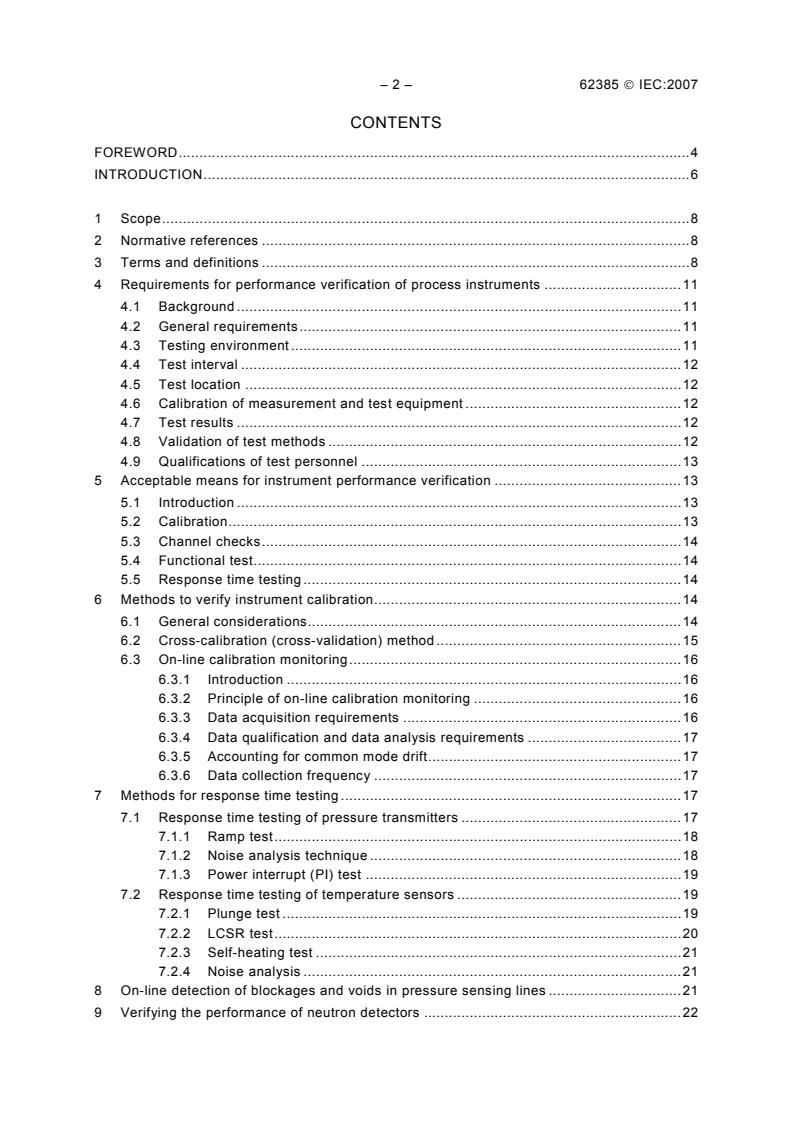
– 2 – 62385 © IEC:2007
CONTENTS
FOREWORD.4
INTRODUCTION.6
1 Scope.8
2 Normative references .8
3 Terms and definitions .8
4 Requirements for performance verification of process instruments .11
4.1 Background .11
4.2 General requirements.11
4.3 Testing environment.11
4.4 Test interval .12
4.5 Test location .12
4.6 Calibration of measurement and test equipment .12
4.7 Test results .12
4.8 Validation of test methods .12
4.9 Qualifications of test personnel .13
5 Acceptable means for instrument performance verification .13
5.1 Introduction .13
5.2 Calibration.13
5.3 Channel checks.14
5.4 Functional test.14
5.5 Response time testing .14
6 Methods to verify instrument calibration.14
6.1 General considerations.14
6.2 Cross-calibration (cross-validation) method .15
6.3 On-line calibration monitoring.16
6.3.1 Introduction .16
6.3.2 Principle of on-line calibration monitoring .16
6.3.3 Data acquisition requirements .16
6.3.4 Data qualification and data analysis requirements .17
6.3.5 Accounting for common mode drift.17
6.3.6 Data collection frequency .17
7 Methods for response time testing .17
7.1 Response time testing of pressure transmitters .17
7.1.1 Ramp test.18
7.1.2 Noise analysis technique .18
7.1.3 Power interrupt (PI) test .19
7.2 Response time testing of temperature sensors .19
7.2.1 Plunge test .19
7.2.2 LCSR test.20
7.2.3 Self-heating test .21
7.2.4 Noise analysis .21
8 On-line detection of blockages and voids in pressure sensing lines .21
9 Verifying the performance of neutron detectors .22
62385 © IEC:2007 – 3 –
Annex A (informative) RTD cross-calibration/cross-validation .23
Annex B (informative) On-line calibration monitoring.28
Annex C (informative) Response time testing techniques for pressure transmitters and
neutron detectors.30
Annex D (informative) Response time testing techniques for RTDs .33
Bibliography.37
– 4 – 62385 © IEC:2007
INTERNATIONAL ELECTROTECHNICAL COMMISSION
____________
NUCLEAR POWER PLANTS –
INSTRUMENTATION AND CONTROL IMPORTANT TO SAFETY –
METHODS FOR ASSESSING THE PERFORMANCE
OF SAFETY SYSTEM INSTRUMENT CHANNELS
FOREWORD
1) The International Electrotechnical Commission (IEC) is a worldwide organization for standardization comprising
all national electrotechnical committees (IEC National Committees). The object of IEC is to promote
international co-operation on all questions concerning standardization in the electrical and electronic fields. To
this end and in addition to other activities, IEC publishes International Standards, Technical Specifications,
Technical Reports, Publicly Available Specifications (PAS) and Guides (hereafter referred to as “IEC
Publication(s)”). Their preparation is entrusted to technical committees; any IEC National Committee interested
in the subject dealt with may participate in this preparatory work. International, governmental and non-
governmental organizations liaising with the IEC also participate in this preparation. IEC collaborates closely
with the International Organization for Standardization (ISO) in accordance with conditions determined by
agreement between the two organizations.
2) The formal decisions or agreements of IEC on technical matters express, as nearly as possible, an international
consensus of opinion on the relevant subjects since each technical committee has representation from all
interested IEC National Committees.
3) IEC Publications have the form of recommendations for international use and are accepted by IEC National
Committees in that sense. While all reasonable efforts are made to ensure that the technical content of IEC
Publications is accurate, IEC cannot be held responsible for the way in which they are used or for any
misinterpretation by any end user.
4) In order to promote international uniformity, IEC National Committees undertake to apply IEC Publications
transparently to the maximum extent possible in their national and regional publications. Any divergence
between any IEC Publication and the corresponding national or regional publication shall be clearly indicated in
the latter.
5) IEC provides no marking procedure to indicate its approval and cannot be rendered responsible for any
equipment declared to be in conformity with an IEC Publication.
6) All users should ensure that they have the latest edition of this publication.
7) No liability shall attach to IEC or its directors, employees, servants or agents including individual experts and
members of its technical committees and IEC National Committees for any personal injury, property damage or
other damage of any nature whatsoever, whether direct or indirect, or for costs (including legal fees) and
expenses arising out of the publication, use of, or reliance upon, this IEC Publication or any other IEC
Publications.
8) Attention is drawn to the Normative references cited in this publication. Use of the referenced publications is
indispensable for the correct application of this publication.
9) Attention is drawn to the possibility that some of the elements of this IEC Publication may be the subject of
patent rights. IEC shall not be held responsible for identifying any or all such patent rights.
International Standard IEC 62385 has been prepared by subcommittee 45A: Instrumentation
and control of nuclear facilities, of IEC technical committee 45: Nuclear instrumentation.
The text of this standard is based on the following documents:
FDIS Report on voting
45A/653/FDIS 45A/661/RVD
Full information on the voting for the approval of this standard can be found in the report on
voting indicated in the above table.
This publication has been drafted in accordance with the ISO/IEC Directives, Part 2.
62385 © IEC:2007 – 5 –
The committee has decided that the contents of this publication will remain unchanged until
the maintenance result date indicated on the IEC web site under "http://webstore.iec.ch" in
the data related to the specific publication. At this date, the publication will be
• reconfirmed,
• withdrawn,
• replaced by a revised edition, or
• amended.
– 6 – 62385 © IEC:2007
INTRODUCTION
a) Technical background, main issues and organisation of the Standard
This International Standard describes test methods for ensuring that safety system instrument
channels in nuclear power plants comply with specifications for accuracy, response time and
other performance characteristics. This Standard applies to those instruments whose primary
sensors measure temperature, pressure, differential pressure, liquid level, flow and neutron
flux. The focus of this Standard is on test methods that can be used remotely while the plant
is on-line without a need to enter the reactor containment or physically access the
instruments.
b) Situation of the current Standard in the structure of the SC 45A standard series
IEC 62385 is the third level SC 45A document tackling the issue of assessing methods of
performance of safety systems instrument channels.
For more details on the structure of the SC 45A standard series, see item d) of this
introduction.
c) Recommendations and limitations regarding the application of this Standard
The main interests to benefit from this international Standard are nuclear utilities that use on-
line performance testing, suppliers who develop and install such systems, and regulatory
authorities seeking documented industry consensus on successful practices. These users will
benefit from the awareness of methods and practices considered appropriate by IEC experts
and from the cost savings associated with the standardization of methods and practices.
d) Description of the structure of the IEC SC 45A standard series and relationships with
other IEC documents and other bodies documents (IAEA, ISO)
The top-level document of the IEC SC 45A standard series is IEC 61513. It provides general
requirements for I&C systems and equipment that are used to perform functions important to
safety in NPPs. IEC 61513 structures the IEC SC 45A standard series.
IEC 61513 refers directly to other IEC SC 45A standards for general topics related to
categorization of functions and classification of systems, qualification, separation of systems,
defence against common cause failure, software aspects of computer-based systems,
hardware aspects of computer-based systems, and control room design. The standards
referenced directly at this second level should be considered together with IEC 61513 as a
consistent document set.
At a third level, IEC SC 45A standards not directly referenced by IEC 61513 are standards
related to specific equipment, technical methods, or specific activities. Usually these
documents, which make reference to second-level documents for general topics, can be used
on their own.
A fourth level extending the IEC SC 45A standard series, corresponds to the Technical
Reports which are not normative.
62385 © IEC:2007 – 7 –
IEC 61513 has adopted a presentation format similar to the basic safety publication
IEC 61508 with an overall safety life-cycle framework and a system life-cycle framework and
provides an interpretation of the general requirements of IEC 61508-1, IEC 61508-2 and
IEC 61508-4, for the nuclear application sector. Compliance with IEC 61513 will facilitate
consistency with the requirements of IEC 61508 as they have been interpreted for the nuclear
industry. In this framework IEC 60880 and IEC 62138 correspond to IEC 61508-3 for the
nuclear application sector.
IEC 61513 refers to ISO as well as to IAEA 50-C-QA (now replaced by IAEA 50-C/SG-Q) for
topics related to quality assurance (QA).
The IEC SC 45A standards series consistently implements and details the principles and
basic safety aspects provided in the IAEA code on the safety of NPPs and in the IAEA safety
series, in particular the Requirements NS-R-1, establishing safety requirements related to the
design of Nuclear Power Plants, and the Safety Guide NS-G-1.3 dealing with instrumentation
and control systems important to safety in Nuclear Power Plants. The terminology and
definitions used by SC 45A standards are consistent with those used by the IAEA.
– 8 – 62385 © IEC:2007
NUCLEAR POWER PLANTS –
INSTRUMENTATION AND CONTROL IMPORTANT TO SAFETY –
METHODS FOR ASSESSING THE PERFORMANCE
OF SAFETY SYSTEM INSTRUMENT CHANNELS
1 Scope
The purpose of this International Standard is to define the requirements for demonstrating
acceptable performance of safety system instrument channels through response time testing,
calibration verification, and other means. The same requirements may be adopted for
demonstrating the acceptable performance of non-safety systems and other instrument
channels. This Standard contains the main topics in its body and includes annexes to provide
further information. The annexes are for information only and contain a selection of the
available methods.
The methods described in this Standard are used to check instrument calibration for accuracy
and time response. It covers direct methods used to set calibration within required tolerances
and indirect methods to indicate a need for a direct calibration. The use of the indirect
methods allows for longer periods between the routine direct calibrations.
2 Normative references
The following referenced documents are indispensable for the application of this document.
For dated references, only the edition cited applies. For undated references, the latest edition
of the referenced document (including any amendments) applies.
IEC 61224:1993, Nuclear reactors – Response time in resistance temperature detectors
(RTD) – In-situ measurements
IEC 62397, Nuclear power plants – Instrumentation and control important for safety –
Resistance Temperature Detectors
3 Terms and definitions
For the purposes of this document, the following terms and definitions apply.
3.1
accuracy of measurement
closeness of the agreement between the result of a measurement and the conventionally true
value of the measurand
[IEV 394-40-35]
3.2
blockage
narrowing of a tube (e.g., pressure sensing line) due to accumulation of contaminants in the
reactor water, solidification of boron, valves that are left partially open, etc. A blockage can
cause a delay in measurement of dynamic pressure information.
62385 © IEC:2007 – 9 –
3.3
calibration
set of operations that establish, under specified conditions, the relationship between values of
quantities indicated by measuring instrument or measuring system, or values represented by
a material measure or a reference material, and the corresponding values realized by
standards
[IEV 394-40-43]
3.4
channel
an arrangement of interconnected components within a system that initiates a single output. A
channel loses its identity where the single-output signals are combined with signals from an-
other channels (e.g. from a monitoring channel or a safety actuation channel).
[IAEA Safety Glossary, Version 2.0, 2006]
3.5
channel check
process by which a plant operator compares the reading of redundant instrument channels on
a regular basis to verify that these are in good agreement according to predefined criteria
3.6
cross-calibration (cross-validation)
a procedure of intercomparing the indications of redundant instruments (e.g., temperature
sensors) to identify outlier sensors as a means of verifying calibration or identifying calibration
changes. A more appropriate term for this definition is “cross-validation,” but, cross-calibration
is more commonly used.
3.7
drift
variation in sensor or instrument channel output that may occur between calibrations that
cannot be related to changes in the process variable or environmental conditions
3.8
impulse line (sensing line)
piping or tubing connecting the process to the sensor; impulse lines/sensing lines are usually
used to connect pressure, level, and flow transmitters to the process. They vary in length from
a few metres to a few hundred metres. Sensing lines may also include isolation and root
valves and other piping hardware along their length.
3.9
in-situ test
test of a sensor or a transmitter that is performed without removing the sensor or transmitter
from its normal installed position in the system
3.10
noise analysis technique
method for in-situ response time testing of sensors, detectors, and transmitters and for on-line
detection of blockages, voids, and leaks in pressure sensing lines
– 10 – 62385 © IEC:2007
3.11
on-line monitoring
continuous or periodic measurement and recording of output of installed instrumentation
3.12
outlier
a sensor such as an RTD that has exceeded a prespecified deviation
3.13
performance monitoring (performance verification)
process of demonstrating that an installed instrument channel continues to perform its
intended function of monitoring the process variable with the expected accuracy, response
time, and stability
3.14
pressure transmitters
pressure, level, and flow transmitters that are based on the principle of pressure or differential
pressure measurement, and are collectively referred to in this Standard as pressure
transmitters, pressure sensors, or just transmitters
3.15
redundancy
provision of alternative (identical or diverse) structures, systems or components, so that any
one can perform the required function regardless of the state of operation or failure of any
other
[IAEA Safety Glossary, Version 2.0, 2006]
3.16
Resistance Temperature Detector (RTD)
detector generally made up of a stainless steel cylindrical barrel protecting a platinum resistor
whose resistance varies with temperature. This detector is placed in the piping containing the
fluid whose temperature is measured in this way. It can be directly immersed in the fluid or
protected by an intermediate casing called the thermowell.
[IEC 62397]
3.17
response time
the period of time necessary for a component to achieve a specified output state from the time
that it receives a signal requiring it to assume that output state
[IAEA Safety Glossary, Version 2.0, 2006]
3.18
test interval
the elapsed time between the initiation of identical tests on the same sensor and signal
processing device, logic assembly or final actuation device
[IEC 60671]
3.19
thermowell
protective jacket for RTDs, thermocouples, and other temperature sensors. The thermowell is
also used to facilitate replacement of the temperature sensor.
62385 © IEC:2007 – 11 –
3.20
time constant
in the case of a first order system, the time required for the output signal of a system to reach
63,2 % of its final variation after a step change of its input signal.
If the system is not first order system, the term "time constant" is not appropriate. For a
system of a higher order, the term "response time" should be used.
[IEC 62397]
4 Requirements for performance verification of process instruments
4.1 Background
The control and safety systems of nuclear power plants depend on process instrumentation
which must provide reliable information to ensure plant safety and efficiency. Therefore, the
performance of this instrumentation should be verified at predefined intervals during the plant
life time. For this purpose, test methods have been developed, validated, and used in nuclear
power plants. These methods include means to perform the tests in-situ and while the plant is
operating (on-line testing).
This clause gives the requirements for in-situ and on-line testing to verify that process
instrumentation provides accurate and timely data and to identify faulty instruments. The
focus of the Standard is on the process sensors that measure temperature, pressure, liquid
level, flow, and neutron flux.
4.2 General requirements
Performance monitoring shall be conducted to verify that the safety system instrument
channels in nuclear power plants are functioning within their performance specification limits.
The tests that verify performance characteristics shall be conducted in accordance with
written procedures, and the test results shall be documented. The instrument channel should
be tested in a single test. When the total channel is not tested in a single test, separate tests
on groups of components or on single components encompassing the total instrument channel
shall be combined to verify total channel performance. Performance monitoring encompasses
the instrument channel portion of the overall safety system. Test boundaries shall include
sensors and transmitters, sensing lines (impulse lines), thermowells, cables, and all other
active and passive components that affect the overall instrument channel performance.
If a performance index such as response cannot be identified exactly, a conservative estimate
of the index shall be made by measurement and analysis and compared against the pertinent
performance requirements to ensure that the performance is acceptable.
4.3 Testing environment
In general, abnormal environmental conditions such as seismic events, radiation fields,
extreme pressures, temperatures, and moisture conditions are covered by design qualification
tests. As such, testing of equipment for such environments is not within the scope of this
Standard. However, the performance testing described in this Standard should be carried out
within the bounds of the instrument’s environmental conditions (e.g., temperature, pressure,
humidity, flow, etc.) If the test conditions vary widely, appropriate corrections shall be made
for comparison or trending of data to compensate for performance due to variation in the
environmental conditions or the effect of the environmental conditions on performance.
– 12 – 62385 © IEC:2007
In some cases, such as response time testing of temperature sensors, process operating
conditions can have a strong influence on the result. In these cases, the tests shall be
performed at or near normal operating conditions to provide the actual “in-service”
performance of the sensors. Extrapolation from laboratory conditions to plant conditions
should not be performed in cases where the extrapolation results can have large and
unquantifiable uncertainties.
4.4 Test interval
The test intervals shall be established to detect unacceptable performance. The following
factors should be considered in determining the test interval:
a) technical specification requirements;
b) regulatory requirements;
c) manufacturer’s recommendation and industry standards;
d) margin between measured performance characteristics and allowable performance limits;
e) rate-of-change of performance characteristics with time; and
f) component failure rates and target reliability.
4.5 Test location
Testing should be performed in-situ to the extent practicable. Instrument removal for testing is
acceptable only if such removal does not affect test results. In most cases of concern in this
Standard, in-situ tests are performed remotely from the instrument cabinet in the control room
area. Procedures shall be implemented to confirm that equipment status is restored after
testing.
4.6 Calibration of measurement and test equipment
The calibration of measurement and test equipment used in verifying equipment performance
characteristics shall be traceable to national standards and/or accepted values of natural
physical phenomena. Written procedures shall be used to perform the calibration and the
results of the calibration shall be documented.
4.7 Test results
The test results shall be compared to the allowable performance limits. Allowances for
uncertainties associated with the performance monitoring test shall be included in the test
results or the establishment of performance limits. If the results are found to exceed the limit,
or the rate of change in the performance characteristics are such that the allowable
performance limits may be exceeded prior to the next test, predetermined action should be
taken to correct the problem.
The accuracy of test results should be stated in terms of a percentage of the reported value or
a ± band around the reported value. This accuracy should be determined from not only the
equipment uncertainties, but also from the uncertainties of the test and analysis techniques
involved. If uncertainties cannot be identified objectively, it should be demonstrated that the
test results are conservative.
4.8 Validation of test methods
All performance monitoring test methods shall be validated. This validation shall be
documented and should address the following considerations:
62385 © IEC:2007 – 13 –
a) Comparison of the test method with suitable laboratory tests, in-situ tests, or both tests to
establish the validity of the method and quantify the accuracy of its results. The accuracy
of the test method and results should be established by theoretical or experimental
means, or both. The accuracy determination should consider all sources of error in the
test method.
b) Theoretical justification for the test method.
c) That the assumptions and conditions to ensure validity of the test method are satisfied.
Furthermore, if the test assumptions are not fully satisfied, it should be demonstrated that
the results that are obtained will nevertheless be conservative.
d) Any software used for data acquisition, data qualification, or data analysis should be
designed and developed using a systematic approach according to accepted industry
standards for software development for nuclear power plants. All software packages
should go through comprehensive verification and validation (V&V) testing. The basis for
the V&V tests and the results of the V&V work should be documented. The V&V tests
should be designed to reveal any problem that can produce invalid or non-conservative
results.
4.9 Qualifications of test personnel
Testing to verify the performance of nuclear power plant instruments shall be performed by
test personnel who have been properly trained by experienced experts with documented
qualification to perform the training. The training of the test personnel shall be documented
and updated periodically. Examples of training topics to qualify the test personnel are:
a) principles of performance verification tests;
b) review of performance test procedures;
c) equipment preparation for data acquisition;
d) training on data acquisition and data analysis software; and
e) interpretation and documentation of results.
5 Acceptable means for instrument performance verification
5.1 Introduction
This clause gives the requirements for calibration, channel checks, functional tests, and
response time testing of process instruments. It is followed by descriptions of methods to
perform instrument calibration and response time testing.
The performance of instruments in nuclear power plants may be established in a laboratory or
by bench testing. The means for laboratory or bench calibration of instruments are well
established and are not addressed in this Standard. Rather, the means for in-situ/on-line
calibration verification of sensors and transmitters are described. Regarding response time
performance of sensors and transmitters, both laboratory/bench testing methods as well as in-
situ/on-line testing methods are described in this Standard.
5.2 Calibration
Instrument calibration utilizes known precision inputs to verify that the instrument produces
the required outputs over the required operational range within specified limits. When
calibration is used for instrument performance verification, the calibration shall be
accomplished or verified through individual application or combination of the following taking
into account previous experience:
– 14 – 62385 © IEC:2007
a) perturbation of the monitored variable;
b) simulation of the monitored variable (this is sometimes referred to as conventional
calibration);
c) on-line monitoring (by redundant and/or diverse parameter comparison); and
d) cross-calibration (also called cross-validation) of redundant sensors.
The focus of this Standard is on the on-line monitoring and cross-calibration/cross-validation
methods.
5.3 Channel checks
Channel checks involving comparison of two or more instrument channels' indications are
intended to verify the continued operability of instrument channels between calibrations.
Consequently, these checks shall be conducted more frequently than calibration. They
generally require no hardware interaction beyond observing or recording the given channel
indication(s).
5.4 Functional test
Functional testing shall be performed to verify that the instrument channel performs its
intended function.
5.5 Response time testing
Response time testing shall be performed at predefined intervals. It may be performed with
the instrumentation either in or out of service. Acceptable methods for response time testing
are identified later in this Standard and further information about these methods is provided in
the annexes. These methods include in-situ tests that can be performed while the plant is on-
line.
Examples of in-situ response time testing methods are the loop current step response (LCSR)
test for RTDs and the noise analysis technique for pressure transmitters and neutron
detectors. For response time testing of thermocouples, either the LCSR test or the noise
analysis technique is used. The noise analysis technique can also be used to monitor for RTD
response time degradation. If response time degradation is identified, then the LCSR test
shall be performed to establish if the RTD response time is acceptable. Detailed requirements
concerning RTD are to be found in IEC 61224 and IEC 62397.
Response time testing of the rest of the instrument channel should also be performed as
required.
Examples of laboratory or bench testing methods are the plunge test for temperature sensors
and the ramp test for pressure sensors.
6 Methods to verify instrument calibration
6.1 General considerations
This Clause is concerned with in-situ/on-line calibration verification of sensors and
transmitters.
62385 © IEC:2007 – 15 –
The calibration of redundant instruments such as primary coolant RTDs in a pressurized water
reactor (PWR) plant can be verified using a method referred to as cross-calibration or cross-
validation. For non-redundant instruments or where redundancy is limited to only a few
instruments, the on-line calibration monitoring approach is used. The requirements for the
cross-calibration method and the on-line calibration monitoring approach are outlined below.
6.2 Cross-calibration (cross-validation) method
The cross-calibration method is typically used for RTDs. Once a group of RTDs is properly
calibrated and installed in a plant, cross-calibration tests shall be performed periodically (e.g.,
once every maintenance cycle) to ensure that the RTD calibrations have not changed beyond
an acceptable limit.
The test involves a systematic comparison of a group of redundant RTDs that are measuring
the same temperature. To perform the test, the resistance of the RTDs should be measured
sequentially and converted to equivalent temperatures using the most recent RTD calibration
tables. Alternatively, the temperature readings of the RTDs should be obtained from the plant
computer or by using a suitable data acquisition system. The temperatures shall then be
averaged and the deviation of each RTD from the average shall be calculated. Any RTD that
has exceeded a prespecified deviation should be called an outlier, flagged and/or removed
from the average, and the process shall be repeated as necessary to identify all outliers.
The test should be performed at several temperatures at isothermal conditions during plant
heat up or cool down periods. With data collected at three or more widely spaced
temperatures, a new calibration table may be generated for an outlier. This approach
essentially amounts to an in-situ calibration of the outlier. For more information, refer to
Annex A.
In performing the cross-calibration/cross-validation tests, a number of factors shall be
accounted for:
a) The test data shall be examined for plant temperature stability to ensure that there are no
excessive temperature fluctuations involved. If excessive plant temperature fluctuations
are involved, analytical corrections shall be applied to the data to minimize fluctuation
effects on the test results.
b) The test data shall be examined for plant temperature uniformity to ensure that various
loops are at the same temperature and redundant sensors are exposed to essentially
equal temperatures. If this is not the case, analytical corrections shall be used to account
for any temperature differences that can affect the results.
c) The uncertainty of the test results shall be determined by combining uncertainties of the
measurement and test equipment as well as the uncertainties due to plant temperature
fluctuations, plant temperature non-uniformity, and any precision error that may be
involved.
The cross-calibration method described above can also be used to verify the calibration of
thermocouples. For this application, the reading of each thermocouple shall be compared with
the average of RTDs. Thermocouples should not be cross calibrated together. They should be
cross-calibrated against the average reading of redundant RTDs that measure the same
temperature.
– 16 – 62385 © IEC:2007
The acceptance criteria for an RTD to pass the cross-calibration test depends on the plant.
The plant procedure shall identify the acceptance criteria based on the plant accuracy
requirements for temperature sensors. Typically, an RTD is accepted if its deviation is less
than ± 0,3 ºC from the average temperature. For thermocouples, typical acceptance criteria is
± 1,0 ºC.
6.3 On-line calibration monitoring
6.3.1 Introduction
The cross-calibration technique described above may be used when there are redundant
instruments (e.g., six or more). When there are not enough redundant instruments, on-line
calibration monitoring should be used to verify the calibration of instruments.
The principle of on-line calibration monitoring is described below and the details are covered
in Annex B. On-line calibration monitoring is applicable to most instruments and can be used
to verify the calibration of sensors and transmitters or an entire instrument channel. In
particular, on-line calibration monitoring is useful for pressure, level, and flow transmitters. As
such, the requirements for on-line calibration monitoring in this Standard are provided based
on pressure, level, and flow transmitters. Pressure, level, and flow transmitters are
collectively referred to as pressure transmitters or just transmitters.
6.3.2 Principle of on-line calibration monitoring
The calibration of nuclear power plant pressure transmitters typically involves two steps:
a) Determine if calibration is needed. This step is performed by providing the instrument with
a series of known inputs covering the operating range of the instrument. The output is
recorded for each input and compared with the acceptance criteria.
b) Calibrate if needed. If the instrument does not meet its acceptance criteria, it is calibrated
by making necessary adjustments.
The first step can be automated and performed while the plant is operating. This approach
may be used to verify instrument calibration or extend the calibration interval of instruments. It
is referred to as on-line calibration monitoring, on-line calibration testing, or on-line drift
monitoring.
6.3.3 Data acquisition requirements
To perform on-line calibration monitoring, the output of instruments should be recorded
continuously or periodically to identify drift, bias errors, noise, and other anomalies. The data
for on-line calibration monitoring may be obtained from the plant computer, a dedicated data
acquisition system, or other means. Data should be collected during plant startup and/or
shutdown periods to allow the calibration of instruments to be verified throughout their
operating range. The calibration of the data acquisition equipment shall be established and
documented. This calibration shall be traceable to applicable quality assurance requirements.
62385 © IEC:2007 – 17 –
6.3.4 Data qualification and data analysis requirements
The on-line monitoring data should be screened (qualified) to ensure that extraneous
information is not used for calibration verification of instruments. Examples of data screening
methods are filtering and amplitude probability density (APD) tests. Following data
qualification, an analysis shall be performed involving averaging and/or modeling techniques
as necessary to estimate the value of the process that is being monitored. The estimated
...