

IEC 61215-1-3:2021
(Main)Terrestrial photovoltaic (PV) modules - Design qualification and type approval - Part 1-3: Special requirements for testing of thin-film amorphous silicon based photovoltaic (PV) modules
General Information
- Abstract
IEC 61215-1-3:2021 lays down requirements for the design qualification of terrestrial photovoltaic modules suitable for long-term operation in open-air climates. The useful service life of modules so qualified will depend on their design, their environment and the conditions under which they are operated. Test results are not construed as a quantitative prediction of module lifetime. This document is intended to apply to all thin-film amorphous silicon (a-Si; a-Si/µc-Si) based terrestrial flat plate modules. As such, it addresses special requirements for testing of this technology supplementing IEC 61215-1:2021 and IEC 61215-2:2021 requirements for testing. This second edition cancels and replaces the first edition of IEC 61215-1-3, issued in 2016. This edition includes the following significant technical changes with respect to the previous edition:
a. A cyclic (dynamic) mechanical load test (MQT 20) added.
b. A test for detection of potential-induced degradation (MQT 21) added.
c. A bending test (MQT 22) for flexible modules.
- Status
- Published
- Publication Date
- 27-Mar-2022
- Technical Committee
- TC 82 - Solar photovoltaic energy systems
- Drafting Committee
- WG 2 - TC 82/WG 2
- Current Stage
- PPUB - Publication issued
- Start Date
- 23-Feb-2021
- Completion Date
- 05-Mar-2021
Buy Documents
IEC 61215-1-3:2021 RLV - Terrestrial photovoltaic (PV) modules - Design qualification and type approval - Part 1-3: Special requirements for testing of thin-film amorphous silicon based photovoltaic (PV) modules Released:2/23/2021
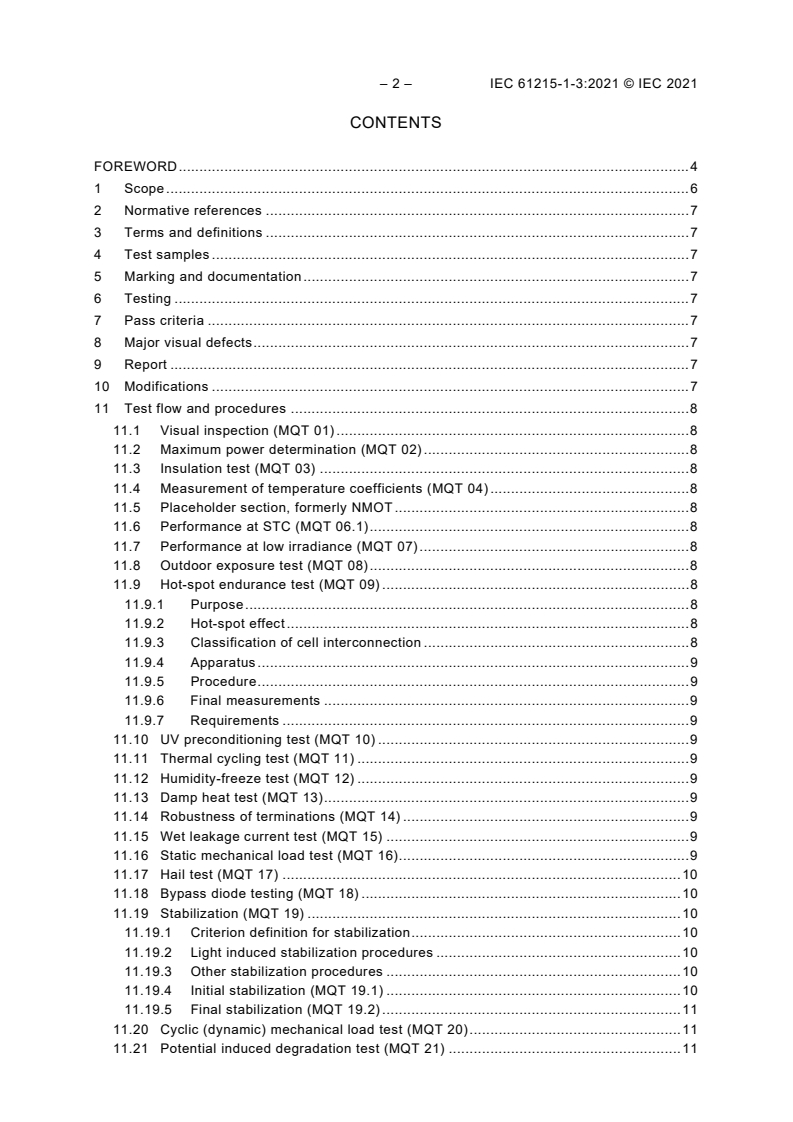
IEC 61215-1-3:2021 - Terrestrial photovoltaic (PV) modules - Design qualification and type approval - Part 1-3: Special requirements for testing of thin-film amorphous silicon based photovoltaic (PV) modules Released:2/23/2021

IEC 61215-1-3:2021+AMD1:2022 CSV - Terrestrial photovoltaic (PV) modules - Design qualification and type approval - Part 1-3: Special requirements for testing of thin-film amorphous silicon based photovoltaic (PV) modules Released:3/28/2022
Overview - IEC 61215-1-3:2021 (thin-film a‑Si PV modules)
IEC 61215-1-3:2021 is a technology-specific part of the IEC 61215 series that defines design qualification and type approval requirements for terrestrial flat‑plate photovoltaic (PV) modules based on thin‑film amorphous silicon (a‑Si; a‑Si/µc‑Si). It supplements the general procedures in IEC 61215-1:2021 and IEC 61215-2:2021, describing special test modifications and additional module‑level tests needed to evaluate long‑term performance in open‑air climates. This second edition (2021) replaces the 2016 edition and introduces new mechanical and degradation tests while clarifying stabilization procedures for thin‑film modules.
Key topics and technical requirements
- Scope: Applies to terrestrial thin‑film a‑Si flat plate modules; excludes high‑concentration systems (low concentration 1–3 suns may be accommodated with adjusted test conditions).
- Design qualification objective: Use accelerated tests to reveal failure modes and verify module robustness; test results are not a quantitative lifetime prediction.
- Test flow and MQT procedures: Adapts standard IEC MQT sequence (visual inspection, maximum power, insulation, temperature coefficients, STC/NMOT performance, low irradiance, outdoor exposure, UV, thermal cycling, damp heat, humidity‑freeze, hot‑spot, hail, bypass diode, stabilization, etc.) with thin‑film‑specific requirements.
- New and notable tests (Edition 2.0):
- MQT 20 - Cyclic (dynamic) mechanical load test: evaluates fatigue under repeated mechanical loading.
- MQT 21 - Potential‑Induced Degradation (PID) detection test: screens thin‑film modules for susceptibility to PID.
- MQT 22 - Bending test: introduced for flexible thin‑film modules.
- Stabilization (MQT 19): Special procedures for stabilizing output of a‑Si modules prior to key measurements.
- Pass criteria & reporting: Pass/fail rules follow IEC 61215-1 with technology adjustments; detailed reporting and documentation requirements are specified.
Applications and who uses it
This standard is used by:
- PV module manufacturers (product development, type approval)
- Independent test laboratories and certification bodies (qualification testing, compliance)
- Procurement teams and system integrators (specification and acceptance testing)
- R&D and reliability engineers evaluating thin‑film a‑Si durability and failure modes
Practical uses include qualifying modules for warranties, validating new flexible thin‑film designs, screening for PID susceptibility, and verifying mechanical fatigue resistance in field‑like conditions.
Related standards and references
- IEC 61215-1:2021 and IEC 61215-2:2021 (general design qualification and test methods)
- IEC 60721-2-1 (climate classification)
- IEC 62506 (accelerated test methods overview)
- IEC TS 63126 (high‑temperature test considerations)
- IEC 62941 (quality systems in PV manufacturing)
- IEC 63163 (consumer electronics PV testing - under development)
Keywords: IEC 61215-1-3:2021, thin‑film amorphous silicon, a‑Si PV modules, PV module testing, design qualification, type approval, PID, cyclic mechanical load test, bending test, accelerated durability testing.
Relations
- Effective Date
- 05-Sep-2023
- Effective Date
- 05-Sep-2023
Buy Documents
IEC 61215-1-3:2021 RLV - Terrestrial photovoltaic (PV) modules - Design qualification and type approval - Part 1-3: Special requirements for testing of thin-film amorphous silicon based photovoltaic (PV) modules Released:2/23/2021
IEC 61215-1-3:2021 - Terrestrial photovoltaic (PV) modules - Design qualification and type approval - Part 1-3: Special requirements for testing of thin-film amorphous silicon based photovoltaic (PV) modules Released:2/23/2021
IEC 61215-1-3:2021+AMD1:2022 CSV - Terrestrial photovoltaic (PV) modules - Design qualification and type approval - Part 1-3: Special requirements for testing of thin-film amorphous silicon based photovoltaic (PV) modules Released:3/28/2022
Get Certified
Connect with accredited certification bodies for this standard

DNV
DNV is an independent assurance and risk management provider.

Lloyd's Register
Lloyd's Register is a global professional services organisation specialising in engineering and technology.
DNV Energy Systems
Energy and renewable energy certification.
Sponsored listings
Frequently Asked Questions
IEC 61215-1-3:2021 is a standard published by the International Electrotechnical Commission (IEC). Its full title is "Terrestrial photovoltaic (PV) modules - Design qualification and type approval - Part 1-3: Special requirements for testing of thin-film amorphous silicon based photovoltaic (PV) modules". This standard covers: IEC 61215-1-3:2021 lays down requirements for the design qualification of terrestrial photovoltaic modules suitable for long-term operation in open-air climates. The useful service life of modules so qualified will depend on their design, their environment and the conditions under which they are operated. Test results are not construed as a quantitative prediction of module lifetime. This document is intended to apply to all thin-film amorphous silicon (a-Si; a-Si/µc-Si) based terrestrial flat plate modules. As such, it addresses special requirements for testing of this technology supplementing IEC 61215-1:2021 and IEC 61215-2:2021 requirements for testing. This second edition cancels and replaces the first edition of IEC 61215-1-3, issued in 2016. This edition includes the following significant technical changes with respect to the previous edition: a. A cyclic (dynamic) mechanical load test (MQT 20) added. b. A test for detection of potential-induced degradation (MQT 21) added. c. A bending test (MQT 22) for flexible modules.
IEC 61215-1-3:2021 lays down requirements for the design qualification of terrestrial photovoltaic modules suitable for long-term operation in open-air climates. The useful service life of modules so qualified will depend on their design, their environment and the conditions under which they are operated. Test results are not construed as a quantitative prediction of module lifetime. This document is intended to apply to all thin-film amorphous silicon (a-Si; a-Si/µc-Si) based terrestrial flat plate modules. As such, it addresses special requirements for testing of this technology supplementing IEC 61215-1:2021 and IEC 61215-2:2021 requirements for testing. This second edition cancels and replaces the first edition of IEC 61215-1-3, issued in 2016. This edition includes the following significant technical changes with respect to the previous edition: a. A cyclic (dynamic) mechanical load test (MQT 20) added. b. A test for detection of potential-induced degradation (MQT 21) added. c. A bending test (MQT 22) for flexible modules.
IEC 61215-1-3:2021 is classified under the following ICS (International Classification for Standards) categories: 27.160 - Solar energy engineering. The ICS classification helps identify the subject area and facilitates finding related standards.
IEC 61215-1-3:2021 has the following relationships with other standards: It is inter standard links to IEC 61215-1-3:2021/AMD1:2022, IEC 61215-1-3:2016. Understanding these relationships helps ensure you are using the most current and applicable version of the standard.
IEC 61215-1-3:2021 is available in PDF format for immediate download after purchase. The document can be added to your cart and obtained through the secure checkout process. Digital delivery ensures instant access to the complete standard document.
Standards Content (Sample)
IEC 61215-1-3 ®
Edition 2.0 2021-02
REDLINE VERSION
INTERNATIONAL
STANDARD
colour
inside
Terrestrial photovoltaic (PV) modules – Design qualification and type approval –
Part 1-3: Special requirements for testing of thin-film amorphous silicon based
photovoltaic (PV) modules
All rights reserved. Unless otherwise specified, no part of this publication may be reproduced or utilized in any form
or by any means, electronic or mechanical, including photocopying and microfilm, without permission in writing from
either IEC or IEC's member National Committee in the country of the requester. If you have any questions about IEC
copyright or have an enquiry about obtaining additional rights to this publication, please contact the address below or
your local IEC member National Committee for further information.
IEC Central Office Tel.: +41 22 919 02 11
3, rue de Varembé info@iec.ch
CH-1211 Geneva 20 www.iec.ch
Switzerland
About the IEC
The International Electrotechnical Commission (IEC) is the leading global organization that prepares and publishes
International Standards for all electrical, electronic and related technologies.
About IEC publications
The technical content of IEC publications is kept under constant review by the IEC. Please make sure that you have the
latest edition, a corrigendum or an amendment might have been published.
IEC publications search - webstore.iec.ch/advsearchform IEC online collection - oc.iec.ch
The advanced search enables to find IEC publications by a Discover our powerful search engine and read freely all the
variety of criteria (reference number, text, technical publications previews. With a subscription you will always
committee, …). It also gives information on projects, replaced have access to up to date content tailored to your needs.
and withdrawn publications.
Electropedia - www.electropedia.org
IEC Just Published - webstore.iec.ch/justpublished
The world's leading online dictionary on electrotechnology,
Stay up to date on all new IEC publications. Just Published
containing more than 22 000 terminological entries in English
details all new publications released. Available online and
and French, with equivalent terms in 18 additional languages.
once a month by email.
Also known as the International Electrotechnical Vocabulary
(IEV) online.
IEC Customer Service Centre - webstore.iec.ch/csc
If you wish to give us your feedback on this publication or
need further assistance, please contact the Customer Service
Centre: sales@iec.ch.
IEC 61215-1-3 ®
Edition 2.0 2021-02
REDLINE VERSION
INTERNATIONAL
STANDARD
colour
inside
Terrestrial photovoltaic (PV) modules – Design qualification and type approval –
Part 1-3: Special requirements for testing of thin-film amorphous silicon based
photovoltaic (PV) modules
INTERNATIONAL
ELECTROTECHNICAL
COMMISSION
ICS 27.160 ISBN 978-2-8322-9488-8
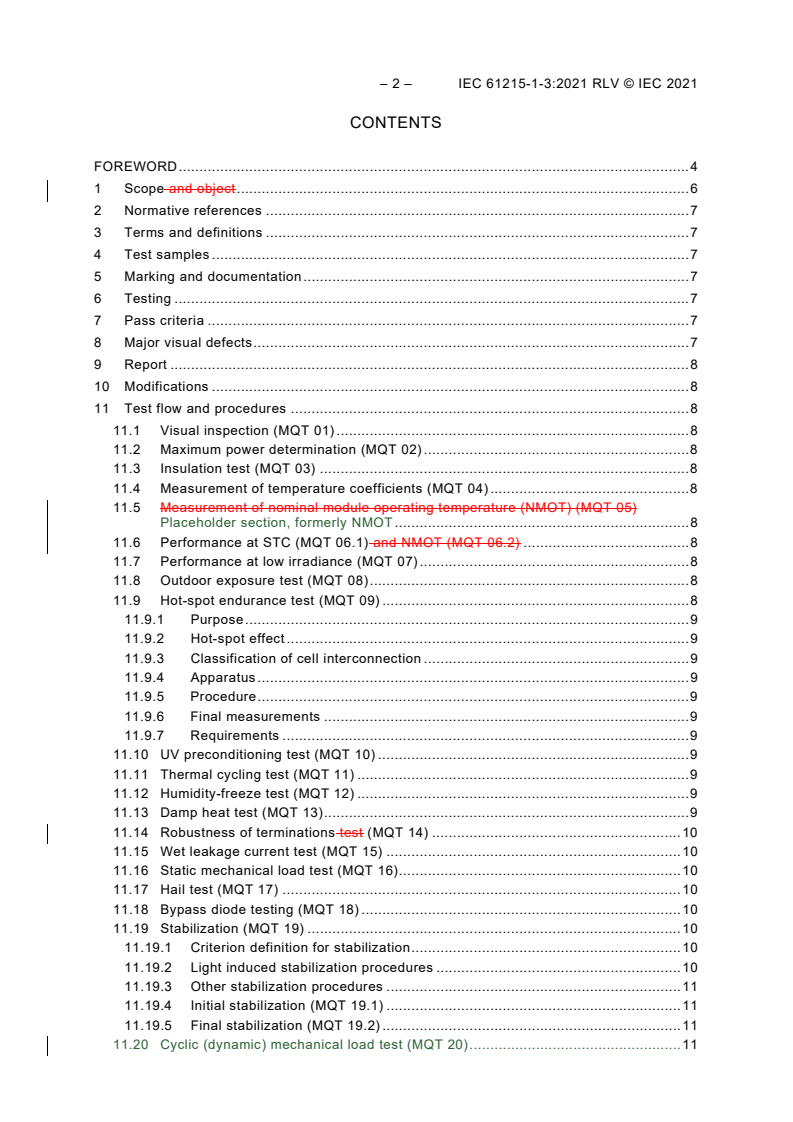
– 2 – IEC 61215-1-3:2021 RLV © IEC 2021
CONTENTS
FOREWORD . 4
1 Scope and object . 6
2 Normative references . 7
3 Terms and definitions . 7
4 Test samples . 7
5 Marking and documentation . 7
6 Testing . 7
7 Pass criteria . 7
8 Major visual defects . 7
9 Report . 8
10 Modifications . 8
11 Test flow and procedures . 8
11.1 Visual inspection (MQT 01) . 8
11.2 Maximum power determination (MQT 02) . 8
11.3 Insulation test (MQT 03) . 8
11.4 Measurement of temperature coefficients (MQT 04) . 8
11.5 Measurement of nominal module operating temperature (NMOT) (MQT 05)
Placeholder section, formerly NMOT . 8
11.6 Performance at STC (MQT 06.1) and NMOT (MQT 06.2) . 8
11.7 Performance at low irradiance (MQT 07) . 8
11.8 Outdoor exposure test (MQT 08) . 8
11.9 Hot-spot endurance test (MQT 09) . 8
11.9.1 Purpose . 9
11.9.2 Hot-spot effect . 9
11.9.3 Classification of cell interconnection . 9
11.9.4 Apparatus . 9
11.9.5 Procedure . 9
11.9.6 Final measurements . 9
11.9.7 Requirements . 9
11.10 UV preconditioning test (MQT 10) . 9
11.11 Thermal cycling test (MQT 11) . 9
11.12 Humidity-freeze test (MQT 12) . 9
11.13 Damp heat test (MQT 13) . 9
11.14 Robustness of terminations test (MQT 14) . 10
11.15 Wet leakage current test (MQT 15) . 10
11.16 Static mechanical load test (MQT 16) . 10
11.17 Hail test (MQT 17) . 10
11.18 Bypass diode testing (MQT 18) . 10
11.19 Stabilization (MQT 19) . 10
11.19.1 Criterion definition for stabilization . 10
11.19.2 Light induced stabilization procedures . 10
11.19.3 Other stabilization procedures . 11
11.19.4 Initial stabilization (MQT 19.1) . 11
11.19.5 Final stabilization (MQT 19.2) . 11
11.20 Cyclic (dynamic) mechanical load test (MQT 20) . 11
11.21 Potential induced degradation test (MQT 21) . 11
11.22 Bending test (MQT 22) . 11
– 4 – IEC 61215-1-3:2021 RLV © IEC 2021
INTERNATIONAL ELECTROTECHNICAL COMMISSION
____________
TERRESTRIAL PHOTOVOLTAIC (PV) MODULES –
DESIGN QUALIFICATION AND TYPE APPROVAL –
Part 1-3: Special requirements for testing of thin-film
amorphous silicon based photovoltaic (PV) modules
FOREWORD
1) The International Electrotechnical Commission (IEC) is a worldwide organization for standardization comprising
all national electrotechnical committees (IEC National Committees). The object of IEC is to promote
international co-operation on all questions concerning standardization in the electrical and electronic fields. To
this end and in addition to other activities, IEC publishes International Standards, Technical Specifications,
Technical Reports, Publicly Available Specifications (PAS) and Guides (hereafter referred to as "IEC
Publication(s)"). Their preparation is entrusted to technical committees; any IEC National Committee interested
in the subject dealt with may participate in this preparatory work. International, governmental and non-
governmental organizations liaising with the IEC also participate in this preparation. IEC collaborates closely
with the International Organization for Standardization (ISO) in accordance with conditions determined by
agreement between the two organizations.
2) The formal decisions or agreements of IEC on technical matters express, as nearly as possible, an international
consensus of opinion on the relevant subjects since each technical committee has representation from all
interested IEC National Committees.
3) IEC Publications have the form of recommendations for international use and are accepted by IEC National
Committees in that sense. While all reasonable efforts are made to ensure that the technical content of IEC
Publications is accurate, IEC cannot be held responsible for the way in which they are used or for any
misinterpretation by any end user.
4) In order to promote international uniformity, IEC National Committees undertake to apply IEC Publications
transparently to the maximum extent possible in their national and regional publications. Any divergence
between any IEC Publication and the corresponding national or regional publication shall be clearly indicated in
the latter.
5) IEC itself does not provide any attestation of conformity. Independent certification bodies provide conformity
assessment services and, in some areas, access to IEC marks of conformity. IEC is not responsible for any
services carried out by independent certification bodies.
6) All users should ensure that they have the latest edition of this publication.
7) No liability shall attach to IEC or its directors, employees, servants or agents including individual experts and
members of its technical committees and IEC National Committees for any personal injury, property damage or
other damage of any nature whatsoever, whether direct or indirect, or for costs (including legal fees) and
expenses arising out of the publication, use of, or reliance upon, this IEC Publication or any other IEC
Publications.
8) Attention is drawn to the Normative references cited in this publication. Use of the referenced publications is
indispensable for the correct application of this publication.
9) Attention is drawn to the possibility that some of the elements of this IEC Publication may be the subject of
patent rights. IEC shall not be held responsible for identifying any or all such patent rights.
This redline version of the official IEC Standard allows the user to identify the changes made to
the previous edition IEC 61215-1-3:2016. A vertical bar appears in the margin wherever a
change has been made. Additions are in green text, deletions are in strikethrough red text.
International Standard IEC 61215-1-3 has been prepared by IEC technical committee 82:
Solar photovoltaic energy systems.
This second edition cancels and replaces the first edition of IEC 61215-1-3, issued in 2016,
and constitutes a technical revision.
This edition includes the following significant technical changes with respect to the previous
edition:
a) A cyclic (dynamic) mechanical load test (MQT 20) added.
b) A test for detection of potential-induced degradation (MQT 21) added.
c) A bending test (MQT 22) for flexible modules.
Informative Annex A of 61215-1:2021 explains the background and reasoning behind some of
the more substantial changes that were made in the IEC 61215 series in progressing from
edition 1 to edition 2.
The text of this standard is based on the following documents:
FDIS Report on voting
82/1826/FDIS 82/1851/RVD
Full information on the voting for the approval of this International Standard can be found in
the report on voting indicated in the above table.
This document has been drafted in accordance with the ISO/IEC Directives, Part 2.
This standard is to be read in conjunction with IEC 61215-1:2021 and IEC 61215-2:2021.
A list of all parts in the IEC 61215 series, published under the general title Terrestrial
photovoltaic (PV) modules – Design qualification and type approval, can be found on the IEC
website.
The committee has decided that the contents of this document will remain unchanged until the
stability date indicated on the IEC website under "http://webstore.iec.ch" in the data related to
the specific document. At this date, the document will be
• reconfirmed,
• withdrawn,
• replaced by a revised edition, or
• amended.
IMPORTANT – The 'colour inside' logo on the cover page of this publication indicates that it
contains colours which are considered to be useful for the correct understanding of its
contents. Users should therefore print this document using a colour printer.
– 6 – IEC 61215-1-3:2021 RLV © IEC 2021
TERRESTRIAL PHOTOVOLTAIC (PV) MODULES –
DESIGN QUALIFICATION AND TYPE APPROVAL –
Part 1-3: Special requirements for testing of thin-film
amorphous silicon based photovoltaic (PV) modules
1 Scope and object
This part of IEC 61215 lays down IEC requirements for the design qualification and type
approval of terrestrial photovoltaic modules suitable for long-term operation in general open-
air climates, as defined in IEC 60721-2-1.
This document lays down requirements for the design qualification of terrestrial photovoltaic
modules suitable for long-term operation in open-air climates. The useful service life of
modules so qualified will depend on their design, their environment and the conditions under
which they are operated. Test results are not construed as a quantitative prediction of module
lifetime.
th
In climates where 98 percentile operating temperatures exceed 70 °C, users are
recommended to consider testing to higher temperature test conditions as described in
IEC TS 63126. Users desiring qualification of PV products with lesser lifetime expectations
are recommended to consider testing designed for PV in consumer electronics, as described
in IEC 63163 (under development). Users wishing to gain confidence that the characteristics
tested in IEC 61215 appear consistently in a manufactured product may wish to utilize
IEC 62941 regarding quality systems in PV manufacturing.
This document is intended to apply to all thin-film amorphous silicon (a-Si; a-Si/µc-Si) based
terrestrial flat plate modules. As such, it addresses special requirements for testing of this
technology supplementing IEC 61215-1:20162021 and IEC 61215-2:20162021 requirements
for testing.
This document does not apply to modules used with concentrated sunlight although it may be
utilized for low concentrator modules (1 to 3 suns). For low concentration modules, all tests
are performed using the irradiance, current, voltage and power levels expected at the design
concentration.
The object of this test sequence is to determine the electrical and thermal characteristics of
the module and to show, as far as possible within reasonable constraints of cost and time,
that the module is capable of withstanding prolonged exposure in climates described in the
scope. The actual lifetime expectancy of modules so qualified will depend on their design,
their environment and the conditions under which they are operated.
The object of this test sequence is to determine the electrical characteristics of the module
and to show, as far as possible within reasonable constraints of cost and time, that the
module is capable of withstanding prolonged exposure outdoors. Accelerated test conditions
are empirically based on those necessary to reproduce selected observed field failures and
are applied equally across module types. Acceleration factors may vary with product design
and thus not all degradation mechanisms may manifest. Further general information on
accelerated test methods including definitions of terms may be found in IEC 62506.
Some long-term degradation mechanisms can only reasonably be detected via component
testing, due to long times required to produce the failure and necessity of stress conditions
that are expensive to produce over large areas. Component tests that have reached a
sufficient level of maturity to set pass/fail criteria with high confidence are incorporated into
the IEC 61215 series via addition to Table 1 in IEC 61215-1. In contrast, the tests procedures
described in this series, in IEC 61215-2, are performed on modules.
This document defines PV technology dependent modifications to the testing procedures and
requirements per IEC 61215-1:20162021 and IEC 61215-2:20162021.
2 Normative references
The normative references of IEC 61215-1:20162021 and IEC 61215-2:20162021 are
applicable without modifications.
3 Terms and definitions
This clause of IEC 61215-1:20162021 is applicable without modifications.
4 Test samples
This clause of IEC 61215-1:20162021 is applicable without modifications.
5 Marking and documentation
This clause of IEC 61215-1:20162021 is applicable without modifications.
6 Testing
This clause of IEC 61215-1:20162021 is applicable with the following modifications:
Special care has to be taken for stabilizing the power output of the module using MQT 19
procedure with specific requirements stated in 11.19 below.
7 Pass criteria
This clause of IEC 61215-1:20162021 is applicable with the following modifications:
The maximum allowable value of reproducibility is set to r = 2,0 %.
The maximum allowable value of measurement uncertainty is set to m1 = 4,0 % for modules
containing single-junction cells, and m = 5,0 % for modules containing multi-junction cells.
8 Major visual defects
This clause of IEC 61215-1:20162021 is applicable without modifications.
– 8 – IEC 61215-1-3:2021 RLV © IEC 2021
9 Report
This clause of IEC 61215-1:20162021 is applicable without modifications.
10 Modifications
This clause of IEC 61215-1:20162021 is applicable without modifications.
11 Test flow and procedures
The test flow from IEC 61215-1:20162021 is applicable.
11.1 Visual inspection (MQT 01)
This test of IEC 61215-2:20162021 is applicable without modifications.
11.2 Maximum power determination (MQT 02)
This test of IEC 61215-2:20162021 is applicable without modifications.
11.3 Insulation test (MQT 03)
This test of IEC 61215-2:20162021 is applicable without modifications.
11.4 Measurement of temperature coefficients (MQT 04)
This test of IEC 61215-2:20162021 is applicable without modifications.
11.5 Measurement of nominal module operating temperature (NMOT) (MQT 05)
Placeholder section, formerly NMOT
This test of IEC 61215-2:2016 is applicable without modifications.
This subclause of IEC 61215-2:2021 does not require technology-specific modifications.
11.6 Performance at STC (MQT 06.1) and NMOT (MQT 06.2)
This test of IEC 61215-2:20162021 is applicable without modifications.
11.7 Performance at low irradiance (MQT 07)
This test of IEC 61215-2:20162021 is applicable without modifications.
11.8 Outdoor exposure test (MQT 08)
This test of IEC 61215-2:20162021 is applicable without modifications.
11.9 Hot-spot endurance test (MQT 09)
This test of IEC 61215-2:2016 is applicable with the following modifications:
This subclause of IEC 61215-2:2021, test MQT 09, is applicable without modifications.
11.9.1 Purpose
This subclause of IEC 61215-2:20162021, test MQT 09, is applicable without modifications.
11.9.2 Hot-spot effect
This subclause of IEC 61215-2:20162021, test MQT 09, is applicable without modifications.
11.9.3 Classification of cell interconnection
This subclause of IEC 61215-2:20162021, test MQT 09, is applicable without modifications.
11.9.4 Apparatus
This subclause of IEC 61215-2:20162021, test MQT 09, is applicable without modifications.
11.9.5 Procedure
MQT 09.2 of IEC 61215-2:20162021 shall be performed for any MLI module design.
If the module is constructed by interconnection of cell-like substructures, MQT 09.1 of
IEC 61215-2:20162021 may be applicable.
11.9.6 Final measurements
This subclause of IEC 61215-2:20162021, test MQT 09, is applicable without modifications.
11.9.7 Requirements
This subclause of IEC 61215-2:20162021, test MQT 09, is applicable without modifications.
11.10 UV preconditioning test (MQT 10)
This test of IEC 61215-2:20162021 is applicable without modifications.
11.11 Thermal cycling test (MQT 11)
This test of IEC 61215-2:20162021 is applicable with the following modifications:
The technology specific current which needs to be applied according to MQT 11 of
IEC 61215-2:20162021 shall be equal to 0,1 × STC peak power current. If 0,1 × STC peak
power current is less than 100 mA, then 100 mA may be applied instead.
11.12 Humidity-freeze test (MQT 12)
This test of IEC 61215-2:20162021 is applicable without modifications.
11.13 Damp heat test (MQT 13)
This test of IEC 61215-2:20162021 is applicable without modifications.
– 10 – IEC 61215-1-3:2021 RLV © IEC 2021
11.14 Robustness of terminations test (MQT 14)
This test of IEC 61215-2:20162021 is applicable without modifications.
11.15 Wet leakage current test (MQT 15)
This test of IEC 61215-2:20162021 is applicable without modifications.
11.16 Static mechanical load test (MQT 16)
This test of IEC 61215-2:20162021 is applicable without modifications.
11.17 Hail test (MQT 17)
This test of IEC 61215-2:20162021 is applicable without modifications.
11.18 Bypass diode testing (MQT 18)
This test of IEC 61215-2:20162021 is applicable without modifications.
11.19 Stabilization (MQT 19)
This test of IEC 61215-2:20162021 is applicable with the following modifications:
Amorphous silicon based thin-film PV modules shall only be stabilized through indoor light
soaking. Due to the non-controllable outdoor conditions, an outdoor method is considered not
to deliver reproducible results.
11.19.1 Criterion definition for stabilization
For the definition of stabilization as per MQT 19 of IEC 61215-2:20162021 x = 0,02 shall be
used.
Any kind of storage shall be done at temperature below 25 °C to avoid thermally activated
processes affecting MQT 06.1 of IEC 61215-2:20162021 measurement.
11.19.2 Light induced stabilization procedures
This test of IEC 61215-2:20162021 is applicable with the following modifications.
11.19.2.1 Apparatus for indoor stabilization
In IEC 61215-2:20162021, 4.19.3.1 replace item d) with: "Use the reference device to set the
2 2
irradiance between 600 W/m and 1 000 W/m . Record the irradiance."
In IEC 61215-2:20162021, 4.19.3.1 replace item e) with: "During the simulator exposure, the
module temperature shall stay below 55 °C."
NOTE Most a-Si containing active layers are known to anneal at module temperatures above 55 °C very quickly.
11.19.2.2 Requirements for outdoor exposure for stabilization
This test of IEC 61215-2:20162021 is not applicable.
11.19.3 Other stabilization procedures
At present no alternative stabilization methods are applicable.
11.19.4 Initial stabilization (MQT 19.1)
Initial stabilization is performed on all modules.
Initial stabilization shall be obtained by exposing the modules to simulated sunlight.
To fulfil MQT 19 requirements using light exposure, a minimum of two intervals each of at
least 43 kWh/m are required. After this preconditioning all of the test modules shall be
measured for STC power (MQT 06.1 of IEC 61215-2:20162021).
Output power determination shall be performed after a minimum cooling time of 30 min.
2 2
NOTE Exposure doses of 200 kWh/m to 400 kWh/m are typically necessary to reach
stabilization of amorphous silicon thin-film modules.
A validated alternative procedure can be used in accordance to MQT 19 of IEC 61215-2:2016.
11.19.5 Final stabilization (MQT 19.2)
Final stabilization is performed on all modules after the test sequences to prove fulfilment of
Gate No. 2 requirement of IEC 61215-1:20162021.
To fulfil MQT 19 requirements a minimum of two intervals of at least 43 kWh/m each are
required.
2 2
NOTE Exposure doses of 200 kWh/m to 400 kWh/m are typically necessary to reach
stabilization of amorphous silicon thin-film modules.
For modules that have been subjected to potential induced degradation (PID) stress (MQT 21),
the maximum exposure limit after reaching stabilization shall not be exceeded. The light soak
shall terminate no more than 86 kWh/m after the stabilization criterion is met.
Output power determination shall be performed after a minimum cooling time of 30 min.
A validated alternative procedure can be used in accordance to MQT 19 of IEC 61215-2:2016.
11.20 Cyclic (dynamic) mechanical load test (MQT 20)
This test of IEC 61215-2:2021 is applicable without modifications.
11.21 Potential induced degradation test (MQT 21)
This test of IEC 61215-2 is applicable without modifications.
11.22 Bending test (MQT 22)
This test of IEC 61215-2:2021 is applicable to flexible modules without modifications.
– 12 – IEC 61215-1-3:2021 RLV © IEC 2021
___________
IEC 61215-1-3 ®
Edition 2.0 2021-02
INTERNATIONAL
STANDARD
NORME
INTERNATIONALE
Terrestrial photovoltaic (PV) modules – Design qualification and type approval –
Part 1-3: Special requirements for testing of thin-film amorphous silicon based
photovoltaic (PV) modules
Modules photovoltaïques (PV) pour applications terrestres – Qualification de la
conception et homologation –
Partie 1-3: Exigences particulières d'essai des modules photovoltaïques (PV)
au silicium amorphe à couches minces
– 2 – IEC 61215-1-3:2021 © IEC 2021
CONTENTS
FOREWORD . 4
1 Scope . 6
2 Normative references . 7
3 Terms and definitions . 7
4 Test samples . 7
5 Marking and documentation . 7
6 Testing . 7
7 Pass criteria . 7
8 Major visual defects . 7
9 Report . 7
10 Modifications . 7
11 Test flow and procedures . 8
11.1 Visual inspection (MQT 01) . 8
11.2 Maximum power determination (MQT 02) . 8
11.3 Insulation test (MQT 03) . 8
11.4 Measurement of temperature coefficients (MQT 04) . 8
11.5 Placeholder section, formerly NMOT . 8
11.6 Performance at STC (MQT 06.1) . 8
11.7 Performance at low irradiance (MQT 07) . 8
11.8 Outdoor exposure test (MQT 08) . 8
11.9 Hot-spot endurance test (MQT 09) . 8
11.9.1 Purpose . 8
11.9.2 Hot-spot effect . 8
11.9.3 Classification of cell interconnection . 8
11.9.4 Apparatus . 9
11.9.5 Procedure . 9
11.9.6 Final measurements . 9
11.9.7 Requirements . 9
11.10 UV preconditioning test (MQT 10) . 9
11.11 Thermal cycling test (MQT 11) . 9
11.12 Humidity-freeze test (MQT 12) . 9
11.13 Damp heat test (MQT 13) . 9
11.14 Robustness of terminations (MQT 14) . 9
11.15 Wet leakage current test (MQT 15) . 9
11.16 Static mechanical load test (MQT 16) . 9
11.17 Hail test (MQT 17) . 10
11.18 Bypass diode testing (MQT 18) . 10
11.19 Stabilization (MQT 19) . 10
11.19.1 Criterion definition for stabilization . 10
11.19.2 Light induced stabilization procedures . 10
11.19.3 Other stabilization procedures . 10
11.19.4 Initial stabilization (MQT 19.1) . 10
11.19.5 Final stabilization (MQT 19.2) . 11
11.20 Cyclic (dynamic) mechanical load test (MQT 20) . 11
11.21 Potential induced degradation test (MQT 21) . 11
11.22 Bending test (MQT 22) . 11
– 4 – IEC 61215-1-3:2021 © IEC 2021
INTERNATIONAL ELECTROTECHNICAL COMMISSION
____________
TERRESTRIAL PHOTOVOLTAIC (PV) MODULES –
DESIGN QUALIFICATION AND TYPE APPROVAL –
Part 1-3: Special requirements for testing of thin-film
amorphous silicon based photovoltaic (PV) modules
FOREWORD
1) The International Electrotechnical Commission (IEC) is a worldwide organization for standardization comprising
all national electrotechnical committees (IEC National Committees). The object of IEC is to promote
international co-operation on all questions concerning standardization in the electrical and electronic fields. To
this end and in addition to other activities, IEC publishes International Standards, Technical Specifications,
Technical Reports, Publicly Available Specifications (PAS) and Guides (hereafter referred to as "IEC
Publication(s)"). Their preparation is entrusted to technical committees; any IEC National Committee interested
in the subject dealt with may participate in this preparatory work. International, governmental and non-
governmental organizations liaising with the IEC also participate in this preparation. IEC collaborates closely
with the International Organization for Standardization (ISO) in accordance with conditions determined by
agreement between the two organizations.
2) The formal decisions or agreements of IEC on technical matters express, as nearly as possible, an international
consensus of opinion on the relevant subjects since each technical committee has representation from all
interested IEC National Committees.
3) IEC Publications have the form of recommendations for international use and are accepted by IEC National
Committees in that sense. While all reasonable efforts are made to ensure that the technical content of IEC
Publications is accurate, IEC cannot be held responsible for the way in which they are used or for any
misinterpretation by any end user.
4) In order to promote international uniformity, IEC National Committees undertake to apply IEC Publications
transparently to the maximum extent possible in their national and regional publications. Any divergence
between any IEC Publication and the corresponding national or regional publication shall be clearly indicated in
the latter.
5) IEC itself does not provide any attestation of conformity. Independent certification bodies provide conformity
assessment services and, in some areas, access to IEC marks of conformity. IEC is not responsible for any
services carried out by independent certification bodies.
6) All users should ensure that they have the latest edition of this publication.
7) No liability shall attach to IEC or its directors, employees, servants or agents including individual experts and
members of its technical committees and IEC National Committees for any personal injury, property damage or
other damage of any nature whatsoever, whether direct or indirect, or for costs (including legal fees) and
expenses arising out of the publication, use of, or reliance upon, this IEC Publication or any other IEC
Publications.
8) Attention is drawn to the Normative references cited in this publication. Use of the referenced publications is
indispensable for the correct application of this publication.
9) Attention is drawn to the possibility that some of the elements of this IEC Publication may be the subject of
patent rights. IEC shall not be held responsible for identifying any or all such patent rights.
International Standard IEC 61215-1-3 has been prepared by IEC technical committee 82:
Solar photovoltaic energy systems.
This second edition cancels and replaces the first edition of IEC 61215-1-3, issued in 2016,
and constitutes a technical revision.
This edition includes the following significant technical changes with respect to the previous
edition:
a) A cyclic (dynamic) mechanical load test (MQT 20) added.
b) A test for detection of potential-induced degradation (MQT 21) added.
c) A bending test (MQT 22) for flexible modules.
Informative Annex A of 61215-1:2021 explains the background and reasoning behind some of
the more substantial changes that were made in the IEC 61215 series in progressing from
edition 1 to edition 2.
The text of this standard is based on the following documents:
FDIS Report on voting
82/1826/FDIS 82/1851/RVD
Full information on the voting for the approval of this International Standard can be found in
the report on voting indicated in the above table.
This document has been drafted in accordance with the ISO/IEC Directives, Part 2.
This standard is to be read in conjunction with IEC 61215-1:2021 and IEC 61215-2:2021.
A list of all parts in the IEC 61215 series, published under the general title Terrestrial
photovoltaic (PV) modules – Design qualification and type approval, can be found on the IEC
website.
The committee has decided that the contents of this document will remain unchanged until the
stability date indicated on the IEC website under "http://webstore.iec.ch" in the data related to
the specific document. At this date, the document will be
• reconfirmed,
• withdrawn,
• replaced by a revised edition, or
• amended.
– 6 – IEC 61215-1-3:2021 © IEC 2021
TERRESTRIAL PHOTOVOLTAIC (PV) MODULES –
DESIGN QUALIFICATION AND TYPE APPROVAL –
Part 1-3: Special requirements for testing of thin-film
amorphous silicon based photovoltaic (PV) modules
1 Scope
This document lays down requirements for the design qualification of terrestrial photovoltaic
modules suitable for long-term operation in open-air climates. The useful service life of
modules so qualified will depend on their design, their environment and the conditions under
which they are operated. Test results are not construed as a quantitative prediction of module
lifetime.
th
In climates where 98 percentile operating temperatures exceed 70 °C, users are
recommended to consider testing to higher temperature test conditions as described in
IEC TS 63126. Users desiring qualification of PV products with lesser lifetime expectations
are recommended to consider testing designed for PV in consumer electronics, as described
in IEC 63163 (under development). Users wishing to gain confidence that the characteristics
tested in IEC 61215 appear consistently in a manufactured product may wish to utilize
IEC 62941 regarding quality systems in PV manufacturing.
This document is intended to apply to all thin-film amorphous silicon (a-Si; a-Si/µc-Si) based
terrestrial flat plate modules. As such, it addresses special requirements for testing of this
technology supplementing IEC 61215-1:2021 and IEC 61215-2:2021 requirements for testing.
This document does not apply to modules used with concentrated sunlight although it may be
utilized for low concentrator modules (1 to 3 suns). For low concentration modules, all tests
are performed using the irradiance, current, voltage and power levels expected at the design
concentration.
The object of this test sequence is to determine the electrical characteristics of the module
and to show, as far as possible within reasonable constraints of cost and time, that the
module is capable of withstanding prolonged exposure outdoors. Accelerated test conditions
are empirically based on those necessary to reproduce selected observed field failures and
are applied equally across module types. Acceleration factors may vary with product design
and thus not all degradation mechanisms may manifest. Further general information on
accelerated test methods including definitions of terms may be found in IEC 62506.
Some long-term degradation mechanisms can only reasonably be detected via component
testing, due to long times required to produce the failure and necessity of stress conditions
that are expensive to produce over large areas. Component tests that have reached a
sufficient level of maturity to set pass/fail criteria with high confidence are incorporated into
the IEC 61215 series via addition to Table 1 in IEC 61215-1. In contrast, the tests procedures
described in this series, in IEC 61215-2, are performed on modules.
This document defines PV technology dependent modifications to the testing procedures and
requirements per IEC 61215-1:2021 and IEC 61215-2:2021.
2 Normative references
The normative references of IEC 61215-1:2021 and IEC 61215-2:2021 are applicable without
modifications.
3 Terms and definitions
This clause of IEC 61215-1:2021 is applicable without modifications.
4 Test samples
This clause of IEC 61215-1:2021 is applicable without modifications.
5 Marking and documentation
This clause of IEC 61215-1:2021 is applicable without modifications.
6 Testing
This clause of IEC 61215-1:2021 is applicable with the following modifications:
Special care has to be taken for stabilizing the power output of the module using MQT 19
procedure with specific requirements stated in 11.19 below.
7 Pass criteria
This clause of IEC 61215-1:2021 is applicable with the following modifications:
The maximum allowable value of reproducibility is set to r = 2,0 %.
The maximum allowable value of measurement uncertainty is set to m1 = 4,0 % for modules
containing single-junction cells, and m = 5,0 % for modules containing multi-junction cells.
8 Major visual defects
This clause of IEC 61215-1:2021 is applicable without modifications.
9 Report
This clause of IEC 61215-1:2021 is applicable without modifications.
10 Modifications
This clause of IEC 61215-1:2021 is applicable without modifications.
– 8 – IEC 61215-1-3:2021 © IEC 2021
11 Test flow and procedures
The test flow from IEC 61215-1:2021 is applicable.
11.1 Visual inspection (MQT 01)
This test of IEC 61215-2:2021 is applicable without modifications.
11.2 Maximum power determination (MQT 02)
This test of IEC 61215-2:2021 is applicable without modifications.
11.3 Insulation test (MQT 03)
This test of IEC 61215-2:2021 is applicable without modifications.
11.4 Measurement of temperature coefficients (MQT 04)
This test of IEC 61215-2:2021 is applicable without modifications.
11.5 Placeholder section, formerly NMOT
This subclause of IEC
...
IEC 61215-1-3 ®
Edition 2.0 2021-02
INTERNATIONAL
STANDARD
NORME
INTERNATIONALE
Terrestrial photovoltaic (PV) modules – Design qualification and type approval –
Part 1-3: Special requirements for testing of thin-film amorphous silicon based
photovoltaic (PV) modules
Modules photovoltaïques (PV) pour applications terrestres – Qualification de la
conception et homologation –
Partie 1-3: Exigences particulières d'essai des modules photovoltaïques (PV)
au silicium amorphe à couches minces
All rights reserved. Unless otherwise specified, no part of this publication may be reproduced or utilized in any form
or by any means, electronic or mechanical, including photocopying and microfilm, without permission in writing from
either IEC or IEC's member National Committee in the country of the requester. If you have any questions about IEC
copyright or have an enquiry about obtaining additional rights to this publication, please contact the address below or
your local IEC member National Committee for further information.
Droits de reproduction réservés. Sauf indication contraire, aucune partie de cette publication ne peut être reproduite
ni utilisée sous quelque forme que ce soit et par aucun procédé, électronique ou mécanique, y compris la photocopie
et les microfilms, sans l'accord écrit de l'IEC ou du Comité national de l'IEC du pays du demandeur. Si vous avez des
questions sur le copyright de l'IEC ou si vous désirez obtenir des droits supplémentaires sur cette publication, utilisez
les coordonnées ci-après ou contactez le Comité national de l'IEC de votre pays de résidence.
IEC Central Office Tel.: +41 22 919 02 11
3, rue de Varembé info@iec.ch
CH-1211 Geneva 20 www.iec.ch
Switzerland
About the IEC
The International Electrotechnical Commission (IEC) is the leading global organization that prepares and publishes
International Standards for all electrical, electronic and related technologies.
About IEC publications
The technical content of IEC publications is kept under constant review by the IEC. Please make sure that you have the
latest edition, a corrigendum or an amendment might have been published.
IEC publications search - webstore.iec.ch/advsearchform IEC online collection - oc.iec.ch
The advanced search enables to find IEC publications by a Discover our powerful search engine and read freely all the
variety of criteria (reference number, text, technical publications previews. With a subscription you will always
committee, …). It also gives information on projects, replaced have access to up to date content tailored to your needs.
and withdrawn publications.
Electropedia - www.electropedia.org
IEC Just Published - webstore.iec.ch/justpublished
The world's leading online dictionary on electrotechnology,
Stay up to date on all new IEC publications. Just Published
containing more than 22 000 terminological entries in English
details all new publications released. Available online and
and French, with equivalent terms in 18 additional languages.
once a month by email.
Also known as the International Electrotechnical Vocabulary
(IEV) online.
IEC Customer Service Centre - webstore.iec.ch/csc
If you wish to give us your feedback on this publication or
need further assistance, please contact the Customer Service
Centre: sales@iec.ch.
A propos de l'IEC
La Commission Electrotechnique Internationale (IEC) est la première organisation mondiale qui élabore et publie des
Normes internationales pour tout ce qui a trait à l'électricité, à l'électronique et aux technologies apparentées.
A propos des publications IEC
Le contenu technique des publications IEC est constamment revu. Veuillez vous assurer que vous possédez l’édition la
plus récente, un corrigendum ou amendement peut avoir été publié.
Recherche de publications IEC - IEC online collection - oc.iec.ch
webstore.iec.ch/advsearchform Découvrez notre puissant moteur de recherche et consultez
La recherche avancée permet de trouver des publications IEC gratuitement tous les aperçus des publications. Avec un
en utilisant différents critères (numéro de référence, texte, abonnement, vous aurez toujours accès à un contenu à jour
comité d’études, …). Elle donne aussi des informations sur adapté à vos besoins.
les projets et les publications remplacées ou retirées.
Electropedia - www.electropedia.org
IEC Just Published - webstore.iec.ch/justpublished
Le premier dictionnaire d'électrotechnologie en ligne au
Restez informé sur les nouvelles publications IEC. Just
monde, avec plus de 22 000 articles terminologiques en
Published détaille les nouvelles publications parues.
anglais et en français, ainsi que les termes équivalents dans
Disponible en ligne et une fois par mois par email.
16 langues additionnelles. Egalement appelé Vocabulaire
Electrotechnique International (IEV) en ligne.
Service Clients - webstore.iec.ch/csc
Si vous désirez nous donner des commentaires sur cette
publication ou si vous avez des questions contactez-nous:
sales@iec.ch.
IEC 61215-1-3 ®
Edition 2.0 2021-02
INTERNATIONAL
STANDARD
NORME
INTERNATIONALE
Terrestrial photovoltaic (PV) modules – Design qualification and type approval –
Part 1-3: Special requirements for testing of thin-film amorphous silicon based
photovoltaic (PV) modules
Modules photovoltaïques (PV) pour applications terrestres – Qualification de la
conception et homologation –
Partie 1-3: Exigences particulières d'essai des modules photovoltaïques (PV)
au silicium amorphe à couches minces
INTERNATIONAL
ELECTROTECHNICAL
COMMISSION
COMMISSION
ELECTROTECHNIQUE
INTERNATIONALE
ICS 27.160 ISBN 978-2-8322-9369-0
– 2 – IEC 61215-1-3:2021 © IEC 2021
CONTENTS
FOREWORD . 4
1 Scope . 6
2 Normative references . 7
3 Terms and definitions . 7
4 Test samples . 7
5 Marking and documentation . 7
6 Testing . 7
7 Pass criteria . 7
8 Major visual defects . 7
9 Report . 7
10 Modifications . 7
11 Test flow and procedures . 8
11.1 Visual inspection (MQT 01) . 8
11.2 Maximum power determination (MQT 02) . 8
11.3 Insulation test (MQT 03) . 8
11.4 Measurement of temperature coefficients (MQT 04) . 8
11.5 Placeholder section, formerly NMOT . 8
11.6 Performance at STC (MQT 06.1) . 8
11.7 Performance at low irradiance (MQT 07) . 8
11.8 Outdoor exposure test (MQT 08) . 8
11.9 Hot-spot endurance test (MQT 09) . 8
11.9.1 Purpose . 8
11.9.2 Hot-spot effect . 8
11.9.3 Classification of cell interconnection . 8
11.9.4 Apparatus . 9
11.9.5 Procedure . 9
11.9.6 Final measurements . 9
11.9.7 Requirements . 9
11.10 UV preconditioning test (MQT 10) . 9
11.11 Thermal cycling test (MQT 11) . 9
11.12 Humidity-freeze test (MQT 12) . 9
11.13 Damp heat test (MQT 13) . 9
11.14 Robustness of terminations (MQT 14) . 9
11.15 Wet leakage current test (MQT 15) . 9
11.16 Static mechanical load test (MQT 16) . 9
11.17 Hail test (MQT 17) . 10
11.18 Bypass diode testing (MQT 18) . 10
11.19 Stabilization (MQT 19) . 10
11.19.1 Criterion definition for stabilization . 10
11.19.2 Light induced stabilization procedures . 10
11.19.3 Other stabilization procedures . 10
11.19.4 Initial stabilization (MQT 19.1) . 10
11.19.5 Final stabilization (MQT 19.2) . 11
11.20 Cyclic (dynamic) mechanical load test (MQT 20) . 11
11.21 Potential induced degradation test (MQT 21) . 11
11.22 Bending test (MQT 22) . 11
– 4 – IEC 61215-1-3:2021 © IEC 2021
INTERNATIONAL ELECTROTECHNICAL COMMISSION
____________
TERRESTRIAL PHOTOVOLTAIC (PV) MODULES –
DESIGN QUALIFICATION AND TYPE APPROVAL –
Part 1-3: Special requirements for testing of thin-film
amorphous silicon based photovoltaic (PV) modules
FOREWORD
1) The International Electrotechnical Commission (IEC) is a worldwide organization for standardization comprising
all national electrotechnical committees (IEC National Committees). The object of IEC is to promote
international co-operation on all questions concerning standardization in the electrical and electronic fields. To
this end and in addition to other activities, IEC publishes International Standards, Technical Specifications,
Technical Reports, Publicly Available Specifications (PAS) and Guides (hereafter referred to as "IEC
Publication(s)"). Their preparation is entrusted to technical committees; any IEC National Committee interested
in the subject dealt with may participate in this preparatory work. International, governmental and non-
governmental organizations liaising with the IEC also participate in this preparation. IEC collaborates closely
with the International Organization for Standardization (ISO) in accordance with conditions determined by
agreement between the two organizations.
2) The formal decisions or agreements of IEC on technical matters express, as nearly as possible, an international
consensus of opinion on the relevant subjects since each technical committee has representation from all
interested IEC National Committees.
3) IEC Publications have the form of recommendations for international use and are accepted by IEC National
Committees in that sense. While all reasonable efforts are made to ensure that the technical content of IEC
Publications is accurate, IEC cannot be held responsible for the way in which they are used or for any
misinterpretation by any end user.
4) In order to promote international uniformity, IEC National Committees undertake to apply IEC Publications
transparently to the maximum extent possible in their national and regional publications. Any divergence
between any IEC Publication and the corresponding national or regional publication shall be clearly indicated in
the latter.
5) IEC itself does not provide any attestation of conformity. Independent certification bodies provide conformity
assessment services and, in some areas, access to IEC marks of conformity. IEC is not responsible for any
services carried out by independent certification bodies.
6) All users should ensure that they have the latest edition of this publication.
7) No liability shall attach to IEC or its directors, employees, servants or agents including individual experts and
members of its technical committees and IEC National Committees for any personal injury, property damage or
other damage of any nature whatsoever, whether direct or indirect, or for costs (including legal fees) and
expenses arising out of the publication, use of, or reliance upon, this IEC Publication or any other IEC
Publications.
8) Attention is drawn to the Normative references cited in this publication. Use of the referenced publications is
indispensable for the correct application of this publication.
9) Attention is drawn to the possibility that some of the elements of this IEC Publication may be the subject of
patent rights. IEC shall not be held responsible for identifying any or all such patent rights.
International Standard IEC 61215-1-3 has been prepared by IEC technical committee 82:
Solar photovoltaic energy systems.
This second edition cancels and replaces the first edition of IEC 61215-1-3, issued in 2016,
and constitutes a technical revision.
This edition includes the following significant technical changes with respect to the previous
edition:
a) A cyclic (dynamic) mechanical load test (MQT 20) added.
b) A test for detection of potential-induced degradation (MQT 21) added.
c) A bending test (MQT 22) for flexible modules.
Informative Annex A of 61215-1:2021 explains the background and reasoning behind some of
the more substantial changes that were made in the IEC 61215 series in progressing from
edition 1 to edition 2.
The text of this standard is based on the following documents:
FDIS Report on voting
82/1826/FDIS 82/1851/RVD
Full information on the voting for the approval of this International Standard can be found in
the report on voting indicated in the above table.
This document has been drafted in accordance with the ISO/IEC Directives, Part 2.
This standard is to be read in conjunction with IEC 61215-1:2021 and IEC 61215-2:2021.
A list of all parts in the IEC 61215 series, published under the general title Terrestrial
photovoltaic (PV) modules – Design qualification and type approval, can be found on the IEC
website.
The committee has decided that the contents of this document will remain unchanged until the
stability date indicated on the IEC website under "http://webstore.iec.ch" in the data related to
the specific document. At this date, the document will be
• reconfirmed,
• withdrawn,
• replaced by a revised edition, or
• amended.
– 6 – IEC 61215-1-3:2021 © IEC 2021
TERRESTRIAL PHOTOVOLTAIC (PV) MODULES –
DESIGN QUALIFICATION AND TYPE APPROVAL –
Part 1-3: Special requirements for testing of thin-film
amorphous silicon based photovoltaic (PV) modules
1 Scope
This document lays down requirements for the design qualification of terrestrial photovoltaic
modules suitable for long-term operation in open-air climates. The useful service life of
modules so qualified will depend on their design, their environment and the conditions under
which they are operated. Test results are not construed as a quantitative prediction of module
lifetime.
th
In climates where 98 percentile operating temperatures exceed 70 °C, users are
recommended to consider testing to higher temperature test conditions as described in
IEC TS 63126. Users desiring qualification of PV products with lesser lifetime expectations
are recommended to consider testing designed for PV in consumer electronics, as described
in IEC 63163 (under development). Users wishing to gain confidence that the characteristics
tested in IEC 61215 appear consistently in a manufactured product may wish to utilize
IEC 62941 regarding quality systems in PV manufacturing.
This document is intended to apply to all thin-film amorphous silicon (a-Si; a-Si/µc-Si) based
terrestrial flat plate modules. As such, it addresses special requirements for testing of this
technology supplementing IEC 61215-1:2021 and IEC 61215-2:2021 requirements for testing.
This document does not apply to modules used with concentrated sunlight although it may be
utilized for low concentrator modules (1 to 3 suns). For low concentration modules, all tests
are performed using the irradiance, current, voltage and power levels expected at the design
concentration.
The object of this test sequence is to determine the electrical characteristics of the module
and to show, as far as possible within reasonable constraints of cost and time, that the
module is capable of withstanding prolonged exposure outdoors. Accelerated test conditions
are empirically based on those necessary to reproduce selected observed field failures and
are applied equally across module types. Acceleration factors may vary with product design
and thus not all degradation mechanisms may manifest. Further general information on
accelerated test methods including definitions of terms may be found in IEC 62506.
Some long-term degradation mechanisms can only reasonably be detected via component
testing, due to long times required to produce the failure and necessity of stress conditions
that are expensive to produce over large areas. Component tests that have reached a
sufficient level of maturity to set pass/fail criteria with high confidence are incorporated into
the IEC 61215 series via addition to Table 1 in IEC 61215-1. In contrast, the tests procedures
described in this series, in IEC 61215-2, are performed on modules.
This document defines PV technology dependent modifications to the testing procedures and
requirements per IEC 61215-1:2021 and IEC 61215-2:2021.
2 Normative references
The normative references of IEC 61215-1:2021 and IEC 61215-2:2021 are applicable without
modifications.
3 Terms and definitions
This clause of IEC 61215-1:2021 is applicable without modifications.
4 Test samples
This clause of IEC 61215-1:2021 is applicable without modifications.
5 Marking and documentation
This clause of IEC 61215-1:2021 is applicable without modifications.
6 Testing
This clause of IEC 61215-1:2021 is applicable with the following modifications:
Special care has to be taken for stabilizing the power output of the module using MQT 19
procedure with specific requirements stated in 11.19 below.
7 Pass criteria
This clause of IEC 61215-1:2021 is applicable with the following modifications:
The maximum allowable value of reproducibility is set to r = 2,0 %.
The maximum allowable value of measurement uncertainty is set to m1 = 4,0 % for modules
containing single-junction cells, and m = 5,0 % for modules containing multi-junction cells.
8 Major visual defects
This clause of IEC 61215-1:2021 is applicable without modifications.
9 Report
This clause of IEC 61215-1:2021 is applicable without modifications.
10 Modifications
This clause of IEC 61215-1:2021 is applicable without modifications.
– 8 – IEC 61215-1-3:2021 © IEC 2021
11 Test flow and procedures
The test flow from IEC 61215-1:2021 is applicable.
11.1 Visual inspection (MQT 01)
This test of IEC 61215-2:2021 is applicable without modifications.
11.2 Maximum power determination (MQT 02)
This test of IEC 61215-2:2021 is applicable without modifications.
11.3 Insulation test (MQT 03)
This test of IEC 61215-2:2021 is applicable without modifications.
11.4 Measurement of temperature coefficients (MQT 04)
This test of IEC 61215-2:2021 is applicable without modifications.
11.5 Placeholder section, formerly NMOT
This subclause of IEC 61215-2:2021 does not require technology-specific modifications.
11.6 Performance at STC (MQT 06.1)
This test of IEC 61215-2:2021 is applicable without modifications.
11.7 Performance at low irradiance (MQT 07)
This test of IEC 61215-2:2021 is applicable without modifications.
11.8 Outdoor exposure test (MQT 08)
This test of IEC 61215-2:2021 is applicable without modifications.
11.9 Hot-spot endurance test (MQT 09)
This subclause of IEC 61215-2:2021, test MQT 09, is applicable without modifications.
11.9.1 Purpose
This subclause of IEC 61215-2:2021, test MQT 09, is applicable without modifications.
11.9.2 Hot-spot effect
This subclause of IEC 61215-2:2021, test MQT 09, is applicable without modifications.
11.9.3 Classification of cell interconnection
This subclause of IEC 61215-2:2021, test MQT 09, is applicable without modifications.
11.9.4 Apparatus
This subclause of IEC 61215-2:2021, test MQT 09, is applicable without modifications.
11.9.5 Procedure
MQT 09.2 of IEC 61215-2:2021 shall be performed for any MLI module design.
If the module is constructed by interconnection of cell-like substructures, MQT 09.1 of
IEC 61215-2:2021 may be applicable.
11.9.6 Final measurements
This subclause of IEC 61215-2:2021, test MQT 09, is applicable without modifications.
11.9.7 Requirements
This subclause of IEC 61215-2:2021, test MQT 09, is applicable without modifications.
11.10 UV preconditioning test (MQT 10)
This test of IEC 61215-2:2021 is applicable without modifications.
11.11 Thermal cycling test (MQT 11)
This test of IEC 61215-2:2021 is applicable with the following modifications:
The technology specific current which needs to be applied according to MQT 11 of
IEC 61215-2:2021 shall be equal to 0,1 × STC peak power current. If 0,1 × STC peak power
current is less than 100 mA, then 100 mA may be applied instead.
11.12 Humidity-freeze test (MQT 12)
This test of IEC 61215-2:2021 is applicable without modifications.
11.13 Damp heat test (MQT 13)
This test of IEC 61215-2:2021 is applicable without modifications.
11.14 Robustness of terminations (MQT 14)
This test of IEC 61215-2:2021 is applicable without modifications.
11.15 Wet leakage current test (MQT 15)
This test of IEC 61215-2:2021 is applicable without modifications.
11.16 Static mechanical load test (MQT 16)
This test of IEC 61215-2:2021 is applicable without modifications.
– 10 – IEC 61215-1-3:2021 © IEC 2021
11.17 Hail test (MQT 17)
This test of IEC 61215-2:2021 is applicable without modifications.
11.18 Bypass diode testing (MQT 18)
This test of IEC 61215-2:2021 is applicable without modifications.
11.19 Stabilization (MQT 19)
This test of IEC 61215-2:2021 is applicable with the following modifications:
Amorphous silicon based thin-film PV modules shall only be stabilized through indoor light
soaking. Due to the non-controllable outdoor conditions, an outdoor method is considered not
to deliver reproducible results.
11.19.1 Criterion definition for stabilization
For the definition of stabilization as per MQT 19 of IEC 61215-2:2021 x = 0,02 shall be used.
Any kind of storage shall be done at temperature below 25 °C to avoid thermally activated
processes affecting MQT 06.1 of IEC 61215-2:2021 measurement.
11.19.2 Light induced stabilization procedures
This test of IEC 61215-2:2021 is applicable with the following modifications.
11.19.2.1 Apparatus for indoor stabilization
In IEC 61215-2:2021, 4.19.3.1 replace item d) with: "Use the reference device to set the
2 2
and 1 000 W/m . Record the irradiance."
irradiance between 600 W/m
In IEC 61215-2:2021, 4.19.3.1 replace item e) with: "During the simulator exposure, the
module temperature shall stay below 55 °C."
NOTE Most a-Si containing active layers are known to anneal at module temperatures above 55 °C very quickly.
11.19.2.2 Requirements for outdoor exposure for stabilization
This test of IEC 61215-2:2021 is not applicable.
11.19.3 Other stabilization procedures
At present no alternative stabilization methods are applicable.
11.19.4 Initial stabilization (MQT 19.1)
Initial stabilization is performed on all modules.
Initial stab
...
IEC 61215-1-3 ®
Edition 2.1 2022-03
CONSOLIDATED VERSION
INTERNATIONAL
STANDARD
NORME
INTERNATIONALE
colour
inside
Terrestrial photovoltaic (PV) modules – Design qualification and type approval –
Part 1-3: Special requirements for testing of thin-film amorphous silicon based
photovoltaic (PV) modules
Modules photovoltaïques (PV) pour applications terrestres – qualification de la
conception et homologation –
Partie 1-3: Exigences particulières d'essai des modules photovoltaïques (PV) au
silicium amorphe à couches minces
All rights reserved. Unless otherwise specified, no part of this publication may be reproduced or utilized in any form
or by any means, electronic or mechanical, including photocopying and microfilm, without permission in writing from
either IEC or IEC's member National Committee in the country of the requester. If you have any questions about IEC
copyright or have an enquiry about obtaining additional rights to this publication, please contact the address below or
your local IEC member National Committee for further information.
Droits de reproduction réservés. Sauf indication contraire, aucune partie de cette publication ne peut être reproduite
ni utilisée sous quelque forme que ce soit et par aucun procédé, électronique ou mécanique, y compris la photocopie
et les microfilms, sans l'accord écrit de l'IEC ou du Comité national de l'IEC du pays du demandeur. Si vous avez des
questions sur le copyright de l'IEC ou si vous désirez obtenir des droits supplémentaires sur cette publication, utilisez
les coordonnées ci-après ou contactez le Comité national de l'IEC de votre pays de résidence.
IEC Secretariat Tel.: +41 22 919 02 11
3, rue de Varembé info@iec.ch
CH-1211 Geneva 20 www.iec.ch
Switzerland
About the IEC
The International Electrotechnical Commission (IEC) is the leading global organization that prepares and publishes
International Standards for all electrical, electronic and related technologies.
About IEC publications
The technical content of IEC publications is kept under constant review by the IEC. Please make sure that you have the
latest edition, a corrigendum or an amendment might have been published.
IEC publications search - webstore.iec.ch/advsearchform IEC Products & Services Portal - products.iec.ch
The advanced search enables to find IEC publications by a Discover our powerful search engine and read freely all the
variety of criteria (reference number, text, technical publications previews. With a subscription you will always
committee, …). It also gives information on projects, replaced have access to up to date content tailored to your needs.
and withdrawn publications.
Electropedia - www.electropedia.org
IEC Just Published - webstore.iec.ch/justpublished
The world's leading online dictionary on electrotechnology,
Stay up to date on all new IEC publications. Just Published
containing more than 22 300 terminological entries in English
details all new publications released. Available online and
and French, with equivalent terms in 19 additional languages.
once a month by email.
Also known as the International Electrotechnical Vocabulary
(IEV) online.
IEC Customer Service Centre - webstore.iec.ch/csc
If you wish to give us your feedback on this publication or
need further assistance, please contact the Customer Service
Centre: sales@iec.ch.
A propos de l'IEC
La Commission Electrotechnique Internationale (IEC) est la première organisation mondiale qui élabore et publie des
Normes internationales pour tout ce qui a trait à l'électricité, à l'électronique et aux technologies apparentées.
A propos des publications IEC
Le contenu technique des publications IEC est constamment revu. Veuillez vous assurer que vous possédez l’édition la
plus récente, un corrigendum ou amendement peut avoir été publié.
Recherche de publications IEC - IEC Products & Services Portal - products.iec.ch
webstore.iec.ch/advsearchform Découvrez notre puissant moteur de recherche et consultez
La recherche avancée permet de trouver des publications IEC gratuitement tous les aperçus des publications. Avec un
en utilisant différents critères (numéro de référence, texte, abonnement, vous aurez toujours accès à un contenu à jour
comité d’études, …). Elle donne aussi des informations sur adapté à vos besoins.
les projets et les publications remplacées ou retirées.
Electropedia - www.electropedia.org
IEC Just Published - webstore.iec.ch/justpublished
Le premier dictionnaire d'électrotechnologie en ligne au
Restez informé sur les nouvelles publications IEC. Just
monde, avec plus de 22 300 articles terminologiques en
Published détaille les nouvelles publications parues.
anglais et en français, ainsi que les termes équivalents dans
Disponible en ligne et une fois par mois par email.
19 langues additionnelles. Egalement appelé Vocabulaire
Electrotechnique International (IEV) en ligne.
Service Clients - webstore.iec.ch/csc
Si vous désirez nous donner des commentaires sur cette
publication ou si vous avez des questions contactez-nous:
sales@iec.ch.
IEC 61215-1-3 ®
Edition 2.1 2022-03
CONSOLIDATED VERSION
INTERNATIONAL
STANDARD
NORME
INTERNATIONALE
colour
inside
Terrestrial photovoltaic (PV) modules – Design qualification and type approval –
Part 1-3: Special requirements for testing of thin-film amorphous silicon based
photovoltaic (PV) modules
Modules photovoltaïques (PV) pour applications terrestres – qualification de la
conception et homologation –
Partie 1-3: Exigences particulières d'essai des modules photovoltaïques (PV) au
silicium amorphe à couches minces
INTERNATIONAL
ELECTROTECHNICAL
COMMISSION
COMMISSION
ELECTROTECHNIQUE
INTERNATIONALE
ICS 27.160 ISBN 978-2-8322-4909-3
IEC 61215-1-3 ®
Edition 2.1 2022-03
CONSOLIDATED VERSION
REDLINE VERSION
VERSION REDLINE
colour
inside
Terrestrial photovoltaic (PV) modules – Design qualification and type approval –
Part 1-3: Special requirements for testing of thin-film amorphous silicon based
photovoltaic (PV) modules
Modules photovoltaïques (PV) pour applications terrestres – qualification de la
conception et homologation –
Partie 1-3: Exigences particulières d'essai des modules photovoltaïques (PV) au
silicium amorphe à couches minces
– 2 – IEC 61215-1-3:2021+AMD1:2022 CSV
© IEC 2022
CONTENTS
FOREWORD . 4
1 Scope . 6
2 Normative references . 7
3 Terms and definitions . 7
4 Test samples . 7
5 Marking and documentation . 7
5.1 Name plate . 7
5.2 Documentation . 8
6 Testing . 8
7 Pass criteria . 8
8 Major visual defects . 8
9 Report . 8
10 Modifications . 9
11 Test flow and procedures . 9
11.1 Visual inspection (MQT 01) . 9
11.2 Maximum power determination (MQT 02) . 9
11.3 Insulation test (MQT 03) . 9
11.4 Measurement of temperature coefficients (MQT 04) . 9
11.5 Placeholder section, formerly NMOT . 9
11.6 Performance at STC (MQT 06.1) . 10
11.7 Performance at low irradiance (MQT 07) . 10
11.8 Outdoor exposure test (MQT 08) . 10
11.9 Hot-spot endurance test (MQT 09). 10
11.9.1 Purpose . 10
11.9.2 Hot-spot effect . 10
11.9.3 Classification of cell interconnection . 10
11.9.4 Apparatus . 10
11.9.5 Procedure . 10
11.9.6 Final measurements . 10
11.9.7 Requirements . 10
11.10 UV preconditioning test (MQT 10) . 10
11.11 Thermal cycling test (MQT 11) . 11
11.12 Humidity-freeze test (MQT 12) . 11
11.13 Damp heat test (MQT 13) . 11
11.14 Robustness of terminations (MQT 14) . 11
11.15 Wet leakage current test (MQT 15) . 11
11.16 Static mechanical load test (MQT 16) . 11
11.17 Hail test (MQT 17) . 11
11.18 Bypass diode testing (MQT 18) . 12
11.19 Stabilization (MQT 19) . 12
11.19.1 Criterion definition for stabilization . 12
11.19.2 Light induced stabilization procedures . 12
11.19.3 Other stabilization procedures . 12
11.19.4 Initial stabilization (MQT 19.1) . 12
11.19.5 Final stabilization (MQT 19.2) . 13
© IEC 2022
11.20 Cyclic (dynamic) mechanical load test (MQT 20) . 13
11.21 Potential induced degradation test (MQT 21) . 13
11.22 Bending test (MQT 22) . 13
– 4 – IEC 61215-1-3:2021+AMD1:2022 CSV
© IEC 2022
INTERNATIONAL ELECTROTECHNICAL COMMISSION
____________
TERRESTRIAL PHOTOVOLTAIC (PV) MODULES –
DESIGN QUALIFICATION AND TYPE APPROVAL –
Part 1-3: Special requirements for testing of thin-film
amorphous silicon based photovoltaic (PV) modules
FOREWORD
1) The International Electrotechnical Commission (IEC) is a worldwide organization for standardization comprising
all national electrotechnical committees (IEC National Committees). The object of IEC is to promote
international co-operation on all questions concerning standardization in the electrical and electronic fields. To
this end and in addition to other activities, IEC publishes International Standards, Technical Specifications,
Technical Reports, Publicly Available Specifications (PAS) and Guides (hereafter referred to as "IEC
Publication(s)"). Their preparation is entrusted to technical committees; any IEC National Committee interested
in the subject dealt with may participate in this preparatory work. International, governmental and non-
governmental organizations liaising with the IEC also participate in this preparation. IEC collaborates closely
with the International Organization for Standardization (ISO) in accordance with conditions determined by
agreement between the two organizations.
2) The formal decisions or agreements of IEC on technical matters express, as nearly as possible, an international
consensus of opinion on the relevant subjects since each technical committee has representation from all
interested IEC National Committees.
3) IEC Publications have the form of recommendations for international use and are accepted by IEC National
Committees in that sense. While all reasonable efforts are made to ensure that the technical content of IEC
Publications is accurate, IEC cannot be held responsible for the way in which they are used or for any
misinterpretation by any end user.
4) In order to promote international uniformity, IEC National Committees undertake to apply IEC Publications
transparently to the maximum extent possible in their national and regional publications. Any divergence
between any IEC Publication and the corresponding national or regional publication shall be clearly indicated in
the latter.
5) IEC itself does not provide any attestation of conformity. Independent certification bodies provide conformity
assessment services and, in some areas, access to IEC marks of conformity. IEC is not responsible for any
services carried out by independent certification bodies.
6) All users should ensure that they have the latest edition of this publication.
7) No liability shall attach to IEC or its directors, employees, servants or agents including individual experts and
members of its technical committees and IEC National Committees for any personal injury, property damage or
other damage of any nature whatsoever, whether direct or indirect, or for costs (including legal fees) and
expenses arising out of the publication, use of, or reliance upon, this IEC Publication or any other IEC
Publications.
8) Attention is drawn to the Normative references cited in this publication. Use of the referenced publications is
indispensable for the correct application of this publication.
9) Attention is drawn to the possibility that some of the elements of this IEC Publication may be the subject of
patent rights. IEC shall not be held responsible for identifying any or all such patent rights.
This consolidated version of the official IEC Standard and its amendment has been
prepared for user convenience.
IEC 61215-1-3 edition 2.1 contains the second edition (2021-02) [documents
82/1826/FDIS and 82/1851/RVD] and its amendment 1 (2022-03) [documents
82/1997/FDIS and 82/2021/RVD].
In this Redline version, a vertical line in the margin shows where the technical content
is modified by amendment 1. Additions are in green text, deletions are in strikethrough
red text. A separate Final version with all changes accepted is available in this
publication.
© IEC 2022
International Standard IEC 61215-1-3 has been prepared by IEC technical committee 82:
Solar photovoltaic energy systems.
This second edition constitutes a technical revision.
This edition includes the following significant technical changes with respect to the previous
edition:
a) A cyclic (dynamic) mechanical load test (MQT 20) added.
b) A test for detection of potential-induced degradation (MQT 21) added.
c) A bending test (MQT 22) for flexible modules.
Informative Annex A of 61215-1:2021 explains the background and reasoning behind some of
the more substantial changes that were made in the IEC 61215 series in progressing from
edition 1 to edition 2.
This document has been drafted in accordance with the ISO/IEC Directives, Part 2.
This standard is to be read in conjunction with IEC 61215-1:2021 and IEC 61215-2:2021.
A list of all parts in the IEC 61215 series, published under the general title Terrestrial
photovoltaic (PV) modules – Design qualification and type approval, can be found on the IEC
website.
The committee has decided that the contents of the base publication and its amendment will
remain unchanged until the stability date indicated on the IEC web site under webstore.iec.ch
in the data related to the specific publication. At this date, the publication will be
• reconfirmed,
• withdrawn,
• replaced by a revised edition, or
• amended.
IMPORTANT – The 'colour inside' logo on the cover page of this publication indicates that it
contains colours which are considered to be useful for the correct understanding of its
contents. Users should therefore print this document using a colour printer.
– 6 – IEC 61215-1-3:2021+AMD1:2022 CSV
© IEC 2022
TERRESTRIAL PHOTOVOLTAIC (PV) MODULES –
DESIGN QUALIFICATION AND TYPE APPROVAL –
Part 1-3: Special requirements for testing of thin-film
amorphous silicon based photovoltaic (PV) modules
1 Scope
This document lays down requirements for the design qualification of terrestrial photovoltaic
modules suitable for long-term operation in open-air climates. The useful service life of
modules so qualified will depend on their design, their environment and the conditions under
which they are operated. Test results are not construed as a quantitative prediction of module
lifetime.
th
In climates where 98 percentile operating temperatures exceed 70 °C, users are
recommended to consider testing to higher temperature test conditions as described in
IEC TS 63126. Users desiring qualification of PV products with lesser lifetime expectations
are recommended to consider testing designed for PV in consumer electronics, as described
in IEC 63163 (under development). Users wishing to gain confidence that the characteristics
tested in IEC 61215 appear consistently in a manufactured product may wish to utilize
IEC 62941 regarding quality systems in PV manufacturing.
This document is intended to apply to all thin-film amorphous silicon (a-Si; a-Si/µc-Si) based
terrestrial flat plate modules. As such, it addresses special requirements for testing of this
technology supplementing IEC 61215-1:2021 and IEC 61215-2:2021 requirements for testing.
This document does not apply to modules used with concentrated sunlight although it may be
utilized for low concentrator modules (1 to 3 suns). For low concentration modules, all tests
are performed using the irradiance, current, voltage and power levels expected at the design
concentration.
The object of this test sequence is to determine the electrical characteristics of the module
and to show, as far as possible within reasonable constraints of cost and time, that the
module is capable of withstanding prolonged exposure outdoors. Accelerated test conditions
are empirically based on those necessary to reproduce selected observed field failures and
are applied equally across module types. Acceleration factors may vary with product design
and thus not all degradation mechanisms may manifest. Further general information on
accelerated test methods including definitions of terms may be found in IEC 62506.
Some long-term degradation mechanisms can only reasonably be detected via component
testing, due to long times required to produce the failure and necessity of stress conditions
that are expensive to produce over large areas. Component tests that have reached a
sufficient level of maturity to set pass/fail criteria with high confidence are incorporated into
the IEC 61215 series via addition to Table 1 in IEC 61215-1. In contrast, the tests procedures
described in this series, in IEC 61215-2, are performed on modules.
This document defines PV technology dependent modifications to the testing procedures and
requirements per IEC 61215-1:2021 and IEC 61215-2:2021.
© IEC 2022
2 Normative references
The normative references of IEC 61215-1:2021 and IEC 61215-2:2021 are applicable without
modifications.
3 Terms and definitions
This clause of IEC 61215-1:2021 is applicable without with the following modifications.
Add the following new terms:
3.13
reduced mechanical load module
module where the test load in MQT 16 is less than 2 400 Pa
Note 1 to entry: 2 400 Pa was required in earlier versions of the IEC 61215 series for all technologies (e.g.
IEC 61215-2:2021).
3.14
restricted access area
area accessible only to electrically skilled persons and electrically instructed persons with the
proper authorization
EXAMPLE Utility-scale PV installations which are protected against public access by fences, location, etc., and
where only persons skilled, trained or instructed in electrical safety have access.
[SOURCE: IEC 60050-195:1998, 195-04-04, modified – The example has been added]
4 Test samples
This clause of IEC 61215-1:2021 is applicable without modifications.
5 Marking and documentation
This clause of IEC 61215-1:2021 is applicable without with the following modifications.
5.1 Name plate
Each module shall include the following clear and indelible markings:
Add the following new items:
l) For modules with reduced mechanical load: the range of positive and negative design
loads [Pa] the module manufacturer’s recommended mounting configurations will allow,
preceded by the phrase, "reduced mechanical design load" and followed by the phrases
"Not for roof mount. For ground mounted installations with restricted access only. May
only be used in systems designed by a licensed professional engineer."
EXAMPLE:
Reduced mechanical design load: ± 800 Pa.
Not for roof mount. For ground mounted installations with restricted access only. May only be used in systems
designed by a licensed professional engineer.
m) For modules with reduced mechanical load: Type or model number designation shall
contain a unique identification that it is used for reduced mechanical load.
– 8 – IEC 61215-1-3:2021+AMD1:2022 CSV
© IEC 2022
EXAMPLE:
Regular mechanical load module type designation: M300W.
Reduced mechanical load module type designation: M300W-X.
Where -X can be e.g. a combination of letters or numbers.
5.2 Documentation
5.2.2 Information to be given in the documentation
Add the following new item:
r) For modules with reduced mechanical load, the documentation shall contain the following:
"When PV modules are intended to be installed in an engineered scenario by qualified
personnel such as in a ground mounted utility scale application with restricted access,
they may be designed for lower loads. The test load may be lower than 2 400 Pa but
greater than 1 200 Pa (or any load in between) with a safety factor of 1,5; corresponding
to design loads of 1 600 Pa and 800 Pa (or any load in between), respectively, for the
down (positive) pressures and uplift (negative) pressures. These modules may be used in
array locations where the module mounting and structure in combination are designed to
meet a specific design load by the installer. Alternatively, modules having a higher
minimum test load compatible to the required site-specific loads may be used. The
reduced load modules cannot be used on a rooftop."
NOTE Many large PV installations of today are designed, engineered, and installed by qualified experts in the
electrical, mechanical and structural fields per the prevailing local codes. Designers utilize allowances in building
codes to target certain locations in the array to handle higher loading than other areas. The manufacturer mounting
configurations, stated design loads and test safety factors are utilized in the overall system design approach.
6 Testing
This clause of IEC 61215-1:2021 is applicable with the following modifications:
Special care has to be taken for stabilizing the power output of the module using MQT 19
procedure with specific requirements stated in 11.19 below.
7 Pass criteria
This clause of IEC 61215-1:2021 is applicable with the following modifications:
The maximum allowable value of reproducibility is set to r = 2,0 %.
The maximum allowable value of measurement uncertainty is set to m = 4,0 % for modules
containing single-junction cells, and m = 5,0 % for modules containing multi-junction cells.
8 Major visual defects
This clause of IEC 61215-1:2021 is applicable without modifications.
9 Report
This clause of IEC 61215-1:2021 is applicable without modifications.
© IEC 2022
10 Modifications
This clause of IEC 61215-1:2021 is applicable without modifications.
11 Test flow and procedures
The test flow from IEC 61215-1:2021 is applicable with the following modifications.
Table 3 – Summary of test levels
Replace:
Test Section in Title Test conditions
IEC 61215-2
Ed.2
MQT 16 4.16 Static mechanical load Three cycles of uniform load specified by the
test manufacturer, applied for 1 h to front and back surfaces in
turn. Minimum test load: 2 400 Pa
by:
Subclause in
Test Title Test conditions
IEC 61215-2
Ed.2
Static mechanical load Three cycles of uniform load specified by the
MQT 16 4.16
test manufacturer, applied for 1 h to front and back surfaces in
turn. Minimum test load: ≥ 1 200 Pa as defined by the
manufacturer (for modules with "reduced design load"
marking); 2 400 Pa (for modules without additional
marking)
11.1 Visual inspection (MQT 01)
This test of IEC 61215-2:2021 is applicable without modifications.
11.2 Maximum power determination (MQT 02)
This test of IEC 61215-2:2021 is applicable without modifications.
11.3 Insulation test (MQT 03)
This test of IEC 61215-2:2021 is applicable without modifications.
11.4 Measurement of temperature coefficients (MQT 04)
This test of IEC 61215-2:2021 is applicable without modifications.
11.5 Placeholder section, formerly NMOT
This subclause of IEC 61215-2:2021 does not require technology-specific modifications.
– 10 – IEC 61215-1-3:2021+AMD1:2022 CSV
© IEC 2022
11.6 Performance at STC (MQT 06.1)
This test of IEC 61215-2:2021 is applicable without modifications.
11.7 Performance at low irradiance (MQT 07)
This test of IEC 61215-2:2021 is applicable without modifications.
11.8 Outdoor exposure test (MQT 08)
This test of IEC 61215-2:2021 is applicable without modifications.
11.9 Hot-spot endurance test (MQT 09)
This subclause of IEC 61215-2:2021, test MQT 09, is applicable without modifications.
11.9.1 Purpose
This subclause of IEC 61215-2:2021, test MQT 09, is applicable without modifications.
11.9.2 Hot-spot effect
This subclause of IEC 61215-2:2021, test MQT 09, is applicable without modifications.
11.9.3 Classification of cell interconnection
This subclause of IEC 61215-2:2021, test MQT 09, is applicable without modifications.
11.9.4 Apparatus
This subclause of IEC 61215-2:2021, test MQT 09, is applicable without modifications.
11.9.5 Procedure
MQT 09.2 of IEC 61215-2:2021 shall be performed for any MLI module design.
If the module is constructed by interconnection of cell-like substructures, MQT 09.1 of
IEC 61215-2:2021 may be applicable.
11.9.6 Final measurements
This subclause of IEC 61215-2:2021, test MQT 09, is applicable without modifications.
11.9.7 Requirements
This subclause of IEC 61215-2:2021, test MQT 09, is applicable without modifications.
11.10 UV preconditioning test (MQT 10)
This test of IEC 61215-2:2021 is applicable without modifications.
© IEC 2022
11.11 Thermal cycling test (MQT 11)
This test of IEC 61215-2:2021 is applicable with the following modifications:
The technology specific current which needs to be applied according to MQT 11 of
IEC 61215-2:2021 shall be equal to 0,1 × STC peak power current. If 0,1 × STC peak power
current is less than 100 mA, then 100 mA may be applied instead.
11.12 Humidity-freeze test (MQT 12)
This test of IEC 61215-2:2021 is applicable without modifications.
11.13 Damp heat test (MQT 13)
This test of IEC 61215-2:2021 is applicable without modifications.
11.14 Robustness of terminations (MQT 14)
This test of IEC 61215-2:2021 is applicable without modifications.
11.15 Wet leakage current test (MQT 15)
This test of IEC 61215-2:2021 is applicable without modifications.
11.16 Static mechanical load test (MQT 16)
This test of IEC 61215-2:2021 is applicable without with the following modifications to
Clause 4.
4 Test procedures
4.16 Static mechanical load test (MQT 16)
4.16.1 Purpose
Replace:
The minimum required design load per this standard is 1 600 Pa, resulting in a minimum test
load of 2 400 Pa.
by:
The minimum required design load per this document depends on the nameplate marking. For
modules without special notification on the nameplate, the minimum design load is 1 600 Pa,
resulting in a minimum test load of 2 400 Pa. For modules with the “reduced design load”
notification on the nameplate and in the documentation, the minimum design load is 800 Pa,
which results in a minimum test load of 1 200 Pa.
11.17 Hail test (MQT 17)
This test of IEC 61215-2:2021 is applicable without modifications.
– 12 – IEC 61215-1-3:2021+AMD1:2022 CSV
© IEC 2022
11.18 Bypass diode testing (MQT 18)
This test of IEC 61215-2:2021 is applicable without modifications.
11.19 Stabilization (MQT 19)
This test of IEC 61215-2:2021 is applicable with the following modifications:
Amorphous silicon based thin-film PV modules shall only be stabilized through indoor light
soaking. Due to the non-controllable outdoor conditions, an outdoor method is considered not
to deliver reproducible results.
11.19.1 Criterion definition for stabilization
For the definition of stabilization as per MQT 19 of IEC 61215-2:2021 x = 0,02 shall be used.
Any kind of storage shall be done at temperature below 25 °C to avoid thermally activated
processes affecting MQT 06.1 of IEC 61215-2:2021 measurement.
11.19.2 Light induced stabilization procedures
This test of IEC 61215-2:2021 is applicable with the following modifications.
11.19.2.1 Apparatus for indoor stabilization
In IEC 61215-2:2021, 4.19.3.1 replace item d) with: "Use the reference device to set the
2 2
irradiance between 600 W/m and 1 000 W/m . Record the irradiance."
In IEC 61215-2:2021, 4.19.3.1 replace item e) with: "During the simulator exposure, the
module temperature shall stay below 55 °C."
NOTE Most a-Si containing active layers are known to anneal at module temperatures above 55 °C very quickly.
11.19.2.2 Requirements for outdoor exposure for stabilization
This test of IEC 61215-2:2021 is not applicable.
11.19.3 Other stabilization procedures
At present no alternative stabilization methods are applicable.
11.19.4 Initial stabilization (MQT 19.1)
Initial stabilization is performed on all modules.
Initial stabilization shall be obtained by exposing the modules to simulated sunlight.
To fulfil MQT 19 requirements using light exposure, a minimum of two intervals each of at
least 43 kWh/m are required. After this preconditioning all of the test modules shall be
measured for STC power (MQT 06.1 of IEC 61215-2:2021).
Output power determination shall be performed after a minimum cooling time of 30 min.
© IEC 2022
2 2
Exposure doses of 200 kWh/m to 400 kWh/m are typically necessary to reach stabilization
of amorphous silicon thin-film modules.
11.19.5 Final stabilization (MQT 19.2)
Final stabilization is performed on all modules after the test sequences to prove fulfilment of
Gate No. 2 requirement of IEC 61215-1:2021.
To fulfil MQT 19 requirements a minimum of two intervals of at least 43 kWh/m each are
required.
2 2
to 400 kWh/m are typically necessary to reach stabilization
Exposure doses of 200 kWh/m
of amorphous silicon thin-film modules.
For modules that have been subjected to potential induced degradation (PID) stress (MQT 21),
the maximum exposure limit after reaching stabilization shall not be exceeded. The light soak
after the stabilization criterion is met.
shall terminate no more than 86 kWh/m
Output power determination shall be performed after a minimum cooling time of 30 min.
11.20 Cyclic (dynamic) mechanical load test (MQT 20)
This test of IEC 61215-2:2021 is applicable without modifications.
11.21 Potential induced degradation test (MQT 21)
This test of IEC 61215-2 is applicable without modifications.
11.22 Bending test (MQT 22)
This test of IEC 61215-2:2021 is applicable to flexible modules without modifications.
___________
– 14 – IEC 61215-1-3:2021+AMD1:2022 CSV
© IEC 2022
SOMMAIRE
AVANT-PROPOS . 16
1 Domaine d'application . 18
2 Références normatives . 19
3 Termes et définitions . 19
4 Échantillons d'essai . 19
5 Marquage et documentation . 19
5.1 Plaque signalétique . 19
5.2 Documentation . 20
6 Essais . 20
7 Critères d'acceptation . 20
8 Défauts visuels majeurs . 21
9 Rapport . 21
10 Modifications . 21
11 Série et procédures d'essais . 21
11.1 Examen visuel (MQT 01) . 21
11.2 Détermination de la puissance maximale (MQT 02). 22
11.3 Essai diélectrique (MQT 03) . 22
11.4 Mesurage des coefficients de température (MQT 04) . 22
11.5 Section de l'espace réservé, précédemment NMOT . 22
11.6 Performances dans les STC (MQT 06.1) . 22
11.7 Performances sous faible éclairement (MQT 07) . 22
11.8 Essai d'exposition en site naturel (MQT 08) . 22
11.9 Essai de tenue à l'échauffement localisé (MQT 09) . 22
11.9.1 Objet . 22
11.9.2 Effet de l'échauffement localisé . 22
11.9.3 Classification des interconnexions de cellules . 22
11.9.4 Appareillage . 22
11.9.5 Procédure . 22
11.9.6 Mesurages finaux . 23
11.9.7 Exigences . 23
11.10 Essai de préconditionnement aux UV (MQT 10) . 23
11.11 Essai de cycle thermique (MQT 11) . 23
11.12 Essai humidité-gel (MQT 12) . 23
11.13 Essai de chaleur humide (MQT 13) . 23
11.14 Essai de robustesse des sorties (MQT 14) . 23
11.15 Essai de courant de fuite en milieu humide (MQT 15) . 23
11.16 Essai de charge mécanique statique (MQT 16) . 23
11.17 Essai à la grêle (MQT 17) . 24
11.18 Essai de la diode de dérivation (MQT 18). 24
11.19 Stabilisation (MQT 19) . 24
11.19.1 Définition de critères pour la stabilisation . 24
11.19.2 Procédures de stabilisation induite par la lumière . 24
11.19.3 Autres procédures de stabilisation . 25
11.19.4 Stabilisation initiale (MQT 19.1) . 25
11.19.5 Stabilisation finale (MQT 19.2). 25
© IEC 2022
11.20 Essai de charge mécanique cyclique (dynamique) (MQT 20) . 25
11.21 Essai de dégradation induite par le potentiel (MQT 21) . 25
11.22 Essai de flexion (MQT 22) . 26
– 16 – IEC 61215-1-3:2021+AMD1:2022 CSV
© IEC 2022
COMMISSION ÉLECTROTECHNIQUE INTERNATIONALE
____________
MODULES PHOTOVOLTAÏQUES (PV) POUR APPLICATIONS
TERRESTRES – QUALIFICATION DE LA CONCEPTION ET
HOMOLOGATION –
Partie 1-3: Exigences particulières d'essai
des modules photovoltaïques (PV)
au silicium amorphe à couches minces
AVANT-PROPOS
1) La Commission Électrotechnique Internationale (IEC) est une organisation mondiale de normalisation
composée de l'ensemble des comités électrotechniques nationaux (Comités nationaux de l’IEC). L’IEC a pour
objet de favoriser la coopération internationale pour toutes les questions de normalisation dans les domaines
de l'électricité et de l'électronique. À cet effet, l’IEC – entre autres activités – publie des Normes
internationales, des Spécifications techniques, des Rapports techniques, des Spécifications accessibles au
public (PAS) et des Guides (ci-après dénommés "Publication(s) de l’IEC"). Leur élaboration est confiée à des
comités d'études, aux travaux desquels tout Comité national intéressé par le sujet traité peut participer. Les
organisations internationales, gouvernementales et non gouvernementales, en liaison avec l’IEC, participent
également aux travaux. L’IEC collabore étroitement avec l'Organisation Internationale de Normalisation (ISO),
selon des conditions fixées par accord entre les deux organisations.
2) Les décisions ou accords officiels de l’IEC concernant les questions techniques représentent, dans la mesure
du possible, un accord international sur les sujets étudiés, étant donné que les Comités nationaux de l’IEC
intéressés sont représentés dans chaque comité d’études.
3) Les Publications de l’IEC se présentent sous la forme de recommandations internationales et sont agréées
comme telles par les Comités nationaux de l’IEC. Tous les efforts raisonnables sont entrepris afin que l’IEC
s'assure de l'exactitude du contenu technique de ses publications; l’IEC ne peut pas être tenue responsable de
l'éventuelle mauvaise utilisation ou interprétation qui en est faite par un quelconque utilisateur final.
4) Dans le but d'encourager l'uniformité internationale, les Comités nationaux de l’IEC s'engagent, dans toute la
mesure possible, à appliquer de façon transparente les Publications de l’IEC dans leurs publications nationales
et régionales. Toutes divergences entre toutes Publications de l’IEC et toutes publications nationales ou
régionales correspondantes doivent être indiquées en termes clairs dans ces dernières.
5) L’IEC elle-même ne fournit aucune attestation de conformité. Des organismes de certification indépendants
fournissent des services d'évaluation de conformité et, dans certains secteurs, accèdent aux marques de
conformité de l’IEC. L’IEC n'est responsable d'aucun des services effectués par les organismes de certification
indépendants.
6) Tous les utilisateurs doivent s'assurer qu'ils sont en possession de la dernière édition de cette publication.
7) Aucune responsabilité ne doit être imputée à l’IEC, à ses administrateurs, employés, auxiliaires ou
mandataires, y compris ses experts particuliers et les membres de ses comités d'études et des Comités
nationaux de l’IEC, pour tout préjudice causé en cas de dommages corporels et matériels, ou de tout autre
dommage de quelque nature que ce soit, directe ou indirecte, ou pour supporter les coûts (y compris les frais
de justice) et les dépenses découlant de la publication ou de l'utilisation de cette Publication de l’IEC ou de
toute autre Publication de l’IEC, ou au crédit qui lui est accordé.
8) L'attention est attirée sur les références
...