

IEC TS 60318-7:2011
(Main)Electroacoustics - Simulators of human head and ear - Part 7: Head and torso simulator for acoustic measurement of hearing aids
General Information
- Abstract
IEC/TS 60318-7:2011(E) describes a head and torso simulator (manikin) intended for the measurement of air-conduction hearing aids in the frequency range from 100 Hz to 10 000 Hz. The device consists of a head mounted on a torso that extends to the waist. The head is equipped with simulated pinnae and with cylindrical cavities having acoustic impedance terminations and microphones located at positions corresponding to those of the eardrums in a median human adult. It has been designed to provide acoustic diffraction similar to that encountered around the median human head and torso. The device with its present pinna simulator, however, is not suitable for the measurement of all types of hearing aids. For example, most in-the-ear (ITE) and completely-in-the-canal (CIC) hearing aids cannot be measured correctly. The manikin is specified in terms of both, its geometrical dimensions and its acoustical properties. IEC/TS 60318-7:2011 has been developed as a revision of IEC/TR 60959 (1990). The main changes, as compared to the technical report, are the insertion of maximum permitted expanded measurement uncertainties and additional references in the Bibliography. A future IEC Standard which will include additional models of head and torso simulators for hearing aid measurements is planned.
- Status
- Published
- Publication Date
- 23-Feb-2011
- Technical Committee
- TC 29 - Electroacoustics
- Drafting Committee
- WG 21 - TC 29/WG 21
- Current Stage
- DELPUB - Deleted Publication
- Start Date
- 12-Apr-2017
- Completion Date
- 28-Aug-2026
Buy Documents
IEC TS 60318-7:2011 - Electroacoustics - Simulators of human head and ear - Part 7: Head and torso simulator for acoustic measurement of hearing aids Released:2/24/2011
IEC TS 60318-7:2011 - Electroacoustics - Simulators of human head and ear - Part 7: Head and torso simulator for acoustic measurement of hearing aids/24/2011
Overview
IEC TS 60318-7:2011 defines a head-and-torso simulator (manikin) for the acoustic measurement of air‑conduction hearing aids. The technical specification covers the physical and acoustical design of a manikin that replicates the diffraction and acoustic loading of a median adult human head and torso in the frequency range 100 Hz to 10 000 Hz. The device includes simulated pinnae, ear‑canal extensions with acoustic impedance terminations, and microphones positioned at the eardrum locations. The standard specifies both geometrical dimensions and acoustical characteristics and includes calibration and uncertainty considerations.
Key topics and technical requirements
- Manikin geometry and materials
- Head mounted on a torso extending to the waist; detailed dimensional tolerances provided for head, torso and pinna simulators.
- Pinna simulator shapes and ear‑canal extensions designed to reproduce human-like diffraction and coupling.
- Acoustical properties
- Microphones located at positions corresponding to human eardrums.
- Cylindrical cavities with defined acoustic impedance terminations to approximate ear loading.
- Free‑field frequency response characteristics specified for 100 Hz–10 kHz.
- Measurement and calibration
- Procedures for calibration, alignment (azimuth/elevation), test point definitions and checks for sound leakage.
- Maximum permitted expanded measurement uncertainties are inserted compared to earlier reports; uncertainty evaluation follows GUM principles.
- Limitations
- The specified pinna and ear coupling are not suitable for all hearing aid types (e.g., most ITE and CIC hearing aids cannot be measured correctly on this manikin).
- Documentation
- Manikin performance is defined by both geometrical and acoustical specifications; deviations and design changes should be documented and statistically validated.
Applications
- Standardized acoustic measurement of air‑conduction hearing aids for R&D, production testing and type evaluation.
- Comparative performance testing of hearing aids using a reproducible, human‑like acoustic reference.
- Development and validation of signal processing, fitting algorithms and microphone systems where a median human acoustic response is required.
Who uses this standard
- Hearing aid manufacturers and acoustic engineers
- Test laboratories and conformity assessment bodies
- Audiology researchers and product development teams
- Certification and regulatory organizations defining measurement protocols
Related standards
- IEC 60318 series (other parts cover occluded‑ear simulators and related test fixtures)
- IEC 60318-4 - Occluded‑ear simulator for earphone/ear‑insert measurements
- ISO/IEC Guide 98-3 (GUM) - Guide to the expression of measurement uncertainty
Keywords: IEC TS 60318-7, head and torso simulator, manikin, hearing aid measurement, acoustic measurement, pinna simulator, ear simulator, occluded ear simulator, measurement uncertainty, calibration.
Relations
- Effective Date
- 25-Aug-2026
- Effective Date
- 25-Aug-2026
- Effective Date
- 25-Aug-2026
- Effective Date
- 05-Sep-2023
- Effective Date
- 05-Sep-2023
Buy Documents
IEC TS 60318-7:2011 - Electroacoustics - Simulators of human head and ear - Part 7: Head and torso simulator for acoustic measurement of hearing aids Released:2/24/2011
IEC TS 60318-7:2011 - Electroacoustics - Simulators of human head and ear - Part 7: Head and torso simulator for acoustic measurement of hearing aids/24/2011
Get Certified
Connect with accredited certification bodies for this standard

BSMI (Bureau of Standards, Metrology and Inspection)
Taiwan's standards and inspection authority.
Sponsored listings
Frequently Asked Questions
IEC TS 60318-7:2011 is a technical specification published by the International Electrotechnical Commission (IEC). Its full title is "Electroacoustics - Simulators of human head and ear - Part 7: Head and torso simulator for acoustic measurement of hearing aids". This standard covers: IEC/TS 60318-7:2011(E) describes a head and torso simulator (manikin) intended for the measurement of air-conduction hearing aids in the frequency range from 100 Hz to 10 000 Hz. The device consists of a head mounted on a torso that extends to the waist. The head is equipped with simulated pinnae and with cylindrical cavities having acoustic impedance terminations and microphones located at positions corresponding to those of the eardrums in a median human adult. It has been designed to provide acoustic diffraction similar to that encountered around the median human head and torso. The device with its present pinna simulator, however, is not suitable for the measurement of all types of hearing aids. For example, most in-the-ear (ITE) and completely-in-the-canal (CIC) hearing aids cannot be measured correctly. The manikin is specified in terms of both, its geometrical dimensions and its acoustical properties. IEC/TS 60318-7:2011 has been developed as a revision of IEC/TR 60959 (1990). The main changes, as compared to the technical report, are the insertion of maximum permitted expanded measurement uncertainties and additional references in the Bibliography. A future IEC Standard which will include additional models of head and torso simulators for hearing aid measurements is planned.
IEC/TS 60318-7:2011(E) describes a head and torso simulator (manikin) intended for the measurement of air-conduction hearing aids in the frequency range from 100 Hz to 10 000 Hz. The device consists of a head mounted on a torso that extends to the waist. The head is equipped with simulated pinnae and with cylindrical cavities having acoustic impedance terminations and microphones located at positions corresponding to those of the eardrums in a median human adult. It has been designed to provide acoustic diffraction similar to that encountered around the median human head and torso. The device with its present pinna simulator, however, is not suitable for the measurement of all types of hearing aids. For example, most in-the-ear (ITE) and completely-in-the-canal (CIC) hearing aids cannot be measured correctly. The manikin is specified in terms of both, its geometrical dimensions and its acoustical properties. IEC/TS 60318-7:2011 has been developed as a revision of IEC/TR 60959 (1990). The main changes, as compared to the technical report, are the insertion of maximum permitted expanded measurement uncertainties and additional references in the Bibliography. A future IEC Standard which will include additional models of head and torso simulators for hearing aid measurements is planned.
IEC TS 60318-7:2011 is classified under the following ICS (International Classification for Standards) categories: 17.140.50 - Electroacoustics. The ICS classification helps identify the subject area and facilitates finding related standards.
IEC TS 60318-7:2011 has the following relationships with other standards: It is inter standard links to EN 71-1:2011+A3:2014, EN 71-1:2014, EN 71-1:2011+A2:2013, IEC TS 60318-7:2017, IEC 60318-7:2022. Understanding these relationships helps ensure you are using the most current and applicable version of the standard.
IEC TS 60318-7:2011 is available in PDF format for immediate download after purchase. The document can be added to your cart and obtained through the secure checkout process. Digital delivery ensures instant access to the complete standard document.
Standards Content (Sample)
IEC/TS 60318-7 ®
Edition 1.0 2011-02
TECHNICAL
SPECIFICATION
Electroacoustics – Simulators of human head and ear –
Part 7: Head and torso simulator for the measurement of hearing aids
IEC/TS 60318-7:2011(E)
All rights reserved. Unless otherwise specified, no part of this publication may be reproduced or utilized in any form or by
any means, electronic or mechanical, including photocopying and microfilm, without permission in writing from either IEC or
IEC's member National Committee in the country of the requester.
If you have any questions about IEC copyright or have an enquiry about obtaining additional rights to this publication,
please contact the address below or your local IEC member National Committee for further information.
Droits de reproduction réservés. Sauf indication contraire, aucune partie de cette publication ne peut être reproduite
ni utilisée sous quelque forme que ce soit et par aucun procédé, électronique ou mécanique, y compris la photocopie
et les microfilms, sans l'accord écrit de la CEI ou du Comité national de la CEI du pays du demandeur.
Si vous avez des questions sur le copyright de la CEI ou si vous désirez obtenir des droits supplémentaires sur cette
publication, utilisez les coordonnées ci-après ou contactez le Comité national de la CEI de votre pays de résidence.
IEC Central Office
3, rue de Varembé
CH-1211 Geneva 20
Switzerland
Email: inmail@iec.ch
Web: www.iec.ch
About IEC publications
The technical content of IEC publications is kept under constant review by the IEC. Please make sure that you have the
latest edition, a corrigenda or an amendment might have been published.
Catalogue of IEC publications: www.iec.ch/searchpub
The IEC on-line Catalogue enables you to search by a variety of criteria (reference number, text, technical committee,…).
It also gives information on projects, withdrawn and replaced publications.
IEC Just Published: www.iec.ch/online_news/justpub
Stay up to date on all new IEC publications. Just Published details twice a month all new publications released. Available
on-line and also by email.
Electropedia: www.electropedia.org
The world's leading online dictionary of electronic and electrical terms containing more than 20 000 terms and definitions
in English and French, with equivalent terms in additional languages. Also known as the International Electrotechnical
Vocabulary online.
Customer Service Centre: www.iec.ch/webstore/custserv
If you wish to give us your feedback on this publication or need further assistance, please visit the Customer Service
Centre FAQ or contact us:
Email: csc@iec.ch
Tel.: +41 22 919 02 11
Fax: +41 22 919 03 00
IEC/TS 60318-7 ®
Edition 1.0 2011-02
TECHNICAL
SPECIFICATION
Electroacoustics – Simulators of human head and ear –
Part 7: Head and torso simulator for the measurement of hearing aids
INTERNATIONAL
ELECTROTECHNICAL
COMMISSION
PRICE CODE
V
ICS 17.140.50 ISBN 978-2-88912-379-7
– 2 – TS 60318-7 IEC:2011(E)
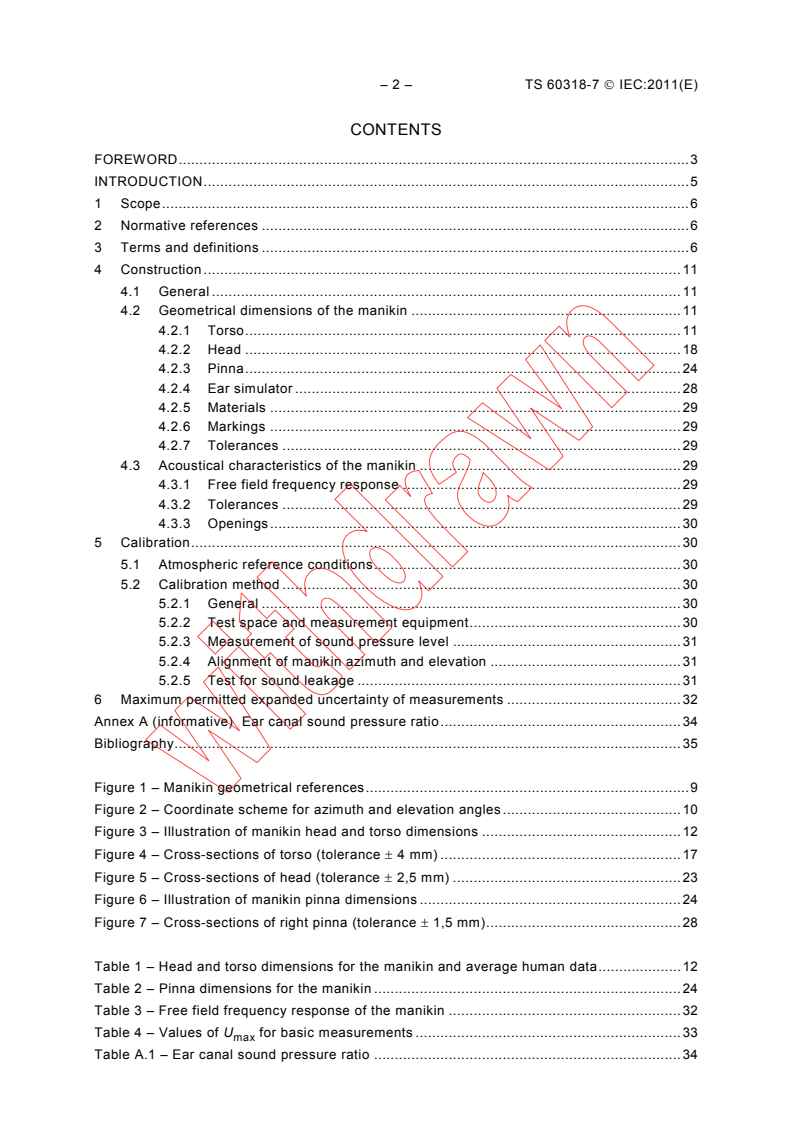
CONTENTS
FOREWORD . 3
INTRODUCTION . 5
1 Scope . 6
2 Normative references . 6
3 Terms and definitions . 6
4 Construction . 11
4.1 General . 11
4.2 Geometrical dimensions of the manikin . 11
4.2.1 Torso . 11
4.2.2 Head . 18
4.2.3 Pinna . 24
4.2.4 Ear simulator . 28
4.2.5 Materials . 29
4.2.6 Markings . 29
4.2.7 Tolerances . 29
4.3 Acoustical characteristics of the manikin . 29
4.3.1 Free field frequency response . 29
4.3.2 Tolerances . 29
4.3.3 Openings . 30
5 Calibration . 30
5.1 Atmospheric reference conditions . 30
5.2 Calibration method . 30
5.2.1 General . 30
5.2.2 Test space and measurement equipment . 30
5.2.3 Measurement of sound pressure level . 31
5.2.4 Alignment of manikin azimuth and elevation . 31
5.2.5 Test for sound leakage . 31
6 Maximum permitted expanded uncertainty of measurements . 32
Annex A (informative) Ear canal sound pressure ratio . 34
Bibliography . 35
Figure 1 – Manikin geometrical references . 9
Figure 2 – Coordinate scheme for azimuth and elevation angles . 10
Figure 3 – Illustration of manikin head and torso dimensions . 12
Figure 4 – Cross-sections of torso (tolerance ± 4 mm) . 17
Figure 5 – Cross-sections of head (tolerance ± 2,5 mm) . 23
Figure 6 – Illustration of manikin pinna dimensions . 24
Figure 7 – Cross-sections of right pinna (tolerance ± 1,5 mm) . 28
Table 1 – Head and torso dimensions for the manikin and average human data . 12
Table 2 – Pinna dimensions for the manikin . 24
Table 3 – Free field frequency response of the manikin . 32
Table 4 – Values of U for basic measurements . 33
max
Table A.1 – Ear canal sound pressure ratio . 34
TS 60318-7 IEC:2011(E) – 3 –
INTERNATIONAL ELECTROTECHNICAL COMMISSION
____________
ELECTROACOUSTICS –
SIMULATORS OF HUMAN HEAD AND EAR –
Part 7: Head and torso simulator
for the measurement of hearing aids
FOREWORD
1) The International Electrotechnical Commission (IEC) is a worldwide organization for standardization comprising
all national electrotechnical committees (IEC National Committees). The object of IEC is to promote
international co-operation on all questions concerning standardization in the electrical and electronic fields. To
this end and in addition to other activities, IEC publishes International Standards, Technical Specifications,
Technical Reports, Publicly Available Specifications (PAS) and Guides (hereafter referred to as “IEC
Publication(s)”). Their preparation is entrusted to technical committees; any IEC National Committee interested
in the subject dealt with may participate in this preparatory work. International, governmental and non-
governmental organizations liaising with the IEC also participate in this preparation. IEC collaborates closely
with the International Organization for Standardization (ISO) in accordance with conditions determined by
agreement between the two organizations.
2) The formal decisions or agreements of IEC on technical matters express, as nearly as possible, an international
consensus of opinion on the relevant subjects since each technical committee has representation from all
interested IEC National Committees.
3) IEC Publications have the form of recommendations for international use and are accepted by IEC National
Committees in that sense. While all reasonable efforts are made to ensure that the technical content of IEC
Publications is accurate, IEC cannot be held responsible for the way in which they are used or for any
misinterpretation by any end user.
4) In order to promote international uniformity, IEC National Committees undertake to apply IEC Publications
transparently to the maximum extent possible in their national and regional publications. Any divergence
between any IEC Publication and the corresponding national or regional publication shall be clearly indicated in
the latter.
5) IEC itself does not provide any attestation of conformity. Independent certification bodies provide conformity
assessment services and, in some areas, access to IEC marks of conformity. IEC is not responsible for any
services carried out by independent certification bodies.
6) All users should ensure that they have the latest edition of this publication.
7) No liability shall attach to IEC or its directors, employees, servants or agents including individual experts and
members of its technical committees and IEC National Committees for any personal injury, property damage or
other damage of any nature whatsoever, whether direct or indirect, or for costs (including legal fees) and
expenses arising out of the publication, use of, or reliance upon, this IEC Publication or any other IEC
Publications.
8) Attention is drawn to the Normative references cited in this publication. Use of the referenced publications is
indispensable for the correct application of this publication.
9) Attention is drawn to the possibility that some of the elements of this IEC Publication may be the subject of
patent rights. IEC shall not be held responsible for identifying any or all such patent rights.
The main task of IEC technical committees is to prepare International Standards. In
exceptional circumstances, a technical committee may propose the publication of a technical
specification when
• the required support cannot be obtained for the publication of an International Standard,
despite repeated efforts, or
• the subject is still under technical development or where, for any other reason, there is the
future but no immediate possibility of an agreement on an International Standard.
Technical specifications are subject to review within three years of publication to decide
whether they can be transformed into International Standards.
IEC/TS 60318-7, which is a technical specification, has been prepared by IEC technical
committee 29: Electroacoustics.
– 4 – TS 60318-7 IEC:2011(E)
The text of this technical specification is based on the following documents:
Enquiry draft Report on voting
29/716/DTS 29/729A/RVC
Full information on the voting for the approval of this technical specification can be found in
the report on voting indicated in the above table.
This publication has been drafted in accordance with the ISO/IEC Directives, Part 2.
A list of all parts of the IEC 60318 series, published under the general title Electroacoustics –
Simulators of human head and ear, can be found on the IEC website.
The committee has decided that the contents of this publication will remain unchanged until
the stability date indicated on the IEC web site under "http://webstore.iec.ch" in the data
related to the specific publication. At this date, the publication will be
• transformed into an International standard,
• reconfirmed,
• withdrawn,
• replaced by a revised edition, or
• amended.
A bilingual version of this document may be issued at a later date.
TS 60318-7 IEC:2011(E) – 5 –
INTRODUCTION
This technical specification describes a head and torso simulator for hearing aid
measurements. It has been developed as a revision of IEC/TR 60959 (1990). The main
changes, as compared to the technical report, are the insertion of maximum permitted
expanded measurement uncertainties and additional references in the Bibliography. A future
IEC Standard which will include additional models of head and torso simulators for hearing aid
measurements is planned.
– 6 – TS 60318-7 IEC:2011(E)
ELECTROACOUSTICS –
SIMULATORS OF HUMAN HEAD AND EAR –
Part 7: Head and torso simulator
for the measurement of hearing aids
1 Scope
This part of IEC 60318 describes a head and torso simulator (manikin) intended for the
measurement of air-conduction hearing aids in the frequency range from 100 Hz to 10 000 Hz.
The device consists of a head mounted on a torso that extends to the waist. The head is
equipped with simulated pinnae and with cylindrical cavities having acoustic impedance
terminations and microphones located at positions corresponding to those of the eardrums in
a median human adult. It has been designed to provide acoustic diffraction similar to that
encountered around the median human head and torso.
The device with its present pinna simulator, however, is not suitable for the measurement of
all types of hearing aids. For example, most in-the-ear (ITE) and completely-in-the-canal
(CIC) hearing aids cannot be measured correctly.
The manikin is specified in terms of both, its geometrical dimensions and its acoustical
properties.
NOTE 1 Measurement results obtained with a manikin may differ substantially from similar results obtained on an
individual person, due to anatomical variations.
NOTE 2 The median values of the human head and torso were drawn from the population samples described
in [5] .
NOTE 3 It is acknowledged that devices conforming to this part of IEC 60318 are also used as the basis for
applications extending beyond this Scope. In such cases it is recommended that any design variations that are
necessary are documented, and that a statistical analysis of the measurement data be carried out to determine the
level of repeatability that can be achieved. It will also be necessary to consider the relevance of the measurements
made with the head and torso simulator to the application in question.
2 Normative references
The following referenced documents are indispensable for the application of this document.
For dated references, only the edition cited applies. For undated references, the latest edition
of the referenced document (including any amendments) applies.
IEC 60318-4, Simulators of human head and ear – Part 4: Occluded-ear simulator for the
measurement of earphones coupled to the ear by means of ear inserts
ISO/IEC Guide 98-3, Uncertainty of measurement – Part 3: Guide to the expression of
uncertainty in measurement (GUM:1995)
3 Terms and definitions
For the purposes of this document, the following terms and definitions apply. Reference is
also made to Figure 1 and Figure 2.
———————
Numbers in square brackets refer to the Bibliography.
TS 60318-7 IEC:2011(E) – 7 –
3.1
manikin
head and torso simulator extending downward from the top of the head to the waist and
designed to simulate the acoustic diffraction produced by a median adult human head and
torso
NOTE The head includes two pinna simulators, and contains at least one ear simulator.
3.2
pinna simulator
device which has the approximate shape and dimensions of a median adult human pinna
3.3
ear simulator
device for measuring the acoustic output of sound sources where the sound pressure is
measured by a calibrated microphone coupled to the source so that the overall acoustic
impedance of the device approximates that of the normal human ear at a given location and in
a given frequency band
NOTE In this technical specification it comprises an ear canal extension and an occluded ear simulator.
3.4
occluded ear simulator
ear simulator which approximates the acoustic transfer impedance of the inner part of the ear
canal, from the tip of an ear insert to the eardrum
NOTE An occluded ear simulator is standardised in IEC 60318-4.
3.5
ear canal extension
device that provides a connection between the ear canal of an occluded ear simulator and the
aperture of a device simulating the concha
3.6
reference plane of the occluded ear simulator
plane perpendicular to the axis of the ear canal, at the junction between the occluded ear
simulator and the ear canal extension
3.7
reference point of the manikin
point bisecting the line joining the centres of the openings of the ear canals (at the junction
between concha and ear canal)
3.8
plane of symmetry of the manikin
virtual plane passing through the reference point of the manikin that divides the left and right
portions of the manikin into symmetrical halves, left and right to be interpreted as for the
human torso (see Figure 1)
NOTE No real human is perfectly symmetrical.
3.9
axis of rotation of the manikin
straight line about which the manikin can be rotated, passing through the reference point of
the manikin and lying in the plane of symmetry of the manikin, and having a direction that
would be vertical if the manikin were mounted in a position corresponding to that of a standing
person (see Figure 1)
– 8 – TS 60318-7 IEC:2011(E)
3.10
reference plane of the manikin
plane perpendicular to the axis of rotation that contains the reference point of the manikin
3.11
test point
reproducible position in the test space at which the sound pressure level is measured with the
manikin absent and at which the reference point of the manikin is to be located for test
purposes
3.12
test axis
line joining the test point and the centre of the sound source (see Figure 2)
3.13
test plane
plane perpendicular to the test axis and containing the test point
3.14
azimuth angle of sound incidence
θ
angle between the plane of symmetry of the manikin (see Figure 2) and the plane defined by
the axis of rotation and the test axis; when the manikin faces the sound source, the azimuth
angle of sound incidence is defined as 0°
NOTE When the right ear of the manikin faces the sound source, the angle is defined as +90°. When the left ear
of the manikin faces the sound source, the angle is defined as +270°.
3.15
elevation angle of sound incidence
α
angle between the reference plane of the manikin and the test axis (see Figure 2); when the
vertex points towards the sound source, the elevation angle is defined as +90°
NOTE When the test axis lies in the reference plane, the elevation angle is defined as 0°.
TS 60318-7 IEC:2011(E) – 9 –
Vertex Vertex
Axis of rotation
Reference plane of the manikin
90°
90°
Reference point
Axis of rotation and
plane of symmetry
Reference point (and top view of axis
of rotation). It bisects the line joining
the centres of the openings of the
ear simulator canals
90°
IEC 398/11
NOTE The reference point is the reference point of the manikin.
Figure 1 – Manikin geometrical references
– 10 – TS 60318-7 IEC:2011(E)
Test axis
Elevation angle of sound incidence
α
Range: –90° to +90°
Reference plane
Reference point and
test point
Azimuth angle of sound incidence
θ
Range: 0° to +360°
Test axis
Sound source
Reference point and
test point
IEC 399/11
NOTE The reference point is the reference point of the manikin.
Figure 2 – Coordinate scheme for azimuth and elevation angles
TS 60318-7 IEC:2011(E) – 11 –
3.16
reference position of the manikin
position of the manikin in the test space that meets the following conditions:
– the reference point of the manikin coincides with the test point,
– the azimuth and elevation angles are both equal to zero
3.17
manikin free field frequency response
difference, as a function of frequency, between the sound pressure level at the ear simulator
microphone with the reference point of the manikin at the test point and the sound pressure
level at the test point with the manikin absent
3.18
ear canal entrance point
EEP
point located at the centre of the manikin ear canal at the junction between concha and ear
canal extension
3.19
vertical pinna reference axis
line through the EEP, and parallel to the axis of rotation of the manikin
3.20
horizontal pinna reference axis
line through the EEP, and parallel to the reference plane of the manikin with an azimuth angle
of 90°
NOTE The horizontal pinna reference axis is needed for vertical cross-sections of a pinna simulator, see for
instance IEC 60268-7 [1].
4 Construction
4.1 General
In the following, both the geometrical physical dimensions of the manikin’s head, torso and
pinnae and the manikin’s acoustical characteristics are specified. Where tolerances are
specified in this technical specification, these shall be reduced by an amount equal to the
actual expanded measurement uncertainty of the test laboratory before deciding if a device
conforms to the stated requirement.
4.2 Geometrical dimensions of the manikin
4.2.1 Torso
4.2.1.1 The principal geometrical dimensions of the manikin torso are illustrated in Figure 3,
and listed in Table 1 (for information only). The realization of the torso is specified in 4.2.1.2.
– 12 – TS 60318-7 IEC:2011(E)
Head breadth Head length
Tragion to occipital wall
Head
height
Chin-to-vertex
length
Tragion to
Neck diameter shoulder
Bitragion diameter
Shoulder depth
Shoulder breadth
Chest depth
Chest breadth
Shoulder position
IEC 400/11 IEC 401/11
a) Front view b) Side view
NOTE For position of tragion, see Figure 6.
Figure 3 – Illustration of manikin head and torso dimensions
Table 1 – Head and torso dimensions for the manikin and average human data
Dimension Manikin Average human data [5]
(mm) (mm)
Head breadth 152 151
Head length 191 188
Head height (tragion to vertex) 125 130
Bitragion diameter 143 139
Tragion t
...
IEC/TS 60318-7 ®
Edition 1.0 2011-02
TECHNICAL
SPECIFICATION
Electroacoustics – Simulators of human head and ear –
Part 7: Head and torso simulator for the measurement of hearing aids
IEC/TS 60318-7:2011(E)
All rights reserved. Unless otherwise specified, no part of this publication may be reproduced or utilized in any form or by
any means, electronic or mechanical, including photocopying and microfilm, without permission in writing from either IEC or
IEC's member National Committee in the country of the requester.
If you have any questions about IEC copyright or have an enquiry about obtaining additional rights to this publication,
please contact the address below or your local IEC member National Committee for further information.
Droits de reproduction réservés. Sauf indication contraire, aucune partie de cette publication ne peut être reproduite
ni utilisée sous quelque forme que ce soit et par aucun procédé, électronique ou mécanique, y compris la photocopie
et les microfilms, sans l'accord écrit de la CEI ou du Comité national de la CEI du pays du demandeur.
Si vous avez des questions sur le copyright de la CEI ou si vous désirez obtenir des droits supplémentaires sur cette
publication, utilisez les coordonnées ci-après ou contactez le Comité national de la CEI de votre pays de résidence.
IEC Central Office
3, rue de Varembé
CH-1211 Geneva 20
Switzerland
Email: inmail@iec.ch
Web: www.iec.ch
About IEC publications
The technical content of IEC publications is kept under constant review by the IEC. Please make sure that you have the
latest edition, a corrigenda or an amendment might have been published.
Catalogue of IEC publications: www.iec.ch/searchpub
The IEC on-line Catalogue enables you to search by a variety of criteria (reference number, text, technical committee,…).
It also gives information on projects, withdrawn and replaced publications.
IEC Just Published: www.iec.ch/online_news/justpub
Stay up to date on all new IEC publications. Just Published details twice a month all new publications released. Available
on-line and also by email.
Electropedia: www.electropedia.org
The world's leading online dictionary of electronic and electrical terms containing more than 20 000 terms and definitions
in English and French, with equivalent terms in additional languages. Also known as the International Electrotechnical
Vocabulary online.
Customer Service Centre: www.iec.ch/webstore/custserv
If you wish to give us your feedback on this publication or need further assistance, please visit the Customer Service
Centre FAQ or contact us:
Email: csc@iec.ch
Tel.: +41 22 919 02 11
Fax: +41 22 919 03 00
IEC/TS 60318-7 ®
Edition 1.0 2011-02
TECHNICAL
SPECIFICATION
Electroacoustics – Simulators of human head and ear –
Part 7: Head and torso simulator for the measurement of hearing aids
INTERNATIONAL
ELECTROTECHNICAL
COMMISSION
PRICE CODE
V
ICS 17.140.50 ISBN 978-2-88912-379-7
– 2 – TS 60318-7 IEC:2011(E)
CONTENTS
FOREWORD . 3
INTRODUCTION . 5
1 Scope . 6
2 Normative references . 6
3 Terms and definitions . 6
4 Construction . 11
4.1 General . 11
4.2 Geometrical dimensions of the manikin . 11
4.2.1 Torso . 11
4.2.2 Head . 18
4.2.3 Pinna . 24
4.2.4 Ear simulator . 28
4.2.5 Materials . 29
4.2.6 Markings . 29
4.2.7 Tolerances . 29
4.3 Acoustical characteristics of the manikin . 29
4.3.1 Free field frequency response . 29
4.3.2 Tolerances . 29
4.3.3 Openings . 30
5 Calibration . 30
5.1 Atmospheric reference conditions . 30
5.2 Calibration method . 30
5.2.1 General . 30
5.2.2 Test space and measurement equipment . 30
5.2.3 Measurement of sound pressure level . 31
5.2.4 Alignment of manikin azimuth and elevation . 31
5.2.5 Test for sound leakage . 31
6 Maximum permitted expanded uncertainty of measurements . 32
Annex A (informative) Ear canal sound pressure ratio . 34
Bibliography . 35
Figure 1 – Manikin geometrical references . 9
Figure 2 – Coordinate scheme for azimuth and elevation angles . 10
Figure 3 – Illustration of manikin head and torso dimensions . 12
Figure 4 – Cross-sections of torso (tolerance ± 4 mm) . 17
Figure 5 – Cross-sections of head (tolerance ± 2,5 mm) . 23
Figure 6 – Illustration of manikin pinna dimensions . 24
Figure 7 – Cross-sections of right pinna (tolerance ± 1,5 mm) . 28
Table 1 – Head and torso dimensions for the manikin and average human data . 12
Table 2 – Pinna dimensions for the manikin . 24
Table 3 – Free field frequency response of the manikin . 32
Table 4 – Values of U for basic measurements . 33
max
Table A.1 – Ear canal sound pressure ratio . 34
TS 60318-7 IEC:2011(E) – 3 –
INTERNATIONAL ELECTROTECHNICAL COMMISSION
____________
ELECTROACOUSTICS –
SIMULATORS OF HUMAN HEAD AND EAR –
Part 7: Head and torso simulator
for the measurement of hearing aids
FOREWORD
1) The International Electrotechnical Commission (IEC) is a worldwide organization for standardization comprising
all national electrotechnical committees (IEC National Committees). The object of IEC is to promote
international co-operation on all questions concerning standardization in the electrical and electronic fields. To
this end and in addition to other activities, IEC publishes International Standards, Technical Specifications,
Technical Reports, Publicly Available Specifications (PAS) and Guides (hereafter referred to as “IEC
Publication(s)”). Their preparation is entrusted to technical committees; any IEC National Committee interested
in the subject dealt with may participate in this preparatory work. International, governmental and non-
governmental organizations liaising with the IEC also participate in this preparation. IEC collaborates closely
with the International Organization for Standardization (ISO) in accordance with conditions determined by
agreement between the two organizations.
2) The formal decisions or agreements of IEC on technical matters express, as nearly as possible, an international
consensus of opinion on the relevant subjects since each technical committee has representation from all
interested IEC National Committees.
3) IEC Publications have the form of recommendations for international use and are accepted by IEC National
Committees in that sense. While all reasonable efforts are made to ensure that the technical content of IEC
Publications is accurate, IEC cannot be held responsible for the way in which they are used or for any
misinterpretation by any end user.
4) In order to promote international uniformity, IEC National Committees undertake to apply IEC Publications
transparently to the maximum extent possible in their national and regional publications. Any divergence
between any IEC Publication and the corresponding national or regional publication shall be clearly indicated in
the latter.
5) IEC itself does not provide any attestation of conformity. Independent certification bodies provide conformity
assessment services and, in some areas, access to IEC marks of conformity. IEC is not responsible for any
services carried out by independent certification bodies.
6) All users should ensure that they have the latest edition of this publication.
7) No liability shall attach to IEC or its directors, employees, servants or agents including individual experts and
members of its technical committees and IEC National Committees for any personal injury, property damage or
other damage of any nature whatsoever, whether direct or indirect, or for costs (including legal fees) and
expenses arising out of the publication, use of, or reliance upon, this IEC Publication or any other IEC
Publications.
8) Attention is drawn to the Normative references cited in this publication. Use of the referenced publications is
indispensable for the correct application of this publication.
9) Attention is drawn to the possibility that some of the elements of this IEC Publication may be the subject of
patent rights. IEC shall not be held responsible for identifying any or all such patent rights.
The main task of IEC technical committees is to prepare International Standards. In
exceptional circumstances, a technical committee may propose the publication of a technical
specification when
• the required support cannot be obtained for the publication of an International Standard,
despite repeated efforts, or
• the subject is still under technical development or where, for any other reason, there is the
future but no immediate possibility of an agreement on an International Standard.
Technical specifications are subject to review within three years of publication to decide
whether they can be transformed into International Standards.
IEC/TS 60318-7, which is a technical specification, has been prepared by IEC technical
committee 29: Electroacoustics.
– 4 – TS 60318-7 IEC:2011(E)
The text of this technical specification is based on the following documents:
Enquiry draft Report on voting
29/716/DTS 29/729A/RVC
Full information on the voting for the approval of this technical specification can be found in
the report on voting indicated in the above table.
This publication has been drafted in accordance with the ISO/IEC Directives, Part 2.
A list of all parts of the IEC 60318 series, published under the general title Electroacoustics –
Simulators of human head and ear, can be found on the IEC website.
The committee has decided that the contents of this publication will remain unchanged until
the stability date indicated on the IEC web site under "http://webstore.iec.ch" in the data
related to the specific publication. At this date, the publication will be
• transformed into an International standard,
• reconfirmed,
• withdrawn,
• replaced by a revised edition, or
• amended.
A bilingual version of this document may be issued at a later date.
TS 60318-7 IEC:2011(E) – 5 –
INTRODUCTION
This technical specification describes a head and torso simulator for hearing aid
measurements. It has been developed as a revision of IEC/TR 60959 (1990). The main
changes, as compared to the technical report, are the insertion of maximum permitted
expanded measurement uncertainties and additional references in the Bibliography. A future
IEC Standard which will include additional models of head and torso simulators for hearing aid
measurements is planned.
– 6 – TS 60318-7 IEC:2011(E)
ELECTROACOUSTICS –
SIMULATORS OF HUMAN HEAD AND EAR –
Part 7: Head and torso simulator
for the measurement of hearing aids
1 Scope
This part of IEC 60318 describes a head and torso simulator (manikin) intended for the
measurement of air-conduction hearing aids in the frequency range from 100 Hz to 10 000 Hz.
The device consists of a head mounted on a torso that extends to the waist. The head is
equipped with simulated pinnae and with cylindrical cavities having acoustic impedance
terminations and microphones located at positions corresponding to those of the eardrums in
a median human adult. It has been designed to provide acoustic diffraction similar to that
encountered around the median human head and torso.
The device with its present pinna simulator, however, is not suitable for the measurement of
all types of hearing aids. For example, most in-the-ear (ITE) and completely-in-the-canal
(CIC) hearing aids cannot be measured correctly.
The manikin is specified in terms of both, its geometrical dimensions and its acoustical
properties.
NOTE 1 Measurement results obtained with a manikin may differ substantially from similar results obtained on an
individual person, due to anatomical variations.
NOTE 2 The median values of the human head and torso were drawn from the population samples described
in [5] .
NOTE 3 It is acknowledged that devices conforming to this part of IEC 60318 are also used as the basis for
applications extending beyond this Scope. In such cases it is recommended that any design variations that are
necessary are documented, and that a statistical analysis of the measurement data be carried out to determine the
level of repeatability that can be achieved. It will also be necessary to consider the relevance of the measurements
made with the head and torso simulator to the application in question.
2 Normative references
The following referenced documents are indispensable for the application of this document.
For dated references, only the edition cited applies. For undated references, the latest edition
of the referenced document (including any amendments) applies.
IEC 60318-4, Simulators of human head and ear – Part 4: Occluded-ear simulator for the
measurement of earphones coupled to the ear by means of ear inserts
ISO/IEC Guide 98-3, Uncertainty of measurement – Part 3: Guide to the expression of
uncertainty in measurement (GUM:1995)
3 Terms and definitions
For the purposes of this document, the following terms and definitions apply. Reference is
also made to Figure 1 and Figure 2.
———————
Numbers in square brackets refer to the Bibliography.
TS 60318-7 IEC:2011(E) – 7 –
3.1
manikin
head and torso simulator extending downward from the top of the head to the waist and
designed to simulate the acoustic diffraction produced by a median adult human head and
torso
NOTE The head includes two pinna simulators, and contains at least one ear simulator.
3.2
pinna simulator
device which has the approximate shape and dimensions of a median adult human pinna
3.3
ear simulator
device for measuring the acoustic output of sound sources where the sound pressure is
measured by a calibrated microphone coupled to the source so that the overall acoustic
impedance of the device approximates that of the normal human ear at a given location and in
a given frequency band
NOTE In this technical specification it comprises an ear canal extension and an occluded ear simulator.
3.4
occluded ear simulator
ear simulator which approximates the acoustic transfer impedance of the inner part of the ear
canal, from the tip of an ear insert to the eardrum
NOTE An occluded ear simulator is standardised in IEC 60318-4.
3.5
ear canal extension
device that provides a connection between the ear canal of an occluded ear simulator and the
aperture of a device simulating the concha
3.6
reference plane of the occluded ear simulator
plane perpendicular to the axis of the ear canal, at the junction between the occluded ear
simulator and the ear canal extension
3.7
reference point of the manikin
point bisecting the line joining the centres of the openings of the ear canals (at the junction
between concha and ear canal)
3.8
plane of symmetry of the manikin
virtual plane passing through the reference point of the manikin that divides the left and right
portions of the manikin into symmetrical halves, left and right to be interpreted as for the
human torso (see Figure 1)
NOTE No real human is perfectly symmetrical.
3.9
axis of rotation of the manikin
straight line about which the manikin can be rotated, passing through the reference point of
the manikin and lying in the plane of symmetry of the manikin, and having a direction that
would be vertical if the manikin were mounted in a position corresponding to that of a standing
person (see Figure 1)
– 8 – TS 60318-7 IEC:2011(E)
3.10
reference plane of the manikin
plane perpendicular to the axis of rotation that contains the reference point of the manikin
3.11
test point
reproducible position in the test space at which the sound pressure level is measured with the
manikin absent and at which the reference point of the manikin is to be located for test
purposes
3.12
test axis
line joining the test point and the centre of the sound source (see Figure 2)
3.13
test plane
plane perpendicular to the test axis and containing the test point
3.14
azimuth angle of sound incidence
θ
angle between the plane of symmetry of the manikin (see Figure 2) and the plane defined by
the axis of rotation and the test axis; when the manikin faces the sound source, the azimuth
angle of sound incidence is defined as 0°
NOTE When the right ear of the manikin faces the sound source, the angle is defined as +90°. When the left ear
of the manikin faces the sound source, the angle is defined as +270°.
3.15
elevation angle of sound incidence
α
angle between the reference plane of the manikin and the test axis (see Figure 2); when the
vertex points towards the sound source, the elevation angle is defined as +90°
NOTE When the test axis lies in the reference plane, the elevation angle is defined as 0°.
TS 60318-7 IEC:2011(E) – 9 –
Vertex Vertex
Axis of rotation
Reference plane of the manikin
90°
90°
Reference point
Axis of rotation and
plane of symmetry
Reference point (and top view of axis
of rotation). It bisects the line joining
the centres of the openings of the
ear simulator canals
90°
IEC 398/11
NOTE The reference point is the reference point of the manikin.
Figure 1 – Manikin geometrical references
– 10 – TS 60318-7 IEC:2011(E)
Test axis
Elevation angle of sound incidence
α
Range: –90° to +90°
Reference plane
Reference point and
test point
Azimuth angle of sound incidence
θ
Range: 0° to +360°
Test axis
Sound source
Reference point and
test point
IEC 399/11
NOTE The reference point is the reference point of the manikin.
Figure 2 – Coordinate scheme for azimuth and elevation angles
TS 60318-7 IEC:2011(E) – 11 –
3.16
reference position of the manikin
position of the manikin in the test space that meets the following conditions:
– the reference point of the manikin coincides with the test point,
– the azimuth and elevation angles are both equal to zero
3.17
manikin free field frequency response
difference, as a function of frequency, between the sound pressure level at the ear simulator
microphone with the reference point of the manikin at the test point and the sound pressure
level at the test point with the manikin absent
3.18
ear canal entrance point
EEP
point located at the centre of the manikin ear canal at the junction between concha and ear
canal extension
3.19
vertical pinna reference axis
line through the EEP, and parallel to the axis of rotation of the manikin
3.20
horizontal pinna reference axis
line through the EEP, and parallel to the reference plane of the manikin with an azimuth angle
of 90°
NOTE The horizontal pinna reference axis is needed for vertical cross-sections of a pinna simulator, see for
instance IEC 60268-7 [1].
4 Construction
4.1 General
In the following, both the geometrical physical dimensions of the manikin’s head, torso and
pinnae and the manikin’s acoustical characteristics are specified. Where tolerances are
specified in this technical specification, these shall be reduced by an amount equal to the
actual expanded measurement uncertainty of the test laboratory before deciding if a device
conforms to the stated requirement.
4.2 Geometrical dimensions of the manikin
4.2.1 Torso
4.2.1.1 The principal geometrical dimensions of the manikin torso are illustrated in Figure 3,
and listed in Table 1 (for information only). The realization of the torso is specified in 4.2.1.2.
– 12 – TS 60318-7 IEC:2011(E)
Head breadth Head length
Tragion to occipital wall
Head
height
Chin-to-vertex
length
Tragion to
Neck diameter shoulder
Bitragion diameter
Shoulder depth
Shoulder breadth
Chest depth
Chest breadth
Shoulder position
IEC 400/11 IEC 401/11
a) Front view b) Side view
NOTE For position of tragion, see Figure 6.
Figure 3 – Illustration of manikin head and torso dimensions
Table 1 – Head and torso dimensions for the manikin and average human data
Dimension Manikin Average human data [5]
(mm) (mm)
Head breadth 152 151
Head length 191 188
Head height (tragion to vertex) 125 130
Bitragion diameter 143 139
Tragion t
...