

IEC 61184:2008
(Main)Bayonet lampholders
General Information
- Abstract
IEC 61184:2008 applies to bayonet lampholders B15d and B22d for connection of lamps and semi-luminaires to a supply voltage of 250 V. This standard also covers lampholders which are integral with a luminaire or intended to be built into appliances. It covers the requirements for the lampholder only. This third edition cancels and replaces the second edition (1997) and its Amendments 1 (2000) and 2 (2004). This third edition constitutes a technical revision. In this edition, information to lampholders intended to be used in applications where they are accessible in normal use (class II as well as class I luminaires) are introduced. Additionally, in Table 11, lamp data where lamps no longer exist has been removed and requirements for shade holder rings have been amended to include shade rings according to IEC 60399 into testing. The contents of the corrigendum of February 2009 and December 2012 have been included in this copy.
- Status
- Published
- Publication Date
- 25-Jul-2011
- Technical Committee
- SC 34B - Fit systems for light sources
- Current Stage
- DELPUB - Deleted Publication
- Start Date
- 22-May-2017
- Completion Date
- 28-Aug-2026
Buy Documents
IEC 61184:2008+AMD1:2011 CSV - Bayonet lampholders Released:7/26/2011
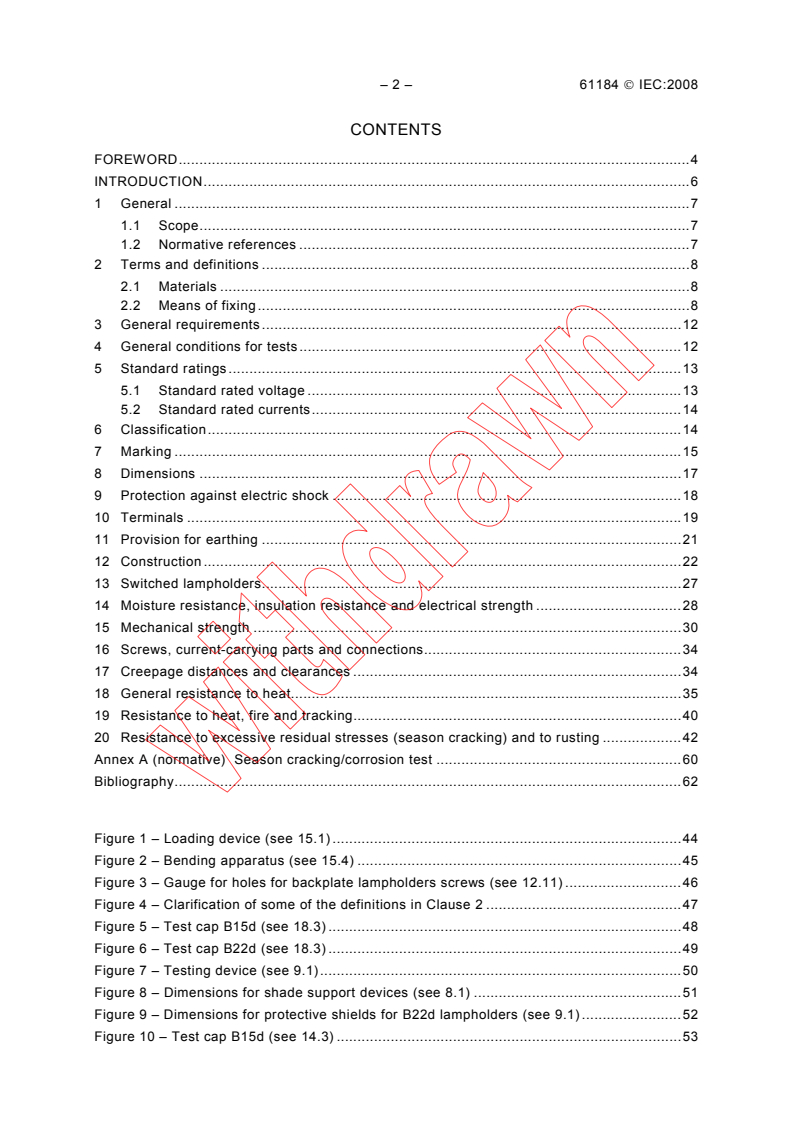
IEC 61184:2008 - Bayonet lampholders Released:7/15/2008
Overview
IEC 61184:2008 is an international standard developed by the International Electrotechnical Commission (IEC) focusing on bayonet lampholders, specifically types B15d and B22d. These lampholders are designed for connecting lamps and semi-luminaires to electrical supplies with voltages up to 250 V. The third edition (2008), with its amendment in 2011, supersedes all previous editions and includes comprehensive revisions improving product safety, performance requirements, and testing methods.
This standard applies to bayonet lampholders whether they are standalone or integral components of luminaires or built into appliances. The document covers strict specifications exclusively for the lampholder itself, ensuring it meets electrical safety and functional standards. The update introduces criteria for lampholders accessible in normal use (class II and class I luminaires) and removes obsolete lamp data. It also revises requirements relating to shade holder rings, ensuring conformity with complementary standards like IEC 60399.
Key Topics
- Scope and Application: Defines lampholder types (B15d and B22d) and maximum supply voltage (250 V), addressing both standalone and integrated devices.
- Safety Requirements: Ensures lampholder designs prevent electric shock, fire hazards, and mechanical failures during normal use.
- Thermal and Electrical Ratings: Specifies rated voltage, operating temperatures, standard rated current values, and insulation requirements.
- Mechanical Specifications: Dimensions, material characteristics, construction techniques, means for fixing, and resistance to mechanical stress.
- Testing Procedures: Includes tests for moisture resistance, insulation, electrical strength, mechanical strength, heat resistance, and corrosion (season cracking).
- Marking and Identification: Requirements for durable and clear markings to aid installation, maintenance, and compliance verification.
- Interchangeability and Compatibility: Refers to IEC 60061 to ensure lampholders fit correctly and operate safely with corresponding lamp caps.
- Shade Holder Ring Requirements: Incorporates updated testing to align with IEC 60399, ensuring shade holders maintain safety and durability.
- Protection Against Electric Shock: Measures to safeguard users, especially for lampholders accessible during normal use.
Applications
IEC 61184:2008 is critical for manufacturers, designers, and quality assurance professionals in the lighting and electrical equipment industries. Its practical applications include:
- Design of Lighting Fixtures: Creating secure and reliable bayonet lampholder components that ensure safe lamp installation and operation.
- Appliance Integration: Ensuring lampholders embedded within appliances comply with electrical safety standards.
- Product Testing and Certification: Supporting conformity assessments conducted by certification bodies to meet international regulations.
- Installation Guidelines: Offering clear standards for electricians and installers to use compliant lampholders in residential, commercial, and industrial settings.
- Safety Compliance: Minimizing risks related to electrical shock, fire, and mechanical failure in lighting applications.
- Replacement and Maintenance: Ensuring compatibility and safe interchangeability with lamps following IEC 60061.
By following these standards, industries can enhance product reliability, user safety, and global market acceptance.
Related Standards
- IEC 60061 – Lamp Caps and Holders: Governs interchangeability and safety of lamp caps, complementing IEC 61184 requirements.
- IEC 60399 – Shade Holder Rings: Specifies dimensions and testing methods for shade holder rings, now integrated into IEC 61184 amendments.
- IEC 60238 – Edison Screw Lampholders: Used as a reference point for thermal characteristics comparison.
- General Electrical Safety Standards: Including various IEC and ISO standards for electrical equipment safety and performance.
Summary
IEC 61184:2008+A1:2011 remains the authoritative guideline for the design, testing, and safety of bayonet lampholders B15d and B22d used in lighting and appliance applications. Compliance with this standard ensures reliable connections, user safety, and regulatory alignment in global markets. By adhering to its rigorous specifications and updated testing protocols, manufacturers and users can achieve high-quality, safe lighting solutions compatible with international requirements.
Relations
- Effective Date
- 05-Sep-2023
- Effective Date
- 05-Sep-2023
- Effective Date
- 05-Sep-2023
- Effective Date
- 05-Sep-2023
- Effective Date
- 05-Sep-2023
- Effective Date
- 05-Sep-2023
Buy Documents
IEC 61184:2008+AMD1:2011 CSV - Bayonet lampholders Released:7/26/2011
IEC 61184:2008 - Bayonet lampholders Released:7/15/2008
Get Certified
Connect with accredited certification bodies for this standard

IMQ S.p.A. (Certification)
Italian electrical product certification.

SLG Prüf- und Zertifizierungs GmbH
German testing and certification body.

UL Solutions
Global safety science company with testing, inspection and certification.
Sponsored listings
Frequently Asked Questions
IEC 61184:2008 is a standard published by the International Electrotechnical Commission (IEC). Its full title is "Bayonet lampholders". This standard covers: IEC 61184:2008 applies to bayonet lampholders B15d and B22d for connection of lamps and semi-luminaires to a supply voltage of 250 V. This standard also covers lampholders which are integral with a luminaire or intended to be built into appliances. It covers the requirements for the lampholder only. This third edition cancels and replaces the second edition (1997) and its Amendments 1 (2000) and 2 (2004). This third edition constitutes a technical revision. In this edition, information to lampholders intended to be used in applications where they are accessible in normal use (class II as well as class I luminaires) are introduced. Additionally, in Table 11, lamp data where lamps no longer exist has been removed and requirements for shade holder rings have been amended to include shade rings according to IEC 60399 into testing. The contents of the corrigendum of February 2009 and December 2012 have been included in this copy.
IEC 61184:2008 applies to bayonet lampholders B15d and B22d for connection of lamps and semi-luminaires to a supply voltage of 250 V. This standard also covers lampholders which are integral with a luminaire or intended to be built into appliances. It covers the requirements for the lampholder only. This third edition cancels and replaces the second edition (1997) and its Amendments 1 (2000) and 2 (2004). This third edition constitutes a technical revision. In this edition, information to lampholders intended to be used in applications where they are accessible in normal use (class II as well as class I luminaires) are introduced. Additionally, in Table 11, lamp data where lamps no longer exist has been removed and requirements for shade holder rings have been amended to include shade rings according to IEC 60399 into testing. The contents of the corrigendum of February 2009 and December 2012 have been included in this copy.
IEC 61184:2008 is classified under the following ICS (International Classification for Standards) categories: 29.140.10 - Lamp caps and holders. The ICS classification helps identify the subject area and facilitates finding related standards.
IEC 61184:2008 has the following relationships with other standards: It is inter standard links to IEC 61184:2008/AMD1:2011, IEC 61184:2008/COR1:2009, IEC 61184:2008/COR2:2012, IEC 61184:1997/AMD1:2000, IEC 61184:1997/AMD2:2004, IEC 61184:2017. Understanding these relationships helps ensure you are using the most current and applicable version of the standard.
IEC 61184:2008 is available in PDF format for immediate download after purchase. The document can be added to your cart and obtained through the secure checkout process. Digital delivery ensures instant access to the complete standard document.
Standards Content (Sample)
IEC 61184 ®
Edition 3.1 2011-07
INTERNATIONAL
STANDARD
NORME
INTERNATIONALE
colour
inside
Bayonet lampholders
Douilles à baïonnette
All rights reserved. Unless otherwise specified, no part of this publication may be reproduced or utilized in any form or by
any means, electronic or mechanical, including photocopying and microfilm, without permission in writing from either IEC or
IEC's member National Committee in the country of the requester.
If you have any questions about IEC copyright or have an enquiry about obtaining additional rights to this publication,
please contact the address below or your local IEC member National Committee for further information.
Droits de reproduction réservés. Sauf indication contraire, aucune partie de cette publication ne peut être reproduite
ni utilisée sous quelque forme que ce soit et par aucun procédé, électronique ou mécanique, y compris la photocopie
et les microfilms, sans l'accord écrit de la CEI ou du Comité national de la CEI du pays du demandeur.
Si vous avez des questions sur le copyright de la CEI ou si vous désirez obtenir des droits supplémentaires sur cette
publication, utilisez les coordonnées ci-après ou contactez le Comité national de la CEI de votre pays de résidence.
IEC Central Office
3, rue de Varembé
CH-1211 Geneva 20
Switzerland
Email: inmail@iec.ch
Web: www.iec.ch
About the IEC
The International Electrotechnical Commission (IEC) is the leading global organization that prepares and publishes
International Standards for all electrical, electronic and related technologies.
About IEC publications
The technical content of IEC publications is kept under constant review by the IEC. Please make sure that you have the
latest edition, a corrigenda or an amendment might have been published.
Catalogue of IEC publications: www.iec.ch/searchpub
The IEC on-line Catalogue enables you to search by a variety of criteria (reference number, text, technical committee,…).
It also gives information on projects, withdrawn and replaced publications.
IEC Just Published: www.iec.ch/online_news/justpub
Stay up to date on all new IEC publications. Just Published details twice a month all new publications released. Available
on-line and also by email.
Electropedia: www.electropedia.org
The world's leading online dictionary of electronic and electrical terms containing more than 20 000 terms and definitions
in English and French, with equivalent terms in additional languages. Also known as the International Electrotechnical
Vocabulary online.
Customer Service Centre: www.iec.ch/webstore/custserv
If you wish to give us your feedback on this publication or need further assistance, please visit the Customer Service
Centre FAQ or contact us:
Email: csc@iec.ch
Tel.: +41 22 919 02 11
Fax: +41 22 919 03 00
A propos de la CEI
La Commission Electrotechnique Internationale (CEI) est la première organisation mondiale qui élabore et publie des
normes internationales pour tout ce qui a trait à l'électricité, à l'électronique et aux technologies apparentées.
A propos des publications CEI
Le contenu technique des publications de la CEI est constamment revu. Veuillez vous assurer que vous possédez
l’édition la plus récente, un corrigendum ou amendement peut avoir été publié.
Catalogue des publications de la CEI: www.iec.ch/searchpub/cur_fut-f.htm
Le Catalogue en-ligne de la CEI vous permet d’effectuer des recherches en utilisant différents critères (numéro de référence,
texte, comité d’études,…). Il donne aussi des informations sur les projets et les publications retirées ou remplacées.
Just Published CEI: www.iec.ch/online_news/justpub
Restez informé sur les nouvelles publications de la CEI. Just Published détaille deux fois par mois les nouvelles
publications parues. Disponible en-ligne et aussi par email.
Electropedia: www.electropedia.org
Le premier dictionnaire en ligne au monde de termes électroniques et électriques. Il contient plus de 20 000 termes et
définitions en anglais et en français, ainsi que les termes équivalents dans les langues additionnelles. Egalement appelé
Vocabulaire Electrotechnique International en ligne.
Service Clients: www.iec.ch/webstore/custserv/custserv_entry-f.htm
Si vous désirez nous donner des commentaires sur cette publication ou si vous avez des questions, visitez le FAQ du
Service clients ou contactez-nous:
Email: csc@iec.ch
Tél.: +41 22 919 02 11
Fax: +41 22 919 03 00
IEC 61184 ®
Edition 3.1 2011-07
INTERNATIONAL
STANDARD
NORME
INTERNATIONALE
colour
inside
Bayonet lampholders
Douilles à baïonnette
INTERNATIONAL
ELECTROTECHNICAL
COMMISSION
COMMISSION
ELECTROTECHNIQUE
PRICE CODE
INTERNATIONALE
CODE PRIX CR
ICS 29.140.10 ISBN 978-2-88912-608-8
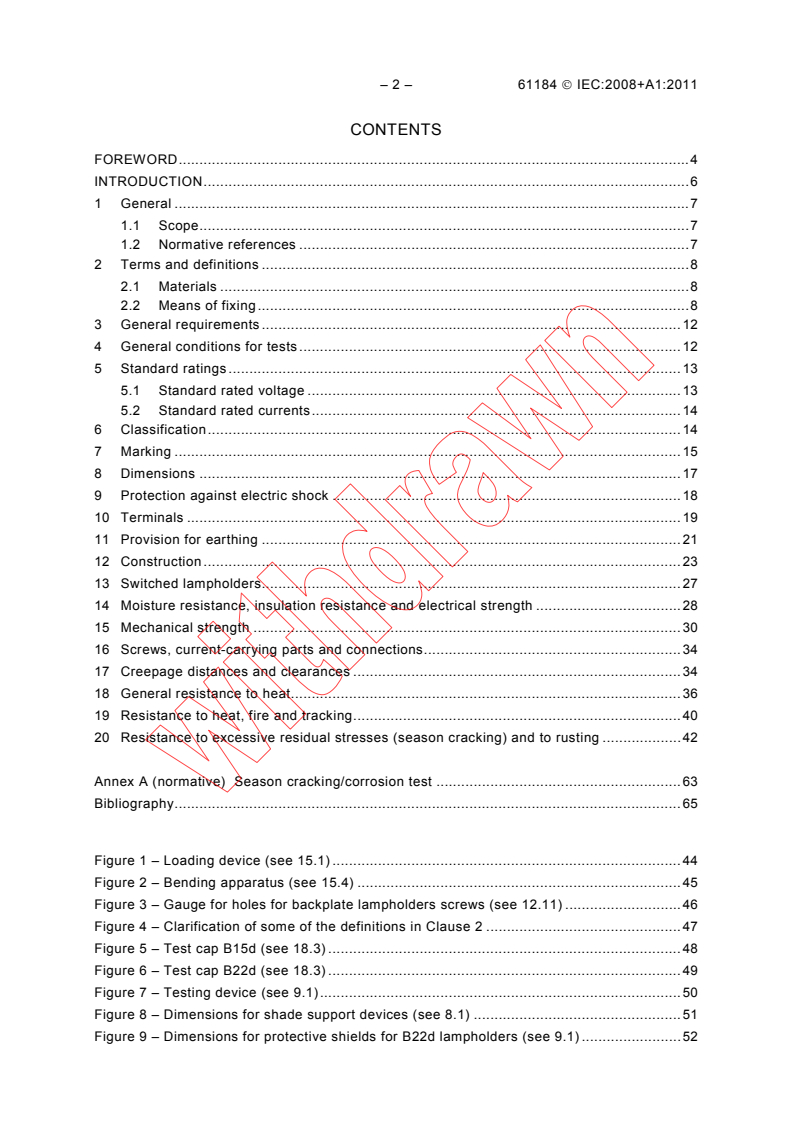
– 2 – 61184 IEC:2008+A1:2011
CONTENTS
FOREWORD . 4
INTRODUCTION . 6
1 General . 7
1.1 Scope . 7
1.2 Normative references . 7
2 Terms and definitions . 8
2.1 Materials . 8
2.2 Means of fixing . 8
3 General requirements . 12
4 General conditions for tests . 12
5 Standard ratings . 13
5.1 Standard rated voltage . 13
5.2 Standard rated currents . 14
6 Classification . 14
7 Marking . 15
8 Dimensions . 17
9 Protection against electric shock . 18
10 Terminals . 19
11 Provision for earthing . 21
12 Construction . 23
13 Switched lampholders. 27
14 Moisture resistance, insulation resistance and electrical strength . 28
15 Mechanical strength . 30
16 Screws, current-carrying parts and connections . 34
17 Creepage distances and clearances . 34
18 General resistance to heat. 36
19 Resistance to heat, fire and tracking . 40
20 Resistance to excessive residual stresses (season cracking) and to rusting . 42
Annex A (normative) Season cracking/corrosion test . 63
Bibliography . 65
Figure 1 – Loading device (see 15.1) . 44
Figure 2 – Bending apparatus (see 15.4) . 45
Figure 3 – Gauge for holes for backplate lampholders screws (see 12.11) . 46
Figure 4 – Clarification of some of the definitions in Clause 2 . 47
Figure 5 – Test cap B15d (see 18.3) . 48
Figure 6 – Test cap B22d (see 18.3) . 49
Figure 7 – Testing device (see 9.1) . 50
Figure 8 – Dimensions for shade support devices (see 8.1) . 51
Figure 9 – Dimensions for protective shields for B22d lampholders (see 9.1) . 52
61184 IEC:2008+A1:2011 – 3 –
Figure 10 – Test cap B15d (see 14.3) . 53
Figure 11 – Test cap B22d (see 14.3) . 54
Figure 12 – Typical apparatus for the heating test (see 18.5) . 55
Figure 13 – Nipple thread for lampholders – Basic profile and design profile for the nut
and for the screw . 57
Figure 14 – Gauges for metric ISO thread for nipples . 60
Figure 15 – Impact-test apparatus . 61
Figure 16 – Mounting support . 61
Figure 17 – Ball-pressure test apparatus . 62
Figure 18 – Pressure apparatus . 62
Table 1 – Dimensions of threaded entries and set screws . 18
Table 2 – Minimum dimensions of pillar type terminals . 20
Table 3 – Limits for contact forces . 23
Table 4 – Pull and torque values . 26
Table 5 – Heights of fall . 32
Table 6 – Maximum deformation values . 33
Table 7 – Torque values . 34
Table 8 – Minimum distances for a.c. (50/60 Hz) sinusoidal voltages – Impulse
withstand category II . 35
Table 9 – Heating cabinet temperature . 36
Table 10 – Heating cabinet temperature . 37
Table 11 – Test temperature and test lamp data . 39
Table A.1 – Ph adjustment . 63
– 4 – 61184 IEC:2008+A1:2011
INTERNATIONAL ELECTROTECHNICAL COMMISSION
____________
BAYONET LAMPHOLDERS
FOREWORD
1) The International Electrotechnical Commission (IEC) is a worldwide organization for standardization comprising
all national electrotechnical committees (IEC National Committees). The object of IEC is to promote
international co-operation on all questions concerning standardization in the electrical and electronic fields. To
this end and in addition to other activities, IEC publishes International Standards, Technical Specifications,
Technical Reports, Publicly Available Specifications (PAS) and Guides (hereafter referred to as “IEC
Publication(s)”). Their preparation is entrusted to technical committees; any IEC National Committee interested
in the subject dealt with may participate in this preparatory work. International, governmental and non-
governmental organizations liaising with the IEC also participate in this preparation. IEC collaborates closely
with the International Organization for Standardization (ISO) in accordance with conditions determined by
agreement between the two organizations.
2) The formal decisions or agreements of IEC on technical matters express, as nearly as possible, an international
consensus of opinion on the relevant subjects since each technical committee has representation from all
interested IEC National Committees.
3) IEC Publications have the form of recommendations for international use and are accepted by IEC National
Committees in that sense. While all reasonable efforts are made to ensure that the technical content of IEC
Publications is accurate, IEC cannot be held responsible for the way in which they are used or for any
misinterpretation by any end user.
4) In order to promote international uniformity, IEC National Committees undertake to apply IEC Publications
transparently to the maximum extent possible in their national and regional publications. Any divergence
between any IEC Publication and the corresponding national or regional publication shall be clearly indicated in
the latter.
5) IEC itself does not provide any attestation of conformity. Independent certification bodies provide conformity
assessment services and, in some areas, access to IEC marks of conformity. IEC is not responsible for any
services carried out by independent certification bodies.
6) All users should ensure that they have the latest edition of this publication.
7) No liability shall attach to IEC or its directors, employees, servants or agents including individual experts and
members of its technical committees and IEC National Committees for any personal injury, property damage or
other damage of any nature whatsoever, whether direct or indirect, or for costs (including legal fees) and
expenses arising out of the publication, use of, or reliance upon, this IEC Publication or any other IEC
Publications.
8) Attention is drawn to the Normative references cited in this publication. Use of the referenced publications is
indispensable for the correct application of this publication.
9) Attention is drawn to the possibility that some of the elements of this IEC Publication may be the subject of
patent rights. IEC shall not be held responsible for identifying any or all such patent rights.
This consolidated version of IEC 611843 consists of the third edition (2008) [documents
34B/1385/FDIS and 34B/1401/RVD, its amendment 1 (2011) [documents 34B/1587/FDIS and
34B/1599/RVD] and its corrigendum of February 2009. It bears the edition number 3.1.
The technical content is therefore identical to the base edition and its amendment and
has been prepared for user convenience. A vertical line in the margin shows where the
base publication has been modified by amendment 1. Additions and deletions are
displayed in red, with deletions being struck through.
61184 IEC:2008+A1:2011 – 5 –
International Standard IEC 61184 has been prepared by subcommittee 34B: Lamp caps and
holders, of IEC technical committee 34: Lamps and related equipment.
In this edition, information to lampholders intended to be used in applications where they are
accessible in normal use (class II as well as class I luminaires) are introduced. Additionally, in
Table 11, lamp data where lamps no longer exist has been removed and requirements for
shade holder rings have been amended to include shade rings according to IEC 60399 into
testing.
In this standard, the following print types are used:
– requirements proper: in roman type;
– test specifications: in italic type;
– notes: in small roman type.
The committee has decided that the contents of the base publication and its amendments will
remain unchanged until the stability date indicated on the IEC web site under
"http://webstore.iec.ch" in the data related to the specific publication. At this date, the
publication will be
• reconfirmed,
• withdrawn,
• replaced by a revised edition, or
• amended.
IMPORTANT – The “colour inside” logo on the cover page of this publication indicates
that it contains colours which are considered to be useful for the correct understanding
of its contents. Users should therefore print this publication using a colour printer.
– 6 – 61184 IEC:2008+A1:2011
INTRODUCTION
This standard covers safety requirements for bayonet lampholders and includes references to
IEC 60061 for the control of interchangeability and safety of the cap and holder fit.
NOTE Safety requirements ensure that electrical equipment constructed in accordance with these requirements
does not endanger the safety of persons, domestic animals or property when properly installed and maintained and
used in applications for which it was intended.
The thermal characteristics of lampholders are specified by the rated operating temperature
(symbol T), which is the highest temperature for which the lampholder is designed. The
temperature rating and the resistance to heat specified in this standard are based on two
different principles, as presently found in IEC 60238 for Edison screw lampholders and in
other national standards for bayonet lampholders. After experience, it may be possible to
rationalize the systems in future editions of this standard.
61184 IEC:2008+A1:2011 – 7 –
BAYONET LAMPHOLDERS
1 General
1.1 Scope
This International Standard applies to bayonet lampholders B15d and B22d for connection of
lamps and semi-luminaires to a supply voltage of 250 V.
This standard also covers lampholders which are integral with a luminaire or intended to be
built into appliances. It covers the requirements for the lampholder only.
For all other requirements, such as protection against electric shock in the area of the
terminals, the requirements of the relevant appliance standard shall be observed and tested
after building into the appropriate equipment, when that equipment is tested according to its
own standard. Lampholders for use by luminaire manufacturers only are not for retail sale.
NOTE Where lampholders are used in luminaires, their maximum operating temperatures are specified in
IEC 60598-1.
B15d denotes the cap/holder fit as defined by IEC 60061-1, sheet 7004-11 and IEC 60061-2,
sheet 7005-16 with the corresponding gauges.
B22d denotes the cap/holder fit as defined by IEC 60061-1, sheet 7004-10 and IEC 60061-2,
sheet 7005-10 with the corresponding gauges.
1.2 Normative references
The following referenced documents are indispensable for the application of this document.
For dated references, only the edition cited applies. For undated references, the latest edition
of the referenced document (including any amendments) applies.
IEC 60061 (all parts), Lamp caps and holders together with gauges for the control of
interchangeability and safety
IEC 60061-1, Lamp caps and holders together with gauges for the control of
interchangeability and safety – Part 1: Lamp caps
IEC 60061-2, Lamp caps and holders together with gauges for the control of
interchangeability and safety – Part 2: Lampholders
IEC 60061-3, Lamp caps and holders together with gauges for the control of
interchangeability and safety – Part 3: Gauges
IEC 60064, Tungsten filament lamps for domestic and similar general lighting purposes –
Performance requirements
IEC 60068-2-75:1997, Environmental testing – Part 2-75: Tests – Test Eh: Hammer tests
IEC 60112:2003, Method for the determination of the proof and the comparative tracking
indices of solid insulating materials
IEC 60227 (all parts), Polyvinyl chloride insulated cables of rated voltages up to and including
450/750 V
– 8 – 61184 IEC:2008+A1:2011
IEC 60245 (all parts), Rubber insulated cables – Rated voltages up to and including
450/750 V
IEC 60399, Barrel thread for lampholders with shade holder ring
IEC 60417, Graphical symbols for use on equipment
IEC 60432 (all parts), Incandescent lamps – Safety specifications
IEC 60529:1989, Degrees of protection provided by enclosures (IP Code)
IEC 60598-1, Luminaires – Part 1: General requirements and tests
IEC 60664-1:2007, Insulation coordination for equipment within low-voltage systems – Part 1:
Principles, requirements and tests
IEC 60695-2-11:2000, Fire hazard testing – Part 2-11: Glowing/hot-wire based test methods –
Glow-wire flammability test method for end-products
IEC 60695-11-5:2004, Fire hazard testing – Part 11-5: Test flames – Needle-flame test
method – Apparatus, confirmatory test arrangement and guidance
ISO 4046-4:2002, Paper, board, pulps and related terms – Vocabulary – Part 4: Paper and
board grades and converted products
2 Terms and definitions
For the purposes of this document, the following terms and definitions apply.
NOTE For clarification of some definitions, see also Figure 4.
2.1 Materials
2.1.1
plastic lampholder
lampholder, the exterior of which is made wholly of plastic material
NOTE The exterior is any part of the lampholder which, when wired and fully assembled and fitted with the testing
device shown in Figure 7, can be touched directly by the standard test finger of IEC 60529.
2.1.2
ceramic lampholder
lampholder, the exterior of which is made wholly of ceramic material (see note to 2.1.1)
2.1.3
metal lampholder
lampholder, the exterior of which is made wholly or partly of metal (see note to 2.1.1)
2.2 Means of fixing
2.2.1
cord grip lampholder
lampholder incorporating a method of retaining a flexible cord by which it may be suspended
(see Figure 4a)
61184 IEC:2008+A1:2011 – 9 –
2.2.2
threaded entry lampholder
lampholder incorporating a threaded component at the point of entry of the supply wires
permitting the lampholder to be mounted on a mating threaded support (formerly called nipple
lampholder) (see Figure 4b)
2.2.3
backplate lampholder
lampholder so designed as to be suitable for mounting, by means of an associated or integral
backplate, directly on to a supporting surface or appropriate box (see Figure 4c)
2.3
terminal/contact assembly
part or assembly of parts which provides a means of connection between the termination of a
supply conductor and the contact-making surfaces of the corresponding lamp cap as well as
resilient means to maintain contact pressure
a) rising type, where the terminal is allowed to rise parallel with the lamp axis on insertion of
a lamp cap;
b) non-rising type, where the terminal is not allowed to rise on insertion of a lamp cap
NOTE The terminal and the barrel may be a unique element.
2.4
union ring
cylindrical component which joins together separate external parts of the lampholder
2.5
shade ring
cylindrical component having an internal thread or other means to engage a corresponding
support on the outer shell and intended to carry or retain a shade
2.6
skirt (plastic lampholders only)
component similar to a shade ring but having a longer cylindrical form to extend to the full
length of the lampholder body
2.6.1
protective shield (plastic lampholders only)
component similar to a skirt but having a flared open end to protect the user from accidental
contact with the lamp cap (see Figure 9)
2.7
dome
part of a cord grip lampholder or threaded entry lampholder which shields the connecting
terminals
2.8
barrel
part of a lampholder which serves for mechanical connection of the lamp cap with the
lampholder
2.9
lampholder for building-in
lampholder designed to be built into a luminaire, an additional enclosure or the like
– 10 – 61184 IEC:2008+A1:2011
2.9.1
unenclosed lampholder
lampholder for building-in so designed that it requires additional means, for example
enclosures, to meet the requirements of this standard with regard to protection against
electric shock
2.9.2
enclosed lampholder
lampholder for building-in so designed that, on its own, it fulfils the requirements of this
standard with regard to protection against electric shock and, if appropriate, IP classification
2.10
independent lampholder
lampholder so designed that it can be mounted separately from a luminaire and at the same
time provide all the necessary protection according to its classification and marking
2.11
switched lampholder
lampholder provided with an integral switch to control the supply to the lamp
2.12
basic insulation
insulation applied to live parts to provide basic protection against electric shock
NOTE Basic insulation does not necessarily include insulation used exclusively for functional purposes.
2.13
supplementary insulation
independent insulation applied in addition to basic insulation in order to provide protection
against electric shock in the event of a failure of basic insulation
2.14
double insulation
insulation comprising both basic insulation and supplementary insulation
2.15
reinforced insulation
single insulation system applied to live parts which provides a degree of protection against
electric shock equivalent to double insulation under the conditions specified
NOTE The term "insulation system" does not imply that the insulation must be one homogeneous piece. It may
comprise several layers which cannot be tested singly as supplementary or basic insulation.
2.16
live part
conductive part which may cause an electric shock in normal use
The neutral conductor is, however, regarded as a live part.
The test to determine whether or not a conductive part is a live part which may cause an
electric shock is given in Annex A of IEC 60598-1.
2.17
type test
test or series of tests made on a type test specimen for the purpose of checking compliance
of the design of a given product with the requirements of the relevant standard
61184 IEC:2008+A1:2011 – 11 –
2.18
type test sample
sample consisting of one or more similar specimens submitted by the manufacturer or
responsible vendor for the purpose of a type test
2.19
semi-luminaire
unit similar to a self-ballasted lamp but designed to utilize a replaceable light source and/or
starting device
2.20
rated operating temperature
highest temperature for which the lampholder is designed
2.21
rated pulse voltage
highest peak of pulse voltages that the holder is able to withstand
2.22
impulse withstand category
numeral defining a transient overvoltage condition
NOTE Impulse withstand categories I, II, III and IV are used.
a) Purpose of classification of impulse withstand categories
Impulse withstand categories are to distinguish different degrees of availability of equipment with regard to
required expectations on continuity of service and on an acceptable risk of failure.
By selection of impulse withstand levels of equipment, insulation co-ordination can be achieved in the whole
installation reducing the risk of failure to an acceptable level providing a basis for overvoltage control.
A higher characteristic numeral of an impulse withstand category indicates a higher specific impulse withstand of
the equipment and offers a wider choice of methods for overvoltage control.
The concept of impulse withstand categories is used for equipment energized directly from the mains.
b) Description of impulse withstand categories
Equipment of impulse withstand category I is equipment which is intended to be connected to the fixed electrical
installations of buildings. Protective means are taken outside the equipment - either in the fixed installation or
between the fixed installation and the equipment - to limit transient overvoltages to the specific level.
Equipment of impulse withstand category II is equipment to be connected to the fixed electrical installations of
buildings.
Equipment of impulse withstand category III is equipment which is part of the fixed electrical installations and other
equipment where a higher degree of availability is expected.
Equipment of impulse withstand category IV is for use at or in the proximity of the origin of the electrical
installations of buildings upstream of the main distribution board.
2.23
primary circuit
circuit which is directly connected to the AC mains supply
It includes, for example, the means for connection to the AC mains supply, the primary
windings of transformers, motors and other loading devices.
– 12 – 61184 IEC:2008+A1:2011
2.24
secondary circuit
circuit which has no direct connection to a primary circuit and derives its power from a
transformer, converter or equivalent isolation device, or from a battery
Exception: autotransformers. Although having direct connection to a primary circuit, the
tapped part of them is also deemed to be a secondary circuit in the above sense.
NOTE Mains transients in such a circuit are attenuated by the corresponding primary windings. Also inductive
ballasts reduce the mains transient voltage height. Therefore, components located after a primary circuit or after an
inductive ballast can be suited for an impulse withstand category of one step lower, i.e. for impulse withstand
category II.
2.25
enclosed reinforced insulated lampholder
lampholder for building-in, so designed that on its own it fulfils the requirements for double or
reinforced insulated parts in class II applications
2.26
partly reinforced insulated lampholder
lampholder for building-in, so designed that some parts of the lampholder require additional
means to fulfil the requirements with regard to double or reinforced insulation
NOTE In some cases, the dimensions might be achieved only after mounting into the luminaire.
3 General requirements
Lampholders shall be so designed and constructed that in normal use they function reliably
and cause no danger to persons or surroundings.
In general, compliance is checked by carrying out all the relevant tests specified.
Independent lampholders, not specifically intended for building-in, shall comply with the
requirements of the following sections and subclauses of IEC 60598-1 where the subject-
matter of these headings is not dealt with in the present standard.
Section 2 – Classification
Section 3 – Marking
Section 4 – Construction (as appropriate)
Section 8 – Protection against electric shock
Section 9 – Resistance to dust, solid objects and moisture
Section 10 – Insulation resistance and electric strength (for class II)
Subclauses 12.4 and 12.5 – Thermal tests
4 General conditions for tests
4.1 Tests according to this standard are type tests.
NOTE The requirements and tolerances permitted by this standard are related to testing of a type test sample
submitted for that purpose. Compliance of the type test sample does not ensure compliance of the whole
production of a manufacturer with this safety standard. In addition to type testing, conformity of production is the
responsibility of the manufacturer and may include routine tests and quality control.
For further information see IEC 60061-4, sheet 7007-13.
4.2 Unless otherwise specified, the samples are tested as delivered and installed as in
normal use without lamps, at an ambient temperature of 20 °C ± 5 °C.
61184 IEC:2008+A1:2011 – 13 –
4.3 All inspections and tests are carried out on a total of:
– 8 specimens for unswitched lampholders, or
– 11 specimens for switched lampholders;
in the order of the clauses as follows:
– 3 specimens: Clauses 3 to 12;
– 3 specimens: Clauses 14 to 18;
– 3 specimens: Clause 13 (switched lampholder tests only);
– 2 specimens: Clauses 19 and 20.
NOTE For testing of screwless terminals according to 10.2, separate additional specimens are required.
This is also necessary for independent lampholders not specifically intended for building-in
(see Clause 3).
4.4 If no lampholder fails in the complete series of tests specified in 4.3, then lampholders of
that type shall be deemed to comply with this standard.
If one lampholder fails in any group in the complete series of tests specified in 4.3, the
lampholders of that type shall be deemed to have failed to comply with this standard, unless
that lampholder can be shown to be not representative of normal production or design, in
which case a further set of lampholders shall be submitted to the test or tests in that group.
Generally, it will be necessary to only repeat the test in which failure occurs. However, if the
lampholder fails in the test specified in Clauses 14 to 18 inclusive, the tests shall be repeated
from the tests of Clause 14 onwards.
An additional type test sample may be submitted, together with the first type test sample, in
case one lampholder fails, in which case the additional type test sample shall then be tested
and shall only be rejected if a further failure occurs. If there is no failure in this retest, then
lampholders of that type shall be deemed to comply with this standard. If the additional type
test sample is not submitted at the same time, a failure of one lampholder shall entail a
rejection.
If more than one specimen fails in the complete series of tests specified in 4.3 then
lampholders of that type shall be deemed to have failed to comply with this standard.
NOTE In view of the duration of the test procedure, lampholders differing only in detail and having the same
constructional principles and materials may be covered by a single series of type tests, subject to agreement
between applicant and test house.
5 Standard ratings
5.1 Standard rated voltage
For all lampholders only a rated voltage of 250 V is allowed.
Lampholders B15d are not intended for use in circuits with ignitors.
Lampholders B22d shall not be used in circuits with ignitors without approval from the
lampholder manufacturer.
NOTE From the theoretical point of view, the minimum creepage distance required for a holder B22d will result in
a clearance sufficient to withstand a pulse voltage of 2,5 kV.
– 14 – 61184 IEC:2008+A1:2011
The measures required to allow easy contact travel and lamp removal might in some
situations, however, be accompanied by unforeseen reduction of the clearance without
influence on normal operation (without ignition) where only the creepage distances are
critical.
BY22d lampholders are specially designed for use in ignitor circuits.
5.2 Standard rated currents
Standard rated currents are:
– 2 A for lampholders B15d;
– 2 A for lampholders B22d.
The rated current shall be not less than the standard value. Rated currents higher than 2 A
are allowed.
Compliance with the requirements of 5.1 and 5.2 is checked by inspection of the marking.
6 Classification
Lampholders are classified:
6.1 According to the material of the exterior:
– lampholders whose exterior is made wholly of plastic material;
– lampholders whose exterior is made wholly of ceramic material;
– lampholders whose exterior is made wholly or partly of metal.
NOTE For definition of "exterior", see note to 2.1.1.
Lampholders with external parts consisting partly of metal and lampholders comprising external parts of insulating
material with a conductive outer surface, e.g. a metallized outer shell, are considered as metal lampholders.
This does not apply to threaded entries and external parts, as for example a metal shade ring mounted on to the
outside of a lampholder of insulating material, which cannot become live even in the case of an insulation fault.
Metal lampholders with insulating coverings are considered as metal lampholders.
If in doubt as to whether or not a surface is conductive, two stripe-electrodes 1,5 mm wide,
25 mm long and with a distance of 2 mm from each other are applied to the surface (e.g. with
silver conductive paint). In accordance with 14.3, the insulating resistance is measured
between the stripes. The surface is considered to be conductive if the resistance is less than
5 MΩ.
6.2 According to degree of protection against solid objects and ingress of water:
– ordinary lampholders;
– drip-proof lampholders.
NOTE A classification for higher degrees of protection against ingress of water is under consideration.
6.3 According to method of fixing:
– threaded entry lampholders;
– cord grip lampholders;
– backplate lampholders;
– other lampholders.
61184 IEC:2008+A1:2011 – 15 –
NOTE Examples of other lampholders are lampholders provided with a mechanical suspension device e.g. a
hook.
6.4 According to type:
– switched lampholders provided with an integral switch to control the supply to the lamp;
– non-switched lampholders.
6.5 According to protection against electric shock:
– enclosed lampholders;
– unenclosed lampholders;
– independent lampholders.
− unenclosed lampholders;
− enclosed lampholders;
− independent lampholders;
− partly reinforced insulated lampholders;
− enclosed reinforced insulated lampholders.
NOTE Where a lampholder is used with a working voltage of 50 % or less of its maximum rating, it may be
regarded as equivalent to a reinforced insulated lampholder.
6.6 According to resistance to heat:
– without T marking, suitable for rated operating temperatures up to and including 135 °C for
B15d lampholders and 165 °C for B22d lampholders;
– with Txxx marking, suitable for rated operating temperatures up to and including the
temperature marked or declared by the manufacturer. These temperatures shall be not
lower than 140 °C for B15d lampholders and not lower than 170 °C for B22d lampholders;
NOTE The value of the temperature marking is increased by steps of 10 °C.
– with T1 marking, suitable for temperatures on the lamp cap up to and including 165 °C;
NOTE The continued use of T1 lampholders is subject to review.
– with T2 marking, suitable for temperatures on the lamp cap up to and including 210 °C.
7 Marking
7.1 Lampholders shall be marked with:
– rated voltage, in volts;
– rated operating temperature Txxx, T1 or T2, if applicable (see 6.6).
In the first version, the letter T shall be followed by the value of the rated operating
temperature in degrees Celsius;
– symbol for nature of supply, if required (for switched lampholders only);
– for lampholders whose exterior is made wholly of ceramic material, information on the
rated operating temperature, if applicable, shall either be marked on the lampholder or
given in the manufacturer's catalogue;
– mark of origin (this may take the form of a trade mark, or the manufacturer's or
responsible vendor's name or identification mark);
NOTE The mark of origin is not intended to mean the country of origin.
– either a unique catalogue number or an identifying reference;
NOTE An identifying reference may include numbers, letters, colour, etc. to identify the lampholder by
reference to the manufacturer's or responsible vendor's catalogue or similar literature.
– 16 – 61184 IEC:2008+A1:2011
NOTE Available technical documentation of the manufacturer like printed catalogues or online catalogues
should allow a clear identification of a lampholder either by a unique catalogue number or by an identifying
reference on the holder, specifying the essential characteristic features and the basic design of the product
supplemented by a clear description. Variations of the basic design like for example different cable length,
fixing means, colours etc., which do not affect safety or performance of the lampholder, may be disregarded
in the type reference marked on the product. Variations included in the type testing procedure are listed in the
corresponding test reports.
– rated current, in amperes, if greater than 2 A;
– IP number, if other than ordinary, for degree of protection against ingress of water (see
6.2);
– for single-pole switched lampholder, the switched pole shall be identified.
For lampholders according to this standard, the distances for impulse withstand category II
are applicable. This information shall be indicated in the manufacturer's catalogue or the like.
Lampholders complying with the electrical strength test for double or reinforced insulation and
having creepage distances and clearances equivalent to double or reinforced insulation offer
an adequate level of protection for use in luminaries where they are accessible in normal use.
Such lampholders are addressed as lampholders for use in class II applications. This
information shall be indicated in the manufacturer’s catalogue or the like.
NOTE Values for creepage distances and clearances as well as test voltages for the electrical strength test for
double or reinforced insulation are given in IEC 60598-1.
To achieve sufficient creepage distances and clearances to outer accessible surfaces,
additional attachments could be used. In some cases, these dimensions might be achieved
only after mounting the lampholder in the luminaire. Relevant information should be provided
in the manufacturer’s catalogue or the like.
Enclosed reinforced insulated lampholders offer an adequate level of protection for use in
luminaires where they are accessible in normal use. This information shall be indicated in the
manufacturer’s catalogue ore the like.
For partly reinforced insulated lampholders, sufficient creepage distances and clearances to
outer accessible surfaces will require additional protection to some parts of the lampholder by
the luminaire design or by use of additional attachment(s) or cover(s). This information shall
be indicated in the manufacturer’s catalogue or the like.
7.2 If symbols are used for current and voltage, A shall denote amperes and V volts.
Alternatively, figures alone may be used, the figure for the rated current being marked before
or above that for the rated voltage and separated from the latter by a line.
Therefore, the marking for current and voltage may be as follows:
4 A 250 V or 4/250 or
The symbol for d.c. shall be (see IEC 60417, symbol IEC 60417-5031(2002-10)).
The symbol for protection against ingress of water shall, for drip-proof lampholders, be IPX1.
NOTE Where X is used in an IP number, it is intended to indicate a missing numeral in the symbol but both the
appropriate numerals in accordance with IEC 60529 must be marked on the lampholder.
7.3 The marking of degree of pr
...
IEC 61184
Edition 3.0 2008-07
INTERNATIONAL
STANDARD
NORME
INTERNATIONALE
Bayonet lampholders
Douilles à baïonnette
All rights reserved. Unless otherwise specified, no part of this publication may be reproduced or utilized in any form or by
any means, electronic or mechanical, including photocopying and microfilm, without permission in writing from either IEC or
IEC's member National Committee in the country of the requester.
If you have any questions about IEC copyright or have an enquiry about obtaining additional rights to this publication,
please contact the address below or your local IEC member National Committee for further information.
Droits de reproduction réservés. Sauf indication contraire, aucune partie de cette publication ne peut être reproduite
ni utilisée sous quelque forme que ce soit et par aucun procédé, électronique ou mécanique, y compris la photocopie
et les microfilms, sans l'accord écrit de la CEI ou du Comité national de la CEI du pays du demandeur.
Si vous avez des questions sur le copyright de la CEI ou si vous désirez obtenir des droits supplémentaires sur cette
publication, utilisez les coordonnées ci-après ou contactez le Comité national de la CEI de votre pays de résidence.
IEC Central Office
3, rue de Varembé
CH-1211 Geneva 20
Switzerland
Email: inmail@iec.ch
Web: www.iec.ch
About the IEC
The International Electrotechnical Commission (IEC) is the leading global organization that prepares and publishes
International Standards for all electrical, electronic and related technologies.
About IEC publications
The technical content of IEC publications is kept under constant review by the IEC. Please make sure that you have the
latest edition, a corrigenda or an amendment might have been published.
ƒ Catalogue of IEC publications: www.iec.ch/searchpub
The IEC on-line Catalogue enables you to search by a variety of criteria (reference number, text, technical committee,…).
It also gives information on projects, withdrawn and replaced publications.
ƒ IEC Just Published: www.iec.ch/online_news/justpub
Stay up to date on all new IEC publications. Just Published details twice a month all new publications released. Available
on-line and also by email.
ƒ Electropedia: www.electropedia.org
The world's leading online dictionary of electronic and electrical terms containing more than 20 000 terms and definitions
in English and French, with equivalent terms in additional languages. Also known as the International Electrotechnical
Vocabulary online.
ƒ Customer Service Centre: www.iec.ch/webstore/custserv
If you wish to give us your feedback on this publication or need further assistance, please visit the Customer Service
Centre FAQ or contact us:
Email: csc@iec.ch
Tel.: +41 22 919 02 11
Fax: +41 22 919 03 00
A propos de la CEI
La Commission Electrotechnique Internationale (CEI) est la première organisation mondiale qui élabore et publie des
normes internationales pour tout ce qui a trait à l'électricité, à l'électronique et aux technologies apparentées.
A propos des publications CEI
Le contenu technique des publications de la CEI est constamment revu. Veuillez vous assurer que vous possédez
l’édition la plus récente, un corrigendum ou amendement peut avoir été publié.
ƒ Catalogue des publications de la CEI: www.iec.ch/searchpub/cur_fut-f.htm
Le Catalogue en-ligne de la CEI vous permet d’effectuer des recherches en utilisant différents critères (numéro de référence,
texte, comité d’études,…). Il donne aussi des informations sur les projets et les publications retirées ou remplacées.
ƒ Just Published CEI: www.iec.ch/online_news/justpub
Restez informé sur les nouvelles publications de la CEI. Just Published détaille deux fois par mois les nouvelles
publications parues. Disponible en-ligne et aussi par email.
ƒ Electropedia: www.electropedia.org
Le premier dictionnaire en ligne au monde de termes électroniques et électriques. Il contient plus de 20 000 termes et
définitions en anglais et en français, ainsi que les termes équivalents dans les langues additionnelles. Egalement appelé
Vocabulaire Electrotechnique International en ligne.
ƒ Service Clients: www.iec.ch/webstore/custserv/custserv_entry-f.htm
Si vous désirez nous donner des commentaires sur cette publication ou si vous avez des questions, visitez le FAQ du
Service clients ou contactez-nous:
Email: csc@iec.ch
Tél.: +41 22 919 02 11
Fax: +41 22 919 03 00
IEC 61184
Edition 3.0 2008-07
INTERNATIONAL
STANDARD
NORME
INTERNATIONALE
Bayonet lampholders
Douilles à baïonnette
INTERNATIONAL
ELECTROTECHNICAL
COMMISSION
COMMISSION
ELECTROTECHNIQUE
PRICE CODE
INTERNATIONALE
XB
CODE PRIX
ICS 29.140.10 ISBN 2-8318-9889-7
– 2 – 61184 © IEC:2008
CONTENTS
FOREWORD.4
INTRODUCTION.6
1 General .7
1.1 Scope.7
1.2 Normative references .7
2 Terms and definitions .8
2.1 Materials .8
2.2 Means of fixing.8
3 General requirements .12
4 General conditions for tests.12
5 Standard ratings .13
5.1 Standard rated voltage .13
5.2 Standard rated currents.14
6 Classification.14
7 Marking .15
8 Dimensions .17
9 Protection against electric shock .18
10 Terminals .19
11 Provision for earthing .21
12 Construction .22
13 Switched lampholders.27
14 Moisture resistance, insulation resistance and electrical strength .28
15 Mechanical strength .30
16 Screws, current-carrying parts and connections.34
17 Creepage distances and clearances .34
18 General resistance to heat.35
19 Resistance to heat, fire and tracking.40
20 Resistance to excessive residual stresses (season cracking) and to rusting .42
Annex A (normative) Season cracking/corrosion test .60
Bibliography.62
Figure 1 – Loading device (see 15.1) .44
Figure 2 – Bending apparatus (see 15.4) .45
Figure 3 – Gauge for holes for backplate lampholders screws (see 12.11) .46
Figure 4 – Clarification of some of the definitions in Clause 2 .47
Figure 5 – Test cap B15d (see 18.3) .48
Figure 6 – Test cap B22d (see 18.3) .49
Figure 7 – Testing device (see 9.1).50
Figure 8 – Dimensions for shade support devices (see 8.1) .51
Figure 9 – Dimensions for protective shields for B22d lampholders (see 9.1) .52
Figure 10 – Test cap B15d (see 14.3) .53
61184 © IEC:2008 – 3 –
Figure 11 – Test cap B22d (see 14.3) .54
Figure 12 – Typical apparatus for the heating test (see 18.5).55
Figure 13 – Nipple thread for lampholders – Basic profile and design profile for the nut
and for the screw .56
Figure 14 – Gauges for metric ISO thread for nipples .57
Figure 15 – Impact-test apparatus .58
Figure 16 – Mounting support .58
Figure 17 – Ball-pressure test apparatus .59
Figure 18 – Pressure apparatus .59
Table 1 – Dimensions of threaded entries and set screws.18
Table 2 – Minimum dimensions of pillar type terminals.20
Table 3 – Limits for contact forces .23
Table 4 – Pull and torque values.26
Table 5 – Heights of fall .32
Table 6 – Maximum deformation values .33
Table 7 – Torque values .34
Table 8 – Minimum distances for a.c. (50/60 Hz) sinusoidal voltages – Impulse
withstand category II.35
Table 9 – Heating cabinet temperature .36
Table 10 – Heating cabinet temperature .37
Table 11 – Test temperature and test lamp data .39
Table A.1 – Ph adjustment.60
– 4 – 61184 © IEC:2008
INTERNATIONAL ELECTROTECHNICAL COMMISSION
____________
BAYONET LAMPHOLDERS
FOREWORD
1) The International Electrotechnical Commission (IEC) is a worldwide organization for standardization comprising
all national electrotechnical committees (IEC National Committees). The object of IEC is to promote
international co-operation on all questions concerning standardization in the electrical and electronic fields. To
this end and in addition to other activities, IEC publishes International Standards, Technical Specifications,
Technical Reports, Publicly Available Specifications (PAS) and Guides (hereafter referred to as “IEC
Publication(s)”). Their preparation is entrusted to technical committees; any IEC National Committee interested
in the subject dealt with may participate in this preparatory work. International, governmental and non-
governmental organizations liaising with the IEC also participate in this preparation. IEC collaborates closely
with the International Organization for Standardization (ISO) in accordance with conditions determined by
agreement between the two organizations.
2) The formal decisions or agreements of IEC on technical matters express, as nearly as possible, an international
consensus of opinion on the relevant subjects since each technical committee has representation from all
interested IEC National Committees.
3) IEC Publications have the form of recommendations for international use and are accepted by IEC National
Committees in that sense. While all reasonable efforts are made to ensure that the technical content of IEC
Publications is accurate, IEC cannot be held responsible for the way in which they are used or for any
misinterpretation by any end user.
4) In order to promote international uniformity, IEC National Committees undertake to apply IEC Publications
transparently to the maximum extent possible in their national and regional publications. Any divergence
between any IEC Publication and the corresponding national or regional publication shall be clearly indicated in
the latter.
5) IEC provides no marking procedure to indicate its approval and cannot be rendered responsible for any
equipment declared to be in conformity with an IEC Publication.
6) All users should ensure that they have the latest edition of this publication.
7) No liability shall attach to IEC or its directors, employees, servants or agents including individual experts and
members of its technical committees and IEC National Committees for any personal injury, property damage or
other damage of any nature whatsoever, whether direct or indirect, or for costs (including legal fees) and
expenses arising out of the publication, use of, or reliance upon, this IEC Publication or any other IEC
Publications.
8) Attention is drawn to the Normative references cited in this publication. Use of the referenced publications is
indispensable for the correct application of this publication.
9) Attention is drawn to the possibility that some of the elements of this IEC Publication may be the subject of
patent rights. IEC shall not be held responsible for identifying any or all such patent rights.
International Standard IEC 61184 has been prepared by subcommittee 34B: Lamp caps and
holders, of IEC technical committee 34: Lamps and related equipment.
This third edition cancels and replaces the second edition (1997) and its Amendments 1
(2000) and 2 (2004). This third edition constitutes a technical revision.
In this edition, information to lampholders intended to be used in applications where they are
accessible in normal use (class II as well as class I luminaires) are introduced. Additionally, in
Table 11, lamp data where lamps no longer exist has been removed and requirements for
shade holder rings have been amended to include shade rings according to IEC 60399 into
testing.
The text of this standard is based on the following documents:
FDIS Report on voting
34B/1385/FDIS 34B/1401/RVD
Full information on the voting for the approval of this standard can be found in the report on
voting indicated in the above table.
61184 IEC:2008 – 5 –
In this standard, the following print types are used:
– requirements proper: in roman type;
– test specifications: in italic type;
– notes: in small roman type.
The committee has decided that the contents of this publication will remain unchanged until
the maintenance result date indicated on the IEC web site under "http://webstore.iec.ch" in
the data related to the specific publication. At this date, the publication will be
• reconfirmed,
• withdrawn,
• replaced by a revised edition, or
• amended.
The contents of the corrigenda of February 2009 and December 2012 have been included in
this copy.
– 6 – 61184 © IEC:2008
INTRODUCTION
This standard covers safety requirements for bayonet lampholders and includes references to
IEC 60061 for the control of interchangeability and safety of the cap and holder fit.
NOTE Safety requirements ensure that electrical equipment constructed in accordance with these requirements
does not endanger the safety of persons, domestic animals or property when properly installed and maintained and
used in applications for which it was intended.
The thermal characteristics of lampholders are specified by the rated operating temperature
(symbol T), which is the highest temperature for which the lampholder is designed. The
temperature rating and the resistance to heat specified in this standard are based on two
different principles, as presently found in IEC 60238 for Edison screw lampholders and in
other national standards for bayonet lampholders. After experience, it may be possible to
rationalize the systems in future editions of this standard.
61184 © IEC:2008 – 7 –
BAYONET LAMPHOLDERS
1 General
1.1 Scope
This International Standard applies to bayonet lampholders B15d and B22d for connection of
lamps and semi-luminaires to a supply voltage of 250 V.
This standard also covers lampholders which are integral with a luminaire or intended to be
built into appliances. It covers the requirements for the lampholder only.
For all other requirements, such as protection against electric shock in the area of the
terminals, the requirements of the relevant appliance standard shall be observed and tested
after building into the appropriate equipment, when that equipment is tested according to its
own standard. Lampholders for use by luminaire manufacturers only are not for retail sale.
NOTE Where lampholders are used in luminaires, their maximum operating temperatures are specified in
IEC 60598-1.
B15 denotes the cap/holder fit as defined by IEC 60061-1, sheet 7004-11 and IEC 60061-2,
sheet 7005-16 with the corresponding gauges.
B22 denotes the cap/holder fit as defined by IEC 60061-1, sheet 7004-10 and IEC 60061-2,
sheet 7005-10 with the corresponding gauges.
1.2 Normative references
The following referenced documents are indispensable for the application of this document.
For dated references, only the edition cited applies. For undated references, the latest edition
of the referenced document (including any amendments) applies.
IEC 60061 (all parts), Lamp caps and holders together with gauges for the control of
interchangeability and safety
IEC 60061-1, Lamp caps and holders together with gauges for the control of
interchangeability and safety – Part 1: Lamp caps
IEC 60061-2, Lamp caps and holders together with gauges for the control of
interchangeability and safety – Part 2: Lampholders
IEC 60061-3, Lamp caps and holders together with gauges for the control of
interchangeability and safety – Part 3: Gauges
IEC 60064, Tungsten filament lamps for domestic and similar general lighting purposes –
Performance requirements
IEC 60068-2-75:1997, Environmental testing – Part 2-75: Tests – Test Eh: Hammer tests
IEC 60112:2003, Method for the determination of the proof and the comparative tracking
indices of solid insulating materials
IEC 60227 (all parts), Polyvinyl chloride insulated cables of rated voltages up to and including
450/750 V
– 8 – 61184 © IEC:2008
IEC 60245 (all parts), Rubber insulated cables – Rated voltages up to and including
450/750 V
IEC 60399, Barrel thread for lampholders with shade holder ring
IEC 60417, Graphical symbols for use on equipment
IEC 60432 (all parts), Incandescent lamps – Safety specifications
IEC 60529:1989, Degrees of protection provided by enclosures (IP Code)
IEC 60598-1, Luminaires – Part 1: General requirements and tests
IEC 60664-1:2007, Insulation coordination for equipment within low-voltage systems – Part 1:
Principles, requirements and tests
IEC 60695-2-11:2000, Fire hazard testing – Part 2-11: Glowing/hot-wire based test methods –
Glow-wire flammability test method for end-products
IEC 60695-11-5:2004, Fire hazard testing – Part 11-5: Test flames – Needle-flame test
method – Apparatus, confirmatory test arrangement and guidance
ISO 4046-4:2002, Paper, board, pulps and related terms – Vocabulary – Part 4: Paper and
board grades and converted products
2 Terms and definitions
For the purposes of this document, the following terms and definitions apply.
NOTE For clarification of some definitions, see also Figure 4.
2.1 Materials
2.1.1
plastic lampholder
lampholder, the exterior of which is made wholly of plastic material
NOTE The exterior is any part of the lampholder which, when wired and fully assembled and fitted with the testing
device shown in Figure 7, can be touched directly by the standard test finger of IEC 60529.
2.1.2
ceramic lampholder
lampholder, the exterior of which is made wholly of ceramic material (see note to 2.1.1)
2.1.3
metal lampholder
lampholder, the exterior of which is made wholly or partly of metal (see note to 2.1.1)
2.2 Means of fixing
2.2.1
cord grip lampholder
lampholder incorporating a method of retaining a flexible cord by which it may be suspended
(see Figure 4a)
61184 © IEC:2008 – 9 –
2.2.2
threaded entry lampholder
lampholder incorporating a threaded component at the point of entry of the supply wires
permitting the lampholder to be mounted on a mating threaded support (formerly called nipple
lampholder) (see Figure 4b)
2.2.3
backplate lampholder
lampholder so designed as to be suitable for mounting, by means of an associated or integral
backplate, directly on to a supporting surface or appropriate box (see Figure 4c)
2.3
terminal/contact assembly
part or assembly of parts which provides a means of connection between the termination of a
supply conductor and the contact-making surfaces of the corresponding lamp cap as well as
resilient means to maintain contact pressure
a) rising type, where the terminal is allowed to rise parallel with the lamp axis on insertion of
a lamp cap;
b) non-rising type, where the terminal is not allowed to rise on insertion of a lamp cap
NOTE The terminal and the barrel may be a unique element.
2.4
union ring
cylindrical component which joins together separate external parts of the lampholder
2.5
shade ring
cylindrical component having an internal thread or other means to engage a corresponding
support on the outer shell and intended to carry or retain a shade
2.6
skirt (plastic lampholders only)
component similar to a shade ring but having a longer cylindrical form to extend to the full
length of the lampholder body
2.6.1
protective shield (plastic lampholders only)
component similar to a skirt but having a flared open end to protect the user from accidental
contact with the lamp cap (see Figure 9)
2.7
dome
part of a cord grip lampholder or threaded entry lampholder which shields the connecting
terminals
2.8
barrel
part of a lampholder which serves for mechanical connection of the lamp cap with the
lampholder
2.9
lampholder for building-in
lampholder designed to be built into a luminaire, an additional enclosure or the like
– 10 – 61184 © IEC:2008
2.9.1
unenclosed lampholder
lampholder for building-in so designed that it requires additional means, for example
enclosures, to meet the requirements of this standard with regard to protection against
electric shock
2.9.2
enclosed lampholder
lampholder for building-in so designed that, on its own, it fulfils the requirements of this
standard with regard to protection against electric shock and, if appropriate, IP classification
2.10
independent lampholder
lampholder so designed that it can be mounted separately from a luminaire and at the same
time provide all the necessary protection according to its classification and marking
2.11
switched lampholder
lampholder provided with an integral switch to control the supply to the lamp
2.12
basic insulation
insulation applied to live parts to provide basic protection against electric shock
NOTE Basic insulation does not necessarily include insulation used exclusively for functional purposes.
2.13
supplementary insulation
independent insulation applied in addition to basic insulation in order to provide protection
against electric shock in the event of a failure of basic insulation
2.14
double insulation
insulation comprising both basic insulation and supplementary insulation
2.15
reinforced insulation
single insulation system applied to live parts which provides a degree of protection against
electric shock equivalent to double insulation under the conditions specified
NOTE The term "insulation system" does not imply that the insulation must be one homogeneous piece. It may
comprise several layers which cannot be tested singly as supplementary or basic insulation.
2.16
live part
conductive part which may cause an electric shock in normal use
The neutral conductor is, however, regarded as a live part.
The test to determine whether or not a conductive part is a live part which may cause an
electric shock is given in Annex A of IEC 60598-1.
61184 © IEC:2008 – 11 –
2.17
type test
test or series of tests made on a type test specimen for the purpose of checking compliance
of the design of a given product with the requirements of the relevant standard
2.18
type test sample
sample consisting of one or more similar specimens submitted by the manufacturer or
responsible vendor for the purpose of a type test
2.19
semi-luminaire
unit similar to a self-ballasted lamp but designed to utilize a replaceable light source and/or
starting device
2.20
rated operating temperature
highest temperature for which the lampholder is designed
2.21
rated pulse voltage
highest peak of pulse voltages that the holder is able to withstand
2.22
impulse withstand category
numeral defining a transient overvoltage condition
NOTE Impulse withstand categories I, II, III and IV are used.
a) Purpose of classification of impulse withstand categories
Impulse withstand categories are to distinguish different degrees of availability of equipment with regard to
required expectations on continuity of service and on an acceptable risk of failure.
By selection of impulse withstand levels of equipment, insulation co-ordination can be achieved in the whole
installation reducing the risk of failure to an acceptable level providing a basis for overvoltage control.
A higher characteristic numeral of an impulse withstand category indicates a higher specific impulse withstand of
the equipment and offers a wider choice of methods for overvoltage control.
The concept of impulse withstand categories is used for equipment energized directly from the mains.
b) Description of impulse withstand categories
Equipment of impulse withstand category I is equipment which is intended to be connected to the fixed electrical
installations of buildings. Protective means are taken outside the equipment - either in the fixed installation or
between the fixed installation and the equipment - to limit transient overvoltages to the specific level.
Equipment of impulse withstand category II is equipment to be connected to the fixed electrical installations of
buildings.
Equipment of impulse withstand category III is equipment which is part of the fixed electrical installations and other
equipment where a higher degree of availability is expected.
Equipment of impulse withstand category IV is for use at or in the proximity of the origin of the electrical
installations of buildings upstream of the main distribution board.
2.23
primary circuit
circuit which is directly connected to the AC mains supply
It includes, for example, the means for connection to the AC mains supply, the primary
windings of transformers, motors and other loading devices.
– 12 – 61184 © IEC:2008
2.24
secondary circuit
circuit which has no direct connection to a primary circuit and derives its power from a
transformer, converter or equivalent isolation device, or from a battery
Exception: autotransformers. Although having direct connection to a primary circuit, the
tapped part of them is also deemed to be a secondary circuit in the above sense.
NOTE Mains transients in such a circuit are attenuated by the corresponding primary windings. Also inductive
ballasts reduce the mains transient voltage height. Therefore, components located after a primary circuit or after an
inductive ballast can be suited for an impulse withstand category of one step lower, i.e. for impulse withstand
category II.
3 General requirements
Lampholders shall be so designed and constructed that in normal use they function reliably
and cause no danger to persons or surroundings.
In general, compliance is checked by carrying out all the relevant tests specified.
Independent lampholders, not specifically intended for building-in, shall comply with the
requirements of the following sections and subclauses of IEC 60598-1 where the subject-
matter of these headings is not dealt with in the present standard.
Section 2 – Classification
Section 3 – Marking
Section 4 – Construction (as appropriate)
Section 8 – Protection against electric shock
Section 9 – Resistance to dust, solid objects and moisture
Section 10 – Insulation resistance and electric strength (for class II)
Subclauses 12.4 and 12.5 – Thermal tests
4 General conditions for tests
4.1 Tests according to this standard are type tests.
NOTE The requirements and tolerances permitted by this standard are related to testing of a type test sample
submitted for that purpose. Compliance of the type test sample does not ensure compliance of the whole
production of a manufacturer with this safety standard. In addition to type testing, conformity of production is the
responsibility of the manufacturer and may include routine tests and quality control.
For further information see IEC 60061-4, sheet 7007-13.
4.2 Unless otherwise specified, the samples are tested as delivered and installed as in
normal use without lamps, at an ambient temperature of 20 °C ± 5 °C.
61184 © IEC:2008 – 13 –
4.3 All inspections and tests are carried out on a total of:
– 8 specimens for unswitched lampholders, or
– 11 specimens for switched lampholders;
in the order of the clauses as follows:
– 3 specimens: Clauses 3 to 12;
– 3 specimens: Clauses 14 to 18;
– 3 specimens: Clause 13 (switched lampholder tests only);
– 2 specimens: Clauses 19 and 20.
NOTE For testing of screwless terminals according to 10.2, separate additional specimens are required.
This is also necessary for independent lampholders not specifically intended for building-in
(see Clause 3).
4.4 If no lampholder fails in the complete series of tests specified in 4.3, then lampholders of
that type shall be deemed to comply with this standard.
If one lampholder fails in any group in the complete series of tests specified in 4.3, the
lampholders of that type shall be deemed to have failed to comply with this standard, unless
that lampholder can be shown to be not representative of normal production or design, in
which case a further set of lampholders shall be submitted to the test or tests in that group.
Generally, it will be necessary to only repeat the test in which failure occurs. However, if the
lampholder fails in the test specified in Clauses 14 to 18 inclusive, the tests shall be repeated
from the tests of Clause 14 onwards.
An additional type test sample may be submitted, together with the first type test sample, in
case one lampholder fails, in which case the additional type test sample shall then be tested
and shall only be rejected if a further failure occurs. If there is no failure in this retest, then
lampholders of that type shall be deemed to comply with this standard. If the additional type
test sample is not submitted at the same time, a failure of one lampholder shall entail a
rejection.
If more than one specimen fails in the complete series of tests specified in 4.3 then
lampholders of that type shall be deemed to have failed to comply with this standard.
NOTE In view of the duration of the test procedure, lampholders differing only in detail and having the same
constructional principles and materials may be covered by a single series of type tests, subject to agreement
between applicant and test house.
5 Standard ratings
5.1 Standard rated voltage
For all lampholders only a rated voltage of 250 V is allowed.
Lampholders B15d are not intended for use in circuits with ignitors.
Lampholders B22d shall not be used in circuits with ignitors without approval from the
lampholder manufacturer.
NOTE From the theoretical point of view, the minimum creepage distance required for a holder B22d will result in
a clearance sufficient to withstand a pulse voltage of 2,5 kV.
The measures required to allow easy contact travel and lamp removal might in some
situations, however, be accompanied by unforeseen reduction of the clearance without
– 14 – 61184 © IEC:2008
influence on normal operation (without ignition) where only the creepage distances are
critical.
BY22d lampholders are specially designed for use in ignitor circuits.
5.2 Standard rated currents
Standard rated currents are:
– 2 A for lampholders B15;
– 2 A for lampholders B22.
The rated current shall be not less than the standard value. Rated currents higher than 2 A
are allowed.
Compliance with the requirements of 5.1 and 5.2 is checked by inspection of the marking.
6 Classification
Lampholders are classified:
6.1 According to the material of the exterior:
– lampholders whose exterior is made wholly of plastic material;
– lampholders whose exterior is made wholly of ceramic material;
– lampholders whose exterior is made wholly or partly of metal.
NOTE For definition of "exterior", see note to 2.1.1.
Lampholders with external parts consisting partly of metal and lampholders comprising external parts of insulating
material with a conductive outer surface, e.g. a metallized outer shell, are considered as metal lampholders.
This does not apply to threaded entries and external parts, as for example a metal shade ring mounted on to the
outside of a lampholder of insulating material, which cannot become live even in the case of an insulation fault.
Metal lampholders with insulating coverings are considered as metal lampholders.
If in doubt as to whether or not a surface is conductive, two stripe-electrodes 1,5 mm wide,
25 mm long and with a distance of 2 mm from each other are applied to the surface (e.g. with
silver conductive paint). In accordance with 14.3, the insulating resistance is measured
between the stripes. The surface is considered to be conductive if the resistance is less than
5 MΩ.
6.2 According to degree of protection against solid objects and ingress of water:
– ordinary lampholders;
– drip-proof lampholders.
NOTE A classification for higher degrees of protection against ingress of water is under consideration.
6.3 According to method of fixing:
– threaded entry lampholders;
– cord grip lampholders;
– backplate lampholders;
– other lampholders.
NOTE Examples of other lampholders are lampholders provided with a mechanical suspension device e.g. a
hook.
61184 © IEC:2008 – 15 –
6.4 According to type:
– switched lampholders provided with an integral switch to control the supply to the lamp;
– non-switched lampholders.
6.5 According to protection against electric shock:
– enclosed lampholders;
– unenclosed lampholders;
– independent lampholders.
6.6 According to resistance to heat:
– without T marking, suitable for rated operating temperatures up to and including 135 °C for
B15d lampholders and 165 °C for B22d lampholders;
– with Txxx marking, suitable for rated operating temperatures up to and including the
temperature marked or declared by the manufacturer. These temperatures shall be not
lower than 140 °C for B15d lampholders and not lower than 170 °C for B22d lampholders;
NOTE The value of the temperature marking is increased by steps of 10 °C.
– with T1 marking, suitable for temperatures on the lamp cap up to and including 165 °C;
NOTE The continued use of T1 lampholders is subject to review.
– with T2 marking, suitable for temperatures on the lamp cap up to and including 210 °C.
7 Marking
7.1 Lampholders shall be marked with:
– rated voltage, in volts;
– rated operating temperature Txxx, T1 or T2, if applicable (see 6.6).
In the first version, the letter T shall be followed by the value of the rated operating
temperature in degrees Celsius;
– symbol for nature of supply, if required (for switched lampholders only);
– for lampholders whose exterior is made wholly of ceramic material, information on the
rated operating temperature, if applicable, shall either be marked on the lampholder or
given in the manufacturer's catalogue;
– mark of origin (this may take the form of a trade mark, or the manufacturer's or
responsible vendor's name or identification mark);
NOTE The mark of origin is not intended to mean the country of origin.
– either a unique catalogue number or an identifying reference;
NOTE An identifying reference may include numbers, letters, colour, etc. to identify the lampholder by
reference to the manufacturer's or responsible vendor's catalogue or similar literature.
– rated current, in amperes, if greater than 2 A;
– IP number, if other than ordinary, for degree of protection against ingress of water (see
6.2);
– for single-pole switched lampholder, the switched pole shall be identified.
For lampholders according to this standard, the distances for impulse withstand category II
are applicable. This information shall be indicated in the manufacturer's catalogue or the like.
Lampholders complying with the electrical strength test for double or reinforced insulation and
having creepage distances and clearances equivalent to double or reinforced insulation offer
an adequate level of protection for use in luminaries where they are accessible in normal use.
– 16 – 61184 © IEC:2008
Such lampholders are addressed as lampholders for use in class II applications. This
information shall be indicated in the manufacturer’s catalogue or the like.
NOTE Values for creepage distances and clearances as well as test voltages for the electrical strength test for
double or reinforced insulation are given in IEC 60598-1.
To achieve sufficient creepage distances and clearances to outer accessible surfaces,
additional attachments could be used. In some cases, these dimensions might be achieved
only after mounting the lampholder in the luminaire. Relevant information should be provided
in the manufacturer’s catalogue or the like.
7.2 If symbols are used for current and voltage, A shall denote amperes and V volts.
Alternatively, figures alone may be used, the figure for the rated current being marked before
or above that for the rated voltage and separated from the latter by a line.
Therefore, the marking for current and voltage may be as follows:
4 A 250 V or 4/250 or
The symbol for d.c. shall be (see IEC 60417, symbol IEC 60417-5031(2002-10)).
The symbol for protection against ingress of water shall, for drip-proof lampholders, be IPX1.
NOTE Where X is used in an IP number, it is intended to indicate a missing numeral in the symbol but both the
appropriate numerals in accordance with IEC 60529 must be marked on the lampholder.
7.3 The marking of degree of protection against ingress of water shall be on the outside of
the lampholder.
7.4 An earthing terminal shall be indicated by the symbol
(see IEC 60417, symbol IEC 60417-5019 (2006-08)).
This symbol shall not be placed on screws, removable washers or other easily removable
parts.
Compliance is checked by inspection.
NOTE In the United Kingdom, metal lampholders intended for retail sale must have the following warning notice
attached or incorporated in the associated packaging:
"THIS LAMPHOLDER MUST BE EARTHED".
7.5 Where the terminal size specified in 10.2 is not complied with, the relevant value, or
values in case of a range, shall be shown in mm followed by a small square (for example
0,5 )
For unenclosed lampholders such marking is not required but relevant information shall be
given in the manufacturer's mounting instructions.
7.6 Marking shall be durable and easily legible.
Compliance with the requirements of 7.1 to 7.5 shall be checked by inspection, and by trying
to remove the marking by rubbing lightly for 15 s with a piece of cloth soaked with water and
for a further 15 s with a piece of cloth soaked with petroleum spirit. After the tests, the
marking shall be still legible.
61184 © IEC:2008 – 17 –
NOTE The petroleum spirit used should consist of a solvent hexane with a content of aromatics of maximum 0,1
volume percentage, a kauri-butanol value of 29, an initial boiling-point of approximately 65 °C, a dry-point of
approximately 69 °C and a specific density of approximately 0,68 g/cm3.
7.7 In the United Kingdom a threaded entry lampholder without means for restraining the
flexible cord, intended for retail sale, shall have the following warning notice attached or
incorporated in the associated packaging:
"Do not connect this lampholder to a flexible cord which may be subject to tension in normal
use, unless means are provided to relieve the conductors from strain and to protect the
insulation".
8 Dimensions
8.1 Lampholder dimensions shall comply with the current edition of the standard sheets of
IEC 60061.
Compliance is checked by measuring in conformity with standard sheets 7005-10 and
7005-16 of IEC 60061-2 and by application of the specified gauges according to the current
edition of IEC 60061-3.
Lampholders designed with a barrel thread for shade holder rings and shade holder rings
shall comply with IEC 60399 where applicable and with the dimensional requirements of
Figure 8.
Compliance is checked by measurement and by means of the gauges given in IEC 60399.
8.2 The threaded entries of lampholders shall be provided with one of the following screw
threads in accordance with Figure 13.
– lampholders B15: M10×1;
– lampholders B22: M10×1 or M13×1.
NOTE 1
– The thr
...