

IEC TR 61289:2019
(Main)High frequency surgical equipment and high frequency surgical accessories - Operation and maintenance
General Information
- Abstract
IEC TR 61289:2019 contains guidelines for medical and nursing personnel regarding the safe and effective operation of HIGH FREQUENCY SURGICAL EQUIPMENT and HIGH FREQUENCY SURGICAL ACCESSORIES (also referred to as HF SURGICAL EQUIPMENT in this document). It is also of use to scientific/technical staff who have responsibility for the maintenance of this equipment. The application guidelines in this document deal with the safe operation of HIGH FREQUENCY SURGICAL EQUIPMENT constructed according to the safety requirements of IEC 60601-1 and IEC 60601-2-2. Not all existing HIGH FREQUENCY SURGICAL EQUIPMENT meets the minimum requirements of current international standards, however, the guidelines in this document is still helpful in utilizing these devices. IEC TR 61289:2019 cancels and replaces the first edition published in 2011. This edition constitutes a technical revision. This edition includes the following significant technical changes with respect to the previous edition:
a) general adaption to IEC 60601-2-2:2017;
b) refinement and additions to the defined terms;
c) separation of HF SURGICAL EQUIPMENT and HF SURGICAL ACCESSORIES;
d) consideration of the HIGH CURRENT MODE;
e) update of symbols.
- Status
- Withdrawn
- Publication Date
- 09-May-2019
- Withdrawal Date
- 19-Jan-2025
- Technical Committee
- SC 62D - Particular medical equipment, software, and systems
- Drafting Committee
- MT 17 - TC 62/SC 62D/MT 17
- Current Stage
- WPUB - Publication withdrawn
- Start Date
- 20-Jan-2025
- Completion Date
- 20-Jan-2025
Buy Documents
IEC TR 61289:2019 - High frequency surgical equipment and high frequency surgical accessories - Operation and maintenance Released:5/10/2019
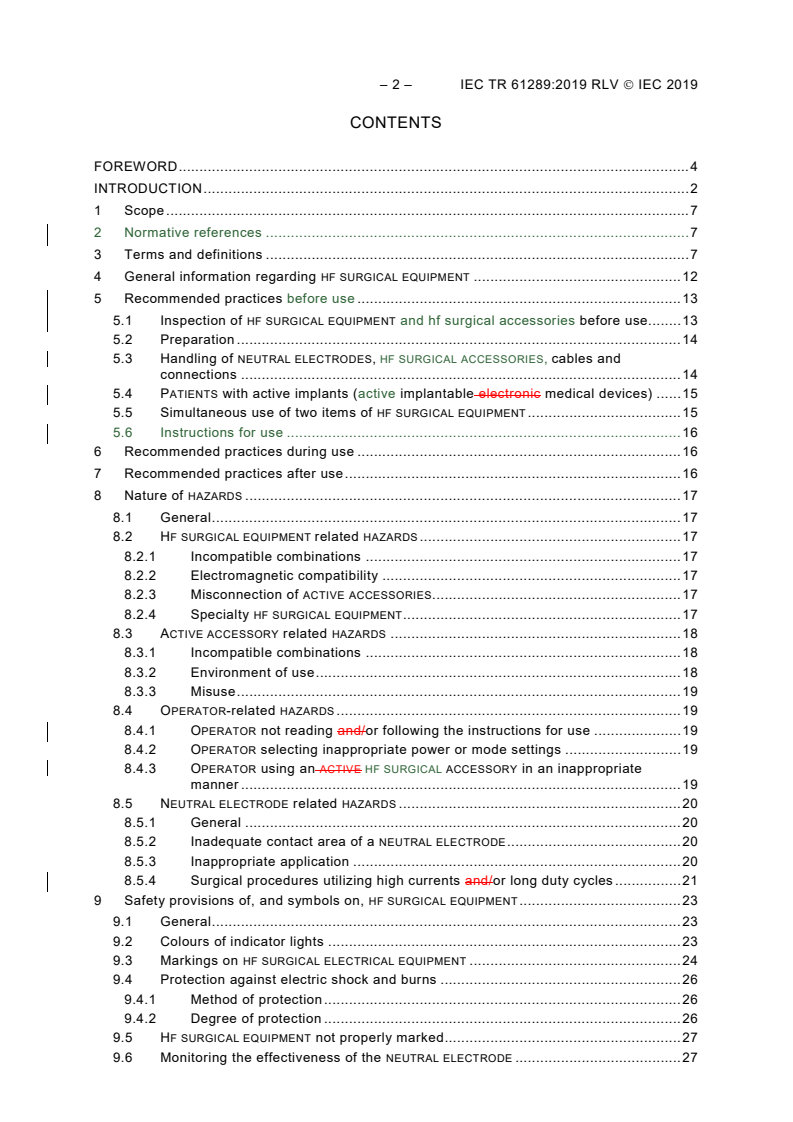
IEC TR 61289:2019 RLV - High frequency surgical equipment and high frequency surgical accessories - Operation and maintenance Released:5/10/2019
Overview
IEC TR 61289:2019 - "High frequency surgical equipment and high frequency surgical accessories - Operation and maintenance" - is a technical report from the IEC that provides practical guidelines for the safe and effective operation and upkeep of electrosurgical (high‑frequency, HF) devices and their accessories. It is intended primarily for medical and nursing personnel and for scientific/technical staff responsible for maintenance. This second edition (2019) supersedes the 2011 edition and aligns the guidance with IEC 60601‑2‑2:2017, refines terms, separates HF equipment from HF accessories, adds consideration of HIGH CURRENT MODE, and updates symbols.
Key topics and technical requirements
- Scope and intended users: Guidance for HF surgical equipment constructed to IEC 60601‑1 and IEC 60601‑2‑2 safety requirements; also applicable where older equipment does not fully meet current standards.
- Pre‑use, during‑use and post‑use practices: Recommended inspection, preparation, handling and documentation to reduce risk during electrosurgery.
- HF surgical accessories: Definitions and safe handling of ACTIVE ACCESSORIES (active handle, active electrode, connectors, finger switches) and NEUTRAL ELECTRODES, including connection and contact‑area considerations.
- Hazard identification: Incompatible equipment/accessory combinations, electromagnetic compatibility (EMC) issues, misconnections, operator errors, environment of use, and risks from inadequate neutral electrode contact.
- High current mode: Specific considerations for procedures that require high currents or long duty cycles (thermal effects, accessory suitability, monitoring).
- Safety provisions and symbols: Colour indicators, markings, symbols for patient circuits (earth referenced vs isolated), and guidance on output indicators and monitoring neutral electrode effectiveness.
- Preventive maintenance and accompanying documentation: Recommended maintenance intervals, inspection checklists, and the importance of following manufacturer instructions for use.
Practical applications
- Ensures safe electrosurgery workflows in operating rooms, ambulatory surgical centers, and clinics performing electrosurgical procedures.
- Informs clinical procedures for patient safety (e.g., placement and monitoring of neutral electrodes, simultaneous device use).
- Guides biomedical engineers and clinical/technical maintenance teams on preventive maintenance practices, inspection, and troubleshooting.
- Helps procurement and risk‑management teams assess device/accessory compatibility and compliance with IEC safety expectations.
Who should use this standard
- Surgeons, perioperative nurses and clinical operators
- Biomedical engineers, clinical engineers and maintenance technicians
- Hospital safety officers and risk‑management personnel
- Manufacturers and product conformity teams seeking alignment with IEC 60601 series requirements
Related standards
- IEC 60601‑1 - General requirements for basic safety and essential performance of medical electrical equipment
- IEC 60601‑2‑2 - Particular requirements for high‑frequency surgical equipment (aligned in the 2019 revision)
Keywords: IEC TR 61289:2019, high frequency surgical equipment, HF surgical accessories, operation and maintenance, electrosurgery, IEC 60601‑2‑2, neutral electrode, active accessory, preventive maintenance, clinical safety.
Relations
- Effective Date
- 05-Sep-2023
Buy Documents
IEC TR 61289:2019 - High frequency surgical equipment and high frequency surgical accessories - Operation and maintenance Released:5/10/2019
IEC TR 61289:2019 RLV - High frequency surgical equipment and high frequency surgical accessories - Operation and maintenance Released:5/10/2019
Get Certified
Connect with accredited certification bodies for this standard

BSI Group
BSI (British Standards Institution) is the business standards company that helps organizations make excellence a habit.

TÜV Rheinland
TÜV Rheinland is a leading international provider of technical services.

TÜV SÜD
TÜV SÜD is a trusted partner of choice for safety, security and sustainability solutions.
Sponsored listings
Frequently Asked Questions
IEC TR 61289:2019 is a technical report published by the International Electrotechnical Commission (IEC). Its full title is "High frequency surgical equipment and high frequency surgical accessories - Operation and maintenance". This standard covers: IEC TR 61289:2019 contains guidelines for medical and nursing personnel regarding the safe and effective operation of HIGH FREQUENCY SURGICAL EQUIPMENT and HIGH FREQUENCY SURGICAL ACCESSORIES (also referred to as HF SURGICAL EQUIPMENT in this document). It is also of use to scientific/technical staff who have responsibility for the maintenance of this equipment. The application guidelines in this document deal with the safe operation of HIGH FREQUENCY SURGICAL EQUIPMENT constructed according to the safety requirements of IEC 60601-1 and IEC 60601-2-2. Not all existing HIGH FREQUENCY SURGICAL EQUIPMENT meets the minimum requirements of current international standards, however, the guidelines in this document is still helpful in utilizing these devices. IEC TR 61289:2019 cancels and replaces the first edition published in 2011. This edition constitutes a technical revision. This edition includes the following significant technical changes with respect to the previous edition: a) general adaption to IEC 60601-2-2:2017; b) refinement and additions to the defined terms; c) separation of HF SURGICAL EQUIPMENT and HF SURGICAL ACCESSORIES; d) consideration of the HIGH CURRENT MODE; e) update of symbols.
IEC TR 61289:2019 contains guidelines for medical and nursing personnel regarding the safe and effective operation of HIGH FREQUENCY SURGICAL EQUIPMENT and HIGH FREQUENCY SURGICAL ACCESSORIES (also referred to as HF SURGICAL EQUIPMENT in this document). It is also of use to scientific/technical staff who have responsibility for the maintenance of this equipment. The application guidelines in this document deal with the safe operation of HIGH FREQUENCY SURGICAL EQUIPMENT constructed according to the safety requirements of IEC 60601-1 and IEC 60601-2-2. Not all existing HIGH FREQUENCY SURGICAL EQUIPMENT meets the minimum requirements of current international standards, however, the guidelines in this document is still helpful in utilizing these devices. IEC TR 61289:2019 cancels and replaces the first edition published in 2011. This edition constitutes a technical revision. This edition includes the following significant technical changes with respect to the previous edition: a) general adaption to IEC 60601-2-2:2017; b) refinement and additions to the defined terms; c) separation of HF SURGICAL EQUIPMENT and HF SURGICAL ACCESSORIES; d) consideration of the HIGH CURRENT MODE; e) update of symbols.
IEC TR 61289:2019 is classified under the following ICS (International Classification for Standards) categories: 11.040.01 - Medical equipment in general. The ICS classification helps identify the subject area and facilitates finding related standards.
IEC TR 61289:2019 has the following relationships with other standards: It is inter standard links to IEC TR 61289:2011. Understanding these relationships helps ensure you are using the most current and applicable version of the standard.
IEC TR 61289:2019 is available in PDF format for immediate download after purchase. The document can be added to your cart and obtained through the secure checkout process. Digital delivery ensures instant access to the complete standard document.
Standards Content (Sample)
IEC TR 61289 ®
Edition 2.0 2019-05
TECHNICAL
REPORT
colour
inside
High frequency surgical equipment and high frequency surgical accessories –
Operation and maintenance
All rights reserved. Unless otherwise specified, no part of this publication may be reproduced or utilized in any form
or by any means, electronic or mechanical, including photocopying and microfilm, without permission in writing from
either IEC or IEC's member National Committee in the country of the requester. If you have any questions about IEC
copyright or have an enquiry about obtaining additional rights to this publication, please contact the address below or
your local IEC member National Committee for further information.
IEC Central Office Tel.: +41 22 919 02 11
3, rue de Varembé info@iec.ch
CH-1211 Geneva 20 www.iec.ch
Switzerland
About the IEC
The International Electrotechnical Commission (IEC) is the leading global organization that prepares and publishes
International Standards for all electrical, electronic and related technologies.
About IEC publications
The technical content of IEC publications is kept under constant review by the IEC. Please make sure that you have the
latest edition, a corrigendum or an amendment might have been published.
IEC publications search - webstore.iec.ch/advsearchform Electropedia - www.electropedia.org
The advanced search enables to find IEC publications by a The world's leading online dictionary on electrotechnology,
variety of criteria (reference number, text, technical containing more than 22 000 terminological entries in English
committee,…). It also gives information on projects, replaced and French, with equivalent terms in 16 additional languages.
and withdrawn publications. Also known as the International Electrotechnical Vocabulary
(IEV) online.
IEC Just Published - webstore.iec.ch/justpublished
Stay up to date on all new IEC publications. Just Published IEC Glossary - std.iec.ch/glossary
details all new publications released. Available online and 67 000 electrotechnical terminology entries in English and
once a month by email. French extracted from the Terms and Definitions clause of
IEC publications issued since 2002. Some entries have been
IEC Customer Service Centre - webstore.iec.ch/csc collected from earlier publications of IEC TC 37, 77, 86 and
If you wish to give us your feedback on this publication or CISPR.
need further assistance, please contact the Customer Service
Centre: sales@iec.ch.
IEC TR 61289 ®
Edition 2.0 2019-05
TECHNICAL
REPORT
colour
inside
High frequency surgical equipment and high frequency surgical accessories –
Operation and maintenance
INTERNATIONAL
ELECTROTECHNICAL
COMMISSION
ICS 11.040.01 ISBN 978-2-8322-6885-8
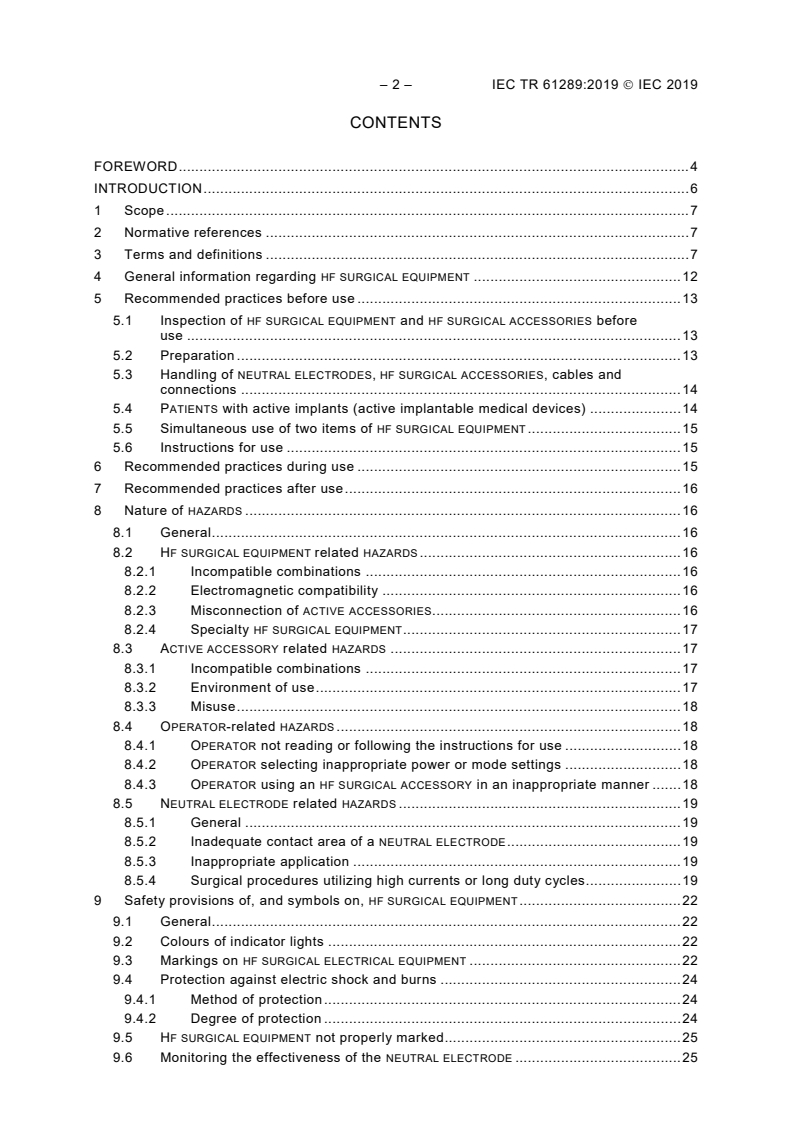
– 2 – IEC TR 61289:2019 IEC 2019
CONTENTS
FOREWORD . 4
INTRODUCTION . 6
1 Scope . 7
2 Normative references . 7
3 Terms and definitions . 7
4 General information regarding HF SURGICAL EQUIPMENT . 12
5 Recommended practices before use . 13
5.1 Inspection of HF SURGICAL EQUIPMENT and HF SURGICAL ACCESSORIES before
use . 13
5.2 Preparation . 13
5.3 Handling of NEUTRAL ELECTRODES, HF SURGICAL ACCESSORIES, cables and
connections . 14
5.4 PATIENTS with active implants (active implantable medical devices) . 14
5.5 Simultaneous use of two items of HF SURGICAL EQUIPMENT . 15
5.6 Instructions for use . 15
6 Recommended practices during use . 15
7 Recommended practices after use . 16
8 Nature of HAZARDS . 16
8.1 General . 16
8.2 HF SURGICAL EQUIPMENT related HAZARDS . 16
8.2.1 Incompatible combinations . 16
8.2.2 Electromagnetic compatibility . 16
8.2.3 Misconnection of ACTIVE ACCESSORIES . 16
8.2.4 Specialty HF SURGICAL EQUIPMENT . 17
8.3 ACTIVE ACCESSORY related HAZARDS . 17
8.3.1 Incompatible combinations . 17
8.3.2 Environment of use . 17
8.3.3 Misuse . 18
8.4 OPERATOR-related HAZARDS . 18
8.4.1 OPERATOR not reading or following the instructions for use . 18
8.4.2 OPERATOR selecting inappropriate power or mode settings . 18
8.4.3 OPERATOR using an HF SURGICAL ACCESSORY in an inappropriate manner . 18
8.5 NEUTRAL ELECTRODE related HAZARDS . 19
8.5.1 General . 19
8.5.2 Inadequate contact area of a NEUTRAL ELECTRODE . 19
8.5.3 Inappropriate application . 19
8.5.4 Surgical procedures utilizing high currents or long duty cycles . 19
9 Safety provisions of, and symbols on, HF SURGICAL EQUIPMENT . 22
9.1 General . 22
9.2 Colours of indicator lights . 22
9.3 Markings on HF SURGICAL ELECTRICAL EQUIPMENT . 22
9.4 Protection against electric shock and burns . 24
9.4.1 Method of protection . 24
9.4.2 Degree of protection . 24
9.5 HF SURGICAL EQUIPMENT not properly marked . 25
9.6 Monitoring the effectiveness of the NEUTRAL ELECTRODE . 25
9.7 Output indicators . 25
10 Accompanying documents . 26
11 Preventive maintenance . 26
Annex A (informative) Concerns regarding high current surgical procedures or high
duty cycles . 27
Bibliography . 28
Figure 1 – Symbol used on Class II equipment . 24
Figure 2 – Symbol used with an earth referenced PATIENT circuit . 25
Figure 3 – Symbol used with an HF ISOLATED PATIENT CIRCUIT . 25
Table 1 – Colours and significance of indicator lights according to IEC 60601-2-2 . 22
Table 2 – Symbols used on HF SURGICAL EQUIPMENT . 23
– 4 – IEC TR 61289:2019 IEC 2019
INTERNATIONAL ELECTROTECHNICAL COMMISSION
____________
HIGH FREQUENCY SURGICAL EQUIPMENT AND HIGH FREQUENCY
SURGICAL ACCESSORIES – OPERATION AND MAINTENANCE
FOREWORD
1) The International Electrotechnical Commission (IEC) is a worldwide organization for standardization comprising
all national electrotechnical committees (IEC National Committees). The object of IEC is to promote
international co-operation on all questions concerning standardization in the electrical and electronic fields. To
this end and in addition to other activities, IEC publishes International Standards, Technical Specifications,
Technical Reports, Publicly Available Specifications (PAS) and Guides (hereafter referred to as “IEC
Publication(s)”). Their preparation is entrusted to technical committees; any IEC National Committee interested
in the subject dealt with may participate in this preparatory work. International, governmental and non-
governmental organizations liaising with the IEC also participate in this preparation. IEC collaborates closely
with the International Organization for Standardization (ISO) in accordance with conditions determined by
agreement between the two organizations.
2) The formal decisions or agreements of IEC on technical matters express, as nearly as possible, an international
consensus of opinion on the relevant subjects since each technical committee has representation from all
interested IEC National Committees.
3) IEC Publications have the form of recommendations for international use and are accepted by IEC National
Committees in that sense. While all reasonable efforts are made to ensure that the technical content of IEC
Publications is accurate, IEC cannot be held responsible for the way in which they are used or for any
misinterpretation by any end user.
4) In order to promote international uniformity, IEC National Committees undertake to apply IEC Publications
transparently to the maximum extent possible in their national and regional publications. Any divergence
between any IEC Publication and the corresponding national or regional publication shall be clearly indicated in
the latter.
5) IEC itself does not provide any attestation of conformity. Independent certification bodies provide conformity
assessment services and, in some areas, access to IEC marks of conformity. IEC is not responsible for any
services carried out by independent certification bodies.
6) All users should ensure that they have the latest edition of this publication.
7) No liability shall attach to IEC or its directors, employees, servants or agents including individual experts and
members of its technical committees and IEC National Committees for any personal injury, property damage or
other damage of any nature whatsoever, whether direct or indirect, or for costs (including legal fees) and
expenses arising out of the publication, use of, or reliance upon, this IEC Publication or any other IEC
Publications.
8) Attention is drawn to the Normative references cited in this publication. Use of the referenced publications is
indispensable for the correct application of this publication.
9) Attention is drawn to the possibility that some of the elements of this IEC Publication may be the subject of
patent rights. IEC shall not be held responsible for identifying any or all such patent rights.
The main task of IEC technical committees is to prepare International Standards. However, a
technical committee may propose the publication of a technical report when it has collected
data of a different kind from that which is normally published as an International Standard, for
example "state of the art".
IEC 61289, which is a technical report, has been prepared by sub-committee 62D:
Electromedical equipment, of IEC technical committee 62: Electrical equipment in medical
practice.
This second edition cancels and replaces the first edition published in 2011. This edition
constitutes a technical revision.
This edition includes the following significant technical changes with respect to the previous
edition:
a) general adaption to IEC 60601-2-2:2017;
b) refinement and additions to the defined terms;
c) separation of HF SURGICAL EQUIPMENT and HF SURGICAL ACCESSORIES;
d) consideration of the HIGH CURRENT MODE;
e) update of symbols.
The text of this technical report is based on the following documents:
Enquiry draft Report on voting
62D/1652/DTR 62D/1662A/RVDTR
Full information on the voting for the approval of this technical report can be found in the
report on voting indicated in the above table.
This publication has been drafted in accordance with the ISO/IEC Directives, Part 2.
In this document, the following print types are used:
– TERMS DEFINED IN CLAUSE 3: SMALL CAPITALS.
The committee has decided that the contents of this publication will remain unchanged until
the stability date indicated on the IEC web site under "http://webstore.iec.ch" in the data
related to the specific publication. At this date, the publication will be
• reconfirmed,
• withdrawn,
• replaced by a revised edition, or
• amended.
A bilingual version of this publication may be issued at a later date.
IMPORTANT – The “colour inside” logo on the cover page of this publication indicates
that it contains colours which are considered to be useful for the correct understanding
of its contents. Users should therefore print this publication using a colour printer.
– 6 – IEC TR 61289:2019 IEC 2019
INTRODUCTION
This document gives guidelines to personnel in charge of operation of equipment covered by
IEC 60601-2-2:2017 to enable them to attain the best conditions of safety for their PATIENTS
and themselves.
HIGH FREQUENCY SURGICAL EQUIPMENT AND HIGH FREQUENCY
SURGICAL ACCESSORIES – OPERATION AND MAINTENANCE
1 Scope
This document contains guidelines for medical and nursing personnel regarding the safe and
effective operation of HIGH FREQUENCY SURGICAL EQUIPMENT and HIGH FREQUENCY SURGICAL
ACCESSORIES (also referred to as HF SURGICAL EQUIPMENT in this document). It is also of use to
scientific/technical staff who have responsibility for the maintenance of this equipment.
The application guidelines in this document deal with the safe operation of HIGH FREQUENCY
SURGICAL EQUIPMENT constructed according to the safety requirements of IEC 60601-1 [1]
and IEC 60601-2-2 [4].
Not all existing HIGH FREQUENCY SURGICAL EQUIPMENT meets the minimum requirements of
current international standards, however, the guidelines in this document is still helpful in
utilizing these devices.
2 Normative references
There are no normative references in this document.
3 Terms and definitions
For the purposes of this document, the following terms and definitions apply.
ISO and IEC maintain terminological databases for use in standardization at the following
addresses:
• IEC Electropedia: available at http://www.electropedia.org/
• ISO Online browsing platform: available at http://www.iso.org/obp
3.1
ACCESSORY
additional part for use with equipment in order to:
– achieve the INTENDED USE,
– adapt it to some special use,
– facilitate its use,
– enhance its performance, or
– enable its functions to be integrated with those of other equipment
[SOURCE: IEC 60601-1:2005, 3.3]
3.2
ACTIVE ACCESSORY
HF SURGICAL ACCESSORY intended for manipulation by the OPERATOR to produce an effect by
electrical conduction adjacent to the ACTIVE ELECTRODE at the intended site on the PATIENT,
__________
Numbers in square brackets refer to the Bibliography.
– 8 – IEC TR 61289:2019 IEC 2019
generally comprising an ACTIVE HANDLE, the cord of an ACTIVE ACCESSORY, ACTIVE CONNECTOR
and ACTIVE ELECTRODE
[SOURCE: IEC 60601-2-2:2017, 201.3.201]
3.3
ACTIVE CONNECTOR
ACTIVE ACCESSORY intended for connection to an ACTIVE OUTPUT TERMINAL, which
part of an
may include additional terminals for connection of a FINGERSWITCH to a SWITCH SENSOR
[SOURCE: IEC 60601-2-2:2017, 201.3.202]
3.4
ACTIVE ELECTRODE
part of an ACTIVE ACCESSORY extending from the ACTIVE HANDLE to the surgical site and
HF current into body tissue
intended to pass
[SOURCE: IEC 60601-2-2:2017, 201.3.203]
3.5
ACTIVE HANDLE
part of an ACTIVE ACCESSORY intended to be held by the OPERATOR
[SOURCE: IEC 60601-2-2:2017, 201.3.205]
3.6
ACTIVE OUTPUT TERMINAL
part of HF SURGICAL EQUIPMENT or ASSOCIATED EQUIPMENT intended for connection to an ACTIVE
ACCESSORY and for delivery of HF current thereto
[SOURCE: IEC 60601-2-2:2017, 201.3.206, modified – The notes have been deleted.]
3.7
APPLIED PART
part of ME EQUIPMENT that in normal use necessarily comes into physical contact with the
PATIENT for ME EQUIPMENT or an ME SYSTEM to perform its function
[SOURCE: IEC 60601-1:2005, 3.8, modified – The notes have been deleted.]
3.8
ASSOCIATED EQUIPMENT
MEDICAL ELECTRICAL EQUIPMENT other than HF SURGICAL EQUIPMENT that may be electrically
connected to the PATIENt circuit
[SOURCE: IEC 60601-2-2:2017, 201.3.207]
3.9
BIPOLAR
method of applying HF current to a PATIENT between two or more ACTIVE ELECTRODES without
the need for a separately connected NEUTRAL ELECTRODE (or the need to use the PATIENT’S
body capacitance to earth) in which an effect is intended in tissue near one or more ACTIVE
ELECTRODES
Note 1 to entry: The BIPOLAR method includes devices energizing pairs of ACTIVE ELECTRODES as well as devices
energizing groups of ACTIVE ELECTRODES where the HF current source and return may have different numbers of
electrodes.
[SOURCE: IEC 60601-2-2:2017, 201.3.208]
3.10
COAGULATION
use of HF current to induce a thermal effect, e.g. to control or prevent bleeding, induce tissue
destruction, or induce tissue shrinkage
Note 1 to entry: COAGULATION may take the form of contact or non-contact COAGULATION.
Note 2 to entry: FULGURATION, desiccation, spray, forced, swift, soft and argon beam (plasma) COAGULATION are
all names of COAGULATION types.
[SOURCE: IEC 60601-2-2:2017, 201.3.210]
3.11
CONTACT QUALITY MONITOR
circuit in HF SURGICAL EQUIPMENT or ASSOCIATED EQUIPMENT intended for connection to a
MONITORING NE providing an alarm in the event that NEUTRAL ELECTRODE (NE) contact with the
PATIENT becomes insufficient
Note 1 to entry: A CONTACT QUALITY MONITOR is functional only when used with a MONITORING NE.
[SOURCE: IEC 60601-2-2:2017, 201.3.211]
3.12
CONTINUITY MONITOR
circuit in HF SURGICAL EQUIPMENT or ASSOCIATED EQUIPMENT intended for connection to an NE,
providing an alarm in the event of electrical discontinuity in the NE cable or its connections
[SOURCE: IEC 60601-2-2:2017, 201.3.212]
3.13
CUTTING
division of body tissue caused by the passage of HIGH FREQUENCY current of high current
density at the ACTIVE ELECTRODE(S)
[SOURCE: IEC 60601-2-2:2017, 201.3.214]
3.14
FINGERSWITCH
device generally included with an ACTIVE ACCESSORY which, when manipulated by the
OPERATOR, enables HF output to be produced and, when released disables HF output
[SOURCE: IEC 60601-2-2:2017, 201.3.216]
3.15
HAZARD
potential source of harm
[SOURCE: IEC 60601-1:2005/AMD1:2012, 3.39]
3.16
HEATING FACTOR
a value equal to I × t where I is the MONOPOLAR current in amperes and t is the duration of the
current flow in s
Note 1 to entry: The HEATING FACTOR is expressed as A s (amperes squared seconds).
[SOURCE: IEC 60601-2-2:2017, 201.3.218]
– 10 – IEC TR 61289:2019 IEC 2019
3.17
HIGH CURRENT MODE
MONOPOLAR output mode whose INTENDED USE (MAXIMUM OUTPUT CURRENT and maximum DUTY
CYCLE) results in a HEATING FACTOR of greater than 30 A s in any 60 s period
[SOURCE: IEC 60601-2-2:2017, 201.3.219]
3.18
HIGH FREQUENCY
HF
frequencies less than 5 MHz and generally greater than 200 kHz
[SOURCE: IEC 60601-2-2:2017, 201.3.220]
3.19
HIGH FREQUENCY SURGICAL ACCESSORY
HF SURGICAL ACCESSORY
ACCESSORY intended to conduct, supplement or monitor HF energy applied to the PATIENT from
HF SURGICAL EQUIPMENT
Note 1 to entry: HF SURGICAL ACCESSORIES include HF surgical application electrodes, including cords and
connectors for attachment to HF SURGICAL EQUIPMENT, as well as other ASSOCIATED EQUIPMENT intended for
connection to the HF surgical PATIENT circuit.
Note 2 to entry: Not all accessories used with HF surgical equipment are HF SURGICAL ACCESSORIES.
[SOURCE: IEC 60601-2-2:2017, 201.3.223, modified – In Note 1, replacement of "active
electrodes" by " HF surgical application electrodes".]
3.20
HIGH FREQUENCY SURGICAL EQUIPMENT
HF SURGICAL EQUIPMENT
MEDICAL ELECTRICAL EQUIPMENT which generates HIGH FREQUENCY currents intended for the
performance of surgical tasks such as CUTTING or COAGULATION of biological tissue by means of
these HIGH FREQUENCY currents
Note 1 to entry: HF SURGICAL EQUIPMENT is also variously known as surgical diathermy, electrosurgical equipment,
electrosurgical generator, RF generator or HF generator.
Note 2 to entry: A footswitch is an example of an associated ACCESSORY that is part of HF SURGICAL EQUIPMENT.
[SOURCE: IEC 60601-2-2:2017, 201.3.224]
3.21
HF SURGICAL MODE
any of a number of OPERATOR selectable HF output characteristics intended to provide a
specific effect at a connected ACTIVE ACCESSORY, such as CUTTING, COAGULATION and the like
Note 1 to entry: Each available HF SURGICAL MODE may be provided with an OPERATOR-adjustable output control to
set the desired intensity or speed of the effect.
[SOURCE: IEC 60601-2-2:2017, 201.3.225]
3.22
INTENDED USE
INTENDED PURPOSE
use for which a product, process or service is intended according to the specifications,
instructions and information provided by the manufacturer
[SOURCE: IEC 60601-1:2005/AMD1:2012, 3.44]
3.23
LEAKAGE CURRENT
current that is not functional
[SOURCE: IEC 60601-1:2005, 3.47, modified – The note has been deleted]
3.24
MEDICAL ELECTRICAL EQUIPMENT
ME EQUIPMENT
electrical equipment having an APPLIED PART or transferring energy to or from the PATIENT or
detecting such energy transfer to or from the PATIENT and which is:
– provided with not more than one connection to a particular supply mains; and
– intended by its manufacturer to be used in the diagnosis, treatment, or monitoring of a
PATIENT; or for compensation or alleviation of disease, injury or disability
Note 1 to entry: ME EQUIPMENT includes those ACCESSORIES as defined by the manufacturer that are necessary to
enable the normal use of the ME EQUIPMENT.
[SOURCE: IEC 60601-1:2005, 3.63, modified – Notes 2 to 5 have been deleted]
3.25
MONITORING NE
NE intended for use with a CONTACT QUALITY MONITOR
Note 1 to entry: A MONITORING NEUTRAL ELECTRODE is also known as a split plate, dual plate, dual foil electrode or
CQM electrode.
[SOURCE: IEC 60601-2-2:2017, 201.3.228]
3.26
MONOPOLAR
method of applying HF output current to a PATIENT via an ACTIVE ELECTRODE and returning via a
separate PATIENT-connected NEUTRAL ELECTRODE (or via the PATIENT’S body capacitance to
earth) in which an effect is intended only in tissue at or near the ACTIVE ELECTRODE
[SOURCE: IEC 60601-2-2:2017, 201.3.229]
3.27
NEUTRAL ELECTRODE
NE
electrode intended to provide a return path for the MONOPOLAR application of HIGH FREQUENCY
current with such a low current density in the PATIENT’S tissue that effects such as excessive
rise in temperature or unwanted burns are avoided
Note 1 to entry: The NEUTRAL ELECTRODE is also known as plate, plate electrode, electrosurgical pad, passive,
return or dispersive electrode.
Note 2 to entry: To keep the current density low enough to prevent unwanted heating, the NEUTRAL ELECTRODE
needs to have a large enough area.
Note 3 to entry: A NEUTRAL ELECTRODE is usually in contact with the PATIENT at a location that is separate from the
MONOPOLAR ACTIVE ELECTRODE.
[SOURCE: IEC 60601-2-2:2017, 201.3.230]
3.28
OPERATOR
person handling equipment
[SOURCE: IEC 60601-1:2005, 3.73]
– 12 – IEC TR 61289:2019 IEC 2019
3.29
PATIENT
living being (person or animal) undergoing a medical, surgical or dental procedure
[SOURCE: IEC 60601-1:2005/AMD1:2012, 3.76, modified – The note has been deleted.]
3.30
RATED ACCESSORY VOLTAGE
maximum peak HF output voltage which may be applied to a MONOPOLAR HF SURGICAL
ACCESSORY with respect to an NE connected to the PATIENT. For a BIPOLAR HF SURGICAL
ACCESSORY, the maximum peak HF output voltage which may be applied to pairs of opposite
polarity
3.31
RATED LOAD
value of non-reactive load resistance which, when connected, results in the maximum HF
output power from each HF SURGICAL MODE of the HF SURGICAL EQUIPMENT
[SOURCE: IEC 60601-2-2:2017, 201.3.232]
3.32
RATED OUTPUT POWER
HF SURGICAL MODE set at its maximum output setting, the power in watts produced
for each
when all ACTIVE OUTPUT TERMINALS which can be activated simultaneously are connected to
their respective RATED LOADs
[Source: IEC 60601-2-2:2017, 201.3.233]
3.33
SWITCH SENSOR
HF SURGICAL EQUIPMENT or ASSOCIATED EQUIPMENT which controls activation of HF output
part of
in response to operation of a connected FINGERSWITCH or footswitch
[SOURCE: IEC 60601-2-2:2017, 201.3.234]
4 General information regarding HF SURGICAL EQUIPMENT
HF SURGICAL EQUIPMENT is MEDICAL ELECTRICAL EQUIPMENT which delivers HIGH FREQUENCY
currents to perform surgical modification of tissue. The most common forms of tissue
modification are CUTTING and COAGULATION but may also include tissue ablation, lesioning,
shrinkage, sealing or fusion.
The current is conducted to and from the PATIENT in the following ways:
– in MONOPOLAR application with an ACTIVE ELECTRODE of a small area and a large NEUTRAL
ELECTRODE;
– in MONOPOLAR application of HF SURGICAL EQUIPMENT with a RATED OUTPUT POWER less than
50 W and not provided with a NEUTRAL ELECTRODE connection point, the circuit for the HIGH
FREQUENCY current being completed through the capacitive coupling between the PATIENT
and the earthed environment;
– in BIPOLAR application with a BIPOLAR electrode only, for example forceps where the legs
are electrically insulated from each other;
– in multipolar application where a multitude of ACTIVE ELECTRODES are present. In this type
of application the current passes from one or more of the ACTIVE ELECTRODES to either a
large NEUTRAL ELECTRODE in a MONOPOLAR like arrangement or to one or more small area
electrodes in the immediate vicinity in a BIPOLAR like arrangement;
– in an application where the current delivery is augmented by the use of argon gas or
saline solution between the ACTIVE ELECTRODE(S) and the target tissue.
The output power may vary considerably depending on the INTENDED USE, from a few watts for
special procedures, for example in ophthalmology, up to 300 W or more for some equipment.
The peak output voltage from some equipment may be as high as 6 000 V or more.
The use of HIGH FREQUENCY (HF) current is a possible HAZARD to the PATIENT, the OPERATOR
and other personnel present and to the surroundings. Other equipment connected to the
PATIENT may be affected. The safe operation of HIGH FREQUENCY SURGICAL EQUIPMENT depends
mainly on the following factors:
– safe use, which depends on:
• OPERATOR's knowledge of the safe methods of use of the equipment,
• OPERATOR's knowledge of safety characteristics of the equipment,
• availability and readability of accompanying documents;
– integrity of the equipment;
– an effective maintenance scheme;
– safety of the installation. This document assumes that the HIGH FREQUENCY SURGICAL
EQUIPMENT has been installed in a healthcare facility that meets national and local
regulations.
5 Recommended practices before use
5.1 Inspection of HF SURGICAL EQUIPMENT and HF SURGICAL ACCESSORIES before use
Before surgery, the OPERATOR should check the HF SURGICAL EQUIPMENT and HF SURGICAL
ACCESSORIES as listed below.
– Inspect the mains plug, connectors and cables, including handles for ACTIVE ACCESSORIES
and any NEUTRAL ELECTRODES, for visible damage. If damaged, do not use. Damaged
instruments or cords may lead to injury to the PATIENT or OPERATOR.
– Check that HF SURGICAL ACCESSORIES, NEUTRAL ELECTRODES, and cables are compatible
with:
• each other;
HF SURGICAL EQUIPMENT;
• with the
• the output mode;
• the output power setting;
• the output voltage that will be used.
Information should be available in the respective instructions for use.
– Check that the selected NEUTRAL ELECTRODE is compatible with the weight of the PATIENT.
– Check that the EQUIPMENT has no visible damage.
– Check that warning signs and other markings on the EQUIPMENT are readable.
– Check that all indicating lamps and audible tones are in working order.
– Conduct any additional checks or inspections as recommended by the manufacturer.
Warning: Do not try to test the HF SURGICAL EQUIPMENT by sparking against metal parts or the
NEUTRAL ELECTRODE.
5.2 Preparation
Before application of the NEUTRAL ELECTRODE, check the positioning of the PATIENT.
– 14 – IEC TR 61289:2019 IEC 2019
– The PATIENT, including their extremities, shall be isolated from earthed metal parts.
– Skin-to-skin contact (for example between the arms and body of the PATIENT) should be
avoided, for example by insertion of dry towel.
– The use of flammable anaesthetics or oxidizing gases such as nitrous oxide (N O) and
oxygen should be avoided if a surgical procedure is carried out in the region of the thorax
or the head, unless these agents are suctioned or scavenged away.
– Use non-flammable agents for cleaning and disinfection wherever possible.
– Before the application of HF surgery, check for pooling of flammable solutions under the
PATIENT or in body depressions such as the umbilicus, and in body cavities such as the
vagina.
– Before using HF SURGICAL EQUIPMENT, after cleaning or disinfection, remove visible volume,
dry the area and allow evaporation of any residual flammable agents used for cleaning or
disinfecting, or as solvents of adhesives from all PATIENT and non-PATIENT surfaces as well
as cavities.
– Assess for the danger of ignition of endogenous gases, e.g., bowel gas methane.
– Be aware that some materials, for example cotton, wool and gauze, when saturated with
oxygen may be ignited by sparks produced in normal use of the HF SURGICAL EQUIPMENT.
– Avoid placement of a NEUTRAL ELECTRODE over poorly vascularized areas such as: bony
prominences, skin lesions, skin folds, and scars.
5.3 Handling of NEUTRAL ELECTRODES, HF SURGICAL ACCESSORIES, cables and
connections
NEUTRAL ELECTRODES and connections shall be placed with care. Special attention shall be
paid to the following.
– The entire area of NEUTRAL ELECTRODES should be reliably in contact with the PATIENT'S
body.
– When HF SURGICAL EQUIPMENT and physiological monitoring equipment are used
simultaneously on the same PATIENT, any monitoring electrodes should be placed as far as
possible from the ACTIVE ELECTRODES. Needle monitoring electrodes are not
recommended. In all cases, monitoring systems incorporating HIGH FREQUENCY current
limiting devices are recommended.
– For NEUTRAL ELECTRODES that use a detachable cord, ensure that the tab of the NEUTRAL
ELECTRODE is fully inserted into the connector so that no metallic surface is exposed.
The selection of ACTIVE ACCESSORIES should take into account their compatibility with HF
SURGICAL EQUIPMENT.
The HF SURGICAL EQUIPMENT leads should be positioned in such a way that contact with the
PATIENT monitoring or other leads is avoided.
Temporarily unused ACTIVE ELECTRODES should be stored in a non-conductive location that is
isolated from the PATIENT, for example in a holster or quiver.
5.4 PATIENTS with active implants (active implantable medical devices)
PATIENTS with active implants, for example pacemakers, implantable neurostimulators,
implantable pumps, implantable defibrillators, or implanted electrodes, may be affected by the
application of HF SURGICAL EQUIPMENT. The effects could be irreparable damage to the active
implant or impairment of its function. The manufacturer of the active implant should be
consulted prior to the surgery. Simultaneous monitoring of such PATIENTS using suitable
monitoring equipment is also recommended.
NOTE Currents induced in the implanted electrodes due to the use of HF SURGICAL EQUIPMENT can cause
irreversible changes in the tissue around the electrodes, causing malfunctioning of the implant.
The following guidelines should be taken into account:
– the selected output power should be as low as possible for the intended application;
– the current path in the body should be at right angles to the leads of the active implant;
BIPOLAR technique should be considered.
– whenever possible, the use of
5.5 Simultaneous use of two items of HF SURGICAL EQUIPMENT
In some applications, it may be necessary to use two separate pieces of HF SURGICAL
EQUIPMENT, for example when simultaneously operating on two different parts of the body. In
these cases, additional technical advice should be sought.
The choice of equipment that provides the lowest clinical risk is the use of two BIPOLAR HF
surgery generators. If this is not clinically appropriate, then use of one BIPOLAR and one
MONOPOLAR generator is the next lower risk option. If the clinical circumstances justify it, two
MONOPOLAR generators can be used. Both should be of the HF isolated type shown by the
symbol as described in 9.4.2.2. The NEUTRAL ELECTRODE for each generator should be
positioned appropriately for the surgical operating site of that generator, taking account of
manufacturers’ recommendations and good clinical practice. The NEUTRAL ELECTRODES should
not be positioned close together and the NEUTRAL ELECTRODE leads should be kept well
separated. Whenever possible, ensure that the current path from ACTIVE ACCESSORY 1 to
NEUTRAL ELECTRODE 1 does not pass through the same part of the PATIENT'S body as the
current path from ACTIVE ACCESSORY 2 to NEUTRAL ELECTRODE 2.
Further technical advice can be sought from the equipment manufacturers or from the local
clinical engineering department.
5.6 Instructions for use
Users should read and understand the instructions for use provided by manufacturer(s).
Modes, options and operating characteristics may not be consistent across manufacturers.
6 Recommended practices during use
When using HF SURGICAL EQUIPMENT caution is necessary, therefore observe the following
rules:
– The HIGH FREQUENCY power should be set as low as possible for the application in
question. Reference should be made to the manufacturer’s recommended setting for the
procedure being carried out.
– Insufficient power at the customary control setting may be caused by, for example, bad
contact of the NEUTRAL ELECTRODE, bad contact in connectors or a broken cable under the
insulation. These items should be checked before a higher power setting is used.
– After repositioning the PATIENT, or if someone trips on the NE cable, the application of the
NEUTRAL ELECTRODES and the NE cables should be inspected. For NEUTRAL ELECTRODES
that use a detachable cord, ensure that the tab of the NEUTRAL ELECTRODE is still fully
inserted into the connector so that no metallic surface is exposed.
– The functioning of the HF SURGICAL EQUIPMENT should not be tested by sparking against
metal parts or the NEUTRAL ELECTRODE.
– When operating in parts of the body having a small cross section, the application of
BIPOLAR technique may be preferable in order to avoid unwanted tissue damage.
– Flammable agents for skin cleaning, grease removal and disinfection shall be completely
evaporated before the application of the HF SURGICAL EQUIPMENT. The HAZARD of igniting
endogenous gases shall also be considered.
– 16 – IEC TR 61289:2019 IEC 2019
– Be aware that electromagnetic interference emanating from HF SURGICAL EQUIPMENT may
influence other MEDICAL ELECTRICAL EQUIPMENT, for example ECG monitors, blood pressure
monitors, infusion pumps, cardiac pacemakers, etc.
HF SURGICAL EQUIPMENT should be activated only when the HF SURGICAL ACCESSORY is
– The
in position and the intended clinical effect is desired.
7 Recommended practices after use
After each use, the HF SURGICAL EQUIPMENt should be cleaned as indicated in the instructions
for use. Reusable HF SURGICAL ACCESSORIES should be cleaned and sterilized according to
local policy and the manufacturer’s recommendations.
8 Nature of HAZARDS
8.1 General
The currents and voltages generated in HF SURGICAL EQUIPMENT may present a HAZARD to the
PATIENT or the OPERATOR by the nature of its use or by its electrical interference with other
equipment in the vicinity of, in contact with, or implanted within the PATIENT. The generation of
sparks or arcs between the ACTIVE ELECTRODE and tissue or, between the ACTIVE ELECTRODE
and metal objects, may be a source of low frequency components in the output current which
may cause neuromuscular stimulation. The following subclauses give some examples of
HAZARDS that are associated with the use of HF SURGICAL EQUIPMENT.
8.2 HF SURGICAL EQUIPMENT related HAZARDS
8.2.1 Incompatible combinations
Although it may be possible to physically connect different pieces of HF SURGICAL EQUIPMENT
or HF SURGICAL ACCESSORIES, the combination may not always work in the expected manner.
OPERATORs should always confirm the compatibility of different pieces of HF SURGICAL
EQUIPMENT or HF SURGICAL ACCESSORIES with all of the manufacturers involved. This includes
correct operation, possible changes in the electromagnetic compatibility of the combination,
and electrical safety. For example, identical looking footswitches from different manufacturers
may not be electrically identical resulting in unexpected, unintended and potentially harmful
results.
8.2.2 Electromagnetic compatibility
When in use, HF SURGICAL EQUIPMENT will generate electromagnetic disturbances. A
disturbance may be radiated through the air, conducted through the PATIENT or conducted
through the mains power cord or PATIENT cables. This may impact other MEDICAL ELECTRICAL
EQUIPMENT in the vicinity of or connected to the PATIENT. OPERATORs should follow the
recommendations of the manufacturer(s) regarding this situation. This includes the
manufacturer of any active implanted, body worn, or semi-implanted device. There may be
techniques for cable placement, equipment setup or output mode/power setting that will help
mitigate this HAZARD.
8.2.3 Misconnection of ACTIVE ACCESSORIES
Some ACTIVE ACCESSORIES may be physically connected to HF SURGICAL EQUIPMENT in a
manner not intended by the manufacturer. An example might be a BIPOLAR ACTIVE ACCESSORY
incorrectly connected to a MONOPOLAR receptacle through the use of an adapter or non-
conforming cord. OPERATORs should always consult the instructions for use for the correct
connection information.
8.2.4 Specialty HF SURGICAL EQUIPMENT
Certain types of specialty HF SURGICAL EQUIPMENT may have risks associated with their use
that are different from traditional HF SURGICAL EQUIPMENT. These risks may not be obvious.
The instructions for use will list the warnings and cautions particular to that HF SURGICAL
EQUIPMENT. An example is argon-enhanced HF SURGICAL EQUIPMENT where the risks
associated with the use of argon gas should be understood by the OPERATOR. Another
example is HF SURGICAL EQUIPMENT that has a HIGH CURRENT MODE where there are risks
NEUTRAL ELECTRODE.
associated with heating under the
8.3 ACTIVE ACCESSORY related HAZARDS
8.3.1 Incompatible combinations
An ACTIVE ACCESSORY may not be compatible with every cord that can be physically connected
to it. The incompatibility may be electrical where the voltage or current that will be used is too
high. The incompatibility may be in the physical connection itself where the mating parts are
not the same size or tolerance, potentially causing the connection to become hot or come
apart during surgery. The connection may be incomplete with uncovered bare metal allowing
unintended current to injure the PATIENT or OPERATOR.
An ACTIVE ACCESSORY may not be compatible with every ACTIVE ELECTRODE that can be
physically connected to it. The incompatibilities and the consequences are likely to be the
same as described above.
An ACTIVE ACCESSORY may not be compatible with every HF SURGICAL MODE, power or voltage
to which it could be exposed. OPERATORS should consult the instructions for use of both the
ACCESSORY and the HF SURGICAL EQUIPMENT for compatibility information and maximum voltage
ratings. An HF SURGICAL MODE or power setting that delivers a peak voltage greater than the
ACTIVE ACCESSORY is an example of this HAZARD and
maximum peak voltage rating of an
should be avoided. The maximum peak voltage rating is also known as the RATED ACCESSORY
VOLTAGE within the IEC 60601-2-2.
8.3.2 Environment of use
Sparks generated at the ACTIVE ELECTRODE during normal use may cause a fire or explosion if
flammable anaesthetic or cleaning agents are present or the HF SURGICAL EQUIPMENT is used
in an atmosphere enriched by endogenous gases, oxygen or nitrous oxide.
Low-frequency voltages caused by sparks or electrical arcs may cause neuromuscular
stimulation. The PATIENT may have excitable tissue stimulated, especially if there is a fault in
the insulation in endoscopes or resectoscopes between the ACTIVE ELECTRODE and the shaft.
For example, during plastic surgery, especially on the face, neuromuscular stimulation may
occur due to arcing from tips of ACTIVE ELECTRODES.
Arcing t
...
IEC TR 61289 ®
Edition 2.0 2019-05
REDLINE VERSION
TECHNICAL
REPORT
colour
inside
High frequency surgical equipment and high frequency surgical accessories –
Operation and maintenance
All rights reserved. Unless otherwise specified, no part of this publication may be reproduced or utilized in any form
or by any means, electronic or mechanical, including photocopying and microfilm, without permission in writing from
either IEC or IEC's member National Committee in the country of the requester. If you have any questions about IEC
copyright or have an enquiry about obtaining additional rights to this publication, please contact the address below or
your local IEC member National Committee for further information.
IEC Central Office Tel.: +41 22 919 02 11
3, rue de Varembé info@iec.ch
CH-1211 Geneva 20 www.iec.ch
Switzerland
About the IEC
The International Electrotechnical Commission (IEC) is the leading global organization that prepares and publishes
International Standards for all electrical, electronic and related technologies.
About IEC publications
The technical content of IEC publications is kept under constant review by the IEC. Please make sure that you have the
latest edition, a corrigendum or an amendment might have been published.
IEC publications search - webstore.iec.ch/advsearchform Electropedia - www.electropedia.org
The advanced search enables to find IEC publications by a The world's leading online dictionary on electrotechnology,
variety of criteria (reference number, text, technical containing more than 22 000 terminological entries in English
committee,…). It also gives information on projects, replaced and French, with equivalent terms in 16 additional languages.
and withdrawn publications. Also known as the International Electrotechnical Vocabulary
(IEV) online.
IEC Just Published - webstore.iec.ch/justpublished
Stay up to date on all new IEC publications. Just Published IEC Glossary - std.iec.ch/glossary
details all new publications released. Available online and 67 000 electrotechnical terminology entries in English and
once a month by email. French extracted from the Terms and Definitions clause of
IEC publications issued since 2002. Some entries have been
IEC Customer Service Centre - webstore.iec.ch/csc collected from earlier publications of IEC TC 37, 77, 86 and
If you wish to give us your feedback on this publication or CISPR.
need further assistance, please contact the Customer Service
Centre: sales@iec.ch.
IEC TR 61289 ®
Edition 2.0 2019-05
REDLINE VERSION
TECHNICAL
REPORT
colour
inside
High frequency surgical equipment and high frequency surgical accessories –
Operation and maintenance
INTERNATIONAL
ELECTROTECHNICAL
COMMISSION
ICS 11.040.01 ISBN 978-2-8322-6934-3
– 2 – IEC TR 61289:2019 RLV IEC 2019
CONTENTS
FOREWORD . 4
INTRODUCTION . 2
1 Scope . 7
2 Normative references . 7
3 Terms and definitions . 7
4 General information regarding HF SURGICAL EQUIPMENT . 12
5 Recommended practices before use . 13
5.1 Inspection of HF SURGICAL EQUIPMENT and hf surgical accessories before use. 13
5.2 Preparation . 14
5.3 Handling of NEUTRAL ELECTRODES, HF SURGICAL ACCESSORIES, cables and
connections . 14
5.4 PATIENTS with active implants (active implantable electronic medical devices) . 15
5.5 Simultaneous use of two items of HF SURGICAL EQUIPMENT . 15
5.6 Instructions for use . 16
6 Recommended practices during use . 16
7 Recommended practices after use . 16
8 Nature of HAZARDS . 17
8.1 General . 17
8.2 HF SURGICAL EQUIPMENT related HAZARDS . 17
8.2.1 Incompatible combinations . 17
8.2.2 Electromagnetic compatibility . 17
8.2.3 Misconnection of ACTIVE ACCESSORIES . 17
8.2.4 Specialty HF SURGICAL EQUIPMENT . 17
8.3 ACTIVE ACCESSORY related HAZARDS . 18
8.3.1 Incompatible combinations . 18
8.3.2 Environment of use . 18
8.3.3 Misuse . 19
8.4 OPERATOR-related HAZARDS . 19
8.4.1 OPERATOR not reading and/or following the instructions for use . 19
8.4.2 OPERATOR selecting inappropriate power or mode settings . 19
8.4.3 OPERATOR using an ACTIVE HF SURGICAL ACCESSORY in an inappropriate
manner . 19
8.5 NEUTRAL ELECTRODE related HAZARDS . 20
8.5.1 General . 20
8.5.2 Inadequate contact area of a NEUTRAL ELECTRODE . 20
8.5.3 Inappropriate application . 20
8.5.4 Surgical procedures utilizing high currents and/or long duty cycles . 21
9 Safety provisions of, and symbols on, HF SURGICAL EQUIPMENT . 23
9.1 General . 23
9.2 Colours of indicator lights . 23
9.3 Markings on HF SURGICAL ELECTRICAL EQUIPMENT . 24
9.4 Protection against electric shock and burns . 26
9.4.1 Method of protection . 26
9.4.2 Degree of protection . 26
9.5 HF SURGICAL EQUIPMENT not properly marked . 27
9.6 Monitoring the effectiveness of the NEUTRAL ELECTRODE . 27
9.7 Output indicators . 27
10 Accompanying documents . 28
11 Preventive maintenance . 28
Annex A (informative) Concerns regarding high current surgical procedures or high
duty cycles . 29
Bibliography . 30
Figure 1 – Symbol used on Class II equipment . 26
Figure 2 – Symbol used with an earth referenced PATIENT circuit . 27
Figure 3 – Symbol used with an HF ISOLATED PATIENT CIRCUIT . 27
Table 1 – Colours and significance of indicator lights according to IEC 60601-2-2 . 24
Table 2 – Symbols used on HF SURGICAL EQUIPMENT . 25
– 4 – IEC TR 61289:2019 RLV IEC 2019
INTERNATIONAL ELECTROTECHNICAL COMMISSION
____________
HIGH FREQUENCY SURGICAL EQUIPMENT AND HIGH FREQUENCY
SURGICAL ACCESSORIES – OPERATION AND MAINTENANCE
FOREWORD
1) The International Electrotechnical Commission (IEC) is a worldwide organization for standardization comprising
all national electrotechnical committees (IEC National Committees). The object of IEC is to promote
international co-operation on all questions concerning standardization in the electrical and electronic fields. To
this end and in addition to other activities, IEC publishes International Standards, Technical Specifications,
Technical Reports, Publicly Available Specifications (PAS) and Guides (hereafter referred to as “IEC
Publication(s)”). Their preparation is entrusted to technical committees; any IEC National Committee interested
in the subject dealt with may participate in this preparatory work. International, governmental and non-
governmental organizations liaising with the IEC also participate in this preparation. IEC collaborates closely
with the International Organization for Standardization (ISO) in accordance with conditions determined by
agreement between the two organizations.
2) The formal decisions or agreements of IEC on technical matters express, as nearly as possible, an international
consensus of opinion on the relevant subjects since each technical committee has representation from all
interested IEC National Committees.
3) IEC Publications have the form of recommendations for international use and are accepted by IEC National
Committees in that sense. While all reasonable efforts are made to ensure that the technical content of IEC
Publications is accurate, IEC cannot be held responsible for the way in which they are used or for any
misinterpretation by any end user.
4) In order to promote international uniformity, IEC National Committees undertake to apply IEC Publications
transparently to the maximum extent possible in their national and regional publications. Any divergence
between any IEC Publication and the corresponding national or regional publication shall be clearly indicated in
the latter.
5) IEC itself does not provide any attestation of conformity. Independent certification bodies provide conformity
assessment services and, in some areas, access to IEC marks of conformity. IEC is not responsible for any
services carried out by independent certification bodies.
6) All users should ensure that they have the latest edition of this publication.
7) No liability shall attach to IEC or its directors, employees, servants or agents including individual experts and
members of its technical committees and IEC National Committees for any personal injury, property damage or
other damage of any nature whatsoever, whether direct or indirect, or for costs (including legal fees) and
expenses arising out of the publication, use of, or reliance upon, this IEC Publication or any other IEC
Publications.
8) Attention is drawn to the Normative references cited in this publication. Use of the referenced publications is
indispensable for the correct application of this publication.
9) Attention is drawn to the possibility that some of the elements of this IEC Publication may be the subject of
patent rights. IEC shall not be held responsible for identifying any or all such patent rights.
This redline version of the official IEC Standard allows the user to identify the changes
made to the previous edition. A vertical bar appears in the margin wherever a change
has been made. Additions are in green text, deletions are in strikethrough red text.
The main task of IEC technical committees is to prepare International Standards. However, a
technical committee may propose the publication of a technical report when it has collected
data of a different kind from that which is normally published as an International Standard, for
example "state of the art".
IEC 61289, which is a technical report, has been prepared by sub-committee 62D:
Electromedical equipment, of IEC technical committee 62: Electrical equipment in medical
practice.
This second edition cancels and replaces the first edition published in 2011. This edition
constitutes a technical revision.
This edition includes the following significant technical changes with respect to the previous
edition:
a) general adaption to IEC 60601-2-2:2017;
b) refinement and additions to the defined terms;
HF SURGICAL EQUIPMENT and HF SURGICAL ACCESSORIES;
c) separation of
d) consideration of the HIGH CURRENT MODE;
e) update of symbols.
The text of this technical report is based on the following documents:
Enquiry draft Report on voting
62D/1652/DTR 62D/1662A/RVDTR
Full information on the voting for the approval of this technical report can be found in the
report on voting indicated in the above table.
This publication has been drafted in accordance with the ISO/IEC Directives, Part 2.
In this document, the following print types are used:
– TERMS DEFINED IN CLAUSE 3: SMALL CAPITALS.
The committee has decided that the contents of this publication will remain unchanged until
the stability date indicated on the IEC web site under "http://webstore.iec.ch" in the data
related to the specific publication. At this date, the publication will be
• reconfirmed,
• withdrawn,
• replaced by a revised edition, or
• amended.
IMPORTANT – The “colour inside” logo on the cover page of this publication indicates
that it contains colours which are considered to be useful for the correct understanding
of its contents. Users should therefore print this publication using a colour printer.
– 6 – IEC TR 61289:2019 RLV IEC 2019
INTRODUCTION
This document gives guidelines to personnel in charge of operation of equipment covered by
IEC 60601-2-2:2017 to enable them to attain the best conditions of safety for their PATIENTS
and themselves.
HIGH FREQUENCY SURGICAL EQUIPMENT AND HIGH FREQUENCY
SURGICAL ACCESSORIES – OPERATION AND MAINTENANCE
1 Scope
This document contains guidelines for medical and nursing personnel regarding the safe and
effective operation of HIGH FREQUENCY SURGICAL EQUIPMENT and HIGH FREQUENCY SURGICAL
ACCESSORIES (also referred to as HF SURGICAL EQUIPMENT in this document). It is also of use to
scientific/technical staff who have responsibility for the maintenance of this equipment.
The application guidelines in this document deal with the safe operation of HIGH FREQUENCY
SURGICAL EQUIPMENT constructed according to the safety requirements of IEC 60601-1 [1]
and IEC 60601-2-2 [4].
Not all existing HIGH FREQUENCY SURGICAL EQUIPMENT meets the minimum requirements of
current international standards, however, the guidelines in this document is still helpful in
utilizing these devices.
This report assumes that the electrical installation of HIGH FREQUENCY SURGICAL EQUIPMENT
meets national and local regulations for medically used rooms.
2 Normative references
There are no normative references in this document.
3 Terms and definitions
For the purposes of this document, the following terms and definitions apply.
ISO and IEC maintain terminological databases for use in standardization at the following
addresses:
• IEC Electropedia: available at http://www.electropedia.org/
• ISO Online browsing platform: available at http://www.iso.org/obp
3.1
ACCESSORY
additional part for use with equipment in order to:
– achieve the INTENDED USE,
– adapt it to some special use,
– facilitate its use,
– enhance its performance, or
– enable its functions to be integrated with those of other equipment
[SOURCE: IEC 60601-1:2005, 3.3]
__________
Numbers in square brackets refer to the Bibliography.
– 8 – IEC TR 61289:2019 RLV IEC 2019
3.2
ACTIVE ACCESSORY
HF SURGICAL ACCESSORY intended for manipulation by the OPERATOR to produce surgical
effects an effect by electrical conduction adjacent to the ACTIVE ELECTRODE at the intended
site on the PATIENT, generally comprising an ACTIVE HANDLE, the cord of an ACTIVE ACCESSORY,
ACTIVE CONNECTOR and ACTIVE ELECTRODE
[SOURCE: IEC 60601-2-2:20092017, 201.3.201]
3.3
ACTIVE CONNECTOR
part of an ACTIVE ACCESSORY intended for connection to an ACTIVE OUTPUT TERMINAL, which
may include additional terminals for connection of a FINGERSWITCH to a SWITCH SENSOR
2017, 201.3.202]
[SOURCE: IEC 60601-2-2:2009
3.4
ACTIVE ELECTRODE
part of an ACTIVE ACCESSORY extending from the ACTIVE HANDLE to the surgical site and
intended to pass HF current into body tissue
[SOURCE: IEC 60601-2-2:20092017, 201.3.203]
3.5
ACTIVE HANDLE
part of an ACTIVE ACCESSORY intended to be held by the OPERATOR
[SOURCE: IEC 60601-2-2:20092017, 201.3.205]
3.6
ACTIVE OUTPUT TERMINAL
HF SURGICAL EQUIPMENT or ASSOCIATED EQUIPMENT intended for connection to an ACTIVE
part of
ACCESSORY and for delivery of HF current thereto
[SOURCE: IEC 60601-2-2:20092017, 201.3.206, modified – The notes have been deleted.]
3.7
APPLIED PART
part of ME EQUIPMENT that in normal use necessarily comes into physical contact with the
PATIENT for ME EQUIPMENT or an ME SYSTEM to perform its function
[SOURCE: IEC 60601-1:2005, 3.8, modified – The notes have been deleted.]
3.8
ASSOCIATED EQUIPMENT
MEDICAL ELECTRICAL EQUIPMENT other than HF SURGICAL EQUIPMENT that may be electrically
connected to the PATIENt circuit and not intended for independent use
[SOURCE: IEC 60601-2-2:20092017, 201.3.207]
3.9
BIPOLAR
method of applying HF output current to a PATIENT via multiple-pole between two or more
ACTIVE ELECTRODES without the need for a separately connected NEUTRAL ELECTRODE (or the
need to use the PATIENT’S body capacitance to earth) in which an effect is intended in tissue
ACTIVE ELECTRODES
near one or more
Note 1 to entry: The BIPOLAR method includes devices energizing pairs of ACTIVE ELECTRODES as well as devices
energizing groups of ACTIVE ELECTRODES where the HF current source and return may have different numbers of
electrodes.
[SOURCE: IEC 60601-2-2:20092017, 201.3.208]
3.10
COAGULATION
use of HF current to elevate the temperature of tissue, e.g. to reduce or terminate undesired
bleeding induce a thermal effect, e.g. to control or prevent bleeding, induce tissue destruction,
or induce tissue shrinkage
Note 1 to entry: COAGULATION may take the form of contact or non-contact COAGULATION.
Note 2 to entry: FULGURATION, desiccation, spray, forced, swift, soft and argon beam (plasma) COAGULATION are
all names of COAGULATION types.
[SOURCE: IEC 60601-2-2:20092017, 201.3.210]
3.11
CONTACT QUALITY MONITOR
circuit in HF SURGICAL EQUIPMENT or ASSOCIATED EQUIPMENT intended for connection to a
MONITORING NE providing an alarm in the event that NEUTRAL ELECTRODE (NE) contact with the
PATIENT becomes insufficient
Note 1 to entry: A CONTACT QUALITY MONITOR is functional only when used with a MONITORING NE.
[SOURCE: IEC 60601-2-2:20092017, 201.3.211]
3.12
CONTINUITY MONITOR
circuit in HF SURGICAL EQUIPMENT or ASSOCIATED EQUIPMENT intended for connection to an NE,
except MONITORING NE, providing an alarm in the event of electrical discontinuity in the NE
cable or its connections
[SOURCE: IEC 60601-2-2:20092017, 201.3.212]
3.13
CUTTING
resection or dissection division of body tissue caused by the passage of HIGH FREQUENCY
current of high current density at the ACTIVE ELECTRODE(S)
[SOURCE: IEC 60601-2-2:20092017, 201.3.214]
3.14
FINGERSWITCH
device generally included with an ACTIVE ACCESSORY which, when manipulated by the
OPERATOR, enables HF output to be produced and, when released disables HF output
[SOURCE: IEC 60601-2-2:20092017, 201.3.216]
3.15
HAZARD
potential source of harm
[SOURCE: IEC 60601-1:2005/AMD1:2012, 3.39]
– 10 – IEC TR 61289:2019 RLV IEC 2019
3.16
HEATING FACTOR
a value equal to I × t where I is the MONOPOLAR current in amperes and t is the duration of the
current flow in s
Note 1 to entry: The HEATING FACTOR is expressed as A s (amperes squared seconds).
[SOURCE: IEC 60601-2-2:2017, 201.3.218]
3.17
HIGH CURRENT MODE
MONOPOLAR output mode whose INTENDED USE (MAXIMUM OUTPUT CURRENT and maximum DUTY
CYCLE) results in a HEATING FACTOR of greater than 30 A s in any 60 s period
[SOURCE: IEC 60601-2-2:2017, 201.3.219]
3.18
HIGH FREQUENCY
HF
frequencies less than 5 MHz and generally greater than 200 kHz
[SOURCE: IEC 60601-2-2:20092017, 201.3.218220]
3.19
HIGH FREQUENCY SURGICAL ACCESSORY
HF SURGICAL ACCESSORY
ACCESSORY intended to conduct, supplement or monitor HF energy applied to the PATIENT from
HF SURGICAL EQUIPMENT
Note 1 to entry: HF SURGICAL ACCESSORIES include HF surgical application electrodes, including cords and
connectors for attachment to HF SURGICAL EQUIPMENT, as well as other ASSOCIATED EQUIPMENT intended for
connection to the HF surgical PATIENT circuit.
Note 2 to entry: Not all accessories used with HF surgical equipment are HF SURGICAL ACCESSORIES.
[SOURCE: IEC 60601-2-2:20092017, 201.3.221223, modified – In Note 1, replacement of
"active electrodes" by " HF surgical application electrodes".]
3.20
HIGH FREQUENCY SURGICAL EQUIPMENT
HF SURGICAL EQUIPMENT
MEDICAL ELECTRICAL EQUIPMENT, including its associated ACCESSORIES, intended for the
performance of surgical operations such as the CUTTING and COAGULATION of biological tissue
by means of HIGH FREQUENCY (HF) currents
MEDICAL ELECTRICAL EQUIPMENT which generates HIGH FREQUENCY currents intended for the
performance of surgical tasks such as CUTTING or COAGULATION of biological tissue by means of
these HIGH FREQUENCY currents
Note 1 to entry: HF SURGICAL EQUIPMENT is also variously known as surgical diathermy, electrosurgical equipment,
electrosurgical generator, RF generator or HF generator.
Note 2 to entry: A footswitch is an example of an associated ACCESSORY that is part of HF SURGICAL EQUIPMENT.
[SOURCE: IEC 60601-2-2:20092017, 201.3.222224]
3.21
HF SURGICAL MODE
any of a number of OPERATOR selectable HF output characteristics intended to provide a
specific indicated surgical effect at a connected ACTIVE ACCESSORY, such as CUTTING,
COAGULATION and the like
Note 1 to entry: Each available HF SURGICAL MODE may be provided with an OPERATOR-adjustable output control to
set the desired intensity or speed of the effect.
[SOURCE: IEC 60601-2-2:20092017, 201.3.223225]
3.22
INTENDED USE
INTENDED PURPOSE
use for which a product, process or service is intended according to the specifications,
instructions and information provided by the manufacturer
[SOURCE: IEC 60601-1:2005/AMD1:2012, 3.44]
3.23
LEAKAGE CURRENT
current that is not functional
[SOURCE: IEC 60601-1:2005, 3.47, modified – The note has been deleted]
3.24
MEDICAL ELECTRICAL EQUIPMENT
ME EQUIPMENT
electrical equipment having an APPLIED PART or transferring energy to or from the PATIENT or
detecting such energy transfer to or from the PATIENT and which is:
– provided with not more than one connection to a particular supply mains; and
– intended by its manufacturer to be used in the diagnosis, treatment, or monitoring of a
PATIENT; or for compensation or alleviation of disease, injury or disability
Note 1 to entry: ME EQUIPMENT includes those ACCESSORIES as defined by the manufacturer that are necessary to
enable the normal use of the ME EQUIPMENT.
[SOURCE: IEC 60601-1:2005, 3.63, modified – Notes 2 to 5 have been deleted]
3.25
MONITORING NE
NE intended for use with a CONTACT QUALITY MONITOR
Note 1 to entry: A MONITORING NEUTRAL ELECTRODE is also known as a split plate, dual plate, dual foil electrode or
CQM electrode.
[SOURCE: IEC 60601-2-2:20092017, 201.3.225228]
3.26
MONOPOLAR
method of applying HF output current to a PATIENT via an ACTIVE ELECTRODE and returning via a
separately PATIENT-connected NEUTRAL ELECTRODE (or via the PATIENT’S body capacitance to
earth) in which an effect is intended only in tissue at or near the ACTIVE ELECTRODE
[SOURCE: IEC 60601-2-2:20092017, 201.3.226229]
3.27
NEUTRAL ELECTRODE
NE
electrode of a relatively large area for connection to the body of the patient, intended to
provide a return path for the MONOPOLAR application of HIGH FREQUENCY current with such a
low current density in the body PATIENT’S tissue that physical effects such as excessive rise in
temperature or unwanted burns are avoided
– 12 – IEC TR 61289:2019 RLV IEC 2019
Note 1 to entry: The NEUTRAL ELECTRODE is also known as plate, plate electrode, electrosurgical pad, passive,
return or dispersive electrode.
Note 2 to entry: To keep the current density low enough to prevent unwanted heating, the NEUTRAL ELECTRODE
needs to have a large enough area.
Note 3 to entry: A NEUTRAL ELECTRODE is usually in contact with the PATIENT at a location that is separate from the
MONOPOLAR ACTIVE ELECTRODE.
[SOURCE: IEC 60601-2-2:20092017, 201.3.227230]
3.28
OPERATOR
person handling equipment
[SOURCE: IEC 60601-1:2005, 3.73]
3.29
PATIENT
living being (person or animal) undergoing a medical, surgical or dental procedure
[SOURCE: IEC 60601-1:2005/AMD1:2012, 3.76, modified – The note has been deleted.]
3.30
RATED ACCESSORY VOLTAGE
maximum peak HF output voltage which may be applied to a MONOPOLAR HF SURGICAL
ACCESSORY with respect to an NE connected to the PATIENT. For a BIPOLAR HF SURGICAL
ACCESSORY, the maximum peak HF output voltage which may be applied to pairs of opposite
polarity
3.31
RATED LOAD
value of non-reactive load resistance which, when connected, results in the maximum HF
output power from each HF SURGICAL MODE of the HF SURGICAL EQUIPMENT
[SOURCE: IEC 60601-2-2:20092017, 201.3.229232]
3.32
RATED OUTPUT POWER
for each HF SURGICAL MODE set at its maximum output setting, the power in watts produced
when all ACTIVE OUTPUT TERMINALS which can be activated simultaneously are connected to
their respective RATED LOADs
[Source: IEC 60601-2-2:20092017, 201.3.230233]
3.33
SWITCH SENSOR
part of HF SURGICAL EQUIPMENT or ASSOCIATED EQUIPMENT which controls activation of HF output
in response to operation of a connected FINGERSWITCH or footswitch
[SOURCE: IEC 60601-2-2:20092017, 201.3.231234]
4 General information regarding HF SURGICAL EQUIPMENT
HF SURGICAL EQUIPMENT is MEDICAL ELECTRICAL EQUIPMENT which delivers HIGH FREQUENCY
currents to perform surgical modification of tissue. The most common forms of tissue
modification are CUTTING and COAGULATION but may also include tissue ablation, lesioning,
shrinkage, sealing or fusion.
The current is conducted to and from the PATIENT in the following ways:
MONOPOLAR application with an ACTIVE ELECTRODE of a small area and a large NEUTRAL
– in
ELECTRODE;
– in MONOPOLAR application of HF SURGICAL EQUIPMENT with a RATED OUTPUT POWER less than
50 W and not provided with a NEUTRAL ELECTRODE connection point, the circuit for the HIGH
current being completed through the capacitive coupling between the PATIENT
FREQUENCY
and the earthed environment;
– in BIPOLAR application with a BIPOLAR electrode only, for example forceps where the legs
are electrically insulated from each other;
– in multipolar application where a multitude of ACTIVE ELECTRODES are present. In this type
of application the current passes from one or more of the ACTIVE ELECTRODES to either a
large NEUTRAL ELECTRODE in a MONOPOLAR like arrangement or to one or more small area
electrodes in the immediate vicinity in a BIPOLAR like arrangement;
– in an application where the current delivery is augmented by the use of argon gas or
saline solution between the ACTIVE ELECTRODE(S) and the target tissue.
The output power may vary considerably depending on the INTENDED USE, from a few watts for
special procedures, for example in ophthalmology, up to 300 W or more for some equipment.
The peak output voltage from some equipment may be as high as 6 000 V or more.
The use of HIGH FREQUENCY (HF) current is a possible HAZARD to the PATIENT, the OPERATOR
and other personnel present and to the surroundings. Other equipment connected to the
PATIENT may be affected. The safe operation of HIGH FREQUENCY SURGICAL EQUIPMENT depends
mainly on the following factors:
– safe use, which depends on:
• OPERATOR's knowledge of the safe methods of use of the equipment,
• OPERATOR's knowledge of safety characteristics of the equipment,
• availability and readability of accompanying documents;
– safety integrity of the equipment;
– an effective maintenance scheme;
– safety of the installation. This document assumes that the HIGH FREQUENCY SURGICAL
EQUIPMENT has been installed in a healthcare facility that meets national and local
regulations.
5 Recommended practices before use
5.1 Inspection of HF SURGICAL EQUIPMENT and HF SURGICAL ACCESSORIES before use
Before surgery, the OPERATOR should check the HF SURGICAL EQUIPMENT and ACTIVE HF
SURGICAL ACCESSORIES as listed below.
– Inspect the mains plug, connectors and cables, including handles for ACTIVE ACCESSORIES
and any reusable NEUTRAL ELECTRODES, for visible damage. If damaged, do not use.
Damaged instruments or cords may lead to injury to the PATIENT or OPERATOR.
– Check that ACTIVE ACCESSORIES and NEUTRAL ELECTRODES are compatible with the HF
SURGICAL EQUIPMENT, the output modes that will be used and the output power settings
that will be used.
– Check to verify that the circuits and/or systems associated with CONTINUITY MONITORS or
CONTACT QUALITY MONITORS used with NEUTRAL ELECTRODES are operating correctly.
– Check that HF SURGICAL ACCESSORIES, NEUTRAL ELECTRODES, and cables are compatible
with:
• each other;
– 14 – IEC TR 61289:2019 RLV IEC 2019
• with the HF SURGICAL EQUIPMENT;
• the output mode;
• the output power setting;
• the output voltage that will be used.
Information should be available in the respective instructions for use.
– Check that the selected NEUTRAL ELECTRODE is compatible with the weight of the PATIENT.
– Check that the EQUIPMENT has no visible damage damage including that warning signs and
other markings on the EQUIPMENT are readable.
– Check that warning signs and other markings on the EQUIPMENT are readable.
– Check that all indicating lamps and audible tones are in working order.
– Conduct any additional checks or inspections as recommended by the manufacturer.
Warning: Do not try to test the HF SURGICAL EQUIPMENT by sparking against metal parts or the
NEUTRAL ELECTRODE.
5.2 Preparation
Before application of the NEUTRAL ELECTRODE, check the positioning of the PATIENT.
– The PATIENT, including their extremities, must shall be isolated from earthed metal parts.
– Skin-to-skin contact (for example between the arms and body of the PATIENT) should be
avoided, for example by insertion of dry towel.
– The use of flammable anaesthetics or oxidizing gases such as nitrous oxide (N2O) and
oxygen should be avoided if a surgical procedure is carried out in the region of the thorax
or the head, unless these agents are suctioned or scavenged away.
– Non-flammable agents should be used for cleaning and disinfection wherever possible.
Flammable agents used for cleaning or disinfecting, or as solvents of adhesives, should
be allowed to evaporate before the application of HF surgery. There is a risk of pooling of
flammable solutions under the patient or in body depressions such as the umbilicus, and
in body cavities such as the vagina. Any fluid pooled in these areas should be removed
and the area dried before HF SURGICAL EQUIPMENT is used. Attention should be called to
the danger of ignition of endogenous gases. Some materials, for example cotton, wool and
gauze, when saturated with oxygen may be ignited by sparks produced in normal use of
the HF SURGICAL EQUIPMENT.
– Use non-flammable agents for cleaning and disinfection wherever possible.
HF surgery, check for pooling of flammable solutions under the
– Before the application of
PATIENT or in body depressions such as the umbilicus, and in body cavities such as the
vagina.
– Before using HF SURGICAL EQUIPMENT, after cleaning or disinfection, remove visible volume,
dry the area and allow evaporation of any residual flammable agents used for cleaning or
disinfecting, or as solvents of adhesives from all PATIENT and non-PATIENT surfaces as well
as cavities.
– Assess for the danger of ignition of endogenous gases, e.g., bowel gas methane.
– Be aware that some materials, for example cotton, wool and gauze, when saturated with
oxygen may be ignited by sparks produced in normal use of the HF SURGICAL EQUIPMENT.
– Avoid placement of a NEUTRAL ELECTRODE over poorly vascularized areas such as: bony
prominences, skin lesions, skin folds, and scars.
5.3 Handling of NEUTRAL ELECTRODES, HF SURGICAL ACCESSORIES, cables and
connections
NEUTRAL ELECTRODES and connections must shall be placed with care. Special attention must
shall be paid to the following.
– The entire area of NEUTRAL ELECTRODES should be reliably in contact with the PATIENT'S
body.
– When HF SURGICAL EQUIPMENT and physiological monitoring equipment are used
PATIENT, any monitoring electrodes should be placed as far as
simultaneously on the same
possible from the ACTIVE ELECTRODES. Needle monitoring electrodes are not
recommended. In all cases, monitoring systems incorporating HIGH FREQUENCY current
limiting devices are recommended.
NEUTRAL ELECTRODES that use a detachable cord, ensure that the tab of the NEUTRAL
– For
ELECTRODE is fully inserted into the connector so that no metallic surface is exposed.
The selection of ACTIVE ACCESSORIES should take into account their compatibility with HF
–
SURGICAL EQUIPMENT.
– The HF SURGICAL EQUIPMENT leads should be positioned in such a way that contact with
the PATIENT monitoring or other leads is avoided.
– Temporarily unused ACTIVE ELECTRODES should be stored in a non-conductive location that
is isolated from the PATIENT, for example in a holster or quiver.
5.4 PATIENTS with active implants (active implantable electronic medical devices)
PATIENTS with active implants, for example pacemakers, implantable neurostimulators,
implantable pumps, implantable defibrillators, or implanted electrodes, may be affected by the
application of HF SURGICAL EQUIPMENT. The effects could be irreparable damage to the active
implant or impairment of its function. The manufacturer of the active implant should be
consulted prior to the surgery. Simultaneous monitoring of such PATIENTS using suitable
monitoring equipment is also recommended.
NOTE Currents induced in the implanted electrodes due to the use of HF SURGICAL EQUIPMENT may can cause
irreversible changes in the tissue around the electrodes, causing malfunctioning of the implant.
The following guidelines should be taken into account:
– the selected output power should be as low as possible for the intended application;
– the current path in the body should be at right angles to the leads of the active implant;
– whenever possible, the use of BIPOLAR technique should be considered.
5.5 Simultaneous use of two items of HF SURGICAL EQUIPMENT
In some applications, it may be necessary to use two separate pieces of HF SURGICAL
EQUIPMENT, for example when simultaneously operating on two different parts of the body. In
these cases, additional technical advice should be sought.
The choice of equipment that provides the lowest clinical risk is the use of two BIPOLAR HF
surgery generators. If this is not clinically appropriate, then use of one BIPOLAR and one
MONOPOLAR generator is the next lower risk option. If the clinical circumstances justify it, two
MONOPOLAR generators can be used. Both should be of the HF isolated type shown by the
symbol as described in 9.4.2.2. The NEUTRAL ELECTRODE for each generator should be
positioned appropriately for the surgical operating site of that generator, taking account of
manufacturers’ recommendations and good clinical practice. The NEUTRAL ELECTRODES should
not be positioned close together and the NEUTRAL ELECTRODE leads should be kept well
ACTIVE ACCESSORY 1 to
separated. Whenever possible, ensure that the current path from
NEUTRAL ELECTRODE 1 does not pass through the same part of the PATIENT'S body as the
current path from ACTIVE ACCESSORY 2 to NEUTRAL ELECTRODE 2.
Further technical advice can be sought from the equipment manufacturers and/or from the
local clinical engineering department.
– 16 – IEC TR 61289:2019 RLV IEC 2019
5.6 Instructions for use
Users should read and understand the instructions for use provided by manufacturer(s).
Modes, options and operating characteristics may not be consistent across manufacturers.
6 Recommended practices during use
When using HF SURGICAL EQUIPMENT caution is necessary, therefore observe the following
rules:
– The HIGH FREQUENCY power should be set as low as possible for the application in
question. Reference can should be made to the manufacturer’s recommended setting for
the procedure being carried out.
– Insufficient power at the customary control setting may be caused by, for example, bad
contact of the NEUTRAL ELECTRODE, bad contact in connectors or a broken cable under the
insulation. These items should be checked before a higher power setting is used.
– After repositioning the PATIENT, or if someone trips on the NE cable, the application of the
NEUTRAL ELECTRODES and the NE cables should be inspected. For NEUTRAL ELECTRODES
that use a detachable cord, ensure that the tab of the NEUTRAL ELECTRODE is still fully
inserted into the connector so that no metallic surface is exposed.
– The functioning of the HF SURGICAL EQUIPMENT should not be tested by sparking against
metal parts or the NEUTRAL ELECTRODE.
– When operating in parts of the body having a small cross section, to avoid unwanted
tissue damage, the application of BIPOLAR technique may be desirable preferable in order
to avoid unwanted tissue damage.
– Flammable agents for skin cleaning, grease removal and disinfection must shall be
completely evaporated before the application of the HF SURGICAL EQUIPMENT. The HAZARD
of igniting endogenous gases and the possibility of their removal through washing with
inert gases must shall also be considered.
– Be aware that electromagnetic interference during use which emanating from HF SURGICAL
EQUIPMENT may influence other MEDICAL ELECTRICAL EQUIPMENT, for example ECG
monitors, blood pressure monitors, infusion pumps, cardiac pacemakers, etc.
– The HF SURGICAL EQUIPMENT should be activated only when the HF SURGICAL ACCESSORY is
in position and the intended clinical effect is desired.
7 Recommended practices after use
After each use, the HF SURGICAL EQUIPMENt should be cleaned as indicated in the instructions
for use. Reusable ACTIVE HF SURGICAL ACCESSORIES should be cleaned and sterilized
according to local policy and the manufacturer’s recommendations. Any irregularities
observed during surgery should be documented and reported to the proper hospital
authorities.
8 Nature of HAZARDS
8.1 General
The currents and voltages generated in HF SURGICAL EQUIPMENT may present a HAZARD to the
PATIENT or the OPERATOR by the nature of its use or by its electrical interference with other
equipment in the vicinity of, in contact with, or implanted within the PATIENT. The generation of
sparks or arcs between the ACTIVE ELECTRODE and tissue or, for example, a metal forceps,
between the ACTIVE ELECTRODE and metal objects, may be a source of low frequency
components in the output current which may cause neuromuscular stimulation (or electric
shock).
The following subclauses give some examples of HAZARDS that are associated with the use of
HF SURGICAL EQUIPMENT.
8.2 HF SURGICAL EQUIPMENT related HAZARDS
8.2.1 Incompatible combinations
HF SURGICAL EQUIPMENT
Although it may be possible to physically connect different pieces of
or HF SURGICAL ACCESSORIES, the combination may not always work in the expected manner.
OPERATORs should always confirm the compatibility of different pieces of HF SURGICAL
EQUIPMENT or HF SURGICAL ACCESSORIES with all of the manufacturers involved. This includes
correct operation, possible changes in the electromagnetic compatibility of the combination,
and electrical safety. For example, identical looking footswitches from different manufacturers
may not be electrically identical resulting in unexpected, unintended and potentially harmful
results.
8.2.2 Electromagnetic compatibility
When in use, HF SURGICAL EQUIPMENT will generate electromagnetic disturbances. A
disturbance may be radiated through the air, conducted through the PATIENT or conducted
through the mains power cord or PATIENT cables. This may impact other MEDICAL ELECTRICAL
EQUIPMENT in the vicinity of or connected to the PATIENT. OPERATORs should follow the
recommendations of the manufacturer(s) regarding this situation. This includes the
manufacturer of any active implanted, body worn, or semi-implanted device. There may be
techniques for cable placement, equipment setup and/or output mode/power setting that will
help mitigate this HAZARD.
8.2.3 Misconnection of ACTIVE ACCESSORIES
Some ACTIVE ACCESSORIES may be physically connected to HF SURGICAL EQUIPMENT in a
manner not intended by the manufacturer. An example might be a BIPOLAR ACTIVE ACCESSORY
incorrectly connected to a MONOPOLAR receptacle through the use of an adapter or non-
conforming cord. OPERATORs should always consult the instructions for use for the correct
connection information.
8.2.4 Specialty HF SURGICAL EQUI
...