

IEC 60034-1:2004
(Main)Rotating electrical machines - Part 1: Rating and performance
General Information
- Abstract
Is applicable to all rotating electrical machines except those covered by other IEC standards (for example, IEC 60349). Machines within the scope of this standard may also be subject to superseding, modifying or additional requirements in other IEC standards.
- Status
- Published
- Publication Date
- 20-Apr-2004
- Technical Committee
- TC 2 - Rotating machinery
- Current Stage
- DELPUB - Deleted Publication
- Start Date
- 03-Feb-2010
- Completion Date
- 28-Aug-2026
Buy Documents
IEC 60034-1:2004 - Rotating electrical machines - Part 1: Rating and performance Released:4/21/2004
IEC 60034-1:2004 - Machines électriques tournantes - Partie 1: Caractéristiques assignées et caractéristiques de fonctionnement Released:4/21/2004
IEC 60034-1:2004 - Rotating electrical machines - Part 1: Rating and performance Released:4/21/2004
Overview
IEC 60034-1:2004 - Rotating electrical machines - Part 1: Rating and performance (Eleventh edition, 2004) is an international standard that defines general requirements for the rating, performance and testing of rotating electrical machines (motors and generators). The standard applies to all rotating electrical machines except those specifically covered by other IEC standards (for example, IEC 60349) and may be supplemented by other parts of IEC 60034 or by product-specific standards. Users should confirm they have the latest edition or amendments via the IEC catalogue.
Key topics and technical requirements
The standard addresses fundamental technical and test requirements that determine machine performance and suitability for service, including:
- Scope and definitions - common terms and machine classification.
- Duty and duty declaration - duty types (S1–S10), continuous, intermittent and non‑periodic duties and how they affect rating and thermal limits.
- Rating and nameplate data - assignment of rated output, rated voltage, coordination of voltage/output and multiple ratings.
- Site operating conditions - altitude, ambient temperature limits, coolant temperatures (air, hydrogen), storage and transport conditions.
- Electrical operating conditions - supply characteristics, voltage/frequency variation limits, unbalanced operation and peak/gradient withstand levels.
- Thermal performance and tests - thermal class, reference coolant, temperature-rise measurement methods, thermal test conditions and limits.
- Other performance and tests - routine tests, dielectric (withstand) tests, excess current and torque tests, pull-up torque, overspeed and short‑circuit testing.
- Electromagnetic compatibility (EMC) - emission and immunity considerations and limits (with informative Annex B).
- Safety, earthing and mechanical details - protective earthing, shaft keying, marking and rating plates.
- Tolerances and documentation - permitted tolerances on specified values and required declarations.
(The standard contains informative annexes including guidance on duty type S10 and EMC limits.)
Practical applications
IEC 60034-1 is used to:
- Specify machine performance and acceptance criteria in procurement contracts.
- Guide motor/generator design decisions (thermal management, insulation class, cooling).
- Define factory and site test procedures for verification and certification.
- Establish rating plates and marking information for installed equipment.
- Inform engineering decisions on installation environment (altitude, ambient, supply variations).
Who should use this standard
- Electrical machine manufacturers and design engineers
- Test laboratories and quality assurance teams
- Specifiers, procurement and commissioning engineers
- Plant engineers and asset managers ensuring machine performance and compliance
Related standards
- IEC 60349 (example of a standard covering specific rotating machines)
- Other parts of the IEC 60034 series for machine-specific requirements and tests
For the latest status, editions and amendments consult the IEC catalogue or IEC Web Site.
Relations
- Effective Date
- 25-Aug-2026
- Effective Date
- 25-Aug-2026
- Effective Date
- 25-Aug-2026
- Effective Date
- 05-Sep-2023
- Effective Date
- 05-Sep-2023
- Effective Date
- 05-Sep-2023
- Effective Date
- 05-Sep-2023
Buy Documents
IEC 60034-1:2004 - Rotating electrical machines - Part 1: Rating and performance Released:4/21/2004
IEC 60034-1:2004 - Machines électriques tournantes - Partie 1: Caractéristiques assignées et caractéristiques de fonctionnement Released:4/21/2004
IEC 60034-1:2004 - Rotating electrical machines - Part 1: Rating and performance Released:4/21/2004
Get Certified
Connect with accredited certification bodies for this standard

IMQ S.p.A. (Certification)
Italian electrical product certification.

SLG Prüf- und Zertifizierungs GmbH
German testing and certification body.

UL Solutions
Global safety science company with testing, inspection and certification.
Sponsored listings
Frequently Asked Questions
IEC 60034-1:2004 is a standard published by the International Electrotechnical Commission (IEC). Its full title is "Rotating electrical machines - Part 1: Rating and performance". This standard covers: Is applicable to all rotating electrical machines except those covered by other IEC standards (for example, IEC 60349). Machines within the scope of this standard may also be subject to superseding, modifying or additional requirements in other IEC standards.
Is applicable to all rotating electrical machines except those covered by other IEC standards (for example, IEC 60349). Machines within the scope of this standard may also be subject to superseding, modifying or additional requirements in other IEC standards.
IEC 60034-1:2004 is classified under the following ICS (International Classification for Standards) categories: 29.160.01 - Rotating machinery in general. The ICS classification helps identify the subject area and facilitates finding related standards.
IEC 60034-1:2004 has the following relationships with other standards: It is inter standard links to EN ISO 10438-3:2007, EN ISO 14224:2006, EN ISO 13710:2004, IEC 60034-1:1996/AMD1:1997, IEC 60034-1:1996, IEC 60034-1:1996/AMD2:1999, IEC 60034-1:2010. Understanding these relationships helps ensure you are using the most current and applicable version of the standard.
IEC 60034-1:2004 is available in PDF format for immediate download after purchase. The document can be added to your cart and obtained through the secure checkout process. Digital delivery ensures instant access to the complete standard document.
Standards Content (Sample)
INTERNATIONAL IEC
STANDARD 60034-1
Eleventh edition
2004-04
Rotating electrical machines –
Part 1:
Rating and performance
This English-language version is derived from the original
bilingual publication by leaving out all French-language
pages. Missing page numbers correspond to the French-
language pages.
Reference number
Publication numbering
As from 1 January 1997 all IEC publications are issued with a designation in the
60000 series. For example, IEC 34-1 is now referred to as IEC 60034-1.
Consolidated editions
The IEC is now publishing consolidated versions of its publications. For example,
edition numbers 1.0, 1.1 and 1.2 refer, respectively, to the base publication, the
base publication incorporating amendment 1 and the base publication incorporating
amendments 1 and 2.
Further information on IEC publications
The technical content of IEC publications is kept under constant review by the IEC,
thus ensuring that the content reflects current technology. Information relating to
this publication, including its validity, is available in the IEC Catalogue of
publications (see below) in addition to new editions, amendments and corrigenda.
Information on the subjects under consideration and work in progress undertaken
by the technical committee which has prepared this publication, as well as the list
of publications issued, is also available from the following:
• IEC Web Site (www.iec.ch)
• Catalogue of IEC publications
The on-line catalogue on the IEC web site (http://www.iec.ch/searchpub/cur_fut.htm)
enables you to search by a variety of criteria including text searches, technical
committees and date of publication. On-line information is also available on
recently issued publications, withdrawn and replaced publications, as well as
corrigenda.
• IEC Just Published
This summary of recently issued publications (http://www.iec.ch/online_news/
justpub/jp_entry.htm) is also available by email. Please contact the Customer
Service Centre (see below) for further information.
• Customer Service Centre
If you have any questions regarding this publication or need further assistance,
please contact the Customer Service Centre:
Email: custserv@iec.ch
Tel: +41 22 919 02 11
Fax: +41 22 919 03 00
INTERNATIONAL IEC
STANDARD 60034-1
Eleventh edition
2004-04
Rotating electrical machines –
Part 1:
Rating and performance
IEC 2004 Copyright - all rights reserved
No part of this publication may be reproduced or utilized in any form or by any means, electronic or mechanical,
including photocopying and microfilm, without permission in writing from the publisher.
International Electrotechnical Commission, 3, rue de Varembé, PO Box 131, CH-1211 Geneva 20, Switzerland
Telephone: +41 22 919 02 11 Telefax: +41 22 919 03 00 E-mail: inmail@iec.ch Web: www.iec.ch
PRICE CODE
XB
Commission Electrotechnique Internationale
International Electrotechnical Commission
МеждународнаяЭлектротехническаяКомиссия
For price, see current catalogue
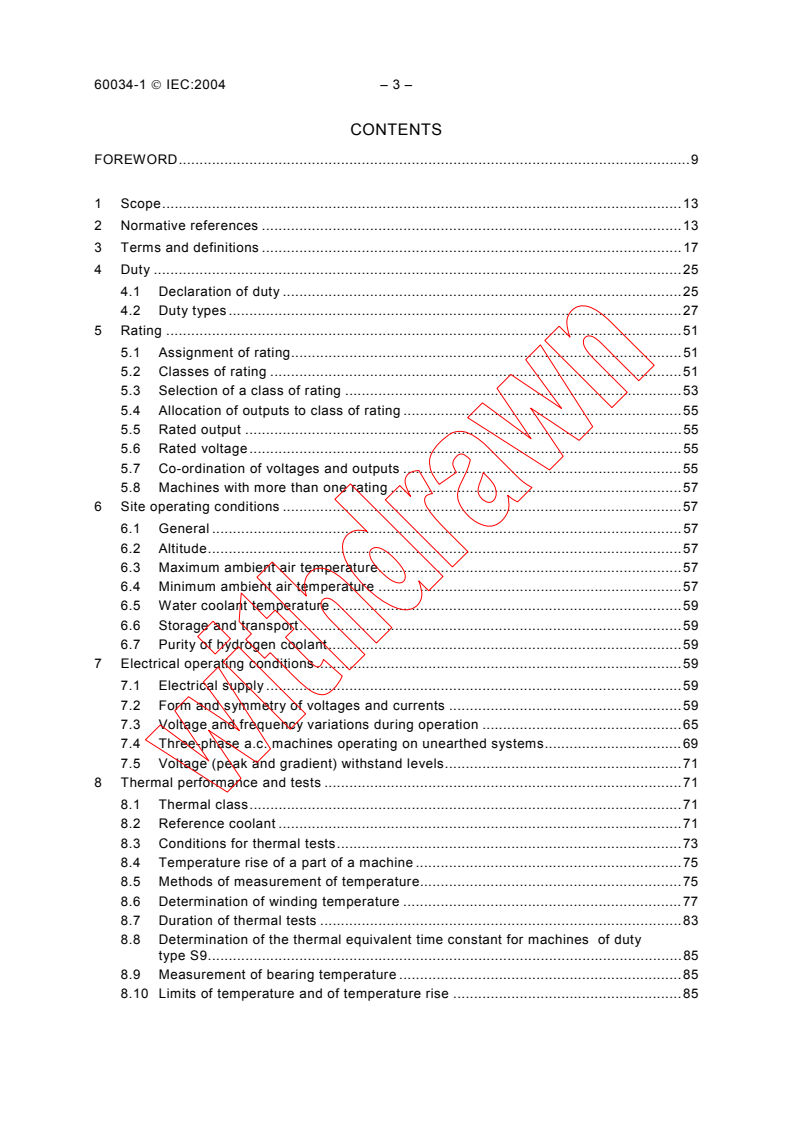
60034-1 IEC:2004 – 3 –
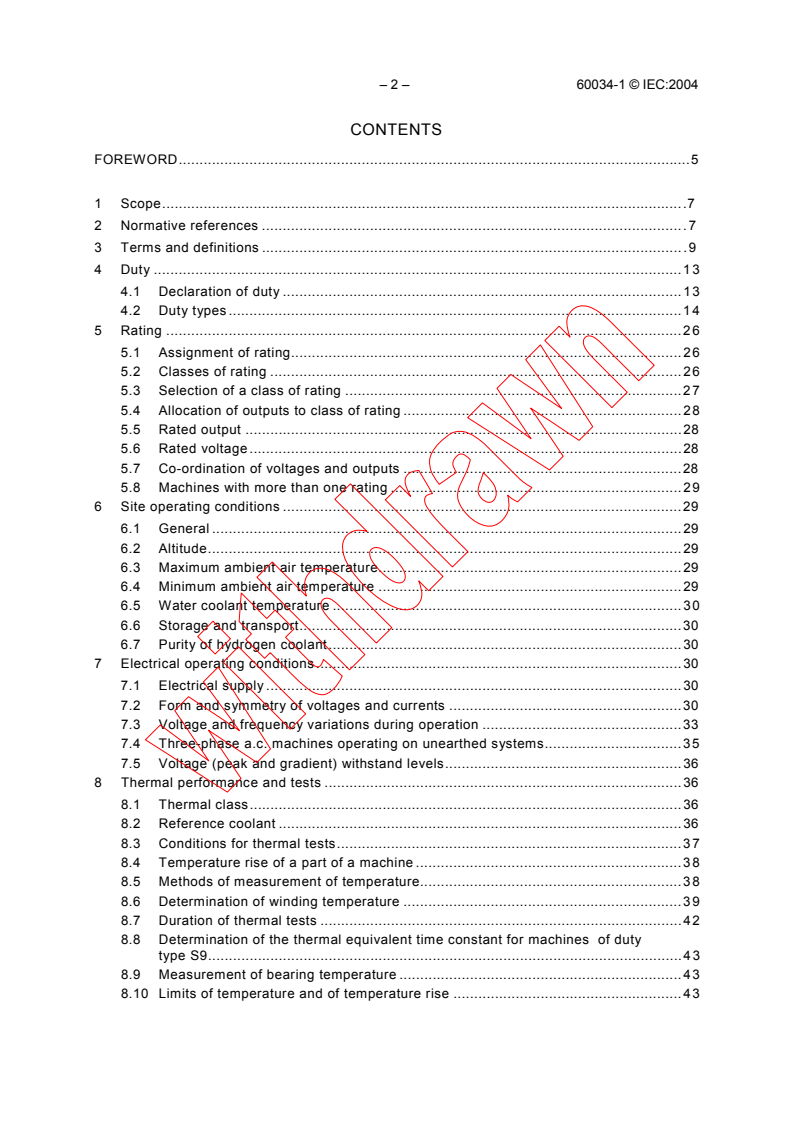
CONTENTS
FOREWORD.9
1 Scope.13
2 Normative references.13
3 Terms and definitions .17
4 Duty.25
4.1 Declaration of duty.25
4.2 Duty types.27
5 Rating.51
5.1 Assignment of rating.51
5.2 Classes of rating.51
5.3 Selection of a class of rating .53
5.4 Allocation of outputs to class of rating .55
5.5 Rated output.55
5.6 Rated voltage.55
5.7 Co-ordination of voltages and outputs .55
5.8 Machines with more than one rating .57
6 Site operating conditions.57
6.1 General.57
6.2 Altitude.57
6.3 Maximum ambient air temperature.57
6.4 Minimum ambient air temperature .57
6.5 Water coolant temperature .59
6.6 Storage and transport.59
6.7 Purity of hydrogen coolant.59
7 Electrical operating conditions.59
7.1 Electrical supply.59
7.2 Form and symmetry of voltages and currents .59
7.3 Voltage and frequency variations during operation .65
7.4 Three-phase a.c. machines operating on unearthed systems.69
7.5 Voltage (peak and gradient) withstand levels.71
8 Thermal performance and tests .71
8.1 Thermal class.71
8.2 Reference coolant.71
8.3 Conditions for thermal tests.73
8.4 Temperature rise of a part of a machine .75
8.5 Methods of measurement of temperature.75
8.6 Determination of winding temperature .77
8.7 Duration of thermal tests .83
8.8 Determination of the thermal equivalent time constant for machines of duty
type S9.85
8.9 Measurement of bearing temperature .85
8.10 Limits of temperature and of temperature rise .85
60034-1 IEC:2004 – 5 –
9 Other performance and tests .103
9.1 Routine tests.103
9.2 Withstand voltage test.105
9.3 Occasional excess current.109
9.4 Momentary excess torque for motors.111
9.5 Pull-up torque.113
9.6 Safe operating speed of cage induction motors .113
9.7 Overspeed.115
9.8 Short-circuit current for synchronous machines .117
9.9 Short-circuit withstand test for synchronous machines.117
9.10 Commutation test for commutator machines .117
9.11 Total Harmonic Distortion (THD) for synchronous machines .117
10 Rating plates.119
10.1 General.119
10.2 Marking.119
11 Miscellaneous requirements.123
11.1 Protective earthing of machines .123
11.2 Shaft-end key(s).125
12 Tolerances.127
12.1 General.127
13 Electromagnetic compatibility (EMC) .131
13.1 General.131
13.2 Immunity.131
13.3 Emission.131
13.4 Immunity tests.131
13.5 Emission tests.133
14 Safety.133
Annex A (informative) Guidance for the application of duty type S10 and for
establishing the value of relative thermal life expectancy TL .135
Annex B (informative) Electromagnetic compatibility (EMC) limits .137
Figure 1 – Continuous running duty – Duty type S1.27
Figure 2 – Short-time duty – Duty type S2.29
Figure 3 – Intermittent periodic duty – Duty type S3.31
Figure 4 – Intermittent periodic duty with starting – Duty type S4 .33
Figure 5 – Intermittent periodic duty with electric braking – Duty type S5 .35
Figure 6 – Continuous operation periodic duty – Duty type S6 .37
Figure 7 – Continuous operation periodic duty with electric braking – Duty type S7 .39
Figure 8 – Continuous operation periodic duty with related load/speed changes –
Duty type S8 .43
Figure 9 – Duty with non-periodic load and speed variations – Duty type S9 .45
Figure 10 – Duty with discrete constant loads – Duty type S10 .49
Figure 11 – Voltage and frequency limits for generators.69
Figure 12 – Voltage and frequency limits for motors.69
60034-1 IEC:2004 – 7 –
Table 1 – Preferred voltage ratings .57
Table 2− Unbalanced operating conditions for synchronous machines .63
Table 3 − Primary functions of machines.67
Table 4 – Reference coolant (see also Table 10) .71
Table 5 – Time interval .81
Table 6 – Measuring points.85
Table 7 – Limits of temperature rise of windings indirectly cooled by air .89
Table 8 − Limits of temperature rise of windings indirectly cooled by hydrogen .91
Table 9 – Adjustments to limits of temperature rise at the operating site of indirect
cooled windings to take account of non-reference operating conditions and ratings .91
Table 10 – Assumed maximum ambient temperature .95
Table 11 – Adjusted limits of temperature rise at the test site (Δθ ) for windings
T
indirectly cooled by air to take account of test site operating conditions .97
Table 12 – Limits of temperature of directly cooled windings and their coolants .99
Table 13 – Adjustments to limits of temperature at the operating site for windings
directly cooled by air or hydrogen to take account of non-reference operating
conditions and ratings.101
Table 14 – Adjusted limits of temperature at the test site θ for windings directly cooled
T
by air to take account of test site operating conditions .101
Table 15 – Minimum schedule of routine tests .103
Table 16 – Withstand voltage tests .107
−1
Table 17 – Maximum safe operating speed (min ) of three-phase single-speed cage
induction motors for voltages up to and including 1 000 V.113
Table 18 – Overspeeds.115
Table 19 – Cross-sectional areas of earthing conductors .125
Table 20 – Schedule of tolerances on values of quantities .127
Table B.1 – Electromagnetic emission limits for machines without brushes .137
Table B.2 – Electromagnetic emission limits for machines with brushes.137
60034-1 IEC:2004 – 9 –
INTERNATIONAL ELECTROTECHNICAL COMMISSION
____________
ROTATING ELECTRICAL MACHINES –
Part 1: Rating and performance
FOREWORD
1) The International Electrotechnical Commission (IEC) is a worldwide organization for standardization comprising
all national electrotechnical committees (IEC National Committees). The object of IEC is to promote
international co-operation on all questions concerning standardization in the electrical and electronic fields. To
this end and in addition to other activities, IEC publishes International Standards, Technical Specifications,
Technical Reports, Publicly Available Specifications (PAS) and Guides (hereafter referred to as “IEC
Publication(s)”). Their preparation is entrusted to technical committees; any IEC National Committee interested
in the subject dealt with may participate in this preparatory work. International, governmental and non-
governmental organizations liaising with the IEC also participate in this preparation. IEC collaborates closely
with the International Organization for Standardization (ISO) in accordance with conditions determined by
agreement between the two organizations.
2) The formal decisions or agreements of IEC on technical matters express, as nearly as possible, an international
consensus of opinion on the relevant subjects since each technical committee has representation from all
interested IEC National Committees.
3) IEC Publications have the form of recommendations for international use and are accepted by IEC National
Committees in that sense. While all reasonable efforts are made to ensure that the technical content of IEC
Publications is accurate, IEC cannot be held responsible for the way in which they are used or for any
misinterpretation by any end user.
4) In order to promote international uniformity, IEC National Committees undertake to apply IEC Publications
transparently to the maximum extent possible in their national and regional publications. Any divergence
between any IEC Publication and the corresponding national or regional publication shall be clearly indicated in
the latter.
5) IEC provides no marking procedure to indicate its approval and cannot be rendered responsible for any
equipment declared to be in conformity with an IEC Publication.
6) All users should ensure that they have the latest edition of this publication.
7) No liability shall attach to IEC or its directors, employees, servants or agents including individual experts and
members of its technical committees and IEC National Committees for any personal injury, property damage or
other damage of any nature whatsoever, whether direct or indirect, or for costs (including legal fees) and
expenses arising out of the publication, use of, or reliance upon, this IEC Publication or any other IEC
Publications.
8) Attention is drawn to the Normative references cited in this publication. Use of the referenced publications is
indispensable for the correct application of this publication.
9) Attention is drawn to the possibility that some of the elements of this IEC Publication may be the subject of
patent rights. IEC shall not be held responsible for identifying any or all such patent rights.
International Standard IEC 60034-1 has been prepared IEC technical committee 2: Rotating
machinery.
This eleventh edition cancels and replaces the tenth edition published in 1996, its
amendments 1 (1997) and 2 (1999). It constitutes a technical revision.
60034-1 IEC:2004 – 11 –
The major changes introduced in this edition are:
Clause or
Change
subclause
7.2.2 New requirements for a.c. generators to supply non-linear circuits
8 Major changes to Tables 4, 7 and 9
9.1 New requirements for routine tests
9.2 Table 16 Test voltage of auxiliaries
9.11 Total harmonic distortion for synchronous machines
11.1 Protective earthing of machines
12.1 Table 20 Tolerance on efficiency
13 Electromagnetic compatibility
The text of this standard is based on the following documents:
FDIS Report on voting
2/1278/FDIS 2/1294/RVD
Full information on the voting for the approval of this standard can be found in the report on
voting indicated in the above table.
This publication has been drafted in accordance with the ISO/IEC Directives, Part 2.
The committee has decided that the contents of this publication will remain unchanged until
2005. At this date, the publication will be
• reconfirmed;
• withdrawn;
• replaced by a revised edition, or
• amended.
60034-1 IEC:2004 – 13 –
ROTATING ELECTRICAL MACHINES –
Part 1: Rating and performance
1 Scope
This part of IEC 60034 is applicable to all rotating electrical machines except those covered
by other IEC standards, for example, IEC 60349.
Machines within the scope of this standard may also be subject to superseding, modifying or
additional requirements in other publications, for example, IEC 60079, and IEC 60092.
NOTE If particular clauses of this standard are modified to meet special applications, for example machines
subject to radioactivity or machines for aerospace, all other clauses apply insofar as they are compatible.
2 Normative references
The following referenced documents are indispensable for the application of this document.
For dated references, only the edition cited applies. For undated references, the latest edition
of the referenced document (including any amendments) applies.
IEC 60027-1, Letter symbols to be used in electrical technology − Part 1: General
IEC 60027-4, Letter symbols to be used in electrical technology − Part 4: Symbols for
quantities to be used for rotating electrical machines
IEC 60034-2, Rotating electrical machines − Part 2: Methods for determining losses and
efficiency of rotating electrical machinery from tests (excluding machines for traction vehicles)
IEC 60034-3, Rotating electrical machines − Part 3: Specific requirements for turbine-type
synchronous machines
IEC 60034-5, Rotating electrical machines − Part 5: Degrees of protection provided by the
integral design of rotating electrical machines (IP code)- Classification
IEC 60034-6, Rotating electrical machines − Part 6: Methods of cooling (IC code)
IEC 60034-8, Rotating electrical machines – Part 8: Terminal markings and direction of
rotation
IEC 60034-12, Rotating electrical machines − Part 12: Starting performance of single-speed
three-phase cage induction motors
IEC 60034-15, Rotating electrical machines − Part 15: Impulse voltage withstand levels of
rotating a.c. machines with form-wound stator coils
− Part 17: Cage induction motors when fed from
IEC 60034-17, Rotating electrical machines
converters – Application guide
60034-1 IEC:2004 – 15 –
IEC 60034-18 (all parts), Rotating electrical machines – Functional evaluation of insulating
systems
IEC 60038, IEC standard voltages
IEC 60050(411):1996, International Electrotechnical Vocabulary (IEV) − Chapter 411:
Rotating machines
IEC 60060-1, High-voltage test techniques – Part 1: General definitions and test requirements
IEC 60072 (all parts), Dimensions and output series for rotating electrical machines
IEC 60204-1, Safety of machinery – Electrical equipment of machines – Part 1: General
requirements
IEC 60204-11, Safety of machinery – Electrical equipment of machines – Part 11:
Requirements for HV equipment for voltages above 1 000 V a.c. or 1 500 V d.c. and not
exceeding 36 kV
IEC 60279, Measurement of the winding resistance of an a.c. machine during operation at
alternating voltage
IEC 60335-1, Household and similar electrical appliances – Safety – Part 1: General
requirements
IEC 60445, Basic and safety principles for man-machine interface, marking and identification
– Identification of equipment terminals and of terminations of certain designated conductors,
including general rules for an alphanumeric system
IEC 60971, Semiconductor convertors. Identification code for convertor connections
IEC 61293, Marking of electrical equipment with ratings related to electrical supply – Safety
requirements
IEC 61986, Rotating electrical machines – Equivalent loading and super-position techniques –
Indirect testing to determine temperature rise
IEC 62114, Electrical insulation systems – Thermal classification
CISPR 11, Industrial, scientific and medical (ISM) radio-frequency equipment –
Electromagnetic disturbance characteristics – Limits and methods of measurement
CISPR 14, Electromagnetic compatibility – Requirements for household appliances, electric
tools and similar apparatus
CISPR 16, Specification for radio disturbance and immunity measuring apparatus and
methods
60034-1 IEC:2004 – 17 –
3 Terms and definitions
For the purposes of this document, the definitions in IEC 60050(411) and the following
definitions apply.
For definitions concerning cooling and coolants, other than those in 3.17 to 3.22, reference
should be made to IEC 60034-6.
For the purposes of this standard, the term ‘agreement’ means ‘agreement between the
manufacturer and purchaser’.
3.1
rated value
a quantity value assigned, generally by a manufacturer, for a specified operating condition of
a machine
[IEV 411-51-23]
NOTE The rated voltage or voltage range is the rated voltage or voltage range between lines at the terminals.
3.2
rating
the set of rated values and operating conditions
[IEV 411-51-24]
3.3
rated output
the value of the output included in the rating
3.4
load
all the values of the electrical and mechanical quantities that signify the demand made on a
rotating machine by an electrical circuit or a mechanism at a given instant
[IEV 411-51-01]
3.5
no-load (operation)
the state of a machine rotating with zero output power (but under otherwise normal operating
conditions)
[IEV 411-51-02, modified]
3.6
full load
the load which causes a machine to operate at its rating
[IEV 411-51-10]
3.7
full load value
a quantity value for a machine operating at full load
[IEV 411-51-11]
NOTE This concept applies to power, torque, current, speed, etc.
60034-1 IEC:2004 – 19 –
3.8
de-energized and rest
the complete absence of all movement and of all electrical supply or mechanical drive
[IEV 411-51-03]
3.9
duty
the statement of the load(s) to which the machine is subjected, including, if applicable,
starting, electric braking, no-load and rest and de-energized periods, and including their
durations and sequence in time
[IEV 411-51-06]
3.10
duty type
a continuous, short-time or periodic duty, comprising one or more loads remaining constant
for the duration specified, or a non-periodic duty in which generally load and speed vary
within the permissible operating range
[IEV 411-51-13]
3.11
cyclic duration factor
the ratio between the period of loading, including starting and electric braking, and the
duration of the duty cycle, expressed as a percentage
[IEV 411-51-09]
3.12
locked-rotor torque
the smallest measured torque the motor develops at its shaft and with the rotor locked, over
all its angular positions at rated voltage and frequency
[IEV 411-48-06]
3.13
locked rotor current
the greatest steady-state r.m.s. current taken from the line with the motor held at rest, over all
angular positions of its rotor, at rated voltage and frequency
[IEV 411-48-16]
3.14
pull-up torque (of an a.c. motor)
the smallest steady-state asynchronous torque which the motor develops between zero speed
and the speed which corresponds to the breakdown torque, when the motor is supplied at the
rated voltage and frequency
This definition does not apply to those asynchronous motors of which the torque continually
decreases with increase in speed.
NOTE In addition to the steady-state asynchronous torques, harmonic synchronous torques, which are a function
of rotor load angle, will be present at specific speeds.
At such speeds, the accelerating torque may be negative for some rotor load angles.
Experience and calculation show this to be an unstable operating condition and therefore harmonic synchronous
torques do not prevent motor acceleration and are excluded from this definition.
60034-1 IEC:2004 – 21 –
3.15
breakdown torque (of an a.c. motor)
the maximum steady-state asynchronous torque which the motor develops without an abrupt
drop in speed, when the motor is supplied at the rated voltage and frequency
This definition does not apply to motors with torques that continually decrease with increase
in speed.
3.16
pull-out torque (of a synchronous motor)
the maximum torque which the synchronous motor develops at synchronous speed with rated
voltage, frequency and field current
3.17
cooling
a procedure by means of which heat resulting from losses occurring in a machine is given up
to a primary coolant, which may be continuously replaced or may itself be cooled by a
secondary coolant in a heat exchanger
[IEV 411-44-01]
3.18
coolant
a medium, liquid or gas, by means of which heat is transferred
[IEV 411-44-02]
3.19
primary coolant
a medium, liquid or gas, which, being at a lower temperature than a part of a machine and in
contact with it, removes heat from that part
[IEV 411-44-03]
3.20
secondary coolant
a medium, liquid or gas, which, being at a lower temperature than the primary coolant,
removes the heat given up by this primary coolant by means of a heat exchanger or through
the external surface of the machine
[IEV 411-44-04]
3.21
direct cooled (inner cooled) winding
a winding mainly cooled by coolant flowing in direct contact with the cooled part through
hollow conductors, tubes, ducts or channels which, regardless of their orientation, form an
integral part of the winding inside the main insulation
[IEV 411-44-08]
3.22
indirect cooled winding
any winding other than a direct cooled winding
[IEV 411-44-09]
___________
1)
In all cases when ‘indirect’ or ‘direct’ is not stated, an indirect cooled winding is implied.
60034-1 IEC:2004 – 23 –
3.23
supplementary insulation
an independent insulation applied in addition to the main insulation in order to ensure
protection against electric shock in the event of failure of the main insulation
3.24
moment of inertia
the sum (integral) of the products of the mass elements of a body and the squares of their
distances (radii) from a given axis
3.25
thermal equilibrium
the state reached when the temperature rises of the several parts of the machine do not vary
by more than a gradient of 2 K per hour
[IEV 411-51-08]
NOTE Thermal equilibrium may be determined from the time-temperature rise plot when the straight lines
between points at the beginning and end of two successive reasonable intervals each have a gradient of less than
2 K per hour.
3.26
thermal equivalent time constant
the time constant, replacing several individual time constants, which determines
approximately the temperature course in a winding after a step-wise current change
3.27
encapsulated winding
a winding which is completely enclosed or sealed by moulded insulation
[IEV 411-39-06]
3.28
rated form factor of direct current supplied to a d.c. motor armature from a static power
converter
the ratio of the r.m.s. maximum permissible value of the current I to its average value
rms,maxN
I (mean value integrated over one period) at rated conditions:
avN
I
rms, maxN
k =
fN
I
avN
3.29
current ripple factor
the ratio of the difference between the maximum value I and the minimum value I of an
max min
undulating current to two times the average value I (mean value integrated over one
av
period):
I − I
max min
q =
i
2 × I
av
NOTE For small values of current ripple, the ripple factor may be approximated by the following expression:
I − I
max min
q =
i
I + I
max min
The above expression may be used as an approximation if the resulting calculated value of q
i
is equal to or less than 0,4.
60034-1 IEC:2004 – 25 –
3.30
tolerance
the permitted deviation between the declared value of a quantity and the measured value
3.31
type test
a test of one or more machines made to a certain design to show that the design meets
certain specifications
[IEV 411-53-01]
NOTE The type test may also be considered valid if it is made on a machine which has minor deviations of rating
or other characteristics. These deviations should be subject to agreement.
3.32
routine test
a test to which each individual machine is subjected during or after manufacture to ascertain
whether it complies with certain criteria
[IEV 411-53-02]
4 Duty
4.1 Declaration of duty
It is the responsibility of the purchaser to declare the duty. The purchaser may describe the
duty by one of the following:
a) numerically, where the load does not vary or where it varies in a known manner;
b) as a time sequence graph of the variable quantities;
c) by selecting one of the duty types S1 to S10 that is no less onerous than the expected
duty.
The duty type shall be designated by the appropriate abbreviation, specified in 4.2, written
after the value of the load.
An expression for the cyclic duration factor is given in the relevant duty type figure.
The purchaser normally cannot provide values for the moment of inertia of the motor (J ) or
M
the relative thermal life expectancy (TL), see Annex A. These values are provided by the
manufacturer.
Where the purchaser does not declare a duty, the manufacturer shall assume that duty type
S1 (continuous running duty) applies.
60034-1 IEC:2004 – 27 –
4.2 Duty types
4.2.1 Duty type S1 – Continuous running duty
Operation at a constant load maintained for sufficient time to allow the machine to reach
thermal equilibrium, see Figure 1.
The appropriate abbreviation is S1.
P
t
P
V
t
Θ
Θ
max
t
IEC 326/04
Key
P load
P electrical losses
V
temperature
Θ
maximum temperature attained
Θ
max
t time
Figure 1 – Continuous running duty – Duty type S1
60034-1 IEC:2004 – 29 –
4.2.2 Duty type S2 – Short-time duty
Operation at constant load for a given time, less than that required to reach thermal
equilibrium, followed by a time de-energized and at rest of sufficient duration to re-establish
machine temperatures within 2 K of the coolant temperature, see Figure 2.
The appropriate abbreviation is S2, followed by an indication of the duration of the duty,
Example: S2 60 min.
P
t
P
V
t
Θ
Θ
max
Δt
P
t
IEC 327/04
Key
P load
P electrical losses
V
Θ temperature
maximum temperature attained
Θ
max
t time
operation time at constant load
Δt
P
Figure 2 – Short-time duty – Duty type S2
60034-1 IEC:2004 – 31 –
4.2.3 Duty type S3 – Intermittent periodic duty
A sequence of identical duty cycles, each including a time of operation at constant load and a
time de-energized and at rest, see Figure 3. In this duty, the cycle is such that the starting
current does not significantly affect the temperature rise.
The appropriate abbreviation is S3, followed by the cyclic duration factor.
Example: S3 25 %
P
T
C
Δt Δt
P R
t
P
V
t
Θ
Θ
max
t
IEC 328/04
Key
P load
P electrical losses
V
temperature
Θ
maximum temperature attained
Θ
max
t time
T time of one load cycle
C
operation time at constant load
Δt
P
time de-energized and at rest
Δt
R
Cyclic duration factor = Δt /T
P C
Figure 3 – Intermittent periodic duty – Duty type S3
___________
2)
Periodic duty implies that thermal equilibrium is not reached during the time on load.
60034-1 IEC:2004 – 33 –
4.2.4 Duty type S4 – Intermittent periodic duty with starting
A sequence of identical duty cycles, each cycle including a significant starting time, a time of
operation at constant load and a time de-energized and at rest, see Figure 4.
The appropriate abbreviation is S4, followed by the cyclic duration factor, the moment of
inertia of the motor (J ) and the moment of inertia of the load (J ), both referred to the motor
M ext
shaft.
2 2
Example: S4 25 % J = 0,15 kg × m J = 0,7 kg × m
M ext
P
T
C
t
Δt Δt
P R
P
V
Δt
D
t
Θ
Θ
max
t
IEC 329/04
Key
P load t time
P electrical losses T time of one load cycle
V C
temperature starting/accelerating time
Θ Δt
D
maximum temperature attained operation time at constant load
Θ Δt
max P
time de-energized and at rest
Δt
R
Cyclic duration factor = (Δt + Δt )/T
D P C
Figure 4 – Intermittent periodic duty with starting – Duty type S4
___________
Periodic duty implies that thermal equilibrium is not reached during the time on load.
60034-1 IEC:2004 – 35 –
4.2.5 Duty type S5 – Intermittent periodic duty with electric braking
A sequence of identical duty cycles, each cycle consisting of a starting time, a time of
operation at constant load, a time of electric braking and a time de-energized and at rest, see
Figure 5.
The appropriate abbreviation is S5, followed by the cyclic duration factor, the moment of inertia of
the motor (J ) and the moment of inertia of the load (J ), both referred to the motor shaft.
M ext
2 2
Example: S5 25 % J = 0,15 kg × m J = 0,7 kg × m
M ext
P
T
C
t
Δt
F
P
V
Δt
P Δt
R
Δt
D
t
Θ
Θ
max
t
IEC 330/04
Key
P T
load time of one load cycle
C
P electrical losses Δt starting/accelerating time
V D
Θ temperature Δt operation time at constant load
P
maximum temperature attained time of electric braking
Θ Δt
max F
t time time de-energized and at rest
Δt
R
Cyclic duration factor = (Δt + Δt + Δt )/T
D P F C
Figure 5 – Intermittent periodic duty with electric braking – Duty type S5
___________
Periodic duty implies that thermal equilibrium is not reached during the time on load.
60034-1 IEC:2004 – 37 –
4.2.6 Duty type S6 – Continuous-operation periodic duty
A sequence of identical duty cycles, each cycle consisting of a time of operation at constant
load and a time of operation at no-load. There is no time de-energized and at rest, see
Figure 6.
The appropriate abbreviation is S6, followed by the cyclic duration factor.
Example: S6 40 %
P
T
C
Δt Δt
P V
t
P
V
t
Θ
Θ
max
t
IEC 331/04
Key
P load t time
P electrical losses T time of one load cycle
V C
temperature operation time at constant load
Θ Δt
P
maximum temperature attained operation time at no-load
Θ Δt
max V
Cyclic duration factor = Δt /T
P C
Figure 6 – Continuous operation periodic duty – Duty type S6
___________
Periodic duty implies that thermal equilibrium is not reached during the time on load.
60034-1 IEC:2004 – 39 –
4.2.7 Duty type S7 – Continuous-operation periodic duty with electric braking
A sequence of identical duty cycles, each cycle consisting of a starting time, a time of
operation at constant load and a time of electric braking. There is no time de-energized and at
rest, see Figure 7.
The appropriate abbreviation is S7, followed by the moment of inertia of the motor (J ) and
M
the moment of inertia of the load (J ), both referred to the motor shaft.
ext
2 2
Example: S7 J = 0,4 kg × m J = 7,5 kg × m
M ext
T
C
P
t
Δt Δt
Δt P F
D
P
V
t
Θ
Θ
max
t
IEC 332/04
Key
P load t time
P electrical losses T time of one load cycle
V C
temperature starting/accelerating time
Θ Δt
D
maximum temperature attained operation time at constant load
Θ Δt
max P
Cyclic duration factor = 1 Δt time of electric braking
F
Figure 7 – Continuous operation periodic duty with electric braking – Duty type S7
___________
Periodic duty implies that thermal equilibrium is not reached during the time on load.
60034-1 IEC:2004 – 41 –
4.2.8 Duty type S8 – Continuous-operation periodic duty with related load/speed
changes
A sequence of identical duty cycles, each cycle consisting of a time of operation at constant
load corresponding to a predetermined speed of rotation, followed by one or more times of
operation at other constant loads corresponding to different speeds of rotation (carried out, for
example, by means of a change in the number of poles in the case of induction motors).
There is no time de-energized and at rest (see Figure 8).
The appropriate abbreviation is S8, followed by the moment of inertia of the motor (J ) and
M
the moment of inertia of the load (J ), both referred to the motor shaft, together with the
ext
load, speed and cyclic duration factor for each speed condition.
2 2 −1
Example: S8 J = 0,5 kg × m J = 6 kg × m 16 kW 740 min 30 %
M ext
−1
40 kW 1 460 min 30 %
−1
25 kW 980 min 40 %
___________
Periodic duty implies that thermal equilibrium is not reached during the time on load.
60034-1 IEC:2004 – 43 –
T
C
P
t
Δt Δt
P2 P3
Δt Δt Δt
D P1 F1
P Δt
V
F2
t
Θ
Θ
max
t
n
t
IEC 333/04
Key
P load t time
P electrical losses T time of one load cycle
V C
temperature starting/accelerating time
Θ Δt
D
maximum temperature attained operation time at constant load (P1, P2, P3)
Θ Δt
max P
n speed Δt time of electric braking (F1, F2)
F
Cyclic duration factor = (Δt +Δt )/T ; (Δt +Δt )/T ; (Δt +Δt )/T
D P1 C F1 P2 C F2 P3 C
Figure 8 – Continuous operation periodic duty with related
load/speed changes – Duty type S8
60034-1 IEC:2004 – 45 –
4.2.9 Duty type S9 – Duty with non-periodic load and speed variations
A duty in which generally load and speed vary non-periodically within the permissible
operating range. This duty includes frequently applied overloads that may greatly exceed the
reference load (see Figure 9).
The appropriate abbreviation is S9.
For this duty type, a constant load appropriately selected and based on duty type S1 is taken
as the reference value ("P " in Figure 9) for the overload concept.
ref
Δt
P
n
Δt
F
Δt
D
Δt
R
t
P
Δt
S
P
ref
t
P
V
t
Θ
Θ
max
t
IEC 334/04
Key
P load t time
P reference load starting/accelerating time
Δt
ref
D
P electrical losses operation time at constant load
Δt
V
P
temperature Δt time of electric braking
Θ
F
Θ maximum temperature attained Δt time de-energized and at rest
max R
n speed time under overload
Δt
S
Figure 9 – Duty with non-periodic load and speed variations – Duty type S9
60034-1 IEC:2004 – 47 –
4.2.10 Duty type S10 – Duty with discrete constant loads and speeds
A duty consisting of a specific number of discrete values of load (or equivalent loading) and if
applicable, speed, each load/speed combination being maintained for sufficient time to allow
the machine to reach thermal equilibrium, see Figure 10. The minimum load within a duty
cycle may have the value zero (no-load or de-energized and at rest).
Th
...
NORME CEI
INTERNATIONALE 60034-1
Onzième édition
2004-04
Machines électriques tournantes –
Partie 1:
Caractéristiques assignées
et caractéristiques de fonctionnement
Cette version française découle de la publication d’origine
bilingue dont les pages anglaises ont été supprimées.
Les numéros de page manquants sont ceux des pages
supprimées.
Numéro de référence
CEI 60034-1:2004(F)
Numérotation des publications
Depuis le 1er janvier 1997, les publications de la CEI sont numérotées à partir de
60000. Ainsi, la CEI 34-1 devient la CEI 60034-1.
Editions consolidées
Les versions consolidées de certaines publications de la CEI incorporant les
amendements sont disponibles. Par exemple, les numéros d’édition 1.0, 1.1 et 1.2
indiquent respectivement la publication de base, la publication de base incorporant
l’amendement 1, et la publication de base incorporant les amendements 1 et 2
Informations supplémentaires sur les publications de la CEI
Le contenu technique des publications de la CEI est constamment revu par la CEI
afin qu'il reflète l'état actuel de la technique. Des renseignements relatifs à cette
publication, y compris sa validité, sont disponibles dans le Catalogue des
publications de la CEI (voir ci-dessous) en plus des nouvelles éditions, amende-
ments et corrigenda. Des informations sur les sujets à l’étude et l’avancement des
travaux entrepris par le comité d’études qui a élaboré cette publication, ainsi que la
liste des publications parues, sont également disponibles par l’intermédiaire de:
• Site web de la CEI (www.iec.ch)
• Catalogue des publications de la CEI
Le catalogue en ligne sur le site web de la CEI (www.iec.ch/searchpub) vous permet
de faire des recherches en utilisant de nombreux critères, comprenant des
recherches textuelles, par comité d’études ou date de publication. Des informations
en ligne sont également disponibles sur les nouvelles publications, les publications
remplacées ou retirées, ainsi que sur les corrigenda.
• IEC Just Published
Ce résumé des dernières publications parues (www.iec.ch/online_news/justpub)
est aussi disponible par courrier électronique. Veuillez prendre contact avec le
Service client (voir ci-dessous) pour plus d’informations.
• Service clients
Si vous avez des questions au sujet de cette publication ou avez besoin de
renseignements supplémentaires, prenez contact avec le Service clients:
Email: custserv@iec.ch
Tél: +41 22 919 02 11
Fax: +41 22 919 03 00
NORME CEI
INTERNATIONALE 60034-1
Onzième édition
2004-04
Machines électriques tournantes –
Partie 1:
Caractéristiques assignées
et caractéristiques de fonctionnement
IEC 2004 Droits de reproduction réservés
Aucune partie de cette publication ne peut être reproduite ni utilisée sous quelque forme que ce soit et par aucun
procédé, électronique ou mécanique, y compris la photocopie et les microfilms, sans l'accord écrit de l'éditeur.
International Electrotechnical Commission, 3, rue de Varembé, PO Box 131, CH-1211 Geneva 20, Switzerland
Telephone: +41 22 919 02 11 Telefax: +41 22 919 03 00 E-mail: inmail@iec.ch Web: www.iec.ch
CODE PRIX
XB
Commission Electrotechnique Internationale
International Electrotechnical Commission
МеждународнаяЭлектротехническаяКомиссия
Pour prix, voir catalogue en vigueur
− 2 − 60034-1 CEI:2004
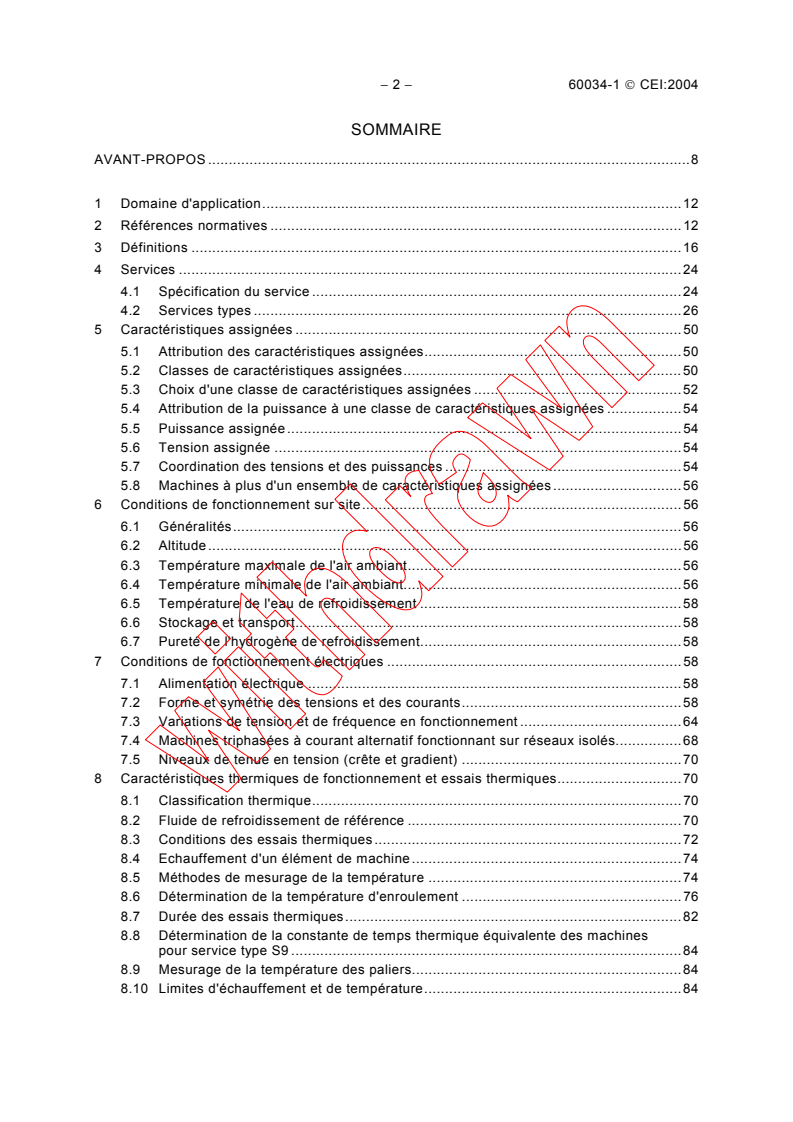
SOMMAIRE
AVANT-PROPOS .8
1 Domaine d'application.12
2 Références normatives.12
3 Définitions.16
4 Services.24
4.1 Spécification du service .24
4.2 Services types.26
5 Caractéristiques assignées.50
5.1 Attribution des caractéristiques assignées.50
5.2 Classes de caractéristiques assignées.50
5.3 Choix d'une classe de caractéristiques assignées .52
5.4 Attribution de la puissance à une classe de caractéristiques assignées .54
5.5 Puissance assignée.54
5.6 Tension assignée.54
5.7 Coordination des tensions et des puissances .54
5.8 Machines à plus d'un ensemble de caractéristiques assignées .56
6 Conditions de fonctionnement sur site.56
6.1 Généralités.56
6.2 Altitude.56
6.3 Température maximale de l'air ambiant.56
6.4 Température minimale de l'air ambiant.56
6.5 Température de l'eau de refroidissement .58
6.6 Stockage et transport.58
6.7 Pureté de l'hydrogène de refroidissement.58
7 Conditions de fonctionnement électriques .58
7.1 Alimentation électrique.58
7.2 Forme et symétrie des tensions et des courants.58
7.3 Variations de tension et de fréquence en fonctionnement .64
7.4 Machines triphasées à courant alternatif fonctionnant sur réseaux isolés.68
7.5 Niveaux de tenue en tension (crête et gradient) .70
8 Caractéristiques thermiques de fonctionnement et essais thermiques.70
8.1 Classification thermique.70
8.2 Fluide de refroidissement de référence .70
8.3 Conditions des essais thermiques.72
8.4 Echauffement d'un élément de machine.74
8.5 Méthodes de mesurage de la température .74
8.6 Détermination de la température d'enroulement .76
8.7 Durée des essais thermiques.82
8.8 Détermination de la constante de temps thermique équivalente des machines
pour service type S9 .84
8.9 Mesurage de la température des paliers.84
8.10 Limites d'échauffement et de température.84
− 4 − 60034-1 CEI:2004
9 Autres caractéristiques de fonctionnement et essais . 102
9.1 Essais individuels.102
9.2 Essais de tension de tenue . 104
9.3 Surintensité occasionnelle.108
9.4 Excès momentané de couple des moteurs . 110
9.5 Couple minimal pendant le démarrage . 112
9.6 Vitesse de sécurité en fonctionnement des moteurs à induction à cage . 112
9.7 Survitesse.114
9.8 Courant de court-circuit des machines synchrones. 116
9.9 Epreuve de tenue au court-circuit des machines synchrones . 116
9.10 Essai de commutation pour machines à collecteur . 116
9.11 Distorsion harmonique totale (DHT) pour machines synchrones . 116
10 Plaques signalétiques.118
10.1 Généralités.118
10.2 Marquage.118
11 Exigences diverses.122
11.1 Mise à la terre de protection des machines . 122
11.2 Clavette(s) de bout d'arbre. 124
12 Tolérances. 126
12.1 Généralités.126
13 Compatibilité électromagnétique (CEM) . 130
13.1 Généralités.130
13.2 Immunité.130
13.3 Emission.130
13.4 Essais d’immunité.130
13.5 Essais d’émission.132
14 Sécurité. 132
Annexe A (informative) Guide pour l'application du service type S10 et pour l'obtention
de la valeur relative de l'espérance de vie thermique TL . 134
Annexe B (informative) Limites de Compatibilité Electromagnétique (CEM). 136
Figure 1 – Service continu – Service type S1 .26
Figure 2 – Service temporaire – Service type S2.28
Figure 3 – Service intermittent périodique – Service type S3.30
Figure 4 – Service intermittent périodique à démarrage – Service type S4 .32
Figure 5 – Service intermittent périodique à freinage électrique – Service type S5.34
Figure 6 – Service ininterrompu périodique à charge intermittente – Service type S6 .36
Figure 7 – Service ininterrompu périodique à freinage électrique – Service type S7.38
Figure 8 – Service ininterrompu périodique à changements liés de charge et de vitesse
– Service type S8 .42
Figure 9 – Service à variations non périodique de charge et de vitesse – Service type S9 .44
Figure 10 – Service avec charges constantes distinctes – Service type S10.48
Figure 11 – Valeurs limites de tension et fréquence pour les alternateurs .68
Figure 12 – Valeurs limites de tension et fréquence pour les moteurs .68
− 6 − 60034-1 CEI:2004
Tableau 1 – Tensions assignées préférables .56
Tableau 2 – Conditions de fonctionnement déséquilibrées pour les machines synchrones.62
Tableau 3 – Fonctions principales des machines .66
Tableau 4 – Fluide de refroidissement de référence (voir aussi Tableau 10) .70
Tableau 5 – Délai.80
Tableau 6 – Points de mesure .84
Tableau 7 – Limites d’échauffement des enroulements à refroidissement indirect par l’air.88
Tableau 8 – Limites d’échauffement des enroulements à refroidissement indirect
par hydrogène.90
Tableau 9 – Corrections aux limites des échauffements sur le site de fonctionnement
des enroulements à refroidissement indirect pour tenir compte de conditions de
fonctionnement et de caractéristiques assignées qui ne sont pas les conditions de
référence .90
Tableau 10 – Températures ambiantes maximales présumées .94
Tableau 11 – Limites corrigées des échauffements sur le site d'essai (Δθ ) des
T
enroulements à refroidissement indirect par air pour tenir compte des conditions de
fonctionnement sur le site d'essai.96
Tableau 12 – Limites des températures des enroulements à refroidissement direct
et de leurs fluides de refroidissement .98
Tableau 13 – Corrections aux limites de température sur le site de fonctionnement
pour les enroulements à refroidissement direct par air ou hydrogène pour tenir compte
de conditions de fonctionnement et de caractéristiques assignées qui ne sont pas les
conditions de référence . 100
Tableau 14 – Limites corrigées de température sur le site d'essai θ pour les
T
enroulement à refroidissement direct par air pour tenir compte des conditions de
fonctionnement sur le site d'essai. 100
Tableau 15 – Liste minimale des essais individuels . 102
Tableau 16 − Essais de tension de tenue. 106
−1
Tableau 17 – Vitesse maximale de sécurité en fonctionnement (min ) des moteurs
triphasés à induction à cage, à une seule vitesse, pour des tensions d’alimentation
inférieures ou égales à 1 000 V . 112
Tableau 18 − Survitesses . 114
Tableau 19 − Section des conducteurs de terre . 124
Tableau 20 − Nomenclature des tolérances sur les valeurs des grandeurs. 126
Tableau B.1 – Limites d’émission électromagnétique pour les machines sans balais. 136
Tableau B.2 – Limites d’émission électromagnétique pour les machines avec balais. 136
− 8 − 60034-1 CEI:2004
COMMISSION ÉLECTROTECHNIQUE INTERNATIONALE
____________
MACHINES ÉLECTRIQUES TOURNANTES –
Partie 1: Caractéristiques assignées et caractéristiques
de fonctionnement
AVANT-PROPOS
1) La Commission Electrotechnique Internationale (CEI) est une organisation mondiale de normalisation composée
de l'ensemble des comités électrotechniques nationaux (Comités nationaux de la CEI). La CEI a pour objet de
favoriser la coopération internationale pour toutes les questions de normalisation dans les domaines de
l'électricité et de l'électronique. A cet effet, la CEI – entre autres activités – publie des Normes internationales,
des Spécifications techniques, des Rapports techniques, des Spécifications accessibles au public (PAS) et des
Guides (ci-après dénommés "Publication(s) de la CEI"). Leur élaboration est confiée à des comités d'études,
aux travaux desquels tout Comité national intéressé par le sujet traité peut participer. Les organisations
internationales, gouvernementales et non gouvernementales, en liaison avec la CEI, participent également aux
travaux. La CEI collabore étroitement avec l'Organisation Internationale de Normalisation (ISO), selon des
conditions fixées par accord entre les deux organisations.
2) Les décisions ou accords officiels de la CEI concernant les questions techniques représentent, dans la mesure
du possible, un accord international sur les sujets étudiés, étant donné que les Comités nationaux de la CEI
intéressés sont représentés dans chaque comité d’études.
3) Les Publications de la CEI se présentent sous la forme de recommandations internationales et sont agréées
comme telles par les Comités nationaux de la CEI. Tous les efforts raisonnables sont entrepris afin que la CEI
s'assure de l'exactitude du contenu technique de ses publications; la CEI ne peut pas être tenue responsable de
l'éventuelle mauvaise utilisation ou interprétation qui en est faite par un quelconque utilisateur final.
4) Dans le but d'encourager l'uniformité internationale, les Comités nationaux de la CEI s'engagent, dans toute la
mesure possible, à appliquer de façon transparente les Publications de la CEI dans leurs publications
nationales et régionales. Toutes divergences entre toutes Publications de la CEI et toutes publications
nationales ou régionales correspondantes doivent être indiquées en termes clairs dans ces dernières.
5) La CEI n’a prévu aucune procédure de marquage valant indication d’approbation et n'engage pas sa
responsabilité pour les équipements déclarés conformes à une de ses Publications.
6) Tous les utilisateurs doivent s'assurer qu'ils sont en possession de la dernière édition de cette publication.
7) Aucune responsabilité ne doit être imputée à la CEI, à ses administrateurs, employés, auxiliaires ou
mandataires, y compris ses experts particuliers et les membres de ses comités d'études et des Comités
nationaux de la CEI, pour tout préjudice causé en cas de dommages corporels et matériels, ou de tout autre
dommage de quelque nature que ce soit, directe ou indirecte, ou pour supporter les coûts (y compris les frais
de justice) et les dépenses découlant de la publication ou de l'utilisation de cette Publication de la CEI ou de
toute autre Publication de la CEI, ou au crédit qui lui est accordé.
8) L'attention est attirée sur les références normatives citées dans cette publication. L'utilisation de publications
référencées est obligatoire pour une application correcte de la présente publication.
9) L’attention est attirée sur le fait que certains des éléments de la présente Publication de la CEI peuvent faire
l’objet de droits de propriété intellectuelle ou de droits analogues. La CEI ne saurait être tenue pour
responsable de ne pas avoir identifié de tels droits de propriété et de ne pas avoir signalé leur existence.
La Norme internationale CEI 60034-1 a été établie par le comité d'études 2 de la CEI:
Machines tournantes.
Cette onzième édition annule et remplace la dixième édition, parue en 1996, ainsi que ses
amendements 1 (1997) et 2 (1999); elle constitue une révision technique.
− 10 − 60034-1 CEI:2004
Les principales modifications apportées par cette édition sont les suivantes:
Article ou
Modifications
Paragraphe
7.2.2 Nouvelles spécifications pour les alternateurs qui alimentent des circuits non
linéaires
8 Modifications importantes dans les Tableaux 4, 7 et 9
9.1 Nouvelles spécifications pour les essais individuels
9.2 Tableau 16 Essais de tension des auxiliaires
9.11 Distorsion harmonique totale (DHT) pour machines synchrones
11.1 Mise à la terre de protection des machines
12.1 Tableau 20 Tolérance sur le rendement
13 Compatibilité électromagnétique
Le texte de cette norme est issu des documents suivants:
FDIS Rapport de vote
2/1278/FDIS 2/1294/RVD
Le rapport de vote indiqué dans le tableau ci-dessus donne toute information sur le vote ayant
abouti à l'approbation de cette norme.
Cette publication a été rédigée selon les Directives ISO/CEI, Partie 2.
Le comité a décidé que le contenu de cette publication ne sera pas modifié avant 2005. A cette
date, la publication sera
• reconduite;
• supprimée;
• remplacée par une édition révisée, ou
• amendée.
− 12 − 60034-1 CEI:2004
MACHINES ÉLECTRIQUES TOURNANTES –
Partie 1: Caractéristiques assignées et caractéristiques
de fonctionnement
1 Domaine d'application
La présente partie de la CEI 60034 est applicable à toutes les machines électriques tournantes
à l'exception de celles qui font l'objet d'autres normes de la CEI, par exemple la CEI 60349.
Les machines comprises dans le domaine d'application de la présente norme peuvent
également être soumises à des exigences nouvelles, modifiées ou complémentaires figurant
dans d'autres publications – par exemple, la CEI 60079 et la CEI 60092.
NOTE S'il est nécessaire de modifier certains articles de la présente norme afin de permettre des applications
spéciales, par exemple pour les matériels soumis à des rayonnements ou les matériels aérospatiaux, tous les
autres articles restent valables, pour autant qu'ils ne soient pas en contradiction avec ces spécifications
particulières.
2 Références normatives
Les documents normatifs suivants sont indispensables pour l’application de la présente norme.
Pour les références datées, seule l’édition citée s’applique. Pour les références non datées, la
dernière édition du document référencé s’applique (y compris les amendements).
CEI 60027-1, Symboles littéraux à utiliser en électrotechnique − Partie 1: Généralités
CEI 60027-4, Symboles littéraux à utiliser en électrotechnique − Partie 4: Symboles des
grandeurs relatives aux machines électriques tournantes
CEI 60034-2, Machines électriques tournantes − Partie 2: Méthodes pour la détermination des
pertes et du rendement des machines électriques tournantes à partir d'essais (à l'exclusion des
machines électriques de traction)
CEI 60034-3, Machines électriques tournantes − Partie 3: Règles spécifiques pour les
turbomachines synchrones
CEI 60034-5, Machines électriques tournantes − Partie 5: Degrés de protection procurés par la
conception intégrale des machines électriques tournantes (code IP). Classification
CEI 60034-6, Machines électriques tournantes − Partie 6: Modes de refroidissement (code IC)
CEI 60034-8, Machines électriques tournantes – Partie 8: Marques d’extrémité et sens de
rotation
CEI 60034-12, Machines électriques tournantes − Partie 12: Caractéristiques de démarrage
des moteurs triphasés à induction à cage à une seule vitesse
CEI 60034-15, Machines électriques tournantes − Partie 15: Niveaux de tension de tenue au
choc des machines tournantes à courant alternatif à bobines stator préformées
CEI 60034-17, Machines électriques tournantes − Partie 17: Moteurs à induction à cage
alimentés par convertisseurs – Guide d’application
− 14 − 60034-1 CEI:2004
CEI 60034-18 (toutes les parties), Machines électriques tournantes – Evaluation fonctionnelle
des systèmes d’isolation
CEI 60038, Tensions normales de la CEI
CEI 60050(411):1996, Vocabulaire Electrotechnique International (VEI) − Chapitre 411:
Machines tournantes
CEI 60060-1, Techniques des essais à haute tension – Partie 1: Définitions et prescriptions
générales relatives aux essais
CEI 60072 (toutes les parties), Dimensions et séries de puissances des machines électriques
tournantes
CEI 60204-1, Sécurité des machines – Equipement électrique des machines – Partie 1: Règles
générales
CEI 60204-11, Sécurité des machines – Equipement électrique des machines – Partie 11:
Prescriptions pour les équipements HT fonctionnant à des tensions supérieures à 1 000 V c.a.
ou 1 500 V c.c. et ne dépassant pas 36 kV
CEI 60279, Mesure de la résistance des enroulements d'une machine à courant alternatif en
fonctionnement sous tension alternative
CEI 60335-1, Appareils électrodomestiques et analogues – Sécurité – Partie 1: Prescriptions
générales
CEI 60445, Principes fondamentaux et de sécurité pour les interfaces hommes-machines, le
marquage et l’identification – Identification des bornes de matériels et des extrémités de
certains conducteurs désignés et règles générales pour un système alphanumérique
CEI 60971, Convertisseurs à semi-conducteurs – Code d'identification pour montages
convertisseurs
CEI 61293, Marquage des matériels électriques avec des caractéristiques assignées relatives
à l'alimentation électrique – Prescriptions de sécurité
CEI 61986, Machines électriques tournantes – Charge équivalente et techniques par super-
position – Essais indirects pour déterminer l’échauffement
CEI 62114, Systèmes d’isolation électrique (SIE) – Classification thermique
CISPR 11, Appareils industriels, scientifiques et médicaux (ISM) à fréquence radioélectrique –
Caractéristiques de perturbations électromagnétiques – Limites et méthodes de mesure
CISPR 14, Compatibilité électromagnétique – Exigences pour les appareils électro-
domestiques, outillages électriques et appareils analogues
CISPR 16, Spécifications des méthodes et des appareils de mesure des perturbations
radioélectriques et de l'immunité aux perturbations radioélectriques
− 16 − 60034-1 CEI:2004
3 Termes et définitions
Pour les besoins du présent document, les définitions de la CEI 60050(411) s’appliquent ainsi
que les définitions suivantes.
Pour des définitions autres que celles de 3.17 à 3.22 concernant les modes et les fluides de
refroidissement, se référer à la CEI 60034-6.
Au sens de la présente norme, le terme «accord» signifie «accord entre le constructeur et
l’acheteur».
3.1
valeur assignée
valeur d'une grandeur fixée, généralement par le constructeur, pour un fonctionnement spécifié
d'une machine
[VEI 411-51-23]
NOTE La tension assignée ou plage de tensions assignées est la tension assignée ou plage de tensions
assignées entre phases aux bornes.
3.2
caractéristiques assignées
ensemble des valeurs assignées et des conditions de fonctionnement
[VEI 411-51-24]
3.3
puissance assignée
valeur de la puissance incluse dans les caractéristiques assignées
3.4
charge
ensemble des valeurs des grandeurs électriques et mécaniques qui caractérisent les
exigences imposées à une machine tournante par un circuit électrique ou un dispositif
mécanique, à un instant donné
[VEI 411-51-01]
3.5
fonctionnement à vide
état de fonctionnement d'une machine tournant à puissance nulle (mais les autres conditions
étant les conditions normales de fonctionnement)
[VEI 411-51-02 modifiée]
3.6
pleine charge
charge amenant une machine à fonctionner à ses caractéristiques assignées
[VEI 411-51-10]
3.7
valeur de pleine charge
valeur d'une grandeur pour une machine fonctionnant à pleine charge
[VEI 411-51-11]
NOTE Cette notion est applicable à la puissance, au couple, au courant, à la vitesse, etc.
− 18 − 60034-1 CEI:2004
3.8
repos
absence complète de tout mouvement et de toute alimentation électrique ou de tout entraî-
nement mécanique
[VEI 411-51-03]
3.9
service
stipulation de la charge (des charges) à laquelle (auxquelles) la machine est soumise,
y compris, le cas échéant, les périodes de démarrage, de freinage électrique, de fonction-
nement à vide et de repos, ainsi que leurs durées et leur ordre de succession dans le temps
[VEI 411-51-06]
3.10
service type
service continu, temporaire ou périodique comprenant une ou plusieurs charges qui restent
constantes pendant la durée spécifiée ou service non périodique pendant lequel généralement
la charge et la vitesse varient dans la plage de fonctionnement admissible
[VEI 411-51-13]
3.11
facteur de marche
rapport entre la période de fonctionnement en charge, y compris le démarrage et le freinage
électrique, à la durée du cycle de service, exprimé en pourcentage
[VEI 411-51-09]
3.12
couple à rotor bloqué
couple mesuré le plus faible que développe le moteur sur son bout d'arbre d'entraînement,
quand son rotor est maintenu bloqué quelle que soit sa position angulaire et qu'il est alimenté à
tension et fréquence assignées
[VEI 411-48-06]
3.13
courant à rotor bloqué
valeur efficace la plus élevée du courant en régime établi, absorbé par le moteur lorsqu'il est
alimenté aux tension et fréquence assignées et que son rotor est maintenu bloqué quelle que
soit sa position angulaire
[VEI 411-48-16]
3.14
couple minimal pendant le démarrage (d'un moteur à courant alternatif)
valeur la plus faible du couple asynchrone en régime établi, que le moteur développe entre la
vitesse nulle et la vitesse qui correspond au couple maximal (couple de décrochage) lorsque le
moteur est alimenté à la tension et à la fréquence assignées
Cette définition ne s'applique pas au cas de moteurs asynchrones dont le couple décroît
continuellement lorsque la vitesse augmente.
NOTE En plus des couples asynchrones en régime établi, il existe, à des vitesses spécifiques, des couples
harmoniques synchrones qui sont fonction de l'angle de charge du rotor.
A de telles vitesses, le couple d'accélération peut être négatif pour certains angles de charge du rotor.
L'expérience et le calcul montrent que c'est une condition de fonctionnement instable et qu'en conséquence les
couples harmoniques synchrones n'empêchent pas l'accélération du moteur et sont exclus de cette définition.
− 20 − 60034-1 CEI:2004
3.15
couple maximal (couple de décrochage) (d'un moteur à courant alternatif)
valeur maximale en régime établi du couple asynchrone que le moteur développe sans chute
brutale de vitesse, lorsqu'il est alimenté à tension et fréquence assignées
Cette définition ne s'applique pas au cas des moteurs asynchrones dont le couple décroît
continuellement lorsque la vitesse augmente.
3.16
couple de décrochage synchrone (d'un moteur)
couple le plus élevé que développe un moteur synchrone à sa température de fonctionnement
et à la vitesse de synchronisme, à tension, fréquence et excitation assignées
3.17
refroidissement
opération par laquelle de la chaleur provenant des pertes produites dans une machine est
cédée à un fluide de refroidissement primaire qui peut être continûment remplacé ou être
lui-même refroidi dans un échangeur de chaleur par un fluide de refroidissement secondaire
[VEI 411-44-01]
3.18
fluide de refroidissement
fluide, liquide ou gaz, par l'intermédiaire duquel la chaleur est transférée
[VEI 411-44-02]
3.19
fluide de refroidissement primaire
fluide, liquide ou gaz, qui, se trouvant à une température inférieure à celle des pièces de la
machine et en contact avec celles-ci, transporte la chaleur cédée par ces pièces
[VEI 411-44-03]
3.20
fluide de refroidissement secondaire
fluide, liquide ou gaz, qui, se trouvant à une température inférieure à celle du fluide de
refroidissement primaire, transporte la chaleur cédée par ce fluide primaire au moyen d'un
échangeur de chaleur ou à travers la surface extérieure de la machine
[VEI 411-44-04]
3.21
enroulement à refroidissement direct (refroidissement interne)
enroulement refroidi principalement par un fluide de refroidissement s'écoulant en contact
direct avec la partie refroidie à travers des passages creux, tubes, conduits ou canaux qui,
quelle que soit leur orientation, forment partie intégrante de l'enroulement à l'intérieur de
l'isolation principale
[VEI 411-44-08]
3.22
enroulement à refroidissement indirect
tout enroulement autre qu’un enroulement à refroidissement direct
[VEI 411-44-09]
___________
Dans tous les cas où «indirect» ou «direct» n’est pas indiqué, il s’agit d’un enroulement à refroidissement
indirect.
− 22 − 60034-1 CEI:2004
3.23
isolation supplémentaire
isolation indépendante prévue en plus de l'isolation principale, en vue d'assurer la protection
contre les chocs électriques en cas de défaut survenant dans l'isolation principale
3.24
moment d'inertie
somme (intégrale) des produits des masses élémentaires d'un corps par le carré de leurs
distances (radiales) par rapport à un axe donné
3.25
équilibre thermique
état atteint lorsque les échauffements des diverses parties de la machine ne varient pas de
plus d’un gradient de 2 K par heure
[VEI 411-51-08]
NOTE On peut déterminer l'équilibre thermique à partir d'un tracé de l’échauffement en fonction du temps, lorsque
les droites entre points pris en début et fin de chacun de deux intervalles de temps raisonnables successifs ont une
pente de moins de 2 K par heure.
3.26
constante de temps thermique équivalente
constante de temps qui, en remplaçant plusieurs constantes de temps individuelles, détermine
approximativement l'évolution de la température dans un enroulement après une variation de
courant en échelon
3.27
enroulement enrobé
enroulement complètement enfermé ou noyé dans un isolant moulé
[VEI 411-39-06]
3.28
valeur assignée du facteur de forme du courant continu fourni à l'induit d'un moteur à
courant continu par un convertisseur statique de puissance
rapport de la valeur efficace maximale admissible du courant I à sa valeur moyenne
eff, maxN
I (valeur moyenne intégrée sur une période) aux conditions assignées:
moyN
I
eff,maxN
k =
fN
I
moyN
3.29
facteur d'ondulation du courant
rapport de la différence entre la valeur maximale I et la valeur minimale I d'un courant
max min
ondulé au double de sa valeur moyenne I (valeur moyenne intégrée sur une période):
moy
II−
max min
q =
i
2 × I
moy
NOTE Pour de faibles valeurs d'ondulation du courant, le facteur d'ondulation peut être approché par la formule
suivante:
I − I
max min
q =
i
I + I
max min
La formule ci-dessus peut être utilisée en tant qu'approximation si la valeur calculée résultante
de q est inférieure ou égale à 0,4.
i
− 24 − 60034-1 CEI:2004
3.30
tolérance
déviation permise entre la valeur déclarée et la valeur mesurée
3.31
essai de type
essai effectué sur une ou plusieurs machines réalisées selon une conception donnée pour
vérifier que cette conception répond à certaines spécifications
[VEI 411-53-01]
NOTE L'essai type peut être aussi considéré comme valide s'il a été réalisé sur une machine ayant des déviations
mineures en caractéristiques assignées ou autres. Il convient que ces déviations fassent l'objet d'un accord.
3.32
essai de routine
essai auquel est soumise chaque machine en cours ou en fin de fabrication pour vérifier qu'elle
satisfait à certains critères définis
[VEI 411-53-02]
4 Services
4.1 Spécification du service
C'est à l'acheteur qu'incombe la responsabilité de spécifier le service. L'acheteur peut décrire
le service par l'une des méthodes suivantes:
a) numériquement, si la charge ne varie pas ou varie de façon connue;
b) graphiquement, par une représentation des grandeurs variables en fonction du temps;
c) en choisissant l'un des services types S1 à S10 qui est au moins aussi sévère que le
service prévu.
Le service type doit être désigné par l’abréviation appropriée spécifiée en 4.2, à la suite de la
valeur de la charge.
Une formulation du facteur de marche est indiquée sous chaque figure appropriée de service
type.
Normalement l'acheteur ne peut pas fournir une valeur au moment d'inertie du moteur (J ) ni à
M
l'espérance de vie thermique en valeur relative (TL), voir Annexe A. Ces valeurs sont fournies
par le constructeur.
Lorsque l'acheteur ne stipule pas de service, le constructeur doit considérer que le service
type S1 (service continu) est applicable.
− 26 − 60034-1 CEI:2004
4.2 Services types
4.2.1 Service type S1 – Service continu
Fonctionnement à charge constante maintenue pendant une durée suffisante pour que la
machine atteigne l'équilibre thermique, voir Figure 1.
L’abréviation appropriée est S1.
P
t
P
V
t
Θ
Θ
max
t
IEC 326/04
Légende
P charge
P pertes électriques
V
Θ température
température maximale atteinte
Θ
max
t temps
Figure 1 – Service continu – Service type S1
− 28 − 60034-1 CEI:2004
4.2.2 Service type S2 – Service temporaire
Fonctionnement à charge constante pendant un temps déterminé, moindre que celui requis
pour atteindre l'équilibre thermique, suivi d'un temps de repos d'une durée suffisante pour
rétablir à 2 K près l'égalité de température entre la machine et le fluide de refroidissement, voir
Figure 2.
L’abréviation appropriée est S2, suivie de la valeur de la durée du service.
Exemple: S2 60 min.
P
t
P
V
t
Θ
Θ
max
Δt
P
t
IEC 327/04
Légende
P charge
P pertes électriques
V
température
Θ
température maximale atteinte
Θ
max
t temps
Δt durée de fonctionnement à charge constante
P
Figure 2 – Service temporaire – Service type S2
− 30 − 60034-1 CEI:2004
4.2.3 Service type S3 – Service intermittent périodique
Suite de cycles de service identiques comprenant chacun un temps de fonctionnement à
charge constante et un temps de repos et non alimenté, voir Figure 3. Dans ce service, le cycle
est tel que le courant de démarrage n'affecte pas l'échauffement de façon significative.
L’abréviation appropriée est S3, suivie de la valeur du facteur de marche.
Exemple: S3 25 %
P
T
C
Δt Δt
P R
t
P
V
t
Θ
Θ
max
t
IEC 328/04
Légende
charge
P
P pertes électriques
V
Θ température
température maximale atteinte
Θ
max
t temps
T durée d’un cycle
C
durée de fonctionnement à charge constante
Δt
P
durée au repos
Δt
R
Facteur de marche = Δt /T
P C
Figure 3 – Service intermittent périodique – Service type S3
___________
Un service type périodique implique que l’équilibre thermique n’est pas atteint pendant la période de charge.
− 32 − 60034-1 CEI:2004
4.2.4 Service type S4 – Service intermittent périodique à démarrage
Suite de cycles de service identiques comprenant chacun un temps non négligeable de
démarrage, un temps de fonctionnement à charge constante et un temps de repos et non
alimenté, voir Figure 4.
L’abréviation appropriée est S4, suivie des valeurs du facteur de charge, du moment d'inertie
du moteur (J ) et du moment d'inertie de la charge (J ), tous deux rapportés à l'arbre du
M ext
moteur.
2 2
Exemple: S4 25 % J = 0,15 kg × m J = 0,7 kg × m
M ext
P
T
C
t
Δt Δt
P R
P
V
Δt
D
t
Θ
Θ
max
t
IEC 329/04
Légende
P charge t temps
P pertes électriques T durée d’un cycle
V C
température durée de démarrage/accélération
Θ Δt
D
température maximale atteinte durée de fonctionnement à charge constante
Θ Δt
max P
Δt durée au repos
R
Facteur de marche (Δt + Δt )/T
D P C
Figure 4 – Service intermittent périodique à démarrage – Service type S4
___________
Un service type périodique implique que l’équilibre thermique n’est pas atteint pendant la période de charge.
− 34 − 60034-1 CEI:2004
4.2.5 Service type S5 – Service intermittent périodique à freinage électrique
Suite de cycles de service identiques comprenant chacun un temps de démarrage, un temps
de fonctionnement à charge constante, un temps de freinage électrique et un temps de repos
et non alimenté, voir Figure 5.
L’abréviation appropriée est S5, suivie des valeurs du facteur de marche, du moment d'inertie
du moteur (J ) et du moment d'inertie de la charge (J ), tous deux rapportés à l'arbre du
M ext
moteur.
2 2
Exemple: S5 25 % J = 0,15 kg × m J = 0,7 kg × m
M ext
P
T
C
t
Δt
F
P
V
Δt
P Δt
R
Δt
D
t
Θ
Θ
max
t
IEC 330/04
Légende
P charge T durée d’un cycle
C
P pertes électriques Δt durée de démarrage/accélération
V D
Θ température Δt durée de fonctionnement à charge constante
P
Θ température maximale atteinte Δt durée de freinage électrique
max F
t temps Δt durée au repos
R
Facteur de marche (Δt + Δt + Δt )/T
D P F C
Figure 5 – Service intermittent périodique à freinage électrique – Service type S5
___________
Un service type périodique implique que l’équilibre thermique n’est pas atteint pendant la période de charge.
− 36 − 60034-1 CEI:2004
4.2.6 Service type S6 – Service ininterrompu périodique
Suite de cycles de service identiques comprenant chacun un temps de fonctionnement à
charge constante et un temps de fonctionnement à vide. Il n'y a pas de temps de repos et non
alimenté, voir Figure 6.
L’abréviation appropriée est S6, suivie de la valeur du facteur de marche.
Exemple: S6 40 %
P
T
C
Δt Δt
P V
t
P
V
t
Θ
Θ
max
t
IEC 331/04
Légende
charge temps
P t
P pertes électriques T durée d’un cycle
V C
température durée de fonctionnement à charge constante
Θ Δt
P
température maximale atteinte durée de fonctionnement à vide
Θ Δt
max V
Facteur de marche Δt /T
P C
Figure 6 – Service ininterrompu périodique à charge intermittente – Service type S6
___________
Un service type périodique implique que l’équilibre thermique n’est pas atteint pendant la période de charge.
− 38 − 60034-1 CEI:2004
4.2.7 Service type S7 – Service ininterrompu périodique à freinage électrique
Suite de cycles de service identiques comprenant chacun un temps de démarrage, un temps
de fonctionnement à charge constante et un temps de freinage électrique. Il n'y a pas de temps
de repos et non alimenté, voir Figure 7.
L’abréviation appropriée est S7 suivie des valeurs du moment d'inertie d
...
IEC 60034-1
Edition 11.0 2004-04
INTERNATIONAL
STANDARD
NORME
INTERNATIONALE
Rotating electrical machines –
Part 1: Rating and performance
Machines électriques tournantes –
Partie 1: Caractéristiques assignées et caractéristiques de fonctionnement
All rights reserved. Unless otherwise specified, no part of this publication may be reproduced or utilized in any form or by
any means, electronic or mechanical, including photocopying and microfilm, without permission in writing from either IEC or
IEC's member National Committee in the country of the requester.
If you have any questions about IEC copyright or have an enquiry about obtaining additional rights to this publication,
please contact the address below or your local IEC member National Committee for further information.
Droits de reproduction réservés. Sauf indication contraire, aucune partie de cette publication ne peut être reproduite
ni utilisée sous quelque forme que ce soit et par aucun procédé, électronique ou mécanique, y compris la photocopie
et les microfilms, sans l'accord écrit de la CEI ou du Comité national de la CEI du pays du demandeur.
Si vous avez des questions sur le copyright de la CEI ou si vous désirez obtenir des droits supplémentaires sur cette
publication, utilisez les coordonnées ci-après ou contactez le Comité national de la CEI de votre pays de résidence.
IEC Central Office
3, rue de Varembé
CH-1211 Geneva 20
Switzerland
Email: inmail@iec.ch
Web: www.iec.ch
About the IEC
The International Electrotechnical Commission (IEC) is the leading global organization that prepares and publishes
International Standards for all electrical, electronic and related technologies.
About IEC publications
The technical content of IEC publications is kept under constant review by the IEC. Please make sure that you have the
latest edition, a corrigenda or an amendment might have been published.
ƒ Catalogue of IEC publications: www.iec.ch/searchpub
The IEC on-line Catalogue enables you to search by a variety of criteria (reference number, text, technical committee,…).
It also gives information on projects, withdrawn and replaced publications.
ƒ IEC Just Published: www.iec.ch/online_news/justpub
Stay up to date on all new IEC publications. Just Published details twice a month all new publications released. Available
on-line and also by email.
ƒ Electropedia: www.electropedia.org
The world's leading online dictionary of electronic and electrical terms containing more than 20 000 terms and definitions
in English and French, with equivalent terms in additional languages. Also known as the International Electrotechnical
Vocabulary online.
ƒ Customer Service Centre: www.iec.ch/webstore/custserv
If you wish to give us your feedback on this publication or need further assistance, please visit the Customer Service
Centre FAQ or contact us:
Email: csc@iec.ch
Tel.: +41 22 919 02 11
Fax: +41 22 919 03 00
A propos de la CEI
La Commission Electrotechnique Internationale (CEI) est la première organisation mondiale qui élabore et publie des
normes internationales pour tout ce qui a trait à l'électricité, à l'électronique et aux technologies apparentées.
A propos des publications CEI
Le contenu technique des publications de la CEI est constamment revu. Veuillez vous assurer que vous possédez
l’édition la plus récente, un corrigendum ou amendement peut avoir été publié.
ƒ Catalogue des publications de la CEI: www.iec.ch/searchpub/cur_fut-f.htm
Le Catalogue en-ligne de la CEI vous permet d’effectuer des recherches en utilisant différents critères (numéro de référence,
texte, comité d’études,…). Il donne aussi des informations sur les projets et les publications retirées ou remplacées.
ƒ Just Published CEI: www.iec.ch/online_news/justpub
Restez informé sur les nouvelles publications de la CEI. Just Published détaille deux fois par mois les nouvelles
publications parues. Disponible en-ligne et aussi par email.
ƒ Electropedia: www.electropedia.org
Le premier dictionnaire en ligne au monde de termes électroniques et électriques. Il contient plus de 20 000 termes et
définitions en anglais et en français, ainsi que les termes équivalents dans les langues additionnelles. Egalement appelé
Vocabulaire Electrotechnique International en ligne.
ƒ Service Clients: www.iec.ch/webstore/custserv/custserv_entry-f.htm
Si vous désirez nous donner des commentaires sur cette publication ou si vous avez des questions, visitez le FAQ du
Service clients ou contactez-nous:
Email: csc@iec.ch
Tél.: +41 22 919 02 11
Fax: +41 22 919 03 00
IEC 60034-1
Edition 11.0 2004-04
INTERNATIONAL
STANDARD
NORME
INTERNATIONALE
Rotating electrical machines –
Part 1: Rating and performance
Machines électriques tournantes –
Partie 1: Caractéristiques assignées et caractéristiques de fonctionnement
INTERNATIONAL
ELECTROTECHNICAL
COMMISSION
COMMISSION
ELECTROTECHNIQUE
PRICE CODE
INTERNATIONALE
XB
CODE PRIX
ICS 29.160 ISBN 2-8318-7455-6
60034-1 IEC:2004 – 2 – – 3 – 60034-1 © IEC:2004
CONTENTS
FOREWORD.5
1 Scope.7
2 Normative references .7
3 Terms and definitions .9
4 Duty .13
4.1 Declaration of duty .13
4.2 Duty types.14
5 Rating .26
5.1 Assignment of rating.26
5.2 Classes of rating .26
5.3 Selection of a class of rating .27
5.4 Allocation of outputs to class of rating .28
5.5 Rated output .28
5.6 Rated voltage.28
5.7 Co-ordination of voltages and outputs .28
5.8 Machines with more than one rating .29
6 Site operating conditions .29
6.1 General.29
6.2 Altitude.29
6.3 Maximum ambient air temperature.29
6.4 Minimum ambient air temperature .29
6.5 Water coolant temperature .30
6.6 Storage and transport.30
6.7 Purity of hydrogen coolant.30
7 Electrical operating conditions.30
7.1 Electrical supply.30
7.2 Form and symmetry of voltages and currents .30
7.3 Voltage and frequency variations during operation .33
7.4 Three-phase a.c. machines operating on unearthed systems.35
7.5 Voltage (peak and gradient) withstand levels.36
8 Thermal performance and tests .36
8.1 Thermal class.36
8.2 Reference coolant .36
8.3 Conditions for thermal tests.37
8.4 Temperature rise of a part of a machine .38
8.5 Methods of measurement of temperature.38
8.6 Determination of winding temperature .39
8.7 Duration of thermal tests .42
8.8 Determination of the thermal equivalent time constant for machines of duty
type S9.43
8.9 Measurement of bearing temperature .43
8.10 Limits of temperature and of temperature rise .43
60034-1 © IEC:200460034-1 IEC:2004 – 3 – – 5 –
9 Other performance and tests .52
9.1 Routine tests.52
9.2 Withstand voltage test.53
9.3 Occasional excess current.55
9.4 Momentary excess torque for motors.56
9.5 Pull-up torque.57
9.6 Safe operating speed of cage induction motors .57
9.7 Overspeed .58
9.8 Short-circuit current for synchronous machines .59
9.9 Short-circuit withstand test for synchronous machines.59
9.10 Commutation test for commutator machines .59
9.11 Total Harmonic Distortion (THD) for synchronous machines .59
10 Rating plates .60
10.1 General.60
10.2 Marking .60
11 Miscellaneous requirements .62
11.1 Protective earthing of machines .62
11.2 Shaft-end key(s).63
12 Tolerances .64
12.1 General.64
13 Electromagnetic compatibility (EMC) .66
13.1 General.66
13.2 Immunity .66
13.3 Emission .66
13.4 Immunity tests.66
13.5 Emission tests.67
14 Safety.67
Annex A (informative) Guidance for the application of duty type S10 and for
establishing the value of relative thermal life expectancy TL .68
Annex B (informative) Electromagnetic compatibility (EMC) limits .69
Figure 1 – Continuous running duty – Duty type S1.14
Figure 2 – Short-time duty – Duty type S2.15
Figure 3 – Intermittent periodic duty – Duty type S3.16
Figure 4 – Intermittent periodic duty with starting – Duty type S4 .17
Figure 5 – Intermittent periodic duty with electric braking – Duty type S5 .18
Figure 6 – Continuous operation periodic duty – Duty type S6 .19
Figure 7 – Continuous operation periodic duty with electric braking – Duty type S7 .20
Figure 8 – Continuous operation periodic duty with related load/speed changes –
Duty type S8 .22
Figure 9 – Duty with non-periodic load and speed variations – Duty type S9 .23
Figure 10 – Duty with discrete constant loads – Duty type S10 .25
Figure 11 – Voltage and frequency limits for generators.35
Figure 12 – Voltage and frequency limits for motors.35
60034-1 IEC:2004 – 4 – – 7 – 60034-1 © IEC:2004
Table 1 – Preferred voltage ratings .29
Table 2− Unbalanced operating conditions for synchronous machines .32
Table 3 − Primary functions of machines.34
Table 4 – Reference coolant (see also Table 10) .36
Table 5 – Time interval .41
Table 6 – Measuring points.43
Table 7 – Limits of temperature rise of windings indirectly cooled by air .45
Table 8 − Limits of temperature rise of windings indirectly cooled by hydrogen .46
Table 9 – Adjustments to limits of temperature rise at the operating site of indirect
cooled windings to take account of non-reference operating conditions and ratings .46
Table 10 – Assumed maximum ambient temperature .48
Table 11 – Adjusted limits of temperature rise at the test site (Δθ ) for windings
T
indirectly cooled by air to take account of test site operating conditions .49
Table 12 – Limits of temperature of directly cooled windings and their coolants .50
Table 13 – Adjustments to limits of temperature at the operating site for windings
directly cooled by air or hydrogen to take account of non-reference operating
conditions and ratings.51
Table 14 – Adjusted limits of temperature at the test site θ for windings directly cooled
T
by air to take account of test site operating conditions .51
Table 15 – Minimum schedule of routine tests .52
Table 16 – Withstand voltage tests .54
−1
Table 17 – Maximum safe operating speed (min ) of three-phase single-speed cage
induction motors for voltages up to and including 1 000 V.57
Table 18 – Overspeeds.58
Table 19 – Cross-sectional areas of earthing conductors .63
Table 20 – Schedule of tolerances on values of quantities .64
Table B.1 – Electromagnetic emission limits for machines without brushes .69
Table B.2 – Electromagnetic emission limits for machines with brushes.69
60034-1 © IEC:200460034-1 IEC:2004 – 5 – – 9 –
INTERNATIONAL ELECTROTECHNICAL COMMISSION
____________
ROTATING ELECTRICAL MACHINES –
Part 1: Rating and performance
FOREWORD
1) The International Electrotechnical Commission (IEC) is a worldwide organization for standardization comprising
all national electrotechnical committees (IEC National Committees). The object of IEC is to promote
international co-operation on all questions concerning standardization in the electrical and electronic fields. To
this end and in addition to other activities, IEC publishes International Standards, Technical Specifications,
Technical Reports, Publicly Available Specifications (PAS) and Guides (hereafter referred to as “IEC
Publication(s)”). Their preparation is entrusted to technical committees; any IEC National Committee interested
in the subject dealt with may participate in this preparatory work. International, governmental and non-
governmental organizations liaising with the IEC also participate in this preparation. IEC collaborates closely
with the International Organization for Standardization (ISO) in accordance with conditions determined by
agreement between the two organizations.
2) The formal decisions or agreements of IEC on technical matters express, as nearly as possible, an international
consensus of opinion on the relevant subjects since each technical committee has representation from all
interested IEC National Committees.
3) IEC Publications have the form of recommendations for international use and are accepted by IEC National
Committees in that sense. While all reasonable efforts are made to ensure that the technical content of IEC
Publications is accurate, IEC cannot be held responsible for the way in which they are used or for any
misinterpretation by any end user.
4) In order to promote international uniformity, IEC National Committees undertake to apply IEC Publications
transparently to the maximum extent possible in their national and regional publications. Any divergence
between any IEC Publication and the corresponding national or regional publication shall be clearly indicated in
the latter.
5) IEC provides no marking procedure to indicate its approval and cannot be rendered responsible for any
equipment declared to be in conformity with an IEC Publication.
6) All users should ensure that they have the latest edition of this publication.
7) No liability shall attach to IEC or its directors, employees, servants or agents including individual experts and
members of its technical committees and IEC National Committees for any personal injury, property damage or
other damage of any nature whatsoever, whether direct or indirect, or for costs (including legal fees) and
expenses arising out of the publication, use of, or reliance upon, this IEC Publication or any other IEC
Publications.
8) Attention is drawn to the Normative references cited in this publication. Use of the referenced publications is
indispensable for the correct application of this publication.
9) Attention is drawn to the possibility that some of the elements of this IEC Publication may be the subject of
patent rights. IEC shall not be held responsible for identifying any or all such patent rights.
International Standard IEC 60034-1 has been prepared IEC technical committee 2: Rotating
machinery.
This eleventh edition cancels and replaces the tenth edition published in 1996, its
amendments 1 (1997) and 2 (1999). It constitutes a technical revision.
60034-1 IEC:2004 –– 6 – 11 – 60034-1 © IEC:2004
The major changes introduced in this edition are:
Clause or
Change
subclause
7.2.2 New requirements for a.c. generators to supply non-linear circuits
8 Major changes to Tables 4, 7 and 9
9.1 New requirements for routine tests
9.2 Table 16 Test voltage of auxiliaries
9.11 Total harmonic distortion for synchronous machines
11.1 Protective earthing of machines
12.1 Table 20 Tolerance on efficiency
13 Electromagnetic compatibility
The text of this standard is based on the following documents:
FDIS Report on voting
2/1278/FDIS 2/1294/RVD
Full information on the voting for the approval of this standard can be found in the report on
voting indicated in the above table.
This publication has been drafted in accordance with the ISO/IEC Directives, Part 2.
The committee has decided that the contents of this publication will remain unchanged until
2005. At this date, the publication will be
• reconfirmed;
• withdrawn;
• replaced by a revised edition, or
• amended.
60034-1 © IEC:200460034-1 IEC:2004 –– 7 – 13 –
ROTATING ELECTRICAL MACHINES –
Part 1: Rating and performance
1 Scope
This part of IEC 60034 is applicable to all rotating electrical machines except those covered
by other IEC standards, for example, IEC 60349.
Machines within the scope of this standard may also be subject to superseding, modifying or
additional requirements in other publications, for example, IEC 60079, and IEC 60092.
NOTE If particular clauses of this standard are modified to meet special applications, for example machines
subject to radioactivity or machines for aerospace, all other clauses apply insofar as they are compatible.
2 Normative references
The following referenced documents are indispensable for the application of this document.
For dated references, only the edition cited applies. For undated references, the latest edition
of the referenced document (including any amendments) applies.
IEC 60027-1, Letter symbols to be used in electrical technology − Part 1: General
IEC 60027-4, Letter symbols to be used in electrical technology − Part 4: Symbols for
quantities to be used for rotating electrical machines
IEC 60034-2, Rotating electrical machines − Part 2: Methods for determining losses and
efficiency of rotating electrical machinery from tests (excluding machines for traction vehicles)
IEC 60034-3, Rotating electrical machines − Part 3: Specific requirements for turbine-type
synchronous machines
IEC 60034-5, Rotating electrical machines − Part 5: Degrees of protection provided by the
integral design of rotating electrical machines (IP code)- Classification
IEC 60034-6, Rotating electrical machines − Part 6: Methods of cooling (IC code)
IEC 60034-8, Rotating electrical machines – Part 8: Terminal markings and direction of
rotation
IEC 60034-12, Rotating electrical machines − Part 12: Starting performance of single-speed
three-phase cage induction motors
IEC 60034-15, Rotating electrical machines − Part 15: Impulse voltage withstand levels of
rotating a.c. machines with form-wound stator coils
− Part 17: Cage induction motors when fed from
IEC 60034-17, Rotating electrical machines
converters – Application guide
60034-1 IEC:2004 –– 8 – 15 – 60034-1 © IEC:2004
IEC 60034-18 (all parts), Rotating electrical machines – Functional evaluation of insulating
systems
IEC 60038, IEC standard voltages
IEC 60050(411):1996, International Electrotechnical Vocabulary (IEV) − Chapter 411:
Rotating machines
IEC 60060-1, High-voltage test techniques – Part 1: General definitions and test requirements
IEC 60072 (all parts), Dimensions and output series for rotating electrical machines
IEC 60204-1, Safety of machinery – Electrical equipment of machines – Part 1: General
requirements
IEC 60204-11, Safety of machinery – Electrical equipment of machines – Part 11:
Requirements for HV equipment for voltages above 1 000 V a.c. or 1 500 V d.c. and not
exceeding 36 kV
IEC 60279, Measurement of the winding resistance of an a.c. machine during operation at
alternating voltage
IEC 60335-1, Household and similar electrical appliances – Safety – Part 1: General
requirements
IEC 60445, Basic and safety principles for man-machine interface, marking and identification
– Identification of equipment terminals and of terminations of certain designated conductors,
including general rules for an alphanumeric system
IEC 60971, Semiconductor convertors. Identification code for convertor connections
IEC 61293, Marking of electrical equipment with ratings related to electrical supply – Safety
requirements
IEC 61986, Rotating electrical machines – Equivalent loading and super-position techniques –
Indirect testing to determine temperature rise
IEC 62114, Electrical insulation systems – Thermal classification
CISPR 11, Industrial, scientific and medical (ISM) radio-frequency equipment –
Electromagnetic disturbance characteristics – Limits and methods of measurement
CISPR 14, Electromagnetic compatibility – Requirements for household appliances, electric
tools and similar apparatus
CISPR 16, Specification for radio disturbance and immunity measuring apparatus and
methods
60034-1 © IEC:200460034-1 IEC:2004 –– 9 – 17 –
3 Terms and definitions
For the purposes of this document, the definitions in IEC 60050(411) and the following
definitions apply.
For definitions concerning cooling and coolants, other than those in 3.17 to 3.22, reference
should be made to IEC 60034-6.
For the purposes of this standard, the term ‘agreement’ means ‘agreement between the
manufacturer and purchaser’.
3.1
rated value
a quantity value assigned, generally by a manufacturer, for a specified operating condition of
a machine
[IEV 411-51-23]
NOTE The rated voltage or voltage range is the rated voltage or voltage range between lines at the terminals.
3.2
rating
the set of rated values and operating conditions
[IEV 411-51-24]
3.3
rated output
the value of the output included in the rating
3.4
load
all the values of the electrical and mechanical quantities that signify the demand made on a
rotating machine by an electrical circuit or a mechanism at a given instant
[IEV 411-51-01]
3.5
no-load (operation)
the state of a machine rotating with zero output power (but under otherwise normal operating
conditions)
[IEV 411-51-02, modified]
3.6
full load
the load which causes a machine to operate at its rating
[IEV 411-51-10]
3.7
full load value
a quantity value for a machine operating at full load
[IEV 411-51-11]
NOTE This concept applies to power, torque, current, speed, etc.
60034-1 IEC:2004 – 10 – – 19 – 60034-1 © IEC:2004
3.8
de-energized and rest
the complete absence of all movement and of all electrical supply or mechanical drive
[IEV 411-51-03]
3.9
duty
the statement of the load(s) to which the machine is subjected, including, if applicable,
starting, electric braking, no-load and rest and de-energized periods, and including their
durations and sequence in time
[IEV 411-51-06]
3.10
duty type
a continuous, short-time or periodic duty, comprising one or more loads remaining constant
for the duration specified, or a non-periodic duty in which generally load and speed vary
within the permissible operating range
[IEV 411-51-13]
3.11
cyclic duration factor
the ratio between the period of loading, including starting and electric braking, and the
duration of the duty cycle, expressed as a percentage
[IEV 411-51-09]
3.12
locked-rotor torque
the smallest measured torque the motor develops at its shaft and with the rotor locked, over
all its angular positions at rated voltage and frequency
[IEV 411-48-06]
3.13
locked rotor current
the greatest steady-state r.m.s. current taken from the line with the motor held at rest, over all
angular positions of its rotor, at rated voltage and frequency
[IEV 411-48-16]
3.14
pull-up torque (of an a.c. motor)
the smallest steady-state asynchronous torque which the motor develops between zero speed
and the speed which corresponds to the breakdown torque, when the motor is supplied at the
rated voltage and frequency
This definition does not apply to those asynchronous motors of which the torque continually
decreases with increase in speed.
NOTE In addition to the steady-state asynchronous torques, harmonic synchronous torques, which are a function
of rotor load angle, will be present at specific speeds.
At such speeds, the accelerating torque may be negative for some rotor load angles.
Experience and calculation show this to be an unstable operating condition and therefore harmonic synchronous
torques do not prevent motor acceleration and are excluded from this definition.
60034-1 © IEC:200460034-1 IEC:2004 – 11 – – 21 –
3.15
breakdown torque (of an a.c. motor)
the maximum steady-state asynchronous torque which the motor develops without an abrupt
drop in speed, when the motor is supplied at the rated voltage and frequency
This definition does not apply to motors with torques that continually decrease with increase
in speed.
3.16
pull-out torque (of a synchronous motor)
the maximum torque which the synchronous motor develops at synchronous speed with rated
voltage, frequency and field current
3.17
cooling
a procedure by means of which heat resulting from losses occurring in a machine is given up
to a primary coolant, which may be continuously replaced or may itself be cooled by a
secondary coolant in a heat exchanger
[IEV 411-44-01]
3.18
coolant
a medium, liquid or gas, by means of which heat is transferred
[IEV 411-44-02]
3.19
primary coolant
a medium, liquid or gas, which, being at a lower temperature than a part of a machine and in
contact with it, removes heat from that part
[IEV 411-44-03]
3.20
secondary coolant
a medium, liquid or gas, which, being at a lower temperature than the primary coolant,
removes the heat given up by this primary coolant by means of a heat exchanger or through
the external surface of the machine
[IEV 411-44-04]
3.21
direct cooled (inner cooled) winding
a winding mainly cooled by coolant flowing in direct contact with the cooled part through
hollow conductors, tubes, ducts or channels which, regardless of their orientation, form an
integral part of the winding inside the main insulation
[IEV 411-44-08]
3.22
indirect cooled winding
any winding other than a direct cooled winding
[IEV 411-44-09]
___________
1)
In all cases when ‘indirect’ or ‘direct’ is not stated, an indirect cooled winding is implied.
60034-1 IEC:2004 – 12 – – 23 – 60034-1 © IEC:2004
3.23
supplementary insulation
an independent insulation applied in addition to the main insulation in order to ensure
protection against electric shock in the event of failure of the main insulation
3.24
moment of inertia
the sum (integral) of the products of the mass elements of a body and the squares of their
distances (radii) from a given axis
3.25
thermal equilibrium
the state reached when the temperature rises of the several parts of the machine do not vary
by more than a gradient of 2 K per hour
[IEV 411-51-08]
NOTE Thermal equilibrium may be determined from the time-temperature rise plot when the straight lines
between points at the beginning and end of two successive reasonable intervals each have a gradient of less than
2 K per hour.
3.26
thermal equivalent time constant
the time constant, replacing several individual time constants, which determines
approximately the temperature course in a winding after a step-wise current change
3.27
encapsulated winding
a winding which is completely enclosed or sealed by moulded insulation
[IEV 411-39-06]
3.28
rated form factor of direct current supplied to a d.c. motor armature from a static power
converter
the ratio of the r.m.s. maximum permissible value of the current I to its average value
rms,maxN
I (mean value integrated over one period) at rated conditions:
avN
I
rms, maxN
k =
fN
I
avN
3.29
current ripple factor
the ratio of the difference between the maximum value I and the minimum value I of an
max min
undulating current to two times the average value I (mean value integrated over one
av
period):
I − I
max min
q =
i
2 × I
av
NOTE For small values of current ripple, the ripple factor may be approximated by the following expression:
I − I
max min
q =
i
I + I
max min
The above expression may be used as an approximation if the resulting calculated value of q
i
is equal to or less than 0,4.
60034-1 © IEC:200460034-1 IEC:2004 – 13 – – 25 –
3.30
tolerance
the permitted deviation between the declared value of a quantity and the measured value
3.31
type test
a test of one or more machines made to a certain design to show that the design meets
certain specifications
[IEV 411-53-01]
NOTE The type test may also be considered valid if it is made on a machine which has minor deviations of rating
or other characteristics. These deviations should be subject to agreement.
3.32
routine test
a test to which each individual machine is subjected during or after manufacture to ascertain
whether it complies with certain criteria
[IEV 411-53-02]
4 Duty
4.1 Declaration of duty
It is the responsibility of the purchaser to declare the duty. The purchaser may describe the
duty by one of the following:
a) numerically, where the load does not vary or where it varies in a known manner;
b) as a time sequence graph of the variable quantities;
c) by selecting one of the duty types S1 to S10 that is no less onerous than the expected
duty.
The duty type shall be designated by the appropriate abbreviation, specified in 4.2, written
after the value of the load.
An expression for the cyclic duration factor is given in the relevant duty type figure.
The purchaser normally cannot provide values for the moment of inertia of the motor (J ) or
M
the relative thermal life expectancy (TL), see Annex A. These values are provided by the
manufacturer.
Where the purchaser does not declare a duty, the manufacturer shall assume that duty type
S1 (continuous running duty) applies.
60034-1 IEC:2004 – 14 – – 27 – 60034-1 © IEC:2004
4.2 Duty types
4.2.1 Duty type S1 – Continuous running duty
Operation at a constant load maintained for sufficient time to allow the machine to reach
thermal equilibrium, see Figure 1.
The appropriate abbreviation is S1.
P
t
P
V
t
Θ
Θ
max
t
IEC 326/04
Key
P load
P electrical losses
V
temperature
Θ
maximum temperature attained
Θ
max
t time
Figure 1 – Continuous running duty – Duty type S1
60034-1 © IEC:200460034-1 IEC:2004 – 15 – – 29 –
4.2.2 Duty type S2 – Short-time duty
Operation at constant load for a given time, less than that required to reach thermal
equilibrium, followed by a time de-energized and at rest of sufficient duration to re-establish
machine temperatures within 2 K of the coolant temperature, see Figure 2.
The appropriate abbreviation is S2, followed by an indication of the duration of the duty,
Example: S2 60 min.
P
t
P
V
t
Θ
Θ
max
Δt
P
t
IEC 327/04
Key
P load
P electrical losses
V
Θ temperature
maximum temperature attained
Θ
max
t time
operation time at constant load
Δt
P
Figure 2 – Short-time duty – Duty type S2
60034-1 IEC:2004 – 16 – – 31 – 60034-1 © IEC:2004
4.2.3 Duty type S3 – Intermittent periodic duty
A sequence of identical duty cycles, each including a time of operation at constant load and a
time de-energized and at rest, see Figure 3. In this duty, the cycle is such that the starting
current does not significantly affect the temperature rise.
The appropriate abbreviation is S3, followed by the cyclic duration factor.
Example: S3 25 %
P
T
C
Δt Δt
P R
t
P
V
t
Θ
Θ
max
t
IEC 328/04
Key
P load
P electrical losses
V
temperature
Θ
maximum temperature attained
Θ
max
t time
T time of one load cycle
C
operation time at constant load
Δt
P
time de-energized and at rest
Δt
R
Cyclic duration factor = Δt /T
P C
Figure 3 – Intermittent periodic duty – Duty type S3
___________
2)
Periodic duty implies that thermal equilibrium is not reached during the time on load.
60034-1 © IEC:200460034-1 IEC:2004 – 17 – – 33 –
4.2.4 Duty type S4 – Intermittent periodic duty with starting
A sequence of identical duty cycles, each cycle including a significant starting time, a time of
operation at constant load and a time de-energized and at rest, see Figure 4.
The appropriate abbreviation is S4, followed by the cyclic duration factor, the moment of
inertia of the motor (J ) and the moment of inertia of the load (J ), both referred to the motor
M ext
shaft.
2 2
Example: S4 25 % J = 0,15 kg × m J = 0,7 kg × m
M ext
P
T
C
t
Δt Δt
P R
P
V
Δt
D
t
Θ
Θ
max
t
IEC 329/04
Key
P load t time
P electrical losses T time of one load cycle
V C
temperature starting/accelerating time
Θ Δt
D
maximum temperature attained operation time at constant load
Θ Δt
max P
time de-energized and at rest
Δt
R
Cyclic duration factor = (Δt + Δt )/T
D P C
Figure 4 – Intermittent periodic duty with starting – Duty type S4
___________
Periodic duty implies that thermal equilibrium is not reached during the time on load.
60034-1 IEC:2004 – 18 – – 35 – 60034-1 © IEC:2004
4.2.5 Duty type S5 – Intermittent periodic duty with electric braking
A sequence of identical duty cycles, each cycle consisting of a starting time, a time of
operation at constant load, a time of electric braking and a time de-energized and at rest, see
Figure 5.
The appropriate abbreviation is S5, followed by the cyclic duration factor, the moment of inertia of
the motor (J ) and the moment of inertia of the load (J ), both referred to the motor shaft.
M ext
2 2
Example: S5 25 % J = 0,15 kg × m J = 0,7 kg × m
M ext
P
T
C
t
Δt
F
P
V
Δt
P Δt
R
Δt
D
t
Θ
Θ
max
t
IEC 330/04
Key
P T
load time of one load cycle
C
P electrical losses Δt starting/accelerating time
V D
Θ temperature Δt operation time at constant load
P
maximum temperature attained time of electric braking
Θ Δt
max F
t time time de-energized and at rest
Δt
R
Cyclic duration factor = (Δt + Δt + Δt )/T
D P F C
Figure 5 – Intermittent periodic duty with electric braking – Duty type S5
___________
Periodic duty implies that thermal equilibrium is not reached during the time on load.
60034-1 © IEC:200460034-1 IEC:2004 – 19 – – 37 –
4.2.6 Duty type S6 – Continuous-operation periodic duty
A sequence of identical duty cycles, each cycle consisting of a time of operation at constant
load and a time of operation at no-load. There is no time de-energized and at rest, see
Figure 6.
The appropriate abbreviation is S6, followed by the cyclic duration factor.
Example: S6 40 %
P
T
C
Δt Δt
P V
t
P
V
t
Θ
Θ
max
t
IEC 331/04
Key
P load t time
P electrical losses T time of one load cycle
V C
temperature operation time at constant load
Θ Δt
P
maximum temperature attained operation time at no-load
Θ Δt
max V
Cyclic duration factor = Δt /T
P C
Figure 6 – Continuous operation periodic duty – Duty type S6
___________
Periodic duty implies that thermal equilibrium is not reached during the time on load.
60034-1 IEC:2004 – 20 – – 39 – 60034-1 © IEC:2004
4.2.7 Duty type S7 – Continuous-operation periodic duty with electric braking
A sequence of identical duty cycles, each cycle consisting of a starting time, a time of
operation at constant load and a time of electric braking. There is no time de-energized and at
rest, see Figure 7.
The appropriate abbreviation is S7, followed by the moment of inertia of the motor (J ) and
M
the moment of inertia of the load (J ), both referred to the motor shaft.
ext
2 2
Example: S7 J = 0,4 kg × m J = 7,5 kg × m
M ext
T
C
P
t
Δt Δt
Δt P F
D
P
V
t
Θ
Θ
max
t
IEC 332/04
Key
P load t time
P electrical losses T time of one load cycle
V C
temperature starting/accelerating time
Θ Δt
D
maximum temperature attained operation time at constant load
Θ Δt
max P
Cyclic duration factor = 1 Δt time of electric braking
F
Figure 7 – Continuous operation periodic duty with electric braking – Duty type S7
___________
Periodic duty implies that thermal equilibrium is not reached during the time on load.
60034-1 © IEC:200460034-1 IEC:2004 – 21 – – 41 –
4.2.8 Duty type S8 – Continuous-operation periodic duty with related load/speed
changes
A sequence of identical duty cycles, each cycle consisting of a time of operation at constant
load corresponding to a predetermined speed of rotation, followed by one or more times of
operation at other constant loads corresponding to different speeds of rotation (carried out, for
example, by means of a change in the number of poles in the case of induction motors).
There is no time de-energized and at rest (see Figure 8).
The appropriate abbreviation is S8, followed by the moment of inertia of the motor (J ) and
M
the moment of inertia of the load (J ), bo
...