

IEC 60034-1:1996/AMD2:1999
(Amendment)Amendment 2 - Rotating electrical machines - Part 1: Rating and performance
General Information
- Abstract
- Status
- Published
- Publication Date
- 30-May-1999
- Technical Committee
- TC 2 - Rotating machinery
- Drafting Committee
- WG 12 - TC 2/WG 12
- Current Stage
- DELPUB - Deleted Publication
- Start Date
- 21-Apr-2004
- Completion Date
- 28-Aug-2026
Overview
IEC 60034-1:1996/AMD2:1999 is the second amendment to the international standard governing rotating electrical machines, specifically focusing on Part 1: Rating and performance. Prepared by the International Electrotechnical Commission (IEC) Technical Committee 2 on rotating machinery, this amendment updates essential clauses of the existing standard to enhance clarity, incorporate new normative references, and refine testing and rating procedures.
This amendment is critical for manufacturers, testing laboratories, and users of rotating electrical machines, such as motors and alternators, ensuring consistent performance assessment, standardized ratings, and safe operation.
Key Topics
Normative References Update
Incorporates key related standards:- IEC 60060 and IEC 60060-1: High-voltage test techniques
- IEC 61293: Marking of electrical equipment with rated values related to electrical supply - safety requirements
Withstand Voltage Test (Clause 8.1)
Renamed to emphasize the test's role in ensuring machines meet voltage endurance requirements for safety and reliability.Rated Values and Assignment (Clause 2.1 & 4.1)
Clarifies that when auxiliary components (e.g., reactors, capacitors) are integrated by manufacturers, ratings must apply to the entire assembly's supply terminals.
Notes specify voltage ratings as the line-to-line voltage at terminals, ensuring consistent interpretation.Thermal Equilibrium & Temperature Measurement
Introduces criteria for determining thermal equilibrium via temperature rise analysis, with a gradient threshold of less than 2 K/hour.
Specifies methods for temperature measurement using various thermometers including bulb thermometers, thermocouples, and resistance thermometers, recommending alcohol thermometers in strong magnetic fields.Duty Types & Equivalent Loading
Updates definitions for operating conditions including periodic duty and equivalent loading ratings.
Establishes test-purpose ratings at stable thermal conditions corresponding to specific duty cycles.Rated Power Factor for Synchronous Generators
Sets rated power factor at 0.8 lagging (over-excited) unless otherwise specified by the purchaser.Electrical Supply and Rated Voltage
Aligns rated voltages for AC machines at 50 or 60 Hz with nominal voltages defined in IEC 60038, adding guidance for high-voltage applications.Operation on Unearthed Systems
Provides requirements for three-phase AC machines to operate safely with neutral at or near earth potential, including conditions on unearthed networks for fault clearance scenarios.Temperature Rise Limits and Measurement
Updates limits for temperature rise of windings cooled indirectly by air, with clear methodology for temperature detection and interpretation based on thermal classes A, E, B, F, and H.
Applications
IEC 60034-1:1996/AMD2:1999 is applicable to:
- Manufacturers designing rotating electrical machines, ensuring conformity with updated rating parameters and thermal limits.
- Testing laboratories conducting high-voltage withstand tests, thermal assessments, and rating verifications under standardized procedures.
- Electrical utilities and end-users needing machines compliant with safe operating conditions, particularly in complex grid connections including unearthed systems.
- Engineers and designers specifying equipment that requires precise rating definitions and performance characteristics for optimal integration in electrical systems.
The amendment enhances reliability, safety, and interchangeability of rotating electrical machinery, essential in industries such as power generation, manufacturing, transportation, and automation.
Related Standards
For comprehensive compliance and testing, IEC 60034-1:1996/AMD2:1999 references and aligns with the following standards:
- IEC 60060 series: High-voltage test techniques specifying definitions and general test requirements.
- IEC 61293:1994: Safety requirements for marking electrical equipment with rated values related to electrical supply.
- IEC 60038: Standard voltages for electrical installations, used here for deriving rated voltages of three-phase machines.
Summary
This amendment to IEC 60034-1 modernizes the rating and performance criteria for rotating electrical machines by refining voltage testing, thermal evaluation, rated value assignment, and operating conditions. It standardizes critical aspects of machine performance assessment, ensuring enhanced safety, reliability, and clarity in international electrical engineering practices. Stakeholders employing or producing rotating electric machinery should reference this amendment for best practice guidance and compliance.
Relations
- Effective Date
- 05-Sep-2023
- Effective Date
- 05-Sep-2023
Get Certified
Connect with accredited certification bodies for this standard

IMQ S.p.A. (Certification)
Italian electrical product certification.

SLG Prüf- und Zertifizierungs GmbH
German testing and certification body.

UL Solutions
Global safety science company with testing, inspection and certification.
Sponsored listings
Frequently Asked Questions
IEC 60034-1:1996/AMD2:1999 is a standard published by the International Electrotechnical Commission (IEC). Its full title is "Amendment 2 - Rotating electrical machines - Part 1: Rating and performance". This standard covers: Amendment 2 - Rotating electrical machines - Part 1: Rating and performance
Amendment 2 - Rotating electrical machines - Part 1: Rating and performance
IEC 60034-1:1996/AMD2:1999 is classified under the following ICS (International Classification for Standards) categories: 29.160.01 - Rotating machinery in general. The ICS classification helps identify the subject area and facilitates finding related standards.
IEC 60034-1:1996/AMD2:1999 has the following relationships with other standards: It is inter standard links to IEC 60034-1:1996, IEC 60034-1:2004. Understanding these relationships helps ensure you are using the most current and applicable version of the standard.
IEC 60034-1:1996/AMD2:1999 is available in PDF format for immediate download after purchase. The document can be added to your cart and obtained through the secure checkout process. Digital delivery ensures instant access to the complete standard document.
Standards Content (Sample)
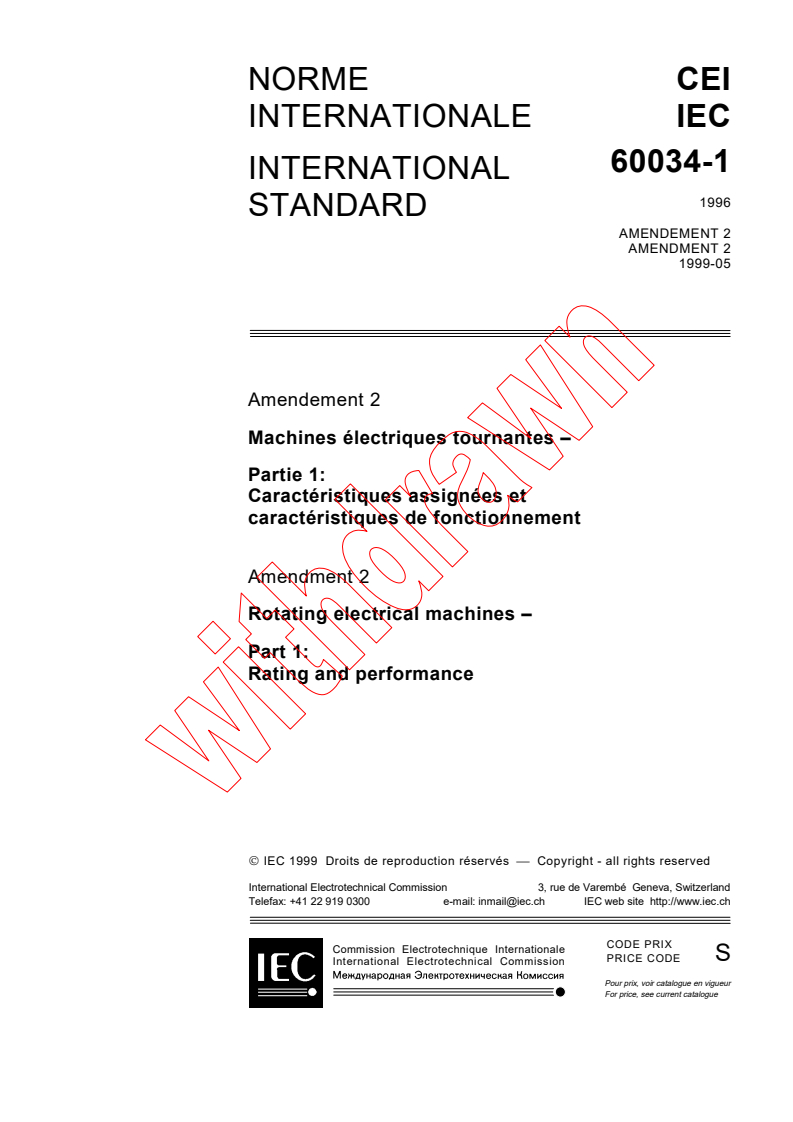
NORME CEI
INTERNATIONALE IEC
60034-1
INTERNATIONAL
STANDARD
AMENDEMENT 2
AMENDMENT 2
1999-05
Amendement 2
Machines électriques tournantes –
Partie 1:
Caractéristiques assignées et
caractéristiques de fonctionnement
Amendment 2
Rotating electrical machines –
Part 1:
Rating and performance
IEC 1999 Droits de reproduction réservés Copyright - all rights reserved
International Electrotechnical Commission 3, rue de Varembé Geneva, Switzerland
Telefax: +41 22 919 0300 e-mail: inmail@iec.ch IEC web site http://www.iec.ch
CODE PRIX
Commission Electrotechnique Internationale
S
PRICE CODE
International Electrotechnical Commission
Pour prix, voir catalogue en vigueur
For price, see current catalogue
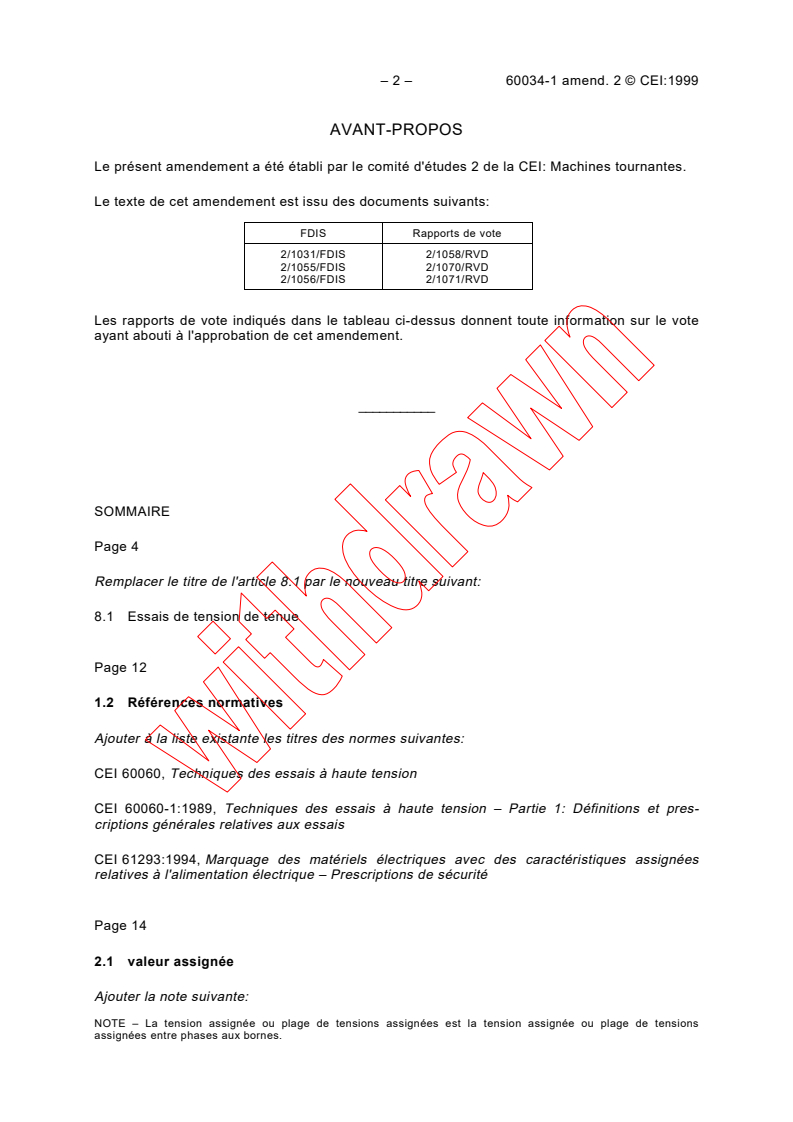
– 2 – 60034-1 amend. 2 © CEI:1999
AVANT-PROPOS
Le présent amendement a été établi par le comité d'études 2 de la CEI: Machines tournantes.
Le texte de cet amendement est issu des documents suivants:
FDIS Rapports de vote
2/1031/FDIS 2/1058/RVD
2/1055/FDIS 2/1070/RVD
2/1056/FDIS 2/1071/RVD
Les rapports de vote indiqués dans le tableau ci-dessus donnent toute information sur le vote
ayant abouti à l'approbation de cet amendement.
___________
SOMMAIRE
Page 4
Remplacer le titre de l'article 8.1 par le nouveau titre suivant:
8.1 Essais de tension de tenue
Page 12
1.2 Références normatives
Ajouter à la liste existante les titres des normes suivantes:
CEI 60060, Techniques des essais à haute tension
CEI 60060-1:1989, Techniques des essais à haute tension – Partie 1: Définitions et pres-
criptions générales relatives aux essais
CEI 61293:1994, Marquage des matériels électriques avec des caractéristiques assignées
relatives à l'alimentation électrique – Prescriptions de sécurité
Page 14
2.1 valeur assignée
Ajouter la note suivante:
NOTE – La tension assignée ou plage de tensions assignées est la tension assignée ou plage de tensions
assignées entre phases aux bornes.
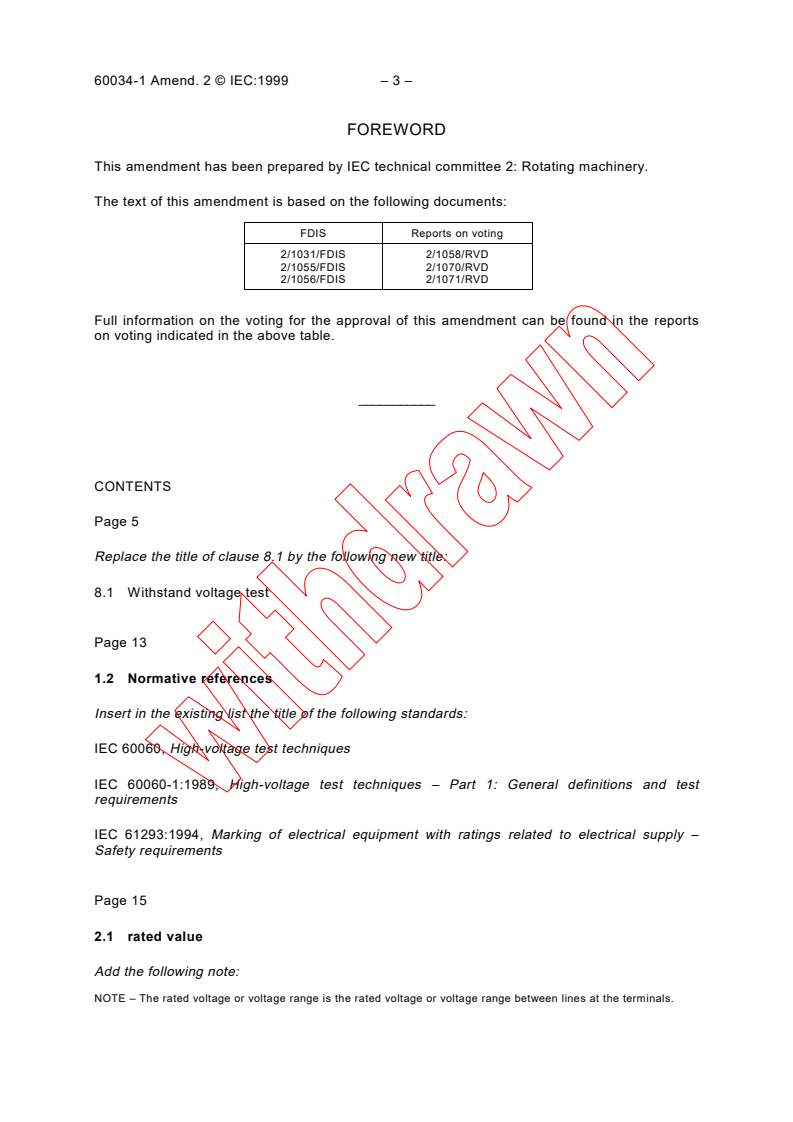
60034-1 Amend. 2 © IEC:1999 – 3 –
FOREWORD
This amendment has been prepared by IEC technical committee 2: Rotating machinery.
The text of this amendment is based on the following documents:
FDIS Reports on voting
2/1031/FDIS 2/1058/RVD
2/1055/FDIS 2/1070/RVD
2/1056/FDIS 2/1071/RVD
Full information on the voting for the approval of this amendment can be found in the reports
on voting indicated in the above table.
___________
CONTENTS
Page 5
Replace the title of clause 8.1 by the following new title:
8.1 Withstand voltage test
Page 13
1.2 Normative references
Insert in the existing list the title of the following standards:
IEC 60060, High-voltage test techniques
IEC 60060-1:1989, High-voltage test techniques – Part 1: General definitions and test
requirements
IEC 61293:1994, Marking of electrical equipment with ratings related to electrical supply –
Safety requirements
Page 15
2.1 rated value
Add the following note:
NOTE – The rated voltage or voltage range is the rated voltage or voltage range between lines at the terminals.
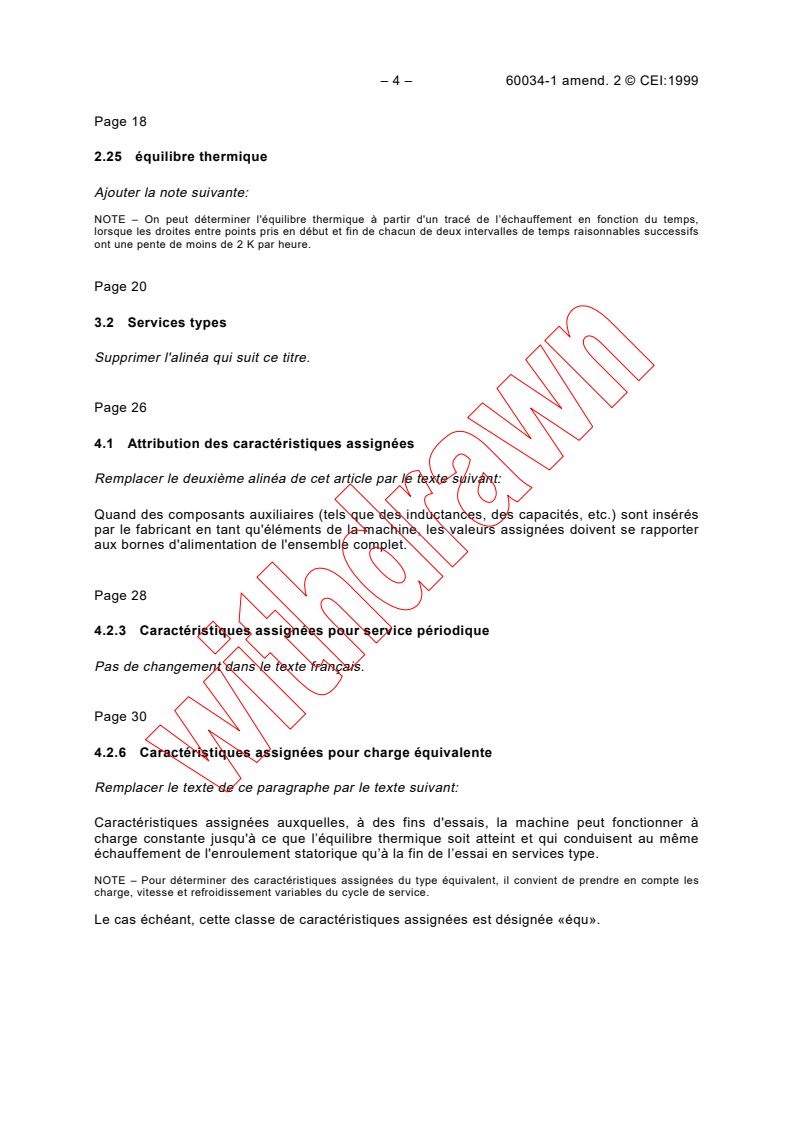
– 4 – 60034-1 amend. 2 © CEI:1999
Page 18
2.25 équilibre thermique
Ajouter la note suivante:
NOTE – On peut déterminer l'équilibre thermique à partir d'un tracé de l’échauffement en fonction du temps,
lorsque les droites entre points pris en début et fin de chacun de deux intervalles de temps raisonnables successifs
ont une pente de moins de 2 K par heure.
Page 20
3.2 Services types
Supprimer l'alinéa qui suit ce titre.
Page 26
4.1 Attribution des caractéristiques assignées
Remplacer le deuxième alinéa de cet article par le texte suivant:
Quand des composants auxiliaires (tels que des inductances, des capacités, etc.) sont insérés
par le fabricant en tant qu'éléments de la machine, les valeurs assignées doivent se rapporter
aux bornes d'alimentation de l'ensemble complet.
Page 28
4.2.3 Caractéristiques assignées pour service périodique
Pas de changement dans le texte français.
Page 30
4.2.6 Caractéristiques assignées pour charge équivalente
Remplacer le texte de ce paragraphe par le texte suivant:
Caractéristiques assignées auxquelles, à des fins d'essais, la machine peut fonctionner à
charge constante jusqu'à ce que l’équilibre thermique soit atteint et qui conduisent au même
échauffement de l'enroulement statorique qu’à la fin de l’essai en services type.
NOTE – Pour déterminer des caractéristiques assignées du type équivalent, il convient de prendre en compte les
charge, vitesse et refroidissement variables du cycle de service.
Le cas échéant, cette classe de caractéristiques assignées est désignée «équ».
60034-1 Amend. 2 © IEC:1999 – 5 –
Page 19
2.25 thermal equilibrium
Add the following note:
NOTE – Thermal equilibrium may be determined from the time-temperature rise plot when the straight lines
between points at the beginning and end of two successive reasonable intervals each have a gradient of less than
2 K per hour.
Page 21
3.2 Duty types
Delete the paragraph under this heading.
Page 27
4.1 Assignment of rating
Replace the second paragraph of this clause with the following new paragraph:
When accessory components (such as reactors, capacitors, etc.) are connected by the
manufacturer as part of the machine, the rated values shall refer to the supply terminals of the
whole arrangement.
Page 29
4.2.3 Rating for periodic duty
Replace the third paragraph of this subclause with the following new paragraph:
Unless otherwise specified, the duration of a duty cycle shall be 10 min and the cyclic duration
factor shall be one of the following values:
15 %, 25 %, 40 %, 60 %.
Page 31
4.2.6 Rating for equivalent loading
Replace the text of this subclause with the following new text:
A rating, for test purposes, at which the machine may be operated at constant load until
thermal equilibrium is reached and which results in the same stator winding temperature rise
as at the end of the test on the specified duty type.
NOTE – The determination of an equivalent rating should take account of the varying load, speed and cooling of the
duty cycle.
This class of rating, if applied, is designated 'equ'.
– 6 – 60034-1 amend. 2 © CEI:1999
4.5.2 Alternateurs
Remplacer le deuxième alinéa de ce paragraphe par le texte suivant:
Le facteur de puissance assigné des alternateurs synchrones doit être de 0,8 surexcité, sauf
spécification contraire de l'acheteur.
Page 32
4.6 Tension assignée
4.6.1 Généralités
Supprimer ce paragraphe et renuméroter les paragraphes 4.6.2 et 4.6.3 en 4.6.1 et 4.6.2
repectivement.
Page 36
6.1 Alimentation électrique
Supprimer le premier alinéa.
Remplacer le deuxième alinéa et la note de cet article par les textes suivants:
Pour les machines triphasées à courant alternatif, 50 Hz ou 60 Hz, destinées à être
directement reliées à un réseau de distribution ou d'utilisation, les tensions assignées doivent
être déduites des tensions nominales données dans la CEI 60038.
NOTE – Pour les machines à courant alternatif de forte puissance à haute tension, les tensions peuvent être
choisies pour l'obtention de caractéristiques de fonctionnement optimales.
Page 40
6.2.4 Moteurs à courant continu alimentés par convertisseurs statiques de puissance
Supprimer la note de ce paragraphe, en page 42.
Page 44
6.4 Machines triphasées à courant alternatif fonctionnant sur réseaux isolés
Remplacer le texte de cet article par le texte suivant:
Les machines triphasées à courant alternatif doivent être capables de fonctionner en marche
continue avec le neutre à un potentiel proche ou égal à celui de la terre. Elles doivent être
aussi capables de fonctionner sur des réseaux isolés ayant une phase au potentiel de la terre
pendant des périodes de courtes durées très peu fréquentes, par exemple telles que
nécessaires pour affranchir normalement le défaut. S'il est prévu de faire fonctionner la
machine en permanence, ou pendant de longues périodes, dans ces conditions, il est
indispensable de prévoir une machine spéciale avec le niveau d'isolement approprié.
60034-1 Amend. 2 © IEC:1999 – 7 –
4.5.2 AC generators
Replace the second paragraph of this subclause with the following new paragraph:
The rated power factor for synchronous generators shall be 0,8 lagging (over-excited), unless
otherwise specified by the purchaser.
Page 33
4.6 Rated voltage
4.6.1 General
Delete this subclause and renumber subclauses 4.6.2 and 4.6.3 as 4.6.1 and 4.6.2,
respectively.
Page 37
6.1 Electrical supply
Delete the first paragraph.
Replace the second paragraph and note with the following new paragraph and note:
For three-phase a.c. machines, 50 Hz or 60 Hz, intended to be directly connected to
distribution or utilisation systems, the rated voltages shall be derived from the nominal voltages
given in IEC 60038.
NOTE – For large high-voltage a.c. machines, the voltages may be selected for optimum performance.
Page 41
6.2.4 DC motors supplied from static power converters
Delete the note of this subclause on page 43.
Page 45
6.4 Three-phase a.c. machines operating on unearthed systems
Replace the existing clause with the following new clause:
Three-phase a.c. machines shall be suitable for continuous operation with the neutral at or
near earth potential. They shall also be suitable for operation on unearthed systems with one
line at earth potential for infrequent periods of short duration, for example as required for
normal fault clearance. If it is intended to run the machine continuously or for prolonged
periods in this condition, a machine with a level of insulation suitable for this condition will be
required.
– 8 – 60034-1 amend. 2 © CEI:1999
Si les enroulements n'ont pas une isolation identique côté phase et côté neutre, cela doit être
spécifié par le constucteur.
NOTE – Il convient que la mise à la terre ou l'interconnexion des points neutres de machines ne soit jamais
effectuée sans consultation des constructeurs des machines, à cause des dangers de circulation de courants
homopolaires de toutes fréquences dans certaines conditions de fonctionnement et des risques d'incidents
mécaniques sur les enroulements lors de défauts entre phase et neutre.
Page 50
7.4 Echauffement d'un élément de machine
Remplacer les deuxième et troisième alinéas de cet article par le texte suivant:
Pour la comparaison avec les limites des échauffements (voir tableau 6 ou 7) ou des
températures (voir tableau 11), lorsque cela est possible la température doit être mesurée
immédiatement avant qu'on arrête la machine à la fin de l'essai thermique, comme cela est
défini à l'article 7.7.
Lorsque cela n'est pas possible, par exemple lors du mesurage direct par la méthode de
variation de résistance, voir 7.6.2.3.
7.5.3 Méthode par thermomètre
Remplacer le texte de ce paragraphe par le nouveau texte suivant:
La température est mesurée au moyen de thermomètres appliqués sur les surfaces
accessibles de la machine terminée. Le terme «thermomètre» s'applique non seulement aux
thermomètres à réservoir, mais aussi aux couples thermoélectriques et thermomètres à
résistance externes. Lorsque des thermomètres à réservoir sont utilisés en des points où il
existe un champ magnétique intense, variable ou mobile, des thermomètres à alcool doivent
être utilisés de préférence aux thermomètres à mercure.
Page 52
7.6.1 Choix de la méthode
Supprimer le point d) du sixième alinéa.
Page 58
7.6.4 Détermination par la méthode du thermomètre
Remplacer le texte de ce paragraphe par le nouveau texte suivant:
Lorsqu'on utilise un couple thermoélectrique ou thermomètre à résistance externe, il ne doit
pas être placé à un point inaccessible à un thermomètre à réservoir.
On doit s'efforcer, autant que cela est compatible avec la sécurité, de placer les thermomètres
aux points présumés les plus chauds (par exemple dans les développantes à proximité du
circuit magnétique) de façon qu'ils soient efficacement protégés du contact avec le fluide de
refroidissement primaire et qu'ils soient en bon contact thermique avec l'enroulement ou autre
élément de machine.
60034-1 Amend. 2 © IEC:1999 – 9 –
If the winding does not have the same insulation at the line and neutral ends, this shall be
stated by the manufacturer.
NOTE – The earthing or interconnection of the machine's neutral points should not be undertaken without
consulting the machine manufacturer because of the danger of zero-sequence components of currents of all
frequencies under some operating conditions and the risk of mechanical damage to the windings under
line-to-neutral fault conditions.
Page 51
7.4 Temperature rise of a part of a machine
Replace the second and third paragraphs of this clause with the following text:
For comparison with the limits of temperature rise (see table 6 or 7) or of temperature (see
table 11), when possible, the temperature shall be measured immediately before the machine
is shut down at the end of the thermal test, as described in clause 7.7.
When this is not possible, e.g. when using the direct measurement of resistance method, see
7.6.2.3.
7.5.3 Thermometer method
Replace the existing subclause with the following new subclause:
The temperature is determined by thermometers applied to accessible surfaces of the
completed machine. The term 'thermometer' includes not only bulb-thermometers, but also
non-embedded thermocouples and resistance thermometers. When bulb-thermometers are
used in places where there is a strong varying or moving magnetic field, alcohol thermometers
shall be used in preference to mercury thermometers.
Page 53
7.6.1 Choice of method
Delete indent d) from the enumeration in the sixth paragraph.
Page 59
7.6.4 Determination by the thermometer method
Replace the existing subclause with the following new subclause:
When a non-embedded thermocouple or a resistance thermometer is used, it shall not be
placed at a point inaccessible to a bulb thermometer.
All reasonable efforts, consistent with safety, shall be made to place thermometers at the point,
or points where the highest temperatures are likely to occur (e.g. in the end windings close to
the core iron) in such a manner that they are effectively protected against contact with the
primary coolant and are in good thermal contact with the winding or other part of the machine.
– 10 – 60034-1 amend. 2 © CEI:1999
Quel que soit le thermomètre, la lecture la plus élevée doit être prise comme valeur de la
température de l'enroulement ou de l'élément de machine.
7.8 Détermination de la constante de temps thermique équivalente
des machines pour service type S9
Supprimer la note de cet article, en page 60.
Page 62
7.10.1 Enroulements à refroidissement indirect
Remplacer le troisième alinéa de ce paragraphe, y compris le texte en retrait, par le nouveau
texte suivant:
En cas de lectures par thermomètre effectuées selon 7.6.1, la limite d'échauffement doit être
conforme au tableau 6.
Page 64
Tableau 6 – Limites d’échauffement des enroulements à refroidissement indirect par l’air
Remplacer le tableau existant par le nouveau tableau suivant:
60034-1 Amend. 2 © IEC:1999 – 11 –
The highest reading from any thermometer shall be taken to be the temperature of the winding
or other part of the machine.
7.8 Determination of the thermal equivalent time constant for machines of duty type S9
Delete the note of this clause on page 61.
Page 63
7.10.1 Indirect cooled windings
Replace the third paragraph of this subclause, including the enumeration with the following new
paragraph:
In the case of thermometer readings made in accordance with 7.6.1, the limit of temperature
rise shall be according to table 6.
Page 65
Table 6 – Limits of temperature rise of windings indirectly cooled by air
Replace the existing table with the following new table:
– 12 – 60034-1 amend. 2 © CEI:1999
Tableau 6 – Limites d’échauffement des enroulements à refroidissement indirect par l’air
Classification thermique A E B F H
Méthode de mesure Th R IIT Th R IIT Th R IIT Th R IIT Th R IIT
Th = Thermomètre, R = Résistance, K K K K K K K K K K K K K K K
IIT = Indicateur interne de température
Point Partie de la machine
1) 1) 1) 1)
1a) Enroulements à courant alternatif de machines de puissance –60 65 – – – – 80 85 – 100 105 – 125 130
supérieure ou égale à 5 000 kW (ou kVA)
1) 1) 1) 1)
1b) Enroulements à courant alternatif de machnes de puissance supérieure –60 65 –75 – – 80 90 – 105 110 – 125 130
à 200 kW (ou kVA), mais inférieure à 5 000 kW (ou kVA)
Enroulements à courant alternatif de machines de puissance inférieure – 60 – – 75 – – 80 – – 105 – – 125 –
1c)
2)
ou égale à 200 kW (ou kVA) autres que ceux des points 1d) ou 1e)
1d) Enroulements à courant alternatif de machines de puissance inférieure – 65 – – 75 – – 85 – – 110 – – 130 –
2)
à 600 W (ou VA)
1e) Enroulements à courant alternatif de machines qui sont refroidies – 65 – – 75 – – 85 – – 110 – – 130 –
2)
naturellement, sans ventilateur (IC40) et/ou à enroulements enrobés
2 Enroulements d’induit reliés à des collecteurs 50 60 – 65 75 – 70 80 – 85 105 – 105 125 –
3 Enroulements d’excitation à courant continu des machines à courant 50 60 – 65 75 – 70 80 – 85 105 – 105 125 –
alternatif et à courant continu, autres que ceux du point 4
4a) Enroulements d’excitation à courant continu des machines synchrones – – – – – – – 90 – – 110 – – 135 –
à rotor cylindrique, dont un enroulement est logé dans l’encoche,
excepté les moteurs synchrones à induction
Enroulements isolés fixes d’excitation à plus d’une couche 50 60 – 65 75 – 70 80 90 85 105 110 105 125 135
4b)
des machines à courant continu
4c) Enroulements d’excitation de faible résistance ayant plus d'une couche 60 60 – 75 75 – 80 80 – 100 100 – 125 125 –
des machines à courant alternatif et à courant continu, et
enroulements de compensation des machines à courant continu
4d) Enroulements à une seule couche des machines à courant alternatif et 65 65 – 80 80 – 90 90 – 110 110 – 135 135 –
3)
à courant continu avec surfaces exposées nues ou en métal verni
1)
Une correction peut être effectuée dans le cas des enroulements à courant alternatif à haute tension (voir point 4 du tableau 8).
2)
Lors de l’application de la méthode d’essai par superposition à des enroulements de machines de puissance inférieure ou égale à 200 kW (ou kVA) avec des classes thermiques A, B,
E et F, les limites des échauffements prévues pour la méthode par variation de résistance peuvent être dépassées de 5 K.
3)
Comprend également les enroulements à plusieurs couches, à condition que les couches inférieures soient chacune en contact avec le fluide de refroidissement primaire en
circulation.
60034-1 Amend.2 © IEC – 13 –
Table 6 – Limits of temperature rise of windings indirectly cooled by air
Thermal classification A E B F H
Method of measurement Th R ETD Th R ETD Th R ETD Th R ETD Th R ETD
Th = Thermometer, R = Resistance, K K K K K K K K K K K K K K K
ETD = Embedded temperature detector
Item Part of machine
1) 1) 1) 1)
1a) AC windings of machines having outputs of 5 000 kW (or kVA) or –60 65 – – – – 80 85 – 100 105 – 125 130
more
1) 1) 1) 1)
1b) AC windings of machines having outputs above 200 kW (or kVA), but –60 65 –75 – –80 90 – 105 110 – 125 130
less than 5 000 kW (or kVA)
1c) AC windings of machines having outputs of 200 kW (or kVA) or less, –60 – –75 – –80 – – 105 – – 125 –
2)
other than those in items 1d) or 1e)
1d) AC windings of machines having rated outputs of less than 600 W (or –65 – –75 – –85 – – 110 – – 130 –
2)
VA)
AC windings which are self-cooled without a fan (IC 40) and/or with –65 – –75 – –85 – – 110 – – 130 –
1e)
2)
encapsulated windings
2 Windings of armatures having commutators 50 60 – 65 75 – 70 80 – 85 105 – 105 125 –
3 Field windings of a.c. and d.c. machines other than those in item 4 50 60 – 65 75 – 70 80 – 85 105 – 105 125 –
4a) Field windings of synchronous machines with cylindrical rotors having – – – – – – – 90 – – 110 – – 135 –
a d.c. excitation winding embedded in slots, except synchronous
induction motors
4b) Insulated stationary field windings of d.c. machines having more than 50 60 – 65 75 – 70 80 90 85 105 110 105 125 135
one layer
4c) Low-resistance field windings of a.c. and d.c. machines having more 60 60 – 75 75 – 80 80 – 100 100 – 125 125 –
than one layer and compensating windings of d.c. machines
4d) Single-layer windings of a.c. and d.c. machines with exposed bare or 65 65 – 80 80 – 90 90 – 110 110 – 135 135 –
3)
varnished metal surfaces.
1)
An adjustment for high-voltage a.c. windings may be applicable to these items, (see item 4 of table 8).
2)
With the application of the superposition test method to windings of machines rated at 200 kW (or kVA) or less with thermal classes A, B, E and F, the limits of temperature rise given
for the resistance method may be exceeded by 5 K.
3)
Also includes multiple layer windings provided that the under layers are each in contact with the circulating primary coolant.
– 14 – 60034-1 amend. 2 © CEI:1999
Page 68
Tableau 8
Remplacer les points 1 et 4 du tableau 8 par ce qui suit:
1 Température 0 °C ≤ θ ≤ 40 °C Peuvent être augmentées par accord, mais cette
c
maximale de l’air augmentation ne doit dépasser ni la différence de
ambiant ou de température entre la température du fluide de refroidis-
l’air à l’entrée de sement et 40 °C, ni un maximum de 30 K.
la machine (θ )
c
Réduites de la différence entre la température du fluide
40 °C < θ ≤ 60 °C
c
de refroidissement et 40 °C
Par accord
θ < 0 °C ou θ > 60 °C
c c
Tension
4 11 kV < U ≤ 17 kV Δθ, pour les indicateurs internes de température (IIT)
N
assignée (U ) doivent être réduites de 1 K par tranche (ou fraction de
N
tranche) à partir de 11 kV jusqu'à 17 kV compris
U > 17 kV Δθ, pour les indicateurs internes de température (IIT)
N
doivent être réduites de 6 K et en plus réduites de 1,5 K
par tranche (ou fraction de tranche) au-dessus de 17 kV
Page 72
Tableau 10
Remplacer le point 2 du tableau 10, par ce qui suit:
2 Différence d’altitude entre site 1 000 m < H ≤ 4 000 m
H − 1 000 m
d’essai (H ) et site de ΔΔθθ=−1
T T
H < 1 000 m
10 000 m
fonctionnement (H) T
H < 1 000 m
H − 1 000 m
T
ΔΔθθ=+1
T
1 000 m < H ≤ 4 000 m
10 000 m
T
1 000 m < H ≤ 4 000 m
HH−
T
ΔΔθθ=+1
T
1 000 m < H ≤ 4 000 m
10 000 m
T
H > 4 000 m ou H > 4 000 m Par accord
T
60034-1 Amend. 2 © IEC:1999 – 15 –
Page 69
Table 8
Replace the text of items 1, 2 and 4 with the following new text:
1 Maximum temperature of 0 °C ≤ θ ≤ 40 °C May be increased by agreement but this
c
ambient air or of the air at increase shall not exceed either the amount by
which the coolant temperature is less than
inlet to the machine (θ )
c
40 °C, or a maximum of 30 K
40 °C < θ ≤ 60 °C Reduced by the amount by which the coolant
c
temperature exceeds 40 °C
θ < 0 °C or θ > 60 °C By agreement
c c
2 Maximum temperature of Increased by 10 K and may be further
5 °C ≤ θ ≤ 25 °C
w
the water at inlet to water- increased by an amount not exceeding the
cooled heat exchangers amount by which the cooling temperature is
(θ ) less than 25 °C
w
θ > 25 °C Increased by 10 K and reduced by the amount
w
by which the maximum cooling water
temperature exceeds 25 °C
Rated stator winding
4 11 kV < U ≤ 17 kV Δθ for embedded temperature detectors (ETD)
N
voltage (U ) shall be reduced by 1 K for each 1 kV (or part
N
thereof) from 11 kV up to and including 17 kV
U > 17 kV Δθ for embedded temperature detectors (ETD)
N
shall be reduced by 6 K plus 1,5 K for each
1 kV (or part thereof) above 17 kV
Page 73
Table 10
Replace the text of item 2 with the following new text:
2 Difference of altitudes of test site 1 000 m < H ≤ 4 000 m
H − 1 000 m
ΔΔθθ=−1
T
(H ) and operating site (H)
T
10 000 m
H < 1 000 m
T
H < 1 000 m
H − 1 000 m
T
ΔΔθθ=+1
T
10 000 m
1 000 m < H ≤ 4 000 m
T
1 000 m < H ≤ 4 000 m
HH−
T
ΔΔθθ=+1
T
1 000 m < H ≤ 4 000 m
10 000 m
T
H > 4 000 m or H > 4 000 m By agreement
T
– 16 – 60034-1 amend. 2 © CEI:1999
Page 76
Tableau 12
Remplacer le point 1 du tableau 12, par ce qui suit:
1 Température du fluide de 0 °C ≤ θ ≤ 40 °C Réduites de la différence entre 40 °C et θ .
c
c
refroidissement de Cependant par accord, une réduction
référence (θ ) inférieure peut être effectuée, sous réserve
c
que si θ < 10 °C, la réduction soit au moins
c
égale à la différence entre 10 °C et θ
c
Pas de correction
40 °C < θ ≤ 60 °C
c
Par accord
θ < 0 °C ou θ > 60 °C
c c
Tableau 13
Remplacer le point 2 du tableau 13 par ce qui suit:
2 Différence d’altitude 1 000 m < H ≤ 4 000 m
H − 1 000 m
entre site d’essai (H ) θθ=−θ 1− +θ
()
T Tc cT
H
< 1 000 m
T 10 000 m
et site de
H
fonctionnement ( )
H < 1 000 m
H − 1 000 m
T
θ =()θ − θ 1 + + θ
T c cT
1 000 m < H 4 000 m
≤
T
10 000 m
1 000 m < H ≤ 4 000 m
H − H
T
θ =()θ − θ 1 + + θ
T c cT
1 000 m < H ≤ 4 000 m
T
10 000 m
H > 4 000 m ou H > 4 000 m Par accord
T
Page 78
8.1 Essais diélectriques
Remplacer le titre et le premier alinéa de cet article par ce qui suit:
8.1 Essais de tension de tenue
Une tension d'essai telle que définie ci–après doit être appliquée entre les enroulements
soumis à l'essai et la carcasse de la machine à laquelle sont reliés le circuit magnétique et les
enroulements non soumis à l'essai. L'essai ne doit être effectué que sur une machine neuve et
terminée, dont toutes les parties sont en place dans des conditions équivalentes aux conditions
normales de fonctionnement; il doit être effectué dans l'atelier du constructeur ou après
montage sur site. Si un essai d'échauffement est effectué, I'essai de tension de tenue doit être
effectué immédiatement après cet essai.
Remplacer le troisième alinéa de cet article par le nouveau texte suivant:
Sauf exception ci–dessous, la tension d'essai doit être à fréquence industrielle et de forme
pratiquement sinusoïdale. La valeur finale de la tension d'essai doit être conforme au
tableau 14. Toutefois, pour les machines de tension assignée égale ou supérieure à 6 kV,
lorsque la disponibilité d'une installation d'essai à fréquence industrielle n'existe pas et après
accord, I'essai peut être effectué en tension continue, à un niveau égal à 1,7 fois la valeur
efficace spécifiée au tableau 14.
NOTE – Il est reconnu que, lors d'un essai en tension continue, la distribution de potentiel de surface le long de
l'isolation des développantes et les mécanismes de vieillissement sont différents de ceux en tension alternative.
60034-1 Amend. 2 © IEC:1999 – 17 –
Page 77
Table 12
Replace the text of item 1 with the following new text:
1 Reference 0 °C ≤ θ ≤ 40 °C Reduction by the amount of the difference between 40 °C
c
coolant θ
and . However, by agreement, a smaller reduction may
c
temperature
θ
be applied, provided that for < 10 °C the reduction is
c
(θ )
made at least equal to the difference between 10 °C
c
θ
and .
c
No adjustment
40 °C < θ ≤ 60 °C
c
By agreement
θ < 0 °C or θ > 60 °C
c
c
Table 13
Replace the text of item 2 with the following new text:
2 Difference of altitudes 1 000 m < H ≤ 4 000 m
H − 1 000 m
of test site (H ) and
θθ=−θ 1− +θ
T ()
Tc cT
H
< 1 000 m
T 10 000 m
operating site (H)
H < 1 000 m
H − 1 000 m
T
θθ=−θ 1+ +θ
()
Tc cT
1 000 m < H ≤ 4 000 m
T 10 000 m
H
1 000 m < ≤ 4 000 m
HH−
T
θθ=−θ 1+ +θ
()
Tc cT
1 000 m < H ≤ 4 000 m
T 10 000 m
H > 4 000 m or H > 4 000 m By agreement
T
Page 79
8.1 Dielectric tests
Replace the title and the first paragraph of this clause with the following:
8.1 Withstand voltage test
A test voltage, as specified below, shall be applied between the windings under test and the
frame of the machine, with the core and the windings not under test connected to the frame. It
shall be applied only to a new and completed machine with all its parts in place under
conditions equivalent to normal working conditions and shall be carried out at the
manufacturer's works or after erection on site. When a thermal test is carried out, the withstand
voltage test shall be carried out immediately after that test.
Replace the third paragraph of this clause with the following new paragraph:
Except as stated below, the test voltage shall be of power frequency and as near as possible to
a sine wave form. The final value of the voltage shall be in accordance with table 14. However,
for machines with a rated voltage 6 kV or greater, when power frequency equipment is not
available, then by agreement a d.c. test may be carried out at a voltage 1,7 times the r.m.s.
value given in table 14.
NOTE – It is recognized that, during a d.c. test, the surface potential distribution along the end winding insulation
and the ageing mechanisms are different from those occurring during an a.c. test.
– 18 – 60034-1 amend. 2 © CEI:1999
Remplacer le quatrième alinéa de cet article par le texte suivant:
L'essai doit être commencé avec une tension ne dépassant pas la moitié de la pleine tension
d'essai. La tension est ensuite
...