

IEC TS 60076-20:2017
(Main)Power transformers - Part 20: Energy efficiency
General Information
- Abstract
IEC TS 60076-20:2017(E) is applicable to transformers in the scope of IEC 60076-1. It proposes two methods of defining an energy efficiency index and introduces three methods of evaluating the energy performance of a transformer. The appropriate method is chosen by agreement between purchasers and manufacturers or according to local regulations.
The contents of the corrigendum of January 2018 have been included in this copy.
- Status
- Published
- Publication Date
- 29-Jan-2017
- Technical Committee
- TC 14 - Power transformers
- Drafting Committee
- PT 60076-20 - TC 14/PT 60076-20
- Current Stage
- PPUB - Publication issued
- Start Date
- 30-Jan-2017
- Completion Date
- 21-Feb-2017
Overview
IEC TS 60076-20:2017 - Power transformers, Part 20: Energy efficiency (with corrigendum Jan 2018) is a Technical Specification from IEC TC14 that provides methods and guidance for specifying and evaluating the energy performance of transformers in the scope of IEC 60076-1. Its objective is to promote higher average energy performance, reduce lifetime losses and greenhouse‑gas emissions, and offer a harmonized model for national standards or procurement practices.
Key topics and requirements
- Scope: Applies to power transformers covered by IEC 60076-1 (liquid‑immersed and dry‑type where applicable). Corrigendum January 2018 is included in this edition.
- Energy indices and methods: Defines two methods for an energy efficiency index and introduces three practical evaluation approaches:
- Peak Efficiency Index (PEI) - used with total cost of ownership (TCO) or specified load factors.
- Maximum load and no‑load losses - rationalized limits for mass production and standardization.
- Efficiency at a defined load factor (commonly 50%) - evaluation of real operating performance.
- Calculation and formulas: Presents formulae for efficiency and efficiency‑index calculations to reflect regional practices (50 Hz / 60 Hz distinctions and single‑phase/three‑phase cases).
- Specification and performance levels: Includes procedures for specifying energy performance, tables of PEI and efficiency index targets for different ratings and voltages, and tolerances for losses and indices.
- Annexes: Informative annexes cover capitalisation of losses (TCO concepts), survey of world practices, and country‑specific practices (e.g., Japan).
Practical applications - who uses this standard
- Transformer manufacturers - to design and certify products that meet buyer or regulatory energy targets.
- Purchasers and utilities - to specify procurement requirements using PEI, loss limits, or efficiency‑at‑load methods, and to compare bids on a fair energy basis.
- Regulators and standards bodies - to adopt national performance targets or incorporate harmonized testing/assessment methods.
- Consultants and system planners - to evaluate lifecycle costs, capitalise losses, and select transformers that optimize operating expenditure and emissions.
- Test laboratories - to verify compliance with loss and efficiency measurement and reporting practices.
Related standards
- IEC 60076-1 (rated characteristics and general requirements) - primary scope reference.
- Other parts of the IEC 60076 series for testing, temperature rise, insulation, dielectric tests, and installation considerations.
IEC TS 60076-20 is a practical tool for aligning transformer procurement and design with energy‑efficiency and lifecycle cost objectives, enabling manufacturers, utilities and regulators to adopt consistent, performance‑based criteria.
Relations
- Corrected By
IEC TS 60076-20:2017/COR1:2018 - Corrigendum 1 - Power transformers - Part 20: Energy efficiency - Effective Date
- 05-Sep-2023
Get Certified
Connect with accredited certification bodies for this standard

IMQ S.p.A. (Certification)
Italian electrical product certification.

SLG Prüf- und Zertifizierungs GmbH
German testing and certification body.

UL Solutions
Global safety science company with testing, inspection and certification.
Sponsored listings
Frequently Asked Questions
IEC TS 60076-20:2017 is a technical specification published by the International Electrotechnical Commission (IEC). Its full title is "Power transformers - Part 20: Energy efficiency". This standard covers: IEC TS 60076-20:2017(E) is applicable to transformers in the scope of IEC 60076-1. It proposes two methods of defining an energy efficiency index and introduces three methods of evaluating the energy performance of a transformer. The appropriate method is chosen by agreement between purchasers and manufacturers or according to local regulations. The contents of the corrigendum of January 2018 have been included in this copy.
IEC TS 60076-20:2017(E) is applicable to transformers in the scope of IEC 60076-1. It proposes two methods of defining an energy efficiency index and introduces three methods of evaluating the energy performance of a transformer. The appropriate method is chosen by agreement between purchasers and manufacturers or according to local regulations. The contents of the corrigendum of January 2018 have been included in this copy.
IEC TS 60076-20:2017 is classified under the following ICS (International Classification for Standards) categories: 29.180 - Transformers. Reactors. The ICS classification helps identify the subject area and facilitates finding related standards.
IEC TS 60076-20:2017 has the following relationships with other standards: It is inter standard links to IEC TS 60076-20:2017/COR1:2018. Understanding these relationships helps ensure you are using the most current and applicable version of the standard.
IEC TS 60076-20:2017 is available in PDF format for immediate download after purchase. The document can be added to your cart and obtained through the secure checkout process. Digital delivery ensures instant access to the complete standard document.
Standards Content (Sample)
IEC TS 60076-20 ®
Edition 1.0 2017-01
TECHNICAL
SPECIFICATION
colour
inside
Power transformers –
Part 20: Energy efficiency
All rights reserved. Unless otherwise specified, no part of this publication may be reproduced or utilized in any form
or by any means, electronic or mechanical, including photocopying and microfilm, without permission in writing from
either IEC or IEC's member National Committee in the country of the requester. If you have any questions about IEC
copyright or have an enquiry about obtaining additional rights to this publication, please contact the address below or
your local IEC member National Committee for further information.
IEC Central Office Tel.: +41 22 919 02 11
3, rue de Varembé Fax: +41 22 919 03 00
CH-1211 Geneva 20 info@iec.ch
Switzerland www.iec.ch
About the IEC
The International Electrotechnical Commission (IEC) is the leading global organization that prepares and publishes
International Standards for all electrical, electronic and related technologies.
About IEC publications
The technical content of IEC publications is kept under constant review by the IEC. Please make sure that you have the
latest edition, a corrigenda or an amendment might have been published.
IEC Catalogue - webstore.iec.ch/catalogue Electropedia - www.electropedia.org
The stand-alone application for consulting the entire The world's leading online dictionary of electronic and
bibliographical information on IEC International Standards, electrical terms containing 20 000 terms and definitions in
Technical Specifications, Technical Reports and other English and French, with equivalent terms in 16 additional
documents. Available for PC, Mac OS, Android Tablets and languages. Also known as the International Electrotechnical
iPad. Vocabulary (IEV) online.
IEC publications search - www.iec.ch/searchpub IEC Glossary - std.iec.ch/glossary
The advanced search enables to find IEC publications by a 65 000 electrotechnical terminology entries in English and
variety of criteria (reference number, text, technical French extracted from the Terms and Definitions clause of
committee,…). It also gives information on projects, replaced IEC publications issued since 2002. Some entries have been
and withdrawn publications. collected from earlier publications of IEC TC 37, 77, 86 and
CISPR.
IEC Just Published - webstore.iec.ch/justpublished
Stay up to date on all new IEC publications. Just Published IEC Customer Service Centre - webstore.iec.ch/csc
details all new publications released. Available online and If you wish to give us your feedback on this publication or
also once a month by email. need further assistance, please contact the Customer Service
Centre: csc@iec.ch.
IEC TS 60076-20 ®
Edition 1.0 2017-01
TECHNICAL
SPECIFICATION
colour
inside
Power transformers –
Part 20: Energy efficiency
INTERNATIONAL
ELECTROTECHNICAL
COMMISSION
ICS 29.180 ISBN 978-2-8322-3870-7
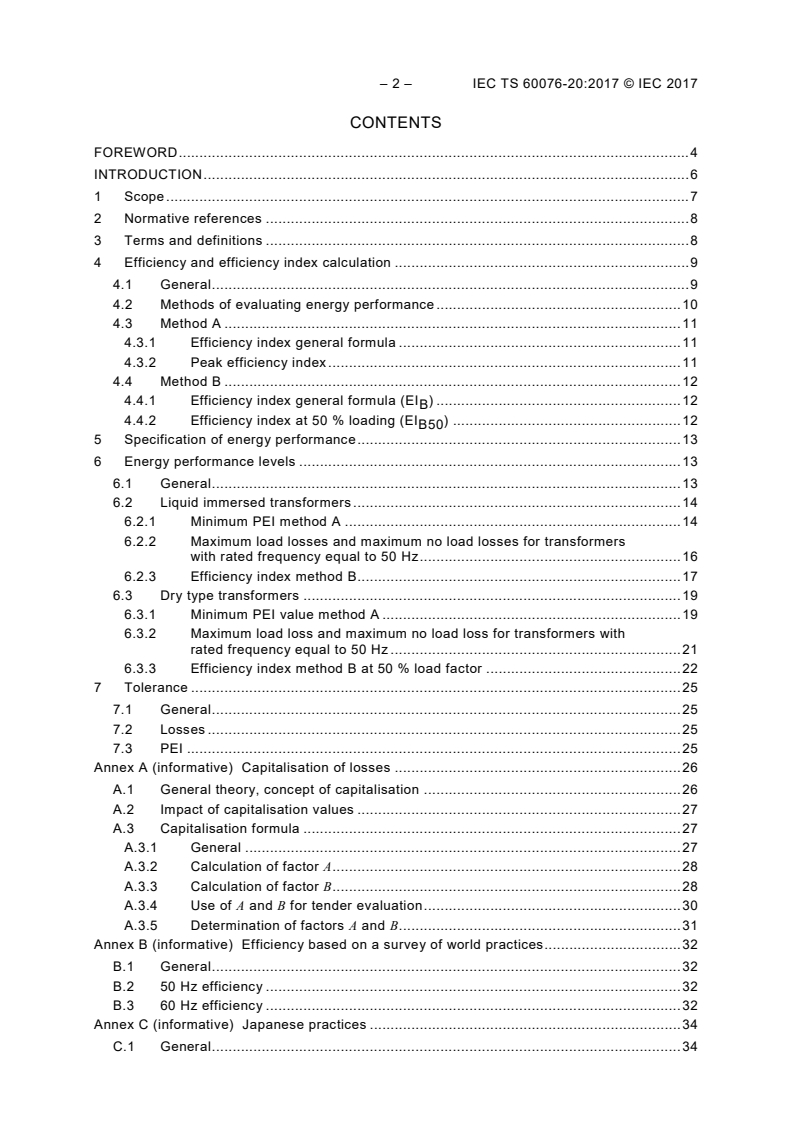
– 2 – IEC TS 60076-20:2017 © IEC 2017
CONTENTS
FOREWORD . 4
INTRODUCTION . 6
1 Scope . 7
2 Normative references . 8
3 Terms and definitions . 8
4 Efficiency and efficiency index calculation . 9
4.1 General . 9
4.2 Methods of evaluating energy performance . 10
4.3 Method A . 11
4.3.1 Efficiency index general formula . 11
4.3.2 Peak efficiency index . 11
4.4 Method B . 12
4.4.1 Efficiency index general formula (EI ) . 12
B
4.4.2 Efficiency index at 50 % loading (EI ) . 12
B50
5 Specification of energy performance . 13
6 Energy performance levels . 13
6.1 General . 13
6.2 Liquid immersed transformers . 14
6.2.1 Minimum PEI method A . 14
6.2.2 Maximum load losses and maximum no load losses for transformers
with rated frequency equal to 50 Hz . 16
6.2.3 Efficiency index method B . 17
6.3 Dry type transformers . 19
6.3.1 Minimum PEI value method A . 19
6.3.2 Maximum load loss and maximum no load loss for transformers with
rated frequency equal to 50 Hz . 21
6.3.3 Efficiency index method B at 50 % load factor . 22
7 Tolerance . 25
7.1 General . 25
7.2 Losses . 25
7.3 PEI . 25
Annex A (informative) Capitalisation of losses . 26
A.1 General theory, concept of capitalisation . 26
A.2 Impact of capitalisation values . 27
A.3 Capitalisation formula . 27
A.3.1 General . 27
A.3.2 Calculation of factor A. 28
A.3.3 Calculation of factor B. 28
A.3.4 Use of A and B for tender evaluation . 30
A.3.5 Determination of factors A and B . 31
Annex B (informative) Efficiency based on a survey of world practices . 32
B.1 General . 32
B.2 50 Hz efficiency . 32
B.3 60 Hz efficiency . 32
Annex C (informative) Japanese practices . 34
C.1 General . 34
C.2 Scope . 34
C.3 Maximum losses calculation methods . 34
C.4 Maximum losses . 34
Bibliography . 36
Figure A.1 – Load profile. 29
Table 1 – PEI values for single-phase transformers with U ≤ 12 kV and S ≤ 100 kVA . 14
m r
Table 2 – PEI values for transformers with U ≤ 36 kV and S ≤ 3 150 kVA . 15
m r
Table 3 – PEI values for transformers with U > 36 kV or S >3 150 kVA . 16
m r
Table 4 – Maximum load losses and maximum no load losses for transformers with
rated frequency equal to 50 Hz . 17
Table 5 – EI value for liquid-immersed 60 Hz transformers . 18
B50
Table 6 – EI value for liquid-immersed 50 Hz transformers . 19
B50
Table 7 – PEI values for dry type transformers with U ≤ 36 kV and S ≤ 3 150 kVA . 20
m r
Table 8 – PEI values for transformers with U ≤ 36 kV and S > 3 150 kVA . 20
m r
Table 9 – PEI values for transformers with U > 36 kV . 21
m
Table 10 – Maximum load loss and maximum no load loss for transformers with rated
frequency equal to 50 Hz . 22
Table 11 – EI values for single-phase dry type 60 Hz transformers . 23
B50
Table 12 – EI values for three-phase dry type 60 Hz transformers . 24
B50
Table 13 – EI values for dry type 50 Hz transformers . 25
B50
Table B.1 – Efficiency equations for transformers with a primary voltage of 36 kV and
below, from 5 kVA to 1 000 kVA single-phase and 15 kVA to 3 150 kVA three-phase,
50 Hz and 50 % load method A . 32
Table B.2 – Efficiency equations for transformers with a primary voltage of 36 kV and
below, from 5 kVA to 1 000 kVA single-phase and 15 kVA to 3 150 kVA three-phase,
60 Hz and 50 % load method B . 33
Table C.1 – Maximum losses . 35
– 4 – IEC TS 60076-20:2017 © IEC 2017
INTERNATIONAL ELECTROTECHNICAL COMMISSION
____________
POWER TRANSFORMERS –
Part 20: Energy efficiency
FOREWORD
1) The International Electrotechnical Commission (IEC) is a worldwide organization for standardization comprising
all national electrotechnical committees (IEC National Committees). The object of IEC is to promote
international co-operation on all questions concerning standardization in the electrical and electronic fields. To
this end and in addition to other activities, IEC publishes International Standards, Technical Specifications,
Technical Reports, Publicly Available Specifications (PAS) and Guides (hereafter referred to as “IEC
Publication(s)”). Their preparation is entrusted to technical committees; any IEC National Committee interested
in the subject dealt with may participate in this preparatory work. International, governmental and non-
governmental organizations liaising with the IEC also participate in this preparation. IEC collaborates closely
with the International Organization for Standardization (ISO) in accordance with conditions determined by
agreement between the two organizations.
2) The formal decisions or agreements of IEC on technical matters express, as nearly as possible, an international
consensus of opinion on the relevant subjects since each technical committee has representation from all
interested IEC National Committees.
3) IEC Publications have the form of recommendations for international use and are accepted by IEC National
Committees in that sense. While all reasonable efforts are made to ensure that the technical content of IEC
Publications is accurate, IEC cannot be held responsible for the way in which they are used or for any
misinterpretation by any end user.
4) In order to promote international uniformity, IEC National Committees undertake to apply IEC Publications
transparently to the maximum extent possible in their national and regional publications. Any divergence
between any IEC Publication and the corresponding national or regional publication shall be clearly indicated in
the latter.
5) IEC itself does not provide any attestation of conformity. Independent certification bodies provide conformity
assessment services and, in some areas, access to IEC marks of conformity. IEC is not responsible for any
services carried out by independent certification bodies.
6) All users should ensure that they have the latest edition of this publication.
7) No liability shall attach to IEC or its directors, employees, servants or agents including individual experts and
members of its technical committees and IEC National Committees for any personal injury, property damage or
other damage of any nature whatsoever, whether direct or indirect, or for costs (including legal fees) and
expenses arising out of the publication, use of, or reliance upon, this IEC Publication or any other IEC
Publications.
8) Attention is drawn to the Normative references cited in this publication. Use of the referenced publications is
indispensable for the correct application of this publication.
9) Attention is drawn to the possibility that some of the elements of this IEC Publication may be the subject of
patent rights. IEC shall not be held responsible for identifying any or all such patent rights.
The main task of IEC technical committees is to prepare International Standards. In
exceptional circumstances, a technical committee may propose the publication of a technical
specification when
• the required support cannot be obtained for the publication of an International Standard,
despite repeated efforts, or
• the subject is still under technical development or where, for any other reason, there is the
future but no immediate possibility of an agreement on an International Standard.
Technical specifications are subject to review within three years of publication to decide
whether they can be transformed into International Standards.
IEC TS 60076-20, which is a technical specification, has been prepared by IEC technical
committee 14: Power transformers.
The text of this technical specification is based on the following documents:
Enquiry draft Report on voting
14/852/DTS 14/884/RVDTS
Full information on the voting for the approval of this technical specification can be found in
the report on voting indicated in the above table.
This document has been drafted in accordance with the ISO/IEC Directives, Part 2.
The reader's attention is drawn to the fact that Annex C lists all of the “in-some-country”
clauses on differing practices of a less permanent nature relating to the subject of this
standard.
A list of all the parts in the IEC 60076 series, under the general title Power transformers, can
be found on the IEC website.
The committee has decided that the contents of this publication will remain unchanged until
the stability date indicated on the IEC website under "http://webstore.iec.ch" in the data
related to the specific publication. At this date, the publication will be
• transformed into an International standard,
• reconfirmed,
• withdrawn,
• replaced by a revised edition, or
• amended.
A bilingual version of this publication may be issued at a later date.
The contents of the corrigendum of January 2018 have been included in this copy.
IMPORTANT – The 'colour inside' logo on the cover page of this publication indicates
that it contains colours which are considered to be useful for the correct
understanding of its contents. Users should therefore print this document using a
colour printer.
– 6 – IEC TS 60076-20:2017 © IEC 2017
INTRODUCTION
The reason prompting the preparation of this document is the need to save energy and to
reduce the emission of greenhouse gases. The objective of this document is to promote a
higher average level of energy performance for transformers.
It provides a basic model for national standards and, alternatively, a supplement to national
standards that do not cover the whole range of transformers.
This part of IEC 60076 gives methods of specifying a transformer with an appropriate level of
energy efficiency according to the loading and operating conditions applicable. It also gives
minimum efficiency and maximum losses which lead to a generally acceptable balance
between losses and use of other resources.
This document proposes two methods (A and B) of defining an energy efficiency index and
introduces three methods of evaluating the energy performance of a transformer.
These are based on existing regional practices:
a) the Peak Efficiency Index (PEI) which should be used in conjunction with either a total
cost of ownership (TCO) approach or any other mean of specifying the load factor.
b) the no-load and load losses at rated power for rationalization of transformer cores and
coils for transformers generally produced in large volumes;
c) the efficiency at a defined power factor and particular load factor (typically at 50 %).
The appropriate method is chosen by agreement between purchasers and manufacturers or
according to local regulations.
A transformer that does not comply with this document can still comply with the requirements
of other standards in the IEC 60076 series.
Formulae for the calculation of efficiency are given to reflect different regional practices and
purposes. The definition of rated power is given in IEC 60076-1.
Energy efficiency is not the sole basis for choosing a transformer. The total capital and
estimated lifetime operating and maintenance costs (TCO) are also significant considerations
in determining the most suitable transformer for the intended application, and may lead to the
selection of more economical solutions when taking into account the lifetime of the
transformers.
This document provides a standard method for evaluating the energy performance of power
transformers through the use of the PEI, gives benchmark figures and the reasons why
certain transformers may have efficiencies which are higher or lower than the benchmark.
Setting a reasonable value of minimum PEI will be effective in improving the overall energy
performance of the installed transformer population by eliminating transformers with low
efficiency, with the exception for some specific network limitations.
The use of a minimum value of PEI sets a floor for transformer energy performance, but the
use of TCO evaluation for purchasing transformers is essential to select a transformer with
the optimal economically justified level of efficiency.
POWER TRANSFORMERS –
Part 20: Energy efficiency
1 Scope
This part of IEC 60076 is applicable to transformers in the scope of IEC 60076-1.
The energy performance levels given in Clause 6 are not applicable to the following
transformers:
• transformers for high current rectifiers as described in the IEC 61378 (all parts) and in the
IEC 60146 (all parts);
• transformers for furnace applications;
• transformers for offshore applications;
NOTE 1 Transformer to be installed on fixed or floating offshore platforms, offshore wind turbines or on board of
ships and all kind of vessels).
• transformers for emergency or temporary mobile installations;
NOTE 2 Transformers designed only to provide cover for a specific time limited situation when the normal power
supply is interrupted either due to an unplanned occurrence such as failure or a station refurbishment, but not to
permanently upgrade an existing substation.
• traction transformers;
• earthing transformers as described in 3.1.10 of IEC 60076-6:2007.
• phase shifting transformers;
• instrument transformers (IEC 61869-1);
• transformers and auto-transformers specifically designed for railway feeding systems, as
defined in EN 50329;
• traction catenary supply transformer for 16,67 Hz;
• transformer for high current rectifiers (IEC 61869-1);
NOTE 3 These are transformers specifically designed and intended to supply power electronic or rectifier loads
specified according to IEC 61378-1.
NOTE 4 This exclusion does not apply to transformers intended to provide AC power from DC sources such as
transformers for wind turbine and photo voltaic applications as well as transformers designed for DC transmission
and distribution applications.”
• transformers for railway feeding systems (EN 50329);
• subsea transformers;
• starting-, testing- and welding transformers;
• starting transformers, specifically designed for starting three-phase induction motors so as
to eliminate supply voltage dips;
NOTE 5 Examples are transformers that are de-energised during normal operation, used for the purpose of
starting a rotating machine).
• transformers specifically designed for explosion-proof and underground mining
applications;
• transformers which cannot fulfil the energy performance requirements due to unavoidable
size and weight limitations.
NOTE 6 Due to the unavoidable weight and size limitation for a rolling stock application, this definition includes all
traction transformers for rolling stock, irrespective of the frequency (e.g. 16,7 Hz, 25 Hz, 50 Hz, 60 Hz).
– 8 – IEC TS 60076-20:2017 © IEC 2017
In this document, "transformers" includes both separate winding transformers and
autotransformers.
NOTE 7 Transformers intended to provide AC power from DC sources such as transformers for wind turbine and
photo voltaic applications as well as transformers designed for DC transmission and distribution applications are
included in the Scope of this document.
2 Normative references
The following documents are referred to in the text in such a way that some or all of their
content constitutes requirements of this document. For dated references, only the edition
cited applies. For undated references, the latest edition of the referenced document (including
any amendments) applies.
IEC 60076-1, Power transformers – Part 1: General
IEC 60076-2, Power transformers – Part 2: Temperature rise for liquid-immersed transformers
3 Terms and definitions
For the purposes of this document, the following terms and definitions apply.
ISO and IEC maintain terminological databases for use in standardization at the following
addresses:
• IEC Electropedia: available at http://www.electropedia.org/
• ISO Online browsing platform: available at http://www.iso.org/obp
3.1
efficiency
ratio of output active power to input active power
Note 1 to entry: This is an apparent power
3.2
electrical losses
electrical power consumed by the transformer at a particular value of transmitted apparent
power excluding the power consumed by the cooling system
3.3
efficiency index method A
EI
A
ratio of the transmitted apparent power of a transformer minus electrical losses including the
power consumed by the cooling to the transmitted apparent power of the transformer for a
given load factor
3.4
efficiency index method B
EI
B
ratio of the transmitted apparent power of a transformer to the transmitted apparent power of
the transformer plus electrical losses for a given load factor
Note 1 to entry: This method is only applicable for naturally cooled transformers.
3.5
peak efficiency index
PEI
highest value of efficiency index method A that can be achieved at the optimum value of load
factor
Note 1 to entry: To characterize the energy performance of power transformers, it is useful to define an index that
is relevant to the transformer design applicable to a wide range of uses rather than a figure that varies from second
to second depending on system conditions. For this reason, a metric, the peak efficiency index, has been
developed and used, which is based on active power losses and total apparent power transmitted and is
independent of load phase angle, load factor and rated power.
3.6
input apparent power
S
input
input voltage multiplied by the input current
Note 1 to entry: This is an apparent power.
Note 2 to entry: For three phase transformers, a factor √3 shall be added.
3.7
output apparent power
S
output
output voltage multiplied by the output current
Note 1 to entry: This is an apparent power.
Note 2 to entry: For three phase transformers, a factor √3 shall be added.
3.8
transformer load factor
k
ratio of the actual input current to the rated current of the transformer
3.9
load factor of peak efficiency index
k
PEI
load factor at which the peak efficiency index (3.5) occurs
3.10
transmitted apparent power
kS
r
product of the load factor and the rated power
4 Efficiency and efficiency index calculation
4.1 General
Transformer efficiency is based on the apparent power, this is equivalent to assuming that the
power factor is one. For transformers, the efficiency is expressed as follows:
𝑆 − 𝐿 𝑆
input output
Efficiency = = (1)
𝑆 𝑆 +𝐿
input output
The defined power can be either input apparent power or output apparent power resulting in
two methods for the calculation of efficiency (Method A and Method B), and historically both
methods have been used.
– 10 – IEC TS 60076-20:2017 © IEC 2017
𝑆−𝐿
Method A Efficiency = (2)
𝑆
𝑆
Method B Efficiency = (3)
𝑆+𝐿
where
S is the defined power;
L is the sum of no-load loss and load loss including loss for cooling equipment.
NOTE S is defined as input apparent power in method A and S is defined as output apparent power in method B.
The formula for calculating efficiency index with method B is limited to transformers without
cooling losses.
For the scope of this document and for the sake of simplicity, it is conventionally assumed
that:
• the voltage and load current systems are symmetrical and sinusoidal;
• the line voltage is equal to the rated voltage.
4.2 Methods of evaluating energy performance
For the purposes of this document, to consider energy efficiency in a practical manner, the
power factor is assumed to be unity, and efficiency can be defined in terms of an efficiency
index at a specific power.
This document defines two methods of calculating the efficiency index, method A and
method B.
This document introduces three methods of evaluating the energy performance of a
transformer:
a) the peak efficiency index (PEI);
b) the no-load and load losses at rated power or at a particular reference power;
c) the efficiency at a defined power factor and particular load factor (typically at 50 %).
The appropriate method shall be chosen by agreement between purchasers and
manufacturers or according to local regulations.
The general definition of efficiency raises some complications, such as whether the electrical
consumption of the cooling equipment of the transformer at no-load or at a particular load
shall be included in the calculation.
The PEI includes the losses associated with only that part of the cooling system that is in
service at k .
PEI
At k loading, sufficient cooling shall be in service to ensure that the rise in temperature of
PEI
the transformer does not exceed the requirements of IEC 60076-2 or the customer's
specification.
NOTE 1 The advantage of the PEI is that it does not impose a particular load factor that can vary greatly
depending on the application, and because it does not depend explicitly on the rated power of the transformer. The
PEI is an intrinsic parameter that does not depend on whether the transformer has alternative ratings depending on
cooling modes.
NOTE 2 If the loss capitalisation method is used in the transformer procurement process, then it can be expected
that the PEI will occur at approximately the loading where the ratio between load and no-load losses is equal to the
ratio between the capitalisation rates for load and no-load loss, except where this has been modified by the relative
cost of reducing load and no-load losses.
It can be advantageous to switch on the cooling at a lower temperature than is required by the maximum
temperature rise requirement to increase the life span of the transformer insulation and reduce total losses,
because of the effect of winding temperature on losses.
4.3 Method A
4.3.1 Efficiency index general formula
The efficiency index according to method A is calculated according to the following formula
expressed per unit:
𝑘𝑆− (𝑃+𝑃 )−(𝑘²𝑃+𝑃 (𝑘))
r 0 c0 k ck
EI = (p.u.) (4)
A
𝑘𝑆
r
where
P is the no-load loss measured at rated voltage in W, rated frequency and on rated tap;
P is the electrical power in W required by the cooling system for no-load operation
c0
derived from the type test measurement of the power taken by the fan and pump
motors;
is the measured load loss in W at rated current and rated frequency on the rated tap
P
k
corrected to reference temperature according to the requirement below;
P (k) is the additional electrical power in W required (in addition to P ) by the cooling
ck c0
system for operation at load factor k, derived from the type test measurement of the
power taken by the fan and pump motors;
S is the rated power in VA of the transformer or autotransformer as defined in
r
IEC 60076-1 on which P is based;
k
k is the load factor.
This approach respects the philosophy of the IEC 60076 series, which refers the rated power
to the rated voltage and current of one of the transformer windings.
For the calculation, the following shall be considered:
a) for liquid-immersed transformers with a rated average winding temperature rise less than
or equal to 65 K for OF or ON, or 70 K for OD, the reference temperature is 75 °C;
b) for transformers with other rated average winding temperature rises, the reference
temperature is equal to the rated average winding temperature rise +20 °C, or rated
winding temperature rise + the yearly external cooling medium average temperature,
whichever is higher.
If a purchaser needs to compare a transformer with different insulation systems and different
average winding temperature rises, the reference temperature should be according to b)
above.
The reference temperature at the rated power chosen for the losses shall be in accordance
with IEC 60076-1.
4.3.2 Peak efficiency index
The peak efficiency index (PEI) is obtained when no-load loss equals load loss and is given
by substituting k in Equation (4) with k as in the expression below:
PEI
𝑃 +𝑃 +𝑃
0 c0 ck
PEI
𝑘 =� (p.u.) (5)
PEI
𝑃
k
P is the additional electrical power required (in addition to P ) by the cooling system for
ckPEI c0
operation at k .
PEI
– 12 – IEC TS 60076-20:2017 © IEC 2017
The formula for calculating the PEI is therefore given by Equation (6):
2(𝑃 +𝑃 +𝑃 )
0 c0 ck
PEI
PEI = 1 - (p.u.) (6)
𝑃 +𝑃 +𝑃
0 ck c0
PEI
�
𝑆
r
𝑃
k
The losses shall be measured in accordance with the methods specified in the IEC 60076
series.
NOTE The value of Equation (6) depends on the ratio S /√P which does not vary significantly if S is changed (for
r K r
example by changing the cooling mode) provided that P is measured at S .
K r
4.4 Method B
4.4.1 Efficiency index general formula (EI )
B
This formula is only applicable to transformers with natural cooling AN, ONAN, KNAN, GNAN
and LNAN. For forced cooled transformers, method A shall apply.
The general way to calculate the efficiency index is given by Equation (7). This is different
from the usual definition of rated power as per IEC 60076-1 as shown by this method. This
method is named method B.
𝑘𝑆
u
EI = (p.u.) (7)
B
𝑘𝑆 + 𝑃 +𝑘²𝑇𝑃
u 0 f k
where
is the no-load loss measured in W at rated voltage, rated frequency and on rated tap;
P
P is the measured load loss in W at the rated current and the rated frequency on the rated
k
tap corrected to the reference temperature of 85 °C;
S is the rated power in VA of the transformer or autotransformer as defined in IEEE
u
C57.12.80 on which P is based. S is used for distinction from S ;
k u r
k is the load factor;
T is the temperature correction factor used to correct the losses from the standard
f
reference temperature to the reference temperature used for calculation of the EI at a
load factor lower than 1.
This method should be applied when an efficiency value is not specified by the purchaser or
in local regulation.
4.4.2 Efficiency index at 50 % loading (EI )
B50
In some countries, regulations are based on an efficiency index calculated according to
method B (Equation (7)) at a load factor k of 50 %.
The efficiency index when the load factor k = 50 % is calculated with Equation (8):
0,5 S
u
EI = (p.u.) (8)
B50
0,5 𝑆 + 𝑃 +0,25×𝑇 ×𝑃
u 0 f k
where
T shall be taken as unity.
f
The exact correction factor T depends at least on the type of winding conductor (copper or
f
aluminum) and the reference temperature at full load and ratio of eddy to I R losses.
In some countries, for transformers with an assumed average winding temperature (yearly
average ambient plus reduced temperature rise due to under-loading conditions) at 50 % load
factor, of 55 °C for liquid immersed transformers, and 75 °C for dry type transformers, T is
f
approximated to an arbitrary value of 0,91.
Other values of T are based on the temperature correction of losses given in IEC 60076-1
f
and IEC 60076-2.
If T is not equal to 1, the value of T shall be given when EI is stated.
f f B50
S is the rated power of the transformer or autotransformer as defined in IEEE 57.12.80.
u
NOTE There is no provision for cooling losses in the formula, and different ratings for different cooling modes are
not accounted for.
5 Specification of energy performance
The energy performance of a transformer may be specified in one of the following ways:
a) minimum PEI (method A, see 4.3) with load and no load loss capitalisation values;
b) maximum load losses and maximum no load losses;
c) minimum efficiency index at a load factor of 50 % EI (method B, see 4.4).
B50
To minimize the total cost of ownership (TCO) of the transformer, a loss capitalisation method
should be used with all methods in addition to the minimum requirement. See Annex A.
Additional requirements may be added, for example, by specifying the level of total losses or
the level of individual losses or the efficiency at another load factor and/or power factor.
NOTE Specifying a k with PEI will achieve the same goal as far as compliance with this standard is concerned,
PEI
nevertheless this may not produce the optimum economical design.
6 Energy performance levels
6.1 General
This document provides two levels of recommended minimum PEIs, two levels of
recommended losses and two levels of recommended efficiency indexes at a load factor of
50 %:
• level 1 is for basic energy performance;
• level 2 is for high energy performance.
The level chosen should be economically validated for the intended application.
For transformers having a rated power not included in these tables, the value of efficiency
shall be linearly interpolated between the figures given for the nearest higher and lower rated
powers:
a) 6.2.1 and 6.3.1 can be applied to all sizes and types of transformers in the scope;
b) 6.2.3 and 6.3.2 are included for the rationalization of transformer cores and coils for
transformers generally produced in mass production;
c) 6.2.3 and 6.3.3 are applicable to particular sizes and types of transformers and are
included because they reflect practices in some countries.
NOTE 1 In addition, Annex A provides a general method to compare energy performances and Annex C provides
Japanese practices.
– 14 – IEC TS 60076-20:2017 © IEC 2017
NOTE 2 Tables 5, 11 and 12 are derived from US Federal regulation. 10 CRF 431.196.
6.2 Liquid immersed transformers
6.2.1 Minimum PEI method A
6.2.1.1 PEI values for single-phase transformers with U ≤ 12 kV and S ≤ 100 kVA
m r
For single-phase two winding transformers with
• U ≤ 12 kV,
m
• S ≤ 100 kVA,
r
• a second winding maximum voltage ≤ 1,1 kV,
• a de-energised tapping range ≤ ± 5 %,
Table 1 applies.
Table 1 – PEI values for single-phase transformers
with U ≤ 12 kV and S ≤ 100 kVA
m r
Rated power PEI level 1 PEI level 2
kVA % %
15 98,38 98,48
25 98,50 98,65
33 98,61 98,80
50 98,73 98,89
100 98,90 99,08
6.2.1.2 PEI values for transformers with U ≤ 36 kV and S ≤ 3 150 kVA
m r
For two winding transformers, single or three phase with vector group Dyn or Yzn
• with U ≤ 36 kV,
m
• S ≤ 3 150 kVA,
r
• with a second winding maximum voltage ≤ 1,1 kV,
• with a de-energised tapping range ≤ ± 5 %,
• not within the applicability of 6.2.1.1, Table 2 applies.
Conditions for the application of the PEI are given in Clause 5.
Three-phase or single-phase transformers shall be evaluated against the rated power of the
individual transformer.
Table 2 – PEI values for transformers with U ≤ 36 kV and S ≤ 3 150 kVA
m r
U ≤ 24 kV 24 kV < U ≤ 36 kV
m m
Rated power PEI level 1 PEI level 2 PEI level 1 PEI level 2
kVA % % % %
≤25 97,992 98,445 97,742 98,251
50 98,741 99,014 98,584 98,891
100 98,993 99,194 98,867 99,093
160 99,122 99,281 99,012 99,191
250 99,210 99,363 99,112 99,283
315 99,248 99,395 99,154 99,320
400 99,297 99,439 99,209 99,369
500 99,330 99,465 99,247 99,398
630 99,373 99,500 99,295 99,437
800 99,416 99,532 99,343 99,473
1 000 99,431 99,541 99,360 99,484
1 250 99,483 99,544 99,418 99,487
1 600 99,488 99,550 99,424 99,494
2 000 99,495 99,558 99,432 99,502
2 500 99,504 99,568 99,442 99,514
3 150 99,506 99,572 99,445 99,518
NOTE Although the values in this table have been developed from 50 Hz transformer data, they are also
applicable to 60 Hz transformers.
National practices may require the use of the highest voltages for equipment up to (but not
including) 52 kV (such as U = 38,5 kV or U = 40,5 kV), when the rated voltage is less than
m m
36 kV. This is considered to be an unusual case and, for these transformers, the requirements
for power transformers with U = 36 kV in the Table 2 apply.
m
6.2.1.3 PEI values for transformers with U > 36 kV or S > 3 150 kVA
m r
For transformers not covered by Table 1 or Table 2, Table 3 applies.
Conditions for the application of PEI are given in Clause 5.
Three-phase or single-phase transformers shall be evaluated against the rated power of the
individual transformer.
– 16 – IEC TS 60076-20:2017 © IEC 2017
Table 3 – PEI values for transformers with U > 36 kV or S >3 150 kVA
m r
Rated power PEI level 1 PEI level 2
kVA % %
> 3 150 and ≤ 4 000 99,465 99,532
5 000 99,483 99,548
6 300 99,510 99,571
8 000 99,535 99,593
10 000 99,560 99,615
12 500 99,588 99,640
16 000 99,615 99,663
20 000 99,639 99,684
25 000 99,657 99,700
31 500 99,671 99,712
40 000 99,684 99,724
50 000 99,696 99,734
63 000 99,709 99,745
80 000 99,723 99,758
≥ 100 000 99,737 99,770
NOTE Although the values in this table have been developed from 50 Hz
transformer data, they are also applicable to 60 Hz transformers.
6.2.2 Maximum load losses and maximum no load losses for transformers with rated
frequency equal to 50 Hz
For two-winding transformers
• with a rated frequency of 50 Hz,
• with U ≤ 24 kV,
m
• S ≤ 3 150 kVA,
r
• with a second winding maximum voltage ≤ 1,1 kV,
• with a de-energised tapping range ≤ ± 5 %,
Table 4 applies.
Table 4 – Maximum load losses and maximum no load losses
for transformers with rated frequency equal to 50 Hz
Level 1 Level 2
Rated power Maximum load Maximum no-load Maximum load Maximum no-load
losses losses losses losses
kVA (in W) (in W) (in W) (in W)
≤ 25 900 70 600 63
50 1 100 90 750 81
100 1 750 145 1 250 130
160 2 350 210 1 750 189
250 3 250 300 2 350 270
315 3 900 360 2 800 324
400 4 600 430 3 250 387
500 5 500 510 3 900 459
630 6 500 600 4 600 540
800 8 400 650 6 000 585
1 000 10 500 770 7 600 693
1 250 11 000 950 9 500 855
1 600 14 000 1 200 12 000 1 080
2 000 18 000 1 450 15 000 1 305
2 500 22 000 1 750 18 500 1 575
3 150 27 500 2 200 23 000 1 980
NOTE In some countries, higher losses are allowed in regulations for transformers outside the scope of this
table, for example with a wider tapping range, dual LV windings or higher voltage.
If economically justified, compliant with local regulation and agreed between the manufacturer
and the purchaser, for transformers outside the scope of this table, the loss values in this
table can be increased by not more than 20 %.
6.2.3 Efficiency index method B
6.2.3.1 60 Hz transformers
For two-winding transformers:
• with S ≤ 2 500 kVA three-phase or ≤ 833 kVA single-phase,
r
• with a rated frequency of 60 Hz,
Table 5 applies.
For transformers not covered by Table 5 and when an efficiency value is not specified by the
purchaser or in local regulation, the values in Table 2 or Table 3 shall be applied preferably
using a method A efficiency calculation. For these transformers, calculation using method B
with values from Table 2 or Table 3 is possible. In this case, for forced cooling transformers,
the cooling losses shall be taken into account.
For applications where the load factor is not close to 50 %, the load factor or capitalization
values shall be provided by the purchaser.
This table is based on rated frequency 60 Hz transformers using a winding temperature of
55 °C.
– 18 – IEC TS 60076-20:2017 © IEC 2017
Table 5 – EI value for liquid-immersed 60 Hz transformers
B50
Single phase Three phase
Rated power EI EI Rated power EI EI
B50 B50 B50 B50
kVA % % kVA % %
Level 1 Level 2 Level 1 Level 2
≤ 10 98,62 98,70 ≤15 98,36 98,65
15 98,76 98,82 30 98,62 98,83
25 98,91 98,95 45 98,76 98,92
37,5 99,01 99,05 75 98,91 99,03
50 99,08 99,11 112,5 99,01 99,11
75 99,17 99,19 150
...