

IEC TS 60695-11-21:2005
(Main)Fire hazard testing - Part 11-21: Test flames - 500 W vertical flame test method for tubular polymeric materials
General Information
- Abstract
Describes a small-scale laboratory procedure for determining the comparative burning characteristics of tubular polymeric materials. A flame is applied to test specimens held in a vertical position, supported by a wire or mandrel. Upon removal of the test flame, the extinguishing times and the burning characteristics are determined. This test method can be used to compare the burning characteristics of tubular polymeric materials. This test method shall not be used to compare the burning characteristics of any wire or cable products or any cable management systems. This test method can be used to compare the relative performance of materials, to aid in material selection, for quality control purposes and for quality assurance.
- Status
- Published
- Publication Date
- 03-May-2005
- Technical Committee
- TC 89 - Fire hazard testing
- Current Stage
- PPUB - Publication issued
- Start Date
- 04-May-2005
- Completion Date
- 30-Jun-2005
Overview
IEC TS 60695-11-21:2005 defines a small-scale laboratory procedure for assessing the comparative burning characteristics of tubular polymeric materials using a 500 W vertical flame test. Developed by the International Electrotechnical Commission (IEC), this technical specification plays a key role in fire hazard testing for materials frequently used in electrotechnical environments. The procedure involves subjecting vertically oriented tubular specimens to a standardized test flame and observing whether, and how quickly, they cease burning once the flame is withdrawn. This method is valuable for evaluating material performance for applications requiring fire resistance, ensuring product safety, and supporting quality control initiatives.
Keywords: fire hazard testing, vertical flame test, tubular polymeric materials, IEC 60695-11-21, burning characteristics, safety standard
Key Topics
- Comparative Burning Characteristics: The method determines how different tubular polymeric materials react to flame exposure, providing key extinguishing times and burning behaviors for comparison.
- Test Procedure: Specimens are placed in a vertical position, supported by either a wire or mandrel, within a controlled laboratory environment. A 500 W test flame is applied, and the resulting combustion is carefully monitored.
- Flaming Time: The primary parameter measured is the "flaming time," defined as the interval after the flame is removed until the specimen ceases to burn with visible flame.
- Practical Limitations: The method is explicitly not intended for the testing of wire, cable products, or cable management systems, ensuring that results are relevant solely to tubular polymeric materials.
- Significance of Results: Results enable direct comparison of fire resistance, help pinpoint the influence of specimen thickness, color, and chemical additives, and inform material choice and quality assurance.
Applications
IEC TS 60695-11-21 is primarily applied in situations where it is essential to:
- Compare Fire Performance: Manufacturers and engineers use it to assess and compare the fire behavior of various tubular polymeric materials, supporting informed material selection for electrotechnical equipment.
- Aid Material Selection: The test is useful for product development, ensuring selected materials meet fire safety requirements for their intended use.
- Quality Control and Assurance: Organizations integrate this test method into their quality management systems to monitor the consistency of fire-related material properties across batches.
- Compliance with Safety Standards: Companies seeking compliance with international fire safety standards for electrotechnical components utilize this method to meet certification requirements.
- Research and Development: Research institutions employ the method for developing new polymeric materials with enhanced fire resistance.
Typical areas of use include:
- Insulating tubes and conduits in electronic assemblies
- Polymeric tubing in appliances and industrial equipment
- Protective pipes in electrical systems (excluding wires and cables)
Related Standards
IEC TS 60695-11-21 belongs to a comprehensive suite of IEC fire hazard testing standards. Important related documents include:
- IEC 60695-11-3: Fire hazard testing - Part 11-3: Test flames - 500 W flames - Apparatus and confirmational test methods
- IEC 60695-11-10: Fire hazard testing - Part 11-10: 50 W horizontal and vertical flame test methods
- IEC 60695-11-20: Test flames - 500 W flame test methods (for other material forms)
- ISO/IEC 13943: Fire safety - Vocabulary, providing critical terminology
- ISO/IEC Guide 51: Guidelines for integrating safety aspects into standards
These standards collectively support consistent and reliable fire hazard assessments for a range of materials and products in the electrotechnical sector.
Conclusion
IEC TS 60695-11-21:2005 is an essential standard for laboratories, manufacturers, and certification bodies seeking reliable methods for fire hazard testing of tubular polymeric materials. By enabling comparative analysis, supporting quality control, and informing safety-oriented material selection, this standard contributes significantly to international fire safety in electrical and electronic equipment.
Relations
- Effective Date
- 10-Feb-2026
- Effective Date
- 10-Feb-2026
- Effective Date
- 10-Feb-2026
- Effective Date
- 10-Feb-2026
Get Certified
Connect with accredited certification bodies for this standard

IMQ S.p.A. (Certification)
Italian electrical product certification.

SLG Prüf- und Zertifizierungs GmbH
German testing and certification body.

UL Solutions
Global safety science company with testing, inspection and certification.
Sponsored listings
Frequently Asked Questions
IEC TS 60695-11-21:2005 is a technical specification published by the International Electrotechnical Commission (IEC). Its full title is "Fire hazard testing - Part 11-21: Test flames - 500 W vertical flame test method for tubular polymeric materials". This standard covers: Describes a small-scale laboratory procedure for determining the comparative burning characteristics of tubular polymeric materials. A flame is applied to test specimens held in a vertical position, supported by a wire or mandrel. Upon removal of the test flame, the extinguishing times and the burning characteristics are determined. This test method can be used to compare the burning characteristics of tubular polymeric materials. This test method shall not be used to compare the burning characteristics of any wire or cable products or any cable management systems. This test method can be used to compare the relative performance of materials, to aid in material selection, for quality control purposes and for quality assurance.
Describes a small-scale laboratory procedure for determining the comparative burning characteristics of tubular polymeric materials. A flame is applied to test specimens held in a vertical position, supported by a wire or mandrel. Upon removal of the test flame, the extinguishing times and the burning characteristics are determined. This test method can be used to compare the burning characteristics of tubular polymeric materials. This test method shall not be used to compare the burning characteristics of any wire or cable products or any cable management systems. This test method can be used to compare the relative performance of materials, to aid in material selection, for quality control purposes and for quality assurance.
IEC TS 60695-11-21:2005 is classified under the following ICS (International Classification for Standards) categories: 13.220.40 - Ignitability and burning behaviour of materials and products; 29.020 - Electrical engineering in general. The ICS classification helps identify the subject area and facilitates finding related standards.
IEC TS 60695-11-21:2005 has the following relationships with other standards: It is inter standard links to EN IEC 62368-1:2024, EN 60684-2:2011, EN IEC 60684-2:2025, EN IEC 62368-1:2020. Understanding these relationships helps ensure you are using the most current and applicable version of the standard.
IEC TS 60695-11-21:2005 is available in PDF format for immediate download after purchase. The document can be added to your cart and obtained through the secure checkout process. Digital delivery ensures instant access to the complete standard document.
Standards Content (Sample)
SPÉCIFICATION CEI
TECHNIQUE
IEC
TS 60695-11-21
TECHNICAL
Première édition
SPECIFICATION
First edition
2005-05
PUBLICATION FONDAMENTALE DE SÉCURITÉ
BASIC SAFETY PUBLICATION
Essais relatifs aux risques du feu –
Partie 11-21:
Flammes d'essai –
Méthode d'essai à la flamme verticale de 500 W
pour matériaux tubulaires polymères
Fire hazard testing –
Part 11-21:
Test flames –
500 W vertical flame test method
for tubular polymeric materials
Numéro de référence
Reference number
CEI/IEC/TS 60695-11-21:2005
Numérotation des publications Publication numbering
Depuis le 1er janvier 1997, les publications de la CEI As from 1 January 1997 all IEC publications are
sont numérotées à partir de 60000. Ainsi, la CEI 34-1 issued with a designation in the 60000 series. For
devient la CEI 60034-1. example, IEC 34-1 is now referred to as IEC 60034-1.
Editions consolidées Consolidated editions
Les versions consolidées de certaines publications de la The IEC is now publishing consolidated versions of its
CEI incorporant les amendements sont disponibles. Par publications. For example, edition numbers 1.0, 1.1
exemple, les numéros d’édition 1.0, 1.1 et 1.2 indiquent and 1.2 refer, respectively, to the base publication,
respectivement la publication de base, la publication de the base publication incorporating amendment 1 and
base incorporant l’amendement 1, et la publication de the base publication incorporating amendments 1
base incorporant les amendements 1 et 2. and 2.
Informations supplémentaires Further information on IEC publications
sur les publications de la CEI
Le contenu technique des publications de la CEI est The technical content of IEC publications is kept
constamment revu par la CEI afin qu'il reflète l'état under constant review by the IEC, thus ensuring that
actuel de la technique. Des renseignements relatifs à the content reflects current technology. Information
cette publication, y compris sa validité, sont dispo- relating to this publication, including its validity, is
nibles dans le Catalogue des publications de la CEI available in the IEC Catalogue of publications
(voir ci-dessous) en plus des nouvelles éditions, (see below) in addition to new editions, amendments
amendements et corrigenda. Des informations sur les and corrigenda. Information on the subjects under
sujets à l’étude et l’avancement des travaux entrepris consideration and work in progress undertaken by the
par le comité d’études qui a élaboré cette publication, technical committee which has prepared this
ainsi que la liste des publications parues, sont publication, as well as the list of publications issued,
également disponibles par l’intermédiaire de: is also available from the following:
• Site web de la CEI (www.iec.ch) • IEC Web Site (www.iec.ch)
• Catalogue des publications de la CEI • Catalogue of IEC publications
Le catalogue en ligne sur le site web de la CEI The on-line catalogue on the IEC web site
(www.iec.ch/searchpub) vous permet de faire des (www.iec.ch/searchpub) enables you to search by a
recherches en utilisant de nombreux critères, variety of criteria including text searches,
comprenant des recherches textuelles, par comité technical committees and date of publication. On-
d’études ou date de publication. Des informations en line information is also available on recently
ligne sont également disponibles sur les nouvelles issued publications, withdrawn and replaced
publications, les publications remplacées ou retirées, publications, as well as corrigenda.
ainsi que sur les corrigenda.
• IEC Just Published • IEC Just Published
Ce résumé des dernières publications parues This summary of recently issued publications
(www.iec.ch/online_news/justpub) est aussi dispo- (www.iec.ch/online_news/justpub) is also available
nible par courrier électronique. Veuillez prendre by email. Please contact the Customer Service
contact avec le Service client (voir ci-dessous) Centre (see below) for further information.
pour plus d’informations.
• Service clients • Customer Service Centre
Si vous avez des questions au sujet de cette If you have any questions regarding this
publication ou avez besoin de renseignements publication or need further assistance, please
supplémentaires, prenez contact avec le Service contact the Customer Service Centre:
clients:
Email: custserv@iec.ch Email: custserv@iec.ch
Tél: +41 22 919 02 11 Tel: +41 22 919 02 11
Fax: +41 22 919 03 00 Fax: +41 22 919 03 00
.
SPÉCIFICATION CEI
TECHNIQUE
IEC
TS 60695-11-21
TECHNICAL
Première édition
SPECIFICATION
First edition
2005-05
PUBLICATION FONDAMENTALE DE SÉCURITÉ
BASIC SAFETY PUBLICATION
Essais relatifs aux risques du feu –
Partie 11-21:
Flammes d'essai –
Méthode d'essai à la flamme verticale de 500 W
pour matériaux tubulaires polymères
Fire hazard testing –
Part 11-21:
Test flames –
500 W vertical flame test method
for tubular polymeric materials
IEC 2005 Droits de reproduction réservés Copyright - all rights reserved
Aucune partie de cette publication ne peut être reproduite ni No part of this publication may be reproduced or utilized in any
utilisée sous quelque forme que ce soit et par aucun procédé, form or by any means, electronic or mechanical, including
électronique ou mécanique, y compris la photocopie et les photocopying and microfilm, without permission in writing from
microfilms, sans l'accord écrit de l'éditeur. the publisher.
International Electrotechnical Commission, 3, rue de Varembé, PO Box 131, CH-1211 Geneva 20, Switzerland
Telephone: +41 22 919 02 11 Telefax: +41 22 919 03 00 E-mail: inmail@iec.ch Web: www.iec.ch
CODE PRIX
N
PRICE CODE
Commission Electrotechnique Internationale
International Electrotechnical Commission
МеждународнаяЭлектротехническаяКомиссия
Pour prix, voir catalogue en vigueur
For price, see current catalogue
– 2 – TS 60695-11-21 CEI:2005
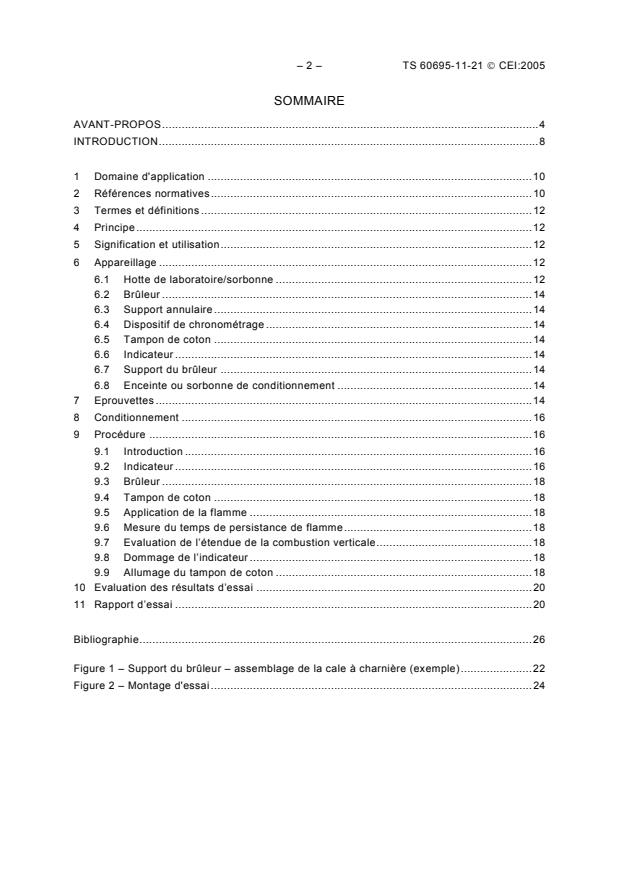
SOMMAIRE
AVANT-PROPOS.4
INTRODUCTION.8
1 Domaine d'application .10
2 Références normatives.10
3 Termes et définitions .12
4 Principe.12
5 Signification et utilisation.12
6 Appareillage .12
6.1 Hotte de laboratoire/sorbonne .12
6.2 Brûleur .14
6.3 Support annulaire.14
6.4 Dispositif de chronométrage .14
6.5 Tampon de coton .14
6.6 Indicateur .14
6.7 Support du brûleur .14
6.8 Enceinte ou sorbonne de conditionnement .14
7 Eprouvettes .14
8 Conditionnement .16
9 Procédure .16
9.1 Introduction .16
9.2 Indicateur .16
9.3 Brûleur .18
9.4 Tampon de coton .18
9.5 Application de la flamme .18
9.6 Mesure du temps de persistance de flamme.18
9.7 Evaluation de l’étendue de la combustion verticale.18
9.8 Dommage de l’indicateur .18
9.9 Allumage du tampon de coton .18
10 Evaluation des résultats d’essai .20
11 Rapport d’essai .20
Bibliographie.26
Figure 1 – Support du brûleur – assemblage de la cale à charnière (exemple).22
Figure 2 – Montage d'essai.24
TS 60695-11-21 IEC:2005 – 3 –
CONTENTS
FOREWORD.5
INTRODUCTION.9
1 Scope.11
2 Normative references .11
3 Terms and definitions .13
4 Principle .13
5 Significance and use .13
6 Apparatus.13
6.1 Laboratory/fumehood chamber .13
6.2 Burner .15
6.3 Ring stand.15
6.4 Timing device .15
6.5 Cotton pad .15
6.6 Indicator flag .15
6.7 Burner support .15
6.8 Conditioning room or chamber.15
7 Test specimens .15
8 Conditioning .17
9 Procedure .17
9.1 Introduction .17
9.2 Indicator flag .17
9.3 Burner .19
9.4 Cotton pad .19
9.5 Flame application .19
9.6 Measurement of flaming time.19
9.7 Evaluation of the extent of vertical burning .19
9.8 Indicator flag damage.19
9.9 Ignition of the cotton pad .19
10 Evaluation of test results .21
11 Test report.21
Bibliography.27
Figure 1 – Burner support – hinged wedge assembly (example).23
Figure 2 – Test arrangement.25
– 4 – TS 60695-11-21 CEI:2005
COMMISSION ÉLECTROTECHNIQUE INTERNATIONALE
____________
ESSAIS RELATIFS AUX RISQUES DU FEU –
Partie 11-21: Flammes d'essai –
Méthode d'essai à la flamme verticale de 500 W
pour matériaux tubulaires polymères
AVANT-PROPOS
1) La Commission Electrotechnique Internationale (CEI) est une organisation mondiale de normalisation
composée de l'ensemble des comités électrotechniques nationaux (Comités nationaux de la CEI). La CEI a
pour objet de favoriser la coopération internationale pour toutes les questions de normalisation dans les
domaines de l'électricité et de l'électronique. A cet effet, la CEI – entre autres activités – publie des Normes
internationales, des Spécifications techniques, des Rapports techniques, des Spécifications accessibles au
public (PAS) et des Guides (ci-après dénommés "Publication(s) de la CEI"). Leur élaboration est confiée à des
comités d'études, aux travaux desquels tout Comité national intéressé par le sujet traité peut participer. Les
organisations internationales, gouvernementales et non gouvernementales, en liaison avec la CEI, participent
également aux travaux. La CEI collabore étroitement avec l'Organisation Internationale de Normalisation (ISO),
selon des conditions fixées par accord entre les deux organisations.
2) Les décisions ou accords officiels de la CEI concernant les questions techniques représentent, dans la mesure
du possible, un accord international sur les sujets étudiés, étant donné que les Comités nationaux de la CEI
intéressés sont représentés dans chaque comité d’études.
3) Les Publications de la CEI se présentent sous la forme de recommandations internationales et sont agréées
comme telles par les Comités nationaux de la CEI. Tous les efforts raisonnables sont entrepris afin que la CEI
s'assure de l'exactitude du contenu technique de ses publications; la CEI ne peut pas être tenue responsable
de l'éventuelle mauvaise utilisation ou interprétation qui en est faite par un quelconque utilisateur final.
4) Dans le but d'encourager l'uniformité internationale, les Comités nationaux de la CEI s'engagent, dans toute la
mesure possible, à appliquer de façon transparente les Publications de la CEI dans leurs publications
nationales et régionales. Toutes divergences entre toutes Publications de la CEI et toutes publications
nationales ou régionales correspondantes doivent être indiquées en termes clairs dans ces dernières.
5) La CEI n’a prévu aucune procédure de marquage valant indication d’approbation et n'engage pas sa
responsabilité pour les équipements déclarés conformes à une de ses Publications.
6) Tous les utilisateurs doivent s'assurer qu'ils sont en possession de la dernière édition de cette publication.
7) Aucune responsabilité ne doit être imputée à la CEI, à ses administrateurs, employés, auxiliaires ou
mandataires, y compris ses experts particuliers et les membres de ses comités d'études et des Comités
nationaux de la CEI, pour tout préjudice causé en cas de dommages corporels et matériels, ou de tout autre
dommage de quelque nature que ce soit, directe ou indirecte, ou pour supporter les coûts (y compris les frais
de justice) et les dépenses découlant de la publication ou de l'utilisation de cette Publication de la CEI ou de
toute autre Publication de la CEI, ou au crédit qui lui est accordé.
8) L'attention est attirée sur les références normatives citées dans cette publication. L'utilisation de publications
référencées est obligatoire pour une application correcte de la présente publication.
9) L’attention est attirée sur le fait que certains des éléments de la présente Publication de la CEI peuvent faire
l’objet de droits de propriété intellectuelle ou de droits analogues. La CEI ne saurait être tenue pour
responsable de ne pas avoir identifié de tels droits de propriété et de ne pas avoir signalé leur existence.
La tâche principale des comités d’études de la CEI est l’élaboration des normes inter-
nationales. Exceptionnellement, un comité d’études peut proposer la publication d’une
spécification technique
• lorsqu’en dépit de maints efforts, l’accord requis ne peut être réalisé en faveur de la
publication d’une Norme internationale, ou
• lorsque le sujet en question est encore en cours de développement technique ou quand,
pour une raison quelconque, la possibilité d’un accord pour la publication d’une Norme
internationale peut être envisagée pour l’avenir mais pas dans l’immédiat.
Les spécifications techniques sont révisées dans les trois années qui suivent leur publication
pour décider si elles peuvent être transformées en Normes internationales.
TS 60695-11-21 IEC:2005 – 5 –
INTERNATIONAL ELECTROTECHNICAL COMMISSION
____________
FIRE HAZARD TESTING –
Part 11-21: Test flames –
500 W vertical flame test method
for tubular polymeric materials
FOREWORD
1) The International Electrotechnical Commission (IEC) is a worldwide organization for standardization comprising
all national electrotechnical committees (IEC National Committees). The object of IEC is to promote
international co-operation on all questions concerning standardization in the electrical and electronic fields. To
this end and in addition to other activities, IEC publishes International Standards, Technical Specifications,
Technical Reports, Publicly Available Specifications (PAS) and Guides (hereafter referred to as “IEC
Publication(s)”). Their preparation is entrusted to technical committees; any IEC National Committee interested
in the subject dealt with may participate in this preparatory work. International, governmental and non-
governmental organizations liaising with the IEC also participate in this preparation. IEC collaborates closely
with the International Organization for Standardization (ISO) in accordance with conditions determined by
agreement between the two organizations.
2) The formal decisions or agreements of IEC on technical matters express, as nearly as possible, an international
consensus of opinion on the relevant subjects since each technical committee has representation from all
interested IEC National Committees.
3) IEC Publications have the form of recommendations for international use and are accepted by IEC National
Committees in that sense. While all reasonable efforts are made to ensure that the technical content of IEC
Publications is accurate, IEC cannot be held responsible for the way in which they are used or for any
misinterpretation by any end user.
4) In order to promote international uniformity, IEC National Committees undertake to apply IEC Publications
transparently to the maximum extent possible in their national and regional publications. Any divergence
between any IEC Publication and the corresponding national or regional publication shall be clearly indicated in
the latter.
5) IEC provides no marking procedure to indicate its approval and cannot be rendered responsible for any
equipment declared to be in conformity with an IEC Publication.
6) All users should ensure that they have the latest edition of this publication.
7) No liability shall attach to IEC or its directors, employees, servants or agents including individual experts and
members of its technical committees and IEC National Committees for any personal injury, property damage or
other damage of any nature whatsoever, whether direct or indirect, or for costs (including legal fees) and
expenses arising out of the publication, use of, or reliance upon, this IEC Publication or any other IEC
Publications.
8) Attention is drawn to the Normative references cited in this publication. Use of the referenced publications is
indispensable for the correct application of this publication.
9) Attention is drawn to the possibility that some of the elements of this IEC Publication may be the subject of
patent rights. IEC shall not be held responsible for identifying any or all such patent rights.
The main task of IEC technical committees is to prepare International Standards. In
exceptional circumstances, a technical committee may propose the publication of a technical
specification when
• the required support cannot be obtained for the publication of an International Standard,
despite repeated efforts, or
• The subject is still under technical development or where, for any other reason, there is
the future but no immediate possibility of an agreement on an International Standard.
Technical specifications are subject to review within three years of publication to decide
whether they can be transformed into International Standards.
– 6 – TS 60695-11-21 CEI:2005
La CEI 60695-11-21, qui est une spécification technique, a été établie par le comité d'études
89 de la CEI: Essais relatifs aux risques du feu.
Elle a le statut de publication fondamentale de sécurité, conformément au Guide CEI 104 et
au Guide ISO/CEI 51.
Le texte de cette spécification technique est issu des documents suivants:
Projet d'enquête Rapport de vote
89/656/DTS 89/671A/RVC
Le rapport de vote indiqué dans le tableau ci-dessus donne toute information sur le vote ayant
abouti à l'approbation de cette spécification technique.
Cette publication a été rédigée selon les Directives ISO/CEI, Partie 2.
La série CEI 60695-11, sous le titre général Essais relatifs aux risques du feu, comprend les
parties suivantes:
Partie 11-2: Flammes d'essai – Flamme à prémélange de 1 kW nominal – Appareillage,
disposition d'essai de vérification et indications
Partie 11-3: Flammes d'essai – Flammes de 500 W – Appareillage et méthodes d'essai de
vérification
Partie 11-4: Flammes d'essai – Flamme de 50 W – Appareillage et méthodes d'essai de
vérification
Partie 11-5: Flammes d'essai – Méthode d'essai au brûleur-aiguille – Appareillage,
dispositif d'essai de vérification et lignes directrices
Partie 11-10: Flammes d'essai – Méthodes d'essai horizontale et verticale à la flamme de
50 W
Partie 11-20: Flammes d'essai – Méthodes d'essai à la flamme de 500 W
Partie 11-21: Flammes d'essai – Méthode d'essai à la flamme verticale de 500 W pour les
matériaux tubulaires polymères
Partie 11-30: Flammes d'essai – Historique et développement de 1979 à 1999
Partie 11-40: Flammes d'essai – Essais de confirmation – Guide
Le comité a décidé que le contenu de cette publication ne sera pas modifié avant la date de
maintenance indiquée sur le site web de la CEI sous «http://webstore.iec.ch» dans les
données relatives à la publication recherchée. A cette date, la publication sera
• transformée en Norme internationale,
• reconduite;
• supprimée;
• remplacée par une édition révisée, ou
• amendée.
TS 60695-11-21 IEC:2005 – 7 –
IEC 60695-11-21, which is a technical specification, has been prepared by IEC technical
committee 89: Fire hazard testing.
It has the status of a basic safety publication in accordance with IEC Guide 104 and ISO/IEC
Guide 51.
The text of this technical specification is based on the following documents:
Enquiry draft Report on voting
89/656/DTS 89/671A/RVC
Full information on the voting for the approval of this technical specification can be found in
the report on voting indicated in the above table.
This publication has been drafted in accordance with the ISO/IEC Directives, Part 2.
The IEC 60695-11 series, under the general title Fire hazard testing, consists of the following
parts:
Part 11-2: Test flames – 1 kW nominal pre-mixed flame – Apparatus, confirmatory test
arrangement and guidance
Part 11-3: Test flames – 500 W flames – Apparatus and confirmational test methods
Part 11-4: Test flames – 50 W flame – Apparatus and confirmational test method
Part 11-5: Test flames – Needle-flame test method – Apparatus, confirmatory test arrange-
ment and guidance
Part 11-10: Test flames – 50 W horizontal and vertical flame test methods
Part 11-20: Test flames – 500 W flame test methods
Part 11-21: Test flames – 500 W vertical flame test method for tubular polymeric materials
Part 11-30: Test flames – History and development from 1979 to 1999
Part 11-40: Test flames – Confirmatory tests – Guidance
The committee has decided that the contents of this publication will remain unchanged until
the maintenance result date indicated on the IEC web site under "http://webstore.iec.ch" in
the data related to the specific publication. At this date, the publication will be
• transformed into an International standard,
• reconfirmed,
• withdrawn,
• replaced by a revised edition, or
• amended.
– 8 – TS 60695-11-21 CEI:2005
INTRODUCTION
La meilleure méthode pour soumettre des produits électrotechniques aux essais au feu et en
évaluer les risques consiste à reproduire exactement les conditions qui apparaissent dans la
pratique. Dans la plupart des cas, cela n'est pas possible. En conséquence, pour des raisons
pratiques, les essais des produits électrotechniques, en ce qui concerne les risques du feu
sont réalisés au mieux en simulant d'aussi près que possible les effets qui se produisent
réellement dans la pratique.
Il convient que les parties d'un matériel électrotechnique qui peuvent être exposées à une
contrainte thermique excessive due à des effets électriques et dont la détérioration peut nuire
à la sécurité du matériel ne soient pas affectées d'une manière anormale par la chaleur et par
le feu engendrés à l'intérieur du matériel.
Des parties de matériau isolant ou autre matériau combustible susceptibles de propager des
flammes à l'intérieur du matériel peuvent être enflammées par des flammes produites par un
composant défaillant. Des flammes peuvent également se produire sous certaines conditions,
par exemple un courant de défaut passant sur une piste de cheminement, une surcharge de
composants ou de parties et de mauvais contacts; de telles flammes peuvent venir lécher des
parties combustibles dans leur voisinage.
Il convient que cette spécification technique soit utilisée pour mesurer et décrire les
propriétés des matériaux, des produits ou des assemblages en réponse à la chaleur et aux
flammes dans des conditions de laboratoire contrôlées et il convient de ne pas l'utiliser pour
décrire ou évaluer le risque du feu ou le risque d'incendie des matériaux, des produits ou des
assemblages dans des conditions de feu réelles. Toutefois, les résultats de cet essai peuvent
être utilisés comme éléments d'évaluation d'un risque d'incendie qui tient compte de tous les
facteurs qui sont pertinents pour une évaluation de risque d'incendie dans une utilisation
finale spécifique.
Cette spécification technique peut mettre en œuvre des matériaux, des opérations et des
matériels dangereux. Cette spécification technique ne prétend pas couvrir tous les problèmes
de sécurité liés à son utilisation. Il est de la responsabilité de l'utilisateur de cette
spécification technique d'établir des pratiques d'hygiène et de sécurité appropriées et de
déterminer l'applicabilité des limitations réglementaires avant utilisation.
TS 60695-11-21 IEC:2005 – 9 –
INTRODUCTION
The best method for testing electrotechnical products with regard to fire hazard is to duplicate
exactly the conditions occurring in practice. In most instances this is not possible.
Accordingly, for practical reasons, the testing of electrotechnical products with regard to fire
hazard is best conducted by simulating as closely as possible the actual effects occurring in
practice.
Parts of electrotechnical equipment which might be exposed to excessive thermal stress due
to electric effects, the deterioration of which might impair the safety of the equipment, should
not be unduly affected by heat and by fire generated within the equipment.
Parts of insulating material or of other combustible material which are liable to propagate
flames inside the equipment may be ignited by flames produced by a failing component.
Under certain conditions, for example a fault current flowing over a tracking path, overloading
of components or parts and bad connections, flames may also occur; such flames may
impinge upon combustible parts in the vicinity.
This technical specification should be used to measure and describe the properties of
materials, products, or assemblies in response to heat and flame under controlled laboratory
conditions and should not be used to describe or appraise the fire hazard or fire risk of
materials, products, or assemblies under actual fire conditions. However, results of this test
may be used as elements of a fire risk assessment which takes into account all of the factors
which are pertinent to an assessment of the fire hazard of a particular end use.
This technical specification may involve hazardous materials, operations, and equipment. This
technical specification does not purport to address all of the safety problems associated with
its use. It is the responsibility of the user of this technical specification to establish
appropriate safety and health practices and determine the applicability of regulatory
limitations prior to use.
– 10 – TS 60695-11-21 CEI:2005
ESSAIS RELATIFS AUX RISQUES DU FEU –
Partie 11-21: Flammes d'essai –
Méthode d'essai à la flamme verticale de 500 W
pour matériaux tubulaires polymères
1 Domaine d'application
La présente spécification technique décrit une procédure de laboratoire à petite échelle pour
déterminer les caractéristiques de combustion comparatives des matériaux polymères
tubulaires. Une flamme est appliquée à des éprouvettes maintenues en position verticale,
soutenues par un fil ou un mandrin. Après
...