

IEC TS 63019:2019
(Main)Photovoltaic power systems (PVPS) - Information model for availability
General Information
- Abstract
IEC TS 63019:2019 provides a framework from which the availability metrics of a PVPS can be derived and reported. It describes how data are categorized and defines generic information categories to which time can be assigned for a PVPS considering internal and external conditions based on fraction of time, system health, and condition by specifying the following:
- generic information categories of a PVPS considering availability and production.
- information category priority to discriminate between concurrent categories.
- entry and exit point for each information category to allocate designation of time.
The PVPS comprises all photovoltaic (PV) modules, inverters, DC and AC collection systems, grid interconnection equipment, the site, its infrastructure, and all functional service elements. Formulas in this document provide normative guidance for standardization. Beyond that, it is not the intention of this document to specify exactly how other undefined, time-based availability metrics shall be calculated. The annexes are examples and guiding principles for developing methods for calculation and estimation of availability metrics, subject to the knowledge and concurrence for use by the involved stakeholders. Estimates and calculations also have recommendations on how they are to be used as part of the informative function.
- Status
- Published
- Publication Date
- 08-May-2019
- Technical Committee
- TC 82 - Solar photovoltaic energy systems
- Drafting Committee
- WG 3 - TC 82/WG 3
- Current Stage
- PPUB - Publication issued
- Start Date
- 09-May-2019
- Completion Date
- 08-Apr-2019
Overview
IEC TS 63019:2019 - Photovoltaic power systems (PVPS) - provides an information model for availability of PV systems. The Technical Specification defines how time-based availability metrics are derived, categorized and reported for an entire PVPS (modules, inverters, DC/AC collection, grid interconnection, site infrastructure and functional services). It describes generic information categories, entry/exit rules and priorities for assigning time fractions to categories, and gives normative guidance (formulas) and informative annexes with examples and methods for estimating availability metrics.
Key topics
- Information categories for PVPS availability: Definitions such as operative, in service, full capability, partial capability, out of service, scheduled maintenance, forced outage, information unavailable and others to classify system state over time.
- Time-based availability model: Allocation of fraction-of-time and system health/condition to compute availability indicators.
- Information category priority: Rules to resolve concurrent events so time is assigned consistently.
- Entry and exit points: Criteria to allocate when a PVPS enters/exits an information category for accurate time accounting.
- Guidance (normative and informative): Normative formulas for standardization guidance; annexes provide examples, energy-based tracking, RAM definitions, verification scenarios and information management practices.
- Limitations and stakeholder use: The TS gives recommended approaches but does not mandate exact calculations for undefined, time-based metrics - encouraging stakeholder agreement on methods.
Applications
IEC TS 63019:2019 is practical for:
- Asset owners & operators using standardized availability reporting for O&M decision-making, performance contracts and warranty claims.
- Project developers & investors assessing reliability, expected uptime and lost production risk.
- O&M providers & data analysts implementing monitoring, diagnostics and availability dashboards.
- Regulators & system planners comparing plant availability and integration impacts.
Practical outputs include consistent availability reports, energy-weighted availability estimates, verification scenarios for outages, and improved asset management workflows.
Related standards
- IEC 61724 series (PV system performance monitoring) - referenced for energy and monitoring practices (see IEC 61724/61724‑1).
- Other IEC PV and RAM guidance - use in conjunction with IEC TS 63019:2019 for comprehensive monitoring, reliability and availability assessment.
IEC TS 63019:2019 helps standardize how PV availability is defined, measured and communicated - enabling clearer comparisons, better asset management and transparent reporting of PV system uptime and lost production.
Get Certified
Connect with accredited certification bodies for this standard

DNV
DNV is an independent assurance and risk management provider.

Lloyd's Register
Lloyd's Register is a global professional services organisation specialising in engineering and technology.
DNV Energy Systems
Energy and renewable energy certification.
Sponsored listings
Frequently Asked Questions
IEC TS 63019:2019 is a technical specification published by the International Electrotechnical Commission (IEC). Its full title is "Photovoltaic power systems (PVPS) - Information model for availability". This standard covers: IEC TS 63019:2019 provides a framework from which the availability metrics of a PVPS can be derived and reported. It describes how data are categorized and defines generic information categories to which time can be assigned for a PVPS considering internal and external conditions based on fraction of time, system health, and condition by specifying the following: - generic information categories of a PVPS considering availability and production. - information category priority to discriminate between concurrent categories. - entry and exit point for each information category to allocate designation of time. The PVPS comprises all photovoltaic (PV) modules, inverters, DC and AC collection systems, grid interconnection equipment, the site, its infrastructure, and all functional service elements. Formulas in this document provide normative guidance for standardization. Beyond that, it is not the intention of this document to specify exactly how other undefined, time-based availability metrics shall be calculated. The annexes are examples and guiding principles for developing methods for calculation and estimation of availability metrics, subject to the knowledge and concurrence for use by the involved stakeholders. Estimates and calculations also have recommendations on how they are to be used as part of the informative function.
IEC TS 63019:2019 provides a framework from which the availability metrics of a PVPS can be derived and reported. It describes how data are categorized and defines generic information categories to which time can be assigned for a PVPS considering internal and external conditions based on fraction of time, system health, and condition by specifying the following: - generic information categories of a PVPS considering availability and production. - information category priority to discriminate between concurrent categories. - entry and exit point for each information category to allocate designation of time. The PVPS comprises all photovoltaic (PV) modules, inverters, DC and AC collection systems, grid interconnection equipment, the site, its infrastructure, and all functional service elements. Formulas in this document provide normative guidance for standardization. Beyond that, it is not the intention of this document to specify exactly how other undefined, time-based availability metrics shall be calculated. The annexes are examples and guiding principles for developing methods for calculation and estimation of availability metrics, subject to the knowledge and concurrence for use by the involved stakeholders. Estimates and calculations also have recommendations on how they are to be used as part of the informative function.
IEC TS 63019:2019 is classified under the following ICS (International Classification for Standards) categories: 27.160 - Solar energy engineering. The ICS classification helps identify the subject area and facilitates finding related standards.
IEC TS 63019:2019 is available in PDF format for immediate download after purchase. The document can be added to your cart and obtained through the secure checkout process. Digital delivery ensures instant access to the complete standard document.
Standards Content (Sample)
IEC TS 63019 ®
Edition 1.0 2019-05
TECHNICAL
SPECIFICATION
colour
inside
Photovoltaic power systems (PVPS) – Information model for availability
All rights reserved. Unless otherwise specified, no part of this publication may be reproduced or utilized in any form
or by any means, electronic or mechanical, including photocopying and microfilm, without permission in writing from
either IEC or IEC's member National Committee in the country of the requester. If you have any questions about IEC
copyright or have an enquiry about obtaining additional rights to this publication, please contact the address below or
your local IEC member National Committee for further information.
IEC Central Office Tel.: +41 22 919 02 11
3, rue de Varembé info@iec.ch
CH-1211 Geneva 20 www.iec.ch
Switzerland
About the IEC
The International Electrotechnical Commission (IEC) is the leading global organization that prepares and publishes
International Standards for all electrical, electronic and related technologies.
About IEC publications
The technical content of IEC publications is kept under constant review by the IEC. Please make sure that you have the
latest edition, a corrigendum or an amendment might have been published.
IEC publications search - webstore.iec.ch/advsearchform Electropedia - www.electropedia.org
The advanced search enables to find IEC publications by a The world's leading online dictionary on electrotechnology,
variety of criteria (reference number, text, technical containing more than 22 000 terminological entries in English
committee,…). It also gives information on projects, replaced and French, with equivalent terms in 16 additional languages.
and withdrawn publications. Also known as the International Electrotechnical Vocabulary
(IEV) online.
IEC Just Published - webstore.iec.ch/justpublished
Stay up to date on all new IEC publications. Just Published IEC Glossary - std.iec.ch/glossary
details all new publications released. Available online and 67 000 electrotechnical terminology entries in English and
once a month by email. French extracted from the Terms and Definitions clause of
IEC publications issued since 2002. Some entries have been
IEC Customer Service Centre - webstore.iec.ch/csc collected from earlier publications of IEC TC 37, 77, 86 and
If you wish to give us your feedback on this publication or CISPR.
need further assistance, please contact the Customer Service
Centre: sales@iec.ch.
IEC TS 63019 ®
Edition 1.0 2019-05
TECHNICAL
SPECIFICATION
colour
inside
Photovoltaic power systems (PVPS) – Information model for availability
INTERNATIONAL
ELECTROTECHNICAL
COMMISSION
ICS 27.160 ISBN 978-2-8322-6638-0
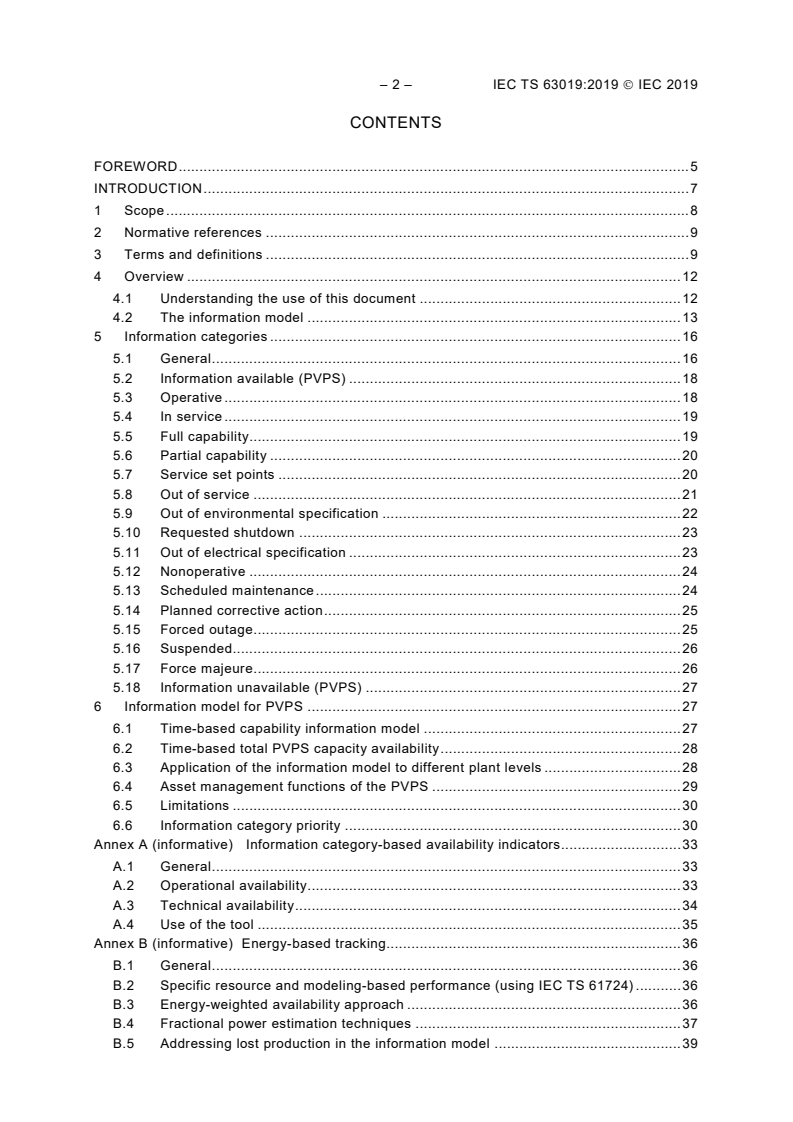
– 2 – IEC TS 63019:2019 IEC 2019
CONTENTS
FOREWORD . 5
INTRODUCTION . 7
1 Scope . 8
2 Normative references . 9
3 Terms and definitions . 9
4 Overview . 12
4.1 Understanding the use of this document . 12
4.2 The information model . 13
5 Information categories . 16
5.1 General . 16
5.2 Information available (PVPS) . 18
5.3 Operative . 18
5.4 In service . 19
5.5 Full capability . 19
5.6 Partial capability . 20
5.7 Service set points . 20
5.8 Out of service . 21
5.9 Out of environmental specification . 22
5.10 Requested shutdown . 23
5.11 Out of electrical specification . 23
5.12 Nonoperative . 24
5.13 Scheduled maintenance . 24
5.14 Planned corrective action . 25
5.15 Forced outage . 25
5.16 Suspended. 26
5.17 Force majeure . 26
5.18 Information unavailable (PVPS) . 27
6 Information model for PVPS . 27
6.1 Time-based capability information model . 27
6.2 Time-based total PVPS capacity availability . 28
6.3 Application of the information model to different plant levels . 28
6.4 Asset management functions of the PVPS . 29
6.5 Limitations . 30
6.6 Information category priority . 30
Annex A (informative) Information category-based availability indicators . 33
A.1 General . 33
A.2 Operational availability . 33
A.3 Technical availability . 34
A.4 Use of the tool . 35
Annex B (informative) Energy-based tracking. 36
B.1 General . 36
B.2 Specific resource and modeling-based performance (using IEC TS 61724) . 36
B.3 Energy-weighted availability approach . 36
B.4 Fractional power estimation techniques . 37
B.5 Addressing lost production in the information model . 39
Annex C (informative) Reliability, availability, maintainability (RAM)
definitions/formulas, availability/stakeholder types, data, and optional categories . 41
C.1 General . 41
C.2 RAM definitions and metrics applicable to forced and maintenance outages . 42
C.3 Stakeholders and types of availability . 42
C.4 Data . 44
C.5 Forced outage – optional categories . 45
C.5.1 General . 45
C.5.2 Response time (R) . 46
C.5.3 Diagnostic time (D) . 46
C.5.4 Logistic time (L) . 46
C.5.5 Repair time (F) . 47
C.5.6 Partial capability – optional category of degraded . 47
C.5.7 Partial capability – optional category of derated . 48
C.5.8 Partial capability – optional category of other. 49
Annex D (informative) Verification scenarios . 50
D.1 Grid outage . 50
D.1.1 Scenario description . 50
D.1.2 Analysis and conclusion . 50
D.2 Entry and exit points . 51
D.3 Inverter outages . 53
D.4 Inverter overtemperature outage . 54
D.4.1 General . 54
D.4.2 Assessment and conclusion . 54
D.5 Tracking system outage . 55
D.5.1 Scenario description . 55
D.5.2 Analysis and conclusion . 55
D.6 Information category priority . 56
D.6.1 General . 56
D.6.2 Assessment . 57
D.7 Verification scenario – Energy: Measured, expected, and lost . 57
D.7.1 Scenario description . 57
D.7.2 Assessment . 58
D.8 Spinning reserve equivalent . 60
D.9 Multiple aggregated systems . 61
D.9.1 Scenario . 61
D.9.2 Approach and methodology . 61
D.9.3 How is the energy calculated? . 61
D.9.4 Assessment . 61
D.10 Service set points operation . 61
D.10.1 General . 61
D.10.2 Scenario . 62
D.10.3 Assessment . 62
D.11 Information unavailable data . 62
D.11.1 General . 62
D.11.2 Scenario . 62
D.11.3 Conclusion . 63
D.12 Redundancy capable PVPS with reliability block diagram . 63
D.12.1 General . 63
– 4 – IEC TS 63019:2019 IEC 2019
D.12.2 Scenario . 64
D.12.3 Analysis . 64
D.13 Levels of monitoring . 65
D.13.1 General . 65
D.13.2 Scenario . 65
D.13.3 Assessment . 65
Annex E (informative) Information management practices . 66
E.1 General . 66
E.2 Masking . 66
E.3 Condition monitoring of components/subcomponents . 67
E.4 Monitoring . 68
E.5 Data with analysis is a powerful tool for understanding PV system
performance . 69
E.6 Recognizing that costs influence decisions throughout the Life Cycle . 71
Bibliography . 72
Figure 1 – Data stakeholders for a PVPS . 7
Figure 2 – PVPS component-to-revenue path . 13
Figure 3 – Process for understanding the use of this document . 15
Figure 4 – PVPS plant levels . 29
Figure B.1 – RBD of a PVPS . 38
Figure C.1 – Typical flow time for failure/correction . 45
Figure D.1 – RBD of PVPS with multiple outages . 52
Figure D.2 – Redundancy capable PVPS RDB . 64
Table 1 – Stakeholder roles and objectives for reliability and maintenance data . 8
Table 2 – Information category overview for a PVPS . 17
Table 3 – Information category priority for PVPS . 31
Table A.1 – Allocation to information categories. 35
Table B.1 – Information categories and additional layers of measured, expected, and
lost production . 39
Table C.1 – Reliability metrics description. 44
Table D.1 – Verification scenarios – grid event . 50
Table D.2 – Verification scenarios – grid/electrical network aspects . 51
Table D.3 – Verification scenarios – inverter outage . 53
Table D.4 – Inverter overtemperature outage . 54
Table D.5 – Tracking system outage . 56
Table D.6 – Information category priority . 57
Table D.7 – Combined performance and availability . 58
Table D.8 – Key metrics . 58
Table D.9 – Measured, expected, and lost . 59
Table D.10 – Spinning reserve . 60
Table D.11 – Redundancy capable PVPS . 64
Table E.1 – Monitoring system classification and suggested applications (IEC 61724-1) . 68
INTERNATIONAL ELECTROTECHNICAL COMMISSION
____________
PHOTOVOLTAIC POWER SYSTEMS (PVPS) –
INFORMATION MODEL FOR AVAILABILITY
FOREWORD
1) The International Electrotechnical Commission (IEC) is a worldwide organization for standardization comprising
all national electrotechnical committees (IEC National Committees). The object of IEC is to promote
international co-operation on all questions concerning standardization in the electrical and electronic fields. To
this end and in addition to other activities, IEC publishes International Standards, Technical Specifications,
Technical Reports, Publicly Available Specifications (PAS) and Guides (hereafter referred to as "IEC
Publication(s)"). Their preparation is entrusted to technical committees; any IEC National Committee interested
in the subject dealt with may participate in this preparatory work. International, governmental and non-
governmental organizations liaising with the IEC also participate in this preparation. IEC collaborates closely
with the International Organization for Standardization (ISO) in accordance with conditions determined by
agreement between the two organizations.
2) The formal decisions or agreements of IEC on technical matters express, as nearly as possible, an international
consensus of opinion on the relevant subjects since each technical committee has representation from all
interested IEC National Committees.
3) IEC Publications have the form of recommendations for international use and are accepted by IEC National
Committees in that sense. While all reasonable efforts are made to ensure that the technical content of IEC
Publications is accurate, IEC cannot be held responsible for the way in which they are used or for any
misinterpretation by any end user.
4) In order to promote international uniformity, IEC National Committees undertake to apply IEC Publications
transparently to the maximum extent possible in their national and regional publications. Any divergence
between any IEC Publication and the corresponding national or regional publication shall be clearly indicated in
the latter.
5) IEC itself does not provide any attestation of conformity. Independent certification bodies provide conformity
assessment services and, in some areas, access to IEC marks of conformity. IEC is not responsible for any
services carried out by independent certification bodies.
6) All users should ensure that they have the latest edition of this publication.
7) No liability shall attach to IEC or its directors, employees, servants or agents including individual experts and
members of its technical committees and IEC National Committees for any personal injury, property damage or
other damage of any nature whatsoever, whether direct or indirect, or for costs (including legal fees) and
expenses arising out of the publication, use of, or reliance upon, this IEC Publication or any other IEC
Publications.
8) Attention is drawn to the Normative references cited in this publication. Use of the referenced publications is
indispensable for the correct application of this publication.
9) Attention is drawn to the possibility that some of the elements of this IEC Publication may be the subject of
patent rights. IEC shall not be held responsible for identifying any or all such patent rights.
The main task of IEC technical committees is to prepare International Standards. In
exceptional circumstances, a technical committee may propose the publication of a Technical
Specification when
• the required support cannot be obtained for the publication of an International Standard,
despite repeated efforts, or
• the subject is still under technical development or where, for any other reason, there is the
future but no immediate possibility of an agreement on an International Standard.
Technical Specifications are subject to review within three years of publication to decide
whether they can be transformed into International Standards.
IEC TS 63019, which is a Technical Specification, has been prepared by IEC technical
committee 82: Solar photovoltaic energy systems.
– 6 – IEC TS 63019:2019 IEC 2019
The text of this International Standard is based on the following documents:
DTS Report on voting
82/1447/DTS 82/1505A/RVDTS
Full information on the voting for the approval of this Technical Specification can be found in
the report on voting indicated in the above table.
This document has been drafted in accordance with the ISO/IEC Directives, Part 2.
Information model categories are written in capital letters.
The committee has decided that the contents of this document will remain unchanged until the
stability date indicated on the IEC website under "http://webstore.iec.ch" in the data related to
the specific document. At this date, the document will be
• transformed into an International standard,
• reconfirmed,
• withdrawn,
• replaced by a revised edition, or
• amended.
A bilingual version of this publication may be issued at a later date.
IMPORTANT – The “colour inside” logo on the cover page of this publication indicates
that it contains colours which are considered to be useful for the correct understanding
of its contents. Users should therefore print this publication using a colour printer.
INTRODUCTION
This technical specification (TS) defines a common basis for the exchange of information on
photovoltaic power system (PVPS) availability metrics among owners, utilities, lenders,
operators, manufacturers, engineer/procure/construction firms, specifiers/designers,
consultants, regulatory bodies, certification bodies, insurance companies, and other
stakeholders. From this diverse group of stakeholders, external and internal interfaces arise
in the operation and delivery of power. Although these are mostly power- and energy-related,
some are informational or for power system control. The intention is for information exchange
on capability- and energy-related data to form a nucleus for separate information needed by
stakeholders, as illustrated in Figure 1.
It identifies external and internal elements related to the capability, health, and condition of
components, subsystems, and the system itself, as well as energy production, plant operation,
and asset management, which also benefit from a defined set of terms. This is achieved by
providing an information model specifying how (PVPS) time designations shall be assigned by
information categories. An information model facilitates how the unavailability of time of
components, subsystems, and systems, as well as the lost power and other capabilities affect
the PVPS. The ability to estimate the resulting lost energy and/or loss of PVPS capability
forms the basis for how to allocate time for reporting availability metrics or, more directly,
unavailability.
Figure 1 – Data stakeholders for a PVPS
– 8 – IEC TS 63019:2019 IEC 2019
PHOTOVOLTAIC POWER SYSTEMS (PVPS) –
INFORMATION MODEL FOR AVAILABILITY
1 Scope
A common basis of understanding results from defined metrics that can be useful to the
stakeholders, populated by data collected in the operation of the PVPS:
a) To provide a standarized approach to characterize availablity and unavailablity for a
PVPS.
b) To provide standard methodologies for determining the appropriate forms of availability of
the PVPS during varying time periods, including real-time capability assessment or longer,
for reporting availablity metrics to stakeholders.
Table 1 – Stakeholder roles and objectives for reliability and maintenance data
Roles Objective
Owner Decision support for investments
Operator Reporting performance indicators
Determining availability and weaknesses
Identifying maintenance strategies
Service provider Maintenance optimization
Optimizing keeping stock of spare parts
Original equipment manufacturers/ Design optimization
supplier
Financier/insurer Risk assessment
Grid operator Highly reliable and stable bulk power system
Source: International Energy Agency (IEA)
This document provides a framework from which the availability metrics of a PVPS can be
derived and reported. It describes how data are categorized and defines generic information
categories to which time can be assigned for a PVPS considering internal and external
conditions based on fraction of time, system health, and condition by specifying the following:
• generic information categories of a PVPS considering availability and production.
• information category priority to discriminate between concurrent categories.
• entry and exit point for each information category to allocate designation of time.
The PVPS comprises all photovoltaic (PV) modules, inverters, DC and AC collection systems,
grid interconnection equipment, the site, its infrastructure, and all functional service elements.
This is further explained in 6.3 and 6.4.
Formulas in this document provide normative guidance for standardization. Beyond that, it is
not the intention of this document to specify exactly how other undefined, time-based
availability metrics shall be calculated. The annexes are examples and guiding principles for
developing methods for calculation and estimation of availability metrics, subject to the
knowledge and concurrence for use by the involved stakeholders. Estimates and calculations
also have recommendations on how they are to be used as part of the informative function.
It is not within the scope of this document to determine the method of information acquisition.
Relevant IEC documents on data collection and information acquisition are included in the
following normative references. IEC 61724-1 has requirements and IEC TS 61724-3:2016,
6.2.5, specifically identifies measured data on this topic.
Data generated during the operation of a PVPS are valuable, establishing who owns the
monitoring data and who will have access to the data and for what purpose should be
established. Different stakeholders will have different needs, as summarized in Table 1 (IEA).
In Annex E, the monitoring systems are addressed in greater detail.
Availability metrics cannot be derived without important outage information. Questions can
require the PVPS operation to properly collect the requisite data, such as what equipment or
portion of the plant is failing, how long, how often, and how much energy is being lost and
categorized by the information model. Asset management questions include the source of the
outage (i.e., Whose clock is it on? Was the outage due to internal or external forces? What
power and energy was generated? And, what was expected?).
2 Normative references
The following documents are referred to in the text in such a way that some or all of their
content constitutes requirements of this document. For dated references, only the edition
cited applies. For undated references, the latest edition of the referenced document (including
any amendments) applies.
IEC TS 61724-3:2016, Photovoltaic system performance – Part 3: Energy evaluation method
IEEE Std 762™-2006, IEEE Standard definitions for use in reporting electric generating unit
reliability, availability, and productivity
3 Terms and definitions
For the purposes of this document, the following terms and definitions apply.
The International Organization for Standardization (ISO) and IEC maintain terminological
databases for use in standardization at the following addresses:
• IEC Electropedia: available at http://www.electropedia.org/
• ISO online browsing platform: available at http://www.iso.org/obp
3.1
availability
where the PVPS, a subsystem, or a component is capable of providing service, regardless of
whether it is actually in service and regardless of the capacity level that can be provided
Note 1 to entry: Specific definitions and characterizations are provided on availability and related terms
throughout the annexes.
[SOURCE: IEEE 762:2006, 4.1.1, modified – Expansion of the term "unit" to more general
applications for PVPS, subsystems and components.]
3.2
capability
degree to which the component, system, or subsystem is operative and functioning according
to design specifications and control logic with no technical restrictions or limitations beyond
the ones included in the specifications
– 10 – IEC TS 63019:2019 IEC 2019
3.3
constrained operation
mode of operation of a PVPS in which the outputs of all inverters are limited by the capability
of the equipment rather than by the output from the PV array
[SOURCE: IEC TS 61724-2:2016, 3.1, modified – Definition tailored to the case of PVPS and
references to DC and AC ratings omitted.]
3.4
curtailed operation
mode of operation of a PVPS in which the output is limited for an external reason, e.g.,
inability of the local grid to receive the power per contractual agreement
3.5
degradation
decrease in equipment operating characteristics or ability to perform due to physical- or
chemical-related reduction in performance
3.6
derating
redefinition of capability due to external commands or constraints
3.7
downtime
total time that the equipment is not capable of operating per specification when it would
otherwise be expected to do so
3.8
energy availability
energy generation of a PV system that is calculated with the same assumptions as those used
in the predicted energy model using actual weather data collected at the site during operation
of the system for the year in question
3.9
energy unavailability
metric that quantifies the energy lost when the system is not operating (as judged by an
automatic indication of functionality, such as the inverter status flag indicating that the inverter
is actively converting DC to AC electricity or not)
[SOURCE: IEC TS 61724-3:2016, 3.2. modified – The second sentence of the definition, on
energy availability has been omitted, along with the note to entry.]
3.10
expected energy
energy of a PVPS that is calculated with the same specific performance model or approved
equal with same assumptions, losses, and formulas as those used in the predicted energy
model using actual weather data collected at the site during operation of the system (for the
period in question)
[SOURCE: IEC TS 61724-3:2016, 3.5, modified – inclusion of assumptions, losses, and
formulas if the original model is not readily available; deletion of Notes 1 and 2 to entry.]
3.11
failure
loss of ability to perform as required
[SOURCE: IEC 60050-192:2015, 192-03-01, modified – The domain and Notes 1 to 3 to entry
have been omitted.]
3.12
masking
PVPS condition and situation where unidentified and/or not easily discernible deficiencies
cause performance to diminish despite the appearance that the PVPS is operating as it was
designed to operate
3.13
PVPS AC capacity
rated output of a PVPS, or, alternatively, its contractually obligated maximum, under specific
designated conditions
3.14
photovoltaic power system
PVPS
electric power generating system, which uses the PV effect to convert solar power into
electricity
3.15
rating
set of rated values and operating conditions
[SOURCE: IEC 60050-151:2001, 151-16-11]
3.16
reliability
probability that an item (component, assembly, or system) can perform its intended function
for a specified interval under stated conditions
3.17
service
provision delivered by the PVPS
3.18
system
composite of equipment, skills, and techniques capable of performing or supporting an
operational role or both
3.19
time
fundamental element used in developing the concept of availability, also used in many
measures of reliability and maintainability (for unavailability)
3.20
unavailability
operational state when the equipment is not capable of operation because of operational or
equipment failures, external restrictions, testing, work being performed, or some adverse
condition
[SOURCE: IEEE 762:2006, 4.1.2, modified – use of the term "equipment" rather than "unit".]
3.21
uptime
amount of time that the system or component is operating during a defined period of time
Note 1 to entry: Other and more specific definitions are contained in the information categories as well as the
annexes. Reliability, availability, maintainability (RAM) metrics have many specified availability definitions based
on specific applications and are further explained in Annex C.
– 12 – IEC TS 63019:2019 IEC 2019
4 Overview
4.1 Understanding the use of this document
This document defines generic terms of PV systems and environmental constraints in
describing PVPS operation and availabilities, restoration, time, and optional energy
accounting criteria for operation and maintenance (O&M) and asset management. This
document defines terminology and generic terms for reporting availability measurements. A
PVPS includes all equipment up to the point of common coupling (interconnection point) to a
grid or network that is buying the energy produced; however, PVPS availability can and often
is affected by the grid and grid quality. Measurements are concerned with units of time
affected; involved components, systems, and subsystems; and site and PVPS O&M.
Unavailability measurements are also instrumental for measurement and/or estimation
techniques for determining PVPS capabilities or, more specifically, capability loss.
The conditions – environmental and other site aspects – are considered for reporting the
station condition and the impact those conditions have on the PVPS, including subsystems
and components. Environmental aspects include solar irradiance and other weather and
location-specific conditions at the site. System operating constraints due to differential site or
as-built characteristics, which might affect or eventually affect energy system performance
(typically energy production), are included in the energy calculus (e.g., availability model and
energy reporting). This document defines terms for reporting fundamental availability metrics.
Formulas and application methods are included in Clause 6 and Annex A and Annex B. The
categories can apply to the whole system (with the grid interface also affecting it) or to
subsystems and components, wherever the outages or reduced capability occur. It is
observed that the more robust and granular data systems are, the better the knowledge of the
issues affecting capabilities.
More generally, although this document is written to be applied to utility-scale PVPS,
stakeholders will find that many of the document's elements have application to smaller
systems, subsystems, or components. Residential and small commercial systems will also
need enough data collection and maintenance logs in their operational phases to determine
and document necessary uptime metrics and who should be receiving the data.
Multiple aspects of PVPS availability depend on the system quality and characteristics,
system health, condition, and operational states. Therefore, it is essential to have clear
knowledge and awareness of the operating and outage status of the power system's
components. This is important for O&M and reliability as well as for financial and insurance
purposes. As such, the data are collected for use. Performance, environmental, failure and
outage, time-based O&M, and electrical parameters are included in the types of data that may
be included in various aspects of the PVPS availability assessments. Levels of systems and
consequential data needs are described in the informative annexes. Information management
is addressed specifically in Annex E.
Night-time generation shutdown is not expected by definition; thus, PVPS cannot provide
power except for those that include storage and are capable of providing night-time services.
A similar definitional clarification – for example, a PVPS not operating because the array is
covered in snow – is in an out-of-environmental specification state even though the PVPS
components are fully functional and available. The information model presented in the
document is designed to be useful in defining boundaries to facilitate contractual division of
responsibilities.
The availability of the total sum of the system, subsystems, and components affects the
performance of the PVPS. Typically, revenues depend on the energy delivered, and that
energy depends on the availability. The proper functioning of the components is a function of
the detailed design specifications and the O&M employed. Tracking downtime is a tool for
asset management and reliability of the system. Figure 2 illustrates this interrelationship.
Figure 2 – PVPS component-to-revenue path
Figure 2 presents a logical consequence of reduced capability impacting energy production.
The energy production will be c metered, and, in addition, the energy flow may generally be
monitored throughout the PVPS, as specified in the design of the monitoring systems. This
logical balance between performance (energy) and availability (PVPS physical condition on a
time basis) demonstrates the need to measure both in order to facilitate the assessment of
required PVPS functions.
It is important to clarify the relationship between this document and the IEC 61724 series.
Both address metrics of PVPS performance and the impact of reductions. IEC TS 61724-3
carefully defines energy unavailability so that the stakeholders can determine the losses in
performance (according to the In-Service Energy Performance Index) separate from the
losses caused by energy unavailability. This will be further explained after the process of
using the information model to handle the granularity of component health and condition
(Figure 2) is applied to lost capacity and energy. The complementary nature of this document
with the IEC 61724 series is characterized in Annex D in verification scenario Clause D.7 –
Energy: measured, expected, and lost.
Assessments of required PVPS functions are desirable because the IEC Renewable Energy
(IECRE) system addresses certification requirements of PVPSs, and the mandatory reporting
requirements of this document are candidates for IECRE procedures. This document is
intended to facilitate application in multiple ways. The first is to provide consistency between
definitions in measurements and reporting. The second is to support certification requirements
that may be specified.
Mandatory information categories defined in the document are written in capital letters. The
designation of mandatory applies to data collection but not necessarily the specific data
reported because that is determined by the stakeholders' needs.
4.2 The information model
With restatement of the fundamental definitions given in 3.1 and 3.20, the information model
follows logically in an expansion of the specific categories to be used in this document.
The "available state" is when a unit can provide service per specification regardless of
whether it is in service and regardless of the capacity level and other capabilities that can be
provided (based on IEEE 762, 4.1.1).
Equipment is in an "unavailable state" when the equipment is not capable of operation to
specification due to equipment failures, external restrictions, testing, maintenance, or other
plant work being performed or some adverse condition. The unavailable state persists until
the unit is made available for operation by being synchronized to the system in service state
(based on IEEE 762, 4.1.2).
– 14 – IEC TS 63019:2019 IEC 2019
These two definitions are fundamental for addressing the availability metrics described in this
document. First, the state of being "available" recognizes that even while available there may
be degrees of loss of the service capability due to internal and external elements. Second,
there may also be customer contractual or power grid reasons for why operation is reduced or
not allowed even though the system is capable of providing service. This document addresses
multiple definitions of availability, including the design, O&M operator, power purchase
agreement, and grid/contractual requirements, which are later clarified by formulas.
Even if the equipment or units are available, a parallel construct is evident wherein all uptime
and downtime states are to be handled similar
...