

IEC 61938:2018
(Main)Multimedia systems - Guide to the recommended characteristics of analogue interfaces to achieve interoperability (GMT)
General Information
- Abstract
IEC 61938:2018 gives guidance on current practice for the characteristics of multimedia analogue interfaces to achieve interoperability between equipment from different manufacturers. It is not a performance standard. Recommendations for interfaces for equipment used in vehicles, and for analogue video interfaces for broadcast and similar equipment, are not given. Refer to IEC 60958 for the interconnection of digital signals. This third edition cancels and replaces the second edition published in 2013. This edition constitutes a technical revision. This edition includes the following significant technical changes with respect to the previous edition:
a) electric tolerance is standardized;
b) recommended value of output source impedance is adjusted;
c) value of 6 Ohms is additionally recommended to impedance-defined loudspeaker systems;
d) values in each table are chosen with respect to the state of the art and representative of best practice in industry.
- Status
- Published
- Publication Date
- 11-Jan-2018
- Technical Committee
- TA 20 - Analogue and digital audio
- Drafting Committee
- MT 61938 - TC 100/MT 61938
- Current Stage
- PPUB - Publication issued
- Start Date
- 12-Jan-2018
- Completion Date
- 19-Dec-2017
Buy Documents
IEC 61938:2018 - Multimedia systems - Guide to the recommended characteristics of analogue interfaces to achieve interoperability (GMT) Released:1/12/2018
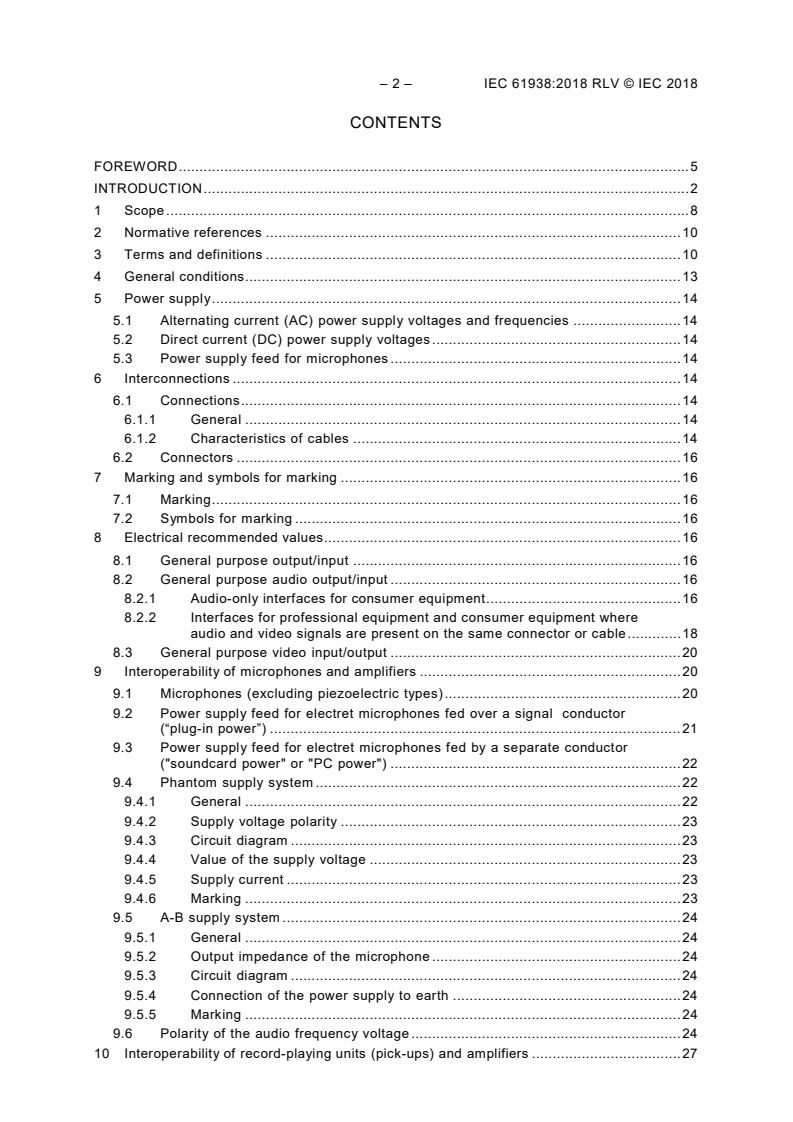
IEC 61938:2018 RLV - Multimedia systems - Guide to the recommended characteristics of analogue interfaces to achieve interoperability (GMT) Released:1/12/2018
IEC 61938:2018 - Multimedia systems - Guide to the recommended characteristics of analogue interfaces to achieve interoperability (GMT) Released:1/12/2018
Overview
IEC 61938:2018 - "Multimedia systems - Guide to the recommended characteristics of analogue interfaces to achieve interoperability" - is an IEC technical guide that provides recommended characteristics for analogue multimedia interfaces so equipment from different manufacturers can interoperate. It is a guidance document (not a performance standard) and covers recommended electrical values, connection practices and interface characteristics for audio and general multimedia analogue interconnections. The third edition (2018) cancels and replaces the 2013 edition and introduces standardized electric tolerances, adjusted output source impedance recommendations and an added 6 Ω recommendation for impedance‑defined loudspeaker systems.
Key technical topics and requirements
- Scope and exclusions: Guidance applies to multimedia analogue interfaces but excludes specific recommendations for vehicle equipment and analogue video interfaces for broadcast and similar professional broadcast equipment. For digital interconnections see IEC 60958.
- Power supply: Recommended AC and DC supply voltages and tolerances; guidance for microphone powering methods (plug‑in power, soundcard power, phantom power, A‑B supply).
- Interconnections and connectors: Cable characteristics, pairing and screening; connector practice to support reliable analogue signal transfer and interoperability.
- Electrical recommended values: General purpose audio, video and signal values presented in industry‑oriented tables (audio-only consumer, professional audio, video).
- Microphones, amplifiers and headphones: Recommended values and interoperability practices including phantom power requirements, polarities, output/input impedances and recommended values for portable and stationary headphone applications.
- Loudspeakers and amplifiers: Recommendations for single unit loudspeakers, impedance‑defined and constant voltage systems; voltage/power interoperability guidance.
- Tables and diagrams: Practical tables for values (power, impedances, recommended levels) and circuit examples for microphone power variants.
- Marking and symbols: Recommended marking practices for interfaces and power supplies.
Practical applications and who uses this standard
IEC 61938 is used by:
- Audio/video equipment manufacturers designing analogue inputs/outputs to ensure cross‑brand compatibility.
- System integrators and installers specifying interconnects and powering methods for multimedia installations.
- Product designers and electrical engineers setting connector, impedance and power‑supply characteristics.
- Test laboratories and quality assurance teams verifying that analogue interfaces conform to recommended interoperability characteristics.
- Audio professionals (recording, sound reinforcement) and specification writers wanting industry best‑practice reference values.
Practical benefits include fewer compatibility issues between devices, clearer design targets for analogue interfaces, and harmonized values for microphone powering, impedance matching and connector wiring.
Related standards / references
- IEC 60958 - for interconnection of digital signals (recommended cross‑reference in this guide).
- Other IEC publications referenced for terminology and related multimedia/electrotechnical practices.
Keywords: IEC 61938, analogue interfaces, multimedia systems, interoperability, audio interfaces, phantom power, microphone powering, loudspeaker impedance, connector standards.
Relations
- Effective Date
- 05-Sep-2023
Buy Documents
IEC 61938:2018 - Multimedia systems - Guide to the recommended characteristics of analogue interfaces to achieve interoperability (GMT) Released:1/12/2018
IEC 61938:2018 RLV - Multimedia systems - Guide to the recommended characteristics of analogue interfaces to achieve interoperability (GMT) Released:1/12/2018
IEC 61938:2018 - Multimedia systems - Guide to the recommended characteristics of analogue interfaces to achieve interoperability (GMT) Released:1/12/2018
Get Certified
Connect with accredited certification bodies for this standard

BSI Group
BSI (British Standards Institution) is the business standards company that helps organizations make excellence a habit.

NYCE
Mexican standards and certification body.

ANCE
Mexican certification and testing association.
Sponsored listings
Frequently Asked Questions
IEC 61938:2018 is a standard published by the International Electrotechnical Commission (IEC). Its full title is "Multimedia systems - Guide to the recommended characteristics of analogue interfaces to achieve interoperability (GMT)". This standard covers: IEC 61938:2018 gives guidance on current practice for the characteristics of multimedia analogue interfaces to achieve interoperability between equipment from different manufacturers. It is not a performance standard. Recommendations for interfaces for equipment used in vehicles, and for analogue video interfaces for broadcast and similar equipment, are not given. Refer to IEC 60958 for the interconnection of digital signals. This third edition cancels and replaces the second edition published in 2013. This edition constitutes a technical revision. This edition includes the following significant technical changes with respect to the previous edition: a) electric tolerance is standardized; b) recommended value of output source impedance is adjusted; c) value of 6 Ohms is additionally recommended to impedance-defined loudspeaker systems; d) values in each table are chosen with respect to the state of the art and representative of best practice in industry.
IEC 61938:2018 gives guidance on current practice for the characteristics of multimedia analogue interfaces to achieve interoperability between equipment from different manufacturers. It is not a performance standard. Recommendations for interfaces for equipment used in vehicles, and for analogue video interfaces for broadcast and similar equipment, are not given. Refer to IEC 60958 for the interconnection of digital signals. This third edition cancels and replaces the second edition published in 2013. This edition constitutes a technical revision. This edition includes the following significant technical changes with respect to the previous edition: a) electric tolerance is standardized; b) recommended value of output source impedance is adjusted; c) value of 6 Ohms is additionally recommended to impedance-defined loudspeaker systems; d) values in each table are chosen with respect to the state of the art and representative of best practice in industry.
IEC 61938:2018 is classified under the following ICS (International Classification for Standards) categories: 33.160.01 - Audio, video and audiovisual systems in general; 35.200 - Interface and interconnection equipment. The ICS classification helps identify the subject area and facilitates finding related standards.
IEC 61938:2018 has the following relationships with other standards: It is inter standard links to IEC 61938:2013. Understanding these relationships helps ensure you are using the most current and applicable version of the standard.
IEC 61938:2018 is available in PDF format for immediate download after purchase. The document can be added to your cart and obtained through the secure checkout process. Digital delivery ensures instant access to the complete standard document.
Standards Content (Sample)
IEC 61938 ®
Edition 3.0 2018-01
INTERNATIONAL
STANDARD
Multimedia systems –
Guide to the recommended characteristics of analogue interfaces to achieve
interoperability
All rights reserved. Unless otherwise specified, no part of this publication may be reproduced or utilized in any form
or by any means, electronic or mechanical, including photocopying and microfilm, without permission in writing from
either IEC or IEC's member National Committee in the country of the requester. If you have any questions about IEC
copyright or have an enquiry about obtaining additional rights to this publication, please contact the address below or
your local IEC member National Committee for further information.
IEC Central Office Tel.: +41 22 919 02 11
3, rue de Varembé Fax: +41 22 919 03 00
CH-1211 Geneva 20 info@iec.ch
Switzerland www.iec.ch
About the IEC
The International Electrotechnical Commission (IEC) is the leading global organization that prepares and publishes
International Standards for all electrical, electronic and related technologies.
About IEC publications
The technical content of IEC publications is kept under constant review by the IEC. Please make sure that you have the
latest edition, a corrigenda or an amendment might have been published.
IEC Catalogue - webstore.iec.ch/catalogue Electropedia - www.electropedia.org
The stand-alone application for consulting the entire The world's leading online dictionary of electronic and
bibliographical information on IEC International Standards, electrical terms containing 20 000 terms and definitions in
Technical Specifications, Technical Reports and other English and French, with equivalent terms in 16 additional
documents. Available for PC, Mac OS, Android Tablets and languages. Also known as the International Electrotechnical
iPad. Vocabulary (IEV) online.
IEC publications search - www.iec.ch/searchpub IEC Glossary - std.iec.ch/glossary
The advanced search enables to find IEC publications by a 65 000 electrotechnical terminology entries in English and
variety of criteria (reference number, text, technical French extracted from the Terms and Definitions clause of
committee,…). It also gives information on projects, replaced IEC publications issued since 2002. Some entries have been
and withdrawn publications. collected from earlier publications of IEC TC 37, 77, 86 and
CISPR.
IEC Just Published - webstore.iec.ch/justpublished
Stay up to date on all new IEC publications. Just Published IEC Customer Service Centre - webstore.iec.ch/csc
details all new publications released. Available online and If you wish to give us your feedback on this publication or
also once a month by email. need further assistance, please contact the Customer Service
Centre: csc@iec.ch.
IEC 61938 ®
Edition 3.0 2018-01
INTERNATIONAL
STANDARD
Multimedia systems –
Guide to the recommended characteristics of analogue interfaces to achieve
interoperability
INTERNATIONAL
ELECTROTECHNICAL
COMMISSION
ICS 33.160.01, 35.200 ISBN 978-2-8322-5056-3
– 2 – IEC 61938:2018 © IEC 2018
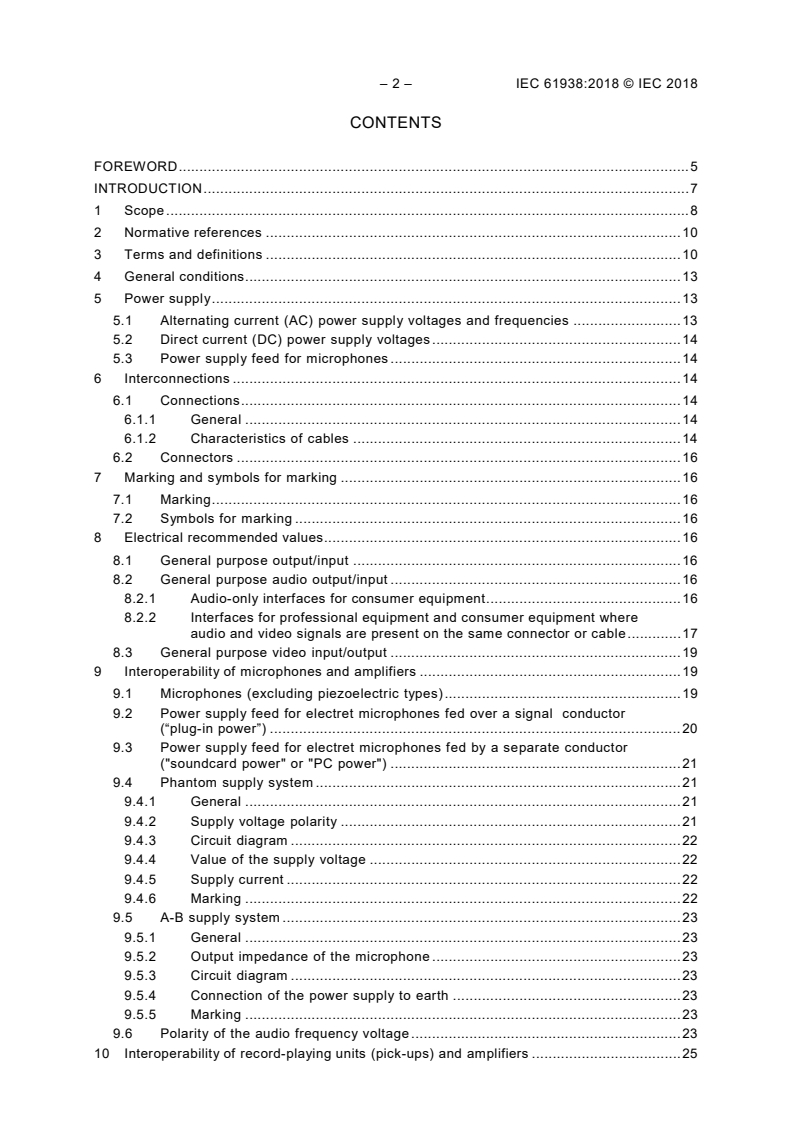
CONTENTS
FOREWORD . 5
INTRODUCTION . 7
1 Scope . 8
2 Normative references . 10
3 Terms and definitions . 10
4 General conditions . 13
5 Power supply . 13
5.1 Alternating current (AC) power supply voltages and frequencies . 13
5.2 Direct current (DC) power supply voltages . 14
5.3 Power supply feed for microphones . 14
6 Interconnections . 14
6.1 Connections . 14
6.1.1 General . 14
6.1.2 Characteristics of cables . 14
6.2 Connectors . 16
7 Marking and symbols for marking . 16
7.1 Marking . 16
7.2 Symbols for marking . 16
8 Electrical recommended values . 16
8.1 General purpose output/input . 16
8.2 General purpose audio output/input . 16
8.2.1 Audio-only interfaces for consumer equipment . 16
8.2.2 Interfaces for professional equipment and consumer equipment where
audio and video signals are present on the same connector or cable . 17
8.3 General purpose video input/output . 19
9 Interoperability of microphones and amplifiers . 19
9.1 Microphones (excluding piezoelectric types) . 19
9.2 Power supply feed for electret microphones fed over a signal conductor
(“plug-in power”) . 20
9.3 Power supply feed for electret microphones fed by a separate conductor
("soundcard power" or "PC power") . 21
9.4 Phantom supply system . 21
9.4.1 General . 21
9.4.2 Supply voltage polarity . 21
9.4.3 Circuit diagram . 22
9.4.4 Value of the supply voltage . 22
9.4.5 Supply current . 22
9.4.6 Marking . 22
9.5 A-B supply system . 23
9.5.1 General . 23
9.5.2 Output impedance of the microphone . 23
9.5.3 Circuit diagram . 23
9.5.4 Connection of the power supply to earth . 23
9.5.5 Marking . 23
9.6 Polarity of the audio frequency voltage . 23
10 Interoperability of record-playing units (pick-ups) and amplifiers . 25
11 Interoperability of loudspeakers and amplifiers . 26
11.1 Single unit loudspeakers . 26
11.2 Loudspeaker systems . 26
11.2.1 Loudspeakers with built-in amplifier . 26
11.2.2 Impedance-defined loudspeaker systems . 26
11.2.3 Constant voltage loudspeaker systems . 27
11.3 Voltage (or power) interoperability of amplifiers and loudspeakers . 27
11.3.1 Overview . 27
11.3.2 Interoperability requirements . 27
11.4 Polarity of the sound pressure . 28
12 Interoperability of headphones and amplifiers . 28
12.1 General . 28
12.2 Interoperability of headphones with stationary amplifiers . 28
12.3 Interoperability of portable audio headphones/earphones and portable audio
equipment . 29
12.3.1 General . 29
12.3.2 Portable audio headphones/earphones . 29
12.3.3 Portable audio equipment . 29
12.3.4 Recommended values and input/output values for portable audio
headphones/earphones and portable audio equipment . 29
13 Interoperability of amplifiers with other amplifiers. 30
13.1 Pre-amplifiers and power amplifiers for general purpose and sound
reinforcement . 30
13.2 Broadcast and similar line amplifiers. 31
Annex A (informative) Pairing and screening of conductors . 32
Annex B (informative) Phantom power variants for specialized applications . 33
Bibliography . 34
Figure 1 – Audio and video sources and destinations . 9
Figure 2 – Example of plug-in power system for a single microphone . 23
Figure 3 – Example of plug-in power system for a two-channel microphone . 24
Figure 4 – Example of soundcard power system . 24
Figure 5 – Example of phantom power supply system . 24
Figure 6 – Example of A-B power supply system . 25
Figure B.1 – Caution symbol . 33
Table 1 – Direct current (DC) power supply voltages and tolerances . 14
Table 2 – General purpose values for audio-only interfaces . 16
Table 3 – General purpose values for audio signals for professional interfaces . 18
Table 4 – General purpose recommended values for video signals . 19
Table 5 – Recommended values for microphones and amplifiers . 20
Table 6 – Required values for phantom supply systems . 25
Table 7 – Required values for A-B power supply systems . 25
Table 8 – Recommended values for analogue record-playing units and amplifiers . 25
Table 9 – Recommended values for impedance-defined loudspeaker systems . 26
Table 10 – Recommended values for constant voltage loudspeaker systems . 27
– 4 – IEC 61938:2018 © IEC 2018
Table 11 – Recommended values for headphones and amplifiers in stationary
applications . 28
Table 12 – Recommended values for portable audio headphones/earphones and
portable audio equipment . 29
Table 13 – Recommended values for pre-amplifiers and power amplifiers . 31
Table 14 – Recommended values for broadcast and similar line amplifiers . 31
INTERNATIONAL ELECTROTECHNICAL COMMISSION
____________
MULTIMEDIA SYSTEMS –
GUIDE TO THE RECOMMENDED CHARACTERISTICS
OF ANALOGUE INTERFACES TO ACHIEVE INTEROPERABILITY
FOREWORD
1) The International Electrotechnical Commission (IEC) is a worldwide organization for standardization comprising
all national electrotechnical committees (IEC National Committees). The object of IEC is to promote
international co-operation on all questions concerning standardization in the electrical and electronic fields. To
this end and in addition to other activities, IEC publishes International Standards, Technical Specifications,
Technical Reports, Publicly Available Specifications (PAS) and Guides (hereafter referred to as “IEC
Publication(s)”). Their preparation is entrusted to technical committees; any IEC National Committee interested
in the subject dealt with may participate in this preparatory work. International, governmental and non-
governmental organizations liaising with the IEC also participate in this preparation. IEC collaborates closely
with the International Organization for Standardization (ISO) in accordance with conditions determined by
agreement between the two organizations.
2) The formal decisions or agreements of IEC on technical matters express, as nearly as possible, an international
consensus of opinion on the relevant subjects since each technical committee has representation from all
interested IEC National Committees.
3) IEC Publications have the form of recommendations for international use and are accepted by IEC National
Committees in that sense. While all reasonable efforts are made to ensure that the technical content of IEC
Publications is accurate, IEC cannot be held responsible for the way in which they are used or for any
misinterpretation by any end user.
4) In order to promote international uniformity, IEC National Committees undertake to apply IEC Publications
transparently to the maximum extent possible in their national and regional publications. Any divergence
between any IEC Publication and the corresponding national or regional publication shall be clearly indicated in
the latter.
5) IEC itself does not provide any attestation of conformity. Independent certification bodies provide conformity
assessment services and, in some areas, access to IEC marks of conformity. IEC is not responsible for any
services carried out by independent certification bodies.
6) All users should ensure that they have the latest edition of this publication.
7) No liability shall attach to IEC or its directors, employees, servants or agents including individual experts and
members of its technical committees and IEC National Committees for any personal injury, property damage or
other damage of any nature whatsoever, whether direct or indirect, or for costs (including legal fees) and
expenses arising out of the publication, use of, or reliance upon, this IEC Publication or any other IEC
Publications.
8) Attention is drawn to the Normative references cited in this publication. Use of the referenced publications is
indispensable for the correct application of this publication.
9) Attention is drawn to the possibility that some of the elements of this IEC Publication may be the subject of
patent rights. IEC shall not be held responsible for identifying any or all such patent rights.
International Standard IEC 61938 has been prepared by IEC technical committee 100: Audio,
video and multimedia systems and equipment.
This third edition cancels and replaces the second edition published in 2013. This edition
constitutes a technical revision.
This edition includes the following significant technical changes with respect to the previous
edition:
a) electric tolerance is standardized;
b) recommended value of output source impedance is adjusted;
c) value of 6 Ω is additionally recommended to impedance-defined loudspeaker systems;
d) values in each table are chosen with respect to the state of the art and representative of
best practice in industry.
– 6 – IEC 61938:2018 © IEC 2018
The text of this International Standard is based on the following documents:
CDV Report on voting
100/2879/CDV 100/2996/RVC
Full information on the voting for the approval of this International Standard can be found in
the report on voting indicated in the above table.
This document has been drafted in accordance with the ISO/IEC Directives, Part 2.
The committee has decided that the contents of this document will remain unchanged until the
stability date indicated on the IEC website under "http://webstore.iec.ch" in the data related to
the specific document. At this date, the document will be
• reconfirmed,
• withdrawn,
• replaced by a revised edition, or
• amended.
A bilingual version of this publication may be issued at a later date.
INTRODUCTION
The first edition of IEC 61938 was derived from IEC 60268-15, IEC 60574-4 and IEC 60933-1
and also from related proposals which had been submitted up until the date of this revision.
IEC 60268-15 was the first standard to address 'interoperability' – the ability of equipment
from different manufacturers to be assembled into a system with full compatibility at every
'interface'. The aim of the previous revision was to make the intention of this document easily
comprehensible by using widely used terminology in the title and text of the document. The
purpose of this revision is to expand the measurement frequency range in step with the
progress of recent equipment.
The features of the revision are the following:
a) unification and arrangement of existing related standards, including effective proposals
which have been submitted;
b) extension of the measurement frequency range.
NOTE The standard numbers mentioned above correspond to the revised numbers, if applicable.
– 8 – IEC 61938:2018 © IEC 2018
MULTIMEDIA SYSTEMS –
GUIDE TO THE RECOMMENDED CHARACTERISTICS
OF ANALOGUE INTERFACES TO ACHIEVE INTEROPERABILITY
1 Scope
This document gives guidance on current practice for the characteristics of multimedia
analogue interfaces to achieve interoperability between equipment from different
manufacturers. It is not a performance standard.
Recommendations for interfaces for equipment used in vehicles, and for analogue video
interfaces for broadcast and similar equipment, are not given.
Refer to IEC 60958 for the interconnection of digital signals.
Figure 1 shows in a diagram the possible interfaces of the audio and video sources and
destinations.
Low voltage
0,5 V rated level Power level
or RF level
9.1
Microphone
Pre-
Record player
amplifier
High/low sensitivity
12.2
12/1 GHz Digital satellite
Headphones
converter radio tuner
8.2
12/1 GHz Satellite TV tuner Active
13.1
8.3
loudspeaker
converter analogue or digital
boxes
8.2
Terrestrial TV tuner
8.3
13.1
Audio power
analogue or digital
amplifier
Auxiliary
8.2
AM/FM radio tuner Loudspeaker
boxes
8.3
Video camera or
8.3
camcorder
Video monitor
8.2
Video tape recorder
8.3
Audio tape cassette 8.2
recorder analogue
9.1
Digital audio tape
8.2
Microphone recorder: DAT, DCC,
Minidisc, …
CD writeable recorder
CD/CD-i/CD-ROM
8.2
SACD DVD BD
Laservision player
Auxiliary
USB-DAC
Still picture camera
System Printer
control
Personal/home
bus
computer
OTT
12.3
Portable audio
Portable audio
equipment headphones/earphones
Remote
Equaliser or
Digital sound Digital video processor
reverberation unit
control
processor and memory
(analogue)
emitter
IEC
NOTE The numbers indicated above the arrows refer to the appropriate clause or subclauses of this document.
Figure 1 – Audio and video sources and destinations
Peripheral equipment Real time signal sources Low voltage source
or pre-recorder signals
Real time signal sources
Radio or TV broadcast
Switchbox/source selector
– 10 – IEC 61938:2018 © IEC 2018
2 Normative references
The following documents are referred to in the text in such a way that some or all of their
content constitutes requirements of this document. For dated references, only the edition
cited applies. For undated references, the latest edition of the referenced document (including
any amendments) applies.
IEC 60038, IEC standard voltages
IEC 60094-2, Magnetic tape recording and reproducing systems – Part 2: Calibration tapes
IEC 60268-1, Sound system equipment – Part 1: General
IEC 60268-3, Sound system equipment – Part 3: Amplifiers
IEC 60268-5, Sound system equipment – Part 5: Loudspeakers
IEC 60268-7:2010, Sound system equipment – Part 7: Headphones and earphones
IEC 60268-11:1987, Sound system equipment – Part 11: Application of connectors for the
interconnection of sound system components
IEC 60268-11:1987/AMD1:1989, Sound system equipment – Part 11: Application of
connectors for the interconnection of sound system components
IEC 60268-11:1987/AMD2:1991, Sound system equipment – Part 11: Application of
connectors for the interconnection of sound system components
IEC 60268-12, Sound system equipment – Part 12: Application of connectors for broadcast
and similar use
IEC 60603-11:1992, Connectors for frequencies below 3 MHz for use with printed boards –
Part 11: Detail specification for concentric connectors (dimensions for free connectors and
fixed connectors)
IEC 60958:2016, Digital audio interface – ALL PARTS
ITU-R BT.1700:2005, Characteristics of composite video signals for conventional analogue
television systems
3 Terms and definitions
For the purposes of this document, the following terms and definitions apply.
ISO and IEC maintain terminological databases for use in standardization at the following
addresses:
• IEC Electropedia: available at http://www.electropedia.org/
• ISO Online browsing platform: available at http://www.iso.org/obp
3.1
luminance signal
electrical signal representing the luminance of the television picture elements
[SOURCE: IEC 60050-723:1997, 723-05-56, modified – Note has been deleted.]
3.2
chrominance signal
electrical signal that is associated with the luminance signal to convey colour information; in
practice this signal is made up of two components
[SOURCE: IEC 60050-723:1997, 723-05-57]
3.3
Y" signal
VBS signal
combined signal consisting of
– a luminance signal;
– blanking and synchronizing signals.
Note 1 to entry: The Y" signal is the composite video signal (CVBS signal) without the C" signal.
3.4
colour signal
C" signal
chrominance signal with burst signal included, modulated on a subcarrier
3.5
composite video signal
CVS signal
combined signal consisting of
– a luminance signal;
– a colour signal.
3.6
composite video, blanking and synchronization signal
CVBS signal
combined signal consisting of
– a luminance signal;
– a colour signal;
– blanking and synchronizing signals.
3.7
blanking signal
signal used to control the suppression of the signal conveying picture information during
certain parts of the scanning period, for example, during fly-back
[SOURCE: IEC 60050-723:1997, 723-05-37, modified – Example has been deleted.]
3.8
synchronizing signal
signal used to determine the timing for the scanning processes in transmission and reception
[SOURCE: IEC 60050-723:1997, 723-05-36]
3.9
interface
shared boundary between two pieces of equipment, defined by functional characteristics,
common physical interconnection characteristics, signal characteristics and other
characteristics, as appropriate
– 12 – IEC 61938:2018 © IEC 2018
[SOURCE: ISO/IEC 2382-9:1995, definition 09.01.06, modified – Definition has been
adapted.]
3.10
minimum output voltage
voltage measured across the rated load impedance of a piece of equipment, and related to
a minimum input signal limited by signal-to-noise ratio
3.11
maximum output voltage
voltage measured across the rated load impedance of a piece of equipment and related to a
maximum input signal limited by non-linearity
3.12
rated source impedance
internal impedance, stated by the manufacturer, of the source supplying the signal to the
piece of equipment
Note 1 to entry: Unless otherwise specified, the rated source impedance is assumed to be a constant pure
resistance.
Note 2 to entry: The manufacturer may also give the range of source impedances which he considers tolerable in
practice.
Note 3 to entry: Multiple values, or a range of values, may be specified, providing the corresponding rated
(distortion-limited) output voltages and/or powers are also stated.
3.13
input impedance
internal impedance measured between the input terminal and its corresponding return of
the piece of equipment
3.14
rated source e.m.f.
e.m.f. specified by the manufacturer which, when connected to the input terminals in series
with the rated source impedance, gives rated distortion-limited output voltage across the
rated load impedance at an appropriate setting of the controls
3.15
minimum source e.m.f. for rated output voltage
e.m.f. that, when connected to the input terminals in series with the rated source impedance,
gives rated output voltage across the rated load impedance with the volume control(s), if any,
set for maximum gain and the tone control(s), if any, set as specified for rated conditions
3.16
rated load impedance
impedance, specified by the manufacturer, to which the output terminals are to be connected
for measuring purposes
Note 1 to entry Unless otherwise specified by the manufacturer, the rated load impedance shall be assumed to
be a constant pure resistance.
Note 2 to entry Multiple values, or a range of values, may be specified, provided the corresponding rated
(distortion-limited) output voltages and/or powers are also stated.
3.17
output source impedance
internal impedance measured between the output terminal and its corresponding return
under specified conditions
3.18
rated output voltage
voltage specified by the manufacturer, measured across the rated load-impedance of a
piece of equipment
3.19
overload source e.m.f.
maximum source e.m.f. for which a piece of equipment, connected as for rated conditions
and with an appropriate setting of the volume control, can deliver an output voltage
10 dB below the rated distortion limited output voltage without exceeding the rated total
harmonic distortion
3.20
externally powered microphone
microphone containing internal active circuitry that obtains its operating power from an
external device to which it is connected
3.21
powered input
point on a device at which an externally powered microphone may be connected
Note 1 to entry This is a terminal which serves as an input for signals from a microphone and also as an output
for power to the microphone.
3.22
P12
designation of a specific phantom power supply system
3.23
P24
designation of a specific phantom power supply system
3.24
P48
designation of a specific phantom power supply system
4 General conditions
All voltages are RMS voltages, unless otherwise indicated.
Impedances of audio circuits are valid in the frequency range of 20 Hz to 20 kHz,
unless otherwise indicated.
Electrical tolerance is ±5 %, unless otherwise indicated.
Tables containing tolerances indicate that the equipment should operate over the entire
range of possible values, but may not meet all of its specifications at the given limits.
5 Power supply
5.1 Alternating current (AC) power supply voltages and frequencies
For AC power supply voltages and frequencies, refer to IEC 60038.
For special applications, for example ships and aircraft, other voltages and/or frequencies
and the permissible tolerances are subject to agreement between manufacturers and users.
– 14 – IEC 61938:2018 © IEC 2018
5.2 Direct current (DC) power supply voltages
DC power supply voltages and the permissible tolerances are given in Table 1. The
equipment should operate over the range of voltages given, but may not necessarily meet
all of its specifications at the given limits.
Table 1 – Direct current (DC) power supply voltages and tolerances
Operating voltage/cell
Rated
voltage/cell
V
Type of power supply
Lower Normal
Upper limit
V
limit voltage
Primary batteries
– Alkali-manganese, zinc chloride-zinc 1,5 1,0 1,5 1,65
– Lithium (organic electrolyte) 3,0 2,0 3,0 3,7
Secondary batteries:
– Lead-acid, except vehicle batteries 2,0 1,8 2,0 2,2
– Lead-acid, vehicle batteries 2,0 1,8 2,4 2,6
– Nickel-cadmium 1,2 1,1 1,2 1,4
5.3 Power supply feed for microphones
Refer to 9.3, 9.4, and 9.5.
6 Interconnections
6.1 Connections
6.1.1 General
Signal cables shall have the appropriate electrical characteristics to permit the transfer of
signals between the parts of a system without unacceptable impairment.
NOTE The degree of impairment which is unacceptable depends on the system specification and the need to
comply with other International Standards, such as those concerning electromagnetic compatibility.
6.1.2 Characteristics of cables
6.1.2.1 General
The following characteristics of cables should be taken into account.
6.1.2.2 Resistance of the conductors
A resistance of less than one-hundredth of the load impedance is usually acceptable for
loudspeaker connections. For other applications, values of one-tenth are acceptable.
Long cables may therefore require conductors of a larger cross-sectional area than those of
short cables.
6.1.2.3 Insulation resistance
An insulation resistance of 50 MΩ is usually acceptable.
6.1.2.4 Magnetic and electromagnetic interference susceptibility of interconnections
The use of untwisted pairs or single conductors with separate return paths is a common
source of magnetic and electromagnetic interference at both audio and radio frequencies,
especially for loudspeaker wiring, and should be avoided. A description of the methods of
avoiding such interference is given in Annex A.
6.1.2.5 Reactance of conductors
The acceptable values vary too widely to give more than general guidance. The cable
should not appreciably affect the signal being carried. In the absence of particular
requirements, the inductive reactance of the cable should not cause more than 1 d B
change in response over the frequency range of interest. The capacitive reactance
between the two conductors of a signal-carrying pair, or a coaxial cable, in parallel with the
load impedance, should be greater than the rated load impedance, at the highest frequency
of interest.
While it is not recommended to use cables in which single conductors carry different audio
signals, the capacitive reactance between conductors in this case should exceed 1 000
times the load impedance at the highest frequency of interest.
6.1.2.6 Capacitance from conductor to screen
The acceptable value varies too widely to give more than general guidance. In the absence of
particular requirements, the capacitive reactance of a coaxial cable, in parallel with the load
impedance, should be greater than the rated load impedance. The capacitance between each
conductor of a balanced pair and its screen should be equal within 7,5 %. A closer tolerance
is desirable.
NOTE The 7,5 % tolerance, which can be achieved using normal cable manufacturing methods, ensures
preservation of adequate common mode rejection in balanced circuits (see Whitlock, JAES, 1995-06). The
electromagnetic interference rejection of such circuits is dependent on impedance balance.
6.1.2.7 Characteristic impedance
This is usually only important for high-frequency signals (such as digital signals in accordance
with IEC 60958).
6.1.2.8 Continuity of screening
In some applications, the screen is connected to contacts of connectors at both ends of the
cable. In other cases, the screen is connected at one end of the cable only. When the screen
of a balanced cable is interrupted, for example to prevent the flow of circulating currents, such
interruption should be at the receiving end of the signal path. The screen of a coaxial cable
should not be interrupted. Connections between equipment should comply with the
requirements of AES48.
The screening of signal cables and connectors shall not be used as a means for the
preservation of safety earth continuity for the prevention of electric shock hazard.
6.1.2.9 Efficiency of screening
The use of screening is meant to reduce the unwanted effects of electromagnetic
disturbances, such as:
a) in reducing crosstalk between conductors in the same cable;
b) in reducing emission of unwanted signals from the cable;
c) in maintaining immunity from external signals entering via the cable.
NOTE These characteristics are related, but good performance in one respect does not ensure good
performance in another.
– 16 – IEC 61938:2018 © IEC 2018
6.2 Connectors
For connectors used within the system, refer to the International Standards cited in Clause 2.
7 Marking and symbols for marking
7.1 Marking
Terminals and controls shall be adequately marked to give information regarding their function,
characteristics and polarity.
The marking shall be such that it is possible to adjust the controls and to identify their
positions with sufficient accuracy in connection with the information given in the user
instructions.
7.2 Symbols for marking
Marking preferably should be composed of letter symbols, signs, numbers and colours,
which are internationally intelligible. Refer to IEC 60027, IEC 60417, IEC 60617 and
IEC 61293 for such symbols of marking.
Markings not included in the above-mentioned standards shall be clearly explained in the user
instructions.
8 Electrical recommended values
8.1 General purpose output/input
In order to preserve the maximum flexibility of use and compatibility in the design of
equipment, all inputs of destination equipment, and all outputs of source equipment for
general applications shall have the same specifications. These are termed "general purpose
input/output".
The manufacturer may choose to designate some or all of these input/outputs for particular
purposes. For example, the general purpose input/output for audio signal would be
designated for tuner, for tape recorder, or for auxiliary input, in order to simplify the operation,
but the specification of all such inputs and outputs nevertheless shall be identical.
8.2 General purpose audio output/input
8.2.1 Audio-only interfaces for consumer equipment
Table 2 gives the values for audio-only interfaces.
Table 2 – General purpose values for audio-only interfaces
a
Output Input
Recommended Recommended
values values
Output source impedance ≤2,2 kΩ Rated source impedance
2,2 kΩ
Rated load impedance 22 kΩ Input impedance ≥22 kΩ
b e
Rated output voltage 0,5 V Rated source e.m.f. 0,5 V
Minimum source e.m.f. for rated
c
Minimum output voltage 0,2 V 0,2 V
output voltage
d f
Maximum output voltage 2 V Overload source e.m.f. ≥2,8 V
Specifications of values of impedance may be extended to cover the frequency range 2 Hz to 200 kHz, if
required.
a
The output voltages are measured with the rated load impedance connected.
b
The value corresponds to:
a) an aerial input level of 40 dB (pW) for FM radio tuners, i.e. 0,86 mV across 75 Ω or 1,73 mV across
300 Ω. The modulation factor is 54 %;
– an aerial input e.m.f. of 1 mV for AM radio tuners. The modulation factor is 30 %;
– a vision carrier input level of 70 dB (µV) for TV sound tuners, having the sound to vision carrier ratio
of the relevant television system (see ITU-R BT.1700). The modulation factor is 54 % for both AM and
FM.
The modulation factor of the above signals is based on the average modulation factor of the relevant
emissions, averaged over at least 15 s;
b) the output of a tape player or monitor, when reproducing a calibration tape in accordance with
IEC 60094-2;
g
c) the output of a digital audio source (see footnote to table ), when reproducing a sinewave signal
d
recorded at a level 12 dB below "full scale" (see footnote to table , item c) recorded digital signal;
d) a source level equal to the average level of the system in other cases.
c
The value corresponds to:
b
a) a level of 8 dB below the recording level given in footnote to table , item b) above, in the case of a tape
player or monitor;
b) the minimum source e.m.f. to the input of the system (8 dB below the rated source e.m.f.) in other cases.
The value as shown is not specified for tuners.
g
In the case of a digital audio source (see footnote to table ), it is not necessary to define a minimum
output voltage since it is directly related to the rated output voltage.
d
The value corresponds to:
a) the maximum r.f. input signal level and maximum modulation in the case of tuners. In some countries,
FM emissions may exceed the rated maximum system deviation, while in others this is not permitted. AM
emissions employing high-efficiency modulation techniques may produce at the receiver an audio output
voltage corresponding to an apparent modulation of more than 100 %, up to approximately 150 %;
b) the maximum recording level in the case of a tape player or monitor;
c) the "full scale" level, which is the sinewave signal having positive and negative peak values represented
by the digital values of 7FFFH and 8001H in a 16-bit system in the case of a digital audio source (see
g
footnote to table ). In the compact disc specification, these values correspond to a maximum (RMS)
analogue output voltage of 2 V ± 3 dB;
d) the input of the system when applying the overload source e.m.f. (12 dB above the rated source e.m.f.)
in other cases.
e
In the case of a tape recorder, the value which produces the same intensity of the magnetic field as that
of the calibration tape in accordance with IEC 60094-2.
f
For inputs intended only for the connection of analogue sources, the value is greater than or equal to 2,0
V. For inputs intended for the connection of analogue outputs of digital audio sources (see footnote to
g
table ), the value is greater than or equal to 2,8 V.
g
The digital audio source may be a compact disc (CD) player, a digital audio tape (DAT/DCC) recorder or
player, a television receiver with digital sound reception facilities or a receiver for digital audio broadcast
h
(see footnote table , below).
h
For NICAM receivers, the relationship between the levels of alignment level tones transmitted by the
broadcasting authorities and the maximum digital coding level, and between the levels of alignment level
tones in mono and stereo modes, may vary in different countries. See:
a) EBU Techn. SPB 424 (3rd Ed.)
b) NICAM 728: Specification for two additional digital sound channels with system I television, IBA, BREMA
and BBC, London 1988.
8.2.2 Interfaces for professional equipment and consumer equipment where audio
and video signals are present on the same connector or cable
Table 3 gives the values for audio signals for professional interfaces. This table does not
apply to interfaces for broadcasting equipment. See Table 14.
– 18 – IEC 61938:2018 © IEC 2018
Table 3 – General purpose values for audio signals for professional interfaces
a
Output Input
Recommended Recommended
values values
Output source impedance ≤1 kΩ Rated source impedance 1 kΩ
g
Rated load impedance Input impedance
10 kΩ ≥10 kΩ
b e
Rated output voltage 0,5 V Rated source e.m.f. 0,5 V
c
Minimum output voltage 0,2 V Minimum source e.m.f. for rated 0,2 V
output voltage
d
f
Maximum output voltage 2 V Overload source e.m.f.
≥2,8 V
a
The output voltages are measured with the rated load impedance connected.
b
The value corresponds to:
a) an aerial input level of 40 dB (pW) for FM radio tuners, i.e. 0,86 mV across 75 Ω or 1,73 mV across
300 Ω. The modulation factor is 54 %;
an aerial input e.m.f. of 1 mV for AM radio tuners. The modulation factor is 30 %;
a vision carrier input level of 70 dB (µV) for TV sound tuners, having the sound to vision carrier ratio of
the relevant television system (see ITU-R BT.1700). The modulation factor is 54 % for both AM and FM.
The modulation factor of the above signals is based on the average modulation factor of the relevant
emissions, averaged over at least 15 s;
b) the output of a tape player or monitor, when reproducing a calibration tape in accordance with
IEC 60094-2;
h
c) the output of a digital audio source (see footnote to table ), when reproducing a sinewave signal
d
recorded at a level 12 dB below "full scale" (see footnote to table , item c) recorded digital signal;
d) a source level equal to the average level of the system in other cases.
c
The value corresponds to:
b
a) a level of 8 dB below the recording level given in footnote to table , item b) in the case of a tape player
or monitor;
b) the minimum source e.m.f. to the input of the system (8 dB below the rated source e.m.f.) in other cases.
The value as shown is not specified for tuners.
h
In the case of a di
...
IEC 61938 ®
Edition 3.0 2018-01
REDLINE VERSION
INTERNATIONAL
STANDARD
colour
inside
Multimedia systems –
Guide to the recommended characteristics of analogue interfaces to achieve
interoperability
All rights reserved. Unless otherwise specified, no part of this publication may be reproduced or utilized in any form
or by any means, electronic or mechanical, including photocopying and microfilm, without permission in writing from
either IEC or IEC's member National Committee in the country of the requester. If you have any questions about IEC
copyright or have an enquiry about obtaining additional rights to this publication, please contact the address below or
your local IEC member National Committee for further information.
IEC Central Office Tel.: +41 22 919 02 11
3, rue de Varembé info@iec.ch
CH-1211 Geneva 20 www.iec.ch
Switzerland
About the IEC
The International Electrotechnical Commission (IEC) is the leading global organization that prepares and publishes
International Standards for all electrical, electronic and related technologies.
About IEC publications
The technical content of IEC publications is kept under constant review by the IEC. Please make sure that you have the
latest edition, a corrigenda or an amendment might have been published.
IEC Catalogue - webstore.iec.ch/catalogue Electropedia - www.electropedia.org
The stand-alone application for consulting the entire The world's leading online dictionary of electronic and
bibliographical information on IEC International Standards, electrical terms containing 21 000 terms and definitions in
Technical Specifications, Technical Reports and other English and French, with equivalent terms in 16 additional
documents. Available for PC, Mac OS, Android Tablets and languages. Also known as the International Electrotechnical
iPad. Vocabulary (IEV) online.
IEC publications search - webstore.iec.ch/advsearchform IEC Glossary - std.iec.ch/glossary
The advanced search enables to find IEC publications by a 67 000 electrotechnical terminology entries in English and
variety of criteria (reference number, text, technical French extracted from the Terms and Definitions clause of
committee,…). It also gives information on projects, replaced IEC publications issued since 2002. Some entries have been
and withdrawn publications. collected from earlier publications of IEC TC 37, 77, 86 and
CISPR.
IEC Just Published - webstore.iec.ch/justpublished
Stay up to date on all new IEC publications. Just Published IEC Customer Service Centre - webstore.iec.ch/csc
details all new publications released. Available online and If you wish to give us your feedback on this publication or
also once a month by email. need further assistance, please contact the Customer Service
Centre: sales@iec.ch.
IEC 61938 ®
Edition 3.0 2018-01
REDLINE VERSION
INTERNATIONAL
STANDARD
colour
inside
Multimedia systems –
Guide to the recommended characteristics of analogue interfaces to achieve
interoperability
INTERNATIONAL
ELECTROTECHNICAL
COMMISSION
ICS 33.160.01, 35.200 ISBN 978-2-8322-5276-5
– 2 – IEC 61938:2018 RLV © IEC 2018
CONTENTS
FOREWORD . 5
INTRODUCTION . 2
1 Scope . 8
2 Normative references . 10
3 Terms and definitions . 10
4 General conditions . 13
5 Power supply . 14
5.1 Alternating current (AC) power supply voltages and frequencies . 14
5.2 Direct current (DC) power supply voltages . 14
5.3 Power supply feed for microphones . 14
6 Interconnections . 14
6.1 Connections . 14
6.1.1 General . 14
6.1.2 Characteristics of cables . 14
6.2 Connectors . 16
7 Marking and symbols for marking . 16
7.1 Marking . 16
7.2 Symbols for marking . 16
8 Electrical recommended values . 16
8.1 General purpose output/input . 16
8.2 General purpose audio output/input . 16
8.2.1 Audio-only interfaces for consumer equipment . 16
8.2.2 Interfaces for professional equipment and consumer equipment where
audio and video signals are present on the same connector or cable . 18
8.3 General purpose video input/output . 20
9 Interoperability of microphones and amplifiers . 20
9.1 Microphones (excluding piezoelectric types) . 20
9.2 Power supply feed for electret microphones fed over a signal conductor
(“plug-in power”) . 21
9.3 Power supply feed for electret microphones fed by a separate conductor
("soundcard power" or "PC power") . 22
9.4 Phantom supply system . 22
9.4.1 General . 22
9.4.2 Supply voltage polarity . 23
9.4.3 Circuit diagram . 23
9.4.4 Value of the supply voltage . 23
9.4.5 Supply current . 23
9.4.6 Marking . 23
9.5 A-B supply system . 24
9.5.1 General . 24
9.5.2 Output impedance of the microphone . 24
9.5.3 Circuit diagram . 24
9.5.4 Connection of the power supply to earth . 24
9.5.5 Marking . 24
9.6 Polarity of the audio frequency voltage . 24
10 Interoperability of record-playing units (pick-ups) and amplifiers . 27
11 Interoperability of loudspeakers and amplifiers . 27
11.1 Single unit loudspeakers . 27
11.2 Loudspeaker systems . 27
11.2.1 Loudspeakers with built-in amplifier . 27
11.2.2 Impedance-defined loudspeaker systems . 28
11.2.3 Constant voltage loudspeaker systems . 28
11.3 Voltage (or power) interoperability of amplifiers and loudspeakers . 28
11.3.1 Overview . 28
11.3.2 Interoperability requirements . 29
11.4 Polarity of the sound pressure . 29
12 Interoperability of headphones and amplifiers . 29
12.1 General . 29
12.2 Interoperability of headphones with stationary amplifiers . 29
12.3 Interoperability of portable audio headphones/earphones and portable audio
equipment . 30
12.3.1 General . 30
12.3.2 Portable audio headphones/earphones . 30
12.3.3 Portable audio equipment . 30
12.3.4 Recommended values and input/output values for portable audio
headphones/earphones and portable audio equipment . 30
13 Interoperability of amplifiers with other amplifiers. 31
13.1 Pre-amplifiers and power amplifiers for general purpose and sound
reinforcement . 31
13.2 Broadcast and similar line amplifiers. 32
Annex A (informative) Pairing and screening of conductors . 33
Annex B (informative) Phantom power variants for specialized applications . 34
Bibliography . 35
Figure 1 – Audio and video sources and destinations . 9
Figure 2 – Example of plug-in power system for a single microphone . 25
Figure 3 – Example of plug-in power system for a two-channel microphone . 25
Figure 4 – Example of soundcard power system . 25
Figure 5 – Example of phantom power supply system . 26
Figure 6 – Example of A-B power supply system . 26
Figure B.1 – Caution symbol . 34
Table 1 – Direct current (DC) power supply voltages and tolerances . 14
Table 2 – General purpose values for audio-only interfaces . 17
Table 3 – General purpose values for audio signals for professional interfaces . 19
Table 4 – General purpose recommended values for video signals . 20
Table 5 – Recommended values for microphones and amplifiers . 21
Table 6 – Required values for phantom supply systems . 26
Table 7 – Required values for A-B power supply systems . 26
Table 8 – Recommended values for analogue record-playing units and amplifiers . 27
Table 9 – Recommended values for impedance-defined loudspeaker systems . 28
Table 10 – Recommended values for constant voltage loudspeaker systems . 28
– 4 – IEC 61938:2018 RLV © IEC 2018
Table 11 – Recommended values for headphones and amplifiers in stationary
applications . 30
Table 12 – Recommended values for portable audio headphones/earphones and
portable audio equipment . 31
Table 13 – Recommended values for pre-amplifiers and power amplifiers . 32
Table 14 – Recommended values for broadcast and similar line amplifiers . 32
INTERNATIONAL ELECTROTECHNICAL COMMISSION
____________
MULTIMEDIA SYSTEMS –
GUIDE TO THE RECOMMENDED CHARACTERISTICS
OF ANALOGUE INTERFACES TO ACHIEVE INTEROPERABILITY
FOREWORD
1) The International Electrotechnical Commission (IEC) is a worldwide organization for standardization comprising
all national electrotechnical committees (IEC National Committees). The object of IEC is to promote
international co-operation on all questions concerning standardization in the electrical and electronic fields. To
this end and in addition to other activities, IEC publishes International Standards, Technical Specifications,
Technical Reports, Publicly Available Specifications (PAS) and Guides (hereafter referred to as “IEC
Publication(s)”). Their preparation is entrusted to technical committees; any IEC National Committee interested
in the subject dealt with may participate in this preparatory work. International, governmental and non-
governmental organizations liaising with the IEC also participate in this preparation. IEC collaborates closely
with the International Organization for Standardization (ISO) in accordance with conditions determined by
agreement between the two organizations.
2) The formal decisions or agreements of IEC on technical matters express, as nearly as possible, an international
consensus of opinion on the relevant subjects since each technical committee has representation from all
interested IEC National Committees.
3) IEC Publications have the form of recommendations for international use and are accepted by IEC National
Committees in that sense. While all reasonable efforts are made to ensure that the technical content of IEC
Publications is accurate, IEC cannot be held responsible for the way in which they are used or for any
misinterpretation by any end user.
4) In order to promote international uniformity, IEC National Committees undertake to apply IEC Publications
transparently to the maximum extent possible in their national and regional publications. Any divergence
between any IEC Publication and the corresponding national or regional publication shall be clearly indicated in
the latter.
5) IEC itself does not provide any attestation of conformity. Independent certification bodies provide conformity
assessment services and, in some areas, access to IEC marks of conformity. IEC is not responsible for any
services carried out by independent certification bodies.
6) All users should ensure that they have the latest edition of this publication.
7) No liability shall attach to IEC or its directors, employees, servants or agents including individual experts and
members of its technical committees and IEC National Committees for any personal injury, property damage or
other damage of any nature whatsoever, whether direct or indirect, or for costs (including legal fees) and
expenses arising out of the publication, use of, or reliance upon, this IEC Publication or any other IEC
Publications.
8) Attention is drawn to the Normative references cited in this publication. Use of the referenced publications is
indispensable for the correct application of this publication.
9) Attention is drawn to the possibility that some of the elements of this IEC Publication may be the subject of
patent rights. IEC shall not be held responsible for identifying any or all such patent rights.
This redline version of the official IEC Standard allows the user to identify the changes
made to the previous edition. A vertical bar appears in the margin wherever a change
has been made. Additions are in green text, deletions are in strikethrough red text.
– 6 – IEC 61938:2018 RLV © IEC 2018
International Standard IEC 61938 has been prepared by IEC technical committee 100: Audio,
video and multimedia systems and equipment.
This third edition cancels and replaces the second edition published in 2013. This edition
constitutes a technical revision.
This edition includes the following significant technical changes with respect to the previous
edition:
a) electric tolerance is standardized;
b) recommended value of output source impedance is adjusted;
c) value of 6 Ω is additionally recommended to impedance-defined loudspeaker systems;
d) values in each table are chosen with respect to the state of the art and representative of
best practice in industry.
The text of this International Standard is based on the following documents:
CDV Report on voting
100/2879/CDV 100/2996/RVC
Full information on the voting for the approval of this International Standard can be found in
the report on voting indicated in the above table.
This document has been drafted in accordance with the ISO/IEC Directives, Part 2.
The committee has decided that the contents of this document will remain unchanged until the
stability date indicated on the IEC website under "http://webstore.iec.ch" in the data related to
the specific document. At this date, the document will be
• reconfirmed,
• withdrawn,
• replaced by a revised edition, or
• amended.
A bilingual version of this publication may be issued at a later date.
IMPORTANT – The “colour inside” logo on the cover page of this publication indicates
that it contains colours which are considered to be useful for the correct understanding
of its contents. Users should therefore print this publication using a colour printer.
INTRODUCTION
The first edition of IEC 61938 was derived from IEC 60268-15, IEC 60574-4 and IEC 60933-1
and also from related proposals which had been submitted up until the date of this revision.
IEC 60268-15 was the first standard to address 'interoperability' – the ability of equipment
from different manufacturers to be assembled into a system with full compatibility at every
'interface'. However, the purpose, terminology and implications of IEC 61938 are now widely
misunderstood because the words 'matching' and 'preferred' used in IEC 61938, are
frequently misinterpreted, resulting in IEC 61938 being regarded as a performance standard,
which was never its intention. The aim of this the previous revision is was to make the
intention of this document easily comprehensible by using widely used terminology in the title
and text of the document. The purpose of this revision is to expand the measurement
frequency range in step with the progress of recent equipment.
The features of the revision are the following:
a) unification and arrangement of existing related standards, including effective proposals
which have been submitted;
b) The concept of "general purpose input/output".
b) extension of the measurement frequency range.
NOTE The standard numbers mentioned above correspond to the revised numbers, if applicable.
– 8 – IEC 61938:2018 RLV © IEC 2018
MULTIMEDIA SYSTEMS –
GUIDE TO THE RECOMMENDED CHARACTERISTICS
OF ANALOGUE INTERFACES TO ACHIEVE INTEROPERABILITY
1 Scope
This document gives guidance on current practice for the characteristics of multimedia
analogue interfaces to achieve interoperability between equipment from different
manufacturers. It is not a performance standard.
Recommendations for interfaces for equipment used in vehicles, and for analogue video
interfaces for broadcast and similar equipment, are not given.
Refer to IEC 60958 for the interconnection of digital signals.
Figure 1 shows in a diagram the possible interfaces of the audio and video sources and
destinations.
Low voltage
0,5 V rated level Power level
or RF level
9.1
Microphone
Pre-
Record player
amplifier
High/low sensitivity
12.2
12/1 GHz Digital satellite
Headphones
converter radio tuner
8.2
12/1 GHz Satellite TV tuner Active
13.1
8.3
loudspeaker
converter analogue or digital
boxes
8.2
Terrestrial TV tuner
8.3
13.1
Audio power
analogue or digital
amplifier
Auxiliary
8.2
AM/FM radio tuner Loudspeaker
boxes
8.3
Video camera or
8.3
camcorder
Video monitor
8.2
Video tape recorder
8.3
Audio tape cassette 8.2
recorder analogue
9.1
Digital audio tape
8.2
Microphone recorder: DAT, DCC,
Minidisc, …
CD writeable recorder
CD/CD-i/CD-ROM
8.2
SACD DVD BD
Laservision player
Auxiliary
USB-DAC
Still picture camera
System Printer
control
Personal/home
bus
computer
OTT
12.3
Portable audio
Portable audio
equipment headphones/earphones
Remote
Equaliser or
Digital sound Digital video processor
reverberation unit
control
processor and memory
(analogue)
emitter
IEC
NOTE The numbers indicated above the arrows refer to the appropriate clause or subclauses of this document.
Figure 1 – Audio and video sources and destinations
Peripheral equipment Real time signal sources Low voltage source
or pre-recorder signals
Real time signal sources
Radio or TV broadcast
Switchbox/source selector
– 10 – IEC 61938:2018 RLV © IEC 2018
2 Normative references
The following documents are referred to in the text in such a way that some or all of their
content constitutes requirements of this document. For dated references, only the edition
cited applies. For undated references, the latest edition of the referenced document (including
any amendments) applies.
IEC 60038:2009, IEC standard voltages
IEC 60094-2:1994, Magnetic tape recording and reproducing systems – Part 2: Calibration
tapes
IEC 60107-6:1989, Recommended methods of measurement on receivers for television
broadcast transmissions – Part 6: Measurements under conditions different from broadcast
signal standards
IEC 60130-9:2011, Connectors for frequencies below 3 MHz – Part 9: Circular connectors
for radio and associated sound equipment
IEC 60268-1:1985, Sound system equipment – Part 1: General
Amendment 1:1988
Amendment 2:1988
IEC 60268-3:2000, Sound system equipment – Part 3: Amplifiers
IEC 60268-5:2003, Sound system equipment – Part 5: Loudspeakers
Amendment 1:2007
IEC 60268-7:2010, Sound system equipment – Part 7: Headphones and earphones
IEC 60268-11:1987, Sound system equipment – Part 11: Application of connectors for the
interconnection of sound system components
IEC 60268-11:1987/AMD1:1989, Sound system equipment – Part 11: Application of
connectors for the interconnection of sound system components
IEC 60268-11:1987/AMD2:1991, Sound system equipment – Part 11: Application of
connectors for the interconnection of sound system components
IEC 60268-12:1987, Sound system equipment – Part 12: Application of connectors for
broadcast and similar use
Amendment 1:1991
Amendment 2:1994
IEC 60603-11:1992, Connectors for frequencies below 3 MHz for use with printed boards –
Part 11: Detail specification for concentric connectors (dimensions for free connectors and
fixed connectors)
IEC 60958:2016, Digital audio interface – ALL PARTS
ITU-R BT.1700:2005, Characteristics of composite video signals for conventional analogue
television systems
3 Terms and definitions
For the purposes of this document, the following terms and definitions apply.
ISO and IEC maintain terminological databases for use in standardization at the following
addresses:
• IEC Electropedia: available at http://www.electropedia.org/
• ISO Online browsing platform: available at http://www.iso.org/obp
3.1
luminance signal
electrical signal representing the luminance of the television picture elements
[SOURCE: IEC 60050-723:1997, 723-05-56, modified – Note has been deleted.]
3.2
chrominance signal
electrical signal that is associated with the luminance signal to convey colour information; in
practice this signal is made up of two components
[SOURCE: IEC 60050-723:1997, 723-05-57]
3.3
Y" signal
VBS signal
combined signal consisting of
– a luminance signal;
– blanking and synchronizing signals.
Note 1 to entry: The Y" signal is the composite video signal (CVBS signal) without the C" signal.
3.4
colour signal
C" signal
chrominance signal with burst signal included, modulated on a subcarrier
3.5
composite video signal
CVS signal
combined signal consisting of
– a luminance signal;
– a colour signal.
3.6
composite video, blanking and synchronization signal
CVBS signal
combined signal consisting of
– a luminance signal;
– a colour signal;
– blanking and synchronizing signals.
3.7
blanking signal
signal used to control the suppression of the signal conveying picture information during
certain parts of the scanning period, for example, during fly-back
[SOURCE: IEC 60050-723:1997, 723-05-37, modified – Example has been deleted.]
– 12 – IEC 61938:2018 RLV © IEC 2018
3.8
synchronizing signal
signal used to determine the timing for the scanning processes in transmission and reception
[SOURCE: IEC 60050-723:1997, 723-05-36]
3.9
interface
shared boundary between two pieces of equipment, defined by functional characteristics,
common physical interconnection characteristics, signal characteristics and other
characteristics, as appropriate
[SOURCE: ISO/IEC 2382-9:1995, definition 09.01.06, modified – Definition has been
adapted.]
3.10
minimum output voltage
voltage measured across the rated load impedance of a piece of equipment, and related to
a minimum input signal limited by signal-to-noise ratio
3.11
maximum output voltage
voltage measured across the rated load impedance of a piece of equipment and related to a
maximum input signal limited by non-linearity
3.12
rated source impedance
internal impedance, stated by the manufacturer, of the source supplying the signal to the
piece of equipment
Note 1 to entry: Unless otherwise specified, the rated source impedance is assumed to be a constant pure
resistance.
Note 2 to entry: The manufacturer may also give the range of source impedances which he considers tolerable in
practice.
Note 3 to entry: Multiple values, or a range of values, may be specified, providing the corresponding rated
(distortion-limited) output voltages and/or powers are also stated.
3.13
input impedance
internal impedance measured between the input terminal and its corresponding return of
the piece of equipment
3.14
rated source e.m.f.
e.m.f. specified by the manufacturer which, when connected to the input terminals in series
with the rated source impedance, gives rated distortion-limited output voltage across the
rated load impedance at an appropriate setting of the controls
3.15
minimum source e.m.f. for rated output voltage
e.m.f. that, when connected to the input terminals in series with the rated source impedance,
gives rated output voltage across the rated load impedance with the volume control(s), if any,
set for maximum gain and the tone control(s), if any, set as specified for rated conditions
3.16
rated load impedance
impedance, specified by the manufacturer, to which the output terminals are to be connected
for measuring purposes
Note 1 to entry Unless otherwise specified by the manufacturer, the rated load impedance shall be assumed to
be a constant pure resistance.
Note 2 to entry Multiple values, or a range of values, may be specified, provided the corresponding rated
(distortion-limited) output voltages and/or powers are also stated.
3.17
output source impedance
internal impedance measured between the output terminal and its corresponding return
under specified conditions
3.18
rated output voltage
voltage specified by the manufacturer, measured across the rated load-impedance of a
piece of equipment
3.19
overload source e.m.f.
maximum source e.m.f. for which a piece of equipment, connected as for rated conditions
and with an appropriate setting of the volume control, can deliver an output voltage
10 dB below the rated distortion limited output voltage without exceeding the rated total
harmonic distortion
3.20
externally powered microphone
microphone containing internal active circuitry that obtains its operating power from an
external device to which it is connected
3.21
powered input
point on a device at which an externally powered microphone may be connected
Note 1 to entry This is a terminal which serves as an input for signals from a microphone and also as an output
for power to the microphone.
3.22
P12
designation of a specific phantom power supply system
3.23
P24
designation of a specific phantom power supply system
3.24
P48
designation of a specific phantom power supply system
4 General conditions
All voltages are RMS voltages, unless otherwise indicated.
Impedances of audio circuits are valid in the frequency range of 20 Hz to 20 kHz,
unless otherwise indicated.
Electrical tolerance is ±5 %, unless otherwise indicated.
Tables containing tolerances indicate that the equipment should operate over the entire
range of possible values, but may not meet all of its specifications at the given limits.
– 14 – IEC 61938:2018 RLV © IEC 2018
5 Power supply
5.1 Alternating current (AC) power supply voltages and frequencies
For AC power supply voltages and frequencies, refer to IEC 60038.
For special applications, for example ships and aircraft, other voltages and/or frequencies
and the permissible tolerances are subject to agreement between manufacturers and users.
5.2 Direct current (DC) power supply voltages
DC power supply voltages and the permissible tolerances are given in Table 1. The
equipment should operate over the range of voltages given, but may not necessarily meet
all of its specifications at the given limits.
Table 1 – Direct current (DC) power supply voltages and tolerances
Operating voltage/cell
Rated
Type of power supply
voltage/cell
V
Lower Normal
Upper limit
V
limit voltage
Primary batteries
– Alkali-manganese, zinc chloride-zinc 1,5 1,0 1,5 1,65
– Lithium (organic electrolyte) 3,0 2,0 3,0 3,7
Secondary batteries:
– Lead-acid, except vehicle batteries 2,0 1,8 2,0 2,2
– Lead-acid, vehicle batteries 2,0 1,8 2,4 2,6
– Nickel-cadmium 1,2 1,1 1,2 1,4
5.3 Power supply feed for microphones
Refer to 9.3, 9.4, and 9.5.
6 Interconnections
6.1 Connections
6.1.1 General
Signal cables shall have the appropriate electrical characteristics to permit the transfer of
signals between the parts of a system without unacceptable impairment.
NOTE The degree of impairment which is unacceptable depends on the system specification and the need to
comply with other International Standards, such as those concerning electromagnetic compatibility.
6.1.2 Characteristics of cables
6.1.2.1 General
The following characteristics of cables should be taken into account.
6.1.2.2 Resistance of the conductors
A resistance of less than one-hundredth of the load impedance is usually acceptable for
loudspeaker connections. For other applications, values of one-tenth are acceptable.
NOTE Long cables may therefore require conductors of a larger cross-sectional area than
those of short cables.
6.1.2.3 Insulation resistance
An insulation resistance of 50 MΩ is usually acceptable.
6.1.2.4 Magnetic and electromagnetic interference susceptibility of interconnections
The use of untwisted pairs or single conductors with separate return paths is a common
source of magnetic and electromagnetic interference at both audio and radio frequencies,
especially for loudspeaker wiring, and should be avoided. A description of the methods of
avoiding such interference is given in Annex A.
6.1.2.5 Reactance of conductors
The acceptable values vary too widely to give more than general guidance. The cable
should not appreciably affect the signal being carried. In the absence of particular
requirements, the inductive reactance of the cable should not cause more than 1 d B
change in response over the frequency range of interest. The capacitive reactance
between the two conductors of a signal-carrying pair, or a coaxial cable, in parallel with the
load impedance, should be greater than the rated load impedance, at the highest frequency
of interest.
While it is not recommended to use cables in which single conductors carry different audio
signals, the capacitive reactance between conductors in this case should exceed 1 000
times the load impedance at the highest frequency of interest.
6.1.2.6 Capacitance from conductor to screen
The acceptable value varies too widely to give more than general guidance. In the absence of
particular requirements, the capacitive reactance of a coaxial cable, in parallel with the load
impedance, should be greater than the rated load impedance. The capacitance between each
conductor of a balanced pair and its screen should be equal within 7,5 %. A closer tolerance
is desirable.
NOTE The 7,5 % tolerance, which can be achieved using normal cable manufacturing methods, ensures
preservation of adequate common mode rejection in balanced circuits (see Whitlock, JAES, 1995-06). The
electromagnetic interference rejection of such circuits is dependent on impedance balance.
6.1.2.7 Characteristic impedance
This is usually only important for high-frequency signals (such as digital signals in accordance
with IEC 60958).
6.1.2.8 Continuity of screening
In some applications, the screen is connected to contacts of connectors at both ends of the
cable. In other cases, the screen is connected at one end of the cable only. When the screen
of a balanced cable is interrupted, for example to prevent the flow of circulating currents, such
interruption should be at the receiving end of the signal path. The screen of a coaxial cable
should not be interrupted. Connections between equipment should comply with the
requirements of AES48.
The screening of signal cables and connectors shall not be used as a means for the
preservation of safety earth continuity for the prevention of electric shock hazard.
– 16 – IEC 61938:2018 RLV © IEC 2018
6.1.2.9 Efficiency of screening
The use of screening is meant to reduce the unwanted effects of electromagnetic
disturbances, such as:
a) in reducing crosstalk between conductors in the same cable;
b) in reducing emission of unwanted signals from the cable;
c) in maintaining immunity from external signals entering via the cable.
NOTE These characteristics are related, but good performance in one respect does not ensure good
performance in another.
6.2 Connectors
For connectors used within the system, refer to the International Standards cited in Clause 2.
7 Marking and symbols for marking
7.1 Marking
Terminals and controls shall be adequately marked to give information regarding their function,
characteristics and polarity.
The marking shall be such that it is possible to adjust the controls and to identify their
positions with sufficient accuracy in connection with the information given in the user
instructions.
7.2 Symbols for marking
Marking preferably should be composed of letter symbols, signs, numbers and colours,
which are internationally intelligible. Refer to IEC 60027, IEC 60417, IEC 60617 and
IEC 61293 for such symbols of marking.
Markings not included in the above-mentioned standards shall be clearly explained in the user
instructions.
8 Electrical recommended values
8.1 General purpose output/input
In order to preserve the maximum flexibility of use and compatibility in the design of
equipment, all inputs of destination equipment, and all outputs of source equipment for
general applications shall have the same specifications. These are termed "general purpose
input/output".
The manufacturer may choose to designate some or all of these input/outputs for particular
purposes. For example, the general purpose input/output for audio signal would be
designated for tuner, for tape recorder, or for auxiliary input, in order to simplify the operation,
but the specification of all such inputs and outputs nevertheless shall be identical.
8.2 General purpose audio output/input
8.2.1 Audio-only interfaces for consumer equipment
Table 2 gives the values for audio-only interfaces.
Table 2 – General purpose values for audio-only interfaces
a
Output Input
Recommended Recommended
values values
Output source impedance ≤2,2 kΩ Rated source impedance 2,2 kΩ
Rated load impedance Input impedance
22 kΩ ≥22 kΩ
b e
Rated output voltage 0,5 V Rated source e.m.f. 0,5 V
Minimum source e.m.f. for rated
c
Minimum output voltage 0,2 V 0,2 V
output voltage
d
f
Maximum output voltage 2 V Overload source e.m.f.
≥2,8 V
Specifications of values of impedance may be extended to cover the frequency range 2 Hz to 200 kHz, if
required.
a
The output voltages are measured with the rated load impedance connected.
b
The value corresponds to:
a) an aerial input level of 40 dB (pW) for FM radio tuners, i.e. 0,86 mV across 75 Ω or 1,73 mV across
300 Ω. The modulation factor is 54 %;
– an aerial input e.m.f. of 1 mV for AM radio tuners. The modulation factor is 30 %;
– a vision carrier input level of 70 dB (µV) for TV sound tuners, having the sound to vision carrier ratio
of the relevant television system (see ITU-R BT.1700). The modulation factor is 54 % for both AM and
FM.
The modulation factor of the above signals is based on the average modulation factor of the relevant
emissions, averaged over at least 15 s;
b) the output of a tape player or monitor, when reproducing a calibration tape in accordance with
IEC 60094-2;
g
c) the output of a digital audio source (see footnote to table ), when reproducing a sinewave signal
d
recorded at a level 12 dB below "full scale" (see footnote to table , item c) recorded digital signal;
d) a source level equal to the average level of the system in other cases.
c
The value corresponds to:
b
a) a level of 8 dB below the recording level given in footnote to table , item b) above, in the case of a tape
player or monitor;
b) the minimum source e.m.f. to the input of the system (8 dB below the rated source e.m.f.) in other cases.
The value as shown is not specified for tuners.
g
), it is not necessary to define a minimum
In the case of a digital audio source (see footnote to table
output voltage since it is directly related to the rated output voltage.
d
The value corresponds to:
a) the maximum r.f. input signal level and maximum modulation in the case of tuners. In some countries,
FM emissions may exceed the rated maximum system deviation, while in others this is not permitted. AM
emissions employing high-efficiency modulation techniques may produce at the receiver an audio output
voltage corresponding to an apparent modulation of more than 100 %, up to approximately 150 %;
b) the maximum recording level in the case of a tape player or monitor;
c) the "full scale" level, which is the sinewave signal having positive and negative peak values represented
by the digital values of 7FFFH and 8001H in a 16-bit system in the case of a digital audio source (see
g
footnote to table ). In the compact disc specification, these values correspond to a maximum (RMS)
analogue output voltage of 2 V ± 3 dB;
d) the input of the system when applying the overload source e.m.f. (12 dB above the rated source e.m.f.)
in other cases.
e
In the case of a tape recorder, the value which produces the same intensity of the magnetic field as that
of the calibration tape in accordance with IEC 60094-2.
f
For inputs intended only for the connection of analogue sources, the value is greater than or equal to 2,0
V. For inputs intended for the connection of analogue outputs of digital audio sources (see footnote to
g
table ), the value is greater than or equal to 2,8 V.
g
The digital audio source may be a compact disc (CD) player, a digital audio tape (DAT/DCC) recorder or
player, a television receiver with digital sound reception facilities or a receiver for digital audio broadcast
h
(see footnote table , below).
– 18 – IEC 61938:2018 RLV © IEC 2018
h
For NICAM receivers, the relationship between the levels of alignment level tones transmitted by the
broadcasting authorities and the maximum digital coding level, and between the levels of alignment level
tones in mono and stereo modes, may vary in different countries. See:
a) EBU Techn. SPB 424 (3rd Ed.)
b) NICAM 728: Specification for two additional digital sound channels with system I television, IBA, BREMA
and BBC, London 1988.
8.2.2 Interfaces for professional equipment and consumer equipment where audio
and video signals are present on the same connector or cable
Table 3 gives the values for audio signals for professional interfaces. This table does not
apply to interfaces for broadcasting equipment. See Table 14.
Table 3 – General purpose values for audio signals for professional interfaces
a
Output Input
Recommended Recommended
values values
Output source impedance ≤1 kΩ Rated source impedance 1 kΩ
g
Rated load impedance Input impedance
10 kΩ ≥10 kΩ
b e
Rated output voltage 0,5 V Rated source e.m.f. 0,5 V
c
Minimum output voltage 0,2 V M
...
IEC 61938 ®
Edition 3.0 2018-01
INTERNATIONAL
STANDARD
NORME
INTERNATIONALE
Multimedia systems – Guide to the recommended characteristics of analogue
interfaces to achieve interoperability
Systèmes multimédias – Guide des caractéristiques recommandées des
interfaces analogiques qui permettent d'obtenir l'interopérabilité
All rights reserved. Unless otherwise specified, no part of this publication may be reproduced or utilized in any form
or by any means, electronic or mechanical, including photocopying and microfilm, without permission in writing from
either IEC or IEC's member National Committee in the country of the requester. If you have any questions about IEC
copyright or have an enquiry about obtaining additional rights to this publication, please contact the address below or
your local IEC member National Committee for further information.
Droits de reproduction réservés. Sauf indication contraire, aucune partie de cette publication ne peut être reproduite ni
utilisée sous quelque forme que ce soit et par aucun procédé, électronique ou mécanique, y compris la photocopie et
les microfilms, sans l'accord écrit de l'IEC ou du Comité national de l'IEC du pays du demandeur. Si vous avez des
questions sur le copyright de l'IEC ou si vous désirez obtenir des droits supplémentaires sur cette publication, utilisez
les coordonnées ci-après ou contactez le Comité national de l'IEC de votre pays de résidence.
IEC Secretariat Tel.: +41 22 919 02 11
3, rue de Varembé info@iec.ch
CH-1211 Geneva 20 www.iec.ch
Switzerland
About the IEC
The International Electrotechnical Commission (IEC) is the leading global organization that prepares and publishes
International Standards for all electrical, electronic and related technologies.
About IEC publications
The technical content of IEC publications is kept under constant review by the IEC. Please make sure that you have the
latest edition, a corrigendum or an amendment might have been published.
IEC publications search - webstore.iec.ch/advsearchform IEC Products & Services Portal - products.iec.ch
The advanced search enables to find IEC publications by a Discover our powerful search engine and read freely all the
variety of criteria (reference number, text, technical publications previews. With a subscription you will always have
committee, …). It also gives information on projects, replaced access to up to date content tailored to your needs.
and withdrawn publications.
Electropedia - www.electropedia.org
IEC Just Published - webstore.iec.ch/justpublished
The world's leading online dictionary on electrotechnology,
Stay up to date on all new IEC publications. Just Published
containing more than 22 300 terminological entries in English
details all new publications released. Available online and once
and French, with equivalent terms in 19 additional languages.
a month by email.
Also known as the International Electrotechnical Vocabulary
(IEV) online.
IEC Customer Service Centre - webstore.iec.ch/csc
If you wish to give us your feedback on this publication or need
further assistance, please contact the Customer Service
Centre: sales@iec.ch.
A propos de l'IEC
La Commission Electrotechnique Internationale (IEC) est la première organisation mondiale qui élabore et publie des
Normes internationales pour tout ce qui a trait à l'électricité, à l'électronique et aux technologies apparentées.
A propos des publications IEC
Le contenu technique des publications IEC est constamment revu. Veuillez vous assurer que vous possédez l’édition la
plus récente, un corrigendum ou amendement peut avoir été publié.
Recherche de publications IEC - Découvrez notre puissant moteur de recherche et consultez
webstore.iec.ch/advsearchform gratuitement tous les aperçus des publications. Avec un
La recherche avancée permet de trouver des publications IEC abonnement, vous aurez toujours accès à un contenu à jour
en utilisant différents critères (numéro de référence, texte, adapté à vos besoins.
comité d’études, …). Elle donne aussi des informations sur les
projets et les publications remplacées ou retirées. Electropedia - www.electropedia.org
Le premier dictionnaire d'électrotechnologie en ligne au monde,
IEC Just Published - webstore.iec.ch/justpublished
avec plus de 22 300 articles terminologiques en anglais et en
Restez informé sur les nouvelles publications IEC. Just
français, ainsi que les termes équivalents dans 19 langues
Published détaille les nouvelles publications parues.
additionnelles. Egalement appelé Vocabulaire
Disponible en ligne et une fois par mois par email.
Electrotechnique International (IEV) en ligne.
Service Clients - webstore.iec.ch/csc
Si vous désirez nous donner des commentaires sur cette
publication ou si vous avez des questions contactez-nous:
sales@iec.ch.
IEC Products & Services Portal - products.iec.ch
IEC 61938 ®
Edition 3.0 2018-01
INTERNATIONAL
STANDARD
NORME
INTERNATIONALE
Multimedia systems – Guide to the recommended characteristics of analogue
interfaces to achieve interoperability
Systèmes multimédias – Guide des caractéristiques recommandées des
interfaces analogiques qui permettent d'obtenir l'interopérabilité
INTERNATIONAL
ELECTROTECHNICAL
COMMISSION
COMMISSION
ELECTROTECHNIQUE
INTERNATIONALE
ICS 33.160.01, 35.200 ISBN 978-2-8322-1096-4
– 2 – IEC 61938:2018 © IEC 2018
CONTENTS
FOREWORD . 5
INTRODUCTION . 7
1 Scope . 8
2 Normative references . 10
3 Terms and definitions . 10
4 General conditions . 13
5 Power supply . 13
5.1 Alternating current (AC) power supply voltages and frequencies . 13
5.2 Direct current (DC) power supply voltages . 14
5.3 Power supply feed for microphones . 14
6 Interconnections . 14
6.1 Connections . 14
6.1.1 General . 14
6.1.2 Characteristics of cables . 14
6.2 Connectors . 16
7 Marking and symbols for marking . 16
7.1 Marking . 16
7.2 Symbols for marking . 16
8 Electrical recommended values . 16
8.1 General purpose output/input . 16
8.2 General purpose audio output/input . 16
8.2.1 Audio-only interfaces for consumer equipment . 16
8.2.2 Interfaces for professional equipment and consumer equipment where
audio and video signals are present on the same connector or cable . 18
8.3 General purpose video input/output . 20
9 Interoperability of microphones and amplifiers . 20
9.1 Microphones (excluding piezoelectric types) . 20
9.2 Power supply feed for electret microphones fed over a signal conductor
(“plug-in power”) . 21
9.3 Power supply feed for electret microphones fed by a separate conductor
("soundcard power" or "PC power") . 22
9.4 Phantom supply system . 22
9.4.1 General . 22
9.4.2 Supply voltage polarity . 22
9.4.3 Circuit diagram . 23
9.4.4 Value of the supply voltage . 23
9.4.5 Supply current . 23
9.4.6 Marking . 23
9.5 A-B supply system . 24
9.5.1 General . 24
9.5.2 Output impedance of the microphone . 24
9.5.3 Circuit diagram . 24
9.5.4 Connection of the power supply to earth . 24
9.5.5 Marking . 24
9.6 Polarity of the audio frequency voltage . 24
10 Interoperability of record-playing units (pick-ups) and amplifiers . 26
11 Interoperability of loudspeakers and amplifiers . 27
11.1 Single unit loudspeakers . 27
11.2 Loudspeaker systems . 27
11.2.1 Loudspeakers with built-in amplifier . 27
11.2.2 Impedance-defined loudspeaker systems . 27
11.2.3 Constant voltage loudspeaker systems . 28
11.3 Voltage (or power) interoperability of amplifiers and loudspeakers . 28
11.3.1 Overview . 28
11.3.2 Interoperability requirements . 28
11.4 Polarity of the sound pressure . 29
12 Interoperability of headphones and amplifiers . 29
12.1 General . 29
12.2 Interoperability of headphones with stationary amplifiers . 29
12.3 Interoperability of portable audio headphones/earphones and portable audio
equipment . 30
12.3.1 General . 30
12.3.2 Portable audio headphones/earphones . 30
12.3.3 Portable audio equipment . 30
12.3.4 Recommended values and input/output values for portable audio
headphones/earphones and portable audio equipment . 30
13 Interoperability of amplifiers with other amplifiers. 31
13.1 Pre-amplifiers and power amplifiers for general purpose and sound
reinforcement . 31
13.2 Broadcast and similar line amplifiers. 32
Annex A (informative) Pairing and screening of conductors . 33
Annex B (informative) Phantom power variants for specialized applications . 34
Bibliography . 35
Figure 1 – Audio and video sources and destinations . 9
Figure 2 – Example of plug-in power system for a single microphone . 24
Figure 3 – Example of plug-in power system for a two-channel microphone . 25
Figure 4 – Example of soundcard power system . 25
Figure 5 – Example of phantom power supply system . 25
Figure 6 – Example of A-B power supply system . 26
Figure B.1 – Caution symbol . 34
Table 1 – Direct current (DC) power supply voltages and tolerances . 14
Table 2 – General purpose values for audio-only interfaces . 17
Table 3 – General purpose values for audio signals for professional interfaces . 19
Table 4 – General purpose recommended values for video signals . 20
Table 5 – Recommended values for microphones and amplifiers . 21
Table 6 – Required values for phantom supply systems . 26
Table 7 – Required values for A-B power supply systems . 26
Table 8 – Recommended values for analogue record-playing units and amplifiers . 27
Table 9 – Recommended values for impedance-defined loudspeaker systems . 28
Table 10 – Recommended values for constant voltage loudspeaker systems . 28
– 4 – IEC 61938:2018 © IEC 2018
Table 11 – Recommended values for headphones and amplifiers in stationary
applications . 30
Table 12 – Recommended values for portable audio headphones/earphones and
portable audio equipment . 31
Table 13 – Recommended values for pre-amplifiers and power amplifiers . 32
Table 14 – Recommended values for broadcast and similar line amplifiers . 32
INTERNATIONAL ELECTROTECHNICAL COMMISSION
____________
MULTIMEDIA SYSTEMS –
GUIDE TO THE RECOMMENDED CHARACTERISTICS
OF ANALOGUE INTERFACES TO ACHIEVE INTEROPERABILITY
FOREWORD
1) The International Electrotechnical Commission (IEC) is a worldwide organization for standardization comprising
all national electrotechnical committees (IEC National Committees). The object of IEC is to promote international
co-operation on all questions concerning standardization in the electrical and electronic fields. To this end and
in addition to other activities, IEC publishes International Standards, Technical Specifications, Technical Reports,
Publicly Available Specifications (PAS) and Guides (hereafter referred to as “IEC Publication(s)”). Their
preparation is entrusted to technical committees; any IEC National Committee interested in the subject dealt with
may participate in this preparatory work. International, governmental and non-governmental organizations liaising
with the IEC also participate in this preparation. IEC collaborates closely with the International Organization for
Standardization (ISO) in accordance with conditions determined by agreement between the two organizations.
2) The formal decisions or agreements of IEC on technical matters express, as nearly as possible, an international
consensus of opinion on the relevant subjects since each technical committee has representation from all
interested IEC National Committees.
3) IEC Publications have the form of recommendations for international use and are accepted by IEC National
Committees in that sense. While all reasonable efforts are made to ensure that the technical content of IEC
Publications is accurate, IEC cannot be held responsible for the way in which they are used or for any
misinterpretation by any end user.
4) In order to promote international uniformity, IEC National Committees undertake to apply IEC Publications
transparently to the maximum extent possible in their national and regional publications. Any divergence between
any IEC Publication and the corresponding national or regional publication shall be clearly indicated in the latter.
5) IEC itself does not provide any attestation of conformity. Independent certification bodies provide conformity
assessment services and, in some areas, access to IEC marks of conformity. IEC is not responsible for any
services carried out by independent certification bodies.
6) All users should ensure that they have the latest edition of this publication.
7) No liability shall attach to IEC or its directors, employees, servants or agents including individual experts and
members of its technical committees and IEC National Committees for any personal injury, property damage or
other damage of any nature whatsoever, whether direct or indirect, or for costs (including legal fees) and
expenses arising out of the publication, use of, or reliance upon, this IEC Publication or any other IEC Publications.
8) Attention is drawn to the Normative references cited in this publication. Use of the referenced publications is
indispensable for the correct application of this publication.
9) Attention is drawn to the possibility that some of the elements of this IEC Publication may be the subject of patent
rights. IEC shall not be held responsible for identifying any or all such patent rights.
International Standard IEC 61938 has been prepared by IEC technical committee 100: Audio,
video and multimedia systems and equipment.
This third edition cancels and replaces the second edition published in 2013. This edition
constitutes a technical revision.
This edition includes the following significant technical changes with respect to the previous
edition:
a) electric tolerance is standardized;
b) recommended value of output source impedance is adjusted;
c) value of 6 Ω is additionally recommended to impedance-defined loudspeaker systems;
d) values in each table are chosen with respect to the state of the art and representative of
best practice in industry.
– 6 – IEC 61938:2018 © IEC 2018
The text of this International Standard is based on the following documents:
CDV Report on voting
100/2879/CDV 100/2996/RVC
Full information on the voting for the approval of this International Standard can be found in the
report on voting indicated in the above table.
This document has been drafted in accordance with the ISO/IEC Directives, Part 2.
The committee has decided that the contents of this document will remain unchanged until the
stability date indicated on the IEC website under "http://webstore.iec.ch" in the data related to
the specific document. At this date, the document will be
• reconfirmed,
• withdrawn,
• replaced by a revised edition, or
• amended.
INTRODUCTION
The first edition of IEC 61938 was derived from IEC 60268-15, IEC 60574-4 and IEC 60933-1
and also from related proposals which had been submitted up until the date of this revision.
IEC 60268-15 was the first standard to address 'interoperability' – the ability of equipment from
different manufacturers to be assembled into a system with full compatibility at every 'interface'.
The aim of the previous revision was to make the intention of this document easily
comprehensible by using widely used terminology in the title and text of the document. The
purpose of this revision is to expand the measurement frequency range in step with the progress
of recent equipment.
The features of the revision are the following:
a) unification and arrangement of existing related standards, including effective proposals
which have been submitted;
b) extension of the measurement frequency range.
NOTE The standard numbers mentioned above correspond to the revised numbers, if applicable.
– 8 – IEC 61938:2018 © IEC 2018
MULTIMEDIA SYSTEMS –
GUIDE TO THE RECOMMENDED CHARACTERISTICS
OF ANALOGUE INTERFACES TO ACHIEVE INTEROPERABILITY
1 Scope
This document gives guidance on current practice for the characteristics of multimedia analogue
interfaces to achieve interoperability between equipment from different manufacturers. It is not
a performance standard.
Recommendations for interfaces for equipment used in vehicles, and for analogue video
interfaces for broadcast and similar equipment, are not given.
Refer to IEC 60958 for the interconnection of digital signals.
Figure 1 shows in a diagram the possible interfaces of the audio and video sources and
destinations.
Low voltage
0,5 V rated level Power level
or RF level
9.1
Microphone
Pre-
Record player
amplifier
High/low sensitivity
12.2
12/1 GHz Digital satellite
Headphones
converter radio tuner
8.2
12/1 GHz Satellite TV tuner Active
13.1
8.3
loudspeaker
converter analogue or digital
boxes
8. 2
Terrestrial TV tuner
8.3
13.1
Audio power
analogue or digital
amplifier
Auxiliary
8.2
AM/FM radio tuner Loudspeaker
boxes
8.3
Video camera or
8.3
camcorder
Video monitor
8.2
Video tape recorder
8.3
Audio tape cassette 8.2
recorder analogue
9.1
Digital audio tape
8.2
Microphone recorder: DAT, DCC,
Minidisc, …
CD writeable recorder
CD/CD-i/CD-ROM
8.2
SACD DVD BD
Laservision player
Auxiliary
USB-DAC
Still picture camera
System Printer
control
Personal/home
bus
computer
OTT
12.3
Portable audio Portable audio
equipment headphones/earphones
Remote
Equaliser or
Digital sound Digital video processor
reverberation unit
control
processor and memory
(analogue)
emitter
IEC
NOTE The numbers indicated above the arrows refer to the appropriate clause or subclauses of this document.
Figure 1 – Audio and video sources and destinations
Peripheral equipment Real time signal sources Low voltage source
or pre-recorder signals
Real time signal sources
Radio or TV broadcast
Switchbox/source selector
– 10 – IEC 61938:2018 © IEC 2018
2 Normative references
The following documents are referred to in the text in such a way that some or all of their content
constitutes requirements of this document. For dated references, only the edition cited applies.
For undated references, the latest edition of the referenced document (including any
amendments) applies.
IEC 60038, IEC standard voltages
IEC 60094-2, Magnetic tape recording and reproducing systems – Part 2: Calibration tapes
IEC 60268-1, Sound system equipment – Part 1: General
IEC 60268-3, Sound system equipment – Part 3: Amplifiers
IEC 60268-5, Sound system equipment – Part 5: Loudspeakers
IEC 60268-7:2010, Sound system equipment – Part 7: Headphones and earphones
IEC 60268-11:1987, Sound system equipment – Part 11: Application of connectors for the
interconnection of sound system components
IEC 60268-11:1987/AMD1:1989, Sound system equipment – Part 11: Application of connectors
for the interconnection of sound system components
IEC 60268-11:1987/AMD2:1991, Sound system equipment – Part 11: Application of connectors
for the interconnection of sound system components
IEC 60268-12, Sound system equipment – Part 12: Application of connectors for broadcast and
similar use
IEC 60603-11:1992, Connectors for frequencies below 3 MHz for use with printed boards – Part
11: Detail specification for concentric connectors (dimensions for free connectors and fixed
connectors)
IEC 60958:2016, Digital audio interface – ALL PARTS
ITU-R BT.1700:2005, Characteristics of composite video signals for conventional analogue
television systems
3 Terms and definitions
For the purposes of this document, the following terms and definitions apply.
ISO and IEC maintain terminological databases for use in standardization at the following
addresses:
• IEC Electropedia: available at http://www.electropedia.org/
• ISO Online browsing platform: available at http://www.iso.org/obp
3.1
luminance signal
electrical signal representing the luminance of the television picture elements
[SOURCE: IEC 60050-723:1997, 723-05-56, modified – Note has been deleted.]
3.2
chrominance signal
electrical signal that is associated with the luminance signal to convey colour information; in
practice this signal is made up of two components
[SOURCE: IEC 60050-723:1997, 723-05-57]
3.3
Y" signal
VBS signal
combined signal consisting of
– a luminance signal;
– blanking and synchronizing signals.
Note 1 to entry: The Y" signal is the composite video signal (CVBS signal) without the C" signal.
3.4
colour signal
C" signal
chrominance signal with burst signal included, modulated on a subcarrier
3.5
composite video signal
CVS signal
combined signal consisting of
– a luminance signal;
– a colour signal.
3.6
composite video, blanking and synchronization signal
CVBS signal
combined signal consisting of
– a luminance signal;
– a colour signal;
– blanking and synchronizing signals.
3.7
blanking signal
signal used to control the suppression of the signal conveying picture information during certain
parts of the scanning period, for example, during fly-back
[SOURCE: IEC 60050-723:1997, 723-05-37, modified – Example has been deleted.]
3.8
synchronizing signal
signal used to determine the timing for the scanning processes in transmission and reception
[SOURCE: IEC 60050-723:1997, 723-05-36]
3.9
interface
shared boundary between two pieces of equipment, defined by functional characteristics,
common physical interconnection characteristics, signal characteristics and other
characteristics, as appropriate
– 12 – IEC 61938:2018 © IEC 2018
[SOURCE: ISO/IEC 2382-9:1995, definition 09.01.06, modified – Definition has been
adapted.]
3.10
minimum output voltage
voltage measured across the rated load impedance of a piece of equipment, and related to
a minimum input signal limited by signal-to-noise ratio
3.11
maximum output voltage
voltage measured across the rated load impedance of a piece of equipment and related to a
maximum input signal limited by non-linearity
3.12
rated source impedance
internal impedance, stated by the manufacturer, of the source supplying the signal to the
piece of equipment
Note 1 to entry: Unless otherwise specified, the rated source impedance is assumed to be a constant pure
resistance.
Note 2 to entry: The manufacturer may also give the range of source impedances which he considers tolerable in
practice.
Note 3 to entry: Multiple values, or a range of values, may be specified, providing the corresponding rated
(distortion-limited) output voltages and/or powers are also stated.
3.13
input impedance
internal impedance measured between the input terminal and its corresponding return of the
piece of equipment
3.14
rated source e.m.f.
e.m.f. specified by the manufacturer which, when connected to the input terminals in series with
the rated source impedance, gives rated distortion-limited output voltage across the rated
load impedance at an appropriate setting of the controls
3.15
minimum source e.m.f. for rated output voltage
e.m.f. that, when connected to the input terminals in series with the rated source impedance,
gives rated output voltage across the rated load impedance with the volume control(s), if any,
set for maximum gain and the tone control(s), if any, set as specified for rated conditions
3.16
rated load impedance
impedance, specified by the manufacturer, to which the output terminals are to be connected
for measuring purposes
Note 1 to entry Unless otherwise specified by the manufacturer, the rated load impedance shall be assumed to
be a constant pure resistance.
Note 2 to entry Multiple values, or a range of values, may be specified, provided the corresponding rated (distortion-
limited) output voltages and/or powers are also stated.
3.17
output source impedance
internal impedance measured between the output terminal and its corresponding return
under specified conditions
3.18
rated output voltage
voltage specified by the manufacturer, measured across the rated load-impedance of a
piece of equipment
3.19
overload source e.m.f.
maximum source e.m.f. for which a piece of equipment, connected as for rated conditions and
with an appropriate setting of the volume control, can deliver an output voltage 10 dB
below the rated distortion limited output voltage without exceeding the rated total harmonic
distortion
3.20
externally powered microphone
microphone containing internal active circuitry that obtains its operating power from an
external device to which it is connected
3.21
powered input
point on a device at which an externally powered microphone may be connected
Note 1 to entry This is a terminal which serves as an input for signals from a microphone and also as an output
for power to the microphone.
3.22
P12
designation of a specific phantom power supply system
3.23
P24
designation of a specific phantom power supply system
3.24
P48
designation of a specific phantom power supply system
4 General conditions
All voltages are RMS voltages, unless otherwise indicated.
Impedances of audio circuits are valid in the frequency range of 20 Hz to 20 kHz, unless
otherwise indicated.
Electrical tolerance is ±5 %, unless otherwise indicated.
Tables containing tolerances indicate that the equipment should operate over the entire range
of possible values, but may not meet all of its specifications at the given limits.
5 Power supply
5.1 Alternating current (AC) power supply voltages and frequencies
For AC power supply voltages and frequencies, refer to IEC 60038.
For special applications, for example ships and aircraft, other voltages and/or frequencies and
the permissible tolerances are subject to agreement between manufacturers and users.
– 14 – IEC 61938:2018 © IEC 2018
5.2 Direct current (DC) power supply voltages
DC power supply voltages and the permissible tolerances are given in Table 1. The equipment
should operate over the range of voltages given, but may not necessarily meet all of its
specifications at the given limits.
Table 1 – Direct current (DC) power supply voltages and tolerances
Operating voltage/cell
Rated
voltage/cell
V
Type of power supply
Lower Normal
Upper limit
V
limit voltage
Primary batteries
– Alkali-manganese, zinc chloride-zinc 1,5 1,0 1,5 1,65
– Lithium (organic electrolyte) 3,0 2,0 3,0 3,7
Secondary batteries:
– Lead-acid, except vehicle batteries 2,0 1,8 2,0 2,2
– Lead-acid, vehicle batteries 2,0 1,8 2,4 2,6
– Nickel-cadmium 1,2 1,1 1,2 1,4
5.3 Power supply feed for microphones
Refer to 9.3, 9.4, and 9.5.
6 Interconnections
6.1 Connections
6.1.1 General
Signal cables shall have the appropriate electrical characteristics to permit the transfer of
signals between the parts of a system without unacceptable impairment.
NOTE The degree of impairment which is unacceptable depends on the system specification and the need to
comply with other International Standards, such as those concerning electromagnetic compatibility.
6.1.2 Characteristics of cables
6.1.2.1 General
The following characteristics of cables should be taken into account.
6.1.2.2 Resistance of the conductors
A resistance of less than one-hundredth of the load impedance is usually acceptable for
loudspeaker connections. For other applications, values of one-tenth are acceptable.
Long cables may therefore require conductors of a larger cross-sectional area than those of
short cables.
6.1.2.3 Insulation resistance
An insulation resistance of 50 MΩ is usually acceptable.
6.1.2.4 Magnetic and electromagnetic interference susceptibility of interconnections
The use of untwisted pairs or single conductors with separate return paths is a common source
of magnetic and electromagnetic interference at both audio and radio frequencies, especially
for loudspeaker wiring, and should be avoided. A description of the methods of avoiding such
interference is given in Annex A.
6.1.2.5 Reactance of conductors
The acceptable values vary too widely to give more than general guidance. The cable should
not appreciably affect the signal being carried. In the absence of particular requirements, the
inductive reactance of the cable should not cause more than 1 d B change in response
over the frequency range of interest. The capacitive reactance between the two conductors
of a signal-carrying pair, or a coaxial cable, in parallel with the load impedance, should be
greater than the rated load impedance, at the highest frequency of interest.
While it is not recommended to use cables in which single conductors carry different audio
signals, the capacitive reactance between conductors in this case should exceed 1 000 times
the load impedance at the highest frequency of interest.
6.1.2.6 Capacitance from conductor to screen
The acceptable value varies too widely to give more than general guidance. In the absence of
particular requirements, the capacitive reactance of a coaxial cable, in parallel with the load
impedance, should be greater than the rated load impedance. The capacitance between each
conductor of a balanced pair and its screen should be equal within 7,5 %. A closer tolerance is
desirable.
NOTE The 7,5 % tolerance, which can be achieved using normal cable manufacturing methods, ensures
preservation of adequate common mode rejection in balanced circuits (see Whitlock, JAES, 1995-06). The
electromagnetic interference rejection of such circuits is dependent on impedance balance.
6.1.2.7 Characteristic impedance
This is usually only important for high-frequency signals (such as digital signals in accordance
with IEC 60958).
6.1.2.8 Continuity of screening
In some applications, the screen is connected to contacts of connectors at both ends of the
cable. In other cases, the screen is connected at one end of the cable only. When the screen
of a balanced cable is interrupted, for example to prevent the flow of circulating currents, such
interruption should be at the receiving end of the signal path. The screen of a coaxial cable
should not be interrupted. Connections between equipment should comply with the
requirements of AES48.
The screening of signal cables and connectors shall not be used as a means for the preservation
of safety earth continuity for the prevention of electric shock hazard.
6.1.2.9 Efficiency of screening
The use of screening is meant to reduce the unwanted effects of electromagnetic disturbances,
such as:
a) in reducing crosstalk between conductors in the same cable;
b) in reducing emission of unwanted signals from the cable;
c) in maintaining immunity from external signals entering via the cable.
NOTE These characteristics are related, but good performance in one respect does not ensure good performance
in another.
– 16 – IEC 61938:2018 © IEC 2018
6.2 Connectors
For connectors used within the system, refer to the International Standards cited in Clause 2.
7 Marking and symbols for marking
7.1 Marking
Terminals and controls shall be adequately marked to give information regarding their function,
characteristics and polarity.
The marking shall be such that it is possible to adjust the controls and to identify their positions
with sufficient accuracy in connection with the information given in the user instructions.
7.2 Symbols for marking
Marking preferably should be composed of letter symbols, signs, numbers and colours, which
are internationally intelligible. Refer to IEC 60027, IEC 60417, IEC 60617 and IEC 61293 for
such symbols of marking.
Markings not included in the above-mentioned standards shall be clearly explained in the user
instructions.
8 Electrical recommended values
8.1 General purpose output/input
In order to preserve the maximum flexibility of use and compatibility in the design of equipment,
all inputs of destination equipment, and all outputs of source equipment for general applications
shall have the same specifications. These are termed "general purpose input/output".
The manufacturer may choose to designate some or all of these input/outputs for particular
purposes. For example, the general purpose input/output for audio signal would be designated
for tuner, for tape recorder, or for auxiliary input, in order to simplify the operation, but the
specification of all such inputs and outputs nevertheless shall be identical.
8.2 General purpose audio output/input
8.2.1 Audio-only interfaces for consumer equipment
Table 2 gives the values for audio-only interfaces.
Table 2 – General purpose values for audio-only interfaces
a
Input
Output
Recommended Recommended
values values
Output source impedance Rated source impedance
≤2,2 kΩ 2,2 kΩ
Rated load impedance 22 kΩ Input impedance ≥22 kΩ
b e
Rated output voltage 0,5 V Rated source e.m.f. 0,5 V
Minimum source e.m.f. for rated
c
Minimum output voltage 0,2 V
0,2 V
output voltage
d f
Maximum output voltage Overload source e.m.f.
2 V ≥2,8 V
Specifications of values of impedance may be extended to cover the frequency range 2 Hz to 200 kHz, if required.
a
The output voltages are measured with the rated load impedance connected.
b
The value corresponds to:
a) an aerial input level of 40 dB (pW) for FM radio tuners, i.e. 0,86 mV across 75 Ω or 1,73 mV across
300 Ω. The modulation factor is 54 %;
– an aerial input e.m.f. of 1 mV for AM radio tuners. The modulation factor is 30 %;
– a vision carrier input level of 70 dB (µV) for TV sound tuners, having the sound to vision carrier ratio
of the relevant television system (see ITU-R BT.1700). The modulation factor is 54 % for both AM and
FM.
The modulation factor of the above signals is based on the average modulation factor of the relevant
emissions, averaged over at least 15 s;
b) the output of a tape player or monitor, when reproducing a calibration tape in accordance with IEC 60094-
2;
g
c) the output of a digital audio source (see footnote to table ), when reproducing a sinewave signal
d
recorded at a level 12 dB below "full scale" (see footnote to table , item c) recorded digital signal;
d) a source level equal to the average level of the system in other cases.
c
The value corresponds to:
b
a) a level of 8 dB below the recording level given in footnote to table , item b) above, in the case of a tape
player or monitor;
b) the minimum source e.m.f. to the input of the system (8 dB below the rated source e.m.f.) in other cases.
The value as shown is not specified for tuners.
g
In the case of a digital audio source (see footnote to table ), it is not necessary to define a minimum output
voltage since it is directly related to the rated output voltage.
d
The value corresponds to:
a) the maximum r.f. input signal level and maximum modulation in the case of tuners. In some countries, FM
emissions may exceed the rated maximum system deviation, while in others this is not permitted. AM
emissions employing high-efficiency modulation techniques may produce at the receiver an audio output
voltage corresponding to an apparent modulation of more than 100 %, up to approximately 150 %;
b) the maximum recording level in the case of a tape player or monitor;
c) the "full scale" level, which is the sinewave signal having positive and negative peak values represented
by the digital values of 7FFFH and 8001H in a 16-bit system in the case of a digital audio source (see
g
footnote to table ). In the compact disc specification, these values correspond to a maximum (RMS)
analogue output voltage of 2 V ± 3 dB;
d) the input of the system when applying the overload source e.m.f. (12 dB above the rated source e.m.f.) in
other cases.
e
In the case of a tape recorder, the value which produces the same intensity of the magnetic field as that of
the calibration tape in accordance with IEC 60094-2.
f
For inputs intended only for the connection of analogue sources, the value is greater than or equal to 2,0 V.
For inputs intended for the connection of analogue outputs of digital audio sources (see footnote to table
g
), the value is greater than or equal to 2,8 V.
g
The digital audio source may be a compact disc (CD) player, a digital audio tape (DAT/DCC) recorder or player,
a television receiver with digital sound reception facilities or a receiver for digital audio broadcast (see
h
footnote table , below).
h
For NICAM receivers, the relationship between the levels of alignment level tones transmitted by the
broadcasting authorities and the maximum digital coding level, and between the levels of alignment level
tones in mono and stereo modes, may vary in different countries. See:
a) EBU Techn. SPB 424 (3rd Ed.)
b) NICAM 72
...