


prEN IEC 62228-7:2025
(Main)Integrated circuits - EMC evaluation of transceivers - Part 7: CXPI transceivers
General Information
- Abstract
- Status
- Not Published
- Publication Date
- 10-Sep-2026
- Technical Committee
- CLC/TC 47X - Semiconductor devices and trusted chips
- Current Stage
- 4060 - Enquiry results established and sent to TC, SR, BTTF - Enquiry
- Start Date
- 02-May-2025
- Completion Date
- 02-May-2025

Overview
prEN IEC 62228-7:2025 is a draft international standard developed by CLC/IEC that defines the methods for evaluating electromagnetic compatibility (EMC) of integrated circuit (IC) CXPI transceivers. This document is part of the IEC 62228 series focusing on EMC assessment of various automotive communication transceivers. CXPI transceivers are increasingly used in automotive electronic systems for connecting ECUs and peripherals due to their efficiency and robustness.
The standard establishes a consistent testing framework for manufacturers and test labs to determine the EMC performance of stand-alone CXPI transceiver ICs and ICs with embedded CXPI transceivers. Its main aim is to ensure that these components meet EMC requirements related to RF emission, immunity to RF disturbances, impulse immunity, and resistance to electrostatic discharge (ESD), thereby supporting compliance and interoperability in automotive environments.
Key Topics
CXPI Transceiver Types: The standard classifies CXPI transceivers into standard type-A, standard type-B, and embedded types, each with specific PHY sublayer configurations according to ISO 20794-4.
EMC Test Methods: The document details:
- RF Emission Measurement using the 150 Ω direct coupling technique.
- RF Immunity Testing via direct power injection.
- Impulse Immunity Testing using non-synchronous transient injection.
- ESD Testing in accordance with automotive application needs.
Test Setups and Configurations: Provides requirements for test circuit boards, network configuration, power supply, coupling networks, and environmental conditions to ensure reproducible, application-oriented testing.
Operational Modes: Specifies that CXPI transceivers are to be tested in both functional and unpowered (passive) modes for comprehensive EMC assessment.
Evaluation Criteria: Outlines acceptance criteria for both powered and unpowered operation, with standard test signals for various functional states, including wake-up from sleep modes.
Applications
prEN IEC 62228-7:2025 delivers practical value by standardizing EMC evaluation procedures for CXPI automotive network transceivers. Its primary applications include:
Automotive Embedded Systems: Ensures that CXPI transceivers used in vehicles meet strict EMC requirements, reducing risk of interference and increasing system reliability in communications between ECUs and automotive peripherals.
Component Qualification: Enables IC manufacturers and system integrators to qualify CXPI transceiver components for compliance with internationally recognized EMC standards.
R&D and Testing Laboratories: Provides a harmonized approach to EMC testing, facilitating repeatability and comparability of test results across organizations.
Regulatory Compliance: Helps automotive suppliers and OEMs demonstrate adherence to EMC directives, using standardized and reproducible test methods relevant to automotive industry needs.
Product Development: Supports designers in selecting suitable CXPI transceiver ICs by ensuring EMC robustness, especially in high-density microelectronic environments.
Related Standards
To assure effective EMC testing of CXPI transceivers, prEN IEC 62228-7:2025 references and complements various international standards, including:
- IEC 61967 Series: Measurement of electromagnetic emissions from ICs.
- IEC 62132 Series: Measurement of electromagnetic immunity of ICs.
- IEC 62215-3: Measurement of impulse immunity for integrated circuits.
- IEC 62228-1: General conditions and definitions for EMC evaluation of transceivers.
- ISO 7637-2: Automotive electrical transient conduction testing.
- ISO 10605: Electrostatic discharge (ESD) test methods for automotive electronics.
- ISO 20794-4 and ISO 20794-7: Specifications and conformance test plans for CXPI physical and data link layers.
These related standards form a comprehensive framework for validating electromagnetic performance of ICs deployed in automotive and microelectronics contexts, supporting robustness in real-world applications.
Keywords: CXPI transceivers, EMC evaluation, integrated circuits, automotive communication, RF emission, RF immunity, impulse immunity, ESD, IEC 62228-7, automotive electronics, CLC standard, electromagnetic compatibility, microelectronics, IC testing.
Relations
- Effective Date
- 24-Sep-2024
Frequently Asked Questions
prEN IEC 62228-7:2025 is a draft published by CLC. Its full title is "Integrated circuits - EMC evaluation of transceivers - Part 7: CXPI transceivers". This standard covers: Integrated circuits - EMC evaluation of transceivers - Part 7: CXPI transceivers
Integrated circuits - EMC evaluation of transceivers - Part 7: CXPI transceivers
prEN IEC 62228-7:2025 is classified under the following ICS (International Classification for Standards) categories: 31.200 - Integrated circuits. Microelectronics. The ICS classification helps identify the subject area and facilitates finding related standards.
prEN IEC 62228-7:2025 has the following relationships with other standards: It is inter standard links to EN IEC 62228-7:2022. Understanding these relationships helps ensure you are using the most current and applicable version of the standard.
prEN IEC 62228-7:2025 is available in PDF format for immediate download after purchase. The document can be added to your cart and obtained through the secure checkout process. Digital delivery ensures instant access to the complete standard document.
Standards Content (Sample)
SLOVENSKI STANDARD
01-april-2025
Integrirana vezja - Vrednotenje elektromagnetne združljivosti (EMC) oddajnikov-
sprejemnikov - 7. del: Oddajniki-sprejemniki CXPI
Integrated circuits - EMC evaluation of transceivers - Part 7: CXPI transceivers
Integrierte Schaltungen - Bewertung der elektromagnetischen Verträglichkeit von Sende-
Empfangsgeräten – Teil 7: CXPI-Sende-Empfangsgeräte
Circuits intégrés - évaluation de la CEM des émetteurs-récepteurs - Partie 7: émetteurs-
récepteurs CXPI
Ta slovenski standard je istoveten z: prEN IEC 62228-7:2025
ICS:
31.200 Integrirana vezja, Integrated circuits.
mikroelektronika Microelectronics
33.100.01 Elektromagnetna združljivost Electromagnetic compatibility
na splošno in general
2003-01.Slovenski inštitut za standardizacijo. Razmnoževanje celote ali delov tega standarda ni dovoljeno.
47A/1180/CDV
COMMITTEE DRAFT FOR VOTE (CDV)
PROJECT NUMBER:
IEC 62228-7 ED2
DATE OF CIRCULATION: CLOSING DATE FOR VOTING:
2025-02-07 2025-05-02
SUPERSEDES DOCUMENTS:
47A/1166/CD, 47A/1175A/CC
IEC SC 47A : INTEGRATED CIRCUITS
SECRETARIAT: SECRETARY:
Japan Mr Yoshinori FUKUBA
OF INTEREST TO THE FOLLOWING COMMITTEES: HORIZONTAL FUNCTION(S):
ASPECTS CONCERNED:
Electromagnetic Compatibility
SUBMITTED FOR CENELEC PARALLEL VOTING NOT SUBMITTED FOR CENELEC PARALLEL VOTING
Attention IEC-CENELEC parallel voting
The attention of IEC National Committees, members of
CENELEC, is drawn to the fact that this Committee Draft
for Vote (CDV) is submitted for parallel voting.
The CENELEC members are invited to vote through the
CENELEC online voting system.
This document is still under study and subject to change. It should not be used for reference purposes.
Recipients of this document are invited to submit, with their comments, notification of any relevant patent rights of
which they are aware and to provide supporting documentation.
Recipients of this document are invited to submit, with their comments, notification of any relevant “In Some
Countries” clauses to be included should this proposal proceed. Recipients are reminded that the CDV stage is
the final stage for submitting ISC clauses. (SEE AC/22/2007 OR NEW GUIDANCE DOC).
TITLE:
Integrated circuits - EMC evaluation of transceivers - Part 7: CXPI transceivers
PROPOSED STABILITY DATE: 2030
NOTE FROM TC/SC OFFICERS:
47A/1175A/CC of 47A/1166/CD were reviewed and addressed all comments, and SC47A decided next
step to be CDV on the SC47A plenary meeting held at 2024-11-28(47A/1177/RM Decision 47A-2024-
08).
download this electronic file, to make a copy and to print out the content for the sole purpose of preparing National
Committee positions. You may not copy or "mirror" the file or printed version of the document, or any part of it,
for any other purpose without permission in writing from IEC.
IEC CDV 62228-7 © IEC 2024 – 2 – 47A/1180/CDV
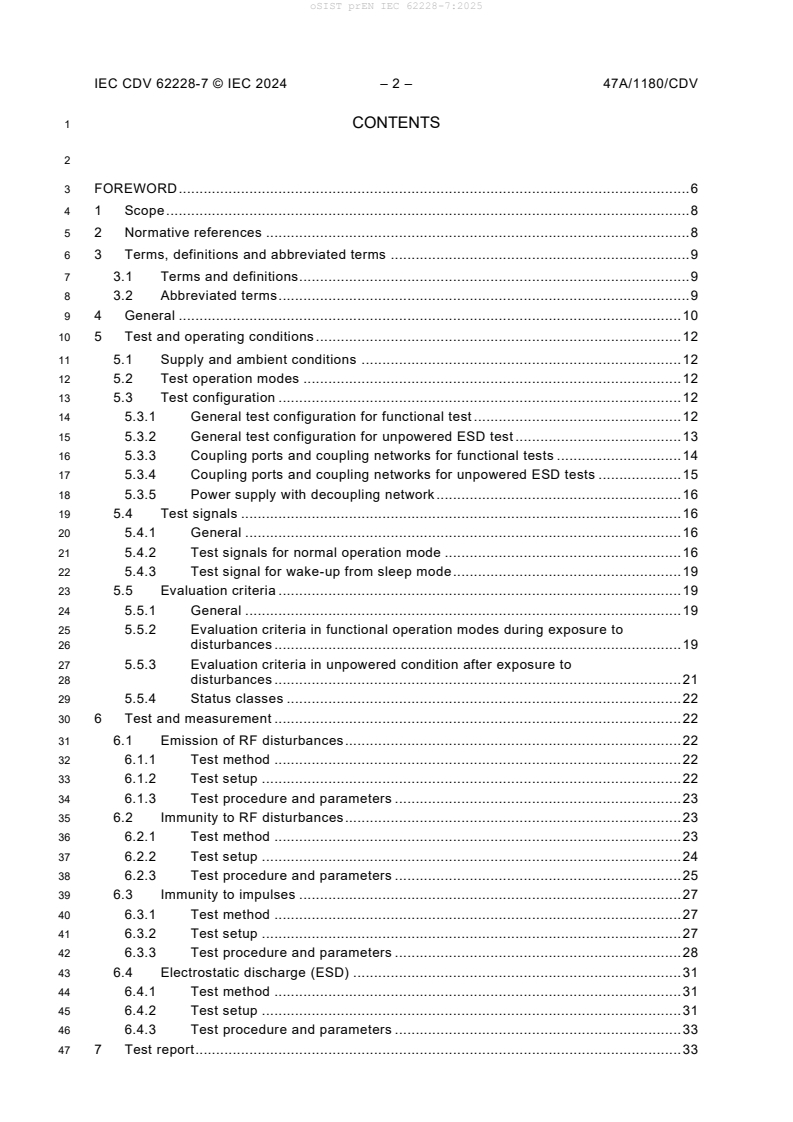
1 CONTENTS
3 FOREWORD . 6
4 1 Scope . 8
5 2 Normative references . 8
6 3 Terms, definitions and abbreviated terms . 9
7 3.1 Terms and definitions. 9
8 3.2 Abbreviated terms . 9
9 4 General . 10
10 5 Test and operating conditions . 12
11 5.1 Supply and ambient conditions . 12
12 5.2 Test operation modes . 12
13 5.3 Test configuration . 12
14 5.3.1 General test configuration for functional test . 12
15 5.3.2 General test configuration for unpowered ESD test . 13
16 5.3.3 Coupling ports and coupling networks for functional tests . 14
17 5.3.4 Coupling ports and coupling networks for unpowered ESD tests . 15
18 5.3.5 Power supply with decoupling network . 16
19 5.4 Test signals . 16
20 5.4.1 General . 16
21 5.4.2 Test signals for normal operation mode . 16
22 5.4.3 Test signal for wake-up from sleep mode . 19
23 5.5 Evaluation criteria . 19
24 5.5.1 General . 19
25 5.5.2 Evaluation criteria in functional operation modes during exposure to
26 disturbances . 19
27 5.5.3 Evaluation criteria in unpowered condition after exposure to
28 disturbances . 21
29 5.5.4 Status classes . 22
30 6 Test and measurement . 22
31 6.1 Emission of RF disturbances . 22
32 6.1.1 Test method . 22
33 6.1.2 Test setup . 22
34 6.1.3 Test procedure and parameters . 23
35 6.2 Immunity to RF disturbances . 23
36 6.2.1 Test method . 23
37 6.2.2 Test setup . 24
38 6.2.3 Test procedure and parameters . 25
39 6.3 Immunity to impulses . 27
40 6.3.1 Test method . 27
41 6.3.2 Test setup . 27
42 6.3.3 Test procedure and parameters . 28
43 6.4 Electrostatic discharge (ESD) . 31
44 6.4.1 Test method . 31
45 6.4.2 Test setup . 31
46 6.4.3 Test procedure and parameters . 33
47 7 Test report . 33
IEC CDV 62228-7 © IEC 2024 – 3 – 47A/1180/CDV
48 Annex A (normative) CXPI test circuits . 34
49 A.1 General . 34
50 A.2 CXPI test circuit for functional tests on standard type-A CXPI transceiver ICs . 34
51 A.3 CXPI test circuit for functional tests on standard type-B CXPI transceiver ICs . 37
52 A.4 CXPI test circuit for functional tests on ICs with embedded CXPI transceiver . 39
53 A.5 CXPI test circuit for unpowered ESD test on a standard type-A CXPI
54 transceiver IC . 42
55 A.6 CXPI test circuit for unpowered ESD test on a standard type-B CXPI
56 transceiver IC . 42
57 Annex B (normative) Test circuit boards . 44
58 B.1 Test circuit board for functional tests . 44
59 B.2 ESD test . 44
60 Annex C (informative) Examples for test limits for CXPI transceiver in automotive
61 application . 46
62 C.1 General . 46
63 C.2 Emission of RF disturbances . 46
64 C.3 Immunity to RF disturbances . 47
65 C.4 Immunity to impulse . 48
66 C.5 Electrostatic discharge (ESD) . 49
67 Annex D (informative) Example of setting for test signals . 50
68 Annex E (informative) Points to note for impulse immunity measurement for functional
69 status class AIC . 52
70 E.1 General . 52
71 E.2 Points to note when testing Pulse 1 . 52
72 Bibliography . 54
74 Figure 1 – PHY sub-layers overview and CXPI transceiver types . 11
75 Figure 2 – General test configuration for tests in functional operation modes . 13
76 Figure 3 – General test configuration for unpowered ESD test . 14
77 Figure 4 – Coupling ports and networks for functional tests . 14
78 Figure 5 – Coupling ports and networks for unpowered ESD tests . 15
79 Figure 6 – Principal drawing of the maximum deviation in the I-V characteristic . 21
80 Figure 7 – Test setup for measurement of RF disturbances . 22
81 Figure 8 – Test setup for DPI tests . 24
82 Figure 9 – Test setup for impulse immunity tests . 28
83 Figure 10 – Test setup for direct ESD tests . 32
84 Figure A.1 – General drawing of the circuit diagram of the test network for standard
85 type-A CXPI transceiver ICs for functional tests . 36
86 Figure A.2 – General drawing of the circuit diagram of the test network for standard
87 type-B CXPI transceiver ICs for functional tests . 38
88 Figure A.3 – General drawing of the circuit diagram of the test network for ICs with
89 embedded CXPI transceiver for functional tests using standard type-A CXPI
90 transceiver IC as Node1 . 40
91 Figure A.4 – General drawing of the circuit diagram of the test network for ICs with
92 embedded CXPI transceiver for functional tests using IC with embedded CXPI
93 transceiver as Node1 . 41
94 Figure A.5 – A general drawing of the test circuit diagram for testing direct ESD of
95 CXPI transceiver in unpowered mode . 42
IEC CDV 62228-7 © IEC 2024 – 4 – 47A/1180/CDV
96 Figure A.6 – A general drawing of the test circuit diagram for testing direct ESD of
97 CXPI standard Type-B transceiver in unpowered mode . 43
98 Figure B.1 – Example of IC interconnections of CXPI signal . 44
99 Figure B.2 – Example of ESD test board for CXPI transceiver ICs . 45
100 Figure C.1 – Example of limits for RF emission – CXPI . 46
101 Figure C.2 – Example of limits for RF emission - VBAT . 46
102 Figure C.3 – Example of limits for RF immunity for functional status class AIC – CXPI . 47
103 Figure C.4 – Example of limits for RF immunity for functional status class AIC – VBAT . 47
104 Figure C.5 – Example of limits for RF immunity for functional status class CIC or DIC -
105 CXPI . 48
106 Figure C.6 – Example of limits for RF immunity for functional status class CIC or DIC -
107 VBAT . 48
108 Figure D.1 – Example of signal setting for standard type-A in 2 transceiver
109 configuration . 50
110 Figure D.2 – Example of signal setting for standard type-B in 2 transceiver
111 configuration . 51
112 Figure E.1 – Relationship between ISO 7637-2 Pulse 1 and transceiver VBAT supply . 52
113 Figure E.2 – Transceiver VBAT supply image when t time is shortened. 53
115 Table 1 – Types for CXPI transceiver . 10
116 Table 2 – Overview of required measurement and tests . 11
117 Table 3 – Supply and ambient conditions for functional operation . 12
118 Table 4 – Definition of coupling ports and coupling network components for functional
119 tests . 15
120 Table 5 – Definitions of coupling ports for unpowered ESD tests . 16
121 Table 6 – Communication test signal TX1 . 17
122 Table 7 – Communication test signal TX2 . 18
123 Table 8 – Communication test signal TX3 . 18
124 Table 9 – Wake-up test signal TX4 . 19
125 Table 10 – Evaluation criteria for standard type-A in functional operation modes . 20
126 Table 11 – Evaluation criteria for standard type-B in functional operation modes . 20
127 Table 12 – Evaluation criteria for ICs with embedded CXPI transceiver in functional
128 operation modes . 21
129 Table 13 – Parameters for emission measurements . 23
130 Table 14 – Settings for the RF measurement equipment . 23
131 Table 15 – Specifications for DPI tests . 25
132 Table 16 – Required DPI tests for functional status class AIC evaluation of standard
133 type-A . 26
134 Table 17 – Required DPI tests for functional status class AIC evaluation of standard
135 type-B . 26
136 Table 18 – Required DPI tests for functional status class AIC evaluation of ICs with
137 embedded CXPI transceiver . 27
138 Table 19 – Required DPI tests for functional status class CIC, D1IC or D2IC evaluation
139 of standard CXPI transceiver ICs and ICs with embedded CXPI transceiver. 27
140 Table 20 – Specifications for impulse immunity tests . 29
141 Table 21 – Parameters for impulse immunity tests . 29
IEC CDV 62228-7 © IEC 2024 – 5 – 47A/1180/CDV
142 Table 22 – Required impulse immunity tests for functional status class AIC evaluation
143 of standard type-A . 30
144 Table 23 – Required impulse immunity tests for functional status class AIC evaluation
145 of standard type-B . 30
146 Table 24 – Required impulse immunity tests for functional status class AIC evaluation
147 of ICs with embedded CXPI transceiver . 30
148 Table 25 – Required impulse immunity tests for functional status class CIC, D1IC or
149 D2IC evaluation of standard CXPI transceiver ICs and ICs with embedded CXPI
150 transceiver . 31
151 Table 26 – Specifications for direct ESD tests . 33
152 Table B.1 – Parameter ESD test circuit board . 45
153 Table C.1 – Example of limits for impulse immunity for functional status
154 class C or D . 48
IC IC
IEC CDV 62228-7 © IEC 2024 – 6 – 47A/1180/CDV
158 INTERNATIONAL ELECTROTECHNICAL COMMISSION
159 ____________
161 INTEGRATED CIRCUITS –
162 EMC EVALUATION OF TRANSCEIVERS –
164 Part 7: CXPI transceivers
166 FOREWORD
167 1) The International Electrotechnical Commission (IEC) is a worldwide organization for standardization comprising
168 all national electrotechnical committees (IEC National Committees). The object of IEC is to promote international
169 co-operation on all questions concerning standardization in the electrical and electronic fields. To this end and
170 in addition to other activities, IEC publishes International Standards, Technical Specifications, Technical Reports,
171 Publicly Available Specifications (PAS) and Guides (hereafter referred to as “IEC Publication(s)”). Their
172 preparation is entrusted to technical committees; any IEC National Committee interested in the subject dealt with
173 may participate in this preparatory work. International, governmental and non-governmental organizations liaising
174 with the IEC also participate in this preparation. IEC collaborates closely with the International Organization for
175 Standardization (ISO) in accordance with conditions determined by agreement between the two organizations.
176 2) The formal decisions or agreements of IEC on technical matters express, as nearly as possible, an international
177 consensus of opinion on the relevant subjects since each technical committee has representation from all
178 interested IEC National Committees.
179 3) IEC Publications have the form of recommendations for international use and are accepted by IEC National
180 Committees in that sense. While all reasonable efforts are made to ensure that the technical content of IEC
181 Publications is accurate, IEC cannot be held responsible for the way in which they are used or for any
182 misinterpretation by any end user.
183 4) In order to promote international uniformity, IEC National Committees undertake to apply IEC Publications
184 transparently to the maximum extent possible in their national and regional publications. Any divergence between
185 any IEC Publication and the corresponding national or regional publication shall be clearly indicated in the latter.
186 5) IEC itself does not provide any attestation of conformity. Independent certification bodies provide conformity
187 assessment services and, in some areas, access to IEC marks of conformity. IEC is not responsible for any
188 services carried out by independent certification bodies.
189 6) All users should ensure that they have the latest edition of this publication.
190 7) No liability shall attach to IEC or its directors, employees, servants or agents including individual experts and
191 members of its technical committees and IEC National Committees for any personal injury, property damage or
192 other damage of any nature whatsoever, whether direct or indirect, or for costs (including legal fees) and
193 expenses arising out of the publication, use of, or reliance upon, this IEC Publication or any other IEC
194 Publications.
195 8) Attention is drawn to the Normative references cited in this publication. Use of the referenced publications is
196 indispensable for the correct application of this publication.
197 9) Attention is drawn to the possibility that some of the elements of this IEC Publication may be the subject of patent
198 rights. IEC shall not be held responsible for identifying any or all such patent rights.
199 IEC 62228-7 has been prepared by subcommittee 47A: Integrated circuits, of IEC technical
200 committee 47: Semiconductor devices. It is an International Standard.
201 The text of this International Standard is based on the following documents:
Draft Report on voting
47A/XX/FDIS 47A/XX/RVD
203 Full information on the voting for its approval can be found in the report on voting indicated in
204 the above table.
205 The language used for the development of this International Standard is English.
IEC CDV 62228-7 © IEC 2024 – 7 – 47A/1180/CDV
206 This document was drafted in accordance with ISO/IEC Directives, Part 2, and developed in
207 accordance with ISO/IEC Directives, Part 1 and ISO/IEC Directives, IEC Supplement, available
208 at www.iec.ch/members_experts/refdocs. The main document types developed by IEC are
209 described in greater detail at www.iec.ch/standardsdev/publications.
210 A list of all parts in the IEC 62228 series, published under the general title Integrated circuits – EMC
211 evaluation of transceivers, can be found on the IEC website.
212 The committee has decided that the contents of this document will remain unchanged until the
213 stability date indicated on the IEC website under webstore.iec.ch in the data related to the
214 specific document. At this date, the document will be
215 • reconfirmed,
216 • withdrawn,
217 • replaced by a revised edition, or
218 • amended.
IMPORTANT – The "colour inside" logo on the cover page of this document indicates that it
contains colours which are considered to be useful for the correct understanding of its
contents. Users should therefore print this document using a colour printer.
IEC CDV 62228-7 © IEC 2024 – 8 – 47A/1180/CDV
222 INTEGRATED CIRCUITS –
223 EMC EVALUATION OF TRANSCEIVERS –
225 Part 7: CXPI transceivers
229 1 Scope
230 This part of IEC 62228 specifies test and measurement methods for the EMC evaluation of
231 CXPI transceiver ICs under network condition. It defines test configurations, test conditions,
232 test signals, failure criteria, test procedures, test setups and test boards. This specification is
233 applicable for standard CXPI transceiver ICs and ICs with embedded CXPI transceiver and
234 covers
235 • the emission of RF disturbances,
236 • the immunity against RF disturbances,
237 • the immunity against impulses and
238 • the immunity against electrostatic discharges (ESD).
239 2 Normative references
240 The following documents are referred to in the text in such a way that some or all of their content
241 constitutes requirements of this document. For dated references, only the edition cited applies.
242 For undated references, the latest edition of the referenced document (including any
243 amendments) applies.
244 IEC 61967-1, Integrated circuits – Measurement of electromagnetic emissions – Part 1: General
245 conditions and definitions
246 IEC 61967-4, Integrated circuits – Measurement of electromagnetic emissions – Part 4:
247 Measurement of conducted emissions – 1 Ω/150 Ω direct coupling method
248 IEC 62132-1, Integrated circuits – Measurement of electromagnetic immunity – Part 1: General
249 conditions and definitions
250 IEC 62132-4, Integrated circuits – Measurement of electromagnetic immunity 150 kHz to 1 GHz
251 – Part 4: Direct RF power injection method
252 IEC 62215-3, Integrated circuits – Measurement of impulse immunity – Part 3: Non-
253 synchronous transient injection method
254 IEC 62228-1, Integrated circuits – EMC evaluation of transceivers – Part 1: General conditions
255 and definitions
256 ISO 7637-2, Road vehicles – Electrical disturbances from conduction and coupling – Part 2:
257 Electrical transient conduction along supply lines only
258 ISO 10605, Road vehicles – Test methods for electrical disturbances from electrostatic
259 discharge
260 ISO 20794-4, Road vehicles – Clock extension peripheral interface (CXPI) – Part 4: Data link
261 layer and physical layer
IEC CDV 62228-7 © IEC 2024 – 9 – 47A/1180/CDV
262 ISO 20794-7, Road vehicles — Clock extension peripheral interface (CXPI) — Part 7: Data link
263 and physical layer conformance test plan
264 3 Terms, definitions and abbreviated terms
265 For the purposes of this document, the terms and definitions given in IEC 62228-1, IEC 61967-
266 1 and IEC 62132-1, as well as the following apply.
267 ISO and IEC maintain terminological databases for use in standardization at the following
268 addresses:
269 • IEC Electropedia: available at http://www.electropedia.org/
270 • ISO Online browsing platform: available at http://www.iso.org/obp
271 3.1 Terms and definitions
272 3.1.1
273 global pin
274 pin that carries a signal or power, which enters or leaves the application board without any
275 active component in between
276 3.1.2
277 standard CXPI transceiver IC
278 standalone CXPI transceiver according to ISO 20794-4 or IC with integrated CXPI transceiver
279 cell with access to CXPI RXD and TXD signal
280 3.1.3
281 IC with embedded CXPI transceiver
282 IC with integrated CXPI transceiver cell and CXPI protocol handler but with or without access
283 to CXPI RXD and TXD signal
284 3.1.4
285 mandatory components, pl
286 components needed for proper function of IC as specified by the IC manufacturer
287 3.1.5
288 commander node
289 node that provides the schedule master management (include ReqTypeID transmission), the
290 primary clock and optionally the sleep message transmission management
291 3.1.6
292 responder node
293 node other than commander node connected to the CXPI network
295 3.2 Abbreviated terms
ASSP application specific standard product
CRC cyclic redundancy check
CXPI clock extension peripheral interface
DLL data link layer
EN enable
FI frame information
IBS inter byte space
IEC CDV 62228-7 © IEC 2024 – 10 – 47A/1180/CDV
NRZ non-return to zero
PCB printed circuit board
PID protected identifier
PMA physical media attachment
PS physical signalling
RXD receive data
TXD transmit data
PWM pulse width modulation
RX PMA receiver interface signal
PWM
RXD PS receiver interface signal
NRZ
TX PMA transmit interface signal
PWM
TXD PS transmit interface signal
NRZ
UART universal asynchronous receiver / transmitter
297 4 General
298 The intention of this document is to evaluate the EMC performance of CXPI transceiver ICs
299 under application conditions in a minimal network. CXPI Transceiver ICs are generally classified
300 into three types, as listed in Table 1.
301 Figure 1 shows a sample configuration of each type of CXPI transceiver IC. The overview of
302 the PHY sublayers is following ISO 20794-4. Standard type-A comprises a CXPI transceiver IC
303 that contains the PS sublayer and the PMA sublayer. Standard type-B contains only the PMA
304 sublayer. The Embedded type includes a microcontroller or ASSP function, in addition to the
305 functions of Standard type-A. The PMA sublayer transmits and receives communication data
306 on the bus line in the PWM signal format. The PS sublayer has the clock generation function,
307 the encoding and decoding of CXPI frames and the bit-wise collision resolution logic. The
308 microcontroller or ASSP transmits and receives the communication data in the NRZ signal
309 format according to the specifications of the application.
310 Table 1 – Types for CXPI transceiver
Communication sublayer
Transceiver classification CXPI transceiver type
implementation
Standard type-A with PMA and PS sublayer
Standard CXPI transceiver IC
Standard type-B with PMA sublayer only
IC with embedded CXPI transceiver Embedded type with PMA, PS sublayer and DLL
IEC CDV 62228-7 © IEC 2024 – 11 – 47A/1180/CDV
9 7 8
1 3
12 10 11
2 4
313 Key
314 1 TXD
NRZ
315 2 RXD
NRZ
316 3 TX
PWM
317 4 RX
PWM
318 5 CXPI network
319 6 Clock (commander node only, provided externally or from micro controller)
320 7 Standard type-A
321 8 Standard type-B
322 9 Embedded type
323 10 PS
324 11 PMA
325 12 Microcontroller or ASSP etc. including DLL
326 Figure 1 – PHY sub-layers overview and CXPI transceiver types
327 The evaluation of the EMC characteristics of CXPI transceivers shall be performed in functional
328 operation modes under network conditions for RF emission, RF immunity and impulse immunity
329 tests, and on a single unpowered transceiver IC for electrostatic discharge tests.
330 The aim of these tests is to determine the EMC performance on dedicated global pins of the
331 CXPI transceiver that are considered EMC relevant in the application. For a standard CXPI
332 transceiver IC and an IC with an embedded CXPI transceiver, these pins are VBAT and CXPI.
333 The test methods used for EMC characterization are based on the international standards for
334 IC EMC tests and are described in Table 2.
335 Table 2 – Overview of required measurement and tests
Functional
Transceiver mode Required test Test method Evaluation
operation mode
150 Ω direct
coupling
RF emission Spectrum Normal
(IEC 61967-4)
Normal
DPI
Functional
RF immunity Function
(powered)
(IEC 62132-4) Sleep
Non-synchronous Normal
transient injection
Impulse immunity Function
Sleep
(IEC 62215-3)
Contact discharge
Passive
ESD Damage Unpowered
(unpowered)
(ISO 10605)
337 The RF emission, RF immunity and impulse immunity test methods are selected for the
338 evaluation of EMC characteristic of transceivers in functional (powered) modes. These three
IEC CDV 62228-7 © IEC 2024 – 12 – 47A/1180/CDV
339 test methods are based on the same approach using conductive coupling. Therefore, it is
340 possible to use the same test board for all tests in functional operation mode, which reduces
341 the effort required and increases the reproducibility and comparability of test results.
342 The ESD test is performed on passive (unpowered) transceiver IC on a separate test board.
343 A general drawing of a schematic with more details of the CXPI transceiver test network for the
344 targeted EMC test is given in Annex A. All measurements and tests should be done with
345 soldered transceivers on test boards as described in Annex B, to ensure application like
346 conditions and avoid setup effects by sockets.
347 Annex C provides example test limits and levels for CXPI transceivers in automotive application.
348 In general, the test definition is done for standard CXPI transceiver ICs. For ICs with embedded
349 CXPI transceivers some adaptations are necessary which are described in this document.
350 Specific adaptations shall be done individually for the dedicated IC but shall follow the general
351 definitions identified.
352 5 Test and operating conditions
353 5.1 Supply and ambient conditions
354 For all tests and measurements under operating conditions, the settings are based on systems
355 with a 12 V power supply, which is the main application for CXPI transceivers. If a transceiver
356 is designed or targeted for a higher power supply voltage, the test conditions and test targets
357 shall be adapted and documented accordingly. The defined supply and ambient conditions for
358 functional operation are given in Table 3. Although the standard voltage of VCCext is 5 V, other
359 voltages such as 3,3 V may be supplied depending on the product.
360 Table 3 – Supply and ambient conditions for functional operation
Parameter Value
a
(14 ± 0,2) V (default)
Voltage supply VBAT
ext
a
(5 ± 0,1) V (default), (3,3 ± 0,1) V
Voltage supply VCC
ext
Test temperature (23 ± 5) °C
a
V means voltage at external terminal on the test board as shown e.g. in Figure A.1
ext
362 For RF emission measurements, the ambient noise floor shall be at least 6 dB below the applied
363 target limit and documented in the test report.
364 Unpowered ESD tests shall be carried out without any supply voltage, and the requirements of
365 ISO 10605 climatic environmental conditions shall be applied.
366 5.2 Test operation modes
367 The CXPI transceiver ICs shall be tested in powered functional operation modes and in the
368 unpowered mode. The functional operation modes are normal mode and sleep mode.
369 5.3 Test configuration
370 5.3.1 General test configuration for functional test
371 The test configuration in general consists of CXPI transceivers with mandatory external
372 components and components for filtering and decoupling (CXPI node) in a minimal test
ext
373 network, where filtered power supplies, signals, monitoring probes and coupling networks are
IEC CDV 62228-7 © IEC 2024 – 13 – 47A/1180/CDV
374 connected as shown in Figure 2. Node 1 is defined as the commander node, and Node 2 is
375 defined as the responder node.
Monitoring and stimulation/mode
control
e.g. TXD, RXD, EN, Clock
Test network
Node 1
CXPI
Decoupling
bus filter
network for
Transceiver
and network
Stimulation and
termination
monitoring
Coupling ports and
Node 2
coupling networks
Decoupling
network for
CXPI
Transceiver
Stimulation and
bus filter
monitoring
Power supply with decoupling
networks
e.g. VBAText, VCCext
377 Figure 2 – General test configuration for tests in functional operation modes
378 For evaluation of RF emission, RF immunity and the impulse immunity characteristics of a CXPI
379 transceiver in functional operation mode, a minimal CXPI test network consisting of two CXPI
380 transceiver ICs shall be used. Depending on the type of transceiver the following network
381 configurations are defined:
382 • two transceivers of the same type in case of standard CXPI transceiver IC (DUT), or
383 • one IC with embedded CXPI transceiver (DUT) and one standard CXPI transceiver IC , or
384 two transceivers of the same type of embedded CXPI transceiver IC (DUT).
385 NOTE In specific cases or for analyses, a deviation from this setup can be agreed between the users of this
386 document and noted in the test report.
387 The CXPI network termination and bus filter including ESD suppression devices (e.g. zener
388 diode) if used, shall comply with the time constant defined in ISO 20794-4. If an optional ESD
389 suppression device is used (e.g. to achieve a certain ESD or impulse immunity level) it shall be
390 used for all other tests of this document and documented in the test report.
391 A general drawing of a schematic with more details of the CXPI transceiver test network is given
392 in Annex A.
393 5.3.2 General test configuration for unpowered ESD test
394 The general test configuration for unpowered ESD test of CXPI transceiver ICs consists of a
395 single CXPI transceiver IC with mandatory external components and components for filtering
396 on a test board with discharge coupling networks as shown in Figure 3.
IEC CDV 62228-7 © IEC 2024 – 14 – 47A/1180/CDV
Unpowered transceiver
Coupling ports and
CXPI
Transceiver
coupling networks
bus filter
398 Figure 3 – General test configuration for unpowered ESD test
399 5.3.3 Coupling ports and coupling networks for functional tests
400 The coupling ports and coupling networks are used to transfer disturbances to or from the test
401 network with a defined transfer characteristic. The schematic of the coupling ports, networks
402 and pins are shown in Figure 4. The values of the components depend on the test method and
403 are defined in Table 4. The tolerance of the components should be 1 % or less.
405 Key
406 1 Coupling ports
407 2 Coupling networks
408 3 Pin networks (including all external mandatory components for the respective pin)
409 4 RF connector
410 Figure 4 – Coupling ports and networks for functional tests
IEC CDV 62228-7 © IEC 2024 – 15 – 47A/1180/CDV
412 Table 4 – Definition of coupling ports and coupling
413 network components for functional tests
Port Type Purpose Component
R , R C , C R , R
CP1 CP2 CP1 CP2 CP1t CP2t
EMI1 RF emission measurement on CXPI 120 Ω 4,7 nF 51 Ω
CP1 RF1 RF coupling for test on CXPI 0 Ω 4,7 nF not used
IMP1 Impulse coupling on CXPI 0 Ω 1,0 nF not used
EMI2 RF emission measurement on VBAT 120 Ω 6,8 nF 51 Ω
CP2 RF2 RF coupling for test on VBAT 0 Ω 6,8 nF not used
IMP2 Impulse coupling on VBAT 0 Ω Shorted not used
415 The test configurations with coupling ports and coupling networks connected to the CXPI test
416 network are given in the general drawing of schematics in Figure A.1 for standard type-A CXPI
417 transceiver ICs, in Figure A.2 for standard type-B CXPI transceiver ICs and in Figure A.3 and
418 Figure A.4 for ICs with embedded CXPI transceiver.
419 The characterization of the coupling ports and coupling networks is carried out as follows:
420 The magnitude of insertion losses (S21 measurement) between the ports CP1, CP2 and the
421 respective transceiver signal pads on the test board shall be measured and documented in the
422 test report. For this characterization, the coupling port shall be configured for the RF immunity
423 or emission test and the CXPI transceiver ICs shall be removed. All other components which
424 are directly connected to the coupling port (e.g. filter to power supply or loads) remain on the
425 test board.
426 5.3.4 Coupling ports and coupling networks for unpowered ESD tests
427 The coupling ports and coupling networks used for unpowered direct ESD tests connect the
428 discharge points to the CXPI transceiver IC test circuitry. The schematic and definitions of the
429 coupling ports, networks and pins are given in Figure 5 and Table 5.
431 Key
432 1 Coupling ports
433 2 Coupling networks
434 3 Pin networks (including all external mandatory components for the respective pin)
435 4 Discharge point
436 Figure 5 – Coupling ports and networks for unpowered ESD tests
IEC CDV 62228-7 © IEC 2024 – 16 – 47A/1180/CDV
438 Table 5 – Definitions of coupling ports for unpowered ESD tests
Port Type Purpose Component
a
CP1 ESD1 ESD coupling on CXPI
Metal trace for galvanic connection
a
CP2 ESD2 ESD coupling on VBAT
Metal trace for galvanic connection
a
The optional resistors R1 and R2 with R ≥ 200 kΩ are used to avoid static pre-charge at the discharge point
caused by the ESD generator. Sparking over at these resistors at high test levels shall be avoided. If a static
pre-charge is prevented by the ESD generator construction, these resistors are not needed. Alternatively, an
external resistor can be used to remove the pre-charge on each discharge point before each single test.
440 5.3.5 Power supply with decoupling network
441 In the general test configurations, decoupling circuits shall be added to the supply lines such
442 as VBAT and VCC.
443 See Annex A for an example of decoupling circuits on a test configuration with two CXPI
444 transceiver ICs.
445 5.4 Test signals
446 5.4.1 General
447 Depending on the transceiver type, different test signals are defined for communication in
448 normal operation mode and wake-up from sleep mode.
449 5.4.2 Test signals for normal operation mode
450 The communication test signal TX1 shall be used for testing standard type-A CXPI transceive
...