

prEN IEC 60071-1:2026
(Main)Insulation co-ordination - Part 1: Definitions, principles and rules
General Information
- Abstract
- Status
- Not Published
- Publication Date
- 25-Jul-2027
- Technical Committee
- CLC/TC 99X - Power installations exceeding 1 kV a.c. (1,5 kV d.c.)
- Current Stage
- 4060 - Enquiry results established and sent to TC, SR, BTTF - Enquiry
- Start Date
- 27-Mar-2026
- Completion Date
- 27-Mar-2026

Overview
prEN IEC 60071-1:2026, developed by CLC and the International Electrotechnical Commission (IEC), defines essential principles, terminology, and rules for insulation co-ordination in high-voltage electrical systems. This standard applies to three-phase AC systems with equipment voltages above 1 kV and is central to ensuring the safe and reliable operation of electrical power installations. It provides a structured procedure for selecting appropriate insulation levels and guides the selection of withstand voltages to mitigate electrical stresses, supporting system longevity and operational safety.
Key Topics
- Definitions and Terminology: Clear identification and explanation of key terms such as insulation co-ordination, external and internal insulation, overvoltages, and withstand voltages.
- Principles of Insulation Co-ordination: Describes the methodology for selecting dielectric strength in relation to operational voltages and expected electrical stresses, considering environmental factors and protective devices.
- Withstand Voltage Selection: Offers detailed rules for determining phase-to-earth, phase-to-phase, and longitudinal insulation withstand voltages for both equipment and system installations.
- Standard Voltage Tests: Specifies standardized test procedures and voltage shapes (e.g., short-duration power-frequency, switching impulses, lightning impulses) used to verify insulation performance.
- Environmental Adjustments: Includes procedures for atmospheric correction and altitude adjustment to ensure appropriate insulation under varying service conditions.
- Coordination and Performance Criteria: Outlines a performance-based approach to insulation selection, targeting acceptable levels of failure and ensuring system resilience.
Applications
Electrical Power Transmission and Distribution
prEN IEC 60071-1:2026 is indispensable for electrical engineers and designers involved in the development, installation, and maintenance of high-voltage AC power systems. Applications include:
- Specification of Equipment Insulation: Assisting manufacturers and utilities in selecting rated insulation capable of withstanding normal operating and fault conditions.
- System Design and Upgrading: Providing a standardized reference when upgrading substations, transformers, circuit breakers, and switchgear for both new and retrofit projects.
- Safety and Reliability Improvement: Reducing risks of insulation failure, equipment damage, and service outages due to overvoltages (temporary, transient, lightning, or switching surges).
- Test and Certification Processes: Establishing uniform test requirements for verifying insulation capability, supporting consistent product rating and certification across markets.
Technical Standards Development
This standard acts as a horizontal standard-a reference for other technical committees developing equipment-specific standards. It ensures consistent insulation co-ordination principles are applied throughout the electrical engineering industry.
Related Standards
For comprehensive insulation co-ordination and testing, the following related standards should be consulted:
- IEC 60071-2: Application guidelines for insulation co-ordination, offering deeper technical justification and practical guidance.
- IEC 60038: Standard voltages for electrical installations.
- IEC 60050 Series: International Electrotechnical Vocabulary for terminology in generation, transmission, and distribution of electricity.
- IEC 60060-1: High-voltage test techniques-General definitions and requirements.
- IEC 60099-4: Surge arresters-Specification for metal-oxide surge arresters.
By using prEN IEC 60071-1:2026 in combination with related standards, engineers and organizations ensure harmonized, robust, and future-proof insulation co-ordination for electrical networks worldwide.
Keywords: Insulation co-ordination, withstand voltage, overvoltage, IEC 60071, high voltage, electrical insulation, electrical safety, standard test voltages, power system reliability, substation standards, altitude correction, atmospheric correction.
Relations
- Effective Date
- 20-Feb-2024
Get Certified
Connect with accredited certification bodies for this standard

IMQ S.p.A. (Certification)
Italian electrical product certification.

SLG Prüf- und Zertifizierungs GmbH
German testing and certification body.

UL Solutions
Global safety science company with testing, inspection and certification.
Sponsored listings
Frequently Asked Questions
prEN IEC 60071-1:2026 is a draft published by CLC. Its full title is "Insulation co-ordination - Part 1: Definitions, principles and rules". This standard covers: Insulation co-ordination - Part 1: Definitions, principles and rules
Insulation co-ordination - Part 1: Definitions, principles and rules
prEN IEC 60071-1:2026 is classified under the following ICS (International Classification for Standards) categories: 29.080.30 - Insulation systems. The ICS classification helps identify the subject area and facilitates finding related standards.
prEN IEC 60071-1:2026 has the following relationships with other standards: It is inter standard links to EN IEC 60071-1:2019. Understanding these relationships helps ensure you are using the most current and applicable version of the standard.
prEN IEC 60071-1:2026 is available in PDF format for immediate download after purchase. The document can be added to your cart and obtained through the secure checkout process. Digital delivery ensures instant access to the complete standard document.
Standards Content (Sample)
SLOVENSKI STANDARD
01-marec-2026
Koordinacija izolacije - 1. del: Definicije, načela in pravila
Insulation co-ordination - Part 1: Definitions, principles and rules
Isolationskoordination - Teil 1: Begriffe, Grundsätze und Anforderungen
Coordination de l'isolement Partie 1: Définitions, principes et règles
Ta slovenski standard je istoveten z: prEN IEC 60071-1:2026
ICS:
01.040.29 Elektrotehnika (Slovarji) Electrical engineering
(Vocabularies)
29.080.01 Električna izolacija na Electrical insulation in
splošno general
2003-01.Slovenski inštitut za standardizacijo. Razmnoževanje celote ali delov tega standarda ni dovoljeno.
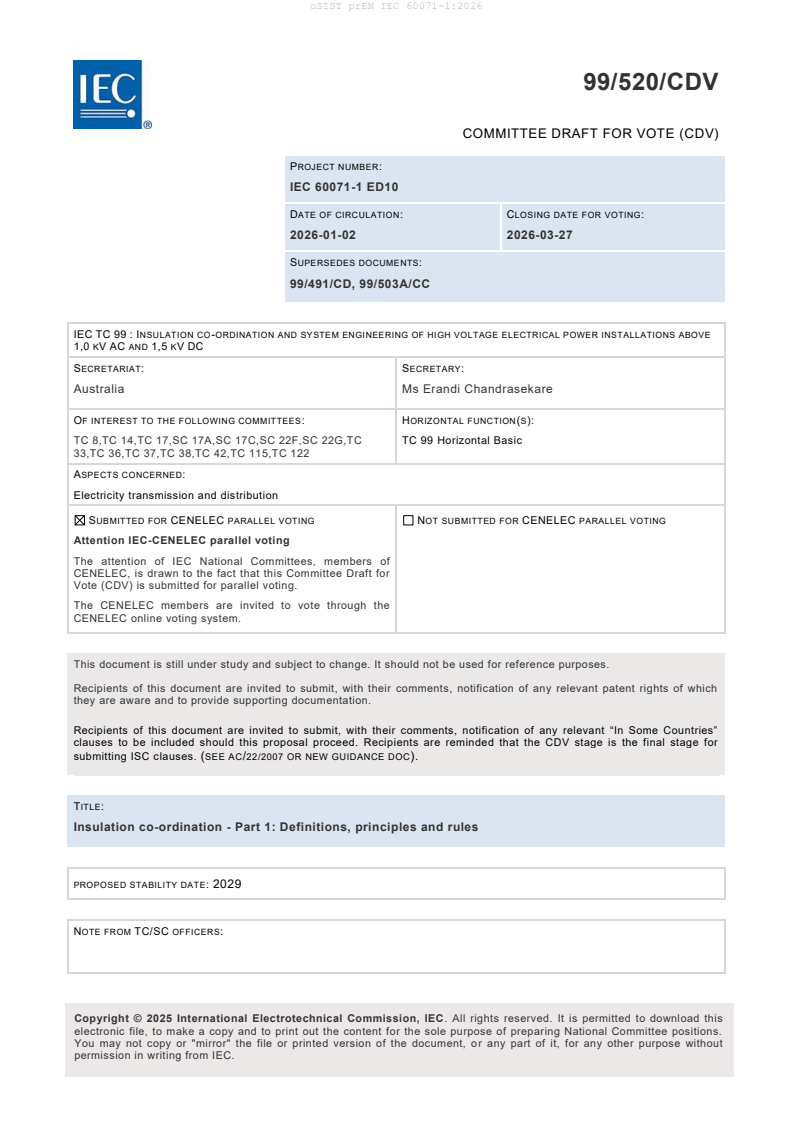
99/520/CDV
COMMITTEE DRAFT FOR VOTE (CDV)
PROJECT NUMBER:
IEC 60071-1 ED10
DATE OF CIRCULATION: CLOSING DATE FOR VOTING:
2026-01-02 2026-03-27
SUPERSEDES DOCUMENTS:
99/491/CD, 99/503A/CC
IEC TC 99 : INSULATION CO-ORDINATION AND SYSTEM ENGINEERING OF HIGH VOLTAGE ELECTRICAL POWER INSTALLATIONS ABOVE
1,0 KV AC AND 1,5 KV DC
SECRETARIAT: SECRETARY:
Australia Ms Erandi Chandrasekare
OF INTEREST TO THE FOLLOWING COMMITTEES: HORIZONTAL FUNCTION(S):
TC 8,TC 14,TC 17,SC 17A,SC 17C,SC 22F,SC 22G,TC TC 99 Horizontal Basic
33,TC 36,TC 37,TC 38,TC 42,TC 115,TC 122
ASPECTS CONCERNED:
Electricity transmission and distribution
SUBMITTED FOR CENELEC PARALLEL VOTING NOT SUBMITTED FOR CENELEC PARALLEL VOTING
Attention IEC-CENELEC parallel voting
The attention of IEC National Committees, members of
CENELEC, is drawn to the fact that this Committee Draft for
Vote (CDV) is submitted for parallel voting.
The CENELEC members are invited to vote through the
CENELEC online voting system.
This document is still under study and subject to change. It should not be used for reference purposes.
Recipients of this document are invited to submit, with their comments, notification of any relevant patent rights of which
they are aware and to provide supporting documentation.
Recipients of this document are invited to submit, with their comments, notification of any relevant “In Some Countries”
clauses to be included should this proposal proceed. Recipients are reminded that the CDV stage is the final stage for
submitting ISC clauses. (SEE AC/22/2007 OR NEW GUIDANCE DOC).
TITLE:
Insulation co-ordination - Part 1: Definitions, principles and rules
PROPOSED STABILITY DATE: 2029
NOTE FROM TC/SC OFFICERS:
electronic file, to make a copy and to print out the content for the sole purpose of preparing National Committee positions.
You may not copy or "mirror" the file or printed version of the document, or any part of it, for any other purpose without
permission in writing from IEC.
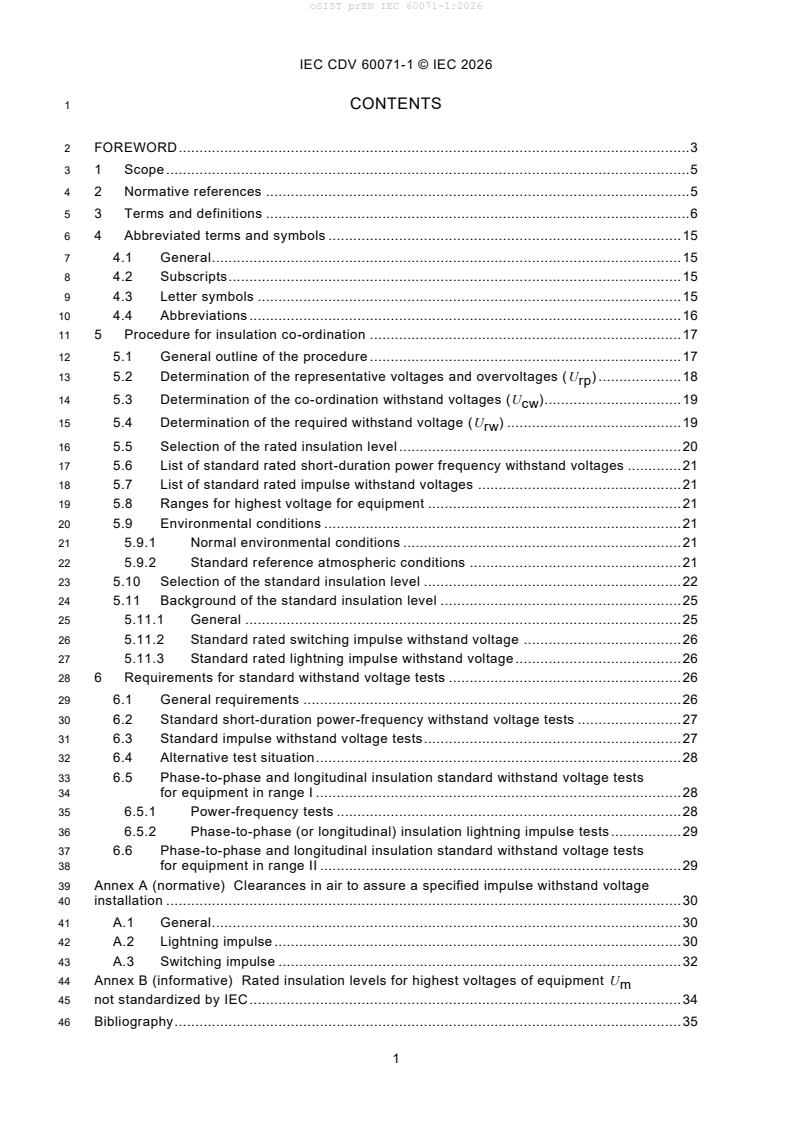
IEC CDV 60071-1 © IEC 2026
1 CONTENTS
2 FOREWORD . 3
3 1 Scope . 5
4 2 Normative references . 5
5 3 Terms and definitions . 6
6 4 Abbreviated terms and symbols . 15
7 4.1 General . 15
8 4.2 Subscripts . 15
9 4.3 Letter symbols . 15
10 4.4 Abbreviations . 16
11 5 Procedure for insulation co-ordination . 17
12 5.1 General outline of the procedure . 17
13 5.2 Determination of the representative voltages and overvoltages ( U ) . 18
rp
14 5.3 Determination of the co-ordination withstand voltages (U ) . 19
cw
15 5.4 Determination of the required withstand voltage (U ) . 19
rw
16 5.5 Selection of the rated insulation level . 20
17 5.6 List of standard rated short-duration power frequency withstand voltages . 21
18 5.7 List of standard rated impulse withstand voltages . 21
19 5.8 Ranges for highest voltage for equipment . 21
20 5.9 Environmental conditions . 21
21 5.9.1 Normal environmental conditions . 21
22 5.9.2 Standard reference atmospheric conditions . 21
23 5.10 Selection of the standard insulation level . 22
24 5.11 Background of the standard insulation level . 25
25 5.11.1 General . 25
26 5.11.2 Standard rated switching impulse withstand voltage . 26
27 5.11.3 Standard rated lightning impulse withstand voltage . 26
28 6 Requirements for standard withstand voltage tests . 26
29 6.1 General requirements . 26
30 6.2 Standard short-duration power-frequency withstand voltage tests . 27
31 6.3 Standard impulse withstand voltage tests. 27
32 6.4 Alternative test situation . 28
33 6.5 Phase-to-phase and longitudinal insulation standard withstand voltage tests
34 for equipment in range I . 28
35 6.5.1 Power-frequency tests . 28
36 6.5.2 Phase-to-phase (or longitudinal) insulation lightning impulse tests . 29
37 6.6 Phase-to-phase and longitudinal insulation standard withstand voltage tests
38 for equipment in range II . 29
39 Annex A (normative) Clearances in air to assure a specified impulse withstand voltage
40 installation . 30
41 A.1 General . 30
42 A.2 Lightning impulse . 30
43 A.3 Switching impulse . 32
44 Annex B (informative) Rated insulation levels for highest voltages of equipment U
m
45 not standardized by IEC . 34
46 Bibliography . 35
IEC CDV 60071-1 © IEC 2026
48 Figure 1 – Flow chart for the determination of rated or standard insulation level . 16
50 Table 1 – Classes and shapes of overvoltages, Standard voltage shapes and Standard
51 withstand voltage tests . 17
52 Table 2 – Standard insulation levels for range I (1 kV < U ≤ 245 kV) . 22
m
53 Table 3 – Standard insulation levels for range II (U > 245 kV) . 23
m
54 Table A.1 – Correlation between standard rated lightning impulse withstand voltages
55 and minimum air clearances . 30
56 Table A.2 – Correlation between standard rated switching impulse withstand voltages
57 and minimum phase-to-earth air clearances . 30
58 Table A.3 – Correlation between standard rated switching impulse withstand voltages
59 and minimum phase-to-phase air clearances . 30
60 Table B.1 – Rated insulation levels for highest voltages of equipment U not
m
61 standardized by IEC. 30
IEC CDV 60071-1 © IEC 2026
64 INTERNATIONAL ELECTROTECHNICAL COMMISSION
65 ___________
67 INSULATION CO-ORDINATION –
69 Part 1: Definitions, principles and rules
71 FOREWORD
72 1) The International Electrotechnical Commission (IEC) is a worldwide organization for standardization comprising
73 all national electrotechnical committees (IEC National Committees). The object of IEC is to promote international
74 co-operation on all questions concerning standardization in the electrical and electronic fields. To this end and
75 in addition to other activities, IEC publishes International Standards, Technical Specifications, Technical Reports,
76 Publicly Available Specifications (PAS) and Guides (hereafter referred to as “IEC Publication(s)”). Their
77 preparation is entrusted to technical committees; any IEC National Committee interested in the subject dealt with
78 may participate in this preparatory work. International, governmental and non-governmental organizations liaising
79 with the IEC also participate in this preparation. IEC collaborates closely with the International Organization for
80 Standardization (ISO) in accordance with conditions determined by agreement between the two organizations.
81 2) The formal decisions or agreements of IEC on technical matters express, as nearly as possible, an international
82 consensus of opinion on the relevant subjects since each technical committee has representation from all
83 interested IEC National Committees.
84 3) IEC Publications have the form of recommendations for international use and are accepted by IEC National
85 Committees in that sense. While all reasonable efforts are made to ensure that the technical content of IEC
86 Publications is accurate, IEC cannot be held responsible for the way in which they are used or for any
87 misinterpretation by any end user.
88 4) In order to promote international uniformity, IEC National Committees undertake to apply IEC Publications
89 transparently to the maximum extent possible in their national and regional publications. Any divergence between
90 any IEC Publication and the corresponding national or regional publication shall be clearly indicated in the latter.
91 5) IEC itself does not provide any attestation of conformity. Independent certification bodies provide conformity
92 assessment services and, in some areas, access to IEC marks of conformity. IEC is not responsible for any
93 services carried out by independent certification bodies.
94 6) All users should ensure that they have the latest edition of this publication.
95 7) No liability shall attach to IEC or its directors, employees, servants or agents including individual experts and
96 members of its technical committees and IEC National Committees for any personal injury, property damage or
97 other damage of any nature whatsoever, whether direct or indirect, or for costs (including legal fees) and
98 expenses arising out of the publication, use of, or reliance upon, this IEC Publication or any other IEC Publications.
99 8) Attention is drawn to the Normative references cited in this publication. Use of the referenced publications is
100 indispensable for the correct application of this publication.
101 9) IEC draws attention to the possibility that the implementation of this document may involve the use of (a) patent(s).
102 IEC takes no position concerning the evidence, validity or applicability of any claimed patent rights in respect
103 thereof. As of the date of publication of this document, IEC had not received notice of (a) patent(s), which may
104 be required to implement this document. However, implementers are cautioned that this may not represent the
105 latest information, which may be obtained from the patent database available at https://patents.iec.ch. IEC shall
106 not be held responsible for identifying any or all such patent rights.
107 IEC 60071-1 has been prepared by IEC technical committee 99: Insulation co-ordination and
108 system engineering of high voltage electrical power installations above 1,0 kV AC and 1,5 kV
109 DC.
110 This tenth edition cancels and replaces the ninth edition published in 2019. This edition
111 constitutes a technical revision.
112 It has the status of a horizontal standard in accordance with IEC Guide 108.
113 This edition includes the following significant technical changes with respect to the previous
114 edition:
115 a) A front time parameter has been introduced for standard switching impulse voltage,
116 analogous to that used for standard lightning impulse voltage. With this addition, the standard
117 switching impulse voltage is now defined as 170/2 500 μs.
IEC CDV 60071-1 © IEC 2026
118 b) The definition of fast-front overvoltage has been revised to include a time to peak T
p
119 parameter, specified as: 0.1 μs < T ≤ 20 μs
p
120 c) A definition for front time T applicable to very-fast-front overvoltage has been introduced.
f
121 d) In Annex A (informative), a reference to IEC 60071-2 has been included to provide further
122 details regarding electrode configurations.
123 The text of this International Standard is based on the following documents:
Draft Report on voting
XX/XX/FDIS XX/XX/RVD
125 Full information on the voting for its approval can be found in the report on voting indicated in
126 the above table.
127 The language used for the development of this International Standard is English.
128 This document was drafted in accordance with ISO/IEC Directives, Part 2, and developed in
129 accordance with ISO/IEC Directives, Part 1 and ISO/IEC Directives, IEC Supplement, available
130 at www.iec.ch/members_experts/refdocs. The main document types developed by IEC are
131 described in greater detail at www.iec.ch/publications.
132 A list of all parts in the IEC 60071 series, published under the general title Insulation co -
133 ordination, can be found on the IEC website.
134 The committee has decided that the contents of this document will remain unchanged until the
135 stability date indicated on the IEC website under webstore.iec.ch in the data related to the
136 specific document. At this date, the document will be
137 • reconfirmed,
138 • withdrawn, or
139 • revised.
IMPORTANT – The “colour inside” logo on the cover page of this publication indicates
that it contains colours which are considered to be useful for the correct understanding
of its contents. Users should therefore print this publication using a colour printer.
IEC CDV 60071-1 © IEC 2026
143 INSULATION CO-ORDINATION –
145 Part 1: Definitions, principles and rules
149 1 Scope
150 This part of IEC 60071 applies to three-phase AC systems having a highest voltage for
151 equipment above 1 kV. It specifies the procedure for the selection of the rated withstand
152 voltages for the phase-to-earth, phase-to-phase and longitudinal insulation of the equipment
153 and the installations of these systems. It also gives the lists of the standard withstand voltages
154 from which the rated withstand voltages are selected.
155 This document describes that the selected withstand voltages are associated with the highest
156 voltage for equipment. This association is for insulation co-ordination purposes only. The
157 requirements for human safety are not covered by this document.
158 Although the principles of this document also apply to transmission line insulation, the values
159 of their withstand voltages can be different from the standard rated withstand voltages.
160 The apparatus committees are responsible for specifying the rated withstand voltages and the
161 test procedures suitable for the relevant equipment taking into consideration the
162 recommendations of this document.
163 NOTE In IEC 60071-2, all rules for insulation co-ordination given in this document are justified in detail, in particular
164 the association of the standard rated withstand voltages with the highest voltage for equipment. When more than
165 one set of standard rated withstand voltages is associated with the same highest voltage for equipment, guidance is
166 provided for the selection of the most suitable set.
167 This horizontal standard is primarily intended for use by technical committees in the preparation
168 of standards in accordance with the principles laid down in IEC Guide 108.
169 One of the responsibilities of a technical committee is, wherever applicable, to make use of
170 horizontal standards in the preparation of its publications. The contents of this horizontal
171 standard will not apply unless specifically referred to or included in the relevant publications.
172 2 Normative references
173 The following documents are referred to in the text in such a way that some or all of their content
174 constitutes requirements of this document. For dated references, only the edition cited applies.
175 For undated references, the latest edition of the referenced document (including any
176 amendments) applies.
177 IEC 60038, IEC standard voltages
178 IEC 60050-601, Amendment 1 - International Electrotechnical Vocabulary (IEV) - Part
179 601: Generation, transmission and distribution of electricity - General
180 IEC 60050-614, International Electrotechnical Vocabulary (IEV) - Part 614: Generation,
181 transmission and distribution of electricity - Operation
182 IEC 60060-1, High-voltage test techniques – Part 1: General definitions and test
183 requirements
184 IEC 60071-2, Insulation co-ordination – Part 2: Application guidelines
IEC CDV 60071-1 © IEC 2026
185 IEC 60099-4, Surge arresters – Part 4: Metal-oxide surge arresters without gaps for
186 a.c. systems
187 3 Terms and definitions
188 For the purposes of this document, the following terms and definitions apply.
189 ISO and IEC maintain terminological databases for use in standardization at the following
190 addresses:
191 • IEC Electropedia: available at http://www.electropedia.org/
192 • ISO Online browsing platform: available at http://www.iso.org/obp
193 3.1
194 insulation co-ordination
195 selection of the dielectric strength of equipment in relation to the operating voltages and
196 overvoltages which can appear on the system for which the equipment is intended , and taking
197 into account the service environment and the characteristics of the available preventing and
198 protective devices
199 Note 1 to entry: By "dielectric strength" of the equipment, is meant here its rated insulation level (3.36) or its
200 standard insulation level (3.37).
201 [SOURCE: IEC 60050-614:2016, 614-03-08, modified – Note 1 to entry has been added]
202 3.2
203 external insulation
204 distances in atmospheric air, and the surfaces in contact with atmospheric air of solid insulation
205 of the equipment which are subject to dielectric stresses and to the effects of atmospheric and
206 other environmental conditions from the site, such as pollution, humidity, vermin, etc.
207 Note 1 to entry: External insulation is either weather protected or non-weather protected, designed to operate
208 outside or inside closed shelters, respectively.
209 [SOURCE: IEC 60050-614:2016, 614-03-02, modified – Note 1 to entry has been added]
210 3.3
211 internal insulation
212 internal distances of the solid, liquid, or gaseous insulation of equipment which are protected
213 from the effects of atmospheric and other external conditions
214 [SOURCE: IEC 60050-614:2016, 614-03-03]
215 3.4
216 self-restoring insulation
217 insulation which completely recovers its insulating properties within a short time interval after a
218 disruptive discharge
219 Note 1 to entry: Insulation of this kind is generally, but not necessarily, external insulation.
220 Note 2 to entry: This definition applies only when the discharge is caused by the application of a test voltage during
221 a dielectric test. However, discharges occurring in service may cause a self-restoring insulation to lose partially or
222 completely its original insulating properties.
223 [SOURCE: IEC 60050-614:2016, 614-03-04]
224 3.5
225 non-self-restoring insulation
226 insulation which loses its insulating properties, or does not recover them completely, after a
227 disruptive discharge
IEC CDV 60071-1 © IEC 2026
228 Note 1 to entry: This definition applies only when the discharge is caused by the application of a test voltage during
229 a dielectric test. However, discharges occurring in service may cause a self-restoring insulation to lose partially or
230 completely its original insulating properties.
231 [SOURCE: IEC 60050-614:2016, 614-03-05]
232 3.6
233 insulation configuration terminal
234 any of the terminals between any two of which a voltage that stresses the insulation can be
235 applied
236 Note 1 to entry: The types of terminal are:
237 a) phase terminal, between which and the neutral is applied in service the phase -to-neutral voltage of the system;
238 a) neutral terminal, representing, or connected to, the neutral point of the system (neutral terminal of transformers,
239 etc.);
240 b) earth terminal, always solidly connected to earth in service (tank of transformers, base of disconnectors,
241 structures of towers, ground plane, etc.).
242 3.7
243 insulation configuration
244 complete geometric configuration of the insulation in service, consisting of the insulation and of
245 all terminals and including all elements (insulating and conducting) which influence its dielectric
246 behaviour
247 Note 1 to entry: The insulation configurations defined in 3.7.1 to 3.7.4 are identified.
248 3.7.1
249 three-phase insulation configuration
250 insulation configuration having three phase terminals, one neutral terminal and one earth
251 terminal
252 3.7.2
253 phase-to-earth insulation configuration
254 three-phase insulation configuration where two phase terminals are disregarded and, except in
255 particular cases, the neutral terminal is earthed
256 3.7.3
257 phase-to-phase insulation configuration
258 three-phase insulation configuration where one phase terminal is disregarded. In particular
259 cases, the neutral and the earth terminals are also disregarded
260 3.7.4
261 longitudinal insulation configuration
262 insulation configuration having two phase terminals and one earth terminal, the phase terminals
263 belonging to the same phase of a three-phase system temporarily separated into two
264 independently energized parts (e.g. open switching devices)
265 Note 1 to entry: The four terminals belonging to the other two phases are disregarded or earthed. In particular
266 cases one of the two phase terminals considered is earthed.
IEC CDV 60071-1 © IEC 2026
268 3.8
269 nominal voltage of a system
270 U
n
271 a suitable approximate value of voltage used to designate or identify a system
272 [IEV: 601-01-21]
273 3.9
274 highest voltage of a system
275 U
s
276 highest value of the phase-to-phase operating voltage (RMS value) which occurs under normal
277 operating conditions at any time and at any point in the system
278 the highest value of operating voltage which occurs under normal operating conditions at any
279 time and any point in the system
280 [SOURCE: IEC 60050-601:1985, 601-01-23, modified – Clear meaning on the voltage has
281 been added.]
282 3.10
283 highest voltage for equipment
284 U
m
285 highest value of phase-to-phase voltage (RMS value) for which the equipment is designed in
286 respect of its insulation as well as other characteristics which relate to this voltage in the
287 relevant equipment standards
288 Note 1 to entry: Under normal service conditions specified by the relevant apparatus committee, this voltage can
289 be applied continuously to the equipment.
290 [SOURCE: IEC 60050-614:2016, 614-03-01]
291 3.11
292 isolated neutral system
293 system where the neutral point is not intentionally connected to earth, except for high
294 impedance connections for protection or measurement purposes
295 [SOURCE: IEC 60050-601:1985, 601-02-24]
296 3.12
297 solidly earthed neutral system
298 system whose neutral point(s) is(are) earthed directly
299 [SOURCE: IEC 60050-601:1985, 601-02-25]
300 3.13
301 impedance earthed (neutral) system
302 system whose neutral point(s) is(are) earthed through impedances to limit earth fault currents
303 [SOURCE: IEC 60050-601:1985, 601-02-26]
IEC CDV 60071-1 © IEC 2026
305 3.14
306 resonant earthed (neutral) system
307 system in which one or more neutral points are connected to earth through reactances which
308 approximately compensate the capacitive component of a single-phase-to-earth fault current
309 Note 1 to entry: With resonant earthing of a system, the residual current in the fault is limited to such an extent that
310 an arcing fault in air is usually self-extinguishing.
311 [SOURCE: IEC 60050-601:1985, 601-02-27]
312 3.15
313 earth fault factor
314 k
315 at a given location of a three-phase system, and for a given system configuration, the ratio of
316 the highest RMS phase-to-earth power-frequency voltage on a healthy phase during a fault to
317 earth affecting one or more phases at any point on the system to the RMS phase-to-earth power-
318 frequency voltage which would be obtained at the given location in the absence of any such
319 fault
320 [SOURCE: IEC 60050-614:2016, 614-03-06, modified – A symbol has been added and
321 description on voltage has been modified.
322 3.16
323 continuous voltage
324 power-frequency voltage, considered having constant RMS value, continuously applied to any
325 pair of terminals of an insulation configuration
326 3.17
327 overvoltage
328 voltage:
329 – between one phase conductor and earth or across a longitudinal insulation having a peak
330 value exceeding the peak of the highest voltage of the system divided by 3 ;
331 – between phase conductors having a peak value exceeding the amplitude of the highest
332 voltage of the system
333 Note 1 to entry: Unless otherwise clearly indicated, such as for surge arresters, overvoltage values expressed in
334 p.u. refer to U x 2 3
s
335 [SOURCE: IEC 60050-614: 2016, 614-03-10]
336 3.17.1
337 temporary overvoltage
338 TOV
339 overvoltage of relatively long duration (0,02 s ≤ T ≤ 3 600 s), a seldom event, undamped or weakly
t
340 damped, with frequencies 10 Hz < f < 500 Hz (see Table 1), usually with power frequency of relatively
341 long duration
342 Note 1 to entry: More details on the causes of temporary overvoltages are given in IEC 60071 -2.
343 [SOURCE: IEC 60050-614: 2016, 614-03-13]
IEC CDV 60071-1 © IEC 2026
345 3.17.2
346 transient overvoltage
347 overvoltage with a duration of a few milliseconds or less, oscillatory or non -oscillatory, usually
348 highly damped
349 Note 1 to entry: Transient overvoltages may be immediately followed by temporary overvoltages. In such cases the
350 two overvoltages are considered as separate events.
351 [SOURCE: IEC 60050-614: 2016, 614-03-14]
352 3.17.2.1
353 slow-front overvoltage
354 SFO
355 transient overvoltage, usually unidirectional, with time to peak 20 µs < T 5 000 µs, and time
p
356 to half-value T 20 ms
357 3.17.2.2
358 fast-front overvoltage
359 FFO
360 transient overvoltage, usually unidirectional, with time to peak 0,1 µs < T 20 µs, and time to
p
361 half-value T < 300 µs
362 3.17.2.3
363 very-fast-front overvoltage
364 VFFO
365 transient overvoltage, usually unidirectional with time to peak T 0,1 µs, and with or without
f
366 superimposed oscillations at frequency 30 kHz < f < 100 MHz
367 3.17.3
368 combined overvoltage
369 overvoltage consisting of two voltage components simultaneously applied between each of the
370 two phase terminals of a phase-to-phase (or longitudinal) insulation and earth
371 Note 1 to entry: It is classified by the component of higher peak value (temporary, slow-front, fast-front or very-fast-
372 front).
373 3.18
374 standard voltage shapes for test
375 voltage and the overvoltage shapes for test that are determined in amplitude, wave front, wave
376 tail and duration
377 Note 1 to entry: More details on the following three first standard voltage shapes are given in IEC 60060-1 and also
378 in Table 1.
379 3.18.1
380 standard short-duration power-frequency voltage
381 sinusoidal voltage with frequency between 48 Hz and 62 Hz, and duration of 60 s
382 3.18.2
383 standard switching impulse voltage
384 The standard switching impulse voltage is an impulse voltage having a front time T of 170 µs
385 and a time to half-value T of 2500 µs. It is described as a 170/2500 impulse.
386 Note 1 to entry: A front time T of 170 µs corresponds closely to the deprecated time to peak T of 250 µs.
1 p
387 3.18.3
388 standard lightning impulse voltage
389 The standard lightning impulse voltage is a lightning impulse voltage having a front time T of
390 1,2 µs and a time to half-value T of 50 µs and described as a 1,2/50 impulse
IEC CDV 60071-1 © IEC 2026
391 3.18.4
392 standard combined switching impulse
393 for phase-to-phase insulation, combined impulse voltage having two components of equal peak
394 value and opposite polarity
395 Note 1 to entry: The positive component is a standard switching impulse and the negative one is a switching impulse
396 whose times to peak and half-value should not be less than those of the positive impulse. Both impulses should
397 reach their peak value at the same instant. The peak value of the combined voltage is, therefore, the sum of th e peak
398 values of the components.
399 3.18.5
400 standard combined voltage
401 for longitudinal insulation, combined voltage having a standard impulse on one terminal and a
402 power-frequency voltage on the other terminal
403 Note 1 to entry: The impulse component is applied at the peak of the power-frequency voltage of opposite polarity.
404 3.19
405 representative overvoltage
406 U
rp
407 overvoltage assumed to produce the same dielectric effect on the insulation as the overvoltage
408 of a given class occurring in service due to various origins
409 Note 1 to entry: Representative overvoltages consist of voltages with the standard shape of the class, and may be
410 defined by one value or a set of values or a frequency distribution of values that char acterize the service conditions.
411 Note 2 to entry: This definition also applies to the continuous power-frequency voltage representing the effect of
412 the service voltage on the insulation.
413 3.20
414 overvoltage limiting device
415 device which limits the peak values of the overvoltages or their durations or both
416 Note 1 to entry: They are classified as preventing devices (e.g. a preinsertion resistor) or as protective devices (e.g.
417 a surge arrester).
418 3.21
419 lightning impulse protective level
420 U
pl
421 maximum permissible peak voltage value on the terminals of a protective device subjected to
422 lightning impulses under specific conditions
423 [SOURCE: IEC 60050-614:2016, 614-03-56]
424 3.22
425 switching impulse protective level
426 U
ps
427 maximum permissible peak voltage value on the terminals of a protective device subjected to
428 switching impulses under specific conditions
429 [SOURCE: IEC 60050-614:2016, IEC 614-03-57]
430 3.23
431 performance criterion
432 basis on which the insulation is selected so as to reduce to an economically and operationally
433 acceptable level the probability that the resulting voltage stresses imposed on the equipment
434 will cause damage to equipment insulation or affect continuity of service
435 Note 1 to entry: The performance criterion is usually expressed in terms of an acceptable failure rate (number of
436 failures per year, years between failures, risk of failure, etc.) of the insulation configuration.
IEC CDV 60071-1 © IEC 2026
437 3.24
438 withstand voltage
439 value of the test voltage to be applied under specified conditions in a withstand voltage test,
440 during which a specified number of disruptive discharges is tolerated
441 Note 1 to entry: The withstand voltage is designated as:
442 a) conventional assumed withstand voltage, when the number of disruptive discharges tolerated is zero. It is
443 deemed to correspond to a withstand probability P = 100 %;
w
444 b) statistical withstand voltage, when the number of disruptive discharges tolerated is related to a specified
445 withstand probability. In this document, the specified probability is P = 90 %.
w
446 Note 2 to entry: In this document, the conventional assumed withstand voltages are specified for non-self-restoring
447 insulation. The statistical withstand voltages are specified for self-restoring insulation.
448 3.25
449 co-ordination withstand voltage
450 U
cw
451 for each class of voltage, the value of the withstand voltage of the insulation configuration in
452 actual service conditions, that meets the performance criterion
453 3.26
454 co-ordination factor
455 K
c
456 factor by which the value of the representative overvoltage must be multiplied in order to obtain
457 the value of the co-ordination withstand voltage
458 3.27
459 standard reference atmospheric conditions
460 atmospheric conditions to which the standardized withstand voltages apply
461 Note 1 to entry: See 5.9.2.
462 3.28
463 required withstand voltage
464 U
rw
465 test voltage that the insulation must withstand in a standard withstand voltage test to ensure
466 that the insulation will meet the performance criterion when subjected to a given class of
467 overvoltages in actual service conditions and for the whole service duration
468 Note 1 to entry: The required withstand voltage has the shape of the co-ordination withstand voltage, and is
469 specified with reference to all the conditions of the standard withstand voltage test selected to verify it.
470 3.29
471 atmospheric correction factor
472 K
t
473 factor to be applied to the co-ordination withstand voltage to account for the difference in
474 dielectric strength between the average atmospheric conditions in service and the standard
475 reference atmospheric conditions
476 Note 1 to entry: It applies to external insulation only, for all altitudes.
477 Note 2 to entry: For the atmospheric correction factor, the atmospheric conditions taken into account are air
478 pressure, temperature and humidity. For insulation co-ordination purposes, usually only the air pressure correction
479 needs to be taken into account.
IEC CDV 60071-1 © IEC 2026
480 3.30
481 altitude correction factor
482 K
a
483 factor to be applied to the co-ordination withstand voltage to account for the difference in
484 dielectric strength between the average pressure corresponding to the altitude in service and
485 the standard reference pressure
486 Note 1 to entry: The altitude correction factor is part of the atmospheric correction factor.
487 3.31
488 safety factor
489 K
s
490 overall factor to be applied to the co-ordination withstand voltage, after the application of the
491 atmospheric correction factor (if required), to obtain the required withstand voltage, accounting
492 for all other differences in dielectric strength between the conditions in service during life time
493 and those in the standard withstand voltage test
494 3.32
495 actual withstand voltage of an equipment or insulation configuration
496 U
aw
497 highest possible value of the test voltage that can be applied to an equipment or insulation
498 configuration in a standard withstand voltage test
499 3.33
500 test conversion factor
501 K
tc
502 for a given equipment or insulation configuration, the factor to be applied to the required
503 withstand voltage of a given overvoltage class, in the case where the standard withstand shape
504 of the selected withstand voltage test is that of a different overvoltage class
505 Note 1 to entry: For a given equipment or insulation configuration: the test conversion factor of the standard voltage
506 shape (a) to the standard voltage shape (b) must be higher than or equal to the ratio between the actual withstand
507 voltage for the standard voltage shape (a) and the actual withstand voltage of the standard voltage shape (b).
508 3.34
509 rated withstand voltage
510 value of the test voltage, applied in a standard withstand voltage test that proves that the
511 insulation complies with one or more required withstand voltages
512 Note 1 to entry: It is a rated value of the insulation of an equipment.
513 3.35
514 standard rated withstand voltage
515 U
w
516 standard value of the rated withstand voltage as specified in this document
517 Note 1 to entry: See 5.6 and 5.7.
518 3.36
519 rated insulation level
520 set of rated withstand voltages which characterize the dielectric strength of the insulation
521 3.37
522 standard insulation level
523 set of standard rated withstand voltages which are associated to U as specified in this
m
524 document
525 Note 1 to entry: See Table 2 and Table 3.
IEC CDV 60071-1 © IEC 2026
526 3.38
527 standard withstand voltage test
528 dielectric test performed in specified conditions to prove that the insulation complies with a
529 standard rated withstand voltage
530 Note 1 to entry: This document covers:
531 – short-duration power-frequency voltage tests;
532 – switching impulse voltage tests;
533 – lightning impulse tests;
534 – combined switching impulse voltage tests;
535 – combined voltage tests.
536 Note 2 to entry: More detailed information on the standard withstand voltage tests is given in IEC 60060-1 (see also
537 Table 1 for the test voltage shapes).
538 Note 3 to entry: The very-fast-front impulse standard withstand voltage tests should be specified by the relevant
539 apparatus committees, if required.
540 3.39
541 front time
542 𝑻
𝟏
543 virtual parameter defined as 1/0,6 times the interval T between the instants when the impulse
544 is 30 % and 90 % of the peak value on the test voltage curve
545 [SOURCE: IEC 60060-1:2025]
546 3.40
547 time to half-value
548 𝑻
𝟐
549 virtual parameter defined as the time interval between the virtual origin, O1, and the instant
550 when the test voltage curve has decreased to half of the peak of test voltage value
551 [SOURCE: IEC 60060-1:2025]
552 3.41
553 front time for very fast front overvoltages
554 𝑻
𝐟
555 Virtual parameter defined as the time interval for the voltage to rise from 10% to 90% of peak
556 value during switching operations
IEC CDV 60071-1 © IEC 2026
558 4 Abbreviated terms and symbols
559 4.1 General
560 The lists provided below cover only the most frequently used symbols and abbreviations which
561 are useful for insulation co-ordination.
562 4.2 Subscripts
Max Maximum
564 4.3 Letter symbols
F Frequency
K earth fault factor
K altitude correction factor
a
K co-ordination factor
c
K safety factor
s
K atmospheric correction factor
t
K test conversion factor
tc
P withstand probability
w
T front time
T time to half-value of a decreasing voltage
T front time for very fast front overvoltages
f
T time to peak value
p
T total overvoltage duration
t
U actual withstand voltage of an equipment or insulation configuration
aw
U co-ordination withstand voltage
cw
U highest voltage for equipment
m
U nominal voltage of a system
n
U lightning impulse protective level
pl
U switching impulse protective level
ps
U representative overvoltage
rp
U required withstand voltage
rw
U highest voltage of a system
s
U standard rated withstand voltage
w
t standard reference temperature
p standard reference absolute pressure
h standard reference absolute humidity
IEC CDV 60071-1 © IEC 2026
567 4.4 Abbreviations
ACWV standard rated short-duration power frequency withstand voltage of an
equipment or insulation configuration
FFO fast-front overvoltage
LIPL lightning impulse protective level of a surge arrester
LIWV standard rated lightning impulse withstand voltage of an equipment or
insulation configuration
SFO slow-front overvoltage
SIPL switching impulse protective level of a surge arrester
SIWV standard rated switching impulse withstand voltage of an equipment or
insulation configuration
TOV temporary overvoltage
VFFO very-fast-front overvoltage
IEC CDV 60071-1 © IEC 2026
569 5 Procedure for insulation co-ordination
570 5.1 General outline of the procedure
571 The procedure for insulation co-ordination consists of the selection of the highest voltage for
572 the equipment together with a corresponding set of standard rated withstand voltages which
573 characterize the insulation of the equipment needed for the application. This procedure is
574 outlined in Figure 1 and its steps are described in 5.1 to 5.5. The optimization of the selected
575 set of U may require reconsideration of some input data and repetition of part of the procedure.
w
576 The rated withstand voltages shall be selected from the lists of standard rated withstand
577 voltages given in 5.6 and 5.7. The set of selected standard voltages constitutes a rated
578 insulation level. If the standard rated withstand voltages are also associated with the same U
m
579 according to 5.10,
...