


EN 60076-11:2004
(Main)Power transformers - Part 11: Dry-type transformers
General Information
- Abstract
Applies to dry-type power transformers (including auto-transformers) having values of highest voltage for equipment up to and including 36 kV and at least one winding operating at greater than 1,1 kV. Applies to all construction technologies.
- Status
- Withdrawn
- Publication Date
- 27-Jul-2004
- Withdrawal Date
- 30-Jun-2007
- Technical Committee
- CLC/TC 14 - Power transformers
- Drafting Committee
- IEC/TC 14 - IEC_TC_14
- Parallel Committee
- IEC/TC 14 - IEC_TC_14
- Current Stage
- 9960 - Withdrawal effective - Withdrawal
- Start Date
- 19-Sep-2021
- Completion Date
- 19-Sep-2021

Relations
- Effective Date
- 29-Jan-2023
- Effective Date
- 30-Oct-2018
- Effective Date
- 20-Feb-2026
- Effective Date
- 10-Feb-2026
- Refers
EN 12390-2:2000 - Testing hardened concrete - Part 2: Making and curing specimens for strength tests - Effective Date
- 09-Feb-2026
- Effective Date
- 09-Feb-2026
- Effective Date
- 03-Feb-2026
- Effective Date
- 03-Feb-2026
- Effective Date
- 03-Feb-2026
- Effective Date
- 03-Feb-2026
- Effective Date
- 03-Feb-2026
- Effective Date
- 03-Feb-2026
- Effective Date
- 03-Feb-2026
- Effective Date
- 03-Feb-2026
- Effective Date
- 03-Feb-2026
Get Certified
Connect with accredited certification bodies for this standard

IMQ S.p.A. (Certification)
Italian electrical product certification.

SLG Prüf- und Zertifizierungs GmbH
German testing and certification body.

UL Solutions
Global safety science company with testing, inspection and certification.
Sponsored listings
Frequently Asked Questions
EN 60076-11:2004 is a standard published by CLC. Its full title is "Power transformers - Part 11: Dry-type transformers". This standard covers: Applies to dry-type power transformers (including auto-transformers) having values of highest voltage for equipment up to and including 36 kV and at least one winding operating at greater than 1,1 kV. Applies to all construction technologies.
Applies to dry-type power transformers (including auto-transformers) having values of highest voltage for equipment up to and including 36 kV and at least one winding operating at greater than 1,1 kV. Applies to all construction technologies.
EN 60076-11:2004 is classified under the following ICS (International Classification for Standards) categories: 29.180 - Transformers. Reactors. The ICS classification helps identify the subject area and facilitates finding related standards.
EN 60076-11:2004 has the following relationships with other standards: It is inter standard links to EN 60726:2003, EN IEC 60076-11:2018, IEC 60332-3-10:2000, IEC 60050-482:2004, EN 12390-2:2000, ENV 1402-7:1998, EN 60076-1:1997, EN 60085:2004, EN 60071-1:1995, EN 60076-1:1997/A1:2000, EN 61330:1996, EN 60076-10:2001, EN 60076-3:2001, EN 60076-5:2000, EN 60076-2:1997. Understanding these relationships helps ensure you are using the most current and applicable version of the standard.
EN 60076-11:2004 is available in PDF format for immediate download after purchase. The document can be added to your cart and obtained through the secure checkout process. Digital delivery ensures instant access to the complete standard document.
Standards Content (Sample)
SLOVENSKI SIST EN 60076-11:2005
STANDARD
februar 2005
Močnostni transformatorji – 11. del: Suhi transformatorji (IEC 60076-11:2004)
Power transformers - Part 11: Dry-type transformers (IEC 60076-11:2004)
ICS 29.180 Referenčna številka
© Standard je založil in izdal Slovenski inštitut za standardizacijo. Razmnoževanje ali kopiranje celote ali delov tega dokumenta ni dovoljeno
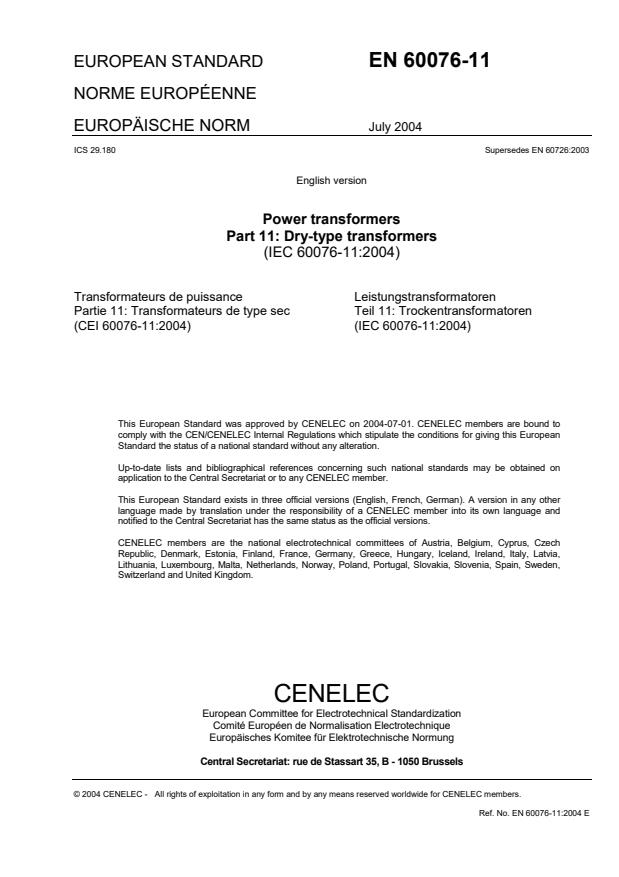
EUROPEAN STANDARD EN 60076-11
NORME EUROPÉENNE
EUROPÄISCHE NORM July 2004
ICS 29.180 Supersedes EN 60726:2003
English version
Power transformers
Part 11: Dry-type transformers
(IEC 60076-11:2004)
Transformateurs de puissance Leistungstransformatoren
Partie 11: Transformateurs de type sec Teil 11: Trockentransformatoren
(CEI 60076-11:2004) (IEC 60076-11:2004)
This European Standard was approved by CENELEC on 2004-07-01. CENELEC members are bound to
comply with the CEN/CENELEC Internal Regulations which stipulate the conditions for giving this European
Standard the status of a national standard without any alteration.
Up-to-date lists and bibliographical references concerning such national standards may be obtained on
application to the Central Secretariat or to any CENELEC member.
This European Standard exists in three official versions (English, French, German). A version in any other
language made by translation under the responsibility of a CENELEC member into its own language and
notified to the Central Secretariat has the same status as the official versions.
CENELEC members are the national electrotechnical committees of Austria, Belgium, Cyprus, Czech
Republic, Denmark, Estonia, Finland, France, Germany, Greece, Hungary, Iceland, Ireland, Italy, Latvia,
Lithuania, Luxembourg, Malta, Netherlands, Norway, Poland, Portugal, Slovakia, Slovenia, Spain, Sweden,
Switzerland and United Kingdom.
CENELEC
European Committee for Electrotechnical Standardization
Comité Européen de Normalisation Electrotechnique
Europäisches Komitee für Elektrotechnische Normung
Central Secretariat: rue de Stassart 35, B - 1050 Brussels
© 2004 CENELEC - All rights of exploitation in any form and by any means reserved worldwide for CENELEC members.
Ref. No. EN 60076-11:2004 E
Foreword
The text of document 14/476/FDIS, future edition 1 of IEC 60076-11, prepared by IEC TC 14, Power
transformers, was submitted to the IEC-CENELEC parallel vote and was approved by CENELEC as
EN 60076-11 on 2004-07-01.
This European Standard supersedes EN 60726:2003.
The following dates were fixed:
– latest date by which the EN has to be implemented
at national level by publication of an identical
national standard or by endorsement (dop) 2005-04-01
– latest date by which the national standards conflicting
with the EN have to be withdrawn (dow) 2007-07-01
Annex ZA has been added by CENELEC.
__________
Endorsement notice
The text of the International Standard IEC 60076-11:2004 was approved by CENELEC as a European
Standard without any modification.
__________
- 3 - EN 60076-11:2004
Annex ZA
(normative)
Normative references to international publications
with their corresponding European publications
The following referenced documents are indispensable for the application of this document. For dated
references, only the edition cited applies. For undated references, the latest edition of the referenced
document (including any amendments) applies.
NOTE Where an international publication has been modified by common modifications, indicated by (mod), the relevant
EN/HD applies.
Publication Year Title EN/HD Year
IEC 60050 Series International Electrotechnical Vocabulary- -
IEC 60071 Series Insulation co-ordination EN 60071 Series
IEC 60076-1 1993 Power transformers EN 60076-1 1997
(mod) Part 1: General A11 1997
A1 1999 A1 2000
A12 2002
1) 2)
IEC 60076-2 - Part 2: Temperature rise EN 60076-2 1997
(mod)
1) 2)
IEC 60076-3 - Part 3: Insulation levels, dielectric tests EN 60076-3 2001
and external clearances in air
1) 2)
IEC 60076-5 - Part 5: Ability to withstand short circuit EN 60076-5 2000
1) 2)
IEC 60076-10 - Part 10: Determination of sound levels EN 60076-10 2001
1)
IEC 60085 - Electrical insulation - Thermal - -
classification
1) 2)
IEC 60270 - High-voltage test techniques - Partial EN 60270 2001
discharge measurements
1)
IEC 60332-3-10 - Test on electric cables under fire - -
conditions
Part 3-10: Test for vertical flame spread
of vertically-mounted bunched wires or
cables - Apparatus
1) 2)
IEC 60529 - Degrees of protection provided by EN 60529 1991
enclosures (IP Code) + corr. May 1993
IEC 60905 1987 Loading guide for dry-type power - -
transformers
1) 2)
IEC 61330 - High-voltage/low-voltage prefabricated EN 61330 1996
substations
1)
Undated reference.
2)
Valid edition at date of issue.
NORME CEI
INTERNATIONALE IEC
60076-11
INTERNATIONAL
Première édition
STANDARD
First edition
2004-05
Transformateurs de puissance –
Partie 11:
Transformateurs de type sec
Power transformers –
Part 11:
Dry-type transformers
© IEC 2004 Droits de reproduction réservés ⎯ Copyright - all rights reserved
Aucune partie de cette publication ne peut être reproduite ni No part of this publication may be reproduced or utilized in any
utilisée sous quelque forme que ce soit et par aucun procédé, form or by any means, electronic or mechanical, including
électronique ou mécanique, y compris la photocopie et les photocopying and microfilm, without permission in writing from
microfilms, sans l'accord écrit de l'éditeur. the publisher.
International Electrotechnical Commission, 3, rue de Varembé, PO Box 131, CH-1211 Geneva 20, Switzerland
Telephone: +41 22 919 02 11 Telefax: +41 22 919 03 00 E-mail: inmail@iec.ch Web: www.iec.ch
CODE PRIX
PRICE CODE W
Commission Electrotechnique Internationale
International Electrotechnical Commission
ɆɟɠɞɭɧɚɪɨɞɧɚɹɗɥɟɤɬɪɨɬɟɯɧɢɱɟɫɤɚɹɄɨɦɢɫɫɢɹ
Pour prix, voir catalogue en vigueur
For price, see current catalogue
60076-11 © IEC:2004 – 3 –
CONTENTS
FOREWORD.9
1 Scope.13
2 Normative references.13
3 Definitions.15
4 Service conditions .15
4.1 General.15
4.2 Normal service conditions .15
4.3 Electromagnetic compatibility (EMC) .17
4.4 Provision for unusual service conditions .17
4.5 Transport and storage conditions .19
5 Tappings.19
6 Connections.19
7 Ability to withstand short circuit .19
8 Rating.21
8.1 General.21
8.2 Rated power.21
8.3 Preferred values of rated power .21
8.4 Operation at higher than rated voltage .21
8.5 Operation with fan cooling .21
8.6 Operation in an enclosure .21
9 Rating plate.23
9.1 Rating plate fitted to the transformer .23
9.2 Rating plate fitted to the transformer enclosure .23
10 Identification according to cooling method .23
10.1 Identification symbols.23
10.2 Arrangement of symbols.25
11 Temperature-rise limits.25
11.1 Normal temperature-rise limits.25
11.2 Reduced temperature rises for transformers designed for high cooling air
temperatures or special air cooling conditions .27
11.3 High altitude temperature rise correction .27
12 Insulation levels.27
12.1 General.27
12.2 Transformers for use at high altitudes .31
13 Climatic, environmental and fire behaviour classes.31
13.1 Climatic classes.31
13.2 Environmental classes.31
13.3 Fire behaviour classes.31
13.4 Test criteria for climatic, environmental and fire behaviour classes.33
14 General requirements for tests .33
15 Measurement of winding resistance (routine test) .33
60076-11 © IEC:2004 – 5 –
16 Measurement of voltage ratio and check of phase displacement (routine test) .35
17 Measurement of short-circuit impedance and load loss (routine test) .35
18 Measurement of no-load loss and current (routine test) .35
19 Separate-source AC withstand voltage test (routine test).35
20 Induced AC withstand voltage test (routine test) .35
21 Lightning impulse test (type test) .37
22 Partial discharge measurement (routine and special test) .37
22.1 General.37
22.2 Basic measuring circuit (typical only).37
22.3 Calibration of the measuring circuit .37
22.4 Voltage application.39
22.5 Partial discharge acceptance levels.41
23 Temperature-rise test (type test) .43
23.1 General.43
23.2 Methods of loading .43
23.3 Winding temperature-rise correction for reduced current .49
23.4 Determination of steady state conditions .49
24 Measurement of sound level (special test) .49
25 Short-circuit test (special test) .51
26 Environmental test (special test).51
26.1 General.51
26.2 Validity of the test .51
26.3 Testing procedure.51
27 Climatic test (special test) .53
27.1 Thermal shock test (special test) .53
27.2 Validity of the test .53
27.3 Thermal shock test for C1 class transformers .55
27.4 Thermal shock test for C2 class transformers .57
28 Fire behaviour test (special test) .57
28.1 General.57
28.2 Checking of corrosive and harmful gases emission.57
28.3 Fire behaviour test for F1 class transformer .59
28.4 Quantities to be measured and measuring devices .63
28.5 Calibration of the test chamber without test object.63
28.6 Test method.63
28.7 Test report.65
28.8 Criteria for evaluating the test results .65
29 Tolerances.67
30 Protection against direct contact.67
31 Degrees of protection provided by enclosures .67
32 Earthing terminal.67
33 Information required with enquiry and order.67
Annex A (informative) Installation and safety of dry-type transformers .73
60076-11 © IEC:2004 – 7 –
Figure 1 – Basic measuring circuit for the partial discharge test for a single-phase
transformer .39
Figure 2 – Basic measuring circuit for the partial discharge test for a three-phase
transformer .39
Figure 3 – Voltage application for routine partial discharge test .41
Figure 4 – Voltage application for special partial discharge test .41
Figure 5 – Example of back-to- back method – Single phase. .47
Figure 6 – Example of back-to-back method – Three-phase.47
Figure 7 – Test chamber .69
Figure 8 – Test chamber details.71
Table 1 – Letter symbols.25
Table 2 – Winding temperature-rise limits .27
Table 3 – Insulation levels based on European practice.29
Table 4 – Insulation levels based on North American practice.29
Table 5 – sequence of tests .33
Table 6 – Dimensions of test chamber (see Figures 7 and 8) .61
60076-11 © IEC:2004 – 9 –
INTERNATIONAL ELECTROTECHNICAL COMMISSION
____________
POWER TRANSFORMERS –
Part 11: Dry-type transformers
FOREWORD
1) The International Electrotechnical Commission (IEC) is a worldwide organization for standardization comprising
all national electrotechnical committees (IEC National Committees). The object of IEC is to promote
international co-operation on all questions concerning standardization in the electrical and electronic fields. To
this end and in addition to other activities, IEC publishes International Standards, Technical Specifications,
Technical Reports, Publicly Available Specifications (PAS) and Guides (hereafter referred to as “IEC
Publication(s)”). Their preparation is entrusted to technical committees; any IEC National Committee interested
in the subject dealt with may participate in this preparatory work. International, governmental and non-
governmental organizations liaising with the IEC also participate in this preparation. IEC collaborates closely
with the International Organization for Standardization (ISO) in accordance with conditions determined by
agreement between the two organizations.
2) The formal decisions or agreements of IEC on technical matters express, as nearly as possible, an international
consensus of opinion on the relevant subjects since each technical committee has representation from all
interested IEC National Committees.
3) IEC Publications have the form of recommendations for international use and are accepted by IEC National
Committees in that sense. While all reasonable efforts are made to ensure that the technical content of IEC
Publications is accurate, IEC cannot be held responsible for the way in which they are used or for any
misinterpretation by any end user.
4) In order to promote international uniformity, IEC National Committees undertake to apply IEC Publications
transparently to the maximum extent possible in their national and regional publications. Any divergence
between any IEC Publication and the corresponding national or regional publication shall be clearly indicated in
the latter.
5) IEC provides no marking procedure to indicate its approval and cannot be rendered responsible for any
equipment declared to be in conformity with an IEC Publication.
6) All users should ensure that they have the latest edition of this publication.
7) No liability shall attach to IEC or its directors, employees, servants or agents including individual experts and
members of its technical committees and IEC National Committees for any personal injury, property damage or
other damage of any nature whatsoever, whether direct or indirect, or for costs (including legal fees) and
expenses arising out of the publication, use of, or reliance upon, this IEC Publication or any other IEC
Publications.
8) Attention is drawn to the Normative references cited in this publication. Use of the referenced publications is
indispensable for the correct application of this publication.
9) Attention is drawn to the possibility that some of the elements of this IEC Publication may be the subject of
patent rights. IEC shall not be held responsible for identifying any or all such patent rights.
International Standard IEC 60076-11 has been prepared by IEC technical committee 14:
Power transformers.
This standard cancels and replaces IEC 60726 (1982) and its amendment 1 (1986).
The text of this standard is based on the following documents:
FDIS Report on voting
14/476/FDIS 14/484/RVD
Full information on the voting for the approval of this standard can be found in the report on
voting indicated in the above table.
This publication has been drafted in accordance with the ISO/IEC Directives, Part 2.
60076-11 © IEC:2004 – 11 –
IEC 60076 consists of the following parts, under the general title Power transformers:
Part 1: General
Part 2: Temperature rise
Part 3: Insulation levels, dielectric tests and external clearances in air
Part 4: Guide to lightning impulse and switching impulse testing – Power transformers
and reactors
Part 5: Ability to withstand short-circuit
Part 6: Reactors
Part 7: Loading guide for oil-immersed power transformers
Part 8: Application guide
Part 10: Determination of sound levels
Part 10-1: Determination of transformer and reactor sound levels – User guide
Part 11: Dry-type transformers
Part 12: Loading guide for dry-type power transformers
Part 13: Self protected liquid filled transformers
Part 14: Guide for the design and application of liquid-immersed power transformers
using high-temperature insulation materials
Part 15: Gas-filled-type power transformers
The committee has decided that the contents of this publication will remain unchanged until
2006. At this date, the publication will be
• reconfirmed;
• withdrawn;
• replaced by a revised edition, or
• amended.
___________
Under consideration.
60076-11 © IEC:2004 – 13 –
POWER TRANSFORMERS –
Part 11: Dry-type transformers
1 Scope
This part of IEC 60076 applies to dry-type power transformers (including auto-transformers)
having values of highest voltage for equipment up to and including 36 kV and at least one
winding operating at greater than 1,1 kV. The standard applies to all construction
technologies.
This standard does not apply to:
– gas-filled dry type transformers where the gas is not air;
– single-phase transformers rated at less than 5 kVA;
– polyphase transformers rated at less than 15 kVA;
– instrument transformers (see IEC 60044 and IEC 60186);
– starting transformers;
– testing transformers;
– traction transformers mounted on rolling stock;
– flameproof and mining transformers;
– welding transformers;
– voltage regulating transformers;
– small power transformers in which safety is a special consideration.
Where IEC standards do not exist for the transformers mentioned above or for other special
transformers, this standard may be applicable as a whole or in parts.
2 Normative references
The following referenced documents are indispensable for the application of this document.
For dated references, only the edition cited applies. For undated references, the latest edition
of the referenced document (including any amendments) applies.
IEC 60050 (all parts), International electrotechnical vocabulary (IEV)
IEC 60071 (all parts), Insulation co-ordination
IEC 60076-1:1993, Power transformers – Part 1: General
Amendment 1 (1999)
IEC 60076-2, Power transformers – Part 2: Temperature rise
IEC 60076-3, Power transformers – Part 3: Insulation levels, dielectric tests and external
clearances in air
60076-11 © IEC:2004 – 15 –
IEC 60076-5, Power transformers – Part 5: Ability to withstand short-circuit
IEC 60076-10, Power transformers – Part 10: Determination of sound levels
IEC 60085, Thermal evaluation and classification of electrical insulation
IEC 60270, High-voltage test techniques – Partial discharge measurements
IEC 60332-3-10, Tests on electric cables under fire conditions – Part 3-10: Test for vertical
flame spread of vertically-mounted bunched wires or cables – Apparatus
IEC 60529, Degrees of protection provided by enclosures (IP Code)
IEC 60905:1987, Loading guide for dry-type power transformers
IEC 61330, High-voltage/low voltage prefabricated substations
3 Terms and definitions
For the purpose of this part of IEC 60076, the following terms and definitions apply.
3.1
dry-type transformer
transformer of which the magnetic circuit and windings are not immersed in an insulating
liquid
3.2
totally enclosed dry-type transformer
transformer in an un-pressurised enclosure cooled by the circulation of the internal air
3.3
enclosed dry-type transformer
transformer in a ventilated enclosure cooled by the circulation of the external air
3.4
non-enclosed dry-type transformer
transformer supplied without a protective enclosure cooled by natural or forced air ventilation
4 Service conditions
4.1 General
The requirements of IEC 60076-1 apply to dry-type transformers only in so far as they are
referred to in this standard.
4.2 Normal service conditions
4.2.1 General
Unless otherwise stated, the service conditions in 4.2.2 to 4.2.6 apply. When transformers are
required to operate outside the normal service conditions, de-rating in accordance with 11.2
and/or 11.3 applies.
60076-11 © IEC:2004 – 17 –
4.2.2 Altitude
A height above sea level not exceeding 1 000 m.
4.2.3 Temperature of cooling air
The temperature of cooling air not exceeding:
40 °C at any time;
30 °C monthly average of the hottest month;
20 °C yearly average.
and not below:
–25 °C in the case of outdoor transformers;
–5 °C in the case of indoor transformers.
where the monthly and yearly averages are as defined in 3.12 of IEC 60076-1.
4.2.4 Wave-shape of supply voltage
A supply voltage of which the waveshape is approximately sinusoidal.
NOTE This requirement is normally not critical in public supply systems but may have to be considered in
installations with considerable converter loading. In such cases, there is a conventional rule that the deformation
shall neither exceed 5 % total harmonic content nor 1 % even harmonic content, see IEC 61000-2-4. Also note the
importance of current harmonics for load loss and temperature rise, see IEC 61378-1.
4.2.5 Symmetry of polyphase supply voltages
For three-phase transformers, a set of three-phase supply voltages which are approximately
symmetrical.
4.2.6 Humidity
The relative humidity of the surrounding air shall be less than 93 %. No drops of water shall
be present on the surface of the coils.
4.3 Electromagnetic compatibility (EMC)
Transformers shall be considered as passive elements in respect to emission and immunity to
electromagnetic disturbances.
4.4 Provision for unusual service conditions
The purchaser shall identify in his enquiry any service conditions not covered by the normal
service conditions in 4.2. Examples of such conditions are:
– high or low ambient temperature outside the limits prescribed in 4.2.3;
– restricted ventilation;
– altitude in excess of the limit prescribed in 4.2.2;
– damaging fumes and vapours;
– steam;
– humidity in excess of the limit prescribed in 4.2.6;
– dripping water;
– salt spray;
60076-11 © IEC:2004 – 19 –
– excessive and abrasive dust;
– high harmonic content of the load current;
– distortion of the supply voltage waveform;
– fast transient overvoltages over the limits prescribed in 12.1 and Clause 21;
– associated power factor correction and method of capacitor switching to limit inrush
current;
– superimposed DC current;
– seismic qualification which would otherwise require special considerations in the design;
– extreme mechanical shock and vibrations;
– transport and storage conditions not covered by the normal condition described in 4.5.
Transformer specification for operation under such abnormal conditions shall be subject to
agreement between the supplier and purchaser.
Supplementary requirements, within defined limits, for the rating and testing of transformers
designed for other than normal service conditions listed in 4.2, such as high temperature of
cooling air or altitude above 1 000 m are given in 11.2 and 11.3.
4.5 Transport and storage conditions
All transformers shall be suitable for transportation and storage at ambient temperatures
down to –25 °C.
The supplier shall be informed of anticipated high levels of shock, vibration and inclination
during transportation to site.
5 Tappings
The requirements in IEC 60076-1 Clause 5 applies. The preferred tapping range is either:
± 5 % in steps of 2,5 % (5 tap positions);
or
± 5 % (3 tap positions).
Tapping selection shall be made off-circuit by the use of bolted links or off-circuit tap-
changers.
6 Connections
Unless otherwise specified by the purchaser, transformer connections shall be Dyn with clock
hour figure 5 or 11 in accordance with Clause 6 of IEC 60076-1. The neutral connection shall
be capable of carrying full phase rated current.
7 Ability to withstand short circuit
Transformers shall fulfil the requirements in IEC 60076-5. If the purchaser requires a test to
demonstrate this fulfilment, this shall be stated in the contract.
60076-11 © IEC:2004 – 21 –
8 Rating
8.1 General
The manufacturer shall assign ratings to the transformer, which shall be marked on the rating
plate, see Clause 9. These ratings shall be such that the transformer can deliver its rated
current under steady loading conditions without exceeding the limits of temperature rise
specified in Clause 11, assuming that the applied primary voltage is equal to the rated voltage
and that the supply is at rated frequency.
8.2 Rated power
The transformer shall have an assigned rated power for each winding which shall be marked
on the rating plate. The transformer shall be fully rated when supplied in an enclosure. The
rated power refers to continuous loading. This is a reference value for guarantees and tests
concerning load losses, temperature rises and short-circuit impedance.
NOTE A two-winding transformer has only one value of rated power, identical for both windings. When the
transformer has rated voltage applied to the primary winding, and rated current flows through the terminals of that
winding, the transformer receives the relevant rated power for both windings.
The rated power corresponds to continuous duty; nevertheless, dry-type transformers
complying with this standard can be overloaded and guidance on overloads is given in
IEC 60905.
8.3 Preferred values of rated power
The preferred values shall be in accordance with 4.3 of IEC 60076-1 starting from 50 kVA.
8.4 Operation at higher than rated voltage
Within the prescribed value of U , a transformer shall be capable of service without damage
m
under conditions of overfluxing where the ratio of voltage over frequency exceeds the
corresponding ratio at rated voltage and rated frequency by no more than 5 %.
NOTE This requirement is not meant to be systematically utilised in normal service. The consequential increase in
iron losses under these conditions will have adverse effects and such operation should be of limited duration. This
condition should be reserved for relatively rare cases of service under limited periods of time, for example
emergency service or extreme peak loading.
8.5 Operation with fan cooling
When additional cooling by means of fans is provided, the nominal power rating with and
without fans shall be subject to agreement between purchaser and supplier.
The rating plate shall indicate both the power rating without fans and the maximum power
rating with fan cooling.
8.6 Operation in an enclosure
For operation in an enclosure that is not provided or later provided by the manufacturer of the
transformer, see Annex D of IEC 61330 and IEC 60905.
60076-11 © IEC:2004 – 23 –
9 Rating plate
9.1 Rating plate fitted to the transformer
Each transformer shall be provided with a rating plate of weatherproof material, fitted in a
visible position, showing the items indicated below. The entries on the plate shall be indelibly
marked (that is, by etching, engraving, stamping or by a photo-chemical process).
a) dry-type transformer;
b) number and year of this part of IEC 60076;
c) manufacturer’s name;
d) manufacturer’s serial number;
e) year of manufacture;
f) insulation system temperature for each winding. The first letter shall refer to the high
voltage winding, the second letter shall refer to the low voltage winding. When more than
two windings are present, the letters shall be placed in the order of the windings from the
high voltage to the low voltage;
g) number of phases;
h) rated power for each kind of cooling;
i) rated frequency;
j) rated voltages, including tapping voltages, if any;
k) rated currents for each kind of cooling;
l) connection symbol;
m) short-circuit impedance at rated current and at the appropriate referenced temperature;
n) type of cooling;
o) total mass;
p) insulation levels;
q) degree of protection;
r) environmental class;
s) climatic class;
t) fire behaviour class.
The rated withstand voltages for all windings shall appear on the rating plate. The principles
of the standard notation are illustrated in Clause 5 of IEC 60076-3.
9.2 Rating plate fitted to the transformer enclosure
Each transformer enclosure shall be provided with a rating plate of weatherproof material,
fitted in a visible position, showing the items indicated in 9.1. The entries on the plate shall be
indelibly marked (that is, by etching, engraving, stamping or by a photo-chemical process).
10 Identification according to cooling method
10.1 Identification symbols
Transformers shall be identified according to the cooling method employed. Letter symbols for
use in connection with each cooling method shall be as given in Table 1.
60076-11 © IEC:2004 – 25 –
Table 1 – Letter symbols
Symbol
Type of cooling medium Air A
Natural N
Type of circulation
Forced F
10.2 Arrangement of symbols
Transformers shall be identified by two symbols for each cooling method for which a rating is
assigned by the manufacturer, typically as follows:
– A transformer designed for natural air ventilation is designated AN.
– A transformer designed for natural air ventilation up to specified rating and with forced
cooling to a higher rating is designated AN/AF.
11 Temperature-rise limits
11.1 Normal temperature-rise limits
The temperature rise of each winding of the transformer, designed for operation at normal
service conditions, shall not exceed the corresponding limit specified in Table 2 when tested
in accordance with Clause 23.
The maximum temperature occurring in any part of the winding insulation system is called the
hot-spot temperature. The hot spot temperature shall not exceed the rated value of the hot-
spot winding temperature specified in Table 1 of IEC 60905. This temperature could be
measured, however an approximate value for practical purposes can be calculated by using
equation 1 in 4.2.4 of IEC 60905 with the values for Z and q given in 7.2 of IEC 60905.
Components used as insulating material may be used separately or in combination providing
that their temperature does not exceed the values given for the appropriate insulation system
temperature in accordance with the requirements as prescribed in the left hand column of
Table 2.
The temperature of the core, metallic parts and adjacent materials shall not reach a value that
will cause damage to any part of the transformer.
60076-11 © IEC:2004 – 27 –
Table 2 – Winding temperature-rise limits
Average winding temperature rise
Insulation system temperature
limits at rated current
(see Note 1)
(see Note 2)
°C
K
105 (A) 60
120 (E) 75
130 (B) 80
155 (F) 100
180 (H) 125
200 135
220 150
NOTE 1 Letters refer to the temperature classifications given in IEC 60085.
NOTE 2 Temperature rise measured in accordance with Clause 23.
11.2 Reduced temperature rises for transformers designed for high cooling air
temperatures or special air cooling conditions
When the transformer is designed for service where the temperature of the cooling air
exceeds one of the maximum values specified in 4.2.3, the temperature rise limits shall be
reduced by the same amount as the excess. The values shall be rounded to the nearest whole
number of K.
Any site conditions that may either impose restrictions on the cooling air or produce high
ambient air temperatures should be stated by the purchaser.
11.3 High altitude temperature rise correction
Unless otherwise agreed upon between the supplier and the purchaser, for transformers
designed for operation at an altitude greater than 1 000 m but tested at normal altitudes, the
limits of temperature rise given in Table 2 shall be reduced by the following amounts for each
500 m by which the intended working altitude exceeds 1 000 m:
natural-air-cooled transformers: 2,5 %;
forced-air-cooled transformers: 5 %.
A corresponding reverse correction may be applied in cases where the altitude of the test
room is above 1 000 m and the altitude of the installation site is below 1 000 m.
Any altitude correction shall be rounded to the nearest whole number of K.
12 Insulation levels
12.1 General
When transformers are intended for general power distribution in public or industrial systems,
the insulation levels shall be those given in Table 3, list 1 or list 2.
60076-11 © IEC:2004 – 29 –
Table 3 – Insulation levels based on European practice
Rated short duration Rated lightning impulse withstand voltage
Highest voltage for
separate source AC (peak value)
equipment U
m
withstand voltage kV
(r.m.s.)
(r.m.s.)
kV
List 1 List 2
kV
≤ 1,1 3 – –
3,6 10 20 40
20 40 60
7,2
28 60 75
12,0
38 75 95
17,5
50 95 125
24,0
36,0 70 145 170
The choice between list 1 and list 2 should be made considering the degree of exposure to
lightning and switching overvoltages, the type of system neutral earthing and, where
applicable, the type of overvoltage protective device, see IEC 60071.
Table 4 – Insulation levels based on North American practice
Dielectric insulation levels for dry type transformers used on system with BILs 200 kV and below
Low Basic Lightning Impulse Insulation Levels (BILs)
Nominal
Max LL frequency
in common use (peak value 1,2 µµµµs)
LL
system
voltage
system
voltage
insulation
voltage
level
10 20 30 45 60 95 110 125 150 200
kV
kV
kV r.m.s.
0,25 0,25 2,5 None
0,6 0,6 3 S 1 1
1,2 1,2 4 S 1 1
2,75 2,5 10 S 1 1
5,6 5 12 S 1 1
9,52 8,7 19 S 1 1
15,5 15 34 S 1 1
18,5 18 40 S 1 1
25,5 25 50 2 S 1 1
36,5 34,5 70 2 S 1
Impulse chopped wave:
1 1 1 1,3 2 2 1,8 2 2,3 2,7
minimum time to flash over (µs)
S = Standard values.
1 = Optional higher levels where exposure to overvoltage occurs and higher protective margins are required.
2 = Lower levels where surge arrester protective devices can be applied with lower spark-over levels.
60076-11 © IEC:2004 – 31 –
12.2 Transformers for use at high altitudes
When the transformers are specified for operation at altitudes between 1 000 m and 3 000 m
above sea-level, but tested at normal altitude, the rated short duration separate source AC
withstand voltage shall be increased by 1 % for each 100 m above 1 000 m. Above 3 000 m,
the insulation level shall be defined by agreement between supplier and purchaser.
13 Climatic, environmental and fire behaviour classes
13.1 Climatic classes
Two climatic classes are defined:
Class C1: The transformer is suitable for operation at ambient temperature not below –5°C
but may be exposed during transport and storage to ambient temperatures down
to –25°C.
Class C2: The transformer is suitable for operation, transport and storage at ambient
temperatures down to –25°C.
Special tests according to Clause 27 shall confirm the conformity of C1 and C2 class
transformers.
NOTE Transformers for outdoor operation should normally be provided with an enclosure or be given other
suitable protection.
13.2 Environmental classes
Environmental conditions for dry-type transformers are identified in terms of humidity,
condensation, pollution and ambient temperature.
NOTE These are important not only during service but also during storage before installation.
With regard to humidity, condensation and pollution, three different environmental classes are
defined:
Class E0: No condensation occurs on the transformers and pollution is negligible. This is
commonly achieved in a clean, dry indoor installation.
Class E1: Occasional condensation can occur on the transformer (for example, when the
transformer is de-energised). Limited pollution is possible.
Class E2: Frequent condensation or heavy pollution or combination of both.
Special tests according to the procedure of Clause 26 shall confirm the conformity of E1 or E2
class transformers.
13.3 Fire behaviour classes
Two fire behaviour classes are defined:
Class F0: There is no special fire risk to consider. Except for the characteristics inherent in
the design of the transformer, no special measures are taken to limit flammability.
Nevertheless, the emission of toxic substances and opaque smoke shall be
minimized.
Class F1: Transformers subject to a fire hazard. Restricted flammability is required. The
emission of toxic substances and opaque smokes shall be minimised.
60076-11 © IEC:2004 – 33 –
Special tests according to the procedure of Clause 28 shall confirm the conformity of class F1
transformers.
NOTE Measurements made in conformity with Clause 28 tend to result in a standard deviation ≤10 K.
13.4 Test criteria for climatic, environmental and fire behaviour classes
When a transformer is declared as suitable for a combination of climatic, environmental and
fire behaviour classes, those tests which prove compliance with said classes, are to be
carried out on the same transformer in the sequence given in Table 5.
The tests specified in Clauses 26, 27 and 28 shall be carried out as specified on one
transformer being representative of the design type.
Table 5 – Sequence of tests
Classes Climatic Environmental Fire behaviour
Tests Clause C1 C2 E0 E1 E2 F0 F1
1 Thermal shock at –5 °C 27.3 Yes No - - - - -
2 Thermal shock at –25 °C 27.4 No Yes - - - - -
3 Condensation test 26.3.1 - - No
...