


prEN IEC 60079-0:2024
(Main)Explosive atmospheres - Part 0: Equipment - General requirements
Explosive atmospheres - Part 0: Equipment - General requirements
Explosionsgefährdete Bereiche - Teil 0: Betriebsmittel - Allgemeine Anforderungen
Atmosphères explosives - Partie 0: Appareils - Exigences générales
Eksplozivne atmosfere - 0. del: Oprema - Splošne zahteve
General Information
- Status
- Not Published
- Publication Date
- 25-Jan-2026
- Technical Committee
- CLC/TC 31 - Electrical apparatus for explosive atmospheres - General requirements
- Drafting Committee
- IEC/TC 31 - Electrical apparatus for potentially explosive atmospheres
- Current Stage
- 4060 - Enquiry results established and sent to TC, SR, BTTF - Enquiry
- Start Date
- 27-Sep-2024
- Completion Date
- 27-Sep-2024
Relations
- Revises
EN IEC 60079-0:2018/A11:2024 - Explosive atmospheres - Part 0: Equipment - General requirements - Effective Date
- 23-Apr-2024
- Revises
EN IEC 60079-0:2018/AC:2020-02 - Explosive atmospheres - Part 0: Equipment - General requirements - Effective Date
- 26-Oct-2021
- Effective Date
- 26-Oct-2021
Overview
The standard prEN IEC 60079-0:2024 titled Explosive atmospheres - Part 0: Equipment - General requirements is a comprehensive guideline published by the CLC (European Committee for Electrotechnical Standardization). It addresses the essential general requirements for equipment intended for use in explosive atmospheres, ensuring safety, reliability, and compliance in hazardous environments.
This latest edition, expected to be stable until 2029, serves as a horizontal standard relating to electrical apparatus used in explosive atmospheres, covering various critical aspects such as temperature limits, material properties, mechanical strength, and protection concepts.
Key Topics
Equipment Grouping and Classification
The standard classifies equipment into Groups I, II, and III, covering mining and surface industries, and different types of explosive atmospheres (gas, vapor, dust). This classification ensures the appropriate application of safety measures per environment type.Temperature Controls
Maximum surface temperature limits are specified to prevent ignition sources. The standard details how environmental conditions, such as ambient temperature and external heat sources, affect equipment temperature ratings.Material Requirements
Both metallic and non-metallic enclosures are examined in depth, including resistance to ultraviolet light, thermal endurance, and prevention of electrostatic charge build-up, which is critical for safety in explosive atmospheres.Mechanical and Electrical Integrity
Mechanical strength requirements, gasket retention, and securing electrical connections are addressed to maintain enclosure integrity against environmental and operational stresses.Connection Facilities
Guidelines for cable glands, earthing, bonding, and other connection provisions ensure safe interfaces within and between equipment enclosures.Special Components and Supplementary Requirements
The standard sets detailed requirements for components such as fasteners, interlocking devices, bushings, and Ex components, as well as supplementary provisions for electric machines, switchgear, plugs, luminaires, and battery-powered equipment.Documentation & Testing
Detailed documentation requirements (drawings, compliance reports) and type test procedures to verify adherence to the standard support manufacturers and users in quality assurance and regulatory compliance.
Applications
This standard is vital for manufacturers, designers, testing laboratories, and compliance bodies involved in:
- Designing and manufacturing electrical equipment used in explosive gas and dust atmospheres such as oil and gas facilities, chemical plants, coal mines, and grain handling industries.
- Ensuring safety equipment like switchgear, luminaires, caplights, and batteries meet stringent safety assessments.
- Regulatory compliance and certification processes in European and international markets where explosive atmospheres are present.
- Enhancing workplace safety, environmental protection, and operational reliability in hazardous locations.
Related Standards
- IEC 60079 series - Explosive atmospheres standards covering specific protection techniques like flameproof enclosures (Ex d), increased safety (Ex e), intrinsic safety (Ex i).
- ISO/IEC standards related to electrical safety and equipment testing.
- National standards harmonized under the CENELEC framework for European market conformity.
Keywords: explosive atmospheres, electrical equipment, IEC 60079-0, equipment general requirements, hazardous locations, explosion protection, temperature control, material specifications, mechanical strength, electrical connections, intrinsic safety, hazardous area certification, CLC standards.


Get Certified
Connect with accredited certification bodies for this standard

Intertek Testing Services NA Inc.
Intertek certification services in North America.

UL Solutions
Global safety science company with testing, inspection and certification.

ANCE
Mexican certification and testing association.
Sponsored listings
Frequently Asked Questions
prEN IEC 60079-0:2024 is a draft published by CLC. Its full title is "Explosive atmospheres - Part 0: Equipment - General requirements". This standard covers: Explosive atmospheres - Part 0: Equipment - General requirements
Explosive atmospheres - Part 0: Equipment - General requirements
prEN IEC 60079-0:2024 is classified under the following ICS (International Classification for Standards) categories: 29.260.20 - Electrical apparatus for explosive atmospheres. The ICS classification helps identify the subject area and facilitates finding related standards.
prEN IEC 60079-0:2024 has the following relationships with other standards: It is inter standard links to EN IEC 60079-0:2018/A11:2024, EN IEC 60079-0:2018/AC:2020-02, EN IEC 60079-0:2018. Understanding these relationships helps ensure you are using the most current and applicable version of the standard.
prEN IEC 60079-0:2024 is associated with the following European legislation: EU Directives/Regulations: 2008/68/EC, 2014/34/EU; Standardization Mandates: M/596, M/BC/CEN/92/46. When a standard is cited in the Official Journal of the European Union, products manufactured in conformity with it benefit from a presumption of conformity with the essential requirements of the corresponding EU directive or regulation.
prEN IEC 60079-0:2024 is available in PDF format for immediate download after purchase. The document can be added to your cart and obtained through the secure checkout process. Digital delivery ensures instant access to the complete standard document.
Standards Content (Sample)
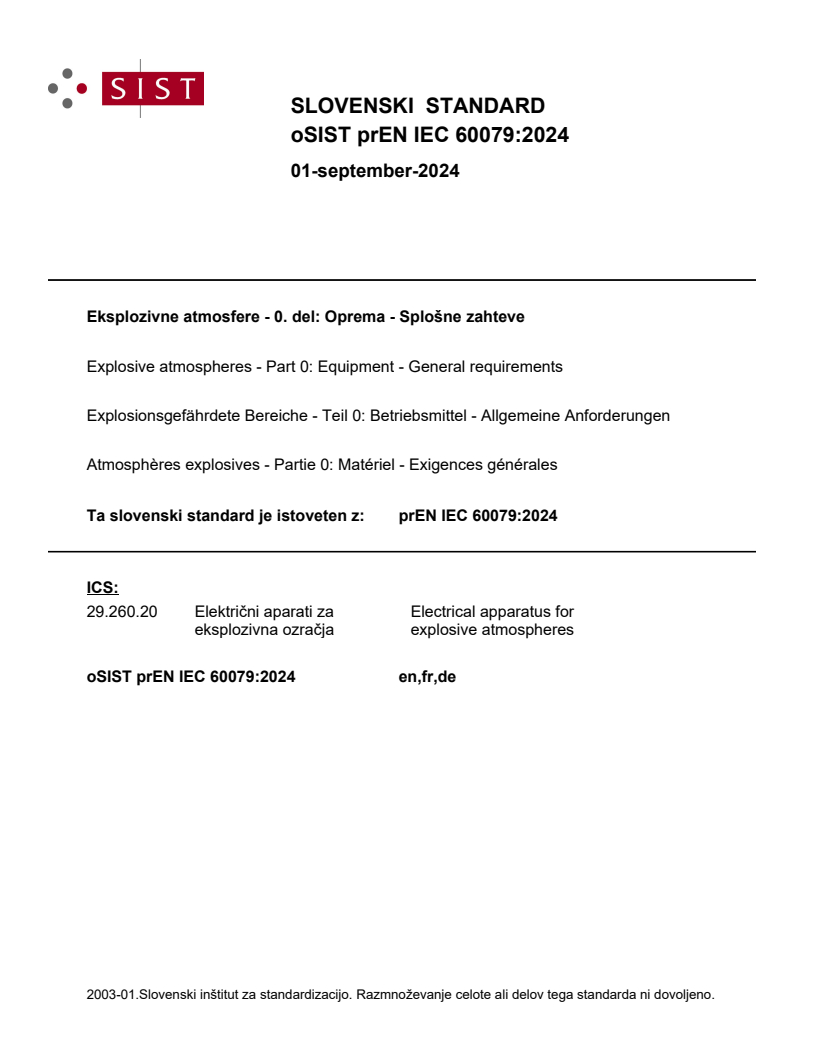
SLOVENSKI STANDARD
01-september-2024
Eksplozivne atmosfere - 0. del: Oprema - Splošne zahteve
Explosive atmospheres - Part 0: Equipment - General requirements
Explosionsgefährdete Bereiche - Teil 0: Betriebsmittel - Allgemeine Anforderungen
Atmosphères explosives - Partie 0: Matériel - Exigences générales
Ta slovenski standard je istoveten z: prEN IEC 60079:2024
ICS:
29.260.20 Električni aparati za Electrical apparatus for
eksplozivna ozračja explosive atmospheres
2003-01.Slovenski inštitut za standardizacijo. Razmnoževanje celote ali delov tega standarda ni dovoljeno.
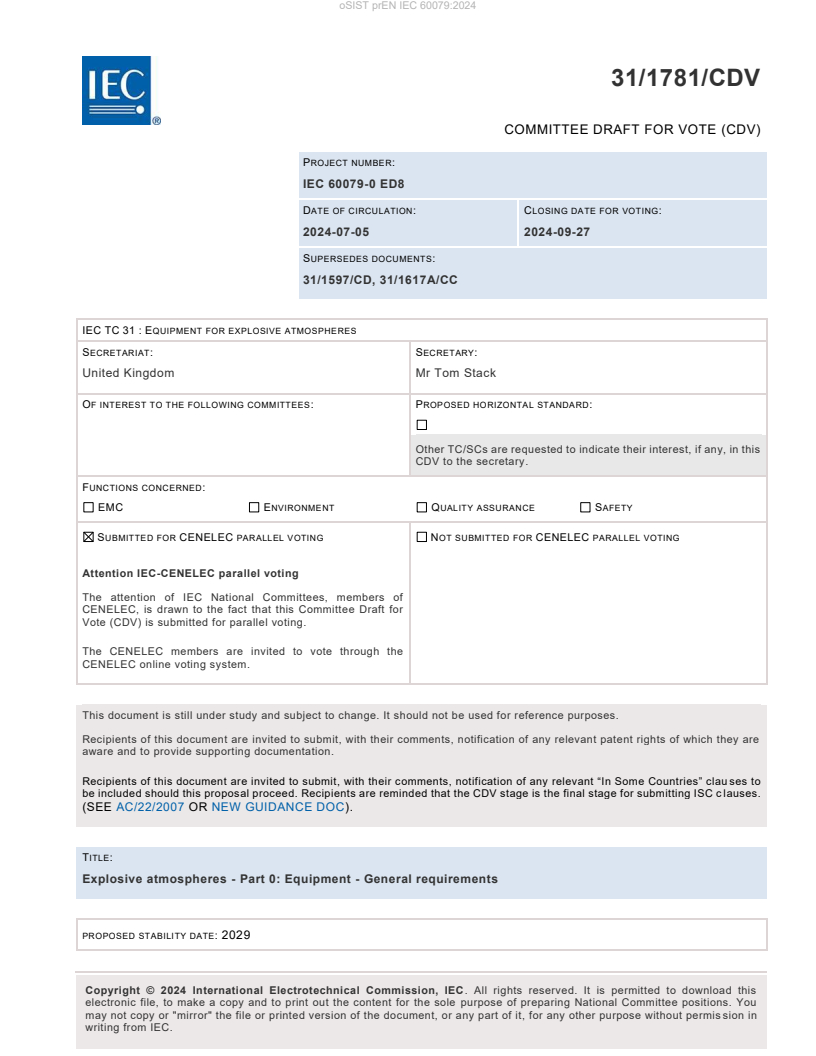
31/1781/CDV
COMMITTEE DRAFT FOR VOTE (CDV)
PROJECT NUMBER:
IEC 60079-0 ED8
DATE OF CIRCULATION: CLOSING DATE FOR VOTING:
2024-07-05 2024-09-27
SUPERSEDES DOCUMENTS:
31/1597/CD, 31/1617A/CC
IEC TC 31 : EQUIPMENT FOR EXPLOSIVE ATMOSPHERES
SECRETARIAT: SECRETARY:
United Kingdom Mr Tom Stack
OF INTEREST TO THE FOLLOWING COMMITTEES: PROPOSED HORIZONTAL STANDARD:
Other TC/SCs are requested to indicate their interest, if any, in this
CDV to the secretary.
FUNCTIONS CONCERNED:
EMC ENVIRONMENT QUALITY ASSURANCE SAFETY
SUBMITTED FOR CENELEC PARALLEL VOTING NOT SUBMITTED FOR CENELEC PARALLEL VOTING
Attention IEC-CENELEC parallel voting
The attention of IEC National Committees, members of
CENELEC, is drawn to the fact that this Committee Draft for
Vote (CDV) is submitted for parallel voting.
The CENELEC members are invited to vote through the
CENELEC online voting system.
This document is still under study and subject to change. It should not be used for reference purposes.
Recipients of this document are invited to submit, with their comments, notification of any relevant patent rights of which they are
aware and to provide supporting documentation.
Recipients of this document are invited to submit, with their comments, notification of any relevant “In Some Countries” clau ses to
be included should this proposal proceed. Recipients are reminded that the CDV stage is the final stage for submitting ISC c lauses.
(SEE AC/22/2007 OR NEW GUIDANCE DOC).
TITLE:
Explosive atmospheres - Part 0: Equipment - General requirements
PROPOSED STABILITY DATE: 2029
electronic file, to make a copy and to print out the content for the sole purpose of preparing National Committee positions. You
may not copy or "mirror" the file or printed version of the document, or any part of it, for any other purpose without permis sion in
writing from IEC.
31/1781/CDV – 2 – IEC CDV 60079-0 © IEC:2024
NOTE FROM TC/SC OFFICERS:
Please refer to 31/1783/INF for the track version of the CDV.
IEC CDV 60079-0 © IEC:2024 – 3 – 31/1781/CDV
2 CONTENTS
3 CONTENTS . 1
4 FOREWORD .10
5 1 Scope .21
6 2 Normative references .22
7 3 Terms and definitions .24
8 4 Equipment grouping .45
9 4.1 General .45
10 4.2 Group I .45
11 4.3 Group II.45
12 4.4 Group III.46
13 4.5 Equipment for a particular explosive gas atmosphere .46
14 5 Temperatures .46
15 5.1 Environmental influences .46
16 5.1.1 Ambient temperature .46
17 5.1.2 External source of heating or cooling .46
18 5.1.3 Service temperature, T .47
S
19 5.2 Maximum surface temperature .47
20 5.2.1 Determination of maximum surface temperature .47
21 5.2.2 Limitation of maximum surface temperature .47
22 5.2.3 Small component temperature for Group I or Group II electrical equipment .49
23 5.2.4 Component temperature of smooth surfaces for Group I or Group II equipment50
24 6 Requirements for all equipment .50
25 6.1 General .50
26 6.2 Mechanical strength of equipment .50
27 6.3 Opening times .50
28 6.4 Circulating currents in enclosures .51
29 6.5 Gasket retention .51
30 6.6 Electromagnetic and ultrasonic energy radiating equipment .52
31 6.6.1 General .52
32 6.6.2 Ultrasonic sources .53
33 7 Non-metallic enclosures and non-metallic parts of enclosures .53
34 7.1 General .53
35 7.1.1 Applicability .53
36 7.1.2 Specification of materials .54
37 7.2 Thermal endurance .55
38 7.2.1 Tests for thermal endurance .55
39 7.2.2 Material selection .55
40 7.2.3 Alternative qualification of elastomeric sealing O-rings .55
41 7.3 Resistance to ultraviolet light .56
42 7.4 Electrostatic charges on external non-metallic materials .56
43 7.4.1 Applicability .56
44 7.4.2 Avoidance of a build-up of electrostatic charge for Group I or Group II .57
31/1781/CDV – 4 – IEC CDV 60079-0 © IEC:2024
45 7.5 Attached external conductive parts .62
46 7.6 Electrostatic charges of cable sheaths .63
47 8 Metallic enclosures and metallic parts of enclosures .63
48 8.1 Material composition .63
49 8.2 Group I .63
50 8.3 Group II.63
51 8.4 Group III.63
52 8.5 Copper Alloys.64
53 9 Fasteners .64
54 9.1 General requirements for fasteners .64
55 9.2 Special fasteners .64
56 9.2.1 General .64
57 9.2.2 Holes for special fasteners .65
58 10 Interlocking devices .66
59 11 Bushings .66
60 12 (Reserved for future use) .66
61 13 Ex Components .66
62 13.1 General .66
63 13.2 Mounting .67
64 13.3 Internal mounting .67
65 13.4 External mounting .67
66 13.5 Ex Component certificate .67
67 14 Connection facilities .67
68 14.1 General .67
69 14.2 Type of Protection .67
70 14.3 Creepage and clearance .68
71 15 Connection facilities for earthing or bonding conductors .68
72 15.1 Equipment requiring earthing or bonding .68
73 15.1.1 Internal earthing.68
74 15.1.2 External bonding .68
75 15.1.3 Electrostatic bonding .68
76 15.2 Equipment not requiring earthing.68
77 15.3 Size of protective earthing conductor connection .69
78 15.4 Size of equipotential bonding conductor connection .69
79 15.5 Protection against corrosion .69
80 15.6 Secureness of electrical connections.69
81 15.7 Internal earth continuity plate .69
82 16 Entries into enclosures .70
83 16.1 General .70
84 16.2 Identification of entries .70
85 16.3 Cable glands .70
86 16.4 Blanking elements .71
87 16.5 Thread adapters .71
88 16.6 Temperature at branching point and entry point .71
89 17 Supplementary requirements for electric machines .72
90 17.1 General .72
IEC CDV 60079-0 © IEC:2024 – 5 – 31/1781/CDV
91 17.2 Ventilation and cooling .72
92 17.2.1 Openings .72
93 17.2.2 External fans .73
94 17.2.3 Auxiliary motor cooling fans .73
95 17.2.4 Room ventilating fans .74
96 17.3 Bearings .75
97 18 Supplementary requirements for switchgear.75
98 18.1 Flammable dielectric .75
99 18.2 Disconnectors .75
100 18.3 Group I – Provisions for locking .76
101 18.4 Doors and covers .76
102 19 Supplementary requirements for factory-wiring between enclosures .76
103 20 Supplementary requirements for external plugs, socket-outlets and connectors for field
104 wiring connection .76
105 20.1 General .76
106 20.2 Explosive gas atmospheres .77
107 20.3 Explosive dust atmospheres .77
108 20.4 Energized plugs .77
109 21 Supplementary requirements for luminaires .77
110 21.1 General .77
111 21.2 Covers for luminaires of EPL Mb, EPL Gb, or EPL Db .78
112 21.3 Covers for luminaires of EPL Gc or EPL Dc .78
113 21.4 Sodium lamps .78
114 21.5 Replacement lamps .79
115 22 Supplementary requirements for caplights and handlights .79
116 22.1 Group I caplights .79
117 22.2 Group II and Group III caplights and handlights .79
118 23 Equipment incorporating cells and batteries .79
119 23.1 General .79
120 23.2 Interconnection of cells to form batteries .79
121 23.3 Electrochemical systems of cells and batteries .79
122 23.4 Cells in a battery .82
123 23.5 Ratings of batteries .82
124 23.6 Interchangeability .82
125 23.7 Prohibition of charging of primary batteries .82
126 23.8 Leakage .82
127 23.9 Connections .82
128 23.10 Orientation .82
129 23.11 Replacement of cells or batteries .83
130 23.12 Replaceable battery pack .83
131 24 Documentation .83
132 24.1 Schedule drawings .83
133 24.2 Related drawings .83
134 25 Compliance of prototype or sample with documents .83
135 26 Type tests .83
136 26.1 General .83
137 26.2 Test configuration .84
31/1781/CDV – 6 – IEC CDV 60079-0 © IEC:2024
138 26.3 Tests in explosive test mixtures .84
139 26.4 Tests of enclosures .84
140 26.4.1 Order of tests .84
141 26.4.2 Resistance to impact .86
142 26.4.3 Drop test .88
143 26.4.4 Acceptance criteria .88
144 26.4.5 Degree of protection (IP Code) by enclosures .88
145 26.5 Thermal tests .89
146 26.5.1 Temperature measurement .89
147 26.5.2 Thermal shock test .92
148 26.5.3 Small component ignition test (Group I and Group II) .92
149 26.6 Torque test for bushings .93
150 26.6.1 Test procedure.93
151 26.6.2 Acceptance criteria .94
152 26.7 Non-metallic enclosures or non-metallic parts of enclosures .94
153 26.7.1 General .94
154 26.7.2 Test temperatures .94
155 26.8 Thermal endurance to heat .94
156 26.9 Thermal endurance to cold .96
157 26.10 Resistance to UV light .96
158 26.10.1 General .96
159 26.10.2 Light exposure .97
160 26.10.3 Acceptance criteria .97
161 26.11 Resistance to chemical agents for Group I equipment .97
162 26.12 Earth continuity .97
163 26.13 Surface resistance test of parts of enclosures of non-metallic materials .99
164 26.14 Measurement of capacitance . 100
165 26.14.1 General . 100
166 26.14.2 Test procedure. 100
167 26.15 Verification of ratings of ventilating fans . 101
168 26.16 Alternative qualification of elastomeric sealing O-rings . 101
169 26.17 Transferred charge test . 101
170 26.17.1 Test equipment . 101
171 26.17.2 Test sample . 105
172 26.17.3 Test procedure. 105
173 27 Routine tests . 106
174 28 Manufacturer's responsibility . 106
175 28.1 Conformity with the Schedule Drawings . 106
176 28.2 Certificate . 107
177 28.3 Responsibility for marking . 107
178 29 Marking . 107
179 29.1 Applicability . 107
180 29.2 Location . 107
181 29.3 General . 107
182 29.4 Ex marking for explosive gas atmospheres . 108
183 29.5 Ex marking for explosive dust atmospheres . 110
184 29.6 Combined Types (or Levels) of Protection . 113
IEC CDV 60079-0 © IEC:2024 – 7 – 31/1781/CDV
185 29.7 Multiple Types of Protection . 113
186 29.8 Ga equipment using two independent Gb Types (or Levels) of Protection. 113
187 29.9 Boundary wall . 113
188 29.10 Ex Components . 113
189 29.11 Small Ex Equipment and small Ex Components . 114
190 29.12 Extremely small Ex Equipment and extremely small Ex Components . 114
191 29.13 Alternative marking of Ex Equipment and Ex Components using digital technology 115
192 29.14 Warning markings . 115
193 29.15 Cells and batteries . 115
194 29.16 Electric machines supplied by a converter . 116
195 29.17 Examples of marking . 116
196 30 Instructions . 121
197 30.1 General . 121
198 30.2 Cells and batteries . 122
199 30.3 Electric machines . 122
200 30.4 Ventilating fans . 123
201 30.5 Cable glands . 124
202 Annex A (normative) Supplementary requirements for cable glands . 125
203 A.1 General . 125
204 A.2 Constructional requirements . 125
205 A.2.1 Cable sealing . 125
206 A.2.2 Filling compounds . 126
207 A.2.3 Clamping . 126
208 A.2.4 Lead-in of cable . 127
209 A.2.5 Release by a tool . 127
210 A.2.6 Fixing . 127
211 A.2.7 Degree of protection (IP Code) rating . 127
212 A.3 Type tests . 127
213 A.3.1 Tests of clamping of non-armoured and braided cables. 127
214 A.3.2 Tests of clamping of armoured cables . 131
215 A.3.3 Type test for resistance to impact . 132
216 A.3.4 Test for degree of protection (IP Code) rating of cable glands . 133
217 A.4 Marking . 134
218 A.4.1 Marking of cable glands . 134
219 A.4.2 Identification of cable-sealing rings . 134
220 A.5 Instructions . 134
221 Annex B (normative) Requirements for Ex Components . 136
222 Annex C (informative) Example of rig for resistance to impact test . 139
223 Annex D (informative) Electric machines supplied by a converter . 140
224 Annex E (informative) Temperature evaluation of electric machines . 141
225 Annex F (informative) Guidance flowchart for tests of non-metallic enclosures or non-metallic
226 parts of enclosures (26.4) . 144
227 Annex G (informative) Guidance flowchart for tests of cable glands . 145
228 Annex H (informative) Shaft voltages resulting in motor bearing or shaft brush sparking
229 Discharge energy calculation . 146
230 H.1 General . 146
231 H.2 Assessment of the risk of ignition using ignition energy calculation . 146
31/1781/CDV – 8 – IEC CDV 60079-0 © IEC:2024
232 H.3 Shaft voltage determination for a rotating machine . 147
233 H.4 Capacitance “C” calculation for a rotating machine . 148
234 H.5 Energy “E” calculation for a rotating machine . 150
235 H.6 Assessment using reference curves . 150
236 Bibliography . 152
238 Figure 1 – Typical battery examples .26
239 Figure 2 – Typical battery compartment .28
240 Figure 3 – Typical replaceable battery pack .29
241 Figure 4 – Shield with electrostatic bonding .59
242 Figure 5 – Cylindrical shield with electrostatic bonding .59
243 Figure 6 – Tolerances and clearance for threaded fasteners .65
244 Figure 7 – Contact surface under head of fastener with a reduced shank .66
245 Figure 8 – Cable gland .72
246 Figure 9 – Conduit entry .72
247 Figure 10 – Assembly of test sample for earth-continuity test .99
248 Figure 11 – Test piece with painted electrodes . 100
249 Figure 12 – Compression set of an O-ring . 101
250 Figure 13 – Correct non-oscillating pulse trace (2) and Math1 trace (M1) . 102
251 Figure 14 – Faulty oscillating pulse trace (2) and Math1 trace (M1) . 103
252 Figure 15 – Shunt with four parallel resistors . 103
253 Figure 16 – Schematic drawing of the method shunt and oscilloscope . 104
254 Figure 17 – Zero-line trace (2) with low zero-point noise and Math1 trace (M1) . 104
255 Figure A.1 – Illustration of the terms used for cable glands . 126
256 Figure A.2 – Rounded edge of the point of entry of the flexible cable . 127
257 Figure A.3 – Seal with multiple openings . 128
258 Figure A.4 – Example of rig for resistance to impact test . 133
259 Figure C.1 – Example of rig for resistance to impact test . 139
260 Figure F.1 – Non-metallic enclosures or non-metallic parts of enclosures . 144
261 Figure H.1 – Capacitance stored in bearing clearance of sleeve bearing Between journal and
262 outer bearing housing . 149
263 Figure H.2 – Air-gap between stator and rotor . 149
264 Figure H.3 – Typical surfaces that form capacitors from the motor shaft to earth . 150
265 Figure H.4 – Capacitive ignition curves . 151
267 Table 1 – Classification of maximum surface temperatures for Group II equipment .48
268 Table 2 – Assessment of temperature classification according to component size .49
269 Table 3 – Assessment of temperature classification Component surface area ≥ 20 mm .49
270 Table 4 – Threshold power .52
271 Table 5 – Threshold energy.52
272 Table 6 – Limitation of surface areas .59
273 Table 7 – Maximum diameter or width .59
274 Table 8 – Limitation of thickness of non-metallic layer .60
IEC CDV 60079-0 © IEC:2024 – 9 – 31/1781/CDV
275 Table 9 – Maximum transferred charge .60
276 Table 10 – Maximum capacitance of unearthed conductive parts .62
277 Table 11 – Minimum cross-sectional area of PE conductors .69
278 Table 12 – Primary cells .80
279 Table 13 – Secondary cells .80
280 Table 14 – Impact tests .87
281 Table 14 – Torque to be applied to the stem of bushing used for connection facilities .94
282 Table 15 – Thermal endurance test .95
283 Table 16 – Thermal endurance tests – personal and portable equipment .96
284 Table 17 – Text of warning markings . 115
285 Table 18 – Example of converter parameters . 123
286 Table B.1 – Applicability of clauses to Ex Components . 136
287 Table H.1 – Maximum permitted energy . 147
31/1781/CDV – 10 – IEC CDV 60079-0 © IEC:2024
290 INTERNATIONAL ELECTROTECHNICAL COMMISSION
291 ____________
293 EXPLOSIVE ATMOSPHERES –
295 Part 0: Equipment – General requirements
297 FOREWORD
298 1) The International Electrotechnical Commission (IEC) is a worldwide organization for standardization comprising all national
299 electrotechnical committees (IEC National Committees). The object of IEC is to promote international co -operation on all
300 questions concerning standardization in the electrical and electronic fields. To this end and in addition to other activities ,
301 IEC publishes International Standards, Technical Specifications, Technical Reports, Publicly Available Specifications (PAS)
302 and Guides (hereafter referred to as “IEC Publication(s)”). Their preparation is entrusted to technical committees; any IEC
303 National Committee interested in the subject dealt with may participate in this preparatory work. International, governmental
304 and non-governmental organizations liaising with the IEC also participate in this preparation. IEC collaborates closely with
305 the International Organization for Standardization (ISO) in accordance with conditions determined by agreement between
306 the two organizations.
307 2) The formal decisions or agreements of IEC on technical matters express, as nearly as possible, an international consensus
308 of opinion on the relevant subjects since each technical committee has representation from all interested IEC National
309 Committees.
310 3) IEC Publications have the form of recommendations for international use and are accepted by IEC National Committees in
311 that sense. While all reasonable efforts are made to ensure that the technical content of IEC Publications is accurate, IEC
312 cannot be held responsible for the way in which they are used or for any misinterpretation by any end user.
313 4) In order to promote international uniformity, IEC National Committees undertake to apply IEC Publications transparently to
314 the maximum extent possible in their national and regional publications. Any divergence between any IEC Publication and
315 the corresponding national or regional publication shall be clearly indicated in the latter.
316 5) IEC itself does not provide any attestation of conformity. Independent certification bodies provide conformity assessment
317 services and, in some areas, access to IEC marks of conformity. IEC is not responsible for any services carried out by
318 independent certification bodies.
319 6) All users should ensure that they have the latest edition of this publication.
320 7) No liability shall attach to IEC or its directors, employees, servants or agents including individual experts and members of
321 its technical committees and IEC National Committees for any personal injury, property damage or other damage of any
322 nature whatsoever, whether direct or indirect, or for costs (including legal fees) and expenses arising out of the publicatio n,
323 use of, or reliance upon, this IEC Publication or any other IEC Publications.
324 8) Attention is drawn to the Normative references cited in this publication. Use of the referenced publications is indispensable
325 for the correct application of this publication.
326 9) Attention is drawn to the possibility that some of the elements of this IEC Publication may be the subject of patent rights.
327 IEC shall not be held responsible for identifying any or all such patent rights.
328 International Standard IEC 60079-0 has been prepared by IEC technical committee 31: Equipment for
329 explosive atmospheres.
330 This eighth edition cancels and replaces the seventh edition, published in 2017. This edition constitutes
331 a technical revision.
332 Users of this document are advised that interpretation sheets clarifying the interpretation of this document can be
333 published. Interpretation sheets are available from the IEC webstore and can be found in the “history” tab of the
334 page for each document.
IEC CDV 60079-0 © IEC:2024 – 11 – 31/1781/CDV
335 The significance of the changes between IEC 60079-0, Edition 7 (2017) and IEC 60079-0, Edition 8 (20XX) are
336 as listed below:
31/1781/CDV – 12 – IEC CDV 60079-0 © IEC:2024
Type
Minor and Major
editorial technical
Explanation of the significance of the changes Clause Extension
changes changes
Equipment replaced by Ex Equipment where
General X
appropriate
Electrical equipment replaced by equipment where
General X
appropriate
Use of term degree of protection (IP Code) reviewed
General X
throughout the document for consistency
Clarify the use of volume fraction terms General X
Clarified the documentation is more clearly specified
General X
as Schedule Drawings.
Added Note 4 to address short-term thermal
1 X
excursions
IEXC TS 60079-46 added 1 X
IEC TS 60079-47 is added 1 X
IEC 62784 is added 1 X
ISO 80079-37 is added 1 X
IEC 60079-20-1 is replaced by ISO/IEC 80079-20-1 1 X
IEC 60243-2 is added 2 X
Admitted term minimum ignition temperature of an
explosive gas atmosphere added. Standard number 3.6 X
corrected
Definition for reverse charging clarified 3.7.10 X
Figure added to typical battery compartment 3.7.14
Definition for brush discharge added 3.8 X
Definition for bushing clarified to be a insulating device 3.10 X
Note 1 to entry for certificate revised to use
declaration, acceptance, and certification terms in 3.13 X
accordance with ISO/IEC 17000
Note 1 to entry for coating added to clarify application
3.14 X
in standards for explosive atmospheres
Definition for continuous operating temperature revised
to show that it is a manufacturer defined property. 3.21 X
Added admitted term continuous service temperature
Term comparable converter added along with domain
3.22.1 X
added
Definition for dust clarified along with Note 1 to entry 3.25 X
Note 2 to entry for conductive dust added to clarify
3.25.1.1 X
how metal
...
Questions, Comments and Discussion
Ask us and Technical Secretary will try to provide an answer. You can facilitate discussion about the standard in here.
Loading comments...