


prEN 50749-1:2025
(Main)Alarm Systems - Hazard Warning Systems - Part 1: Hazard warning systems for use in residential buildings - System requirements
Alarm Systems - Hazard Warning Systems - Part 1: Hazard warning systems for use in residential buildings - System requirements
This document applies to the planning, installation, operation, and maintenance of hazard warning systems (HWS) for use in residential buildings, flats, and rooms with flat-like use. It also specifies basic requirements and provisions for reliable interconnection of safety and security technology with smart home systems or active assisted living (AAL) systems and applications. Furthermore, it describes basic requirements for devices and systems or references to respective standards and specifications. This document does not override or in any way limit existing European standards. Hazard warning systems are used for early warning of persons to avoid or reduce personal injury and damage to property, which can result from intrusion, hold-up, fire, dangerous gases, and water ingress as well as technical defects of building services. HWS can also be used in residential properties in the event of duress/harassment and, for communication with persons in emergency situations who are present in the property covered by the HWS or to initiate controls in building services because of the aforementioned events. HWS can be designed in compliance with this standard as a self-contained system, or as HWS with connection of Smart Home components, or as a HWS that is a Smart Home system with integrated security applications. For the purposes of this document, the term “smart home” includes all networked systems and or web-based technical processes or IoT devices that are used in residential properties. This includes also, for example, remotely controllable devices such as cameras, entertainment electronics, household appliances, heating, air conditioning, ventilation (HVAC), electrical control components, door/gate/window openings and others. For the purposes of this document, AAL systems are assistance systems that support everyday life and are usually used in combination with services to provide needs-based support in the home environment for people with special needs. In most cases, AAL systems are web- or IoT-based. AAL systems and components are tailored to the individual needs of their users and their living environment and are networked with the building technology and security technology (in this case the HWS) for safety reasons to provide the user with the best possible support to make sure they react appropriately and in time to the situation in the event of an emergency. The task of AAL systems often includes recognizing critical health conditions of their users and initiating appropriate measures. For the purposes of this document, the term networking also means any integration of systems into the HWS and in many cases the connection to smart devices (e.g. smartphone, tablet, PC) via the Internet in conjunction with a specific application software (app). This standard can also be applied when systems are connected to the HWS and themselves use a connection to the Internet to outsource functional intelligence and utilize opportunities to automate processes across application areas, which can be either local, remote or a combination. Any notification or change in status of the HWS or its components can optionally be sent to other persons present in the building and/or to other locations/systems (e.g. emergency call centres [ERC]).
Alarmanlagen - Gefahrenwarnanlagen - Teil 1: Gefahrenwarnanlagen für den Einsatz in Wohngebäuden - Systemanforderungen
Systèmes d'alarme - Systèmes d'alerte de danger - Partie 1 : Systèmes d'alarme de danger pour l'utilisation dans les bâtiments résidentiels - Exigences du système
Le présent document s’applique à la planification, à l’installation, à l’utilisation et à la maintenance des systèmes d’alerte de danger (HWS) destinés à être utilisés dans les bâtiments résidentiels, les appartements et les locaux à usage assimilé à un logement. Il spécifie également les exigences de base et les dispositions pour une interconnexion fiable des technologies de sûreté et de sécurité avec les systèmes de maison intelligente (SHS) ou les systèmes et applications d’assistance à l’autonomie à domicile (AAD). En outre, le présent document décrit les exigences de base relatives aux dispositifs et systèmes, ou fournit des références aux normes et spécifications correspondantes. Le présent document ne remplace pas et ne limite en aucune manière les Normes européennes existantes. Les systèmes d’alerte de danger sont utilisés pour avertir de manière précoce les personnes afin d’éviter ou de réduire les blessures corporelles et les dommages matériels pouvant résulter d’une intrusion, d’un hold-up, d’un incendie, de la présence de gaz dangereux, d’une pénétration d’eau ou encore de défaillances techniques des branchements du bâtiment. Les systèmes d’alerte de danger (HWS) peuvent également être utilisés dans les propriétés résidentielles en cas d’agression ou de harcèlement, ainsi que pour la communication avec des personnes en situation d’urgence présentes dans la propriété couverte par le HWS, ou encore pour déclencher des contrôles sur les branchements du bâtiment en raison des événements précités. Les HWS peuvent être conçus, conformément à la présente norme, comme un système autonome, un HWS avec connexion à des composants de maison intelligente ou un HWS comportant des applications de sécurité intégrées. Pour les besoins du présent document, le terme "maison intelligente" englobe tous les systèmes en réseau et/ou les processus techniques basés sur le Web ou sur l’internet des objets (IdO) utilisés dans les propriétés résidentielles. Cela inclut notamment les dispositifs commandés à distance, comme les caméras, les équipements de divertissement, les appareils électroménagers, les systèmes de chauffage, de climatisation et de ventilation (CVC), les composants de commande électrique, les dispositifs d’ouverture de portes, portails ou fenêtres, et d’autres encore. Pour les besoins du présent document, les systèmes AAD sont des systèmes d’assistance à la vie quotidienne destinés à fournir un soutien adapté aux besoins dans l’environnement domestique des personnes ayant des besoins spécifiques, généralement en combinaison avec des services associés. Dans la plupart des cas, les systèmes AAD sont basés sur le Web ou sur l’IdO. Les systèmes et composants AAD sont adaptés aux besoins individuels de leurs utilisateurs et à leur environnement de vie, et interconnectés avec la technologie du bâtiment et les technologies de sécurité (en l’occurrence le HWS), pour des raisons de sécurité, afin d’assurer le meilleur soutien possible à l’utilisateur et d’assurer une réaction appropriée et rapide en cas d’urgence. Les tâches des systèmes AAD comprennent souvent la détection de situations critiques de santé de leurs utilisateurs et le déclenchement des mesures appropriées. Pour les besoins du présent document, le terme "mise en réseau" désigne également toute intégration de systèmes dans le HWS et, dans de nombreux cas, la connexion à des dispositifs intelligents (par exemple, smartphone, tablette, ordinateur) par internet, en association avec un logiciel applicatif spécifique (application). (...)
Alarmni sistemi - Sistemi za opozarjanje pred nevarnostjo - 1. del: Sistemi za opozarjanje pred nevarnostjo za uporabo v stanovanjskih stavbah - Sistemske zahteve
General Information
- Status
- Not Published
- Publication Date
- 06-Jun-2027
- Technical Committee
- CLC/TC 79 - Alarm systems
- Drafting Committee
- WG 18 - Domestic Hazard Warning Systems
- Current Stage
- 4060 - Enquiry results established and sent to TC, SR, BTTF - Enquiry
- Start Date
- 27-Feb-2026
- Due Date
- 18-Jun-2025
- Completion Date
- 27-Feb-2026

Overview
The prEN 50749-1:2025 standard, developed by the CLC (European Committee for Electrotechnical Standardization), specifies system requirements for hazard warning systems (HWS) designed for residential buildings including flats and rooms with flat-like use. This standard addresses the planning, installation, operation, and maintenance of these systems with a strong emphasis on safety and security integration. Importantly, it supports the interconnection of hazard warning systems with smart home technologies and active assisted living (AAL) systems, facilitating enhanced safety and emergency response.
Hazard warning systems covered by this standard are designed to provide early warnings to occupants, helping to avoid or reduce harm caused by threats such as intrusion, fire, dangerous gases, water ingress, and technical building service faults. The standard also addresses duress or harassment alarms and communication during emergencies within the residence. This flexibility allows HWS to function as standalone systems or interconnected with smart home and IoT components.
Key Topics
- System Requirements: The standard outlines general requirements including system architecture, reliability, hardware and software quality, data security, and operational safety.
- Integration with Smart Home & AAL Systems: Supports interconnection with IoT-enabled devices such as cameras, HVAC control, household appliances, and security applications. This enables comprehensive hazard detection combined with everyday assistance functions tailored to residents' individual needs.
- Communication & Information Security: Emphasizes secure data transmission, privacy, and protection against unauthorized access, particularly for remote access and cloud-based functionalities.
- Installation & Operation: Details on detector zones, power supply, alarming and notification protocols, video surveillance integration, and handling of non-security devices connected to the system.
- User Interfaces and Applications: Requirements for access control levels, application safety, usability, and cloud interaction, ensuring safe and efficient user operation.
- Emergency Communication: Provisions for forwarding alarms and status notifications to occupants, emergency call centers, or other systems for rapid response.
- Functional Safety & Reliability: Focus on system robustness, installation instructions, fault tolerance, and sabotage protection.
- Alarm Functions: Defines settings for intrusion alarms, fire alarms, hold-up or duress alarms, and water ingress detection with explicit guidance on alarm tones, durations, and signaling.
Applications
This standard applies broadly to:
- Residential Buildings: Houses, apartments, and flat-like living spaces.
- Smart Homes: Integrating hazard warning functions with automated home systems and IoT devices for enhanced safety.
- Active Assisted Living: Systems tailored to support elderly or people with special needs by combining hazard warnings with health monitoring and life assistance.
- Security Systems: Used by installers, system designers, and facility managers for implementing reliable and secure hazard warning setups.
- Emergency Response Integration: Systems that connect with emergency call centers or remote monitoring to ensure prompt action during incidents.
By following prEN 50749-1:2025, stakeholders can ensure compliant, interoperable, and technologically advanced hazard warning systems that protect residents and their property effectively.
Related Standards
The prEN 50749-1:2025 standard complements other European and international standards related to alarm and security systems including:
- EN 54 series on fire detection and alarm systems.
- EN 50131 series for intruder and hold-up alarm systems.
- Standards on smart home interoperability and IoT security protocols.
- Relevant IEC and ISO standards covering building automation and safety devices.
These related standards collectively ensure cohesive system design, implementation, and maintenance practices in residential hazard warning and security technologies.
Keywords: hazard warning systems, residential buildings, smart home integration, active assisted living, alarm systems standard, fire alarm, intrusion detection, duress alarm, IoT devices, system requirements, CLC standards, emergency communication, system reliability, European standard prEN 50749-1, safety technology in homes.
Get Certified
Connect with accredited certification bodies for this standard

CIS Institut d.o.o.
Personal Protective Equipment (PPE) certification body. Notified Body NB-2890 for EU Regulation 2016/425 PPE.

Kiwa BDA Testing
Building and construction product certification.
Kmetijski inštitut Slovenije
Agricultural Institute of Slovenia. Soil testing, plant health, agricultural product analysis.
Sponsored listings
Frequently Asked Questions
prEN 50749-1:2025 is a draft published by CLC. Its full title is "Alarm Systems - Hazard Warning Systems - Part 1: Hazard warning systems for use in residential buildings - System requirements". This standard covers: This document applies to the planning, installation, operation, and maintenance of hazard warning systems (HWS) for use in residential buildings, flats, and rooms with flat-like use. It also specifies basic requirements and provisions for reliable interconnection of safety and security technology with smart home systems or active assisted living (AAL) systems and applications. Furthermore, it describes basic requirements for devices and systems or references to respective standards and specifications. This document does not override or in any way limit existing European standards. Hazard warning systems are used for early warning of persons to avoid or reduce personal injury and damage to property, which can result from intrusion, hold-up, fire, dangerous gases, and water ingress as well as technical defects of building services. HWS can also be used in residential properties in the event of duress/harassment and, for communication with persons in emergency situations who are present in the property covered by the HWS or to initiate controls in building services because of the aforementioned events. HWS can be designed in compliance with this standard as a self-contained system, or as HWS with connection of Smart Home components, or as a HWS that is a Smart Home system with integrated security applications. For the purposes of this document, the term “smart home” includes all networked systems and or web-based technical processes or IoT devices that are used in residential properties. This includes also, for example, remotely controllable devices such as cameras, entertainment electronics, household appliances, heating, air conditioning, ventilation (HVAC), electrical control components, door/gate/window openings and others. For the purposes of this document, AAL systems are assistance systems that support everyday life and are usually used in combination with services to provide needs-based support in the home environment for people with special needs. In most cases, AAL systems are web- or IoT-based. AAL systems and components are tailored to the individual needs of their users and their living environment and are networked with the building technology and security technology (in this case the HWS) for safety reasons to provide the user with the best possible support to make sure they react appropriately and in time to the situation in the event of an emergency. The task of AAL systems often includes recognizing critical health conditions of their users and initiating appropriate measures. For the purposes of this document, the term networking also means any integration of systems into the HWS and in many cases the connection to smart devices (e.g. smartphone, tablet, PC) via the Internet in conjunction with a specific application software (app). This standard can also be applied when systems are connected to the HWS and themselves use a connection to the Internet to outsource functional intelligence and utilize opportunities to automate processes across application areas, which can be either local, remote or a combination. Any notification or change in status of the HWS or its components can optionally be sent to other persons present in the building and/or to other locations/systems (e.g. emergency call centres [ERC]).
This document applies to the planning, installation, operation, and maintenance of hazard warning systems (HWS) for use in residential buildings, flats, and rooms with flat-like use. It also specifies basic requirements and provisions for reliable interconnection of safety and security technology with smart home systems or active assisted living (AAL) systems and applications. Furthermore, it describes basic requirements for devices and systems or references to respective standards and specifications. This document does not override or in any way limit existing European standards. Hazard warning systems are used for early warning of persons to avoid or reduce personal injury and damage to property, which can result from intrusion, hold-up, fire, dangerous gases, and water ingress as well as technical defects of building services. HWS can also be used in residential properties in the event of duress/harassment and, for communication with persons in emergency situations who are present in the property covered by the HWS or to initiate controls in building services because of the aforementioned events. HWS can be designed in compliance with this standard as a self-contained system, or as HWS with connection of Smart Home components, or as a HWS that is a Smart Home system with integrated security applications. For the purposes of this document, the term “smart home” includes all networked systems and or web-based technical processes or IoT devices that are used in residential properties. This includes also, for example, remotely controllable devices such as cameras, entertainment electronics, household appliances, heating, air conditioning, ventilation (HVAC), electrical control components, door/gate/window openings and others. For the purposes of this document, AAL systems are assistance systems that support everyday life and are usually used in combination with services to provide needs-based support in the home environment for people with special needs. In most cases, AAL systems are web- or IoT-based. AAL systems and components are tailored to the individual needs of their users and their living environment and are networked with the building technology and security technology (in this case the HWS) for safety reasons to provide the user with the best possible support to make sure they react appropriately and in time to the situation in the event of an emergency. The task of AAL systems often includes recognizing critical health conditions of their users and initiating appropriate measures. For the purposes of this document, the term networking also means any integration of systems into the HWS and in many cases the connection to smart devices (e.g. smartphone, tablet, PC) via the Internet in conjunction with a specific application software (app). This standard can also be applied when systems are connected to the HWS and themselves use a connection to the Internet to outsource functional intelligence and utilize opportunities to automate processes across application areas, which can be either local, remote or a combination. Any notification or change in status of the HWS or its components can optionally be sent to other persons present in the building and/or to other locations/systems (e.g. emergency call centres [ERC]).
prEN 50749-1:2025 is classified under the following ICS (International Classification for Standards) categories: 13.320 - Alarm and warning systems. The ICS classification helps identify the subject area and facilitates finding related standards.
prEN 50749-1:2025 is available in PDF format for immediate download after purchase. The document can be added to your cart and obtained through the secure checkout process. Digital delivery ensures instant access to the complete standard document.
Standards Content (Sample)
SLOVENSKI STANDARD
01-februar-2026
Alarmni sistemi - Sistemi za opozarjanje pred nevarnostjo - 1. del: Sistemi za
opozarjanje pred nevarnostjo za uporabo v stanovanjskih stavbah - Sistemske
zahteve
Alarm Systems - Hazard Warning Systems - Part 1: Hazard warning systems for use in
residential buildings - System requirements
Alarmanlagen - Gefahrenwarnanlagen - Teil 1: Gefahrenwarnanlagen für den Einsatz in
Wohngebäuden - Systemanforderungen
Systèmes d'alarme - Systèmes d'alerte de danger - Partie 1 : Systèmes d'alarme de
danger pour l'utilisation dans les bâtiments résidentiels - Exigences du système
Ta slovenski standard je istoveten z: prEN 50749-1:2025
ICS:
13.320 Alarmni in opozorilni sistemi Alarm and warning systems
2003-01.Slovenski inštitut za standardizacijo. Razmnoževanje celote ali delov tega standarda ni dovoljeno.
EUROPEAN STANDARD DRAFT
prEN 50749-1
NORME EUROPÉENNE
EUROPÄISCHE NORM
December 2025
ICS 13.320 -
English Version
Alarm Systems - Hazard Warning Systems - Part 1: Hazard
warning systems for use in residential buildings - System
requirements
Systèmes d'alarme - Systèmes d'alerte de danger - Partie 1 Alarmanlagen - Gefahrenwarnanlagen - Teil 1:
: Systèmes d'alarme de danger pour l'utilisation dans les Gefahrenwarnanlagen für den Einsatz in Wohngebäuden -
bâtiments résidentiels - Exigences du système Systemanforderungen
This draft European Standard is submitted to CENELEC members for enquiry.
Deadline for CENELEC: 2026-02-27.
It has been drawn up by CLC/TC 79.
If this draft becomes a European Standard, CENELEC members are bound to comply with the CEN/CENELEC Internal Regulations which
stipulate the conditions for giving this European Standard the status of a national standard without any alteration.
This draft European Standard was established by CENELEC in three official versions (English, French, German).
A version in any other language made by translation under the responsibility of a CENELEC member into its own language and notified to
the CEN-CENELEC Management Centre has the same status as the official versions.
CENELEC members are the national electrotechnical committees of Austria, Belgium, Bulgaria, Croatia, Cyprus, the Czech Republic,
Denmark, Estonia, Finland, France, Germany, Greece, Hungary, Iceland, Ireland, Italy, Latvia, Lithuania, Luxembourg, Malta, the
Netherlands, Norway, Poland, Portugal, Republic of North Macedonia, Romania, Serbia, Slovakia, Slovenia, Spain, Sweden, Switzerland,
Türkiye and the United Kingdom.
Recipients of this draft are invited to submit, with their comments, notification of any relevant patent rights of which they are aware and to
provide supporting documentation.
Warning : This document is not a European Standard. It is distributed for review and comments. It is subject to change without notice and
shall not be referred to as a European Standard.
European Committee for Electrotechnical Standardization
Comité Européen de Normalisation Electrotechnique
Europäisches Komitee für Elektrotechnische Normung
CEN-CENELEC Management Centre: Rue de la Science 23, B-1040 Brussels
© 2025 CENELEC All rights of exploitation in any form and by any means reserved worldwide for CENELEC Members.
Project: 79038 Ref. No. prEN 50749-1:2025 E
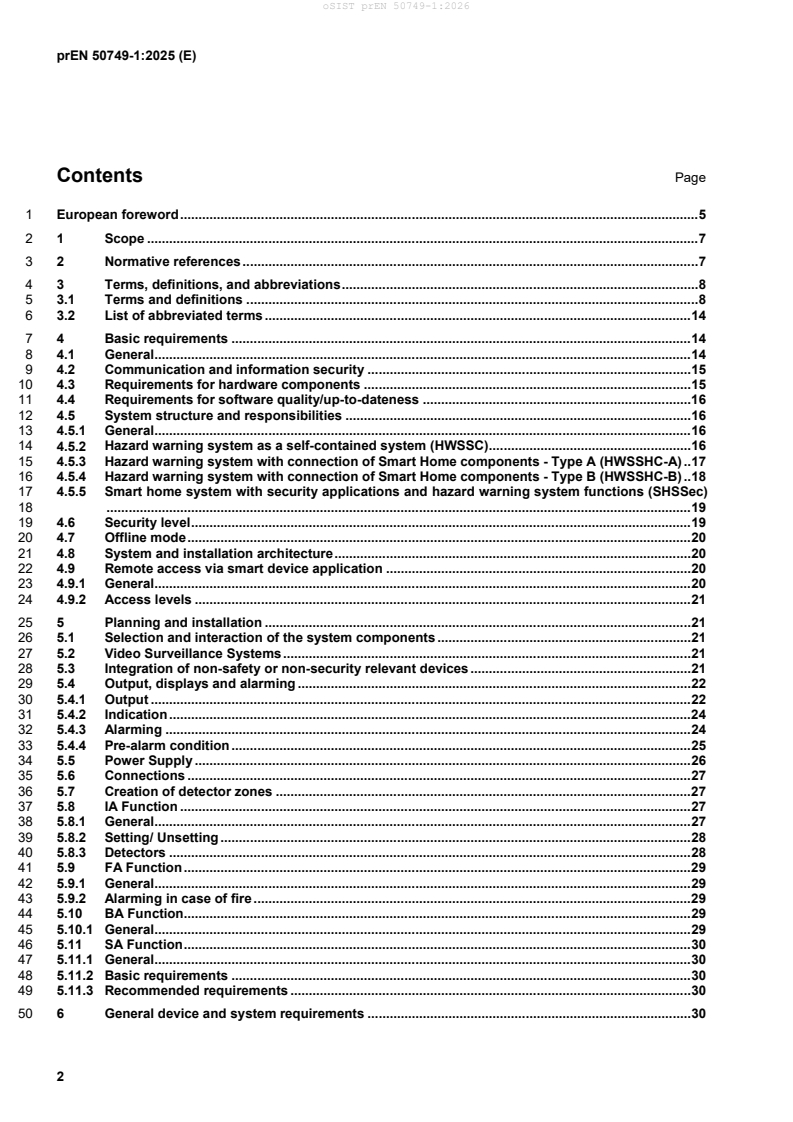
Contents Page
1 European foreword . 5
2 1 Scope . 7
3 2 Normative references . 7
4 3 Terms, definitions, and abbreviations . 8
5 3.1 Terms and definitions . 8
6 3.2 List of abbreviated terms . 14
7 4 Basic requirements . 14
8 4.1 General . 14
9 4.2 Communication and information security . 15
10 4.3 Requirements for hardware components . 15
11 4.4 Requirements for software quality/up-to-dateness . 16
12 4.5 System structure and responsibilities . 16
13 4.5.1 General . 16
14 4.5.2 Hazard warning system as a self-contained system (HWSSC) . 16
15 4.5.3 Hazard warning system with connection of Smart Home components - Type A (HWSSHC-A) . 17
16 4.5.4 Hazard warning system with connection of Smart Home components - Type B (HWSSHC-B) . 18
17 4.5.5 Smart home system with security applications and hazard warning system functions (SHSSec)
18 . 19
19 4.6 Security level . 19
20 4.7 Offline mode . 20
21 4.8 System and installation architecture . 20
22 4.9 Remote access via smart device application . 20
23 4.9.1 General . 20
24 4.9.2 Access levels . 21
25 5 Planning and installation . 21
26 5.1 Selection and interaction of the system components . 21
27 5.2 Video Surveillance Systems . 21
28 5.3 Integration of non-safety or non-security relevant devices . 21
29 5.4 Output, displays and alarming . 22
30 5.4.1 Output . 22
31 5.4.2 Indication . 24
32 5.4.3 Alarming . 24
33 5.4.4 Pre-alarm condition . 25
34 5.5 Power Supply . 26
35 5.6 Connections . 27
36 5.7 Creation of detector zones . 27
37 5.8 IA Function . 27
38 5.8.1 General . 27
39 5.8.2 Setting/ Unsetting . 28
40 5.8.3 Detectors . 28
41 5.9 FA Function . 29
42 5.9.1 General . 29
43 5.9.2 Alarming in case of fire . 29
44 5.10 BA Function. 29
45 5.10.1 General . 29
46 5.11 SA Function . 30
47 5.11.1 General . 30
48 5.11.2 Basic requirements . 30
49 5.11.3 Recommended requirements . 30
50 6 General device and system requirements . 30
51 6.1 General requirements . 30
52 6.2 Protection against environmental influences . 30
53 6.2.1 General . 30
54 6.2.2 Application limits . 31
55 6.3 Functional safety . 31
56 6.3.1 Technical data . 31
57 6.3.2 Assembly and installation instructions . 32
58 6.3.3 Operating instructions . 32
59 6.3.4 Reliability . 32
60 6.3.5 Access to modules and components . 32
61 6.3.6 Connection and adjustment elements . 32
62 6.4 Operating safety . 32
63 6.4.1 Operation . 32
64 6.4.2 Labelling . 32
65 6.4.3 Protection class . 32
66 6.4.4 Access protection . 32
67 6.4.5 Fault tolerance . 32
68 6.4.6 Parameterisation of HWS with IA function . 32
69 6.5 Displays . 33
70 6.6 Notifications . 33
71 6.6.1 Recognition of notifications . 33
72 6.6.2 Notification output . 33
73 6.6.3 Loss of notification . 33
74 6.6.4 Test functions . 33
75 6.6.5 Switch-off functions . 33
76 6.7 Sabotage . 33
77 6.8 Structure . 33
78 6.8.1 Stability . 33
79 6.8.2 Stationary mounting . 33
80 6.8.3 Potential-free, insulation resistance . 33
81 6.8.4 Shielded cable routing . 34
82 6.8.5 Strain relief . 34
83 6.9 User interfaces and applications . 34
84 6.9.1 General . 34
85 6.9.2 Access levels and access protection . 34
86 6.9.3 Cloud-based solutions . 34
87 6.9.4 Data protection . 35
88 6.9.5 User application (app) . 35
89 6.9.6 Safety of the application . 35
90 6.10 Options . 36
91 7 Additional device and system requirements . 36
92 7.1 General . 36
93 7.2 Additional device and system requirements for the IA function . 36
94 7.2.1 Hold-up / duress alarm devices . 36
95 7.3 Additional device and system requirements for the FA function . 36
96 7.4 Additional device and system requirements for the BA function . 36
97 7.5 Additional device and system requirements for the SA function . 36
98 7.6 Additional device and system requirements for message forwarding . 37
99 7.6.1 Signalling devices for internal alarms . 37
100 7.6.2 General . 37
101 7.6.3 Volume . 37
102 7.7 Alarm signal tones . 37
103 7.7.1 General . 37
104 7.7.2 Alarm time limitation . 37
105 7.8 Signalling devices for notifications . 37
106 7.8.1 General . 37
107 7.8.2 Volume . 37
108 7.8.3 Alarm signal tones . 37
109 7.9 Remote alarm . 38
110 7.9.1 General . 38
111 7.9.2 Transmission methods . 38
112 7.9.3 Type of notifications . 38
113 7.9.4 Unambiguity of notifications . 38
114 8 Additional device and system requirements for video surveillance systems (VSS) . 38
115 9 Additional device and system requirements for smart device applications . 38
116 9.1 General . 38
117 9.2 Requirements . 38
118 9.2.1 Basic protection measures . 38
119 9.2.2 Measures against brute force attacks . 39
120 9.2.3 General . 39
121 9.2.4 Measures against keyloggers . 39
122 10 General additional system requirements . 40
123 10.1 General . 40
124 10.2 Documents . 40
125 10.3 Technical requirements . 40
126 10.3.1 Functional interaction of the system components . 40
127 10.3.2 Options . 40
128 Annex A (normative) Symbols for Hazard Warning Systems . 41
129 Bibliography . 43
130 European foreword
131 This document (prEN 50749-1:2025) has been prepared by CLC/TC 79 “Alarm Systems”.
132 This document is currently submitted to the Enquiry.
133 The following dates are proposed:
• latest date by which the existence of this (doa) dav + 6 months
document has to be announced at national
level
• latest date by which this document has to be (dop) dav + 12 months
implemented at national level by publication of
an identical national standard or by
endorsement
• latest date by which the national standards (dow) dav + 36 months
conflicting with this document have to be (to be confirmed or
withdrawn modified when voting)
134 This document is read in conjunction with CLC/FprTS 50749-7.
135 Introduction
136 This standard establishes essential requirements for planning, installation, operation, and maintenance of
137 hazard warning systems (HWS) in residential buildings, flats or premises with similar usage. It also addresses
138 options for a reliable connection of safety and security technologies with smart home and/or active assisted
139 living (AAL) systems.
140 Hazard warning systems are designed to provide early alerts of hazardous situations to occupants, thus helping
141 prevent or minimize injury and property damage caused by risks such as intrusion, hold-up, fire, hazardous
142 gases, water ingress, and technical faults in building systems. The standard offers guidance to a wide range of
143 stakeholders, including planners, architects, installers, manufacturers, authorities, insurers, builders, owners,
144 and operators of residential properties.
145 This standard ensures that all integral parts of hazard warning systems are effectively interconnected and able
146 to provide clearly communicated alerts to users, enabling timely and appropriate responses. By aligning with
147 current and emerging EU regulations, this standard promotes the integration of safety, security, and emergency
148 systems into an interoperable building environment without compromising existing standards. It also addresses
149 gaps in current specifications, particularly regarding the safe use of smart home technologies in residential
150 settings.
151 1 Scope
152 This document applies to the planning, installation, operation, and maintenance of hazard warning systems
153 (HWS) for use in residential buildings, flats, and rooms with flat-like use. It also specifies basic requirements
154 and provisions for reliable interconnection of safety and security technology with smart home systems or active
155 assisted living (AAL) systems and applications. Furthermore, it describes basic requirements for devices and
156 systems or references to respective standards and specifications. This document does not override or in any
157 way limit existing European standards.
158 Hazard warning systems are used for early warning of persons to avoid or reduce personal injury and damage
159 to property, which can result from intrusion, hold-up, fire, dangerous gases, and water ingress as well as
160 technical defects of building services. HWS can also be used in residential properties in the event of
161 duress/harassment and, for communication with persons in emergency situations who are present in the
162 property covered by the HWS or to initiate controls in building services because of the aforementioned events.
163 HWS can be designed in compliance with this standard as a self-contained system, or as HWS with connection
164 of Smart Home components, or as a HWS that is a Smart Home system with integrated security applications.
165 For the purposes of this document, the term “smart home” includes all networked systems and or web-based
166 technical processes or IoT devices that are used in residential properties. This includes also, for example,
167 remotely controllable devices such as cameras, entertainment electronics, household appliances, heating, air
168 conditioning, ventilation (HVAC), electrical control components, door/gate/window openings and others.
169 For the purposes of this document, AAL systems are assistance systems that support everyday life and are
170 usually used in combination with services to provide needs-based support in the home environment for people
171 with special needs. In most cases, AAL systems are web- or IoT-based. AAL systems and components are
172 tailored to the individual needs of their users and their living environment and are networked with the building
173 technology and security technology (in this case the HWS) for safety reasons to provide the user with the best
174 possible support to make sure they react appropriately and in time to the situation in the event of an emergency.
175 The task of AAL systems often includes recognizing critical health conditions of their users and initiating
176 appropriate measures.
177 For the purposes of this document, the term networking also means any integration of systems into the HWS
178 and in many cases the connection to smart devices (e.g. smartphone, tablet, PC) via the Internet in conjunction
179 with a specific application software (app).
180 This standard can also be applied when systems are connected to the HWS and themselves use a connection
181 to the Internet to outsource functional intelligence and utilize opportunities to automate processes across
182 application areas, which can be either local, remote or a combination.
183 Any notification or change in status of the HWS or its components can optionally be sent to other persons
184 present in the building and/or to other locations/systems (e.g. emergency call centres [ERC]).
185 2 Normative references
186 The following documents are referred to in the text in such a way that some or all their content constitutes
187 requirements of this document. For dated references, only the edition cited applies. For undated references, the
188 latest edition of the referenced document (including any amendments) applies.
189 EN 14604:2005, Smoke alarm devices
190 EN 16763, Services for fire safety systems and security systems
191 EN 17529, Data protection and privacy by design and by default
192 CEN/TS 18026, Three-level approach for a set of cybersecurity requirements for cloud services
193 EN 18031-1, Common security requirements for radio equipment - Part 1: Internet connected radio equipment
As impacted by EN 14604:2005/AC:2008.
194 EN 50130-4, Alarm systems - Part 4: Electromagnetic compatibility - Product family standard: Immunity
195 requirements for components of fire, intruder, hold up, CCTV, access control and social alarm systems
196 EN 50130-5, Alarm systems - Part 5: Environmental test methods
197 EN 50131 (all parts), Alarm systems - Intrusion and hold-up systems
198 EN 50134 (all parts), Alarm systems - Social alarm systems
199 EN 50136 (all parts), Alarm systems - Alarm transmission systems and equipment
200 EN 50194-1, Electrical apparatus for the detection of flammable gases in household premises - Part 1: Test
201 methods and performance requirements
202 EN 50291-1, Gas detectors - Electrical apparatus for the detection of carbon monoxide in domestic premises -
203 Part 1: Test methods and performance requirements
204 EN 50518, Monitoring and Alarm Receiving Centre
205 EN 60529, Degrees of protection provided by enclosures (IP Code) (IEC 60529)
206 EN IEC 62443-3-3, Industrial communication networks - Network and system security - Part 3-3: System
207 security requirements and security levels (IEC 62443-3-3)
208 EN IEC 62443-4-2, Security for industrial automation and control systems - Part 4-2: Technical security
209 requirements for IACS components (IEC 62443-4-2)
210 EN IEC 62676 (all parts), Video surveillance systems for use in security applications (IEC 62676)
211 EN ISO/IEC 27001, Information security, cybersecurity and privacy protection - Information security
212 management systems - Requirements (ISO/IEC 27001)
213 EN ISO/IEC 27005, Information security, cybersecurity and privacy protection - Guidance on managing
214 information security risks (ISO/IEC 27005)
215 ETSI EN 303-645, Cyber Security for Consumer Internet of Things: Baseline Requirements
216 ISO/IEC 25000, Systems and software engineering — Systems and software Quality Requirements and
217 Evaluation (SQuaRE) — Guide to SQuaRE
218 OWASP Top 10, Standard awareness document for the top 10 Web Application Security Risks
219 3 Terms, definitions, and abbreviations
220 For the purposes of this document, the following terms and definitions apply.
221 ISO and IEC maintain terminology databases for use in standardization at the following addresses:
222 — ISO Online browsing platform: available at https://www.iso.org/obp/
223 — IEC Electropedia: available at https://www.electropedia.org/
224 3.1 Terms and definitions
225 3.1.1
226 access level
227 level that enables access to certain functions of the HWS or SHS
228 Note 1 to entry: For the IA function the access levels defined in EN 50131-1 still apply
229 3.1.2
230 Advanced Encryption Standard
231 AES
232 encryption standard adopted by the US National Institute of Standards and Technology (NIST) as a symmetric
233 method with a block size of at least 128 bits (AES128) using the same key for encryption and decryption
234 3.1.3
235 alarm
236 notification of the potential presence of a hazard to life, property, environment or alert for assistance
237 3.1.4
238 alarm verification
239 process to provide information additional to a notified alarm, which increases the probability that the alarm
240 should be considered genuine
241 3.1.5
242 assistance centre
243 private individual or emergency call centre (ECC) or alarm receiving centre (ARC) contracted by the operator of
244 the hazard warning system to receive remote alarms, notifications (messages) and information from the property
245 in order to deliver services
246 3.1.6
247 attention signal
248 acoustic signal intended to notify the user of a HWS to a fault condition in the HWS that requires a response
249 (e.g. power failure)
250 3.1.7
251 authentication
252 verification of information received during authentisation
253 3.1.8
254 authenticity
255 property of the authenticity and trustworthiness of a person or an object (e.g. information)
256 3.1.9
257 authentisation
258 provision of proof of the authenticity of a property in relation to permitted participation in a communication
259 connection or access authorisation to a system
260 3.1.10
261 building services function
262 BS-function
263 function of a HWS to process technical statuses or to recognise, report and notify of hazardous building
264 technology situations and, if necessary, to control corresponding devices
265 3.1.11
266 client
267 end device with connection to the HWS
268 3.1.12
269 coerciveness
270 measure that prevents the IA function of a HWS from being full set if it is not functional, or that the user can
271 inadvertently trigger the internal alarm and/or remote alarm when the IA function is full set (e.g. entering the
272 rooms without prior unset)
273 Note 1 to entry: The procedure according to CLC/TS 50131-12:2016, 4.2.3, shall be used for setting.
274 Note 2 to entry: The procedure according to CLC/TS 50131-12:2016, 4.3.4, shall be used for unsetting.
275 Note 3 to entry: The “coerciveness” principle is known in Germany as “Zwangsläufigkeit”.
276 3.1.13
277 duress alarm
278 text alarm that can be triggered deliberately by people in the acute case of harassment (e.g. aggressive door-
279 to-door sales) as a deterrent
280 3.1.14
281 false alarm
282 alarm that is not based on a danger but triggered by a deception
283 3.1.15
284 fire alarm function
285 FA function
286 function of a HWS to detect, notify and report fires, especially fire smoke
287 3.1.16
288 fire smoke
289 mixture of particles and vapours from complete and incomplete combustion
290 Note 1 to entry: Fire smoke contains a large number of highly toxic substances and gases and can lead to
291 unconsciousness and later death within a few minutes if inhaled.
292 3.1.17
293 gas alarm devices
294 device that detects flammable gas and/or carbon monoxide, analyses concentrations, reports to a panel and
295 automatically emits an acoustic alarm
296 Note 1 to entry: Gas alarms that are part of a HWS shall comply with EN 50194-1 or EN 50291-1.
297 3.1.18
298 Hazard Warning System
299 HWS
300 system in a property for the early notification of persons present of danger and for the prevention or reduction
301 of damage that can be caused by intrusion, hold-up, fire, dangerous gases and escaping water as well as
302 technical defects, also for defence in the event of nuisance, for the control of building services functions or for
303 communication with persons on site in emergency situations
304 3.1.19
305 HWS technician
306 qualified person who, based on professional training, knowledge, and experience as well as knowledge of the
307 relevant standards, regulations and directives, is able to assess the work assigned, recognise possible hazards
308 and is responsible for professional project planning, installation and maintenance
309 Note 1 to entry: This requires knowledge for the assessment of the object conditions, such as fire protection,
310 security/monitoring technology or room acoustics as well as the influence of the room utilization and the application limits of
311 the intended technologies to be able to implement the concept requirements.
312 Note 2 to entry: Training from the spectrum of electrical engineering in the field of communications, information,
313 microprocessor, measurement and control or general electrical engineering is required, and experience in the respective
314 other fields as well as system knowledge of hazard detection technology shall be demonstrated.
315 Note 3 to entry: Several years of proven experience in the relevant fields of work can also be used to assess technical
316 training.
317 3.1.20
318 HWS-Panel
319 device that records all relevant information from all HWS functions (FA, IA, SA, BS), creates and displays
320 notifications and, if required, transmits them to one or more HWS functions and, if applicable, provides a master
321 control and display function to oversee and manage the overall system operations
322 3.1.21
323 identification feature
324 IF
325 feature of identification that exists in the user's memory (mental IF, e.g. as a sequence of numbers, characters
326 or letters), carried by the user in physical form (material IF, e.g. key, chip card) or present on the user's person
327 (biological IF, e.g. fingerprint, eye background, face, voice or other personal features)
328 3.1.22
329 Internet of Things
330 IoT
331 vision of a global infrastructure that enables physical and virtual objects to be networked with each other and to
332 work together using information and communication technologies
333 3.1.23
334 intrusion alarm function
335 IA function
336 function of a HWS to detect, warn and report potential intrusions or attempted intrusions into the monitored
337 premises
338 3.1.24
339 keylogger
340 hardware or software that logs the user's keyboard entries
341 3.1.25
342 local alarm
343 acoustic alarm signal in the building when HWS functions are triggered to notify persons present with the aim
344 of initiating the necessary measures (e.g. self-help, self-rescue, notification of an assistance centre)
345 Note 1 to entry: Other alarm techniques (e.g. visual or tactile) are permitted if necessary.
346 3.1.26
347 MAC address
348 unique, 48-bit hardware address of a network adapter
349 3.1.27
350 master
351 function of the panel for remote access
352 3.1.28
353 non-exclusive connection
354 connection in which the responsibility for the transmission of information is not an exclusive responsibility and
355 to which others also have access, e.g. radio, non-exclusive bus systems, non-dedicated wired connections
356 3.1.29
357 non-reactive effect
358 effect given if non-system functions and devices are connected to a safety system without any influence to the
359 systems, if a failure and/or malfunction of these functions/devices or the connection to these devices has no
360 influence on the system itself (e.g. no influence on functions, networks, firmware, power supply) and the
361 undisturbed operation of the system is guaranteed at all times regardless of these functions/devices
362 Note 1 to entry: This does not affect the ability to analyse and process an error status of these functions/devices.
363 3.1.30
364 notification
365 form of signal, message, report that a HWS as a whole or parts thereof (functions, components, etc.) triggers,
366 processes, displays, or forwards
367 3.1.31
368 operator
369 person responsible for the operation of the HWS
370 3.1.32
371 passcode
372 freely selected character/letter sequence that protects against unauthorised use of a smart device app
373 3.1.33
374 perimeter monitoring
375 monitoring and detection of potential access into external areas between the building or / and the perimeter
376 border
377 3.1.34
378 Personal Unblocking Key
379 PUK
380 electronic key that can be used to unlock a previously recognised operating error
381 3.1.35
382 presence/absence
383 operating function of a HWS that enables the user to switch certain functions from local alarm on presence to
384 remote alarm on absence
385 3.1.36
386 reminder signal
387 signal, e.g. acoustic signal, which notifies the user at regular intervals to a limited functionality of the HWS, e.g.
388 to a switched-off function, switched-off detectors or similar
389 3.1.37
390 remote alarm
391 indication of a hazardous situation to an authorised assistance centre or person that is not on site
392 3.1.38
393 remote alarm system
394 device or system that forwards remote alarms, notifications or messages, or information to a remote location
395 3.1.39
396 set
397 status of an I&HAS (IA function) or part thereof in which an intruder or hold-up alarm condition can be notified
398 Note 1 to entry: This status is also widely known as “armed”.
399 Note 2 to entry: This status can either include the entire I&HAS (full set) or only certain devices (partial set).
400 3.1.40
401 smart device
402 portable communication device, typically a smartphone, tablet or similar, on which an app is launched
403 3.1.41
404 Smart Device App
405 application on a smart device in the form of firmware/software or any associated application that is used for
406 possible visualisation, control or configuration of the HWS
407 3.1.42
408 Smart Home
409 technical processes and systems in living spaces and homes that focus on increasing the quality of living and
410 quality of life, health and efficient energy use on the basis of networked and remotely controllable devices and
411 installations as well as automatable processes
412 3.1.43
413 Smoke Alarm Device
414 device in which all components required to detect smoke and generate an audible alarm signal, with the possible
415 exception of the power supply, are contained in a single housing
416 [SOURCE: EN 14604:2005, 3.9]
417 3.1.44
418 social alarm function
419 SA function
420 function of a HWS to establish voice communication between persons in the building and an assistance centre
421 (see 3.1.9 ) if a trigger device is activated
422 Note 1 to entry: Social alarm system shall comply with the EN 50134 series of standards if they are part of a HWS.
423 3.1.45
424 Specialist Installer
425 company responsible for the planning, installation, commissioning and maintenance of the HWS, which can
426 demonstrate the necessary technical competence and qualifications by means of at least one recognised
427 certificate and which has at least one HWS technician for each processing phase and for each HWS function
428 Note 1 to entry: Proof of competence and qualification shall be a certificate in accordance with EN 16763.
429 3.1.46
430 technical defect
431 improper condition or function of a device o
...