


EN 140101-806:2008
(Main)Detail Specification: Fixed low power film resistors - Metal film resistors on high grade ceramic, conformal coated or molded, axial or preformed leads
Detail Specification: Fixed low power film resistors - Metal film resistors on high grade ceramic, conformal coated or molded, axial or preformed leads
Supersedes CECC 40 101-806:1997 * Corrigendum to EN issued October 2009
2021: CLC legacy converted by DCLab NISOSTS
Bauartspezifikation: Schicht-Festwiderstände niedriger Belastbarkeit - Metallschichtwiderstände auf hochwertiger Keramik, mit konformer Umhüllung und axialen oder vorgeformten Anschlüssen
Spécification particulière: Résistances fixes à couche et à faible dissipation - Résistances à couche métallique sur céramique de qualité supérieure, moulée ou disposant d'un revêtement enrobant, avec des sorties préformées ou axiales
Podrobna specifikacija - Fiksni plastni upori majhnih moči - Upori s kovinsko plastjo na visokokakovostni keramiki, z običajno prevleko ali zaliti, osni ali predoblikovani izvodi
Različni parametri tega sestavnega dela so natančno opredeljeni v tej specifikaciji. Neopredeljeni parametri so lahko pri posameznih sestavnih delih različni.
General Information
- Status
- Published
- Publication Date
- 13-Mar-2008
- Withdrawal Date
- 31-Oct-2010
- Technical Committee
- CLC/TC 40XB - CLC/TC 40XB
- Drafting Committee
- CLC/TC 40XB - CLC/TC 40XB
- Parallel Committee
- IEC/TC 40 - IEC_TC_40
- Current Stage
- 9093 - Decision to confirm - Review Enquiry
- Start Date
- 04-Mar-2026
- Completion Date
- 07-Apr-2026
Relations
- Effective Date
- 12-Feb-2013
- Effective Date
- 23-Jan-2023
Overview
EN 140101-806:2008 (CLC) is a CENELEC detail specification for fixed low power film resistors - specifically metal film resistors on high‑grade ceramic, either conformal coated or molded, with axial or preformed leads. It supersedes CECC 40 101‑806:1997 (with a corrigendum issued October 2009) and is part of the EN 140101 series that complements the generic EN 60115‑1 requirements for fixed resistors. The document defines mechanical sizes, electrical ratings, stability classes and the test/quality assessment procedures required for components of assessed quality.
Key topics and technical requirements
- Styles, dimensions and ratings: Defined outline sizes (styles A–D), lead lengths and rated dissipation values (P70) with associated maximum voltages and insulation voltages.
- Resistance ranges and tolerances: Permitted resistance value ranges and tolerances are specified for different stability classes and product Versions (A and E); E‑series values per IEC 60063 are referenced.
- Stability classes and temperature coefficients (TCR): Stability classes include 2, 1, 0.5, 0.25, 0.1 and 0.05. Newer TCR options (e.g., ±10×10‑6/K and ±5×10‑6/K) and code letters per EN 60062 are introduced.
- Derating and thermal limits: A derating curve and temperature‑rise limits are provided; category temperatures (LCT/UCT) relate to each stability class.
- Performance limits and tests: Limits for change of resistance at specified tests, non‑linearity requirements, pulse load capability, resistance drift and noise characteristics are set out.
- New/updated tests and methods introduced in this edition:
- Electrostatic discharge (ESD) resistance test and Annex A procedure
- Lead‑free soldering description and test methods
- Pulse load information and revised drift testing
- Quality assessment: Qualification Approval and Quality Conformance Inspection procedures, with fixed sample‑size test schedules and assessment level EZ (Annex A).
Applications and who uses it
- Component manufacturers use this standard to design, test and qualify metal film resistors for electronic equipment.
- Purchasing and procurement teams reference the standard when specifying supplier requirements and ordering designations.
- Test labs and compliance engineers perform the specified electrical, thermal and reliability tests (ESD, pulse, solderability, drift) to certify parts to the detail specification.
- Design engineers and quality managers rely on the defined stability classes, TCRs, derating data and pulse capability when selecting resistors for precision, safety‑critical or high‑reliability applications (e.g., industrial, instrumentation, medical electronics).
Related standards
- EN 60115‑1 (Fixed resistors for use in electronic equipment - generic specification)
- EN 140100 and EN 140101 (sectional and blank detail specifications for low power film resistors)
- EN 60062 (code letters for temperature coefficients)
- IECQ/IEC QC rules referenced for assessed quality procedures
Keywords: EN 140101-806:2008, fixed low power film resistors, metal film resistors, conformal coated, molded resistors, axial leads, preformed leads, temperature coefficient, stability classes, ESD, lead‑free soldering, qualification approval.

Frequently Asked Questions
EN 140101-806:2008 is a standard published by CLC. Its full title is "Detail Specification: Fixed low power film resistors - Metal film resistors on high grade ceramic, conformal coated or molded, axial or preformed leads". This standard covers: Supersedes CECC 40 101-806:1997 * Corrigendum to EN issued October 2009 2021: CLC legacy converted by DCLab NISOSTS
Supersedes CECC 40 101-806:1997 * Corrigendum to EN issued October 2009 2021: CLC legacy converted by DCLab NISOSTS
EN 140101-806:2008 is classified under the following ICS (International Classification for Standards) categories: 31.040.10 - Fixed resistors. The ICS classification helps identify the subject area and facilitates finding related standards.
EN 140101-806:2008 has the following relationships with other standards: It is inter standard links to EN 140101-806:2008/A1:2013, EN 140101-806:2008/AC:2014. Understanding these relationships helps ensure you are using the most current and applicable version of the standard.
EN 140101-806:2008 is available in PDF format for immediate download after purchase. The document can be added to your cart and obtained through the secure checkout process. Digital delivery ensures instant access to the complete standard document.
Standards Content (Sample)
2003-01.Slovenski inštitut za standardizacijo. Razmnoževanje celote ali delov tega standarda ni dovoljeno.Detail Specification: Fixed low power film resistors - Metal film resistors on high grade ceramic, conformal coated or molded, axial or preformed leadsSpécification particulière: Résistances fixes à couche et à faible dissipation - Résistances à couche métallique sur céramique de qualité supérieure, moulée ou disposant d'un revêtement enrobant, avec des sorties préformées ou axialesBauartspezifikation: Schicht-Festwiderstände niedriger Belastbarkeit - Metallschichtwiderstände auf hochwertiger Keramik, mit konformer Umhüllung und axialen oder vorgeformten Anschlüssen31.040.10Fiksni uporFixed resistorsICS:SIST EN 140101-806:2008en,fr,deTa slovenski standard je istoveten z:EN 140101-806:200801-junij-2008SIST EN 140101-806:2008SLOVENSKI
STANDARD
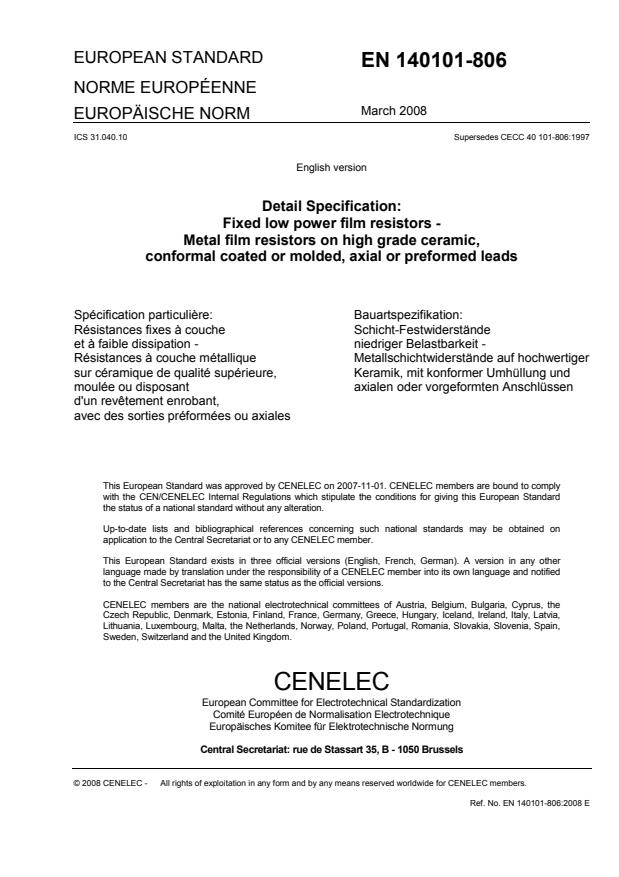
EUROPEAN STANDARD EN 140101-806 NORME EUROPÉENNE
EUROPÄISCHE NORM March 2008
CENELEC European Committee for Electrotechnical Standardization Comité Européen de Normalisation Electrotechnique Europäisches Komitee für Elektrotechnische Normung
Central Secretariat: rue de Stassart 35, B - 1050 Brussels
© 2008 CENELEC -
All rights of exploitation in any form and by any means reserved worldwide for CENELEC members.
Ref. No. EN 140101-806:2008 E
ICS 31.040.10 Supersedes CECC 40 101-806:1997
English version
Detail Specification:
Fixed low power film resistors -
Metal film resistors on high grade ceramic,
conformal coated or molded, axial or preformed leads
Spécification particulière:
Résistances fixes à couche
et à faible dissipation -
Résistances à couche métallique
sur céramique de qualité supérieure, moulée ou disposant
d'un revêtement enrobant,
avec des sorties préformées ou axiales
Bauartspezifikation:
Schicht-Festwiderstände
niedriger Belastbarkeit -
Metallschichtwiderstände auf hochwertiger Keramik, mit konformer Umhüllung und axialen oder vorgeformten Anschlüssen
This European Standard was approved by CENELEC on 2007-11-01. CENELEC members are bound to comply with the CEN/CENELEC Internal Regulations which stipulate the conditions for giving this European Standard the status of a national standard without any alteration.
Up-to-date lists and bibliographical references concerning such national standards may be obtained on application to the Central Secretariat or to any CENELEC member.
This European Standard exists in three official versions (English, French, German). A version in any other language made by translation under the responsibility of a CENELEC member into its own language and notified to the Central Secretariat has the same status as the official versions.
CENELEC members are the national electrotechnical committees of Austria, Belgium, Bulgaria, Cyprus, the Czech Republic, Denmark, Estonia, Finland, France, Germany, Greece, Hungary, Iceland, Ireland, Italy, Latvia, Lithuania, Luxembourg, Malta, the Netherlands, Norway, Poland, Portugal, Romania, Slovakia, Slovenia, Spain, Sweden, Switzerland and the United Kingdom.
(dop)
2008-11-01 – latest date by which the national standards conflicting with the EN have to be withdrawn
(dow)
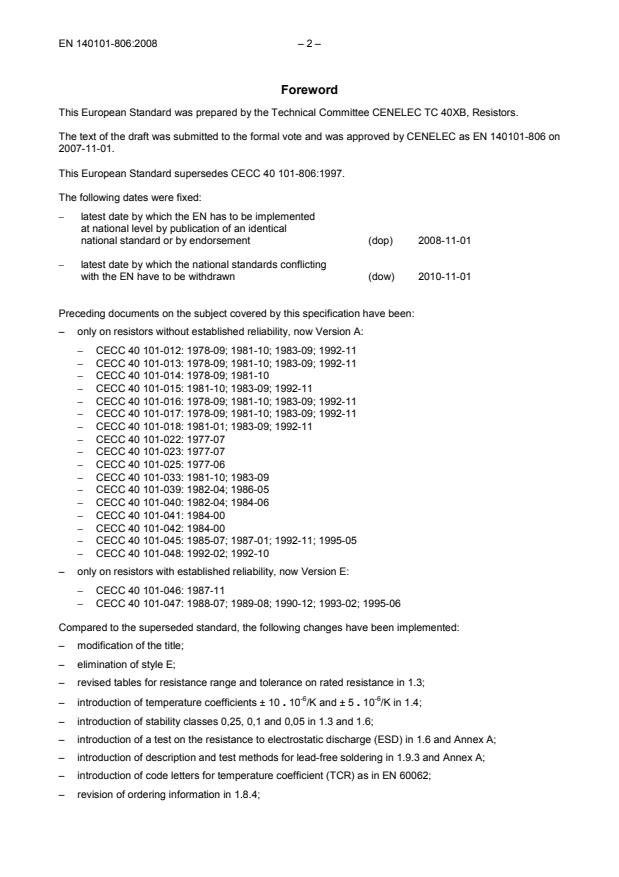
2010-11-01 Preceding documents on the subject covered by this specification have been: – only on resistors without established reliability, now Version A: − CECC 40 101-012: 1978-09; 1981-10; 1983-09; 1992-11 − CECC 40 101-013: 1978-09; 1981-10; 1983-09; 1992-11 − CECC 40 101-014: 1978-09; 1981-10 − CECC 40 101-015: 1981-10; 1983-09; 1992-11 − CECC 40 101-016: 1978-09; 1981-10; 1983-09; 1992-11 − CECC 40 101-017: 1978-09; 1981-10; 1983-09; 1992-11 − CECC 40 101-018: 1981-01; 1983-09; 1992-11 − CECC 40 101-022: 1977-07 − CECC 40 101-023: 1977-07 − CECC 40 101-025: 1977-06 − CECC 40 101-033: 1981-10; 1983-09 − CECC 40 101-039: 1982-04; 1986-05 − CECC 40 101-040: 1982-04; 1984-06 − CECC 40 101-041: 1984-00 − CECC 40 101-042: 1984-00 − CECC 40 101-045: 1985-07; 1987-01; 1992-11; 1995-05 − CECC 40 101-048: 1992-02; 1992-10 – only on resistors with established reliability, now Version E: − CECC 40 101-046: 1987-11 − CECC 40 101-047: 1988-07; 1989-08; 1990-12; 1993-02; 1995-06 Compared to the superseded standard, the following changes have been implemented: – modification of the title; – elimination of style E; – revised tables for resistance range and tolerance on rated resistance in 1.3; – introduction of temperature coefficients ± 10 . 10-6/K and ± 5 . 10-6/K in 1.4; – introduction of stability classes 0,25, 0,1 and 0,05 in 1.3 and 1.6; – introduction of a test on the resistance to electrostatic discharge (ESD) in 1.6 and Annex A; – introduction of description and test methods for lead-free soldering in 1.9.3 and Annex A; – introduction of code letters for temperature coefficient (TCR) as in EN 60062; – revision of ordering information in 1.8.4;
– 3 – EN 140101-806:2008 – revised information on pulse load capability in 1.9.5; – revised information on resistance drift in 1.9.6; – adoption of the IECQ rules of procedure, IEC QC 001002-3; – revision of the sample quantities and the sequence of tests in Annex A; – editorial revision.
This specification is part of a series of documents describing fixed low power film resistors as follows. – EN 60115-1 Fixed resistors for use in electronic equipment – Part 1: Generic specification (IEC 60115-1, mod.) – EN 140100
Sectional specification: Fixed low power film resistors – this detail specification. Any detail specification within this series is written on the basis of – EN 140101 Blank detail specification: Fixed low power film resistors. —————
Fixed sample size Qualification Approval and Quality Conformance Inspection test schedule for fixed low power film resistors . 25 Annex B (informative)
Letter symbols and abbreviations . 33 Bibliography . 35 Figure 1 – Outline and dimensions (see Table 1) . 5 Figure 2 – Derating curve . 7 Figure 3 – Limits of non-linearity in resistance . 13 Figure 4 – Pulse parameter for rectangular and exponential pulses . 13 Figure 5 – Maximum permissible pulse load Pi,max for continuous pulses . 17 Figure 6 – Maximum permissible pulse load Pi,max for single pulses . 18 Figure 7 – Maximum permissible pulse voltage Ui,max . 18 Figure 8a – Drift factor for UCT = 155 °C . 19 Figure 8b – Drift factor for UCT = 125 °C . 20 Figure 8c – Drift factor for UCT = 85 °C . 20 Figure 9 – Current noise
.................................................................................................................................. 21 Table 1 – Style and dimensions ......................................................................................................................... 5 Table 2a – Ratings for stability classes 2; 1; 0,5 ................................................................................................ 6 Table 2b – Ratings for stability class 0,25 .......................................................................................................... 6 Table 2c – Ratings for stability class 0,1; 0,05 ................................................................................................... 6 Table 2d – Ratings for 0 Ω resistors ................................................................................................................... 6 Table 3a – Resistance range and tolerance on rated resistance for Version A ................................................. 8 Table 3b – Resistance range and tolerance on rated resistance for Version E ............................................... 10 Table 4 – Temperature coefficients and percentage change of resistance ..................................................... 11 Table 5 – Limits of temperature rise ................................................................................................................. 11 Table 6 – Climatic categories ........................................................................................................................... 11 Table 7a – Limits for change of resistance at tests .......................................................................................... 12 Table 7b – Limits for change of resistance at tests .......................................................................................... 12 Table A.1 – Test schedule for Qualification Approval and Quality Conformance Inspection, lot-by-lot tests, assessment level EZ .................................................................................................................... 24 Table A.2 – Test schedule for Qualification Approval and Quality Conformance Inspection, periodic tests, assessment level EZ .................................................................................................................... 27
– 5 – EN 140101-806:2008 Specification available from: CENELEC Central Secretariat, Rue de Stassart 35, B-1050 Brussels, or from the addresses shown on the inside cover EN 140101-806 Electronic components of assessed quality in accordance with: EN 60115-1:2001 + A1:2001 EN 140100:2008 EN 140101:2008 Issue 2 March 2008
Other shapes are permitted within the given dimensions. Figure 1 – Outline and dimensions (see Table 1) Fixed low power film resistors Metal film resistors on high grade ceramic, conformal coated or molded, axial or preformed lead-free leads Assessment level EZ a Version A: with 100 %-test Version E: with failure rate level and 100 %-test Stability classes 0,05; 0,1; 0,25; 0,5; 1; 2 a For explanation on assessment level EZ see 2.1.1. 1 Characteristics and ratings Various parameters of this component are precisely defined in this specification. Unspecified parameters may vary from one component to another. 1.1 Dimensions and ratings Table 1 – Style and dimensions Style Length L mm Diameter D mm d a mm e b mm c c mm Mass d mg Code Size d min. max. min. max.
max. max. A 0204 3,0 4,0 1,3 1,9 0,4 / 0,5 7,5 0,5 130 B 0207 5,0 6,5 2,0 2,5 0,6 10,0 0,5 280 C 0411 7,5 10,7 3,0 4,0 0,6 / 0,7 15,0 0,5 600 D 0414 10,0 12,0 3,6 4,1 0,8 17,5 1,0 790 a Permissible tolerance according to HD 349 S1. b Standard distance for the axis to bent leads. Smaller modules may be agreed between manufacturer and customer. c Length of excess protective coating. d For information only. The minimum lead length of 21 mm is valid for tape packaging according to EN 60286-1 only (free lead length). Taping according to EN 60286-1 or preformed leads are permitted. Details to be agreed between manufacturer and customer. For preformed leads the length of excess protective coating may be larger than given in Table 1. Information about manufacturers who have components qualified to this detail specification is available in the approvals section of the website http://www.iecq.org
Table 2b – Ratings for stability class 0,25 Style Stability class Rated dissipation P70 mW Limiting element voltaged.c. or a.c. (r.m.s.) UmaxV Insulation voltage d.c. or a.c. (peak) Uins V 1 min continuous A 0,25 250 200 300 75 B 0,25 400 300 500 75 C 0,25 500 500 750 75 D 0,25 600 500 750 75
Table 2c – Ratings for stability class 0,1; 0,05 Style Stability class Rated dissipation P70 mW Limiting element voltaged.c. or a.c. (r.m.s.) UmaxV Insulation voltage d.c. or a.c. (peak) Uins V 1 min continuous A 0,1; 0,05 75 200 300 75 B 0,1; 0,05 125 300 500 75 C 0,1; 0,05 150 500 750 75 D 0,1; 0,05 175 500 750 75
Table 2d – Ratings for 0 Ω resistors Style Maximum current Imax A Maximum resistance Rmax mΩ Insulation voltage d.c. or a.c. (peak) Uins V 1 min continuous A 3 20 300 75 B 5 20 500 75
– 7 – EN 140101-806:2008 1.2 Derating curve Resistors covered by this specification are derated according to the following diagram: Ambient temperature ϑaPercentage of rated dissipation-50 °C100 °C50 °C0 °C150 °C0 %60 %40 %20 %100 %80 %70 °C-55 °C-10 °C85 °C125 °C155 °CLower category temperature (LCT)Upper category temperature (UCT)-100 °C200 °CStability class 0,1; 0,05Stability class 0,25Stability class 2; 1; 0,5 Figure 2 – Derating curve
Refer to Table 6 for the category temperatures of the stability classes. 1.3 Resistance range and tolerance on rated resistance 1.3.1 Version A The following combinations of temperature coefficient and tolerance on rated resistance may be approved only. Products from this extent shall be used for the Qualification approval according to 2.2.1 and for the Quality conformance inspection according to 2.3. Resistance values of an E-series according to IEC 60063 shall be used.
The qualification of resistance values below or beyond the specified resistance values is permitted, if they fulfil the requirements of the closest stability class (e.g. Style B 1 % > 10 MΩ shall fulfil the requirements of stability class 2).
range Stability class c % Code a 10-6/K b A ± 5 J ± 50 0,22 Ω to < 1 Ω 1 ± 1 F ± 50 1 Ω to < 10 Ω 0,5 ± 50; ± 25 10 Ω to 332 kΩ 0,5 10 Ω to 332 kΩ 0,25 > 332 kΩ to 10 MΩ 2 ± 0,5 D ± 50; ± 25 10 Ω to 332 kΩ 0,25 10 Ω to 332 kΩ 0,5 ± 0,25 C ± 25; ± 15; ± 10 22 Ω to 332 kΩ 0,25 ± 25; ± 15; ± 10; ± 5 43 Ω to < 100 Ω 0,1 100 Ω to 100 kΩ 0,05 > 100 kΩ to 221 kΩ 0,1 ± 0,1 B ± 25; ± 15; ± 10 43 Ω to 332 kΩ 0,25 ± 25; ± 15; ± 10; ± 5 43 Ω to < 100 Ω 0,1 100 Ω to 100 kΩ 0,05 > 100 kΩ to 221 kΩ 0,1 B ± 5 J ± 50 0,22 Ω to < 1 Ω 1 > 10 MΩ to 22 MΩ 2 ± 1 F ± 50 1 Ω to < 10 Ω 0,5 ± 50; ± 25 10 Ω to 1 MΩ 0,5 10 Ω to 1 MΩ 0,25 > 1 MΩ to 10 MΩ 2 ± 0,5 D ± 50; ± 25 10 Ω to 1 MΩ 0,25 10 Ω to 1 MΩ 0,5 ± 0,25 C ± 25; ± 15; ± 10 22 Ω to 1 MΩ 0,25 ± 25; ± 15; ± 10; ± 5 43 Ω to < 100 Ω 0,1 100 Ω to 270 kΩ 0,05 > 270 kΩ to 510 kΩ 0,1 ± 0,1 B ± 25; ± 15; ± 10 43 Ω to 1 MΩ 0,25 ± 25; ± 15; ± 10; ± 5 43 Ω to < 100 Ω 0,1 100 Ω to 270 kΩ 0,05 > 270 kΩ to 510 kΩ 0,1
– 9 – EN 140101-806:2008 Table 3a – Resistance range and tolerance on rated resistance for Version A (continued) Style Tolerance on rated resistance Temperature coefficient Resistance
range Stability class b % Code a 10-6/K b C ± 5 J ± 50 0,22 Ω to < 1 Ω 1 ± 1 F ± 50 1 Ω to < 10 Ω 0,5 ± 50; ± 25 10 Ω to 2,43 MΩ 0,5 10 Ω to 2,43 MΩ 0,25 > 2,43 MΩ to 22 MΩ 2 ± 0,5 D ± 50; ± 25 10 Ω to 2,43 MΩ 0,25 10 Ω to 2,43 MΩ 0,5 ± 0,25 C ± 25; ± 15; ± 10 22 Ω to 1,5 MΩ 0,25 ± 25; ± 15; ± 10; ± 5 43 Ω to < 100 Ω 0,1 100 Ω to 470 kΩ 0,05 > 470 kΩ to 1 MΩ 0,1 ± 0,1 B ± 25; ± 15; ± 10 43 Ω to 1,5 MΩ 0,25 ± 25; ± 15; ± 10; ± 5 43 Ω to < 100 Ω 0,1 100 Ω to 470 kΩ 0,05 > 470 kΩ to 1 MΩ 0,1 D ± 5 J ± 50 0,22 Ω to < 1 Ω 1 ± 1 F ± 50 1 Ω to < 10 Ω 0,5 ± 50; ± 25 10 Ω to 2,43 MΩ 0,5 10 Ω to 2,43 MΩ 0,25 > 2,43 MΩ to 22 MΩ 2 ± 0,5 D ± 50; ± 25 10 Ω to 2,43 MΩ 0,25 10 Ω to 2,43 MΩ 0,5 ± 0,25 C ± 25; ± 15; ± 10 22 Ω to 1,5 MΩ 0,25 ± 25; ± 15; ± 10; ± 5 43 Ω to < 100 Ω 0,1 100 Ω to 470 kΩ 0,05 > 470 kΩ to 1 MΩ 0,1 ± 0,1 B ± 25; ± 15; ± 10 43 Ω to 1,5 MΩ 0,25 ± 25; ± 15; ± 10; ± 5 43 Ω to < 100 Ω 0,1 100 Ω to 470 kΩ 0,05 > 470 kΩ to 1 MΩ 0,1 0 Ω resistors according to Table 2d for styles A and B. a Code letters according to EN 60062. b For the category temperatures of stability classes refer to Table 6.
range Stability class b E series % Code a 10-6/K A ± 1 F ± 50 1 Ω to 332 kΩ 0,5 E96 340 kΩ to 5,11 MΩ 2 ± 0,5 D ± 25 49,9 Ω to 332 kΩ 0,5 E96 340 kΩ to 511 kΩ 2 ± 0,1 B ± 15 100 Ω to 332 kΩ 0,25 E192 B ± 1 F ± 50 1 Ω to 1 MΩ 0,5 E96 1,02 MΩ to 5,11 MΩ 1 5,23 MΩ to 10 MΩ 2 ± 0,5 D ± 25 10 Ω to 1 MΩ 0,5 E96 ± 0,1 B ± 15 100 Ω to 499 kΩ 0,25 E192 C ± 1 F ± 50 1 Ω to 2,43 MΩ 0,5 E96 2,49 MΩ to 5,11 MΩ 1 5,23 kΩ to 10 MΩ 2 ± 0,5 D ± 25 10 Ω to 1 MΩ 0,5 E96 ± 0,1 B ± 15 100 Ω to 681 kΩ 0,25 E192 D ± 1 F ± 50 1 Ω to 2,43 MΩ 0,5 E96 2,49 MΩ to 5,11 MΩ 1 5,23 MΩ to 21,5 MΩ 2 ± 0,5 D ± 25 10 Ω to 1,5 MΩ 0,5 E96 ± 0,1 B ± 15 100 Ω to 1 MΩ 0,25 E192 0 Ω resistors according to Table 2d for styles A and B. a Code letters according to EN 60062. b For the category temperatures of stability classes refer to Table 6.
– 11 – EN 140101-806:2008 1.4 Variation of resistance with temperature and temperature rise Table 4 – Temperature coefficients and percentage change of resistance Temperature coefficient Limit of resistance change ∆R/R %
10-6/K Code a Code b LCT / Reference temp. °C Reference temperature / UCT °C
-55 / 20 -10 / 20 20 / 85 20 / 125 20 / 155 ± 50 R C ± 0,375 ± 0,150 ± 0,325 ± 0,525 ± 0,675 ± 25 Q D ± 0,188 ± 0,075 ± 0,163 ± 0,262 ± 0,338 ± 15 P E ± 0,113 ± 0,045 ± 0,098 ± 0,158 — ± 10 N — ± 0,075 ± 0,030 ± 0,065 ± 0,105 — ± 5 M — — ± 0,015 ± 0,033 — — a Code letters according to EN 60062. b Historical code letters according to CECC 40 101-806, for information only.
Table 5 – Limits of temperature rise Stability class Limit of temperature rise
at rated dissipation 2; 1; 0,5 Tr ≤ 85 K 0,25 Tr ≤ 55 K 0,1; 0,05 Tr ≤ 15 K
1.5 Climatic categories Table 6 – Climatic categories Stability class Climatic category LCT / UCT / Duration 2; 1; 0,5 55 / 155 / 56 0,25 55 / 125 / 56 0,1; 0,05 55 / 085 / 56
EN 60115-1 a, 4.13 Overload 4.16 Robustness of
terminations 4.18 Resistance to
soldering heat 4.19 Rapid change
of temperature, 5 cycles 4.22 Vibration 1 000 h Extended, 8 000 h 2 ± (2 % R + 0,1 Ω) c ± (0,5 % R + 0,05 Ω) b ± (1 % R + 0,05 Ω) b ± (0,5 % R + 0,05 Ω) 1 ± (1 % R + 0,05 Ω) d ± (0,5 % R + 0,05 Ω) b ± (1 % R + 0,05 Ω) b ± (0,25 % R + 0,05 Ω) 0,5 ± (0,5 % R + 0,05 Ω) ± (0,5 % R + 0,05 Ω) ± (1 % R + 0,05 Ω) ± (0,1 % R + 0,02 Ω) 0,25 ± (0,25 % R + 0,05 Ω) ± (0,25 % R + 0,05 Ω) ± (0,5 % R + 0,05 Ω) ± (0,05 % R + 0,01 Ω) 0,1 ± (0,1 % R + 0,02 Ω) ± (0,1 % R + 0,02 Ω) ± (0,25 % R + 0,05 Ω) ± (0,05 % R + 0,01 Ω) 0,05 ± (0,05 % R + 0,01 Ω) ± (0,05 % R + 0,01 Ω) ± (0,1 % R + 0,02 Ω) ± (0,05 % R + 0,01 Ω) a EN 60115-1:2001 + A1:2001. b Tightening of the general definition of stability classes against the requirements of EN 140100:2008, 2.1.4. c +(2 % R + 0,05 Ω)/-(0,5 % R + 0,05 Ω) for endurance at upper category temperature, see also b. d +(1 % R + 0,05 Ω)/-(0,5 % R + 0,05 Ω) for endurance at upper category temperature, see also b.
Table 7b – Limits for change of resistance at tests
Stability class Limit of resistance change ∆R/R
EN 60115-1 a, 4.19 Rapid change
of temperature, ≥ 100 cycles EN 60115-1 a, 4.27 Single pulse
high voltage
overload test EN 60115-1 a, 4.27 Periodic
electric
overload EN 60115-1 a, 4.40 Electrostatic discharge b 2 c ± (0,5 % R + 0,05 Ω) ± (0,5 % R + 0,05 Ω) ± (1 % R + 0,05 Ω) ± (0,5 % R + 0,05 Ω) 1 0,5 0,25 ± (0,25 % R + 0,05 Ω) 0,1 0,05 a EN 60115-1:2001 + A1:2001. b Human body model (HBM) according to EN 61340-3-1, 3 positive + 3 negative discharges. c Tightening of the general definition of stability classes against the requirements of EN 140100:2008, 2.1.4
– 13 – EN 140101-806:2008 1.7 Non-linear properties If for resistors in the range 10 Ω ≤ R ≤ 10 MΩ measurement of non-linearity is required according to 2.1.2,
the measured values shall be above the limits given in the diagram below. The resistors shall be tested according to IEC/TR 60440 where the test voltage shall be the rated voltage. Resistance value RAttenuation of 3rd Harmonic A310 Ω100 Ω1 kΩ10 kΩ100 kΩ1 MΩ10 MΩ130 dB120 dB110 dB100 dB90 dB80 dB70 dB60 dBStyle AStyle DStyle CStyle B Figure 3 – Limits of non-linearity in resistance 1.8 Tests related to soldering 1.8.1 Severities for solderability testing Solderability testing shall be preceded by an accelerated ageing according to IEC 60068-2-20, Test Ta, Ageing 3a: 4 h at 155 °C dry heat. To prove the compatibility of resistors according to this specification with lead-free solder, e.g. SnCu, SnCuNi, SnAg or SnAgCu, and traditional SnPb solder, solderability shall be tested with both types of solder. a) Solderability with traditional SnPb solder shall be tested according to IEC 60068-2-20, Test Ta, solder bath method, with the following conditions:
solder alloy: Sn60Pb40 or Sn63Pb37;
solder bath temperature: (235 ± 5) °C;
immersion time: (2 ± 0,2) s.
solder alloy: Sn99,3Cu0,7;
solder bath temperature: (250 ± 5) °C;
immersion time: (3 ± 0,3) s,
or
solder alloy: Sn96,5Ag3,0Cu0,5;
solder bath temperature: (245 ± 5) °C;
immersion time: (3 ± 0,3) s. 1.8.2 Severities for testing resistance to soldering heat The severity of the resistance to soldering heat test is determined by the peak temperature and by the temperature slopes before and after the dwell time at the peak temperature. The choice of the solder alloy from the range given below is not known to have any impact on the results of this test. Resistance to soldering heat for a conventional SnPb soldering process and for a lead-free soldering process shall be covered by one test and therefore tested according to IEC 60068-2-20, Test Tb, solder bath method with the following conditions:
solder alloy: any alloy SnPb or SnCu or SnAgCu or SnAg;
solder bath temperature: (270 ± 5) °C;
immersion time: (10 ± 1) s. 1.9 Marking, packaging and ordering designation 1.9.1 Marking of the component The resistor shall be marked with the rated resistance and tolerance on rated resistance according to EN 60062:2005, 3.4 (colour code) or according to EN 60062:2005, 4.2 (alphanumeric code). Marking of the temperature coefficient and of any other item from the list of EN 60115-1:2001 + A1:2001, 2.4.1 shall be the choice of the manufacturer. NOTE 0 Ω Resistors are marked with one black colour band or with the characters “000”. 1.9.2 Taping Components may be taped or untaped. Taping shall be in accordance with EN 60286-1.
1.9.3 Marking of the packaging The packaging of the component shall be marked with ordering information in accordance to 1.9.4 and additionally with – CECC or IECQ sign of conformity, – CECC or IECQ manufacturer code, – NATO manufacturer code (only Version E, if required), – date code of manufacture according to EN 60062. Additional information is permissible.
– 15 – EN 140101-806:2008 1.9.4 Ordering information Orders for resistors covered by this specification shall contain the following information: – detail specification number; – assessment level; – style; – temperature coefficient; – rated resistance; – tolerance on rated resistance; – failure rate level (only for Version E); – form of delivery, packaging method (in addition to the ordering informati
...
Questions, Comments and Discussion
Ask us and Technical Secretary will try to provide an answer. You can facilitate discussion about the standard in here.
Loading comments...