

prEN IEC 81346-50:2026
(Main)Industrial systems, installations and equipment and industrial products -- Structuring principles and reference designation - Part 50: Processes
General Information
- Abstract
- Status
- Not Published
- Publication Date
- 05-Sep-2027
- Technical Committee
- CLC/SR 3 - Information structures, documentation and graphical symbols
- Current Stage
- 4060 - Enquiry results established and sent to TC, SR, BTTF - Enquiry
- Start Date
- 01-May-2026
- Completion Date
- 01-May-2026

Overview
prEN IEC 81346-50:2026 defines structuring principles and reference designation methods for processes within industrial systems, installations, equipment, and industrial products. Developed by the IEC Technical Committee 3 and in cooperation with ISO, this standard extends the well-established 81346 series to include process structuring, offering rules and classification schemes for identifying and managing processes throughout the life cycle of technical systems. The document serves as a horizontal standard, suitable for application across multiple technical domains and industry sectors, thereby supporting international harmonization and efficient process management.
Key Topics
- Process Aspect: Introduces the concept of the process aspect for reference designation, allowing the consistent identification and structuring of processes related to any object (system, product, organization) during its entire life cycle.
- Hierarchical Process Classification: Defines three levels of process abstraction:
- Prime Processes: High-level, overarching organizational processes (e.g., designing, producing, governing).
- Activity Processes: Mid-level processes that break down strategic objectives into actionable activities.
- Task Processes: Detailed, operational work steps executed by individuals or automated means.
- Reference Designation System: Specifies a notation system using the prefix
$(dollar sign) for process aspects, supporting both single-level and multi-level reference designations. - Structuring Principles: Allows for process-oriented breakdown structures similar to system breakdowns, supporting modularity and scalability.
- Classification Schemes: Provides detailed letter-code-based classification systems for prime, activity, and task processes, fostering clarity and computer-interpretable documentation.
Applications
prEN IEC 81346-50:2026 delivers practical value through unambiguous process identification, which is essential for:
- Project Planning and Management: Enables systematic management of processes such as requirements gathering, design, implementation, and testing. Supports creation of work breakdown structures (WBS) where each process is clearly designated for better tracking and coordination.
- Standard Operating Procedures (SOPs): Facilitates consistent documentation and access to procedures, crucial for training, compliance, and quality assurance in complex technical environments.
- Organizational Strategies: Supports tracking and alignment of processes involved in strategic initiatives, product development, or market analysis.
- Process Optimization: By structuring and classifying processes, organizations can analyze, aggregate, and relate process data (such as cost, time, emissions) for continuous improvement and informed decision-making.
- Cross-industry Standardization: The horizontal nature of the standard allows integration into various technical domains, making it valuable for sectors such as manufacturing, electrical engineering, software development, and facility management.
- Interoperability and Digitalization: Promotes computer-readable documentation, enabling seamless data exchange between information systems and supporting digital transformation initiatives.
Related Standards
- IEC 81346-1:2022: Provides the basic rules for structuring principles and reference designations for industrial systems and products. Part 50 is to be read in conjunction with this core standard.
- IEC 81346 Series: Includes multiple parts for different structuring aspects, such as products, functions, and locations, offering a consistent global framework for reference designation.
- ISO Standards: Utilizes methodology from ISO 704 and ISO 22274 in its classification schemes and references ISO/IEC/IEEE 15288 for system life cycle processes.
- ISO 9000:2015: Definitions align with standardized terminology for procedures and process management.
By establishing a comprehensive and flexible approach to reference designation for processes, prEN IEC 81346-50:2026 empowers organizations to improve efficiency, traceability, and quality in managing the full complexity of industrial systems and products. Its adoption promotes stronger standardization, eases international collaboration, and underpins effective process management throughout the industrial product lifecycle.
Get Certified
Connect with accredited certification bodies for this standard

IMQ S.p.A. (Certification)
Italian electrical product certification.

SLG Prüf- und Zertifizierungs GmbH
German testing and certification body.

UL Solutions
Global safety science company with testing, inspection and certification.
Sponsored listings
Frequently Asked Questions
prEN IEC 81346-50:2026 is a draft published by CLC. Its full title is "Industrial systems, installations and equipment and industrial products -- Structuring principles and reference designation - Part 50: Processes". This standard covers: Industrial systems, installations and equipment and industrial products -- Structuring principles and reference designation - Part 50: Processes
Industrial systems, installations and equipment and industrial products -- Structuring principles and reference designation - Part 50: Processes
prEN IEC 81346-50:2026 is classified under the following ICS (International Classification for Standards) categories: 01.110 - Technical product documentation; 29.020 - Electrical engineering in general. The ICS classification helps identify the subject area and facilitates finding related standards.
prEN IEC 81346-50:2026 is available in PDF format for immediate download after purchase. The document can be added to your cart and obtained through the secure checkout process. Digital delivery ensures instant access to the complete standard document.
Standards Content (Sample)
SLOVENSKI STANDARD
01-april-2026
Industrijski sistemi, inštalacije, oprema in industrijski izdelki - Načela
strukturiranja in referenčne oznake - 50. del: Postopki
Industrial systems, installations and equipment and industrial products -- Structuring
principles and reference designation - Part 50: Processes
Systèmes, installations et équipements industriels, et produits industriels - Principes de
structuration et désignations de référence - Partie 50: Processus
Ta slovenski standard je istoveten z: prEN IEC 81346-50:2026
ICS:
01.110 Tehnična dokumentacija za Technical product
izdelke documentation
29.020 Elektrotehnika na splošno Electrical engineering in
general
2003-01.Slovenski inštitut za standardizacijo. Razmnoževanje celote ali delov tega standarda ni dovoljeno.
3/1763/CDV
COMMITTEE DRAFT FOR VOTE (CDV)
PROJECT NUMBER:
IEC 81346-50 ED1
DATE OF CIRCULATION: CLOSING DATE FOR VOTING:
2026-02-06 2026-05-01
SUPERSEDES DOCUMENTS:
3/1699/CD, 3/1761/CC
IEC TC 3 : DOCUMENTATION, GRAPHICAL SYMBOLS AND REPRESENTATIONS OF TECHNICAL INFORMATION
SECRETARIAT: SECRETARY:
Sweden Mr Mikael Törnkvist
OF INTEREST TO THE FOLLOWING COMMITTEES: HORIZONTAL FUNCTION(S):
TC 3 Horizontal
SC 45A,TC 65,SC 65A,SC 65C
ASPECTS CONCERNED:
SUBMITTED FOR CENELEC PARALLEL VOTING NOT SUBMITTED FOR CENELEC PARALLEL VOTING
Attention IEC-CENELEC parallel voting
The attention of IEC National Committees, members of
CENELEC, is drawn to the fact that this Committee Draft for
Vote (CDV) is submitted for parallel voting.
The CENELEC members are invited to vote through the
CENELEC online voting system.
This document is still under study and subject to change. It should not be used for reference purposes.
Recipients of this document are invited to submit, with their comments, notification of any relevant patent rights of which
they are aware and to provide supporting documentation.
Recipients of this document are invited to submit, with their comments, notification of any relevant “In Some Countries”
clauses to be included should this proposal proceed. Recipients are reminded that the CDV stage is the final stage for
submitting ISC clauses. (SEE AC/22/2007 OR NEW GUIDANCE DOC).
TITLE:
Industrial systems, installations and equipment and industrial products -- Structuring principles and
reference designation - Part 50: Processes
PROPOSED STABILITY DATE: 2031
NOTE FROM TC/SC OFFICERS:
electronic file, to make a copy and to print out the content for the sole purpose of preparing National Committee positions.
You may not copy or "mirror" the file or printed version of the document, or any part of it, for any other purpose without
permission in writing from IEC.
IEC CDV 81346-50 © IEC 2026
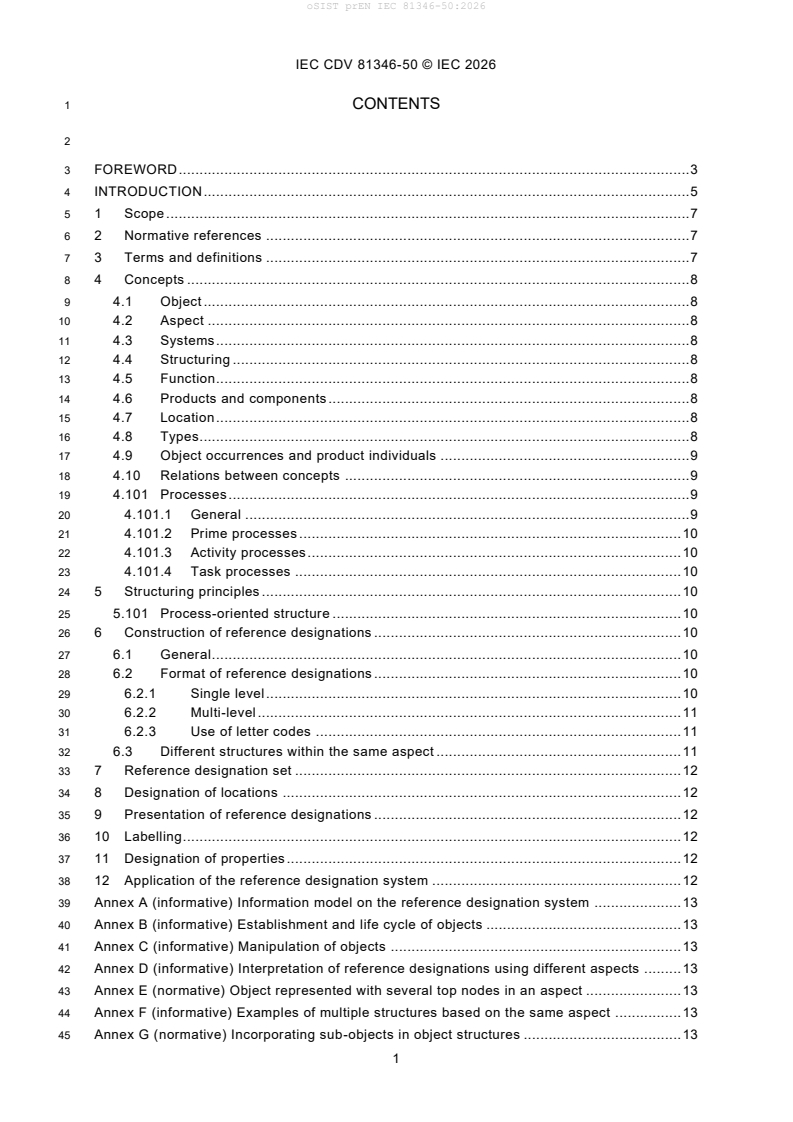
1 CONTENTS
3 FOREWORD . 3
4 INTRODUCTION . 5
5 1 Scope . 7
6 2 Normative references . 7
7 3 Terms and definitions . 7
8 4 Concepts . 8
9 4.1 Object . 8
10 4.2 Aspect . 8
11 4.3 Systems . 8
12 4.4 Structuring . 8
13 4.5 Function . 8
14 4.6 Products and components . 8
15 4.7 Location . 8
16 4.8 Types. 8
17 4.9 Object occurrences and product individuals . 9
18 4.10 Relations between concepts . 9
19 4.101 Processes . 9
20 4.101.1 General . 9
21 4.101.2 Prime processes . 10
22 4.101.3 Activity processes . 10
23 4.101.4 Task processes . 10
24 5 Structuring principles . 10
25 5.101 Process-oriented structure . 10
26 6 Construction of reference designations . 10
27 6.1 General . 10
28 6.2 Format of reference designations . 10
29 6.2.1 Single level . 10
30 6.2.2 Multi-level . 11
31 6.2.3 Use of letter codes . 11
32 6.3 Different structures within the same aspect . 11
33 7 Reference designation set . 12
34 8 Designation of locations . 12
35 9 Presentation of reference designations . 12
36 10 Labelling . 12
37 11 Designation of properties . 12
38 12 Application of the reference designation system . 12
39 Annex A (informative) Information model on the reference designation system . 13
40 Annex B (informative) Establishment and life cycle of objects . 13
41 Annex C (informative) Manipulation of objects . 13
42 Annex D (informative) Interpretation of reference designations using different aspects . 13
43 Annex E (normative) Object represented with several top nodes in an aspect . 13
44 Annex F (informative) Examples of multiple structures based on the same aspect . 13
45 Annex G (normative) Incorporating sub-objects in object structures . 13
IEC CDV 81346-50 © IEC 2026
46 Annex H (informative) Example of reference designations within a system . 13
47 Annex I (normative) Designation of relations between objects . 13
48 Annex J (informative) Requirements for developing sector-specific parts of the
49 International Standard 81346 series . 13
50 Annex K (informative) Metadata resource for structure management . 13
51 Annex L (informative) Recommendations for documentation of the application of the
52 reference designation system . 13
53 Annex M (informative) Fundamental ideas for this document. 13
54 Annex N (informative) Relationship to other standards . 13
55 Annex AA (normative) Classification letter codes for processes . 14
56 AA.1 General . 14
57 AA.2 Classes of prime processes . 14
58 AA.3 Classes of activity processes . 14
59 AA.4 Classes of task processes . 17
60 Annex BB (informative) Use cases . 30
61 BB.1 General . 30
62 BB.2 Use case: Pump maintenance . 30
63 BB.3 Use case: Project management planning . 31
64 BB.4 Use case: Product development following ISO/IEC/IEEE 15288 . 33
65 Bibliography . 36
67 Figure 1 – Classification hierarchy of processes . 12
68 Figure BB.1 – Process flow diagram of pump maintenance . 31
69 Figure BB.2 – Process breakdown structure of pump maintenance, . 32
70 Figure BB.3 – Example of project management planning. 33
71 Figure BB.4 – System life cycle processes as provided in ISO/IEC/IEEE 15288:2023,
72 Figure 4 . 35
74 Table AA.1 – Classes of prime processes . 14
75 Table AA.2 – Entry classes of the classification of activity processes . 15
76 Table AA.3 – Classes of activity processes . 15
77 Table AA.4 – Entry classes of task processes . 18
78 Table AA.5 – Classes of task processes . 19
79 Table BB.1 – Explanation to some of the processes shown in Figure BB.3 . 34
80 Table BB.2 – Example of mapping of technical processes of ISO/IEC/IEEE 15288 to
81 the classification scheme of this document . 36
IEC CDV 81346-50 © IEC 2026
85 INTERNATIONAL ELECTROTECHNICAL COMMISSION
86 ____________
88 Industrial systems, installations and equipment and industrial products —
89 Structuring principles and reference designations
91 Part 50: Processes
95 FOREWORD
96 1) The International Electrotechnical Commission (IEC) is a worldwide organization for standardization comprising
97 all national electrotechnical committees (IEC National Committees). The object of IEC is to promote international
98 co-operation on all questions concerning standardization in the electrical and electronic fields. To this end and
99 in addition to other activities, IEC publishes International Standards, Technical Specifications, Technical Reports,
100 Publicly Available Specifications (PAS) and Guides (hereafter referred to as “IEC Publication(s)”). Their
101 preparation is entrusted to technical committees; any IEC National Committee interested in the subject dealt with
102 may participate in this preparatory work. International, governmental and non-governmental organizations liaising
103 with the IEC also participate in this preparation. IEC collaborates closely with the International Organization for
104 Standardization (ISO) in accordance with conditions determined by agreement between the two organizations.
105 2) The formal decisions or agreements of IEC on technical matters express, as nearly as possible, an international
106 consensus of opinion on the relevant subjects since each technical committee has representation from all
107 interested IEC National Committees.
108 3) IEC Publications have the form of recommendations for international use and are accepted by IEC National
109 Committees in that sense. While all reasonable efforts are made to ensure that the technical content of IEC
110 Publications is accurate, IEC cannot be held responsible for the way in which they are used or for any
111 misinterpretation by any end user.
112 4) In order to promote international uniformity, IEC National Committees undertake to apply IEC Publications
113 transparently to the maximum extent possible in their national and regional publications. Any divergence between
114 any IEC Publication and the corresponding national or regional publication shall be clearly indicated in the latter.
115 5) IEC itself does not provide any attestation of conformity. Independent certification bodies provide conformity
116 assessment services and, in some areas, access to IEC marks of conformity. IEC is not responsible for any
117 services carried out by independent certification bodies.
118 6) All users should ensure that they have the latest edition of this publication.
119 7) No liability shall attach to IEC or its directors, employees, servants or agents including individual experts and
120 members of its technical committees and IEC National Committees for any personal injury, property damage or
121 other damage of any nature whatsoever, whether direct or indirect, or for costs (including legal fees) and
122 expenses arising out of the publication, use of, or reliance upon, this IEC Publication or any other IEC
123 Publications.
124 8) Attention is drawn to the Normative references cited in this publication. Use of the referenced publications is
125 indispensable for the correct application of this publication.
126 9) Attention is drawn to the possibility that some of the elements of this IEC Publication may be the subject of patent
127 rights. IEC shall not be held responsible for identifying any or all such patent rights.
128 IEC 81346-50 has been prepared by IEC technical committee 3: Documentation, graphical
129 symbols and representations of technical information, in close cooperation with ISO technical
130 committee 10: Technical product documentation. It is an International Standard.
131 It is published as a double logo standard and has the status of a horizontal publication in
132 accordance with IEC Guide 108.
IEC CDV 81346-50 © IEC 2026
134 The text of this standard is based on the following documents: [IN PROGRESS]
FDIS Report on voting
3/[xxx]/FDIS 3/[xxx]/RVD
136 Full information on the voting for its approval can be found in the report on voting indicated in
137 the above table. In ISO, the standard has been approved by [xx] members out of [xx] having
138 cast a vote.
139 The language used for the development of this International Standard is English.
140 This document is to be read in conjunction with IEC 81346-1:2022. The provisions of the general
141 rules dealt with in IEC 81346-1 are only applicable to this document insofar as they are
142 specifically cited. When this document states “addition”, “modification” or “replacement”, the
143 relevant text in IEC 81346-1:2022 is to be adapted accordingly.
144 Subclauses that are numbered with a 101 (102, 103, etc.) suffix are additional to the same
145 subclause in IEC 81346-1:2022.
146 Tables and figures in this document that are new are numbered starting with 101.
147 New annexes in this document are lettered AA, BB, etc.
148 A list of parts of the 81346 International Standard, published under the general title Industrial
149 systems, installations and equipment and industrial products — Structuring principles and
150 reference designations, can be found on the IEC website.
151 This document was drafted in accordance with ISO/IEC Directives, Part 2, and developed in
152 accordance with ISO/IEC Directives, Part 1 and ISO/IEC Directives, IEC Supplement, available
153 at www.iec.ch/members_experts/refdocs. The main document types developed by IEC are
154 described in greater detail at www.iec.ch/standardsdev/publications. [IN PROGRESS]
155 In this document, italic type is used as follows:
156 • the introductory statement in the clauses describing the applicability of the corresponding
157 clause of IEC 81346-1:2022; and
158 • for the initial process (i.e. prime process, activity process and task process) in the definition
159 of the entry classes of the classification schemes; and
160 • for the name indicating the parent class in the definition of a sub-class in the classification
161 schemes.
162 The committee has decided that the contents of this document will remain unchanged until the
163 stability date indicated on the IEC website under webstore.iec.ch in the data related to the
164 specific document. At this date, the document will be
165 • reconfirmed,
166 • withdrawn,
167 • replaced by a revised edition, or
168 • amended.
IEC CDV 81346-50 © IEC 2026
171 INTRODUCTION
172 This document considers and supports the designation of processes and activities within
173 industrial systems. The application of a reference designation system tailored for this purpose
174 may lead to innovative perspectives and structuring of these elements, offering opportunities
175 and potential for enhanced efficiency and optimization.
176 The users of this standard will be able to manage processes, relation among these and related
177 properties in a more efficient and consistent way. When implemented, information across
178 various data processing systems can be handled in an unambiguous way.
179 The focus of this addition to the 81346 International Standard series is to define classes of
180 processes which are used in life cycle of a technical system or product.
181 The following advantages of designation systems in accordance with this international standard
182 and the 81346-standard series in general will be more and more important in the future:
183 • The reference designation system can be applied in several technical fields in the same
184 way and is not designed only for one;
185 • The reference designation is not bound to a fixed structural pattern. Thus, the
186 designation system is expandible, which makes the interpretability in some cases quite
187 complex. Therefore, an exact and computer sensible documentation and description is
188 essential.
IEC CDV 81346-50 © IEC 2026
193 (Blank)
IEC CDV 81346-50 © IEC 2026
194 Industrial systems, installations and equipment and industrial products —
195 Structuring principles and reference designations
197 Part 50: Processes
199 1 Scope
200 This part of 81346 International Standard, published jointly by IEC and ISO, provides, in
201 combination with IEC 81346-1, rules and recommendations on the structuring of processes and
202 the information on processes used in the life cycle of technical systems. It also provides
203 classification schemes of those processes.
204 The structuring principles and the classes of processes are intended to be applied for providing
205 unambiguous identification of processes throughout their life cycles.
206 This document is also a horizontal publication intended for use by technical committees in
207 preparation of publications related to reference designations in accordance with the principles
208 laid down in IEC Guide 108.
209 2 Normative references
210 The following referenced documents are indispensable for the application of this document. For
211 dated references, only the edition cited applies. For undated references, the latest edition of
212 the referenced document (including any amendments) applies.
213 IEC 81346-1:2022, Industrial systems, installations and equipment and industrial products –
214 Structuring principles and reference designations – Part 1: Basic rules
215 3 Terms and definitions
216 For the purposes of this document, the terms and definitions given in IEC 81346-1:2022 and
217 the following apply.
218 3.1
219 information
220 knowledge concerning objects, such as facts, events, things, processes, or ideas (including
221 concepts) that, within a certain context, has a particular meaning
223 [SOURCE: IEC 60050-171:2019, 171-01-01]
224 3.2
225 data
226 representation of information (3.1) in a formalized manner suitable for human or automatic
227 processing
228 Note 1 to entry: Processing includes communication and interpretation.
229 Note 2 to entry: In English, the word "data" is generally used in plural form. For use in singular form, it can be called
230 "data item".
231 [SOURCE: IEC 60050-171:2019, 171-01-02]
232 3.3
233 prime process
234 process that constitutes an overall step in the life cycle of a system
IEC CDV 81346-50 © IEC 2026
235 Note 1 to entry: A prime process is usually performed by an organization.
236 3.4
237 activity process
238 process where the set of operations are performed in a given sequence
239 Note 1 to entry: A activity process is usually performed by a team.
240 3.5
241 task process
242 process consisting of a specific work to be done
243 Note 1 to entry: A task process is usually performed by an individual.
244 Note 2 to entry: The work can be performed by using tools and resources.
245 3.6
246 procedure
247 specified way to carry out an activity or a process
248 [SOURCE: ISO 9000:2015, 3.4.5, modified – Note 1 to entry deleted.]
250 4 Concepts
251 4.1 Object
252 IEC 81346-1:2022, 4.1 applies.
253 4.2 Aspect
254 IEC 81346-1:2022, 4.2 applies with the following addition:
nd
255 Add the following bullet to the bullets of the 2 paragraph:
256 • intended or accomplished activities constituting an object – the process aspect.
257 4.3 Systems
258 IEC 81346-1:2022, 4.3 applies.
259 4.4 Structuring
260 IEC 81346-1:2022, 4.4 applies.
261 4.5 Function
262 IEC 81346-1:2022, 4.5 applies.
263 4.6 Products and components
264 IEC 81346-1:2022, 4.6 applies.
265 4.7 Location
266 IEC 81346-1:2022, 4.7 applies.
267 4.8 Types
268 IEC 81346-1:2022, 4.8 applies.
IEC CDV 81346-50 © IEC 2026
269 4.9 Object occurrences and product individuals
270 IEC 81346-1:2022, 4.9 applies.
271 4.10 Relations between concepts
272 IEC 81346-1:2022, 4.10 applies with the addition of the following subclause:
273 4.101 Processes
274 4.101.1 General
275 In this document the process aspect is introduced to filter process information about an object
276 that is of relevance to it throughout its life cycle.
277 The application of the process aspect involves a structured approach to identify and designat e
278 processes. The process aspect is used to describe what happens with an object (e.g. system,
279 person, organization) over time. This allows designers to create references in areas of:
280 1. Organizational Strategies and Plans such as market analysis, product development,
281 and marketing campaigns, designated to track progress and ensure alignment with
282 organizational goals. This helps in managing and executing strategic initiatives
283 effectively, provides a clear roadmap, aligns activities with strategic goals, and
284 enhances the ability to monitor and adjust plans as needed.
285 2. Overall Development Projects where software, construction, or other fields, processes
286 such as requirements gathering, design, implementation, testing, and deployment can
287 to be clearly identified. Reference designations help in managing these phases
288 systematically, ensuring systematic progress, improving coordination among different
289 phases, and enhancing the ability to manage project timelines and deliverables.
290 3. Work Breakdown Structures (WBS), used to break down a project into smaller,
291 manageable sections. By applying reference designations to each process within the
292 WBS, project managers can ensure that every task is clearly identified and tracked,
293 facilitating better planning, execution, and monitoring. Thereby, clarity is enhanced, task
294 management is improved and ensuring that all project components are accounted for
295 and properly coordinated
296 4. Standard Operating Procedures (SOPs), critical for maintaining consistency and
297 quality. Reference designations for each procedure ensure that all steps are
298 documented and easily accessible, which is essential for training, compliance and
299 quality control. This promotes uniformity, ensures compliance with standards, and
300 facilitates training and quality assurance.
301 5. Lessons Learned Projects, either as part of design projects, construction projects or
302 other field processes, or as separate projects, where information such as cost,
303 emissions, time and more, can be systemized, aggregated and related, for further
304 analysis.
305 The process aspect is recognized by the prefix $ - DOLLAR
306 To differentiate between levels of abstraction, three classification libraries are used with
307 definition of their own process types:
308 • prime processes;
309 • activity processes; and
310 • task processes.
IEC CDV 81346-50 © IEC 2026
312 4.101.2 Prime processes
313 Prime processes represent the highest level of abstraction. These processes encompass broad,
314 overarching procedures and strategies that define the general direction and objectives of an
315 organization.
316 4.101.3 Activity processes
317 Activity processes represent the middle level of abstraction. These processes bridge the gap
318 between high-level strategies and detailed operational tasks. They are more specific than those
319 at the high level but still maintain a degree of generality. They are essential for translating
320 strategic objectives into actionable plans and coordinating various functions within the
321 organization.
322 4.101.4 Task processes
323 Task processes represent the lowest level of abstraction. These processes include detailed,
324 specific tasks and activities that are carried out on a day-to-day basis by operators and other
325 personnel or by automatic means. They are critical for the execution of operational plans and
326 ensure that the organization’s strategies are implemented effectively and efficiently .
327 5 Structuring principles
328 The requirements of IEC 81346-1:2022, clause 5 applies with the addition of the following
329 subclause:
330 5.101 Process-oriented structure
331 The process-oriented structure specifies on greater detail what is going on or needs to be done
332 to achieve a result. A constituency relation can be used to divide any process into sub-elements.
333 This can apply to a system which needs to undergo a particular order of operations, but also
334 the work an operator has to do.
335 Any process can be considered as the overall accomplishment of a number of sub-processes.
336 This constituency relationship allows a designer to create a breakdown structure using the same
337 principles as any other system breakdown structure.
338 6 Construction of reference designations
339 6.1 General
340 The requirements of IEC 81346-1:2022, 6.1 apply.
341 6.2 Format of reference designations
342 6.2.1 Single level
343 IEC 81346-1:2022, 6.1 applies with the following modifications:
344 Replace Rule 6 by the following:
345 Rule 6: A single-level reference designation assigned to an object occurrence shall consist
346 of a prefix sign followed by a letter code followed by a number.
347 Add the following item to Rule 7:
348 The prefix signs used to indicate the type of aspect in a reference designation shall be:
349 a) “$” (DOLLAR) when relating to the process aspect of the object.
IEC CDV 81346-50 © IEC 2026
350 6.2.2 Multi-level
351 IEC 81346-1:2022, 6.2.2 applies.
352 6.2.3 Use of letter codes
353 IEC 81346-1:2022, 6.2.3 applies with the following modifications.
354 Item b) of Rule 13 does not apply.
355 6.2.3.101 Classification of processes
356 6.2.3.101.1 General
357 A structured approach to classifying processes has been established to ensure clarity and
358 consistency across various domains. This standard introduces a hierarchical framework that
359 categorizes processes into three distinct levels of abstraction, each identified by the number of
360 characters in their class codes. This framework is essential for accommodating the diverse
361 needs of stakeholders, from high-level organizational planning to detailed operational tasks.
362 For the classification of prime processes, the classification scheme provided in Table AA.1
363 apply.
364 For the classification of activity processes, the classification scheme provided in Table AA.3
365 apply.
366 For the classification of task processes, the classification scheme provided in Table AA.5 apply.
367 Figure 1 illustrates the hierarchy of the classification schemes.
370 Figure 1 – Classification hierarchy of processes
371 6.3 Different structures within the same aspect
372 IEC 81346-1:2022, 6.3 applies.
IEC CDV 81346-50 © IEC 2026
373 7 Reference designation set
374 IEC 81346-1:2022, 7 applies.
375 8 Designation of locations
376 IEC 81346-1:2022, 8 applies.
377 9 Presentation of reference designations
378 IEC 81346-1:2022, 9 applies.
379 10 Labelling
380 IEC 81346-1:2022, 10 applies.
381 11 Designation of properties
382 IEC 81346-1:2022, 11 applies.
383 12 Application of the reference designation system
384 IEC 81346-1:2022, 12 applies.
IEC CDV 81346-50 © IEC 2026
385 Annex A (informative) Information model on the reference designation system
386 IEC 81346-1:2022, Annex A applies.
387 Annex B (informative) Establishment and life cycle of objects
388 IEC 81346-1:2022, Annex B applies.
389 Annex C (informative) Manipulation of objects
390 IEC 81346-1:2022, Annex C applies.
391 Annex D (informative) Interpretation of reference designations using different
392 aspects
393 IEC 81346-1:2022, Annex D applies.
394 Annex E (normative) Object represented with several top nodes in an aspect
395 IEC 81346-1:2022, Annex E applies.
396 Annex F (informative) Examples of multiple structures based on the same aspect
397 IEC 81346-1:2022, Annex F applies.
398 Annex G (normative) Incorporating sub-objects in object structures
399 IEC 81346-1:2022, Annex G applies.
400 Annex H (informative) Example of reference designations within a system
401 IEC 81346-1:2022, Annex does not apply.
402 Annex I (normative) Designation of relations between objects
403 IEC 81346-1:2022, Annex I applies.
404 Annex J (informative) Requirements for developing sector-specific parts of the
405 International Standard 81346 series
406 IEC 81346-1:2022, Annex J applies.
407 Annex K (informative) Metadata resource for structure management
408 IEC 81346-1:2022, Annex K applies.
409 Annex L (informative) Recommendations for documentation of the application of
410 the reference designation system
411 IEC 81346-1:2022, Annex L applies.
412 Annex M (informative) Fundamental ideas for this document
413 IEC 81346-1:2022, Annex M applies.
414 Annex N (informative) Relationship to other standards
415 IEC 81346-1:2022, Annex N applies.
IEC CDV 81346-50 © IEC 2026
416 Annex AA
417 (normative)
419 Classification letter codes for processes
420 AA.1 General
421 This annex provides classification schemes for prime processes, activity processes and task
422 processes. The classification schemes are mainly intended to be applied for designating object
423 occurrences within a process-oriented structure. They may also be applied for designation of
424 types.
425 The classification schemes are developed in accordance with the rules and guidelines given in
426 ISO 704 and ISO 22274.
427 AA.2 Classes of prime processes
428 Table AA.1 lists the classes of prime processes.
429 Table AA.1 – Classes of prime processes
Class
Class definition Preferred term Examples
code
prime process of designing
A designing process modelling, prototyping
an object
prime process of retrieving
B extracting process capturing, harvesting, obtaining
an object
prime process of making a assembling, building, fabricating,
C producing process
new object programming
prime process of treating an
facility management, maintaining,
D existing object to serve the treating process
servicing
same purposes or needs
prime process of moving an
E transporting process shipping. transferring
object
prime process of transmitting
F communicating process corresponding, marketing, publishing
information
prime process of governing
process enabling, quality assurance,
G activities and interactions of managing process
technical management
other prime processes
prime process of facilitating agreement process, handover process,
H transacting process
the exchange of ownership procurement
prime process of destroying
J destroying process demolishing
an existing object
prime process of modifying
altering, changing, enhancing,
K an existing entity to serve modifying process
transforming, upgrading
new purposes or needs
NOTE 1 The letters I and O are not used in class codes.
NOTE 2 Letters not used in this table are reserved for future standardization.
430 AA.3 Classes of activity processes
431 Table AA.2 lists the entry classes of the classification of activity processes. This table provides
432 an overview of the activity process classes. Table AA.3 lists the complete classification scheme
433 of activity processes and shall be used for the classification of activity processes.
IEC CDV 81346-50 © IEC 2026
434 Table AA.2 – Entry classes of the classification of activity processes
Class Criteria for definition of
Class definition Preferred term
code sub-classes
activity process for modelling data of an developing activity
A
object
activity process for changing characteristics transforming activity
B
on an object
activity process for using executive, managing activity
C
administrative or supervisory direction
activity process for handling a physical handling activity
D
object without changing its characteristics
activity process for obtaining and information activity
E
transferring information
F activity process for retrieving an object retrieving activity
NOTE 1 The letters I and O are not used in class codes.
NOTE 2 Letters not used in this table are reserved for future standardization.
436 Table AA.3 – Classes of activity processes
Class
code
Class definition Preferred term Examples
1 2
A activity process for modelling data of an developing activity [PHK] Criteria: operational
object function in development
workflow
AA developing activity by expanding analysing activity calculating, contemplating,
understanding of a subject estimating, evaluating,
mapping, requirements
analysing, refining, risk
assessing, searching, thinking
AB developing activity by predicting future planning activity coordinating, forecasting,
events foreseeing, logistics planning,
predicting, process planning,
scheduling
developing activity by handling computing, defining, drafting,
AC engineering activity
requirements or properties outlining, requiring
AD developing activity by establishing documenting activity authoring, characterizing,
information containers compiling, composing,
describing, documenting,
formalizing, recording,
specifying, stating
AE developing activity by organizing sorting activity allocating, arranging,
information in groups cataloguing, grouping,
indexing, prioritizing, sorting,
structuring
B activity process for changing transforming activity [ES] Criteria: Kind of
characteristics on an object transformation
[PHK] Criteria: goal of
transforming (or
transformational function)
BA transforming activity by preserving from maintaining activity adjusting, calibrating,
failure or decline cleaning, nourishing
optimizing, preserving,
repairing, restoring, tuning,
updating
BB transforming activity by reshaping reshaping activity creating, making, moulding
IEC CDV 81346-50 © IEC 2026
Class
code
Class definition Preferred term Examples
1 2
transforming activity by assembling or building, constructing,
BC assembly activity
dismantling creating, making
transforming activity by material material modification
BD cooking, creating, making
modification activity
BE transforming activity by mitigating the protecting activity covering, medicating,
effect of undesirable or dangerous mitigating risks, packing,
conditions preserving, safeguarding,
securing
BF transforming activity by adapting the configuring activity adjusting, calibrating,
object to its intended use optimizing, organizing
environment, preparing,
supporting, tuning
BG transforming activity by allowing time to ageing activity curing, decaying,
pass deteriorating, lingering,
maturing
BH transforming activity by dismantling dismantling activity amputating, demolishing,
disassembling
C activity process for using executive, managing activity [ES] Criteria: Kind of
administrative or supervisory direction managing
[PHK] Criteria: form of
executive direction and type
of object managed
CA managing activity for granting authorizing activity allocating, approving,
permission assigning, attesting,
authenticating,
commissioning, confirming,
delegating, designating,
endorsing, reviewing
CB managing activity for making a decision deciding activity assessing, choosing,
corroborating, deciding,
determining, judging,
negotiating, proving,
resolving, selecting, settling,
substantiating, validating,
verifying
CC managing activity for carrying out a implementing activity adapting, commissioning,
decision enforcing, executing, fulfilling,
installing, integrating,
realizing
CD managing activity for providing supervising activity administering, advising,
governance aiding, conducting,
controlling, coordinating,
evacuating, guiding, helping,
instructing, leading,
monitoring, overcoming
hijackers, overseeing, quality
assuring
CE managing activity for transferring acquiring activity buying, capturing, collecting,
ownership of an object exchanging, gathering,
obtaining, purchasing,
retrieving, securing, selling,
taking over, trading
CF managing activity for operating piloting activity driving, flying, navigating,
equipment operating
D activity process for handling a physical handling activity [ES] Criteria: Kind of handling
object without changing its
[PHK] Criteria: operational
characteristics
function in the object lifecycle
DA handling activity for transporting the transporting activity departing, evacuating,
object between locations moving, positioning, returning
IEC CDV 81346-50 © IEC 2026
Class
code
Class definition Preferred term Examples
1 2
DB handling activity for delivering the object delivering activity supplying, transitioning
for further processing or usage
DC handling activity for receiving the object receiving activity
for further processing
DD handling activity for storing the object storing activity accumulating, depositing,
keeping, locking away,
saving, stashing, stocking
DE handling activity for discarding the discarding activity dumping, getting rid of,
object recycling, removing
E activity process for obtaining and information activity [ES] Criteria: Method for
transferring information information obtainment
[PHK] Criteria: method for
information interaction
EA information activity by carrying out testing activity collecting data,
experiments experimenting, investigating
EB information activity by monitoring an observing activity capturing information,
object examining, measuring,
monitoring, retrieving
information, tracking
EC information activity by retrieving existing consulting activity checking, comprehending,
information confirming, consulting,
knowledge sharing, reviewing
ED information activity by transferring the communicating activity commanding, communicating,
information conference meeting,
demonstrating, directing,
displaying, explaining,
formulating, informing,
meeting, presenting,
proposing, publishing,
reporting, requesting,
socializing, suggesting,
teaching, telling, working
meeting
F activity process for retrieving an object retrieving activity [ES] Criteria: Source for
retrieving
[PHK] Criteria: recourse
environment domain
FA retrieving activity by agricultural agricultural activity farming
processes
FB retrieving activity by aquatic processes aquatic activity
FC retrieving activity by forestry processes forestry activity
FD retrieving activity by mining processes mining activity
FE retrieving activity by fluids extraction oil&gas activity water extraction
processes
NOTE 1 The letters I and O are not used in class codes.
NOTE 2 Letters not used in this table are reserved for future standardization.
437 AA.4 Classes of task processes
438 Table AA.4 lists the entry classes of task processes. This table provides an overview of the task
439 process classes. Table AA.5 list the complete classification scheme of task processes and shall
440 be used for the classification of task processes.
...