

prEN IEC 61508-3:2025
(Main)Functional safety of electrical/electronic/programmable electronic safety-related systems - Part 3: Software requirements
General Information
- Abstract
- Status
- Not Published
- Publication Date
- 14-Sep-2026
- Technical Committee
- CLC/TC 65X - Industrial-process measurement, control and automation
- Drafting Committee
- IEC/SC 65A - IEC_SC_65A
- Current Stage
- 4060 - Enquiry results established and sent to TC, SR, BTTF - Enquiry
- Start Date
- 16-May-2025
- Completion Date
- 16-May-2025

Overview
The prEN IEC 61508-3:2025 standard addresses the functional safety requirements for software in electrical, electronic, and programmable electronic (E/E/PE) safety-related systems. As Part 3 of the IEC 61508 series, this document focuses specifically on the software safety lifecycle ensuring that safety-related software development meets stringent criteria to avoid failures that could endanger people, property, or the environment.
Issued by the CLC and scheduled for release in 2025, this standard provides a comprehensive framework for managing safety-related software throughout its entire lifecycle-from initial specification to design, implementation, validation, operation, modification, and verification. It aligns with international efforts for industrial process measurement and control (ICS 25.040.40), emphasizing robust processes for software in critical systems.
Key Topics
Safety Lifecycle Management
Defines the systematic approach for software safety lifecycle requirements, including safety planning, specification, design, coding, testing, integration, validation, and modification.Software Safety Requirements Specification
Emphasizes clear and detailed documentation of software safety requirements as the foundation for safe software development.Design and Development
Covers architectural design requirements, programming language support, detailed software and system design, implementation, and module and integration testing to achieve safety integrity.Software Verification and Validation
Includes rigorous verification and validation processes to confirm software fulfils safety requirements and performs as intended without introducing faults.Functional Safety Assessment
Provides guidelines for conducting assessments throughout the lifecycle to assure compliance and identify potential safety issues.Use of Tools and Techniques
Specifies requirements for supporting tools such as programming environments and software off-line support tools, including confidence measures and qualification planning.Software Modification Procedures
Details rigorous change management protocols necessary to maintain safety integrity during software updates or corrections.Supplementary Guidance
Includes annexes covering technique selection, systematic capability properties, safe usage of software tools, model-based software development guidelines, and data-driven system considerations.
Applications
prEN IEC 61508-3:2025 is essential for organizations developing or managing safety-critical software embedded in:
- Industrial process control systems requiring reliable and safe operation
- Electrical and electronic safety-related equipment in sectors such as oil & gas, chemical, transportation, and manufacturing
- Programmable electronic systems where functional safety is mandatory for compliance
- Software-driven monitoring and diagnostic systems that protect personnel and assets
- Development environments requiring structured lifecycle processes to ensure software safety integrity levels (SIL)
This standard supports engineering teams, safety managers, software developers, quality assurance professionals, and auditors by providing a detailed methodology for delivering and maintaining safe software conforming to international safety requirements.
Related Standards
- IEC 61508-1 – Framework and general requirements for functional safety
- IEC 61508-2 – Hardware requirements for safety-related systems
- IEC 61511 – Functional safety standards for the process industry sector (building on IEC 61508 software requirements)
- IEC 62061 – Functional safety for machinery safety-related electrical control systems
- ISO 26262 – Safety of automotive software and E/E systems following a similar lifecycle approach
Understanding prEN IEC 61508-3 in conjunction with these related standards aids in integrating software safety into broader system safety engineering efforts, thereby ensuring comprehensive coverage for all safety-critical components.
By adhering to the prEN IEC 61508-3:2025 software requirements, organizations strengthen their safety management systems, reduce risks associated with software failures, and validate the reliability of safety-related software components in critical E/E/PE systems.
Relations
- Effective Date
- 11-Oct-2022
Get Certified
Connect with accredited certification bodies for this standard

DVS-ZERT GmbH
German welding certification society.
CARES (UK Certification Authority for Reinforcing Steels)
UK certification for reinforcing steels and construction.
EWF/IIW (European/International Welding Federation)
International welding personnel certification.
Sponsored listings
Frequently Asked Questions
prEN IEC 61508-3:2025 is a draft published by CLC. Its full title is "Functional safety of electrical/electronic/programmable electronic safety-related systems - Part 3: Software requirements". This standard covers: Functional safety of electrical/electronic/programmable electronic safety-related systems - Part 3: Software requirements
Functional safety of electrical/electronic/programmable electronic safety-related systems - Part 3: Software requirements
prEN IEC 61508-3:2025 is classified under the following ICS (International Classification for Standards) categories: 25.040.40 - Industrial process measurement and control. The ICS classification helps identify the subject area and facilitates finding related standards.
prEN IEC 61508-3:2025 has the following relationships with other standards: It is inter standard links to EN 61508-3:2010. Understanding these relationships helps ensure you are using the most current and applicable version of the standard.
prEN IEC 61508-3:2025 is available in PDF format for immediate download after purchase. The document can be added to your cart and obtained through the secure checkout process. Digital delivery ensures instant access to the complete standard document.
Standards Content (Sample)
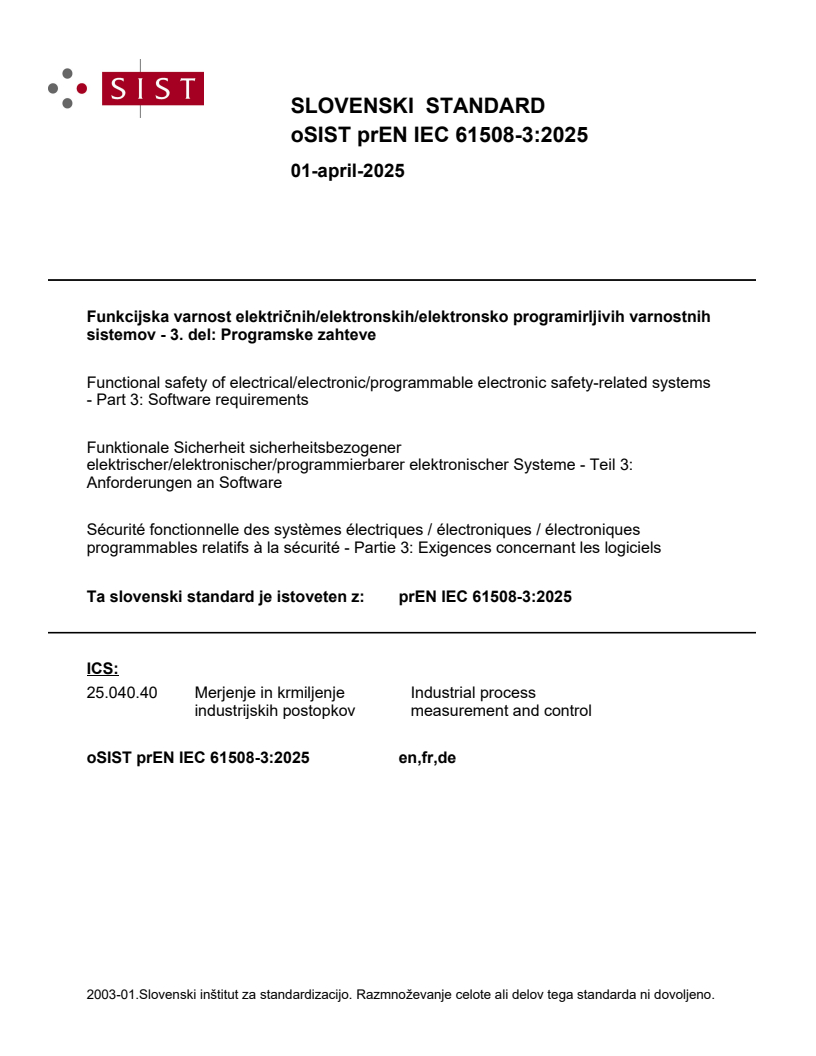
SLOVENSKI STANDARD
01-april-2025
Funkcijska varnost električnih/elektronskih/elektronsko programirljivih varnostnih
sistemov - 3. del: Programske zahteve
Functional safety of electrical/electronic/programmable electronic safety-related systems
- Part 3: Software requirements
Funktionale Sicherheit sicherheitsbezogener
elektrischer/elektronischer/programmierbarer elektronischer Systeme - Teil 3:
Anforderungen an Software
Sécurité fonctionnelle des systèmes électriques / électroniques / électroniques
programmables relatifs à la sécurité - Partie 3: Exigences concernant les logiciels
Ta slovenski standard je istoveten z: prEN IEC 61508-3:2025
ICS:
25.040.40 Merjenje in krmiljenje Industrial process
industrijskih postopkov measurement and control
2003-01.Slovenski inštitut za standardizacijo. Razmnoževanje celote ali delov tega standarda ni dovoljeno.
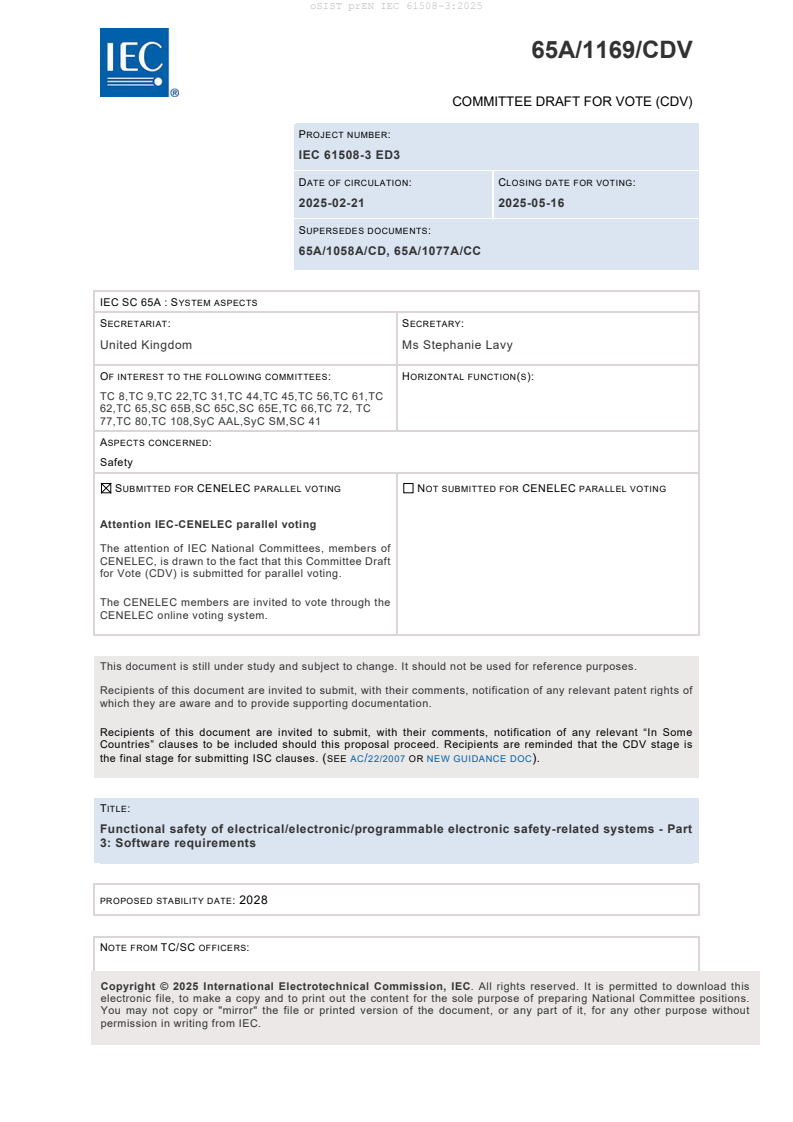
65A/1169/CDV
COMMITTEE DRAFT FOR VOTE (CDV)
PROJECT NUMBER:
IEC 61508-3 ED3
DATE OF CIRCULATION: CLOSING DATE FOR VOTING:
2025-02-21 2025-05-16
SUPERSEDES DOCUMENTS:
65A/1058A/CD, 65A/1077A/CC
IEC SC 65A : SYSTEM ASPECTS
SECRETARIAT: SECRETARY:
United Kingdom Ms Stephanie Lavy
OF INTEREST TO THE FOLLOWING COMMITTEES: HORIZONTAL FUNCTION(S):
TC 8,TC 9,TC 22,TC 31,TC 44,TC 45,TC 56,TC 61,TC
62,TC 65,SC 65B,SC 65C,SC 65E,TC 66,TC 72, TC
77,TC 80,TC 108,SyC AAL,SyC SM,SC 41
ASPECTS CONCERNED:
Safety
SUBMITTED FOR CENELEC PARALLEL VOTING NOT SUBMITTED FOR CENELEC PARALLEL VOTING
Attention IEC-CENELEC parallel voting
The attention of IEC National Committees, members of
CENELEC, is drawn to the fact that this Committee Draft
for Vote (CDV) is submitted for parallel voting.
The CENELEC members are invited to vote through the
CENELEC online voting system.
This document is still under study and subject to change. It should not be used for reference purposes.
Recipients of this document are invited to submit, with their comments, notification of any relevant patent rights of
which they are aware and to provide supporting documentation.
Recipients of this document are invited to submit, with their comments, notification of any relevant “In Some
Countries” clauses to be included should this proposal proceed. Recipients are reminded that the CDV stage is
the final stage for submitting ISC clauses. (SEE AC/22/2007 OR NEW GUIDANCE DOC).
TITLE:
Functional safety of electrical/electronic/programmable electronic safety-related systems - Part
3: Software requirements
PROPOSED STABILITY DATE: 2028
NOTE FROM TC/SC OFFICERS:
electronic file, to make a copy and to print out the content for the sole purpose of preparing National Committee positions.
You may not copy or "mirror" the file or printed version of the document, or any part of it, for any other purpose without
permission in writing from IEC.
IEC CDV 61508-3 ED3 © IEC 2025 2 65A/1169/CDV
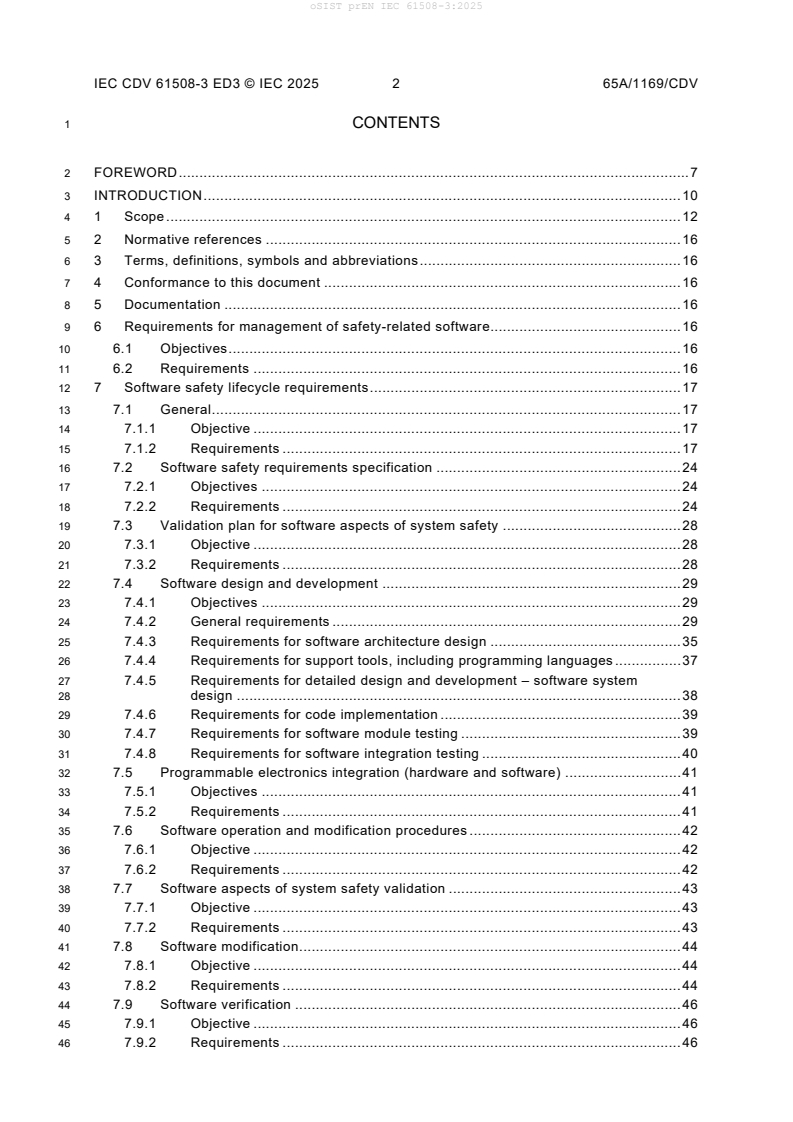
1 CONTENTS
2 FOREWORD . 7
3 INTRODUCTION . 10
4 1 Scope . 12
5 2 Normative references . 16
6 3 Terms, definitions, symbols and abbreviations . 16
7 4 Conformance to this document . 16
8 5 Documentation . 16
9 6 Requirements for management of safety-related software. 16
10 6.1 Objectives . 16
11 6.2 Requirements . 16
12 7 Software safety lifecycle requirements . 17
13 7.1 General . 17
14 7.1.1 Objective . 17
15 7.1.2 Requirements . 17
16 7.2 Software safety requirements specification . 24
17 7.2.1 Objectives . 24
18 7.2.2 Requirements . 24
19 7.3 Validation plan for software aspects of system safety . 28
20 7.3.1 Objective . 28
21 7.3.2 Requirements . 28
22 7.4 Software design and development . 29
23 7.4.1 Objectives . 29
24 7.4.2 General requirements . 29
25 7.4.3 Requirements for software architecture design . 35
26 7.4.4 Requirements for support tools, including programming languages . 37
27 7.4.5 Requirements for detailed design and development – software system
28 design . 38
29 7.4.6 Requirements for code implementation . 39
30 7.4.7 Requirements for software module testing . 39
31 7.4.8 Requirements for software integration testing . 40
32 7.5 Programmable electronics integration (hardware and software) . 41
33 7.5.1 Objectives . 41
34 7.5.2 Requirements . 41
35 7.6 Software operation and modification procedures . 42
36 7.6.1 Objective . 42
37 7.6.2 Requirements . 42
38 7.7 Software aspects of system safety validation . 43
39 7.7.1 Objective . 43
40 7.7.2 Requirements . 43
41 7.8 Software modification . 44
42 7.8.1 Objective . 44
43 7.8.2 Requirements . 44
44 7.9 Software verification . 46
45 7.9.1 Objective . 46
46 7.9.2 Requirements . 46
IEC CDV 61508-3 ED3 © IEC 2025 3 65A/1169/CDV
47 8 Functional safety assessment . 50
48 9 Bibliography . 51
49 Annex A (normative) Guide to the selection of techniques and measures . 52
50 Annex B (informative) Detailed tables . 61
51 Annex C (informative) Properties for systematic capability of software elements . 65
52 C.1 Introduction . 65
53 C.1.1 Structure of Annex C, relating to Annexes A and B . 65
54 C.1.2 Method of use – 1 . 67
55 C.1.3 Method of use – 2 . 68
56 C.2 Properties for systematic capability . 70
57 C.3 Properties for systematic capability – Detailed tables . 96
58 Annex D (normative) Safety manual for compliant items – additional requirements for
59 software elements . 110
60 D.1 Purpose of the safety manual . 110
61 D.2 Contents of the safety manual for a software element . 110
62 D.3 Justification of claims in the safety manual for compliant items . 112
63 Annex E (informative) Relationships between IEC 61508-2 and this document. 113
64 Annex F (informative) Techniques for achieving non-interference between software
65 elements on a single computer . 116
66 F.1 Introduction . 116
67 F.2 Domains of behaviour . 116
68 F.3 Causal factor analysis . 117
69 F.4 Achieving spatial independence . 117
70 F.5 Achieving temporal independence . 118
71 F.6 Requirements for supporting software . 119
72 F.7 Independence of software modules – programming language aspects . 119
73 Annex G (informative) Guidance for systems configured by application data . 125
74 G.1 Introduction . 125
75 G.2 Aspects influencing lifecycle requirements . 125
76 G.2.1 Complexity of E/E/PE systems . 125
77 G.2.2 Rationale for the lifecycle requirements . 126
78 G.2.3 Complexity in software . 127
79 G.2.4 Programming language characteristics and safety . 128
80 G.2.5 Role of the tools . 129
81 G.3 Guidance for tailoring the lifecycle . 130
82 G.3.1 Recommendations for tailoring the lifecycle . 130
83 G.3.2 Tailoring principles . 130
84 G.3.3 Fixed functionalities and configuration . 130
85 G.3.4 Fixed functionalities and programming . 131
86 G.3.5 Limited functionalities and configuration . 132
87 G.3.6 Limited functionalities and programming . 132
88 G.3.7 Open functionalities and configuration . 133
89 G.3.8 Open functionalities and programming . 133
90 Annex H (normative) Confidence in the usage of Software Off-line Support Tools . 134
91 H.1 Scope and conventions . 134
92 H.2 Software off-line support tool usage confidence approach overview . 134
93 H.2.1 Software off-line support tool usage confidence objectives . 134
94 H.2.2 Software off-line support tool confidence approach . 135
IEC CDV 61508-3 ED3 © IEC 2025 4 65A/1169/CDV
95 H.2.3 Software off-line support tool usage confidence measures overview . 136
96 H.3 Measures concerning software off-line support tool usage . 137
97 H.3.1 Software off-line support tool usage planning and qualification planning . 137
98 H.3.2 Software off-line support tool classification in the usage context . 138
99 H.3.3 Software off-line support tool user documentation. 140
100 H.3.4 Software off-line support tool integration and assessment in the usage
101 environment . 141
102 H.3.5 Software off-line support tool configuration management in the tool user
103 context . 141
104 H.3.6 Software off-line support tool operation . 142
105 H.4 Measures concerning software off-line support tool development including
106 verification . 142
107 H.4.1 Software off-line support tool development with avoidance of systematic
108 faults . 142
109 H.4.2 Confidence from software off-line support tool usage history . 143
110 H.4.3 Software off-line support tool documentation and problem management . 144
111 H.5 Required evidence for software off-line support tool usage confidence . 145
112 Annex I (informative) Model Based Software Development and Verification Guidelines . 147
113 I.1 Objectives and scope of this annex . 147
114 I.2 Rationale for this annex . 147
115 I.3 Approach and relationship with the body of this document . 148
116 I.4 Documentation . 148
117 I.5 Safety lifecycle planning . 148
118 I.6 Techniques and measures . 150
119 I.7 Software safety requirements specification . 151
120 I.8 Software architecture design . 151
121 I.9 Requirements for software off-line support tools, including programming
122 languages. . 152
123 I.10 Detailed design and development . 152
124 I.11 Code Implementation . 153
125 I.12 Software module testing . 153
126 I.13 Software integration testing . 154
127 I.14 Model Verification . 155
128 I.15 Model-Based verification . 155
129 Annex J (Informative) Data Driven Systems . 157
130 J.1 General . 157
131 J.2 Systems with Minimal Configurable Parameters . 158
132 J.3 Systems with Comprehensive Configurability . 158
133 J.4 Role of the tools . 159
135 Figure 1 – Overall framework of the IEC 61508 series . 14
136 Figure 2 – Overall E/E/PE system safety lifecycle . 15
137 Figure 3 – E/E/PE system safety lifecycle (in realisation phase) . 19
138 Figure 4 – Software safety lifecycle (in realisation phase) . 19
139 Figure 5 – Relationship and scope for IEC 61508-2 and this document (see also
140 Annex E) . 20
141 Figure 6 – Systematic capability for software and the development lifecycle (the V-
142 model) . 20
143 Figure H.1 – Tool Confidence Principle . 135
IEC CDV 61508-3 ED3 © IEC 2025 5 65A/1169/CDV
144 Figure H.2 – Data flow overview of software off-line support tool usage confidence
145 measures for an on-demand software off-line support tool . 136
146 Figure H.3 – Data flow overview of software off-line support tool usage confidence
147 measures for a COTS software off-line support tool . 137
150 Table 1 – Software safety lifecycle – overview (1 of 4) . 21
151 Table A.1 – Software safety requirements specification . 53
152 Table A.2 – Software design and development – software architecture design . 53
153 Table A.3 – Software design and development – programming language . 55
154 Table A.4 – Software design and development – detailed design . 55
155 Table A.5 – Software design and development – software module testing and
156 integration . 56
157 Table A.6 – Programmable electronics integration (hardware and software) . 57
158 Table A.7 – Software aspects of system safety validation . 57
159 Table A.8 – Modification . 57
160 Table A.9 – Software verification . 59
161 Table A.10 – Not Used : Replaced by additional requirements in Table A.2 . 59
162 Table A.11 – Software life cycle through lifecycle activities . 60
163 Table B.1 – Design and coding standards . 61
164 Table B.2 – Dynamic analysis and testing . 61
165 Table B.3 – Functional and black-box testing . 62
166 Table B.4 – Not Used : Replaced by additional requirements in Table A.2 . 62
167 Table B.5 – Modelling . 63
168 Table B.6 – Performance testing . 63
169 Table B.7 – Not Used . 63
170 Table B.8 – Static analysis . 64
171 Table B.9 – Modular approach . 64
172 Table C.1.1 – Extract of Table A.1 for illustration . 65
173 Table C.1.2 – Extract of Table C.1 for illustration . 66
174 Table C.1.3 – Extract of Table C.1 for illustration . 66
175 Table C.1.4 – Rigour of techniques . 67
176 Table C.1.5 – Use of rigour ranking . 67
177 Table C.1.2.1 Method of Use 1 : link between rigour and CS . 68
178 Table C.1 – Properties for systematic capability – Software safety requirements
179 specification. 70
180 Table C.2 – Properties for systematic capability – Software design and development –
181 software Architecture Design . 73
182 Table C.3 – Properties for systematic capability – Software design and development –
183 programming language . 84
184 Table C.4 – Properties for systematic capability – Software design and development –
185 detailed design (includes software system design, software module design and
186 coding) . 85
187 Table C.5 – Properties for systematic capability – Software design and development –
188 software module testing and integration . 89
IEC CDV 61508-3 ED3 © IEC 2025 6 65A/1169/CDV
189 Table C.6 – Properties for systematic capability – Programmable electronics
190 integration (hardware and software) . 91
191 Table C.7 – Properties for systematic capability – Software aspects of system safety
192 validation . 92
193 Table C.8 – Properties for systematic capability – Software modification . 93
194 Table C.9 – Properties for systematic capability – Software verification . 95
195 Table C.11 – Detailed properties – Design and coding standards . 96
196 Table C.12 – Detailed properties – Dynamic analysis and testing. 98
197 Table C.13 – Detailed properties – Functional and black-box testing . 100
198 Table C.14 – Deleted – Replaced by additional information in Table C.2 . 101
199 Table C.15 – Detailed properties – Modelling . 101
200 Table C.16 – Detailed properties – Performance testing. 102
201 Table C.17 – Not Used. 103
202 Table C.18 – Properties for systematic capability – Static analysis . 103
203 Table C.19 – Detailed properties – Modular approach . 104
204 Table C.20 – Properties for systematic capability - through lifecycle aspects . 106
205 Technique/Measure . 106
206 Table E.1 – Categories of IEC 61508-2 requirements . 113
207 Table E.2 – Requirements of IEC 61508-2 for software and their typical relevance to
208 certain types of software . 113
209 Table F.1 – Types of module coupling . 121
210 Table G.1 – Variability in complexity of E/E/PE systems . 126
211 Table H.1 – TD Levels . 139
212 Table H.2 –TIC/FSI/TD/TUS Balancing Rules . 140
213 Table H.3 – Required Tool Usage Confidence Evidence per TUS. 145
214 Table I.1 – Comparison of Separation vs Merging Development Layers . 149
IEC CDV 61508-3 ED3 © IEC 2025 7 65A/1169/CDV
217 INTERNATIONAL ELECTROTECHNICAL COMMISSION
218 ____________
220 FUNCTIONAL SAFETY OF ELECTRICAL/ELECTRONIC/
221 PROGRAMMABLE ELECTRONIC SAFETY-RELATED SYSTEMS –
223 Part 3: Software requirements
225 FOREWORD
226 1) The International Electrotechnical Commission (IEC) is a worldwide organization for standardization comprising
227 all national electrotechnical committees (IEC National Committees). The object of IEC is to promote international
228 co-operation on all questions concerning standardization in the electrical and electronic fields. To this end and
229 in addition to other activities, IEC publishes International Standards, Technical Specifications, Technical Reports,
230 Publicly Available Specifications (PAS) and Guides (hereafter referred to as “IEC Publication(s)”). Their
231 preparation is entrusted to technical committees; any IEC National Committee interested in the subject dealt with
232 may participate in this preparatory work. International, governmental and non-governmental organizations liaising
233 with the IEC also participate in this preparation. IEC collaborates closely with the International Organization for
234 Standardization (ISO) in accordance with conditions determined by agreement between the two organizations.
235 2) The formal decisions or agreements of IEC on technical matters express, as nearly as possible, an international
236 consensus of opinion on the relevant subjects since each technical committee has representation from all
237 interested IEC National Committees.
238 3) IEC Publications have the form of recommendations for international use and are accepted by IEC National
239 Committees in that sense. While all reasonable efforts are made to ensure that the technical content of IEC
240 Publications is accurate, IEC cannot be held responsible for the way in which they are used or for any
241 misinterpretation by any end user.
242 4) In order to promote international uniformity, IEC National Committees undertake to apply IEC Publications
243 transparently to the maximum extent possible in their national and regional publications. Any divergence between
244 any IEC Publication and the corresponding national or regional publication shall be clearly indicated in the latter.
245 5) IEC itself does not provide any attestation of conformity. Independent certification bodies provide conformity
246 assessment services and, in some areas, access to IEC marks of conformity. IEC is not responsible for any
247 services carried out by independent certification bodies.
248 6) All users should ensure that they have the latest edition of this publication.
249 7) No liability shall attach to IEC or its directors, employees, servants or agents including individual experts and
250 members of its technical committees and IEC National Committees for any personal injury, property damage or
251 other damage of any nature whatsoever, whether direct or indirect, or for costs (including legal fees) and
252 expenses arising out of the publication, use of, or reliance upon, this IEC Publication or any other IEC
253 Publications.
254 8) Attention is drawn to the Normative references cited in this publication. Use of the referenced publications is
255 indispensable for the correct application of this publication.
256 9) IEC draws attention to the possibility that the implementation of this document may involve the use of (a)
257 patent(s). IEC takes no position concerning the evidence, validity or applicability of any claimed patent rights in
258 respect thereof. As of the date of publication of this document, IEC had not received notice of (a) patent(s), which
259 may be required to implement this document. However, implementers are cautioned that this may not represent
260 the latest information, which may be obtained from the patent database available at https://patents.iec.ch [and/or]
261 www.iso.org/patents. IEC shall not be held responsible for identifying any or all such patent rights.
262 IEC 61508-3 has been prepared by subcommittee SC65A: SYSTEM ASPECTS, of IEC technical
263 committee TC65: INDUSTRIAL PROCESS MEASUREMENT, CONTROL AND AUTOMATION.
264 It is an International Standard.
265 This third edition cancels and replaces the second edition published in 2010. This edition
266 constitutes a technical revision.
267 This edition includes the following significant technical changes with respect to the previous
268 edition:
269 This document has been upgraded to the 2024 version of the ISO/IEC Directives; this does
270 introduce a significant number of editorial changes and Clause renumbering throughout. In
271 addition, the following technical changes have been made:
IEC CDV 61508-3 ED3 © IEC 2025 8 65A/1169/CDV
272 a) All requirements on use of artificial Intelligence, security and human factors are limited
273 to the references in Scope to external guidance
274 b) The requirements of IEC TS 61508-3-1 have been incorporated into Clause 7 and
275 extended to address requirements to achieve Systematic Capability SC3 and SC4
276 c) The interfaces to other Parts of IEC 61508 have been clarified and duplication of
277 requirements in other Parts has been removed
278 d) The requirement to undertake software functional failure analysis has been transferred
279 from the requirements for functional safety assessment to the requirements on
280 architectural design and renamed software failure analysis; the differentiation between
281 functional safety audit, functional safety assessment and software failure analysis has
282 been clarified in IEC 61508-7
283 e) The differentiation between the required Safety Integrity Level (SIL) and the achieved
284 Systematic Capability (SC) has been clarified
285 f) The requirements for formal methods has been clarified throughout all software lifecycle
286 phases, the requirements of TS 61508-3-2 have been referenced in this document and
287 IEC 61508-7 and the concept of semi-formal methods has been re-instated to the status
288 in Edition 2 of this document; the meaning of ‘unambiguously defined’ methods has been
289 clarified
290 g) Rules for synthesis of software elements has been clarified; detailed requirements on
291 software used in diagnostics is now addressed in IEC 61508-2
292 h) The requirements on software off-line support tools have been refined
293 i) The guidance on data driven systems has been provided in a separate Annex from the
294 guidance on data configuration and limited variability programming; the guidance on
295 limited variability programming has been updated to be consistent with IEC 61131-1.
296 j) The requirements in Annex A on modification have been re-instated to the status in
297 Edition 2 and clarified
298 k) An additional table has been added to define requirements on management activities
299 which occur throughout the entire software lifecycle; this table includes requirements on
300 traceability, which have been removed from individual phase requirements
301 l) Requirements on regression testing have been clarified
302 m) The use of the terminology ‘verification’ and ‘validation’ has been brought in line with the
303 definitions in IEC 61508-4; much supplementary information added at Ed 3 CD has been
304 transferred to IEC 61508-7 as informative guidance, or else deleted
305 n) The requirements on the use of object oriented design and development have been
306 brought in line with practical applications; further detail is being developed in TR 61508-
307 3-3
308 o) Various minor editorial errors have been corrected.
309 NOTE In order to avoid the need for extensive editing to existing compliance tools, the methods and techniques
310 specified in Annex A and Annex B of this document have retained their original reference ID. Where methods and
311 techniques have been deleted the phrase ‘Not Used’ has been entered. Where methods and techniques have been
312 added an additional row with additional reference ID have been added. As far as possible this also applies to Clauses
313 in the body of the document, but some renumbering has been inevitable where information has been added.
314 This edition has been subject to a thorough review and incorporates many comments received
315 at the various revision stages.
316 It has the status of a basic safety publication according to IEC Guide 104.
317 The text of this document is based on the following documents:
Draft Report on voting
XX/XX/FDIS XX/XX/RVD
IEC CDV 61508-3 ED3 © IEC 2025 9 65A/1169/CDV
319 Full information on the voting for its approval can be found in the report on voting indicated in
320 the above table.
321 The language used for the development of this document is English.
322 This document was drafted in accordance with ISO/IEC Directives, Part 2, and developed in
323 accordance with ISO/IEC Directives, Part 1 and ISO/IEC Directives, IEC Supplement, available
324 at www.iec.ch/members_experts/refdocs. The main document types developed by IEC are
325 described in greater detail at www.iec.ch/publications.
326 A list of all parts of the IEC 61508 series, published under the general title Functional safety of
327 electrical / electronic / programmable electronic safety-related systems, can be found on the
328 IEC website.
329 The committee has decided that the contents of this document will remain unchanged until the
330 stability date indicated on the IEC website under webstore.iec.ch in the data related to the
331 specific document. At this date, the document will be
332 • replaced by a revised edition, or
333 • amended.
IEC CDV 61508-3 ED3 © IEC 2025 10 65A/1169/CDV
335 INTRODUCTION
336 Systems comprised of electrical and/or electronic elements have been used for many years to
337 perform safety functions in most application sectors. Computer-based systems (generically
338 referred to as programmable electronic systems) are being used in all application sectors to
339 perform non-safety functions and, increasingly, to perform safety functions. If computer system
340 technology is to be effectively and safely exploited, it is essential that those responsible for
341 making decisions have sufficient guidance on the safety aspects on which to make these
342 decisions.
343 This document sets out a generic approach for all safety lifecycle activities for systems
344 comprised of electrical and/or electronic and/or programmable electronic (E/E/PE) elements
345 that are used to perform safety functions. This unified approach has been adopted in order that
346 a rational and consistent technical policy be developed for all electrically-based safety-related
347 systems. A major objective is to facilitate the development of product and application sector
348 international standards based on the IEC 61508 series.
349 NOTE 1 Examples of product and application sector international standards based on the IEC 61508 series are
350 given in the bibliography.
351 In most situations, safety is achieved by a number of systems which rely on many technologies (for
352 example mechanical, hydraulic, pneumatic, electrical, electronic, programmable electronic). Any
353 safety strategy considers not only all the elements within an individual system (for example sensors,
354 controlling devices and actuators) and humans as part of the system, as part of the realization
355 process, operation, and management of verification/decision making), but also all the safety-related
356 systems making up the total combination of safety-related systems. Therefore, while this document is
357 concerned with E/E/PE safety-related systems, it can also provide a framework within which safety-
358 related systems based on other technologies can be considered.
359 It is recognized that there is a great variety of applications using E/E/PE safety-related systems
360 in a variety of application sectors and covering a wide range of complexity, hazard and risk
361 potentials. In any particular application, the required safety measures will be dependent on
362 many factors specific to the application. This document, by being generic, will enable such
363 measures to be formulated in future product and application sector international standards and
364 in revisions of those that already exist.
365 This document
366 – considers all relevant overall, E/E/PE system and software safety lifecycle phases (for example,
367 from initial concept, through design, implementation, operation and maintenance to
368 decommissioning) when E/E/PE systems are used to perform safety functions;
369 – has been conceived with a rapidly developing technology in mind; the framework is sufficiently
370 robust and comprehensive to cater for future developments;
371 – enables product and application sector international standards, dealing with E/E/PE safety-
372 related systems, to be developed; the development of product and application sector
373 international standards, within the framework of this document, should lead to a high level of
374 consistency (for example, of underlying principles, terminology etc.) both within application
375 sectors and across application sectors; this will have both safety and economic benefits;
376 – provides a method for the development of the safety requirements specification necessary to
377 achieve the required functional safety for E/E/PE safety-related systems;
378 – adopts a risk-based approach by which the safety integrity requirements can be determined;
379 – introduces safety integrity levels for specifying the target level of safety integrity for the safety
380 functions to be implemented by the E/E/PE safety-related systems;
381 NOTE 1 The standard does not specify the safety integrity level requirements for any safety function, nor does it
382 mandate how the safety integrity level is determined. Instead, it provides a risk-based conceptual framework and
383 example techniques.
384 – sets target failure measures for safety functions carried out by E/E/PE safety-related systems,
385 which are linked to the safety integrity levels;
IEC CDV 61508-3 ED3 © IEC 2025 11 65A/1169/CDV
386 – sets a lower limit on the target failure measures for a safety function carried out by a single
387 E/E/PE safety-related system. For E/E/PE safety-related systems operating in
388 • a low demand mode of operation, the lower limit is set at an average probability of a
–5
389 dangerous failure on demand of 10 ;
390 • a high demand or a continuous mode of operation, the lower limit is set at an average
–9 -1
391 frequency of a dangerous failure of 10 [h ];
392 NOTE 2 A single E/E/PE safety-related system does not necessarily mean a single-channel architecture.
393 NOTE 3 It can be possible to achieve designs of safety-related systems with lower values for the target safety
394 integrity for non-complex systems, but these limits are considered to represent what can be achieved for relatively
395 complex systems (for example programmable electronic safety-related systems) at the present time.
396 – sets requirements for the avoidance and control of systematic faults, which are based on
397 experience and judgement from practical experience gained in industry. Even though the
398 probability of occurrence of systematic failures cannot in general be quantified the standard
399 does, however, allow a claim to be made, for a specified safety function, that the target failure
400 measure associated with the safety function can be considered to be achieved if all the
401 requirements in the standard have been met;
402 – introduces systematic capability as a measure of confidence that an E/E/PE system meets the
403 safety requirements with regards to avoidance and control of systematic faults;
404 – adopts a broad range of principles, techniques and measures to achieve functional safety for
405 E/E/PE safety-related systems but does not explicitly use the concept of fail safe. However, the
406 concepts of “fail safe” can be applicable and adoption of such concepts is acceptable provi
...