

EN 50174-2:2018
(Main)Information technology - Cabling installation - Part 2: Installation planning and practices inside buildings
General Information
- Abstract
1.1 Scope This European Standard specifies requirements for the following aspects of information technology cabling: a) planning; b) installation practice. This European Standard is applicable to all types of information technology cabling inside buildings (and may be applied to cabling that is defined as part of the building) including generic cabling systems designed in accordance with the EN 50173 series. The requirements of Clauses 4, 5 and 6 of this standard are premises-independent unless amended by the requirements of premises-specific clauses. This European Standard: 1) details the considerations for satisfactory installation and operation of information technology cabling; 2) describes the methodology for the assessment of spaces, pathways (and pathway systems) and cabling (either installed or planned) in support of remote powering objectives; 3) excludes specific requirements applicable to other cabling systems (e.g. power supply cabling); however, it takes account of the effects other cabling systems have on the installation of information technology cabling (and vice versa) and gives general advice; 4) excludes those aspects of installation associated with the transmission of signals in free space between transmitters, receivers or their associated antenna systems (e.g. wireless, radio, microwave or satellite). This European Standard is intended for application within commercial and residential premises. This standard is applicable to certain hazardous environments. It does not exclude additional requirements which are applicable in particular circumstances, defined by e.g. electricity supply and electrified railways. 1.2 Conformance For a cabling installation to conform to this European Standard: a) the planning of the installation shall meet the requirements of Clause 4; b) the installation practices shall meet the requirements of Clause 5; c) the additional requirements of the applicable premises-specific clause shall be met; d) the bonding system within the premises shall be in accordance with EN 50310; e) where a lightning protection system is required, it shall conform to the “integrated lightning protection system" according to EN 62305-4; f) other lightning protection systems, including the “isolated lightning protection system” according to EN 62305-3 are allowed provided that specific restrictions are applied both to the implementation of the information technology cabling and the requirements of EN 50310 as agreed between the planners of the lightning protection system and the information technology cabling; g) local regulations shall be met. The responsibilities for specific elements of conformance may be made by national-specific amendment of Annex B.
- Status
- Published
- Publication Date
- 28-Jun-2018
- Technical Committee
- CLC/TC 215 - Electrotechnical aspects of telecommunication equipment
- Drafting Committee
- ISO/IEC/JTC 1/SC25 - ISO/IEC_JTC_1/SC25
- Current Stage
- 9093 - Decision to confirm - Review Enquiry
- Start Date
- 09-Nov-2022
- Completion Date
- 25-Aug-2026


Overview
EN 50174-2:2018 - "Information technology - Cabling installation - Part 2: Installation planning and practices inside buildings" - is a European standard that specifies requirements for planning and installation practices of information technology cabling inside buildings. It applies to all types of IT cabling (including building-defined cabling) and supports generic cabling systems designed to the EN 50173 series. The standard is intended for commercial and residential premises and addresses premises-independent requirements (Clauses 4, 5 and 6) plus premises-specific clauses.
Key topics and technical requirements
This standard guides practical and safe cabling installation with emphasis on:
- Installation planning
- Safety for personnel and equipment
- Documentation and record keeping
- Assessment of spaces, pathways and pathway systems
- Installation practice
- Cable handling, storage and termination
- Jointing, routing, cable management and closures
- Labelling, testing and contractual acceptance
- Pathways and pathway systems
- Requirements and recommendations for overhead, underfloor and conduit systems
- Cable management and spaces
- Design of racks, containment, access and repair planning
- Segregation
- Rules for segregation of metallic IT cabling and power supply cabling to avoid interference and safety risks
- Remote powering considerations
- Methodology for assessing cabling/pathways in support of remote powering objectives (thermal and electrical impacts)
- Lightning and earthing
- Requirements for bonding systems (EN 50310), integrated lightning protection (EN 62305-4) and coordination with other lightning protection approaches
- Conformance
- To conform, installations must meet Clause 4 (planning), Clause 5 (installation practices), applicable premises clauses, bonding (EN 50310), and local regulations. Additional coordination is required where other lightning protection systems are used.
The standard excludes specifics for other cabling systems (e.g., mains power cabling) and free-space transmission (wireless/antenna systems), while giving general advice on their interactions.
Practical applications and users
EN 50174-2:2018 is used by:
- Network designers and cabling planners
- Installers, contractors and site technicians
- Facility managers and building owners
- Architects and integrators coordinating building services
- Compliance officers and safety engineers
Typical applications include office networks, residential building cabling, data closets, industrial premises planning and installations where reliable, safe cabling and support for remote powering (PoE and similar) are required.
Related standards
- EN 50173 series (generic cabling systems)
- EN 50310 (bonding of network infrastructure)
- EN 62305-4 / EN 62305-3 (lightning protection)
- Local regulations and premises-specific national amendments
Keywords: cabling installation, information technology cabling, installation planning, pathways, cable management, remote powering, segregation, EN 50174-2.
Relations
- Effective Date
- 28-Jan-2023
- Effective Date
- 28-Jan-2023
- Effective Date
- 28-Jan-2023
- Effective Date
- 12-May-2026
- Effective Date
- 09-Feb-2026
- Effective Date
- 03-Feb-2026
- Referred By
CLC/TR 50174-99-1:2015 - Information technology - Cabling installation - Part 99-1: Remote powering - Effective Date
- 03-Feb-2026
- Effective Date
- 03-Feb-2026
- Effective Date
- 03-Feb-2026
- Effective Date
- 03-Feb-2026
- Effective Date
- 03-Feb-2026
- Effective Date
- 03-Feb-2026
- Effective Date
- 03-Feb-2026
- Effective Date
- 03-Feb-2026
- Effective Date
- 03-Feb-2026
Get Certified
Connect with accredited certification bodies for this standard

BSI Group
BSI (British Standards Institution) is the business standards company that helps organizations make excellence a habit.

DIBt (Deutsches Institut für Bautechnik)
German Institute for Building Technology.
DIN CERTCO
DIN Group product certification.
Sponsored listings
Frequently Asked Questions
EN 50174-2:2018 is a standard published by CLC. Its full title is "Information technology - Cabling installation - Part 2: Installation planning and practices inside buildings". This standard covers: 1.1 Scope This European Standard specifies requirements for the following aspects of information technology cabling: a) planning; b) installation practice. This European Standard is applicable to all types of information technology cabling inside buildings (and may be applied to cabling that is defined as part of the building) including generic cabling systems designed in accordance with the EN 50173 series. The requirements of Clauses 4, 5 and 6 of this standard are premises-independent unless amended by the requirements of premises-specific clauses. This European Standard: 1) details the considerations for satisfactory installation and operation of information technology cabling; 2) describes the methodology for the assessment of spaces, pathways (and pathway systems) and cabling (either installed or planned) in support of remote powering objectives; 3) excludes specific requirements applicable to other cabling systems (e.g. power supply cabling); however, it takes account of the effects other cabling systems have on the installation of information technology cabling (and vice versa) and gives general advice; 4) excludes those aspects of installation associated with the transmission of signals in free space between transmitters, receivers or their associated antenna systems (e.g. wireless, radio, microwave or satellite). This European Standard is intended for application within commercial and residential premises. This standard is applicable to certain hazardous environments. It does not exclude additional requirements which are applicable in particular circumstances, defined by e.g. electricity supply and electrified railways. 1.2 Conformance For a cabling installation to conform to this European Standard: a) the planning of the installation shall meet the requirements of Clause 4; b) the installation practices shall meet the requirements of Clause 5; c) the additional requirements of the applicable premises-specific clause shall be met; d) the bonding system within the premises shall be in accordance with EN 50310; e) where a lightning protection system is required, it shall conform to the “integrated lightning protection system" according to EN 62305-4; f) other lightning protection systems, including the “isolated lightning protection system” according to EN 62305-3 are allowed provided that specific restrictions are applied both to the implementation of the information technology cabling and the requirements of EN 50310 as agreed between the planners of the lightning protection system and the information technology cabling; g) local regulations shall be met. The responsibilities for specific elements of conformance may be made by national-specific amendment of Annex B.
1.1 Scope This European Standard specifies requirements for the following aspects of information technology cabling: a) planning; b) installation practice. This European Standard is applicable to all types of information technology cabling inside buildings (and may be applied to cabling that is defined as part of the building) including generic cabling systems designed in accordance with the EN 50173 series. The requirements of Clauses 4, 5 and 6 of this standard are premises-independent unless amended by the requirements of premises-specific clauses. This European Standard: 1) details the considerations for satisfactory installation and operation of information technology cabling; 2) describes the methodology for the assessment of spaces, pathways (and pathway systems) and cabling (either installed or planned) in support of remote powering objectives; 3) excludes specific requirements applicable to other cabling systems (e.g. power supply cabling); however, it takes account of the effects other cabling systems have on the installation of information technology cabling (and vice versa) and gives general advice; 4) excludes those aspects of installation associated with the transmission of signals in free space between transmitters, receivers or their associated antenna systems (e.g. wireless, radio, microwave or satellite). This European Standard is intended for application within commercial and residential premises. This standard is applicable to certain hazardous environments. It does not exclude additional requirements which are applicable in particular circumstances, defined by e.g. electricity supply and electrified railways. 1.2 Conformance For a cabling installation to conform to this European Standard: a) the planning of the installation shall meet the requirements of Clause 4; b) the installation practices shall meet the requirements of Clause 5; c) the additional requirements of the applicable premises-specific clause shall be met; d) the bonding system within the premises shall be in accordance with EN 50310; e) where a lightning protection system is required, it shall conform to the “integrated lightning protection system" according to EN 62305-4; f) other lightning protection systems, including the “isolated lightning protection system” according to EN 62305-3 are allowed provided that specific restrictions are applied both to the implementation of the information technology cabling and the requirements of EN 50310 as agreed between the planners of the lightning protection system and the information technology cabling; g) local regulations shall be met. The responsibilities for specific elements of conformance may be made by national-specific amendment of Annex B.
EN 50174-2:2018 is classified under the following ICS (International Classification for Standards) categories: 35.110 - Networking; 91.140.50 - Electricity supply systems. The ICS classification helps identify the subject area and facilitates finding related standards.
EN 50174-2:2018 has the following relationships with other standards: It is inter standard links to EN 50174-2:2009/A1:2011/AC:2011, EN 50174-2:2009/A2:2014, EN 50174-2:2009/A1:2011, EN 50600-3-1:2026, EN ISO 11197:2019, CLC/TR 50174-99-2:2020, CLC/TR 50174-99-1:2015, EN 50491-6-1:2014, EN 50491-1:2014, CLC/TR 50173-99-2:2020, EN 50600-2-4:2015, EN 50700:2014, EN 50600-2-2:2014, CLC/TR 50484:2009, EN 50173-20:2022. Understanding these relationships helps ensure you are using the most current and applicable version of the standard.
EN 50174-2:2018 is available in PDF format for immediate download after purchase. The document can be added to your cart and obtained through the secure checkout process. Digital delivery ensures instant access to the complete standard document.
Standards Content (Sample)
SLOVENSKI STANDARD
01-oktober-2018
Nadomešča:
SIST EN 50174-2:2009
SIST EN 50174-2:2009/A1:2011
SIST EN 50174-2:2009/A1:2011/AC:2011
SIST EN 50174-2:2009/A2:2014
Informacijska tehnologija - Kabelska inštalacija - 2. del: Načrtovanje inštalacij in
tehnike dela v stavbah
Information technology - Cabling installation - Part 2: Installation planning and practices
inside buildings
Informationstechnik - Installation von Kommunikationsverkabelung - Teil 2:
Installationsplanung und Installationspraktiken in Gebäuden
Technologies de l'information - Installation de câblages - Partie 2 : Planification et
pratiques d'installation à l'intérieur des bâtiments
Ta slovenski standard je istoveten z: EN 50174-2:2018
ICS:
33.040.50 Vodi, zveze in tokokrogi Lines, connections and
circuits
35.110 Omreževanje Networking
91.140.50 Sistemi za oskrbo z elektriko Electricity supply systems
2003-01.Slovenski inštitut za standardizacijo. Razmnoževanje celote ali delov tega standarda ni dovoljeno.
EUROPEAN STANDARD EN 50174-2
NORME EUROPÉENNE
EUROPÄISCHE NORM
June 2018
ICS 35.110; 91.140.50 Supersedes EN 50174-2:2009
English Version
Information technology - Cabling installation - Part 2: Installation
planning and practices inside buildings
Technologies de l'information - Installation de câblages - Informationstechnik - Installation von
Partie 2 : Planification et pratiques d'installation à l'intérieur Kommunikationsverkabelung - Teil 2: Installationsplanung
des bâtiments und Installationspraktiken in Gebäuden
This European Standard was approved by CENELEC on 2018-05-21. CENELEC members are bound to comply with the CEN/CENELEC
Internal Regulations which stipulate the conditions for giving this European Standard the status of a national standard without any alteration.
Up-to-date lists and bibliographical references concerning such national standards may be obtained on application to the CEN-CENELEC
Management Centre or to any CENELEC member.
This European Standard exists in three official versions (English, French, German). A version in any other language made by translation
under the responsibility of a CENELEC member into its own language and notified to the CEN-CENELEC Management Centre has the
same status as the official versions.
CENELEC members are the national electrotechnical committees of Austria, Belgium, Bulgaria, Croatia, Cyprus, the Czech Republic,
Denmark, Estonia, Finland, Former Yugoslav Republic of Macedonia, France, Germany, Greece, Hungary, Iceland, Ireland, Italy, Latvia,
Lithuania, Luxembourg, Malta, the Netherlands, Norway, Poland, Portugal, Romania, Serbia, Slovakia, Slovenia, Spain, Sweden,
Switzerland, Turkey and the United Kingdom.
European Committee for Electrotechnical Standardization
Comité Européen de Normalisation Electrotechnique
Europäisches Komitee für Elektrotechnische Normung
CEN-CENELEC Management Centre: Rue de la Science 23, B-1040 Brussels
© 2018 CENELEC All rights of exploitation in any form and by any means reserved worldwide for CENELEC Members.
Ref. No. EN 50174-2:2018 E
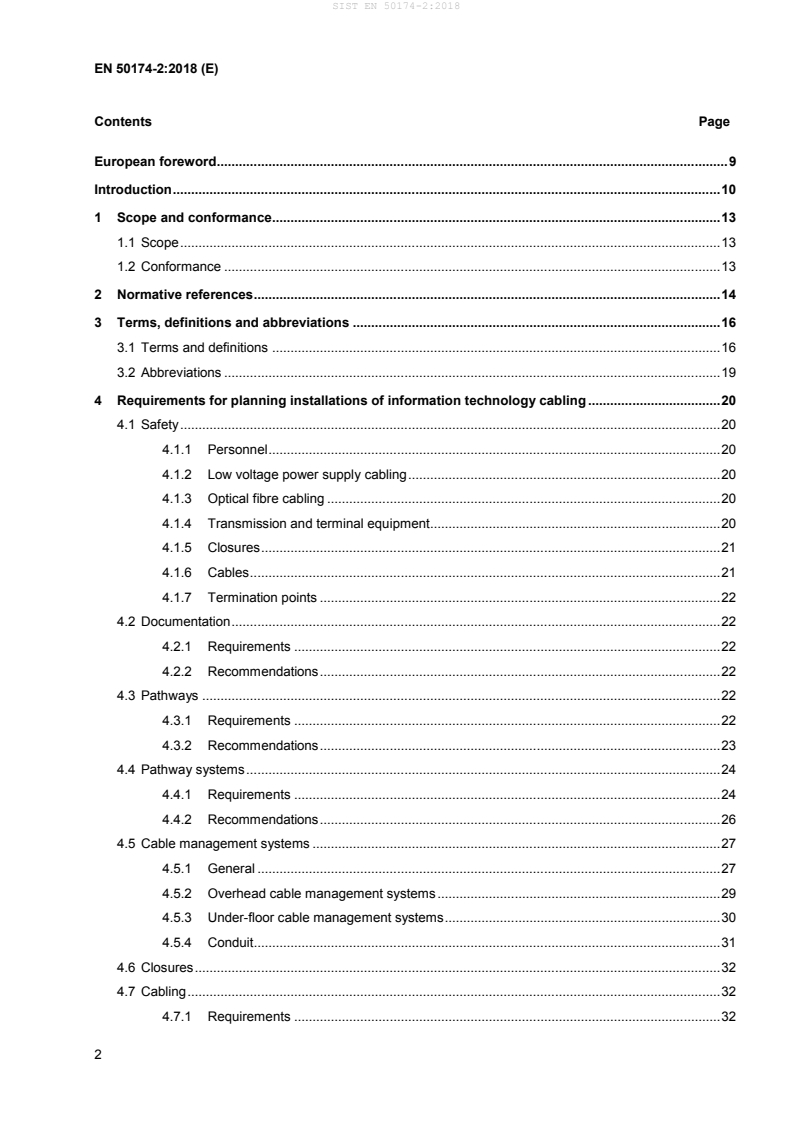
Contents Page
European foreword . 9
Introduction . 10
1 Scope and conformance . 13
1.1 Scope . 13
1.2 Conformance . 13
2 Normative references . 14
3 Terms, definitions and abbreviations . 16
3.1 Terms and definitions . 16
3.2 Abbreviations . 19
4 Requirements for planning installations of information technology cabling . 20
4.1 Safety . 20
4.1.1 Personnel . 20
4.1.2 Low voltage power supply cabling . 20
4.1.3 Optical fibre cabling . 20
4.1.4 Transmission and terminal equipment . 20
4.1.5 Closures . 21
4.1.6 Cables . 21
4.1.7 Termination points . 22
4.2 Documentation . 22
4.2.1 Requirements . 22
4.2.2 Recommendations . 22
4.3 Pathways . 22
4.3.1 Requirements . 22
4.3.2 Recommendations . 23
4.4 Pathway systems . 24
4.4.1 Requirements . 24
4.4.2 Recommendations . 26
4.5 Cable management systems . 27
4.5.1 General . 27
4.5.2 Overhead cable management systems . 29
4.5.3 Under-floor cable management systems . 30
4.5.4 Conduit. 31
4.6 Closures . 32
4.7 Cabling . 32
4.7.1 Requirements . 32
4.8 Filtering and electrical isolation components and surge protective devices . 33
4.9 Spaces . 33
4.9.1 Requirements . 33
4.9.2 Recommendations . 34
4.10 Planning for repair . 36
4.11 Planning and assessment of cabling in support of remote powering objectives . 37
4.11.1 General . 37
4.11.2 Balanced cabling in accordance with EN 50173 series . 37
5 Requirements for the installation of information technology cabling . 42
5.1 Safety . 42
5.1.1 General . 42
5.1.2 Pathways . 42
5.1.3 Closures . 43
5.1.4 Cables . 43
5.2 Documentation . 43
5.3 Installation practice . 43
5.3.1 Storage of cabling components and equipment . 43
5.3.2 Pathways . 43
5.3.3 Pathway systems . 44
5.3.4 Closures . 47
5.3.5 Cable installation . 47
5.3.6 Jointing and termination of cables . 49
5.3.7 Cords and jumpers . 50
5.4 Surge protective devices . 51
5.5 Labelling . 51
5.6 Testing . 51
5.7 Contractual acceptance . 51
5.8 Operation . 51
5.8.1 Requirements . 51
5.8.2 Recommendations . 51
6 Segregation of metallic information technology cabling and power supply cabling . 52
6.1 General . 52
6.2 Requirements . 52
6.2.1 General segregation requirements . 52
6.2.2 Conditional relaxation of requirement . 59
6.3 Recommendations . 59
6.4 Separation of cable bundles to reduce thermal impact of remote powering . 60
7 Electricity distribution systems and lightning protection . 60
7.1 Electricity distribution systems . 60
7.1.1 General . 60
7.1.2 Availability of supply . 61
7.1.3 Earthing of the AC distribution system . 61
7.2 Protection against lightning and induced overvoltages . 62
7.2.1 General . 62
7.2.2 Design . 62
7.2.3 Installation . 63
8 Office (commercial) spaces. 63
8.1 General . 63
8.2 Office (commercial) spaces cabling design overview . 63
8.3 Requirements for planning installations of information technology cabling . 63
8.3.1 Safety . 63
8.3.2 Documentation . 63
8.3.3 Pathways . 63
8.3.4 Pathway systems . 64
8.3.5 Cable management systems . 64
8.3.6 Closures . 64
8.3.7 Cabling . 64
8.3.8 Spaces . 64
8.4 Requirements for installers of information technology cabling . 67
8.5 Segregation of metallic information technology cabling and power supply cabling . 67
9 Industrial spaces . 67
9.1 General . 67
9.2 Industrial premises cabling design overview . 67
9.3 Requirements for planning installations of information technology cabling . 68
9.3.1 Safety . 68
9.3.2 Documentation . 69
9.3.3 Pathways . 69
9.3.4 Pathway systems . 69
9.3.5 Cable management systems . 69
9.3.6 Closures . 69
9.3.7 Cabling . 69
9.3.8 Spaces . 70
9.4 Requirements for installers of information technology cabling . 70
9.4.1 General . 70
9.4.2 Cable pair count . 70
9.4.3 Mix of cable and connector types . 70
9.4.4 Termination of unused pairs . 70
9.4.5 High flexibility cables . 70
9.4.6 Rolling “C” tracks . 70
9.5 Segregation of metallic information technology cabling and power supply cabling . 70
10 Homes . 70
10.1 General. 70
10.2 Home cabling design overview . 71
10.2.1 General . 71
10.2.2 Generic cabling . 74
10.2.3 Cabling in accordance with EN 50491-6-1 . 74
10.3 Requirements for planning installations of information technology cabling . 75
10.3.1 Safety . 75
10.3.2 Documentation. 75
10.3.3 Pathways . 75
10.3.4 Pathway systems . 76
10.3.5 Cable management systems . 76
10.3.6 Closures . 76
10.3.7 Cabling . 76
10.3.8 Spaces . 77
10.4 Requirements for installers of information technology cabling . 81
10.4.1 Requirements . 81
10.4.2 Recommendations . 81
10.5 Segregation of metallic information technology cabling and power supply cabling . 81
11 Data centre spaces . 81
11.1 General. 81
11.2 Data centre cabling design and planning overview . 82
11.2.1 General . 82
11.2.2 Requirements . 82
11.2.3 Recommendations . 82
11.3 Requirements for planning installations of information technology cabling . 82
11.3.1 Safety . 82
11.3.2 Documentation. 82
11.3.3 Pathways . 83
11.3.4 Pathway systems . 84
11.3.5 Cable management systems . 84
11.3.6 Closures . 84
11.3.7 Cabling . 84
11.3.8 Spaces . 84
11.3.9 Operation . 87
11.4 Requirements for installers of information technology cabling . 87
11.5 Segregation of metallic information technology cabling and power supply cabling . 87
11.5.1 Requirements . 87
11.5.2 Recommendations . 87
12 Cabling for distributed services within buildings . 87
12.1 General. 87
12.2 Requirements for planning installations of information technology cabling . 87
12.2.1 Safety . 87
12.2.2 Documentation. 87
12.2.3 Pathways . 88
12.2.4 Pathway systems . 88
12.2.5 Cable management systems . 88
12.2.6 Closures . 88
12.2.7 Cabling . 89
12.2.8 Spaces . 89
12.2.9 Operation . 89
12.3 Requirements for installers of information technology cabling . 90
12.4 Segregation of metallic information technology cabling and power supply cabling . 90
13 Common infrastructures within multi-tenant buildings . 90
13.1 General. 90
13.2 Pathways and spaces in common areas . 91
13.2.1 Pathways in common areas . 91
13.2.2 Spaces in common areas . 92
13.3 Requirements for planning installations of information technology cabling . 92
13.3.1 Safety . 92
13.3.2 Documentation. 92
13.3.3 Pathways . 92
13.3.4 Pathway systems . 93
13.3.5 Cable management systems . 93
13.3.6 Closures . 93
13.3.7 Cabling . 93
13.3.8 Spaces . 94
13.4 Requirements for the installers of information technology cabling . 95
13.5 Segregation of metallic information technology cabling and power supply cabling . 95
Annex A (informative) Application of responsibilities . 96
Annex B (informative) Installation conditions. 100
Annex C (normative) Additional information for remote powering installations . 101
C.1 General . 101
C.2 Calculation of T . 101
global
C.3 Remote powering installation of Category RP2 . 101
Annex D (informative) Equipment accommodation environments . 104
Bibliography . 105
Figures
Figure 1 — Schematic relationship between the EN 50174 series and other relevant standards . 11
Figure 2 — Examples of non-conformant and conformant bend limiting techniques . 25
Figure 3 — Cable arrangement in a metallic section . 29
Figure 4 — Example of layered cable trays with smaller width upper trays . 30
Figure 5 — Example of accessible row of floor tiles to provide access to lower tray . 31
Figure 6 — Continuity of metallic cable management systems . 46
Figure 7 — Interruption of metallic cable management systems at fire barriers . 46
Figure 8 — Flowchart for cable separation calculation . 56
Figure 9 — Minimum separation of power supply and information technology cables . 57
Figure 10 — Separation of power supply and information technology cables without dividers . 57
Figure 11 — Separation of power supply and information technology cables with dividers . 58
Figure 12 — Separation of cable bundles to minimize heating . 60
Figure 13 — Minimum dimensions for rooms housing cabling components only . 65
Figure 14 — Minimum dimensions for rooms housing active equipment in addition to cabling
components . 66
Figure 15 — Structure of generic cabling in industrial premises . 68
Figure 16 — Pathways within homes . 72
Figure 17 — Example of primary distribution space . 73
Figure 18 — Example of local distribution spaces and junction boxes . 74
Figure 19 — Example of infrastructure supporting star cabling topology . 74
Figure 20 — Example of common pathways and spaces in a multi-tenant building . 91
Figure B.1 — Illustration of installation environments . 100
Tables
Table 1 — Contextual relationship between EN 50174 series and other standards relevant for
information technology cabling systems . 12
Table 2 — Stacking height for typical distances l . 26
Table 3 — Typical elements of information exchange . 34
Table 4 — Technology-independent channel length vs. temperature . 38
Table 5 — Temperature changes for various cable bundle sizes (Category RP3) . 39
Table 6 — Reduction factors for rectangular cable groups . 40
Table 7 — Classification of information technology cables . 54
Table 8 — Minimum separation S . 54
Table 9 — Power cabling factor . 55
Table 10 — Separation requirements between metallic cabling and specific EMI sources . 59
Table 11 — Minimum requirements for dimensions of primary distribution spaces . 79
Table 12 — Requirements for dimensions of secondary distribution spaces . 79
Table 13 — Minimum dimensions of spaces allocated to junction boxes . 80
Table A.1 — Responsibilities template . 96
Table A.2 — Example of completed responsibilities . 98
Table C.1 — Temperature changes for remote power installations of Category RP2 . 102
Table D.1 — Equipment environmental specifications . 104
European foreword
This document (EN 50174-2:2018) has been prepared by Technical Committee CLC/TC 215,
"Electrotechnical aspects of telecommunication equipment".
The following dates are fixed:
• latest date by which this document has to be (dop) 2019-05-21
implemented at national level by publication of
an identical national standard or by
endorsement
• latest date by which the national standards (dow) 2021-05-21
conflicting with this document have to be
withdrawn
This document supersedes EN 50174-2:2009, EN 50174-2:2009/A1:2011 and EN 50174-2:2009/A2:2014.
EN 50174 comprises three parts. All three parts support the specification, implementation and operation of
information technology cabling. There are specific requirements for cabling systems that are in accordance
with the design requirements of the EN 50173 series. However, the three parts also apply to cabling systems
of any design including those in accordance with standards such as EN 50700.
This part, EN 50174-2, is concerned with the planning and installation of information technology cabling
using metallic cabling and optical fibre cabling inside buildings. It provides guidance as to the responsibilities
of those involved and is intended to be referenced in relevant contracts.
It does not cover those aspects of installation associated with the transmission of signals in free space
between transmitters, receivers or their associated antenna systems (e.g. wireless, radio, microwave or
satellite).
This edition of EN 50174-2:
a) revises requirements of Clause 4 and Clause 5, respectively, regarding closures, cables, the stacking
height of pathway systems, surge protective devices;
b) introduces a new subclause 4.11 and Annex C on planning and assessment of cabling in support of
remote powering objectives;
c) amends requirements in Clause 6 on segregation;
d) modifies Clause 7 on electricity distribution systems and lightning protection;
e) introduces minor changes to Clauses 8, 9, 10, 11;
f) removes the previous Annex A;
g) introduces Clause 12 on cabling for distributed services cabling within buildings, Clause 13 on common
infrastructures within multi-tenant buildings, Annex B installation conditions and Annex D on equipment
accommodation environments.
Introduction
The importance of services delivered by information technology cabling infrastructure is similar to that of
utilities such as heating, lighting and electricity supplies. As with those utilities, interruptions to service can
have a serious impact. Poor quality of service due to lack of planning, use of inappropriate components,
incorrect installation, poor administration or inadequate support can threaten an organisation’s effectiveness.
There are four phases in the successful implementation of information technology cabling. These are:
a) design;
b) specification – the detailed requirement for the cabling, including the planning of its accommodation and
associated building services addressing specific environments (e.g. electromagnetic) together with the
quality assurance requirements to be applied;
c) installation – in accordance with the requirements of the specification;
d) operation – the management of connectivity and the maintenance of transmission performance during
the life of the cabling.
This European Standard is in three parts and addresses the specification, installation and operational
aspects. The EN 50173 series and other application standards cover design issues.
EN 50174-1 is used during the specification phase. It addresses the:
– installation specification, quality assurance procedures and documentation;
– documentation and administration;
– operation and maintenance.
This part, EN 50174-2, and EN 50174-3 are intended to be used by the personnel directly involved in the
planning aspects (of the specification phase) and installation phase. EN 50174-2 is applicable inside
buildings and EN 50174-3 is applicable outside buildings.
This European Standard is also relevant to:
• architects, building designers and builders;
• main contractors;
• designers, suppliers, installers, inspectors (auditors), maintainers and owners of information technology
cabling;
• public network providers and local service providers;
• end users.
This part, EN 50174-2, contains requirements and recommendations relating to the installation planning and
practices by defining:
i) planning strategy (road map) and guidance depending on the application, electromagnetic environment,
building infrastructure and facilities, etc.;
ii) planning and installation requirements for metallic and optical fibre information technology cabling
depending on the application, electromagnetic environment, building infrastructure and facilities, etc.;
iii) the practices and procedures to be adopted to ensure that the cabling is installed in accordance with the
specification.
In addition, this document describes the methodology for the assessment of spaces, pathways (and pathway
systems) and cabling (either installed or planned) in support of remote powering objectives.
Figure 1 and Table 1 show the schematic and contextual relationships between the standards produced by
CLC/TC 215 for information technology cabling, namely:
1) this and other parts of the EN 50174 series;
2) generic cabling design (EN 50173 series);
3) application dependent cabling design (e.g. EN 50700);
4) bonding requirements (EN 50310).
Figure 1 — Schematic relationship between the EN 50174 series
and other relevant standards
Table 1 — Contextual relationship between EN 50174 series and other standards
relevant for information technology cabling systems
Building design Generic cabling Specification Installation Operation phase
phase design phase phase phase
EN 50173–2 EN 50174–1
EN 50173–3
Planning phase
EN 50173–4
EN 50174–2
EN 50173–5
EN 50310 EN 50174–3 EN 50174–1
EN 50173–6 EN 50174–2
EN 50310
EN 50174–3
(these ENs
EN 50310
reference general
requirements of
EN 50173–1)
1 Scope and conformance
1.1 Scope
This European Standard specifies requirements for the following aspects of information technology cabling:
a) planning;
b) installation practice.
This European Standard is applicable to all types of information technology cabling inside buildings (and may
be applied to cabling that is defined as part of the building) including generic cabling systems designed in
accordance with the EN 50173 series.
NOTE Planning and installation of certain types of application-specific cabling can be supplemented by other
standards e.g. EN 50491-6-1 for Home Building Electronics System (HBES) and Building Automation and Control
Systems (BACS).
The requirements of Clauses 4, 5 and 6 of this standard are premises-independent unless amended by the
requirements of premises-specific clauses.
This European Standard:
1) details the considerations for satisfactory installation and operation of information technology cabling;
2) describes the methodology for the assessment of spaces, pathways (and pathway systems) and cabling
(either installed or planned) in support of remote powering objectives;
3) excludes specific requirements applicable to other cabling systems (e.g. power supply cabling);
however, it takes account of the effects other cabling systems have on the installation of information
technology cabling (and vice versa) and gives general advice;
4) excludes those aspects of installation associated with the transmission of signals in free space between
transmitters, receivers or their associated antenna systems.
This standard is applicable to certain hazardous environments. It does not exclude additional requirements
which are applicable in particular circumstances, defined by e.g. electricity supply and electrified railways.
1.2 Conformance
For a cabling installation to conform to this European Standard:
a) the planning of the installation shall meet the requirements of Clause 4;
b) the installation practices shall meet the requirements of Clause 5;
c) the additional requirements of the applicable premises-specific clause shall be met;
d) the bonding system within the premises shall be in accordance with EN 50310;
e) where a lightning protection system is required, it shall conform to the “integrated lightning protection
system" according to EN 62305-4;
f) other lightning protection systems, including the “isolated lightning protection system” according to
EN 62305-3 are allowed provided that specific restrictions are applied both to the imple
...