

EN 61108-2:1998
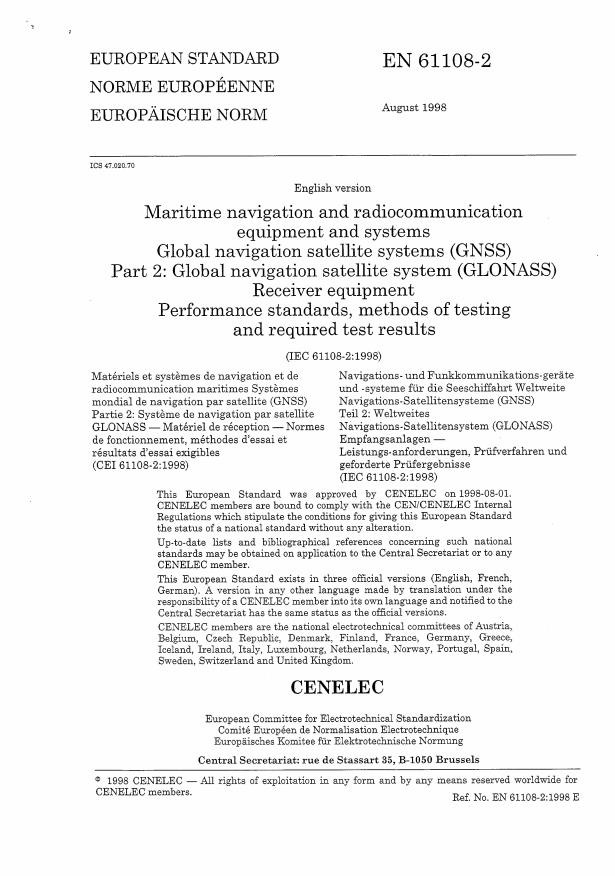
(Main)Maritime navigation and radiocommunication equipment and systems - Global navigation satellite systems (GNSS) - Part 2: Global navigation satellite system (GLONASS) - Receiver equipment - Performance standards, methods of testing and required test results
General Information
- Abstract
Specifies minimum performance standards, methods of testing and required test results for GLONASS shipborne receiver equipment, based upon the IMO Resolution MSC.53(66), which uses the signals from the Russian Ministry of Defence Global Navigation Satellite System, in order to determine position.
- Status
- Published
- Publication Date
- 06-Aug-1998
- Withdrawal Date
- 30-Apr-2001
- Technical Committee
- CLC/SR 80 - Maritime navigation and radiocommunication equipment and systems
- Drafting Committee
- IEC/TC 80 - IEC_TC_80
- Parallel Committee
- IEC/TC 80 - IEC_TC_80
- Current Stage
- 6060 - Document made available - Publishing
- Start Date
- 07-Aug-1998
- Completion Date
- 25-Aug-2026

Overview
EN 61108-2:1998 is a key European standard that defines performance standards, testing methods, and required test results for shipborne receiver equipment using the Russian Global Navigation Satellite System (GLONASS). This standard is part of the broader maritime navigation and radiocommunication equipment and systems guidelines under the Global Navigation Satellite Systems (GNSS) framework. It aligns with the International Maritime Organization (IMO) Resolution MSC.53(66), ensuring that GLONASS-based maritime navigational receivers meet stringent accuracy, reliability, and operational requirements.
This standard supports safe and efficient maritime operations by specifying minimum performance criteria that facilitate precise positioning at sea using GLONASS signals. Published by the CLC (European Committee for Electrotechnical Standardization), it is crucial for manufacturers, testing laboratories, and maritime authorities engaged in the development, certification, and regulation of GNSS receiver equipment.
Key Topics
Performance Standards for GLONASS Receivers
EN 61108-2 sets out minimum technical requirements that shipborne GLONASS receivers must fulfill. These include parameters related to positioning accuracy, signal tracking capability, and operational reliability under various maritime conditions.Testing Methods
The standard provides detailed procedures to test GLONASS receiver equipment, ensuring consistent evaluation. Tests cover signal acquisition, tracking performance, accuracy validation, environmental resilience, and error measurement.Required Test Results
Clear pass/fail criteria and performance thresholds are defined for manufacturers and testing bodies. This ensures equipment compliance in terms of positional accuracy, availability, and integrity consistent with IMO performance requirements.IMO Alignment
The standard is developed based on IMO Resolution MSC.53(66), cementing its role as a mandatory reference for maritime navigation safety involving GLONASS receivers.
Applications
Maritime Navigation Safety
Ensuring vessel navigational equipment using GLONASS meets international standards for accurate position fixing, reducing risks of grounding, collisions, and navigational errors.Receiver Manufacturing and Certification
Manufacturers of GLONASS shipborne navigational receivers utilize EN 61108-2 to design compliant products. Certification bodies use this standard as a benchmark during product approval processes.Port and Coastal Infrastructure
Authorities implementing navigation aids and harbor operations rely on GLONASS-based systems meeting these standards to support vessel traffic management and search and rescue operations.Maritime Electronics Testing
Testing laboratories adopt the specified methods and pass criteria to validate performance and reliability of GNSS receivers before they enter the market or are deployed onboard.
Related Standards
- EN 61108-1: GNSS - GPS receiver equipment performance standards, methods of testing, and test results
- EN 61108-3: GNSS - Galileo receiver equipment performance standards
- IMO Resolution MSC.53(66): Performance standards for shipborne radio navigation equipment utilizing GNSS
- IEC 61108 series: International standards covering GNSS receiver equipment for maritime navigation systems
By adhering to EN 61108-2, maritime stakeholders ensure GLONASS receiver equipment delivers reliable and precise global positioning, enhancing navigational safety and operational efficiency at sea. This standard supports the harmonization of maritime GNSS equipment, fostering international maritime safety in line with evolving satellite navigation technologies.
Relations
- Effective Date
- 03-Feb-2026
- Effective Date
- 03-Feb-2026
- Effective Date
- 03-Feb-2026
- Effective Date
- 03-Feb-2026
- Effective Date
- 03-Feb-2026
- Effective Date
- 03-Feb-2026
- Effective Date
- 03-Feb-2026
- Effective Date
- 03-Feb-2026
- Effective Date
- 03-Feb-2026
- Effective Date
- 03-Feb-2026
- Effective Date
- 03-Feb-2026
- Effective Date
- 03-Feb-2026
- Effective Date
- 03-Feb-2026
- Effective Date
- 03-Feb-2026
- Effective Date
- 03-Feb-2026
Get Certified
Connect with accredited certification bodies for this standard

DNV
DNV is an independent assurance and risk management provider.

Lloyd's Register
Lloyd's Register is a global professional services organisation specialising in engineering and technology.

FSC International
Forest Stewardship Council certification.
Sponsored listings
Frequently Asked Questions
EN 61108-2:1998 is a standard published by CLC. Its full title is "Maritime navigation and radiocommunication equipment and systems - Global navigation satellite systems (GNSS) - Part 2: Global navigation satellite system (GLONASS) - Receiver equipment - Performance standards, methods of testing and required test results". This standard covers: Specifies minimum performance standards, methods of testing and required test results for GLONASS shipborne receiver equipment, based upon the IMO Resolution MSC.53(66), which uses the signals from the Russian Ministry of Defence Global Navigation Satellite System, in order to determine position.
Specifies minimum performance standards, methods of testing and required test results for GLONASS shipborne receiver equipment, based upon the IMO Resolution MSC.53(66), which uses the signals from the Russian Ministry of Defence Global Navigation Satellite System, in order to determine position.
EN 61108-2:1998 is classified under the following ICS (International Classification for Standards) categories: 47.020.70 - Navigation and control equipment. The ICS classification helps identify the subject area and facilitates finding related standards.
EN 61108-2:1998 has the following relationships with other standards: It is inter standard links to EN 60945:1997, EN 60721-3-6:1993, EN 61993-2:2002, EN 62320-2:2017, EN 62287-1:2011, EN 62287-1:2017, EN 62252:2004, EN IEC 61993-2:2018, EN IEC 63269:2022, EN 62287-2:2013, EN 62320-2:2008, EN 62065:2002, EN 61097-14:2010, EN 62287-2:2017, EN 61162-1:2016. Understanding these relationships helps ensure you are using the most current and applicable version of the standard.
EN 61108-2:1998 is available in PDF format for immediate download after purchase. The document can be added to your cart and obtained through the secure checkout process. Digital delivery ensures instant access to the complete standard document.
Standards Content (Sample)
SLOVENSKI SIST EN 61108-2:2004
STANDARD
julij 2004
Maritime navigation and radiocommunication equipment and systems - Global
navigation satellite systems (GNSS) - Part 2: Global navigation satellite system
(GLONASS) - Receiver equipment - Performance standards, methods of testing
and requir
...