


HD 630.2.1 S6:2003
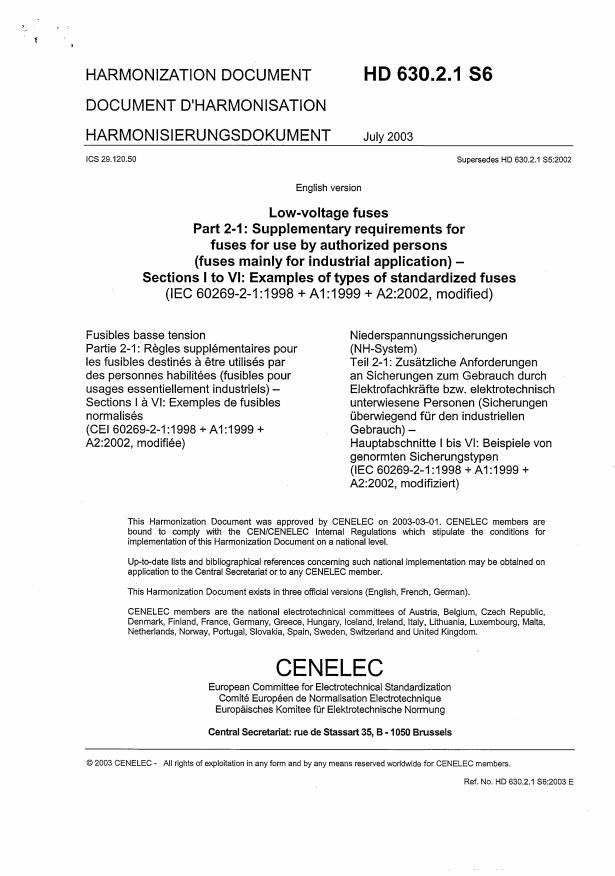
(Main)Low-voltage fuses - Part 2-1: Supplementary requirements for fuses for use by authorized persons (fuses mainly for industrial application) - Sections I to VI: Examples of types of standardized fuses
Low-voltage fuses - Part 2-1: Supplementary requirements for fuses for use by authorized persons (fuses mainly for industrial application) - Sections I to VI: Examples of types of standardized fuses
This standard is divided into six sections, each dealing with a specific example of standardized fuse for use by authorized persons: Section I: Fuses with fuse-links with blade contacts. Section II: Fuses with fuse-links for bolted connections. Section III: Fuses with fuse-links having cylindrical contact caps. Section IV: Fuses with fuse-links with offset blade contacts. Section V: Fuses with fuse-links having gD and gN characteristics. Section VI: gV fuse-links with wedge tightening contacts. NOTE - The following fuse systems are standardized systems in respect to their safety aspects.
Niederspannungssicherungen (NH-System) - Teil 2-1: Zusätzliche Anforderungen an Sicherungen zum Gebrauch durch Elektrofachkräfte bzw. elektrotechnisch unterwiesene Personen (Sicherungen überwiegend für den industriellen Gebrauch) - Hauptabschnitte I bis VI: Beispiele von genormten Sicherungstypen
Fusibles basse tension - Partie 2-1: Règles supplémentaires pour les fusibles destinés à être utilisés par des personnes habilitées (fusibles pour usages essentiellement industriels) - Sections I à VI: Exemples de fusibles normalisés
La présente norme est divisée en six sections traitant chacune d'un exemple spécifique de fusible normalisé destiné à être utilisé par des personnes habilitées: Section I: Fusibles avec éléments de remplacement à couteaux. Section II: Fusibles avec éléments de remplacement à platines. Section III: Fusibles avec éléments de remplacement à capsules cylindriques. Section IV: Fusibles avec éléments de remplacement à couteaux déportés. Section V: Fusibles dont les éléments de remplacement ont des caractéristiques gD et gN. Section VI : Eléments de remplacement gV à contacts de serrage à encoche. NOTE - Les systèmes de fusibles suivants sont normalisés en ce qui concerne les aspects de sécurité.
Low-voltage fuses - Part 2-1: Supplementary requirements for fuses for use by authorized persons (fuses mainly for industrial application) - Sections I to VI: Examples of types of standardized fuses
General Information
- Status
- Withdrawn
- Publication Date
- 24-Jul-2003
- Technical Committee
- CLC/SR 32B - Low-voltage fuses
- Drafting Committee
- IEC/SC 32B - IEC_SC_32B
- Parallel Committee
- IEC/SC 32B - IEC_SC_32B
- Current Stage
- 9960 - Withdrawal effective - Withdrawal
- Start Date
- 01-Apr-2008
- Completion Date
- 01-Apr-2008
Relations
- Effective Date
- 29-Jan-2023
- Effective Date
- 28-Jan-2023
- Effective Date
- 03-Feb-2026
- Referred By
EN 60694:1996/A1:2000 - Common specifications for high-voltage switchgear and controlgear standards - Effective Date
- 03-Feb-2026
- Effective Date
- 03-Feb-2026

Get Certified
Connect with accredited certification bodies for this standard

Intertek Testing Services NA Inc.
Intertek certification services in North America.

UL Solutions
Global safety science company with testing, inspection and certification.

ANCE
Mexican certification and testing association.
Sponsored listings
Frequently Asked Questions
HD 630.2.1 S6:2003 is a standardization document published by CLC. Its full title is "Low-voltage fuses - Part 2-1: Supplementary requirements for fuses for use by authorized persons (fuses mainly for industrial application) - Sections I to VI: Examples of types of standardized fuses". This standard covers: This standard is divided into six sections, each dealing with a specific example of standardized fuse for use by authorized persons: Section I: Fuses with fuse-links with blade contacts. Section II: Fuses with fuse-links for bolted connections. Section III: Fuses with fuse-links having cylindrical contact caps. Section IV: Fuses with fuse-links with offset blade contacts. Section V: Fuses with fuse-links having gD and gN characteristics. Section VI: gV fuse-links with wedge tightening contacts. NOTE - The following fuse systems are standardized systems in respect to their safety aspects.
This standard is divided into six sections, each dealing with a specific example of standardized fuse for use by authorized persons: Section I: Fuses with fuse-links with blade contacts. Section II: Fuses with fuse-links for bolted connections. Section III: Fuses with fuse-links having cylindrical contact caps. Section IV: Fuses with fuse-links with offset blade contacts. Section V: Fuses with fuse-links having gD and gN characteristics. Section VI: gV fuse-links with wedge tightening contacts. NOTE - The following fuse systems are standardized systems in respect to their safety aspects.
HD 630.2.1 S6:2003 is classified under the following ICS (International Classification for Standards) categories: 29.120.50 - Fuses and other overcurrent protection devices. The ICS classification helps identify the subject area and facilitates finding related standards.
HD 630.2.1 S6:2003 has the following relationships with other standards: It is inter standard links to HD 630.2.1 S5:2002, HD 60269-2-1:2005, EN 61347-2-2:2001, EN 60694:1996/A1:2000, EN 60947-4-1:2001. Understanding these relationships helps ensure you are using the most current and applicable version of the standard.
HD 630.2.1 S6:2003 is associated with the following European legislation: EU Directives/Regulations: 2006/95/EC, 73/23/EEC. When a standard is cited in the Official Journal of the European Union, products manufactured in conformity with it benefit from a presumption of conformity with the essential requirements of the corresponding EU directive or regulation.
HD 630.2.1 S6:2003 is available in PDF format for immediate download after purchase. The document can be added to your cart and obtained through the secure checkout process. Digital delivery ensures instant access to the complete standard document.
Questions, Comments and Discussion
Ask us and Technical Secretary will try to provide an answer. You can facilitate discussion about the standard in here.
Loading comments...