


FprEN IEC 61375-1:2025
(Main)Electronic railway equipment - Train communication network (TCN) - Part 1: General architecture
Electronic railway equipment - Train communication network (TCN) - Part 1: General architecture
IEC 61375-1:2026 applies to the architecture of data communication systems in open trains, i.e. it covers the architecture of a communication system for the data communication between vehicles of the said open trains, the data communication within the vehicles and the data communication from train to the ground. The applicability of IEC 61375-1 to the train network technologies allows for interoperability of individual vehicles within open trains in international traffic. The data communication systems inside vehicles are given as recommended solutions to cope with the said TCN. In any case, proof of compatibility between a proposed train backbone and a proposed consist network will have to be brought by the supplier. IEC 61375-1 might be additionally applicable to closed trains and multiple unit trains when so agreed between purchaser and supplier. This fourth edition cancels and replaces the third edition published in 2012. This edition constitutes a technical revision. This edition includes the following significant technical changes with respect to the previous edition: a) Extension of train backbone topologies: aggregated and segregated topology; b) Added independent consist orientation check with segregated train backbone topology; c) Introduction of wireless technologies: wireless train backbone and wireless consist network; d) Possibility of virtual networks; e) Definition of data classes and protocol requirements suitable for the OMTS domain; f) New clause about cybersecurity in train communication networks.
Elektronische Betriebsmittel für Bahnen - Zug-Kommunikations-Netzwerk (TCN) - Teil 1: Allgemeiner Aufbau
Matériel électronique ferroviaire - Réseau embarqué de train (TCN) - Partie 1: Architecture générale
L'IEC 61375-1:2026 s’applique à l’architecture des systèmes de communication de données dans les trains à composition variable, c’est-à-dire qu’elle couvre l’architecture d’un système de communication de données entre les véhicules des trains considérés, les communications de données dans les véhicules et les communications de données train-sol. L'application de IEC 61375-1 aux technologies de réseau de train permet l'interopérabilité de véhicules individuels dans des trains à composition variable en trafic international. Les systèmes de communication de données dans les véhicules sont donnés comme solutions recommandées pour fonctionner avec ledit TCN. Dans tous les cas, le fournisseur devra apporter la preuve de la compatibilité entre un réseau central de train proposé et un réseau de rame proposé. Par ailleurs, IEC 61375-1 pourrait s'appliquer aux rames non modifiables et aux trains à unités multiples après accord entre acheteur et fournisseur. Cette quatrième édition annule et remplace la troisième édition publiée en 2012. Cette édition constitue une révision technique. Cette édition inclut également les modifications techniques majeures suivantes par rapport à l'édition précédente: a) Extension des topologies de réseau central de train: topologie agrégée et séparée b) Ajout d'une vérification indépendante de l'orientation de la rame avec une topologie séparée de réseau central de train c) Introduction des technologies sans fil: réseau central de train sans fil et réseau de rame sans fil d) Possibilité de réseaux virtuels e) Définition des classes de données et des exigences de protocole adaptées au domaine OMTS f) Nouvel article sur la cybersécurité dans les réseaux embarqués de train
Železniške elektronske naprave - Komunikacijsko omrežje vlaka TCN) TCN - Splošna arhitektura
General Information
- Status
- Not Published
- Publication Date
- 16-Apr-2026
- Technical Committee
- CLC/TC 9X - Electrical and electronic applications for railways
- Drafting Committee
- IEC/TC 9 - IEC_TC_9
- Current Stage
- 5060 - Voting results sent to TC, SR - Formal Approval
- Start Date
- 26-Sep-2025
- Completion Date
- 26-Sep-2025
Relations
- Effective Date
- 09-Dec-2021
Overview
FprEN IEC 61375-1:2025 defines the general architecture for the Train Communication Network (TCN) used in electronic railway equipment. Published as a CLC-adopted parallel vote of IEC TC 9 work (IEC 61375-1 ED4), this Part 1 document specifies the high-level structure, network realms, and design concepts that enable interoperable on-board communication between vehicles, consists and train-level systems. The draft CDV circulated in 2024 targets a proposed stability date of 2027.
Key topics and requirements
The standard sets out architecture and requirements across core TCN elements, including:
- Basic architecture and realms - hierarchical organization of train backbone and consist networks and naming conventions.
- Train backbone - topologies (bus, switched, wireless), node numbering, directions/orientation, and train composition management.
- Consist network - bus (e.g., MVB/CCN), switched (ECN) and wireless (WLCN) options, sub-networks and heterogeneous networks.
- Gateways and interfaces - functional descriptions of gateway roles, router-to-bridge implementation options, and standardized consist interfaces.
- On-board data communication - communication patterns (push, pull, subscription), addressing at network and application layers, data classes, communication and application profiles.
- Train inauguration and directories - mechanisms for node discovery, sequence/orientation determination, train directory structure and inauguration state control.
- Cybersecurity guidance - lifecycle considerations, authentication, authorization, integrity/confidentiality, network segmentation and train-wayside link protection.
- Terminology and conventions - definitions, acronyms and state-diagram/numeric conventions to ensure consistent interpretations.
The document provides figures and tables illustrating topologies, communication patterns, train directories and service/data class definitions to support implementation and procurement.
Practical applications
This standard is intended for:
- Railway vehicle manufacturers and system integrators designing onboard communication systems.
- Suppliers of train backbone and consist network equipment (switches, routers, gateways, wireless modules).
- Train operators and infrastructure managers specifying interoperability and procurement requirements.
- Safety, cybersecurity and systems engineers developing secure, modular on-board architectures.
- Test labs and certification bodies validating conformant TCN implementations.
Practical uses include designing interoperable TCN architectures, specifying communication profiles for subsystems, defining gateway behaviors for mixed-technology networks, and applying cybersecurity measures for on-board and train-to-wayside links.
Related standards
- Part 1 is the architectural cornerstone of the IEC 61375 series (TCN). Other parts of the series address specific technologies, protocols and implementation details (refer to IEC/CLC catalogues for parts covering MVB, ECN, WLCN and application profiles).


Get Certified
Connect with accredited certification bodies for this standard

Bureau Veritas Railway Certification
Railway and transportation certification.

Deutsch Quality Systems (India) Pvt. Ltd. (DQS India)
Subsidiary of DQS Holding GmbH, founding member of IQNet. CDSCO Notified Body.

Excellence Ireland Quality Association (EIQA)
Irish quality certification organization.
Sponsored listings
Frequently Asked Questions
FprEN IEC 61375-1:2025 is a draft published by CLC. Its full title is "Electronic railway equipment - Train communication network (TCN) - Part 1: General architecture". This standard covers: IEC 61375-1:2026 applies to the architecture of data communication systems in open trains, i.e. it covers the architecture of a communication system for the data communication between vehicles of the said open trains, the data communication within the vehicles and the data communication from train to the ground. The applicability of IEC 61375-1 to the train network technologies allows for interoperability of individual vehicles within open trains in international traffic. The data communication systems inside vehicles are given as recommended solutions to cope with the said TCN. In any case, proof of compatibility between a proposed train backbone and a proposed consist network will have to be brought by the supplier. IEC 61375-1 might be additionally applicable to closed trains and multiple unit trains when so agreed between purchaser and supplier. This fourth edition cancels and replaces the third edition published in 2012. This edition constitutes a technical revision. This edition includes the following significant technical changes with respect to the previous edition: a) Extension of train backbone topologies: aggregated and segregated topology; b) Added independent consist orientation check with segregated train backbone topology; c) Introduction of wireless technologies: wireless train backbone and wireless consist network; d) Possibility of virtual networks; e) Definition of data classes and protocol requirements suitable for the OMTS domain; f) New clause about cybersecurity in train communication networks.
IEC 61375-1:2026 applies to the architecture of data communication systems in open trains, i.e. it covers the architecture of a communication system for the data communication between vehicles of the said open trains, the data communication within the vehicles and the data communication from train to the ground. The applicability of IEC 61375-1 to the train network technologies allows for interoperability of individual vehicles within open trains in international traffic. The data communication systems inside vehicles are given as recommended solutions to cope with the said TCN. In any case, proof of compatibility between a proposed train backbone and a proposed consist network will have to be brought by the supplier. IEC 61375-1 might be additionally applicable to closed trains and multiple unit trains when so agreed between purchaser and supplier. This fourth edition cancels and replaces the third edition published in 2012. This edition constitutes a technical revision. This edition includes the following significant technical changes with respect to the previous edition: a) Extension of train backbone topologies: aggregated and segregated topology; b) Added independent consist orientation check with segregated train backbone topology; c) Introduction of wireless technologies: wireless train backbone and wireless consist network; d) Possibility of virtual networks; e) Definition of data classes and protocol requirements suitable for the OMTS domain; f) New clause about cybersecurity in train communication networks.
FprEN IEC 61375-1:2025 is classified under the following ICS (International Classification for Standards) categories: 45.060.01 - Railway rolling stock in general. The ICS classification helps identify the subject area and facilitates finding related standards.
FprEN IEC 61375-1:2025 has the following relationships with other standards: It is inter standard links to EN 61375-1:2012. Understanding these relationships helps ensure you are using the most current and applicable version of the standard.
FprEN IEC 61375-1:2025 is associated with the following European legislation: EU Directives/Regulations: 2008/57/EC, 2016/797/EU; Standardization Mandates: M/483, M/591. When a standard is cited in the Official Journal of the European Union, products manufactured in conformity with it benefit from a presumption of conformity with the essential requirements of the corresponding EU directive or regulation.
FprEN IEC 61375-1:2025 is available in PDF format for immediate download after purchase. The document can be added to your cart and obtained through the secure checkout process. Digital delivery ensures instant access to the complete standard document.
Standards Content (Sample)
SLOVENSKI STANDARD
oSIST prEN IEC 61375-1:2025
01-januar-2025
Železniške elektronske naprave - Komunikacijsko omrežje vlaka TCN) TCN -
Splošna arhitektura
Electronic railway equipment - Train communication network (TCN) - Part 1: General
architecture
Elektronische Betriebsmittel für Bahnen - Zug-Kommunikations-Netzwerk (TCN) - Teil 1:
Allgemeiner Aufbau
Matériel électronique ferroviaire - Réseau embarqué de train (TCN) - Partie 1:
Architecture générale
Ta slovenski standard je istoveten z: prEN IEC 61375-1:2024
ICS:
45.020 Železniška tehnika na Railway engineering in
splošno general
oSIST prEN IEC 61375-1:2025 en
2003-01.Slovenski inštitut za standardizacijo. Razmnoževanje celote ali delov tega standarda ni dovoljeno.
oSIST prEN IEC 61375-1:2025
oSIST prEN IEC 61375-1:2025
9/3149/CDV
COMMITTEE DRAFT FOR VOTE (CDV)
PROJECT NUMBER:
IEC 61375-1 ED4
DATE OF CIRCULATION: CLOSING DATE FOR VOTING:
2024-11-29 2025-02-21
SUPERSEDES DOCUMENTS:
9/2885/CD, 9/2922A/CC
IEC TC 9 : ELECTRICAL EQUIPMENT AND SYSTEMS FOR RAILWAYS
SECRETARIAT: SECRETARY:
France Mr Denis MIGLIANICO
OF INTEREST TO THE FOLLOWING COMMITTEES: HORIZONTAL FUNCTION(S):
ASPECTS CONCERNED:
SUBMITTED FOR CENELEC PARALLEL VOTING NOT SUBMITTED FOR CENELEC PARALLEL VOTING
Attention IEC-CENELEC parallel voting
The attention of IEC National Committees, members of CENELEC,
is drawn to the fact that this Committee Draft for Vote (CDV) is
submitted for parallel voting.
The CENELEC members are invited to vote through the CENELEC
online voting system.
This document is still under study and subject to change. It should not be used for reference purposes.
Recipients of this document are invited to submit, with their comments, notification of any relevant patent rights of which they are
aware and to provide supporting documentation.
Recipients of this document are invited to submit, with their comments, notification of any relevant “In Some Countries” clauses to be
included should this proposal proceed. Recipients are reminded that the CDV stage is the final stage for submitting ISC clauses. (SEE
AC/22/2007 OR NEW GUIDANCE DOC).
TITLE:
Electronic railway equipment – Train communication network (TCN) – Part 1: General architecture
PROPOSED STABILITY DATE: 2027
NOTE FROM TC/SC OFFICERS:
electronic file, to make a copy and to print out the content for the sole purpose of preparing National Committee positions.
You may not copy or "mirror" the file or printed version of the document, or any part of it, for any other purpose without
permission in writing from IEC.
oSIST prEN IEC 61375-1:2025
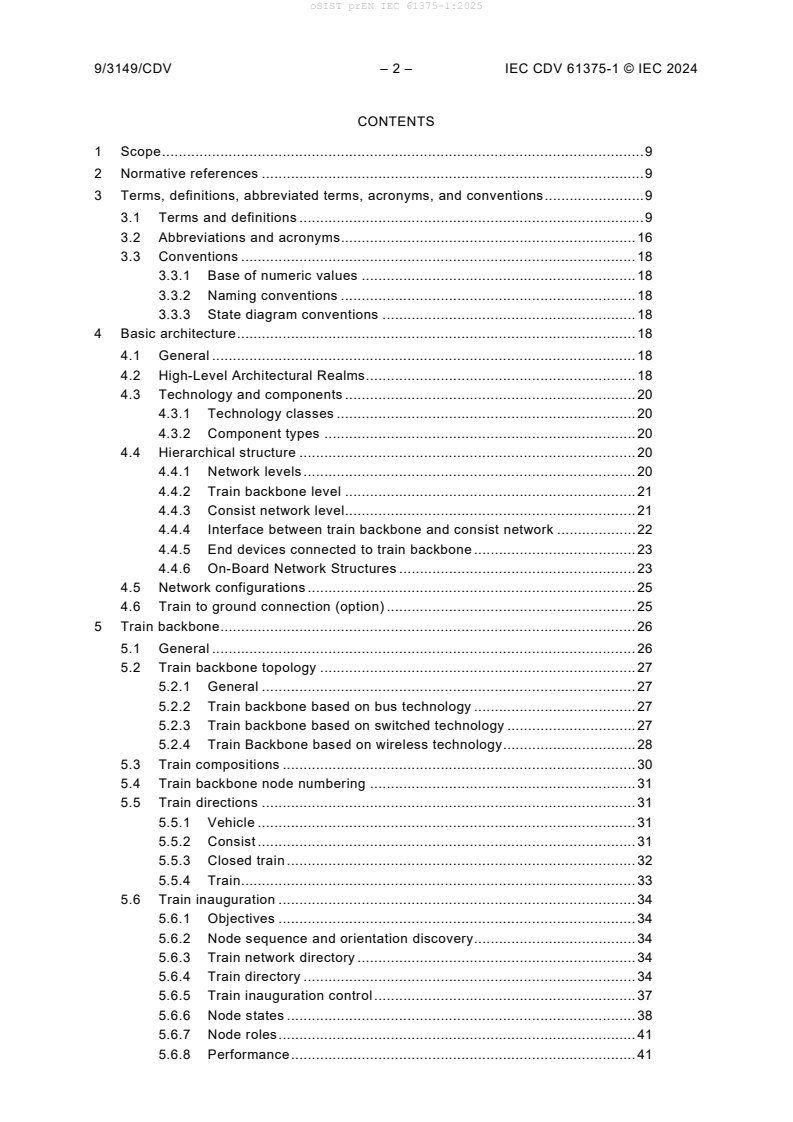
9/3149/CDV – 2 – IEC CDV 61375-1 © IEC 2024
CONTENTS
1 Scope . 9
2 Normative references . 9
3 Terms, definitions, abbreviated terms, acronyms, and conventions . 9
3.1 Terms and definitions . 9
3.2 Abbreviations and acronyms . 16
3.3 Conventions . 18
3.3.1 Base of numeric values . 18
3.3.2 Naming conventions . 18
3.3.3 State diagram conventions . 18
4 Basic architecture . 18
4.1 General . 18
4.2 High-Level Architectural Realms . 18
4.3 Technology and components . 20
4.3.1 Technology classes . 20
4.3.2 Component types . 20
4.4 Hierarchical structure . 20
4.4.1 Network levels . 20
4.4.2 Train backbone level . 21
4.4.3 Consist network level . 21
4.4.4 Interface between train backbone and consist network . 22
4.4.5 End devices connected to train backbone . 23
4.4.6 On-Board Network Structures . 23
4.5 Network configurations . 25
4.6 Train to ground connection (option) . 25
5 Train backbone . 26
5.1 General . 26
5.2 Train backbone topology . 27
5.2.1 General . 27
5.2.2 Train backbone based on bus technology . 27
5.2.3 Train backbone based on switched technology . 27
5.2.4 Train Backbone based on wireless technology . 28
5.3 Train compositions . 30
5.4 Train backbone node numbering . 31
5.5 Train directions . 31
5.5.1 Vehicle . 31
5.5.2 Consist . 31
5.5.3 Closed train . 32
5.5.4 Train . 33
5.6 Train inauguration . 34
5.6.1 Objectives . 34
5.6.2 Node sequence and orientation discovery . 34
5.6.3 Train network directory . 34
5.6.4 Train directory . 34
5.6.5 Train inauguration control . 37
5.6.6 Node states . 38
5.6.7 Node roles . 41
5.6.8 Performance . 41
oSIST prEN IEC 61375-1:2025
IEC CDV 61375-1 IEC 2024 – 3 – 9/3149/CDV
5.6.9 Independent consist orientation check (Option) . 41
6 Consist network . 42
6.1 General . 42
6.2 Scope of standardization . 42
6.3 Consist network topology . 43
6.3.1 Consist network based on bus technology (MVB, CCN) . 43
6.3.2 Consist network based on switched technology (ECN) . 44
6.3.3 Consist network based on wireless technology (WLCN) . 46
6.3.4 Sub-networks . 46
6.3.5 Heterogeneous consist network . 47
6.4 Gateway . 47
6.4.1 General . 47
6.4.2 Functional description. 47
6.4.3 Application layer gateway . 48
6.4.4 Gateway implemented by a router . 48
6.4.5 Gateway implemented by a bridge . 49
7 On-board data communication . 49
7.1 General . 49
7.2 Communication patterns . 49
7.2.1 Purpose . 49
7.2.2 Definitions . 49
7.2.3 Push pattern . 50
7.2.4 Pull pattern . 51
7.2.5 Subscription pattern . 53
7.3 Addressing . 53
7.3.1 General . 53
7.3.2 Network layer addressing . 53
7.3.3 Application layer addressing . 55
7.4 Availability of data communication . 55
7.5 Data classes . 56
7.5.1 General . 56
7.5.2 Service parameters . 56
7.5.3 TCN data class definition . 58
7.6 Communication profile . 59
7.7 Application Profile . 59
8 Cybersecurity . 60
8.1 General . 60
8.2 System under Consideration (SuC). 60
8.3 Lifecycle . 61
8.3.1 General . 61
8.3.2 Legacy Systems . 61
8.3.3 Protocol Design . 61
8.4 Guidelines . 61
8.4.1 Overview . 61
8.4.2 Network Authentication . 61
8.4.3 Function Authentication . 62
8.4.4 Authorisation . 62
8.4.5 Integrity Protection . 62
8.4.6 On-Board Confidentiality. 62
oSIST prEN IEC 61375-1:2025
9/3149/CDV – 4 – IEC CDV 61375-1 © IEC 2024
8.4.7 Network Segmentation. 63
8.4.8 Gateways . 63
8.4.9 Train-Wayside Link Initiation . 63
8.4.10 Train-Wayside Confidentiality . 63
8.4.11 Train-Wayside Integrity Protection . 64
Figure 1 – Architectural Realms . 19
Figure 2 – Train backbone and consist network . 21
Figure 3 – Example of consist with 2 consist networks . 22
Figure 4 – End device connected to the train backbone (example) . 23
Figure 5 – Network segregation options for on-board physical networks . 24
Figure 6 – Communication between train and ground (example) . 26
Figure 7 – Interfaces between consists . 27
Figure 8 – Train backbone bus topology . 27
Figure 9 – Train backbone switched topology (aggregated transmission media) . 28
Figure 10 – Train backbone switched topology (segregated transmission media) . 28
Figure 11 – Wireless train backbone mesh topology . 29
Figure 12 – Wireless train backbone base station topology . 29
Figure 13 – Wireless train backbone mesh topology for redundancy . 30
Figure 14 – Wireless train backbone base station topology for redundancy . 30
Figure 15 – Directions and orientation in a vehicle . 31
Figure 16 – Directions and orientations in a consist (example) . 32
Figure 17 – Directions and orientations in a closed train . 33
Figure 18 – Directions and orientations in train (TCN directions) . 33
Figure 19 – Structure of train directory (example) . 36
Figure 20 – Train inauguration block diagram . 39
Figure 21 – Train inauguration state chart . 40
Figure 22 – Independent orientation check with BEACON telegrams . 41
Figure 23 – Consist network standard interfaces . 43
Figure 24 – Consist network (bus technology) . 44
Figure 25 – Consist switches . 44
Figure 26 – Examples of consist network topologies (switched technology) . 45
Figure 27 – End device connected to two consist switches . 45
Figure 28 – Wireless consist network (left: wired consist network extended with
wireless end device connection; right: pure wireless consist network) . 46
Figure 29 – Sub-networks in a consist network (left: parallel; right: serial) . 47
Figure 30 – Implementation example for two vehicle busses . 47
Figure 31 – Example of heterogeneous train control network architecture . 48
Figure 32 – Point to point communication pattern (push) . 50
Figure 33 – Point to multi-point communication pattern (push) . 51
Figure 34 – Point to point communication pattern (pull) . 52
Figure 35 – Point to multi-point communication pattern (push) . 52
Figure 36 – Subscription communication pattern . 53
oSIST prEN IEC 61375-1:2025
IEC CDV 61375-1 IEC 2024 – 5 – 9/3149/CDV
Table 1 – Train composition changes . 31
Table 2 – Train specific parameters (example) . 36
Table 3 – Consist specific parameters (example) . 36
Table 4 – Vehicle specific parameters (example) . 36
Table 5 – Device specific parameters (example) . 36
Table 6 – Service parameters . 57
Table 7 – Principal data classes . 58
oSIST prEN IEC 61375-1:2025
9/3149/CDV – 6 – IEC CDV 61375-1 © IEC 2024
INTERNATIONAL ELECTROTECHNICAL COMMISSION
____________
ELECTRONIC RAILWAY EQUIPMENT –
TRAIN COMMUNICATION NETWORK (TCN) –
Part 1: General architecture
FOREWORD
1) The International Electrotechnical Commission (IEC) is a worldwide organization for standardization comprising
all national electrotechnical committees (IEC National Committees). The object of IEC is to promote international
co-operation on all questions concerning standardization in the electrical and electronic fields. To this end and
in addition to other activities, IEC publishes International Standards, Technical Specifications, Technical Reports,
Publicly Available Specifications (PAS) and Guides (hereafter referred to as “IEC Publication(s)”). Their
preparation is entrusted to technical committees; any IEC National Committee interested in the subject dealt with
may participate in this preparatory work. International, governmental and non-governmental organizations liaising
with the IEC also participate in this preparation. IEC collaborates closely with the International Organization for
Standardization (ISO) in accordance with conditions determined by agreement between the two organizations.
2) The formal decisions or agreements of IEC on technical matters express, as nearly as possible, an international
consensus of opinion on the relevant subjects since each technical committee has representation from all
interested IEC National Committees.
3) IEC Publications have the form of recommendations for international use and are accepted by IEC National
Committees in that sense. While all reasonable efforts are made to ensure that the technical content of IEC
Publications is accurate, IEC cannot be held responsible for the way in which they are used or for any
misinterpretation by any end user.
4) In order to promote international uniformity, IEC National Committees undertake to apply IEC Publications
transparently to the maximum extent possible in their national and regional publications. Any divergence between
any IEC Publication and the corresponding national or regional publication shall be clearly indicated in the latter.
5) IEC itself does not provide any attestation of conformity. Independent certification bodies provide conformity
assessment services and, in some areas, access to IEC marks of conformity. IEC is not responsible for any
services carried out by independent certification bodies.
6) All users should ensure that they have the latest edition of this publication.
7) No liability shall attach to IEC or its directors, employees, servants or agents including individual experts and
members of its technical committees and IEC National Committees for any personal injury, property damage or
other damage of any nature whatsoever, whether direct or indirect, or for costs (including legal fees) and
expenses arising out of the publication, use of, or reliance upon, this IEC Publication or any other IEC Publications.
8) Attention is drawn to the Normative references cited in this publication. Use of the referenced publications is
indispensable for the correct application of this publication.
9) Attention is drawn to the possibility that some of the elements of this IEC Publication may be the subject of patent
rights. IEC shall not be held responsible for identifying any or all such patent rights.
International Standard IEC 61375-1 has been prepared by IEC technical committee 9: Electrical
equipment and systems for railways.
This fourth edition cancels the third edition published in 2012 and constitutes a technical
revision.
The main technical changes with regard to the previous edition are as follows:
• Extension of train backbone topologies: aggregated and segregated topology
• Added independent consist orientation check with segregated train backbone topology
• Introduction of wireless technologies: wireless train backbone and wireless consist network
• Possibility of virtual networks
• Definition of data classes and protocol requirements suitable for the OMTS domain
• New clause about cybersecurity in train communication networks
oSIST prEN IEC 61375-1:2025
IEC CDV 61375-1 IEC 2024 – 7 – 9/3149/CDV
The text of this standard is based on the following documents:
FDIS Report on voting
9/XXX/FDIS 9/XXXX/RVD
Full information on the voting for the approval of this standard can be found in the report on
voting indicated in the above table.
This publication has been drafted in accordance with the ISO/IEC Directives, Part 2.
A list of all parts of IEC 61375 series, under the general title Electronic railway equipment –
Train communication network (TCN), can be found on the IEC website.
The committee has decided that the contents of this publication will remain unchanged until the
stability date indicated on the IEC web site under "http://webstore.iec.ch" in the data related to
the specific publication. At this date, the publication will be
• reconfirmed,
• withdrawn,
• replaced by a revised edition, or
• amended.
IMPORTANT – The 'colour inside' logo on the cover page of this publication indicates
that it contains colours which are considered to be useful for the correct understanding
of its contents. Users should therefore print this document using a colour printer.
oSIST prEN IEC 61375-1:2025
9/3149/CDV – 8 – IEC CDV 61375-1 © IEC 2024
1 INTRODUCTION
2 IEC 61375-1 defines the general architecture of the Train Communication Network (TCN) to
3 achieve compatibility between consist networks and train backbones defined by the standard
4 series of IEC 61375.
5 The creation of this fourth edition of the standard has been motivated by advances in technology,
6 namely in the fields of Ethernet communication, wireless communication, and cybersecurity,
7 which made it necessary to adapt or to extend some sections of the TCN general architecture.
8 These changes will then further on be reflected in the detailed technical specifications given in
9 subsequent parts of this standard series.
10 The TCN has a hierarchical structure with two levels of networks, a train backbone and a consist
11 network:
12 a) for interconnecting vehicles in closed or open trains, this part of IEC 61375 specifies train
13 backbones with different characteristics.
14 b) for connecting standard on-board equipment, this part of IEC 61375 specifies consist
15 networks with different characteristics.
16 The general architecture of the TCN, which is defined in this part of the standard, does
17 c) establish the rules for interconnecting consist networks with train backbones, as
18 • identifying the interfaces;
19 • defining the principles of how train topology changes can be discovered;
20 • defining the basic communication services provided by train backbones to be used by
21 consist networks;
22 d) establish basic rules for the train backbone and for the consist network;
23 e) establish rules for communalities in operation, as:
24 • patterns for the communication between users;
25 • addressing principles;
26 • data classes to be supported
27 f) establish rules to support cybersecurity of the TCN
oSIST prEN IEC 61375-1:2025
IEC CDV 61375-1 IEC 2024 – 9 – 9/3149/CDV
29 ELECTRONIC RAILWAY EQUIPMENT –
30 TRAIN COMMUNICATION NETWORK (TCN) –
32 Part 1: General architecture
36 1 Scope
37 This part of IEC 61375 applies to the architecture of data communication systems in open trains,
38 i.e., it covers the architecture of a communication system for the data communication between
39 vehicles of the said open trains, the data communication within the vehicles and the data
40 communication from train to the ground.
41 The applicability of this part of IEC 61375 to the train network technologies allows for
42 interoperability of individual vehicles within open trains in international traffic. The data
43 communication systems inside vehicles are given as recommended solutions to cope with the
44 said TCN. In any case, proof of compatibility between a proposed train backbone and a
45 proposed consist network will have to be brought by the supplier.
46 This part of IEC 61375 may be additionally applicable to closed trains and multiple unit trains
47 when so agreed between purchaser and supplier.
48 NOTE 1 For a definition of open trains, multiple unit trains and closed trains, see Clause 3.
49 NOTE 2 Road vehicles such as buses and trolley buses are not considered in this part of IEC 61375.
50 2 Normative references
51 There are no normative references in this document.
52 3 Terms, definitions, abbreviated terms, acronyms, and conventions
53 3.1 Terms and definitions
54 For the purposes of this document, the following terms and definitions apply.
55 ISO and IEC maintain terminology databases for use in standardization at the following
56 addresses:
57 • ISO Online browsing platform: available at https://www.iso.org/obp
58 • IEC Electropedia: available at http://www.electropedia.org
59 3.1.1
60 active train backbone node
61 train backbone node receiving a sequence number during train inauguration and forwarding
62 user data packets between consist network and train backbone
63 3.1.2
64 application layer
65 upper layer in the OSI model, interfacing directly to the application
66 [SOURCE: IEC 60050-811:2017, 811-37-03]
oSIST prEN IEC 61375-1:2025
9/3149/CDV – 10 – IEC CDV 61375-1 © IEC 2024
67 3.1.3
68 application process
69 element within a real open system which performs the information processing for a particular
70 application
71 [SOURCE: IEC 60050-811:2017, 811-37-05]
72 3.1.4
73 bridge
74 device which stores and forwards frames from one bus to another on the base of their link layer
75 addresses
76 [SOURCE: IEC 60050-811:2017, 811-37-09]
77 3.1.5
78 broadcast
79 nearly simultaneous transmission of the same information to several destinations
80 Note 1 to entry: broadcast in the TCN is not considered reliable, i.e., some destinations can receive the information
81 and others not.
82 [SOURCE: IEC 60050-811:2017, 811-37-10]
83 3.1.6
84 bus
85 communication medium which broadcasts the same information to all attached participants at
86 nearly the same time, allowing all devices to obtain the same sight of its state, at least for the
87 purpose of arbitration
88 [SOURCE: IEC 60050-871:2018, 871-05-02]
89 3.1.7
90 closed train
91 train composed of one or a set of consists, where the train composition does not change during
92 normal operation
93 EXAMPLE Metro, sub-urban train, or high-speed train unit.
94 Note 1 to entry: Consists are coupled in a workshop to establish a closed train for operation.
95 [SOURCE: IEC 60050-811:2017, 811-37-17]
96 3.1.8
97 communication device
98 device connected to the consist network or train backbone with the ability to transport, source
99 or sink data
100 [SOURCE: IEC 60050-811:2017, 811-37-18]
101 3.1.9
102 consist
103 single vehicle or a group of vehicles which are not separated during normal operation
104 Note 1 to entry: A consist can contain no, one or several consist networks
105 [SOURCE: IEC 60050-811:2017, 811-37-20]
106 3.1.10
107 consist network
108 communication network interconnecting communication devices in one consist
109 Note 1 to entry: Consist networks do not spread beyond consist boundaries.
oSIST prEN IEC 61375-1:2025
IEC CDV 61375-1 IEC 2024 – 11 – 9/3149/CDV
110 “[SOURCE: IEC 60050-811:2017, 811-37-21, modified – The definition has been replaced with
111 “communication network interconnecting communication devices in one consist”]
112 3.1.11
113 consist network address
114 network address, which does not change after train inauguration and which is used to address
115 communication device in the own consist network
116 3.1.12
117 consist sequence number
118 sequence number of the consist in the train as obtained during train inauguration
119 3.1.13
120 consist switch
121 network component used in consist network based on switched technology
122 [SOURCE: IEC 60050-811:2017]
123 3.1.14
124 cybersecurity
125 set of activities and measures taken with the objective to prevent, detect, react to unauthorized
126 access or cyberattack which could lead to an accident, an unsafe situation, or railway
127 application performance degradation
128 [SOURCE: EN TS 50701:2017]
129 3.1.15
130 end device
131 unit connected to one consist network or to one set of consist networks prepared for redundancy
132 reasons
133 [SOURCE: IEC 60050-811:2017, 811-37-33]
134 3.1.16
135 end node
136 node which terminates the train backbone
137 [SOURCE: IEC 60050-811:2017, 811-37-34]
138 3.1.17
139 essential function
140 function or capability that is required to maintain health, safety, the environment and availability
141 for the equipment under control
142 Note 1 to entry: Essential functions include, but are not limited to, the safety instrumented function (SIF), the control
143 function and the ability of the operator to view and manipulate the equipment under control. The loss of essential
144 functions is commonly termed loss of protection, loss of control and loss of view respectively. In some industries
145 additional functions such as history may be considered essential.
146 [SOURCE: IEC 62443-4-2:2019, 3.1.20]
147 3.1.18
148 function,
149 application process which exchanges messages with another application process
150 3.1.19
151 gateway,
152 connection between different busses at the application layer requiring application-dependent data
153 analysis and protocol conversion
154 [SOURCE: IEC 60050-811:2017, 811-37-44]
oSIST prEN IEC 61375-1:2025
9/3149/CDV – 12 – IEC CDV 61375-1 © IEC 2024
155 3.1.20
156 group address
157 address of a multicast group to which a device belongs
158 [SOURCE: IEC 60050-811:2017, 811-37-45]
159 3.1.21
160 integrity,
161 property of a system to recognize and to reject wrong data in case of malfunction of its parts
162 3.1.22
163 intermediate node
164 node which establishes continuity between two bus sections connected to it, but does not
165 terminate them
166 [SOURCE: IEC 60050-811:2017, 811-37-49]
167 3.1.23
168 linear topology
169 topology where the nodes are connected in series, with two nodes each connected to only one
170 other node and all others each connected to two other nodes (i.e., connected in the shape of a
171 line)
172 [SOURCE: IEC 60050-811:2017, 811-37-51]
173 3.1.24
174 local area network,
175 part of a network characterized by a common medium access and address space
176 [SOURCE: IEC 60050-811:2017, 811-37-60]
177 3.1.25
178 medium access control,
179 sublayer of the link layer, which controls the access to the medium (arbitration, mastership
180 transfer, polling)
181 3.1.26
182 medium,
183 physical carrier of the signal: electrical wires, optical fibers, etc.
184 3.1.27
185 message,
186 information which is transmitted in one or several packets from a sender to one or more
187 receivers
188 “[SOURCE: IEC 60050-821:2017, 821-37-29]”
189 3.1.28
190 multicast
191 transmission of the same message to a group of receivers, identified by their group address
192 Note 1 to entry: the word "multicast" is used even if the group includes all receivers
193 [SOURCE: IEC 60050-811:2017, 811-37-66]
194 3.1.29
195 multimedia data
196 data used for onboard multimedia and telematic services (OMTS), like video/audio streams or
197 file transfer
oSIST prEN IEC 61375-1:2025
IEC CDV 61375-1 IEC 2024 – 13 – 9/3149/CDV
198 3.1.30
199 multiple unit train
200 train comprising one or more train-units which can be controlled simultaneously from one cab
201 and able to operate at normal speed in either direction without re-marshalling
202 [SOURCE: IEC 60050-811:2017, 811-02-12]
203 3.1.31
204 network,
205 set of possibly different communication systems which interchange information in a commonly
206 agreed way
207 [SOURCE: IEC 60050-811:2017, 811-37-68]
208 3.1.32
209 network address
210 address which identifies a communication device on network layer
211 [SOURCE: IEC 60050-811:2017, 811-37-69]
212 3.1.33
213 network device
214 component used to set up consist networks and train networks.
215 Note 1 to entry: these can be passive components like cables or connectors, active unmanaged components like
216 repeaters, media converters or (unmanaged) switches, or managed active components like gateways, routers and
217 (managed) switches.
218 [SOURCE: IEC 60050-811:2017, 811-37-70]
219 3.1.34
220 network layer
221 layer in the OSI model responsible for routing between different busses
222 [SOURCE: IEC 60050-811:2017, 811-37-72]
223 3.1.35
224 network management,
225 operations necessary to remotely configure, monitor, diagnose and maintain the network
226 [SOURCE: IEC 60050-811:2017, 811-37-73]
227 3.1.36
228 node,
229 device on the train backbone that acts as a gateway between train backbone and consist
230 network
231 [SOURCE: IEC 60050-811:2017, 811-37-74]
232 3.1.37
233 octet
234 byte
235 ordered set of eight binary digits, operated on as an entity
236 [SOURCE: IEC 60050-171:2019, 171-02-12]
237 3.1.38
238 open train
239 train composed of one or a set of consists, where the configuration can change during operation
oSIST prEN IEC 61375-1:2025
9/3149/CDV – 14 – IEC CDV 61375-1 © IEC 2024
240 EXAMPLE Locomotive-hauled international UIC (International Union of Railways, the international railways operators
241 association) trains
242 [SOURCE: IEC 60050-811:2017, 811-37-79]
243 3.1.39
244 operator
245 enterprise or organization which is operating trains
246 3.1.40
247 operational data
248 data critical for train operation (TCMS), like propulsion control, brake control, doors control,
249 lightning control or heating, ventilation, and air conditioning control
250 3.1.41
251 packet,
252 unit of a message (information, acknowledgement, or control) transmitted by protocols on
253 network or transport layer
254 3.1.42
255 receiver,
256 electronic device which can receive signals from the physical medium
257 3.1.43
258 repeater
259 connection at the physical layer between bus segments, providing an extension of the bus
260 beyond the limits permitted by passive means
261 Note 1 to entry: The connected segments operate at the same speed and with the same protocol. The delay
262 introduced by a repeater is in the order of one bit duration.”
263 [SOURCE: IEC 60050-811:2017, 811-37-90]
264 3.1.44
265 ring topology
266 active network where each node is connected in series to two other nodes
267 Note 1 to entry Ring can also be referred to as loop.
268 [SOURCE: IEC 60050-811:2017, 811-37-91]
269 3.1.45
270 router,
271 connection between two busses at the network layer, which forwards datagrams from one bus
272 to another on the base of their network address
273 3.1.46 safety integrity
274 ability of a safety-related system to achieve its required safety functions under all the stated
275 conditions within a stated operational environment and within a stated duration
276 [SOURCE: IEC 60050-821:2017, 821-12-54]
277 3.1.47
278 service,
279 capabilities and features of a sub-system (e.g., a communication layer) provided to a user
280 [SOURCE: IEC 60050-811:2017, 811-37-93]
oSIST prEN IEC 61375-1:2025
IEC CDV 61375-1 IEC 2024 – 15 – 9/3149/CDV
281 3.1.48
282 system under consideration,
283 collection of assets that are needed to provide and operate a railway application including any
284 relevant network infrastructure assets
285 Note 1 to entry: In a cyber security context as defined in IEC 62443-3-2:2017 [22], a system under consideration
286 consists of one or more zones and related conduits. All assets within a system under consideration belong to either
287 a zone or conduit.
288 3.1.49
289 switch,
290 MAC bridge as defined in IEEE 802.1Q
291 Note 1 to entry: MAC means "Medium Access Control", a sub-layer within the Link Layer ruling which device is
292 entitled to send on the bus.
293 [SOURCE: IEC 60050-811:2017, 811-37-101]
294 topography
295 data structure describing the nodes attached to the train backbone, including their address,
296 orientation, position and node descriptor
297 [SOURCE: IEC 60050-811:2017, 811-37-105]
298 3.1.50
299 topology
300 possible cable interconnection and number of devices in a given network
301 [SOURCE: IEC 60050-811:2017, 811-37-106]
302 3.1.51
303 train
304 combination of rolling stock coupled together
305 Note 1 to entry: Rolling stock includes banking locomotives.
306 [SOURCE: IEC 60050-811:2011, 811-01-08]
307 3.1.52
308 train communication network
309 data communication network for connecting programmable electronic equipment on-board rail
310 vehicles
311 [SOURCE: IEC 60050-811:2017, 811-37-108]
312 3.1.53
313 train backbone,
314 train bus
315 bus connecting the consists of a train, in particular the wire train bus, and which conforms to
316 the TCN
317 [SOURCE: IEC 60050-811:2017, 811-37-107]
318 3.1.54
319 train backbone node,
320 node
321 device on the train backbone that acts as a gateway between the train backbone and the consist
322 network
323 [SOURCE: IEC 60050-811:2017, 811-37-74]
oSIST prEN IEC 61375-1:2025
9/3149/CDV – 16 – IEC CDV 61375-1 © IEC 2024
324 3.1.55
325 train backbone node number
326 node address
327 node number
328 unique number assigned to a node during train inauguration indicating the position of the train
329 backbone node on the train backbone
330 Note 1 to entry: this number can be used as part of the train network address for addressing devices in the consist,
331 the train backbone node belongs to, from any location in the train.
332 3.1.56
333 train composition
334 sequence, orientation and characteristics of consists which represent a train
335 3.1.57
336 train directory
337 data structure which describes the train composition and provides user information about the
338 consists
339 3.1.58 train inauguration
340 operation executed in case of train composition change, which gives all nodes of the train
341 backbone their train backbone node number, their orientation and information about all named
342 nodes on the same backbone, and which determines the actual train composition
343 3.1.59
344 train network address
345 dynamic network address, which is used to address communication devices in other consist
346 networks
347 Note 1 to entry: this address can change after each train inauguration.
348 [SOURCE: IEC 60050-811:2017, 811-37-109]
349 3.1.60
350 train network directory
351 data structure which describes the sequence of train backbone nodes, the sequence of consist
352 networks and the orientation of the consists the nodes are located in.
353 3.1.61
354 transport layer
355 layer of the OSI model responsible for end-to-end flow control and error recovery
356 [SOURCE: IEC 60050-811:2017, 811-37-113]
357 3.1.62
358 wireless access point
359 active network device, using a wireless network interface to offer access to the consist network
360 3.1.63
361 wireless end device
362 active end device, using a wireless network interface to exchange data within the consist
363 network
364 3.2 Abbreviations and acronyms
365 ALG Application Layer Gateway
366 BER Bit Error Rate
367 CAN Controller Area Network
oSIST prEN IEC 61375-1:2025
IEC CDV 61375-1 IEC 2024 – 17 – 9/3149/CDV
368 CCN CANOpen Consist Network
369 CCS Command, Control and Signalling
370 CCU Consist Control Unit
371 CLC CENELEC European Committee for Electrotechnical Standardization
372 CN Consist Network
373 COTS Components Off The Shelf
374 CPS Communication Protocol Stack
375 ECN Ethernet Consist Network
376 ED End Device
377 ETB Ethernet Train Backbone
378 ETBN Ethernet Train Backbone Node
379 GCG Ground Communication Gateway
380 HFR Hazardous Failure Rate
381 HVAC Heat, Ventilation and Air Conditioning
382 IEEE Institute of Electrical and Electronics Engineers
383 IETF Internet Engineering Task Force
384 IP Internet Protocols
385 IT Information technology
386 LAN Local Area Network
387 MAC Medium Access Control
388 MCG Mobile Communication Gateway
389 MVB Multifunction Vehicle Bus
390 ND Network Device
391 OMTN OnBoard Multimedia and Telematic Network
392 OMTS OnBoard Multimedia and Telematic Services
393 OSI Open System Interconnection
394 OT Operational Technology
395 PA Public Address
396 PCP Priority Code Point
397 QoS Quality of Service
398 RFC Request For Comments
399 RFID Radio Frequency Identification
400 SuC System under Consideration
401 SW Software
402 TB Train Backbone
403 TBN Train Bac
...
Questions, Comments and Discussion
Ask us and Technical Secretary will try to provide an answer. You can facilitate discussion about the standard in here.
Loading comments...