

EN 62386-202:2009
(Main)Digital addressable lighting interface - Part 202: Particular requirements for control gear - Self-contained emergency lighting (device type 1)
General Information
- Abstract
IEC 62386-202:2009 specifies a protocol and test procedures for the control by digital signals of electronic control gear for use on a.c. or d.c. supplies, associated with self-contained emergency lighting. This Part 202 is intended to be used in conjunction with IEC 62386-101 and IEC 62386-102, which contain general requirements for the relevant product type (control gear or control devices).
- Status
- Withdrawn
- Publication Date
- 26-Aug-2009
- Withdrawal Date
- 30-Jun-2012
- Technical Committee
- CLC/TC 34 - 'Lamps and related equipment
- Drafting Committee
- IEC/TC 34 - IEC_TC_34
- Parallel Committee
- IEC/SC 34C - IEC_SC_34C
- Current Stage
- 9960 - Withdrawal effective - Withdrawal
- Start Date
- 19-Jan-2026
- Completion Date
- 19-Jan-2026



Overview
EN 62386-202:2009 (IEC 62386-202:2009) is a CLC / CENELEC adoption of the Digital Addressable Lighting Interface (DALI) Part 202. It specifies the protocol and test procedures for digital control of electronic control gear used with self-contained emergency lighting (device type 1) operating from a.c. or d.c. supplies. This part is intended to be used together with EN/IEC 62386-101 and 62386-102, which define general system and control-gear requirements.
Key topics and technical requirements
EN 62386-202 covers the following technical areas:
- Communication protocol and transmission structure for digital control of emergency luminaires.
- Electrical specifications and interface power supply requirements for device type 1 emergency control gear.
- Timing requirements including command timeouts (e.g., referenced 100 ms timeout test sequences).
- Method of operation: modes of operation, light level definitions and behaviour in normal and emergency states.
- Declaration of variables and command definitions: a defined set of DALI commands and application-extended commands for emergency functions.
- Extensive test procedures and test sequences for compliance, including:
- RESET, INHIBIT, ON/OFF and fading
- START/STOP FUNCTION TEST and DURATION TEST (automatic/manual)
- FUNCTION TEST / DURATION TEST failure and pending states
- Persistent memory, configuration and extended RESET
- Identification, battery charge queries and interface failure handling
- Annexes and examples: illustrative timing diagrams, duration-test examples and comprehensive figure/table lists for validation and lab testing.
Practical applications
This standard enables:
- Interoperability between DALI system controllers and self-contained emergency luminaires.
- Centralised remote testing and monitoring of emergency lighting (function/duration tests, battery status).
- Consistent compliance testing methods for manufacturers and test labs to demonstrate conformance.
- Enhanced safety management by allowing building owners and BMS integrators to verify emergency lighting readiness via digital control.
Who should use it
- Manufacturers of emergency luminaires and electronic control gear (device type 1)
- Lighting control system designers and DALI integrators
- Certification bodies and test laboratories performing compliance testing
- Specifiers, electrical contractors and facilities managers responsible for emergency lighting systems
Related standards
- EN/IEC 62386-101 - DALI Part 101: General requirements - System
- EN/IEC 62386-102 - DALI Part 102: General requirements - Control gear
- Referenced harmonized IEC standards (listed in annex ZA) for related electrical and safety norms
Keywords: EN 62386-202:2009, IEC 62386-202, Digital Addressable Lighting Interface, DALI, self-contained emergency lighting, device type 1, control gear, emergency lighting test procedures, DALI protocol.
Relations
- Effective Date
- 26-Jan-2023
- Effective Date
- 03-Feb-2026
- Effective Date
- 03-Feb-2026
- Effective Date
- 03-Feb-2026
- Effective Date
- 03-Feb-2026
Get Certified
Connect with accredited certification bodies for this standard

IMQ S.p.A. (Certification)
Italian electrical product certification.

SLG Prüf- und Zertifizierungs GmbH
German testing and certification body.

UL Solutions
Global safety science company with testing, inspection and certification.
Sponsored listings
Frequently Asked Questions
EN 62386-202:2009 is a standard published by CLC. Its full title is "Digital addressable lighting interface - Part 202: Particular requirements for control gear - Self-contained emergency lighting (device type 1)". This standard covers: IEC 62386-202:2009 specifies a protocol and test procedures for the control by digital signals of electronic control gear for use on a.c. or d.c. supplies, associated with self-contained emergency lighting. This Part 202 is intended to be used in conjunction with IEC 62386-101 and IEC 62386-102, which contain general requirements for the relevant product type (control gear or control devices).
IEC 62386-202:2009 specifies a protocol and test procedures for the control by digital signals of electronic control gear for use on a.c. or d.c. supplies, associated with self-contained emergency lighting. This Part 202 is intended to be used in conjunction with IEC 62386-101 and IEC 62386-102, which contain general requirements for the relevant product type (control gear or control devices).
EN 62386-202:2009 is classified under the following ICS (International Classification for Standards) categories: 29.140.50 - Lighting installation systems; 29.140.99 - Other standards related to lamps. The ICS classification helps identify the subject area and facilitates finding related standards.
EN 62386-202:2009 has the following relationships with other standards: It is inter standard links to EN IEC 62386-202:2023, EN IEC 62386-103:2022, EN 60929:2011, EN IEC 62386-102:2022, EN IEC 62386-101:2022. Understanding these relationships helps ensure you are using the most current and applicable version of the standard.
EN 62386-202:2009 is available in PDF format for immediate download after purchase. The document can be added to your cart and obtained through the secure checkout process. Digital delivery ensures instant access to the complete standard document.
Standards Content (Sample)
SLOVENSKI STANDARD
01-november-2009
Digitalni naslovljivi vmesnik za razsvetljavo - 202. del: Posebne zahteve za krmilja;
avtonomna nujnostna razsvetljava (naprava tipa 1) (IEC 62386-202:2009)
Digital addressable lighting interface - Part 202: Particular requirements for control gears;
self-contained emergency lighting (device type 1) (IEC 62386-202:2009)
Digital adressierbare Schnittstelle für die Beleuchtung - Teil 202: Besondere
Anforderungen an Betriebsgeräte - Notbeleuchtung mit Einzelbatterie (Gerätetyp 1) (IEC
62386-202:2009)
Interface d'éclairage adressable numérique - Partie 202: Exigences particulières pour les
appareillages; blocs autonomes d'éclairage de secours (dispositifs de type 1) (CEI 62386
-202:2009)
Ta slovenski standard je istoveten z: EN 62386-202:2009
ICS:
29.140.50 Instalacijski sistemi za Lighting installation systems
razsvetljavo
35.200 Vmesniška in povezovalna Interface and interconnection
oprema equipment
2003-01.Slovenski inštitut za standardizacijo. Razmnoževanje celote ali delov tega standarda ni dovoljeno.
EUROPEAN STANDARD
EN 62386-202
NORME EUROPÉENNE
August 2009
EUROPÄISCHE NORM
ICS 29.140.50; 29.140.99
English version
Digital addressable lighting interface -
Part 202: Particular requirements for control gear -
Self-contained emergency lighting (device type 1)
(IEC 62386-202:2009)
Interface d'éclairage Digital adressierbare Schnittstelle
adressable numérique - für die Beleuchtung -
Partie 202: Exigences particulières Teil 202: Besondere Anforderungen
pour les appareillages de commande - an Betriebsgeräte -
Blocs autonomes d'éclairage de secours Notbeleuchtung mit Einzelbatterie
(dispositifs de type 1) (Gerätetyp 1)
(CEI 62386-202:2009) (IEC 62386-202:2009)
This European Standard was approved by CENELEC on 2009-07-01. CENELEC members are bound to comply
with the CEN/CENELEC Internal Regulations which stipulate the conditions for giving this European Standard
the status of a national standard without any alteration.
Up-to-date lists and bibliographical references concerning such national standards may be obtained on
application to the Central Secretariat or to any CENELEC member.
This European Standard exists in three official versions (English, French, German). A version in any other
language made by translation under the responsibility of a CENELEC member into its own language and notified
to the Central Secretariat has the same status as the official versions.
CENELEC members are the national electrotechnical committees of Austria, Belgium, Bulgaria, Cyprus, the
Czech Republic, Denmark, Estonia, Finland, France, Germany, Greece, Hungary, Iceland, Ireland, Italy, Latvia,
Lithuania, Luxembourg, Malta, the Netherlands, Norway, Poland, Portugal, Romania, Slovakia, Slovenia, Spain,
Sweden, Switzerland and the United Kingdom.
CENELEC
European Committee for Electrotechnical Standardization
Comité Européen de Normalisation Electrotechnique
Europäisches Komitee für Elektrotechnische Normung
Central Secretariat: Avenue Marnix 17, B - 1000 Brussels
© 2009 CENELEC - All rights of exploitation in any form and by any means reserved worldwide for CENELEC members.
Ref. No. EN 62386-202:2009 E
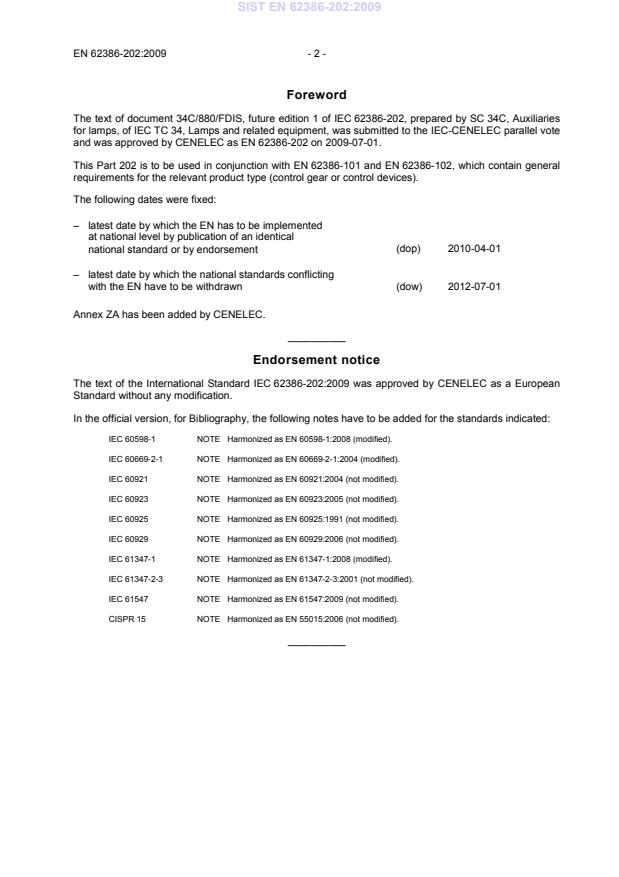
Foreword
The text of document 34C/880/FDIS, future edition 1 of IEC 62386-202, prepared by SC 34C, Auxiliaries
for lamps, of IEC TC 34, Lamps and related equipment, was submitted to the IEC-CENELEC parallel vote
and was approved by CENELEC as EN 62386-202 on 2009-07-01.
This Part 202 is to be used in conjunction with EN 62386-101 and EN 62386-102, which contain general
requirements for the relevant product type (control gear or control devices).
The following dates were fixed:
– latest date by which the EN has to be implemented
at national level by publication of an identical
national standard or by endorsement (dop) 2010-04-01
– latest date by which the national standards conflicting
with the EN have to be withdrawn (dow) 2012-07-01
Annex ZA has been added by CENELEC.
__________
Endorsement notice
The text of the International Standard IEC 62386-202:2009 was approved by CENELEC as a European
Standard without any modification.
In the official version, for Bibliography, the following notes have to be added for the standards indicated:
IEC 60598-1 NOTE Harmonized as EN 60598-1:2008 (modified).
IEC 60669-2-1 NOTE Harmonized as EN 60669-2-1:2004 (modified).
IEC 60921 NOTE Harmonized as EN 60921:2004 (not modified).
IEC 60923 NOTE Harmonized as EN 60923:2005 (not modified).
IEC 60925 NOTE Harmonized as EN 60925:1991 (not modified).
IEC 60929 NOTE Harmonized as EN 60929:2006 (not modified).
IEC 61347-1 NOTE Harmonized as EN 61347-1:2008 (modified).
IEC 61347-2-3 NOTE Harmonized as EN 61347-2-3:2001 (not modified).
IEC 61547 NOTE Harmonized as EN 61547:2009 (not modified).
CISPR 15 NOTE Harmonized as EN 55015:2006 (not modified).
__________
- 3 - EN 62386-202:2009
Annex ZA
(normative)
Normative references to international publications
with their corresponding European publications
The following referenced documents are indispensable for the application of this document. For dated
references, only the edition cited applies. For undated references, the latest edition of the referenced
document (including any amendments) applies.
NOTE When an international publication has been modified by common modifications, indicated by (mod), the relevant EN/HD
applies.
Publication Year Title EN/HD Year
IEC 62386-101 2009 Digital addressable lighting interface - EN 62386-101 2009
Part 101: General requirements - System
IEC 62386-102 2009 Digital addressable lighting interface - EN 62386-102 2009
Part 102: General requirements - Control gear
IEC 62386-202 ®
Edition 1.0 2009-06
INTERNATIONAL
STANDARD
NORME
INTERNATIONALE
Digital addressable lighting interface –
Part 202: Particular requirements for control gear – Self-contained emergency
lighting (device type 1)
Interface d’éclairage adressable numérique –
Partie 202: Exigences particulières pour les appareillages de commande – Blocs
autonomes d'éclairage de secours (dispositifs de type 1)
INTERNATIONAL
ELECTROTECHNICAL
COMMISSION
COMMISSION
ELECTROTECHNIQUE
PRICE CODE
INTERNATIONALE
XE
CODE PRIX
ICS 29.140.50; 29.140.99 ISBN 2-8318-1045-2
– 2 – 62386-202 © IEC:2009
CONTENTS
FOREWORD.5
INTRODUCTION.7
1 Scope.8
2 Normative references .8
3 Terms and definitions .8
4 General .10
5 Electrical specifications .10
6 Interface power suppy .10
7 Transmission protocol structure.10
8 Timing .10
9 Method of operation .10
10 Declaration of variables .14
11 Definition of commands .15
12 Test procedures .26
Annex A (informative) Examples .104
Bibliography.107
Figure 1 – Example of light level definitions .12
Figure 2 – Modes of operation .13
Figure 3 – Application extended control or configuration command sequence example .16
Figure 4 – Test sequence 'Features' .27
Figure 5 – Test sequence 'RESET'.30
Figure 6 – Test sequence '100 ms-timeout' .32
Figure 7 – Test sequence 'Commands in-between' .34
Figure 8 – Test sequence 'Persistent memory' .36
Figure 9 – Test sequence 'ON AND OFF'.39
Figure 10 – Test sequence 'OFF WITH FADING'.41
Figure 11 – Test sequence 'Physical address allocation'.42
Figure 12 – Test sequence 'QUERY LAMP POWER ON'.44
Figure 13 – Test sequence 'REST' .45
Figure 14 – Test sequence 'INHIBIT'.47
Figure 15 – Test sequence 'START/STOP FUNCTION TEST' .48
Figure 16 – Test sequence 'FUNCTION TEST FAILURE' .50
Figure 17 – Test sequence 'FUNCTION TEST REQUEST PENDING'.52
Figure 18 – Test sequence 'START/STOP DURATION TEST' .53
Figure 19 – Test sequence 'DURATION TEST FAILURE' .54
Figure 20 – Test sequence 'DURATION TEST REQUEST PENDING'.56
Figure 21 – Test sequence 'TESTS IN PARALLEL' .58
Figure 22 – Test sequence 'LAMP TIMER' .59
Figure 23 – Test sequence 'STOP PENDING TEST' .60
Figure 24 – Test sequence 'STORE THE DTR AS EMERGENCY LEVEL' .62
62386-202 © IEC:2009 – 3 –
Figure 25 – Test sequence 'EMERGENCY LEVEL vs. MIN / MAX' .64
Figure 26 – Test sequence 'STORE TEST TIMING'.66
Figure 27 – Test sequence 'EXECUTE AUTOMATIC TEST' .68
Figure 28 – Test sequence 'STORE TEST EXECUTION TIMEOUT' .70
Figure 29 – Test sequence 'STORE PROLONG TIME' .72
Figure 30 – Test sequence 'START IDENTIFICATION'.73
Figure 31 – Test sequence 'INTERFACE FAILURE' .74
Figure 32 – Test sequence 'QUERY BATTERY CHARGE'.75
Figure 33 – Test sequence 'QUERY HARDWIRED INHIBIT'.76
Figure 34 – Test sequence 'QUERY HARDWIRED SWITCHED MAINS POWER' .77
Figure 35 – Test sequence 'QUERY PHYSICAL SELECTED' .78
Figure 36 – Test sequence 'REST: APPLICATION EXTENDED COMMAND
SEQUENCE' .80
Figure 37 – Test sequence 'INHIBIT & TEST: APPL. EXT. COMMAND SEQUENCES' .82
Figure 38 – Test sequence 'RESET FT DONE FLAG: APPL. EXT. COMMAND
SEQUENCE' .84
Figure 39 – Test sequence 'RESET DT DONE FLAG: APPL. EXT. COMMAND
SEQUENCE' .86
Figure 40 – Test sequence 'CONFIGURATION: Other command after Enable Device
Type 1 .88
Figure 41 – Test sequence 'CONFIGURATION: 100ms timeout'.90
Figure 42 – Test sequence 'CONFIGURATION: Commands in-between' .92
Figure 43 – Test sequence 'QUERY: Other command after Enable Device Type 1' .93
Figure 44 – Test sequence 'START IDENTIFICATION: APPL. EXT. COMMAND
SEQUENCE' .95
Figure 45 – Test sequence 'Extended RESET’ .97
Figure 46 – Test sequence 'Extended PERSISTENT MEMORY'.99
Figure 47 – Test sequence 'Restore Factory Settings'.101
Figure 48 – Test sequence 'Reserved DTR Selected Function' .102
Figure 49 – Test sequence 'QUERY EXTENDED VERSION NUMBER' . 103
Figure A.1 – Duration test sequence example .105
Figure A.2 – Timing diagram for function and duration tests. 105
Table 1 – Declaration of additional variables.14
Table 2 – Summary of the application extended command set .25
Table 3 – Types of emergency control gear .26
Table 4 – List of test sequences 'Configuration commands' .28
Table 5 – Parameters for test sequences 'RESET' .29
Table 6 – Parameters for test sequences '100 ms-timeout' .31
Table 7 – Parameters for test sequences 'Commands in-between' .33
Table 8 – Parameters for test sequences 'Persistent memory' .35
Table 9 – List of test sequences 'Arc power control commands' .37
Table 10 – Parameters for test sequences 'ON AND OFF' .38
Table 11 – Parameters for test sequences 'OFF WITH FADING' .40
Table 12 – List of test sequences 'Queries and reserved commands' .43
– 4 – 62386-202 © IEC:2009
Table 13 – Parameters for test sequences 'INHIBIT' .46
Table 14 – Parameters for test sequences 'FUNCTION TEST FAILURE'.49
Table 15 – Parameters for test sequences 'FUNCTION TEST REQUEST PENDING' .51
Table 16 – Parameters for test sequences 'DURATION TEST REQUEST PENDING' .55
Table 17 – Parameters for test sequences 'TESTS IN PARALLEL'.57
Table 18 – Parameters for test sequences 'STORE THE DTR AS EMERGENCY
LEVEL' .61
Table 19 – Parameters for test sequences 'EMERGENCY LEVEL vs. MIN / MAX'.63
Table 20 – Parameters for test sequences 'STORE TEST TIMING' .65
Table 21 – Parameters for test sequences 'EXECUTE AUTOMATIC TEST'.67
Table 22 – Parameters for test sequences 'STORE TEST EXECUTION TIMEOUT' .69
Table 23 – Parameters for test sequences 'STORE PROLONG TIME'.71
Table 24 – Parameters for test sequences 'REST: APPLICATION EXTENDED
COMMAND SEQUENCE' .79
Table 25 – Parameters for test sequences 'INHIBIT & TEST: APPL. EXT. COMMAND
SEQUENCES'.81
Table 26 – Parameters for test sequences 'RESET FT DONE FLAG: APPL. EXT.
COMMAND SEQUENCE' .83
Table 27 – Parameters for test sequences 'RESET DT DONE FLAG: APPL. EXT.
COMMAND SEQUENCE' .85
Table 28 – Parameters for test sequences 'CONFIGURATION: Other command after
Enable Device Type 1.87
Table 29 – Parameters for test sequences 'CONFIGURATION: 100ms timeout' .89
Table 30 – Parameters for test sequences 'CONFIGURATION: Commands in-between'.91
Table 31 – Parameters for test sequences 'QUERY: Other command after Enable
Device Type 1' .93
Table 32 – Parameters for test sequences 'START IDENTIFICATION: APPL. EXT.
COMMAND SEQUENCE' .94
Table 33 – Parameters for test sequences 'Extended RESET’ .96
Table 34 – Parameters for test sequences 'Extended PERSISTENT MEMORY' .98
Table 35 – Parameters for test sequences 'Restore Factory Settings' .100
62386-202 © IEC:2009 – 5 –
INTERNATIONAL ELECTROTECHNICAL COMMISSION
____________
DIGITAL ADDRESSABLE LIGHTING INTERFACE –
Part 202: Particular requirements for control gear –
Self-contained emergency lighting (device type 1)
FOREWORD
1) The International Electrotechnical Commission (IEC) is a worldwide organization for standardization comprising
all national electrotechnical committees (IEC National Committees). The object of IEC is to promote
international co-operation on all questions concerning standardization in the electrical and electronic fields. To
this end and in addition to other activities, IEC publishes International Standards, Technical Specifications,
Technical Reports, Publicly Available Specifications (PAS) and Guides (hereafter referred to as “IEC
Publication(s)”). Their preparation is entrusted to technical committees; any IEC National Committee interested
in the subject dealt with may participate in this preparatory work. International, governmental and non-
governmental organizations liaising with the IEC also participate in this preparation. IEC collaborates closely
with the International Organization for Standardization (ISO) in accordance with conditions determined by
agreement between the two organizations.
2) The formal decisions or agreements of IEC on technical matters express, as nearly as possible, an international
consensus of opinion on the relevant subjects since each technical committee has representation from all
interested IEC National Committees.
3) IEC Publications have the form of recommendations for international use and are accepted by IEC National
Committees in that sense. While all reasonable efforts are made to ensure that the technical content of IEC
Publications is accurate, IEC cannot be held responsible for the way in which they are used or for any
misinterpretation by any end user.
4) In order to promote international uniformity, IEC National Committees undertake to apply IEC Publications
transparently to the maximum extent possible in their national and regional publications. Any divergence
between any IEC Publication and the corresponding national or regional publication shall be clearly indicated in
the latter.
5) IEC provides no marking procedure to indicate its approval and cannot be rendered responsible for any
equipment declared to be in conformity with an IEC Publication.
6) All users should ensure that they have the latest edition of this publication.
7) No liability shall attach to IEC or its directors, employees, servants or agents including individual experts and
members of its technical committees and IEC National Committees for any personal injury, property damage or
other damage of any nature whatsoever, whether direct or indirect, or for costs (including legal fees) and
expenses arising out of the publication, use of, or reliance upon, this IEC Publication or any other IEC
Publications.
8) Attention is drawn to the Normative references cited in this publication. Use of the referenced publications is
indispensable for the correct application of this publication.
9) Attention is drawn to the possibility that some of the elements of this IEC Publication may be the subject of
patent rights. IEC shall not be held responsible for identifying any or all such patent rights.
International Standard IEC 62386-202 has been prepared by subcommittee 34C: Auxiliaries
for lamps, of IEC technical committee 34: Lamps and related equipment.
The text of this standard is based on the following documents:
FDIS Report on voting
34C/880/FDIS 34C/887/RVD
Full information on the voting for the approval of this standard can be found in the report on
voting indicated in the above table.
This publication has been drafted in accordance with the ISO/IEC Directives, Part 2.
This Part 202 is intended to be used in conjunction with IEC 62386-101 and IEC 62386-102,
which contain general requirements for the relevant product type (control gear or control
devices).
– 6 – 62386-202 © IEC:2009
A list of all parts of the IEC 62386 series, under the general title: Digital addressable lighting
interface, can be found on the IEC website.
The committee has decided that the contents of this publication will remain unchanged until
the maintenance result date indicated on the IEC web site under "http://webstore.iec.ch" in
the data related to the specific publication. At this date, the publication will be
• reconfirmed,
• withdrawn,
• replaced by a revised edition, or
• amended.
62386-202 © IEC:2009 – 7 –
INTRODUCTION
This first edition of IEC 62386-202 is published in conjunction with IEC 62386-101 and
IEC 62386-102. The division of IEC 62386 into separately published parts provides for ease
of future amendments and revisions. Additional requirements will be added as and when a
need for them is recognized.
This International Standard, and the other parts that make up IEC 62386-200 series, in
referring to any of the clauses of IEC 62386-101 or IEC 62386-102, specify the extent to
which such a clause is applicable and the order in which the tests are to be performed; The
parts also include additional requirements, as necessary. All parts that make up the
IEC 62386-200 series are self-contained and therefore do not include references to each
other.
Where the requirements of any of the clauses of IEC 62386-101 or IEC 62386-102 are
referred to in this International Standard by the statement "The requirements of IEC 62386-
1XX, clause “n” apply”, this sentence is to be interpreted as meaning that all requirements of
the clause in question of Part 101 or Part 102 apply, except any which are inapplicable to the
specific type of lamp control gear covered by this Part 202.
All numbers used in this International Standard are decimal numbers unless otherwise noted.
Hexadecimal numbers are given in the format 0xVV, where VV is the value. Binary numbers
are given in the format XXXXXXXXb or in the format XXXX XXXX, where X is 0 or 1; 'x' in
binary numbers means 'don't care'.
– 8 – 62386-202 © IEC:2009
DIGITAL ADDRESSABLE LIGHTING INTERFACE –
Part 202: Particular requirements for control gear –
Self-contained emergency lighting (device type 1)
1 Scope
This International Standard specifies a protocol and test procedures for the control by digital
signals of electronic control gear for use on a.c. or d.c. supplies, associated with self-
contained emergency lighting.
NOTE Tests in this standard are type tests. Requirements for testing individual control gear during production are
not included.
2 Normative references
The following referenced documents are indispensable for the application of this document.
For dated references, only the edition cited applies. For undated references, the latest edition
of the referenced document (including any amendments) applies.
IEC 62386-101:2009, Digital addressable lighting interface – Part 101: General requirements
– System
IEC 62386-102:2009, Digital addressable lighting interface – Part 102: General requirements
– Control gear
3 Terms and definitions
For the purposes of this document, the terms and definitions given in Clause 3 of
IEC 62386-101:2009 and Clause 3 of IEC 62386-102:2009 apply, together with the following.
3.1
normal mode (for self-contained emergency control gear)
mode in which mains supply is available, with the battery charged or charging
3.2
emergency mode (for self-contained emergency control gear)
mode in which mains supply has failed and whilst the control gear is powered by the battery
until deep discharge point
3.3
rest mode (for self-contained emergency control gear)
mode in which the lamp is intentionally off whilst the control gear is powered by the battery
3.4
inhibit mode (for self-contained emergency control gear)
mode in which the control gear is powered from the mains but prevented from going into
emergency mode in the event of mains failure
3.5
extended emergency mode (for self-contained emergency control gear)
mode in which the control gear continues to operate the lamp in the same way as in
emergency mode for the programmed prolong time after the restoration of the mains supply
62386-202 © IEC:2009 – 9 –
3.6
function test
test to check the integrity of the circuit and the correct operation of a lamp, a changeover
device and the self-contained battery
3.7
duration test
test to check if the self-contained battery supplies the system within the limits of rated
duration of emergency operation
3.8
hardwired inhibit
optional additional input of the control gear which prevents the control gear from going into
the emergency mode.
NOTE The hardwired inhibit input is specified by the manufacturer. The state of the switch may be “active” or
“inactive”.
3.9
prolong time
time the extended emergency mode will last after restoration of the mains supply
3.10
non-maintained control gear
control gear which operates the lamp only in emergency mode or test mode and supports
neither arc power control commands nor corresponding configuration commands
3.11
maintained control gear
control gear which operates the lamp always, no matter whether the mains is present or not,
but which supports neither arc power control commands nor corresponding configuration
commands
3.12
switched maintained non-dimmable control gear
control gear with physical minimum level equal to 254 (100 %)
NOTE If the mains is present, this type acts like a standard dimmable device with its minimum level set to 254.
Therefore this type supports all arc power commands and corresponding configuration commands defined in
Part 102. Because of the definition of the physical minimum level, all arc power commands will result in
'no reaction', 'lamp on' or 'lamp off' only – depending on the definition of the actual command.
3.13
switched maintained dimmable control gear
emergency control gear with a physical minimum level below 254 (100 %)
NOTE If the mains is present, this type acts like a standard dimmable device. Therefore this type supports all arc
power commands and corresponding configuration commands defined in Part 102.
3.14
hardwired switch
optional additional input of the control gear to switch the lamp on and off in normal mode
NOTE The hardwired switch input is specified by the manufacturer. The state of the switch may be “on” or “off”.
3.15
integral emergency control gear
lamp control gear which forms a non-replaceable part of an emergency luminaire and which
cannot be tested separately from the luminaire
– 10 – 62386-202 © IEC:2009
3.16
deep discharge
situation in which the lamp can no longer be powered by the battery because the battery
voltage has fallen to the lower battery threshold as defined by the cell manufacturer
4 General
The requirements of Clause 4 of IEC 62386-101:2009 and Clause 4 of IEC 62386-102:2009
shall apply.
5 Electrical specifications
The requirements of Clause 5 of IEC 62386-101:2009 and Clause 5 of IEC 62386-102:2009
shall apply.
6 Interface power supply
The requirements of Clause 6 of IEC 62386-101:2009 and Clause 6 of IEC 62386-102:2009
shall apply if the control gear has an integral power supply.
7 Transmission protocol structure
The requirements of Clause 7 of IEC 62386-101:2009 and Clause 7 of IEC 62386-102:2009
shall apply.
8 Timing
The requirements of Clause 8 of IEC 62386-101:2009 and Clause 8 of IEC 62386-102:2009
shall apply.
9 Method of operation
9.1 Logarithmic dimming curve, arc power levels and accuracy
The requirements of Subclause 9.1 of IEC 62386-102:2009 shall apply only if the emergency
control gear supports arc power commands and the corresponding configuration commands.
9.2 Power-on
The requirements of Sublause 9.2 of IEC 62386-102:2009 shall apply if the emergency control
gear supports arc power control commands and where “power-on” means the application of
mains supply once the battery supply is established.
Where "power-on" means application of the mains power, the control gear shall react properly
to commands no later than 0.5 s after power-on.
Where “power-on” means application of only the battery supply, the control gear shall either remain in
a power-down state or go into emergency mode or rest mode. If the control gear goes into emergency
mode or rest mode it shall react properly to commands no later than 5 s after power-on.
If mains power is applied to the control gear when it is completely powered off, it shall go into
normal mode.
NOTE 1 The battery supply is normally permanently connected to the control gear
62386-202 © IEC:2009 – 11 –
NOTE 2 Low power clock circuits may take several seconds to start.
NOTE 3 It follows that the power-on time of emergency control gear may not be well synchronised with the power-
on time of other control gear in the same system.
NOTE 4 The application of mains power to gear running on battery power is not a power-on event, but may
change the mode of operation of the control gear as described in 9.9 below.
9.3 Interface-failure
If the control gear supports arc power commands and the corresponding configuration
commands, then the requirements of Subclause 9.3 of IEC 62386-102:2009 shall apply, when
the control gear is in normal mode. Otherwise, an interface failure as described in Subclause
9.3 of IEC 62386-102:2009 shall have no effect on the arc power level.
NOTE Although the requirements of Subclause 9.3 of IEC 62386-102:2009 state that on restoration of the idle
voltage the control gear shall not change its state, in practice there may be an approximately simultaneous change
of state if the restoration of the interface idle voltage coincides with the restoration of mains power.
9.4 Min and max level
If the control gear supports arc power commands and the corresponding configuration
commands, then the requirements of Subclause 9.4 IEC 62386-102:2009 shall apply when the
control gear is in normal mode.
The EMERGENCY LEVEL shall not be affected by the MIN LEVEL and MAX LEVEL settings.
The MIN LEVEL and MAX LEVEL shall only affect the arc power level during normal mode;
they have no relation with and shall therefore not be linked in any way to the
EMERGENCY LEVEL, EMERGENCY MIN LEVEL and EMERGENCY MAX LEVEL.
NOTE 1 If commands affecting the EMERGENCY LEVEL are supported, then (because of the provisions of 11.2)
programming an EMEGENCY LEVEL above the EMERGENCY MAX LEVEL or below the EMERGENCY MIN LEVEL
causes the EMERGENCY LEVEL to be set to the EMERGENCY MAX LEVEL or EMERGENCY MIN LEVEL.
NOTE 2 PHYSICAL MIN LEVEL is the manufacturer-fixed minimum level for mains operation and is not
necessarily related to any emergency light level.
NOTE 3 Figure 1 illustrates the relationship of the various light level definitions.
– 12 – 62386-202 © IEC:2009
254 = 100%
MAX LEVEL
user / installer defined
MIN LEVEL
user / installer defined
EMERGENCY MAX LEVEL
manufacturer fixed
EMERGENCY LEVEL
installer defined
EMERGENCY MIN LEVEL
manufacturer fixed
PHYSICAL MIN LEVEL
manufacturer fixed
0%
IEC 862/09
Figure 1 – Example of light level definitions
9.5 Fade time and fade rate
If the control gear supports arc power commands and the corresponding configuration
commands, then the requirements of Subclause 9.5 of IEC 62386-102:2009 shall apply.
9.6 Reaction to commands during error state
If the control gear supports arc power commands and the corresponding configuration
commands, then the requirements of Subclause 9.6 of IEC 62386-102:2009 shall apply when
the control gear is in normal mode.
9.7 Behaviour during lamp preheating and lamp ignition time
If the control gear supports arc power commands and the corresponding configuration
commands, then the requirements of Subclause 9.7of IEC 62386-102:2009 shall apply when
the control gear is in normal mode.
9.8 Memory access and memory map
The requirements of Subclause 9.8 of IEC 62386-102:2009 shall apply.
9.9 Modes of operation
The state transition diagram in Figure 2 shows the different modes of operation and the
conditions for mode transitions. In addition the value of the EMERGENCY MODE byte (EM)
and the value of the EMERGENCY STATUS byte (ES) in the different modes are shown.
theoretical range
physical range
emergency
range
normal
operating range
62386-202 © IEC:2009 – 13 –
function test
in progress
EM X X 0 1 0 0 0 0
ES X X X 0 X X 0 0
start function
test
test finished
or stopped
duration test
start duration test
in progress
normal mode
EM X X 1 0 0 0 0 0
EM X 0 0 0 0 0 1 0
ES X X 0 X X 0 X 0
test finished
ES X X X X X X X 0
or stopped
inhibit
mains = Off
timeout or
mains = Off
reset inhibit
mains = Off
inhibit mode
mains = On
EM X X 0 0 0 0 1 0
rest or
ES X X X X X X X 1
discharged
battery
emergency mode
rest mode
EM X 0 0 0 0 1 0 0
ES X X X X X X X 0
mains = Off
EM X X 0 0 0 0 0 1
re-light
ES X X X X X X X X
prolong time expired or
discharged battery
extended mains = On
emergency mode
EM X X 0 0 1 0 0 0
mains = Off
ES X X X X X X X 0
IEC 863/09
Figure 2 – Modes of operation
9.10 Function and duration test
The control gear shall be able to perform two kinds of tests, a function test and a duration
test. The emergency status byte, failure status byte and duration test result byte shall give an
indication of the progress and results of these tests.
Automatic testing is an optional feature, the presence of which shall be indicated in bit 3 of
the FEATURES byte.
NOTE The ability to perform duration tests and function tests is not an optional feature, the commands to start
and stop tests being supported by all self-contained emergency control gear. It is the automatic scheduling of such
tests which is optional.
If automatic testing is supported, the gear shall be capable of starting function tests and
duration tests according to a schedule defined by the functionality required for commands 234
to 237, and illustrated in annexes A.5 and A.6.
– 14 – 62386-202 © IEC:2009
10 Declaration of variables
The requirements of Clause 10 of IEC 62386-102:2009 shall apply together with the
declaration of additional variables shown in Table 1.
Table 1 – Declaration of additional variables
a
Variable Default value Reset value Range of validity Memory
(control gear leaves
the factory)
‘EMERGENCY LEVEL’ EMERGENCY MAX No change ‘EMERGENCY MIN LEVEL’ 1 byte
LEVEL – ‘EMERGENCY MAX
LEVEL’ or ‘MASK’
‘EMERGENCY MIN LEVEL’ Factory burn-in No change 1 – ‘EMERGENCY MAX 1 byte ROM
LEVEL’ or ‘MASK’
‘EMERGENCY MAX LEVEL’ Factory burn-in No change 1 byte ROM
‘EMERGENCY MIN LEVEL’
– 254 or ‘MASK’
‘PROLONG TIME’ 0 No change 0 – 255 1 byte
d b
‘TEST DELAY TIME’ 0 0 0x0000 – 0xFFFF 2 bytes RAM
‘FUNCTION TEST DELAY 0 No change 0x0000 – 0xFFFF 2 bytes
d
TIME’
‘DURATION TEST DELAY 0 No change 0x0000 – 0xFFFF 2 bytes
d
TIME’
‘FUNCTION TEST 7 No change 0 (disabled), 1 byte
d
INTERVAL’
1 – 255
‘DURATION TEST 52 No change 0 (disabled), 1 byte
d
INTERVAL’
1 – 97
‘TEST EXECUTION TIMEOUT’ 7 No change 0 – 255 1 byte
b
‘BATTERY CHARGE’ ???? ???? No change 0 – 255 1 byte RAM
b
‘DURATION TEST RESULT’ 0 No change 0 – 255 1 byte RAM
‘LAMP EMERGENCY TIME’ 0 No change 0 – 255 1 byte
‘LAMP TOTAL OPERATION 0 No change 0 – 255 1 byte
TIME’
‘RATED DURATION’ Factory burn-in No change 0 – 255 1 byte ROM
b
‘EMERGENCY MODE’ ???? ???? No change 0 – 255 1 byte RAM
c
??00 0010
‘FEATURES’ Factory burn-in No change 0 – 255 1 byte ROM
b
‘FAILURE STATUS’ ???? ???? No change 0 – 255 1 byte RAM
c
0000 ????
b
‘EMERGENCY STATUS’ ?0?? ???? No change 0 – 255 1 byte RAM
c
?0?? ?000
‘DEVICE TYPE’ 1 No change 0 – 254 or 'MASK' 1 byte ROM
'EXTENDED VERSION 1 No change 0 – 255 1 byte ROM
NUMBER'
? Value will be generated by the control gear in accordance with the actual situation
a
Persistent memory (storage time indefinite) if not stated otherwise.
RAM value will be sustained until neither mains supply nor battery supply is available.
b
Power on value (general case)
c
Power on value in the particular case that the control gear is able to continue in normal mode (e.g. no
interruption by automatic test)
NOTE Power down means for this device type: Neither mains supply nor battery supply
d
The TEST DELAY TIME, FUNCTION TEST DELAY TIME, DURATION TEST DELAY TIME, FUNCTION
TEST INTERVAL AND DURATION TEST INTERVAL, are optional variables which are supported only if
bit 3 of the FEATURES byte “auto test capability” is set.
62386-202 © IEC:2009 – 15 –
11 Definition of commands
11.1 Arc power control commands
If the control gear supports arc power commands, then the requirements of Subclause 11.1 of
IEC 62386-102:2009 shall apply, except that if a hardwired switch is fitted then arc power
commands shall be obeyed only if the hardwired switch is on. If the hardwired switch is fitted
but switched off, no arc power commands shall be executed.
Commands affecting the Arc Power Level shall only be processed in normal mode or inhibit
mode. Likewise, the control gear shall take account of the state of the hardwires switch only
when in normal mode or inhibit mode.
NOTE This behaviour is similar to that of a non-emergency control gear with switched mains connected.
11.2 Configuration commands
If the control gear supports arc power commands, then the requirements of Subclause 11.2 of
IEC 62386-102:2009 shall apply.
The following commands shall have no effect upon control gear which does not support arc
power commands:
Command 33: YAAA AAA1 0010 0001 "STORE ACTUAL LEVEL IN THE DTR"
Command 42: YAAA AAA1 0010 1010 "STORE THE DTR AS MAX LEVEL"
Command 43: YAAA AAA1 0010 1011 "STORE THE DTR AS MIN LEVEL"
Command 44: YAAA AAA1 0010 1100 "STORE THE DTR AS SYSTEM FAILURE
LEVEL"
Command 45: YAAA AAA1 0010 1101 "STORE THE DTR AS POWER ON LEVEL"
Command 46: YAAA AAA1 0010 1110 "STORE THE DTR AS FADE TIME"
Command 47: YAAA AAA1 0010 1111 "STORE THE DTR AS FADE RATE"
Commands 64 – 79: YAAA AAA1 0100 XXXX "STORE THE DTR AS SCENE"
Commands 80 – 95: YAAA AAA1 0101 XXXX "REMOVE FROM SCENE"
All other commands defined in Subclause 11.2 of IEC 62386-102:2009 shall affect all control
gear in the ways defined in that clause.
11.3 Query commands
The requirements of Subclause 11.3 of IEC 62386-102:2009 shall apply with the following
exceptions:
11.3.1 Queries related to status information
Command 144: YAAA AAA1 1001 0000 "QUERY STATUS"
The answer shall be the following "STATUS INFORMATION" byte:
bit 0 Status of control gear; "0" = OK
bit 1 Lamp failure; "0" = no lamp failure
NOTE The emergency control gear may not be able to detect an emergency lamp failure without performing a
function test or a duration test or entering emergency mode.
bit 2 Lamp powered by emergency control gear; "0" = Lamp not powered by emergency
control gear.
NOTE The emergency control gear may not be able to provide information about the state of the lamp when in
normal mode.
– 16 – 62386-202 © IEC:2009
bit 3 If the emergency control gear supports arc power commands, the value of this bit is as
defined in Subclause 11.3.1of IEC 62386-102:2009; otherwise this bit shall be cleared.
bit 4 If the emergency control gear supports arc power commands, the value of this bit is as
defined in Subclause 11.3.1of IEC 62386-102:2009; otherwise this bit shall be cleared.
bit 5 Query: "RESET STATE"? "0" = "No"
bit 6 Query: Missing short address? "0" = "No"
bit 7 If the emergency control gear supports arc power commands, the value of this bit is as
defined in Subclause 11.3.1of IEC 62386-102:2009; otherwise this bit shall be cleared.
Command 146: YAAA AAA1 1001 0010 "QUERY LAMP FAILURE"
Ask if there is a lamp problem at the given address. The answer shall be "Yes" or "No".
NOTE The emergency control gear may not be able to detect an emergency l
...